1
• Meaning and Types of Expected
Service
2
• Factors That Influence Customer
Expectations of Service
3
• Current Issues Involving
Customer Service Expectations
1. Meaning and Types of
Expected Service
Customer Expectations of Service
Customer Expectations
 Beliefs about service delivery
 Serve as standards or reference
points against which performance is
judged.
 Customers compare their perceptions
of performance with these reference
points when evaluating service quality.
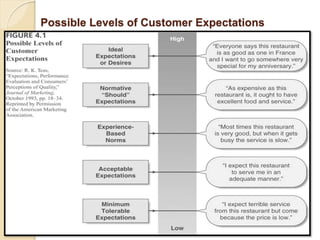
Expected Service: Levels of Expectations
Possible Levels of Customer Expectation
Ideal Expectations or Desires
Normative “Should” Expectations
Experience Based Expectation
Acceptable Expectations
Minimum Tolerable Expectations
Desired Service
Quality
Adequate Service
Quality
Possible Levels of Customer Expectations
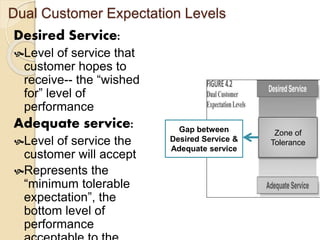
Dual Customer Expectation Levels
Desired Service:
Level of service that
customer hopes to
receive-- the “wished
for” level of
performance
Adequate service:
Level of service the
customer will accept
Represents the
“minimum tolerable
expectation”, the
bottom level of
performance
Zone of
Tolerance
Gap between
Desired Service &
Adequate service
TheZoneofTolerance
The extent to which customer recognize and
are willing to accept this variation
Range or window in which customers do not
notice service performance
When service falls outside this range(either
very high or very low), the service gets the
customer’s attention in either a positive or
negative way
Different customers possess
different Zone of tolerance
Some customers have narrow zones
of tolerance
They require tighter range of service
from providers
Others allow a greater range of
service
An individual customer’s zone of
tolerance vary for a number of
factors e.g. price, personal needs,
Zones of Tolerance for
Different Service Dimensions
***the more important the factor, the narrower the zone
of tolerance is likely to be
Source: Berry, Parasuraman, and Zeithaml (1993)
Most Important Factors
Adequate Service
Desired Service
Zone of
Tolerance
Zone
of
Tolerance
Desired Service
Adequate Service
Least Important factors
Level
of
Expectation
2. Factors That Influence
Customer Expectations of
Service
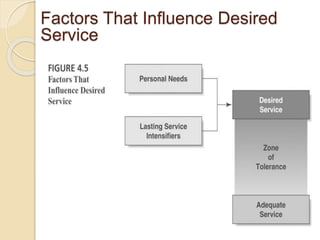
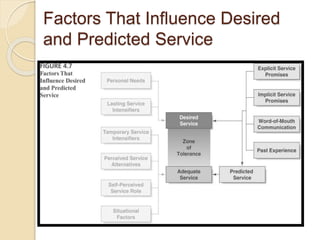
Factors That Influence Desired
Service
Lasting Service intensifiers: individual
stable factors that lead the customer to a
heightened sensitivity
2 Factors:
* Derived service expectations-- customer
expectations are driven by another person or
group of people
* Personal service philosophy– the customer’s
underlying generic attitude about the meaning of
service and proper conduct of service providers
Personal Needs:
states or conditions essential to the
physical or psychological well being -
-- physical, social, psychological, and
functional
Sources of Desired Service
Expectations
Factors That Influence Adequate
Service
Sources of Adequate Service
Expectations
 These influences are short term and tend to fluctuate more
than the factors that influence desired service.
 In this section we explain the five factors that influence
adequate service:
◦ (1) temporary service intensifiers
(short-term, individual factors that make a consumer more aware of
the need of service)
◦ (2) perceived service alternatives
(other providers from whom the customer can obtain service)
◦ (3) customer self-perceived service role
(customer perception on the degree to which customers exert an
influence on the level service they receive)
◦ (4) situational factors
(service performance conditions that customers view as beyond the
control of the service provider)
Example: Reason for purchase, Consumer mood, Weather, Time constraints ,Emergency
(5) predicted service.
Factors That Influence Desired
and Predicted Service
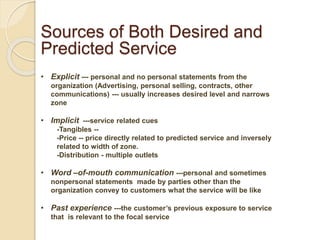
Sources of Both Desired and
Predicted Service
• Explicit --- personal and no personal statements from the
organization (Advertising, personal selling, contracts, other
communications) --- usually increases desired level and narrows
zone
• Implicit ---service related cues
-Tangibles --
-Price -- price directly related to predicted service and inversely
related to width of zone.
-Distribution - multiple outlets
• Word –of-mouth communication ---personal and sometimes
nonpersonal statements made by parties other than the
organization convey to customers what the service will be like
• Past experience ---the customer’s previous exposure to service
that is relevant to the focal service
3. Current Issues Involving
Customer Service
Expectations
WHAT DOES A SERVICE MARKETER DO IF
CUSTOMER EXPECTATIONS ARE
“UNREALISTIC”?
 Under promise
 Reality check after purchase
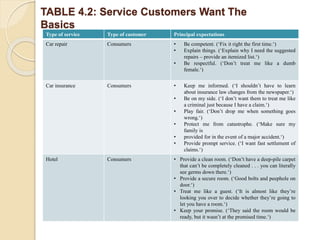
TABLE 4.2: Service Customers Want The
Basics
Type of service Type of customer Principal expectations
Car repair Consumers • Be competent. (‘Fix it right the first time.‘)
• Explain things. (‘Explain why I need the suggested
repairs – provide an itemized list.‘)
• Be respectful. (‘Don’t treat me like a dumb
female.‘)
Car insurance Consumers • Keep me informed. (‘I shouldn’t have to learn
about insurance law changes from the newspaper.‘)
• Be on my side. (‘I don’t want them to treat me like
a criminal just because I have a claim.‘)
• Play fair. (‘Don’t drop me when something goes
wrong.‘)
• Protect me from catastrophe. (‘Make sure my
family is
• provided for in the event of a major accident.‘)
• Provide prompt service. (‘I want fast settlement of
claims.‘)
Hotel Consumers • Provide a clean room. (‘Don’t have a deep-pile carpet
that can’t be completely cleaned . . . you can literally
see germs down there.‘)
• Provide a secure room. (‘Good bolts and peephole on
door.‘)
• Treat me like a guest. (‘It is almost like they’re
looking you over to decide whether they’re going to
let you have a room.‘)
• Keep your promise. (‘They said the room would be
ready, but it wasn’t at the promised time.‘)
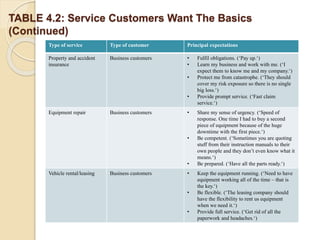
Type of service Type of customer Principal expectations
Property and accident
insurance
Business customers • Fulfil obligations. (‘Pay up.‘)
• Learn my business and work with me. (‘I
expect them to know me and my company.‘)
• Protect me from catastrophe. (‘They should
cover my risk exposure so there is no single
big loss.‘)
• Provide prompt service. (‘Fast claim
service.‘)
Equipment repair Business customers • Share my sense of urgency. (‘Speed of
response. One time I had to buy a second
piece of equipment because of the huge
downtime with the first piece.‘)
• Be competent. (‘Sometimes you are quoting
stuff from their instruction manuals to their
own people and they don’t even know what it
means.‘)
• Be prepared. (‘Have all the parts ready.‘)
Vehicle rental/leasing Business customers • Keep the equipment running. (‘Need to have
equipment working all of the time – that is
the key.‘)
• Be flexible. (‘The leasing company should
have the flexibility to rent us equipment
when we need it.‘)
• Provide full service. (‘Get rid of all the
paperwork and headaches.‘)
TABLE 4.2: Service Customers Want The Basics
(Continued)
SHOULD A COMPANY TRY TO DELIGHT THE
CUSTOMER?
 Musts
 Satisfiers
 Delights
 Have Both costs
& benefits
HOW DOES A COMPANY EXCEED
CUSTOMERS SERVICE
EXPECTATIONS?
 There are 3 approaches for exceeding customer
service expectation:-
1. Customer Relationship- Maintaining customer
relationship is one of the approach for exceeding
service expectations.
2. Underpromise the Service:- The strategy is
underpromise and overdeliver. If the promise is less
than what will eventually happen, customers can be
delighted frequently.
3. Unusual service as Unique:- A final way to exceed
the expectations without raising them in the future is
to position unusual service as unique rather than
standard.
DO CUSTOMER SERVICE EXPECTATIONS
CONTINUALLY ESCALATE?
 Desired service expectations are relatively stable
 Adequate service expectations rise as quickly as service delivery or
promise rise
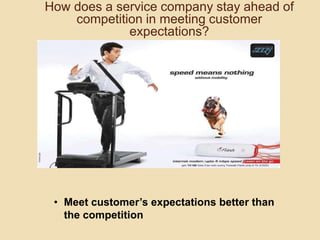
How does a service company stay ahead of
competition in meeting customer
expectations?
• Meet customer’s expectations better than
the competition
Customerexpectation 161201061152

Customerexpectation 161201061152

  • 2.
    1 • Meaning andTypes of Expected Service 2 • Factors That Influence Customer Expectations of Service 3 • Current Issues Involving Customer Service Expectations
  • 3.
    1. Meaning andTypes of Expected Service
  • 4.
    Customer Expectations ofService Customer Expectations  Beliefs about service delivery  Serve as standards or reference points against which performance is judged.  Customers compare their perceptions of performance with these reference points when evaluating service quality.
  • 5.
    Expected Service: Levelsof Expectations Possible Levels of Customer Expectation Ideal Expectations or Desires Normative “Should” Expectations Experience Based Expectation Acceptable Expectations Minimum Tolerable Expectations Desired Service Quality Adequate Service Quality
  • 6.
    Possible Levels ofCustomer Expectations
  • 7.
    Dual Customer ExpectationLevels Desired Service: Level of service that customer hopes to receive-- the “wished for” level of performance Adequate service: Level of service the customer will accept Represents the “minimum tolerable expectation”, the bottom level of performance Zone of Tolerance Gap between Desired Service & Adequate service
  • 8.
    TheZoneofTolerance The extent towhich customer recognize and are willing to accept this variation Range or window in which customers do not notice service performance When service falls outside this range(either very high or very low), the service gets the customer’s attention in either a positive or negative way
  • 9.
    Different customers possess differentZone of tolerance Some customers have narrow zones of tolerance They require tighter range of service from providers Others allow a greater range of service An individual customer’s zone of tolerance vary for a number of factors e.g. price, personal needs,
  • 10.
    Zones of Tolerancefor Different Service Dimensions ***the more important the factor, the narrower the zone of tolerance is likely to be Source: Berry, Parasuraman, and Zeithaml (1993) Most Important Factors Adequate Service Desired Service Zone of Tolerance Zone of Tolerance Desired Service Adequate Service Least Important factors Level of Expectation
  • 11.
    2. Factors ThatInfluence Customer Expectations of Service
  • 12.
    Factors That InfluenceDesired Service
  • 13.
    Lasting Service intensifiers:individual stable factors that lead the customer to a heightened sensitivity 2 Factors: * Derived service expectations-- customer expectations are driven by another person or group of people * Personal service philosophy– the customer’s underlying generic attitude about the meaning of service and proper conduct of service providers Personal Needs: states or conditions essential to the physical or psychological well being - -- physical, social, psychological, and functional Sources of Desired Service Expectations
  • 14.
    Factors That InfluenceAdequate Service
  • 15.
    Sources of AdequateService Expectations  These influences are short term and tend to fluctuate more than the factors that influence desired service.  In this section we explain the five factors that influence adequate service: ◦ (1) temporary service intensifiers (short-term, individual factors that make a consumer more aware of the need of service) ◦ (2) perceived service alternatives (other providers from whom the customer can obtain service) ◦ (3) customer self-perceived service role (customer perception on the degree to which customers exert an influence on the level service they receive) ◦ (4) situational factors (service performance conditions that customers view as beyond the control of the service provider) Example: Reason for purchase, Consumer mood, Weather, Time constraints ,Emergency (5) predicted service.
  • 16.
    Factors That InfluenceDesired and Predicted Service
  • 17.
    Sources of BothDesired and Predicted Service • Explicit --- personal and no personal statements from the organization (Advertising, personal selling, contracts, other communications) --- usually increases desired level and narrows zone • Implicit ---service related cues -Tangibles -- -Price -- price directly related to predicted service and inversely related to width of zone. -Distribution - multiple outlets • Word –of-mouth communication ---personal and sometimes nonpersonal statements made by parties other than the organization convey to customers what the service will be like • Past experience ---the customer’s previous exposure to service that is relevant to the focal service
  • 18.
    3. Current IssuesInvolving Customer Service Expectations
  • 19.
    WHAT DOES ASERVICE MARKETER DO IF CUSTOMER EXPECTATIONS ARE “UNREALISTIC”?  Under promise  Reality check after purchase
  • 20.
    TABLE 4.2: ServiceCustomers Want The Basics Type of service Type of customer Principal expectations Car repair Consumers • Be competent. (‘Fix it right the first time.‘) • Explain things. (‘Explain why I need the suggested repairs – provide an itemized list.‘) • Be respectful. (‘Don’t treat me like a dumb female.‘) Car insurance Consumers • Keep me informed. (‘I shouldn’t have to learn about insurance law changes from the newspaper.‘) • Be on my side. (‘I don’t want them to treat me like a criminal just because I have a claim.‘) • Play fair. (‘Don’t drop me when something goes wrong.‘) • Protect me from catastrophe. (‘Make sure my family is • provided for in the event of a major accident.‘) • Provide prompt service. (‘I want fast settlement of claims.‘) Hotel Consumers • Provide a clean room. (‘Don’t have a deep-pile carpet that can’t be completely cleaned . . . you can literally see germs down there.‘) • Provide a secure room. (‘Good bolts and peephole on door.‘) • Treat me like a guest. (‘It is almost like they’re looking you over to decide whether they’re going to let you have a room.‘) • Keep your promise. (‘They said the room would be ready, but it wasn’t at the promised time.‘)
  • 21.
    Type of serviceType of customer Principal expectations Property and accident insurance Business customers • Fulfil obligations. (‘Pay up.‘) • Learn my business and work with me. (‘I expect them to know me and my company.‘) • Protect me from catastrophe. (‘They should cover my risk exposure so there is no single big loss.‘) • Provide prompt service. (‘Fast claim service.‘) Equipment repair Business customers • Share my sense of urgency. (‘Speed of response. One time I had to buy a second piece of equipment because of the huge downtime with the first piece.‘) • Be competent. (‘Sometimes you are quoting stuff from their instruction manuals to their own people and they don’t even know what it means.‘) • Be prepared. (‘Have all the parts ready.‘) Vehicle rental/leasing Business customers • Keep the equipment running. (‘Need to have equipment working all of the time – that is the key.‘) • Be flexible. (‘The leasing company should have the flexibility to rent us equipment when we need it.‘) • Provide full service. (‘Get rid of all the paperwork and headaches.‘) TABLE 4.2: Service Customers Want The Basics (Continued)
  • 22.
    SHOULD A COMPANYTRY TO DELIGHT THE CUSTOMER?  Musts  Satisfiers  Delights  Have Both costs & benefits
  • 23.
    HOW DOES ACOMPANY EXCEED CUSTOMERS SERVICE EXPECTATIONS?  There are 3 approaches for exceeding customer service expectation:- 1. Customer Relationship- Maintaining customer relationship is one of the approach for exceeding service expectations. 2. Underpromise the Service:- The strategy is underpromise and overdeliver. If the promise is less than what will eventually happen, customers can be delighted frequently. 3. Unusual service as Unique:- A final way to exceed the expectations without raising them in the future is to position unusual service as unique rather than standard.
  • 24.
    DO CUSTOMER SERVICEEXPECTATIONS CONTINUALLY ESCALATE?  Desired service expectations are relatively stable  Adequate service expectations rise as quickly as service delivery or promise rise
  • 25.
    How does aservice company stay ahead of competition in meeting customer expectations? • Meet customer’s expectations better than the competition