























STAGE CURTAIN TYPES
The Front Setting
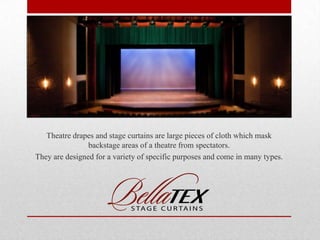
Theatre drapes and stage curtains are large pieces of cloth which mask
backstage areas of a theatre from spectators.
They are designed for a variety of specific purposes and come in many types.
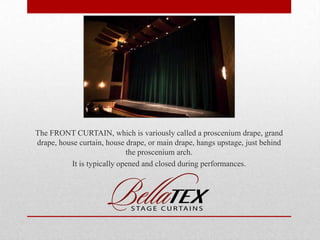
The FRONT CURTAIN, which is variously called a proscenium drape, grand
drape, house curtain, house drape, or main drape, hangs upstage, just behind
the proscenium arch.
It is typically opened and closed during performances.
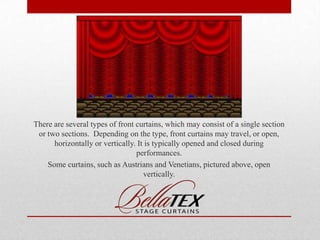
There are several types of front curtains, which may consist of a single section
or two sections. Depending on the type, front curtains may travel, or open,
horizontally or vertically. It is typically opened and closed during
performances.
Some curtains, such as Austrians and Venetians, pictured above, open
vertically.
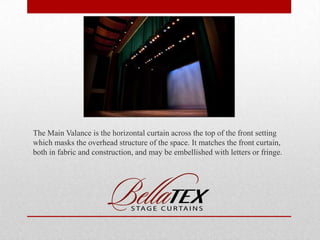
The Main Valance is the horizontal curtain across the top of the front setting
which masks the overhead structure of the space. It matches the front curtain,
both in fabric and construction, and may be embellished with letters or fringe.
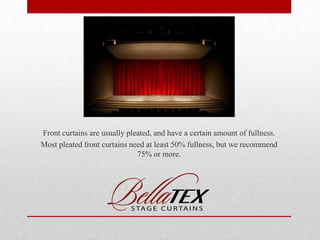
Front curtains are usually pleated, and have a certain amount of fullness.
Most pleated front curtains need at least 50% fullness, but we recommend
75% or more.
There are many fabrics to choose from for front curtains.
We recommend Inherently Flame Retardant (IFR) fabrics.
Contact us for more information about fabrics. Or, view our
BellaTEX Fabric Selection video.
Easy! The rest of the curtains are usually black, and mask the backstage areas.
These curtains make up the Rear Setting.
The Rear Setting
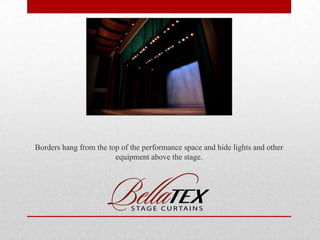
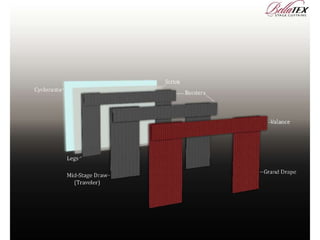
Borders hang from the top of the performance space and hide lights and other
equipment above the stage.
Legs are tall, narrow curtains which hide off-stage areas and provide space
for entrances and side lights.
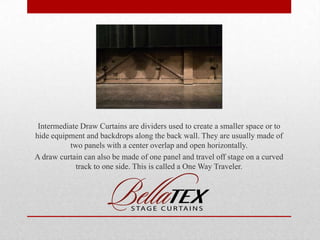
Intermediate Draw Curtains are dividers used to create a smaller space or to
hide equipment and backdrops along the back wall. They are usually made of
two panels with a center overlap and open horizontally.
A draw curtain can also be made of one panel and travel off stage on a curved
track to one side. This is called a One Way Traveler.
Rear setting curtains can be flat or pleated.
Scrims and Cycs
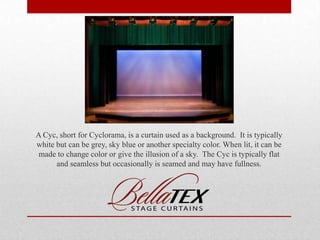
A Cyc, short for Cyclorama, is a curtain used as a background. It is typically
white but can be grey, sky blue or another specialty color. When lit, it can be
made to change color or give the illusion of a sky. The Cyc is typically flat
and seamless but occasionally is seamed and may have fullness.
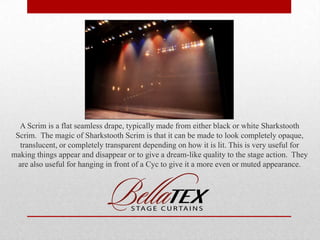
A Scrim is a flat seamless drape, typically made from either black or white Sharkstooth
Scrim. The magic of Sharkstooth Scrim is that it can be made to look completely opaque,
translucent, or completely transparent depending on how it is lit. This is very useful for
making things appear and disappear or to give a dream-like quality to the stage action. They
are also useful for hanging in front of a Cyc to give it a more even or muted appearance.
No problem! Curtains aren’t just for theatres.
Let’s learn about some common curtain types used for other applications.
U-Surround Curtains
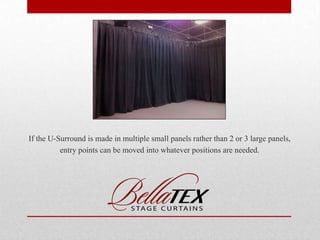
A U-Surround is typically found on very small stages. It is an economical way
to provide some masking of the offstage areas and give a more pleasant
background than the bare walls.
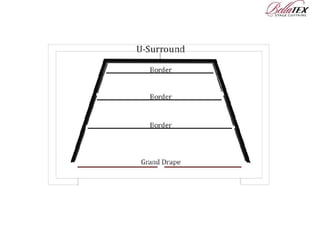
A U-Surround typically runs at an angle from the offstage sides of the Grand
Drape to the upstage corners of the acting area, and straight across the back.
A light-duty curved track works best.
If the U-Surround is made in multiple small panels rather than 2 or 3 large panels,
entry points can be moved into whatever positions are needed.
Pipe-and-Drape
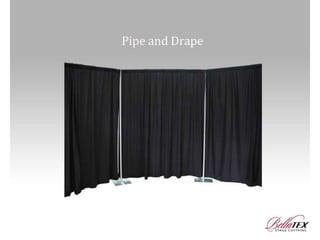
Pipe and drape displays consist of steel bases, aluminum pipes and
curtains. Pipe and drape displays are temporary, set up is very simple, and
the structure is portable.
Pipe and drape displays are used in churches, schools, wedding halls,
convention centers, photography studios, hospitals, shopping malls,
backstage dressing areas in theatres - anywhere a temporary partition or
curtain is needed.
Pipe and drape can be used in a utilitarian way, as for a tradeshow, or can
be creatively erected, as for a dramatic wedding reception.
House Divider Curtains
House Divider curtains are also known as Gym Divider or
Room Divider curtains.
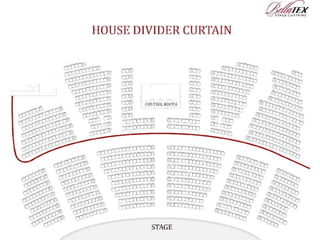
A House Divider curtain can be an economical way to split large spaces up
for classes, meetings, or events. Divider curtains are often used in large
churches to mask off unused areas of the sanctuary during smaller
services.
House Divider curtains can be lined or double-faced so both sides have a
finished look. Various vinyl and cloth fabrics are available depending on
the specific requirements.
Contact us at 1-800-372-3373 to locate a BellaTEX dealer near you.
If you’re a dealer, please inquire about how you can be a part of our
fantastic BellaTEX Dealer Network.
Contact us at www.bellatex.com!
Curtain types
Curtain types
Curtain types
Curtain types
Curtain types

Curtain types

  • 6.
  • 10.
  • 11.
    Theatre drapes andstage curtains are large pieces of cloth which mask backstage areas of a theatre from spectators. They are designed for a variety of specific purposes and come in many types.
  • 12.
    The FRONT CURTAIN,which is variously called a proscenium drape, grand drape, house curtain, house drape, or main drape, hangs upstage, just behind the proscenium arch. It is typically opened and closed during performances.
  • 13.
    There are severaltypes of front curtains, which may consist of a single section or two sections. Depending on the type, front curtains may travel, or open, horizontally or vertically. It is typically opened and closed during performances. Some curtains, such as Austrians and Venetians, pictured above, open vertically.
  • 14.
    The Main Valanceis the horizontal curtain across the top of the front setting which masks the overhead structure of the space. It matches the front curtain, both in fabric and construction, and may be embellished with letters or fringe.
  • 15.
    Front curtains areusually pleated, and have a certain amount of fullness. Most pleated front curtains need at least 50% fullness, but we recommend 75% or more.
  • 16.
    There are manyfabrics to choose from for front curtains. We recommend Inherently Flame Retardant (IFR) fabrics. Contact us for more information about fabrics. Or, view our BellaTEX Fabric Selection video.
  • 18.
    Easy! The restof the curtains are usually black, and mask the backstage areas. These curtains make up the Rear Setting.
  • 19.
  • 20.
    Borders hang fromthe top of the performance space and hide lights and other equipment above the stage.
  • 21.
    Legs are tall,narrow curtains which hide off-stage areas and provide space for entrances and side lights.
  • 22.
    Intermediate Draw Curtainsare dividers used to create a smaller space or to hide equipment and backdrops along the back wall. They are usually made of two panels with a center overlap and open horizontally. A draw curtain can also be made of one panel and travel off stage on a curved track to one side. This is called a One Way Traveler.
  • 23.
    Rear setting curtainscan be flat or pleated.
  • 24.
  • 25.
    A Cyc, shortfor Cyclorama, is a curtain used as a background. It is typically white but can be grey, sky blue or another specialty color. When lit, it can be made to change color or give the illusion of a sky. The Cyc is typically flat and seamless but occasionally is seamed and may have fullness.
  • 26.
    A Scrim isa flat seamless drape, typically made from either black or white Sharkstooth Scrim. The magic of Sharkstooth Scrim is that it can be made to look completely opaque, translucent, or completely transparent depending on how it is lit. This is very useful for making things appear and disappear or to give a dream-like quality to the stage action. They are also useful for hanging in front of a Cyc to give it a more even or muted appearance.
  • 29.
    No problem! Curtainsaren’t just for theatres. Let’s learn about some common curtain types used for other applications.
  • 30.
  • 31.
    A U-Surround istypically found on very small stages. It is an economical way to provide some masking of the offstage areas and give a more pleasant background than the bare walls.
  • 32.
    A U-Surround typicallyruns at an angle from the offstage sides of the Grand Drape to the upstage corners of the acting area, and straight across the back. A light-duty curved track works best.
  • 33.
    If the U-Surroundis made in multiple small panels rather than 2 or 3 large panels, entry points can be moved into whatever positions are needed.
  • 35.
  • 37.
    Pipe and drapedisplays consist of steel bases, aluminum pipes and curtains. Pipe and drape displays are temporary, set up is very simple, and the structure is portable.
  • 38.
    Pipe and drapedisplays are used in churches, schools, wedding halls, convention centers, photography studios, hospitals, shopping malls, backstage dressing areas in theatres - anywhere a temporary partition or curtain is needed.
  • 39.
    Pipe and drapecan be used in a utilitarian way, as for a tradeshow, or can be creatively erected, as for a dramatic wedding reception.
  • 40.
  • 41.
    House Divider curtainsare also known as Gym Divider or Room Divider curtains.
  • 42.
    A House Dividercurtain can be an economical way to split large spaces up for classes, meetings, or events. Divider curtains are often used in large churches to mask off unused areas of the sanctuary during smaller services.
  • 44.
    House Divider curtainscan be lined or double-faced so both sides have a finished look. Various vinyl and cloth fabrics are available depending on the specific requirements.
  • 46.
    Contact us at1-800-372-3373 to locate a BellaTEX dealer near you. If you’re a dealer, please inquire about how you can be a part of our fantastic BellaTEX Dealer Network. Contact us at www.bellatex.com!