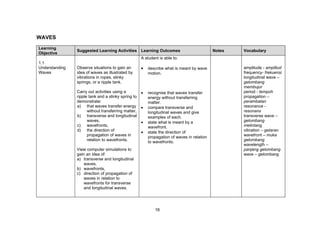
1. Waves can transfer energy without transferring matter. The document discusses different types of waves including transverse, longitudinal, plane, and sound waves. It also covers key wave concepts such as amplitude, wavelength, frequency, speed, and direction of propagation.
2. The document discusses various wave phenomena including reflection, refraction, diffraction, and interference. Activities are suggested to observe and analyze these phenomena using tools like ripple tanks and computer simulations. Formulas related to speed, wavelength and frequency are also introduced.
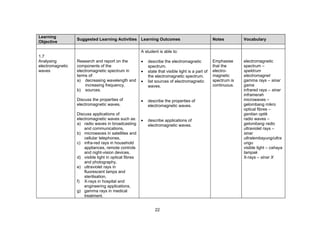
3. The document covers additional topics related to waves and oscillations including standing waves, resonance, and applications to sound waves and the electromagnetic spectrum. Learning outcomes focus on describing, analyzing and solving problems involving different types