Curriculum Redesign for
Fulfillment Center New Hires
Background
• 25 Fulfillment Centers
• 12 Learning Specialists
• 5 different order-filling systems
• 3 different curriculums
• Limited classroom space
Change
All warehouses converted to one technology
Challenges
Higher than normal turnover
Error ratios increasing
Productivity decreasing
Needs Analysis
1. Deconstructed & coded skill sets.
2. Identified relationships and dependencies.
3. Surveyed trainers to prioritize skill sets.
4. Tabulated results and ranked skill sets.
Solution
• Provide flexibility so each building can adapt to their unique needs.
• Structure curriculum into pre-requisite knowledge and functional skills.
• Use real-world scenarios to engage learners.
• Incorporate learning transfer mechanisms such as peer support and
skill-based demonstrations.
Development
1. Build prototypes & deliver to focus groups.
2. Gather structured feedback & revise content.
3. Pilot delivery and monitor results.
4. Further revise content based on performance results.
5. Launch to remaining buildings.
RESULTS:
Project team reported a 75% reduction in training related issues.
Network-wide decrease in errors and increase in productivity.

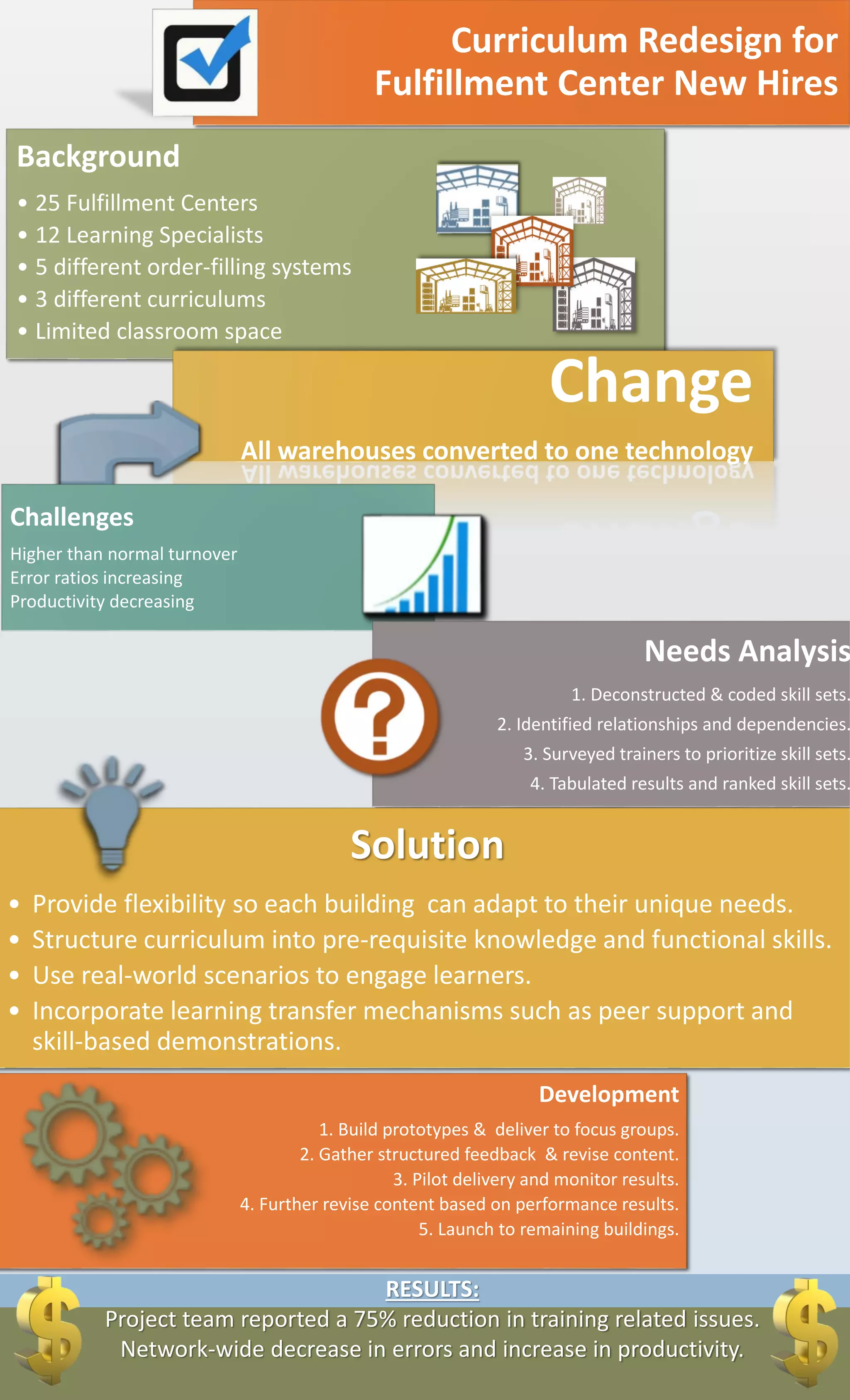
Curriculum Redesign_Case Study Infographic

  • 1.
    Curriculum Redesign for FulfillmentCenter New Hires Background • 25 Fulfillment Centers • 12 Learning Specialists • 5 different order-filling systems • 3 different curriculums • Limited classroom space Change All warehouses converted to one technology Challenges Higher than normal turnover Error ratios increasing Productivity decreasing Needs Analysis 1. Deconstructed & coded skill sets. 2. Identified relationships and dependencies. 3. Surveyed trainers to prioritize skill sets. 4. Tabulated results and ranked skill sets. Solution • Provide flexibility so each building can adapt to their unique needs. • Structure curriculum into pre-requisite knowledge and functional skills. • Use real-world scenarios to engage learners. • Incorporate learning transfer mechanisms such as peer support and skill-based demonstrations. Development 1. Build prototypes & deliver to focus groups. 2. Gather structured feedback & revise content. 3. Pilot delivery and monitor results. 4. Further revise content based on performance results. 5. Launch to remaining buildings. RESULTS: Project team reported a 75% reduction in training related issues. Network-wide decrease in errors and increase in productivity.