SPECIAL EDUCATION
Management 8/e - Chapter 10 2
Topic Outline
What is Special Education
 Definition
 Special Education as Intervention
 Classifications
Comparison of Regular and Special Education
History of Special Education
Management 8/e - Chapter 10 3
Management 8/e - Chapter 10 4
Special Education
It is an individually planned,
systematically implemented and
carefully evaluated instruction to help
exceptional children achieve greatest
possible personal self-sufficiency and
success in the present and future
environments.
Management 8/e - Chapter 10 5
It can be differentiated from regular
education by its curriculum-some
children needed intensive, systematic
instruction to learn skills that
normally developing children acquire
naturally. It provides learning
opportunities that are not provided in
standard or regular school curricula
or by regular school services.Management 8/e - Chapter 10 6
Management 8/e - Chapter 10 7
The child’s individual needs dictate
the curriculum. The individualized
programming that is the core of
special education must be provided in
settings that best meet each
student’s special needs.
Management 8/e - Chapter 10 8
Some exceptional children are taught
certain skills to compensate or reduce
the handicapping effects of a disability.
The special education supports the
proposition that children with
disabilities need to be integrated or
included in normal or regular educational
services programs to the extent that it
is reasonable.
TEACHING is what Special Education is
all about.
Management 8/e - Chapter 10 9
WHO:
Exceptional children whose special
needs or abilities necessitate an
individualized program of education.
Teachers who have specialized training
programs in preparation for their work
with students with special needs- SPED
Teachers and regular teachers
Other professionals who are members
of the multidisciplinary team
Management 8/e - Chapter 10 10
Management 8/e - Chapter 10 11
Management 8/e - Chapter 10 12
School administrators
Parents and other family members
and caregivers
Community
Legislators
Society
WHERE:
Schools - special and regular
schools; therapy or early
intervention centers; home;
vocational centers; community
Management 8/e - Chapter 10 13
Management 8/e - Chapter 10 14
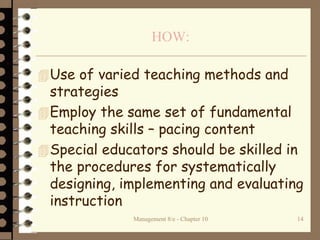
HOW:
Use of varied teaching methods and
strategies
Employ the same set of fundamental
teaching skills – pacing content
Special educators should be skilled in
the procedures for systematically
designing, implementing and evaluating
instruction
Management 8/e - Chapter 10 15
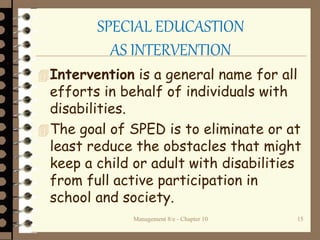
SPECIAL EDUCASTION
AS INTERVENTION
Intervention is a general name for all
efforts in behalf of individuals with
disabilities.
The goal of SPED is to eliminate or at
least reduce the obstacles that might
keep a child or adult with disabilities
from full active participation in
school and society.
Management 8/e - Chapter 10 16
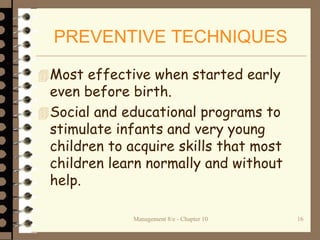
PREVENTIVE TECHNIQUES
Most effective when started early
even before birth.
Social and educational programs to
stimulate infants and very young
children to acquire skills that most
children learn normally and without
help.
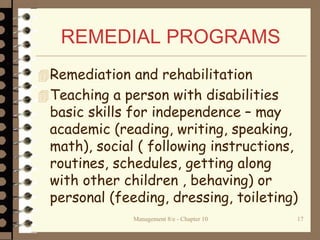
REMEDIAL PROGRAMS
Remediation and rehabilitation
Teaching a person with disabilities
basic skills for independence – may
academic (reading, writing, speaking,
math), social ( following instructions,
routines, schedules, getting along
with other children , behaving) or
personal (feeding, dressing, toileting)
Management 8/e - Chapter 10 17
Management 8/e - Chapter 10 18
Vocational rehabilitation –
preparation for work, habits,
attitudes, programs that help people
succeed in normal meetings.
Management 8/e - Chapter 10 19
COMPENSATORY EFFORTS
Giving a kind of substitute skill or
device to rely on to compensate for a
person’s disability. (use
wheelchair, Braille, sign language)
Aims to give individual some kind of
asset to be able to use tools and
techniques for meeting learning
needs.
Management 8/e - Chapter 10 20
WHO NEEDS SPED?
Exceptional People – refer to
individuals who differ from societal
or community standards of
normalcy; some exceptionalities are
obvious while others are not;
exceptionalities may be beneficial
(ex. gifted or talented) or may be a
significant problem (ex. Mental
retardation)
Management 8/e - Chapter 10 21
Differ from the norm either below or
above to such an extent that an
individualized program of special
education is required to meet their
needs.
It is an inclusive term that refers to
individuals with learning or behavior
problems, individuals with physical
and sensory disabilities and those who
are intellectually gifted.
Management 8/e - Chapter 10 22
Kirk (1972) defines the exceptional
child (included gifted and talented
children as well as children with
disabilities) as the child who deviates
from the average or normal child to
such an extent that he or she
requires a modification of school
practices, or special education
services, in order to develop his
maximum capacity.
Management 8/e - Chapter 10 23
In mental characteristics
In sensory abilities
In neuromuscular or physical
characteristics
In social and emotional behavior
In communication abilities
Or in multiple handicaps
CLASSIFICATION
OF EXCEPTIONALITIES
 Autism
 Deafness
 Deaf-Blindness
 Hearing Impairment
 Mental retardation
 Multiple disabilities
 Orthopedic impairment
Management 8/e - Chapter 10 24
Management 8/e - Chapter 10 25
Other health impairment
Serious emotional disturbance
 Specific learning disability
Speech or language impairment
Traumatic brain injury
Visual impairment
Gifted and Talented
Management 8/e - Chapter 10 26
DIFFERENT
TERMINOLOGIES
IN SPED
1. Disability - refers to the inability of an
individual to do something in a certain
way, incapacity to perform as other
individuals due to impairments in
sensory, physical, cognitive and other
areas of functioning.
Refers to the loss or reduced function of
a particular body part or organ
Synonymous to impairmentManagement 8/e - Chapter 10 27
Management 8/e - Chapter 10 28
It limits the ability to perform certain
tasks
A disabled person is not handicapped
unless the physical disability leads to
educational, personal, social, vocational,
and other problems.
Management 8/e - Chapter 10 29
2.Handicap – refers to the problems
that an individual with a disability
encounters as he or she attempts to
function or interact in his or her
environment; this term is used when
explaining the consequences or impact
imposed on the individual by his or her
disability.
Management 8/e - Chapter 10 30
Refers tom problems a person with
disability or impairment encounters in
interacting with the environment.
The term is more restrictive than
exceptional; does not include gifted and
talented.
3. Developmental Delay
Because of adverse effects of labeling,
young children with special needs are
sometimes identified as being
developmentally delayed or at – risk for
future problems in school.
Management 8/e - Chapter 10 31
Management 8/e - Chapter 10 32
Children do not have to be identified
with any disability label. However, they
are considered to have a high
probability of developing a disability;
Defining a child’s delay may vary and
may be derived from various
assessment instruments.
Management 8/e - Chapter 10 33
Developmental disability – a severe,
chronic disability of an individual five
years of age or older that:
Is attributed to a mental or physical
impairment or combination of mental
and physical impairments
Manifested before the person attains the
age of 22
Is likely to continue indefinitely
Management 8/e - Chapter 10 34
Results in substantial functional limitation
in three or more of the following learning
areas or major life activity – self-care;
receptive and expressive language;
learning; mobility; self-direction; capacity
for independent living; and economic
sufficiency.
Reflects the individual’s need for a
combination and sequence of special
interdisciplinary services, supports and
other assistance that is lifelong or
extended duration and is individually
planned and coordinated. (NICHCY, 1996)
Management 8/e - Chapter 10 35
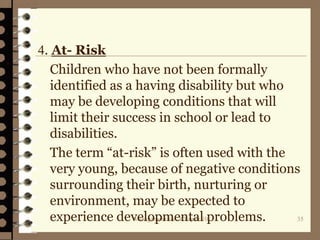
4. At- Risk
Children who have not been formally
identified as a having disability but who
may be developing conditions that will
limit their success in school or lead to
disabilities.
The term “at-risk” is often used with the
very young, because of negative conditions
surrounding their birth, nurturing or
environment, may be expected to
experience developmental problems.
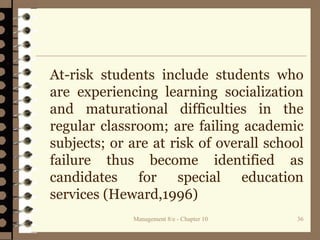
At-risk students include students who
are experiencing learning socialization
and maturational difficulties in the
regular classroom; are failing academic
subjects; or are at risk of overall school
failure thus become identified as
candidates for special education
services (Heward,1996)
Management 8/e - Chapter 10 36
Management 8/e - Chapter 10 37
Can be the result of exposure to adverse
genetic, biological or environmental
factors- result to increased probability
for cognitive, social, affective and
physical problems.
a. Established risk – medical disorder of
known etiology and predictable
prognosis or outcome; ex. Cerebral
palsy, Down syndrome
Management 8/e - Chapter 10 38
b. Biological risk- post –natal conditions
and developmental events that heighten
the potential for later unusual or
abnormal development; ex. Premature
birth, low birth weight, maternal
diabetes, rubella, bacterial infections
like meningitis and HIV
Management 8/e - Chapter 10 39
c. Environmental risk- children are
biologically typical but their life
experiences or environmental
conditions are so limiting or threatening
that the likelihood of delayed
development exists; ex. extreme
poverty, child abuse, absence of
adequate shelter and medical care,
parental substance abuse, limited
opportunities for nurturance and social
stimulation.
FACTORS PLACING
YOUNG CHILDREN
AT-RISK FOR DEVELOPMENTAL
PROBLEMS
Management 8/e - Chapter 10 40
Management 8/e - Chapter 10 41
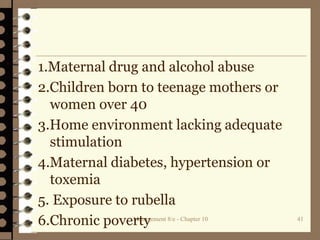
1.Maternal drug and alcohol abuse
2.Children born to teenage mothers or
women over 40
3.Home environment lacking adequate
stimulation
4.Maternal diabetes, hypertension or
toxemia
5. Exposure to rubella
6.Chronic poverty
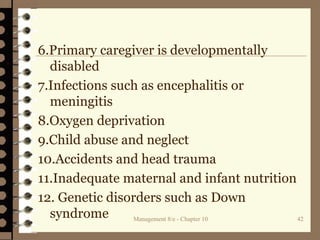
6.Primary caregiver is developmentally
disabled
7.Infections such as encephalitis or
meningitis
8.Oxygen deprivation
9.Child abuse and neglect
10.Accidents and head trauma
11.Inadequate maternal and infant nutrition
12. Genetic disorders such as Down
syndrome Management 8/e - Chapter 10 42
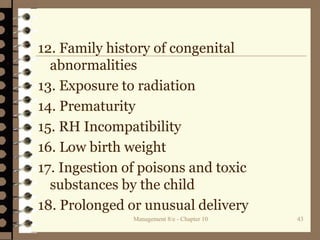
12. Family history of congenital
abnormalities
13. Exposure to radiation
14. Prematurity
15. RH Incompatibility
16. Low birth weight
17. Ingestion of poisons and toxic
substances by the child
18. Prolonged or unusual delivery
Management 8/e - Chapter 10 43
Comparison Of
Regular
And
Special Education
Management 8/e - Chapter 10 44
Management 8/e - Chapter 10 45
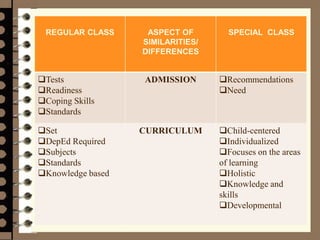
REGULAR CLASS ASPECT OF
SIMILARITIES/
DIFFERENCES
SPECIAL CLASS
Tests
Readiness
Coping Skills
Standards
ADMISSION Recommendations
Need
Set
DepEd Required
Subjects
Standards
Knowledge based
CURRICULUM Child-centered
Individualized
Focuses on the areas
of learning
Holistic
Knowledge and
skills
Developmental
Management 8/e - Chapter 10 46
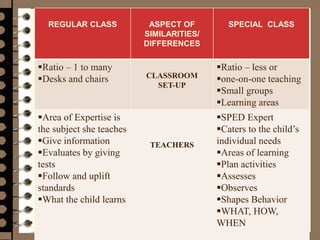
REGULAR CLASS ASPECT OF
SIMILARITIES/
DIFFERENCES
SPECIAL CLASS
Ratio – 1 to many
Desks and chairs CLASSROOM
SET-UP
Ratio – less or
one-on-one teaching
Small groups
Learning areas
Area of Expertise is
the subject she teaches
Give information
Evaluates by giving
tests
Follow and uplift
standards
What the child learns
TEACHERS
SPED Expert
Caters to the child’s
individual needs
Areas of learning
Plan activities
Assesses
Observes
Shapes Behavior
WHAT, HOW,
WHEN
Management 8/e - Chapter 10 47
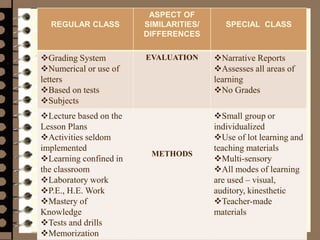
REGULAR CLASS
ASPECT OF
SIMILARITIES/
DIFFERENCES
SPECIAL CLASS
Grading System
Numerical or use of
letters
Based on tests
Subjects
EVALUATION Narrative Reports
Assesses all areas of
learning
No Grades
Lecture based on the
Lesson Plans
Activities seldom
implemented
Learning confined in
the classroom
Laboratory work
P.E., H.E. Work
Mastery of
Knowledge
Tests and drills
Memorization
METHODS
Small group or
individualized
Use of lot learning and
teaching materials
Multi-sensory
All modes of learning
are used – visual,
auditory, kinesthetic
Teacher-made
materials
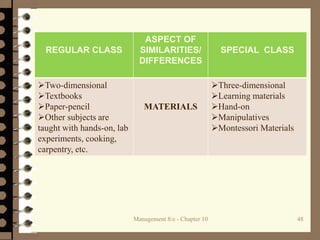
Management 8/e - Chapter 10 48
REGULAR CLASS
ASPECT OF
SIMILARITIES/
DIFFERENCES
SPECIAL CLASS
Two-dimensional
Textbooks
Paper-pencil
Other subjects are
taught with hands-on, lab
experiments, cooking,
carpentry, etc.
MATERIALS
Three-dimensional
Learning materials
Hand-on
Manipulatives
Montessori Materials
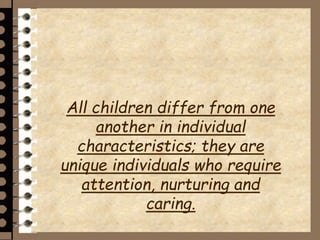
All children differ from one
another in individual
characteristics; they are
unique individuals who require
attention, nurturing and
caring.
History of
Special Education
Management 8/e - Chapter 10 50
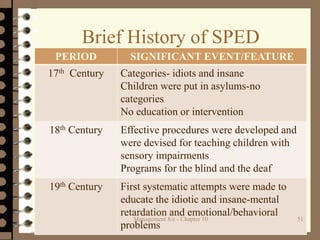
Brief History of SPED
PERIOD SIGNIFICANT EVENT/FEATURE
17th Century Categories- idiots and insane
Children were put in asylums-no
categories
No education or intervention
18th Century Effective procedures were developed and
were devised for teaching children with
sensory impairments
Programs for the blind and the deaf
19th Century First systematic attempts were made to
educate the idiotic and insane-mental
retardation and emotional/behavioral
problems
Management 8/e - Chapter 10 51
Management 8/e - Chapter 10 52
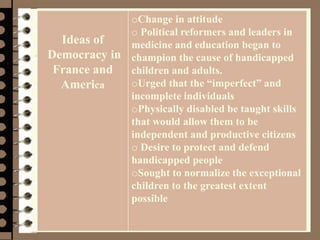
Ideas of
Democracy in
France and
America
oChange in attitude
o Political reformers and leaders in
medicine and education began to
champion the cause of handicapped
children and adults.
oUrged that the “imperfect” and
incomplete individuals
oPhysically disabled be taught skills
that would allow them to be
independent and productive citizens
o Desire to protect and defend
handicapped people
oSought to normalize the exceptional
children to the greatest extent
possible
Management 8/e - Chapter 10 53
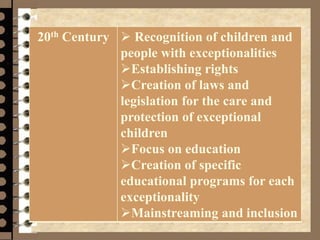
20th Century  Recognition of children and
people with exceptionalities
Establishing rights
Creation of laws and
legislation for the care and
protection of exceptional
children
Focus on education
Creation of specific
educational programs for each
exceptionality
Mainstreaming and inclusion
SIGNIFICANT PEOPLE
IN SPED
Management 8/e - Chapter 10 54
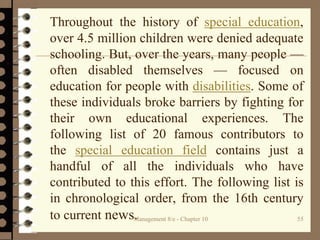
Throughout the history of special education,
over 4.5 million children were denied adequate
schooling. But, over the years, many people —
often disabled themselves — focused on
education for people with disabilities. Some of
these individuals broke barriers by fighting for
their own educational experiences. The
following list of 20 famous contributors to
the special education field contains just a
handful of all the individuals who have
contributed to this effort. The following list is
in chronological order, from the 16th century
to current news.Management 8/e - Chapter 10 55
Management 8/e - Chapter 10 56
SIGNIFICANT
PEOPLE
CONTRIBUTIONS
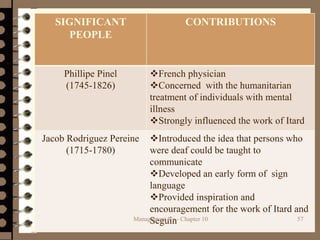
Phillipe Pinel
(1745-1826)
French physician
Concerned with the humanitarian
treatment of individuals with mental
illness
Strongly influenced the work of Itard
Jacob Rodriguez Pereine
(1715-1780)
Introduced the idea that persons who
were deaf could be taught to
communicate
Developed an early form of sign
language
Provided inspiration and
encouragement for the work of Itard and
SeguinManagement 8/e - Chapter 10 57
Management 8/e - Chapter 10 58
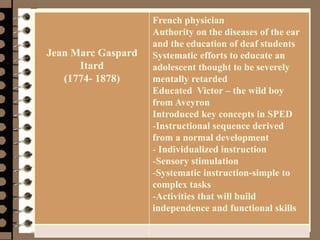
Jean Marc Gaspard
Itard
(1774- 1878)
French physician
Authority on the diseases of the ear
and the education of deaf students
Systematic efforts to educate an
adolescent thought to be severely
mentally retarded
Educated Victor – the wild boy
from Aveyron
Introduced key concepts in SPED
-Instructional sequence derived
from a normal development
- Individualized instruction
-Sensory stimulation
-Systematic instruction-simple to
complex tasks
-Activities that will build
independence and functional skills
Management 8/e - Chapter 10 59

Sped

  • 1.
  • 2.
    Management 8/e -Chapter 10 2 Topic Outline What is Special Education  Definition  Special Education as Intervention  Classifications Comparison of Regular and Special Education History of Special Education
  • 3.
    Management 8/e -Chapter 10 3
  • 4.
    Management 8/e -Chapter 10 4 Special Education It is an individually planned, systematically implemented and carefully evaluated instruction to help exceptional children achieve greatest possible personal self-sufficiency and success in the present and future environments.
  • 5.
    Management 8/e -Chapter 10 5
  • 6.
    It can bedifferentiated from regular education by its curriculum-some children needed intensive, systematic instruction to learn skills that normally developing children acquire naturally. It provides learning opportunities that are not provided in standard or regular school curricula or by regular school services.Management 8/e - Chapter 10 6
  • 7.
    Management 8/e -Chapter 10 7 The child’s individual needs dictate the curriculum. The individualized programming that is the core of special education must be provided in settings that best meet each student’s special needs.
  • 8.
    Management 8/e -Chapter 10 8 Some exceptional children are taught certain skills to compensate or reduce the handicapping effects of a disability. The special education supports the proposition that children with disabilities need to be integrated or included in normal or regular educational services programs to the extent that it is reasonable. TEACHING is what Special Education is all about.
  • 9.
    Management 8/e -Chapter 10 9 WHO: Exceptional children whose special needs or abilities necessitate an individualized program of education. Teachers who have specialized training programs in preparation for their work with students with special needs- SPED Teachers and regular teachers Other professionals who are members of the multidisciplinary team
  • 10.
    Management 8/e -Chapter 10 10
  • 11.
    Management 8/e -Chapter 10 11
  • 12.
    Management 8/e -Chapter 10 12 School administrators Parents and other family members and caregivers Community Legislators Society
  • 13.
    WHERE: Schools - specialand regular schools; therapy or early intervention centers; home; vocational centers; community Management 8/e - Chapter 10 13
  • 14.
    Management 8/e -Chapter 10 14 HOW: Use of varied teaching methods and strategies Employ the same set of fundamental teaching skills – pacing content Special educators should be skilled in the procedures for systematically designing, implementing and evaluating instruction
  • 15.
    Management 8/e -Chapter 10 15 SPECIAL EDUCASTION AS INTERVENTION Intervention is a general name for all efforts in behalf of individuals with disabilities. The goal of SPED is to eliminate or at least reduce the obstacles that might keep a child or adult with disabilities from full active participation in school and society.
  • 16.
    Management 8/e -Chapter 10 16 PREVENTIVE TECHNIQUES Most effective when started early even before birth. Social and educational programs to stimulate infants and very young children to acquire skills that most children learn normally and without help.
  • 17.
    REMEDIAL PROGRAMS Remediation andrehabilitation Teaching a person with disabilities basic skills for independence – may academic (reading, writing, speaking, math), social ( following instructions, routines, schedules, getting along with other children , behaving) or personal (feeding, dressing, toileting) Management 8/e - Chapter 10 17
  • 18.
    Management 8/e -Chapter 10 18 Vocational rehabilitation – preparation for work, habits, attitudes, programs that help people succeed in normal meetings.
  • 19.
    Management 8/e -Chapter 10 19 COMPENSATORY EFFORTS Giving a kind of substitute skill or device to rely on to compensate for a person’s disability. (use wheelchair, Braille, sign language) Aims to give individual some kind of asset to be able to use tools and techniques for meeting learning needs.
  • 20.
    Management 8/e -Chapter 10 20 WHO NEEDS SPED? Exceptional People – refer to individuals who differ from societal or community standards of normalcy; some exceptionalities are obvious while others are not; exceptionalities may be beneficial (ex. gifted or talented) or may be a significant problem (ex. Mental retardation)
  • 21.
    Management 8/e -Chapter 10 21 Differ from the norm either below or above to such an extent that an individualized program of special education is required to meet their needs. It is an inclusive term that refers to individuals with learning or behavior problems, individuals with physical and sensory disabilities and those who are intellectually gifted.
  • 22.
    Management 8/e -Chapter 10 22 Kirk (1972) defines the exceptional child (included gifted and talented children as well as children with disabilities) as the child who deviates from the average or normal child to such an extent that he or she requires a modification of school practices, or special education services, in order to develop his maximum capacity.
  • 23.
    Management 8/e -Chapter 10 23 In mental characteristics In sensory abilities In neuromuscular or physical characteristics In social and emotional behavior In communication abilities Or in multiple handicaps
  • 24.
    CLASSIFICATION OF EXCEPTIONALITIES  Autism Deafness  Deaf-Blindness  Hearing Impairment  Mental retardation  Multiple disabilities  Orthopedic impairment Management 8/e - Chapter 10 24
  • 25.
    Management 8/e -Chapter 10 25 Other health impairment Serious emotional disturbance  Specific learning disability Speech or language impairment Traumatic brain injury Visual impairment Gifted and Talented
  • 26.
    Management 8/e -Chapter 10 26 DIFFERENT TERMINOLOGIES IN SPED
  • 27.
    1. Disability -refers to the inability of an individual to do something in a certain way, incapacity to perform as other individuals due to impairments in sensory, physical, cognitive and other areas of functioning. Refers to the loss or reduced function of a particular body part or organ Synonymous to impairmentManagement 8/e - Chapter 10 27
  • 28.
    Management 8/e -Chapter 10 28 It limits the ability to perform certain tasks A disabled person is not handicapped unless the physical disability leads to educational, personal, social, vocational, and other problems.
  • 29.
    Management 8/e -Chapter 10 29 2.Handicap – refers to the problems that an individual with a disability encounters as he or she attempts to function or interact in his or her environment; this term is used when explaining the consequences or impact imposed on the individual by his or her disability.
  • 30.
    Management 8/e -Chapter 10 30 Refers tom problems a person with disability or impairment encounters in interacting with the environment. The term is more restrictive than exceptional; does not include gifted and talented.
  • 31.
    3. Developmental Delay Becauseof adverse effects of labeling, young children with special needs are sometimes identified as being developmentally delayed or at – risk for future problems in school. Management 8/e - Chapter 10 31
  • 32.
    Management 8/e -Chapter 10 32 Children do not have to be identified with any disability label. However, they are considered to have a high probability of developing a disability; Defining a child’s delay may vary and may be derived from various assessment instruments.
  • 33.
    Management 8/e -Chapter 10 33 Developmental disability – a severe, chronic disability of an individual five years of age or older that: Is attributed to a mental or physical impairment or combination of mental and physical impairments Manifested before the person attains the age of 22 Is likely to continue indefinitely
  • 34.
    Management 8/e -Chapter 10 34 Results in substantial functional limitation in three or more of the following learning areas or major life activity – self-care; receptive and expressive language; learning; mobility; self-direction; capacity for independent living; and economic sufficiency. Reflects the individual’s need for a combination and sequence of special interdisciplinary services, supports and other assistance that is lifelong or extended duration and is individually planned and coordinated. (NICHCY, 1996)
  • 35.
    Management 8/e -Chapter 10 35 4. At- Risk Children who have not been formally identified as a having disability but who may be developing conditions that will limit their success in school or lead to disabilities. The term “at-risk” is often used with the very young, because of negative conditions surrounding their birth, nurturing or environment, may be expected to experience developmental problems.
  • 36.
    At-risk students includestudents who are experiencing learning socialization and maturational difficulties in the regular classroom; are failing academic subjects; or are at risk of overall school failure thus become identified as candidates for special education services (Heward,1996) Management 8/e - Chapter 10 36
  • 37.
    Management 8/e -Chapter 10 37 Can be the result of exposure to adverse genetic, biological or environmental factors- result to increased probability for cognitive, social, affective and physical problems. a. Established risk – medical disorder of known etiology and predictable prognosis or outcome; ex. Cerebral palsy, Down syndrome
  • 38.
    Management 8/e -Chapter 10 38 b. Biological risk- post –natal conditions and developmental events that heighten the potential for later unusual or abnormal development; ex. Premature birth, low birth weight, maternal diabetes, rubella, bacterial infections like meningitis and HIV
  • 39.
    Management 8/e -Chapter 10 39 c. Environmental risk- children are biologically typical but their life experiences or environmental conditions are so limiting or threatening that the likelihood of delayed development exists; ex. extreme poverty, child abuse, absence of adequate shelter and medical care, parental substance abuse, limited opportunities for nurturance and social stimulation.
  • 40.
    FACTORS PLACING YOUNG CHILDREN AT-RISKFOR DEVELOPMENTAL PROBLEMS Management 8/e - Chapter 10 40
  • 41.
    Management 8/e -Chapter 10 41 1.Maternal drug and alcohol abuse 2.Children born to teenage mothers or women over 40 3.Home environment lacking adequate stimulation 4.Maternal diabetes, hypertension or toxemia 5. Exposure to rubella 6.Chronic poverty
  • 42.
    6.Primary caregiver isdevelopmentally disabled 7.Infections such as encephalitis or meningitis 8.Oxygen deprivation 9.Child abuse and neglect 10.Accidents and head trauma 11.Inadequate maternal and infant nutrition 12. Genetic disorders such as Down syndrome Management 8/e - Chapter 10 42
  • 43.
    12. Family historyof congenital abnormalities 13. Exposure to radiation 14. Prematurity 15. RH Incompatibility 16. Low birth weight 17. Ingestion of poisons and toxic substances by the child 18. Prolonged or unusual delivery Management 8/e - Chapter 10 43
  • 44.
  • 45.
    Management 8/e -Chapter 10 45 REGULAR CLASS ASPECT OF SIMILARITIES/ DIFFERENCES SPECIAL CLASS Tests Readiness Coping Skills Standards ADMISSION Recommendations Need Set DepEd Required Subjects Standards Knowledge based CURRICULUM Child-centered Individualized Focuses on the areas of learning Holistic Knowledge and skills Developmental
  • 46.
    Management 8/e -Chapter 10 46 REGULAR CLASS ASPECT OF SIMILARITIES/ DIFFERENCES SPECIAL CLASS Ratio – 1 to many Desks and chairs CLASSROOM SET-UP Ratio – less or one-on-one teaching Small groups Learning areas Area of Expertise is the subject she teaches Give information Evaluates by giving tests Follow and uplift standards What the child learns TEACHERS SPED Expert Caters to the child’s individual needs Areas of learning Plan activities Assesses Observes Shapes Behavior WHAT, HOW, WHEN
  • 47.
    Management 8/e -Chapter 10 47 REGULAR CLASS ASPECT OF SIMILARITIES/ DIFFERENCES SPECIAL CLASS Grading System Numerical or use of letters Based on tests Subjects EVALUATION Narrative Reports Assesses all areas of learning No Grades Lecture based on the Lesson Plans Activities seldom implemented Learning confined in the classroom Laboratory work P.E., H.E. Work Mastery of Knowledge Tests and drills Memorization METHODS Small group or individualized Use of lot learning and teaching materials Multi-sensory All modes of learning are used – visual, auditory, kinesthetic Teacher-made materials
  • 48.
    Management 8/e -Chapter 10 48 REGULAR CLASS ASPECT OF SIMILARITIES/ DIFFERENCES SPECIAL CLASS Two-dimensional Textbooks Paper-pencil Other subjects are taught with hands-on, lab experiments, cooking, carpentry, etc. MATERIALS Three-dimensional Learning materials Hand-on Manipulatives Montessori Materials
  • 49.
    All children differfrom one another in individual characteristics; they are unique individuals who require attention, nurturing and caring.
  • 50.
  • 51.
    Brief History ofSPED PERIOD SIGNIFICANT EVENT/FEATURE 17th Century Categories- idiots and insane Children were put in asylums-no categories No education or intervention 18th Century Effective procedures were developed and were devised for teaching children with sensory impairments Programs for the blind and the deaf 19th Century First systematic attempts were made to educate the idiotic and insane-mental retardation and emotional/behavioral problems Management 8/e - Chapter 10 51
  • 52.
    Management 8/e -Chapter 10 52 Ideas of Democracy in France and America oChange in attitude o Political reformers and leaders in medicine and education began to champion the cause of handicapped children and adults. oUrged that the “imperfect” and incomplete individuals oPhysically disabled be taught skills that would allow them to be independent and productive citizens o Desire to protect and defend handicapped people oSought to normalize the exceptional children to the greatest extent possible
  • 53.
    Management 8/e -Chapter 10 53 20th Century  Recognition of children and people with exceptionalities Establishing rights Creation of laws and legislation for the care and protection of exceptional children Focus on education Creation of specific educational programs for each exceptionality Mainstreaming and inclusion
  • 54.
  • 55.
    Throughout the historyof special education, over 4.5 million children were denied adequate schooling. But, over the years, many people — often disabled themselves — focused on education for people with disabilities. Some of these individuals broke barriers by fighting for their own educational experiences. The following list of 20 famous contributors to the special education field contains just a handful of all the individuals who have contributed to this effort. The following list is in chronological order, from the 16th century to current news.Management 8/e - Chapter 10 55
  • 56.
    Management 8/e -Chapter 10 56
  • 57.
    SIGNIFICANT PEOPLE CONTRIBUTIONS Phillipe Pinel (1745-1826) French physician Concernedwith the humanitarian treatment of individuals with mental illness Strongly influenced the work of Itard Jacob Rodriguez Pereine (1715-1780) Introduced the idea that persons who were deaf could be taught to communicate Developed an early form of sign language Provided inspiration and encouragement for the work of Itard and SeguinManagement 8/e - Chapter 10 57
  • 58.
    Management 8/e -Chapter 10 58 Jean Marc Gaspard Itard (1774- 1878) French physician Authority on the diseases of the ear and the education of deaf students Systematic efforts to educate an adolescent thought to be severely mentally retarded Educated Victor – the wild boy from Aveyron Introduced key concepts in SPED -Instructional sequence derived from a normal development - Individualized instruction -Sensory stimulation -Systematic instruction-simple to complex tasks -Activities that will build independence and functional skills
  • 59.
    Management 8/e -Chapter 10 59