CURRICULUM CHANGE AND
INNOVATION
BY
NARMATHA P
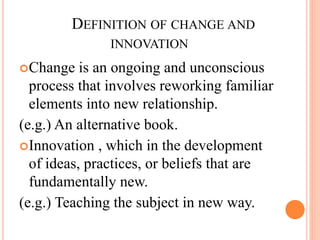
DEFINITION OF CHANGE AND
INNOVATION
Change is an ongoing and unconscious
process that involves reworking familiar
elements into new relationship.
(e.g.) An alternative book.
Innovation , which in the development
of ideas, practices, or beliefs that are
fundamentally new.
(e.g.) Teaching the subject in new way.
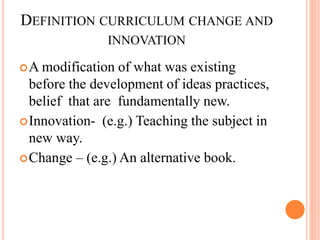
DEFINITION CURRICULUM CHANGE AND
INNOVATION
A modification of what was existing
before the development of ideas practices,
belief that are fundamentally new.
Innovation- (e.g.) Teaching the subject in
new way.
Change – (e.g.) An alternative book.
SOURCES OF CHANGE AND
INNOVATION
National imposition- Occur when the
central authority decides to adopt a new
idea.
Societal need - To tackle existing
problems and identify the new problems.
Technology- Due to development of new
technology like a using computer in
education and online technology in
lessons.
TYPE OF CURRICULUM CHANGE
Hardware change
New classrooms
Equipment
Books
Playgrounds
Software change
Affect the content of the curriculum
Related to the methods of delivery of
curriculum.
FORMS OF CHANGE
Substitution
(e.g.) New textbook and equipment.
Alteration
(e.g.) Replacement of the whole curriculum and
syllabus.
Addition
(e.g.) Introduction of new component like audio,
visual aids and workshops.
Restructuring
(e.g.)Rearrangement of the curriculum or syllabus.
STRATEGIES OF CURRICULUM CHANGE
AND EVALUATION
Participative problem solving - This
strategy focuses on the users and their
needs. Then how they satisfy these need.
Planned linkage- This is linkage process
based on the link between the school and
the various specialized agencies like
national agencies of curriculum
development.
Cont’d
Coercive Strategies- An already prepared
curriculum is developed by the
government education sector such as
national curriculum development center in
the form of a syllabus document was given
to the teachers to implement.
MODELS OF CURRICULIM CHANGE AND
INNOVETION(TANNER AND TANNER-1980)
 The research, development and diffusion model-
1.Invented or discovered,
2.Developed ,
3.Disseminated to the user.
 Problem solving model or Problem reduction
model-
1.Determine the problem,
2. Search for an innovation,
3.Evaluate the trials,
4.Implement the innovation.
CONT’D
Social interaction model- Involves the
transmission of knowledge by social group
of school.
1.Awareness of innovation,
2.Interest in the innovation,
3.Trial the innovation,
4.Adoption for permanent use.
PLANNING AND EXECUTING THE
CHANGE
The change agent- Teachers, schools heads,
local authorities or the ministry of education.
The innovation- Executing the change and
put it into the use or operation.
The system users- Relates to the person or
group of peoples at which the innovation is
directed.
Time- Innovation is a social process which
takes place over a period of time.
curriculum change and innovation.pptx

curriculum change and innovation.pptx

  • 1.
  • 2.
    DEFINITION OF CHANGEAND INNOVATION Change is an ongoing and unconscious process that involves reworking familiar elements into new relationship. (e.g.) An alternative book. Innovation , which in the development of ideas, practices, or beliefs that are fundamentally new. (e.g.) Teaching the subject in new way.
  • 3.
    DEFINITION CURRICULUM CHANGEAND INNOVATION A modification of what was existing before the development of ideas practices, belief that are fundamentally new. Innovation- (e.g.) Teaching the subject in new way. Change – (e.g.) An alternative book.
  • 4.
    SOURCES OF CHANGEAND INNOVATION National imposition- Occur when the central authority decides to adopt a new idea. Societal need - To tackle existing problems and identify the new problems. Technology- Due to development of new technology like a using computer in education and online technology in lessons.
  • 5.
    TYPE OF CURRICULUMCHANGE Hardware change New classrooms Equipment Books Playgrounds Software change Affect the content of the curriculum Related to the methods of delivery of curriculum.
  • 6.
    FORMS OF CHANGE Substitution (e.g.)New textbook and equipment. Alteration (e.g.) Replacement of the whole curriculum and syllabus. Addition (e.g.) Introduction of new component like audio, visual aids and workshops. Restructuring (e.g.)Rearrangement of the curriculum or syllabus.
  • 7.
    STRATEGIES OF CURRICULUMCHANGE AND EVALUATION Participative problem solving - This strategy focuses on the users and their needs. Then how they satisfy these need. Planned linkage- This is linkage process based on the link between the school and the various specialized agencies like national agencies of curriculum development.
  • 8.
    Cont’d Coercive Strategies- Analready prepared curriculum is developed by the government education sector such as national curriculum development center in the form of a syllabus document was given to the teachers to implement.
  • 9.
    MODELS OF CURRICULIMCHANGE AND INNOVETION(TANNER AND TANNER-1980)  The research, development and diffusion model- 1.Invented or discovered, 2.Developed , 3.Disseminated to the user.  Problem solving model or Problem reduction model- 1.Determine the problem, 2. Search for an innovation, 3.Evaluate the trials, 4.Implement the innovation.
  • 10.
    CONT’D Social interaction model-Involves the transmission of knowledge by social group of school. 1.Awareness of innovation, 2.Interest in the innovation, 3.Trial the innovation, 4.Adoption for permanent use.
  • 11.
    PLANNING AND EXECUTINGTHE CHANGE The change agent- Teachers, schools heads, local authorities or the ministry of education. The innovation- Executing the change and put it into the use or operation. The system users- Relates to the person or group of peoples at which the innovation is directed. Time- Innovation is a social process which takes place over a period of time.