Prof. Dr. Md. Nazrul Islam
Former Director, IQAC, SAU, Sylhet
1
CHAPTERS OF THE SAR
1. Introduction
2. Governance
3. Curriculum Design & Review
4. Teaching Learning and Assessment
5. Student Entry Qualifications, Admission Procedure,
Progress And Achievements
6. Physical facilities
7. Student Support Services
8. Research and Extension
9. Staff and Facilities: Recruitment and staff
development
10. Process Management and Continuous Improvement
11. SWOT Analysis
12. Conclusion & Recommendation
2
CHAPTER 1: INTRODUCTION
a. Significance of program Self-Assessment
b. Process of Assessment
c. Overview of the university
d. Overview of the program offering entity
e. Objectives and learning Outcomes of the
Program
f. Brief Summary of the program(s) under
review
3
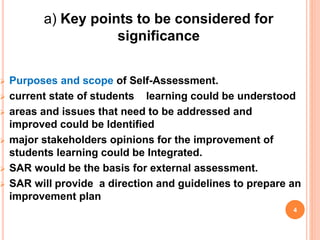
 Purposes and scope of Self-Assessment.
 current state of students learning could be understood
 areas and issues that need to be addressed and
improved could be Identified
 major stakeholders opinions for the improvement of
students learning could be Integrated.
 SAR would be the basis for external assessment.
 SAR will provide a direction and guidelines to prepare an
improvement plan
4
a) Key points to be considered for
significance
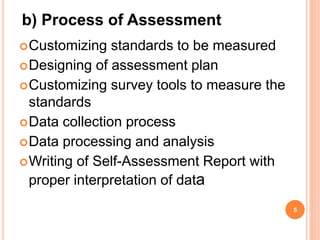
Customizing standards to be measured
Designing of assessment plan
Customizing survey tools to measure the
standards
Data collection process
Data processing and analysis
Writing of Self-Assessment Report with
proper interpretation of data
5
b) Process of Assessment
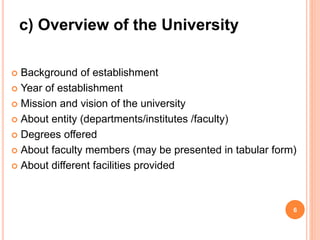
 Background of establishment
 Year of establishment
 Mission and vision of the university
 About entity (departments/institutes /faculty)
 Degrees offered
 About faculty members (may be presented in tabular form)
 About different facilities provided
6
c) Overview of the University
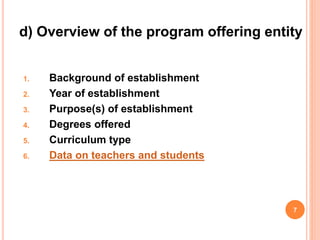
1. Background of establishment
2. Year of establishment
3. Purpose(s) of establishment
4. Degrees offered
5. Curriculum type
6. Data on teachers and students
7
d) Overview of the program offering entity
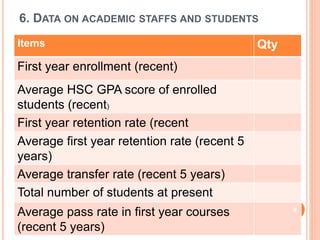
6. DATA ON ACADEMIC STAFFS AND STUDENTS
Items Qty
First year enrollment (recent)
Average HSC GPA score of enrolled
students (recent)
First year retention rate (recent
Average first year retention rate (recent 5
years)
Average transfer rate (recent 5 years)
Total number of students at present
Average pass rate in first year courses
(recent 5 years)
8
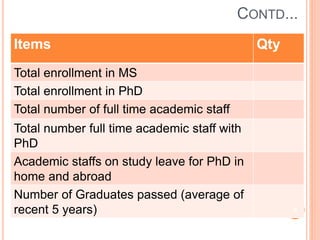
CONTD...
Items Qty
Total enrollment in MS
Total enrollment in PhD
Total number of full time academic staff
Total number full time academic staff with
PhD
Academic staffs on study leave for PhD in
home and abroad
Number of Graduates passed (average of
recent 5 years) 9
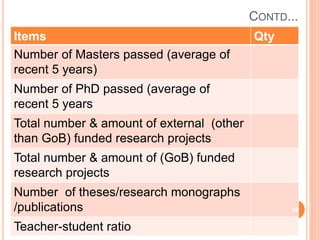
CONTD...
Items Qty
Number of Masters passed (average of
recent 5 years)
Number of PhD passed (average of
recent 5 years
Total number & amount of external (other
than GoB) funded research projects
Total number & amount of (GoB) funded
research projects
Number of theses/research monographs
/publications
Teacher-student ratio
10
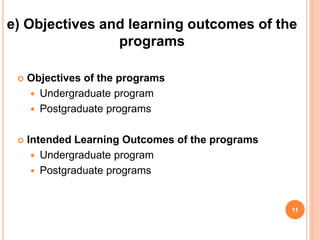
 Objectives of the programs
 Undergraduate program
 Postgraduate programs
 Intended Learning Outcomes of the programs
 Undergraduate program
 Postgraduate programs
11
e) Objectives and learning outcomes of the
programs
 Undergraduate Program
 Course requirement
 Teaching strategy
 Assessment strategy
 Academic calendar
 Class attendance marks & bases
 Examination (Theoretical & Practical)
 Study Tour
 Field Trip
 Distribution of Marks
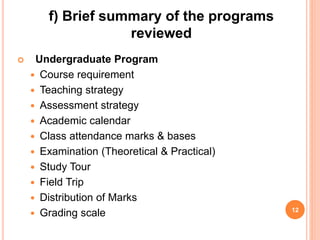
 Grading scale 12
f) Brief summary of the programs
reviewed
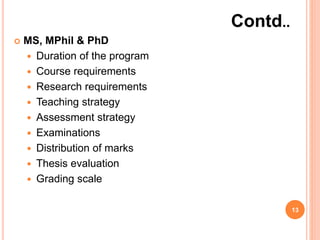
 MS, MPhil & PhD
 Duration of the program
 Course requirements
 Research requirements
 Teaching strategy
 Assessment strategy
 Examinations
 Distribution of marks
 Thesis evaluation
 Grading scale
13
Contd..
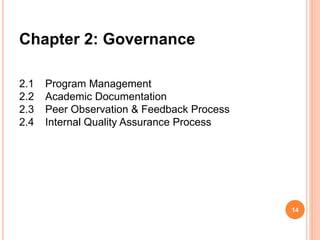
Chapter 2: Governance
2.1 Program Management
2.2 Academic Documentation
2.3 Peer Observation & Feedback Process
2.4 Internal Quality Assurance Process
14
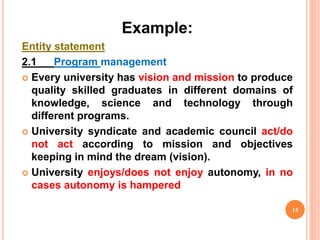
Example:
Entity statement
2.1 Program management
 Every university has vision and mission to produce
quality skilled graduates in different domains of
knowledge, science and technology through
different programs.
 University syndicate and academic council act/do
not act according to mission and objectives
keeping in mind the dream (vision).
 University enjoys/does not enjoy autonomy, in no
cases autonomy is hampered
15
 The VC, Pro-VC are appointed mostly based on their
political affiliation/ reputation, past academic and
administrative performance and in most cases their
activities cause dispersion/ integration among the staff
(teaching & non-teaching) of every administrative and
academic unit and result weak governance/good
governance
 Recruitment is fair/not fair and mostly based on political
affiliation/academic competence
 Our programs have also mission and objectives in
compliance with the university vision and mission
16
 On a regular basis, program mission and
objectives are monitored and justified that entity is
heading towards its destination.
 Faculty members have clear idea about program
mission and objectives.
 Students are being informed about university
vision, mission and program mission and
objectives, students’ code of conduct, examination
procedure etc at the time of admission providing a
brochure
17
 Degree offering entity exercises autonomy
 All academic and administrative affairs are strictly
maintained in compliance with rules and regulations
to ensure good governance in the entity.
 Decisions in the department are taken democratically
 Students can participate in academic decision making
mechanism
18
2.2 Academic documentation
 Meeting resolutions are recoded/not recorded
properly
 All other academic records e.g.; lesson plan,
marks, attendance registrar etc are
documented/ not documented and maintained
properly
19
2.3 Peer observation & feedback
process
 Well defined policy for mentoring and peer
observation exists/not exists and followed/not
followed properly
 Feedback process from both teachers’ end and
students’ end are taken/not taken and duly
honored/not honored
20
2.4 Internal quality assurance
process
 Self assessment process is in practice/not in practice
 Evaluation of teachers by the students is a
regular/not regular/ not at regular phenomenon
 Course evaluation by the teacher, students and head
of the department is usual/not usual practice after
completion of each course
Views of the stakeholders
21
Chapter 3: Curriculum Design & Review
3.1 Need assessment
3.2 Curriculum design
3.3 Curriculum alignment/ skill mapping
3.4 Curriculum review process
3.5 Gaps in Curriculum : Adequacy to Meet the
Needs
22
Example:
Entity statement
3.1.Need Assessment:
 Regulatory requirements,
 National qualifications framework,
 Existing & emerging industry needs,
 General societal factors, community needs,
 Professional & career requirements
23
3.2 Curriculum design
Content & structure: Selecting courses for
foundation, general development, major, minor,
categorization of courses, audit course & capstone
Learning outcome: Observable, specific and
measurable learning outcomes in terms of
knowledge, skills and attitude
24
3.3 Curriculum alignment/skill
mapping
There is coherence/no coherence between assessment,
teaching strategies and intended learning outcomes in
curriculum.
25
3.4 Curriculum review process
 Frequent/infrequent review
 needs reviewed/not reviewed
 to ensure relevance to industry and society
 to cope up with global needs
 major stakeholders are involved/not involved (students
graduates and employers) with special attention to
achievement of CLOs,
 employability of the graduates is kept/not kept in mind,
 course evaluation by the students and respective
course teachers is done/not done,
26
3.5 Gaps in Curriculum : Adequacy to
Meet the Needs
 Gaps and lapses in existing curriculum are identified/not
identified through curriculum alignment and taking
concerns/views of stakeholders,
 Accordingly initiatives are taken/not taken to close the
gaps
Views of the stakeholders
27
4.1 Entry Qualifications
4.2 Admission Procedure
4.3 Progress and Achievement
28
Chapter 4: Student Admission,
Progress and Achievements
Example
Entity statement
4.1 Entry qualifications
 Eligibility of learners (based on programs))are well
defined/not well defined
 Learners are interested and committed to learn and
able to to afford the study load, understand the subject
matter and comply with the program requirements
29
4.2 Admission Procedure
 Fair//unfair selection of students
 Selection procedures of eligible candidates (in brief)
4.3 Progress & Achievement
 Periodic progress and final achievements of the learning
outcomes by the learners are consistent /not consistent
with the quality of learners
Views of the stakeholders
30
5.1 Classroom
5.2 Library facilities
5.3 Laboratory and field laboratories
5.4 Medical facilities
5.5 Other facilities
31
Chapter 5: Physical facilities
Example
Entity statement
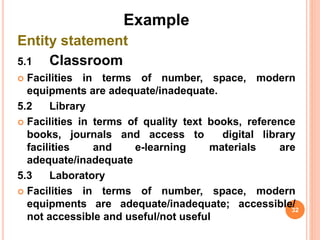
5.1 Classroom
 Facilities in terms of number, space, modern
equipments are adequate/inadequate.
5.2 Library
 Facilities in terms of quality text books, reference
books, journals and access to digital library
facilities and e-learning materials are
adequate/inadequate
5.3 Laboratory
 Facilities in terms of number, space, modern
equipments are adequate/inadequate; accessible/
not accessible and useful/not useful
32
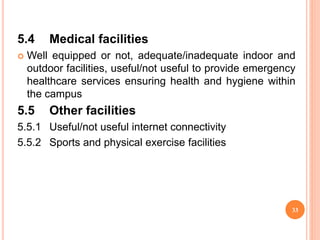
5.4 Medical facilities
 Well equipped or not, adequate/inadequate indoor and
outdoor facilities, useful/not useful to provide emergency
healthcare services ensuring health and hygiene within
the campus
5.5 Other facilities
5.5.1 Useful/not useful internet connectivity
5.5.2 Sports and physical exercise facilities
33
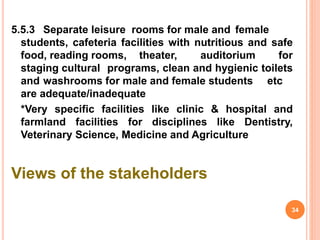
5.5.3 Separate leisure rooms for male and female
students, cafeteria facilities with nutritious and safe
food, reading rooms, theater, auditorium for
staging cultural programs, clean and hygienic toilets
and washrooms for male and female students etc
are adequate/inadequate
*Very specific facilities like clinic & hospital and
farmland facilities for disciplines like Dentistry,
Veterinary Science, Medicine and Agriculture
Views of the stakeholders
34
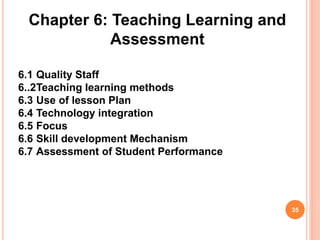
Chapter 6: Teaching Learning and
Assessment
6.1 Quality Staff
6..2Teaching learning methods
6.3 Use of lesson Plan
6.4 Technology integration
6.5 Focus
6.6 Skill development Mechanism
6.7 Assessment of Student Performance
35
Example
Entity statement
Teaching learning constitute the core of education.
Without effective teaching learning no quality in
education ca be achieved
Quality staff
 Should make explicit comment over adequacy,
knowledge and skills of academic and non-
academic (technical and administrative) whether
they are fit/not fit to meet the requirements of
academic standards and strategies of teaching
learning
36
Teaching learning methods
 Teachers use innovative teaching techniques (lecture,
seminar, reading assignment, group assignment, role
playing, presentation, project/ assignment,
demonstration, field visit, field work, lab work
interactive teaching ) to make the students keen,
focused and interested to learn.
Use of lesson Plan
 Lesson plan is used/not used to specify the subject
matter to be taught, learning objectives and
assessment of that learning.
37
Technology integration
 Whether techniques of IT are integrated in teaching
learning to communicate complex ideas in easier,
attractive and more effective way.
Focus
 Whether teaching learning addresses higher order of
learning in knowledge domain (i.e., application to
creation)
Skill Development Mechanism
 Advisory roles of teachers for co- and extra-
curricular activities in addition to classroom
teaching
38
Assessment of Student Performance
 Students are well informed/not informed at the
beginning of the course about the assessment of
performance (ie,. criteria, processes, techniques,
tools and rubrics to be used)
Views of the stakeholders
39
Chapter 7: Student Support
Services
7.1 Academic Guidance and
Counseling
7.2 Co-curricular and Extra-curricular
Activities
7.3 Career & Placement
7.4 Alumni Services
7.5 Community Services
40
Example
Entity statement
Academic Guidance and Counseling
Policy for academic guidance and counseling exists/not
exists
Students are guided/not guided regarding their academic
and personal (if needed) matters
Co-curricular and Extra-curricular Activities
Current status of Department of Physical Education,
Teacher Student Cultural Centre (TSCC) and facilities to
stage drama hold debates, musical soiree, publish journals
and exhibit fine arts; entity level students association or
society like debating club, environment club, culture club
etc.
41
Career & Placement
Career and placement office for career
counseling and placement arrangement for the
graduates and graduating students to get the
right job opportunities and select suitable career
Alumni Services
 Alumni association and its role to develop
institutional network and university industry
collaboration (UIC) for promoting research and
placement of the graduates.
42
Community Services
There is scope/no scope for community involvement to
understand the social issues and working with people
and to synthesize academic learning with real life
situation and contribute to the community
development.
Views of the stakeholders
43
8.1 Recruitment
8.2 Staff Development
8.3 Peer Observation
8.4 Career Development
8.5 Key Performance Indicators (KPIs)
44
Chapter 8: Staff and Facilities
Example
Entity statement
Recruitment
 Current condition regarding recruitment of sufficient
number of academic staff with good quality
Staff Development
 About training development facilities both in home
and abroad for the academic and non-academic
staff
Peer Observation
 Whether there are regular peer observation and
mentoring practices in the entity
45
Career Development
 Present conditions for career development
opportunities (rules and practice)
Key Performance Indicators (KPIs)
 Whether there are KPIs (TPIs & RPIs) for the
performance appraisal of the academic staff
 Status of practical use of KPIs
Views of stakeholders
46
Chapter 9: Research and
Extension
9.1 Policy and program
9.2 Fund and facilities
9.3 Fund hunting/collection
9.4 Dissemination of research findings
47
Example
Entity statement
Policy and program
Statement about research policies and present
programs
Fund and facilities
Statement regarding fund resource and opportunities
for research
Fund hunting/collection
Role of academics for fund collection
Dissemination of research findings
Status of technology transfer
Views of the stakeholders
48
Chapter 10: Process Management
and Continuous Improvement
10.1 Self-assessment
10,2 Improvement plan
10,3 Stakeholders feedback and its Use
10.4 Use of peer observation results
10.5 Regular updating of program objectives and
ILOs
49
Example
Entity statement
Self-assessment
Any self assessment done before?
Improvement plan
Any plan for improvement ever designed?
Stakeholders feedback and its Use
Stakeholders feedback taken and honored?
Use of peer observation results
Peer opinions taken and used?
Regular updating of program objectives and ILOs
 Whether done/not done
Views of the Stakeholders
50
Chapter 11: SWOT Analysis
 Strengths
 Weaknesses
 Opportunities
 Threats
51
Chapter 12: Conclusion &
Recommendation
52
53

Guidelines for SAR Writing

  • 1.
    Prof. Dr. Md.Nazrul Islam Former Director, IQAC, SAU, Sylhet 1
  • 2.
    CHAPTERS OF THESAR 1. Introduction 2. Governance 3. Curriculum Design & Review 4. Teaching Learning and Assessment 5. Student Entry Qualifications, Admission Procedure, Progress And Achievements 6. Physical facilities 7. Student Support Services 8. Research and Extension 9. Staff and Facilities: Recruitment and staff development 10. Process Management and Continuous Improvement 11. SWOT Analysis 12. Conclusion & Recommendation 2
  • 3.
    CHAPTER 1: INTRODUCTION a.Significance of program Self-Assessment b. Process of Assessment c. Overview of the university d. Overview of the program offering entity e. Objectives and learning Outcomes of the Program f. Brief Summary of the program(s) under review 3
  • 4.
     Purposes andscope of Self-Assessment.  current state of students learning could be understood  areas and issues that need to be addressed and improved could be Identified  major stakeholders opinions for the improvement of students learning could be Integrated.  SAR would be the basis for external assessment.  SAR will provide a direction and guidelines to prepare an improvement plan 4 a) Key points to be considered for significance
  • 5.
    Customizing standards tobe measured Designing of assessment plan Customizing survey tools to measure the standards Data collection process Data processing and analysis Writing of Self-Assessment Report with proper interpretation of data 5 b) Process of Assessment
  • 6.
     Background ofestablishment  Year of establishment  Mission and vision of the university  About entity (departments/institutes /faculty)  Degrees offered  About faculty members (may be presented in tabular form)  About different facilities provided 6 c) Overview of the University
  • 7.
    1. Background ofestablishment 2. Year of establishment 3. Purpose(s) of establishment 4. Degrees offered 5. Curriculum type 6. Data on teachers and students 7 d) Overview of the program offering entity
  • 8.
    6. DATA ONACADEMIC STAFFS AND STUDENTS Items Qty First year enrollment (recent) Average HSC GPA score of enrolled students (recent) First year retention rate (recent Average first year retention rate (recent 5 years) Average transfer rate (recent 5 years) Total number of students at present Average pass rate in first year courses (recent 5 years) 8
  • 9.
    CONTD... Items Qty Total enrollmentin MS Total enrollment in PhD Total number of full time academic staff Total number full time academic staff with PhD Academic staffs on study leave for PhD in home and abroad Number of Graduates passed (average of recent 5 years) 9
  • 10.
    CONTD... Items Qty Number ofMasters passed (average of recent 5 years) Number of PhD passed (average of recent 5 years Total number & amount of external (other than GoB) funded research projects Total number & amount of (GoB) funded research projects Number of theses/research monographs /publications Teacher-student ratio 10
  • 11.
     Objectives ofthe programs  Undergraduate program  Postgraduate programs  Intended Learning Outcomes of the programs  Undergraduate program  Postgraduate programs 11 e) Objectives and learning outcomes of the programs
  • 12.
     Undergraduate Program Course requirement  Teaching strategy  Assessment strategy  Academic calendar  Class attendance marks & bases  Examination (Theoretical & Practical)  Study Tour  Field Trip  Distribution of Marks  Grading scale 12 f) Brief summary of the programs reviewed
  • 13.
     MS, MPhil& PhD  Duration of the program  Course requirements  Research requirements  Teaching strategy  Assessment strategy  Examinations  Distribution of marks  Thesis evaluation  Grading scale 13 Contd..
  • 14.
    Chapter 2: Governance 2.1Program Management 2.2 Academic Documentation 2.3 Peer Observation & Feedback Process 2.4 Internal Quality Assurance Process 14
  • 15.
    Example: Entity statement 2.1 Programmanagement  Every university has vision and mission to produce quality skilled graduates in different domains of knowledge, science and technology through different programs.  University syndicate and academic council act/do not act according to mission and objectives keeping in mind the dream (vision).  University enjoys/does not enjoy autonomy, in no cases autonomy is hampered 15
  • 16.
     The VC,Pro-VC are appointed mostly based on their political affiliation/ reputation, past academic and administrative performance and in most cases their activities cause dispersion/ integration among the staff (teaching & non-teaching) of every administrative and academic unit and result weak governance/good governance  Recruitment is fair/not fair and mostly based on political affiliation/academic competence  Our programs have also mission and objectives in compliance with the university vision and mission 16
  • 17.
     On aregular basis, program mission and objectives are monitored and justified that entity is heading towards its destination.  Faculty members have clear idea about program mission and objectives.  Students are being informed about university vision, mission and program mission and objectives, students’ code of conduct, examination procedure etc at the time of admission providing a brochure 17
  • 18.
     Degree offeringentity exercises autonomy  All academic and administrative affairs are strictly maintained in compliance with rules and regulations to ensure good governance in the entity.  Decisions in the department are taken democratically  Students can participate in academic decision making mechanism 18
  • 19.
    2.2 Academic documentation Meeting resolutions are recoded/not recorded properly  All other academic records e.g.; lesson plan, marks, attendance registrar etc are documented/ not documented and maintained properly 19
  • 20.
    2.3 Peer observation& feedback process  Well defined policy for mentoring and peer observation exists/not exists and followed/not followed properly  Feedback process from both teachers’ end and students’ end are taken/not taken and duly honored/not honored 20
  • 21.
    2.4 Internal qualityassurance process  Self assessment process is in practice/not in practice  Evaluation of teachers by the students is a regular/not regular/ not at regular phenomenon  Course evaluation by the teacher, students and head of the department is usual/not usual practice after completion of each course Views of the stakeholders 21
  • 22.
    Chapter 3: CurriculumDesign & Review 3.1 Need assessment 3.2 Curriculum design 3.3 Curriculum alignment/ skill mapping 3.4 Curriculum review process 3.5 Gaps in Curriculum : Adequacy to Meet the Needs 22
  • 23.
    Example: Entity statement 3.1.Need Assessment: Regulatory requirements,  National qualifications framework,  Existing & emerging industry needs,  General societal factors, community needs,  Professional & career requirements 23
  • 24.
    3.2 Curriculum design Content& structure: Selecting courses for foundation, general development, major, minor, categorization of courses, audit course & capstone Learning outcome: Observable, specific and measurable learning outcomes in terms of knowledge, skills and attitude 24
  • 25.
    3.3 Curriculum alignment/skill mapping Thereis coherence/no coherence between assessment, teaching strategies and intended learning outcomes in curriculum. 25
  • 26.
    3.4 Curriculum reviewprocess  Frequent/infrequent review  needs reviewed/not reviewed  to ensure relevance to industry and society  to cope up with global needs  major stakeholders are involved/not involved (students graduates and employers) with special attention to achievement of CLOs,  employability of the graduates is kept/not kept in mind,  course evaluation by the students and respective course teachers is done/not done, 26
  • 27.
    3.5 Gaps inCurriculum : Adequacy to Meet the Needs  Gaps and lapses in existing curriculum are identified/not identified through curriculum alignment and taking concerns/views of stakeholders,  Accordingly initiatives are taken/not taken to close the gaps Views of the stakeholders 27
  • 28.
    4.1 Entry Qualifications 4.2Admission Procedure 4.3 Progress and Achievement 28 Chapter 4: Student Admission, Progress and Achievements
  • 29.
    Example Entity statement 4.1 Entryqualifications  Eligibility of learners (based on programs))are well defined/not well defined  Learners are interested and committed to learn and able to to afford the study load, understand the subject matter and comply with the program requirements 29
  • 30.
    4.2 Admission Procedure Fair//unfair selection of students  Selection procedures of eligible candidates (in brief) 4.3 Progress & Achievement  Periodic progress and final achievements of the learning outcomes by the learners are consistent /not consistent with the quality of learners Views of the stakeholders 30
  • 31.
    5.1 Classroom 5.2 Libraryfacilities 5.3 Laboratory and field laboratories 5.4 Medical facilities 5.5 Other facilities 31 Chapter 5: Physical facilities
  • 32.
    Example Entity statement 5.1 Classroom Facilities in terms of number, space, modern equipments are adequate/inadequate. 5.2 Library  Facilities in terms of quality text books, reference books, journals and access to digital library facilities and e-learning materials are adequate/inadequate 5.3 Laboratory  Facilities in terms of number, space, modern equipments are adequate/inadequate; accessible/ not accessible and useful/not useful 32
  • 33.
    5.4 Medical facilities Well equipped or not, adequate/inadequate indoor and outdoor facilities, useful/not useful to provide emergency healthcare services ensuring health and hygiene within the campus 5.5 Other facilities 5.5.1 Useful/not useful internet connectivity 5.5.2 Sports and physical exercise facilities 33
  • 34.
    5.5.3 Separate leisurerooms for male and female students, cafeteria facilities with nutritious and safe food, reading rooms, theater, auditorium for staging cultural programs, clean and hygienic toilets and washrooms for male and female students etc are adequate/inadequate *Very specific facilities like clinic & hospital and farmland facilities for disciplines like Dentistry, Veterinary Science, Medicine and Agriculture Views of the stakeholders 34
  • 35.
    Chapter 6: TeachingLearning and Assessment 6.1 Quality Staff 6..2Teaching learning methods 6.3 Use of lesson Plan 6.4 Technology integration 6.5 Focus 6.6 Skill development Mechanism 6.7 Assessment of Student Performance 35
  • 36.
    Example Entity statement Teaching learningconstitute the core of education. Without effective teaching learning no quality in education ca be achieved Quality staff  Should make explicit comment over adequacy, knowledge and skills of academic and non- academic (technical and administrative) whether they are fit/not fit to meet the requirements of academic standards and strategies of teaching learning 36
  • 37.
    Teaching learning methods Teachers use innovative teaching techniques (lecture, seminar, reading assignment, group assignment, role playing, presentation, project/ assignment, demonstration, field visit, field work, lab work interactive teaching ) to make the students keen, focused and interested to learn. Use of lesson Plan  Lesson plan is used/not used to specify the subject matter to be taught, learning objectives and assessment of that learning. 37
  • 38.
    Technology integration  Whethertechniques of IT are integrated in teaching learning to communicate complex ideas in easier, attractive and more effective way. Focus  Whether teaching learning addresses higher order of learning in knowledge domain (i.e., application to creation) Skill Development Mechanism  Advisory roles of teachers for co- and extra- curricular activities in addition to classroom teaching 38
  • 39.
    Assessment of StudentPerformance  Students are well informed/not informed at the beginning of the course about the assessment of performance (ie,. criteria, processes, techniques, tools and rubrics to be used) Views of the stakeholders 39
  • 40.
    Chapter 7: StudentSupport Services 7.1 Academic Guidance and Counseling 7.2 Co-curricular and Extra-curricular Activities 7.3 Career & Placement 7.4 Alumni Services 7.5 Community Services 40
  • 41.
    Example Entity statement Academic Guidanceand Counseling Policy for academic guidance and counseling exists/not exists Students are guided/not guided regarding their academic and personal (if needed) matters Co-curricular and Extra-curricular Activities Current status of Department of Physical Education, Teacher Student Cultural Centre (TSCC) and facilities to stage drama hold debates, musical soiree, publish journals and exhibit fine arts; entity level students association or society like debating club, environment club, culture club etc. 41
  • 42.
    Career & Placement Careerand placement office for career counseling and placement arrangement for the graduates and graduating students to get the right job opportunities and select suitable career Alumni Services  Alumni association and its role to develop institutional network and university industry collaboration (UIC) for promoting research and placement of the graduates. 42
  • 43.
    Community Services There isscope/no scope for community involvement to understand the social issues and working with people and to synthesize academic learning with real life situation and contribute to the community development. Views of the stakeholders 43
  • 44.
    8.1 Recruitment 8.2 StaffDevelopment 8.3 Peer Observation 8.4 Career Development 8.5 Key Performance Indicators (KPIs) 44 Chapter 8: Staff and Facilities
  • 45.
    Example Entity statement Recruitment  Currentcondition regarding recruitment of sufficient number of academic staff with good quality Staff Development  About training development facilities both in home and abroad for the academic and non-academic staff Peer Observation  Whether there are regular peer observation and mentoring practices in the entity 45
  • 46.
    Career Development  Presentconditions for career development opportunities (rules and practice) Key Performance Indicators (KPIs)  Whether there are KPIs (TPIs & RPIs) for the performance appraisal of the academic staff  Status of practical use of KPIs Views of stakeholders 46
  • 47.
    Chapter 9: Researchand Extension 9.1 Policy and program 9.2 Fund and facilities 9.3 Fund hunting/collection 9.4 Dissemination of research findings 47
  • 48.
    Example Entity statement Policy andprogram Statement about research policies and present programs Fund and facilities Statement regarding fund resource and opportunities for research Fund hunting/collection Role of academics for fund collection Dissemination of research findings Status of technology transfer Views of the stakeholders 48
  • 49.
    Chapter 10: ProcessManagement and Continuous Improvement 10.1 Self-assessment 10,2 Improvement plan 10,3 Stakeholders feedback and its Use 10.4 Use of peer observation results 10.5 Regular updating of program objectives and ILOs 49
  • 50.
    Example Entity statement Self-assessment Any selfassessment done before? Improvement plan Any plan for improvement ever designed? Stakeholders feedback and its Use Stakeholders feedback taken and honored? Use of peer observation results Peer opinions taken and used? Regular updating of program objectives and ILOs  Whether done/not done Views of the Stakeholders 50
  • 51.
    Chapter 11: SWOTAnalysis  Strengths  Weaknesses  Opportunities  Threats 51
  • 52.
    Chapter 12: Conclusion& Recommendation 52
  • 53.