Curriculum Design
Authored by
Adithya Ligory
Defining Curriculum Design
Curriculum design is a blueprint of the learning objectives for students
as well as tutors.
The curriculum once designed provides a clear pathway with regards
to learning outcomes, teaching goals and ultimately helps students in
acquiring and retaining key skills, subject knowledge and
competencies.
With student development as one of the core aspects of curriculum
design - a well structured curriculum takes into account the student’s
past curricula, and current teaching and assessment trends, to ensure
that students have a holistic development on the personal, academic
as well as professional fronts.
Evolution of Curriculum Design
Early man passed on hunting
techniques to the next
generation
Today’s technologically
charged environment
coupled with the vast
progress of humanity-calls
for curricula that deal with
multiple subjects.
How is Time Utilized in a Classroom?
According to a newly designed curriculum, time in the classroom will
need to be divided into the following key areas:
Deploy
effective
learning
strategies
Identify
preferred
learning
methods
Effective
skills
development
Efficient
objective
setting
Goal setting
and time
allocation
Skill
development
through self
evaluation
Kern’s Six Step Methodology for Curriculum
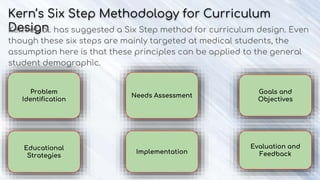
DesignKern et. al. has suggested a Six Step method for curriculum design. Even
though these six steps are mainly targeted at medical students, the
assumption here is that these principles can be applied to the general
student demographic.
Problem
Identification
Needs Assessment
Goals and
Objectives
Evaluation and
Feedback
Educational
Strategies
Implementation
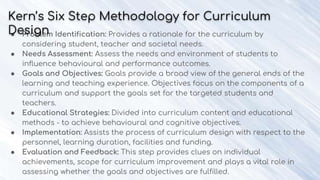
● Problem Identification: Provides a rationale for the curriculum by
considering student, teacher and societal needs.
● Needs Assessment: Assess the needs and environment of students to
influence behavioural and performance outcomes.
● Goals and Objectives: Goals provide a broad view of the general ends of the
learning and teaching experience. Objectives focus on the components of a
curriculum and support the goals set for the targeted students and
teachers.
● Educational Strategies: Divided into curriculum content and educational
methods - to achieve behavioural and cognitive objectives.
● Implementation: Assists the process of curriculum design with respect to the
personnel, learning duration, facilities and funding.
● Evaluation and Feedback: This step provides clues on individual
achievements, scope for curriculum improvement and plays a vital role in
assessing whether the goals and objectives are fulfilled.
Kern’s Six Step Methodology for Curriculum
Design
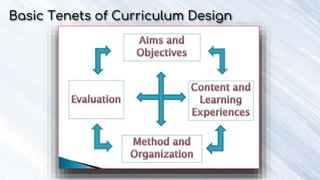
Basic Tenets of Curriculum Design
What Questions Are Posed to a Curriculum
Designer?
Ralph W Tyler from the University of Chicago proposed these
questions to academics who design curricula:
● What educational purposes should the curriculum seek to attain?
● What educational experience can be provided by the curriculum
to obtain the purposes?
● How can the educational experiences be organized and
delivered?
● How can the educational purposes be evaluated for efficiency in
terms of content, measuring student outcomes and provide an
overall assessment of the proposed curriculum?
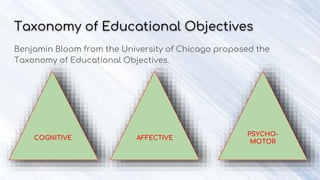
Taxonomy of Educational Objectives
Benjamin Bloom from the University of Chicago proposed the
Taxonomy of Educational Objectives.
COGNITIVE AFFECTIVE
PSYCHO-
MOTOR
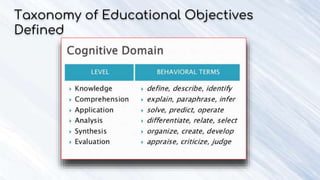
Taxonomy of Educational Objectives
Defined
Taxonomy of Educational Objectives
Defined
Taxonomy of Educational Objectives
Defined
Levels of Curriculum Design
The Planned
Curriculum
What is intended for
the students by the
curriculum?
The Delivered
Curriculum
What is taught by
teachers?
The Experienced
Curriculum
What is learnt by the
students?
Types of Curriculum Design
Subject Based Design
Subject-centered curriculum design
describes what needs to be studied and
how it should be studied.
Drawback:
Does not take into account a student’s
individual learning style.
Problem Based Design
Is focused on teaching students on
observing problems and arriving at
solutions based on life experiences.
Drawback:
May not take individual learning styles
into consideration.
Learner Based Design
Pays special attention to the varied
learning needs of students, and
accommodates different student needs.
Drawback:
Puts pressure on instructors to create
customized material conducive to varying
student needs.
Determinants of Content in Curriculum
Design
While creating the content and the objectives for a curriculum these
are the components that are taking into consideration:
Knowledge Component
Concepts, Principles, Theories
and Laws.
Process and Skill Component
Mental Processes and Physical
Processes
Affective Component
Attitudes and Values
How is Content Selected for a New
Curriculum?
Validity
Content that is accurate and
current based on advances,
discoveries, global and local
events.
Learnability
Content focused on the
learner’s level of subject matter
comprehension.
Relevance
Content needs to reflect the
social, cultural and
technological environments
that the student interacts
with.
Balance
Content must maintain a
balance between constant
fundamental aspects and
changing theoretical and
practical aspects of a subject.
Feasibility
Content that takes into
consideration resources,
personnel and an institute’s
calendar of events.
QUESTIONS?
Bibliography
● https://simplyeducate.me/2014/12/13/the-meaning-and-importance-of-curriculum-development/
● https://www.thoughtco.com/curriculum-design-definition-4154176
● http://cei.ust.hk/teaching-resources/outcome-based-education/institutional-resources/obe-principles-and-process
● https://pt.slideshare.net/CarlRichardDagalea/curriculum-models-and-types/15
● https://www.slideshare.net/arjayalteza/lesson-2-curriculum-design-arjay-alteza
● https://slideplayer.com/slide/253544/
● https://www.slideshare.net/AminaTariq8/computer-assisted-assesment-presentation?next_slideshow=1
● https://tophat.com/blog/curriculum-development-models-design/
● https://tophat.com/blog/blended-learning/
● https://www.slideshare.net/kazekage15/curriculum-design-14005429
● http://www.bumc.bu.edu/bumg/files/2015/07/Curriculum-Design-_Garg_5_24_18.pdf
● http://www.flinders.edu.au/teaching/teaching-strategies/curriculum-development/topic-curriculum-development/topic-curriculum-
development_home.cfm
● https://www.uwc.ac.za/TandL/Pages/Curriculum-Design.aspx
● https://www.researchgate.net/publication/234642145_Curriculum_Design_Purposes_and_Processes_in_Physical_Education_T
eaching-Learning
● https://medicine.osu.edu/education/Documents/curriculum_design_2010.pdf
● https://clt.curtin.edu.au/events/conferences/tlf/tlf2002/refereed/santhanam.pdf
● http://archive.ecml.at/mtp2/chagal_setup/en/student_centredness/content_selection_and_priority_setting.htm
Curriculum design   101

Curriculum design 101

  • 1.
  • 2.
    Defining Curriculum Design Curriculumdesign is a blueprint of the learning objectives for students as well as tutors. The curriculum once designed provides a clear pathway with regards to learning outcomes, teaching goals and ultimately helps students in acquiring and retaining key skills, subject knowledge and competencies. With student development as one of the core aspects of curriculum design - a well structured curriculum takes into account the student’s past curricula, and current teaching and assessment trends, to ensure that students have a holistic development on the personal, academic as well as professional fronts.
  • 3.
    Evolution of CurriculumDesign Early man passed on hunting techniques to the next generation Today’s technologically charged environment coupled with the vast progress of humanity-calls for curricula that deal with multiple subjects.
  • 4.
    How is TimeUtilized in a Classroom? According to a newly designed curriculum, time in the classroom will need to be divided into the following key areas: Deploy effective learning strategies Identify preferred learning methods Effective skills development Efficient objective setting Goal setting and time allocation Skill development through self evaluation
  • 5.
    Kern’s Six StepMethodology for Curriculum DesignKern et. al. has suggested a Six Step method for curriculum design. Even though these six steps are mainly targeted at medical students, the assumption here is that these principles can be applied to the general student demographic. Problem Identification Needs Assessment Goals and Objectives Evaluation and Feedback Educational Strategies Implementation
  • 6.
    ● Problem Identification:Provides a rationale for the curriculum by considering student, teacher and societal needs. ● Needs Assessment: Assess the needs and environment of students to influence behavioural and performance outcomes. ● Goals and Objectives: Goals provide a broad view of the general ends of the learning and teaching experience. Objectives focus on the components of a curriculum and support the goals set for the targeted students and teachers. ● Educational Strategies: Divided into curriculum content and educational methods - to achieve behavioural and cognitive objectives. ● Implementation: Assists the process of curriculum design with respect to the personnel, learning duration, facilities and funding. ● Evaluation and Feedback: This step provides clues on individual achievements, scope for curriculum improvement and plays a vital role in assessing whether the goals and objectives are fulfilled. Kern’s Six Step Methodology for Curriculum Design
  • 7.
    Basic Tenets ofCurriculum Design
  • 8.
    What Questions ArePosed to a Curriculum Designer? Ralph W Tyler from the University of Chicago proposed these questions to academics who design curricula: ● What educational purposes should the curriculum seek to attain? ● What educational experience can be provided by the curriculum to obtain the purposes? ● How can the educational experiences be organized and delivered? ● How can the educational purposes be evaluated for efficiency in terms of content, measuring student outcomes and provide an overall assessment of the proposed curriculum?
  • 9.
    Taxonomy of EducationalObjectives Benjamin Bloom from the University of Chicago proposed the Taxonomy of Educational Objectives. COGNITIVE AFFECTIVE PSYCHO- MOTOR
  • 10.
    Taxonomy of EducationalObjectives Defined
  • 11.
    Taxonomy of EducationalObjectives Defined
  • 12.
    Taxonomy of EducationalObjectives Defined
  • 13.
    Levels of CurriculumDesign The Planned Curriculum What is intended for the students by the curriculum? The Delivered Curriculum What is taught by teachers? The Experienced Curriculum What is learnt by the students?
  • 14.
    Types of CurriculumDesign Subject Based Design Subject-centered curriculum design describes what needs to be studied and how it should be studied. Drawback: Does not take into account a student’s individual learning style. Problem Based Design Is focused on teaching students on observing problems and arriving at solutions based on life experiences. Drawback: May not take individual learning styles into consideration. Learner Based Design Pays special attention to the varied learning needs of students, and accommodates different student needs. Drawback: Puts pressure on instructors to create customized material conducive to varying student needs.
  • 15.
    Determinants of Contentin Curriculum Design While creating the content and the objectives for a curriculum these are the components that are taking into consideration: Knowledge Component Concepts, Principles, Theories and Laws. Process and Skill Component Mental Processes and Physical Processes Affective Component Attitudes and Values
  • 16.
    How is ContentSelected for a New Curriculum? Validity Content that is accurate and current based on advances, discoveries, global and local events. Learnability Content focused on the learner’s level of subject matter comprehension. Relevance Content needs to reflect the social, cultural and technological environments that the student interacts with. Balance Content must maintain a balance between constant fundamental aspects and changing theoretical and practical aspects of a subject. Feasibility Content that takes into consideration resources, personnel and an institute’s calendar of events.
  • 17.
  • 18.
    Bibliography ● https://simplyeducate.me/2014/12/13/the-meaning-and-importance-of-curriculum-development/ ● https://www.thoughtco.com/curriculum-design-definition-4154176 ●http://cei.ust.hk/teaching-resources/outcome-based-education/institutional-resources/obe-principles-and-process ● https://pt.slideshare.net/CarlRichardDagalea/curriculum-models-and-types/15 ● https://www.slideshare.net/arjayalteza/lesson-2-curriculum-design-arjay-alteza ● https://slideplayer.com/slide/253544/ ● https://www.slideshare.net/AminaTariq8/computer-assisted-assesment-presentation?next_slideshow=1 ● https://tophat.com/blog/curriculum-development-models-design/ ● https://tophat.com/blog/blended-learning/ ● https://www.slideshare.net/kazekage15/curriculum-design-14005429 ● http://www.bumc.bu.edu/bumg/files/2015/07/Curriculum-Design-_Garg_5_24_18.pdf ● http://www.flinders.edu.au/teaching/teaching-strategies/curriculum-development/topic-curriculum-development/topic-curriculum- development_home.cfm ● https://www.uwc.ac.za/TandL/Pages/Curriculum-Design.aspx ● https://www.researchgate.net/publication/234642145_Curriculum_Design_Purposes_and_Processes_in_Physical_Education_T eaching-Learning ● https://medicine.osu.edu/education/Documents/curriculum_design_2010.pdf ● https://clt.curtin.edu.au/events/conferences/tlf/tlf2002/refereed/santhanam.pdf ● http://archive.ecml.at/mtp2/chagal_setup/en/student_centredness/content_selection_and_priority_setting.htm