CULTURE MEDIA – PART 2
MODERATOR : Dr. S. K. SINGH
PRESENTED BY:
Dr. SAVITA CHOUDHARY
DR. SUMEDHA THANVI
INTRODUCTION
DEFINITION:
• CULTURE MEDIA: A medium used for cultivation of microorganisms.
• CULTIVATION: Cultivation is a process of growing microorganisms in
culture by taking bacteria from infection site (i.e. the in vivo
environment ) by some means of specimen collection and growing
them in artificial environment of the lab (i.e. in vitro environment ).
TYPES OF CULTURE MEDIA
• BASED ON FUNCTION:
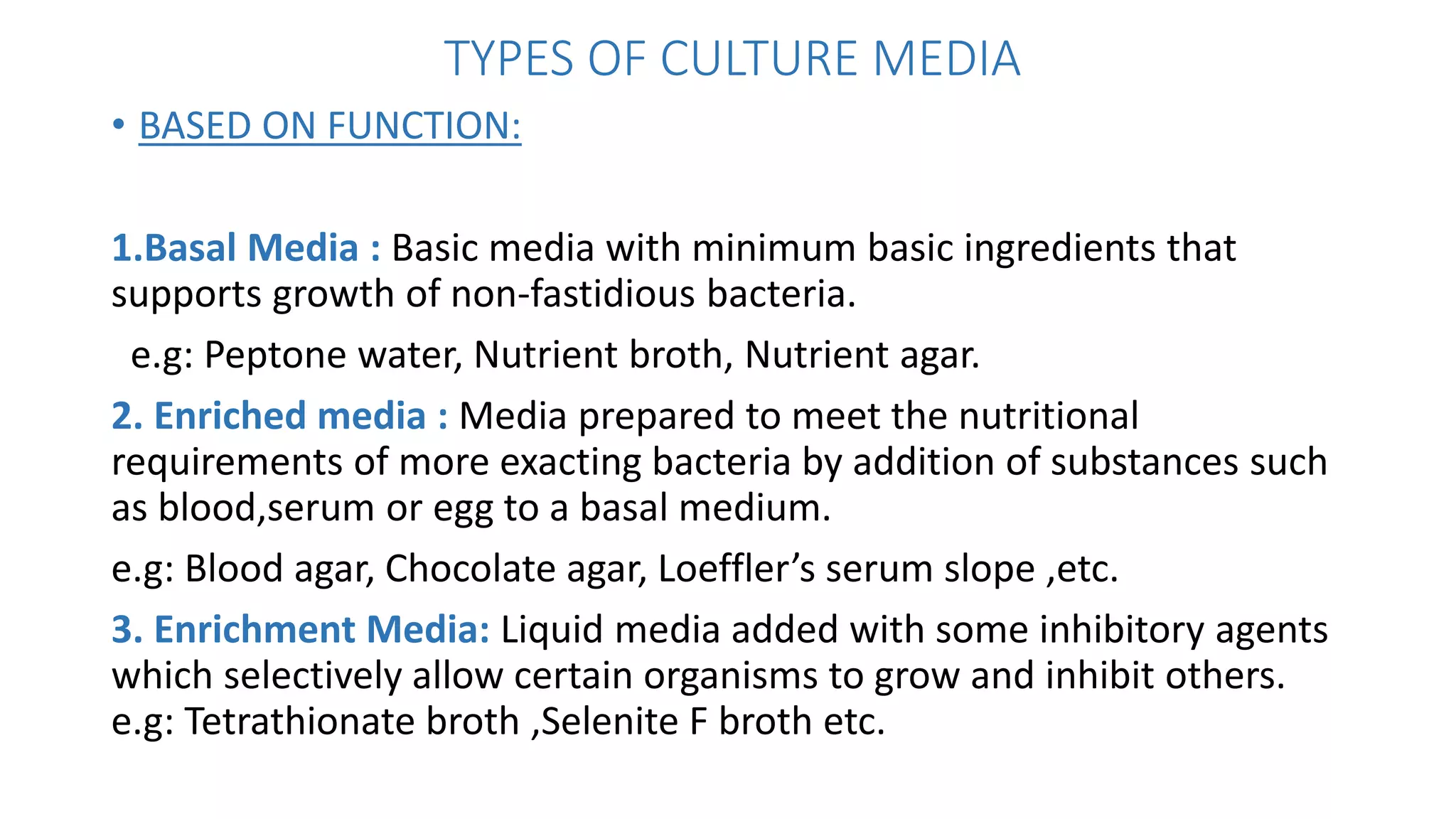
1.Basal Media : Basic media with minimum basic ingredients that
supports growth of non-fastidious bacteria.
e.g: Peptone water, Nutrient broth, Nutrient agar.
2. Enriched media : Media prepared to meet the nutritional
requirements of more exacting bacteria by addition of substances such
as blood,serum or egg to a basal medium.
e.g: Blood agar, Chocolate agar, Loeffler’s serum slope ,etc.
3. Enrichment Media: Liquid media added with some inhibitory agents
which selectively allow certain organisms to grow and inhibit others.
e.g: Tetrathionate broth ,Selenite F broth etc.
TYPES OF CULTURE MEDIA (…contd)
• 4. Selective Media: This media contains one or more agents that are
inhibitory to all organisms except those “ selected” by the specific
growth condition or chemical. E.g: Lowenstein- Jensen
medium,Thiosulfate Citrate Bile Salt (TCBS) agar, etc.
• 5. Differential Media: These media differentiate between two groups
of bacteria by using an indicator. E.g: Mac conkey agar, CLED agar, etc
• 6. Transport Media : Media which are devised to maintain the
viability of a pathogen and to avoid overgrowth of other
contaminants during transit from the patient to laboratory.
e.g: Stuart’s medium, Venkatraman- Ramakrishnan medium, Cary
Blair medium, etc.
Gram positive cocci
• Mannitol Salt Agar
• Tellurite Glycine Agar
• Salt cooked meat broth
• DNase Test Agar
• Milk Salt Agar
Staphylococci
• Todd Hewitt broth
• Crystal violet blood agar
• PNF medium
• Nichols & Freeman Medium
Streptococci
Mannitol Salt Agar
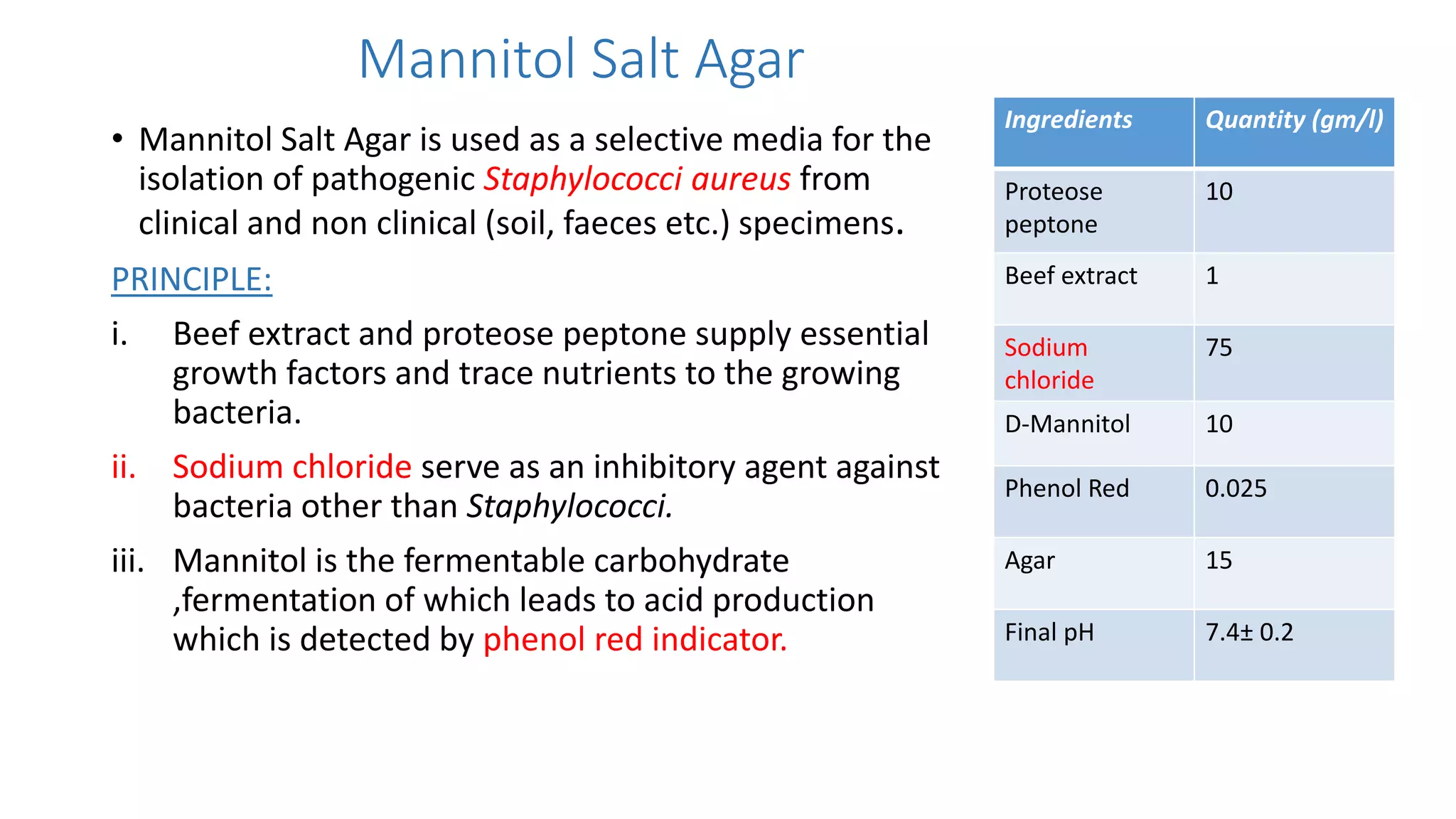
• Mannitol Salt Agar is used as a selective media for the
isolation of pathogenic Staphylococci aureus from
clinical and non clinical (soil, faeces etc.) specimens.
PRINCIPLE:
i. Beef extract and proteose peptone supply essential
growth factors and trace nutrients to the growing
bacteria.
ii. Sodium chloride serve as an inhibitory agent against
bacteria other than Staphylococci.
iii. Mannitol is the fermentable carbohydrate
,fermentation of which leads to acid production
which is detected by phenol red indicator.
Ingredients Quantity (gm/l)
Proteose
peptone
10
Beef extract 1
Sodium
chloride
75
D-Mannitol 10
Phenol Red 0.025
Agar 15
Final pH 7.4± 0.2
Mannitol Salt Agar (…contd)
INTERPRETATION:
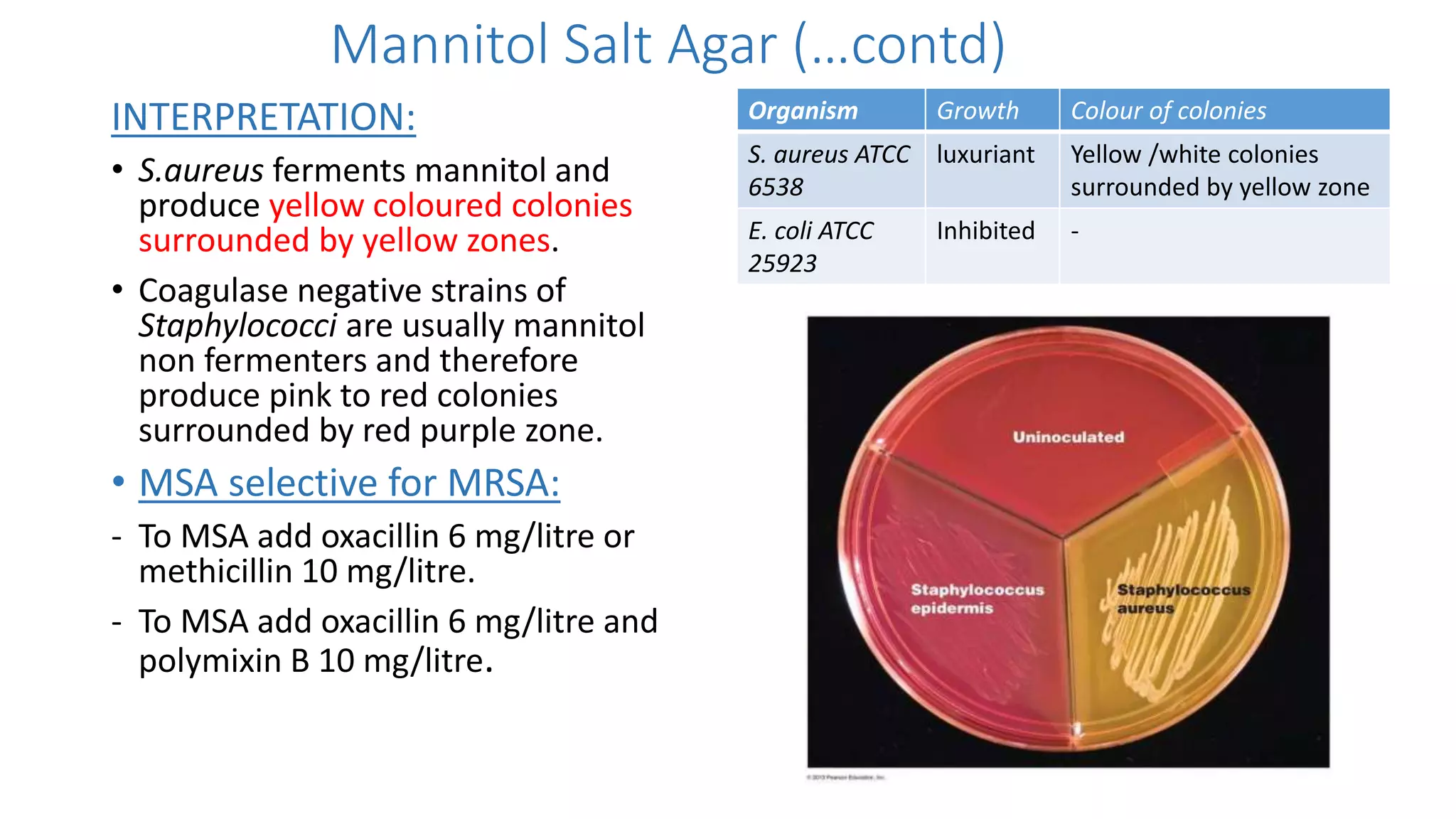
• S.aureus ferments mannitol and
produce yellow coloured colonies
surrounded by yellow zones.
• Coagulase negative strains of
Staphylococci are usually mannitol
non fermenters and therefore
produce pink to red colonies
surrounded by red purple zone.
• MSA selective for MRSA:
- To MSA add oxacillin 6 mg/litre or
methicillin 10 mg/litre.
- To MSA add oxacillin 6 mg/litre and
polymixin B 10 mg/litre.
Organism Growth Colour of colonies
S. aureus ATCC
6538
luxuriant Yellow /white colonies
surrounded by yellow zone
E. coli ATCC
25923
Inhibited -
Tellurite Glycine Agar
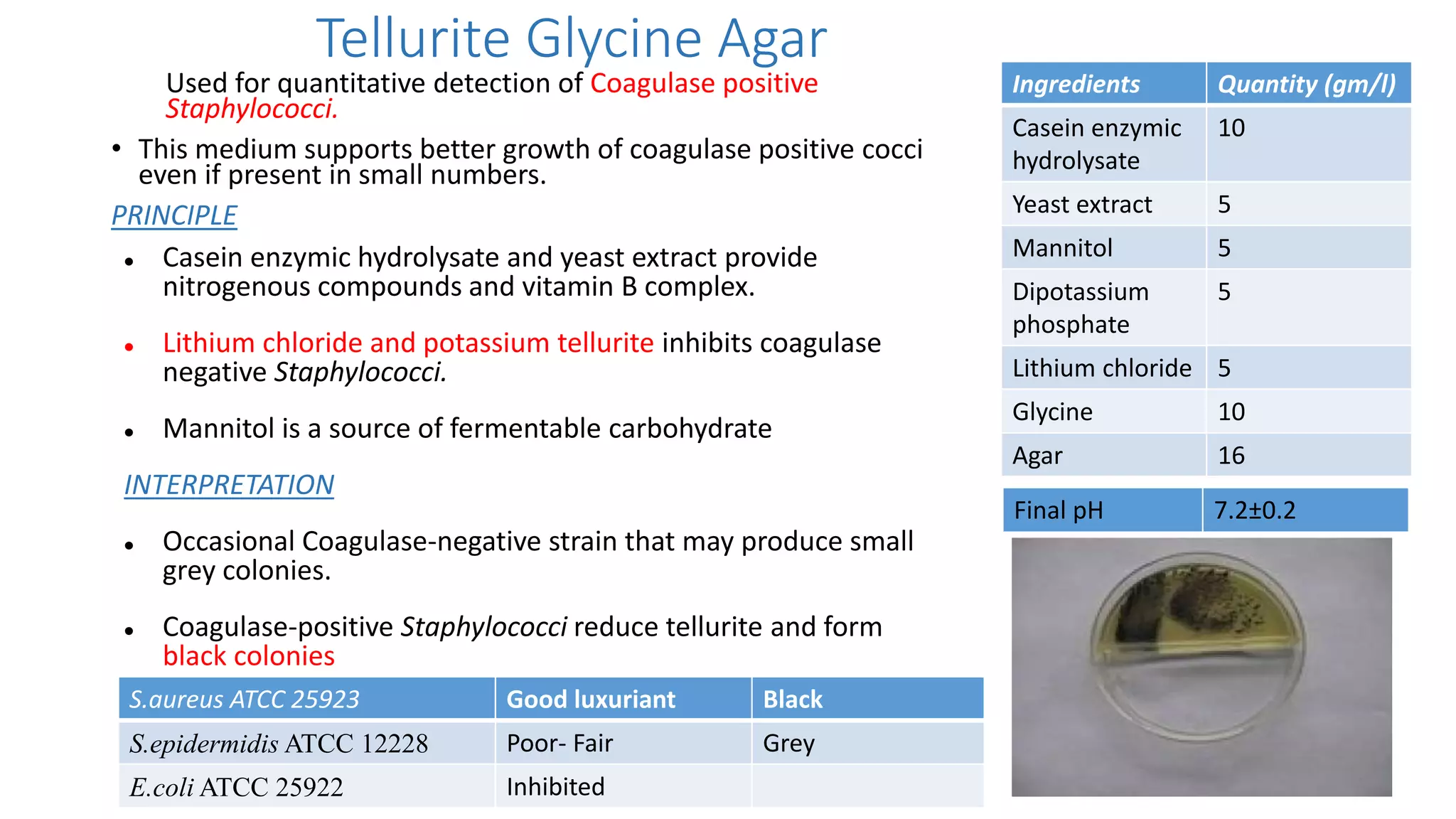
Used for quantitative detection of Coagulase positive
Staphylococci.
• This medium supports better growth of coagulase positive cocci
even if present in small numbers.
PRINCIPLE
 Casein enzymic hydrolysate and yeast extract provide
nitrogenous compounds and vitamin B complex.
 Lithium chloride and potassium tellurite inhibits coagulase
negative Staphylococci.
 Mannitol is a source of fermentable carbohydrate
INTERPRETATION
 Occasional Coagulase-negative strain that may produce small
grey colonies.
 Coagulase-positive Staphylococci reduce tellurite and form
black colonies
Ingredients Quantity (gm/l)
Casein enzymic
hydrolysate
10
Yeast extract 5
Mannitol 5
Dipotassium
phosphate
5
Lithium chloride 5
Glycine 10
Agar 16
Final pH 7.2±0.2
S.aureus ATCC 25923 Good luxuriant Black
S.epidermidis ATCC 12228 Poor- Fair Grey
E.coli ATCC 25922 Inhibited
DNase Test Agar
• This agar is recommended for the detection of
deoxyribonuclease activity of bacteria and fungi, specially
for the identification of pathogenic Staphylococci.
PRINCIPLE AND INTERPRETATION:
• Detection of deoxyribonuclease activity of bacteria and
fungi.
• With added toluidine blue,it is used in the identification
and differentiation of non pigmented Serratia spp. from
Enterobacter and Klebsiella.
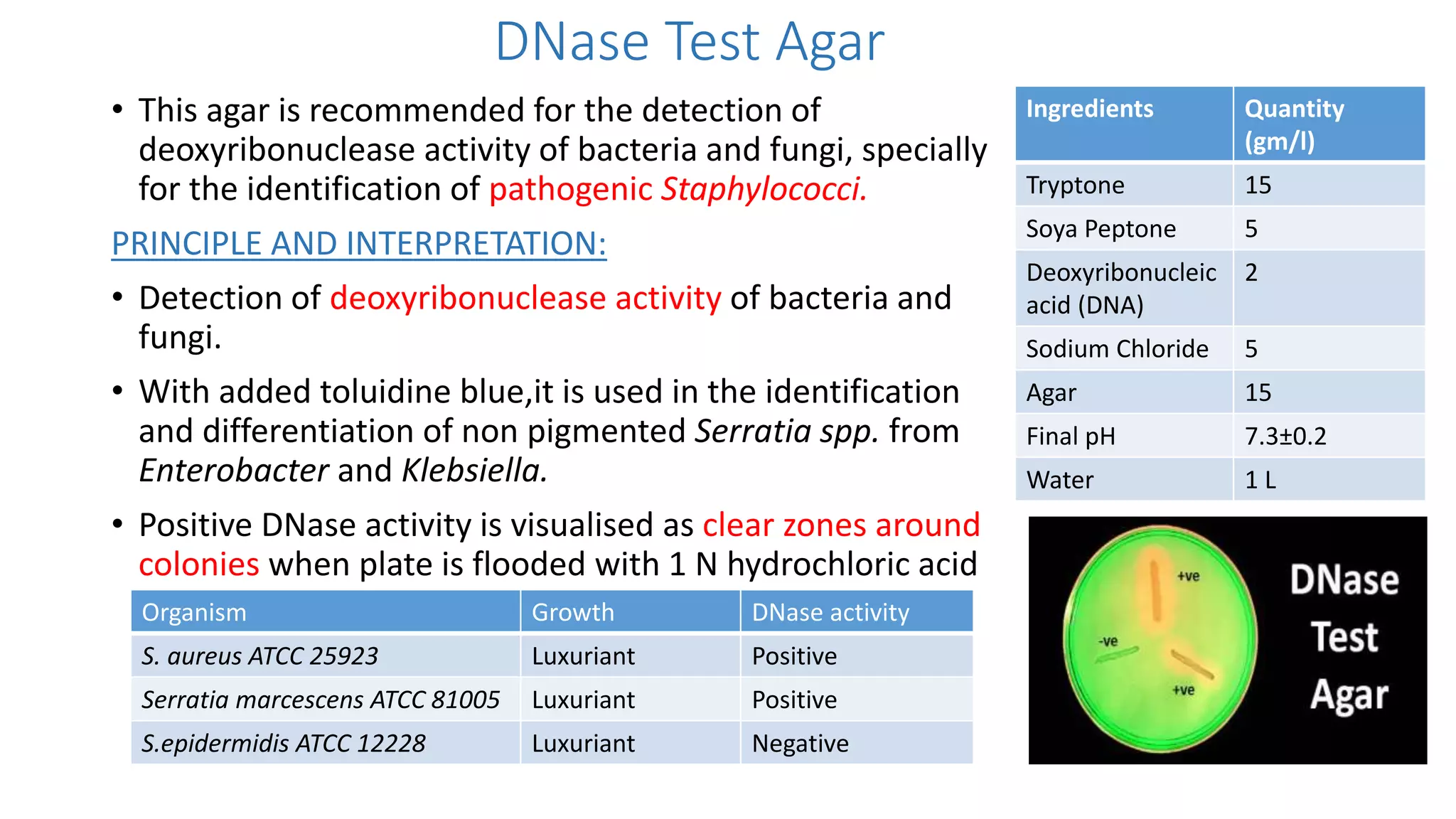
• Positive DNase activity is visualised as clear zones around
colonies when plate is flooded with 1 N hydrochloric acid
Organism Growth DNase activity
S. aureus ATCC 25923 Luxuriant Positive
Serratia marcescens ATCC 81005 Luxuriant Positive
S.epidermidis ATCC 12228 Luxuriant Negative
Ingredients Quantity
(gm/l)
Tryptone 15
Soya Peptone 5
Deoxyribonucleic
acid (DNA)
2
Sodium Chloride 5
Agar 15
Final pH 7.3±0.2
Water 1 L
Salt Cooked Meat Broth
Used as an enrichment medium for isolation of
Staphylococcus from grossly contaminated
specimens.
PRINCIPLE AND INTERPRETATION:
• Selective for Staphylococci due to presence of
sodium chloride in high concentration.
• Peptic digest of animal tissue and beef extract
provide essential nutrients.
• Sodium chloride maintains osmotic equilibrium.
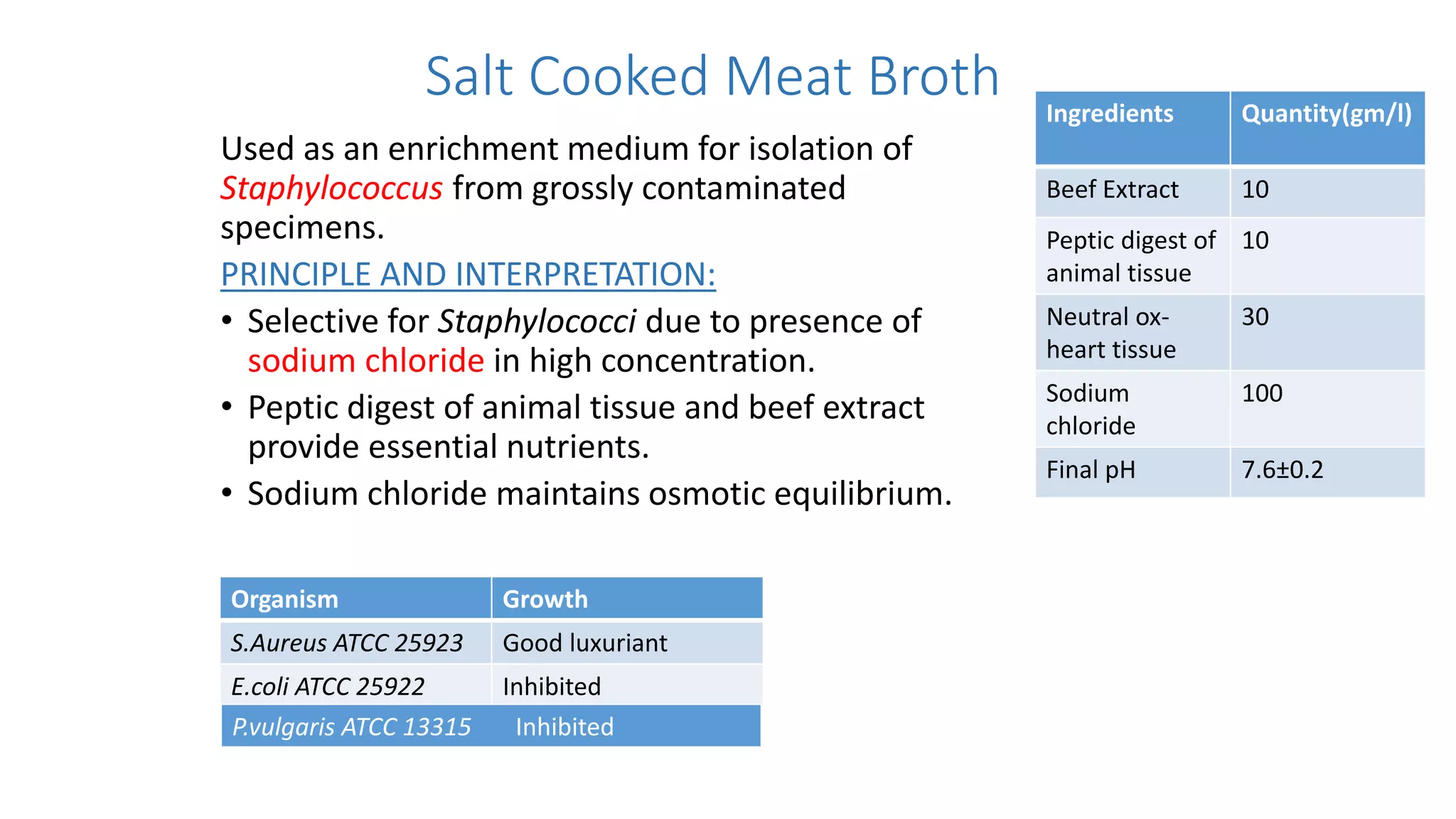
Organism Growth
S.Aureus ATCC 25923 Good luxuriant
E.coli ATCC 25922 Inhibited
Ingredients Quantity(gm/l)
Beef Extract 10
Peptic digest of
animal tissue
10
Neutral ox-
heart tissue
30
Sodium
chloride
100
Final pH 7.6±0.2
P.vulgaris ATCC 13315 Inhibited
Milk Salt Agar
• Used for selective isolation and cultivation of
Staphylococcus.
PRINCIPLE AND INTERPRETATION:
 Beef extract, peptic digest of animal tissue and skim
milk supply essential nutrients
 Highly selective as majority of the contaminating
organisms are inhibited by the high salt
concentration (6.5%)
Organism Growth Recovery
S.aureus ATCC 25923 Good Luxuriant >=50%
E.coli ATCC 25922 Inhibited 0%
Ingredients Gms/L
Peptic digest of
animal tissue
5
Beef extract 3
Sodium
chloride
65
Skim Milk 10%
Agar 15
Todd Hewitt broth
•This enriched broth is used for luxuriant growth of
organisms such as group A haemolytic Streptococci
PRINCIPLE & INTERPRETATION:
•Todd Hewitt Broth medium is very nutritious due to the presence of
peptic digest of animal tissue and beef heart infusion.
•Dextrose stimulates haemolysin production
•The medium is well buffered by sodium phosphate and sodium
carbonate to neutralize the acid produced during dextrose
fermentation. This restricts destruction of antigenic streptococcal
haemolysin.
Selective medium for group B Streptococci : Prepare a solution
of 15µg/l nalidixic acid and 8µg/l gentamicin and add .5ml of it and
.25ml sterile defibrinated sheep blood to 4.75 ml of todd Hewwit
broth.
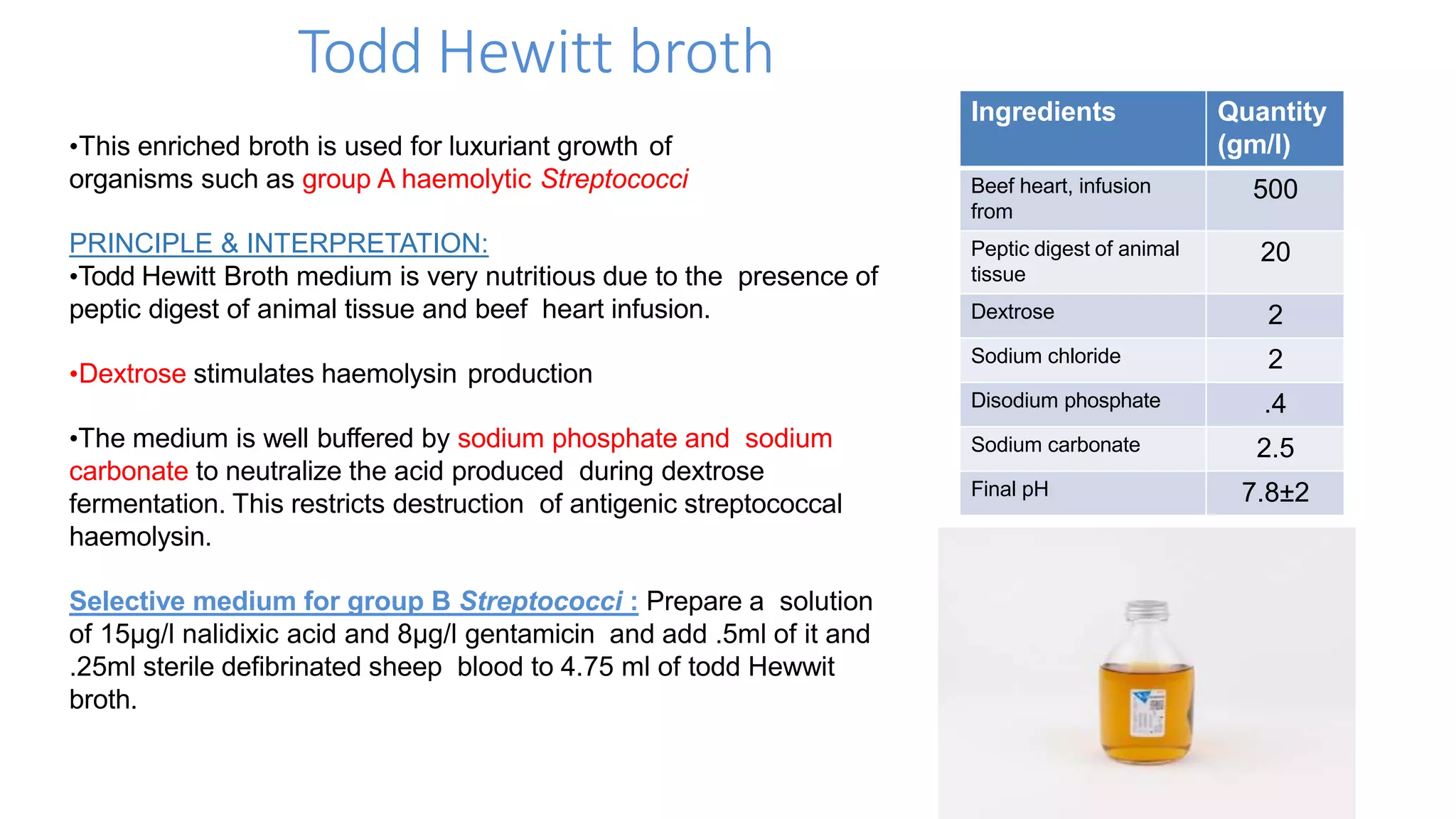
Ingredients Quantity
(gm/l)
Beef heart, infusion
from
500
Peptic digest of animal
tissue
20
Dextrose 2
Sodium chloride 2
Disodium phosphate .4
Sodium carbonate 2.5
Final pH 7.8±2
Crystal violet blood agar
• Selective for Streptococus pyogenes and other
Streptococci
•At a concentration of 1 in 500000, crystal violet inhibits the
growth of Staphylococcus aureus and some other bacteria
found in clinical specimen
PNF Medium
Selective for Beta hemolytic Streptococci
 Inhibit the growth of Staphylococci and Coliforms
 Melt the Nutrient Agar, cool to 50ºC, add the
ingredients and pour plates
Ingredients Per
Litre
Sterile Nutrient
Agar
90 ml
Sterile Blood 10 ml
Crystal Violet 0.1
%
0.2 ml
Ingredients Per Litre
Sterile
Nutrient Agar
Sterile Blood 50 ml
Polymyxin B
Sulphate
17000 units
Agar of Nicholas and Freeman
(Crystal Violet- Nalidixic Acid- Gentamycin Agar (CVNG)
• This is a new selective
medium for the detection of
Streptococcus pneumonia
• Highly selective for Strept.
pneumoniae in sputum
samples.
• This medium is inhibitory to
many respiratory bacteria
other then the
Pneumococcus,Viridans
Streptococci and Enterococci.
Ingredients Quantity
Columbia agar
Defibrinated
horse blood
10%
Crystal violet 2 mg/l
Nalidixic acid 50mg/l
Gentamycin 2mg/l
Gram Negative Cocci
Neisseria:
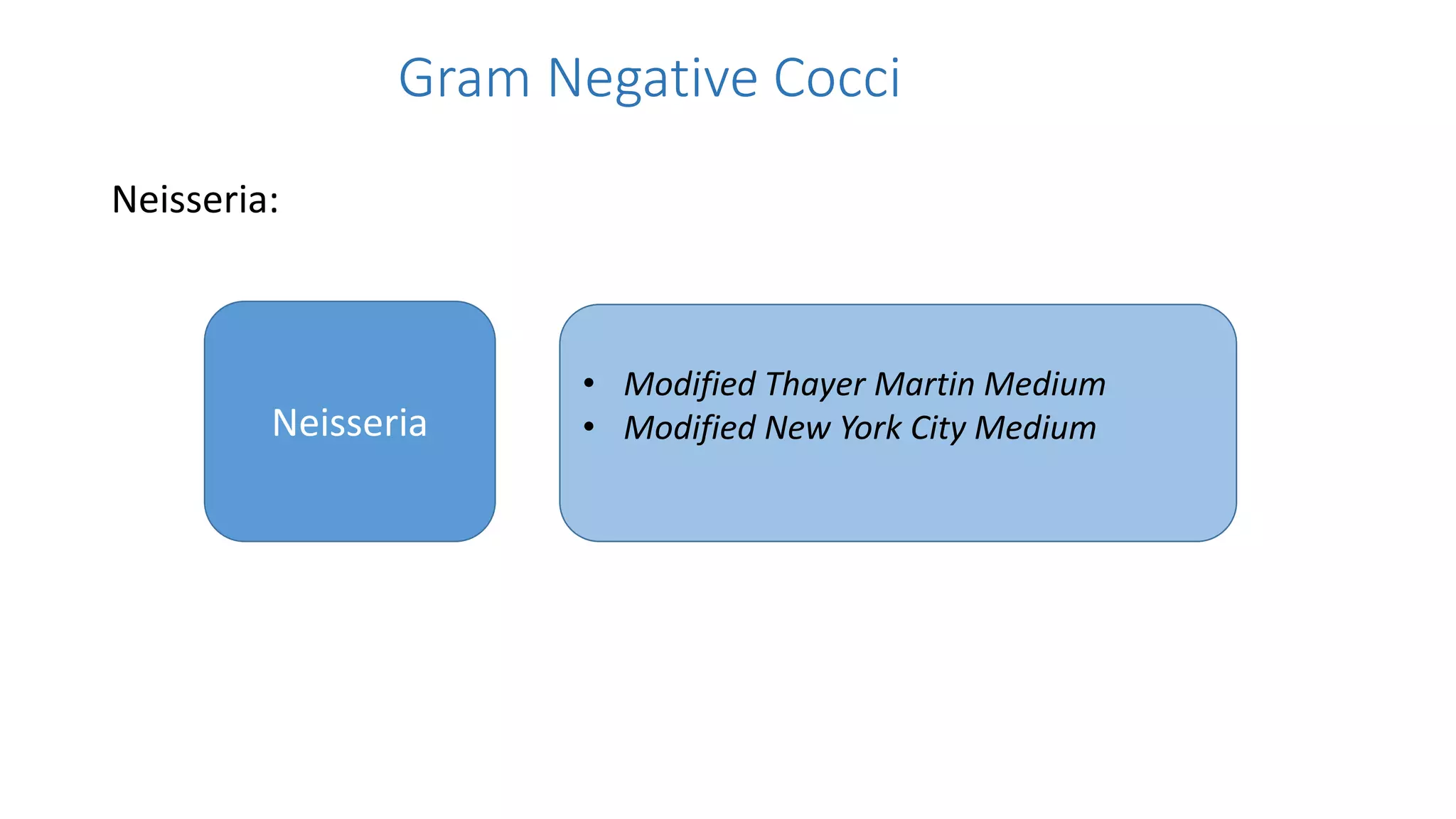
Neisseria
• Modified Thayer Martin Medium
• Modified New York City Medium
Modified Thayer Martin Medium
 Selective isolation & enumeration of Neisseria
gonorrhoeae
PRINCIPLE & INTERPRETATION:
 Vancomycin, Colistin, Nystatin and Trimethoprim make
medium selective
 Peptic digest of animal tissue provides nutrients while
starch neutralizes the toxic fatty acid.
 Vancomycin inhibits gram-positive, Colistin inhibits
gram-negative bacteria and Nystatin inhibits fungi.
 If chocolate agar and antibiotics added-suppress the
growth of contaminants , saprophytic Neisseria species
; enhace the growth of pathogenic Neisseria.
 Small grey convex colonies with irregular outlines seen.
Growth is slower as compared to other selective media.
Ingredients Gms/L
Peptone 23
Starch 1
Sodium
Chloride
5
Dextrose 2.5
Agar 20
Organism Growth Colour of colony
N.gonorrhoeae
ATCC 19424
Good-luxuriant Small, greyishwhite to colourless,
mucoid
E.coli ATCC
25922
Inhibited
Modified New York City Medium
 Enriched selective medium for Neisseria sp.
 Preferred medium as it gives better growth ; use of
lincomycin as selective agent avoid problem of
vancomycin sensitivity.
PRINCIPLE & INTERPRETATION:
 Lysed horse blood, dextrose and yeast dialysate are the
enrichments; proteose peptone,horse plasma,
hemoglobin provide nutrients.
• Colistin inhibits gram-negative bacilli, amphotericin B
suppress yeast growth and trimethoprim prevents
Proteus sp. swarming
• After incubation for 24 hours in moist aerobic
environment,5-10% CO2- small( 1mm) ,grey,convex
colonies; after 48 hours, larger colonies with crenated
margins & opaque raised centre.
GC Medium Base 36 g
Yeast dialysate 25 ml
Blood (100ml) lysed with 5
ml of 10% saponin
105 ml
Glucose 10% sterlized at
115ºC for 10 min.
10 ml
Colistin (6mg/L) 1ml
Lincomycin (1mg/L) 1ml
Trimethoprim (5mg/L) 1ml
Amphoterecin B (1mg/L) 1ml
Organisms Growth Recovery
Neisseria gonorrheae ATCC 19424 Good-luxuriant >=50%
Proteus mirabilis ATCC 13883 None- poor <=10%
Gram Positive Bacilli
• Gram positive bacilli:
Corynebacterium
Bacillus
Listeria
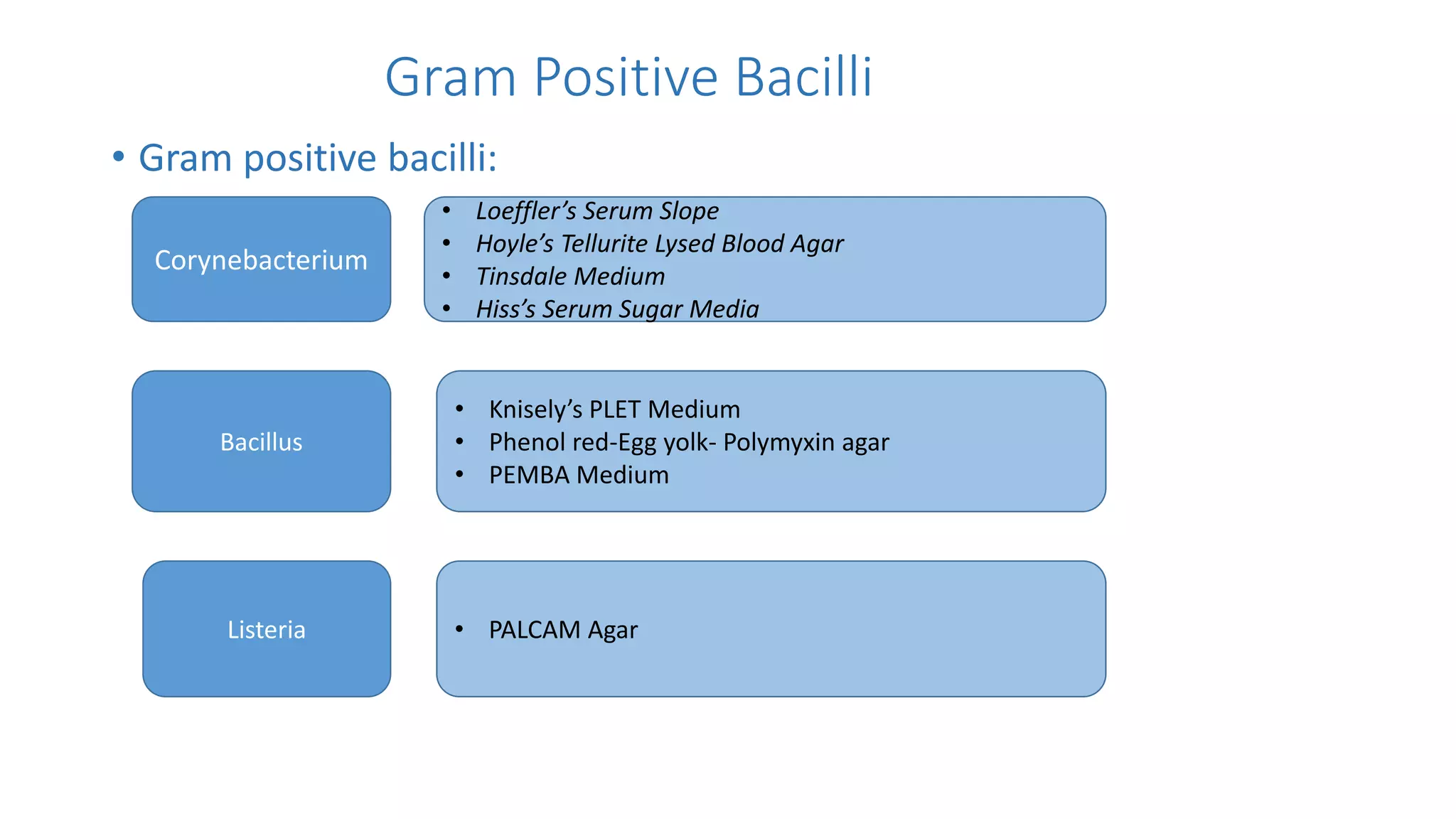
• Loeffler’s Serum Slope
• Hoyle’s Tellurite Lysed Blood Agar
• Tinsdale Medium
• Hiss’s Serum Sugar Media
• Knisely’s PLET Medium
• Phenol red-Egg yolk- Polymyxin agar
• PEMBA Medium
• PALCAM Agar
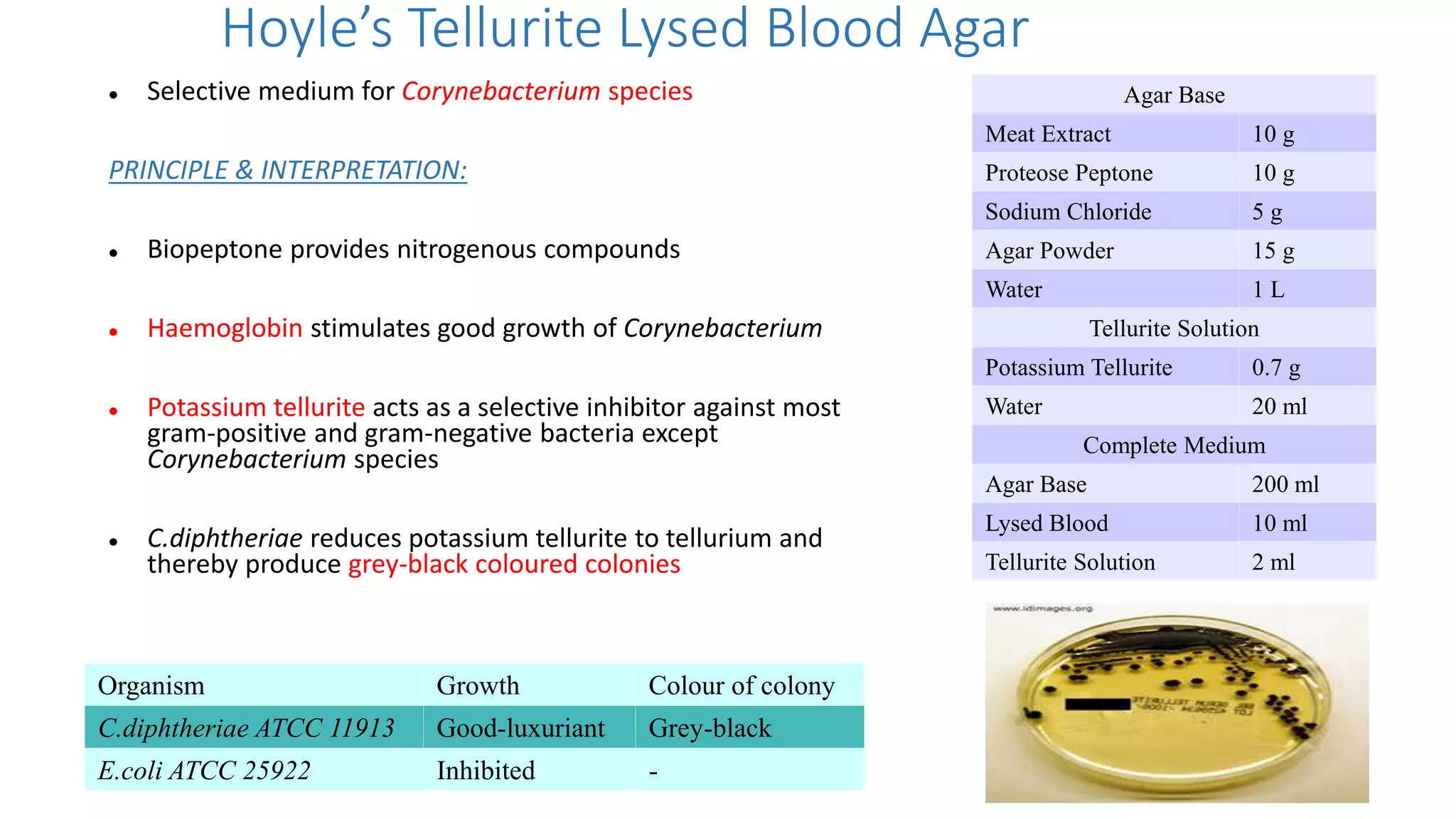
Hoyle’s Tellurite Lysed Blood Agar
 Selective medium for Corynebacterium species
PRINCIPLE & INTERPRETATION:
 Biopeptone provides nitrogenous compounds
 Haemoglobin stimulates good growth of Corynebacterium
 Potassium tellurite acts as a selective inhibitor against most
gram-positive and gram-negative bacteria except
Corynebacterium species
 C.diphtheriae reduces potassium tellurite to tellurium and
thereby produce grey-black coloured colonies
Agar Base
Meat Extract 10 g
Proteose Peptone 10 g
Sodium Chloride 5 g
Agar Powder 15 g
Water 1 L
Tellurite Solution
Potassium Tellurite 0.7 g
Water 20 ml
Complete Medium
Agar Base 200 ml
Lysed Blood 10 ml
Tellurite Solution 2 ml
Organism Growth Colour of colony
C.diphtheriae ATCC 11913 Good-luxuriant Grey-black
E.coli ATCC 25922 Inhibited -
Tinsdale Medium
 For selective isolation and differentiation of
Corynebacterium diphtheria.
PRINCIPLE & INTERPRETATION:
 Peptic digest provides nitrogenous compounds. L-cystine
and sodium thiosulphate form the H₂S indicator system.
 Potassium tellurite inhibits all gram-negative bacteria and
most of the upper respiratory tract normal flora.
 C.diphtheriae forms greyish black colonies surrounded by
a dark brown halo. Halo is formed due to H₂S production
from cystine combining with the tellurite salt.
Agar Base
Proteose Peptone 20 g
Sodium Chloride 5 g
Agar Powder 19 g
Water 1 L
Complete Medium
Agar Base 200 ml
Ox Serum 20 ml
Sodium Hydroxide 0.1
mol/L
12 ml
L-Cystine, 0.4% in Hcl,
0.1 mol/L
12 ml
Potassium Tellurite 1% in
Sterile Water
6 ml
Sodium Thiosulphate
2.5% solution
3.4 ml
Organism Growth Colony characteristics
C.diphtheriae gravis Good-luxuriant Brown-black with halo
K.pneumoniae ATCC 13883 Inhibited
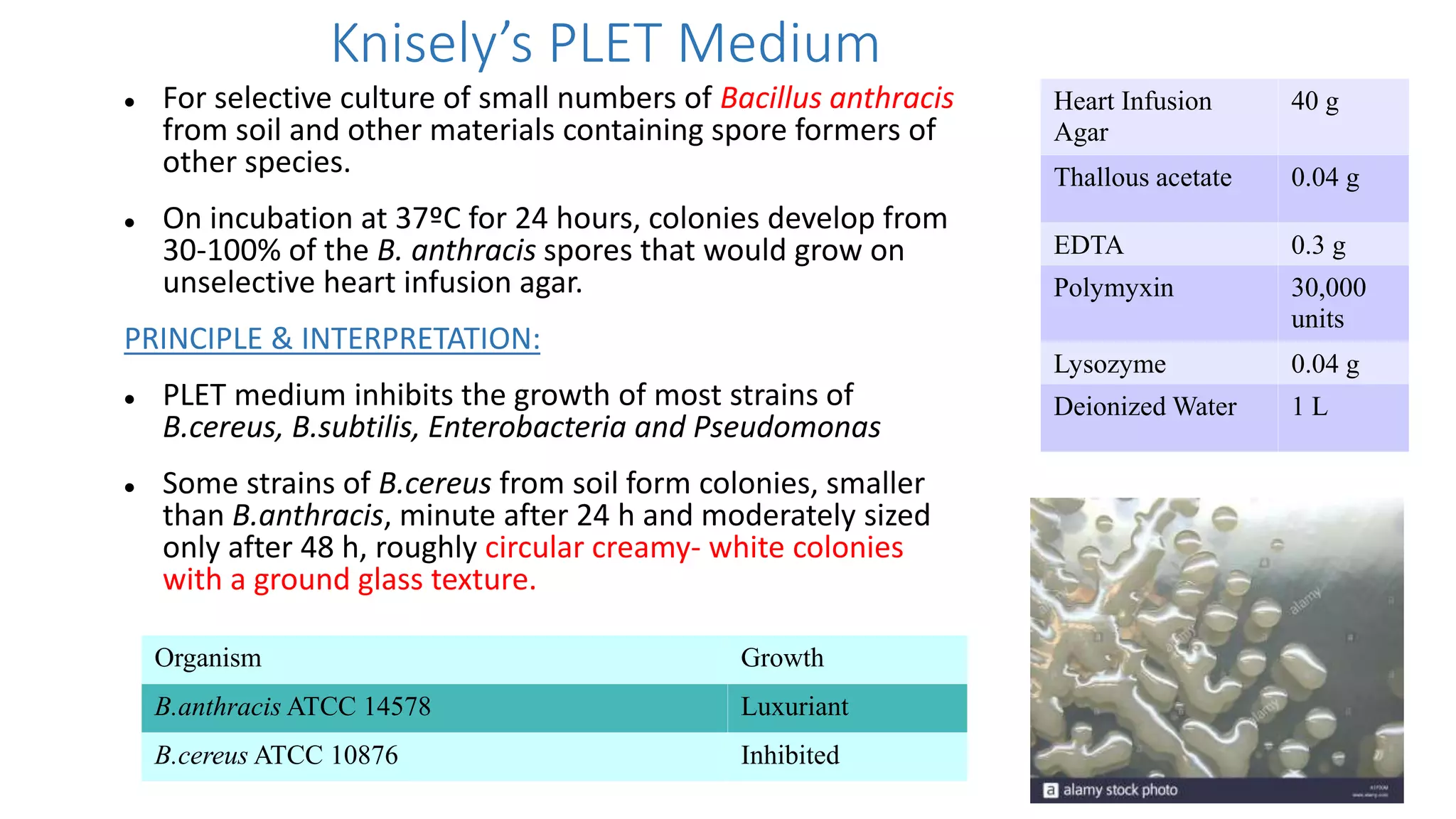
Knisely’s PLET Medium
 For selective culture of small numbers of Bacillus anthracis
from soil and other materials containing spore formers of
other species.
 On incubation at 37ºC for 24 hours, colonies develop from
30-100% of the B. anthracis spores that would grow on
unselective heart infusion agar.
PRINCIPLE & INTERPRETATION:
 PLET medium inhibits the growth of most strains of
B.cereus, B.subtilis, Enterobacteria and Pseudomonas
 Some strains of B.cereus from soil form colonies, smaller
than B.anthracis, minute after 24 h and moderately sized
only after 48 h, roughly circular creamy- white colonies
with a ground glass texture.
Heart Infusion
Agar
40 g
Thallous acetate 0.04 g
EDTA 0.3 g
Polymyxin 30,000
units
Lysozyme 0.04 g
Deionized Water 1 L
Organism Growth
B.anthracis ATCC 14578 Luxuriant
B.cereus ATCC 10876 Inhibited
Phenol Red Egg Yolk Polymyxin Agar
• Relatively selective for B.cereus ; used to isolate it from
food,faeces and vomitus.
PRINCIPLE & INTERPRETATION:
 Colonies recognized by their opacity in the egg-yolk, pink
color with phenol red and failure to ferment mannitol.
 Egg yolk emulsion helps in differentiation of lecithinase
producing colonies which are surrounded by a zone of
white precipitate
 Polymyxin B Sulphate restricts growth of gram-negative
bacteria such as E.coli and Pseudomonas aeruginosa
 Differentiation of Bacillus cereus from other Bacillus
species by its inability to ferment mannitol and poor
sporulation
Peptone 10 g
Meat Extract 1 g
Mannitol 10 g
Sodium Chloride 10 g
Phenol red 0.025 g
Agar 15 g
Egg-yolk emulsion 100 ml
Polymyxin B sulphate 0.01 g
Deionized water 1 L
Organism Growth Recovery Colour Lecithinase activity
B.cereus ATCC
10876
Luxuriant >=50% Red Positive,opaque zone
around the colony
E.coli ATCC
25922
None-poor <=10%
PEMBA Medium
(Polymyxin Pyruvate Egg Yolk Mannitol Bromothymol Blue Agar)
• Recommended for enumeration of B.cereus in foods.
• Supports growth of even a small number of B.cereus.
PRINCIPLE & INTERPRETATION:
 Low peptone content promotes sporulation,sodium
pyruvate reduces the colony size of the organisms.
 Egg yolk emulsion demonstrates the strong lecithinase
opacity reaction
 Bromothymol blue acts as pH indicator to detect mannitol
fermentation.
 B.cereus forms crenated blue colonies surrounded by a
zone of opacity in the medium
Peptone 1 g
D- Mannitol 10 g
Magnesium
sulphate.heptahydrate
0.1 g
Disodium phosphate 2.5 g
Potassium dihydrogen
phosphate
0.25 g
Sodium chloride 2 g
Sodium pyruvate 10 g
Polymyxin B sulphate 1 lac U
Bromothymol blue 0.1 g
Egg-yolk emulsion 50 ml
Agar 18 g
Deionized water 1 L
Organism Growth Colour of colony Egg Yolk Reaction
B.cereus ATCC
10876
Good-luxuriant Blue Positive, precipitation
E.coli ATCC
25922
Inhibited
PALCAM Agar
(Polymyxin-Acriflavin-Lithium chloride-Ceftazidime-Aesculin-Mannitol)
• For selective isolation and identification of Listeria species.
PRINCIPLE & INTERPRETATION:
 Highly selective due to the presence of lithium chloride,
ceftazidime, polymyxin B and acriflavin.
 Differential diagnostic medium utilizing two indicator systems,
esculin-ferric citrate and mannitol-phenol red.
 L. monocytogenes hydrolyzes esculin forms esculetin and
dextrose. Esculetin reacts with ammonium ferric citrate and forms
a brown-black complex seen as a black halo around colonies.
 On PALCAM Agar,after inoculation and incubation at 35 degrees for
24-48 hours in aerobic or microaerophillic condition, Listeria
colonies appear grey-green with a black precipitate.
Ingredients g/L
Peptone 23
Starch 1
Sodium Chloride 5
Mannitol 10
Ammonium ferric citrate 0.5
Esculin 0.8
Dextrose 0.5
Lithium Chloride 15
Phenol red 0.08
Agar 13
Gram Negative Bacilli
• .
Coliforms
Salmonella &
Shigella
Yersinia
EMB Agar
• Bismuth Sulphite Agar
• DCA
• XLD
• Hektoen Agar
• SS Agar
Schiemann CIN Agar
Vibrio
• TCBS Agar
• Bile Salt Agar
• Monsur’s Tellurite Taurocholate Gelatin Agar
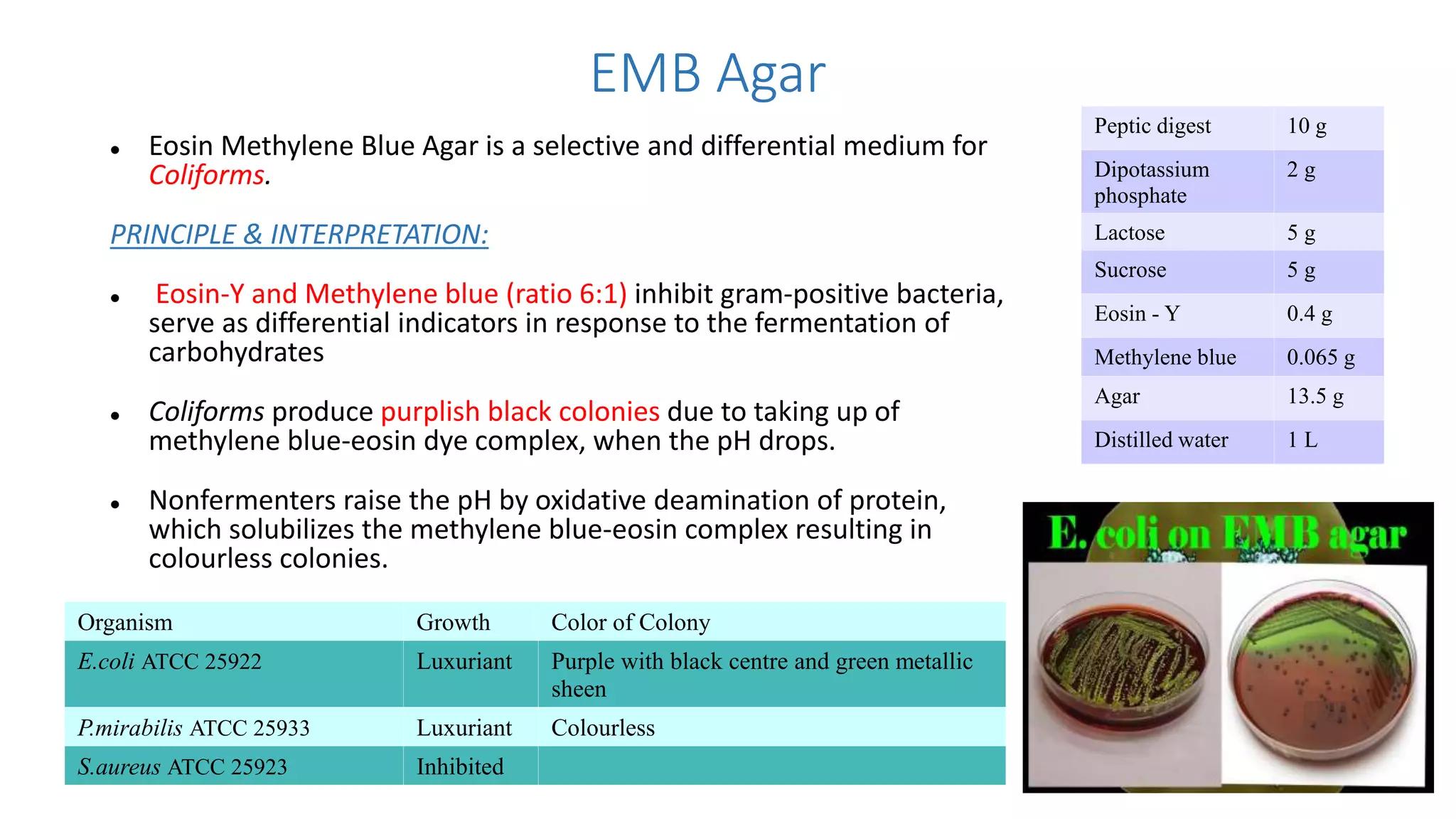
EMB Agar
 Eosin Methylene Blue Agar is a selective and differential medium for
Coliforms.
PRINCIPLE & INTERPRETATION:
 Eosin-Y and Methylene blue (ratio 6:1) inhibit gram-positive bacteria,
serve as differential indicators in response to the fermentation of
carbohydrates
 Coliforms produce purplish black colonies due to taking up of
methylene blue-eosin dye complex, when the pH drops.
 Nonfermenters raise the pH by oxidative deamination of protein,
which solubilizes the methylene blue-eosin complex resulting in
colourless colonies.
Organism Growth Color of Colony
E.coli ATCC 25922 Luxuriant Purple with black centre and green metallic
sheen
P.mirabilis ATCC 25933 Luxuriant Colourless
S.aureus ATCC 25923 Inhibited
Peptic digest 10 g
Dipotassium
phosphate
2 g
Lactose 5 g
Sucrose 5 g
Eosin - Y 0.4 g
Methylene blue 0.065 g
Agar 13.5 g
Distilled water 1 L
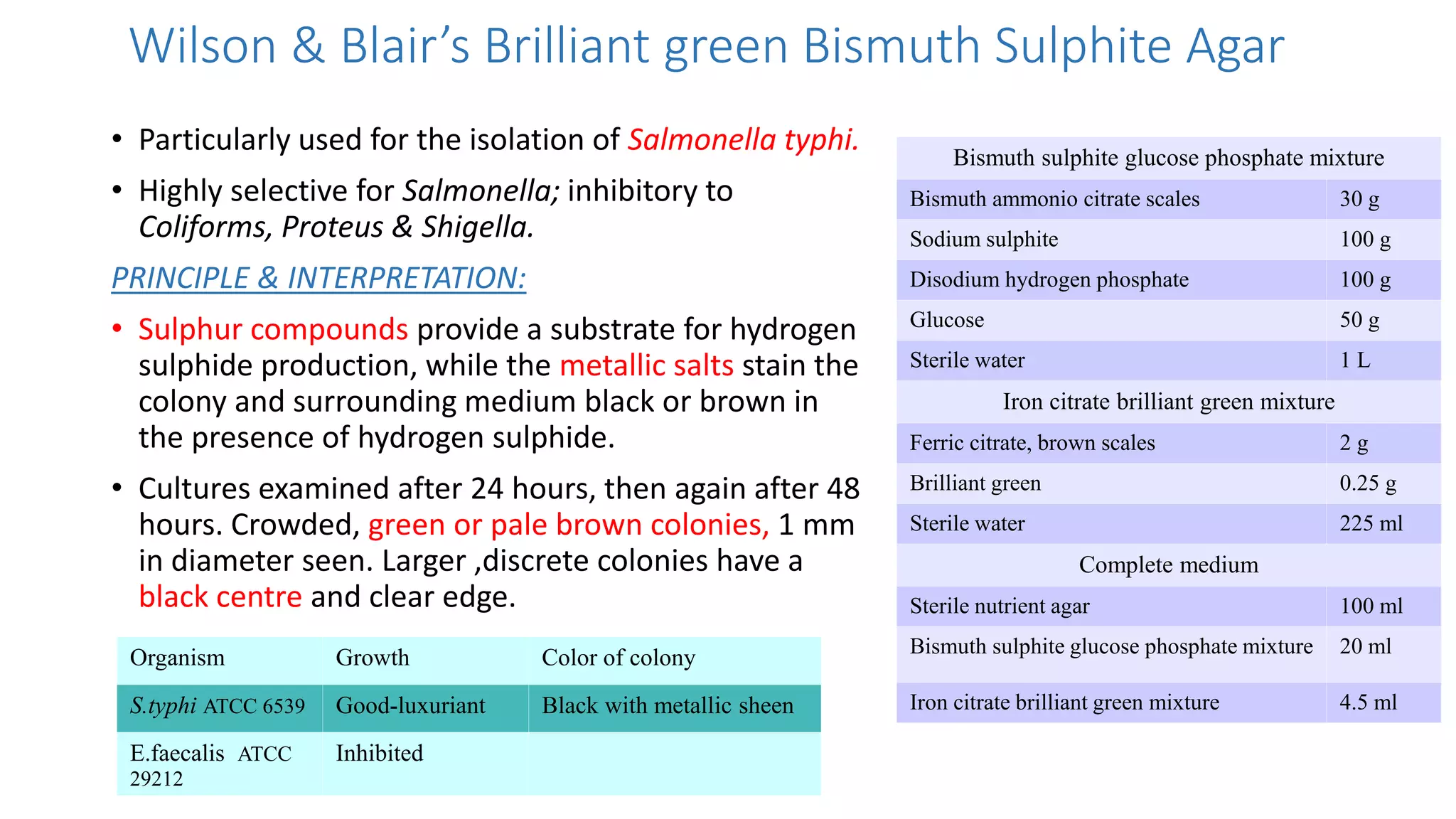
Wilson & Blair’s Brilliant green Bismuth Sulphite Agar
• Particularly used for the isolation of Salmonella typhi.
• Highly selective for Salmonella; inhibitory to
Coliforms, Proteus & Shigella.
PRINCIPLE & INTERPRETATION:
• Sulphur compounds provide a substrate for hydrogen
sulphide production, while the metallic salts stain the
colony and surrounding medium black or brown in
the presence of hydrogen sulphide.
• Cultures examined after 24 hours, then again after 48
hours. Crowded, green or pale brown colonies, 1 mm
in diameter seen. Larger ,discrete colonies have a
black centre and clear edge.
Bismuth sulphite glucose phosphate mixture
Bismuth ammonio citrate scales 30 g
Sodium sulphite 100 g
Disodium hydrogen phosphate 100 g
Glucose 50 g
Sterile water 1 L
Iron citrate brilliant green mixture
Ferric citrate, brown scales 2 g
Brilliant green 0.25 g
Sterile water 225 ml
Complete medium
Sterile nutrient agar 100 ml
Bismuth sulphite glucose phosphate mixture 20 ml
Iron citrate brilliant green mixture 4.5 ml
Organism Growth Color of colony
S.typhi ATCC 6539 Good-luxuriant Black with metallic sheen
E.faecalis ATCC
29212
Inhibited
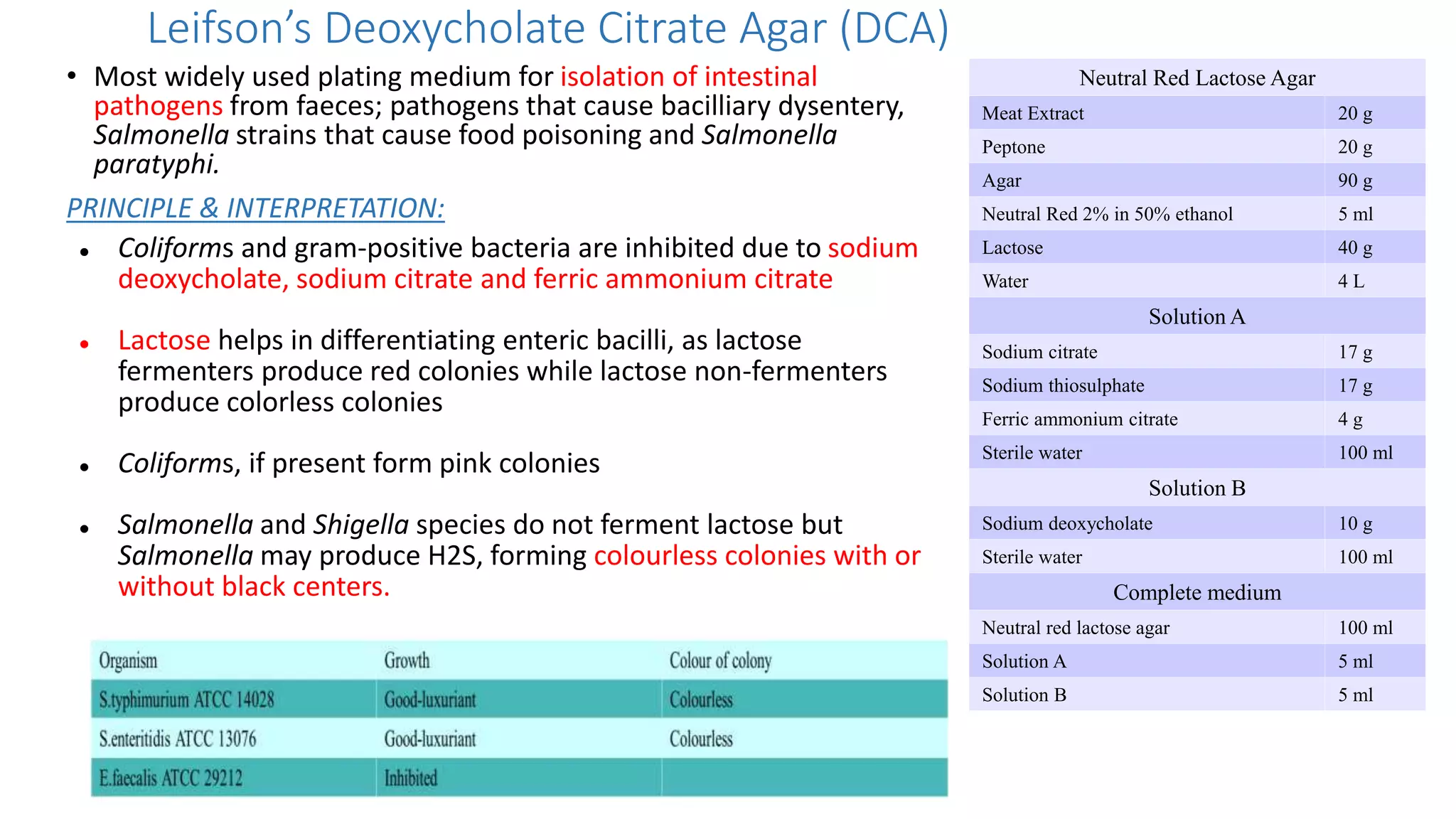
Leifson’s Deoxycholate Citrate Agar (DCA)
• Most widely used plating medium for isolation of intestinal
pathogens from faeces; pathogens that cause bacilliary dysentery,
Salmonella strains that cause food poisoning and Salmonella
paratyphi.
PRINCIPLE & INTERPRETATION:
 Coliforms and gram-positive bacteria are inhibited due to sodium
deoxycholate, sodium citrate and ferric ammonium citrate
 Lactose helps in differentiating enteric bacilli, as lactose
fermenters produce red colonies while lactose non-fermenters
produce colorless colonies
 Coliforms, if present form pink colonies
 Salmonella and Shigella species do not ferment lactose but
Salmonella may produce H2S, forming colourless colonies with or
without black centers.
Neutral Red Lactose Agar
Meat Extract 20 g
Peptone 20 g
Agar 90 g
Neutral Red 2% in 50% ethanol 5 ml
Lactose 40 g
Water 4 L
Solution A
Sodium citrate 17 g
Sodium thiosulphate 17 g
Ferric ammonium citrate 4 g
Sterile water 100 ml
Solution B
Sodium deoxycholate 10 g
Sterile water 100 ml
Complete medium
Neutral red lactose agar 100 ml
Solution A 5 ml
Solution B 5 ml
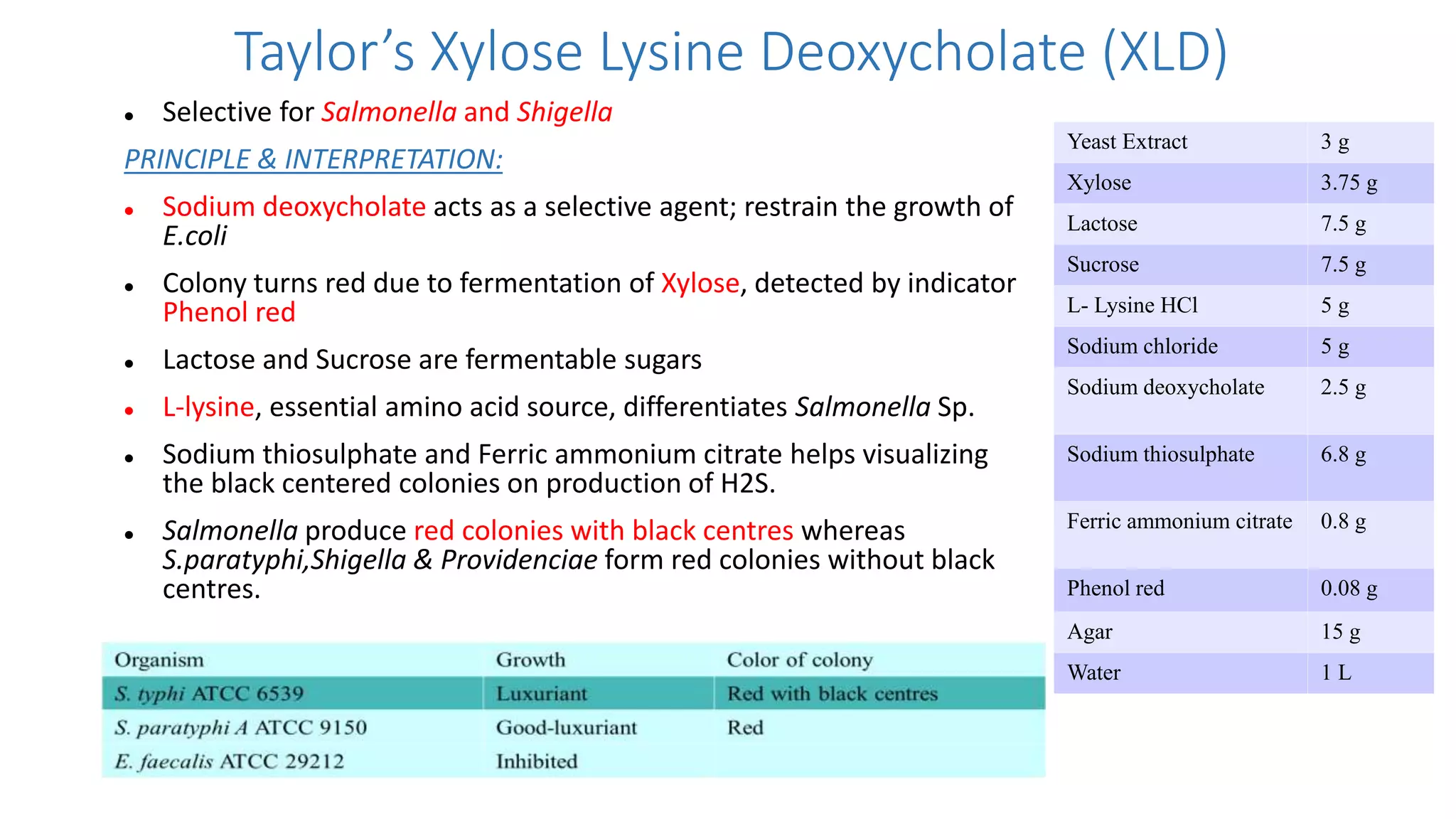
Taylor’s Xylose Lysine Deoxycholate (XLD)
 Selective for Salmonella and Shigella
PRINCIPLE & INTERPRETATION:
 Sodium deoxycholate acts as a selective agent; restrain the growth of
E.coli
 Colony turns red due to fermentation of Xylose, detected by indicator
Phenol red
 Lactose and Sucrose are fermentable sugars
 L-lysine, essential amino acid source, differentiates Salmonella Sp.
 Sodium thiosulphate and Ferric ammonium citrate helps visualizing
the black centered colonies on production of H2S.
 Salmonella produce red colonies with black centres whereas
S.paratyphi,Shigella & Providenciae form red colonies without black
centres.
Yeast Extract 3 g
Xylose 3.75 g
Lactose 7.5 g
Sucrose 7.5 g
L- Lysine HCl 5 g
Sodium chloride 5 g
Sodium deoxycholate 2.5 g
Sodium thiosulphate 6.8 g
Ferric ammonium citrate 0.8 g
Phenol red 0.08 g
Agar 15 g
Water 1 L
Hektoen Enteric Agar Medium
 For differential and selective isolation of Salmonella and
Shigella
PRINCIPLE & INTERPRETATION:
 Bile salts, bromothymol blue and acid fuchsin inhibit the
growth of most gram positive organisms
 Ferric ammonium citrate as iron source, cause production
of hydrogen sulfide from sodium thiosulphate and by
reacting with hydrogen sulfide, forms a black precipitate.
 Enterobacters other than Salmonella and Shigella are
capable of fermenting one or more of the carbohydrates
produce yellow or salmon-orange coloured colonies.
 Non-fermenters will produce blue-green colonies
 Salmonella reduce sulfur to hydrogen sulfide, producing a
black precipitate
Peptone 12 g
Yeast extract 3 g
Lactose 12 g
Sucrose 2 g
Salicin 9 g
Bile Salts mixture 9 g
Sodium chloride 5 g
Sodium thiosulfate 5 g
Ferric ammonium citrate 1.5
Acid fuchsin 0.1 g
Bromothymol blue 0.065g
Agar 14 g
Water 1 L
Organism Colour of colony
S. typhimurium ATCC 14028 Blue-green with or without black centres
Shigella flexneri ATCC 12022 Greenish blue
E. faecalis ATCC 29212 -
SS Agar
 Moderately selective and differential for Salmonella spp. and
some Shigella spp.
 Modification of the Deoxycholate Citrate Agar
PRINCIPLE & INTERPRETATION:
 Bile Salts, Sodium Citrate and Brilliant Green inhibit gram-
positive, Coliforms and inhibit swarming Proteus spp.
 Thiosulfate and Ferric Citrate permit detection of hydrogen
sulfide by the production of colonies with black centers
 Salmonella will not ferment lactose, but produce hydrogen
sulfide gas; colonies appear colorless with black centres.
 Shigella do not ferment lactose or produce hydrogen sulfide gas,
hence colonies appear colourless.
Beef Extract 5 g
Enzymatic Digest of Casein 2.5 g
Enzymatic Digest of Animal
Tissue
2.5 g
Lactose 10 g
Bile Salts 8.5 g
Sodium Citrate 8.5 g
Sodium Thiosulfate 8.5 g
Ferric Citrate 1.0 g
Brilliant Green 0.00033 g
Neutral Red 0.025 g
Agar 13.5
Distilled Water 1 L
S. typhi ATCC 6539 Colorless colonies with black center
S. flexneri ATCC 12022 Colorless colonies
E. faecalis ATCC 19433 Inhibited
Special Medias for Salmonella & Shigella
• .
BISMUTH SULPHITE AGAR
HEKTOEN ENTERIC AGAR
XLD
DCA
SS AGAR
Schiemann CIN Agar
Cefsulodin Irgasan Novobiocin
 Selective isolation of Yersinia enterocolitica
 Differentiates between mannitol fermenting and non-fermenting
bacteria
PRINCIPLE & INTERPRETATION:
 Mannitol fermenting colonies take red colour, while non-fermenting
form colourless and translucent colonies
 Sodium deoxycholate and crystal violet, selectively inhibit gram-
positive and gram-negative bacteria
 Antibiotic supplement makes it highly selective for Yersinia
 Dark red colonies resembling bulls eye, surrounded by a transparent
border
 Serotyping is based on colony size, smoothness and ratio of the
border to centre diameter
Yersinia Selective Agar Base
Peptone 20 g/L
Yeast Extract 2.0 g/L
Mannitol 20 g/L
Sodium pyruvate 2.0 g/L
Sodium chloride 1.0 g/L
Magnesium sulphate 0.01 g/L
Sodium deoxycholate 0.5 g/L
Neutral red 0.03 g/L
Crystal violet 0.001 g/L
Agar 12.5 g/L
Complete medium
Agar Base 500ml
Cefsulodin 7.5 mg
Irgasan 2.0 mg
Novobiocin 1.25 mg
Organism Growth Colour of colony
Y.enterocolitica ATCC
27729
Good-
luxuriant
Transluscent with dark pink/red
centre & bile precipitate
E.faecalis ATCC 29212 Inhibited
TCBS Agar
(Thiosulphate Citrate Bile Sucrose)
 Highly selective and differential for Vibrio species
PRINCIPLE & INTERPRETATION:
 Sucrose fermentation produces acid, which converts the colour of
bromothymol blue or thymol blue
 High concentrations of sodium thiosulfate and sodium citrate inhibit
the growth of Enterobacteriaceae
 Inhibition of Gram-positive bacteria is achieved by the
incorporation of ox bile
 Sodium thiosulfate as a sulfur source, with ferric citrate, allows easy
detection of hydrogen sulfide production
 Alkaline pH of the medium enhances the recovery of V.cholerae and
inhibits the growth of others
Yeast extract 5 g
Peptone 10 g
Sodium thiosulfate 10 g
Sodium citrate 10 g
Ox bile 8 g
Sucrose 20 g
Sodium chloride 10 g
Ferric citrate 1 g
Bromothymol blue 0.04 g
Thymol blue 0.04 g
Agar 15 g
Water 1 L
Organism Growth Colour of colony
V.cholerae ATCC 15748 Good-luxuriant Yellow
E.faecalis ATCC 29212 Inhibited
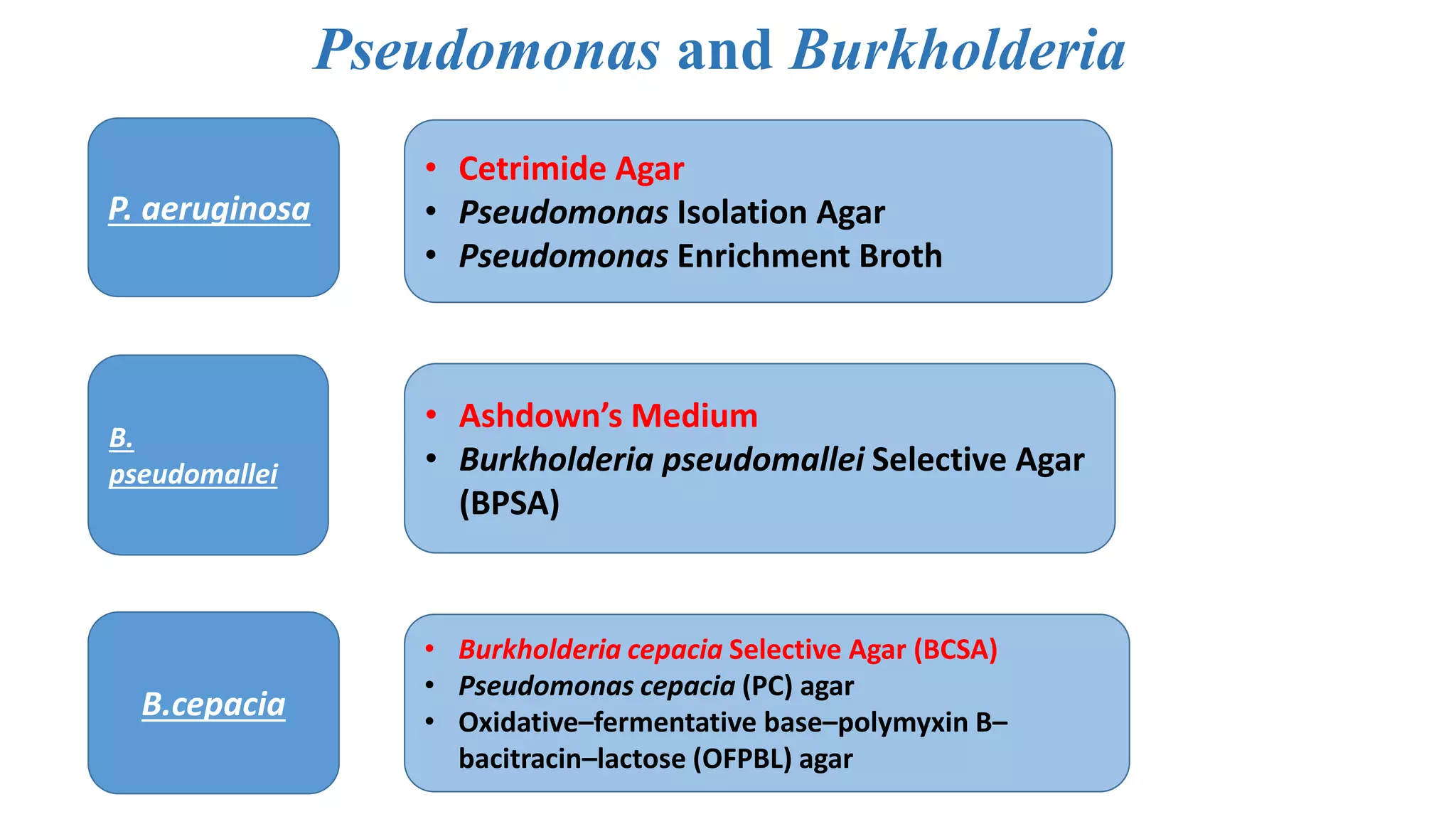
Bile Salt Agar (BSA)
 For isolation and identification of bile tolerant bacteria
responsible for food poisoning.
PRINCIPLE & INTERPRETATION:
 Vibrio species, like many other gram-negative bacteria, grow
in the presence of relatively high levels of bile salts
 Sodium chloride buffers the medium well. Sodium
taurocholate inhibits most of the gram-negative organisms
 Colonies of Vibrios have a distinctive appearance which may
be seen by comparing a known strain of Vibrio cholerae with
Escherichia coli.
Peptone 10 g
Meat Extract 5 g
Sodium Chloride 5 g
Sodium
taurocholate
5 g
Agar 15 g
Water 1 L
Organism Growth
Vibrio cholerae ATCC15748 Luxuriant
Staphylococcus aureus ATCC 25923 Inhibited
Monsur's tellurite taurocholate gelatin agar
 Selective isolation and differentiation of Vibrio cholerae and
other species of Vibrios.
PRINCIPLE & INTERPRETATION:
 Sodium chloride maintains the osmotic equilibrium ; sodium
carbonate maintains the elevated pH
 Gelatin acts as an additional carbon and energy source
 The high pH and potassium tellurite are inhibitory to most
Enterobacteriaceae and gram-positive bacteria, though
Proteus may form grey centered colonies without a halo
 Colonies are often surrounded by a gelatin liquefaction halo.
Organism Growth Color
Vibrio cholerae ATCC 15748 Good-luxuriant Grey
Proteus mirabilis ATCC 25933 None-poor Black
Taurocholate Gelatin Agar
Peptone 10 g
Sodium chloride 10 g
Sodium taurocholate 5 g
Sodium carbonate 1 g
Gelatin 30 g
Agar 15 g
Distilled water 1 L
Complete Medium
Taurocholate Gelatin Agar 100 ml
Diluted Potassium tellurite
(0.05%)
1 ml
Pseudomonas and Burkholderia
P. aeruginosa
B.
pseudomallei
B.cepacia
• Cetrimide Agar
• Pseudomonas Isolation Agar
• Pseudomonas Enrichment Broth
• Ashdown’s Medium
• Burkholderia pseudomallei Selective Agar
(BPSA)
• Burkholderia cepacia Selective Agar (BCSA)
• Pseudomonas cepacia (PC) agar
• Oxidative–fermentative base–polymyxin B–
bacitracin–lactose (OFPBL) agar
Cetrimide Agar
• For isolation of Pseudomonas aeruginosa.
• P. aeruginosa produces water soluble pigments, including yellow-green
fluorescent pigment pyoverdin and blue pigment pyocyanin, together creating
bright green colour.
PRINCIPLE & INTERPRETATION:
• Cetyltrimethylammonium bromide (Cetrimide) acts as cationic detergent and
causes denaturation of bacterial membrane proteins .
• Gelatin peptone provides nutrition.
• Sodium chloride maintains osmotic equilibrium.
• Magnesium chloride and potassium sulphate act as pigment-enhancers.
• Colonies exhibit a yellow-green to blue colour and show fluorescence under
short wavelength (254 nm) ultraviolet light, with a characteristic grape like
smell of aminoacetophenone.
Pseudomonas aeruginosa ATCC
9027
luxuriant
Escherichia coli ATCC 8739 inhibited
Ingredients
Gelatin peptone
Magnesium chloride
Potassium sulphate
Cetrimide (0.03%)
Agar (1.5%)
Ashdown's medium
• For isolation of Burkholderia pseudomallei.
PRINCIPLE & INTERPRETATION:
• Crystal violet and Gentamicin act as selective agents.
• Neutral red – indicator.
• Glycerol provides nutrition.
• Colonies appear flat, wrinkled, slightly dry, having pinkish purple
colour with a metallic sheen.
B.pseudomallei ATCC 23343 Growth
P. aeruginosa ATCC 27853 No growth
INGREDIENTS-
Tryptone soya broth
Gentamicin
Crystal violet (0.1%)
Neutral Red (1%)
Glycerol
Agar (1.5%)
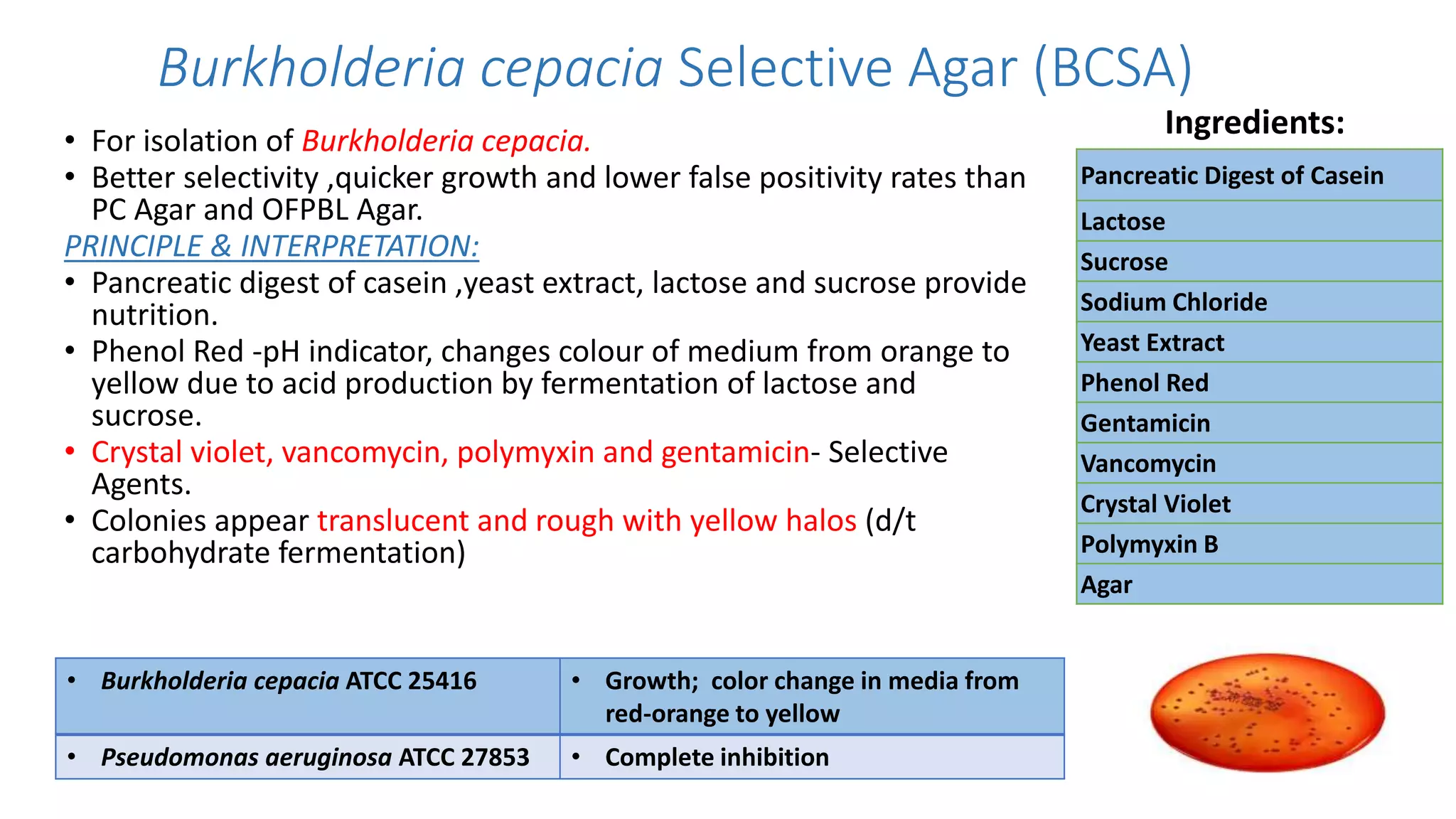
Burkholderia cepacia Selective Agar (BCSA)
• For isolation of Burkholderia cepacia.
• Better selectivity ,quicker growth and lower false positivity rates than
PC Agar and OFPBL Agar.
PRINCIPLE & INTERPRETATION:
• Pancreatic digest of casein ,yeast extract, lactose and sucrose provide
nutrition.
• Phenol Red -pH indicator, changes colour of medium from orange to
yellow due to acid production by fermentation of lactose and
sucrose.
• Crystal violet, vancomycin, polymyxin and gentamicin- Selective
Agents.
• Colonies appear translucent and rough with yellow halos (d/t
carbohydrate fermentation)
• Burkholderia cepacia ATCC 25416 • Growth; color change in media from
red-orange to yellow
• Pseudomonas aeruginosa ATCC 27853 • Complete inhibition
Pancreatic Digest of Casein
Lactose
Sucrose
Sodium Chloride
Yeast Extract
Phenol Red
Gentamicin
Vancomycin
Crystal Violet
Polymyxin B
Agar
Ingredients:
Haemophilus species
• Fildes Blood-Digest Agar
• Levinthal’s Medium
• Haemophilus Isolation Agar
• Haemophilus Differential
Selective medium
H.influanzae,
H.parainfluanzae,H.
parahaemolyticus
• Mueller-Hinton–based
chocolate agar (supplemented
with 1% IsoVitaleX and 3 mg/mL
vancomycin)
• Heart infusion–based agar
(supplemented with 10% fetal bovine
serum and 3 mg/mL vancomycin)
H.ducreyi
Fildes Blood-Digest Agar
Used for isolation of Haemophilus species.
PRINCIPLE & INTERPRETATION:
•Pepsin causes sterile digestion of Defibrinated Sheep Blood
which causes release of factor x (haemin) and factor V(NAD)
•High concentration of haemin is inhibitory to many throat
commensals
•Colonies of Non capsulated strains 0.5-1 mm circular, low
convex, smooth, pale grey and transparent with slightly blue
iridescence and a fishy, seminal odour.
•Capsulated strains = Larger (1-3mm), high convex, mucoid
with strong irridescence of red, orange, green and blue
shades which alter with angle of observation.
INGREDIENTS Qnt.
NaCl 150ml
HCl 6ml
Defibrinated
Sheep Blood
50ml
Pepsin 1g
NaOH 12ml
Chloroform .5ml
Agar
Levinthal’s Medium
For cultivation of Haemophilus species
PRINCIPLE & INTERPRETATION:
•Blood provides factor-X (Heat stable) and factor-V (Heat
labile).
•Peptic digest of animal tissue and beef extract act as source
of nitrogen.
•Sodium chloride maintains osmotic balance.
Capsulated strains show translucent colonies with distinctive
iridescence while non-capsulated strains are transparent and
bluish .
Composition Quantity
Peptic digest of animal
tissue
10
Beef extract 10
sterile rabbit or human
blood
5
sterile rabbit or human
blood
Agar 20
H.influenzae ATCC 35056 Luxuriant
H. influenzae ATCC 35056 Luxuriant
Haemophilus Isolation Agar
For isolation of Haemophilus species.
PRINCIPLE & INTERPRETATION:
• Horse blood provides factor-X, factor-V and other Growth Factors.
•Intact erythrocytes enable differentiation of hemolytic and non-
hemolytic Haemophilus spp.
•Beef Heart Infusion and Casein Peptone provide nutrition.
•Bacitracin (300 μg/mL) inhibits the normal respiratory tract microbes
(i.e., Staphylococci, Micrococci, Neisseriae , Streptococci).
Haemophilus influenzae ATCC 10211 Growth
Haemophilus parahaemolyticus ATCC
10014
Growth, Beta hemolysis
Staphylococcus aureus ATCC 25923 Inhibition (partial to complete)
Composition-
Beef Heart Infusion
Yeast extract
Casein Peptone
Sodium Chloride
NAD
Bacitracin
Defibrinated Horse Blood
(5%)
Agar
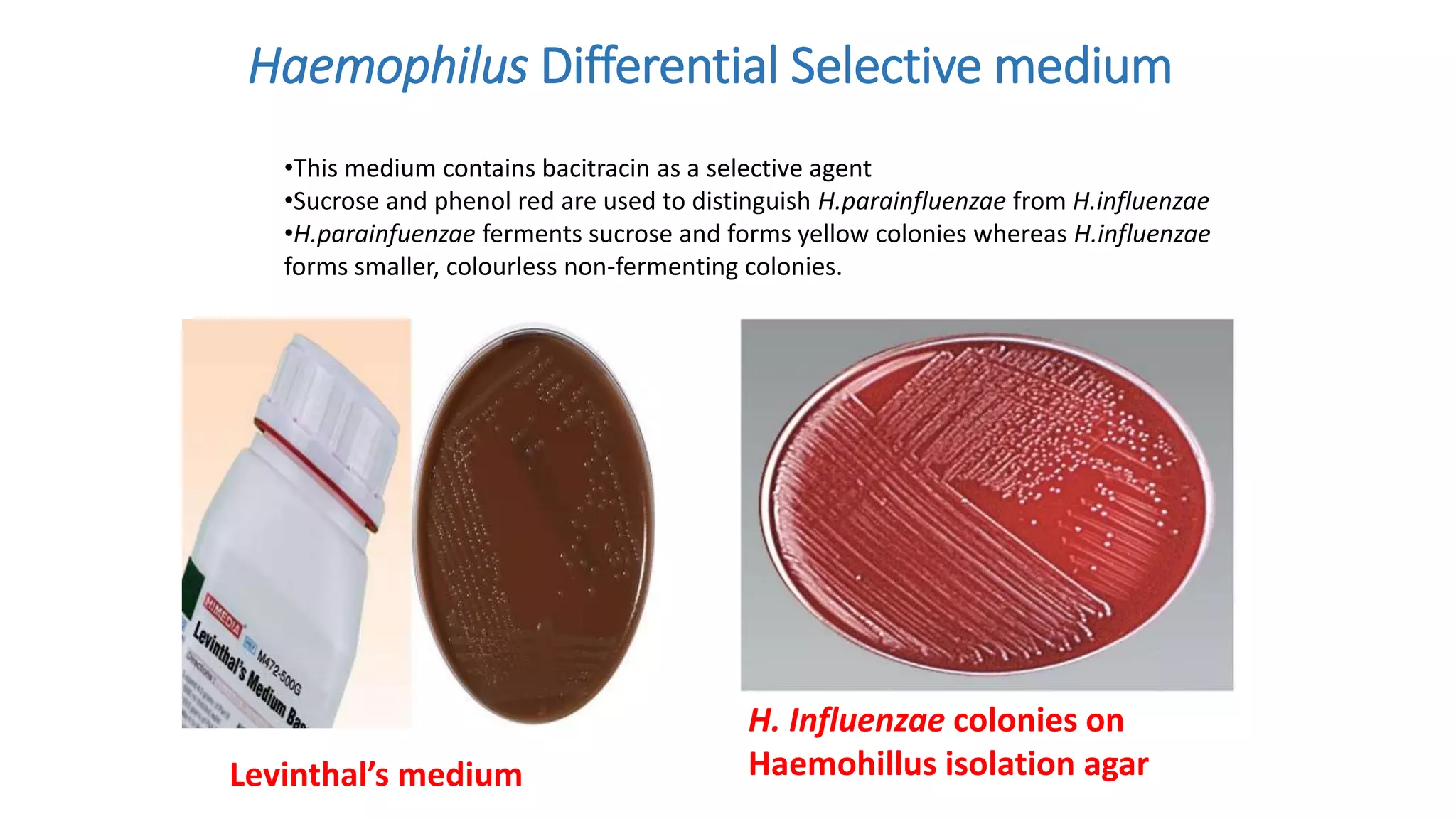
Haemophilus Differential Selective medium
•This medium contains bacitracin as a selective agent
•Sucrose and phenol red are used to distinguish H.parainfluenzae from H.influenzae
•H.parainfuenzae ferments sucrose and forms yellow colonies whereas H.influenzae
forms smaller, colourless non-fermenting colonies.
Levinthal’s medium
H. Influenzae colonies on
Haemohillus isolation agar
Bordetella
• Bordet Gengou Medium
• Regan-Lowe Agar (Charcoal Blood Agar)
• Stainer Scholte synthetic medium
• Jones-Kendrick Medium(Blood-free solid medium for
transport and cultivation)
Bordetella
Bordet Gengou Medium
Recommended for the detection and isolation of Bordetella pertussis and
Bordetella parapertussis .
PRINCIPLE & INTERPRETATION:
•Potato infusion and peptic digest of animal tissue serve as carbon and
nitrogen source while glycerol and blood enrichment provides additional
nutrients.
•Sodium chloride maintains osmotic equilibrium
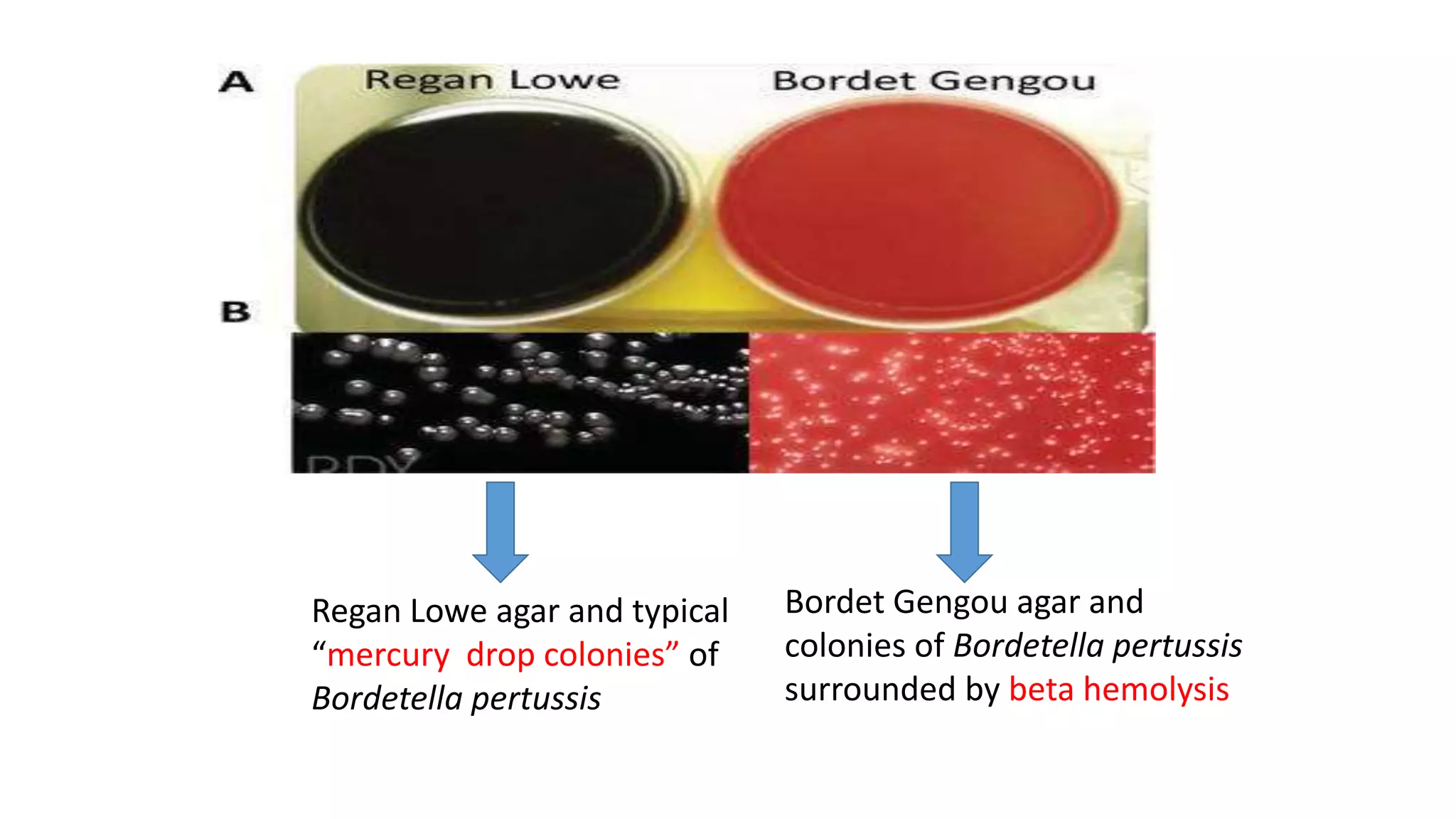
• Colonies appear small, smooth, dome shaped, greyish-white with a shiny
surface resembling ‘mercury drops’ or ‘bisected pearls’ surrounded by a
hazy zone of haemolysis.
Bordetella pertussis ATCC 8467 Luxuriant growth with beta-hemolysis
Bordetella parapertussis ATCC 15311 Luxuriant growth with gamma-hemolysis
Staphylococcus aureus ATCC 25923 Inhibited
Ingredients Qnt.
(gm/l)
Potatoes,
infusion from
125
Peptic digest of
animal tissue
10
Sodium chloride 5
Agar 20
Final pH 6.7±0.2
Regan-Lowe Agar(Charcoal Blood Agar)
This media has largely replaced traditional Bordet Gongou media
PRINCIPLE & INTERPRETATION:
• Peptic digest of animal tissue, beef extract and yeast extract
provide essential nutrients to the organisms
•Sodium chloride maintains osmotic balance
• Starch soluble and charcoal neutralizes substances toxic to
Bordetella species such as fatty acid
Bordetella pertussis ATCC 8467 Growth
Staphylococcus aureus ATCC
25923
Inhibition
Ingredients Qnt.
(gm/l)
Peptic digest of
animal tissue
10
Beef extract 10
Starch soluble 10
Sodium chloride 5
charcol 4
Yeast extract 3.5
Agar 12
Final pH 7.5±0.2
Both media contain cephalaxin as an additive
for suppression of contaminating microorganism
Regan Lowe agar and typical
“mercury drop colonies” of
Bordetella pertussis
Bordet Gengou agar and
colonies of Bordetella pertussis
surrounded by beta hemolysis
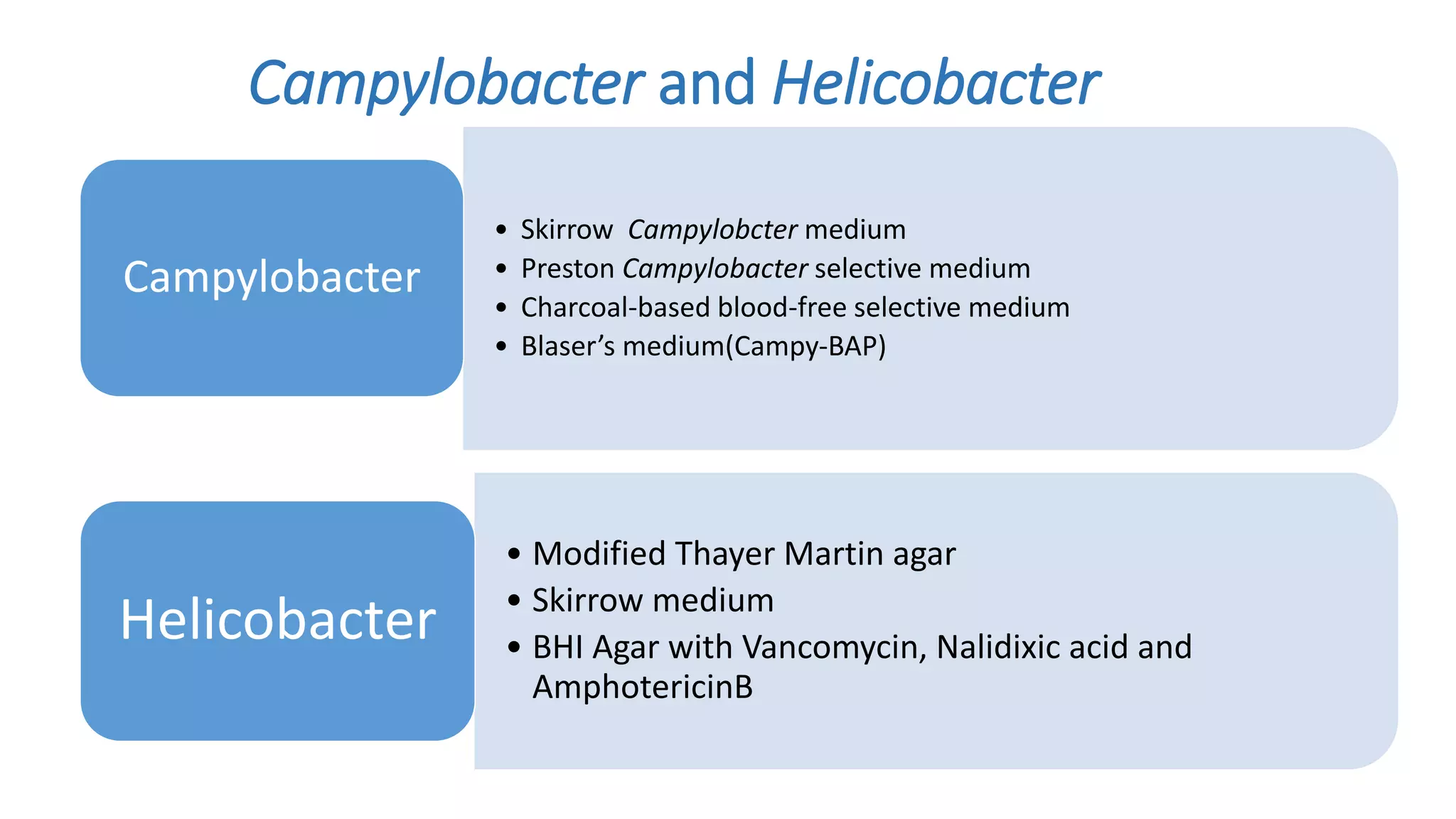
Campylobacter and Helicobacter
• Skirrow Campylobcter medium
• Preston Campylobacter selective medium
• Charcoal-based blood-free selective medium
• Blaser’s medium(Campy-BAP)
Campylobacter
• Modified Thayer Martin agar
• Skirrow medium
• BHI Agar with Vancomycin, Nalidixic acid and
AmphotericinB
Helicobacter
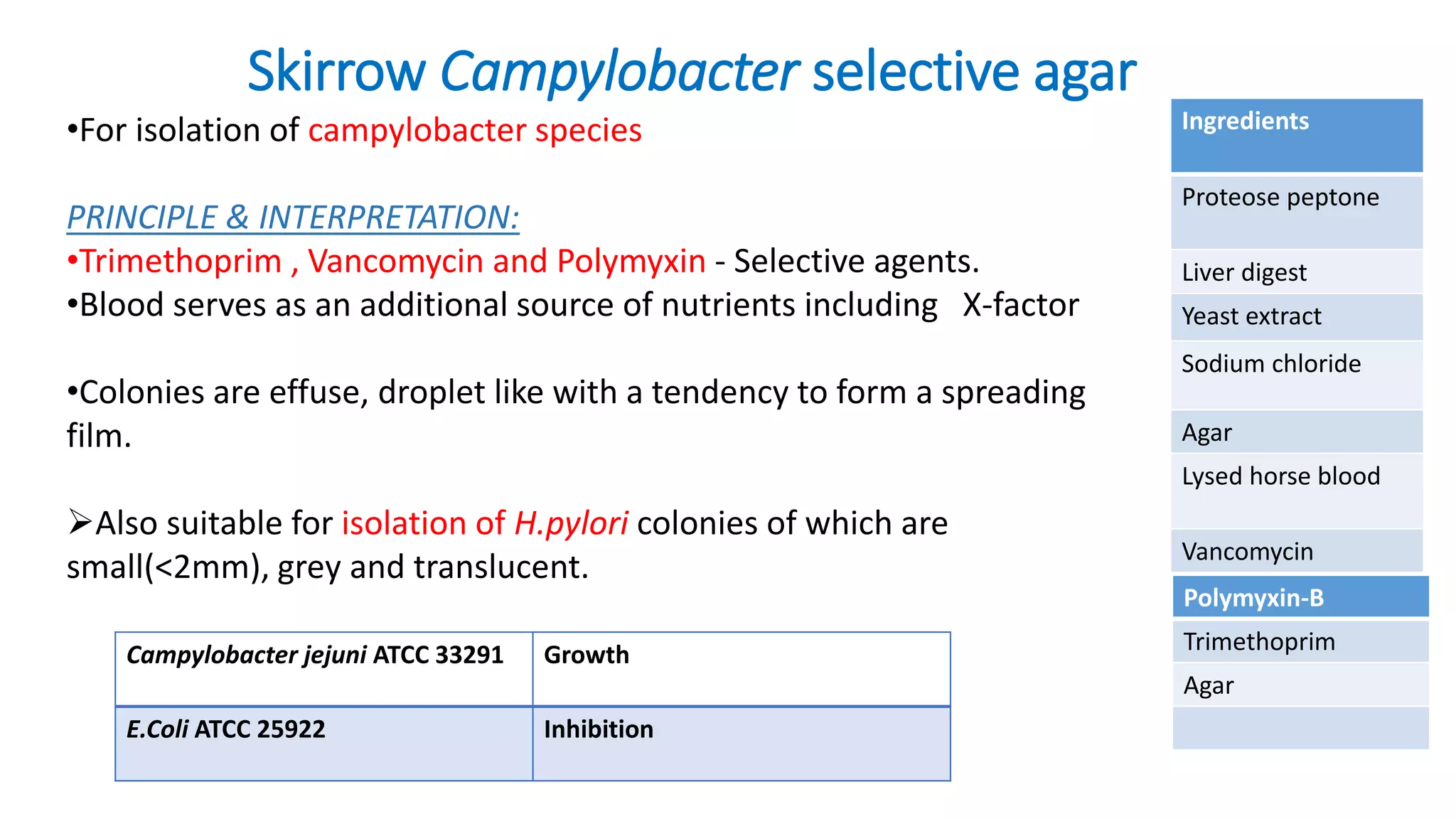
Skirrow Campylobacter selective agar
•For isolation of campylobacter species
PRINCIPLE & INTERPRETATION:
•Trimethoprim , Vancomycin and Polymyxin - Selective agents.
•Blood serves as an additional source of nutrients including X-factor
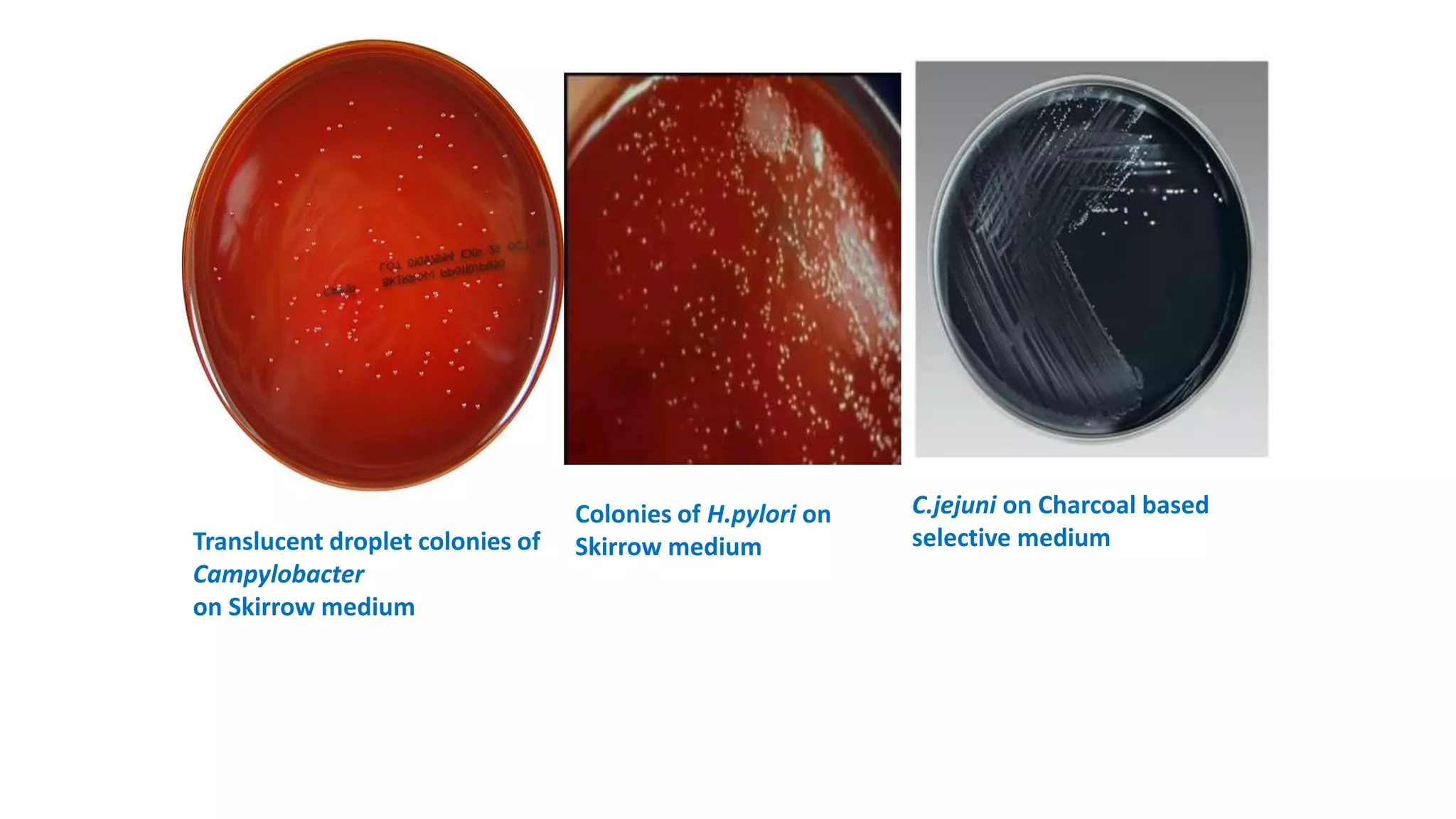
•Colonies are effuse, droplet like with a tendency to form a spreading
film.
Also suitable for isolation of H.pylori colonies of which are
small(<2mm), grey and translucent.
Campylobacter jejuni ATCC 33291 Growth
E.Coli ATCC 25922 Inhibition
Ingredients
Proteose peptone
Liver digest
Yeast extract
Sodium chloride
Agar
Lysed horse blood
Vancomycin
Polymyxin-B
Trimethoprim
Agar
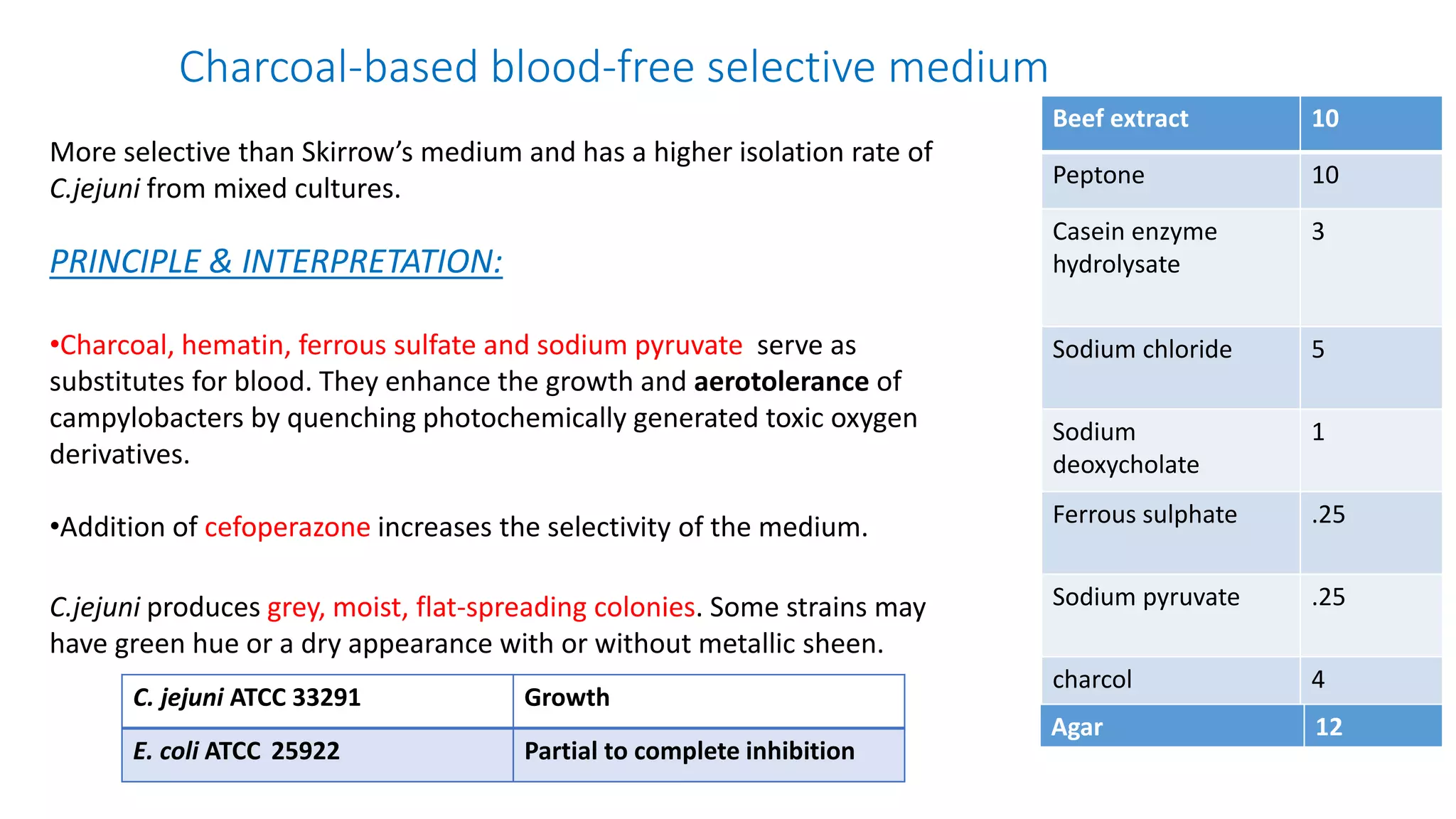
Charcoal-based blood-free selective medium
More selective than Skirrow’s medium and has a higher isolation rate of
C.jejuni from mixed cultures.
PRINCIPLE & INTERPRETATION:
•Charcoal, hematin, ferrous sulfate and sodium pyruvate serve as
substitutes for blood. They enhance the growth and aerotolerance of
campylobacters by quenching photochemically generated toxic oxygen
derivatives.
•Addition of cefoperazone increases the selectivity of the medium.
C.jejuni produces grey, moist, flat-spreading colonies. Some strains may
have green hue or a dry appearance with or without metallic sheen.
C. jejuni ATCC 33291 Growth
E. coli ATCC 25922 Partial to complete inhibition
Beef extract 10
Peptone 10
Casein enzyme
hydrolysate
3
Sodium chloride 5
Sodium
deoxycholate
1
Ferrous sulphate .25
Sodium pyruvate .25
charcol 4
Agar 12
Translucent droplet colonies of
Campylobacter
on Skirrow medium
Colonies of H.pylori on
Skirrow medium
C.jejuni on Charcoal based
selective medium
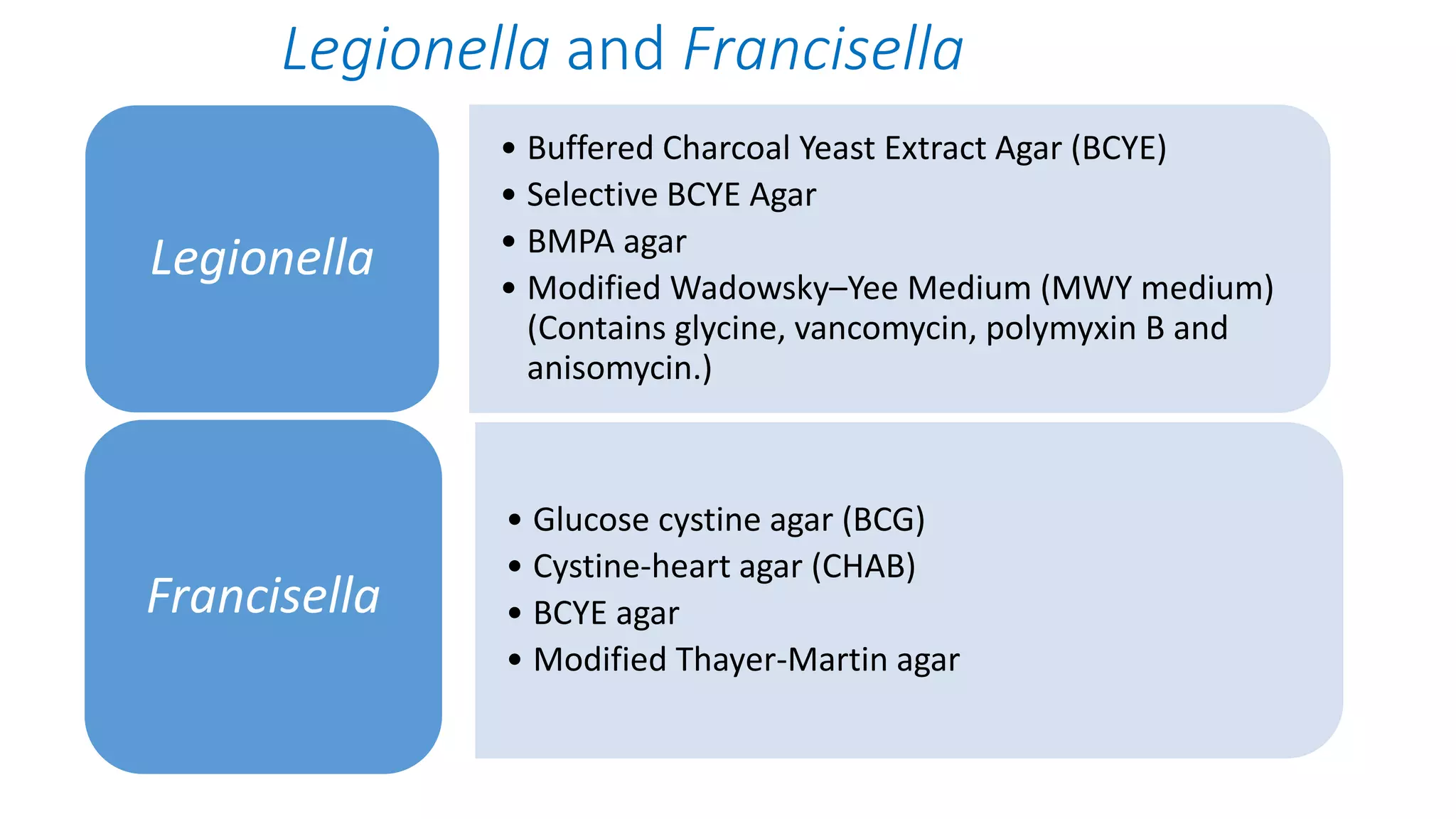
Legionella and Francisella
• Buffered Charcoal Yeast Extract Agar (BCYE)
• Selective BCYE Agar
• BMPA agar
• Modified Wadowsky–Yee Medium (MWY medium)
(Contains glycine, vancomycin, polymyxin B and
anisomycin.)
Legionella
• Glucose cystine agar (BCG)
• Cystine-heart agar (CHAB)
• BCYE agar
• Modified Thayer-Martin agar
Francisella
Buffered Charcoal Yeast Extract Agar (BCYE)
Selective isolation and cultivation of Legionella species
PRINCIPLE & INTERPRETATION:
•Charcoal acts as a detoxicant.
•Yeast extract acts as a rich source of vitamins, nitrogen as well as carbon.
•L-cystine hydrochloride; ferric pyrophosphate and a-ketoglutarate
stimulate growth of Legionella species
•ACES buffer maintains optimal pH.
Legionella colonies are gray-white to blue-green, glistening, convex, and
circular and may exhibit a cut-glass type of internal granular speckling.
Legionella pneumophila ATCC 33153 luxuriant
Enterococcus faecalis ATCC 29212 inhibited
Ingredients Qty.
(gm/l)
Yeast extract 10
Activated charcol 2
Alpha
ketoglutarate,
mono potassium
salt
1
ACES buffer 10
Agar 12
Final pH 6.8±0.2
Selective BCYE Agar- BCYE+ Glycine+ Polymyxin-B (79,200 IU/L)+ Cycloheximide(80mg/L)+
Vancomycin(5mg/L).
BMPA Medium- BCYE base supplemented with cefamandole, polymyxin-B and anisomycin
BYCE Agar also supports growth of Francisella tularensis and Bordetella
pertussis.
Colonies of Legionella on BCYE Agar
Media for Isolation of Francisella
•The organism is strictly aerobic and is enhanced by
enriched medium containing sulfhydryl compound
(cystine, cystein, thiosulphate, IsoVitalex)
•Two commercial media available: Glucose cystine agar
(BCG) and Cystine-heart agar (CHAB), both require the
addition of 5% sheep or rabbit blood.
•Colonies are minute droplet like (2-4mm), butyrous and
smooth with an opalescent sheen.
glucose 2.5%
Cystine HCL 0.1%
Blood(human
/Sheep/rabbit)
5%
Nutrient agar
Francisella tularensis ATCC
29684
luxuriant
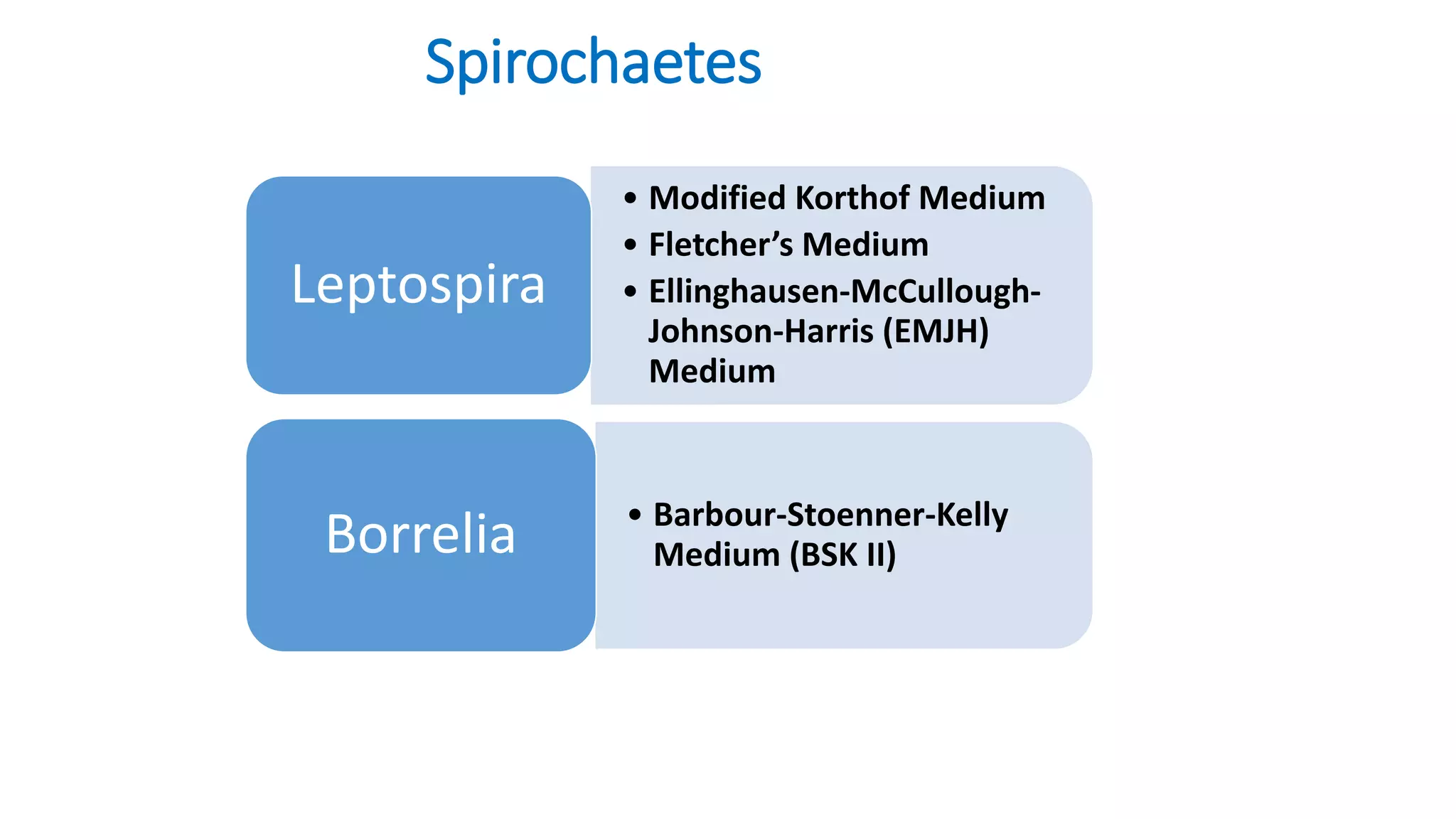
Spirochaetes
• Modified Korthof Medium
• Fletcher’s Medium
• Ellinghausen-McCullough-
Johnson-Harris (EMJH)
Medium
Leptospira
• Barbour-Stoenner-Kelly
Medium (BSK II)
Borrelia
Modified Korthof Medium
Liquid media used for isolation, cultivation and maintenance of
Leptospira species.
PRINCIPLE & INTERPRETATION:
•Peptic digest of animal tissue provide amino acids and other
nitrogenous substances
•The salts supply essential nutrients
•Phosphates form buffering system while sodium chloride maintains
osmotic equilibrium and provides essential ions.
Growth occurs as a ringed area (disc) 1-3 cm below the surface of the
medium. Growth is examined using a direct wet preparation under
dark field illumination.
Peptic digest of
animal tissue
0.8
Sodium chloride 1.4
Sodium bicarbonate 0.02
Pottassium chloride 0.04
Calcium chloride 0.04
Monopotassium
hydrogen phosphate
0.240
Disodium hydrogen
phosphate
0.880
Final pH 7.2±.2
Fletcher’s Medium
Semi-solid Medium for isolation of Leptospira species.
Advantages over Liquid medium-
1. Evaporates less rapidly
2. Helps to maintain the virulence of freshly isolated
strains
3. Used for preparing cultures for iv inoculation into
rabbits for production of hyperimmune serum.
• Low concentration of agar helps in detecting motility
• Leptospira multiply within the upper part of the tube
forming zones of turbidity at varying depths, known as
Dinger’s Rings.
ingredients Qty.
(gm/l)
Peptic digest of
animal tissue
0.3
Beef extract 0.2
Sodium chloride 0.5
Agar 1.5
Final pH 7.9±.2
DINGER’S RING
EMJH Medium
(Ellinghausen-McCullough-Johnson-Harris)
Semi-solid medium where rabbit whole serum is replaced by bovine serum
albumin (fraction V) and polysorbate (Tween 80).
Thiamine, Albumin and polysorbate 80 are growth factors
Growth occurs as a band 0.5 to 1.0 cm below the surface of semisolid
media, known as Dinger’s ring.
Barbour-Stoenner-Kelly Medium (BSK II)
•This medium is complex mixture of different amino acids, vitamins and
growth factors which are required for the growth of Borrelia and
Spirochaete
PRINCIPLE & INTERPRETATION:
• Peptone, special serves as nitrogen source while glucose as energy source.
•Cholesterol acts as source of lipids.
• HEPES provides buffering capacity .
•Salts of Magnesium, sodium, calcium and potassium maintain the ionic
balance.
•Cultures are examined by dark-field microscopy or by fluorescence
microscopy .
B. burgdorferi ATCC 35210 Fair to good
S. aureus ATCC 25923 Inhibited
Ingredients-
CMRL 1066 medium
Neopeptone
Bovine serum albumin, fraction
V
yeastolate
HEPES
glucose
Sodium pyruvate
Sodium Citrate
N-acetylglucosamine
Sodium bicarbonate
7% gelatin
Unheated rabbit serum
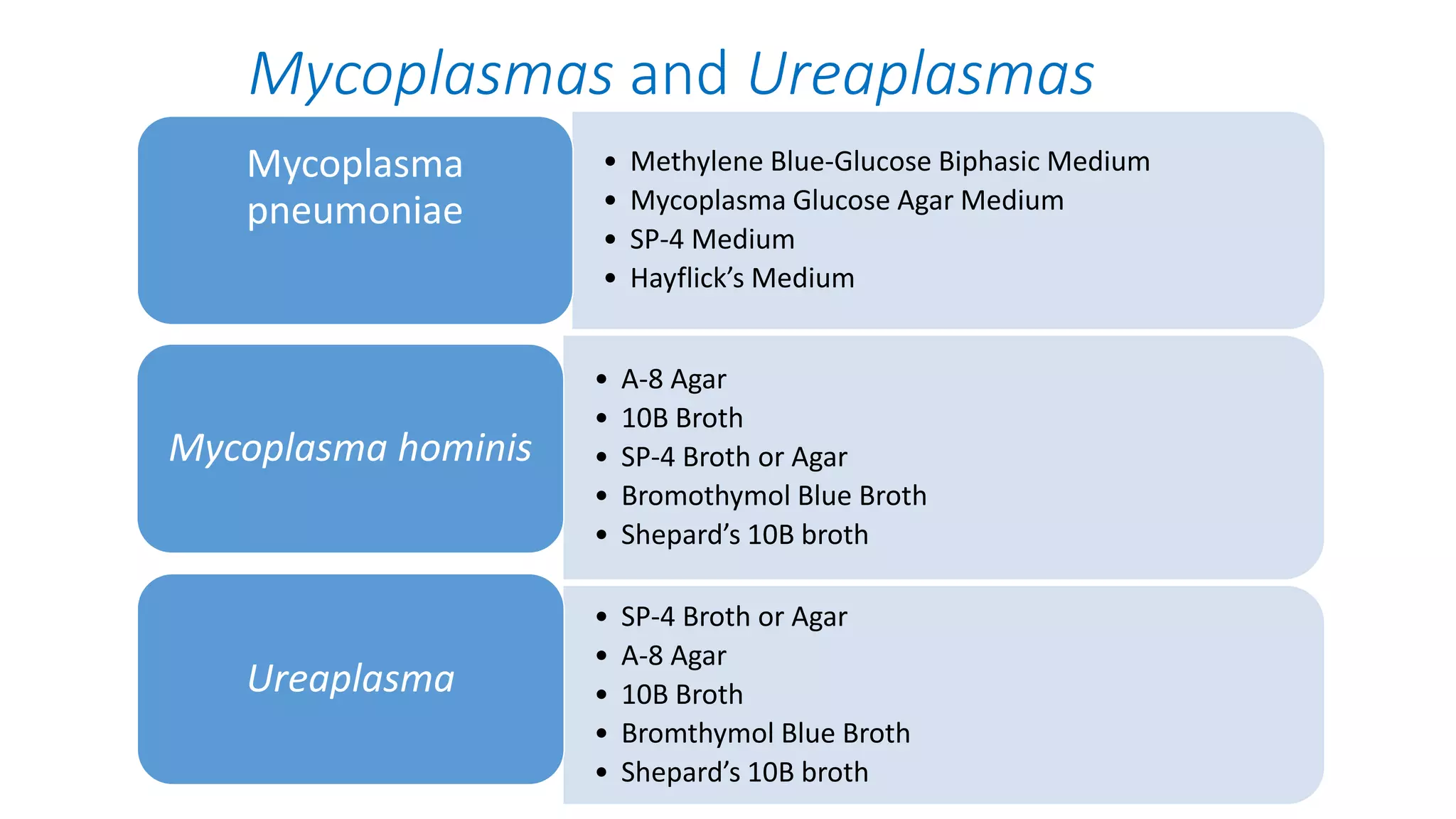
Mycoplasmas and Ureaplasmas
• Methylene Blue-Glucose Biphasic Medium
• Mycoplasma Glucose Agar Medium
• SP-4 Medium
• Hayflick’s Medium
Mycoplasma
pneumoniae
• A-8 Agar
• 10B Broth
• SP-4 Broth or Agar
• Bromothymol Blue Broth
• Shepard’s 10B broth
Mycoplasma hominis
• SP-4 Broth or Agar
• A-8 Agar
• 10B Broth
• Bromthymol Blue Broth
• Shepard’s 10B broth
Ureaplasma
Methylene Blue-Glucose Biphasic Medium
•Biphasic medium for isolation of M.pneumoniae
•Solid phase is dispensed in sterile bottles ,allowed to set and
then overlayed with liquid phase.
PRINCIPLE & INTERPRETATION:
•Methylene blue acts as selective agent
•During growth , the medium becomes acidic and phenol red
turns colour from salmon to yellow.
•Reduction of methylene blue turns medium from blue to
colourless.
•Hence, colour of broth phase changes from purple to green,
while the agar phase turns from purple to yellow.
Mycoplasma pneumoniae
ATCC 15531
Growth; colour change
Escherichia coli ATCC 25922 Inhibited
Ingredients
PPLO
(agar base/broth) w/o
crystal violet
Yeast extract
Sodiumdeoxyribonucleate
(calf thymus) solution (0.2%)
Thallous acetate solution
Penicillin solution
Horse serum (unheated)
Glucose solution (10%)
Phenol Red solution (0.2%)
Methylene blue
solution(0.1%)
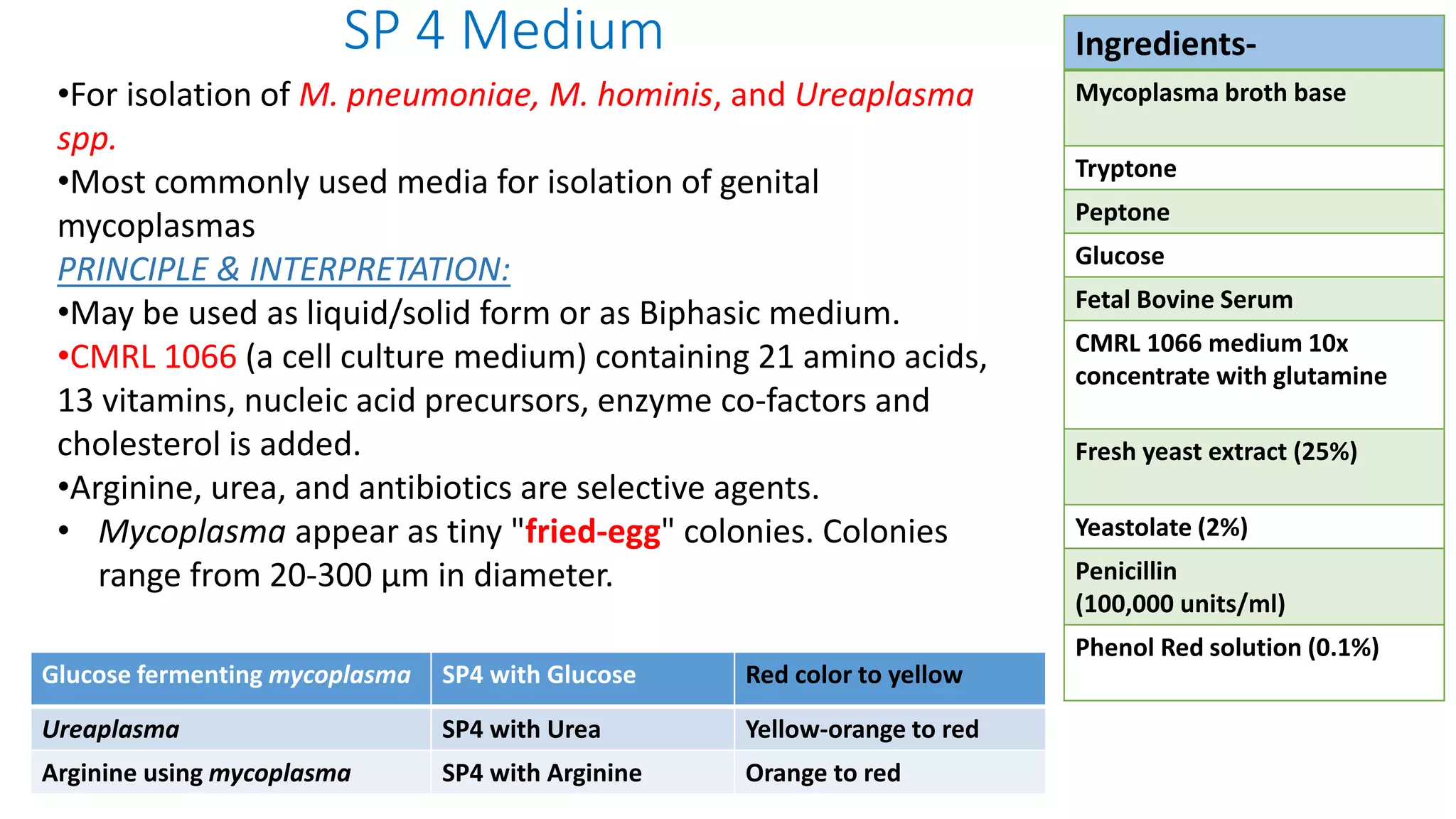
SP 4 Medium
•For isolation of M. pneumoniae, M. hominis, and Ureaplasma
spp.
•Most commonly used media for isolation of genital
mycoplasmas
PRINCIPLE & INTERPRETATION:
•May be used as liquid/solid form or as Biphasic medium.
•CMRL 1066 (a cell culture medium) containing 21 amino acids,
13 vitamins, nucleic acid precursors, enzyme co-factors and
cholesterol is added.
•Arginine, urea, and antibiotics are selective agents.
• Mycoplasma appear as tiny "fried-egg" colonies. Colonies
range from 20-300 µm in diameter.
Glucose fermenting mycoplasma SP4 with Glucose Red color to yellow
Ureaplasma SP4 with Urea Yellow-orange to red
Arginine using mycoplasma SP4 with Arginine Orange to red
Ingredients-
Mycoplasma broth base
Tryptone
Peptone
Glucose
Fetal Bovine Serum
CMRL 1066 medium 10x
concentrate with glutamine
Fresh yeast extract (25%)
Yeastolate (2%)
Penicillin
(100,000 units/ml)
Phenol Red solution (0.1%)
Growth of
M.pneumoniae on
Methylene Blue-Glucose
Biphasic Medium
Fried egg
colonies of
Mycoplasma
SP-4 Medium
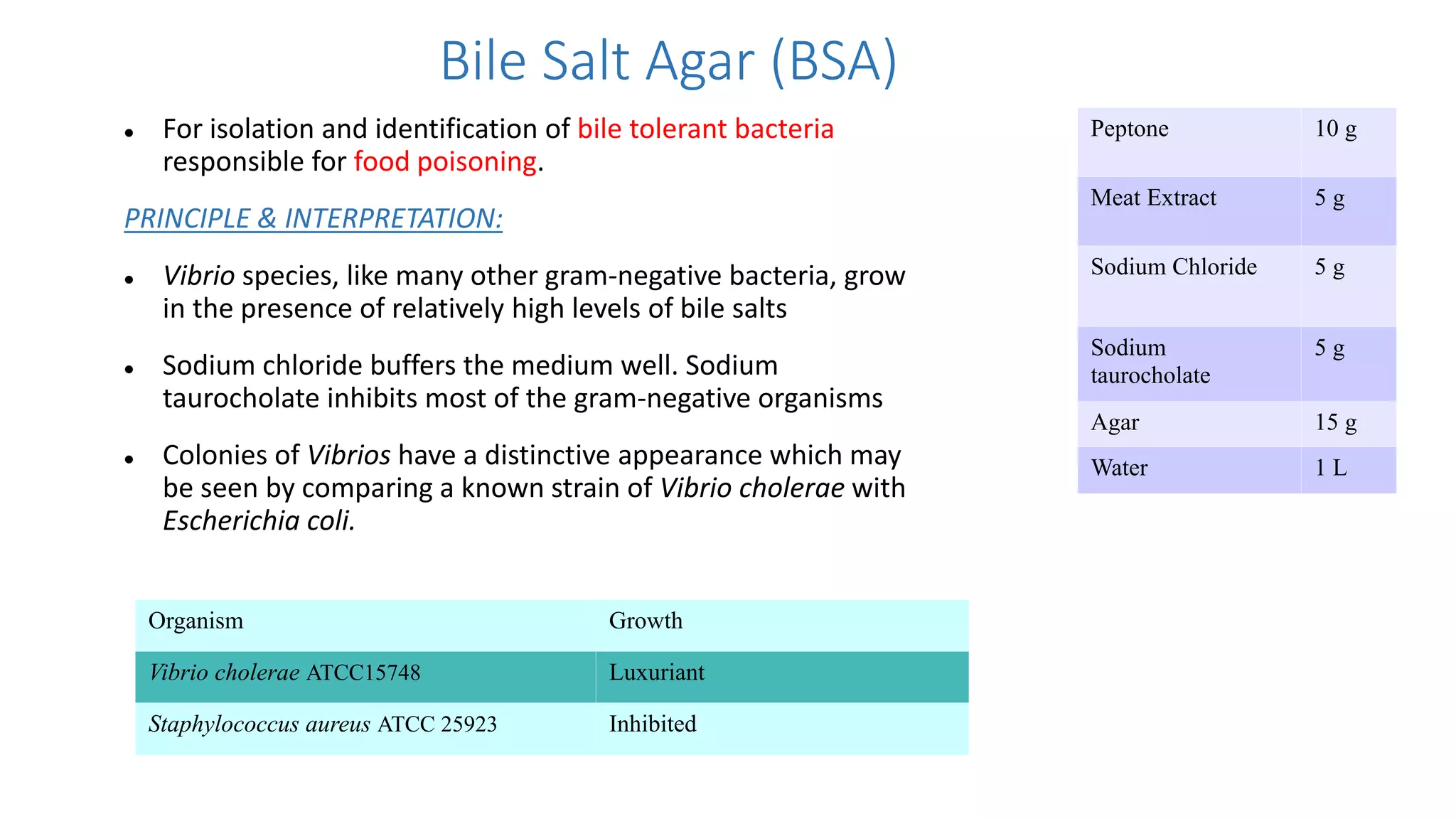
REFERENCES
• Mackie & McCartney Practical Medical
Microbiology (14th edition)
• Bailey and Scott’s Diagnostic Microbiology (15th
edition)
• HIMEDIA
• Nichols T, Freeman R. A new selective medium
Streptococcus pneumoniae. J Clin Pathol. 1980
Aug;33(8):770-3. doi: 10.1136/jcp.33.8.770. PMID:
7430390; PMCID: PMC1146214.
THANK YOU!!
.

Culture media part-2

  • 1.
    CULTURE MEDIA –PART 2 MODERATOR : Dr. S. K. SINGH PRESENTED BY: Dr. SAVITA CHOUDHARY DR. SUMEDHA THANVI
  • 2.
    INTRODUCTION DEFINITION: • CULTURE MEDIA:A medium used for cultivation of microorganisms. • CULTIVATION: Cultivation is a process of growing microorganisms in culture by taking bacteria from infection site (i.e. the in vivo environment ) by some means of specimen collection and growing them in artificial environment of the lab (i.e. in vitro environment ).
  • 3.
    TYPES OF CULTUREMEDIA • BASED ON FUNCTION: 1.Basal Media : Basic media with minimum basic ingredients that supports growth of non-fastidious bacteria. e.g: Peptone water, Nutrient broth, Nutrient agar. 2. Enriched media : Media prepared to meet the nutritional requirements of more exacting bacteria by addition of substances such as blood,serum or egg to a basal medium. e.g: Blood agar, Chocolate agar, Loeffler’s serum slope ,etc. 3. Enrichment Media: Liquid media added with some inhibitory agents which selectively allow certain organisms to grow and inhibit others. e.g: Tetrathionate broth ,Selenite F broth etc.
  • 4.
    TYPES OF CULTUREMEDIA (…contd) • 4. Selective Media: This media contains one or more agents that are inhibitory to all organisms except those “ selected” by the specific growth condition or chemical. E.g: Lowenstein- Jensen medium,Thiosulfate Citrate Bile Salt (TCBS) agar, etc. • 5. Differential Media: These media differentiate between two groups of bacteria by using an indicator. E.g: Mac conkey agar, CLED agar, etc • 6. Transport Media : Media which are devised to maintain the viability of a pathogen and to avoid overgrowth of other contaminants during transit from the patient to laboratory. e.g: Stuart’s medium, Venkatraman- Ramakrishnan medium, Cary Blair medium, etc.
  • 5.
    Gram positive cocci •Mannitol Salt Agar • Tellurite Glycine Agar • Salt cooked meat broth • DNase Test Agar • Milk Salt Agar Staphylococci • Todd Hewitt broth • Crystal violet blood agar • PNF medium • Nichols & Freeman Medium Streptococci
  • 6.
    Mannitol Salt Agar •Mannitol Salt Agar is used as a selective media for the isolation of pathogenic Staphylococci aureus from clinical and non clinical (soil, faeces etc.) specimens. PRINCIPLE: i. Beef extract and proteose peptone supply essential growth factors and trace nutrients to the growing bacteria. ii. Sodium chloride serve as an inhibitory agent against bacteria other than Staphylococci. iii. Mannitol is the fermentable carbohydrate ,fermentation of which leads to acid production which is detected by phenol red indicator. Ingredients Quantity (gm/l) Proteose peptone 10 Beef extract 1 Sodium chloride 75 D-Mannitol 10 Phenol Red 0.025 Agar 15 Final pH 7.4± 0.2
  • 7.
    Mannitol Salt Agar(…contd) INTERPRETATION: • S.aureus ferments mannitol and produce yellow coloured colonies surrounded by yellow zones. • Coagulase negative strains of Staphylococci are usually mannitol non fermenters and therefore produce pink to red colonies surrounded by red purple zone. • MSA selective for MRSA: - To MSA add oxacillin 6 mg/litre or methicillin 10 mg/litre. - To MSA add oxacillin 6 mg/litre and polymixin B 10 mg/litre. Organism Growth Colour of colonies S. aureus ATCC 6538 luxuriant Yellow /white colonies surrounded by yellow zone E. coli ATCC 25923 Inhibited -
  • 8.
    Tellurite Glycine Agar Usedfor quantitative detection of Coagulase positive Staphylococci. • This medium supports better growth of coagulase positive cocci even if present in small numbers. PRINCIPLE  Casein enzymic hydrolysate and yeast extract provide nitrogenous compounds and vitamin B complex.  Lithium chloride and potassium tellurite inhibits coagulase negative Staphylococci.  Mannitol is a source of fermentable carbohydrate INTERPRETATION  Occasional Coagulase-negative strain that may produce small grey colonies.  Coagulase-positive Staphylococci reduce tellurite and form black colonies Ingredients Quantity (gm/l) Casein enzymic hydrolysate 10 Yeast extract 5 Mannitol 5 Dipotassium phosphate 5 Lithium chloride 5 Glycine 10 Agar 16 Final pH 7.2±0.2 S.aureus ATCC 25923 Good luxuriant Black S.epidermidis ATCC 12228 Poor- Fair Grey E.coli ATCC 25922 Inhibited
  • 9.
    DNase Test Agar •This agar is recommended for the detection of deoxyribonuclease activity of bacteria and fungi, specially for the identification of pathogenic Staphylococci. PRINCIPLE AND INTERPRETATION: • Detection of deoxyribonuclease activity of bacteria and fungi. • With added toluidine blue,it is used in the identification and differentiation of non pigmented Serratia spp. from Enterobacter and Klebsiella. • Positive DNase activity is visualised as clear zones around colonies when plate is flooded with 1 N hydrochloric acid Organism Growth DNase activity S. aureus ATCC 25923 Luxuriant Positive Serratia marcescens ATCC 81005 Luxuriant Positive S.epidermidis ATCC 12228 Luxuriant Negative Ingredients Quantity (gm/l) Tryptone 15 Soya Peptone 5 Deoxyribonucleic acid (DNA) 2 Sodium Chloride 5 Agar 15 Final pH 7.3±0.2 Water 1 L
  • 10.
    Salt Cooked MeatBroth Used as an enrichment medium for isolation of Staphylococcus from grossly contaminated specimens. PRINCIPLE AND INTERPRETATION: • Selective for Staphylococci due to presence of sodium chloride in high concentration. • Peptic digest of animal tissue and beef extract provide essential nutrients. • Sodium chloride maintains osmotic equilibrium. Organism Growth S.Aureus ATCC 25923 Good luxuriant E.coli ATCC 25922 Inhibited Ingredients Quantity(gm/l) Beef Extract 10 Peptic digest of animal tissue 10 Neutral ox- heart tissue 30 Sodium chloride 100 Final pH 7.6±0.2 P.vulgaris ATCC 13315 Inhibited
  • 11.
    Milk Salt Agar •Used for selective isolation and cultivation of Staphylococcus. PRINCIPLE AND INTERPRETATION:  Beef extract, peptic digest of animal tissue and skim milk supply essential nutrients  Highly selective as majority of the contaminating organisms are inhibited by the high salt concentration (6.5%) Organism Growth Recovery S.aureus ATCC 25923 Good Luxuriant >=50% E.coli ATCC 25922 Inhibited 0% Ingredients Gms/L Peptic digest of animal tissue 5 Beef extract 3 Sodium chloride 65 Skim Milk 10% Agar 15
  • 12.
    Todd Hewitt broth •Thisenriched broth is used for luxuriant growth of organisms such as group A haemolytic Streptococci PRINCIPLE & INTERPRETATION: •Todd Hewitt Broth medium is very nutritious due to the presence of peptic digest of animal tissue and beef heart infusion. •Dextrose stimulates haemolysin production •The medium is well buffered by sodium phosphate and sodium carbonate to neutralize the acid produced during dextrose fermentation. This restricts destruction of antigenic streptococcal haemolysin. Selective medium for group B Streptococci : Prepare a solution of 15µg/l nalidixic acid and 8µg/l gentamicin and add .5ml of it and .25ml sterile defibrinated sheep blood to 4.75 ml of todd Hewwit broth. Ingredients Quantity (gm/l) Beef heart, infusion from 500 Peptic digest of animal tissue 20 Dextrose 2 Sodium chloride 2 Disodium phosphate .4 Sodium carbonate 2.5 Final pH 7.8±2
  • 13.
    Crystal violet bloodagar • Selective for Streptococus pyogenes and other Streptococci •At a concentration of 1 in 500000, crystal violet inhibits the growth of Staphylococcus aureus and some other bacteria found in clinical specimen PNF Medium Selective for Beta hemolytic Streptococci  Inhibit the growth of Staphylococci and Coliforms  Melt the Nutrient Agar, cool to 50ºC, add the ingredients and pour plates Ingredients Per Litre Sterile Nutrient Agar 90 ml Sterile Blood 10 ml Crystal Violet 0.1 % 0.2 ml Ingredients Per Litre Sterile Nutrient Agar Sterile Blood 50 ml Polymyxin B Sulphate 17000 units
  • 14.
    Agar of Nicholasand Freeman (Crystal Violet- Nalidixic Acid- Gentamycin Agar (CVNG) • This is a new selective medium for the detection of Streptococcus pneumonia • Highly selective for Strept. pneumoniae in sputum samples. • This medium is inhibitory to many respiratory bacteria other then the Pneumococcus,Viridans Streptococci and Enterococci. Ingredients Quantity Columbia agar Defibrinated horse blood 10% Crystal violet 2 mg/l Nalidixic acid 50mg/l Gentamycin 2mg/l
  • 15.
    Gram Negative Cocci Neisseria: Neisseria •Modified Thayer Martin Medium • Modified New York City Medium
  • 16.
    Modified Thayer MartinMedium  Selective isolation & enumeration of Neisseria gonorrhoeae PRINCIPLE & INTERPRETATION:  Vancomycin, Colistin, Nystatin and Trimethoprim make medium selective  Peptic digest of animal tissue provides nutrients while starch neutralizes the toxic fatty acid.  Vancomycin inhibits gram-positive, Colistin inhibits gram-negative bacteria and Nystatin inhibits fungi.  If chocolate agar and antibiotics added-suppress the growth of contaminants , saprophytic Neisseria species ; enhace the growth of pathogenic Neisseria.  Small grey convex colonies with irregular outlines seen. Growth is slower as compared to other selective media. Ingredients Gms/L Peptone 23 Starch 1 Sodium Chloride 5 Dextrose 2.5 Agar 20 Organism Growth Colour of colony N.gonorrhoeae ATCC 19424 Good-luxuriant Small, greyishwhite to colourless, mucoid E.coli ATCC 25922 Inhibited
  • 17.
    Modified New YorkCity Medium  Enriched selective medium for Neisseria sp.  Preferred medium as it gives better growth ; use of lincomycin as selective agent avoid problem of vancomycin sensitivity. PRINCIPLE & INTERPRETATION:  Lysed horse blood, dextrose and yeast dialysate are the enrichments; proteose peptone,horse plasma, hemoglobin provide nutrients. • Colistin inhibits gram-negative bacilli, amphotericin B suppress yeast growth and trimethoprim prevents Proteus sp. swarming • After incubation for 24 hours in moist aerobic environment,5-10% CO2- small( 1mm) ,grey,convex colonies; after 48 hours, larger colonies with crenated margins & opaque raised centre. GC Medium Base 36 g Yeast dialysate 25 ml Blood (100ml) lysed with 5 ml of 10% saponin 105 ml Glucose 10% sterlized at 115ºC for 10 min. 10 ml Colistin (6mg/L) 1ml Lincomycin (1mg/L) 1ml Trimethoprim (5mg/L) 1ml Amphoterecin B (1mg/L) 1ml Organisms Growth Recovery Neisseria gonorrheae ATCC 19424 Good-luxuriant >=50% Proteus mirabilis ATCC 13883 None- poor <=10%
  • 18.
    Gram Positive Bacilli •Gram positive bacilli: Corynebacterium Bacillus Listeria • Loeffler’s Serum Slope • Hoyle’s Tellurite Lysed Blood Agar • Tinsdale Medium • Hiss’s Serum Sugar Media • Knisely’s PLET Medium • Phenol red-Egg yolk- Polymyxin agar • PEMBA Medium • PALCAM Agar
  • 19.
    Hoyle’s Tellurite LysedBlood Agar  Selective medium for Corynebacterium species PRINCIPLE & INTERPRETATION:  Biopeptone provides nitrogenous compounds  Haemoglobin stimulates good growth of Corynebacterium  Potassium tellurite acts as a selective inhibitor against most gram-positive and gram-negative bacteria except Corynebacterium species  C.diphtheriae reduces potassium tellurite to tellurium and thereby produce grey-black coloured colonies Agar Base Meat Extract 10 g Proteose Peptone 10 g Sodium Chloride 5 g Agar Powder 15 g Water 1 L Tellurite Solution Potassium Tellurite 0.7 g Water 20 ml Complete Medium Agar Base 200 ml Lysed Blood 10 ml Tellurite Solution 2 ml Organism Growth Colour of colony C.diphtheriae ATCC 11913 Good-luxuriant Grey-black E.coli ATCC 25922 Inhibited -
  • 20.
    Tinsdale Medium  Forselective isolation and differentiation of Corynebacterium diphtheria. PRINCIPLE & INTERPRETATION:  Peptic digest provides nitrogenous compounds. L-cystine and sodium thiosulphate form the H₂S indicator system.  Potassium tellurite inhibits all gram-negative bacteria and most of the upper respiratory tract normal flora.  C.diphtheriae forms greyish black colonies surrounded by a dark brown halo. Halo is formed due to H₂S production from cystine combining with the tellurite salt. Agar Base Proteose Peptone 20 g Sodium Chloride 5 g Agar Powder 19 g Water 1 L Complete Medium Agar Base 200 ml Ox Serum 20 ml Sodium Hydroxide 0.1 mol/L 12 ml L-Cystine, 0.4% in Hcl, 0.1 mol/L 12 ml Potassium Tellurite 1% in Sterile Water 6 ml Sodium Thiosulphate 2.5% solution 3.4 ml Organism Growth Colony characteristics C.diphtheriae gravis Good-luxuriant Brown-black with halo K.pneumoniae ATCC 13883 Inhibited
  • 21.
    Knisely’s PLET Medium For selective culture of small numbers of Bacillus anthracis from soil and other materials containing spore formers of other species.  On incubation at 37ºC for 24 hours, colonies develop from 30-100% of the B. anthracis spores that would grow on unselective heart infusion agar. PRINCIPLE & INTERPRETATION:  PLET medium inhibits the growth of most strains of B.cereus, B.subtilis, Enterobacteria and Pseudomonas  Some strains of B.cereus from soil form colonies, smaller than B.anthracis, minute after 24 h and moderately sized only after 48 h, roughly circular creamy- white colonies with a ground glass texture. Heart Infusion Agar 40 g Thallous acetate 0.04 g EDTA 0.3 g Polymyxin 30,000 units Lysozyme 0.04 g Deionized Water 1 L Organism Growth B.anthracis ATCC 14578 Luxuriant B.cereus ATCC 10876 Inhibited
  • 22.
    Phenol Red EggYolk Polymyxin Agar • Relatively selective for B.cereus ; used to isolate it from food,faeces and vomitus. PRINCIPLE & INTERPRETATION:  Colonies recognized by their opacity in the egg-yolk, pink color with phenol red and failure to ferment mannitol.  Egg yolk emulsion helps in differentiation of lecithinase producing colonies which are surrounded by a zone of white precipitate  Polymyxin B Sulphate restricts growth of gram-negative bacteria such as E.coli and Pseudomonas aeruginosa  Differentiation of Bacillus cereus from other Bacillus species by its inability to ferment mannitol and poor sporulation Peptone 10 g Meat Extract 1 g Mannitol 10 g Sodium Chloride 10 g Phenol red 0.025 g Agar 15 g Egg-yolk emulsion 100 ml Polymyxin B sulphate 0.01 g Deionized water 1 L Organism Growth Recovery Colour Lecithinase activity B.cereus ATCC 10876 Luxuriant >=50% Red Positive,opaque zone around the colony E.coli ATCC 25922 None-poor <=10%
  • 23.
    PEMBA Medium (Polymyxin PyruvateEgg Yolk Mannitol Bromothymol Blue Agar) • Recommended for enumeration of B.cereus in foods. • Supports growth of even a small number of B.cereus. PRINCIPLE & INTERPRETATION:  Low peptone content promotes sporulation,sodium pyruvate reduces the colony size of the organisms.  Egg yolk emulsion demonstrates the strong lecithinase opacity reaction  Bromothymol blue acts as pH indicator to detect mannitol fermentation.  B.cereus forms crenated blue colonies surrounded by a zone of opacity in the medium Peptone 1 g D- Mannitol 10 g Magnesium sulphate.heptahydrate 0.1 g Disodium phosphate 2.5 g Potassium dihydrogen phosphate 0.25 g Sodium chloride 2 g Sodium pyruvate 10 g Polymyxin B sulphate 1 lac U Bromothymol blue 0.1 g Egg-yolk emulsion 50 ml Agar 18 g Deionized water 1 L Organism Growth Colour of colony Egg Yolk Reaction B.cereus ATCC 10876 Good-luxuriant Blue Positive, precipitation E.coli ATCC 25922 Inhibited
  • 24.
    PALCAM Agar (Polymyxin-Acriflavin-Lithium chloride-Ceftazidime-Aesculin-Mannitol) •For selective isolation and identification of Listeria species. PRINCIPLE & INTERPRETATION:  Highly selective due to the presence of lithium chloride, ceftazidime, polymyxin B and acriflavin.  Differential diagnostic medium utilizing two indicator systems, esculin-ferric citrate and mannitol-phenol red.  L. monocytogenes hydrolyzes esculin forms esculetin and dextrose. Esculetin reacts with ammonium ferric citrate and forms a brown-black complex seen as a black halo around colonies.  On PALCAM Agar,after inoculation and incubation at 35 degrees for 24-48 hours in aerobic or microaerophillic condition, Listeria colonies appear grey-green with a black precipitate. Ingredients g/L Peptone 23 Starch 1 Sodium Chloride 5 Mannitol 10 Ammonium ferric citrate 0.5 Esculin 0.8 Dextrose 0.5 Lithium Chloride 15 Phenol red 0.08 Agar 13
  • 25.
    Gram Negative Bacilli •. Coliforms Salmonella & Shigella Yersinia EMB Agar • Bismuth Sulphite Agar • DCA • XLD • Hektoen Agar • SS Agar Schiemann CIN Agar Vibrio • TCBS Agar • Bile Salt Agar • Monsur’s Tellurite Taurocholate Gelatin Agar
  • 26.
    EMB Agar  EosinMethylene Blue Agar is a selective and differential medium for Coliforms. PRINCIPLE & INTERPRETATION:  Eosin-Y and Methylene blue (ratio 6:1) inhibit gram-positive bacteria, serve as differential indicators in response to the fermentation of carbohydrates  Coliforms produce purplish black colonies due to taking up of methylene blue-eosin dye complex, when the pH drops.  Nonfermenters raise the pH by oxidative deamination of protein, which solubilizes the methylene blue-eosin complex resulting in colourless colonies. Organism Growth Color of Colony E.coli ATCC 25922 Luxuriant Purple with black centre and green metallic sheen P.mirabilis ATCC 25933 Luxuriant Colourless S.aureus ATCC 25923 Inhibited Peptic digest 10 g Dipotassium phosphate 2 g Lactose 5 g Sucrose 5 g Eosin - Y 0.4 g Methylene blue 0.065 g Agar 13.5 g Distilled water 1 L
  • 27.
    Wilson & Blair’sBrilliant green Bismuth Sulphite Agar • Particularly used for the isolation of Salmonella typhi. • Highly selective for Salmonella; inhibitory to Coliforms, Proteus & Shigella. PRINCIPLE & INTERPRETATION: • Sulphur compounds provide a substrate for hydrogen sulphide production, while the metallic salts stain the colony and surrounding medium black or brown in the presence of hydrogen sulphide. • Cultures examined after 24 hours, then again after 48 hours. Crowded, green or pale brown colonies, 1 mm in diameter seen. Larger ,discrete colonies have a black centre and clear edge. Bismuth sulphite glucose phosphate mixture Bismuth ammonio citrate scales 30 g Sodium sulphite 100 g Disodium hydrogen phosphate 100 g Glucose 50 g Sterile water 1 L Iron citrate brilliant green mixture Ferric citrate, brown scales 2 g Brilliant green 0.25 g Sterile water 225 ml Complete medium Sterile nutrient agar 100 ml Bismuth sulphite glucose phosphate mixture 20 ml Iron citrate brilliant green mixture 4.5 ml Organism Growth Color of colony S.typhi ATCC 6539 Good-luxuriant Black with metallic sheen E.faecalis ATCC 29212 Inhibited
  • 28.
    Leifson’s Deoxycholate CitrateAgar (DCA) • Most widely used plating medium for isolation of intestinal pathogens from faeces; pathogens that cause bacilliary dysentery, Salmonella strains that cause food poisoning and Salmonella paratyphi. PRINCIPLE & INTERPRETATION:  Coliforms and gram-positive bacteria are inhibited due to sodium deoxycholate, sodium citrate and ferric ammonium citrate  Lactose helps in differentiating enteric bacilli, as lactose fermenters produce red colonies while lactose non-fermenters produce colorless colonies  Coliforms, if present form pink colonies  Salmonella and Shigella species do not ferment lactose but Salmonella may produce H2S, forming colourless colonies with or without black centers. Neutral Red Lactose Agar Meat Extract 20 g Peptone 20 g Agar 90 g Neutral Red 2% in 50% ethanol 5 ml Lactose 40 g Water 4 L Solution A Sodium citrate 17 g Sodium thiosulphate 17 g Ferric ammonium citrate 4 g Sterile water 100 ml Solution B Sodium deoxycholate 10 g Sterile water 100 ml Complete medium Neutral red lactose agar 100 ml Solution A 5 ml Solution B 5 ml
  • 29.
    Taylor’s Xylose LysineDeoxycholate (XLD)  Selective for Salmonella and Shigella PRINCIPLE & INTERPRETATION:  Sodium deoxycholate acts as a selective agent; restrain the growth of E.coli  Colony turns red due to fermentation of Xylose, detected by indicator Phenol red  Lactose and Sucrose are fermentable sugars  L-lysine, essential amino acid source, differentiates Salmonella Sp.  Sodium thiosulphate and Ferric ammonium citrate helps visualizing the black centered colonies on production of H2S.  Salmonella produce red colonies with black centres whereas S.paratyphi,Shigella & Providenciae form red colonies without black centres. Yeast Extract 3 g Xylose 3.75 g Lactose 7.5 g Sucrose 7.5 g L- Lysine HCl 5 g Sodium chloride 5 g Sodium deoxycholate 2.5 g Sodium thiosulphate 6.8 g Ferric ammonium citrate 0.8 g Phenol red 0.08 g Agar 15 g Water 1 L
  • 30.
    Hektoen Enteric AgarMedium  For differential and selective isolation of Salmonella and Shigella PRINCIPLE & INTERPRETATION:  Bile salts, bromothymol blue and acid fuchsin inhibit the growth of most gram positive organisms  Ferric ammonium citrate as iron source, cause production of hydrogen sulfide from sodium thiosulphate and by reacting with hydrogen sulfide, forms a black precipitate.  Enterobacters other than Salmonella and Shigella are capable of fermenting one or more of the carbohydrates produce yellow or salmon-orange coloured colonies.  Non-fermenters will produce blue-green colonies  Salmonella reduce sulfur to hydrogen sulfide, producing a black precipitate Peptone 12 g Yeast extract 3 g Lactose 12 g Sucrose 2 g Salicin 9 g Bile Salts mixture 9 g Sodium chloride 5 g Sodium thiosulfate 5 g Ferric ammonium citrate 1.5 Acid fuchsin 0.1 g Bromothymol blue 0.065g Agar 14 g Water 1 L Organism Colour of colony S. typhimurium ATCC 14028 Blue-green with or without black centres Shigella flexneri ATCC 12022 Greenish blue E. faecalis ATCC 29212 -
  • 31.
    SS Agar  Moderatelyselective and differential for Salmonella spp. and some Shigella spp.  Modification of the Deoxycholate Citrate Agar PRINCIPLE & INTERPRETATION:  Bile Salts, Sodium Citrate and Brilliant Green inhibit gram- positive, Coliforms and inhibit swarming Proteus spp.  Thiosulfate and Ferric Citrate permit detection of hydrogen sulfide by the production of colonies with black centers  Salmonella will not ferment lactose, but produce hydrogen sulfide gas; colonies appear colorless with black centres.  Shigella do not ferment lactose or produce hydrogen sulfide gas, hence colonies appear colourless. Beef Extract 5 g Enzymatic Digest of Casein 2.5 g Enzymatic Digest of Animal Tissue 2.5 g Lactose 10 g Bile Salts 8.5 g Sodium Citrate 8.5 g Sodium Thiosulfate 8.5 g Ferric Citrate 1.0 g Brilliant Green 0.00033 g Neutral Red 0.025 g Agar 13.5 Distilled Water 1 L S. typhi ATCC 6539 Colorless colonies with black center S. flexneri ATCC 12022 Colorless colonies E. faecalis ATCC 19433 Inhibited
  • 32.
    Special Medias forSalmonella & Shigella • . BISMUTH SULPHITE AGAR HEKTOEN ENTERIC AGAR XLD DCA SS AGAR
  • 33.
    Schiemann CIN Agar CefsulodinIrgasan Novobiocin  Selective isolation of Yersinia enterocolitica  Differentiates between mannitol fermenting and non-fermenting bacteria PRINCIPLE & INTERPRETATION:  Mannitol fermenting colonies take red colour, while non-fermenting form colourless and translucent colonies  Sodium deoxycholate and crystal violet, selectively inhibit gram- positive and gram-negative bacteria  Antibiotic supplement makes it highly selective for Yersinia  Dark red colonies resembling bulls eye, surrounded by a transparent border  Serotyping is based on colony size, smoothness and ratio of the border to centre diameter Yersinia Selective Agar Base Peptone 20 g/L Yeast Extract 2.0 g/L Mannitol 20 g/L Sodium pyruvate 2.0 g/L Sodium chloride 1.0 g/L Magnesium sulphate 0.01 g/L Sodium deoxycholate 0.5 g/L Neutral red 0.03 g/L Crystal violet 0.001 g/L Agar 12.5 g/L Complete medium Agar Base 500ml Cefsulodin 7.5 mg Irgasan 2.0 mg Novobiocin 1.25 mg Organism Growth Colour of colony Y.enterocolitica ATCC 27729 Good- luxuriant Transluscent with dark pink/red centre & bile precipitate E.faecalis ATCC 29212 Inhibited
  • 34.
    TCBS Agar (Thiosulphate CitrateBile Sucrose)  Highly selective and differential for Vibrio species PRINCIPLE & INTERPRETATION:  Sucrose fermentation produces acid, which converts the colour of bromothymol blue or thymol blue  High concentrations of sodium thiosulfate and sodium citrate inhibit the growth of Enterobacteriaceae  Inhibition of Gram-positive bacteria is achieved by the incorporation of ox bile  Sodium thiosulfate as a sulfur source, with ferric citrate, allows easy detection of hydrogen sulfide production  Alkaline pH of the medium enhances the recovery of V.cholerae and inhibits the growth of others Yeast extract 5 g Peptone 10 g Sodium thiosulfate 10 g Sodium citrate 10 g Ox bile 8 g Sucrose 20 g Sodium chloride 10 g Ferric citrate 1 g Bromothymol blue 0.04 g Thymol blue 0.04 g Agar 15 g Water 1 L Organism Growth Colour of colony V.cholerae ATCC 15748 Good-luxuriant Yellow E.faecalis ATCC 29212 Inhibited
  • 35.
    Bile Salt Agar(BSA)  For isolation and identification of bile tolerant bacteria responsible for food poisoning. PRINCIPLE & INTERPRETATION:  Vibrio species, like many other gram-negative bacteria, grow in the presence of relatively high levels of bile salts  Sodium chloride buffers the medium well. Sodium taurocholate inhibits most of the gram-negative organisms  Colonies of Vibrios have a distinctive appearance which may be seen by comparing a known strain of Vibrio cholerae with Escherichia coli. Peptone 10 g Meat Extract 5 g Sodium Chloride 5 g Sodium taurocholate 5 g Agar 15 g Water 1 L Organism Growth Vibrio cholerae ATCC15748 Luxuriant Staphylococcus aureus ATCC 25923 Inhibited
  • 36.
    Monsur's tellurite taurocholategelatin agar  Selective isolation and differentiation of Vibrio cholerae and other species of Vibrios. PRINCIPLE & INTERPRETATION:  Sodium chloride maintains the osmotic equilibrium ; sodium carbonate maintains the elevated pH  Gelatin acts as an additional carbon and energy source  The high pH and potassium tellurite are inhibitory to most Enterobacteriaceae and gram-positive bacteria, though Proteus may form grey centered colonies without a halo  Colonies are often surrounded by a gelatin liquefaction halo. Organism Growth Color Vibrio cholerae ATCC 15748 Good-luxuriant Grey Proteus mirabilis ATCC 25933 None-poor Black Taurocholate Gelatin Agar Peptone 10 g Sodium chloride 10 g Sodium taurocholate 5 g Sodium carbonate 1 g Gelatin 30 g Agar 15 g Distilled water 1 L Complete Medium Taurocholate Gelatin Agar 100 ml Diluted Potassium tellurite (0.05%) 1 ml
  • 37.
    Pseudomonas and Burkholderia P.aeruginosa B. pseudomallei B.cepacia • Cetrimide Agar • Pseudomonas Isolation Agar • Pseudomonas Enrichment Broth • Ashdown’s Medium • Burkholderia pseudomallei Selective Agar (BPSA) • Burkholderia cepacia Selective Agar (BCSA) • Pseudomonas cepacia (PC) agar • Oxidative–fermentative base–polymyxin B– bacitracin–lactose (OFPBL) agar
  • 38.
    Cetrimide Agar • Forisolation of Pseudomonas aeruginosa. • P. aeruginosa produces water soluble pigments, including yellow-green fluorescent pigment pyoverdin and blue pigment pyocyanin, together creating bright green colour. PRINCIPLE & INTERPRETATION: • Cetyltrimethylammonium bromide (Cetrimide) acts as cationic detergent and causes denaturation of bacterial membrane proteins . • Gelatin peptone provides nutrition. • Sodium chloride maintains osmotic equilibrium. • Magnesium chloride and potassium sulphate act as pigment-enhancers. • Colonies exhibit a yellow-green to blue colour and show fluorescence under short wavelength (254 nm) ultraviolet light, with a characteristic grape like smell of aminoacetophenone. Pseudomonas aeruginosa ATCC 9027 luxuriant Escherichia coli ATCC 8739 inhibited Ingredients Gelatin peptone Magnesium chloride Potassium sulphate Cetrimide (0.03%) Agar (1.5%)
  • 39.
    Ashdown's medium • Forisolation of Burkholderia pseudomallei. PRINCIPLE & INTERPRETATION: • Crystal violet and Gentamicin act as selective agents. • Neutral red – indicator. • Glycerol provides nutrition. • Colonies appear flat, wrinkled, slightly dry, having pinkish purple colour with a metallic sheen. B.pseudomallei ATCC 23343 Growth P. aeruginosa ATCC 27853 No growth INGREDIENTS- Tryptone soya broth Gentamicin Crystal violet (0.1%) Neutral Red (1%) Glycerol Agar (1.5%)
  • 40.
    Burkholderia cepacia SelectiveAgar (BCSA) • For isolation of Burkholderia cepacia. • Better selectivity ,quicker growth and lower false positivity rates than PC Agar and OFPBL Agar. PRINCIPLE & INTERPRETATION: • Pancreatic digest of casein ,yeast extract, lactose and sucrose provide nutrition. • Phenol Red -pH indicator, changes colour of medium from orange to yellow due to acid production by fermentation of lactose and sucrose. • Crystal violet, vancomycin, polymyxin and gentamicin- Selective Agents. • Colonies appear translucent and rough with yellow halos (d/t carbohydrate fermentation) • Burkholderia cepacia ATCC 25416 • Growth; color change in media from red-orange to yellow • Pseudomonas aeruginosa ATCC 27853 • Complete inhibition Pancreatic Digest of Casein Lactose Sucrose Sodium Chloride Yeast Extract Phenol Red Gentamicin Vancomycin Crystal Violet Polymyxin B Agar Ingredients:
  • 41.
    Haemophilus species • FildesBlood-Digest Agar • Levinthal’s Medium • Haemophilus Isolation Agar • Haemophilus Differential Selective medium H.influanzae, H.parainfluanzae,H. parahaemolyticus • Mueller-Hinton–based chocolate agar (supplemented with 1% IsoVitaleX and 3 mg/mL vancomycin) • Heart infusion–based agar (supplemented with 10% fetal bovine serum and 3 mg/mL vancomycin) H.ducreyi
  • 42.
    Fildes Blood-Digest Agar Usedfor isolation of Haemophilus species. PRINCIPLE & INTERPRETATION: •Pepsin causes sterile digestion of Defibrinated Sheep Blood which causes release of factor x (haemin) and factor V(NAD) •High concentration of haemin is inhibitory to many throat commensals •Colonies of Non capsulated strains 0.5-1 mm circular, low convex, smooth, pale grey and transparent with slightly blue iridescence and a fishy, seminal odour. •Capsulated strains = Larger (1-3mm), high convex, mucoid with strong irridescence of red, orange, green and blue shades which alter with angle of observation. INGREDIENTS Qnt. NaCl 150ml HCl 6ml Defibrinated Sheep Blood 50ml Pepsin 1g NaOH 12ml Chloroform .5ml Agar
  • 43.
    Levinthal’s Medium For cultivationof Haemophilus species PRINCIPLE & INTERPRETATION: •Blood provides factor-X (Heat stable) and factor-V (Heat labile). •Peptic digest of animal tissue and beef extract act as source of nitrogen. •Sodium chloride maintains osmotic balance. Capsulated strains show translucent colonies with distinctive iridescence while non-capsulated strains are transparent and bluish . Composition Quantity Peptic digest of animal tissue 10 Beef extract 10 sterile rabbit or human blood 5 sterile rabbit or human blood Agar 20 H.influenzae ATCC 35056 Luxuriant H. influenzae ATCC 35056 Luxuriant H. influenzae ATCC 35056 Luxuriant
  • 44.
    Haemophilus Isolation Agar Forisolation of Haemophilus species. PRINCIPLE & INTERPRETATION: • Horse blood provides factor-X, factor-V and other Growth Factors. •Intact erythrocytes enable differentiation of hemolytic and non- hemolytic Haemophilus spp. •Beef Heart Infusion and Casein Peptone provide nutrition. •Bacitracin (300 μg/mL) inhibits the normal respiratory tract microbes (i.e., Staphylococci, Micrococci, Neisseriae , Streptococci). Haemophilus influenzae ATCC 10211 Growth Haemophilus parahaemolyticus ATCC 10014 Growth, Beta hemolysis Staphylococcus aureus ATCC 25923 Inhibition (partial to complete) Composition- Beef Heart Infusion Yeast extract Casein Peptone Sodium Chloride NAD Bacitracin Defibrinated Horse Blood (5%) Agar
  • 45.
    Haemophilus Differential Selectivemedium •This medium contains bacitracin as a selective agent •Sucrose and phenol red are used to distinguish H.parainfluenzae from H.influenzae •H.parainfuenzae ferments sucrose and forms yellow colonies whereas H.influenzae forms smaller, colourless non-fermenting colonies. Levinthal’s medium H. Influenzae colonies on Haemohillus isolation agar
  • 46.
    Bordetella • Bordet GengouMedium • Regan-Lowe Agar (Charcoal Blood Agar) • Stainer Scholte synthetic medium • Jones-Kendrick Medium(Blood-free solid medium for transport and cultivation) Bordetella
  • 47.
    Bordet Gengou Medium Recommendedfor the detection and isolation of Bordetella pertussis and Bordetella parapertussis . PRINCIPLE & INTERPRETATION: •Potato infusion and peptic digest of animal tissue serve as carbon and nitrogen source while glycerol and blood enrichment provides additional nutrients. •Sodium chloride maintains osmotic equilibrium • Colonies appear small, smooth, dome shaped, greyish-white with a shiny surface resembling ‘mercury drops’ or ‘bisected pearls’ surrounded by a hazy zone of haemolysis. Bordetella pertussis ATCC 8467 Luxuriant growth with beta-hemolysis Bordetella parapertussis ATCC 15311 Luxuriant growth with gamma-hemolysis Staphylococcus aureus ATCC 25923 Inhibited Ingredients Qnt. (gm/l) Potatoes, infusion from 125 Peptic digest of animal tissue 10 Sodium chloride 5 Agar 20 Final pH 6.7±0.2
  • 48.
    Regan-Lowe Agar(Charcoal BloodAgar) This media has largely replaced traditional Bordet Gongou media PRINCIPLE & INTERPRETATION: • Peptic digest of animal tissue, beef extract and yeast extract provide essential nutrients to the organisms •Sodium chloride maintains osmotic balance • Starch soluble and charcoal neutralizes substances toxic to Bordetella species such as fatty acid Bordetella pertussis ATCC 8467 Growth Staphylococcus aureus ATCC 25923 Inhibition Ingredients Qnt. (gm/l) Peptic digest of animal tissue 10 Beef extract 10 Starch soluble 10 Sodium chloride 5 charcol 4 Yeast extract 3.5 Agar 12 Final pH 7.5±0.2 Both media contain cephalaxin as an additive for suppression of contaminating microorganism
  • 49.
    Regan Lowe agarand typical “mercury drop colonies” of Bordetella pertussis Bordet Gengou agar and colonies of Bordetella pertussis surrounded by beta hemolysis
  • 50.
    Campylobacter and Helicobacter •Skirrow Campylobcter medium • Preston Campylobacter selective medium • Charcoal-based blood-free selective medium • Blaser’s medium(Campy-BAP) Campylobacter • Modified Thayer Martin agar • Skirrow medium • BHI Agar with Vancomycin, Nalidixic acid and AmphotericinB Helicobacter
  • 51.
    Skirrow Campylobacter selectiveagar •For isolation of campylobacter species PRINCIPLE & INTERPRETATION: •Trimethoprim , Vancomycin and Polymyxin - Selective agents. •Blood serves as an additional source of nutrients including X-factor •Colonies are effuse, droplet like with a tendency to form a spreading film. Also suitable for isolation of H.pylori colonies of which are small(<2mm), grey and translucent. Campylobacter jejuni ATCC 33291 Growth E.Coli ATCC 25922 Inhibition Ingredients Proteose peptone Liver digest Yeast extract Sodium chloride Agar Lysed horse blood Vancomycin Polymyxin-B Trimethoprim Agar
  • 52.
    Charcoal-based blood-free selectivemedium More selective than Skirrow’s medium and has a higher isolation rate of C.jejuni from mixed cultures. PRINCIPLE & INTERPRETATION: •Charcoal, hematin, ferrous sulfate and sodium pyruvate serve as substitutes for blood. They enhance the growth and aerotolerance of campylobacters by quenching photochemically generated toxic oxygen derivatives. •Addition of cefoperazone increases the selectivity of the medium. C.jejuni produces grey, moist, flat-spreading colonies. Some strains may have green hue or a dry appearance with or without metallic sheen. C. jejuni ATCC 33291 Growth E. coli ATCC 25922 Partial to complete inhibition Beef extract 10 Peptone 10 Casein enzyme hydrolysate 3 Sodium chloride 5 Sodium deoxycholate 1 Ferrous sulphate .25 Sodium pyruvate .25 charcol 4 Agar 12
  • 53.
    Translucent droplet coloniesof Campylobacter on Skirrow medium Colonies of H.pylori on Skirrow medium C.jejuni on Charcoal based selective medium
  • 54.
    Legionella and Francisella •Buffered Charcoal Yeast Extract Agar (BCYE) • Selective BCYE Agar • BMPA agar • Modified Wadowsky–Yee Medium (MWY medium) (Contains glycine, vancomycin, polymyxin B and anisomycin.) Legionella • Glucose cystine agar (BCG) • Cystine-heart agar (CHAB) • BCYE agar • Modified Thayer-Martin agar Francisella
  • 55.
    Buffered Charcoal YeastExtract Agar (BCYE) Selective isolation and cultivation of Legionella species PRINCIPLE & INTERPRETATION: •Charcoal acts as a detoxicant. •Yeast extract acts as a rich source of vitamins, nitrogen as well as carbon. •L-cystine hydrochloride; ferric pyrophosphate and a-ketoglutarate stimulate growth of Legionella species •ACES buffer maintains optimal pH. Legionella colonies are gray-white to blue-green, glistening, convex, and circular and may exhibit a cut-glass type of internal granular speckling. Legionella pneumophila ATCC 33153 luxuriant Enterococcus faecalis ATCC 29212 inhibited Ingredients Qty. (gm/l) Yeast extract 10 Activated charcol 2 Alpha ketoglutarate, mono potassium salt 1 ACES buffer 10 Agar 12 Final pH 6.8±0.2
  • 56.
    Selective BCYE Agar-BCYE+ Glycine+ Polymyxin-B (79,200 IU/L)+ Cycloheximide(80mg/L)+ Vancomycin(5mg/L). BMPA Medium- BCYE base supplemented with cefamandole, polymyxin-B and anisomycin BYCE Agar also supports growth of Francisella tularensis and Bordetella pertussis. Colonies of Legionella on BCYE Agar
  • 57.
    Media for Isolationof Francisella •The organism is strictly aerobic and is enhanced by enriched medium containing sulfhydryl compound (cystine, cystein, thiosulphate, IsoVitalex) •Two commercial media available: Glucose cystine agar (BCG) and Cystine-heart agar (CHAB), both require the addition of 5% sheep or rabbit blood. •Colonies are minute droplet like (2-4mm), butyrous and smooth with an opalescent sheen. glucose 2.5% Cystine HCL 0.1% Blood(human /Sheep/rabbit) 5% Nutrient agar Francisella tularensis ATCC 29684 luxuriant
  • 58.
    Spirochaetes • Modified KorthofMedium • Fletcher’s Medium • Ellinghausen-McCullough- Johnson-Harris (EMJH) Medium Leptospira • Barbour-Stoenner-Kelly Medium (BSK II) Borrelia
  • 59.
    Modified Korthof Medium Liquidmedia used for isolation, cultivation and maintenance of Leptospira species. PRINCIPLE & INTERPRETATION: •Peptic digest of animal tissue provide amino acids and other nitrogenous substances •The salts supply essential nutrients •Phosphates form buffering system while sodium chloride maintains osmotic equilibrium and provides essential ions. Growth occurs as a ringed area (disc) 1-3 cm below the surface of the medium. Growth is examined using a direct wet preparation under dark field illumination. Peptic digest of animal tissue 0.8 Sodium chloride 1.4 Sodium bicarbonate 0.02 Pottassium chloride 0.04 Calcium chloride 0.04 Monopotassium hydrogen phosphate 0.240 Disodium hydrogen phosphate 0.880 Final pH 7.2±.2
  • 60.
    Fletcher’s Medium Semi-solid Mediumfor isolation of Leptospira species. Advantages over Liquid medium- 1. Evaporates less rapidly 2. Helps to maintain the virulence of freshly isolated strains 3. Used for preparing cultures for iv inoculation into rabbits for production of hyperimmune serum. • Low concentration of agar helps in detecting motility • Leptospira multiply within the upper part of the tube forming zones of turbidity at varying depths, known as Dinger’s Rings. ingredients Qty. (gm/l) Peptic digest of animal tissue 0.3 Beef extract 0.2 Sodium chloride 0.5 Agar 1.5 Final pH 7.9±.2 DINGER’S RING
  • 61.
    EMJH Medium (Ellinghausen-McCullough-Johnson-Harris) Semi-solid mediumwhere rabbit whole serum is replaced by bovine serum albumin (fraction V) and polysorbate (Tween 80). Thiamine, Albumin and polysorbate 80 are growth factors Growth occurs as a band 0.5 to 1.0 cm below the surface of semisolid media, known as Dinger’s ring.
  • 62.
    Barbour-Stoenner-Kelly Medium (BSKII) •This medium is complex mixture of different amino acids, vitamins and growth factors which are required for the growth of Borrelia and Spirochaete PRINCIPLE & INTERPRETATION: • Peptone, special serves as nitrogen source while glucose as energy source. •Cholesterol acts as source of lipids. • HEPES provides buffering capacity . •Salts of Magnesium, sodium, calcium and potassium maintain the ionic balance. •Cultures are examined by dark-field microscopy or by fluorescence microscopy . B. burgdorferi ATCC 35210 Fair to good S. aureus ATCC 25923 Inhibited Ingredients- CMRL 1066 medium Neopeptone Bovine serum albumin, fraction V yeastolate HEPES glucose Sodium pyruvate Sodium Citrate N-acetylglucosamine Sodium bicarbonate 7% gelatin Unheated rabbit serum
  • 63.
    Mycoplasmas and Ureaplasmas •Methylene Blue-Glucose Biphasic Medium • Mycoplasma Glucose Agar Medium • SP-4 Medium • Hayflick’s Medium Mycoplasma pneumoniae • A-8 Agar • 10B Broth • SP-4 Broth or Agar • Bromothymol Blue Broth • Shepard’s 10B broth Mycoplasma hominis • SP-4 Broth or Agar • A-8 Agar • 10B Broth • Bromthymol Blue Broth • Shepard’s 10B broth Ureaplasma
  • 64.
    Methylene Blue-Glucose BiphasicMedium •Biphasic medium for isolation of M.pneumoniae •Solid phase is dispensed in sterile bottles ,allowed to set and then overlayed with liquid phase. PRINCIPLE & INTERPRETATION: •Methylene blue acts as selective agent •During growth , the medium becomes acidic and phenol red turns colour from salmon to yellow. •Reduction of methylene blue turns medium from blue to colourless. •Hence, colour of broth phase changes from purple to green, while the agar phase turns from purple to yellow. Mycoplasma pneumoniae ATCC 15531 Growth; colour change Escherichia coli ATCC 25922 Inhibited Ingredients PPLO (agar base/broth) w/o crystal violet Yeast extract Sodiumdeoxyribonucleate (calf thymus) solution (0.2%) Thallous acetate solution Penicillin solution Horse serum (unheated) Glucose solution (10%) Phenol Red solution (0.2%) Methylene blue solution(0.1%)
  • 65.
    SP 4 Medium •Forisolation of M. pneumoniae, M. hominis, and Ureaplasma spp. •Most commonly used media for isolation of genital mycoplasmas PRINCIPLE & INTERPRETATION: •May be used as liquid/solid form or as Biphasic medium. •CMRL 1066 (a cell culture medium) containing 21 amino acids, 13 vitamins, nucleic acid precursors, enzyme co-factors and cholesterol is added. •Arginine, urea, and antibiotics are selective agents. • Mycoplasma appear as tiny "fried-egg" colonies. Colonies range from 20-300 µm in diameter. Glucose fermenting mycoplasma SP4 with Glucose Red color to yellow Ureaplasma SP4 with Urea Yellow-orange to red Arginine using mycoplasma SP4 with Arginine Orange to red Ingredients- Mycoplasma broth base Tryptone Peptone Glucose Fetal Bovine Serum CMRL 1066 medium 10x concentrate with glutamine Fresh yeast extract (25%) Yeastolate (2%) Penicillin (100,000 units/ml) Phenol Red solution (0.1%)
  • 66.
    Growth of M.pneumoniae on MethyleneBlue-Glucose Biphasic Medium Fried egg colonies of Mycoplasma SP-4 Medium
  • 67.
    REFERENCES • Mackie &McCartney Practical Medical Microbiology (14th edition) • Bailey and Scott’s Diagnostic Microbiology (15th edition) • HIMEDIA • Nichols T, Freeman R. A new selective medium Streptococcus pneumoniae. J Clin Pathol. 1980 Aug;33(8):770-3. doi: 10.1136/jcp.33.8.770. PMID: 7430390; PMCID: PMC1146214.
  • 68.