MICROBIOLOGY PRACTICAL

INVADERS
Unit

:I

Problem

:Invaders

Year

:2

Date

:Tuesday 09.10.2012

Time

:09:00-11:00 a.m

OBJECTIVES:
Each student should be familiar with the basic techniques for the
identification of medically important microorganisms (Bacteria, Fungi,
Parasites and Viruses):

MATERIALS MAY BE POTENTIALLY INFECTIOUS, YOU
ARE EXPECTED TO ADOPT THE UNIVERSAL
PRECAUTIONS (UP)
Edited by: A. Qareeballa
STATION-1:
1.Observe and discuss the different types of
culture media
ROUTINE LABORATORY MEDIA
1. Basal media, e.g. Nutrient agar.
2. Enriched media, e.g. blood agar.
3. Enrichment media, e.g. Selenite F
4. Differential (Indicator media), e.g. MacConkey agar.
5. Selective media, e.g. Campylobacter medium.
6. Transport media
7. Storage media.
8. Leishmania media
9. Anaerobic media, e.g. (Cooked meat &
Thioglycholate media)
Edited by: A. Qareeballa
TYPES OF CULTURE MEDIA
Media are of different types on consistency and chemical
composition.
A. On Consistency:

1. Solid Media.
a. Advantages of solid media:
• Bacteria may be identified by studying the colony character,
• Mixed bacteria can be separated.
b. Solid media is used for the isolation of bacteria as pure culture.
'Agar' is most commonly used to prepare solid media.
• Agar is polysaccharide extract obtained from seaweed.
• Agar is an ideal solidifying agent as it is :
• Bacteriologically inert, i.e. no influence on bacterial
growth,
• It remains solid at 37°C, and
• It is transparent.
2. Liquid Media. It is used for profuse growth, e.g. blood culture in
liquid media. Mixed organisms cannot be separated.
Edited by: A. Qareeballa
B. On Chemical Composition :
1. Routine Laboratory Media
2. Synthetic Media. These are chemically
defined media prepared from pure
chemical substances. It is used in
research work

Edited by: A. Qareeballa
1. BASAL MEDIA.
Basal media are those that may be used for growth (culture)
of bacteria that do not need enrichment of the media.
Examples: Nutrient broth, nutrient agar and peptone water.
Staphylococcus and Enterobacteriaceae grow in these media.
1. ENRICHED MEDIA. The media are enriched usually by
adding blood, serum or egg. Examples: Enriched media are
blood agar and Lowenstein-Jensen media. Streptococci grow
in blood agar media.
2. SELECTIVE MEDIA. These media favour the growth of a
particular bacterium by inhibiting the growth of undesired
bacteria and allowing growth of desirable bacteria.
Examples: MacConkey agar, Lowenstein-Jensen media,
tellurite media (Tellurite inhibits the growth of most of the
throat organisms except diphtheria bacilli). Antibiotic may
be added to a medium for inhibition.
Edited by: A. Qareeballa
4. INDICATOR (DIFFERENTIAL) MEDIA.
An indicator is included in the medium. A particular
organism causes change in the indicator, e.g. blood,
neutral red, tellurite. Examples: Blood agar and
MacConkey agar are indicator media.
5. TRANSPORT MEDIA.
These media are used when specie-men cannot be
cultured soon after collection. Examples: Cary-Blair
medium, Amies medium, Stuart medium.
6. STORAGE MEDIA.
Media used for storing the bacteria for a long period of
time. Examples: Egg saline medium, chalk cooked meat
broth.

Edited by: A. Qareeballa
TYPES OF CULTURE MEDIA
BASAL MEDIA
Basal media are those that may be used for growth (culture)
of bacteria that do not need enrichment of the media.
Examples: Nutrient broth, nutrient agar and peptone
water. Staphylococcus and Enterobacteriaceae grow in
these media.
ENRICHED MEDIA
Enriched media: Blood and other special nutrients may be
added to general purpose media to encourage the growth of
fastidious microbes. These specially prepared media are
called as enriched media. e.g. Blood agar, Chocolate agar.

Edited by: A. Qareeballa
TYPES OF CULTURE MEDIA
Enrichment media
Enrichment media: This is a media which promotes
the growth of a particular organism by providing it
with the essential nutrients and rarely contains certain
inhibitory substance to prevent the growth of normal
competitors. e.g. Selenite F broth- this media favours
the growth of Salmonella also prevents the growth of
normal competitors like E. coli . but E. coli do not
perish in the medium but they do not flourish like
Salmonella
Edited by: A. Qareeballa
TYPES OF CULTURE MEDIA
Differential Medium:
Culture medium that allows one to distinguish between
or among different microorganisms based on a difference
in colony appearance (color, shape, or growth pattern) on
the medium.
Dyes in the medium (e.g.: eosin/methylene blue in EMB)
or pH indicators change the color of the medium as
sugars in the medium (e.g.: lactose in EMB &
MacConkey's and Mannitol in MSA) are fermented to
produce acid products

Edited by: A. Qareeballa
TYPES OF CULTURE MEDIA
Selective Medium:
Culture medium that allows the growth of
certain types of organisms, while inhibiting
the growth of other organisms
Dyes in the medium (e.g.: methylene blue in
EMB & crystal violet in MacConkey
medium) or high salt concentration in the
medium (e.g.: 7% salt in Mannitol Salt
Agar) inhibit the growth of unwanted
microorganisms
Edited by: A. Qareeballa
TRANSPORT MEDIA
These media are used when specie-men cannot be
cultured soon after collection. Examples: Cary-Blair
medium, Amies medium, Stuart medium.
STORAGE MEDIA
Media used for storing the bacteria for a long period of
time. Examples: Egg saline medium, chalk cooked meat
broth.

Edited by: A. Qareeballa
NUTRIENT AGAR
A general purpose medium which may be enriched with 10% blood or other biological fluid.
Formula
'Lab-Lemco' powder
Yeast extract
Peptone
Sodium chloride
Agar
pH

gm/litre
1.0
2.0
5.0
5.0
15.0
7.4 +/- 0.2

Directions
Suspend 28g in 1 litre of distilled water. Bring to the boil to dissolve completely. Sterilize by
autoclaving at 121°C for 15 minutes.
Description
Nutrient Agar is a basic culture medium used to subculture organisms for maintenance
purposes or to check the purity of subcultures from isolation plates prior to biochemical or
serological tests.
In semi-solid form, agar slopes or agar butts the medium is used to maintain control
organisms.
Nutrient Agar is suitable for teaching and demonstration purposes. It contains a concentration
of 1.5% of agar to permit the addition of up to 10% of blood or other biological fluid, as
required. The medium, without additions may be used for the cultivation of organisms which
are not exacting in their food requirements.
For a medium which is richer in nutrients, see Blood Agar Base.
Edited by: A. Qareeballa
Blood Agar
Tryptone

15 g

Phytone or soytone

5g

NaCl
Agar
Distilled water

5g
15 g
1 liter

Heat with agitation to dissolve agar. Autoclave 15 min at
121°C. Cool to 50°C. Add 5 ml defibrinated sheep red blood
cells to 100 ml melted agar. Mix and pour 20 ml portions into
sterile petri dishes. Final pH of base, 7.3 ± 0.2.
Edited by: A. Qareeballa
MacConkey Agar
Proteose peptone or polypeptone

3g

Peptone or gelysate

17 g

Lactose

10 g

Bile salts No. 3 or bile salts mixture 1.5 g
NaCl

5g

Neutral red

0.03 g

Crystal violet

0.001 g

Agar

13.5 g

Distilled water

1 liter

Suspend ingredients and heat with agitation to dissolve. Boil 1-2 min.
Autoclave 15 min at 121°C, cool to 45-50°C, and pour 20 ml portions into
sterile petri dishes. Dry at room temperature with lids closed. Final pH, 7.1
± 0.2.
Edited by: A. Qareeballa
SABOURAUD DEXTROSE AGAR
Sabouraud Dextrose Agar is used for the cultivation of fungi.
Product Summary and Explanation
Sabouraud Dextrose Agar (SDA) is used for cultivating pathogenic & commensal fungi and yeasts.
The high dextrose concentration and acidic pH of the formula permits selectivity of fungi. SDA
enhanced with the addition of cycloheximide, streptomycin, and penicillin to produce an excellent
medium for the primary isolation of dermatophytes.
Sabouraud Dextrose Agar is used clinically to aid in the diagnosis of yeast and fungal infections.
Principles of the Procedure
Enzymatic Digest of Casein and Enzymatic Digest of Animal Tissue provide the nitrogen and vitamin
source required for organism growth in Sabouraud Dextrose Agar. The high concentration of Dextrose
is included as an energy source. Agar is the solidifying agent.
Formula / Liter
Enzymatic Digest of Casein......................................................5 g
Enzymatic Digest of Animal Tissue...........................................5 g
Dextrose..................................................................................40 g
Agar.........................................................................................15 g
Final pH: 5.6 ± 0.2 at 25°C
Formula may be adjusted and/or supplemented as required to meet performance specifications.
Directions
1.Suspend 65 g of the medium in one liter of purified water.
2.Heat with frequent agitation and boil for one minute to completely dissolve the medium.
3.Autoclave at 121°C for 15 minutes.
Edited by: A. Qareeballa
Continue SABOURAUD DEXTROSE AGAR
Expected Cultural Response
Cultural response on Sabouraud Dextrose Agar at 25 - 30°C after 2 – 7 days of
incubation.
Microorganism

Response

Aspergillus niger ATCC® 16404

growth

Candida albicans ATCC® 10231

growth

Microsporum canis ATCC® 36299

growth

Penicillium roquefortii ATCC® 10110

growth

Trichophyton mentagrophytes ATCC® 9533

growth

Results
Yeasts grow creamy to white colonies. Molds will grow as filamentous colonies of
various colors. Count the number of colonies and consider the dilution factor (if
the test sample was diluted) in determining the yeast and/or mold counts per
gram or milliliter of material.

Edited by: A. Qareeballa
Continue SABOURAUD DEXTROSE AGAR
Expected Cultural Response
Cultural response on Sabouraud Dextrose Agar at 25 - 30°C after 2 – 7 days of
incubation.
Microorganism

Response

Aspergillus niger ATCC® 16404

growth

Candida albicans ATCC® 10231

Growth

Microsporum canis ATCC® 36299

Growth

Penicillium roquefortii ATCC® 10110

growth

Trichophyton mentagrophytes ATCC® 9533

growth

Results
Yeasts grow creamy to white colonies. Molds will grow as filamentous colonies of
various colors. Count the number of colonies and consider the dilution factor (if
the test sample was diluted) in determining the yeast and/or mold counts per
gram or milliliter of material.
Edited by: A. Qareeballa
Anaerobic Transport Media Surgery Pack (ATMSP)
Anaerobic Transport Medium Surgery Pack (ATMSP) is a mineral salt base semi-solid
media with reducing agents designed as a holding medium for maintaining viability of
microorganisms, especially anaerobic bacteria through collection, transport and
shipment of clinical specimens from a sterile surgical environment. The Anaerobic
Transport Medium Surgery Pack contains buffered mineral salts in a semi-solid media
with sodium thioglycolate and cysteine added to provide a reduced environment.
Resazurin is added as a redox indicator to reveal exposure to oxygen by turning blue.
This product has been prepared to provide an environment, which maintains viability
of most microorganisms without significant multiplication and allows for dilution of
inhibitors present in clinical material. This medium is designed to meet the stringent
viability requirements of obligate anaerobes. All items are supplied with screw caps
containing rubber septa (Hungate caps), which allows for either direct injection of
aspirated clinical material or introduction of tissue samples. The contents and outer
surface of the tube are sterile. This medium is prepared, dispensed and packaged under
oxygen-free conditions to prevent the formation of oxidized products prior to use.

Edited by: A. Qareeballa
STATION-1:
2. Observe and discuss the atmospheric
conditions (O2 requirement, incubation
temperature and pH) for microorganisms
growth:
• Aerobic
• Anaerobic
• Microaerophilic
• CO2 requirements.

Edited by: A. Qareeballa
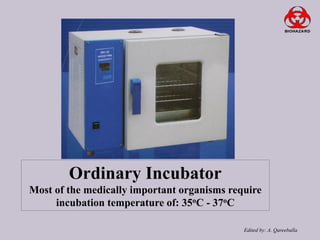
Ordinary Incubator
Most of the medically important organisms require
incubation temperature of: 35oC - 37oC
Edited by: A. Qareeballa
Co2 Incubator
Anaerobic Incubator for anaerobes

Edited by: A. Qareeballa
Anaerobic Jar

Microaerophilic Jar
Edited by: A. Qareeballa
Candle Jar for CO2
Edited by: A. Qareeballa
Anaerobic chamber

Edited by: A. Qareeballa
STATION-1
3. Examine macroscopically:
• Culture plates showing bacterial colonies
• Antimicrobial susceptibilty testing plates
• Fungi (molds) contaminated bread.
• Cultured plates seeded with Candida
species
• Adult parasite worms, e.g. Ascaris
lumbricoides & Fasciola hepatica

Edited by: A. Qareeballa
NUTRIENT AGAR
Cultured with some
organisms
Notice: Bacterial
colonies

Edited by: A. Qareeballa
Hemolysis with Blood Agar

Edited by: A. Qareeballa
SABOURAUD DEXTROSE AGAR
Cultured with Candida species

Edited by: A. Qareeballa
Molds growth on Sabouraud agar
Edited by: A. Qareeballa
STATION-2
1.Explain the preparation of bacteriological
smears and stain the provided prepared smear
with Gram’s staining method.
2.Examine microscopically:
• Gram-positive cocci.
• Gram-negative cocci
• Gram-positive bacilli (rods)
• Gram-negative bacilli (rods)
• Yeast cells.
• Protozoa, e.g. Leishmania species.
Edited by: A. Qareeballa
Gram staining technique
Required:
Basic Stain
Mordant
 Crystal violet  Lugol's
 or Gentian
iodine
violet

Decolorizer:
 Acetone
 or Acetonealcohol
 or Ethanol

Counterstain:
 Neutral red
(1% w/v)
 or Safranin
 or Diluted
carbol fuchsin

Edited by: A. Qareeballa
PREPARATION OF THE SMEAR
1. A small sample of a bacterial culture is removed from
a culture. In this example it is being taken from a broth
culture of the pure microbe but it could be removed
from a culture on solid medium or from material
containing bacteria eg faeces or soil.
2.The bacterial suspension is smeared onto a clean glass
slide. If the bacteria have been removed from a culture
on solid media or it is from a soil or faeces sample it
will have to be mixed with a drop of bacteria-free
saline solution.
3.The bacterial smear is then dried slowly at first and
then, when dry, heated for a few seconds to the point
when the glass slide is too hot to handle. This fixes ie
kills the bacteria making the slide safe to handle. Care
must be taken not to overheat which will char the cells
Edited by: A. Qareeballa
IMPORTANT NOTES:
• Failure to follow these directions may cause
staining artifacts and disrupt the normal
morphology of bacteria and cells.
• To be visible on a slide, organisms that stain by
the Gram method must be present in
concentrations of a minimum of 104 to 105
organisms/ml of unconcentrated staining fluid.
At lower concentrations, the Gram stain of a
clinical specimen seldom reveals organisms
even if the culture is positive.
• Smears that are not properly fixed tend to be
washed away during staining and washing
resulting in the absence of stained bacteria.
Edited by: A. Qareeballa
Gram staining technique
Method
1. Fix the dried smear using gentle heat or fix with methanol for 2 minutes. The purpose of
fixation is to preserve microorganisms and prevent smears being washed from slides during
staining.
2. Cover the fixed smear with crystal violet stain for 30-60 seconds.
3. Rapidly wash off the stain with clean water.
4. Tip off all the water, and cover the smear with Lugol's iodine for 30-60 seconds.
5. Wash off the iodine with clean water.
6. Decolorize rapidly {few seconds} with acetone-alcohol. Wash immediately with clean water.
Caution: Acetone- alcohol is highly flammable; therefore use it well away from an open flame.
7. Cover the smear with neutral red stain for 1 minute.
8. Wash off the stain with clean water.
9. Wipe the back of the slide clean, and place it in a draining rack for the smear to air-dry.
10. Examine the smear microscopically, first with the 40x objective to check the staining and to
see the distribution of material, and then with the oil immersion objective (X100) to report the
bacteria and cells.

Results
Gram positive bacteria

Dark purple

Yeast cells

Dark purple

Gram negative bacteria

Pale to dark red

Nuclei of pus cells

Red

Epithelial cells

Pale red

Edited by: A. Qareeballa
STATION-2
2. Examine microscopically Stained smears
of::
• Gram-positive cocci.
• Gram-negative cocci
• Gram-negative bacilli (rods)
• Gram-positive bacilli (rods)
• Yeast cells.
• Protozoa, e.g. Leishmania species.
Edited by: A. Qareeballa
Amastigote of Leishmania sp.

Promastigote of Leishmania sp.

Edited by: A. Qareeballa
VERO Cells, normal

Infected with herpes B Virus
Phase-contrast microscopic image
of Vero cells.
Edited by: A. Qareeballa

Invaders 09 10-2012

  • 1.
    MICROBIOLOGY PRACTICAL INVADERS Unit :I Problem :Invaders Year :2 Date :Tuesday 09.10.2012 Time :09:00-11:00a.m OBJECTIVES: Each student should be familiar with the basic techniques for the identification of medically important microorganisms (Bacteria, Fungi, Parasites and Viruses): MATERIALS MAY BE POTENTIALLY INFECTIOUS, YOU ARE EXPECTED TO ADOPT THE UNIVERSAL PRECAUTIONS (UP) Edited by: A. Qareeballa
  • 2.
    STATION-1: 1.Observe and discussthe different types of culture media ROUTINE LABORATORY MEDIA 1. Basal media, e.g. Nutrient agar. 2. Enriched media, e.g. blood agar. 3. Enrichment media, e.g. Selenite F 4. Differential (Indicator media), e.g. MacConkey agar. 5. Selective media, e.g. Campylobacter medium. 6. Transport media 7. Storage media. 8. Leishmania media 9. Anaerobic media, e.g. (Cooked meat & Thioglycholate media) Edited by: A. Qareeballa
  • 3.
    TYPES OF CULTUREMEDIA Media are of different types on consistency and chemical composition. A. On Consistency: 1. Solid Media. a. Advantages of solid media: • Bacteria may be identified by studying the colony character, • Mixed bacteria can be separated. b. Solid media is used for the isolation of bacteria as pure culture. 'Agar' is most commonly used to prepare solid media. • Agar is polysaccharide extract obtained from seaweed. • Agar is an ideal solidifying agent as it is : • Bacteriologically inert, i.e. no influence on bacterial growth, • It remains solid at 37°C, and • It is transparent. 2. Liquid Media. It is used for profuse growth, e.g. blood culture in liquid media. Mixed organisms cannot be separated. Edited by: A. Qareeballa
  • 4.
    B. On ChemicalComposition : 1. Routine Laboratory Media 2. Synthetic Media. These are chemically defined media prepared from pure chemical substances. It is used in research work Edited by: A. Qareeballa
  • 5.
    1. BASAL MEDIA. Basalmedia are those that may be used for growth (culture) of bacteria that do not need enrichment of the media. Examples: Nutrient broth, nutrient agar and peptone water. Staphylococcus and Enterobacteriaceae grow in these media. 1. ENRICHED MEDIA. The media are enriched usually by adding blood, serum or egg. Examples: Enriched media are blood agar and Lowenstein-Jensen media. Streptococci grow in blood agar media. 2. SELECTIVE MEDIA. These media favour the growth of a particular bacterium by inhibiting the growth of undesired bacteria and allowing growth of desirable bacteria. Examples: MacConkey agar, Lowenstein-Jensen media, tellurite media (Tellurite inhibits the growth of most of the throat organisms except diphtheria bacilli). Antibiotic may be added to a medium for inhibition. Edited by: A. Qareeballa
  • 6.
    4. INDICATOR (DIFFERENTIAL)MEDIA. An indicator is included in the medium. A particular organism causes change in the indicator, e.g. blood, neutral red, tellurite. Examples: Blood agar and MacConkey agar are indicator media. 5. TRANSPORT MEDIA. These media are used when specie-men cannot be cultured soon after collection. Examples: Cary-Blair medium, Amies medium, Stuart medium. 6. STORAGE MEDIA. Media used for storing the bacteria for a long period of time. Examples: Egg saline medium, chalk cooked meat broth. Edited by: A. Qareeballa
  • 7.
    TYPES OF CULTUREMEDIA BASAL MEDIA Basal media are those that may be used for growth (culture) of bacteria that do not need enrichment of the media. Examples: Nutrient broth, nutrient agar and peptone water. Staphylococcus and Enterobacteriaceae grow in these media. ENRICHED MEDIA Enriched media: Blood and other special nutrients may be added to general purpose media to encourage the growth of fastidious microbes. These specially prepared media are called as enriched media. e.g. Blood agar, Chocolate agar. Edited by: A. Qareeballa
  • 8.
    TYPES OF CULTUREMEDIA Enrichment media Enrichment media: This is a media which promotes the growth of a particular organism by providing it with the essential nutrients and rarely contains certain inhibitory substance to prevent the growth of normal competitors. e.g. Selenite F broth- this media favours the growth of Salmonella also prevents the growth of normal competitors like E. coli . but E. coli do not perish in the medium but they do not flourish like Salmonella Edited by: A. Qareeballa
  • 9.
    TYPES OF CULTUREMEDIA Differential Medium: Culture medium that allows one to distinguish between or among different microorganisms based on a difference in colony appearance (color, shape, or growth pattern) on the medium. Dyes in the medium (e.g.: eosin/methylene blue in EMB) or pH indicators change the color of the medium as sugars in the medium (e.g.: lactose in EMB & MacConkey's and Mannitol in MSA) are fermented to produce acid products Edited by: A. Qareeballa
  • 10.
    TYPES OF CULTUREMEDIA Selective Medium: Culture medium that allows the growth of certain types of organisms, while inhibiting the growth of other organisms Dyes in the medium (e.g.: methylene blue in EMB & crystal violet in MacConkey medium) or high salt concentration in the medium (e.g.: 7% salt in Mannitol Salt Agar) inhibit the growth of unwanted microorganisms Edited by: A. Qareeballa
  • 11.
    TRANSPORT MEDIA These mediaare used when specie-men cannot be cultured soon after collection. Examples: Cary-Blair medium, Amies medium, Stuart medium. STORAGE MEDIA Media used for storing the bacteria for a long period of time. Examples: Egg saline medium, chalk cooked meat broth. Edited by: A. Qareeballa
  • 12.
    NUTRIENT AGAR A generalpurpose medium which may be enriched with 10% blood or other biological fluid. Formula 'Lab-Lemco' powder Yeast extract Peptone Sodium chloride Agar pH gm/litre 1.0 2.0 5.0 5.0 15.0 7.4 +/- 0.2 Directions Suspend 28g in 1 litre of distilled water. Bring to the boil to dissolve completely. Sterilize by autoclaving at 121°C for 15 minutes. Description Nutrient Agar is a basic culture medium used to subculture organisms for maintenance purposes or to check the purity of subcultures from isolation plates prior to biochemical or serological tests. In semi-solid form, agar slopes or agar butts the medium is used to maintain control organisms. Nutrient Agar is suitable for teaching and demonstration purposes. It contains a concentration of 1.5% of agar to permit the addition of up to 10% of blood or other biological fluid, as required. The medium, without additions may be used for the cultivation of organisms which are not exacting in their food requirements. For a medium which is richer in nutrients, see Blood Agar Base. Edited by: A. Qareeballa
  • 13.
    Blood Agar Tryptone 15 g Phytoneor soytone 5g NaCl Agar Distilled water 5g 15 g 1 liter Heat with agitation to dissolve agar. Autoclave 15 min at 121°C. Cool to 50°C. Add 5 ml defibrinated sheep red blood cells to 100 ml melted agar. Mix and pour 20 ml portions into sterile petri dishes. Final pH of base, 7.3 ± 0.2. Edited by: A. Qareeballa
  • 14.
    MacConkey Agar Proteose peptoneor polypeptone 3g Peptone or gelysate 17 g Lactose 10 g Bile salts No. 3 or bile salts mixture 1.5 g NaCl 5g Neutral red 0.03 g Crystal violet 0.001 g Agar 13.5 g Distilled water 1 liter Suspend ingredients and heat with agitation to dissolve. Boil 1-2 min. Autoclave 15 min at 121°C, cool to 45-50°C, and pour 20 ml portions into sterile petri dishes. Dry at room temperature with lids closed. Final pH, 7.1 ± 0.2. Edited by: A. Qareeballa
  • 15.
    SABOURAUD DEXTROSE AGAR SabouraudDextrose Agar is used for the cultivation of fungi. Product Summary and Explanation Sabouraud Dextrose Agar (SDA) is used for cultivating pathogenic & commensal fungi and yeasts. The high dextrose concentration and acidic pH of the formula permits selectivity of fungi. SDA enhanced with the addition of cycloheximide, streptomycin, and penicillin to produce an excellent medium for the primary isolation of dermatophytes. Sabouraud Dextrose Agar is used clinically to aid in the diagnosis of yeast and fungal infections. Principles of the Procedure Enzymatic Digest of Casein and Enzymatic Digest of Animal Tissue provide the nitrogen and vitamin source required for organism growth in Sabouraud Dextrose Agar. The high concentration of Dextrose is included as an energy source. Agar is the solidifying agent. Formula / Liter Enzymatic Digest of Casein......................................................5 g Enzymatic Digest of Animal Tissue...........................................5 g Dextrose..................................................................................40 g Agar.........................................................................................15 g Final pH: 5.6 ± 0.2 at 25°C Formula may be adjusted and/or supplemented as required to meet performance specifications. Directions 1.Suspend 65 g of the medium in one liter of purified water. 2.Heat with frequent agitation and boil for one minute to completely dissolve the medium. 3.Autoclave at 121°C for 15 minutes. Edited by: A. Qareeballa
  • 16.
    Continue SABOURAUD DEXTROSEAGAR Expected Cultural Response Cultural response on Sabouraud Dextrose Agar at 25 - 30°C after 2 – 7 days of incubation. Microorganism Response Aspergillus niger ATCC® 16404 growth Candida albicans ATCC® 10231 growth Microsporum canis ATCC® 36299 growth Penicillium roquefortii ATCC® 10110 growth Trichophyton mentagrophytes ATCC® 9533 growth Results Yeasts grow creamy to white colonies. Molds will grow as filamentous colonies of various colors. Count the number of colonies and consider the dilution factor (if the test sample was diluted) in determining the yeast and/or mold counts per gram or milliliter of material. Edited by: A. Qareeballa
  • 17.
    Continue SABOURAUD DEXTROSEAGAR Expected Cultural Response Cultural response on Sabouraud Dextrose Agar at 25 - 30°C after 2 – 7 days of incubation. Microorganism Response Aspergillus niger ATCC® 16404 growth Candida albicans ATCC® 10231 Growth Microsporum canis ATCC® 36299 Growth Penicillium roquefortii ATCC® 10110 growth Trichophyton mentagrophytes ATCC® 9533 growth Results Yeasts grow creamy to white colonies. Molds will grow as filamentous colonies of various colors. Count the number of colonies and consider the dilution factor (if the test sample was diluted) in determining the yeast and/or mold counts per gram or milliliter of material. Edited by: A. Qareeballa
  • 18.
    Anaerobic Transport MediaSurgery Pack (ATMSP) Anaerobic Transport Medium Surgery Pack (ATMSP) is a mineral salt base semi-solid media with reducing agents designed as a holding medium for maintaining viability of microorganisms, especially anaerobic bacteria through collection, transport and shipment of clinical specimens from a sterile surgical environment. The Anaerobic Transport Medium Surgery Pack contains buffered mineral salts in a semi-solid media with sodium thioglycolate and cysteine added to provide a reduced environment. Resazurin is added as a redox indicator to reveal exposure to oxygen by turning blue. This product has been prepared to provide an environment, which maintains viability of most microorganisms without significant multiplication and allows for dilution of inhibitors present in clinical material. This medium is designed to meet the stringent viability requirements of obligate anaerobes. All items are supplied with screw caps containing rubber septa (Hungate caps), which allows for either direct injection of aspirated clinical material or introduction of tissue samples. The contents and outer surface of the tube are sterile. This medium is prepared, dispensed and packaged under oxygen-free conditions to prevent the formation of oxidized products prior to use. Edited by: A. Qareeballa
  • 19.
    Edited by: A.Qareeballa
  • 20.
    STATION-1: 2. Observe anddiscuss the atmospheric conditions (O2 requirement, incubation temperature and pH) for microorganisms growth: • Aerobic • Anaerobic • Microaerophilic • CO2 requirements. Edited by: A. Qareeballa
  • 21.
    Ordinary Incubator Most ofthe medically important organisms require incubation temperature of: 35oC - 37oC Edited by: A. Qareeballa
  • 22.
    Co2 Incubator Anaerobic Incubatorfor anaerobes Edited by: A. Qareeballa
  • 23.
  • 24.
    Candle Jar forCO2 Edited by: A. Qareeballa
  • 25.
    Edited by: A.Qareeballa
  • 26.
  • 27.
    STATION-1 3. Examine macroscopically: •Culture plates showing bacterial colonies • Antimicrobial susceptibilty testing plates • Fungi (molds) contaminated bread. • Cultured plates seeded with Candida species • Adult parasite worms, e.g. Ascaris lumbricoides & Fasciola hepatica Edited by: A. Qareeballa
  • 28.
    NUTRIENT AGAR Cultured withsome organisms Notice: Bacterial colonies Edited by: A. Qareeballa
  • 29.
    Hemolysis with BloodAgar Edited by: A. Qareeballa
  • 30.
    Edited by: A.Qareeballa
  • 31.
    SABOURAUD DEXTROSE AGAR Culturedwith Candida species Edited by: A. Qareeballa
  • 32.
    Molds growth onSabouraud agar Edited by: A. Qareeballa
  • 33.
    STATION-2 1.Explain the preparationof bacteriological smears and stain the provided prepared smear with Gram’s staining method. 2.Examine microscopically: • Gram-positive cocci. • Gram-negative cocci • Gram-positive bacilli (rods) • Gram-negative bacilli (rods) • Yeast cells. • Protozoa, e.g. Leishmania species. Edited by: A. Qareeballa
  • 34.
    Gram staining technique Required: BasicStain Mordant  Crystal violet  Lugol's  or Gentian iodine violet Decolorizer:  Acetone  or Acetonealcohol  or Ethanol Counterstain:  Neutral red (1% w/v)  or Safranin  or Diluted carbol fuchsin Edited by: A. Qareeballa
  • 35.
    PREPARATION OF THESMEAR 1. A small sample of a bacterial culture is removed from a culture. In this example it is being taken from a broth culture of the pure microbe but it could be removed from a culture on solid medium or from material containing bacteria eg faeces or soil. 2.The bacterial suspension is smeared onto a clean glass slide. If the bacteria have been removed from a culture on solid media or it is from a soil or faeces sample it will have to be mixed with a drop of bacteria-free saline solution. 3.The bacterial smear is then dried slowly at first and then, when dry, heated for a few seconds to the point when the glass slide is too hot to handle. This fixes ie kills the bacteria making the slide safe to handle. Care must be taken not to overheat which will char the cells Edited by: A. Qareeballa
  • 36.
    IMPORTANT NOTES: • Failureto follow these directions may cause staining artifacts and disrupt the normal morphology of bacteria and cells. • To be visible on a slide, organisms that stain by the Gram method must be present in concentrations of a minimum of 104 to 105 organisms/ml of unconcentrated staining fluid. At lower concentrations, the Gram stain of a clinical specimen seldom reveals organisms even if the culture is positive. • Smears that are not properly fixed tend to be washed away during staining and washing resulting in the absence of stained bacteria. Edited by: A. Qareeballa
  • 37.
    Gram staining technique Method 1.Fix the dried smear using gentle heat or fix with methanol for 2 minutes. The purpose of fixation is to preserve microorganisms and prevent smears being washed from slides during staining. 2. Cover the fixed smear with crystal violet stain for 30-60 seconds. 3. Rapidly wash off the stain with clean water. 4. Tip off all the water, and cover the smear with Lugol's iodine for 30-60 seconds. 5. Wash off the iodine with clean water. 6. Decolorize rapidly {few seconds} with acetone-alcohol. Wash immediately with clean water. Caution: Acetone- alcohol is highly flammable; therefore use it well away from an open flame. 7. Cover the smear with neutral red stain for 1 minute. 8. Wash off the stain with clean water. 9. Wipe the back of the slide clean, and place it in a draining rack for the smear to air-dry. 10. Examine the smear microscopically, first with the 40x objective to check the staining and to see the distribution of material, and then with the oil immersion objective (X100) to report the bacteria and cells. Results Gram positive bacteria Dark purple Yeast cells Dark purple Gram negative bacteria Pale to dark red Nuclei of pus cells Red Epithelial cells Pale red Edited by: A. Qareeballa
  • 38.
    STATION-2 2. Examine microscopicallyStained smears of:: • Gram-positive cocci. • Gram-negative cocci • Gram-negative bacilli (rods) • Gram-positive bacilli (rods) • Yeast cells. • Protozoa, e.g. Leishmania species. Edited by: A. Qareeballa
  • 40.
    Edited by: A.Qareeballa
  • 41.
    Amastigote of Leishmaniasp. Promastigote of Leishmania sp. Edited by: A. Qareeballa
  • 42.
    VERO Cells, normal Infectedwith herpes B Virus
  • 43.
    Phase-contrast microscopic image ofVero cells. Edited by: A. Qareeballa