ANAEROBIC BACTERIA
An anaerobicbacteria or anaerobe is any organism that does not
require oxygen for growth.
It may react negatively or even die if free oxygen is present.
Depending on amount of oxygen tolerated, they are divided in
three types
Obligate Anaerobe
Aero-Tolerant Anaerobes
Facultative Anaerobes
3.
ANAEROBIC BACTERIA
Depending onamount of oxygen tolerated, they are divided in three
types
Obligate Anaerobe
These are microorganisms killed by normal atmospheric concentrations
of oxygen (20.95% O2). Oxygen tolerance varies between species,
Some capable of surviving in up to 8% oxygen, others losing viability
unless the oxygen concentration is less than 0.5%
Aero-Tolerant Anaerobes
Survive in presence of oxygen –
Do not use oxygen for energy requirements but use fermentation to
produce ATP. They do not utilize oxygen,
They can protect themselves from reactive oxygen molecules.
Facultative Anaerobes
A facultative anaerobe is an organism that makes ATP by aerobic
respiration if oxygen is present, but is capable of switching
to fermentation if oxygen is absent.
4.
METHODS FOR CULTIVATIONOF
ANAEROBIC BACTERIA
Candle Jar Method
Anaerobic Jar Method
Anaerobic Chamber
Vacuum and Gas Displacement Method
Thioglycollate Broth Method
Alkalline – Pyrogallol Method
Brewer Anaerobic Culture Plate Method
5.
CANDLE JAR METHOD
Inthis method, media plates with bacterial inoculum is kept
inside the jar.
Seal the jar with the lit candle inside.
The candle flame will consume most of the oxygen in the jar
and will produce an elevated level of carbon dioxide.
These conditions are ideal for the growth of anaerobic and
microaerophilic organisms.
ANAEROBIC JAR METHOD
Inthis method, media plates with bacterial inoculum is kept
inside the jar.
The jar contains palladium pellets, that produces hydrogen
inside the jar.
The hydrogen reacts with oxygen present inside the jar and
form water molecules.
This cause reduction in oxygen concentration inside the jar.
The anaerobic condition can be confirmed by indicator,
methylene blue. Indicator becomes colorless in absence of
oxygen
This condition is ideal for the growth of anaerobic organisms.
ANAEROBIC CHAMBER
Anaerobic chambers,also known as anaerobic glove boxes,
are atmosphere control units designed to be used when
working with oxygen sensitive materials.
The chamber contains the sealed environment of H2, CO2 or
N2.
The media plates are kept in the chamber and then N2 is
purged in =side the chamber
VACUUM AND GASDISPLACEMENT
METHOD
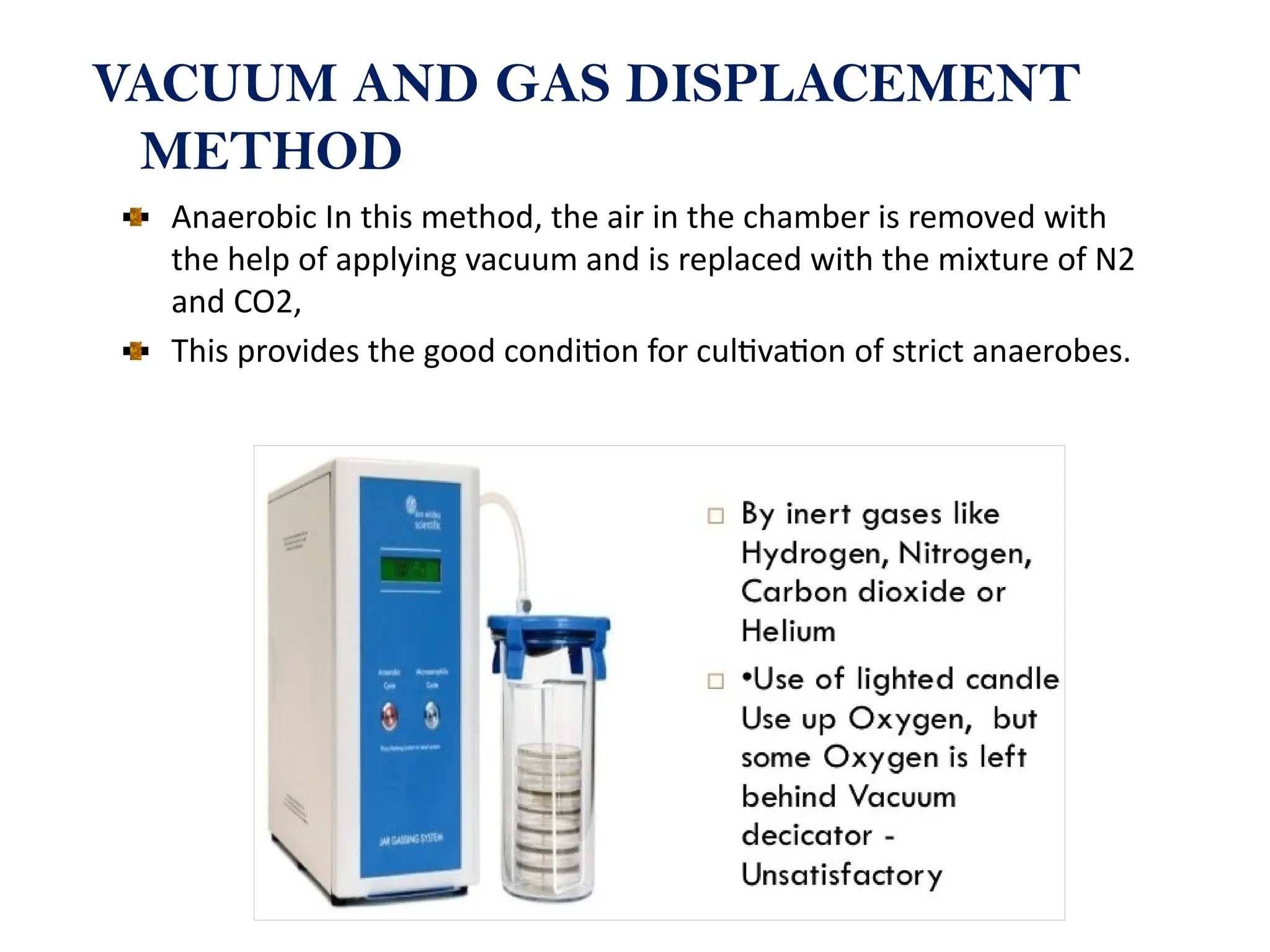
Anaerobic In this method, the air in the chamber is removed with
the help of applying vacuum and is replaced with the mixture of N2
and CO2,
This provides the good condition for cultivation of strict anaerobes.
12.
THIOGLYCOLLATE BROTH METHOD
ThioglycollateBroth is a multipurpose,
enriched, differential medium used
primarily to determine the oxyen
requirements of microorganisms.
Sodium thioglycolate in the medium
consumes oxygen and permits the
growth of obligate anaerobes
13.
ALKALLINE – PYROGALLOLMETHOD
Alkaline solutions of pyrogallol absorb oxygen efficiently
and are used in determining the oxygen content of gas
mixtures
14.
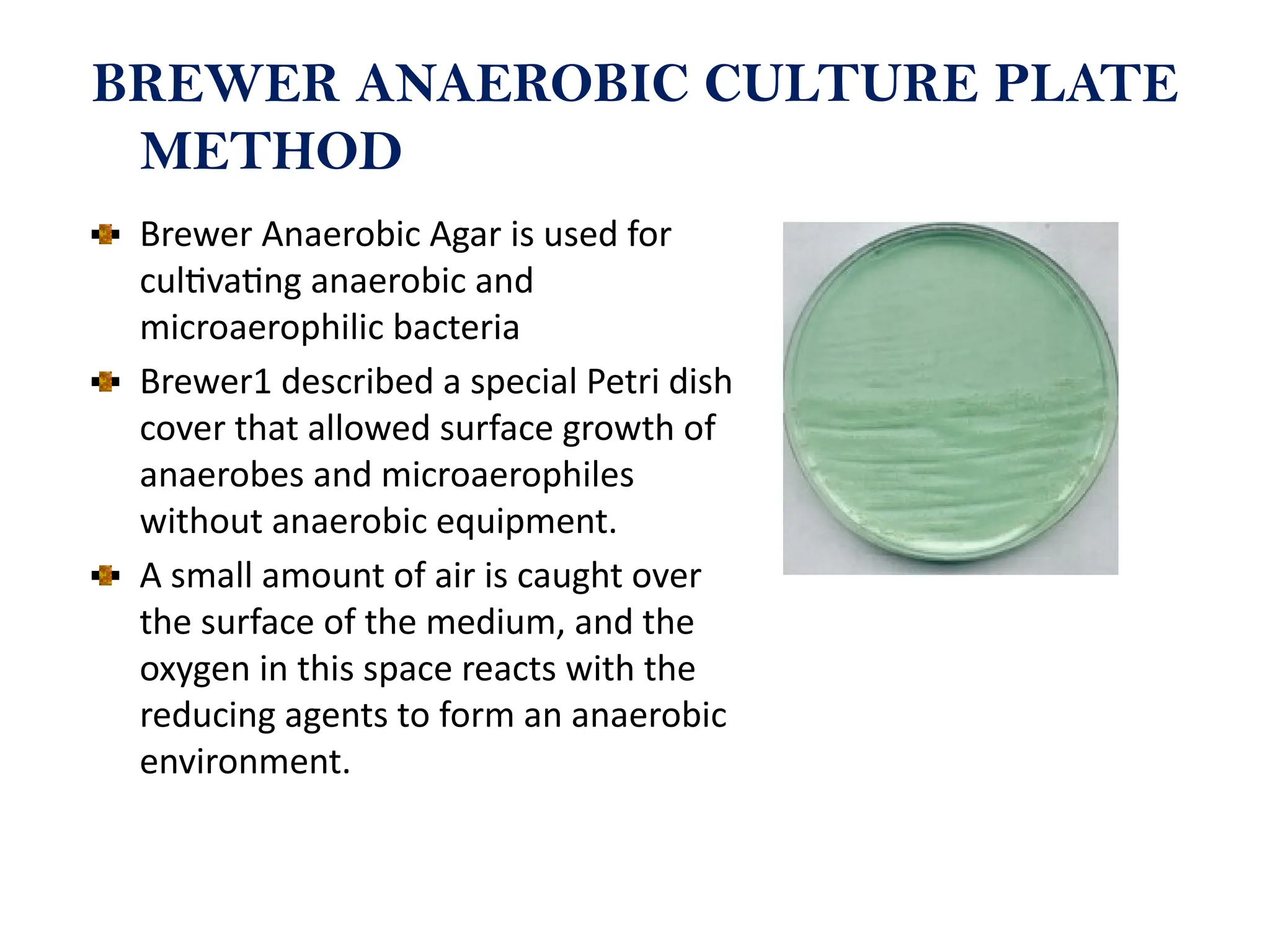
BREWER ANAEROBIC CULTUREPLATE
METHOD
Brewer Anaerobic Agar is used for
cultivating anaerobic and
microaerophilic bacteria
Brewer1 described a special Petri dish
cover that allowed surface growth of
anaerobes and microaerophiles
without anaerobic equipment.
A small amount of air is caught over
the surface of the medium, and the
oxygen in this space reacts with the
reducing agents to form an anaerobic
environment.
15.
BREWER ANAEROBIC CULTUREPLATE
METHOD
Brewer Anaerobic Agar Approximate Formula* Per Liter
Pancreatic Digest of Casein .......................... 5.0 g
Proteose Peptone No. 3............................. 10.0 g Yeast
Extract .............................................. 5.0 g
Dextrose .......................................... 10.0 g Sodium
Chloride .................................. 5.0 g
Agar ............................................... 20.0 g Sodium
Thioglycollate ................................ 2.0 g Sodium
Formaldehyde Sulfoxylate................ 1.0 g
Resazurin .............................................. 2.0 mg










![Microbiology ppt[1]](https://cdn.slidesharecdn.com/ss_thumbnails/microbiologyppt1-201007071552-thumbnail.jpg?width=640&height=640&fit=bounds)


