ArrayFire Webinar:
OpenCL and CUDA Trade-Offs and Comparisons
GPU Software Features
              Programmability
Portability                 Scalability

Performance                Community
Leading GPU Computing Platforms
              Programmability
Portability                 Scalability

Performance                Community
Performance
• Both CUDA and OpenCL are fast
• Both can fully utilize the hardware
• Devil in the details:
  – Hardware type, algorithm type, code quality
Performance
• ArrayFire results at end of webinar
Scalability
• Laptops --> Single GPU Machine
  – Both CUDA and OpenCL scale, no code change
• Single GPU Machine --> Multi-GPU Machine
  – User managed, low-level synchronization
• Multi-GPU Machine --> Cluster
  – MPI
Scalability
Interesting developments:
• Memory Transfer Optimizations
  – CUDA GPUDirect technology
• Mobile GPU Computing
  – OpenCL available on ARM, Imgtec, Freescale, …
Scalability
• Laptops --> Single GPU Machine
   – ArrayFire’s JIT optimizes for GPU type
• Single GPU Machine --> Multi-GPU Machine
   – ArrayFire’s deviceset() function is super easy
• Multi-GPU Machine --> Cluster
   – MPI
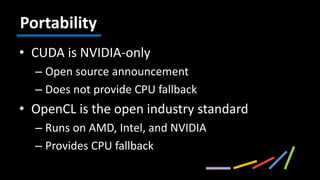
Portability
• CUDA is NVIDIA-only
  – Open source announcement
  – Does not provide CPU fallback
• OpenCL is the open industry standard
  – Runs on AMD, Intel, and NVIDIA
  – Provides CPU fallback
Portability
• ArrayFire is fully portable
  – Same ArrayFire code runs on CUDA or OpenCL
  – Simply select the right library
Community
• NVIDIA CUDA Forums – 26,893 topics
• AMD OpenCL Forums – 4,038 topics

• Stackoverflow CUDA Tag – 1,709 tags
• Stackoverflow OpenCL Tag – 564 tags
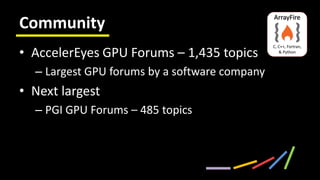
Community
• AccelerEyes GPU Forums – 1,435 topics
  – Largest GPU forums by a software company
• Next largest
  – PGI GPU Forums – 485 topics
Programmability
• Both CUDA and OpenCL are low-level
  – Time consuming kernel development
  – Data-parallel algorithm design
• Focus on programmability interfaces
Programmability

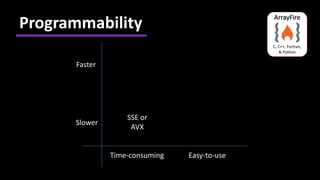
      Faster


                   SSE or
      Slower
                    AVX


               Time-consuming   Easy-to-use
Programmability
                  Writing
      Faster
                  Kernels


                   SSE or
      Slower
                    AVX


               Time-consuming   Easy-to-use
Programmability
                  Writing
      Faster
                  Kernels


                   SSE or       Compiler
      Slower
                    AVX         Directives


               Time-consuming   Easy-to-use
Programmability
                  Writing          Using
      Faster
                  Kernels        Libraries


                   SSE or       Compiler
      Slower
                    AVX         Directives


               Time-consuming   Easy-to-use
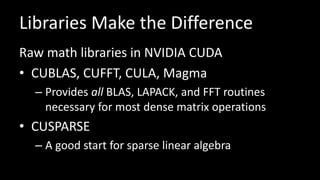
Libraries Make the Difference
Raw math libraries in NVIDIA CUDA
• CUBLAS, CUFFT, CULA, Magma
  – Provides all BLAS, LAPACK, and FFT routines
    necessary for most dense matrix operations
• CUSPARSE
  – A good start for sparse linear algebra
Libraries Make the Difference
Raw math libraries in AMD OpenCL
• clAmdBlas, clAmdFft
  – Provides most important Blas routines
  – Provides radix 2, 3, and 5 FFT routines
  – No LAPACK support
  – No sparse data support
Libraries Make the Difference
Raw math libraries in AMD OpenCL
• clAmdBlas, clAmdFft
  – Provides most important Blas routines
  – Provides radix 2, 3, and 5 FFT routines
  – No LAPACK support
  – No sparse data support
  – Runs on any OpenCL-compliant device
ArrayFire Code and Benchmarks

CUDA vs OpenCL

  • 1.
    ArrayFire Webinar: OpenCL andCUDA Trade-Offs and Comparisons
  • 2.
    GPU Software Features Programmability Portability Scalability Performance Community
  • 3.
    Leading GPU ComputingPlatforms Programmability Portability Scalability Performance Community
  • 4.
    Performance • Both CUDAand OpenCL are fast • Both can fully utilize the hardware • Devil in the details: – Hardware type, algorithm type, code quality
  • 5.
  • 6.
    Scalability • Laptops -->Single GPU Machine – Both CUDA and OpenCL scale, no code change • Single GPU Machine --> Multi-GPU Machine – User managed, low-level synchronization • Multi-GPU Machine --> Cluster – MPI
  • 7.
    Scalability Interesting developments: • MemoryTransfer Optimizations – CUDA GPUDirect technology • Mobile GPU Computing – OpenCL available on ARM, Imgtec, Freescale, …
  • 8.
    Scalability • Laptops -->Single GPU Machine – ArrayFire’s JIT optimizes for GPU type • Single GPU Machine --> Multi-GPU Machine – ArrayFire’s deviceset() function is super easy • Multi-GPU Machine --> Cluster – MPI
  • 9.
    Portability • CUDA isNVIDIA-only – Open source announcement – Does not provide CPU fallback • OpenCL is the open industry standard – Runs on AMD, Intel, and NVIDIA – Provides CPU fallback
  • 10.
    Portability • ArrayFire isfully portable – Same ArrayFire code runs on CUDA or OpenCL – Simply select the right library
  • 11.
    Community • NVIDIA CUDAForums – 26,893 topics • AMD OpenCL Forums – 4,038 topics • Stackoverflow CUDA Tag – 1,709 tags • Stackoverflow OpenCL Tag – 564 tags
  • 12.
    Community • AccelerEyes GPUForums – 1,435 topics – Largest GPU forums by a software company • Next largest – PGI GPU Forums – 485 topics
  • 13.
    Programmability • Both CUDAand OpenCL are low-level – Time consuming kernel development – Data-parallel algorithm design • Focus on programmability interfaces
  • 14.
    Programmability Faster SSE or Slower AVX Time-consuming Easy-to-use
  • 15.
    Programmability Writing Faster Kernels SSE or Slower AVX Time-consuming Easy-to-use
  • 16.
    Programmability Writing Faster Kernels SSE or Compiler Slower AVX Directives Time-consuming Easy-to-use
  • 17.
    Programmability Writing Using Faster Kernels Libraries SSE or Compiler Slower AVX Directives Time-consuming Easy-to-use
  • 18.
    Libraries Make theDifference Raw math libraries in NVIDIA CUDA • CUBLAS, CUFFT, CULA, Magma – Provides all BLAS, LAPACK, and FFT routines necessary for most dense matrix operations • CUSPARSE – A good start for sparse linear algebra
  • 19.
    Libraries Make theDifference Raw math libraries in AMD OpenCL • clAmdBlas, clAmdFft – Provides most important Blas routines – Provides radix 2, 3, and 5 FFT routines – No LAPACK support – No sparse data support
  • 20.
    Libraries Make theDifference Raw math libraries in AMD OpenCL • clAmdBlas, clAmdFft – Provides most important Blas routines – Provides radix 2, 3, and 5 FFT routines – No LAPACK support – No sparse data support – Runs on any OpenCL-compliant device
  • 21.