k.S.N.Murthy, m.Suman, v.Sriram, n.Sai Kotewararao, b.Phani Krishna Rao / International
             Journal of Engineering Research and Applications (IJERA)ISSN: 2248-9622
                     www.ijera.com Vol. 2, Issue 4, June-July 2012, pp.631-635
                  Speech Enhancement Using A Recursive Filter
  1
      k.S.N.Murthy, 2m.Suman, 3v.Sriram, 4n.Sai Kotewararao,5b.Phani Krishna
                                      Rao
                         1,2
                               Professors,Department of ECE, K L C E, Guntur DT, AP, India
                         3,4,5
                                Students, Department of ECE, K L C E, Guntur DT, AP, India


Abstract–
          one of the major components in speech                   2. RECURSIVE FILTER
enhancement is noise estimation. In earlier                            This recursive Filter is an estimator for what is
methods residual noise will be present in the                  called the “linear quadratic problem”, which focuses
enhanced speech signal because of inaccurate                   on estimating the instantaneous “state” of a
noise estimation and not suitable in non-stationary            lineardynamic system perturbed by white noise.
noise environments.                                            Statistically, this estimator is optimal withrespect to
In this paper noise is estimated using a recursive             any quadratic function of estimation errors.
filter. In this estimation estimator is recursively
updated in each frame so that non-stationary                     3.     PROCESS
noise is tracked and estimated. In performance                          After going through some of the
comparison proposed approach we present the of                 introduction and advantages of using this filter, we
segmental SNR values for different environments.               will now take a look at the process. The process
These results shows that proposed approach will                commences with the addresses of a general problem
produce enhanced speech with less residual noise.              of trying to estimate the state of a discrete-time
                                                               controlled process that is governed by a linear
Keywords-recursive     filter,    time          update         stochastic difference equation:
measurement update, error co-variance
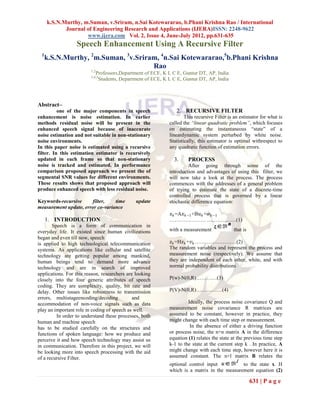
                                                               𝑥 𝑘 =A𝑥 𝑘 −1 +B𝑢 𝑘 +𝑤 𝑘 −1
      1. INTRODUCTION                                          ………………… .…………….(1)
       Speech is a form of communication in
everyday life. It existed since human civilizations            with a measurement              that is
began and even till now, speech
is applied to high technological telecommunication              𝑧 𝑘 =H𝑥 𝑘 +𝑣 𝑘 ……………………(2)
systems. As applications like cellular and satellite           The random variables and represent the process and
technology are getting popular among mankind,                  measurement noise (respectively). We assume that
human beings tend to demand more advance                       they are independent of each other, white, and with
technology and are in search of improved                       normal probability distributions
applications. For this reason, researchers are looking
closely into the four generic attributes of speech             P(w)-N(0,R)…………(3)
coding. They are complexity, quality, bit rate and
delay. Other issues like robustness to transmission            P(V)-N(0,R)……………(4)
errors, multistageencoding/decoding           and
accommodation of non-voice signals such as data                         Ideally, the process noise covariance Q and
play an important role in coding of speech as well.            measurement noise covariance R matrices are
         In order to understand these processes, both          assumed to be constant, however in practice, they
human and machine speech                                       might change with each time step or measurement.
has to be studied carefully on the structures and                        In the absence of either a driving function
functions of spoken language: how we produce and               or process noise, the n×n matrix A in the difference
perceive it and how speech technology may assist us            equation (1) relates the state at the previous time step
in communication. Therefore in this project, we will           k-1 to the state at the current step k . In practice, A
be looking more into speech processing with the aid            might change with each time step, however here it is
of a recursive Filter.                                         assumed constant. The n×l matrix B relates the
                                                               optional control input          to the state x. H
                                                               which is a matrix in the measurement equation (2)

                                                                                                         631 | P a g e
k.S.N.Murthy, m.Suman, v.Sriram, n.Sai Kotewararao, b.Phani Krishna Rao / International
           Journal of Engineering Research and Applications (IJERA)ISSN: 2248-9622
                   www.ijera.com Vol. 2, Issue 4, June-July 2012, pp.631-635
which relates the state to the measurement, zk. In
practice H might change with each time step or                      Once again, notice how the time update
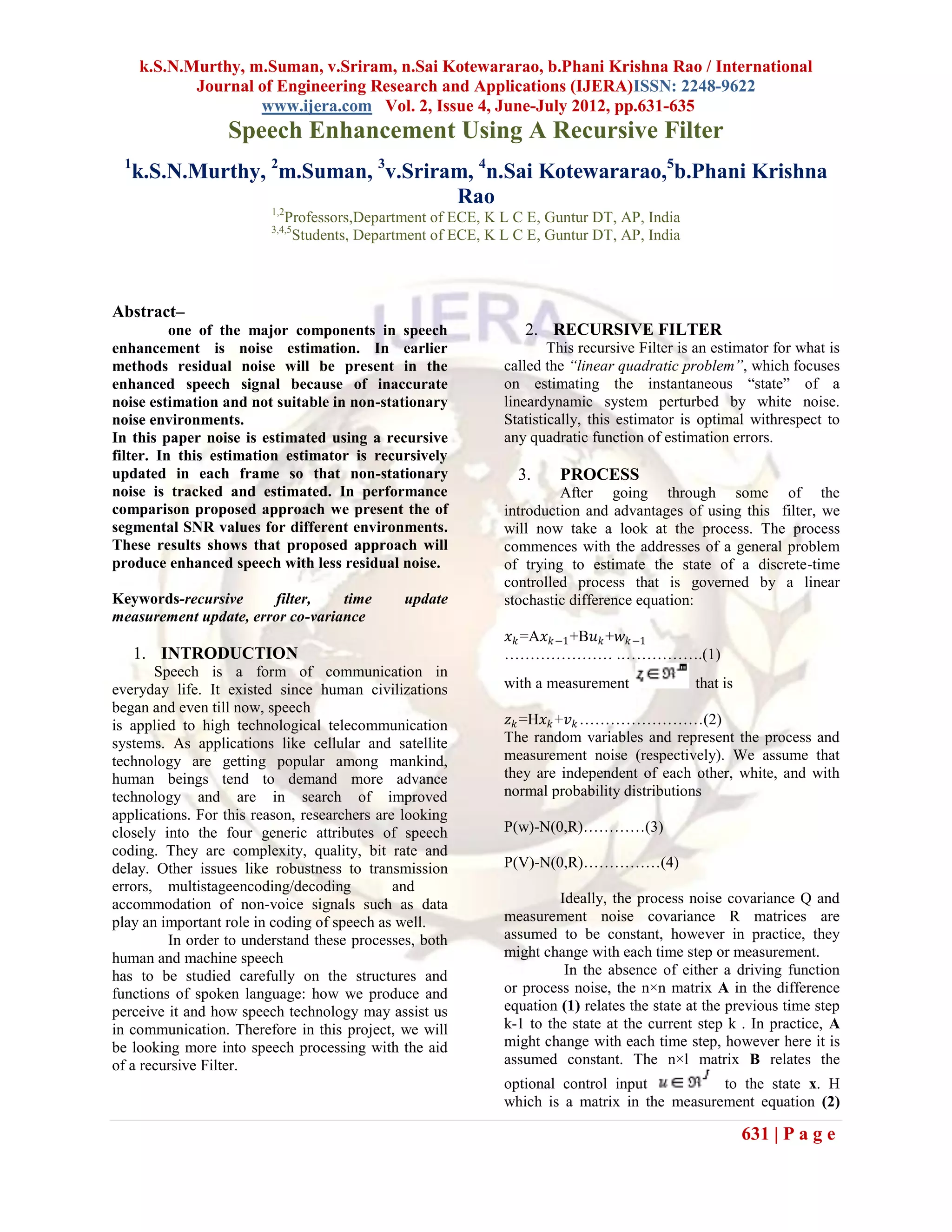
measurement, however we assume it is constant.            equations in Table 4.1 project its state, x and
                                                          covariance, 𝑃 𝑘 estimates forward from time step k-1
   4.   ALGORITHM                                         to step k. As mentionedearlier, the matrixes A and B
          This section will begin with a broad            are from (1), while is from (3). Initial conditions
overview, covering the "high-level" operation of one      forthe filter are discussed in the earlier section.
form of this fillter. After presenting this high-level
view, I will narrow the focus to the specific equations   𝐾 𝑘 = 𝑃 𝑘 𝐻 𝑇 𝐻𝑃 𝑘 𝐻 𝑇 + 𝑅   −1
                                                                                            ………..(7)
and their use in this discrete version of the filter.
Firstly, it estimates a process by using a form of        𝑥 𝑘 = 𝑥 𝑘 + 𝐾 𝑘 (𝑧 𝑘 − 𝐻𝑥 𝑘 )……….(8)
feedback control loop whereby the filter estimates the
process state at some time and then obtains feedback      𝑃 𝑘 = (𝐼 − 𝐾 𝑘 𝐻)𝑃 𝑘 ………………………(9)
in the form of (noisy) measurements. As such, these
equations for this filter fall into two groups: “Time     Table 4.2: Measurement update equations
Update equations” and “Measurement Update
equations”                                                          By referring to above data, it is obvious that
          The responsibilities of the time update         the first task during the measurement update is to
equations are for projecting forward (in time) the        compute the gain, kk.. By comparing (7) in the table
current state and error covariance estimates to obtain    above and the previous section, notice the equations
the priori estimates for the next time step. The          are the same. Next, is to actually measure the process
measurement update equations are responsible for the      in order to obtain zk , and then to generate a posteriori
feedback i.e. for incorporating a new measurement         state estimate𝑥 𝑘 by incorporating the measurement as
into the priori estimate to obtain an improved            in (8). Once again, notice the repeated equation of (8)
posteriori estimate.                                      here for completeness. Finally, the last step is to
          The time update equations can also be           obtain a posteriori error covariance estimate via (9).
thought of as “predictor” equations, while the                      Thus, after each time and measurement
measurement update equations can be thought of as         update pair, this loop process is repeated to project or
“corrector” equations. By and large, this loop            predict the new time step priori estimates using the
process of the final estimation algorithm resembles       previous time step posteriori estimates. This recursive
that of a predictor-corrector algorithm for solving       nature is one of the very appealing features of this
numerical problems just like the one shown in Fig         filter → it makes practical implementations much
below.                                                    more feasible than (for example) an implementation
                                                          of a Wiener filterwhich is designed to operate on all
                                                          of the data directly for each estimate. Instead, this
                                                          filter recursively conditions the current estimate on
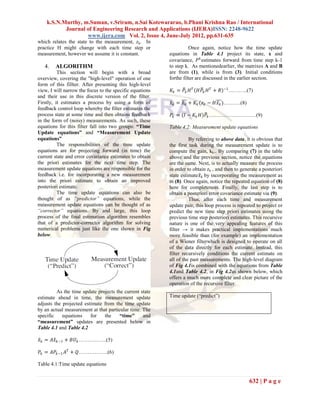
                                                          all of the past measurements. The high-level diagram
                                                          of Fig 4.1is combined with the equations from Table
                                                          4.1and Table 4.2, in Fig 4.2as shown below, which
                                                          offers a much more complete and clear picture of the
                                                          operation of the recursive filter.
         As the time update projects the current state
estimate ahead in time, the measurement update            Time update (“predict”)
adjusts the projected estimate from the time update
by an actual measurement at that particular time. The
specific    equations    for   the     “time”     and
“measurement” updates are presented below in
Table 4.1 and Table 4.2

𝑥 𝑘 = 𝐴𝑥 𝑘 −1 + 𝐵𝑈 𝑘 …………….(5)

𝑃 𝑘 = 𝐴𝑃 𝑘 −1 𝐴 𝑇 + 𝑄……………..(6)

Table 4.1:Time update equations


                                                                                                  632 | P a g e
k.S.N.Murthy, m.Suman, v.Sriram, n.Sai Kotewararao, b.Phani Krishna Rao / International
             Journal of Engineering Research and Applications (IJERA)ISSN: 2248-9622
                     www.ijera.com Vol. 2, Issue 4, June-July 2012, pp.631-635
      1.   Project the state head                         In order to apply this filtering to the speech
                                                          expression shown above, it must be expressed in state
                     𝑥 𝑘 = 𝑓 𝑥 𝑘 −1 , 𝑢 𝑘 , O             space form as

      2.   Project the error covariance ahead             𝐻 𝑘 = 𝑋𝐻 𝑘−1 + 𝑊 𝑘 ………….(12)

           𝑃 𝑘 = 𝐴 𝑘 𝑃 𝑘 −1 𝐴 𝑘𝑇 + 𝑊 𝑘 𝑄 𝑘−1 𝑊 𝑘𝑇         𝑦 𝑘 = 𝑔𝐻 𝑘 …………………….(13)


                                                                  𝑎1   𝑎2   …     𝑎 𝑁−1      𝑎𝑁
                                                                  1    0    …       0        0
                                                          X=      0    1    …       0        0
Measurement update (“correct”)                                    ⋮    ⋮    ⋱       ⋮        ⋮
                                                                  0    0    ⋯       1        0

                                                                                             𝑦𝑘
      1.   Compute the gain
                                                                                           𝑦 𝑘 −1
                                                                                𝐻𝑘 =       𝑦 𝑘 −2
       𝐾 𝑘 = 𝑃 𝑘 𝐻 𝑘𝑇 (𝐻 𝑘 𝑃 𝑘 𝐻 𝑘𝑇 + 𝑉 𝑘 𝑅 𝑘 𝑉 𝑘𝑇 )−1
                                                                                             ⋮
                                                                                          𝑦 𝑘 −𝑁+1
      2.   Update estimate with measurement
                                                                                            𝑤𝑘
           𝑥 𝑘 = 𝑥 𝑘 + 𝐾 𝑘 (𝑧 𝑘 − 𝑕 𝑥 𝑘 , 0 )                                               0
                                                                                 𝑤𝑘 =       0
      3.   Update the error covariance                                                      ⋮
                                                                                            0
                   𝑃 𝑘 = (𝐼 − 𝐾 𝑘 𝐻 𝑘 )𝑃 𝑘
                                                          g= 1 0 … 0
                                                          X is the system matrix, Hkconsists of the series of
Fig: Complete operation of the filter                     speech samples; 𝑊 𝑘 is the excitation vector and g, the
                                                          output vector. The reason of (k-N+1)th iteration is due
   5. IMPLEMENTATION                                      to the state vector, Hk, consists of N samples, from
          From a statistical point of view, many          the kth iteration back to the (k-N+1)th iteration. The
signals such as speech exhibit large amounts of           above formulations are suitable for this filter. As
correlation. From the perspective of coding or            mentioned in the previously, this filter functions in a
filtering, this correlation can be put to good use. The   looping method. Here we denote the following steps
all pole, or autoregressive (AR), signal model is often   within the loop of the filter. Define matrix 𝐻 𝑘𝑇−1 as
used for speech. The AR signal model is introduced        the row vector:
as:                                                           𝑻
                                                            𝑯 𝒌−𝟏 =-[𝒚 𝒌−𝟏 𝒚 𝒌−𝟐 ……𝒚 𝒌−𝑵 ]
                                                          ........... (14)
                                                          Andzk= yk. Then (11) and (14) yield
           1
𝑦𝑘=        𝑁        𝑊 𝑘 ………(10)
      1−∑ 𝑖−1 𝛼𝑍                                                    𝑻
Equation (10) can also be written in this form as          𝒛 𝒌 =𝑯 𝒌−𝟏 𝑿 𝒌 +𝑾 𝒌
shown below:                                              .............. (15)
                                                          WhereXkwill always be updated according to the
𝑦 𝑘 =𝑎1 𝑦 𝑘 −1 +𝑎2 𝑦 𝑘 −2 ……+𝑎 𝑁 𝑦 𝑘 −𝑁 + 𝑊 𝑘             number of iterations, k.
                                                                        Note that when the k = 0, the matrix Hk-1 is
                                                          unable to be determined. However, when the time
…………………….. (11)
                                                          zkis detected, the value in matrix Hk-1 is known. The
where,
k→ Number of iterations;                                  above purpose is thus sufficient enough for defining
yk → current input speech signal sample;                  the recursive filter, which consists of:
yk–N→ (N-1)th sample of speech signal;                                     𝑋 𝑘 = 1 − 𝐾 𝑘 𝐻 𝑘𝑇−1 𝑋 𝑘−1 + 𝐾 𝑘 𝑍 𝑘
aN → Nth filter coefficient; and                                                     .........…...(16)
wk → excitation sequence (white noise).


                                                                                                     633 | P a g e
k.S.N.Murthy, m.Suman, v.Sriram, n.Sai Kotewararao, b.Phani Krishna Rao / International
            Journal of Engineering Research and Applications (IJERA)ISSN: 2248-9622
                    www.ijera.com Vol. 2, Issue 4, June-July 2012, pp.631-635
                 1       0           0       0                    babble       0.7560         4.8810           5.6148
                             ….
                 0       1           0       0                    car          2.4997         4.8747           4.3537
Where I=             ⋮           ⋱       ⋮                        exhibition   2.3022         4.8301           4.5720
                 0       0      1            0
                             ….                                   restaurant   0.8976         4.9388           5.0451
                 0       0      0            1
                                                                  station      0.5629         3.3547           5.1048
With 𝐾 𝑘 = 𝑃 𝑘 −1 𝐻 𝑘 −1 [𝐻 𝑘𝑇−1 𝑃 𝑘 −1 𝐻 𝑘 −1 + 𝑅]               street       1.8141         3.7160           5.033
………………….(17)

Where 𝐾 𝑘 𝑖𝑠 𝑡𝑕𝑒 𝑓𝑖𝑙𝑡𝑒𝑟 𝑔𝑎𝑖𝑛                                      Fig1: Below result is for the input speech

𝑃 𝑘 −1 is the priori error covariance matrix

R is the measurement noise covariance
                𝑃 𝑘 = 𝑃 𝑘−1 − 𝑃 𝑘 −1 𝐻 𝑘−1
          𝐻 𝑘−1 𝑃 𝑘 −1 𝐻 𝑘 −1 + 𝑅 𝐻 𝑘𝑇−1 𝑃 𝑘 −1 + 𝑄
            𝑇


…………………….(18)

Where 𝑃 𝑘 is the posteriori error co-variance
Matrix

     1       0           0       0
                 ….
     0       1           0       0
Q=       ⋮       ⋱           ⋮
     0       0           1       0
                 ….
     0       0           0       1
                                                                  Fig2. Noise added
Thereafter the reconstructed speech signal, Ykafter
filtering will be formed in a manner similar to (11):

𝒀 𝒌 =𝒂 𝟏 𝒀 𝒌−𝟏 +𝒂 𝟐 𝒀 𝒌−𝟐 +…..𝒂 𝑵 𝒀 𝒌−𝑵 +𝑾 𝒌

         Since the value of ykis the input at the
beginning of the process, there will be no problem
forming HTk-1. In that case a question rises, how is Yk
                                     𝑁
formed? The parameterswk and {𝑎} 𝑖−1 are determined
from application of this filter to the input speech
signal yk. That is in order to construct Yk, we will
need matrix X that contains the filtering coefficients
and the white noise, wk which both are obtained from
the estimation of the input signal. This information is
enough to determine HHk-1
where
              𝑌𝑘−1
HH 𝑘−1 =      𝑌𝑘−2                                                Fig3. Estimated signal
            𝑌𝑘−𝑁+1
Thus, forming the equation (19)mentioned above.

RESULTS
The SNR values for different types of noises

Input             O/P SNR                O/P SNR     O/P SNR
                  for                    for         for input=
                  input=0dB              input=5dB   10dB
airport           1.1520                 4.9623      5.7959

                                                                                                        634 | P a g e
k.S.N.Murthy, m.Suman, v.Sriram, n.Sai Kotewararao, b.Phani Krishna Rao / International
           Journal of Engineering Research and Applications (IJERA)ISSN: 2248-9622
                   www.ijera.com Vol. 2, Issue 4, June-July 2012, pp.631-635
                                                          indeed has the ability to estimate accurately.
                                                          Furthermore, the results have also shown that this
                                                          recursive filter could be tuned to provide optimal
                                                          performance.

                                                          ACKNOWLEDGEMENT
                                                                  We would like to thank our respected
                                                          teachers and colleagues for their guidance and
                                                          support. We are thankful to our HOD, ECE
                                                          Department.    We      also     thank    Principal&
                                                          Chairman,KoneruLakshmaiah         University     for
                                                          providing us most suitable environment for research
                                                          and development.

                                                          REFERENCES:
Fig 4: combined plot                                      [1]    E. Grivel, M. Gabrea, and M. Najim, “Speech
                                                                 Enhancements a Realization Issue,” Signal
                                                                 Processing, vol. 82, pp. 1963–1978, Dec.
                                                                 2002.
                                                          [2]     M. Gabrea, E. Grivel, and M. Najim, “A
                                                                 single microphone kalman filter-based noise
                                                                 canceller,” IEEESignal Processing Lett., vol.
                                                                 6, pp. 55–57, Mar. 1999.
                                                          [3]     J. D. Gibson, B. Koo, and S. D. Gray,
                                                                 “Filtering of colored noise for speech
                                                                 enhancement and coding,”IEEE Trans. Signal
                                                                 Processing, vol. 39, pp. 1732–1742, Aug.
                                                                 1991.
                                                          [4]    H. Morikawa and H. Fujisaki, “Noise
                                                                 reduction of speech signal by adaptive kalman
                                                                 filtering,” Special issue in Signal Processing
Fig 5: mean square error                                         APII-AFCET, vol. 22, pp. 53–68, 1988.
                                                          [5]     M. Gabrea, “Robust adaptive kalman filtering
                                                                 based speech enhancement algorithm,” in
                                                                 Proc.ICASSP’04, 2004.
                                                          [6]    M. Gabrea and D. O’Shaugnessy, “Speech
                                                                 signal recovery in white noise using an
                                                                 adaptive kalman filter, “inProc. EUSIPCO’00,
                                                                 2000, pp. 159–162.
                                                          [7]     B. A. Anderson and J. B. Moore, Optimal
                                                                 Filtering, NJ:Prentice-Hall, Englewood Cliffs,
                                                                 1979.
                                                          [8]     B. D. Kovacevic, M. M. Milosavljevic, and
                                                                 M. Dj. Veinovic, “Robust recursive ar speech
                                                                 analysis,” SignalProcessing, vol. 44, pp. 125–
                                                                 138, 1995.
                                                          [9]     R. K. Mehra, “On the identification of
CONCLUSION                                                       variances and adaptive kalman filtering,” IEEE
         Inthis project, an implementation of                    Trans. AutomaticControl, vol. AC-15, pp.
employing this recursive filtering to speech                     175–184, Apr. 1970.
processing had been developed. As has been                [10]    T. Kailath, “An innovations approach to least
previously mentioned, the purpose of this approach is            squares estimation, part i: Linear filtering in
to reconstruct an output speech signal by making use             additive white noise,” IEEE Tran. Automatic
of the accurate estimating ability of this filter. True          Control, vol. AC-13, pp. 646–655, Dec. 1968.
enough, simulated results had proven that this filter

                                                                                                635 | P a g e

Cu24631635

  • 1.
    k.S.N.Murthy, m.Suman, v.Sriram,n.Sai Kotewararao, b.Phani Krishna Rao / International Journal of Engineering Research and Applications (IJERA)ISSN: 2248-9622 www.ijera.com Vol. 2, Issue 4, June-July 2012, pp.631-635 Speech Enhancement Using A Recursive Filter 1 k.S.N.Murthy, 2m.Suman, 3v.Sriram, 4n.Sai Kotewararao,5b.Phani Krishna Rao 1,2 Professors,Department of ECE, K L C E, Guntur DT, AP, India 3,4,5 Students, Department of ECE, K L C E, Guntur DT, AP, India Abstract– one of the major components in speech 2. RECURSIVE FILTER enhancement is noise estimation. In earlier This recursive Filter is an estimator for what is methods residual noise will be present in the called the “linear quadratic problem”, which focuses enhanced speech signal because of inaccurate on estimating the instantaneous “state” of a noise estimation and not suitable in non-stationary lineardynamic system perturbed by white noise. noise environments. Statistically, this estimator is optimal withrespect to In this paper noise is estimated using a recursive any quadratic function of estimation errors. filter. In this estimation estimator is recursively updated in each frame so that non-stationary 3. PROCESS noise is tracked and estimated. In performance After going through some of the comparison proposed approach we present the of introduction and advantages of using this filter, we segmental SNR values for different environments. will now take a look at the process. The process These results shows that proposed approach will commences with the addresses of a general problem produce enhanced speech with less residual noise. of trying to estimate the state of a discrete-time controlled process that is governed by a linear Keywords-recursive filter, time update stochastic difference equation: measurement update, error co-variance 𝑥 𝑘 =A𝑥 𝑘 −1 +B𝑢 𝑘 +𝑤 𝑘 −1 1. INTRODUCTION ………………… .…………….(1) Speech is a form of communication in everyday life. It existed since human civilizations with a measurement that is began and even till now, speech is applied to high technological telecommunication 𝑧 𝑘 =H𝑥 𝑘 +𝑣 𝑘 ……………………(2) systems. As applications like cellular and satellite The random variables and represent the process and technology are getting popular among mankind, measurement noise (respectively). We assume that human beings tend to demand more advance they are independent of each other, white, and with technology and are in search of improved normal probability distributions applications. For this reason, researchers are looking closely into the four generic attributes of speech P(w)-N(0,R)…………(3) coding. They are complexity, quality, bit rate and delay. Other issues like robustness to transmission P(V)-N(0,R)……………(4) errors, multistageencoding/decoding and accommodation of non-voice signals such as data Ideally, the process noise covariance Q and play an important role in coding of speech as well. measurement noise covariance R matrices are In order to understand these processes, both assumed to be constant, however in practice, they human and machine speech might change with each time step or measurement. has to be studied carefully on the structures and In the absence of either a driving function functions of spoken language: how we produce and or process noise, the n×n matrix A in the difference perceive it and how speech technology may assist us equation (1) relates the state at the previous time step in communication. Therefore in this project, we will k-1 to the state at the current step k . In practice, A be looking more into speech processing with the aid might change with each time step, however here it is of a recursive Filter. assumed constant. The n×l matrix B relates the optional control input to the state x. H which is a matrix in the measurement equation (2) 631 | P a g e
  • 2.
    k.S.N.Murthy, m.Suman, v.Sriram,n.Sai Kotewararao, b.Phani Krishna Rao / International Journal of Engineering Research and Applications (IJERA)ISSN: 2248-9622 www.ijera.com Vol. 2, Issue 4, June-July 2012, pp.631-635 which relates the state to the measurement, zk. In practice H might change with each time step or Once again, notice how the time update measurement, however we assume it is constant. equations in Table 4.1 project its state, x and covariance, 𝑃 𝑘 estimates forward from time step k-1 4. ALGORITHM to step k. As mentionedearlier, the matrixes A and B This section will begin with a broad are from (1), while is from (3). Initial conditions overview, covering the "high-level" operation of one forthe filter are discussed in the earlier section. form of this fillter. After presenting this high-level view, I will narrow the focus to the specific equations 𝐾 𝑘 = 𝑃 𝑘 𝐻 𝑇 𝐻𝑃 𝑘 𝐻 𝑇 + 𝑅 −1 ………..(7) and their use in this discrete version of the filter. Firstly, it estimates a process by using a form of 𝑥 𝑘 = 𝑥 𝑘 + 𝐾 𝑘 (𝑧 𝑘 − 𝐻𝑥 𝑘 )……….(8) feedback control loop whereby the filter estimates the process state at some time and then obtains feedback 𝑃 𝑘 = (𝐼 − 𝐾 𝑘 𝐻)𝑃 𝑘 ………………………(9) in the form of (noisy) measurements. As such, these equations for this filter fall into two groups: “Time Table 4.2: Measurement update equations Update equations” and “Measurement Update equations” By referring to above data, it is obvious that The responsibilities of the time update the first task during the measurement update is to equations are for projecting forward (in time) the compute the gain, kk.. By comparing (7) in the table current state and error covariance estimates to obtain above and the previous section, notice the equations the priori estimates for the next time step. The are the same. Next, is to actually measure the process measurement update equations are responsible for the in order to obtain zk , and then to generate a posteriori feedback i.e. for incorporating a new measurement state estimate𝑥 𝑘 by incorporating the measurement as into the priori estimate to obtain an improved in (8). Once again, notice the repeated equation of (8) posteriori estimate. here for completeness. Finally, the last step is to The time update equations can also be obtain a posteriori error covariance estimate via (9). thought of as “predictor” equations, while the Thus, after each time and measurement measurement update equations can be thought of as update pair, this loop process is repeated to project or “corrector” equations. By and large, this loop predict the new time step priori estimates using the process of the final estimation algorithm resembles previous time step posteriori estimates. This recursive that of a predictor-corrector algorithm for solving nature is one of the very appealing features of this numerical problems just like the one shown in Fig filter → it makes practical implementations much below. more feasible than (for example) an implementation of a Wiener filterwhich is designed to operate on all of the data directly for each estimate. Instead, this filter recursively conditions the current estimate on all of the past measurements. The high-level diagram of Fig 4.1is combined with the equations from Table 4.1and Table 4.2, in Fig 4.2as shown below, which offers a much more complete and clear picture of the operation of the recursive filter. As the time update projects the current state estimate ahead in time, the measurement update Time update (“predict”) adjusts the projected estimate from the time update by an actual measurement at that particular time. The specific equations for the “time” and “measurement” updates are presented below in Table 4.1 and Table 4.2 𝑥 𝑘 = 𝐴𝑥 𝑘 −1 + 𝐵𝑈 𝑘 …………….(5) 𝑃 𝑘 = 𝐴𝑃 𝑘 −1 𝐴 𝑇 + 𝑄……………..(6) Table 4.1:Time update equations 632 | P a g e
  • 3.
    k.S.N.Murthy, m.Suman, v.Sriram,n.Sai Kotewararao, b.Phani Krishna Rao / International Journal of Engineering Research and Applications (IJERA)ISSN: 2248-9622 www.ijera.com Vol. 2, Issue 4, June-July 2012, pp.631-635 1. Project the state head In order to apply this filtering to the speech expression shown above, it must be expressed in state 𝑥 𝑘 = 𝑓 𝑥 𝑘 −1 , 𝑢 𝑘 , O space form as 2. Project the error covariance ahead 𝐻 𝑘 = 𝑋𝐻 𝑘−1 + 𝑊 𝑘 ………….(12) 𝑃 𝑘 = 𝐴 𝑘 𝑃 𝑘 −1 𝐴 𝑘𝑇 + 𝑊 𝑘 𝑄 𝑘−1 𝑊 𝑘𝑇 𝑦 𝑘 = 𝑔𝐻 𝑘 …………………….(13) 𝑎1 𝑎2 … 𝑎 𝑁−1 𝑎𝑁 1 0 … 0 0 X= 0 1 … 0 0 Measurement update (“correct”) ⋮ ⋮ ⋱ ⋮ ⋮ 0 0 ⋯ 1 0 𝑦𝑘 1. Compute the gain 𝑦 𝑘 −1 𝐻𝑘 = 𝑦 𝑘 −2 𝐾 𝑘 = 𝑃 𝑘 𝐻 𝑘𝑇 (𝐻 𝑘 𝑃 𝑘 𝐻 𝑘𝑇 + 𝑉 𝑘 𝑅 𝑘 𝑉 𝑘𝑇 )−1 ⋮ 𝑦 𝑘 −𝑁+1 2. Update estimate with measurement 𝑤𝑘 𝑥 𝑘 = 𝑥 𝑘 + 𝐾 𝑘 (𝑧 𝑘 − 𝑕 𝑥 𝑘 , 0 ) 0 𝑤𝑘 = 0 3. Update the error covariance ⋮ 0 𝑃 𝑘 = (𝐼 − 𝐾 𝑘 𝐻 𝑘 )𝑃 𝑘 g= 1 0 … 0 X is the system matrix, Hkconsists of the series of Fig: Complete operation of the filter speech samples; 𝑊 𝑘 is the excitation vector and g, the output vector. The reason of (k-N+1)th iteration is due 5. IMPLEMENTATION to the state vector, Hk, consists of N samples, from From a statistical point of view, many the kth iteration back to the (k-N+1)th iteration. The signals such as speech exhibit large amounts of above formulations are suitable for this filter. As correlation. From the perspective of coding or mentioned in the previously, this filter functions in a filtering, this correlation can be put to good use. The looping method. Here we denote the following steps all pole, or autoregressive (AR), signal model is often within the loop of the filter. Define matrix 𝐻 𝑘𝑇−1 as used for speech. The AR signal model is introduced the row vector: as: 𝑻 𝑯 𝒌−𝟏 =-[𝒚 𝒌−𝟏 𝒚 𝒌−𝟐 ……𝒚 𝒌−𝑵 ] ........... (14) Andzk= yk. Then (11) and (14) yield 1 𝑦𝑘= 𝑁 𝑊 𝑘 ………(10) 1−∑ 𝑖−1 𝛼𝑍 𝑻 Equation (10) can also be written in this form as 𝒛 𝒌 =𝑯 𝒌−𝟏 𝑿 𝒌 +𝑾 𝒌 shown below: .............. (15) WhereXkwill always be updated according to the 𝑦 𝑘 =𝑎1 𝑦 𝑘 −1 +𝑎2 𝑦 𝑘 −2 ……+𝑎 𝑁 𝑦 𝑘 −𝑁 + 𝑊 𝑘 number of iterations, k. Note that when the k = 0, the matrix Hk-1 is unable to be determined. However, when the time …………………….. (11) zkis detected, the value in matrix Hk-1 is known. The where, k→ Number of iterations; above purpose is thus sufficient enough for defining yk → current input speech signal sample; the recursive filter, which consists of: yk–N→ (N-1)th sample of speech signal; 𝑋 𝑘 = 1 − 𝐾 𝑘 𝐻 𝑘𝑇−1 𝑋 𝑘−1 + 𝐾 𝑘 𝑍 𝑘 aN → Nth filter coefficient; and .........…...(16) wk → excitation sequence (white noise). 633 | P a g e
  • 4.
    k.S.N.Murthy, m.Suman, v.Sriram,n.Sai Kotewararao, b.Phani Krishna Rao / International Journal of Engineering Research and Applications (IJERA)ISSN: 2248-9622 www.ijera.com Vol. 2, Issue 4, June-July 2012, pp.631-635 1 0 0 0 babble 0.7560 4.8810 5.6148 …. 0 1 0 0 car 2.4997 4.8747 4.3537 Where I= ⋮ ⋱ ⋮ exhibition 2.3022 4.8301 4.5720 0 0 1 0 …. restaurant 0.8976 4.9388 5.0451 0 0 0 1 station 0.5629 3.3547 5.1048 With 𝐾 𝑘 = 𝑃 𝑘 −1 𝐻 𝑘 −1 [𝐻 𝑘𝑇−1 𝑃 𝑘 −1 𝐻 𝑘 −1 + 𝑅] street 1.8141 3.7160 5.033 ………………….(17) Where 𝐾 𝑘 𝑖𝑠 𝑡𝑕𝑒 𝑓𝑖𝑙𝑡𝑒𝑟 𝑔𝑎𝑖𝑛 Fig1: Below result is for the input speech 𝑃 𝑘 −1 is the priori error covariance matrix R is the measurement noise covariance 𝑃 𝑘 = 𝑃 𝑘−1 − 𝑃 𝑘 −1 𝐻 𝑘−1 𝐻 𝑘−1 𝑃 𝑘 −1 𝐻 𝑘 −1 + 𝑅 𝐻 𝑘𝑇−1 𝑃 𝑘 −1 + 𝑄 𝑇 …………………….(18) Where 𝑃 𝑘 is the posteriori error co-variance Matrix 1 0 0 0 …. 0 1 0 0 Q= ⋮ ⋱ ⋮ 0 0 1 0 …. 0 0 0 1 Fig2. Noise added Thereafter the reconstructed speech signal, Ykafter filtering will be formed in a manner similar to (11): 𝒀 𝒌 =𝒂 𝟏 𝒀 𝒌−𝟏 +𝒂 𝟐 𝒀 𝒌−𝟐 +…..𝒂 𝑵 𝒀 𝒌−𝑵 +𝑾 𝒌 Since the value of ykis the input at the beginning of the process, there will be no problem forming HTk-1. In that case a question rises, how is Yk 𝑁 formed? The parameterswk and {𝑎} 𝑖−1 are determined from application of this filter to the input speech signal yk. That is in order to construct Yk, we will need matrix X that contains the filtering coefficients and the white noise, wk which both are obtained from the estimation of the input signal. This information is enough to determine HHk-1 where 𝑌𝑘−1 HH 𝑘−1 = 𝑌𝑘−2 Fig3. Estimated signal 𝑌𝑘−𝑁+1 Thus, forming the equation (19)mentioned above. RESULTS The SNR values for different types of noises Input O/P SNR O/P SNR O/P SNR for for for input= input=0dB input=5dB 10dB airport 1.1520 4.9623 5.7959 634 | P a g e
  • 5.
    k.S.N.Murthy, m.Suman, v.Sriram,n.Sai Kotewararao, b.Phani Krishna Rao / International Journal of Engineering Research and Applications (IJERA)ISSN: 2248-9622 www.ijera.com Vol. 2, Issue 4, June-July 2012, pp.631-635 indeed has the ability to estimate accurately. Furthermore, the results have also shown that this recursive filter could be tuned to provide optimal performance. ACKNOWLEDGEMENT We would like to thank our respected teachers and colleagues for their guidance and support. We are thankful to our HOD, ECE Department. We also thank Principal& Chairman,KoneruLakshmaiah University for providing us most suitable environment for research and development. REFERENCES: Fig 4: combined plot [1] E. Grivel, M. Gabrea, and M. Najim, “Speech Enhancements a Realization Issue,” Signal Processing, vol. 82, pp. 1963–1978, Dec. 2002. [2] M. Gabrea, E. Grivel, and M. Najim, “A single microphone kalman filter-based noise canceller,” IEEESignal Processing Lett., vol. 6, pp. 55–57, Mar. 1999. [3] J. D. Gibson, B. Koo, and S. D. Gray, “Filtering of colored noise for speech enhancement and coding,”IEEE Trans. Signal Processing, vol. 39, pp. 1732–1742, Aug. 1991. [4] H. Morikawa and H. Fujisaki, “Noise reduction of speech signal by adaptive kalman filtering,” Special issue in Signal Processing Fig 5: mean square error APII-AFCET, vol. 22, pp. 53–68, 1988. [5] M. Gabrea, “Robust adaptive kalman filtering based speech enhancement algorithm,” in Proc.ICASSP’04, 2004. [6] M. Gabrea and D. O’Shaugnessy, “Speech signal recovery in white noise using an adaptive kalman filter, “inProc. EUSIPCO’00, 2000, pp. 159–162. [7] B. A. Anderson and J. B. Moore, Optimal Filtering, NJ:Prentice-Hall, Englewood Cliffs, 1979. [8] B. D. Kovacevic, M. M. Milosavljevic, and M. Dj. Veinovic, “Robust recursive ar speech analysis,” SignalProcessing, vol. 44, pp. 125– 138, 1995. [9] R. K. Mehra, “On the identification of CONCLUSION variances and adaptive kalman filtering,” IEEE Inthis project, an implementation of Trans. AutomaticControl, vol. AC-15, pp. employing this recursive filtering to speech 175–184, Apr. 1970. processing had been developed. As has been [10] T. Kailath, “An innovations approach to least previously mentioned, the purpose of this approach is squares estimation, part i: Linear filtering in to reconstruct an output speech signal by making use additive white noise,” IEEE Tran. Automatic of the accurate estimating ability of this filter. True Control, vol. AC-13, pp. 646–655, Dec. 1968. enough, simulated results had proven that this filter 635 | P a g e