CARVENOUS SINUS
THROMBOSIS
What is cavernous sinus ?
intracranial Venous channels
It is formed by the splitting of the Dura matter.
• The 2 cavernous sinus are interconnected by small
anterior and posterior inter cavernous channels
• The lateral wall of cavernous sinus is composed
of 2 layers
1. Superficial layer of dura – dura matter on the medial
side of middle cranial fossa
2. Deep layer of dura – formed by sheath of :
Oculomotor 3
Trochlea 4
Trigeminal(Ophthalmic and Maxillary). 5
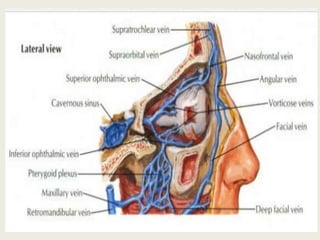
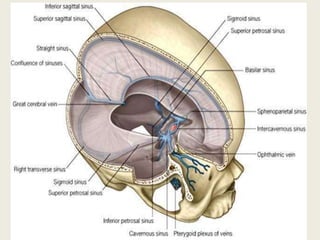
Cavernous sinus receives blood from the following:
• Face, eyes and maxilla
superior and inferior ophthalmic veins
Pterigoid plexus via emissary veins
• Anteriorly
Sphenoparietal vein
Superficial middle cerebral vein
• Posteriorly
Superior petrosal sinus
Inferior petrosal sinus • It drains into
1. Transverse sinuses
2. Internal jugular vein
What is CST ?
 Formation of blood clot within the cavernous sinus
What are the types of CST ?
Pathology of CST can be divided in to two types:
1. Aseptic thrombosis
2. Septic thrombosis
Aseptic thrombosis occurs with:
1) Trauma
2) Tumor invasion
3) Aneurysmal expansion
4) Hypercoagulable states
septic thrombosis occurs with:
• It is the commonest type .
• 2ry to the spread of infection by veins and by direct
extension..
Septic CST occurs via infection through
1. Danger area of the face (angular &ophthalmic
vein).
2. Tooth extraction
3. Nasal sinuses ( maxillary , spheroidal )
4. Otitis media .
5. Extension from infected internal jugular vein,
lateral sinus or petrosal sinus
What is The most commonly isolated organisms
causing CST ?
1) Staphylococcus aurous (about 70%)
2) Streptococcus species (about 20%)..
General syptoms :--
• Headache (50% to 90% of cases) generally
unilateral, fronto temporal, or retro bulbar in
location.
• Signs of sepsis,
1) FAHM.
2) Tachycardia
3) Hypotension.
4) Confusion.
5) coma.
6) Pyrexia is seen usually with a “picket fence”
Ocular symptoms :-
1) Periorbital edema.
2) Eye pain
3) Ptosis
4) Proptosis
5) Conjunctival Chemosis
6) Ophthalmoplegia . Why ??
Orbital congestion – stasis sec to thrombosis
Infection of EOM.
NB : -
Impaired EOM starting with a LR..
• Blurred vision due to:-
Arterial insufficiency
Venous stasis with engorged retinal vessels
Retinal hemorrhage
Papilledema
Keratitis due to loss of corneal sensation
• Diplopia
What are the complications of CST ??
• Orbital abscess .
• Septicemia
• Intracranial extension of infection may result in:-
 Meningitis,
 Encephalitis,
 Brain abscess
• Extension of the thrombus to other sinuses
• Cortical vein thrombosis can result in:-
 Hemorrhagic infarction
 hemiplegia
Differential Diagnosis
1) THS ( painful Ophthalmoplegia ) , no affect on ON.
2) OAS (cranial nerve palsy +optic nerve dysfunction).
3) Myositis .
4) Orbital cellulitis
5) Orbital tumor
6) Orbital pseudo tumor .
Investigations
1) FBP & ESR
2) Blood culture and sensitivity
3) Lumber puncture
1) mixed pleocytosis and polymophonuclear cells
2) Raised proteins
3) Normal/low glucose
4) CT Brain and orbit
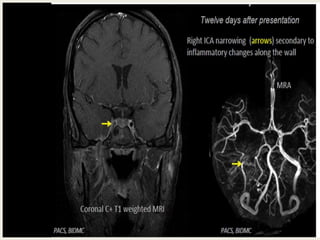
MRI brain
Management of CST
Medical Management
ANTIBIOTICS
• Broad spectrum iv antibiotics – 3 to 4 weeks but if
evidence of intracranial suppuration then 6 to 8 weeks.
i.e.
1. Ceftriaxone IV
2. Metronidazole IV
ANTICOAGULANTS .(ASAP )
• The proposed benefit is to dissolve the clot E.g. heparin .
STEROID THERAPY
• Helps reduce level of inflammation
Surgical Management
SURGICAL MANAGEMENT
• Surgical intervention should be directed at the
primary source of the infection and the
surrounding areas of involvement.
• Incision and drainage should be done ASAP.
Septic CST
Aseptic CST
SUPERIOR ORBITAL FISSURE
Left orbit
SUPERIOR ORBITAL FISSURE
• 22 mm long
• It communicate ( ) the orbit & the middle cranial
fossa
• Lateral superior part of the fissure is narrower
than the medial inferior part.
SOFS
• Causes :-
1) Idiopathic
2) Trauma ( craniofacial fractures) (most commonly)
3) Tumor
4) hematoma of the cavernous sinus .
5) Infections
6) Narrowing, aneurysm of ICA.
Clinical picture :- DOPPE ( diplopia , Ophthalmoplegia , ptosis , Proptosis ).
It occurs as a result of inflammation & Compression of
adjacent nervous tissue
• Diplopia
• Orbital pain .
• Lid ptosis
– Sympathetic fibers in CS – Mullers muscle
– Efferent fibers Superior Oculomotor Nerve – Levetor
palpebrae superioris muscle
• Ophthalmoplegia
– Impairment of cranial nerves III, IV, and VI.
• Anesthesia of the forehead and upper eyelid.
• Proptosis
– loss of tone of EOM muscles ..
Investigations
1) FBP & ESR
2) Blood culture and sensitivity
3) CT/MRI Brain and orbit
4) Angiogram
Maxillofacial CT scan
Angiogram SOFS
Left carotid angiogram showing narrowing with
aneurysm
CT Brian – Axial view for SOFS
Treatment
1. Exploration .
2. Treatment of the cause
3. Steroids
4. Antibiotics
5. surgical intervention .
a) Orbitotomy.
b) Orbital decompression .
Surgical Treatment of SOFS
SOFS

CST & SOFS.pptx

  • 1.
  • 2.
    What is cavernoussinus ? intracranial Venous channels It is formed by the splitting of the Dura matter. • The 2 cavernous sinus are interconnected by small anterior and posterior inter cavernous channels • The lateral wall of cavernous sinus is composed of 2 layers 1. Superficial layer of dura – dura matter on the medial side of middle cranial fossa 2. Deep layer of dura – formed by sheath of : Oculomotor 3 Trochlea 4 Trigeminal(Ophthalmic and Maxillary). 5
  • 4.
    Cavernous sinus receivesblood from the following: • Face, eyes and maxilla superior and inferior ophthalmic veins Pterigoid plexus via emissary veins • Anteriorly Sphenoparietal vein Superficial middle cerebral vein • Posteriorly Superior petrosal sinus Inferior petrosal sinus • It drains into 1. Transverse sinuses 2. Internal jugular vein
  • 7.
    What is CST?  Formation of blood clot within the cavernous sinus What are the types of CST ? Pathology of CST can be divided in to two types: 1. Aseptic thrombosis 2. Septic thrombosis Aseptic thrombosis occurs with: 1) Trauma 2) Tumor invasion 3) Aneurysmal expansion 4) Hypercoagulable states septic thrombosis occurs with: • It is the commonest type . • 2ry to the spread of infection by veins and by direct extension..
  • 8.
    Septic CST occursvia infection through 1. Danger area of the face (angular &ophthalmic vein). 2. Tooth extraction 3. Nasal sinuses ( maxillary , spheroidal ) 4. Otitis media . 5. Extension from infected internal jugular vein, lateral sinus or petrosal sinus What is The most commonly isolated organisms causing CST ? 1) Staphylococcus aurous (about 70%) 2) Streptococcus species (about 20%)..
  • 11.
    General syptoms :-- •Headache (50% to 90% of cases) generally unilateral, fronto temporal, or retro bulbar in location. • Signs of sepsis, 1) FAHM. 2) Tachycardia 3) Hypotension. 4) Confusion. 5) coma. 6) Pyrexia is seen usually with a “picket fence”
  • 12.
    Ocular symptoms :- 1)Periorbital edema. 2) Eye pain 3) Ptosis 4) Proptosis 5) Conjunctival Chemosis 6) Ophthalmoplegia . Why ?? Orbital congestion – stasis sec to thrombosis Infection of EOM. NB : - Impaired EOM starting with a LR..
  • 13.
    • Blurred visiondue to:- Arterial insufficiency Venous stasis with engorged retinal vessels Retinal hemorrhage Papilledema Keratitis due to loss of corneal sensation • Diplopia
  • 15.
    What are thecomplications of CST ?? • Orbital abscess . • Septicemia • Intracranial extension of infection may result in:-  Meningitis,  Encephalitis,  Brain abscess • Extension of the thrombus to other sinuses • Cortical vein thrombosis can result in:-  Hemorrhagic infarction  hemiplegia
  • 16.
    Differential Diagnosis 1) THS( painful Ophthalmoplegia ) , no affect on ON. 2) OAS (cranial nerve palsy +optic nerve dysfunction). 3) Myositis . 4) Orbital cellulitis 5) Orbital tumor 6) Orbital pseudo tumor .
  • 17.
    Investigations 1) FBP &ESR 2) Blood culture and sensitivity 3) Lumber puncture 1) mixed pleocytosis and polymophonuclear cells 2) Raised proteins 3) Normal/low glucose 4) CT Brain and orbit
  • 18.
  • 20.
  • 21.
    Medical Management ANTIBIOTICS • Broadspectrum iv antibiotics – 3 to 4 weeks but if evidence of intracranial suppuration then 6 to 8 weeks. i.e. 1. Ceftriaxone IV 2. Metronidazole IV ANTICOAGULANTS .(ASAP ) • The proposed benefit is to dissolve the clot E.g. heparin . STEROID THERAPY • Helps reduce level of inflammation
  • 22.
    Surgical Management SURGICAL MANAGEMENT •Surgical intervention should be directed at the primary source of the infection and the surrounding areas of involvement. • Incision and drainage should be done ASAP.
  • 23.
  • 24.
  • 25.
  • 26.
    SUPERIOR ORBITAL FISSURE •22 mm long • It communicate ( ) the orbit & the middle cranial fossa • Lateral superior part of the fissure is narrower than the medial inferior part.
  • 27.
    SOFS • Causes :- 1)Idiopathic 2) Trauma ( craniofacial fractures) (most commonly) 3) Tumor 4) hematoma of the cavernous sinus . 5) Infections 6) Narrowing, aneurysm of ICA.
  • 28.
    Clinical picture :-DOPPE ( diplopia , Ophthalmoplegia , ptosis , Proptosis ). It occurs as a result of inflammation & Compression of adjacent nervous tissue • Diplopia • Orbital pain . • Lid ptosis – Sympathetic fibers in CS – Mullers muscle – Efferent fibers Superior Oculomotor Nerve – Levetor palpebrae superioris muscle • Ophthalmoplegia – Impairment of cranial nerves III, IV, and VI. • Anesthesia of the forehead and upper eyelid. • Proptosis – loss of tone of EOM muscles ..
  • 31.
    Investigations 1) FBP &ESR 2) Blood culture and sensitivity 3) CT/MRI Brain and orbit 4) Angiogram
  • 32.
  • 33.
    Angiogram SOFS Left carotidangiogram showing narrowing with aneurysm
  • 34.
    CT Brian –Axial view for SOFS
  • 35.
    Treatment 1. Exploration . 2.Treatment of the cause 3. Steroids 4. Antibiotics 5. surgical intervention . a) Orbitotomy. b) Orbital decompression .
  • 36.
  • 37.