States of Matter  By: Tyler Hamilton  Erin Wolff
Three Main States of Matter  Gases  Liquids  Solids
Table Of Contents  What is Matter? Gases  Liquids   Solids  Comparisons  Physical Changes  Phase Change Graph  States Of Matter Web Page  States Of Matter Video  Temperature-Role in Phase Changes
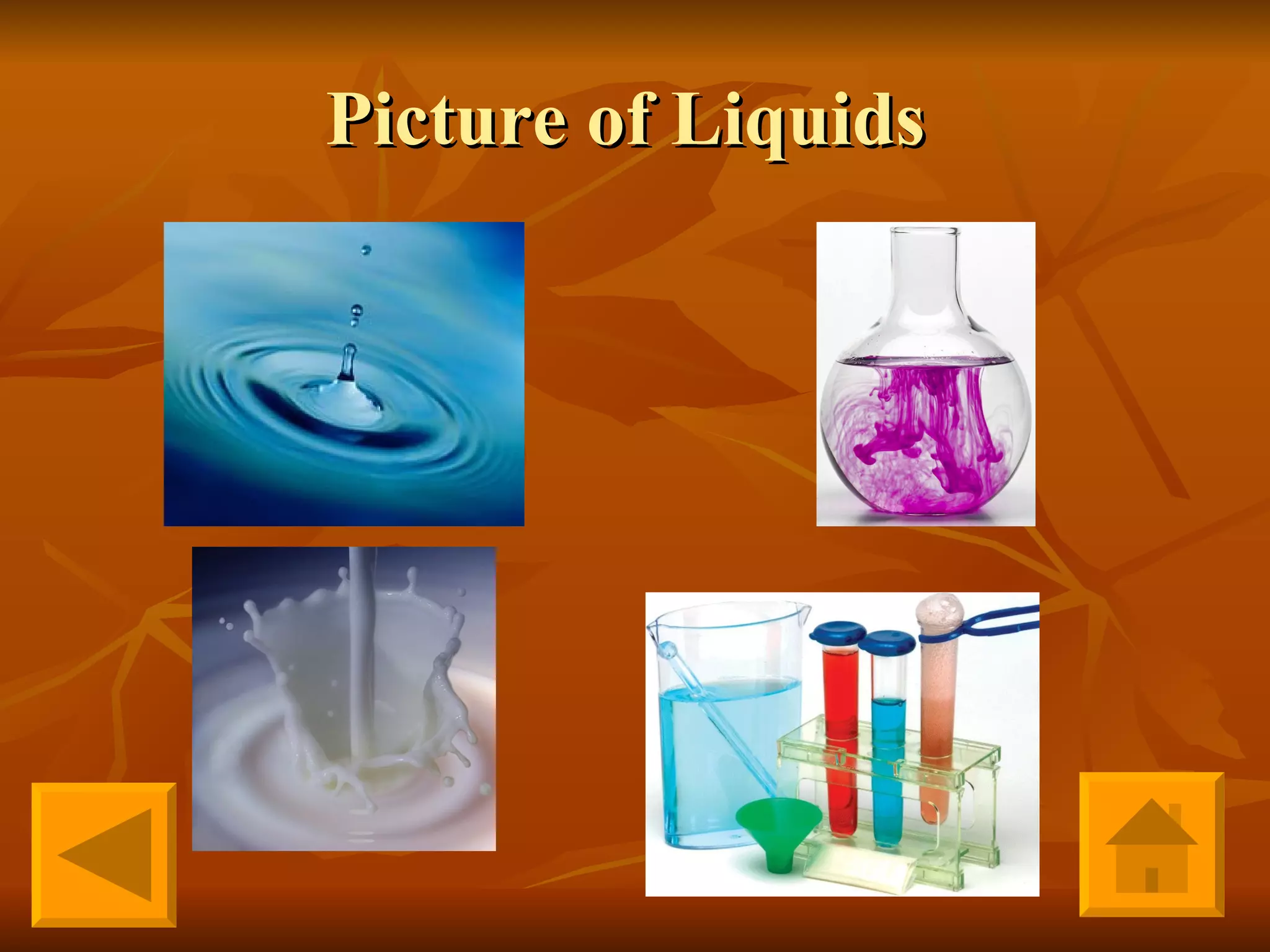
Liquids  The state of matter in which a substance exhibits a characteristic readiness to flow, little or no tendency to disperse, and relatively high incompressibility. Matter or a specific body of matter in this state.  Matter is everything around you. On Earth, matter is usually found in one of three states, or phases. The three main states of matter are solid, liquid, and gas.
Solids  A substance having a definite shape and volume; one that is neither liquid nor gaseous.
Gases  a substance possessing perfect molecular mobility and the property of indefinite expansion, as opposed to a solid or liquid.
Comparisons Gas Particles  * Gas are well separated with no regular arrangement.  * Gas vibrate and move freely at high speeds.
Comparisons  Liquid Particles * Liquid are close together with no regular arrangement.  *  Liquid vibrate, move about, and slide past each other.
Comparisons  Solid Particles  *  Solid are tightly packed, usually in a regular pattern.  *  Solid vibrate (jiggle) but generally do not move from place to place.
Webpage  http://www.chem.purdue.edu/gchelp/atoms/states.html
Physical Changes  Physical changes  occur when objects undergo a change that does not change their chemical nature. A physical change involves a change in physical properties. Physical properties can be observed without changing the type of matter. Examples of physical properties include: texture, shape, size, color, odor, volume, mass, weight, and density.
Physical Changes  Elements move from one phase to another when physical forces are present  * Examples: solid to a liquid   liquid to gas
Physical Changes Increased temperature/Increased Pressure Decreased temperature/Decreased Pressure
NASA Video  http://ksnn.larc.nasa.gov/k2/s_statesMatter_v.html
Temperature  Temperature changes materials from one state of matter to another.  Heated solids melt into liquids. Heated liquids evaporate into gases.   Cooled gases condense into liquids. Cooled liquids freeze into solids.
What is Matter?  Matter is everything around you. On Earth, matter is usually found in one of three states, or phases. The three main states of matter are solid, liquid, and gas.
Picture of Liquids
Pictures Of Solids
Pictures of Gases
Graph

States Of Matter[1]

  • 1.
    States of Matter By: Tyler Hamilton Erin Wolff
  • 2.
    Three Main Statesof Matter Gases Liquids Solids
  • 3.
    Table Of Contents What is Matter? Gases Liquids Solids Comparisons Physical Changes Phase Change Graph States Of Matter Web Page States Of Matter Video Temperature-Role in Phase Changes
  • 4.
    Liquids Thestate of matter in which a substance exhibits a characteristic readiness to flow, little or no tendency to disperse, and relatively high incompressibility. Matter or a specific body of matter in this state. Matter is everything around you. On Earth, matter is usually found in one of three states, or phases. The three main states of matter are solid, liquid, and gas.
  • 5.
    Solids Asubstance having a definite shape and volume; one that is neither liquid nor gaseous.
  • 6.
    Gases asubstance possessing perfect molecular mobility and the property of indefinite expansion, as opposed to a solid or liquid.
  • 7.
    Comparisons Gas Particles * Gas are well separated with no regular arrangement. * Gas vibrate and move freely at high speeds.
  • 8.
    Comparisons LiquidParticles * Liquid are close together with no regular arrangement. * Liquid vibrate, move about, and slide past each other.
  • 9.
    Comparisons SolidParticles * Solid are tightly packed, usually in a regular pattern. * Solid vibrate (jiggle) but generally do not move from place to place.
  • 10.
  • 11.
    Physical Changes Physical changes occur when objects undergo a change that does not change their chemical nature. A physical change involves a change in physical properties. Physical properties can be observed without changing the type of matter. Examples of physical properties include: texture, shape, size, color, odor, volume, mass, weight, and density.
  • 12.
    Physical Changes Elements move from one phase to another when physical forces are present * Examples: solid to a liquid liquid to gas
  • 13.
    Physical Changes Increasedtemperature/Increased Pressure Decreased temperature/Decreased Pressure
  • 14.
    NASA Video http://ksnn.larc.nasa.gov/k2/s_statesMatter_v.html
  • 15.
    Temperature Temperaturechanges materials from one state of matter to another.  Heated solids melt into liquids. Heated liquids evaporate into gases.  Cooled gases condense into liquids. Cooled liquids freeze into solids.
  • 16.
    What is Matter? Matter is everything around you. On Earth, matter is usually found in one of three states, or phases. The three main states of matter are solid, liquid, and gas.
  • 17.
  • 18.
  • 19.
  • 20.