Organizational
Behavior
ORGANIZATION Behavior
An overview of Organizational Behavior
A. Introduction to Organizational Behavior
B. Essence of OB.
C. Related concept of OB.
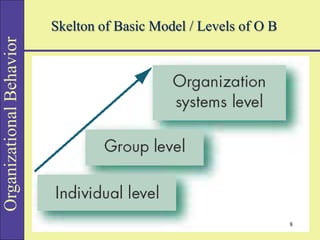
D. Skelton of basic Model-OB.
E. Organizational Behavior Models
S-O-B-C model & other
F. Basic Approaches to the study of O B.
1
Organizational
Behavior
Introduction: Organizational Behaviour
• O B has two components Organization and Behaviour.
Organization is a living body with its functions and the
basic characteristic of organization is people, goal and
structure.
• Behaviour is the study and application of knowledge
about how people-as a individual and as a group act
within the organization. It strives to identify ways in
which people can act more effectively.
2
Organizational
Behavior
Introduction: Organizational Behaviour
Organization Behaviour is a field of study based on theory,
research and observation. It is analyzing and understanding
the, attitudes, feelings, perceptions, motives, and behaviour
of people in the organization.
• The primary goals of OB are to improve individuals and
organizations performance and increase employees
participation (satisfaction)
3
Organizational
Behavior
Essence of OB
OB is scientific study of behaviour of individuals and
groups in the organization. It deals with practical
issues in the organization as;
1) Help employees to achieve greater job satisfaction
and performance.
2) Helping Managers to become more effective in
dealing with human resources.
4
Organizational
Behavior Related Concept in Organizational
Behavior
1. Behaviour: It is observable and measurable activity of
human being indicated by action. It exists a cause and
effect relationship in human behaviour.
2. Perception: A process individual organize and interpret
their sensory impression in order to arrive meaning thereto.
3. Personality: Personality is the sum total of ways in which
an individual reacts & interacts with others. It refer to
personal traits, such as dominance, aggressiveness etc.
5
Organizational
Behavior Related Concept in Organizational
Behavior
4. Ability: It refers to the skills and capabilities of an
person which are require for an effective performance.
5. Values: It represent basic convictions of what is good
or bad or desirable or undesirable in one’s conduct.
Values are core of personality and are powerful source
affecting behaviour.
6. Attitudes: A predisposition to respond in a positive or
negative way to someone. It shows likes or dislikes. It
is different from opinion and belief. 6
Organizational
Behavior Related Concept in Organizational
Behavior
7. Learning: It is psychological process of determining
human behaviour based on acquired knowledge and
skills. It may involves change for better or worse.
8. Motivation: It refers to the force that energies persons
efforts. It has effect on performance.
Performance = Ability x Motivation x Environmental
factors (situation)
7
Organizational
Behavior
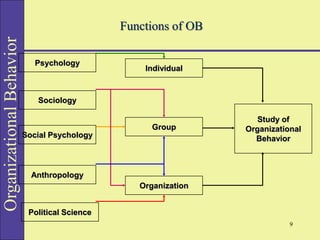
Skelton of Basic Model / Levels of O B
8
Organizational
Behavior
Individual
Group
Organization
Study of
Organizational
Behavior
Social Psychology
Political Science
Anthropology
Psychology
Sociology
Functions of OB
9
Organizational
Behavior
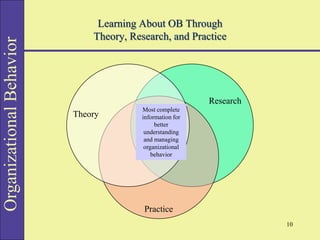
Learning About OB Through
Theory, Research, and Practice
Research
Practice
Theory
Most complete
information for
better
understanding
and managing
organizational
behavior
10
Organizational
Behavior
Learning About OB From Theory
A good theoretical model:
Defines key terms.
Constructs a conceptual framework that explains
how important factors are interrelated. (Graphic
models.)
Provides a departure point for research and
practical application.
11
Organizational
Behavior
Learning About OB From Research
Five Sources of OB Research Insights;
1. Meta-analyses
2. Field studies
3. Laboratory studies
4. Sample surveys
5. Case studies
12
Organizational
Behavior
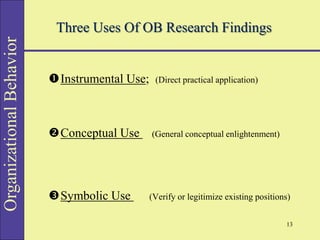
Three Uses Of OB Research Findings
Instrumental Use; (Direct practical application)
Conceptual Use (General conceptual enlightenment)
Symbolic Use (Verify or legitimize existing positions)
13
Organizational
Behavior Organizational Behavior Models
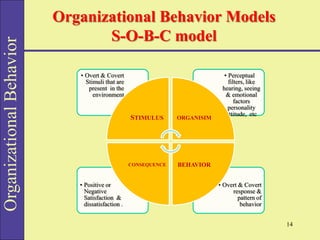
S-O-B-C model
• Overt & Covert
response &
pattern of
behavior
• Positive or
Negative
Satisfaction &
dissatisfaction .
• Perceptual
filters, like
hearing, seeing
& emotional
factors
personality
attitude, etc
• Overt & Covert
Stimuli that are
present in the
environment
STIMULUS ORGANISIM
BEHAVIOR
CONSEQUENCE
14
Organizational
Behavior BASIC APPROACHES TO THE STUDY
OF OB
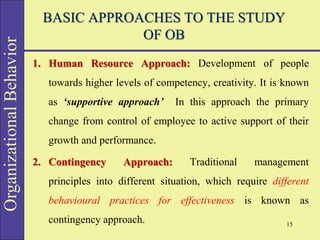
1. Human Resource Approach: Development of people
towards higher levels of competency, creativity. It is known
as ‘supportive approach’ In this approach the primary
change from control of employee to active support of their
growth and performance.
2. Contingency Approach: Traditional management
principles into different situation, which require different
behavioural practices for effectiveness is known as
contingency approach. 15
Organizational
Behavior BASIC APPROACHES TO THE STUDY
OF OB
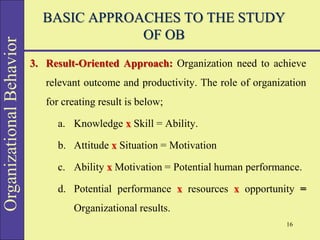
3. Result-Oriented Approach: Organization need to achieve
relevant outcome and productivity. The role of organization
for creating result is below;
a. Knowledge x Skill = Ability.
b. Attitude x Situation = Motivation
c. Ability x Motivation = Potential human performance.
d. Potential performance x resources x opportunity =
Organizational results.
16
Organizational
Behavior BASIC APPROACHES TO THE STUDY
OF OB
4. System Approach: It takes many factors and variables
which affect all other in complex relationship. System
approach compels Manager to take a Holistic view of the
organization. Holistic OB interprets people-organization
relationship in term of the whole person, whole group,
whole organization and whole social system.
Manager’s are using Organization Behaviour to achieve
maximum performance of individual, organization and
societal goals to reap rewards. 17
Organizational
Behavior
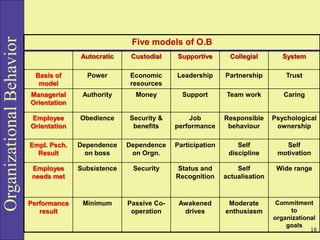
Five models of O.B
Autocratic Custodial Supportive Collegial System
Basis of
model
Power Economic
resources
Leadership Partnership Trust
Managerial
Orientation
Authority Money Support Team work Caring
Employee
Orientation
Obedience Security &
benefits
Job
performance
Responsible
behaviour
Psychological
ownership
Empl. Psch.
Result
Dependence
on boss
Dependence
on Orgn.
Participation Self
discipline
Self
motivation
Employee
needs met
Subsistence Security Status and
Recognition
Self
actualisation
Wide range
Performance
result
Minimum Passive Co-
operation
Awakened
drives
Moderate
enthusiasm
Commitment
to
organizational
goals
18

Session 28,29 Introduction OB.pdfhhjbvvhb

  • 1.
    Organizational Behavior ORGANIZATION Behavior An overviewof Organizational Behavior A. Introduction to Organizational Behavior B. Essence of OB. C. Related concept of OB. D. Skelton of basic Model-OB. E. Organizational Behavior Models S-O-B-C model & other F. Basic Approaches to the study of O B. 1
  • 2.
    Organizational Behavior Introduction: Organizational Behaviour •O B has two components Organization and Behaviour. Organization is a living body with its functions and the basic characteristic of organization is people, goal and structure. • Behaviour is the study and application of knowledge about how people-as a individual and as a group act within the organization. It strives to identify ways in which people can act more effectively. 2
  • 3.
    Organizational Behavior Introduction: Organizational Behaviour OrganizationBehaviour is a field of study based on theory, research and observation. It is analyzing and understanding the, attitudes, feelings, perceptions, motives, and behaviour of people in the organization. • The primary goals of OB are to improve individuals and organizations performance and increase employees participation (satisfaction) 3
  • 4.
    Organizational Behavior Essence of OB OBis scientific study of behaviour of individuals and groups in the organization. It deals with practical issues in the organization as; 1) Help employees to achieve greater job satisfaction and performance. 2) Helping Managers to become more effective in dealing with human resources. 4
  • 5.
    Organizational Behavior Related Conceptin Organizational Behavior 1. Behaviour: It is observable and measurable activity of human being indicated by action. It exists a cause and effect relationship in human behaviour. 2. Perception: A process individual organize and interpret their sensory impression in order to arrive meaning thereto. 3. Personality: Personality is the sum total of ways in which an individual reacts & interacts with others. It refer to personal traits, such as dominance, aggressiveness etc. 5
  • 6.
    Organizational Behavior Related Conceptin Organizational Behavior 4. Ability: It refers to the skills and capabilities of an person which are require for an effective performance. 5. Values: It represent basic convictions of what is good or bad or desirable or undesirable in one’s conduct. Values are core of personality and are powerful source affecting behaviour. 6. Attitudes: A predisposition to respond in a positive or negative way to someone. It shows likes or dislikes. It is different from opinion and belief. 6
  • 7.
    Organizational Behavior Related Conceptin Organizational Behavior 7. Learning: It is psychological process of determining human behaviour based on acquired knowledge and skills. It may involves change for better or worse. 8. Motivation: It refers to the force that energies persons efforts. It has effect on performance. Performance = Ability x Motivation x Environmental factors (situation) 7
  • 8.
  • 9.
  • 10.
    Organizational Behavior Learning About OBThrough Theory, Research, and Practice Research Practice Theory Most complete information for better understanding and managing organizational behavior 10
  • 11.
    Organizational Behavior Learning About OBFrom Theory A good theoretical model: Defines key terms. Constructs a conceptual framework that explains how important factors are interrelated. (Graphic models.) Provides a departure point for research and practical application. 11
  • 12.
    Organizational Behavior Learning About OBFrom Research Five Sources of OB Research Insights; 1. Meta-analyses 2. Field studies 3. Laboratory studies 4. Sample surveys 5. Case studies 12
  • 13.
    Organizational Behavior Three Uses OfOB Research Findings Instrumental Use; (Direct practical application) Conceptual Use (General conceptual enlightenment) Symbolic Use (Verify or legitimize existing positions) 13
  • 14.
    Organizational Behavior Organizational BehaviorModels S-O-B-C model • Overt & Covert response & pattern of behavior • Positive or Negative Satisfaction & dissatisfaction . • Perceptual filters, like hearing, seeing & emotional factors personality attitude, etc • Overt & Covert Stimuli that are present in the environment STIMULUS ORGANISIM BEHAVIOR CONSEQUENCE 14
  • 15.
    Organizational Behavior BASIC APPROACHESTO THE STUDY OF OB 1. Human Resource Approach: Development of people towards higher levels of competency, creativity. It is known as ‘supportive approach’ In this approach the primary change from control of employee to active support of their growth and performance. 2. Contingency Approach: Traditional management principles into different situation, which require different behavioural practices for effectiveness is known as contingency approach. 15
  • 16.
    Organizational Behavior BASIC APPROACHESTO THE STUDY OF OB 3. Result-Oriented Approach: Organization need to achieve relevant outcome and productivity. The role of organization for creating result is below; a. Knowledge x Skill = Ability. b. Attitude x Situation = Motivation c. Ability x Motivation = Potential human performance. d. Potential performance x resources x opportunity = Organizational results. 16
  • 17.
    Organizational Behavior BASIC APPROACHESTO THE STUDY OF OB 4. System Approach: It takes many factors and variables which affect all other in complex relationship. System approach compels Manager to take a Holistic view of the organization. Holistic OB interprets people-organization relationship in term of the whole person, whole group, whole organization and whole social system. Manager’s are using Organization Behaviour to achieve maximum performance of individual, organization and societal goals to reap rewards. 17
  • 18.
    Organizational Behavior Five models ofO.B Autocratic Custodial Supportive Collegial System Basis of model Power Economic resources Leadership Partnership Trust Managerial Orientation Authority Money Support Team work Caring Employee Orientation Obedience Security & benefits Job performance Responsible behaviour Psychological ownership Empl. Psch. Result Dependence on boss Dependence on Orgn. Participation Self discipline Self motivation Employee needs met Subsistence Security Status and Recognition Self actualisation Wide range Performance result Minimum Passive Co- operation Awakened drives Moderate enthusiasm Commitment to organizational goals 18