Orbits of Linear Maps and Regular Languages

                                    S. Tarasov, M. Vyalyi

                               Dorodnitsyn Computing Center of RAS


                                              CSR 2011


S. Tarasov, M. Vyalyi (CCAS)     Orbits of linear maps and regular languages   CSR 2011   1 / 17
Contents


1    Orbits of linear maps


2    Regular realizability (RR)


3    Examples of relation between RR and linear algebra


    S. Tarasov, M. Vyalyi (CCAS)   Orbits of linear maps and regular languages   CSR 2011   2 / 17
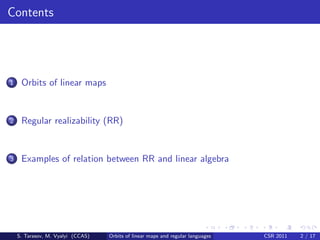
Chamber hitting problem


Definition
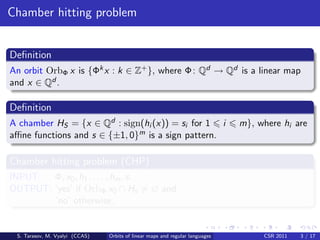
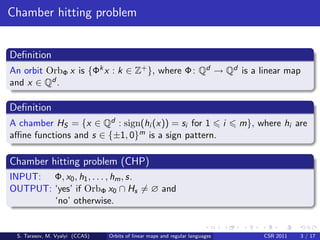
An orbit OrbΦ x is {Φk x : k ∈ Z+ }, where Φ : Qd → Qd is a linear map
and x ∈ Qd .

Definition
A chamber HS = {x ∈ Qd : sign(hi (x)) = si for 1 i                            m}, where hi are
affine functions and s ∈ {±1, 0}m is a sign pattern.

Chamber hitting problem (CHP)
INPUT: Φ, x0 , h1 , . . . , hm , s.
OUTPUT: ‘yes’ if OrbΦ x0 ∩ Hs = ∅ and
        ‘no’ otherwise.


 S. Tarasov, M. Vyalyi (CCAS)   Orbits of linear maps and regular languages        CSR 2011   3 / 17
Chamber hitting problem


Definition
An orbit OrbΦ x is {Φk x : k ∈ Z+ }, where Φ : Qd → Qd is a linear map
and x ∈ Qd .

Definition
A chamber HS = {x ∈ Qd : sign(hi (x)) = si for 1 i                            m}, where hi are
affine functions and s ∈ {±1, 0}m is a sign pattern.

Chamber hitting problem (CHP)
INPUT: Φ, x0 , h1 , . . . , hm , s.
OUTPUT: ‘yes’ if OrbΦ x0 ∩ Hs = ∅ and
        ‘no’ otherwise.


 S. Tarasov, M. Vyalyi (CCAS)   Orbits of linear maps and regular languages        CSR 2011   3 / 17
Chamber hitting problem


Definition
An orbit OrbΦ x is {Φk x : k ∈ Z+ }, where Φ : Qd → Qd is a linear map
and x ∈ Qd .

Definition
A chamber HS = {x ∈ Qd : sign(hi (x)) = si for 1 i                            m}, where hi are
affine functions and s ∈ {±1, 0}m is a sign pattern.

Chamber hitting problem (CHP)
INPUT: Φ, x0 , h1 , . . . , hm , s.
OUTPUT: ‘yes’ if OrbΦ x0 ∩ Hs = ∅ and
        ‘no’ otherwise.


 S. Tarasov, M. Vyalyi (CCAS)   Orbits of linear maps and regular languages        CSR 2011   3 / 17
Special cases: the orbit problem


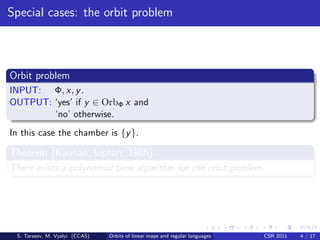
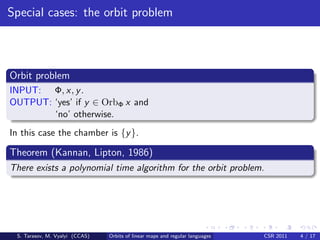
Orbit problem
INPUT: Φ, x, y .
OUTPUT: ‘yes’ if y ∈ OrbΦ x and
        ‘no’ otherwise.
In this case the chamber is {y }.

Theorem (Kannan, Lipton, 1986)
There exists a polynomial time algorithm for the orbit problem.


 S. Tarasov, M. Vyalyi (CCAS)   Orbits of linear maps and regular languages   CSR 2011   4 / 17
Special cases: the orbit problem


Orbit problem
INPUT: Φ, x, y .
OUTPUT: ‘yes’ if y ∈ OrbΦ x and
        ‘no’ otherwise.
In this case the chamber is {y }.

Theorem (Kannan, Lipton, 1986)
There exists a polynomial time algorithm for the orbit problem.


 S. Tarasov, M. Vyalyi (CCAS)   Orbits of linear maps and regular languages   CSR 2011   4 / 17
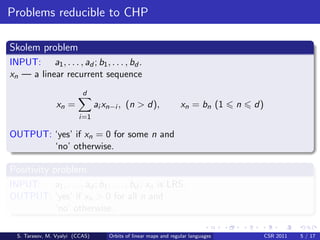
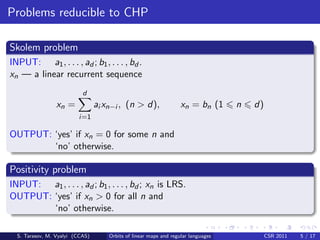
Problems reducible to CHP

Skolem problem
INPUT: a1 , . . . , ad ; b1 , . . . , bd .
xn — a linear recurrent sequence
                           d
                 xn =            ai xn−i , (n > d),                xn = bn (1      n   d)
                         i=1

OUTPUT: ‘yes’ if xn = 0 for some n and
        ‘no’ otherwise.

Positivity problem
INPUT: a1 , . . . , ad ; b1 , . . . , bd ; xn is LRS.
OUTPUT: ‘yes’ if xn > 0 for all n and
        ‘no’ otherwise.

  S. Tarasov, M. Vyalyi (CCAS)       Orbits of linear maps and regular languages            CSR 2011   5 / 17
Problems reducible to CHP

Skolem problem
INPUT: a1 , . . . , ad ; b1 , . . . , bd .
xn — a linear recurrent sequence
                           d
                 xn =            ai xn−i , (n > d),                xn = bn (1      n   d)
                         i=1

OUTPUT: ‘yes’ if xn = 0 for some n and
        ‘no’ otherwise.

Positivity problem
INPUT: a1 , . . . , ad ; b1 , . . . , bd ; xn is LRS.
OUTPUT: ‘yes’ if xn > 0 for all n and
        ‘no’ otherwise.

  S. Tarasov, M. Vyalyi (CCAS)       Orbits of linear maps and regular languages            CSR 2011   5 / 17
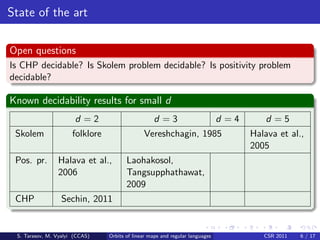
State of the art

Open questions
Is CHP decidable? Is Skolem problem decidable? Is positivity problem
decidable?

Known decidability results for small d
                       d =2                        d =3                        d =4       d =5
 Skolem               folklore                 Vereshchagin, 1985                     Halava et al.,
                                                                                      2005
 Pos. pr.       Halava et al.,          Laohakosol,
                2006                    Tangsupphathawat,
                                        2009
 CHP              Sechin, 2011


 S. Tarasov, M. Vyalyi (CCAS)    Orbits of linear maps and regular languages             CSR 2011   6 / 17
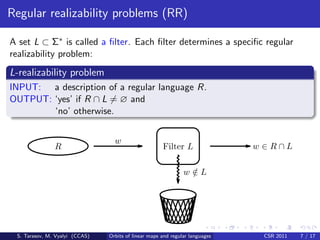
Regular realizability problems (RR)

A set L ⊂ Σ∗ is called a filter. Each filter determines a specific regular
realizability problem:
L-realizability problem
INPUT: a description of a regular language R.
OUTPUT: ‘yes’ if R ∩ L = ∅ and
        ‘no’ otherwise.


                                  w
               R                                      Filter L                w ∈R∩L

                                                               w∈L
                                                                /


 S. Tarasov, M. Vyalyi (CCAS)   Orbits of linear maps and regular languages    CSR 2011   7 / 17
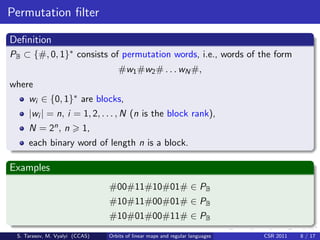
Permutation filter

Definition
PB ⊂ {#, 0, 1}∗ consists of permutation words, i.e., words of the form
                                   #w1 #w2 # . . . wN #,
where
     wi ∈ {0, 1}∗ are blocks,
     |wi | = n, i = 1, 2, . . . , N (n is the block rank),
     N = 2n , n           1,
     each binary word of length n is a block.

Examples
                                #00#11#10#01# ∈ PB
                                #10#11#00#01# ∈ PB
                                #10#01#00#11# ∈ PB
 S. Tarasov, M. Vyalyi (CCAS)   Orbits of linear maps and regular languages   CSR 2011   8 / 17
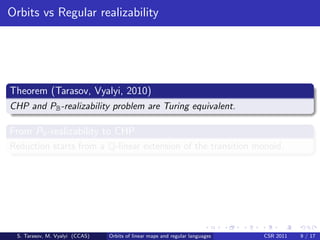
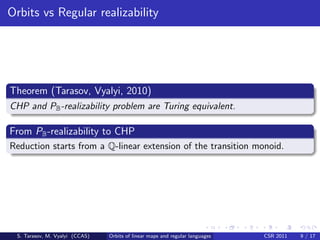
Orbits vs Regular realizability


Theorem (Tarasov, Vyalyi, 2010)
CHP and PB -realizability problem are Turing equivalent.

From PB -realizability to CHP
Reduction starts from a Q-linear extension of the transition monoid.


 S. Tarasov, M. Vyalyi (CCAS)   Orbits of linear maps and regular languages   CSR 2011   9 / 17
Orbits vs Regular realizability


Theorem (Tarasov, Vyalyi, 2010)
CHP and PB -realizability problem are Turing equivalent.

From PB -realizability to CHP
Reduction starts from a Q-linear extension of the transition monoid.


 S. Tarasov, M. Vyalyi (CCAS)   Orbits of linear maps and regular languages   CSR 2011   9 / 17
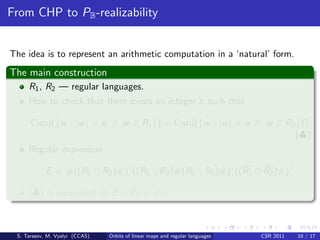
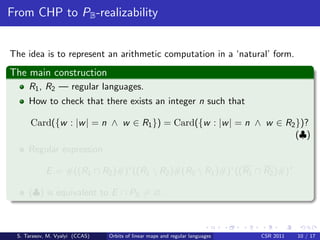
From CHP to PB -realizability


The idea is to represent an arithmetic computation in a ‘natural’ form.
The main construction
     R1 , R2 — regular languages.
     How to check that there exists an integer n such that

      Card({w : |w | = n ∧ w ∈ R1 }) = Card({w : |w | = n ∧ w ∈ R2 })?
                                                                   (♣)
     Regular expression

            E = #((R1 ∩ R2 )#)∗ ((R1  R2 )#(R2  R1 )#)∗ ((R1 ∩ R2 )#)∗

     (♣) is equivalent to E ∩ PB = ∅.


 S. Tarasov, M. Vyalyi (CCAS)   Orbits of linear maps and regular languages   CSR 2011   10 / 17
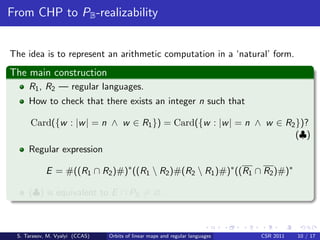
From CHP to PB -realizability


The idea is to represent an arithmetic computation in a ‘natural’ form.
The main construction
     R1 , R2 — regular languages.
     How to check that there exists an integer n such that

      Card({w : |w | = n ∧ w ∈ R1 }) = Card({w : |w | = n ∧ w ∈ R2 })?
                                                                   (♣)
     Regular expression

            E = #((R1 ∩ R2 )#)∗ ((R1  R2 )#(R2  R1 )#)∗ ((R1 ∩ R2 )#)∗

     (♣) is equivalent to E ∩ PB = ∅.


 S. Tarasov, M. Vyalyi (CCAS)   Orbits of linear maps and regular languages   CSR 2011   10 / 17
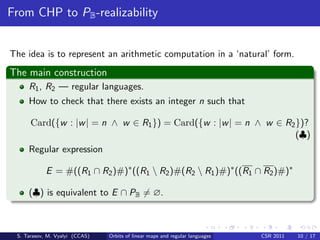
From CHP to PB -realizability


The idea is to represent an arithmetic computation in a ‘natural’ form.
The main construction
     R1 , R2 — regular languages.
     How to check that there exists an integer n such that

      Card({w : |w | = n ∧ w ∈ R1 }) = Card({w : |w | = n ∧ w ∈ R2 })?
                                                                   (♣)
     Regular expression

            E = #((R1 ∩ R2 )#)∗ ((R1  R2 )#(R2  R1 )#)∗ ((R1 ∩ R2 )#)∗

     (♣) is equivalent to E ∩ PB = ∅.


 S. Tarasov, M. Vyalyi (CCAS)   Orbits of linear maps and regular languages   CSR 2011   10 / 17
From CHP to PB -realizability


The idea is to represent an arithmetic computation in a ‘natural’ form.
The main construction
     R1 , R2 — regular languages.
     How to check that there exists an integer n such that

      Card({w : |w | = n ∧ w ∈ R1 }) = Card({w : |w | = n ∧ w ∈ R2 })?
                                                                   (♣)
     Regular expression

            E = #((R1 ∩ R2 )#)∗ ((R1  R2 )#(R2  R1 )#)∗ ((R1 ∩ R2 )#)∗

     (♣) is equivalent to E ∩ PB = ∅.


 S. Tarasov, M. Vyalyi (CCAS)   Orbits of linear maps and regular languages   CSR 2011   10 / 17
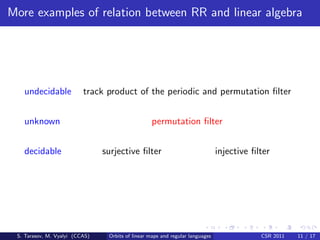
More examples of relation between RR and linear algebra


   undecidable            track product of the periodic and permutation filter


   unknown                                         permutation filter


   decidable                    surjective filter                               injective filter


 S. Tarasov, M. Vyalyi (CCAS)    Orbits of linear maps and regular languages               CSR 2011   11 / 17
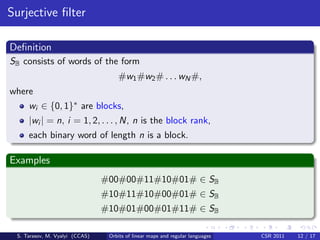
Surjective filter

Definition
SB consists of words of the form
                                    #w1 #w2 # . . . wN #,
where
     wi ∈ {0, 1}∗ are blocks,
     |wi | = n, i = 1, 2, . . . , N, n is the block rank,
     each binary word of length n is a block.

Examples
                                #00#00#11#10#01# ∈ SB
                                #10#11#10#00#01# ∈ SB
                                #10#01#00#01#11# ∈ SB

 S. Tarasov, M. Vyalyi (CCAS)    Orbits of linear maps and regular languages   CSR 2011   12 / 17
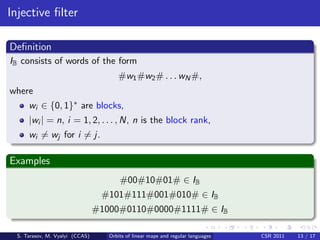
Injective filter

Definition
IB consists of words of the form
                                       #w1 #w2 # . . . wN #,
where
      wi ∈ {0, 1}∗ are blocks,
      |wi | = n, i = 1, 2, . . . , N, n is the block rank,
      wi = wj for i = j.

Examples
                                        #00#10#01# ∈ IB
                                  #101#111#001#010# ∈ IB
                                 #1000#0110#0000#1111# ∈ IB

  S. Tarasov, M. Vyalyi (CCAS)      Orbits of linear maps and regular languages   CSR 2011   13 / 17
Decidability results


Theorem
IB -realizability problem is decidable.
SB -realizability problem is decidable.

Proofs are based on converting IB -realizability problem (resp.,
SB -realizability problem) to a problem about orbits.


 S. Tarasov, M. Vyalyi (CCAS)   Orbits of linear maps and regular languages   CSR 2011   14 / 17
Decidability results


Theorem
IB -realizability problem is decidable.
SB -realizability problem is decidable.

Proofs are based on converting IB -realizability problem (resp.,
SB -realizability problem) to a problem about orbits.


 S. Tarasov, M. Vyalyi (CCAS)   Orbits of linear maps and regular languages   CSR 2011   14 / 17
An undecidable problem


Zero in the Upper Right Corner Problem (ZURC)
INPUT: A1 , . . . , AN are D × D integer matrices.
OUTPUT: ‘yes’ if there exists a sequence j1 , . . . , j such that

                                (Aj1 Aj2 . . . Aj )1D = 0 and

               ‘no’ otherwise.

Theorem (Bell, Potapov, 2006)
The ZURC problem is undecidable for N = 2 and D = 18.

The ZURC problem is reduced to the regular realizability problem for the
track product of periodic and permutation filters.


 S. Tarasov, M. Vyalyi (CCAS)    Orbits of linear maps and regular languages   CSR 2011   15 / 17
An undecidable problem


Zero in the Upper Right Corner Problem (ZURC)
INPUT: A1 , . . . , AN are D × D integer matrices.
OUTPUT: ‘yes’ if there exists a sequence j1 , . . . , j such that

                                (Aj1 Aj2 . . . Aj )1D = 0 and

               ‘no’ otherwise.

Theorem (Bell, Potapov, 2006)
The ZURC problem is undecidable for N = 2 and D = 18.

The ZURC problem is reduced to the regular realizability problem for the
track product of periodic and permutation filters.


 S. Tarasov, M. Vyalyi (CCAS)    Orbits of linear maps and regular languages   CSR 2011   15 / 17
An undecidable problem


Zero in the Upper Right Corner Problem (ZURC)
INPUT: A1 , . . . , AN are D × D integer matrices.
OUTPUT: ‘yes’ if there exists a sequence j1 , . . . , j such that

                                (Aj1 Aj2 . . . Aj )1D = 0 and

               ‘no’ otherwise.

Theorem (Bell, Potapov, 2006)
The ZURC problem is undecidable for N = 2 and D = 18.

The ZURC problem is reduced to the regular realizability problem for the
track product of periodic and permutation filters.


 S. Tarasov, M. Vyalyi (CCAS)    Orbits of linear maps and regular languages   CSR 2011   15 / 17
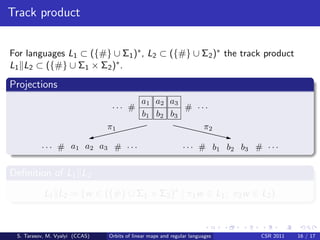
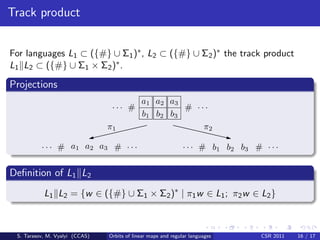
Track product


For languages L1 ⊂ ({#} ∪ Σ1 )∗ , L2 ⊂ ({#} ∪ Σ2 )∗ the track product
L1 L2 ⊂ ({#} ∪ Σ1 × Σ2 )∗ .

Projections
                                             a1 a2 a3
                                 ... #                 # ...
                                             b 1 b2 b3
                                π1                         π2

          . . . # a1 a2 a3 # . . .                             . . . # b 1 b 2 b3 # . . .


Definition of L1 L2
           L1 L2 = {w ∈ ({#} ∪ Σ1 × Σ2 )∗ | π1 w ∈ L1 ; π2 w ∈ L2 }


 S. Tarasov, M. Vyalyi (CCAS)   Orbits of linear maps and regular languages         CSR 2011   16 / 17
Track product


For languages L1 ⊂ ({#} ∪ Σ1 )∗ , L2 ⊂ ({#} ∪ Σ2 )∗ the track product
L1 L2 ⊂ ({#} ∪ Σ1 × Σ2 )∗ .

Projections
                                             a1 a2 a3
                                 ... #                 # ...
                                             b 1 b2 b3
                                π1                         π2

          . . . # a1 a2 a3 # . . .                             . . . # b 1 b 2 b3 # . . .


Definition of L1 L2
           L1 L2 = {w ∈ ({#} ∪ Σ1 × Σ2 )∗ | π1 w ∈ L1 ; π2 w ∈ L2 }


 S. Tarasov, M. Vyalyi (CCAS)   Orbits of linear maps and regular languages         CSR 2011   16 / 17
Track product of periodic and permutation filters


Definitions
     Periodic filter PerΣ ⊂ ({#} ∪ Σ)∗ consists of words of the form
                                             #w #w # . . . w #,
     where w ∈         {0, 1}∗ .
     Definition of the permutation filter PΣ over the alphabet {#} ∪ Σ is
     similar to the binary case.

Theorem
ZURC ≤m (PerΣ1 PΣ2 )-regular realizability for |Σ1 | = 2, |Σ2 | = 648.

Informally, the periodic part is to represent a sequence of matrices and the
permutation part is to encode the condition that the URC entry is 0.


 S. Tarasov, M. Vyalyi (CCAS)      Orbits of linear maps and regular languages   CSR 2011   17 / 17
Track product of periodic and permutation filters


Definitions
     Periodic filter PerΣ ⊂ ({#} ∪ Σ)∗ consists of words of the form
                                             #w #w # . . . w #,
     where w ∈         {0, 1}∗ .
     Definition of the permutation filter PΣ over the alphabet {#} ∪ Σ is
     similar to the binary case.

Theorem
ZURC ≤m (PerΣ1 PΣ2 )-regular realizability for |Σ1 | = 2, |Σ2 | = 648.

Informally, the periodic part is to represent a sequence of matrices and the
permutation part is to encode the condition that the URC entry is 0.


 S. Tarasov, M. Vyalyi (CCAS)      Orbits of linear maps and regular languages   CSR 2011   17 / 17

Csr2011 june17 11_30_vyalyi

  • 1.
    Orbits of LinearMaps and Regular Languages S. Tarasov, M. Vyalyi Dorodnitsyn Computing Center of RAS CSR 2011 S. Tarasov, M. Vyalyi (CCAS) Orbits of linear maps and regular languages CSR 2011 1 / 17
  • 2.
    Contents 1 Orbits of linear maps 2 Regular realizability (RR) 3 Examples of relation between RR and linear algebra S. Tarasov, M. Vyalyi (CCAS) Orbits of linear maps and regular languages CSR 2011 2 / 17
  • 3.
    Chamber hitting problem Definition Anorbit OrbΦ x is {Φk x : k ∈ Z+ }, where Φ : Qd → Qd is a linear map and x ∈ Qd . Definition A chamber HS = {x ∈ Qd : sign(hi (x)) = si for 1 i m}, where hi are affine functions and s ∈ {±1, 0}m is a sign pattern. Chamber hitting problem (CHP) INPUT: Φ, x0 , h1 , . . . , hm , s. OUTPUT: ‘yes’ if OrbΦ x0 ∩ Hs = ∅ and ‘no’ otherwise. S. Tarasov, M. Vyalyi (CCAS) Orbits of linear maps and regular languages CSR 2011 3 / 17
  • 4.
    Chamber hitting problem Definition Anorbit OrbΦ x is {Φk x : k ∈ Z+ }, where Φ : Qd → Qd is a linear map and x ∈ Qd . Definition A chamber HS = {x ∈ Qd : sign(hi (x)) = si for 1 i m}, where hi are affine functions and s ∈ {±1, 0}m is a sign pattern. Chamber hitting problem (CHP) INPUT: Φ, x0 , h1 , . . . , hm , s. OUTPUT: ‘yes’ if OrbΦ x0 ∩ Hs = ∅ and ‘no’ otherwise. S. Tarasov, M. Vyalyi (CCAS) Orbits of linear maps and regular languages CSR 2011 3 / 17
  • 5.
    Chamber hitting problem Definition Anorbit OrbΦ x is {Φk x : k ∈ Z+ }, where Φ : Qd → Qd is a linear map and x ∈ Qd . Definition A chamber HS = {x ∈ Qd : sign(hi (x)) = si for 1 i m}, where hi are affine functions and s ∈ {±1, 0}m is a sign pattern. Chamber hitting problem (CHP) INPUT: Φ, x0 , h1 , . . . , hm , s. OUTPUT: ‘yes’ if OrbΦ x0 ∩ Hs = ∅ and ‘no’ otherwise. S. Tarasov, M. Vyalyi (CCAS) Orbits of linear maps and regular languages CSR 2011 3 / 17
  • 6.
    Special cases: theorbit problem Orbit problem INPUT: Φ, x, y . OUTPUT: ‘yes’ if y ∈ OrbΦ x and ‘no’ otherwise. In this case the chamber is {y }. Theorem (Kannan, Lipton, 1986) There exists a polynomial time algorithm for the orbit problem. S. Tarasov, M. Vyalyi (CCAS) Orbits of linear maps and regular languages CSR 2011 4 / 17
  • 7.
    Special cases: theorbit problem Orbit problem INPUT: Φ, x, y . OUTPUT: ‘yes’ if y ∈ OrbΦ x and ‘no’ otherwise. In this case the chamber is {y }. Theorem (Kannan, Lipton, 1986) There exists a polynomial time algorithm for the orbit problem. S. Tarasov, M. Vyalyi (CCAS) Orbits of linear maps and regular languages CSR 2011 4 / 17
  • 8.
    Problems reducible toCHP Skolem problem INPUT: a1 , . . . , ad ; b1 , . . . , bd . xn — a linear recurrent sequence d xn = ai xn−i , (n > d), xn = bn (1 n d) i=1 OUTPUT: ‘yes’ if xn = 0 for some n and ‘no’ otherwise. Positivity problem INPUT: a1 , . . . , ad ; b1 , . . . , bd ; xn is LRS. OUTPUT: ‘yes’ if xn > 0 for all n and ‘no’ otherwise. S. Tarasov, M. Vyalyi (CCAS) Orbits of linear maps and regular languages CSR 2011 5 / 17
  • 9.
    Problems reducible toCHP Skolem problem INPUT: a1 , . . . , ad ; b1 , . . . , bd . xn — a linear recurrent sequence d xn = ai xn−i , (n > d), xn = bn (1 n d) i=1 OUTPUT: ‘yes’ if xn = 0 for some n and ‘no’ otherwise. Positivity problem INPUT: a1 , . . . , ad ; b1 , . . . , bd ; xn is LRS. OUTPUT: ‘yes’ if xn > 0 for all n and ‘no’ otherwise. S. Tarasov, M. Vyalyi (CCAS) Orbits of linear maps and regular languages CSR 2011 5 / 17
  • 10.
    State of theart Open questions Is CHP decidable? Is Skolem problem decidable? Is positivity problem decidable? Known decidability results for small d d =2 d =3 d =4 d =5 Skolem folklore Vereshchagin, 1985 Halava et al., 2005 Pos. pr. Halava et al., Laohakosol, 2006 Tangsupphathawat, 2009 CHP Sechin, 2011 S. Tarasov, M. Vyalyi (CCAS) Orbits of linear maps and regular languages CSR 2011 6 / 17
  • 11.
    Regular realizability problems(RR) A set L ⊂ Σ∗ is called a filter. Each filter determines a specific regular realizability problem: L-realizability problem INPUT: a description of a regular language R. OUTPUT: ‘yes’ if R ∩ L = ∅ and ‘no’ otherwise. w R Filter L w ∈R∩L w∈L / S. Tarasov, M. Vyalyi (CCAS) Orbits of linear maps and regular languages CSR 2011 7 / 17
  • 12.
    Permutation filter Definition PB ⊂{#, 0, 1}∗ consists of permutation words, i.e., words of the form #w1 #w2 # . . . wN #, where wi ∈ {0, 1}∗ are blocks, |wi | = n, i = 1, 2, . . . , N (n is the block rank), N = 2n , n 1, each binary word of length n is a block. Examples #00#11#10#01# ∈ PB #10#11#00#01# ∈ PB #10#01#00#11# ∈ PB S. Tarasov, M. Vyalyi (CCAS) Orbits of linear maps and regular languages CSR 2011 8 / 17
  • 13.
    Orbits vs Regularrealizability Theorem (Tarasov, Vyalyi, 2010) CHP and PB -realizability problem are Turing equivalent. From PB -realizability to CHP Reduction starts from a Q-linear extension of the transition monoid. S. Tarasov, M. Vyalyi (CCAS) Orbits of linear maps and regular languages CSR 2011 9 / 17
  • 14.
    Orbits vs Regularrealizability Theorem (Tarasov, Vyalyi, 2010) CHP and PB -realizability problem are Turing equivalent. From PB -realizability to CHP Reduction starts from a Q-linear extension of the transition monoid. S. Tarasov, M. Vyalyi (CCAS) Orbits of linear maps and regular languages CSR 2011 9 / 17
  • 15.
    From CHP toPB -realizability The idea is to represent an arithmetic computation in a ‘natural’ form. The main construction R1 , R2 — regular languages. How to check that there exists an integer n such that Card({w : |w | = n ∧ w ∈ R1 }) = Card({w : |w | = n ∧ w ∈ R2 })? (♣) Regular expression E = #((R1 ∩ R2 )#)∗ ((R1 R2 )#(R2 R1 )#)∗ ((R1 ∩ R2 )#)∗ (♣) is equivalent to E ∩ PB = ∅. S. Tarasov, M. Vyalyi (CCAS) Orbits of linear maps and regular languages CSR 2011 10 / 17
  • 16.
    From CHP toPB -realizability The idea is to represent an arithmetic computation in a ‘natural’ form. The main construction R1 , R2 — regular languages. How to check that there exists an integer n such that Card({w : |w | = n ∧ w ∈ R1 }) = Card({w : |w | = n ∧ w ∈ R2 })? (♣) Regular expression E = #((R1 ∩ R2 )#)∗ ((R1 R2 )#(R2 R1 )#)∗ ((R1 ∩ R2 )#)∗ (♣) is equivalent to E ∩ PB = ∅. S. Tarasov, M. Vyalyi (CCAS) Orbits of linear maps and regular languages CSR 2011 10 / 17
  • 17.
    From CHP toPB -realizability The idea is to represent an arithmetic computation in a ‘natural’ form. The main construction R1 , R2 — regular languages. How to check that there exists an integer n such that Card({w : |w | = n ∧ w ∈ R1 }) = Card({w : |w | = n ∧ w ∈ R2 })? (♣) Regular expression E = #((R1 ∩ R2 )#)∗ ((R1 R2 )#(R2 R1 )#)∗ ((R1 ∩ R2 )#)∗ (♣) is equivalent to E ∩ PB = ∅. S. Tarasov, M. Vyalyi (CCAS) Orbits of linear maps and regular languages CSR 2011 10 / 17
  • 18.
    From CHP toPB -realizability The idea is to represent an arithmetic computation in a ‘natural’ form. The main construction R1 , R2 — regular languages. How to check that there exists an integer n such that Card({w : |w | = n ∧ w ∈ R1 }) = Card({w : |w | = n ∧ w ∈ R2 })? (♣) Regular expression E = #((R1 ∩ R2 )#)∗ ((R1 R2 )#(R2 R1 )#)∗ ((R1 ∩ R2 )#)∗ (♣) is equivalent to E ∩ PB = ∅. S. Tarasov, M. Vyalyi (CCAS) Orbits of linear maps and regular languages CSR 2011 10 / 17
  • 19.
    More examples ofrelation between RR and linear algebra undecidable track product of the periodic and permutation filter unknown permutation filter decidable surjective filter injective filter S. Tarasov, M. Vyalyi (CCAS) Orbits of linear maps and regular languages CSR 2011 11 / 17
  • 20.
    Surjective filter Definition SB consistsof words of the form #w1 #w2 # . . . wN #, where wi ∈ {0, 1}∗ are blocks, |wi | = n, i = 1, 2, . . . , N, n is the block rank, each binary word of length n is a block. Examples #00#00#11#10#01# ∈ SB #10#11#10#00#01# ∈ SB #10#01#00#01#11# ∈ SB S. Tarasov, M. Vyalyi (CCAS) Orbits of linear maps and regular languages CSR 2011 12 / 17
  • 21.
    Injective filter Definition IB consistsof words of the form #w1 #w2 # . . . wN #, where wi ∈ {0, 1}∗ are blocks, |wi | = n, i = 1, 2, . . . , N, n is the block rank, wi = wj for i = j. Examples #00#10#01# ∈ IB #101#111#001#010# ∈ IB #1000#0110#0000#1111# ∈ IB S. Tarasov, M. Vyalyi (CCAS) Orbits of linear maps and regular languages CSR 2011 13 / 17
  • 22.
    Decidability results Theorem IB -realizabilityproblem is decidable. SB -realizability problem is decidable. Proofs are based on converting IB -realizability problem (resp., SB -realizability problem) to a problem about orbits. S. Tarasov, M. Vyalyi (CCAS) Orbits of linear maps and regular languages CSR 2011 14 / 17
  • 23.
    Decidability results Theorem IB -realizabilityproblem is decidable. SB -realizability problem is decidable. Proofs are based on converting IB -realizability problem (resp., SB -realizability problem) to a problem about orbits. S. Tarasov, M. Vyalyi (CCAS) Orbits of linear maps and regular languages CSR 2011 14 / 17
  • 24.
    An undecidable problem Zeroin the Upper Right Corner Problem (ZURC) INPUT: A1 , . . . , AN are D × D integer matrices. OUTPUT: ‘yes’ if there exists a sequence j1 , . . . , j such that (Aj1 Aj2 . . . Aj )1D = 0 and ‘no’ otherwise. Theorem (Bell, Potapov, 2006) The ZURC problem is undecidable for N = 2 and D = 18. The ZURC problem is reduced to the regular realizability problem for the track product of periodic and permutation filters. S. Tarasov, M. Vyalyi (CCAS) Orbits of linear maps and regular languages CSR 2011 15 / 17
  • 25.
    An undecidable problem Zeroin the Upper Right Corner Problem (ZURC) INPUT: A1 , . . . , AN are D × D integer matrices. OUTPUT: ‘yes’ if there exists a sequence j1 , . . . , j such that (Aj1 Aj2 . . . Aj )1D = 0 and ‘no’ otherwise. Theorem (Bell, Potapov, 2006) The ZURC problem is undecidable for N = 2 and D = 18. The ZURC problem is reduced to the regular realizability problem for the track product of periodic and permutation filters. S. Tarasov, M. Vyalyi (CCAS) Orbits of linear maps and regular languages CSR 2011 15 / 17
  • 26.
    An undecidable problem Zeroin the Upper Right Corner Problem (ZURC) INPUT: A1 , . . . , AN are D × D integer matrices. OUTPUT: ‘yes’ if there exists a sequence j1 , . . . , j such that (Aj1 Aj2 . . . Aj )1D = 0 and ‘no’ otherwise. Theorem (Bell, Potapov, 2006) The ZURC problem is undecidable for N = 2 and D = 18. The ZURC problem is reduced to the regular realizability problem for the track product of periodic and permutation filters. S. Tarasov, M. Vyalyi (CCAS) Orbits of linear maps and regular languages CSR 2011 15 / 17
  • 27.
    Track product For languagesL1 ⊂ ({#} ∪ Σ1 )∗ , L2 ⊂ ({#} ∪ Σ2 )∗ the track product L1 L2 ⊂ ({#} ∪ Σ1 × Σ2 )∗ . Projections a1 a2 a3 ... # # ... b 1 b2 b3 π1 π2 . . . # a1 a2 a3 # . . . . . . # b 1 b 2 b3 # . . . Definition of L1 L2 L1 L2 = {w ∈ ({#} ∪ Σ1 × Σ2 )∗ | π1 w ∈ L1 ; π2 w ∈ L2 } S. Tarasov, M. Vyalyi (CCAS) Orbits of linear maps and regular languages CSR 2011 16 / 17
  • 28.
    Track product For languagesL1 ⊂ ({#} ∪ Σ1 )∗ , L2 ⊂ ({#} ∪ Σ2 )∗ the track product L1 L2 ⊂ ({#} ∪ Σ1 × Σ2 )∗ . Projections a1 a2 a3 ... # # ... b 1 b2 b3 π1 π2 . . . # a1 a2 a3 # . . . . . . # b 1 b 2 b3 # . . . Definition of L1 L2 L1 L2 = {w ∈ ({#} ∪ Σ1 × Σ2 )∗ | π1 w ∈ L1 ; π2 w ∈ L2 } S. Tarasov, M. Vyalyi (CCAS) Orbits of linear maps and regular languages CSR 2011 16 / 17
  • 29.
    Track product ofperiodic and permutation filters Definitions Periodic filter PerΣ ⊂ ({#} ∪ Σ)∗ consists of words of the form #w #w # . . . w #, where w ∈ {0, 1}∗ . Definition of the permutation filter PΣ over the alphabet {#} ∪ Σ is similar to the binary case. Theorem ZURC ≤m (PerΣ1 PΣ2 )-regular realizability for |Σ1 | = 2, |Σ2 | = 648. Informally, the periodic part is to represent a sequence of matrices and the permutation part is to encode the condition that the URC entry is 0. S. Tarasov, M. Vyalyi (CCAS) Orbits of linear maps and regular languages CSR 2011 17 / 17
  • 30.
    Track product ofperiodic and permutation filters Definitions Periodic filter PerΣ ⊂ ({#} ∪ Σ)∗ consists of words of the form #w #w # . . . w #, where w ∈ {0, 1}∗ . Definition of the permutation filter PΣ over the alphabet {#} ∪ Σ is similar to the binary case. Theorem ZURC ≤m (PerΣ1 PΣ2 )-regular realizability for |Σ1 | = 2, |Σ2 | = 648. Informally, the periodic part is to represent a sequence of matrices and the permutation part is to encode the condition that the URC entry is 0. S. Tarasov, M. Vyalyi (CCAS) Orbits of linear maps and regular languages CSR 2011 17 / 17