Social Responsibility
    Accounting
        (SRA)
Definition

•Reporting of individual items like employee welfare, human resources
development, energy, environmental protection, anti pollution as well as
health and safety measures, adopted by a company usually on an ad-hoc
basis.

•Voluntary disclosure of information both of qualitative and quantitative
nature made to influence a wide range of audiences.

•Reporting of (quantifiable) cost and benefit arising from economic
activities, which are substantially received by the community at large.
i.e. the community outside the reporting entity or agency SRA can be seen
as the reporting of non-financial matters usually on a voluntary basis to all
members of society.
Objectives


1) To enable the public of users to
   make decision which are
   environmentally sensitive

2) Maximizing the return on their
   investment or capital invested
Areas of SRA Reporting

1) Environmental protection measures
2) Employee related information including detail
   about health & safety
3) Product safety
4) Reduce / conserve energy usage or
   consumption
5) R&D efforts (important of company product &
   services)
6) Community related projects / charities
SRA Disclosure

1) Who disclosure SRA information
   - Main board of KLSE such As Tenaga
     National, Maybank, Shell Malaysia and DRB
     Hicom, etc

2) Where is SRA information disclosure
  - By use of graphics like photograph, pie chart,
    line graphs in order to enhance the quality of
    the disclosure
Problem with SRA disclosure

1) Lack of legislation to entire or mandate
   SRA disclosure.
2) Lack of uniformity and acceptance as to
   content and style in disclosure
3) Disclosure lack credibility since they are
   mostly qualitative in nature
4) The problem of limited budgets & lack
   of specialized knowledge
Suggestion with disclosure
• Accountant should help to formulate the
  specific or standard reporting system social
  responsibility.
• Set up guidelines on areas that should be
  included on SRA reporting.
• The introductory of social audits i.e. special
  audits for the purpose.
• The production of environmental or social
  responsibility accounts and balance sheet.
Advantages of SRA

• SRA acts as a device to transfer
  information to the publics, vice-versa.
• Shareholders are able to make decision
  from the information gathered.
• The publics and the company itself will
  benefited economically.
• SRA rely on quantitative and qualitative
  information as well.
Ethics and Social Responsibility
•   Understanding Ethics
    - Ethical behavior is important to ensure the
      successfulness of the organization
    - Important to ensure that the accounting
      information reported can be trusted
    - Ethical challenge the competency to make
      ethical decision

•   Social Responsibility
    - Becoming more prevalent / common today due to
      social awareness of the environment.
    - A social audit is can be the way of analyzing the
       organization successfulness
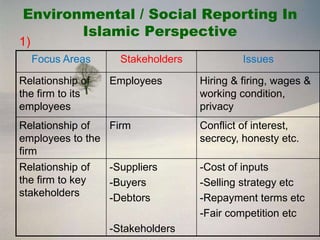
Environmental / Social Reporting In
       Islamic Perspective
1)
     Focus Areas     Stakeholders            Issues

Relationship of    Employees        Hiring & firing, wages &
the firm to its                     working condition,
employees                           privacy
Relationship of    Firm             Conflict of interest,
employees to the                    secrecy, honesty etc.
firm
Relationship of    -Suppliers       -Cost of inputs
the firm to key    -Buyers          -Selling strategy etc
stakeholders       -Debtors         -Repayment terms etc
                                    -Fair competition etc
                   -Stakeholders
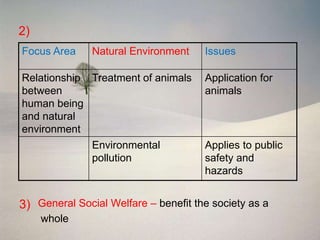
2)
Focus Area     Natural Environment    Issues

Relationship Treatment of animals     Application for
between                               animals
human being
and natural
environment
             Environmental            Applies to public
             pollution                safety and
                                      hazards


3) General Social Welfare – benefit the society as a
     whole
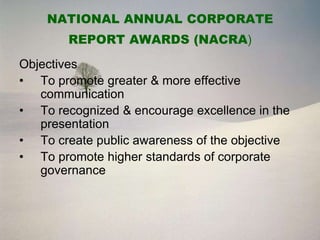
NATIONAL ANNUAL CORPORATE
        REPORT AWARDS (NACRA)
Objectives
• To promote greater & more effective
   communication
• To recognized & encourage excellence in the
   presentation
• To create public awareness of the objective
• To promote higher standards of corporate
   governance
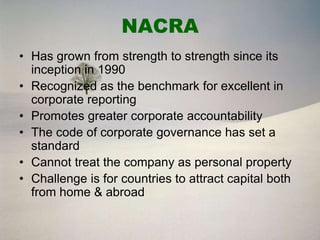
NACRA
• Has grown from strength to strength since its
  inception in 1990
• Recognized as the benchmark for excellent in
  corporate reporting
• Promotes greater corporate accountability
• The code of corporate governance has set a
  standard
• Cannot treat the company as personal property
• Challenge is for countries to attract capital both
  from home & abroad
PRINCIPLES OF EXCELLENGE

• Transparency
• Integrity
• Accountability
• Effective board of director
• Sound system of internal control
• Independence & effectiveness of external
  auditing
• High quality financial reporting
ADJUDICATION

1. Preliminary screening criteria:
     •   Promptness of publication
     •   Unmodified auditor’s report
     •   Compliance with approved accounting standard
     •   Available of annual report in Bahasa Malaysia
     •   No public sanction
     •   Not under section 176 scheme or KLSE PN4
     •   At least 3 years fin highlights & historical summary
     •   Name of co. secretary, reg. add. & registrar’s add
2. Detailed Adjudication
     • First stage
       Annual reports will be assessed within industry
       groups.
     • Second stage
       Those report which are nominated by the industry
       group adjudicators for the Overall Excellence
       Award
     • Assessment of annual reports
       Assessment of annual reports will be carried out by
       a panel of more than 70 adjudicators

Csr powerpoint

  • 1.
    Social Responsibility Accounting (SRA)
  • 2.
    Definition •Reporting of individualitems like employee welfare, human resources development, energy, environmental protection, anti pollution as well as health and safety measures, adopted by a company usually on an ad-hoc basis. •Voluntary disclosure of information both of qualitative and quantitative nature made to influence a wide range of audiences. •Reporting of (quantifiable) cost and benefit arising from economic activities, which are substantially received by the community at large. i.e. the community outside the reporting entity or agency SRA can be seen as the reporting of non-financial matters usually on a voluntary basis to all members of society.
  • 3.
    Objectives 1) To enablethe public of users to make decision which are environmentally sensitive 2) Maximizing the return on their investment or capital invested
  • 4.
    Areas of SRAReporting 1) Environmental protection measures 2) Employee related information including detail about health & safety 3) Product safety 4) Reduce / conserve energy usage or consumption 5) R&D efforts (important of company product & services) 6) Community related projects / charities
  • 5.
    SRA Disclosure 1) Whodisclosure SRA information - Main board of KLSE such As Tenaga National, Maybank, Shell Malaysia and DRB Hicom, etc 2) Where is SRA information disclosure - By use of graphics like photograph, pie chart, line graphs in order to enhance the quality of the disclosure
  • 6.
    Problem with SRAdisclosure 1) Lack of legislation to entire or mandate SRA disclosure. 2) Lack of uniformity and acceptance as to content and style in disclosure 3) Disclosure lack credibility since they are mostly qualitative in nature 4) The problem of limited budgets & lack of specialized knowledge
  • 7.
    Suggestion with disclosure •Accountant should help to formulate the specific or standard reporting system social responsibility. • Set up guidelines on areas that should be included on SRA reporting. • The introductory of social audits i.e. special audits for the purpose. • The production of environmental or social responsibility accounts and balance sheet.
  • 8.
    Advantages of SRA •SRA acts as a device to transfer information to the publics, vice-versa. • Shareholders are able to make decision from the information gathered. • The publics and the company itself will benefited economically. • SRA rely on quantitative and qualitative information as well.
  • 9.
    Ethics and SocialResponsibility • Understanding Ethics - Ethical behavior is important to ensure the successfulness of the organization - Important to ensure that the accounting information reported can be trusted - Ethical challenge the competency to make ethical decision • Social Responsibility - Becoming more prevalent / common today due to social awareness of the environment. - A social audit is can be the way of analyzing the organization successfulness
  • 10.
    Environmental / SocialReporting In Islamic Perspective 1) Focus Areas Stakeholders Issues Relationship of Employees Hiring & firing, wages & the firm to its working condition, employees privacy Relationship of Firm Conflict of interest, employees to the secrecy, honesty etc. firm Relationship of -Suppliers -Cost of inputs the firm to key -Buyers -Selling strategy etc stakeholders -Debtors -Repayment terms etc -Fair competition etc -Stakeholders
  • 11.
    2) Focus Area Natural Environment Issues Relationship Treatment of animals Application for between animals human being and natural environment Environmental Applies to public pollution safety and hazards 3) General Social Welfare – benefit the society as a whole
  • 12.
    NATIONAL ANNUAL CORPORATE REPORT AWARDS (NACRA) Objectives • To promote greater & more effective communication • To recognized & encourage excellence in the presentation • To create public awareness of the objective • To promote higher standards of corporate governance
  • 13.
    NACRA • Has grownfrom strength to strength since its inception in 1990 • Recognized as the benchmark for excellent in corporate reporting • Promotes greater corporate accountability • The code of corporate governance has set a standard • Cannot treat the company as personal property • Challenge is for countries to attract capital both from home & abroad
  • 14.
    PRINCIPLES OF EXCELLENGE •Transparency • Integrity • Accountability • Effective board of director • Sound system of internal control • Independence & effectiveness of external auditing • High quality financial reporting
  • 15.
    ADJUDICATION 1. Preliminary screeningcriteria: • Promptness of publication • Unmodified auditor’s report • Compliance with approved accounting standard • Available of annual report in Bahasa Malaysia • No public sanction • Not under section 176 scheme or KLSE PN4 • At least 3 years fin highlights & historical summary • Name of co. secretary, reg. add. & registrar’s add
  • 16.
    2. Detailed Adjudication • First stage Annual reports will be assessed within industry groups. • Second stage Those report which are nominated by the industry group adjudicators for the Overall Excellence Award • Assessment of annual reports Assessment of annual reports will be carried out by a panel of more than 70 adjudicators