Corporate Social Responsibility
CSR - Definition The commitment of businesses to behave ethically and contribute to sustainable economic development by working with all relevant stakeholders to improve their lives in ways that are good for business and society at large. Management is responsible to the organization itself and to all the interest groups with which it interacts
Why Businesses need to be socially responsible Long term survival Public Expectation Goodwill Govt. Laws and Regulations Better environment to operate Keep the balance (Give and Take)
Ackerman’s model of SR Awareness stage Planning and action stage Implementation stage
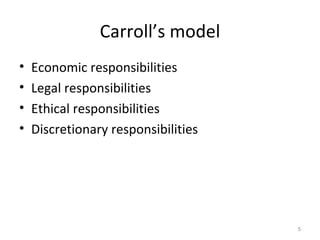
Carroll’s model Economic responsibilities Legal responsibilities Ethical responsibilities Discretionary responsibilities
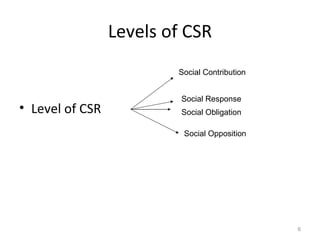
Levels of CSR Level of CSR  Social Contribution Social Response Social Obligation Social Opposition
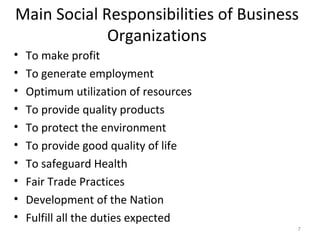
Main Social Responsibilities of Business Organizations To make profit To generate employment Optimum utilization of resources To provide quality products To protect the environment To provide good quality of life To safeguard Health Fair Trade Practices Development of the Nation Fulfill all the duties expected
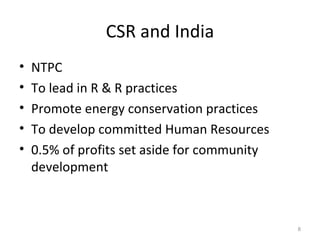
CSR and India NTPC  To lead in R & R practices Promote energy conservation practices To develop committed Human Resources 0.5% of profits set aside for community development
BPCL Adopted 37 villages in India Programme for vocational training and agricultural innovations ACC Setting up schools, colleges, health centres and co-operative societies to improve the quality of life in rural areas.
Infosys First company in India to prepare its accounts in compliance with the US accounting norms. Honest and ethical conduct Infosys foundation
Thank You

Csr Intro

  • 1.
  • 2.
    CSR - DefinitionThe commitment of businesses to behave ethically and contribute to sustainable economic development by working with all relevant stakeholders to improve their lives in ways that are good for business and society at large. Management is responsible to the organization itself and to all the interest groups with which it interacts
  • 3.
    Why Businesses needto be socially responsible Long term survival Public Expectation Goodwill Govt. Laws and Regulations Better environment to operate Keep the balance (Give and Take)
  • 4.
    Ackerman’s model ofSR Awareness stage Planning and action stage Implementation stage
  • 5.
    Carroll’s model Economicresponsibilities Legal responsibilities Ethical responsibilities Discretionary responsibilities
  • 6.
    Levels of CSRLevel of CSR Social Contribution Social Response Social Obligation Social Opposition
  • 7.
    Main Social Responsibilitiesof Business Organizations To make profit To generate employment Optimum utilization of resources To provide quality products To protect the environment To provide good quality of life To safeguard Health Fair Trade Practices Development of the Nation Fulfill all the duties expected
  • 8.
    CSR and IndiaNTPC To lead in R & R practices Promote energy conservation practices To develop committed Human Resources 0.5% of profits set aside for community development
  • 9.
    BPCL Adopted 37villages in India Programme for vocational training and agricultural innovations ACC Setting up schools, colleges, health centres and co-operative societies to improve the quality of life in rural areas.
  • 10.
    Infosys First companyin India to prepare its accounts in compliance with the US accounting norms. Honest and ethical conduct Infosys foundation
  • 11.