 Obligation of managers to take actions
that protect and improve the welfare of
society as a whole along with their own
interests
 To produce customized products
 To establish fair prices of products consistent with
quality, efficiency and reasonable profit to the firm.
 To provide prompt, adequate, courteous, and
friendly service to customers.
 To ensure fairly wide distribution of products among
all sections of consumers.
 To improve their standard of living in society by
producing goods and services which they need
 Fair remuneration
 Job security and safety
 Proper working conditions and
employee welfare
 Trade union rights
 Employee promotion and code of
conduct
 Employee participation in management.
 Help the local civic administration to provide better public
services
 Promote community help by indulging into philanthropical
activities
 Aid schools, colleges and other educational institutions
 Promote cultural enrichment of the community by
encouraging greater appreciation of art, music and drama.
 Encourage sports and provide recreational facilities.
 Organize community forums and discussion groups and thus
promote better understanding of national and local affairs.
 Minimize the problem of pollution and help community
efforts in this direction.
 Abandon ostentatious living and display of wealth, and
develop socially desirable standards of living for themselves.
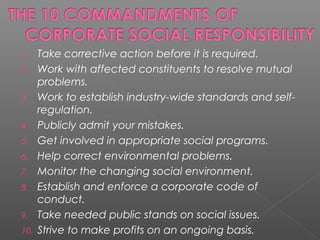
1. Take corrective action before it is required.
2. Work with affected constituents to resolve mutual
problems.
3. Work to establish industry-wide standards and self-
regulation.
4. Publicly admit your mistakes.
5. Get involved in appropriate social programs.
6. Help correct environmental problems.
7. Monitor the changing social environment.
8. Establish and enforce a corporate code of
conduct.
9. Take needed public stands on social issues.
10. Strive to make profits on an ongoing basis.
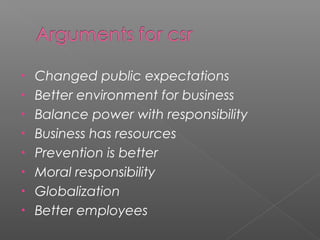
• Changed public expectations
• Better environment for business
• Balance power with responsibility
• Business has resources
• Prevention is better
• Moral responsibility
• Globalization
• Better employees
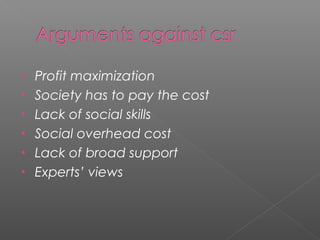
• Profit maximization
• Society has to pay the cost
• Lack of social skills
• Social overhead cost
• Lack of broad support
• Experts’ views
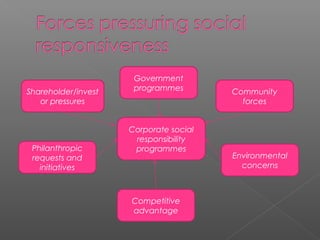
Corporate social
responsibility
programmes
Government
programmesShareholder/invest
or pressures
Philanthropic
requests and
initiatives
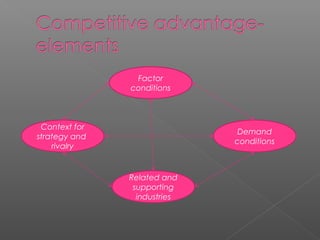
Competitive
advantage
Environmental
concerns
Community
forces
Factor
conditions
Demand
conditions
Context for
strategy and
rivalry
Related and
supporting
industries
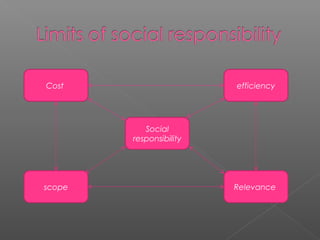
Cost
Social
responsibility
scope Relevance
efficiency
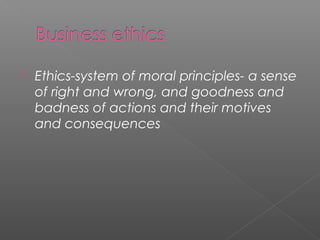
 Ethics-system of moral principles- a sense
of right and wrong, and goodness and
badness of actions and their motives
and consequences
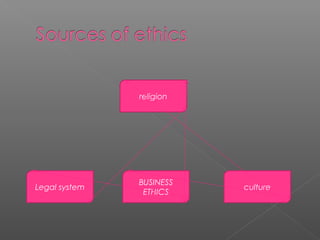
religion
Legal system
BUSINESS
ETHICS
culture
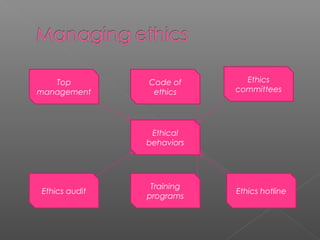
Ethical
behaviors
Code of
ethics
Top
management
Ethics
committees
Ethics audit
Training
programs
Ethics hotline
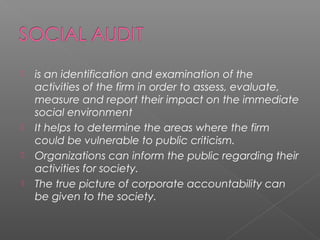
 is an identification and examination of the
activities of the firm in order to assess, evaluate,
measure and report their impact on the immediate
social environment
 It helps to determine the areas where the firm
could be vulnerable to public criticism.
 Organizations can inform the public regarding their
activities for society.
 The true picture of corporate accountability can
be given to the society.
Ethics

Ethics

  • 2.
     Obligation ofmanagers to take actions that protect and improve the welfare of society as a whole along with their own interests
  • 3.
     To producecustomized products  To establish fair prices of products consistent with quality, efficiency and reasonable profit to the firm.  To provide prompt, adequate, courteous, and friendly service to customers.  To ensure fairly wide distribution of products among all sections of consumers.  To improve their standard of living in society by producing goods and services which they need
  • 4.
     Fair remuneration Job security and safety  Proper working conditions and employee welfare  Trade union rights  Employee promotion and code of conduct  Employee participation in management.
  • 5.
     Help thelocal civic administration to provide better public services  Promote community help by indulging into philanthropical activities  Aid schools, colleges and other educational institutions  Promote cultural enrichment of the community by encouraging greater appreciation of art, music and drama.  Encourage sports and provide recreational facilities.  Organize community forums and discussion groups and thus promote better understanding of national and local affairs.  Minimize the problem of pollution and help community efforts in this direction.  Abandon ostentatious living and display of wealth, and develop socially desirable standards of living for themselves.
  • 6.
    1. Take correctiveaction before it is required. 2. Work with affected constituents to resolve mutual problems. 3. Work to establish industry-wide standards and self- regulation. 4. Publicly admit your mistakes. 5. Get involved in appropriate social programs. 6. Help correct environmental problems. 7. Monitor the changing social environment. 8. Establish and enforce a corporate code of conduct. 9. Take needed public stands on social issues. 10. Strive to make profits on an ongoing basis.
  • 7.
    • Changed publicexpectations • Better environment for business • Balance power with responsibility • Business has resources • Prevention is better • Moral responsibility • Globalization • Better employees
  • 8.
    • Profit maximization •Society has to pay the cost • Lack of social skills • Social overhead cost • Lack of broad support • Experts’ views
  • 9.
  • 10.
  • 11.
  • 12.
     Ethics-system ofmoral principles- a sense of right and wrong, and goodness and badness of actions and their motives and consequences
  • 13.
  • 14.
  • 15.
     is anidentification and examination of the activities of the firm in order to assess, evaluate, measure and report their impact on the immediate social environment  It helps to determine the areas where the firm could be vulnerable to public criticism.  Organizations can inform the public regarding their activities for society.  The true picture of corporate accountability can be given to the society.