Presenters 
Fayaz hussain chandio 
Salman ali memon 
Geeta lalwani
• I believe in trying to get a balance between 
individual freedom on the one hand and 
social responsibility on the other. 
Chris Patten 
• It's a full on job just looking for human social 
responsibility. 
Colin Greenwood
Why CSR? 
• Consumers & investors: growing expectation 
for organizations 
• Consumer awareness: ‘Green’ and ‘Ethical’ 
consumerism 
• Legislation: Sustainability, Codes of Practice 
• Globalization: Adoption of ‘Best Practice’,
Definitions and Relationships 
• Corporate social responsibility (CSR) is the 
process by which businesses negotiate their 
role in society 
• In the business world, ethics is the study of 
morally appropriate behaviors and decisions, 
examining what "should be done”
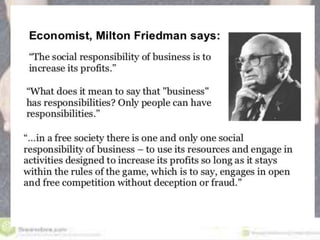
• It is important to note that Friedman is not saying 
that managers ought to maximize profits even it is 
done in an unethical way. 
• . Business managers ought to follow the law and 
they ought to obey the ethical customs embedded 
in society.
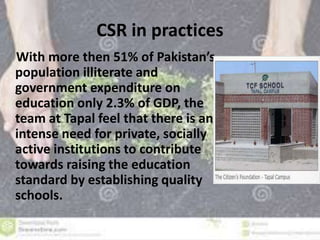
CSR in practices 
With more then 51% of Pakistan’s 
population illiterate and 
government expenditure on 
education only 2.3% of GDP, the 
team at Tapal feel that there is an 
intense need for private, socially 
active institutions to contribute 
towards raising the education 
standard by establishing quality 
schools.
Corporate Citizenship Model 
• Consistently satisfactory 
• Sustainable economic performance 
• Ethical actions 
• Behavior.
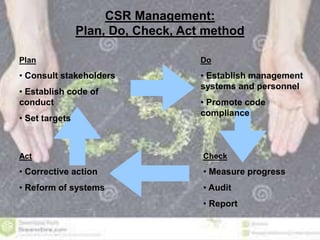
CSR Management: 
Plan, Do, Check, Act method 
Plan 
• Consult stakeholders 
• Establish code of 
conduct 
• Set targets 
Do 
• Establish management 
systems and personnel 
• Promote code 
compliance 
Check 
• Measure progress 
• Audit 
• Report 
Act 
• Corrective action 
• Reform of systems
why CSR programs are good for 
business? 
• Help attract and retain members 
• Enhance innovation in the sector 
• Build positive government and NGO relations 
• . Help identify industry priorities: 
• Fulfill association goals: 
• Enhance employee recruitment and retention
Making ‘green’ fashionable: The Body 
Shop 
• They were one of the first companies to 
publish a full report on their CSR initiatives 
• They beliefs on environmental protection, 
animal rights, community trade and human 
rights. 
• The Body Shop is famous for its anti-animal 
testing stance.
Concepts of CSR 
CSR (Carol, 1979) 
Firms have responsibilities to societies including economic, legal, 
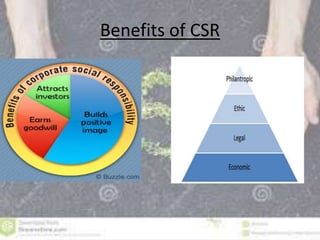
ethical and discretionary (or philanthropic). 
- See also DE George (1999) on the “Myth of the Amoral Firm” 
Social Contract (Donaldson, 1982; Donaldson and 
Dunfee, 1999) – There is a tacit social contract between 
the firm and society; the contract bestows certain rights 
in exchange for certain responsibilities. 
Stakeholder Theory (Freeman, 1984) – A stakeholder is “any 
group or individual who can affect or is affected by the 
achievement of an organization's purpose.” Argues that it is in 
the company’s strategic interest to respect the interests of all 
its stakeholders.
Types of Social Responsibility 
• Responsibility towards Society. Carrying on business with moral& 
ethical standards. Prevention of environmental pollution. Minimizing 
natural imbalance. Contributing towards the development of social health, 
education 
• Responsibility towards Government. Obey rules & regulations. 
Regular payment of taxes. Cooperating with the Govt to promote social 
values 
• Responsibility towards Shareholders. To ensure a reasonable rate 
of return over time. To work for the survival & the growth of the concern. 
• Responsibility towards Employee. To provide a healthy working 
environment. To grant regular & fair wages. To provide welfare services
Need for Corporate Social 
Responsibility 
• To reduce the social cost. 
• To enhance the performance of employees. 
• It leads to industrial peace. 
• It improves the public image. 
• Can generate more profit. 
• To provide moral justification. 
• It satisfies the stakeholders.
Benefits of CSR
Corporate social responsibility

Corporate social responsibility

  • 1.
    Presenters Fayaz hussainchandio Salman ali memon Geeta lalwani
  • 2.
    • I believein trying to get a balance between individual freedom on the one hand and social responsibility on the other. Chris Patten • It's a full on job just looking for human social responsibility. Colin Greenwood
  • 3.
    Why CSR? •Consumers & investors: growing expectation for organizations • Consumer awareness: ‘Green’ and ‘Ethical’ consumerism • Legislation: Sustainability, Codes of Practice • Globalization: Adoption of ‘Best Practice’,
  • 4.
    Definitions and Relationships • Corporate social responsibility (CSR) is the process by which businesses negotiate their role in society • In the business world, ethics is the study of morally appropriate behaviors and decisions, examining what "should be done”
  • 6.
    • It isimportant to note that Friedman is not saying that managers ought to maximize profits even it is done in an unethical way. • . Business managers ought to follow the law and they ought to obey the ethical customs embedded in society.
  • 7.
    CSR in practices With more then 51% of Pakistan’s population illiterate and government expenditure on education only 2.3% of GDP, the team at Tapal feel that there is an intense need for private, socially active institutions to contribute towards raising the education standard by establishing quality schools.
  • 8.
    Corporate Citizenship Model • Consistently satisfactory • Sustainable economic performance • Ethical actions • Behavior.
  • 9.
    CSR Management: Plan,Do, Check, Act method Plan • Consult stakeholders • Establish code of conduct • Set targets Do • Establish management systems and personnel • Promote code compliance Check • Measure progress • Audit • Report Act • Corrective action • Reform of systems
  • 10.
    why CSR programsare good for business? • Help attract and retain members • Enhance innovation in the sector • Build positive government and NGO relations • . Help identify industry priorities: • Fulfill association goals: • Enhance employee recruitment and retention
  • 11.
    Making ‘green’ fashionable:The Body Shop • They were one of the first companies to publish a full report on their CSR initiatives • They beliefs on environmental protection, animal rights, community trade and human rights. • The Body Shop is famous for its anti-animal testing stance.
  • 12.
    Concepts of CSR CSR (Carol, 1979) Firms have responsibilities to societies including economic, legal, ethical and discretionary (or philanthropic). - See also DE George (1999) on the “Myth of the Amoral Firm” Social Contract (Donaldson, 1982; Donaldson and Dunfee, 1999) – There is a tacit social contract between the firm and society; the contract bestows certain rights in exchange for certain responsibilities. Stakeholder Theory (Freeman, 1984) – A stakeholder is “any group or individual who can affect or is affected by the achievement of an organization's purpose.” Argues that it is in the company’s strategic interest to respect the interests of all its stakeholders.
  • 13.
    Types of SocialResponsibility • Responsibility towards Society. Carrying on business with moral& ethical standards. Prevention of environmental pollution. Minimizing natural imbalance. Contributing towards the development of social health, education • Responsibility towards Government. Obey rules & regulations. Regular payment of taxes. Cooperating with the Govt to promote social values • Responsibility towards Shareholders. To ensure a reasonable rate of return over time. To work for the survival & the growth of the concern. • Responsibility towards Employee. To provide a healthy working environment. To grant regular & fair wages. To provide welfare services
  • 14.
    Need for CorporateSocial Responsibility • To reduce the social cost. • To enhance the performance of employees. • It leads to industrial peace. • It improves the public image. • Can generate more profit. • To provide moral justification. • It satisfies the stakeholders.
  • 15.