© 2012 Pearson Education, Inc. All rights reserved.

                            Chapter 9:
                A Second Look at Classes and Objects

                         Starting Out with Java:
              From Control Structures through Data Structures

                                                  Second Edition


                         by Tony Gaddis and Godfrey Muganda
Chapter Topics
 Chapter 9 discusses the following main topics:
       –    Static Class Members
       –    Passing Objects as Arguments to Methods
       –    Returning Objects from Methods
       –    The toString method
       –    Writing an equals Method
       –    Methods that Copy Objects


© 2012 Pearson Education, Inc. All rights reserved.   9-2
Chapter Topics
 Chapter 9 discusses the following main topics:
       –    Aggregation
       –    The this Reference Variable
       –    Enumerated Types
       –    Garbage Collection
       –    Focus on Object-Oriented Design: Class
            Collaboration


© 2012 Pearson Education, Inc. All rights reserved.   9-3
Review of Instance Fields and Methods
 • Each instance of a class has its own copy of instance
   variables.
       – Example:
              • The Rectangle class defines a length and a width field.
              • Each instance of the Rectangle class can have different values
                stored in its length and width fields.
 • Instance methods require that an instance of a class be
   created in order to be used.
 • Instance methods typically interact with instance fields
   or calculate values based on those fields.

© 2012 Pearson Education, Inc. All rights reserved.                              9-4
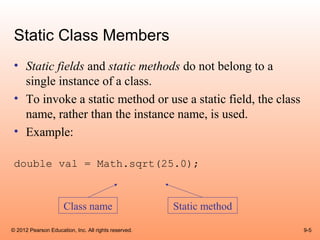
Static Class Members
 • Static fields and static methods do not belong to a
   single instance of a class.
 • To invoke a static method or use a static field, the class
   name, rather than the instance name, is used.
 • Example:

 double val = Math.sqrt(25.0);


                      Class name                      Static method

© 2012 Pearson Education, Inc. All rights reserved.                   9-5
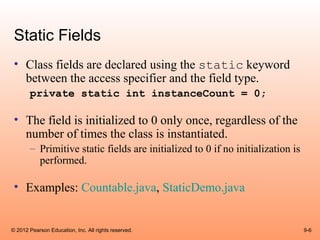
Static Fields
 • Class fields are declared using the static keyword
   between the access specifier and the field type.
       private static int instanceCount = 0;

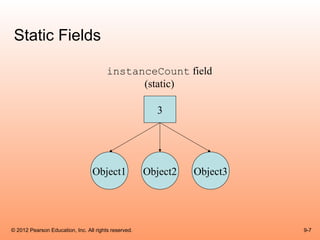
 • The field is initialized to 0 only once, regardless of the
   number of times the class is instantiated.
       – Primitive static fields are initialized to 0 if no initialization is
         performed.

 • Examples: Countable.java, StaticDemo.java


© 2012 Pearson Education, Inc. All rights reserved.                             9-6
Static Fields

                                        instanceCount field
                                              (static)

                                                        3


                                  Object1             Object2   Object3


© 2012 Pearson Education, Inc. All rights reserved.                       9-7
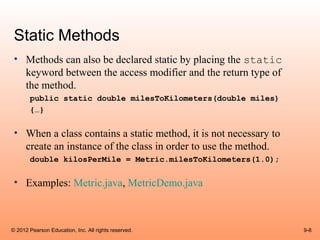
Static Methods
 • Methods can also be declared static by placing the static
   keyword between the access modifier and the return type of
   the method.
       public static double milesToKilometers(double miles)
       {…}

 • When a class contains a static method, it is not necessary to
   create an instance of the class in order to use the method.
       double kilosPerMile = Metric.milesToKilometers(1.0);

 • Examples: Metric.java, MetricDemo.java


© 2012 Pearson Education, Inc. All rights reserved.                9-8
Static Methods
 • Static methods are convenient because they may be
   called at the class level.
 • They are typically used to create utility classes, such as
   the Math class in the Java Standard Library.
 • Static methods may not communicate with instance
   fields, only static fields.


© 2012 Pearson Education, Inc. All rights reserved.             9-9
Passing Objects as Arguments
 • Objects can be passed to methods as arguments.
 • Java passes all arguments by value.
 • When an object is passed as an argument, the value of the
   reference variable is passed.
 • The value of the reference variable is an address or
   reference to the object in memory.
 • A copy of the object is not passed, just a pointer to the
   object.
 • When a method receives a reference variable as an
   argument, it is possible for the method to modify the
   contents of the object referenced by the variable.


© 2012 Pearson Education, Inc. All rights reserved.            9-10
Passing Objects as Arguments
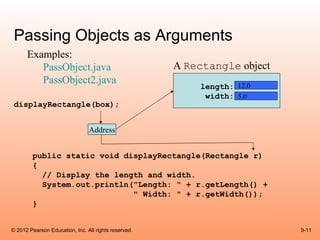
      Examples:
         PassObject.java                              A Rectangle object
         PassObject2.java
                                                           length: 12.0
                                                            width: 5.0
 displayRectangle(box);


                                Address


        public static void displayRectangle(Rectangle r)
        {
          // Display the length and width.
          System.out.println("Length: " + r.getLength() +
                             " Width: " + r.getWidth());
        }


© 2012 Pearson Education, Inc. All rights reserved.                        9-11
Returning Objects From Methods
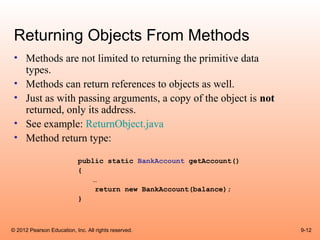
 • Methods are not limited to returning the primitive data
   types.
 • Methods can return references to objects as well.
 • Just as with passing arguments, a copy of the object is not
   returned, only its address.
 • See example: ReturnObject.java
 • Method return type:

                            public static BankAccount getAccount()
                            {
                                …
                                 return new BankAccount(balance);
                            }


© 2012 Pearson Education, Inc. All rights reserved.                  9-12
Returning Objects from Methods
       account = getAccount();
                                                      A BankAccount Object

                                                      balance:      3200.0


     address


                                public static BankAccount getAccount()
                                {
                                   …
                                   return new BankAccount(balance);
                                }


© 2012 Pearson Education, Inc. All rights reserved.                          9-13
The toString Method
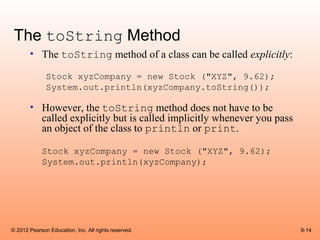
       • The toString method of a class can be called explicitly:

              Stock xyzCompany = new Stock ("XYZ", 9.62);
              System.out.println(xyzCompany.toString());

       • However, the toString method does not have to be
         called explicitly but is called implicitly whenever you pass
         an object of the class to println or print.

            Stock xyzCompany = new Stock ("XYZ", 9.62);
            System.out.println(xyzCompany);


© 2012 Pearson Education, Inc. All rights reserved.                     9-14
The toString method
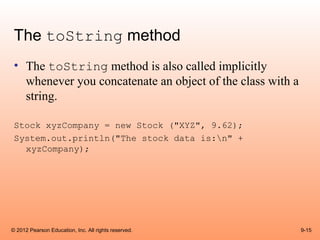
 • The toString method is also called implicitly
   whenever you concatenate an object of the class with a
   string.

 Stock xyzCompany = new Stock ("XYZ", 9.62);
 System.out.println("The stock data is:n" +
   xyzCompany);


© 2012 Pearson Education, Inc. All rights reserved.         9-15
The toString Method
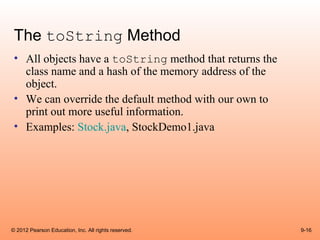
 • All objects have a toString method that returns the
   class name and a hash of the memory address of the
   object.
 • We can override the default method with our own to
   print out more useful information.
 • Examples: Stock.java, StockDemo1.java


© 2012 Pearson Education, Inc. All rights reserved.      9-16
The equals Method
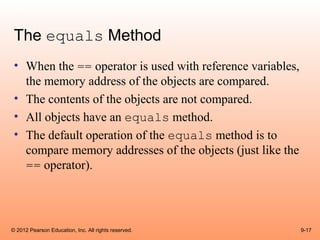
 • When the == operator is used with reference variables,
   the memory address of the objects are compared.
 • The contents of the objects are not compared.
 • All objects have an equals method.
 • The default operation of the equals method is to
   compare memory addresses of the objects (just like the
   == operator).


© 2012 Pearson Education, Inc. All rights reserved.         9-17
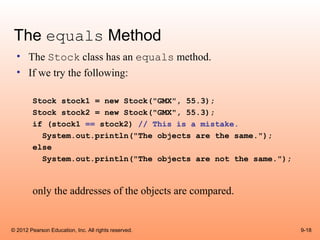
The equals Method
  • The Stock class has an equals method.
  • If we try the following:

        Stock stock1 = new Stock("GMX", 55.3);
        Stock stock2 = new Stock("GMX", 55.3);
        if (stock1 == stock2) // This is a mistake.
          System.out.println("The objects are the same.");
        else
          System.out.println("The objects are not the same.");


        only the addresses of the objects are compared.


© 2012 Pearson Education, Inc. All rights reserved.              9-18
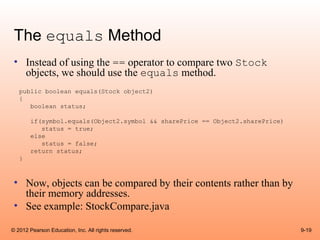
The equals Method
 • Instead of using the == operator to compare two Stock
   objects, we should use the equals method.
   public boolean equals(Stock object2)
   {
      boolean status;

        if(symbol.equals(Object2.symbol && sharePrice == Object2.sharePrice)
           status = true;
        else
           status = false;
        return status;
   }


 • Now, objects can be compared by their contents rather than by
   their memory addresses.
 • See example: StockCompare.java

© 2012 Pearson Education, Inc. All rights reserved.                            9-19
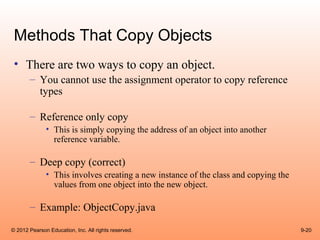
Methods That Copy Objects
 • There are two ways to copy an object.
       – You cannot use the assignment operator to copy reference
         types

       – Reference only copy
              • This is simply copying the address of an object into another
                reference variable.

       – Deep copy (correct)
              • This involves creating a new instance of the class and copying the
                values from one object into the new object.

       – Example: ObjectCopy.java

© 2012 Pearson Education, Inc. All rights reserved.                                  9-20
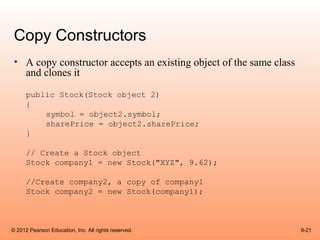
Copy Constructors
 • A copy constructor accepts an existing object of the same class
   and clones it
      public Stock(Stock object 2)
      {
          symbol = object2.symbol;
          sharePrice = object2.sharePrice;
      }

      // Create a Stock object
      Stock company1 = new Stock("XYZ", 9.62);

      //Create company2, a copy of company1
      Stock company2 = new Stock(company1);


© 2012 Pearson Education, Inc. All rights reserved.                  9-21
Aggregation
 • Creating an instance of one class as a reference in
   another class is called object aggregation.
 • Aggregation creates a “has a” relationship between
   objects.
 • Examples:
       – Instructor.java, Textbook.java, Course.java,
         CourseDemo.java


© 2012 Pearson Education, Inc. All rights reserved.      9-22
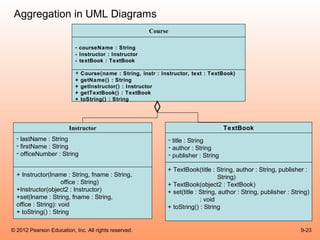
Aggregation in UML Diagrams
                                                        Course

                          - courseName : String
                          - Instructor : Instructor
                          - textBook : TextBook

                          + Course(name : String, instr : Instructor, text : TextBook)
                          +   getName() : String
                          +   getInstructor() : Instructor
                          +   getTextBook() : TextBook
                          +   toString() : String


                        Instructor                                                      TextBook
  - lastName : String                                            - title : String
  - firstName : String                                           - author : String
  - officeNumber : String                                        - publisher : String

                                                             + TextBook(title : String, author : String, publisher :
  + Instructor(lname : String, fname : String,                                     String)
                     office : String)                        + TextBook(object2 : TextBook)
  +Instructor(object2 : Instructor)                          + set(title : String, author : String, publisher : String)
  +set(lname : String, fname : String,                                     : void
  office : String): void                                     + toString() : String
  + toString() : String

© 2012 Pearson Education, Inc. All rights reserved.                                                                9-23
Returning References to Private Fields
 • Avoid returning references to private data elements.
 • Returning references to private variables will allow
   any object that receives the reference to modify the
   variable.


© 2012 Pearson Education, Inc. All rights reserved.       9-24
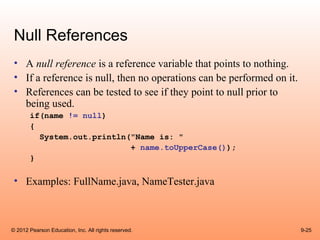
Null References
 • A null reference is a reference variable that points to nothing.
 • If a reference is null, then no operations can be performed on it.
 • References can be tested to see if they point to null prior to
   being used.
       if(name != null)
       {
         System.out.println("Name is: "
                            + name.toUpperCase());
       }

 • Examples: FullName.java, NameTester.java


© 2012 Pearson Education, Inc. All rights reserved.                     9-25
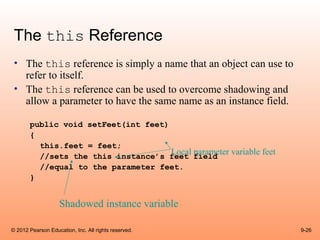
The this Reference
 • The this reference is simply a name that an object can use to
   refer to itself.
 • The this reference can be used to overcome shadowing and
   allow a parameter to have the same name as an instance field.

       public void setFeet(int feet)
       {
         this.feet = feet;
                                     Local parameter variable feet
         //sets the this instance’s feet field
         //equal to the parameter feet.
       }


                    Shadowed instance variable

© 2012 Pearson Education, Inc. All rights reserved.                  9-26
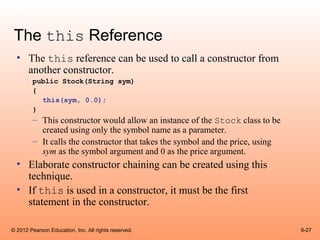
The this Reference
  • The this reference can be used to call a constructor from
    another constructor.
        public Stock(String sym)
        {
          this(sym, 0.0);
        }
        – This constructor would allow an instance of the Stock class to be
          created using only the symbol name as a parameter.
        – It calls the constructor that takes the symbol and the price, using
          sym as the symbol argument and 0 as the price argument.
  • Elaborate constructor chaining can be created using this
    technique.
  • If this is used in a constructor, it must be the first
    statement in the constructor.

© 2012 Pearson Education, Inc. All rights reserved.                             9-27
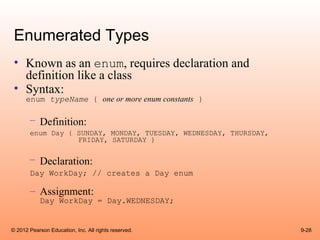
Enumerated Types
 • Known as an enum, requires declaration and
   definition like a class
 • Syntax:
      enum typeName { one or more enum constants }

       – Definition:
       enum Day { SUNDAY, MONDAY, TUESDAY, WEDNESDAY, THURSDAY,
                  FRIDAY, SATURDAY }

       – Declaration:
       Day WorkDay; // creates a Day enum

       – Assignment:
            Day WorkDay = Day.WEDNESDAY;


© 2012 Pearson Education, Inc. All rights reserved.               9-28
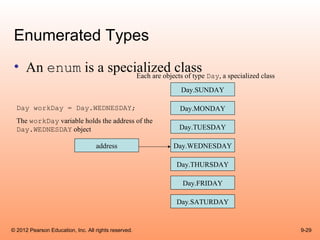
Enumerated Types
 • An enum is a specialized class Day, a specialized class
                     Each are objects of type
                                                       Day.SUNDAY

  Day workDay = Day.WEDNESDAY;                         Day.MONDAY
  The workDay variable holds the address of the
  Day.WEDNESDAY object                                 Day.TUESDAY

                                   address            Day.WEDNESDAY

                                                      Day.THURSDAY

                                                        Day.FRIDAY

                                                      Day.SATURDAY


© 2012 Pearson Education, Inc. All rights reserved.                   9-29
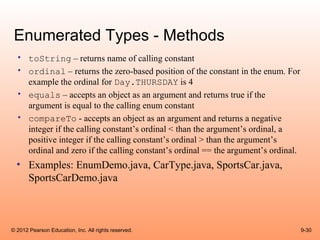
Enumerated Types - Methods
  • toString – returns name of calling constant
  • ordinal – returns the zero-based position of the constant in the enum. For
    example the ordinal for Day.THURSDAY is 4
  • equals – accepts an object as an argument and returns true if the
    argument is equal to the calling enum constant
  • compareTo - accepts an object as an argument and returns a negative
    integer if the calling constant’s ordinal < than the argument’s ordinal, a
    positive integer if the calling constant’s ordinal > than the argument’s
    ordinal and zero if the calling constant’s ordinal == the argument’s ordinal.
  • Examples: EnumDemo.java, CarType.java, SportsCar.java,
    SportsCarDemo.java


© 2012 Pearson Education, Inc. All rights reserved.                                 9-30
Enumerated Types - Switching
  • Java allows you to test an enum constant with a
    switch statement.

  Example: SportsCarDemo2.java


© 2012 Pearson Education, Inc. All rights reserved.   9-31
Garbage Collection
 • When objects are no longer needed they should be
   destroyed.
 • This frees up the memory that they consumed.
 • Java handles all of the memory operations for you.
 • Simply set the reference to null and Java will reclaim
   the memory.


© 2012 Pearson Education, Inc. All rights reserved.         9-32
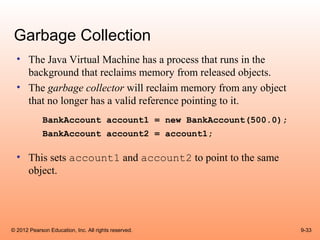
Garbage Collection
  • The Java Virtual Machine has a process that runs in the
    background that reclaims memory from released objects.
  • The garbage collector will reclaim memory from any object
    that no longer has a valid reference pointing to it.
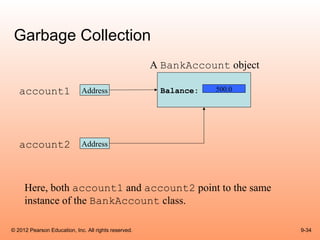
             BankAccount account1 = new BankAccount(500.0);
             BankAccount account2 = account1;

  • This sets account1 and account2 to point to the same
    object.


© 2012 Pearson Education, Inc. All rights reserved.             9-33
Garbage Collection
                                                      A BankAccount object

   account1                  Address                   Balance:   500.0


   account2                  Address


     Here, both account1 and account2 point to the same
     instance of the BankAccount class.

© 2012 Pearson Education, Inc. All rights reserved.                          9-34
Garbage Collection
                                                      A BankAccount object

   account1                     null                   Balance:   500.0


   account2                  Address


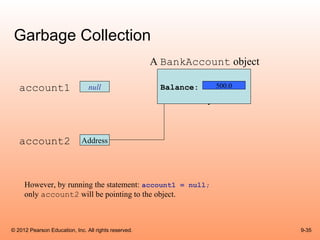
     However, by running the statement: account1 = null;
     only account2 will be pointing to the object.


© 2012 Pearson Education, Inc. All rights reserved.                          9-35
Garbage Collection
                                                        A BankAccount object

   account1                     null                        Balance:          500.0


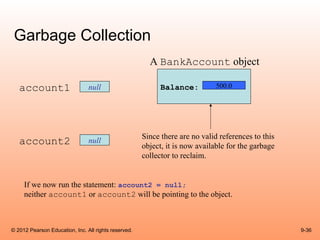
                                                      Since there are no valid references to this
   account2                     null
                                                      object, it is now available for the garbage
                                                      collector to reclaim.


     If we now run the statement: account2 = null;
     neither account1 or account2 will be pointing to the object.


© 2012 Pearson Education, Inc. All rights reserved.                                                 9-36
Garbage Collection
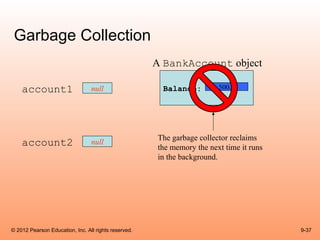
                                                      A BankAccount object

    account1                     null                  Balance:         500.0


                                                      The garbage collector reclaims
    account2                     null
                                                      the memory the next time it runs
                                                      in the background.


© 2012 Pearson Education, Inc. All rights reserved.                                      9-37
The finalize Method
 • If a method with the signature:
              public void finalize(){…}
   is included in a class, it will run just prior to the
   garbage collector reclaiming its memory.
 • The garbage collector is a background thread that runs
   periodically.
 • It cannot be determined when the finalize method
   will actually be run.


© 2012 Pearson Education, Inc. All rights reserved.         9-38
Class Collaboration
 • Collaboration – two classes interact with each other
 • If an object is to collaborate with another object, it
   must know something about the second object’s
   methods and how to call them
 • If we design a class StockPurchase that
   collaborates with the Stock class (previously
   defined), we define it to create and manipulate a
   Stock object
 See examples: StockPurchase.java, StockTrader.java


© 2012 Pearson Education, Inc. All rights reserved.         9-39
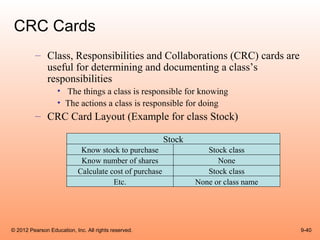
CRC Cards
          – Class, Responsibilities and Collaborations (CRC) cards are
            useful for determining and documenting a class’s
            responsibilities
                   • The things a class is responsible for knowing
                   • The actions a class is responsible for doing
          – CRC Card Layout (Example for class Stock)

                                                         Stock
                             Know stock to purchase                 Stock class
                             Know number of shares                     None
                            Calculate cost of purchase              Stock class
                                       Etc.                      None or class name


© 2012 Pearson Education, Inc. All rights reserved.                                   9-40

Cso gaddis java_chapter9ppt

  • 1.
    © 2012 PearsonEducation, Inc. All rights reserved. Chapter 9: A Second Look at Classes and Objects Starting Out with Java: From Control Structures through Data Structures Second Edition by Tony Gaddis and Godfrey Muganda
  • 2.
    Chapter Topics Chapter9 discusses the following main topics: – Static Class Members – Passing Objects as Arguments to Methods – Returning Objects from Methods – The toString method – Writing an equals Method – Methods that Copy Objects © 2012 Pearson Education, Inc. All rights reserved. 9-2
  • 3.
    Chapter Topics Chapter9 discusses the following main topics: – Aggregation – The this Reference Variable – Enumerated Types – Garbage Collection – Focus on Object-Oriented Design: Class Collaboration © 2012 Pearson Education, Inc. All rights reserved. 9-3
  • 4.
    Review of InstanceFields and Methods • Each instance of a class has its own copy of instance variables. – Example: • The Rectangle class defines a length and a width field. • Each instance of the Rectangle class can have different values stored in its length and width fields. • Instance methods require that an instance of a class be created in order to be used. • Instance methods typically interact with instance fields or calculate values based on those fields. © 2012 Pearson Education, Inc. All rights reserved. 9-4
  • 5.
    Static Class Members • Static fields and static methods do not belong to a single instance of a class. • To invoke a static method or use a static field, the class name, rather than the instance name, is used. • Example: double val = Math.sqrt(25.0); Class name Static method © 2012 Pearson Education, Inc. All rights reserved. 9-5
  • 6.
    Static Fields •Class fields are declared using the static keyword between the access specifier and the field type. private static int instanceCount = 0; • The field is initialized to 0 only once, regardless of the number of times the class is instantiated. – Primitive static fields are initialized to 0 if no initialization is performed. • Examples: Countable.java, StaticDemo.java © 2012 Pearson Education, Inc. All rights reserved. 9-6
  • 7.
    Static Fields instanceCount field (static) 3 Object1 Object2 Object3 © 2012 Pearson Education, Inc. All rights reserved. 9-7
  • 8.
    Static Methods •Methods can also be declared static by placing the static keyword between the access modifier and the return type of the method. public static double milesToKilometers(double miles) {…} • When a class contains a static method, it is not necessary to create an instance of the class in order to use the method. double kilosPerMile = Metric.milesToKilometers(1.0); • Examples: Metric.java, MetricDemo.java © 2012 Pearson Education, Inc. All rights reserved. 9-8
  • 9.
    Static Methods •Static methods are convenient because they may be called at the class level. • They are typically used to create utility classes, such as the Math class in the Java Standard Library. • Static methods may not communicate with instance fields, only static fields. © 2012 Pearson Education, Inc. All rights reserved. 9-9
  • 10.
    Passing Objects asArguments • Objects can be passed to methods as arguments. • Java passes all arguments by value. • When an object is passed as an argument, the value of the reference variable is passed. • The value of the reference variable is an address or reference to the object in memory. • A copy of the object is not passed, just a pointer to the object. • When a method receives a reference variable as an argument, it is possible for the method to modify the contents of the object referenced by the variable. © 2012 Pearson Education, Inc. All rights reserved. 9-10
  • 11.
    Passing Objects asArguments Examples: PassObject.java A Rectangle object PassObject2.java length: 12.0 width: 5.0 displayRectangle(box); Address public static void displayRectangle(Rectangle r) { // Display the length and width. System.out.println("Length: " + r.getLength() + " Width: " + r.getWidth()); } © 2012 Pearson Education, Inc. All rights reserved. 9-11
  • 12.
    Returning Objects FromMethods • Methods are not limited to returning the primitive data types. • Methods can return references to objects as well. • Just as with passing arguments, a copy of the object is not returned, only its address. • See example: ReturnObject.java • Method return type: public static BankAccount getAccount() { … return new BankAccount(balance); } © 2012 Pearson Education, Inc. All rights reserved. 9-12
  • 13.
    Returning Objects fromMethods account = getAccount(); A BankAccount Object balance: 3200.0 address public static BankAccount getAccount() { … return new BankAccount(balance); } © 2012 Pearson Education, Inc. All rights reserved. 9-13
  • 14.
    The toString Method • The toString method of a class can be called explicitly: Stock xyzCompany = new Stock ("XYZ", 9.62); System.out.println(xyzCompany.toString()); • However, the toString method does not have to be called explicitly but is called implicitly whenever you pass an object of the class to println or print. Stock xyzCompany = new Stock ("XYZ", 9.62); System.out.println(xyzCompany); © 2012 Pearson Education, Inc. All rights reserved. 9-14
  • 15.
    The toString method • The toString method is also called implicitly whenever you concatenate an object of the class with a string. Stock xyzCompany = new Stock ("XYZ", 9.62); System.out.println("The stock data is:n" + xyzCompany); © 2012 Pearson Education, Inc. All rights reserved. 9-15
  • 16.
    The toString Method • All objects have a toString method that returns the class name and a hash of the memory address of the object. • We can override the default method with our own to print out more useful information. • Examples: Stock.java, StockDemo1.java © 2012 Pearson Education, Inc. All rights reserved. 9-16
  • 17.
    The equals Method • When the == operator is used with reference variables, the memory address of the objects are compared. • The contents of the objects are not compared. • All objects have an equals method. • The default operation of the equals method is to compare memory addresses of the objects (just like the == operator). © 2012 Pearson Education, Inc. All rights reserved. 9-17
  • 18.
    The equals Method • The Stock class has an equals method. • If we try the following: Stock stock1 = new Stock("GMX", 55.3); Stock stock2 = new Stock("GMX", 55.3); if (stock1 == stock2) // This is a mistake. System.out.println("The objects are the same."); else System.out.println("The objects are not the same."); only the addresses of the objects are compared. © 2012 Pearson Education, Inc. All rights reserved. 9-18
  • 19.
    The equals Method • Instead of using the == operator to compare two Stock objects, we should use the equals method. public boolean equals(Stock object2) { boolean status; if(symbol.equals(Object2.symbol && sharePrice == Object2.sharePrice) status = true; else status = false; return status; } • Now, objects can be compared by their contents rather than by their memory addresses. • See example: StockCompare.java © 2012 Pearson Education, Inc. All rights reserved. 9-19
  • 20.
    Methods That CopyObjects • There are two ways to copy an object. – You cannot use the assignment operator to copy reference types – Reference only copy • This is simply copying the address of an object into another reference variable. – Deep copy (correct) • This involves creating a new instance of the class and copying the values from one object into the new object. – Example: ObjectCopy.java © 2012 Pearson Education, Inc. All rights reserved. 9-20
  • 21.
    Copy Constructors •A copy constructor accepts an existing object of the same class and clones it public Stock(Stock object 2) { symbol = object2.symbol; sharePrice = object2.sharePrice; } // Create a Stock object Stock company1 = new Stock("XYZ", 9.62); //Create company2, a copy of company1 Stock company2 = new Stock(company1); © 2012 Pearson Education, Inc. All rights reserved. 9-21
  • 22.
    Aggregation • Creatingan instance of one class as a reference in another class is called object aggregation. • Aggregation creates a “has a” relationship between objects. • Examples: – Instructor.java, Textbook.java, Course.java, CourseDemo.java © 2012 Pearson Education, Inc. All rights reserved. 9-22
  • 23.
    Aggregation in UMLDiagrams Course - courseName : String - Instructor : Instructor - textBook : TextBook + Course(name : String, instr : Instructor, text : TextBook) + getName() : String + getInstructor() : Instructor + getTextBook() : TextBook + toString() : String Instructor TextBook - lastName : String - title : String - firstName : String - author : String - officeNumber : String - publisher : String + TextBook(title : String, author : String, publisher : + Instructor(lname : String, fname : String, String) office : String) + TextBook(object2 : TextBook) +Instructor(object2 : Instructor) + set(title : String, author : String, publisher : String) +set(lname : String, fname : String, : void office : String): void + toString() : String + toString() : String © 2012 Pearson Education, Inc. All rights reserved. 9-23
  • 24.
    Returning References toPrivate Fields • Avoid returning references to private data elements. • Returning references to private variables will allow any object that receives the reference to modify the variable. © 2012 Pearson Education, Inc. All rights reserved. 9-24
  • 25.
    Null References •A null reference is a reference variable that points to nothing. • If a reference is null, then no operations can be performed on it. • References can be tested to see if they point to null prior to being used. if(name != null) { System.out.println("Name is: " + name.toUpperCase()); } • Examples: FullName.java, NameTester.java © 2012 Pearson Education, Inc. All rights reserved. 9-25
  • 26.
    The this Reference • The this reference is simply a name that an object can use to refer to itself. • The this reference can be used to overcome shadowing and allow a parameter to have the same name as an instance field. public void setFeet(int feet) { this.feet = feet; Local parameter variable feet //sets the this instance’s feet field //equal to the parameter feet. } Shadowed instance variable © 2012 Pearson Education, Inc. All rights reserved. 9-26
  • 27.
    The this Reference • The this reference can be used to call a constructor from another constructor. public Stock(String sym) { this(sym, 0.0); } – This constructor would allow an instance of the Stock class to be created using only the symbol name as a parameter. – It calls the constructor that takes the symbol and the price, using sym as the symbol argument and 0 as the price argument. • Elaborate constructor chaining can be created using this technique. • If this is used in a constructor, it must be the first statement in the constructor. © 2012 Pearson Education, Inc. All rights reserved. 9-27
  • 28.
    Enumerated Types •Known as an enum, requires declaration and definition like a class • Syntax: enum typeName { one or more enum constants } – Definition: enum Day { SUNDAY, MONDAY, TUESDAY, WEDNESDAY, THURSDAY, FRIDAY, SATURDAY } – Declaration: Day WorkDay; // creates a Day enum – Assignment: Day WorkDay = Day.WEDNESDAY; © 2012 Pearson Education, Inc. All rights reserved. 9-28
  • 29.
    Enumerated Types •An enum is a specialized class Day, a specialized class Each are objects of type Day.SUNDAY Day workDay = Day.WEDNESDAY; Day.MONDAY The workDay variable holds the address of the Day.WEDNESDAY object Day.TUESDAY address Day.WEDNESDAY Day.THURSDAY Day.FRIDAY Day.SATURDAY © 2012 Pearson Education, Inc. All rights reserved. 9-29
  • 30.
    Enumerated Types -Methods • toString – returns name of calling constant • ordinal – returns the zero-based position of the constant in the enum. For example the ordinal for Day.THURSDAY is 4 • equals – accepts an object as an argument and returns true if the argument is equal to the calling enum constant • compareTo - accepts an object as an argument and returns a negative integer if the calling constant’s ordinal < than the argument’s ordinal, a positive integer if the calling constant’s ordinal > than the argument’s ordinal and zero if the calling constant’s ordinal == the argument’s ordinal. • Examples: EnumDemo.java, CarType.java, SportsCar.java, SportsCarDemo.java © 2012 Pearson Education, Inc. All rights reserved. 9-30
  • 31.
    Enumerated Types -Switching • Java allows you to test an enum constant with a switch statement. Example: SportsCarDemo2.java © 2012 Pearson Education, Inc. All rights reserved. 9-31
  • 32.
    Garbage Collection •When objects are no longer needed they should be destroyed. • This frees up the memory that they consumed. • Java handles all of the memory operations for you. • Simply set the reference to null and Java will reclaim the memory. © 2012 Pearson Education, Inc. All rights reserved. 9-32
  • 33.
    Garbage Collection • The Java Virtual Machine has a process that runs in the background that reclaims memory from released objects. • The garbage collector will reclaim memory from any object that no longer has a valid reference pointing to it. BankAccount account1 = new BankAccount(500.0); BankAccount account2 = account1; • This sets account1 and account2 to point to the same object. © 2012 Pearson Education, Inc. All rights reserved. 9-33
  • 34.
    Garbage Collection A BankAccount object account1 Address Balance: 500.0 account2 Address Here, both account1 and account2 point to the same instance of the BankAccount class. © 2012 Pearson Education, Inc. All rights reserved. 9-34
  • 35.
    Garbage Collection A BankAccount object account1 null Balance: 500.0 account2 Address However, by running the statement: account1 = null; only account2 will be pointing to the object. © 2012 Pearson Education, Inc. All rights reserved. 9-35
  • 36.
    Garbage Collection A BankAccount object account1 null Balance: 500.0 Since there are no valid references to this account2 null object, it is now available for the garbage collector to reclaim. If we now run the statement: account2 = null; neither account1 or account2 will be pointing to the object. © 2012 Pearson Education, Inc. All rights reserved. 9-36
  • 37.
    Garbage Collection A BankAccount object account1 null Balance: 500.0 The garbage collector reclaims account2 null the memory the next time it runs in the background. © 2012 Pearson Education, Inc. All rights reserved. 9-37
  • 38.
    The finalize Method • If a method with the signature: public void finalize(){…} is included in a class, it will run just prior to the garbage collector reclaiming its memory. • The garbage collector is a background thread that runs periodically. • It cannot be determined when the finalize method will actually be run. © 2012 Pearson Education, Inc. All rights reserved. 9-38
  • 39.
    Class Collaboration •Collaboration – two classes interact with each other • If an object is to collaborate with another object, it must know something about the second object’s methods and how to call them • If we design a class StockPurchase that collaborates with the Stock class (previously defined), we define it to create and manipulate a Stock object See examples: StockPurchase.java, StockTrader.java © 2012 Pearson Education, Inc. All rights reserved. 9-39
  • 40.
    CRC Cards – Class, Responsibilities and Collaborations (CRC) cards are useful for determining and documenting a class’s responsibilities • The things a class is responsible for knowing • The actions a class is responsible for doing – CRC Card Layout (Example for class Stock) Stock Know stock to purchase Stock class Know number of shares None Calculate cost of purchase Stock class Etc. None or class name © 2012 Pearson Education, Inc. All rights reserved. 9-40