Network Security
UNIT 1
Introduction
Threat
 A potential for violation of security, which exists
when there is a circumstance, capability, action, or
event that could break security and cause damage.
 That is, a threat is a possible danger that might take
advantage of a vulnerability.
Attack
An attack on system security that derives from an
intelligent threat; that is, an intelligent act that is a
purposeful attempt (especially in the sense of a
method or technique) to avoid security services and
violate the security policy of a system.
Security Attacks
 Passive attacks
 Active attacks
Passive attacks
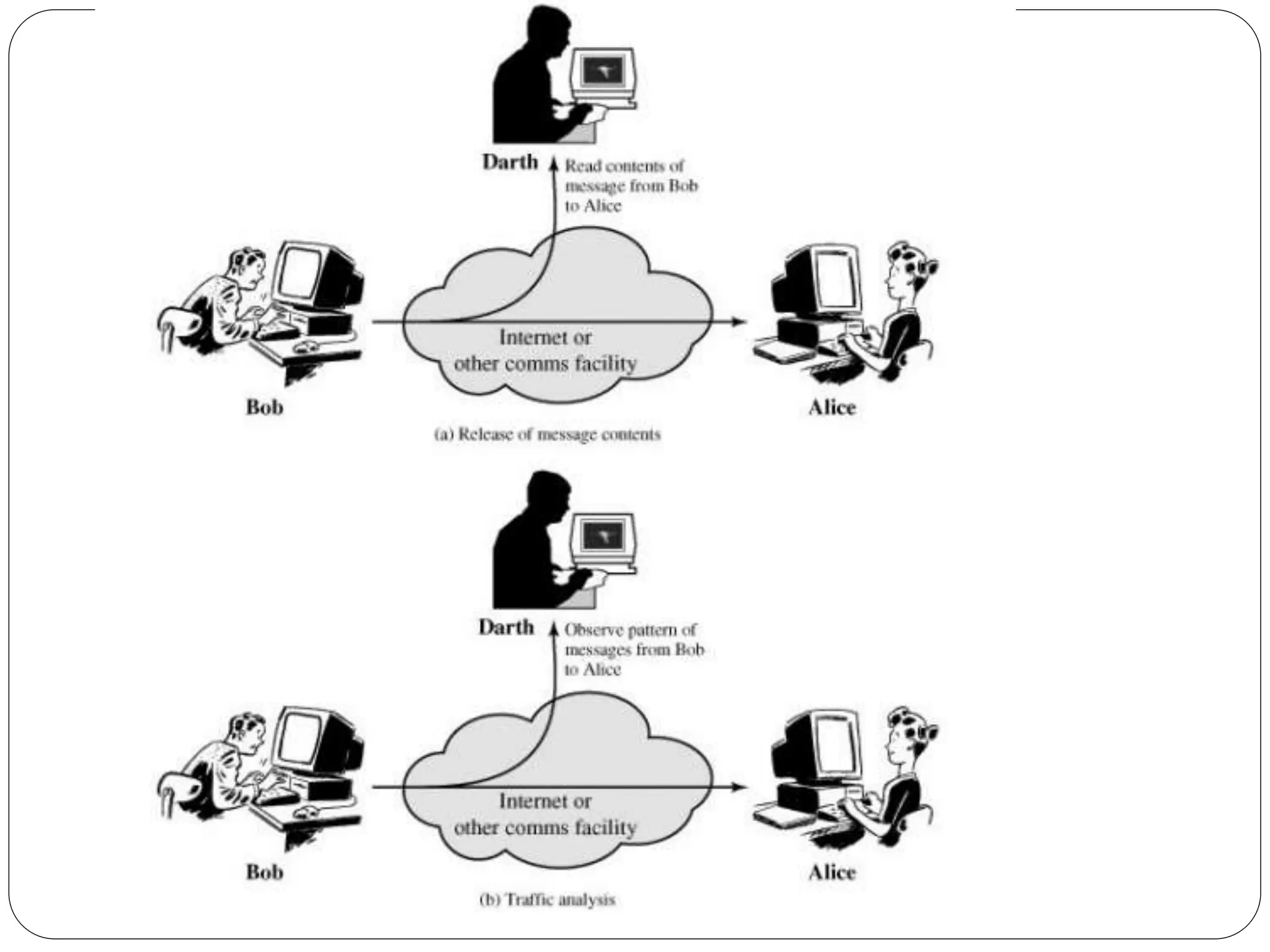
 A passive attack attempts to learn or make use of
information from the system but does not affect
system resources.
 The goal of the opponent is to obtain information that
is being transmitted. Two types of passive attacks
are release of message contents and traffic
analysis.
 The release of message contents is easily
understood
 A telephone conversation, an electronic mail message, and a
transferred file may contain sensitive or confidential
information.
 We would like to prevent an opponent from learning the
contents of these transmissions.
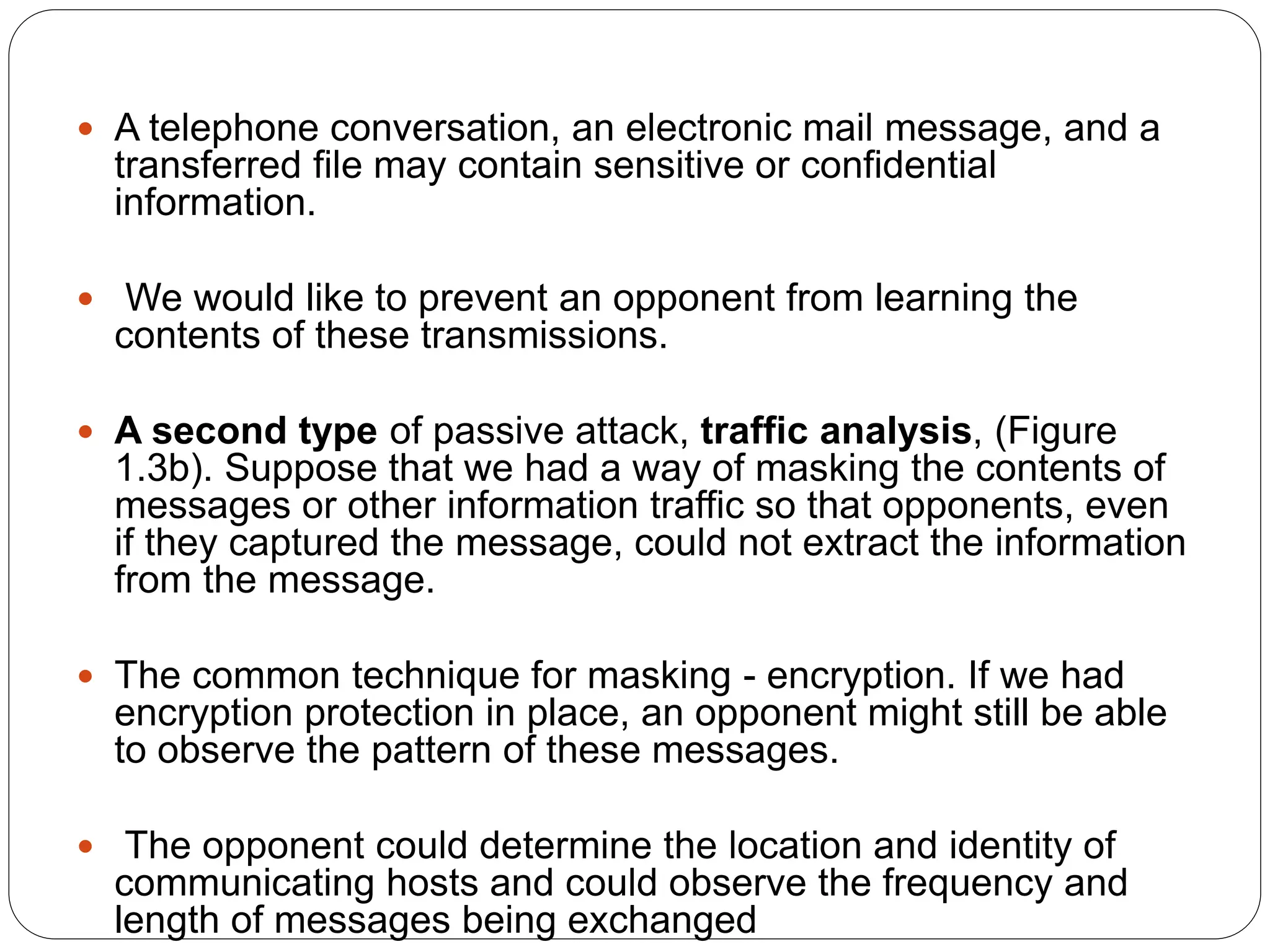
 A second type of passive attack, traffic analysis, (Figure
1.3b). Suppose that we had a way of masking the contents of
messages or other information traffic so that opponents, even
if they captured the message, could not extract the information
from the message.
 The common technique for masking - encryption. If we had
encryption protection in place, an opponent might still be able
to observe the pattern of these messages.
 The opponent could determine the location and identity of
communicating hosts and could observe the frequency and
length of messages being exchanged
 This information might be useful in guessing the nature of
the communication that was taking place.
 Passive attacks are very difficult to detect because
they do not involve any alteration of the data.
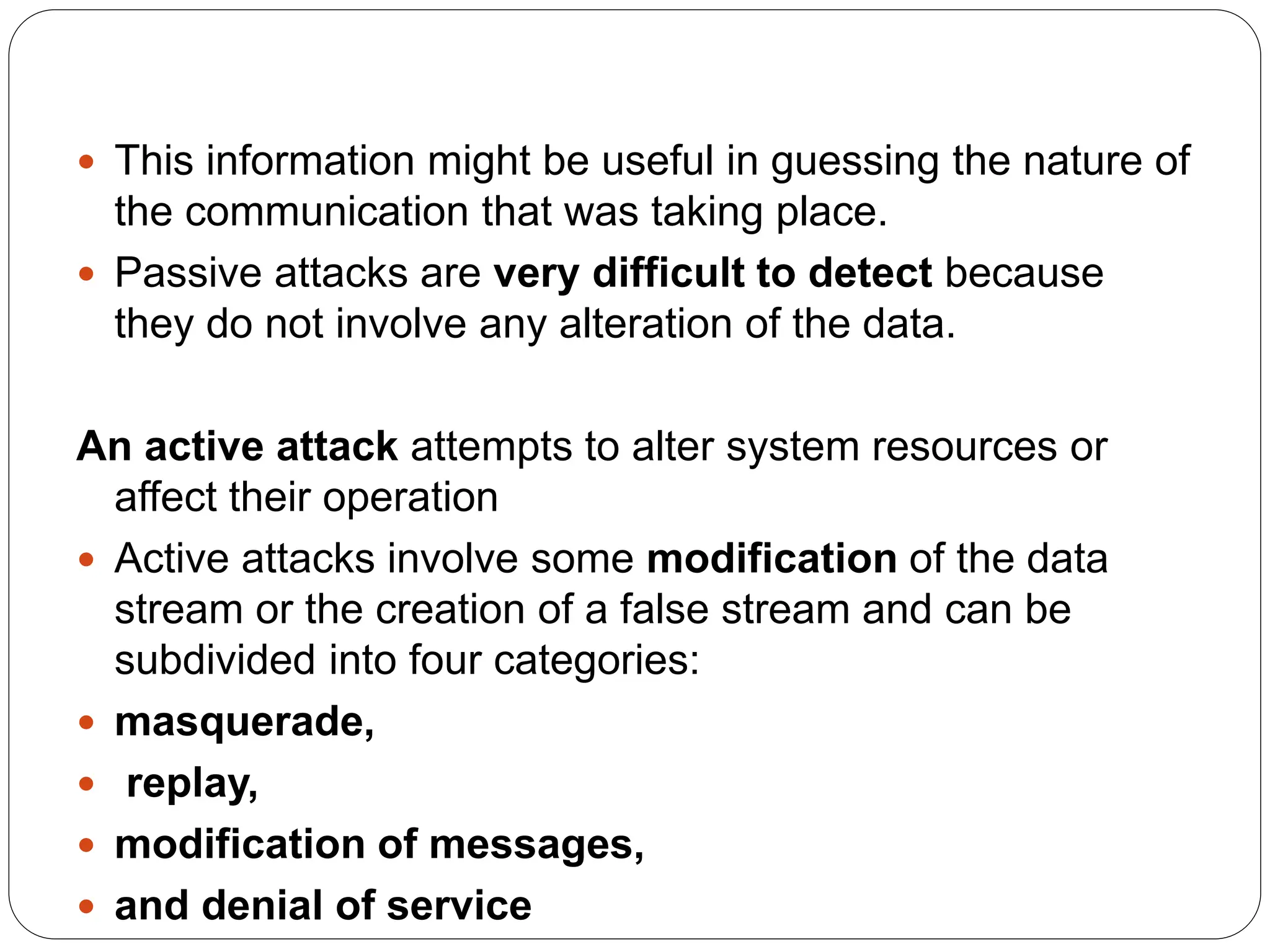
An active attack attempts to alter system resources or
affect their operation
 Active attacks involve some modification of the data
stream or the creation of a false stream and can be
subdivided into four categories:
 masquerade,
 replay,
 modification of messages,
 and denial of service
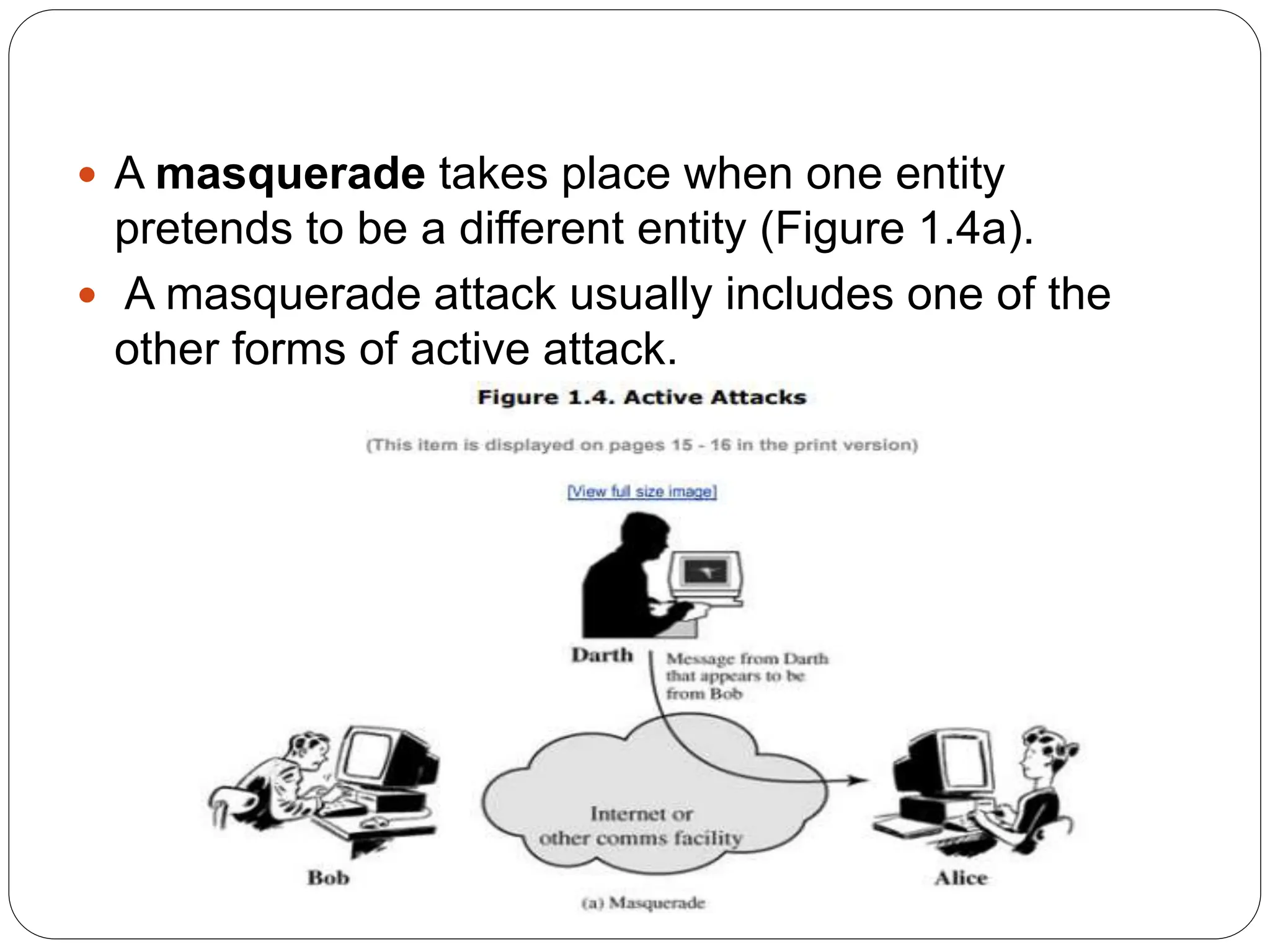
 A masquerade takes place when one entity
pretends to be a different entity (Figure 1.4a).
 A masquerade attack usually includes one of the
other forms of active attack.
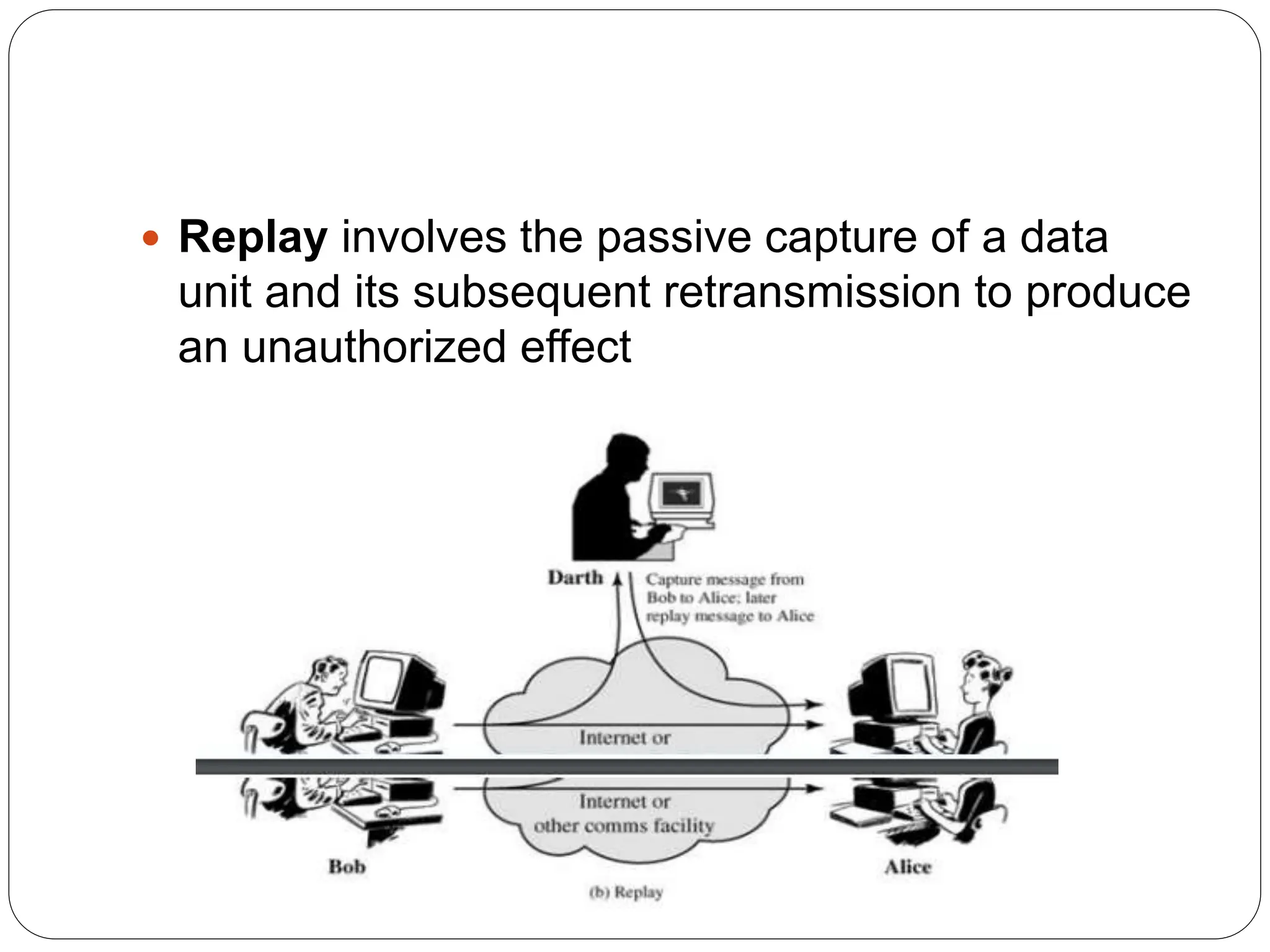
 Replay involves the passive capture of a data
unit and its subsequent retransmission to produce
an unauthorized effect
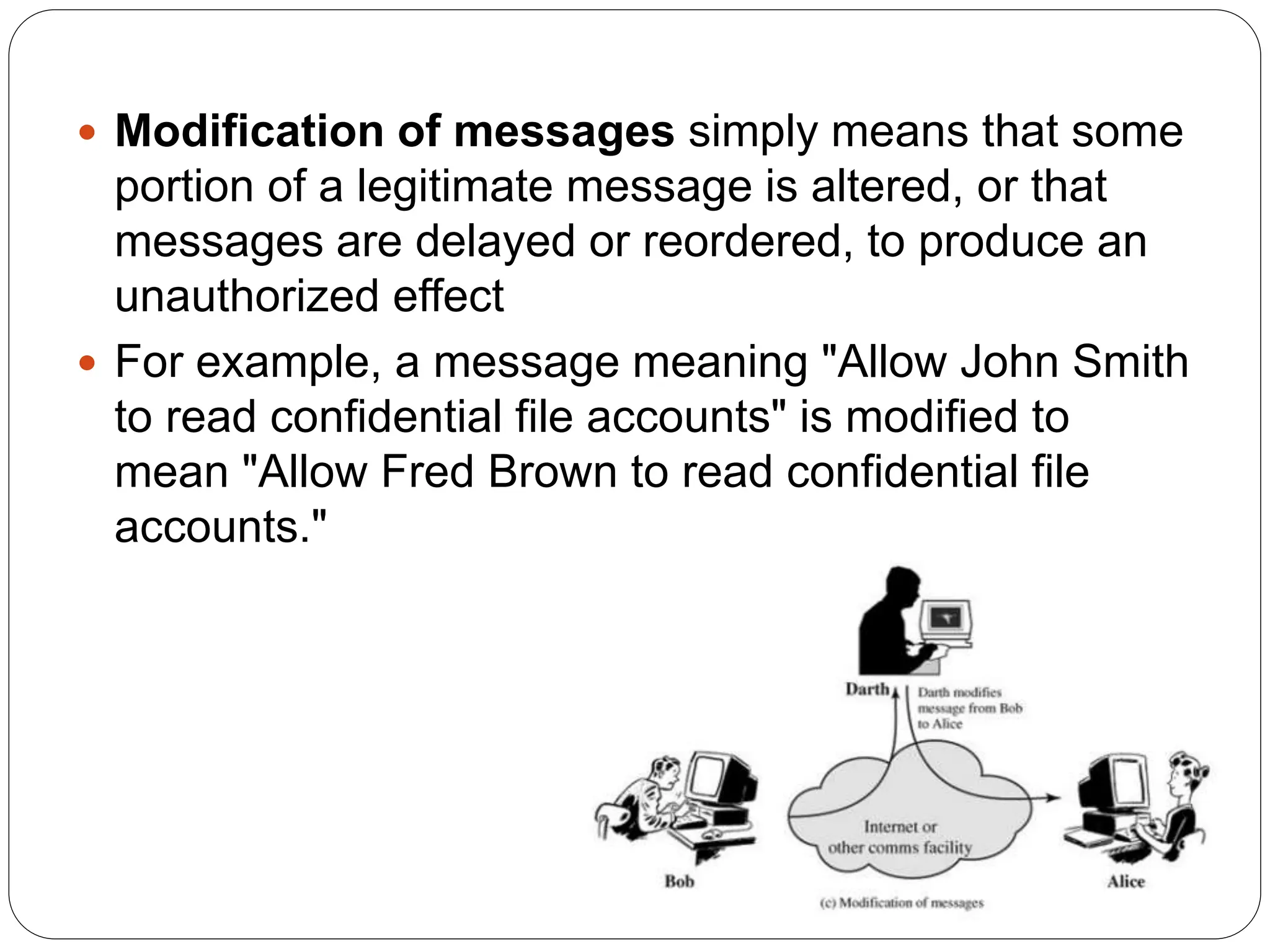
 Modification of messages simply means that some
portion of a legitimate message is altered, or that
messages are delayed or reordered, to produce an
unauthorized effect
 For example, a message meaning "Allow John Smith
to read confidential file accounts" is modified to
mean "Allow Fred Brown to read confidential file
accounts."
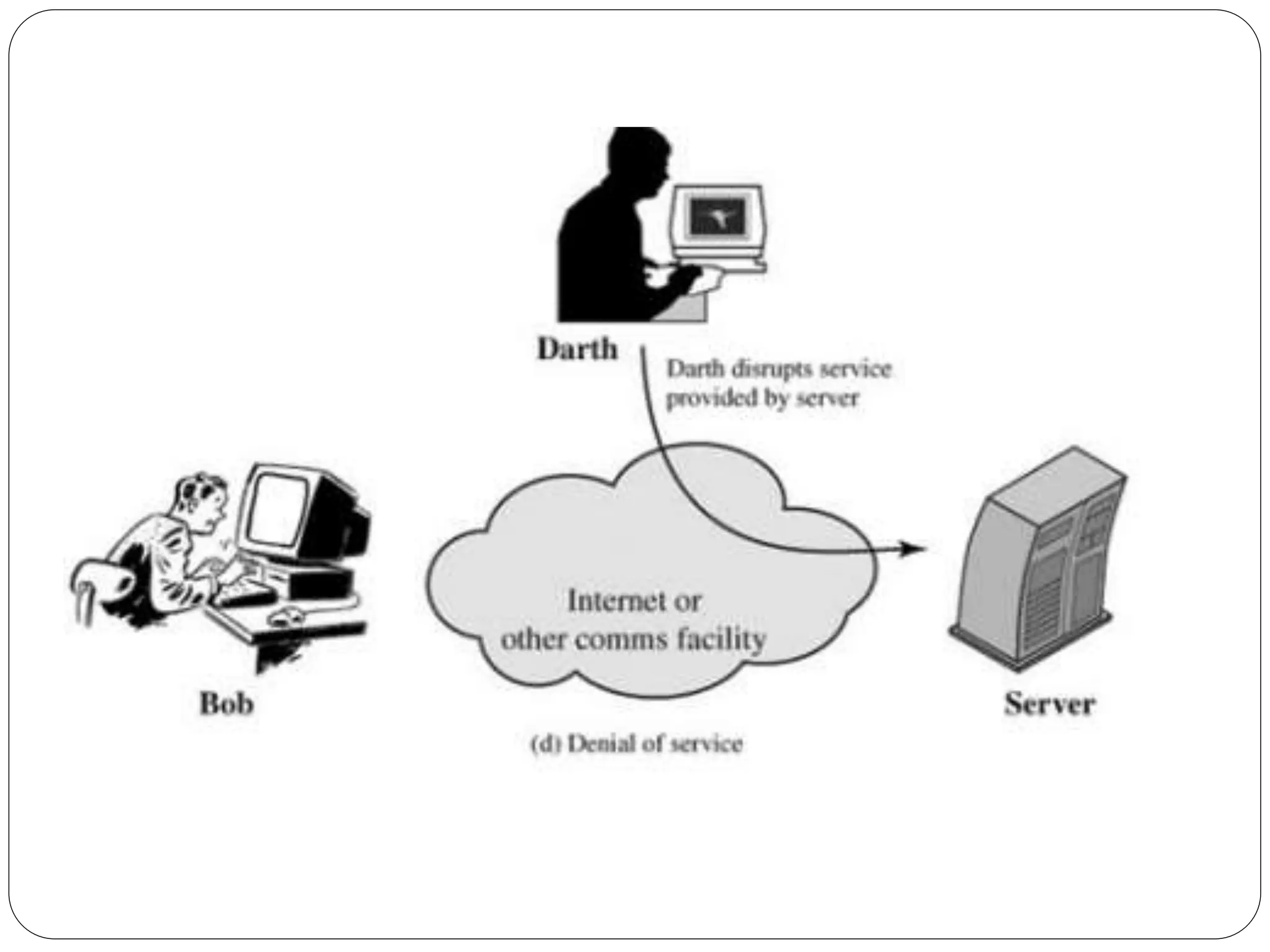
 The denial of service prevents or inhibits the normal
use or management of communications facilities
 This attack may have a specific target; for example,
an entity may suppress all messages directed to a
particular destination (e.g., the security audit
service).
 Another form of service denial is the disruption of an
entire network, either by disabling the network or by
overloading it with messages so as to degrade
performance.
Security Services
 Ensures adequate security of the systems or of data
transfers.
 A processing or communication service that is
provided by a system to give a specific kind of
protection to system resources;
 Security services implement security policies and are
implemented by security mechanisms
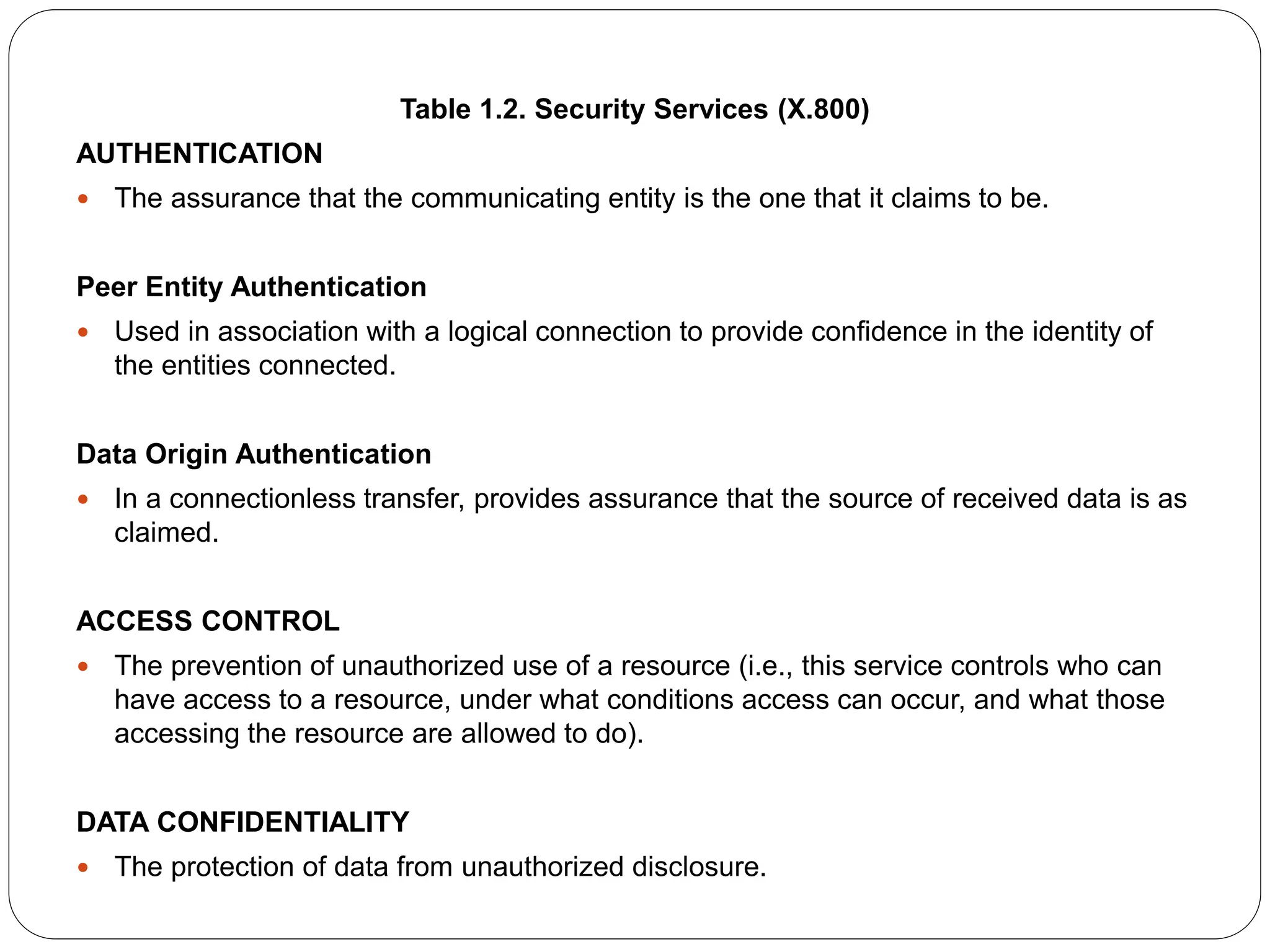
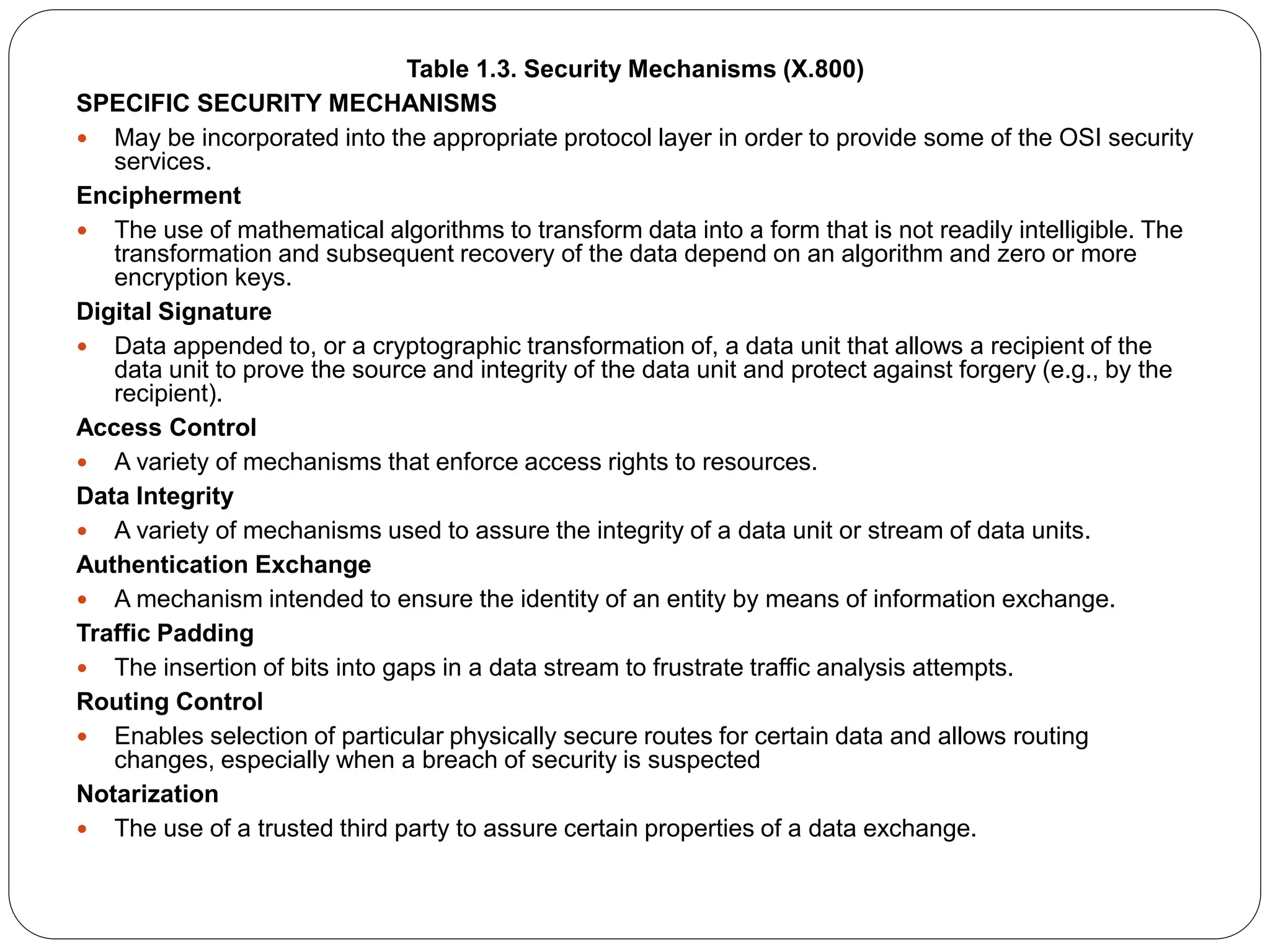
 X.800 divides these services into five categories and
fourteen specific services (Table 1.2).
Table 1.2. Security Services (X.800)
AUTHENTICATION
 The assurance that the communicating entity is the one that it claims to be.
Peer Entity Authentication
 Used in association with a logical connection to provide confidence in the identity of
the entities connected.
Data Origin Authentication
 In a connectionless transfer, provides assurance that the source of received data is as
claimed.
ACCESS CONTROL
 The prevention of unauthorized use of a resource (i.e., this service controls who can
have access to a resource, under what conditions access can occur, and what those
accessing the resource are allowed to do).
DATA CONFIDENTIALITY
 The protection of data from unauthorized disclosure.
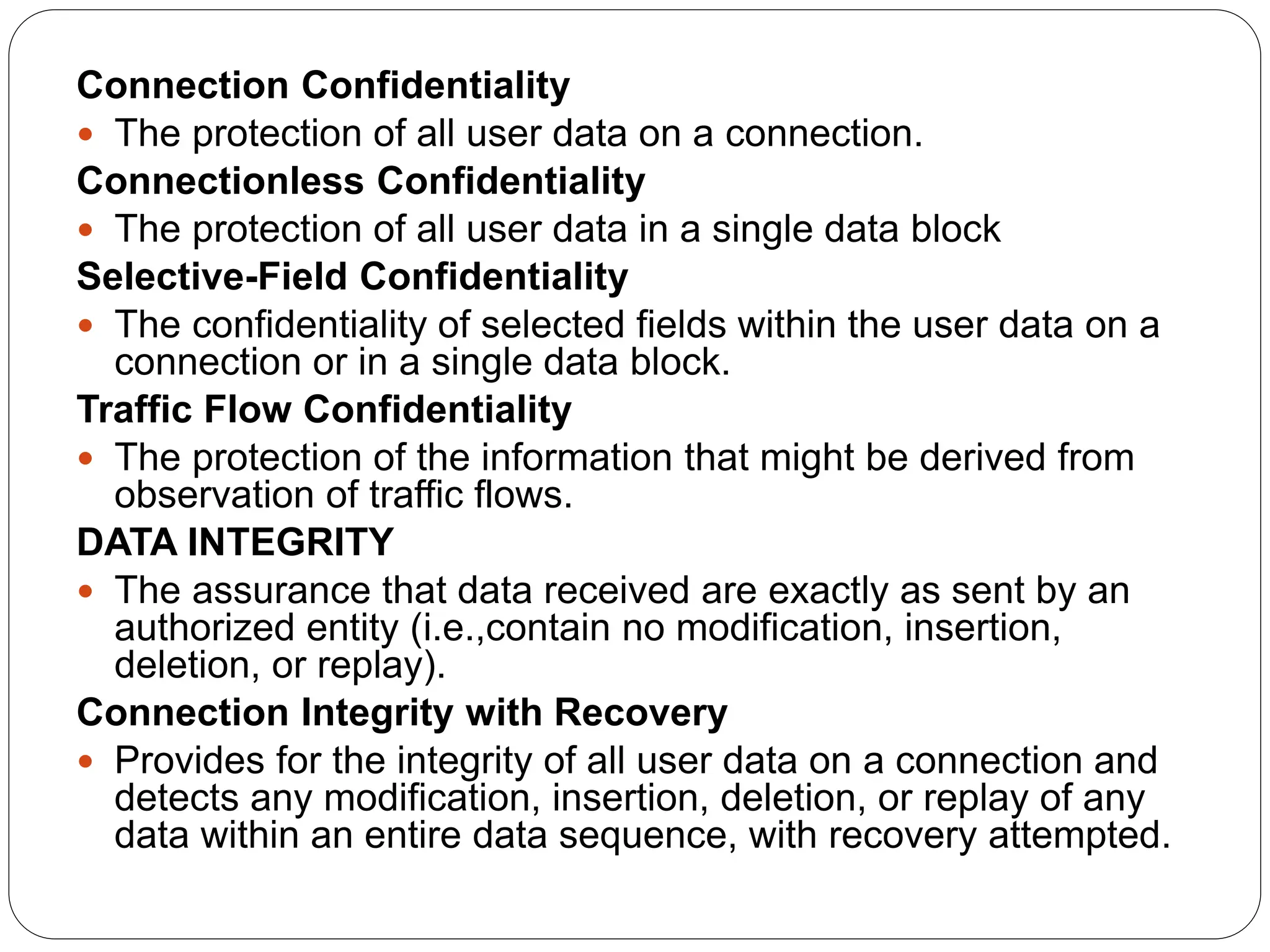
Connection Confidentiality
 The protection of all user data on a connection.
Connectionless Confidentiality
 The protection of all user data in a single data block
Selective-Field Confidentiality
 The confidentiality of selected fields within the user data on a
connection or in a single data block.
Traffic Flow Confidentiality
 The protection of the information that might be derived from
observation of traffic flows.
DATA INTEGRITY
 The assurance that data received are exactly as sent by an
authorized entity (i.e.,contain no modification, insertion,
deletion, or replay).
Connection Integrity with Recovery
 Provides for the integrity of all user data on a connection and
detects any modification, insertion, deletion, or replay of any
data within an entire data sequence, with recovery attempted.
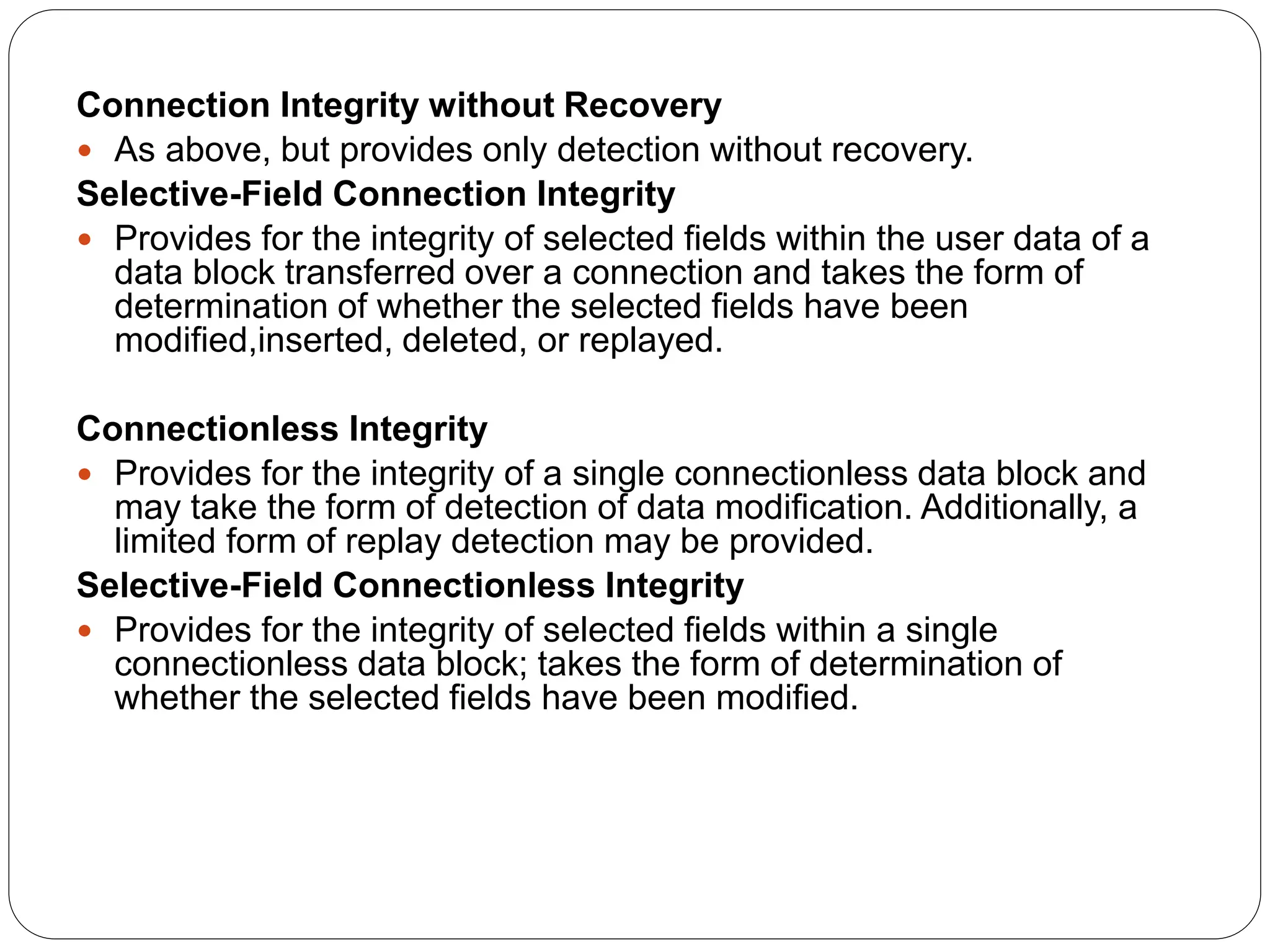
Connection Integrity without Recovery
 As above, but provides only detection without recovery.
Selective-Field Connection Integrity
 Provides for the integrity of selected fields within the user data of a
data block transferred over a connection and takes the form of
determination of whether the selected fields have been
modified,inserted, deleted, or replayed.
Connectionless Integrity
 Provides for the integrity of a single connectionless data block and
may take the form of detection of data modification. Additionally, a
limited form of replay detection may be provided.
Selective-Field Connectionless Integrity
 Provides for the integrity of selected fields within a single
connectionless data block; takes the form of determination of
whether the selected fields have been modified.
Security Mechanisms
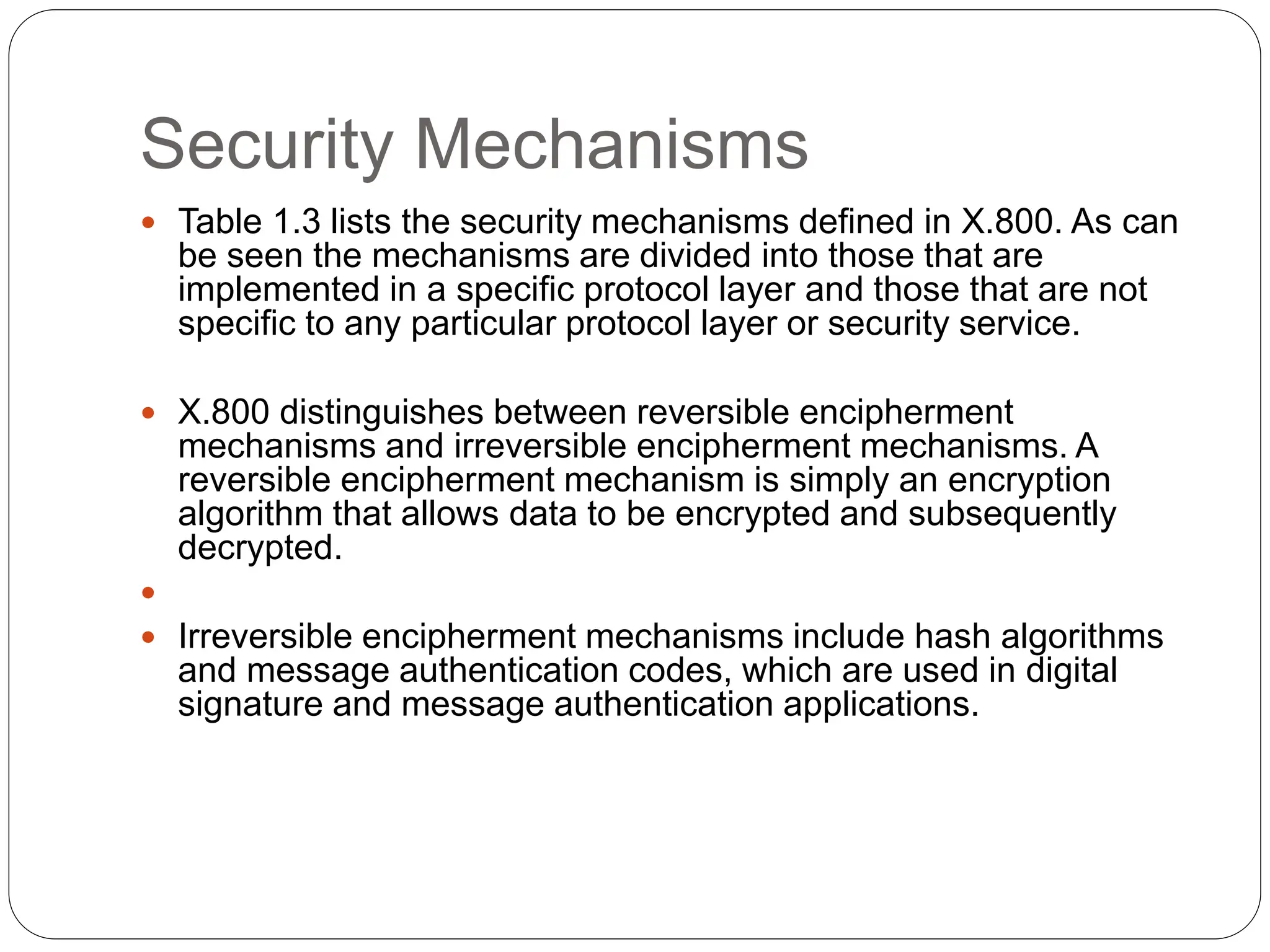
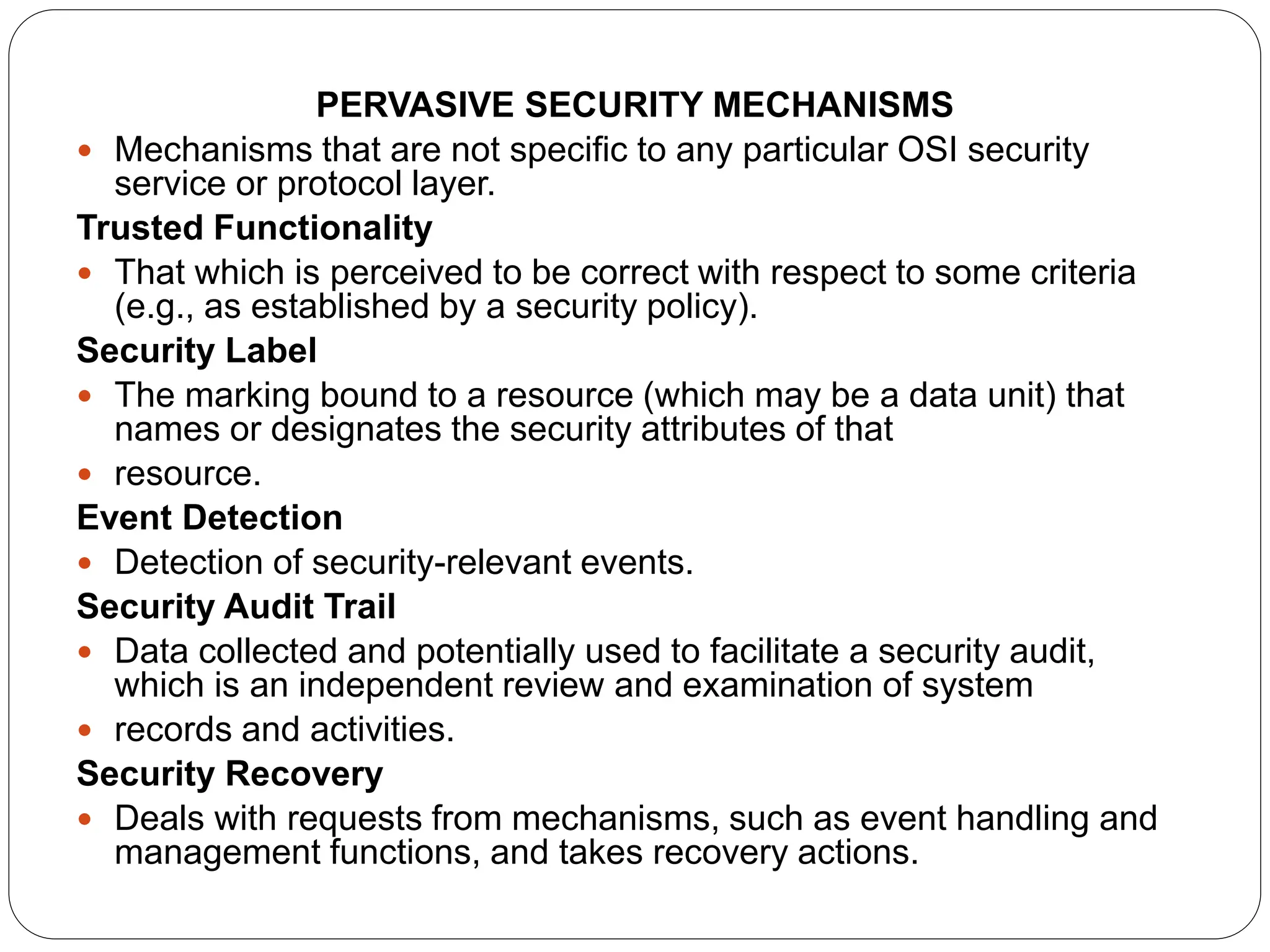
 Table 1.3 lists the security mechanisms defined in X.800. As can
be seen the mechanisms are divided into those that are
implemented in a specific protocol layer and those that are not
specific to any particular protocol layer or security service.
 X.800 distinguishes between reversible encipherment
mechanisms and irreversible encipherment mechanisms. A
reversible encipherment mechanism is simply an encryption
algorithm that allows data to be encrypted and subsequently
decrypted.

 Irreversible encipherment mechanisms include hash algorithms
and message authentication codes, which are used in digital
signature and message authentication applications.
Table 1.3. Security Mechanisms (X.800)
SPECIFIC SECURITY MECHANISMS
 May be incorporated into the appropriate protocol layer in order to provide some of the OSI security
services.
Encipherment
 The use of mathematical algorithms to transform data into a form that is not readily intelligible. The
transformation and subsequent recovery of the data depend on an algorithm and zero or more
encryption keys.
Digital Signature
 Data appended to, or a cryptographic transformation of, a data unit that allows a recipient of the
data unit to prove the source and integrity of the data unit and protect against forgery (e.g., by the
recipient).
Access Control
 A variety of mechanisms that enforce access rights to resources.
Data Integrity
 A variety of mechanisms used to assure the integrity of a data unit or stream of data units.
Authentication Exchange
 A mechanism intended to ensure the identity of an entity by means of information exchange.
Traffic Padding
 The insertion of bits into gaps in a data stream to frustrate traffic analysis attempts.
Routing Control
 Enables selection of particular physically secure routes for certain data and allows routing
changes, especially when a breach of security is suspected
Notarization
 The use of a trusted third party to assure certain properties of a data exchange.
PERVASIVE SECURITY MECHANISMS
 Mechanisms that are not specific to any particular OSI security
service or protocol layer.
Trusted Functionality
 That which is perceived to be correct with respect to some criteria
(e.g., as established by a security policy).
Security Label
 The marking bound to a resource (which may be a data unit) that
names or designates the security attributes of that
 resource.
Event Detection
 Detection of security-relevant events.
Security Audit Trail
 Data collected and potentially used to facilitate a security audit,
which is an independent review and examination of system
 records and activities.
Security Recovery
 Deals with requests from mechanisms, such as event handling and
management functions, and takes recovery actions.
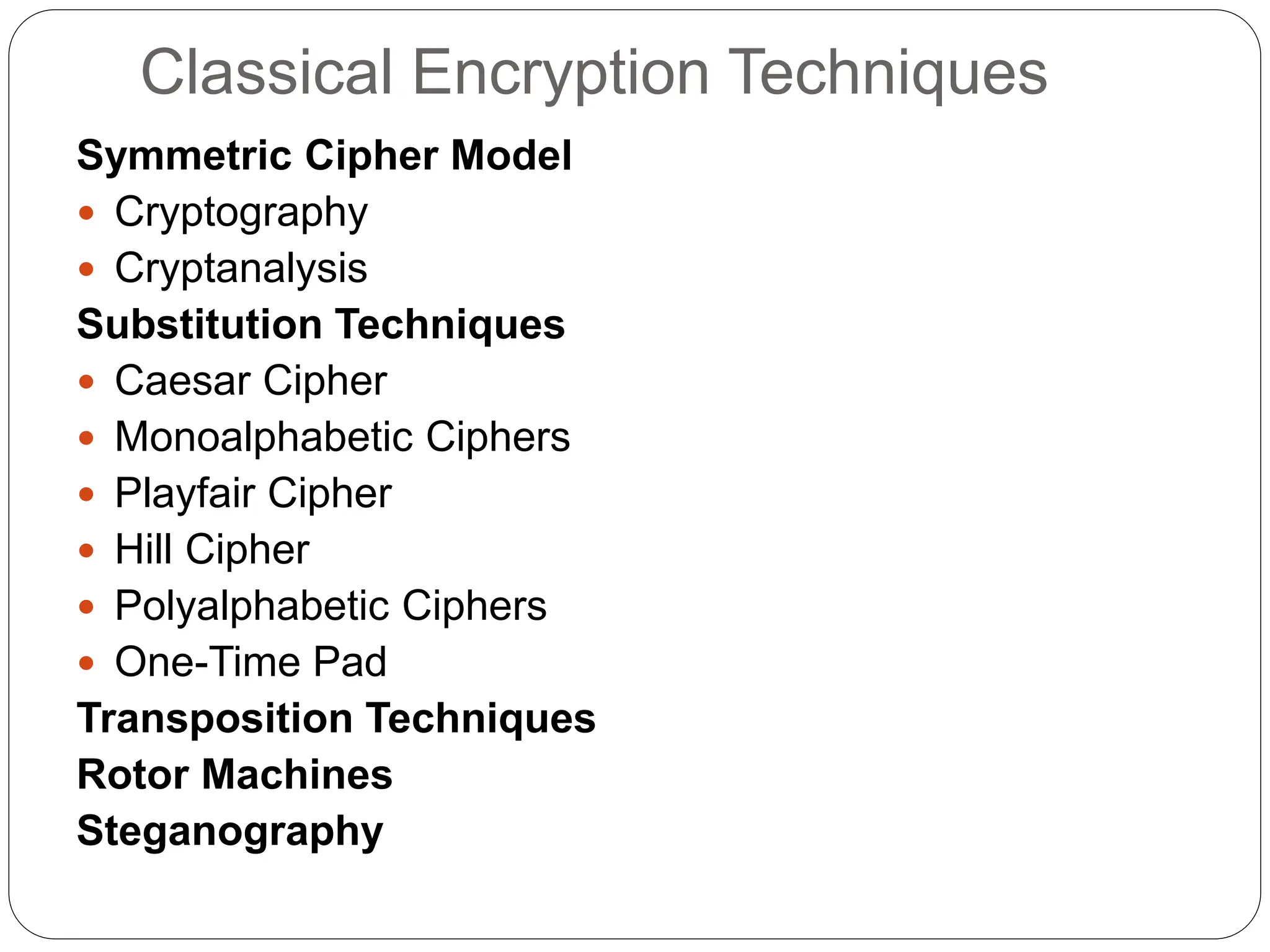
Classical Encryption Techniques
Symmetric Cipher Model
 Cryptography
 Cryptanalysis
Substitution Techniques
 Caesar Cipher
 Monoalphabetic Ciphers
 Playfair Cipher
 Hill Cipher
 Polyalphabetic Ciphers
 One-Time Pad
Transposition Techniques
Rotor Machines
Steganography
Classical Encryption Techniques
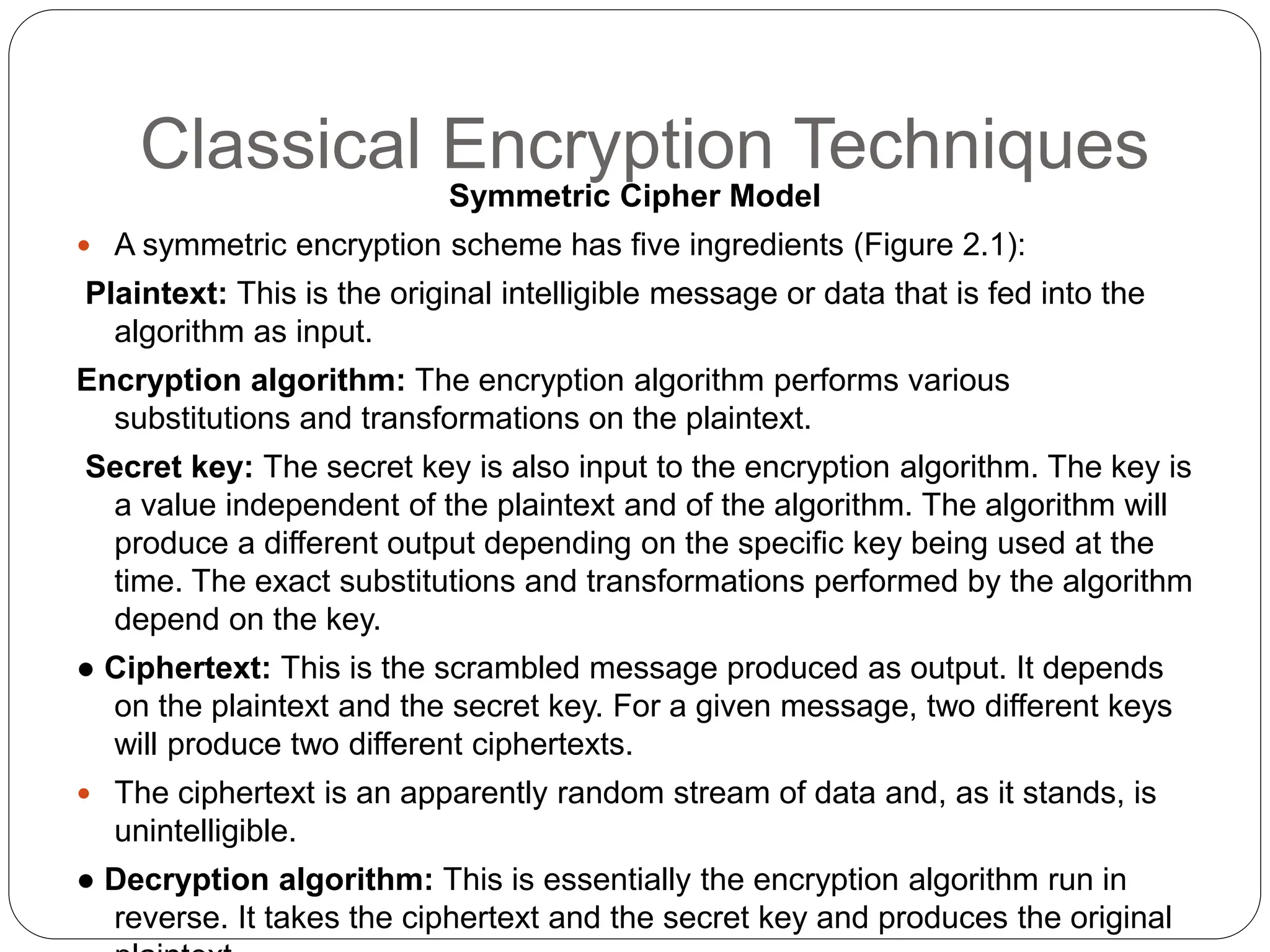
Symmetric Cipher Model
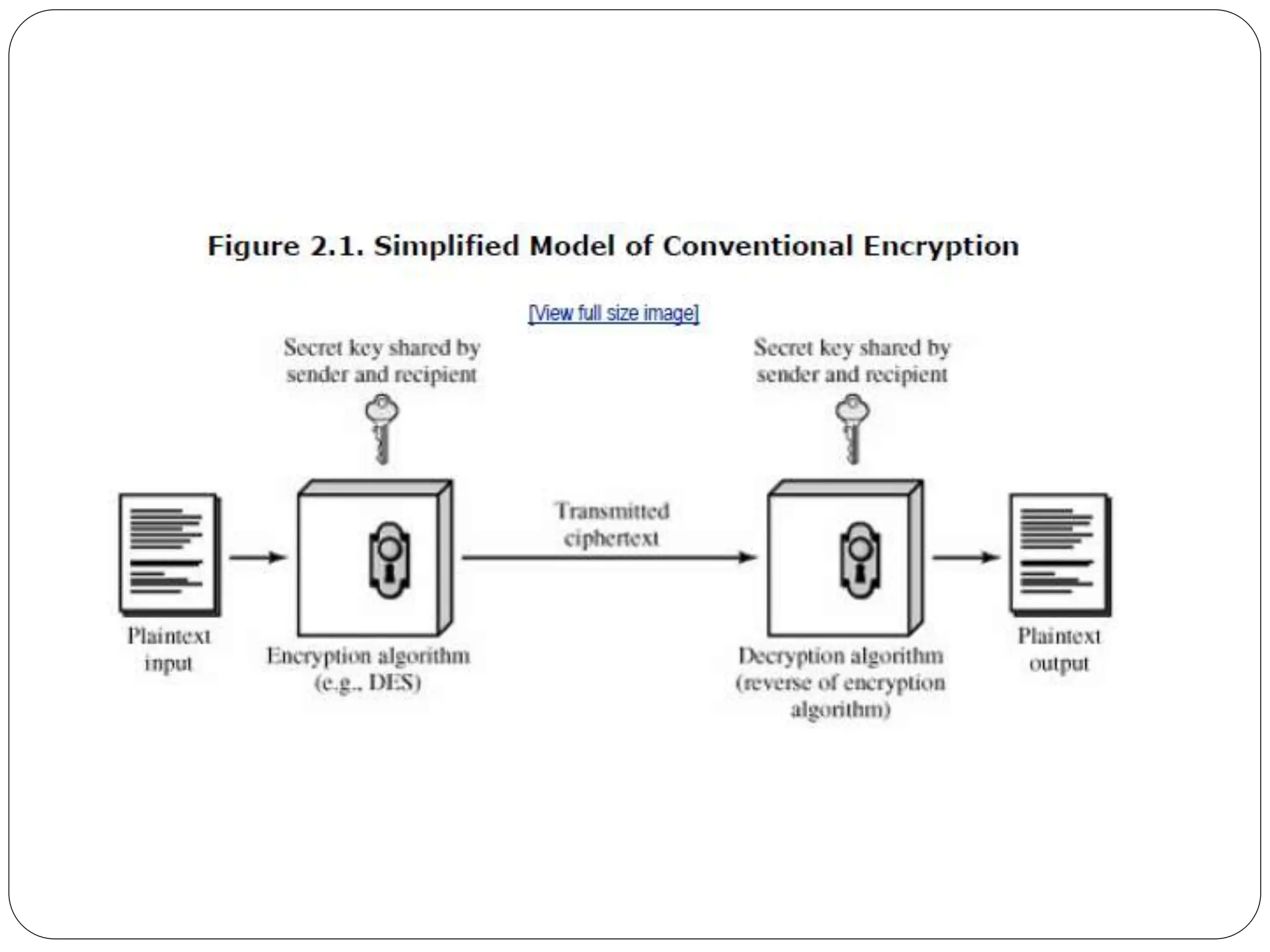
 A symmetric encryption scheme has five ingredients (Figure 2.1):
Plaintext: This is the original intelligible message or data that is fed into the
algorithm as input.
Encryption algorithm: The encryption algorithm performs various
substitutions and transformations on the plaintext.
Secret key: The secret key is also input to the encryption algorithm. The key is
a value independent of the plaintext and of the algorithm. The algorithm will
produce a different output depending on the specific key being used at the
time. The exact substitutions and transformations performed by the algorithm
depend on the key.
● Ciphertext: This is the scrambled message produced as output. It depends
on the plaintext and the secret key. For a given message, two different keys
will produce two different ciphertexts.
 The ciphertext is an apparently random stream of data and, as it stands, is
unintelligible.
● Decryption algorithm: This is essentially the encryption algorithm run in
reverse. It takes the ciphertext and the secret key and produces the original
 There are two requirements for secure use of
conventional encryption:
1.
 We need a strong encryption algorithm. At a
minimum, we would like the algorithm to be such that
an opponent who knows the algorithm and has
access to one or more ciphertexts would be
unable to decipher the ciphertext or figure out the
key.
 This requirement is usually stated in a stronger form:
The opponent should be unable to decrypt
ciphertext or discover the key even if he or she is
in possession of a number of ciphertexts together
with the plaintext that produced each ciphertext.
Model of Conventional
Cryptosystem
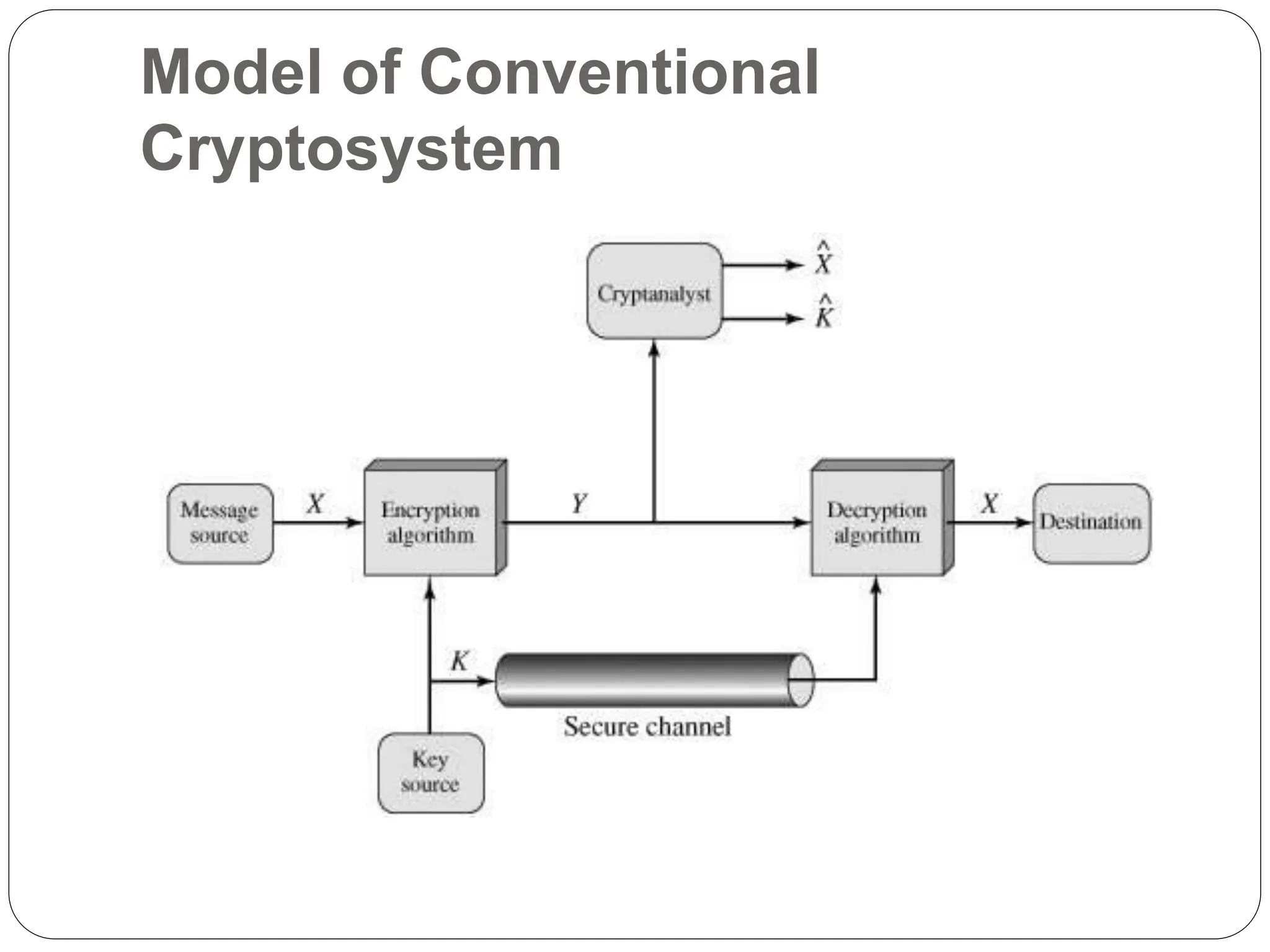
 A source produces a message in plaintext, X = [X1,
X2, ..., XM]. The M elements of X are letters in some
finite alphabet. Traditionally, the alphabet usually
consisted of the 26 capital letters.
 Nowadays, the binary alphabet {0, 1} is typically used.
For encryption, a key of the form K = [K1, K2, ..., KJ]
is generated. If the key is generated at the message
source, then it must also be provided to the
destination by means of some secure channel.
 Alternatively, a third party could generate the key and
securely deliver it to both source and destination.
 With the message X and the encryption key K as
input, the encryption algorithm forms the ciphertext Y
= [Y1, Y2, ..., YN].
 We can write this as
Y = E(K, X)
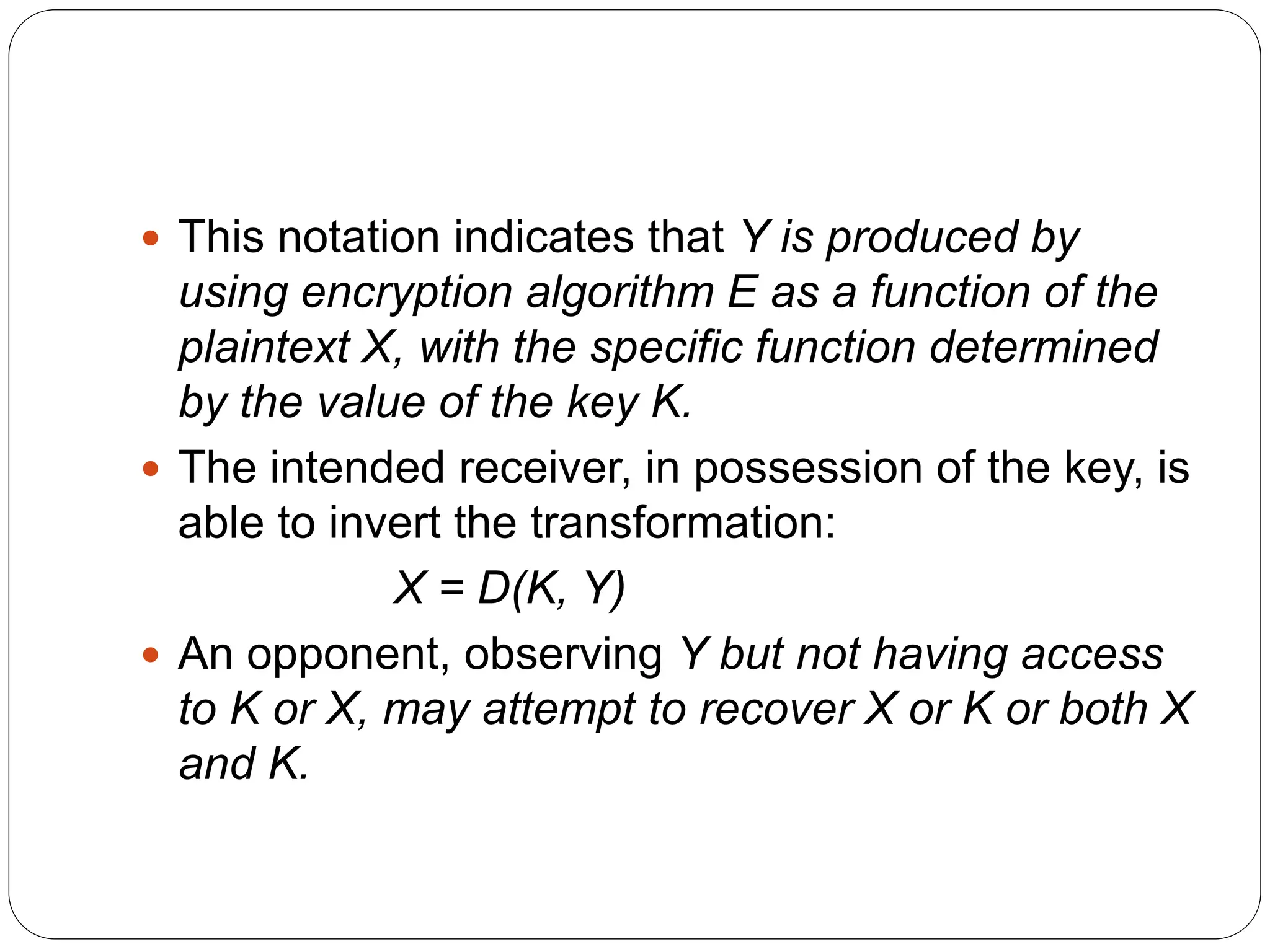
 This notation indicates that Y is produced by
using encryption algorithm E as a function of the
plaintext X, with the specific function determined
by the value of the key K.
 The intended receiver, in possession of the key, is
able to invert the transformation:
X = D(K, Y)
 An opponent, observing Y but not having access
to K or X, may attempt to recover X or K or both X
and K.
Cryptography
 Cryptographic systems are characterized along three
independent dimensions:
 1. The type of operations used for transforming
plaintext to ciphertext. All encryption algorithms are
based on two general principles: substitution, in which
each element in the plaintext (bit, letter, group of bits or
letters) is mapped into another element, and transposition,
in which elements in the plaintext are rearranged.
 The fundamental requirement is that no information be lost
(that is, that all operations are reversible).
 2. The number of keys used. If both sender and
receiver use the same key, the system is referred to as
symmetric, single-key, secret-key, or conventional
encryption. If the sender and receiver use different keys,
the system is referred to as asymmetric, two-key, or public-
key encryption.
 3. The way in which the plaintext is processed. A block
cipher processes the input one block of elements at a
time, producing an output block for each input block.
 A stream cipher processes the input elements
continuously, producing output one element at a time, as it
Cryptanalysis
 the objective of attacking an encryption system is
to recover the key in use rather then simply to
recover the plaintext of a single ciphertext. There
are two general approaches to attacking a
conventional encryption scheme:
 ● Cryptanalysis: Cryptanalytic attacks rely on
the nature of the algorithm plus perhaps some
knowledge of the general characteristics of the
plaintext or even some sample plaintext
ciphertext pairs. This type of attack exploits the
characteristics of the algorithm to attempt to
deduce a specific plaintext or to deduce the key
being used.
 Brute-force attack: The attacker tries every
possible key on a piece of ciphertext until an
intelligible translation into plaintext is obtained.
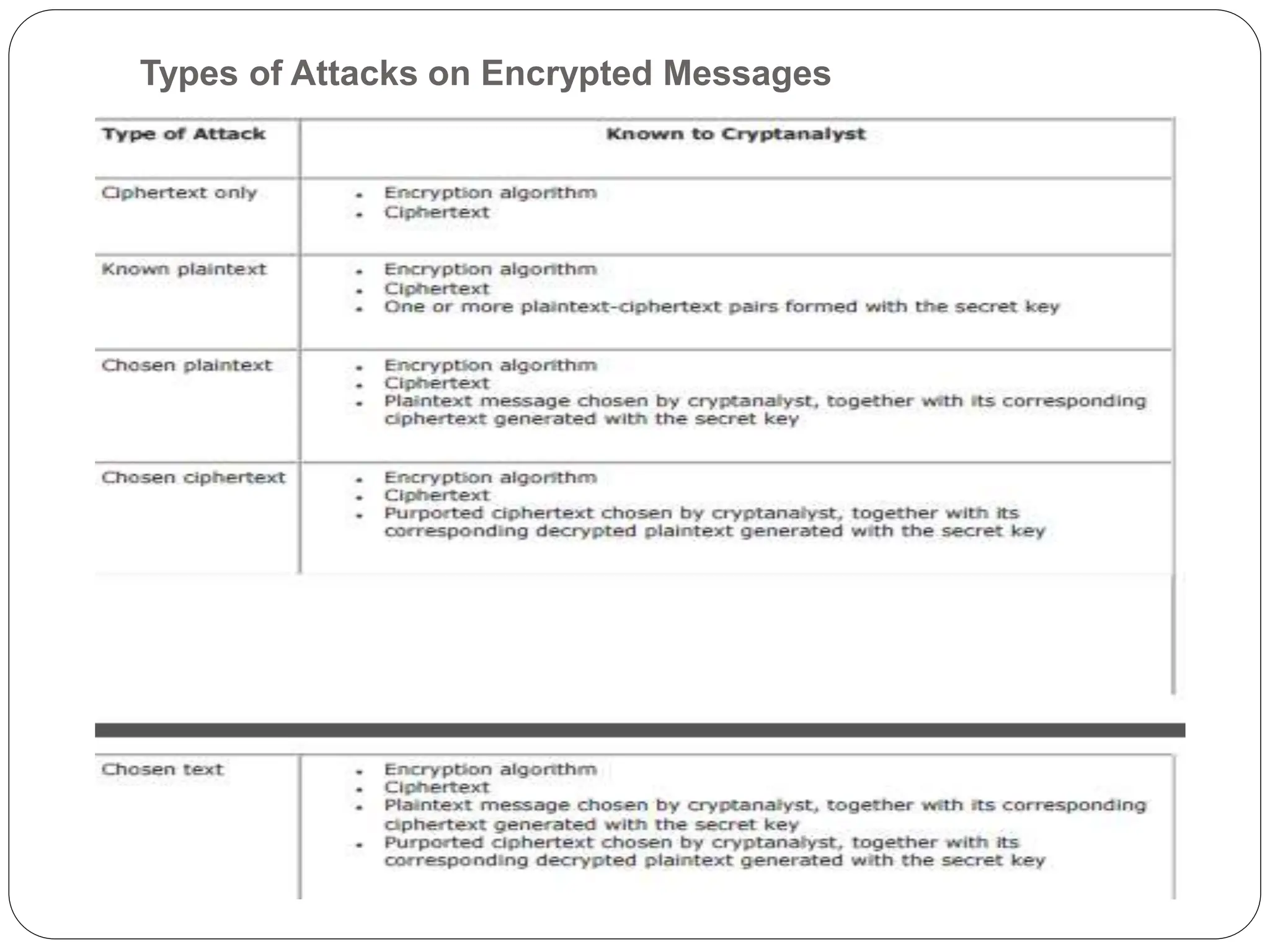
Types of Attacks on Encrypted Messages
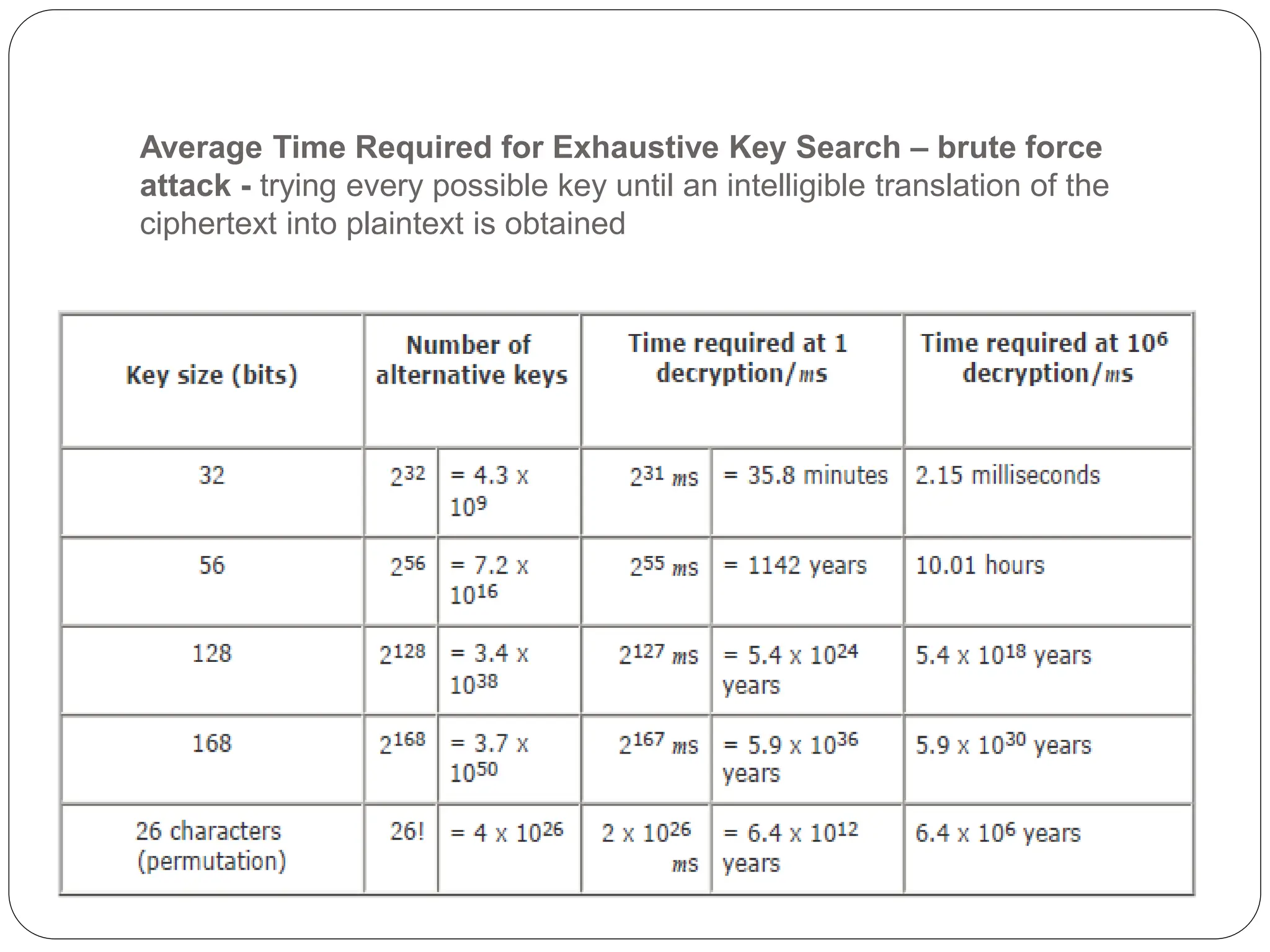
Average Time Required for Exhaustive Key Search – brute force
attack - trying every possible key until an intelligible translation of the
ciphertext into plaintext is obtained
Substitution Techniques
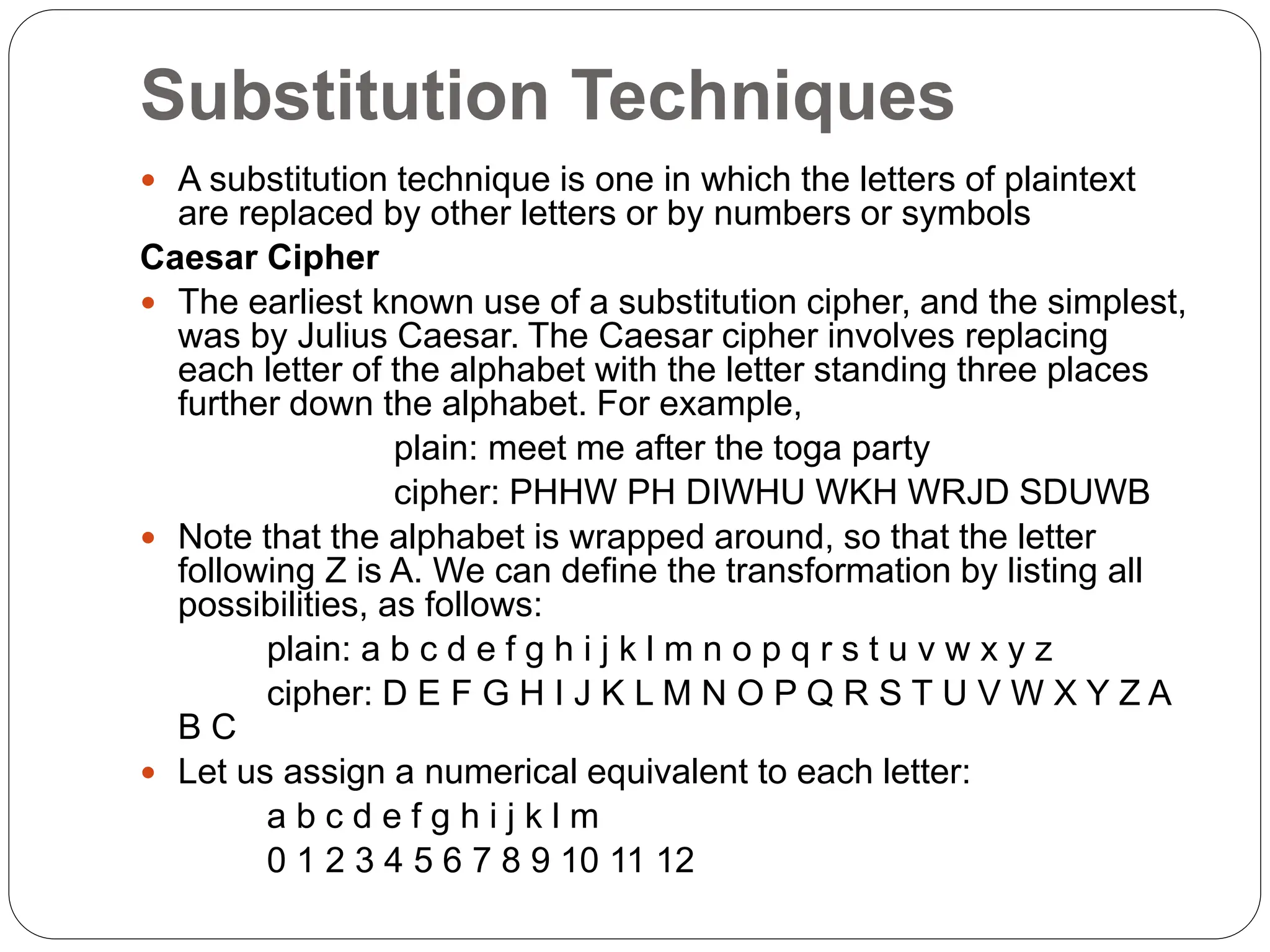
 A substitution technique is one in which the letters of plaintext
are replaced by other letters or by numbers or symbols
Caesar Cipher
 The earliest known use of a substitution cipher, and the simplest,
was by Julius Caesar. The Caesar cipher involves replacing
each letter of the alphabet with the letter standing three places
further down the alphabet. For example,
plain: meet me after the toga party
cipher: PHHW PH DIWHU WKH WRJD SDUWB
 Note that the alphabet is wrapped around, so that the letter
following Z is A. We can define the transformation by listing all
possibilities, as follows:
plain: a b c d e f g h i j k l m n o p q r s t u v w x y z
cipher: D E F G H I J K L M N O P Q R S T U V W X Y Z A
B C
 Let us assign a numerical equivalent to each letter:
a b c d e f g h i j k l m
0 1 2 3 4 5 6 7 8 9 10 11 12
n o p q r s t u v w x y z
13 14 15 16 17 18 19 20 21 22 23 24 25
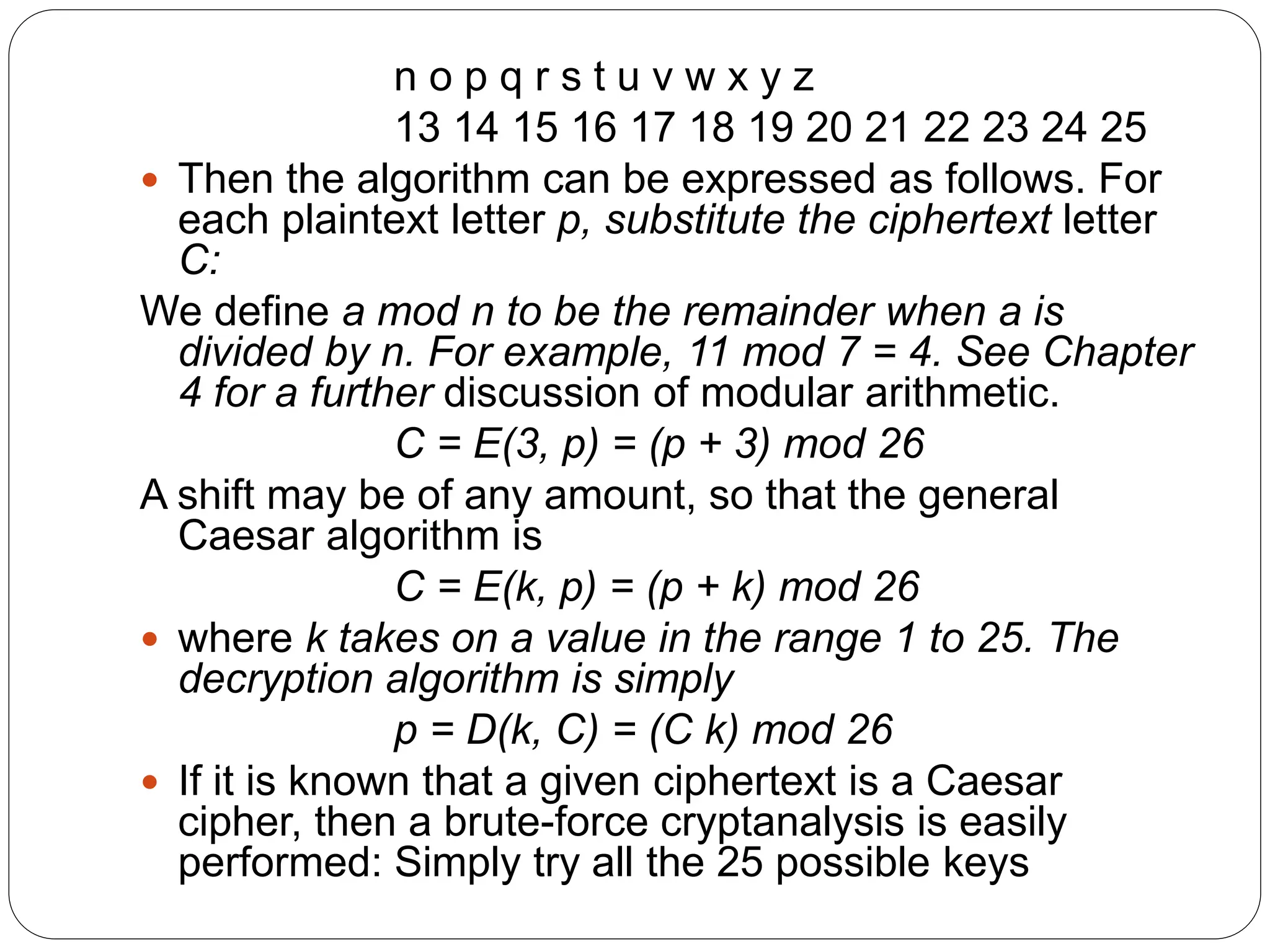
 Then the algorithm can be expressed as follows. For
each plaintext letter p, substitute the ciphertext letter
C:
We define a mod n to be the remainder when a is
divided by n. For example, 11 mod 7 = 4. See Chapter
4 for a further discussion of modular arithmetic.
C = E(3, p) = (p + 3) mod 26
A shift may be of any amount, so that the general
Caesar algorithm is
C = E(k, p) = (p + k) mod 26
 where k takes on a value in the range 1 to 25. The
decryption algorithm is simply
p = D(k, C) = (C k) mod 26
 If it is known that a given ciphertext is a Caesar
cipher, then a brute-force cryptanalysis is easily
performed: Simply try all the 25 possible keys
Monoalphabetic Ciphers
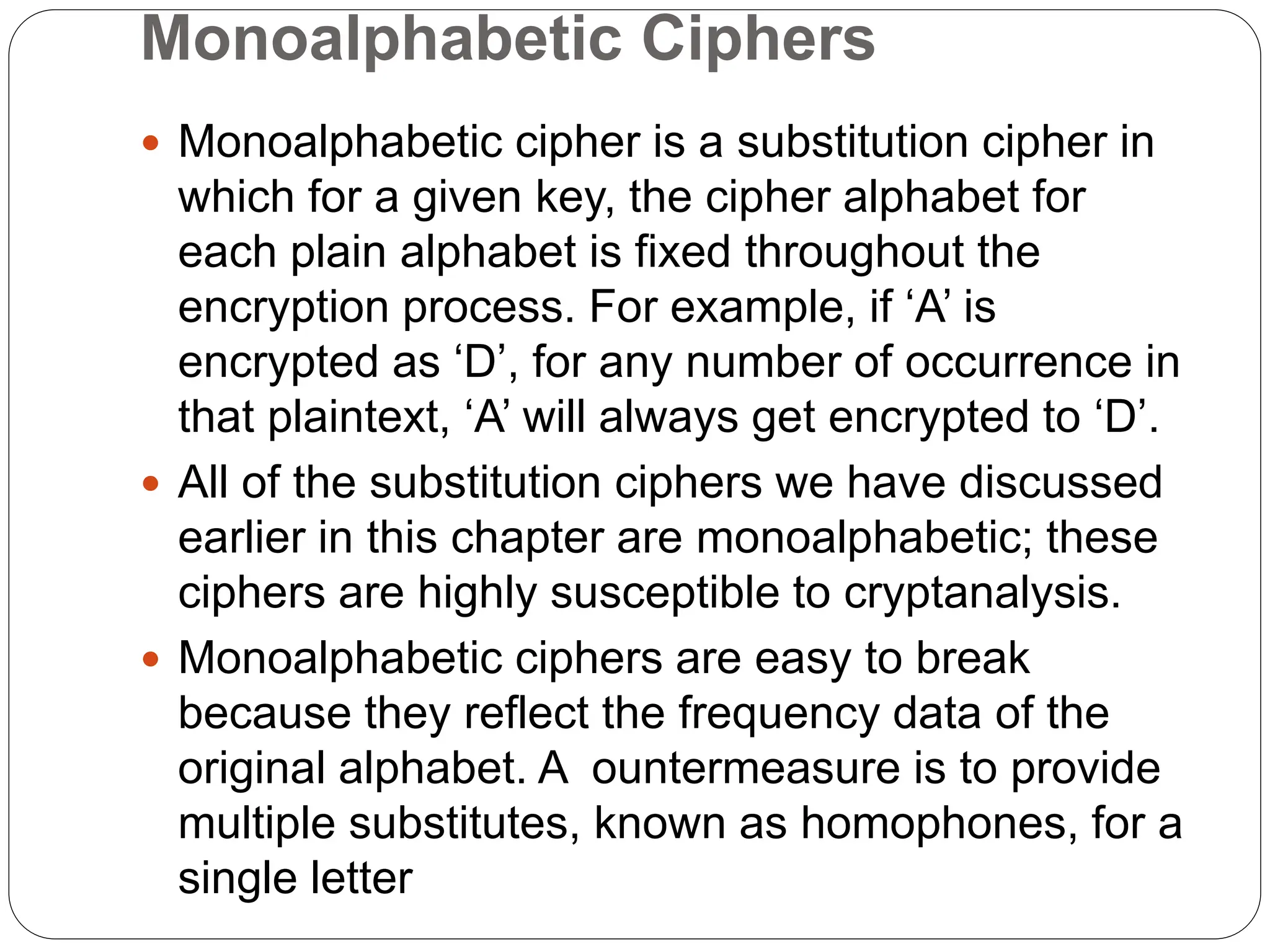
 Monoalphabetic cipher is a substitution cipher in
which for a given key, the cipher alphabet for
each plain alphabet is fixed throughout the
encryption process. For example, if ‘A’ is
encrypted as ‘D’, for any number of occurrence in
that plaintext, ‘A’ will always get encrypted to ‘D’.
 All of the substitution ciphers we have discussed
earlier in this chapter are monoalphabetic; these
ciphers are highly susceptible to cryptanalysis.
 Monoalphabetic ciphers are easy to break
because they reflect the frequency data of the
original alphabet. A ountermeasure is to provide
multiple substitutes, known as homophones, for a
single letter
Playfair Cipher
 The best-known multiple-letter encryption cipher
is the Playfair, which treats digrams in the
plaintext as single units and translates these units
into ciphertext digrams
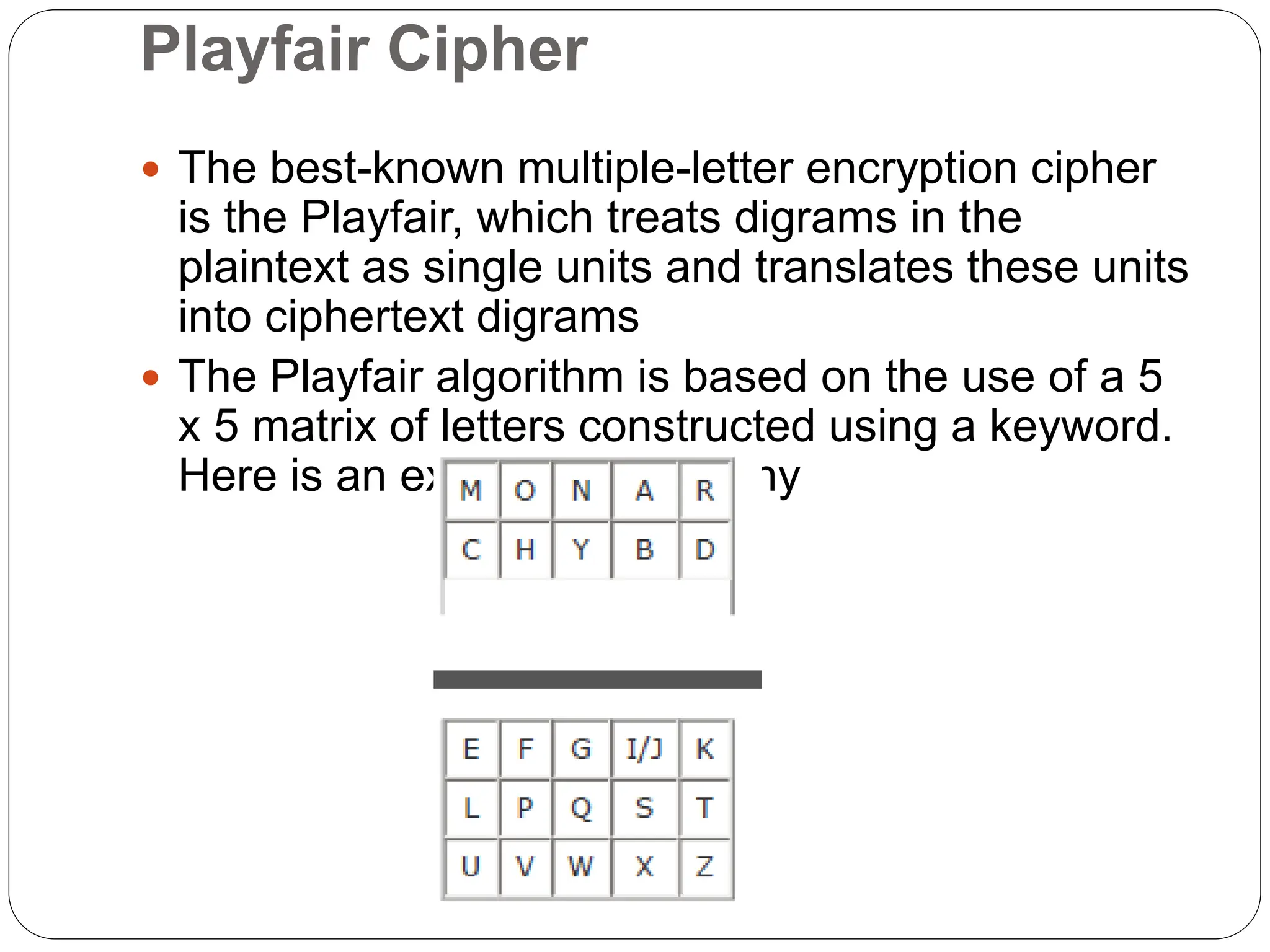
 The Playfair algorithm is based on the use of a 5
x 5 matrix of letters constructed using a keyword.
Here is an example, Monarchy
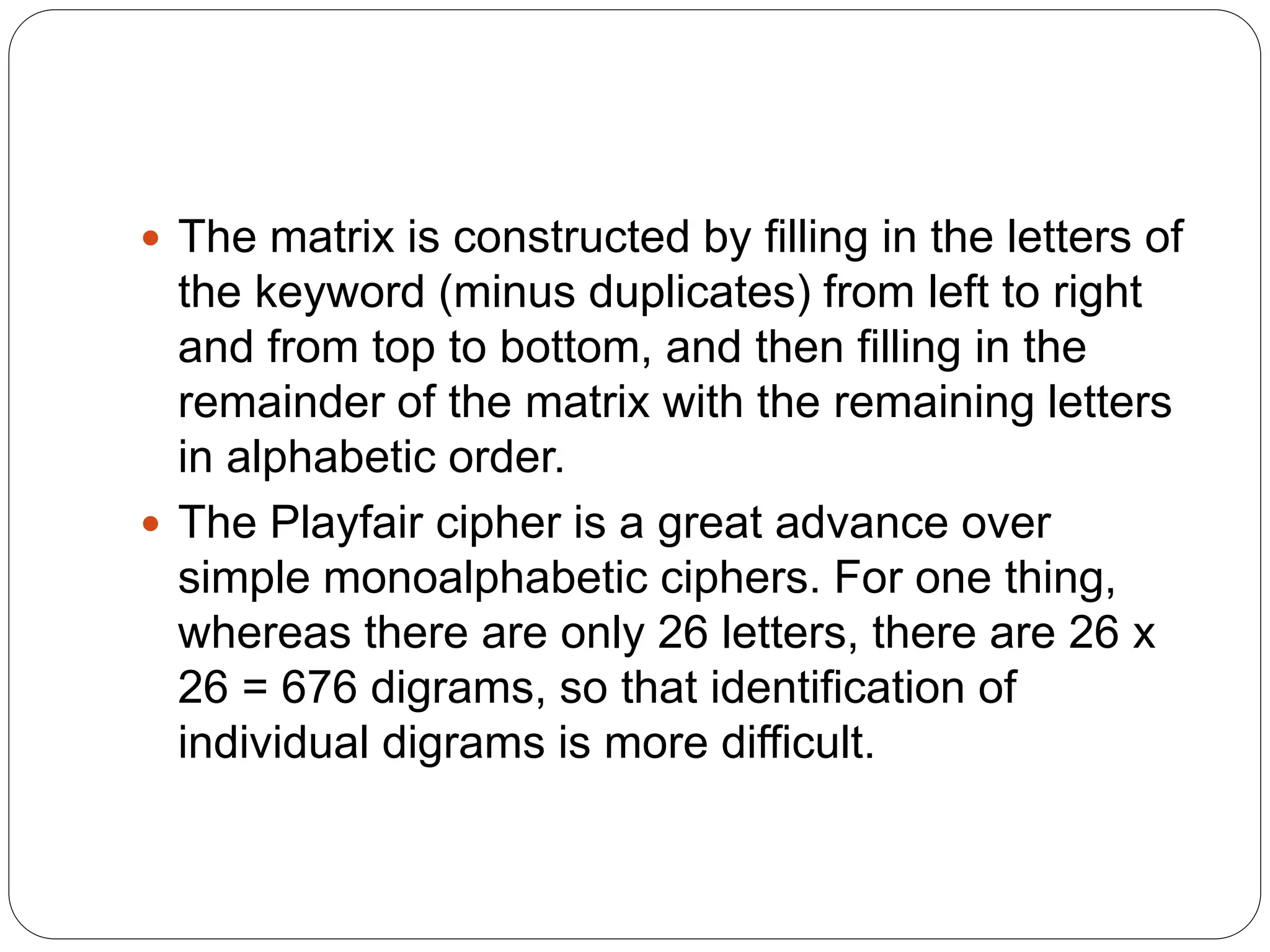
 The matrix is constructed by filling in the letters of
the keyword (minus duplicates) from left to right
and from top to bottom, and then filling in the
remainder of the matrix with the remaining letters
in alphabetic order.
 The Playfair cipher is a great advance over
simple monoalphabetic ciphers. For one thing,
whereas there are only 26 letters, there are 26 x
26 = 676 digrams, so that identification of
individual digrams is more difficult.
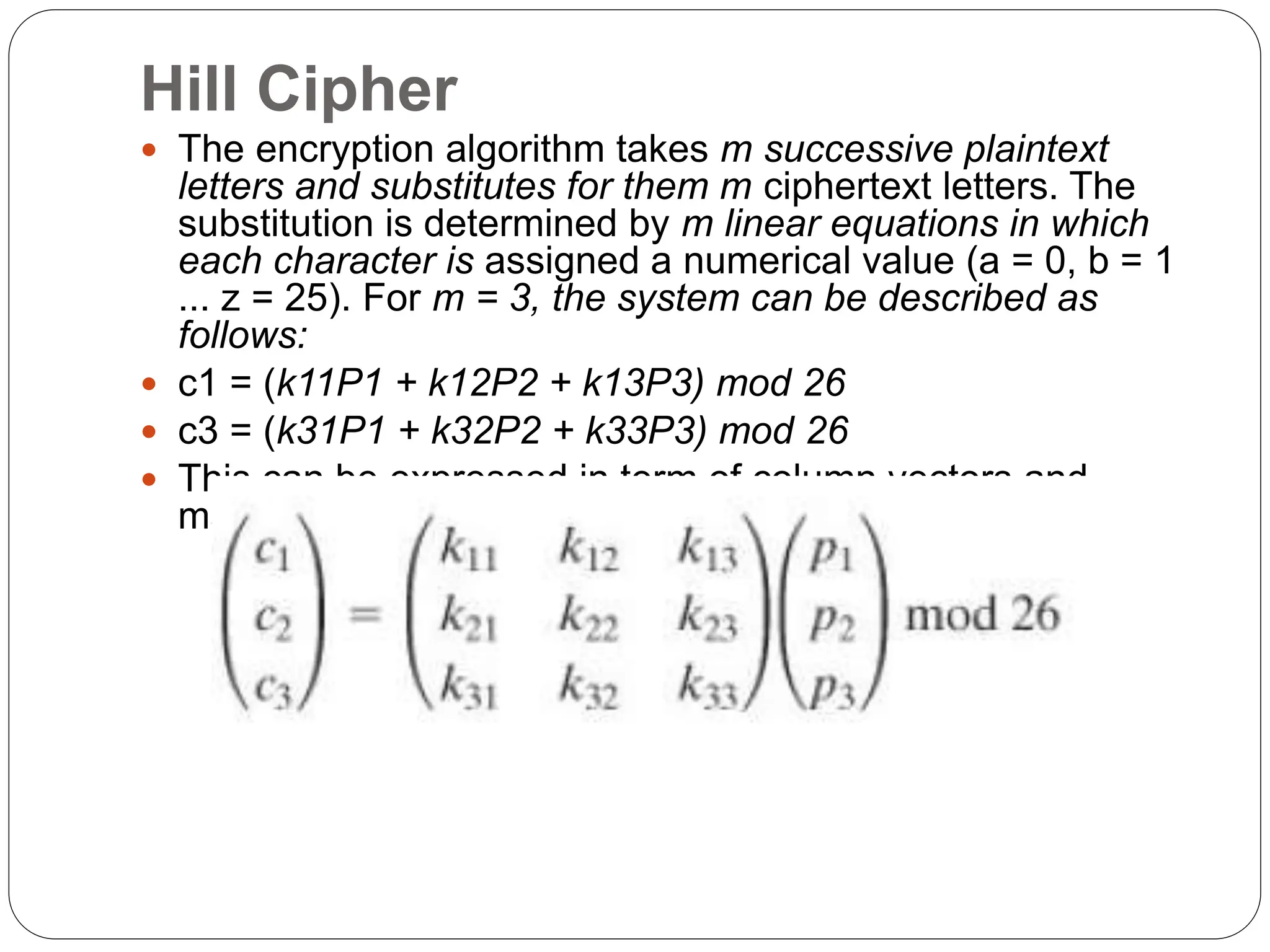
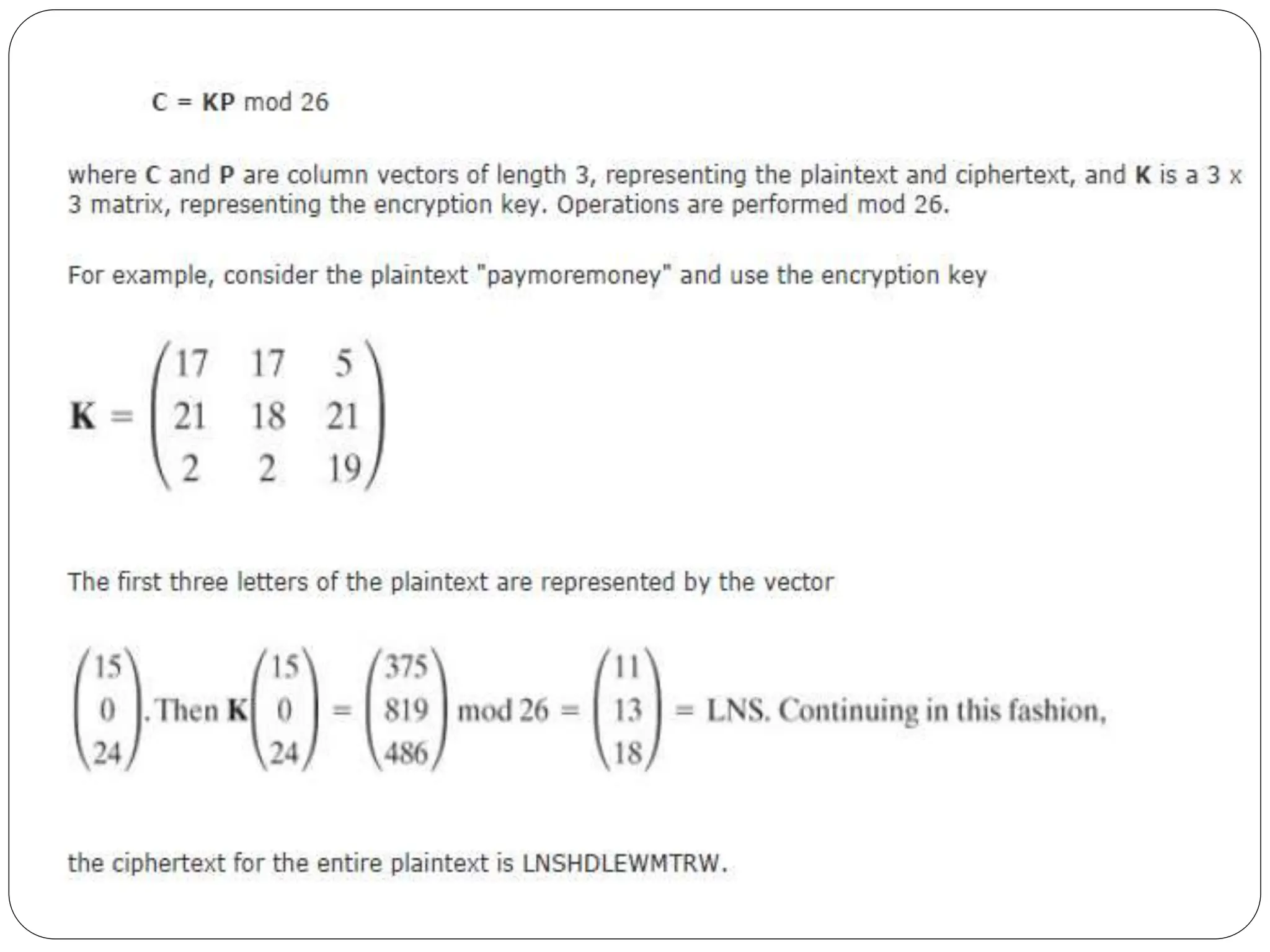
Hill Cipher
 The encryption algorithm takes m successive plaintext
letters and substitutes for them m ciphertext letters. The
substitution is determined by m linear equations in which
each character is assigned a numerical value (a = 0, b = 1
... z = 25). For m = 3, the system can be described as
follows:
 c1 = (k11P1 + k12P2 + k13P3) mod 26
 c3 = (k31P1 + k32P2 + k33P3) mod 26
 This can be expressed in term of column vectors and
matrices:
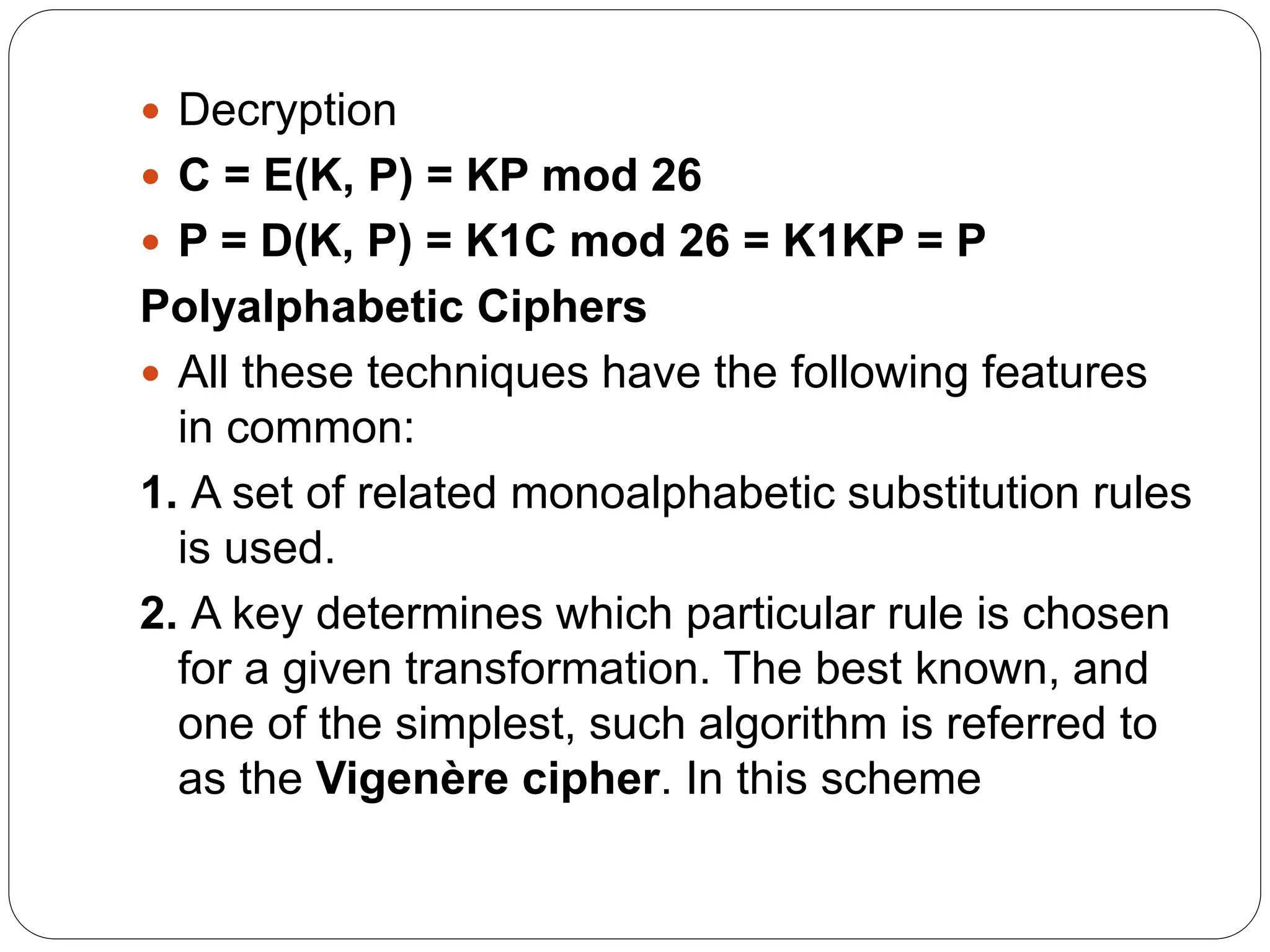
 Decryption
 C = E(K, P) = KP mod 26
 P = D(K, P) = K1C mod 26 = K1KP = P
Polyalphabetic Ciphers
 All these techniques have the following features
in common:
1. A set of related monoalphabetic substitution rules
is used.
2. A key determines which particular rule is chosen
for a given transformation. The best known, and
one of the simplest, such algorithm is referred to
as the Vigenère cipher. In this scheme
 This scheme of cipher uses a text string (say, a
word) as a key, which is then used for doing a
number of shifts on the plaintext.
 For example, let’s assume the key is ‘point’. Each
alphabet of the key is converted to its respective
numeric value: In this case,
p → 16, o → 15, i → 9, n → 14, and t
→ 20.
Thus, the key is: 16 15 9 14 20.
 The sender and the receiver decide on a key. Say
‘point’ is the key. Numeric representation of this
key is ‘16 15 9 14 20’.
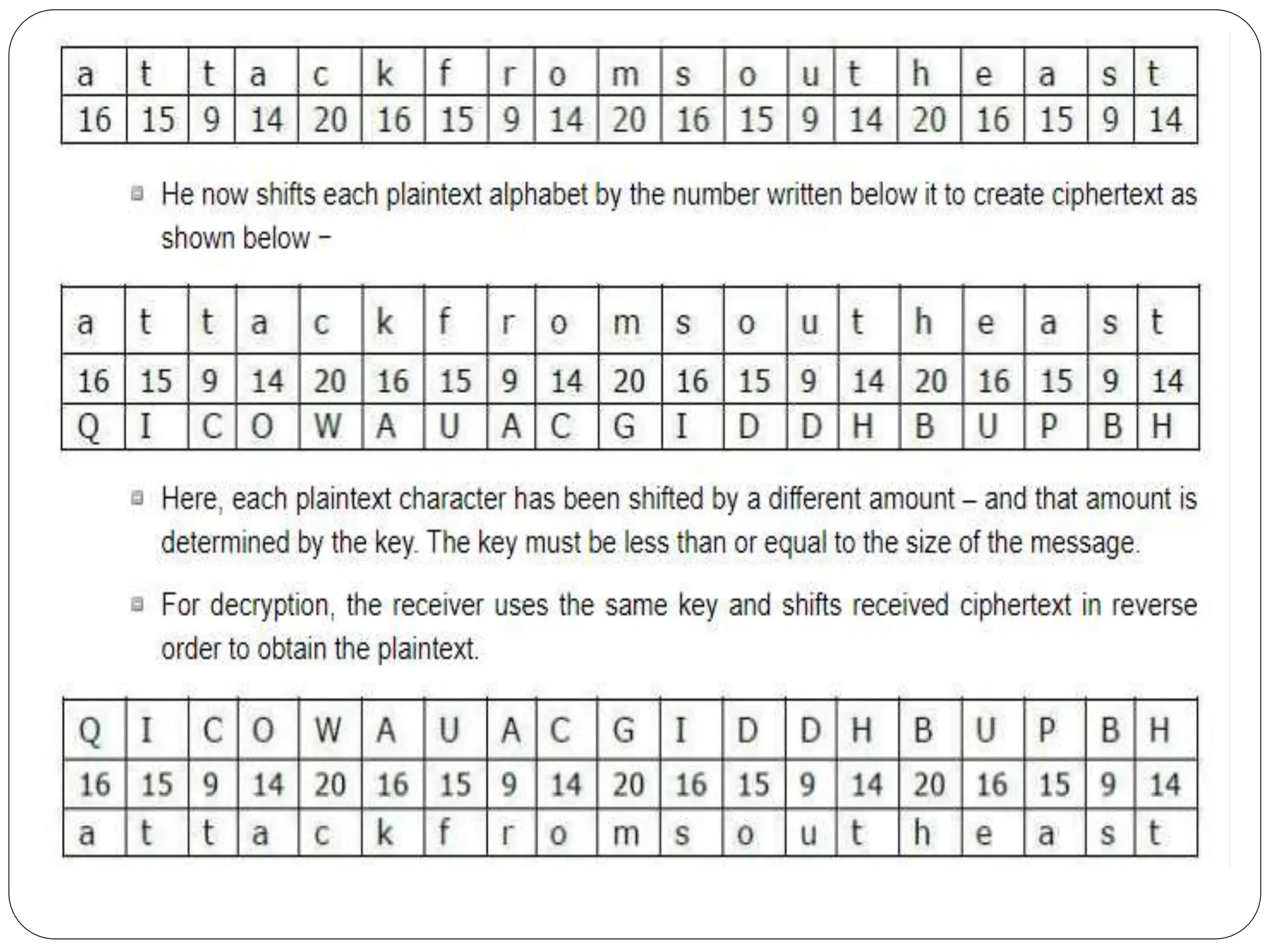
 The sender wants to encrypt the message, say
‘attack from south east’. He will arrange plaintext
and numeric key as follows −
One-Time Pad
 The circumstances are − The length of the keyword is same
as the length of the plaintext.
 The keyword is a randomly generated string of alphabets. The
keyword is used only once.
 Security Value
 Let us compare Shift cipher with one-time pad.
 Shift Cipher − Easy to Break
 In case of Shift cipher, the entire message could have had a shift
between 1 and 25. This is a very small size, and very easy to
brute force. However, with each character now having its own
individual shift between 1 and 26, the possible keys grow
exponentially for the message.
 One-time Pad − Impossible to Break
 Let us say, we encrypt the name “point” with a one-time pad. It is
a 5 letter text. To break the ciphertext by brute force, you need to
try all possibilities of keys and conduct computation for (26 x 26 x
26 x 26 x 26) = 265 = 11881376 times. That’s for a message with
5 alphabets. Thus, for a longer message, the computation grows
exponentially with every additional alphabet. This makes it
computationally impossible to break the ciphertext by brute force.
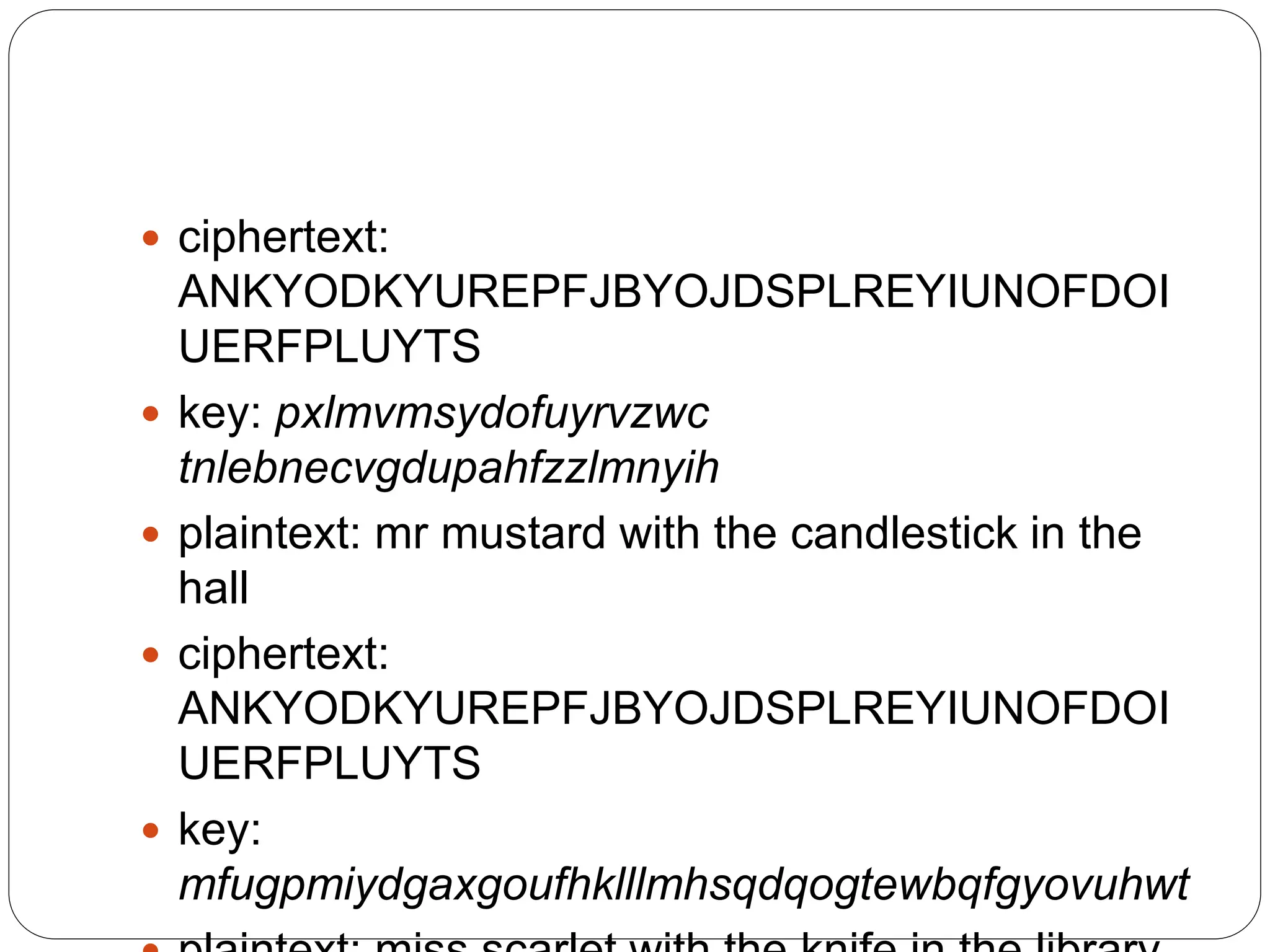
 ciphertext:
ANKYODKYUREPFJBYOJDSPLREYIUNOFDOI
UERFPLUYTS
 key: pxlmvmsydofuyrvzwc
tnlebnecvgdupahfzzlmnyih
 plaintext: mr mustard with the candlestick in the
hall
 ciphertext:
ANKYODKYUREPFJBYOJDSPLREYIUNOFDOI
UERFPLUYTS
 key:
mfugpmiydgaxgoufhklllmhsqdqogtewbqfgyovuhwt
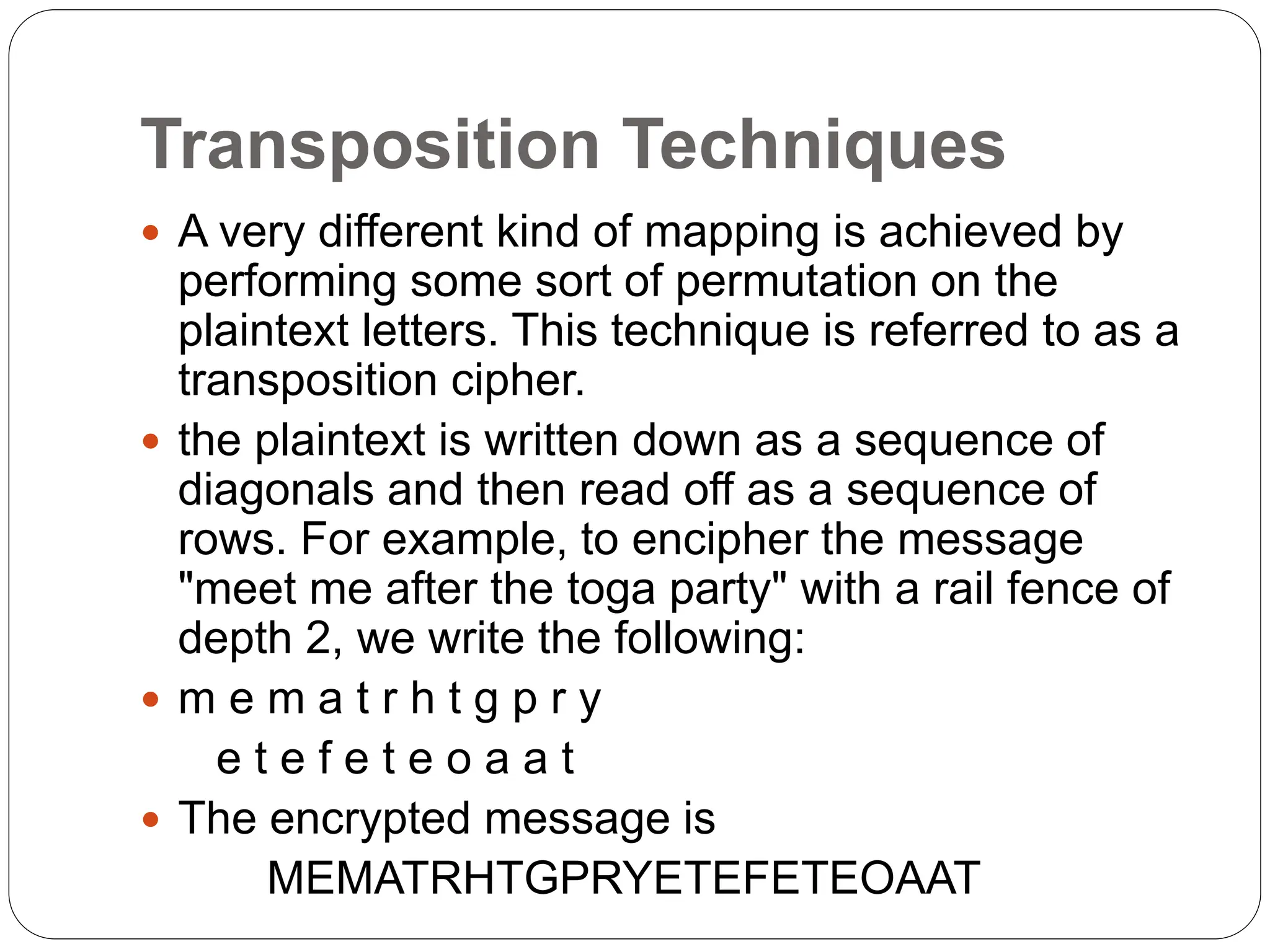
Transposition Techniques
 A very different kind of mapping is achieved by
performing some sort of permutation on the
plaintext letters. This technique is referred to as a
transposition cipher.
 the plaintext is written down as a sequence of
diagonals and then read off as a sequence of
rows. For example, to encipher the message
"meet me after the toga party" with a rail fence of
depth 2, we write the following:
 m e m a t r h t g p r y
e t e f e t e o a a t
 The encrypted message is
MEMATRHTGPRYETEFETEOAAT
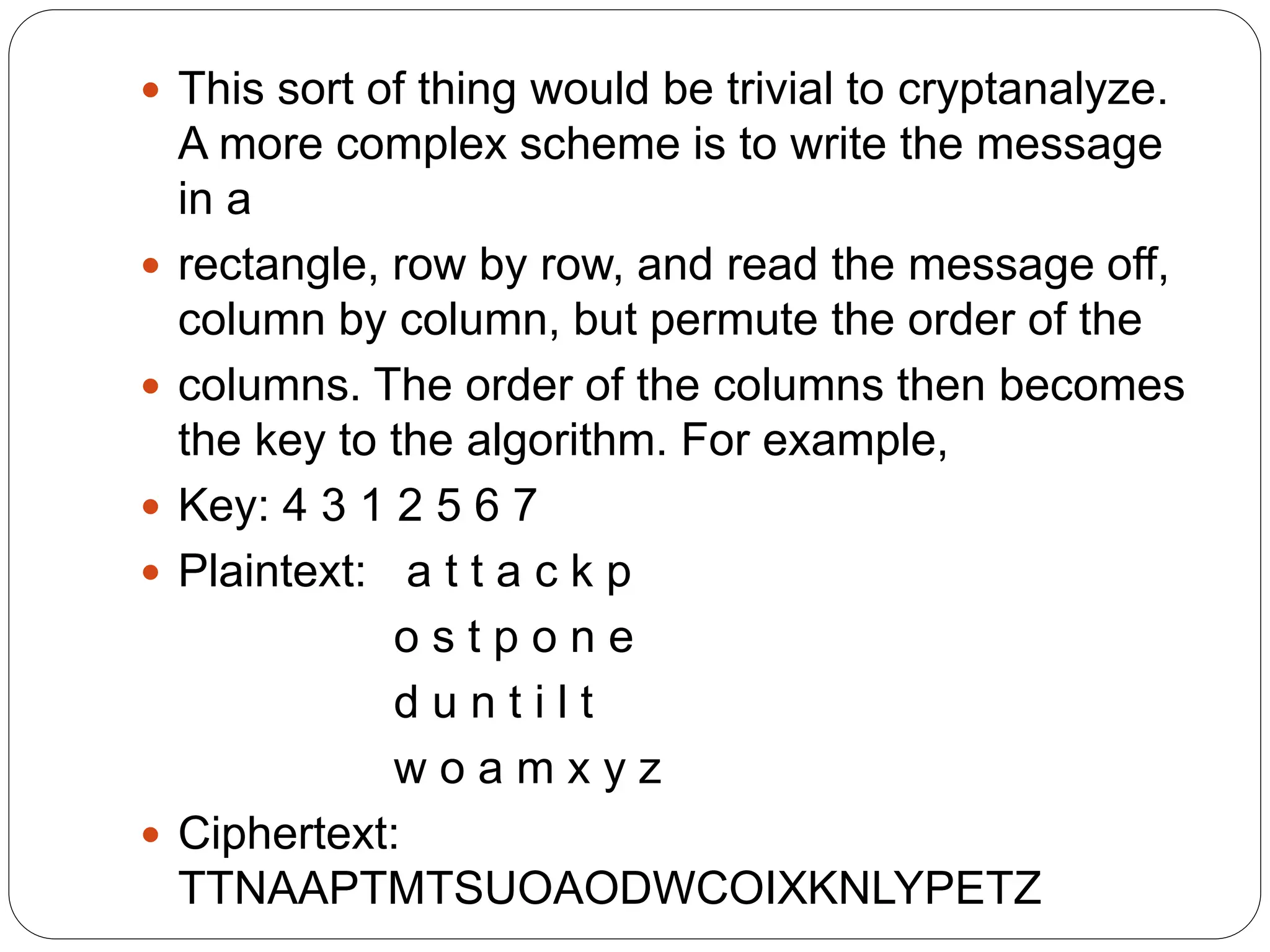
 This sort of thing would be trivial to cryptanalyze.
A more complex scheme is to write the message
in a
 rectangle, row by row, and read the message off,
column by column, but permute the order of the
 columns. The order of the columns then becomes
the key to the algorithm. For example,
 Key: 4 3 1 2 5 6 7
 Plaintext: a t t a c k p
o s t p o n e
d u n t i l t
w o a m x y z
 Ciphertext:
TTNAAPTMTSUOAODWCOIXKNLYPETZ
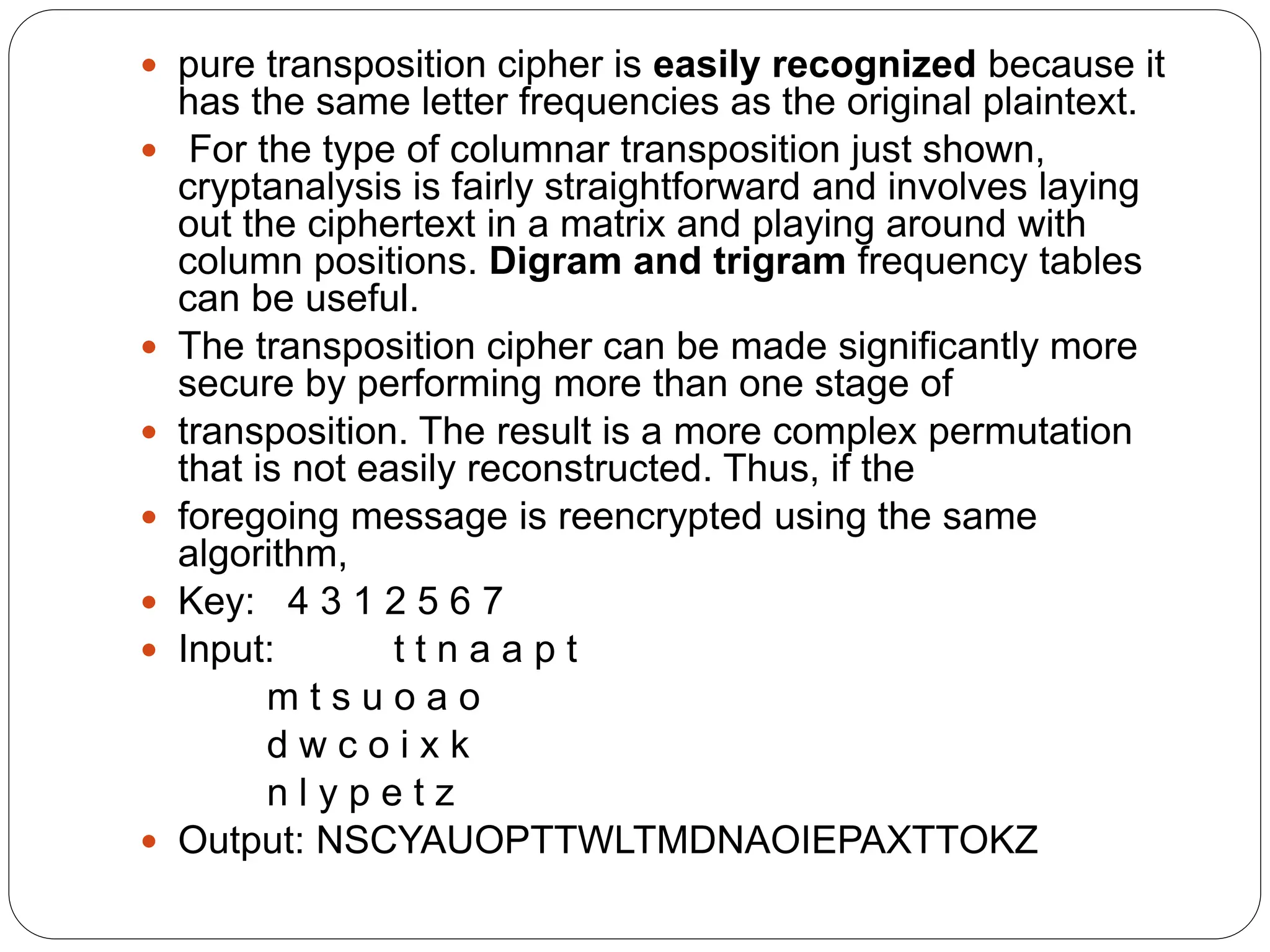
 pure transposition cipher is easily recognized because it
has the same letter frequencies as the original plaintext.
 For the type of columnar transposition just shown,
cryptanalysis is fairly straightforward and involves laying
out the ciphertext in a matrix and playing around with
column positions. Digram and trigram frequency tables
can be useful.
 The transposition cipher can be made significantly more
secure by performing more than one stage of
 transposition. The result is a more complex permutation
that is not easily reconstructed. Thus, if the
 foregoing message is reencrypted using the same
algorithm,
 Key: 4 3 1 2 5 6 7
 Input: t t n a a p t
m t s u o a o
d w c o i x k
n l y p e t z
 Output: NSCYAUOPTTWLTMDNAOIEPAXTTOKZ
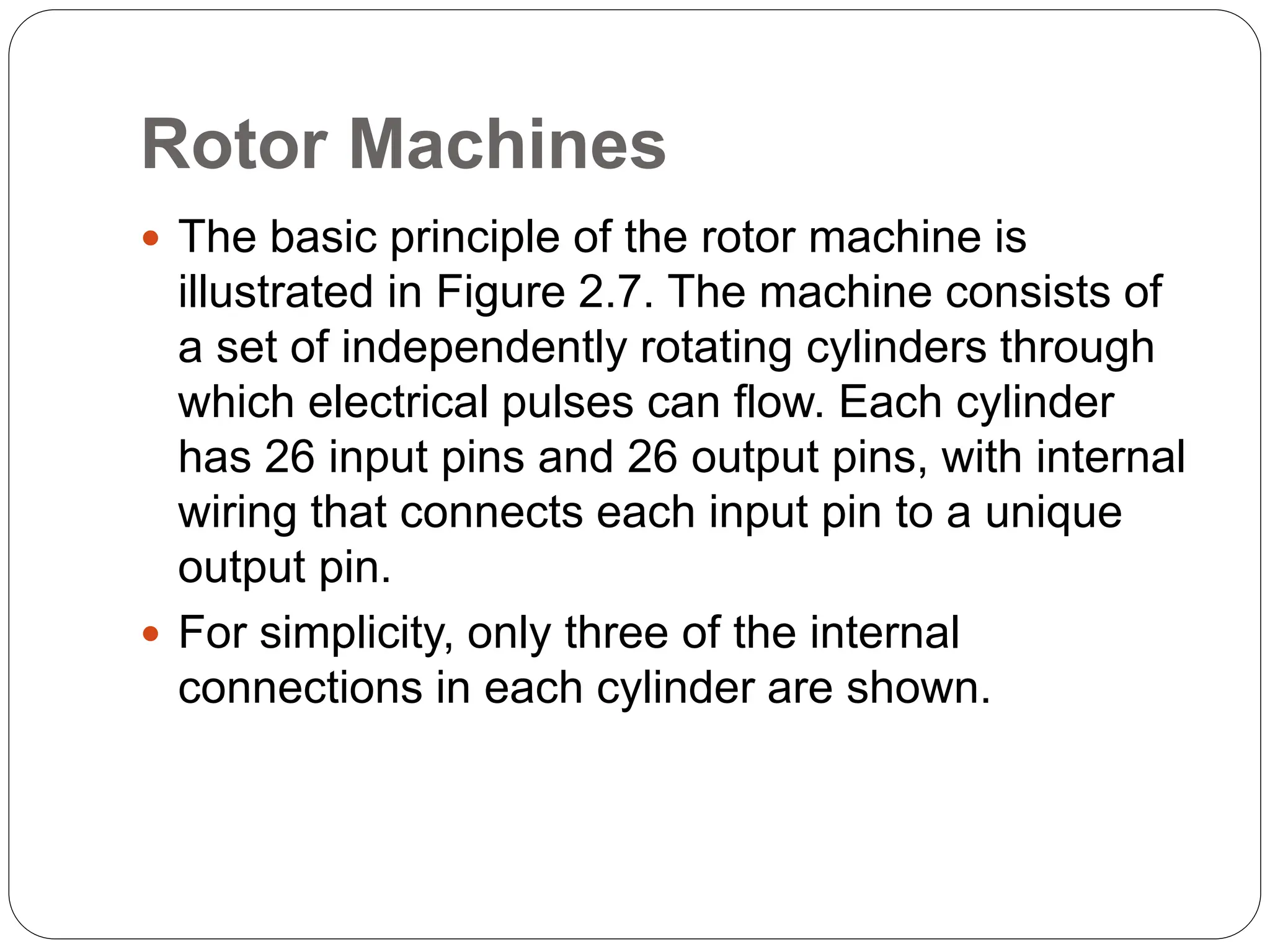
Rotor Machines
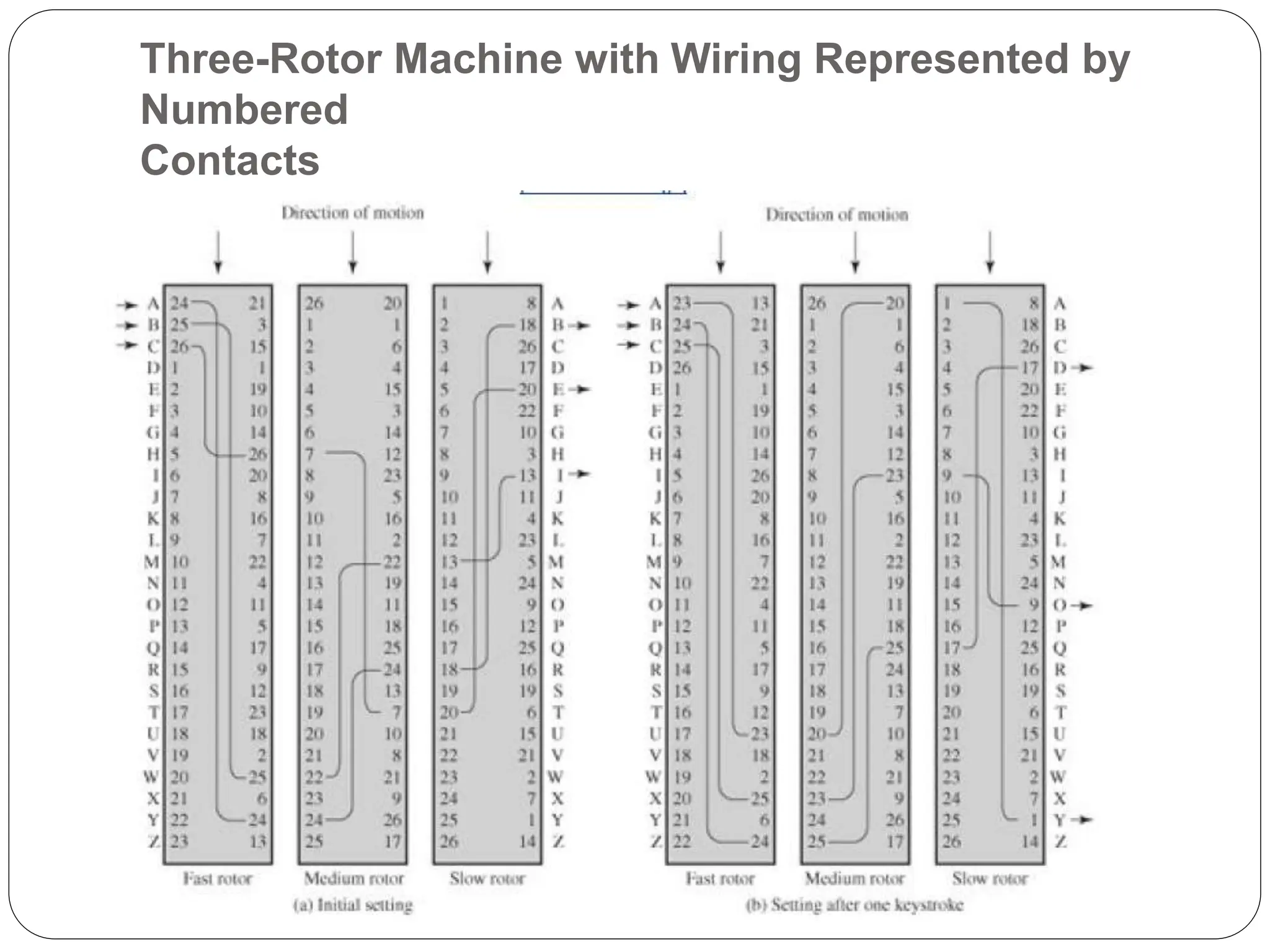
 The basic principle of the rotor machine is
illustrated in Figure 2.7. The machine consists of
a set of independently rotating cylinders through
which electrical pulses can flow. Each cylinder
has 26 input pins and 26 output pins, with internal
wiring that connects each input pin to a unique
output pin.
 For simplicity, only three of the internal
connections in each cylinder are shown.
Three-Rotor Machine with Wiring Represented by
Numbered
Contacts
 If we associate each input and output pin with a
letter of the alphabet, then a single cylinder
defines a monoalphabetic substitution.
 if an operator depresses the key for the letter A,
an electric signal is applied to the first pin of the
first cylinder and flows through the internal
connection to the twenty-fifth output pin.
 the cylinder rotates one position, so that the
internal connections are shifted accordingly.
Thus, a different monoalphabetic substitution
cipher is defined. After 26 letters of plaintext, the
cylinder would be back to the initial position.
Steganography
 A plaintext message may be hidden in one of two
ways. The methods of steganography conceal the
existence of the message, whereas the methods
of cryptography render the message unintelligible
to outsiders by various transformations of the
text.
 A simple form of steganography, but one that is
time-consuming to construct, is one in which an
arrangement of words or letters within an
apparently innocuous text spells out the real
message.
 For example, the sequence of first letters of each
word of the overall message spells out the hidden
Message
A Puzzle for Inspector Morse
 Character marking: Selected letters of printed or
typewritten text are overwritten in pencil. The marks
are ordinarily not visible unless the paper is held at an
angle to bright light.
 ● Invisible ink: A number of substances can be used
for writing but leave no visible trace until heat or some
chemical is applied to the paper
 Pin punctures: Small pin punctures on selected
letters are ordinarily not visible unless the paper is
held up in front of a light.
 ● Typewriter correction ribbon: Used between lines
typed with a black ribbon, the results of typing with the
correction tape are visible only under a strong light.
 Steganography has a number of drawbacks when
compared to encryption. It requires a lot of
overhead to hide a relatively few bits of
information, although using some scheme like
that proposed in the preceding paragraph may
make it more effective.
 Also, once the system is discovered, it becomes
virtually worthless.
Modern encryption Techniques
 Modern encryption is the key to advanced computer and
communication security. This stream of cryptography is
completely based on the ideas of mathematics such as
number theory and computational complexity theory as
well as concepts of probability.
 Types
 It gave rise to two new ways of encryption mechanism for
data security. These are:
 Symmetric key encryption
 Asymmetric key encryption
 Key: It can be a number, word, phrase, or any code that
will be used for encrypting as well as decrypting any
ciphertext information to plain text and vice versa.
 Symmetric and asymmetric key cryptography is based on
the number of keys and the way these keys work. Let us
know about both of them in details:
Symmetric key encryption
 Symmetric key encryption technique uses a straight forward
method of encryption.
 Hence, this is the simpler among these two practices. In the case
of symmetric key encryption, the encryption is done through only
one secret key which is known as "Symmetric Key" and this key
remains to both the parties.
 The same key is implemented for both encodings as well as
decoding the information. So the key is used first by the sender
prior to sending the message and on the receiver side, that key
is used to decipher the encoded message.
 One of the good old examples of this encryption technique is
Caesar's Cipher. Modern examples and algorithms that use the
concept of symmetric key encryption are
 RC4,
 QUAD,
 AES,
 DES,
 Blowfish,
 3DES, etc.
Asymmetric Encryption
 Asymmetric Encryption is another encryption method that
uses two keys, which is a new and sophisticated
encryption technique.
 This is because it integrates two cryptographic keys for
implementing data security.
 These keys are termed as Public Key and Private Key. The
"public key", as the name implies, is accessible to all who
wants to send an encrypted message.
 The other is the "private key" that is kept secure by the
owner of that public key or the one who is encrypting.
 Encryption of information is done through public key first,
with the help of a particular algorithm and then the private
key, which the receiver possesses, will use to decrypt that
encrypted information.
 The same algorithm will be used in both encodings as well
as decoding. Examples of asymmetric key encryption
algorithms are
 Diffie-Hellman and RSA algorithm.
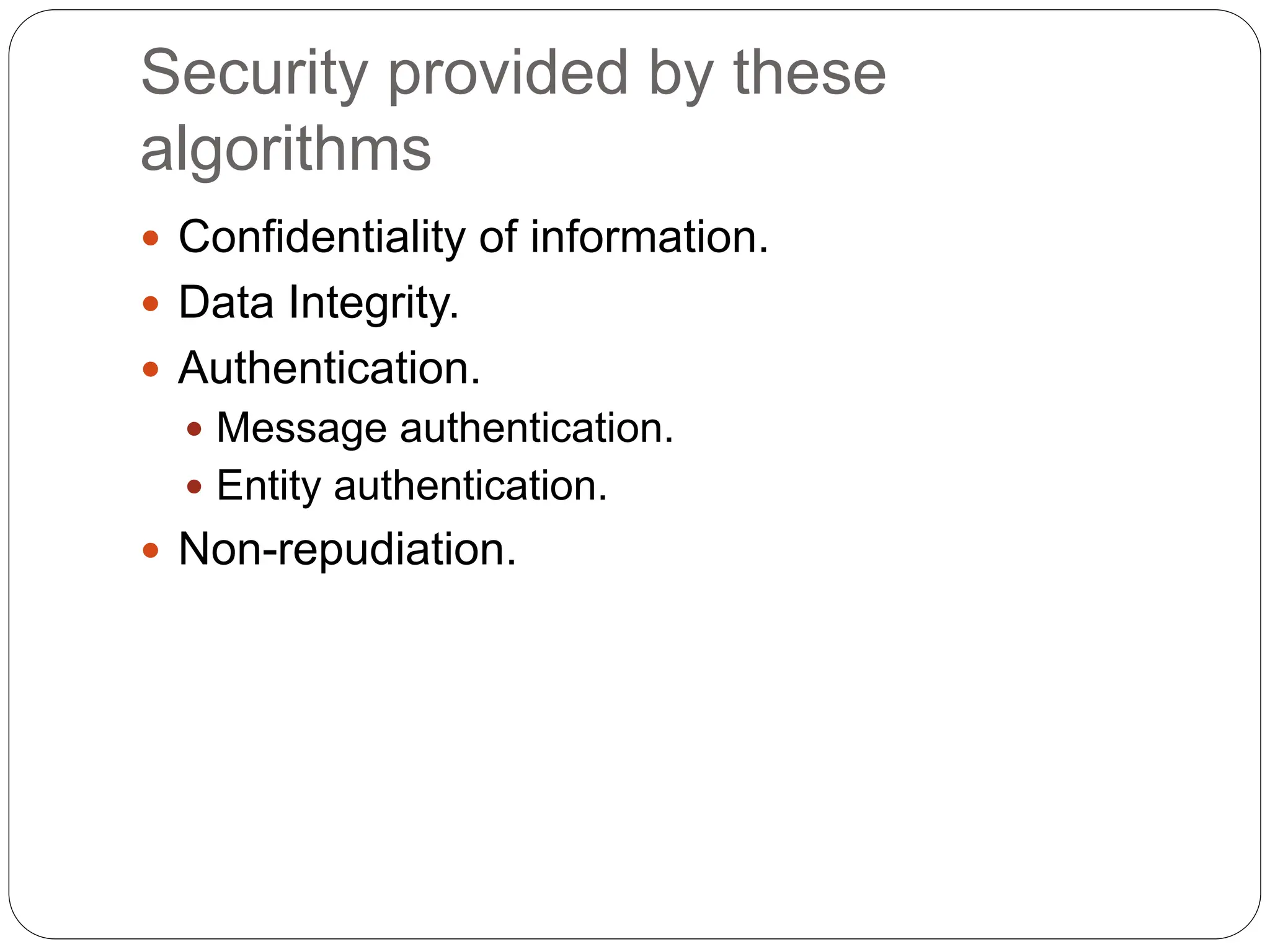
Security provided by these
algorithms
 Confidentiality of information.
 Data Integrity.
 Authentication.
 Message authentication.
 Entity authentication.
 Non-repudiation.
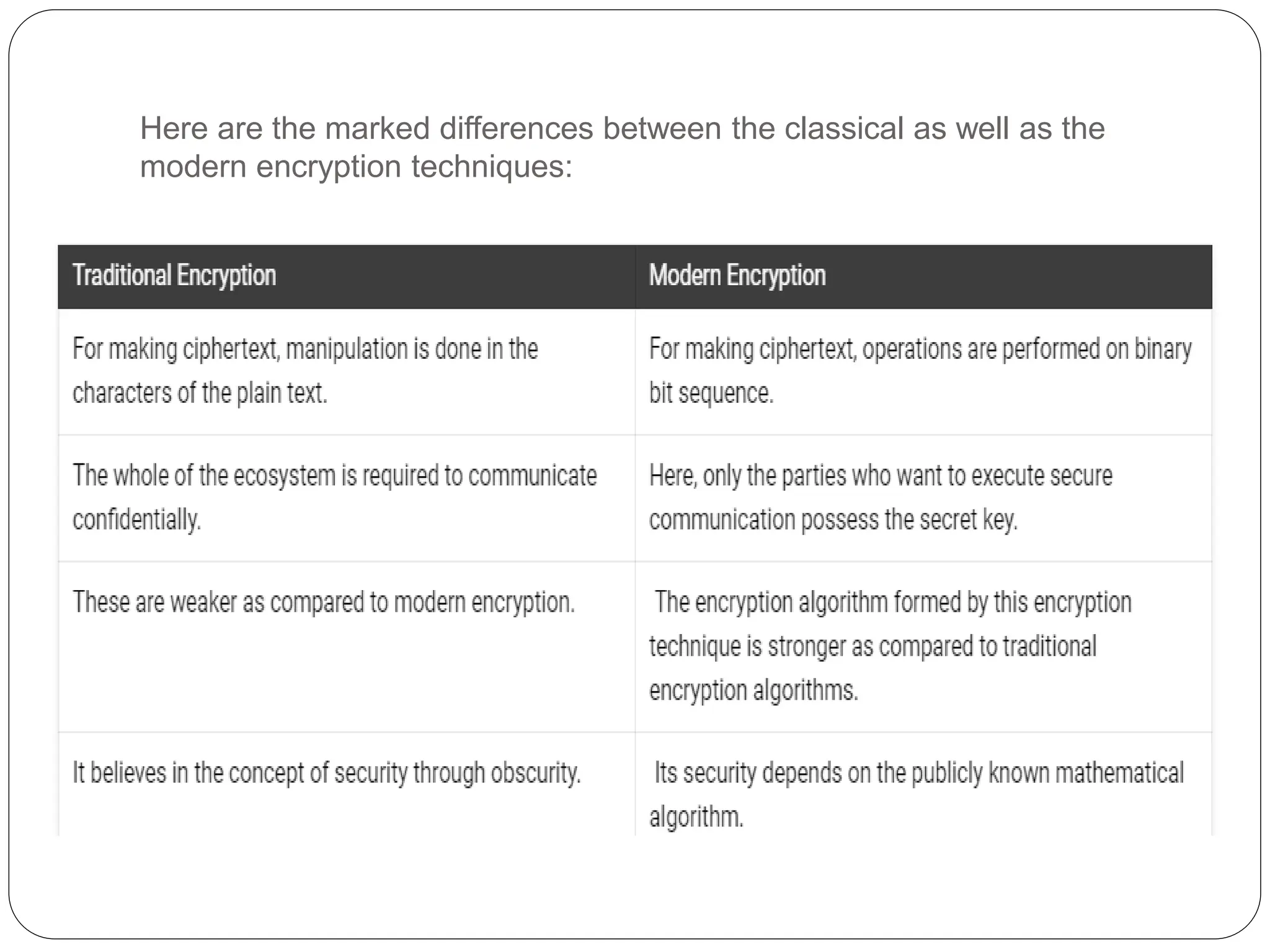
Here are the marked differences between the classical as well as the
modern encryption techniques:
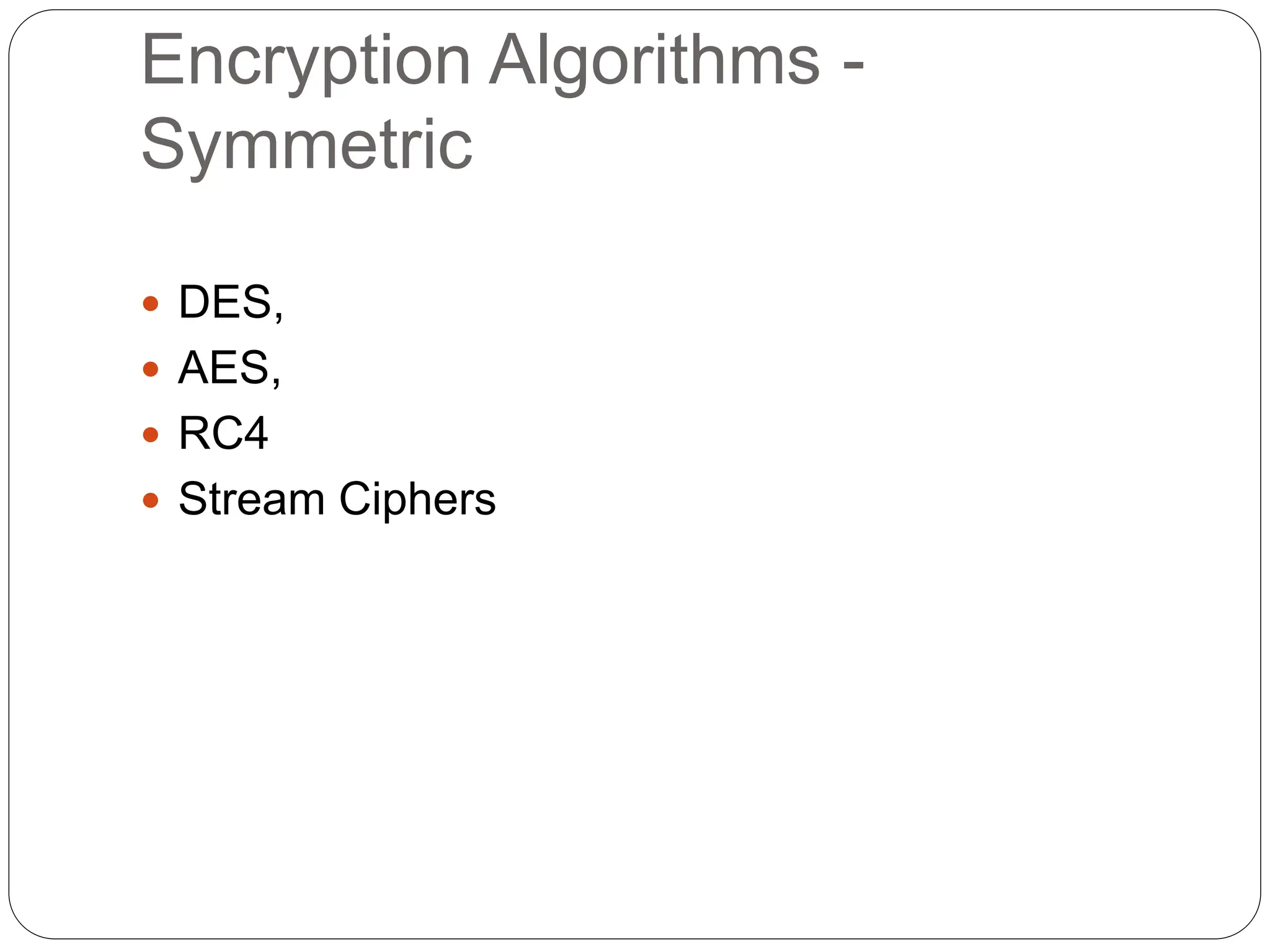
Encryption Algorithms -
Symmetric
 DES,
 AES,
 RC4
 Stream Ciphers
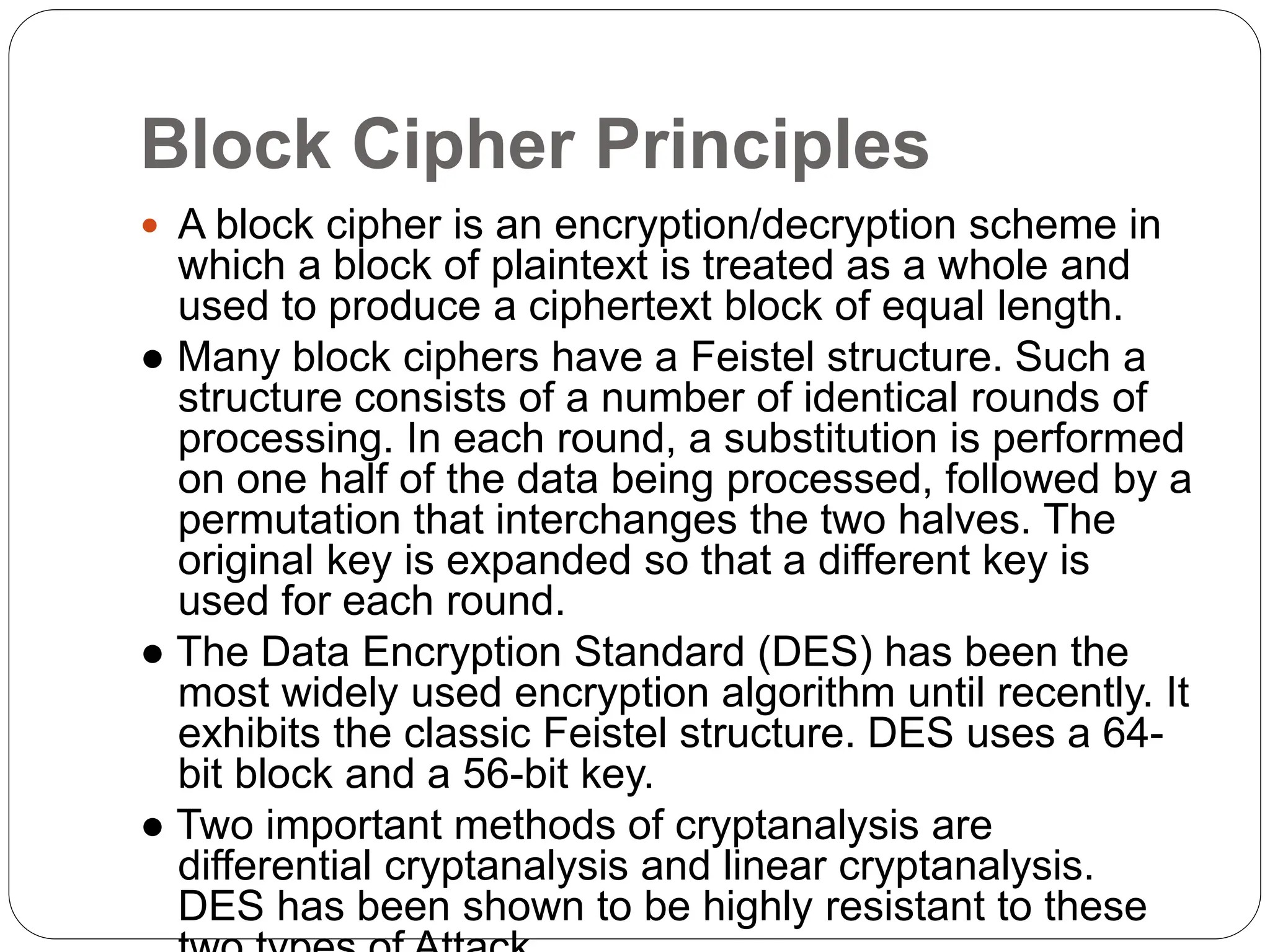
Block Cipher Principles
 A block cipher is an encryption/decryption scheme in
which a block of plaintext is treated as a whole and
used to produce a ciphertext block of equal length.
● Many block ciphers have a Feistel structure. Such a
structure consists of a number of identical rounds of
processing. In each round, a substitution is performed
on one half of the data being processed, followed by a
permutation that interchanges the two halves. The
original key is expanded so that a different key is
used for each round.
● The Data Encryption Standard (DES) has been the
most widely used encryption algorithm until recently. It
exhibits the classic Feistel structure. DES uses a 64-
bit block and a 56-bit key.
● Two important methods of cryptanalysis are
differential cryptanalysis and linear cryptanalysis.
DES has been shown to be highly resistant to these
Stream Ciphers and Block
Ciphers
 A stream cipher is one that encrypts a digital
data stream one bit or one byte at a time.
Examples of classical stream ciphers are the
autokeyed Vigenère cipher and the Vernam
cipher.
 A block cipher is one in which a block of
plaintext is treated as a whole and used to
produce a ciphertext block of equal length.
Typically, a block size of 64 or 128 bits is used.
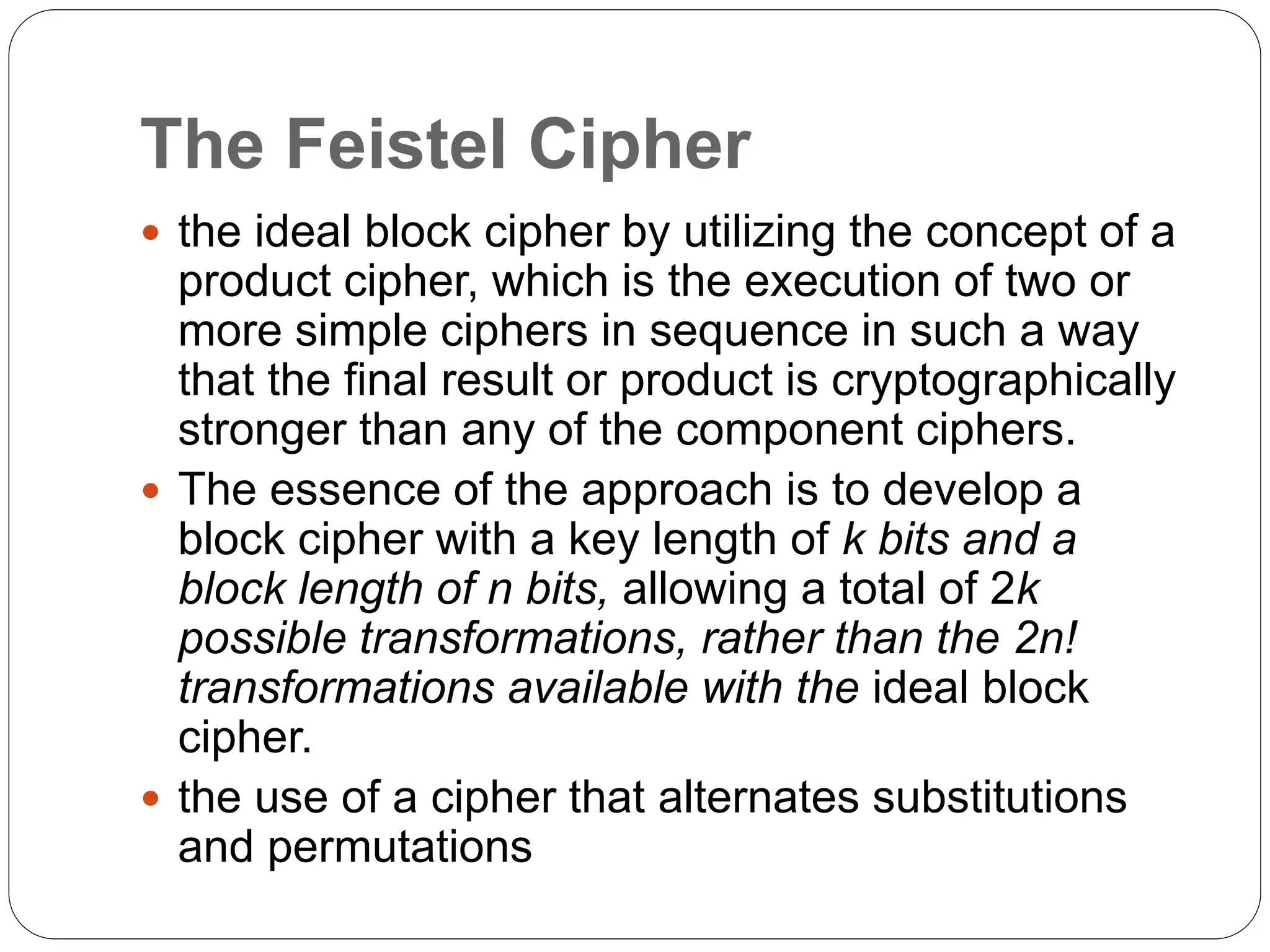
The Feistel Cipher
 the ideal block cipher by utilizing the concept of a
product cipher, which is the execution of two or
more simple ciphers in sequence in such a way
that the final result or product is cryptographically
stronger than any of the component ciphers.
 The essence of the approach is to develop a
block cipher with a key length of k bits and a
block length of n bits, allowing a total of 2k
possible transformations, rather than the 2n!
transformations available with the ideal block
cipher.
 the use of a cipher that alternates substitutions
and permutations
Feistel Cipher Structure
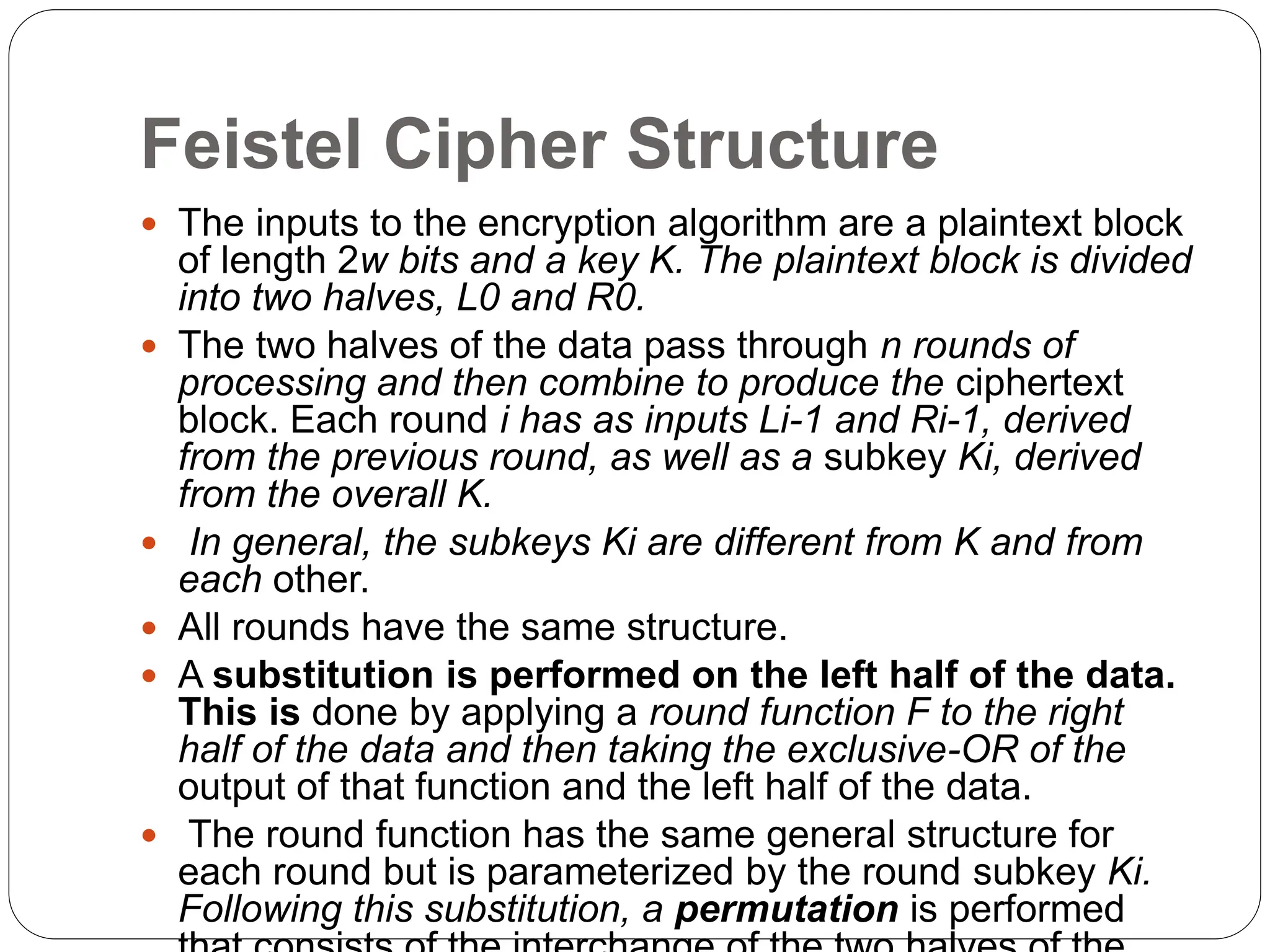
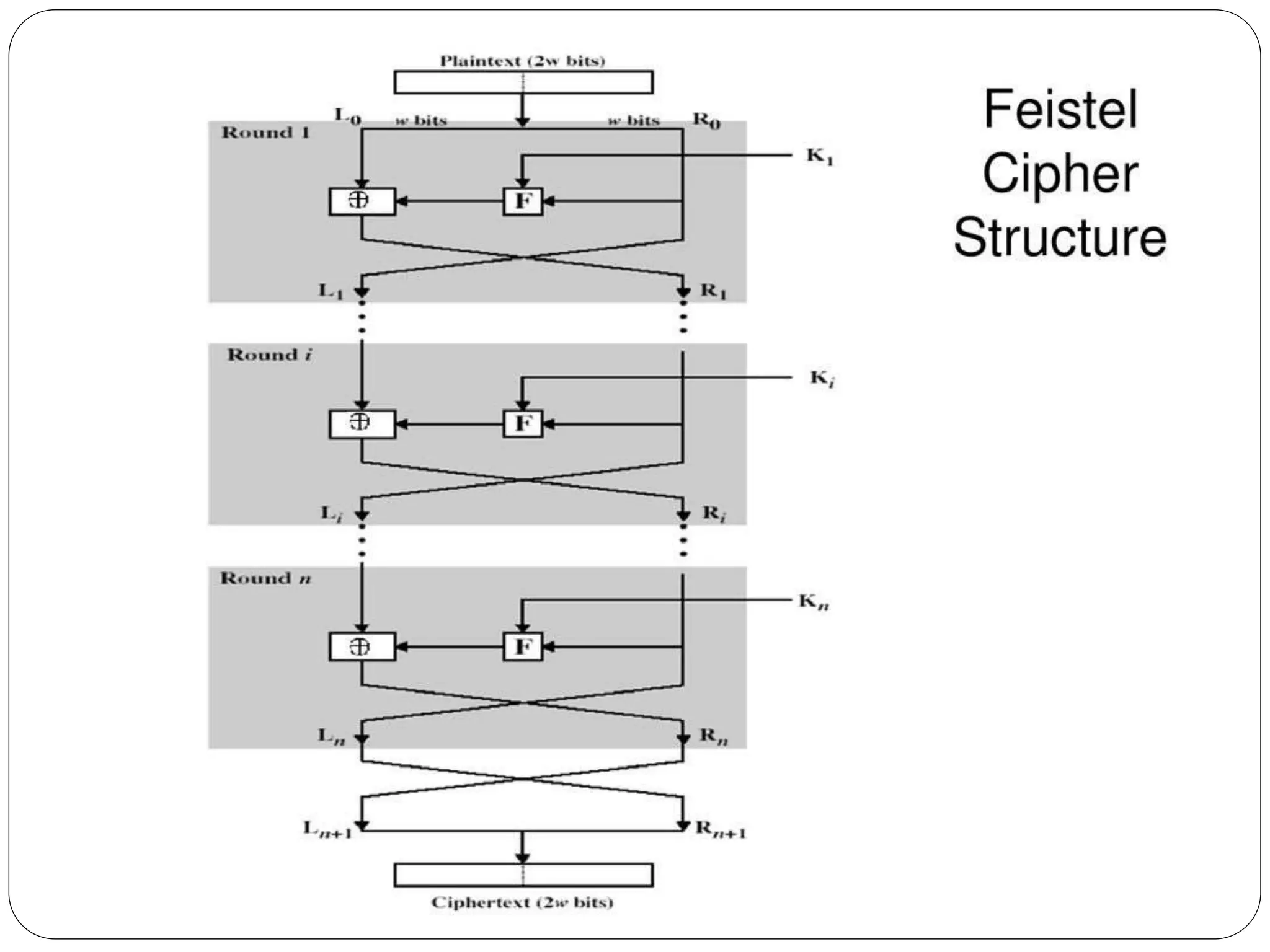
 The inputs to the encryption algorithm are a plaintext block
of length 2w bits and a key K. The plaintext block is divided
into two halves, L0 and R0.
 The two halves of the data pass through n rounds of
processing and then combine to produce the ciphertext
block. Each round i has as inputs Li-1 and Ri-1, derived
from the previous round, as well as a subkey Ki, derived
from the overall K.
 In general, the subkeys Ki are different from K and from
each other.
 All rounds have the same structure.
 A substitution is performed on the left half of the data.
This is done by applying a round function F to the right
half of the data and then taking the exclusive-OR of the
output of that function and the left half of the data.
 The round function has the same general structure for
each round but is parameterized by the round subkey Ki.
Following this substitution, a permutation is performed
 The exact realization of a Feistel network depends on the
choice of the following parameters and design features:
● Block size: Larger block sizes mean greater security (all
other things being equal) but reduced
encryption/decryption speed for a given algorithm, a block
size of 64 bits has been considered a reasonable tradeoff
and was nearly universal in block cipher design. However,
the new AES uses a 128-bit block size.
 Key size: Larger key size means greater security but may
decrease encryption/decryption speed.
 The greater security is achieved by greater resistance to
brute-force attacks and greater confusion. Key sizes of 64
bits or less are now widely considered to be inadequate,
and 128 bitshas become a common size.
● Number of rounds: The essence of the Feistel cipher is
that a single round offers inadequate security but that
multiple rounds offer increasing security.
 A typical size is 16 rounds.
● Subkey generation algorithm: Greater complexity in this

Network security introduction part .pptx

  • 1.
  • 2.
    Introduction Threat  A potentialfor violation of security, which exists when there is a circumstance, capability, action, or event that could break security and cause damage.  That is, a threat is a possible danger that might take advantage of a vulnerability. Attack An attack on system security that derives from an intelligent threat; that is, an intelligent act that is a purposeful attempt (especially in the sense of a method or technique) to avoid security services and violate the security policy of a system.
  • 3.
    Security Attacks  Passiveattacks  Active attacks Passive attacks  A passive attack attempts to learn or make use of information from the system but does not affect system resources.  The goal of the opponent is to obtain information that is being transmitted. Two types of passive attacks are release of message contents and traffic analysis.  The release of message contents is easily understood
  • 5.
     A telephoneconversation, an electronic mail message, and a transferred file may contain sensitive or confidential information.  We would like to prevent an opponent from learning the contents of these transmissions.  A second type of passive attack, traffic analysis, (Figure 1.3b). Suppose that we had a way of masking the contents of messages or other information traffic so that opponents, even if they captured the message, could not extract the information from the message.  The common technique for masking - encryption. If we had encryption protection in place, an opponent might still be able to observe the pattern of these messages.  The opponent could determine the location and identity of communicating hosts and could observe the frequency and length of messages being exchanged
  • 6.
     This informationmight be useful in guessing the nature of the communication that was taking place.  Passive attacks are very difficult to detect because they do not involve any alteration of the data. An active attack attempts to alter system resources or affect their operation  Active attacks involve some modification of the data stream or the creation of a false stream and can be subdivided into four categories:  masquerade,  replay,  modification of messages,  and denial of service
  • 7.
     A masqueradetakes place when one entity pretends to be a different entity (Figure 1.4a).  A masquerade attack usually includes one of the other forms of active attack.
  • 8.
     Replay involvesthe passive capture of a data unit and its subsequent retransmission to produce an unauthorized effect
  • 9.
     Modification ofmessages simply means that some portion of a legitimate message is altered, or that messages are delayed or reordered, to produce an unauthorized effect  For example, a message meaning "Allow John Smith to read confidential file accounts" is modified to mean "Allow Fred Brown to read confidential file accounts."
  • 10.
     The denialof service prevents or inhibits the normal use or management of communications facilities  This attack may have a specific target; for example, an entity may suppress all messages directed to a particular destination (e.g., the security audit service).  Another form of service denial is the disruption of an entire network, either by disabling the network or by overloading it with messages so as to degrade performance.
  • 12.
    Security Services  Ensuresadequate security of the systems or of data transfers.  A processing or communication service that is provided by a system to give a specific kind of protection to system resources;  Security services implement security policies and are implemented by security mechanisms  X.800 divides these services into five categories and fourteen specific services (Table 1.2).
  • 13.
    Table 1.2. SecurityServices (X.800) AUTHENTICATION  The assurance that the communicating entity is the one that it claims to be. Peer Entity Authentication  Used in association with a logical connection to provide confidence in the identity of the entities connected. Data Origin Authentication  In a connectionless transfer, provides assurance that the source of received data is as claimed. ACCESS CONTROL  The prevention of unauthorized use of a resource (i.e., this service controls who can have access to a resource, under what conditions access can occur, and what those accessing the resource are allowed to do). DATA CONFIDENTIALITY  The protection of data from unauthorized disclosure.
  • 14.
    Connection Confidentiality  Theprotection of all user data on a connection. Connectionless Confidentiality  The protection of all user data in a single data block Selective-Field Confidentiality  The confidentiality of selected fields within the user data on a connection or in a single data block. Traffic Flow Confidentiality  The protection of the information that might be derived from observation of traffic flows. DATA INTEGRITY  The assurance that data received are exactly as sent by an authorized entity (i.e.,contain no modification, insertion, deletion, or replay). Connection Integrity with Recovery  Provides for the integrity of all user data on a connection and detects any modification, insertion, deletion, or replay of any data within an entire data sequence, with recovery attempted.
  • 15.
    Connection Integrity withoutRecovery  As above, but provides only detection without recovery. Selective-Field Connection Integrity  Provides for the integrity of selected fields within the user data of a data block transferred over a connection and takes the form of determination of whether the selected fields have been modified,inserted, deleted, or replayed. Connectionless Integrity  Provides for the integrity of a single connectionless data block and may take the form of detection of data modification. Additionally, a limited form of replay detection may be provided. Selective-Field Connectionless Integrity  Provides for the integrity of selected fields within a single connectionless data block; takes the form of determination of whether the selected fields have been modified.
  • 16.
    Security Mechanisms  Table1.3 lists the security mechanisms defined in X.800. As can be seen the mechanisms are divided into those that are implemented in a specific protocol layer and those that are not specific to any particular protocol layer or security service.  X.800 distinguishes between reversible encipherment mechanisms and irreversible encipherment mechanisms. A reversible encipherment mechanism is simply an encryption algorithm that allows data to be encrypted and subsequently decrypted.   Irreversible encipherment mechanisms include hash algorithms and message authentication codes, which are used in digital signature and message authentication applications.
  • 17.
    Table 1.3. SecurityMechanisms (X.800) SPECIFIC SECURITY MECHANISMS  May be incorporated into the appropriate protocol layer in order to provide some of the OSI security services. Encipherment  The use of mathematical algorithms to transform data into a form that is not readily intelligible. The transformation and subsequent recovery of the data depend on an algorithm and zero or more encryption keys. Digital Signature  Data appended to, or a cryptographic transformation of, a data unit that allows a recipient of the data unit to prove the source and integrity of the data unit and protect against forgery (e.g., by the recipient). Access Control  A variety of mechanisms that enforce access rights to resources. Data Integrity  A variety of mechanisms used to assure the integrity of a data unit or stream of data units. Authentication Exchange  A mechanism intended to ensure the identity of an entity by means of information exchange. Traffic Padding  The insertion of bits into gaps in a data stream to frustrate traffic analysis attempts. Routing Control  Enables selection of particular physically secure routes for certain data and allows routing changes, especially when a breach of security is suspected Notarization  The use of a trusted third party to assure certain properties of a data exchange.
  • 18.
    PERVASIVE SECURITY MECHANISMS Mechanisms that are not specific to any particular OSI security service or protocol layer. Trusted Functionality  That which is perceived to be correct with respect to some criteria (e.g., as established by a security policy). Security Label  The marking bound to a resource (which may be a data unit) that names or designates the security attributes of that  resource. Event Detection  Detection of security-relevant events. Security Audit Trail  Data collected and potentially used to facilitate a security audit, which is an independent review and examination of system  records and activities. Security Recovery  Deals with requests from mechanisms, such as event handling and management functions, and takes recovery actions.
  • 19.
    Classical Encryption Techniques SymmetricCipher Model  Cryptography  Cryptanalysis Substitution Techniques  Caesar Cipher  Monoalphabetic Ciphers  Playfair Cipher  Hill Cipher  Polyalphabetic Ciphers  One-Time Pad Transposition Techniques Rotor Machines Steganography
  • 20.
    Classical Encryption Techniques SymmetricCipher Model  A symmetric encryption scheme has five ingredients (Figure 2.1): Plaintext: This is the original intelligible message or data that is fed into the algorithm as input. Encryption algorithm: The encryption algorithm performs various substitutions and transformations on the plaintext. Secret key: The secret key is also input to the encryption algorithm. The key is a value independent of the plaintext and of the algorithm. The algorithm will produce a different output depending on the specific key being used at the time. The exact substitutions and transformations performed by the algorithm depend on the key. ● Ciphertext: This is the scrambled message produced as output. It depends on the plaintext and the secret key. For a given message, two different keys will produce two different ciphertexts.  The ciphertext is an apparently random stream of data and, as it stands, is unintelligible. ● Decryption algorithm: This is essentially the encryption algorithm run in reverse. It takes the ciphertext and the secret key and produces the original
  • 22.
     There aretwo requirements for secure use of conventional encryption: 1.  We need a strong encryption algorithm. At a minimum, we would like the algorithm to be such that an opponent who knows the algorithm and has access to one or more ciphertexts would be unable to decipher the ciphertext or figure out the key.  This requirement is usually stated in a stronger form: The opponent should be unable to decrypt ciphertext or discover the key even if he or she is in possession of a number of ciphertexts together with the plaintext that produced each ciphertext.
  • 23.
  • 24.
     A sourceproduces a message in plaintext, X = [X1, X2, ..., XM]. The M elements of X are letters in some finite alphabet. Traditionally, the alphabet usually consisted of the 26 capital letters.  Nowadays, the binary alphabet {0, 1} is typically used. For encryption, a key of the form K = [K1, K2, ..., KJ] is generated. If the key is generated at the message source, then it must also be provided to the destination by means of some secure channel.  Alternatively, a third party could generate the key and securely deliver it to both source and destination.  With the message X and the encryption key K as input, the encryption algorithm forms the ciphertext Y = [Y1, Y2, ..., YN].  We can write this as Y = E(K, X)
  • 25.
     This notationindicates that Y is produced by using encryption algorithm E as a function of the plaintext X, with the specific function determined by the value of the key K.  The intended receiver, in possession of the key, is able to invert the transformation: X = D(K, Y)  An opponent, observing Y but not having access to K or X, may attempt to recover X or K or both X and K.
  • 26.
    Cryptography  Cryptographic systemsare characterized along three independent dimensions:  1. The type of operations used for transforming plaintext to ciphertext. All encryption algorithms are based on two general principles: substitution, in which each element in the plaintext (bit, letter, group of bits or letters) is mapped into another element, and transposition, in which elements in the plaintext are rearranged.  The fundamental requirement is that no information be lost (that is, that all operations are reversible).  2. The number of keys used. If both sender and receiver use the same key, the system is referred to as symmetric, single-key, secret-key, or conventional encryption. If the sender and receiver use different keys, the system is referred to as asymmetric, two-key, or public- key encryption.  3. The way in which the plaintext is processed. A block cipher processes the input one block of elements at a time, producing an output block for each input block.  A stream cipher processes the input elements continuously, producing output one element at a time, as it
  • 27.
    Cryptanalysis  the objectiveof attacking an encryption system is to recover the key in use rather then simply to recover the plaintext of a single ciphertext. There are two general approaches to attacking a conventional encryption scheme:  ● Cryptanalysis: Cryptanalytic attacks rely on the nature of the algorithm plus perhaps some knowledge of the general characteristics of the plaintext or even some sample plaintext ciphertext pairs. This type of attack exploits the characteristics of the algorithm to attempt to deduce a specific plaintext or to deduce the key being used.  Brute-force attack: The attacker tries every possible key on a piece of ciphertext until an intelligible translation into plaintext is obtained.
  • 28.
    Types of Attackson Encrypted Messages
  • 29.
    Average Time Requiredfor Exhaustive Key Search – brute force attack - trying every possible key until an intelligible translation of the ciphertext into plaintext is obtained
  • 30.
    Substitution Techniques  Asubstitution technique is one in which the letters of plaintext are replaced by other letters or by numbers or symbols Caesar Cipher  The earliest known use of a substitution cipher, and the simplest, was by Julius Caesar. The Caesar cipher involves replacing each letter of the alphabet with the letter standing three places further down the alphabet. For example, plain: meet me after the toga party cipher: PHHW PH DIWHU WKH WRJD SDUWB  Note that the alphabet is wrapped around, so that the letter following Z is A. We can define the transformation by listing all possibilities, as follows: plain: a b c d e f g h i j k l m n o p q r s t u v w x y z cipher: D E F G H I J K L M N O P Q R S T U V W X Y Z A B C  Let us assign a numerical equivalent to each letter: a b c d e f g h i j k l m 0 1 2 3 4 5 6 7 8 9 10 11 12
  • 31.
    n o pq r s t u v w x y z 13 14 15 16 17 18 19 20 21 22 23 24 25  Then the algorithm can be expressed as follows. For each plaintext letter p, substitute the ciphertext letter C: We define a mod n to be the remainder when a is divided by n. For example, 11 mod 7 = 4. See Chapter 4 for a further discussion of modular arithmetic. C = E(3, p) = (p + 3) mod 26 A shift may be of any amount, so that the general Caesar algorithm is C = E(k, p) = (p + k) mod 26  where k takes on a value in the range 1 to 25. The decryption algorithm is simply p = D(k, C) = (C k) mod 26  If it is known that a given ciphertext is a Caesar cipher, then a brute-force cryptanalysis is easily performed: Simply try all the 25 possible keys
  • 32.
    Monoalphabetic Ciphers  Monoalphabeticcipher is a substitution cipher in which for a given key, the cipher alphabet for each plain alphabet is fixed throughout the encryption process. For example, if ‘A’ is encrypted as ‘D’, for any number of occurrence in that plaintext, ‘A’ will always get encrypted to ‘D’.  All of the substitution ciphers we have discussed earlier in this chapter are monoalphabetic; these ciphers are highly susceptible to cryptanalysis.  Monoalphabetic ciphers are easy to break because they reflect the frequency data of the original alphabet. A ountermeasure is to provide multiple substitutes, known as homophones, for a single letter
  • 33.
    Playfair Cipher  Thebest-known multiple-letter encryption cipher is the Playfair, which treats digrams in the plaintext as single units and translates these units into ciphertext digrams  The Playfair algorithm is based on the use of a 5 x 5 matrix of letters constructed using a keyword. Here is an example, Monarchy
  • 34.
     The matrixis constructed by filling in the letters of the keyword (minus duplicates) from left to right and from top to bottom, and then filling in the remainder of the matrix with the remaining letters in alphabetic order.  The Playfair cipher is a great advance over simple monoalphabetic ciphers. For one thing, whereas there are only 26 letters, there are 26 x 26 = 676 digrams, so that identification of individual digrams is more difficult.
  • 35.
    Hill Cipher  Theencryption algorithm takes m successive plaintext letters and substitutes for them m ciphertext letters. The substitution is determined by m linear equations in which each character is assigned a numerical value (a = 0, b = 1 ... z = 25). For m = 3, the system can be described as follows:  c1 = (k11P1 + k12P2 + k13P3) mod 26  c3 = (k31P1 + k32P2 + k33P3) mod 26  This can be expressed in term of column vectors and matrices:
  • 37.
     Decryption  C= E(K, P) = KP mod 26  P = D(K, P) = K1C mod 26 = K1KP = P Polyalphabetic Ciphers  All these techniques have the following features in common: 1. A set of related monoalphabetic substitution rules is used. 2. A key determines which particular rule is chosen for a given transformation. The best known, and one of the simplest, such algorithm is referred to as the Vigenère cipher. In this scheme
  • 38.
     This schemeof cipher uses a text string (say, a word) as a key, which is then used for doing a number of shifts on the plaintext.  For example, let’s assume the key is ‘point’. Each alphabet of the key is converted to its respective numeric value: In this case, p → 16, o → 15, i → 9, n → 14, and t → 20. Thus, the key is: 16 15 9 14 20.  The sender and the receiver decide on a key. Say ‘point’ is the key. Numeric representation of this key is ‘16 15 9 14 20’.  The sender wants to encrypt the message, say ‘attack from south east’. He will arrange plaintext and numeric key as follows −
  • 40.
    One-Time Pad  Thecircumstances are − The length of the keyword is same as the length of the plaintext.  The keyword is a randomly generated string of alphabets. The keyword is used only once.  Security Value  Let us compare Shift cipher with one-time pad.  Shift Cipher − Easy to Break  In case of Shift cipher, the entire message could have had a shift between 1 and 25. This is a very small size, and very easy to brute force. However, with each character now having its own individual shift between 1 and 26, the possible keys grow exponentially for the message.  One-time Pad − Impossible to Break  Let us say, we encrypt the name “point” with a one-time pad. It is a 5 letter text. To break the ciphertext by brute force, you need to try all possibilities of keys and conduct computation for (26 x 26 x 26 x 26 x 26) = 265 = 11881376 times. That’s for a message with 5 alphabets. Thus, for a longer message, the computation grows exponentially with every additional alphabet. This makes it computationally impossible to break the ciphertext by brute force.
  • 41.
     ciphertext: ANKYODKYUREPFJBYOJDSPLREYIUNOFDOI UERFPLUYTS  key:pxlmvmsydofuyrvzwc tnlebnecvgdupahfzzlmnyih  plaintext: mr mustard with the candlestick in the hall  ciphertext: ANKYODKYUREPFJBYOJDSPLREYIUNOFDOI UERFPLUYTS  key: mfugpmiydgaxgoufhklllmhsqdqogtewbqfgyovuhwt
  • 42.
    Transposition Techniques  Avery different kind of mapping is achieved by performing some sort of permutation on the plaintext letters. This technique is referred to as a transposition cipher.  the plaintext is written down as a sequence of diagonals and then read off as a sequence of rows. For example, to encipher the message "meet me after the toga party" with a rail fence of depth 2, we write the following:  m e m a t r h t g p r y e t e f e t e o a a t  The encrypted message is MEMATRHTGPRYETEFETEOAAT
  • 43.
     This sortof thing would be trivial to cryptanalyze. A more complex scheme is to write the message in a  rectangle, row by row, and read the message off, column by column, but permute the order of the  columns. The order of the columns then becomes the key to the algorithm. For example,  Key: 4 3 1 2 5 6 7  Plaintext: a t t a c k p o s t p o n e d u n t i l t w o a m x y z  Ciphertext: TTNAAPTMTSUOAODWCOIXKNLYPETZ
  • 44.
     pure transpositioncipher is easily recognized because it has the same letter frequencies as the original plaintext.  For the type of columnar transposition just shown, cryptanalysis is fairly straightforward and involves laying out the ciphertext in a matrix and playing around with column positions. Digram and trigram frequency tables can be useful.  The transposition cipher can be made significantly more secure by performing more than one stage of  transposition. The result is a more complex permutation that is not easily reconstructed. Thus, if the  foregoing message is reencrypted using the same algorithm,  Key: 4 3 1 2 5 6 7  Input: t t n a a p t m t s u o a o d w c o i x k n l y p e t z  Output: NSCYAUOPTTWLTMDNAOIEPAXTTOKZ
  • 45.
    Rotor Machines  Thebasic principle of the rotor machine is illustrated in Figure 2.7. The machine consists of a set of independently rotating cylinders through which electrical pulses can flow. Each cylinder has 26 input pins and 26 output pins, with internal wiring that connects each input pin to a unique output pin.  For simplicity, only three of the internal connections in each cylinder are shown.
  • 46.
    Three-Rotor Machine withWiring Represented by Numbered Contacts
  • 47.
     If weassociate each input and output pin with a letter of the alphabet, then a single cylinder defines a monoalphabetic substitution.  if an operator depresses the key for the letter A, an electric signal is applied to the first pin of the first cylinder and flows through the internal connection to the twenty-fifth output pin.  the cylinder rotates one position, so that the internal connections are shifted accordingly. Thus, a different monoalphabetic substitution cipher is defined. After 26 letters of plaintext, the cylinder would be back to the initial position.
  • 48.
    Steganography  A plaintextmessage may be hidden in one of two ways. The methods of steganography conceal the existence of the message, whereas the methods of cryptography render the message unintelligible to outsiders by various transformations of the text.  A simple form of steganography, but one that is time-consuming to construct, is one in which an arrangement of words or letters within an apparently innocuous text spells out the real message.  For example, the sequence of first letters of each word of the overall message spells out the hidden Message
  • 49.
    A Puzzle forInspector Morse
  • 50.
     Character marking:Selected letters of printed or typewritten text are overwritten in pencil. The marks are ordinarily not visible unless the paper is held at an angle to bright light.  ● Invisible ink: A number of substances can be used for writing but leave no visible trace until heat or some chemical is applied to the paper  Pin punctures: Small pin punctures on selected letters are ordinarily not visible unless the paper is held up in front of a light.  ● Typewriter correction ribbon: Used between lines typed with a black ribbon, the results of typing with the correction tape are visible only under a strong light.
  • 51.
     Steganography hasa number of drawbacks when compared to encryption. It requires a lot of overhead to hide a relatively few bits of information, although using some scheme like that proposed in the preceding paragraph may make it more effective.  Also, once the system is discovered, it becomes virtually worthless.
  • 52.
    Modern encryption Techniques Modern encryption is the key to advanced computer and communication security. This stream of cryptography is completely based on the ideas of mathematics such as number theory and computational complexity theory as well as concepts of probability.  Types  It gave rise to two new ways of encryption mechanism for data security. These are:  Symmetric key encryption  Asymmetric key encryption  Key: It can be a number, word, phrase, or any code that will be used for encrypting as well as decrypting any ciphertext information to plain text and vice versa.  Symmetric and asymmetric key cryptography is based on the number of keys and the way these keys work. Let us know about both of them in details:
  • 53.
    Symmetric key encryption Symmetric key encryption technique uses a straight forward method of encryption.  Hence, this is the simpler among these two practices. In the case of symmetric key encryption, the encryption is done through only one secret key which is known as "Symmetric Key" and this key remains to both the parties.  The same key is implemented for both encodings as well as decoding the information. So the key is used first by the sender prior to sending the message and on the receiver side, that key is used to decipher the encoded message.  One of the good old examples of this encryption technique is Caesar's Cipher. Modern examples and algorithms that use the concept of symmetric key encryption are  RC4,  QUAD,  AES,  DES,  Blowfish,  3DES, etc.
  • 54.
    Asymmetric Encryption  AsymmetricEncryption is another encryption method that uses two keys, which is a new and sophisticated encryption technique.  This is because it integrates two cryptographic keys for implementing data security.  These keys are termed as Public Key and Private Key. The "public key", as the name implies, is accessible to all who wants to send an encrypted message.  The other is the "private key" that is kept secure by the owner of that public key or the one who is encrypting.  Encryption of information is done through public key first, with the help of a particular algorithm and then the private key, which the receiver possesses, will use to decrypt that encrypted information.  The same algorithm will be used in both encodings as well as decoding. Examples of asymmetric key encryption algorithms are  Diffie-Hellman and RSA algorithm.
  • 55.
    Security provided bythese algorithms  Confidentiality of information.  Data Integrity.  Authentication.  Message authentication.  Entity authentication.  Non-repudiation.
  • 56.
    Here are themarked differences between the classical as well as the modern encryption techniques:
  • 57.
    Encryption Algorithms - Symmetric DES,  AES,  RC4  Stream Ciphers
  • 58.
    Block Cipher Principles A block cipher is an encryption/decryption scheme in which a block of plaintext is treated as a whole and used to produce a ciphertext block of equal length. ● Many block ciphers have a Feistel structure. Such a structure consists of a number of identical rounds of processing. In each round, a substitution is performed on one half of the data being processed, followed by a permutation that interchanges the two halves. The original key is expanded so that a different key is used for each round. ● The Data Encryption Standard (DES) has been the most widely used encryption algorithm until recently. It exhibits the classic Feistel structure. DES uses a 64- bit block and a 56-bit key. ● Two important methods of cryptanalysis are differential cryptanalysis and linear cryptanalysis. DES has been shown to be highly resistant to these
  • 59.
    Stream Ciphers andBlock Ciphers  A stream cipher is one that encrypts a digital data stream one bit or one byte at a time. Examples of classical stream ciphers are the autokeyed Vigenère cipher and the Vernam cipher.  A block cipher is one in which a block of plaintext is treated as a whole and used to produce a ciphertext block of equal length. Typically, a block size of 64 or 128 bits is used.
  • 60.
    The Feistel Cipher the ideal block cipher by utilizing the concept of a product cipher, which is the execution of two or more simple ciphers in sequence in such a way that the final result or product is cryptographically stronger than any of the component ciphers.  The essence of the approach is to develop a block cipher with a key length of k bits and a block length of n bits, allowing a total of 2k possible transformations, rather than the 2n! transformations available with the ideal block cipher.  the use of a cipher that alternates substitutions and permutations
  • 61.
    Feistel Cipher Structure The inputs to the encryption algorithm are a plaintext block of length 2w bits and a key K. The plaintext block is divided into two halves, L0 and R0.  The two halves of the data pass through n rounds of processing and then combine to produce the ciphertext block. Each round i has as inputs Li-1 and Ri-1, derived from the previous round, as well as a subkey Ki, derived from the overall K.  In general, the subkeys Ki are different from K and from each other.  All rounds have the same structure.  A substitution is performed on the left half of the data. This is done by applying a round function F to the right half of the data and then taking the exclusive-OR of the output of that function and the left half of the data.  The round function has the same general structure for each round but is parameterized by the round subkey Ki. Following this substitution, a permutation is performed
  • 63.
     The exactrealization of a Feistel network depends on the choice of the following parameters and design features: ● Block size: Larger block sizes mean greater security (all other things being equal) but reduced encryption/decryption speed for a given algorithm, a block size of 64 bits has been considered a reasonable tradeoff and was nearly universal in block cipher design. However, the new AES uses a 128-bit block size.  Key size: Larger key size means greater security but may decrease encryption/decryption speed.  The greater security is achieved by greater resistance to brute-force attacks and greater confusion. Key sizes of 64 bits or less are now widely considered to be inadequate, and 128 bitshas become a common size. ● Number of rounds: The essence of the Feistel cipher is that a single round offers inadequate security but that multiple rounds offer increasing security.  A typical size is 16 rounds. ● Subkey generation algorithm: Greater complexity in this