MODULE-1
INTRODUCTION: Security Goals, Cryptographic Attacks, Services and Mechanisms,
Techniques.
What is Computer Security
The protection afforded to an automated information system in order to attain the applicable
objectives of preserving the integrity, availability, and confidentiality of information system
resources (includes hardware, software, firmware, information/data, and telecommunications).
This definition introduces three key objectives that are at the heart of computer security:
■ Confidentiality: This term covers two related concepts:
• Data confidentiality: Assures that private or confidential information is not made available or
disclosed to unauthorized individuals.
• Privacy: Assures that individuals control or influence what information related to them may
be collected and stored and by whom and to whom that information may be disclosed.
Introduction
• When computer data travels in a network, there exist several threats to the data such as modification,
forging, etc.
• Cryptography is the method of transforming a message at the sender to unreadable format to
protect it from unauthorized access in transit.
• At the receiver, the unreadable message is returned back to its original form.
There are three aspects of information security which needs to be considered:
Security attack – Any action that compromises the security of information owned by an
organization.
Security mechanism – A mechanism that is designed to detect, prevent, or recover from a
security attack.
Security service – A service that enhances the security of the data processing systems and the
information transfers of an organization. The services are intended to counter security attacks and they
make use of one or more security mechanisms to provide the service
X.800
X.800, also known as the "Security Architecture for Open
Systems Interconnection (OSI)," is a standard developed by
the International Telecommunication Union (ITU). It provides
a comprehensive framework for securing open systems and
communications networks.
Security Services
X.800 defines a security service as a protocol layer service that ensures system and data
transfer security in open systems. RFC 4949 defines it as a service providing specific protection
to system resources, implementing security policies through security mechanisms.
X.800 divides these services into five categories.
1. Authentication : The authentication service ensures that communications are authentic.
For a single message, it confirms that the message is from the claimed source. For
ongoing interactions, it verifies the authenticity of both entities at the start and ensures
the connection is not compromised by third parties.
X.800 defines two specific authentication services:
• Peer Entity Authentication: Verifies the identity of a peer entity in an association, such as
two TCP modules in different systems. It is used at connection establishment or during data
transfer to ensure no masquerading or unauthorized replay.
• Data Origin Authentication: Confirms the source of a data unit, but does not protect
against duplication or modification. It is useful for applications like email where prior
interactions are not present.
2. Access control : In the context of network security, access control is the ability to limit and
control the access to host systems and applications via communications links. To achieve this,
each entity trying to gain access must first be identified, or authenticated, so that access
rights can be tailored to the individual.
3. Data Confidentiality:
Confidentiality protects transmitted data from passive attacks. It can be implemented at
different levels:
• Broad Protection: Safeguards all user data transmitted over a period, such as data in a TCP
connection.
• Narrower Protection: Focuses on single messages or specific fields, though these are less
effective and more complex.
Confidentiality also includes protecting traffic flow from analysis, preventing attackers from
observing traffic characteristics like source, destination, frequency, and length.
4 Data Integrity:
Integrity can apply to a stream of messages, a single message, or specific fields. The
most effective approach is total stream protection.
• Connection-Oriented Integrity: Ensures that messages in a stream are received as
sent, with no duplication, modification, reordering, or replay. It also covers data
destruction and denial of service.
• Connectionless Integrity: Focuses on individual messages, primarily protecting
against modification.
Integrity services can be with or without recovery. For active attacks, detection is
crucial, and violations may need manual or automated recovery mechanisms.
Automated recovery is generally preferred.
5 Nonrepudiation prevents either sender or receiver from denying a transmitted
message. Thus, when a message is sent, the receiver can prove that the alleged
sender in fact sent the message. Similarly, when a message is received, the sender
can prove that the alleged receiver in fact received the message.
Availability
• Both X.800 and RFC 4949 define availability as the ability of a system or resource to
be accessible and usable by authorized entities upon demand, according to system
performance specifications.
• Availability is impacted by various attacks, some of which can be mitigated through
automated measures like authentication and encryption, while others require
physical intervention.
• X.800 considers availability as part of various security services but also identifies it as
a specific service
Security Mechanisms
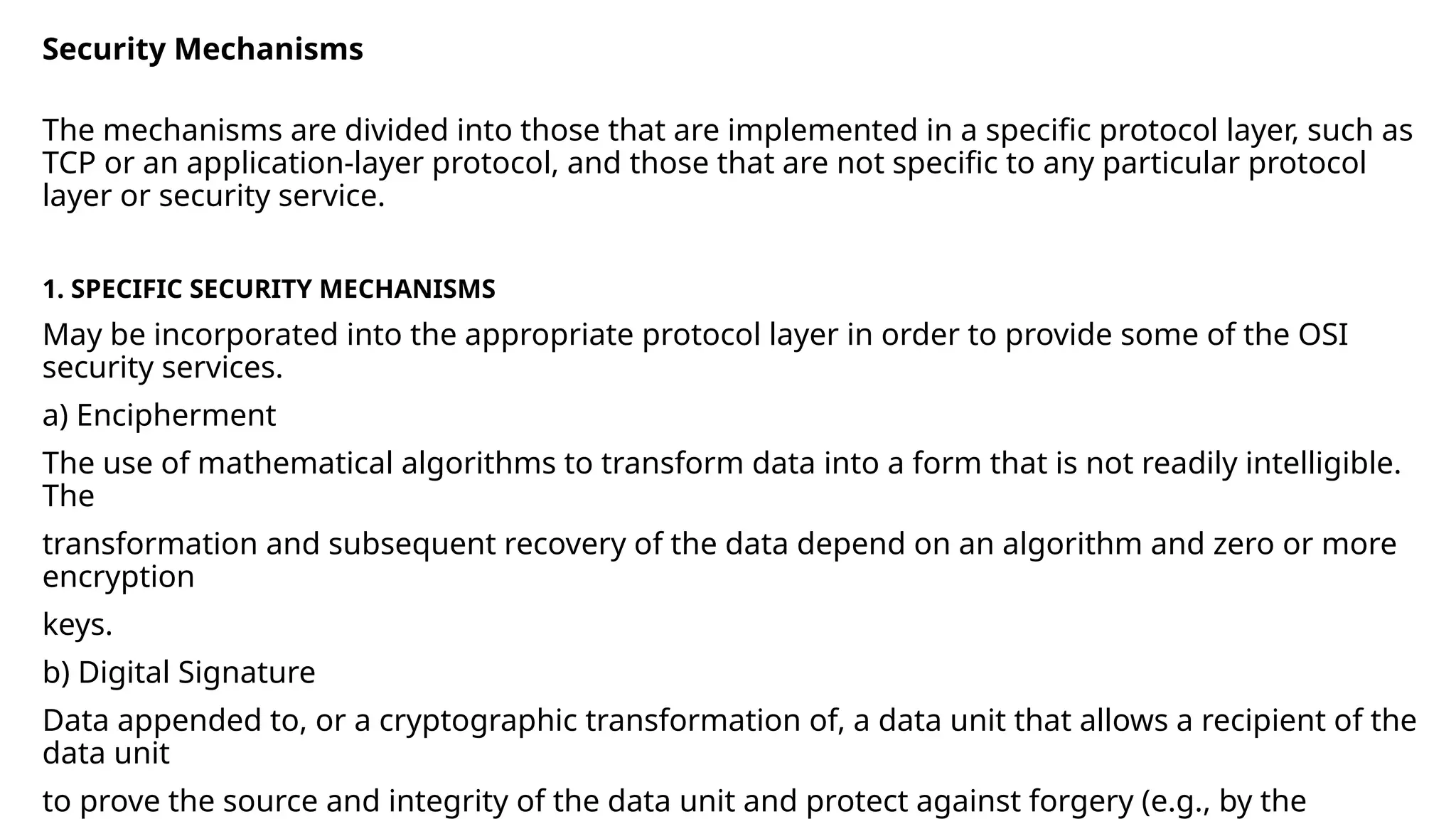
The mechanisms are divided into those that are implemented in a specific protocol layer, such as
TCP or an application-layer protocol, and those that are not specific to any particular protocol
layer or security service.
1. SPECIFIC SECURITY MECHANISMS
May be incorporated into the appropriate protocol layer in order to provide some of the OSI
security services.
a) Encipherment
The use of mathematical algorithms to transform data into a form that is not readily intelligible.
The
transformation and subsequent recovery of the data depend on an algorithm and zero or more
encryption
keys.
b) Digital Signature
Data appended to, or a cryptographic transformation of, a data unit that allows a recipient of the
data unit
to prove the source and integrity of the data unit and protect against forgery (e.g., by the
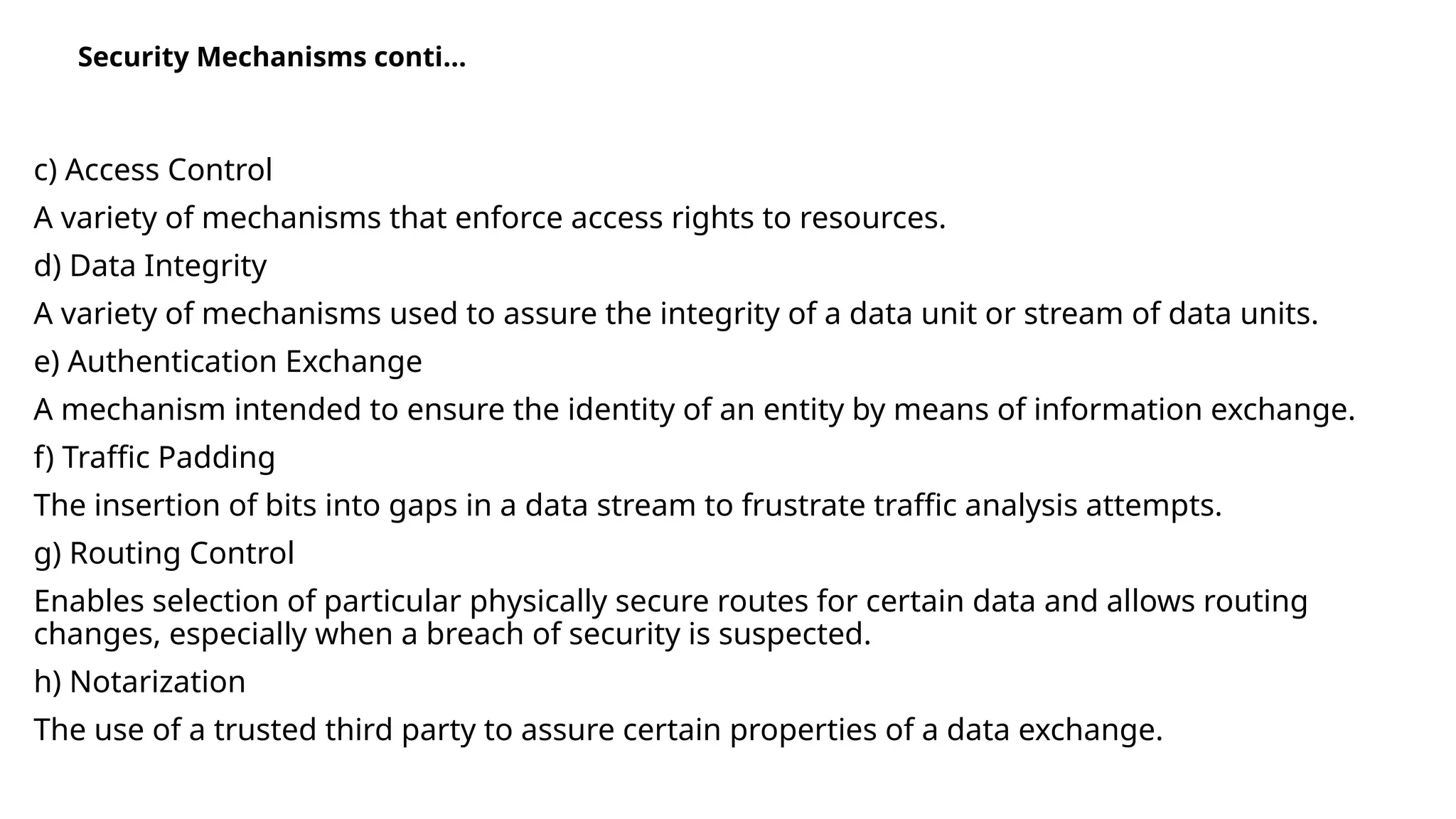
c) Access Control
A variety of mechanisms that enforce access rights to resources.
d) Data Integrity
A variety of mechanisms used to assure the integrity of a data unit or stream of data units.
e) Authentication Exchange
A mechanism intended to ensure the identity of an entity by means of information exchange.
f) Traffic Padding
The insertion of bits into gaps in a data stream to frustrate traffic analysis attempts.
g) Routing Control
Enables selection of particular physically secure routes for certain data and allows routing
changes, especially when a breach of security is suspected.
h) Notarization
The use of a trusted third party to assure certain properties of a data exchange.
Security Mechanisms conti…
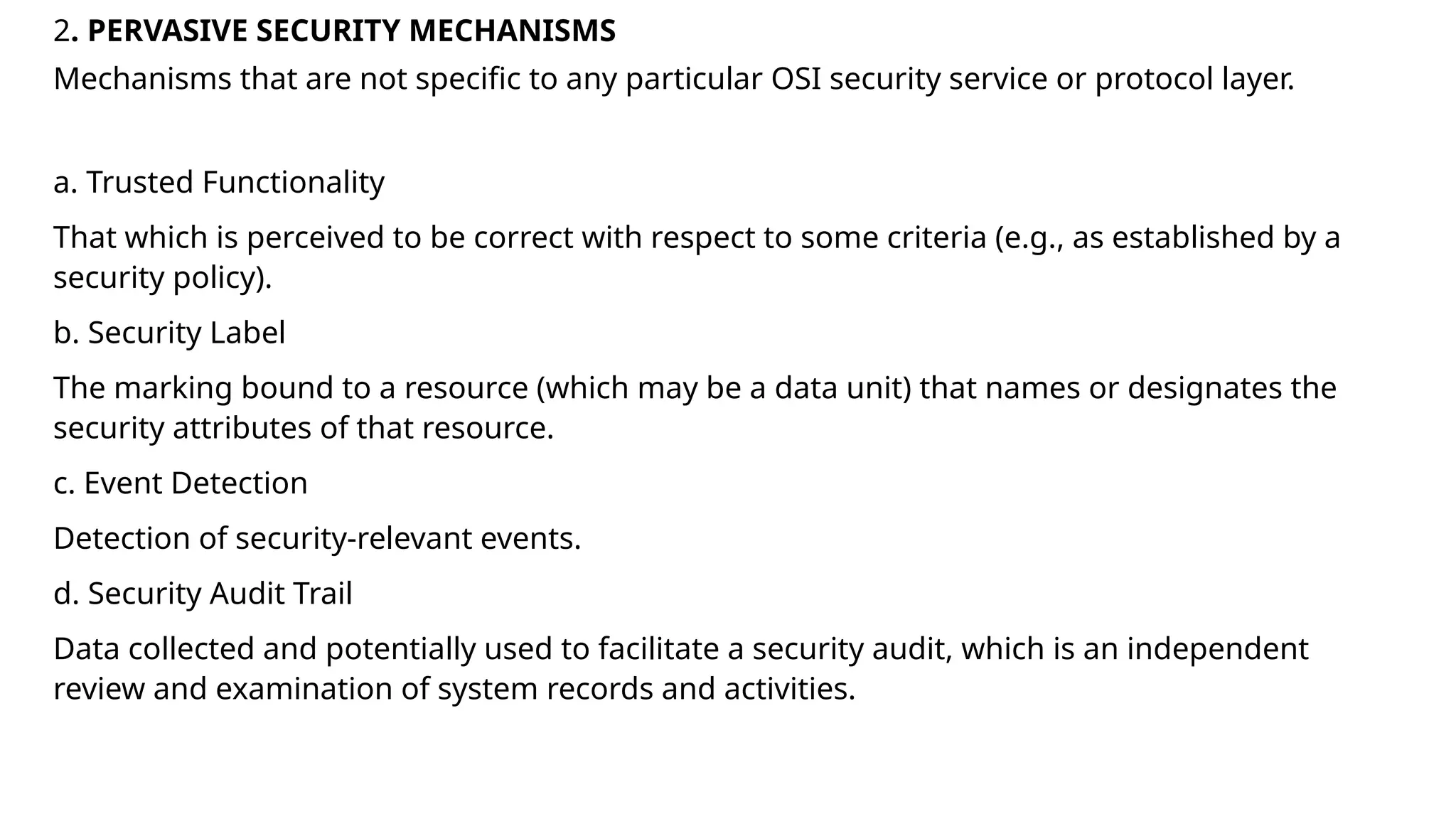
2. PERVASIVE SECURITY MECHANISMS
Mechanisms that are not specific to any particular OSI security service or protocol layer.
a. Trusted Functionality
That which is perceived to be correct with respect to some criteria (e.g., as established by a
security policy).
b. Security Label
The marking bound to a resource (which may be a data unit) that names or designates the
security attributes of that resource.
c. Event Detection
Detection of security-relevant events.
d. Security Audit Trail
Data collected and potentially used to facilitate a security audit, which is an independent
review and examination of system records and activities.
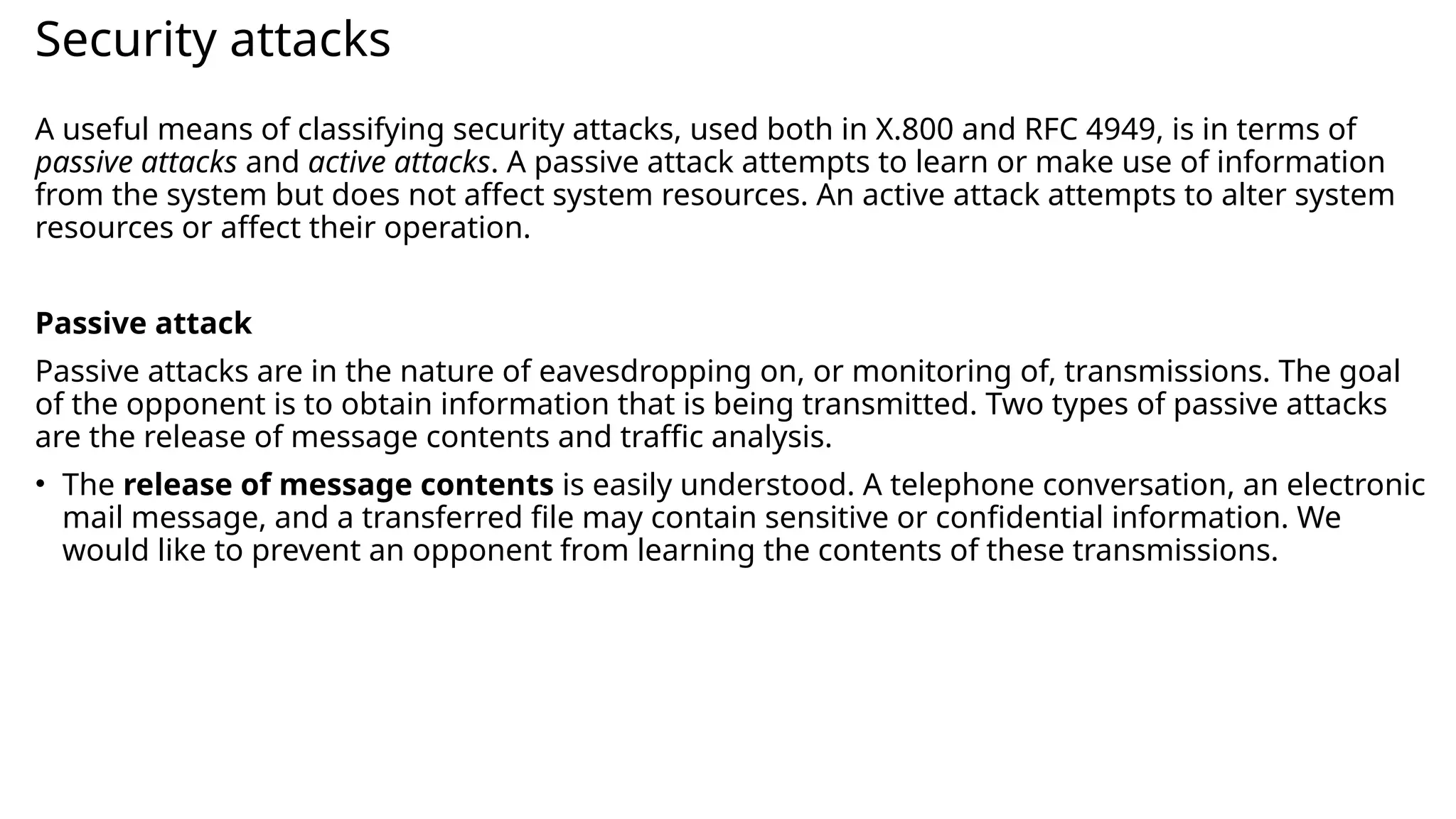
Security attacks
A useful means of classifying security attacks, used both in X.800 and RFC 4949, is in terms of
passive attacks and active attacks. A passive attack attempts to learn or make use of information
from the system but does not affect system resources. An active attack attempts to alter system
resources or affect their operation.
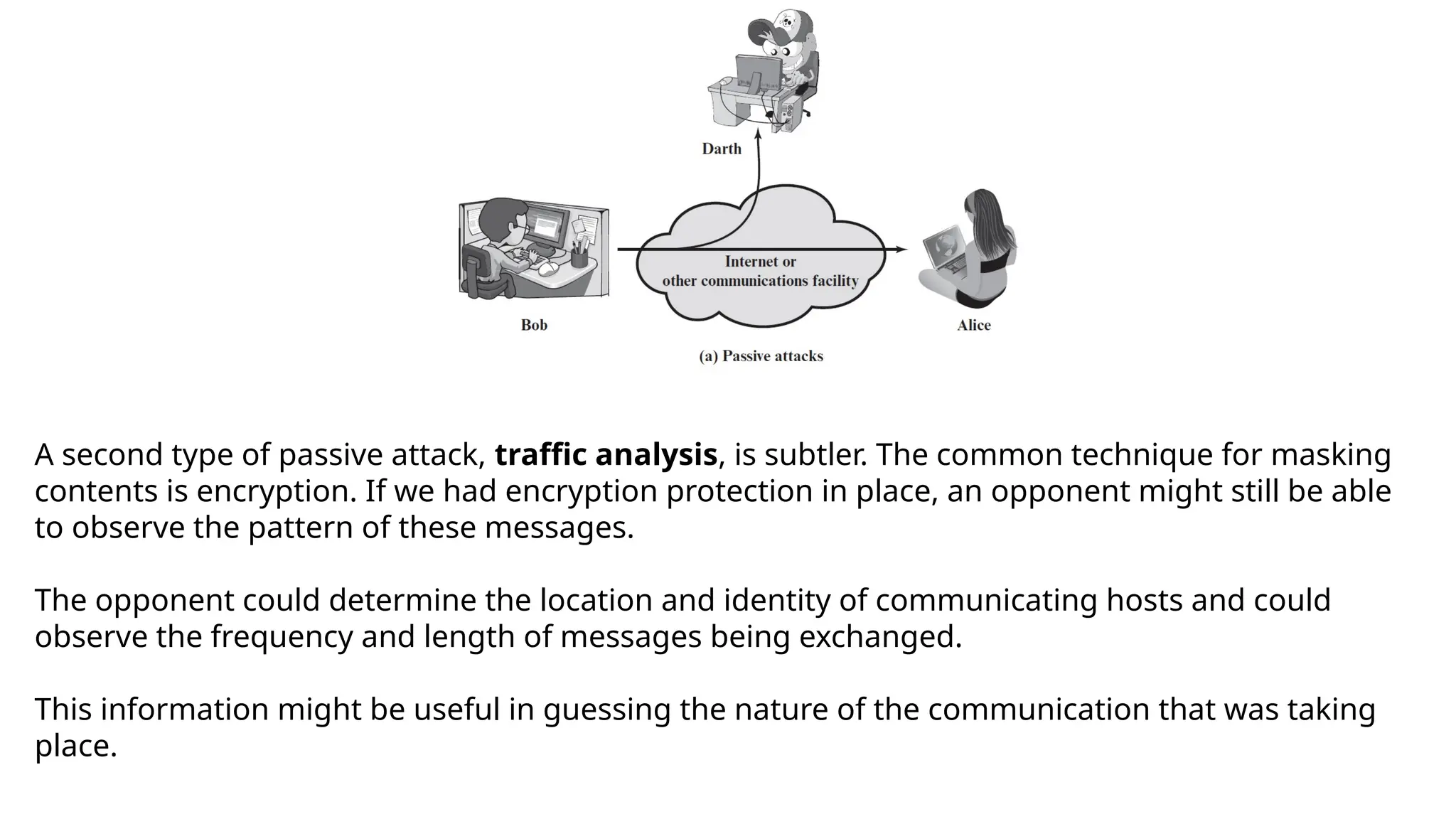
Passive attack
Passive attacks are in the nature of eavesdropping on, or monitoring of, transmissions. The goal
of the opponent is to obtain information that is being transmitted. Two types of passive attacks
are the release of message contents and traffic analysis.
• The release of message contents is easily understood. A telephone conversation, an electronic
mail message, and a transferred file may contain sensitive or confidential information. We
would like to prevent an opponent from learning the contents of these transmissions.
A second type of passive attack, traffic analysis, is subtler. The common technique for masking
contents is encryption. If we had encryption protection in place, an opponent might still be able
to observe the pattern of these messages.
The opponent could determine the location and identity of communicating hosts and could
observe the frequency and length of messages being exchanged.
This information might be useful in guessing the nature of the communication that was taking
place.
Passive attacks are very difficult to detect, because they do not involve any alteration of the data. Typically,
the message traffic is sent and received in an apparently normal fashion, and neither the sender nor
receiver is aware that a third party has read the messages or observed the traffic pattern.
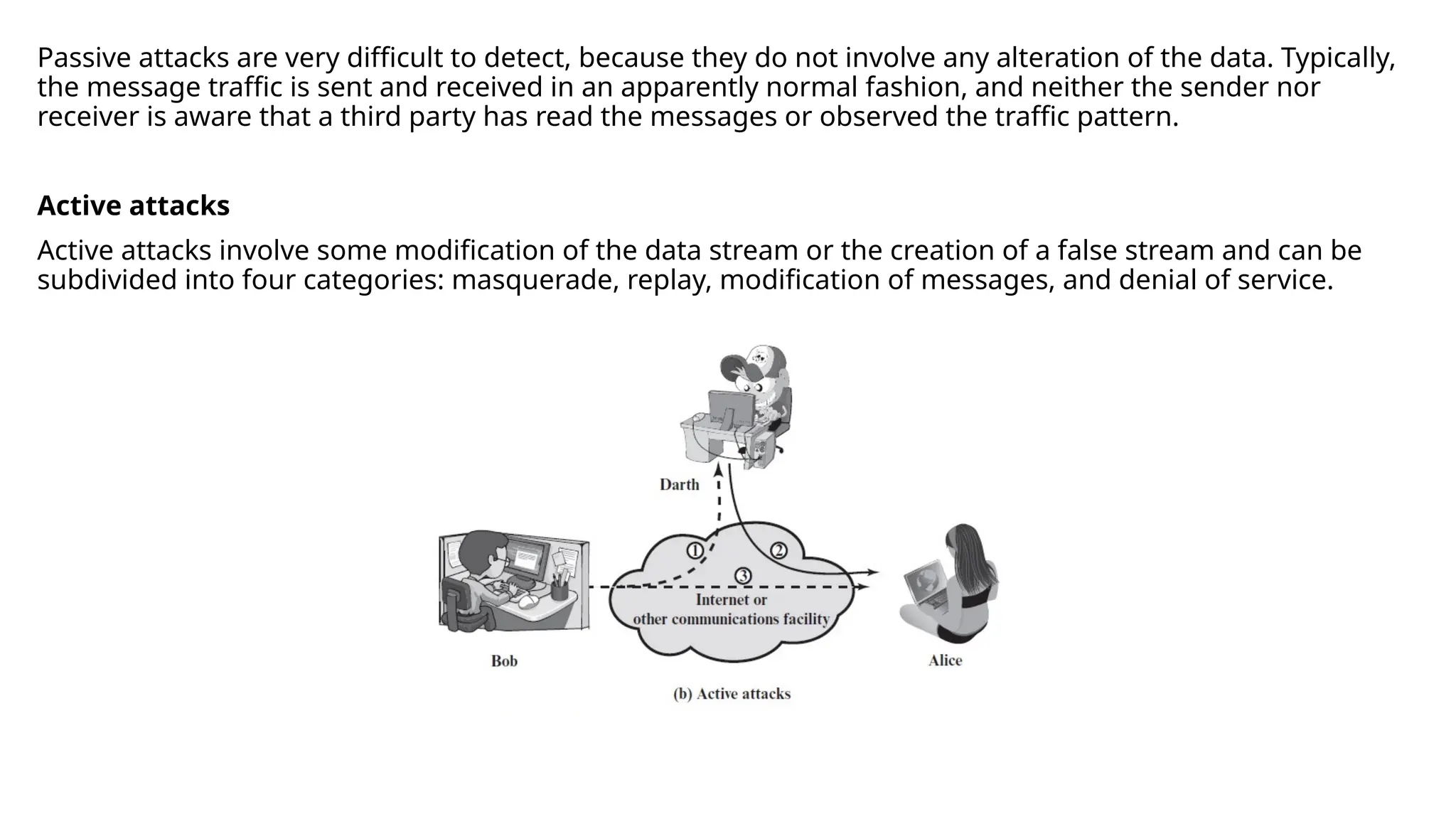
Active attacks
Active attacks involve some modification of the data stream or the creation of a false stream and can be
subdivided into four categories: masquerade, replay, modification of messages, and denial of service.
A masquerade takes place when one entity pretends to be a different entity (path 2 of previous
Figure). A masquerade attack usually includes one of the other forms of active attack.
For example, authentication sequences can be captured and replayed after a valid authentication
sequence has taken place, thus enabling an authorized entity with few privileges to obtain extra
privileges by impersonating an entity that has those privileges.
Replay involves the passive capture of a data unit and its subsequent retransmission to produce
an unauthorized effect (paths 1, 2, and 3 active).
Modification of messages simply means that some portion of a legitimate message is altered,
or that messages are delayed or reordered, to produce an unauthorized effect (paths 1 and 2
active).
For example, a message meaning “Allow John Smith to read confidential file accounts” is
modified to mean “Allow Fred Brown to read confidential file accounts.”
The denial of service prevents or inhibits the normal use or management of communications facilities
(path 3 active). This attack may have a specific target; for example, an entity may suppress all messages
directed to a particular destination (e.g., the security audit service).
Another form of service denial is the disruption of an entire network, either by disabling the network or
by overloading it with messages so as to degrade performance.
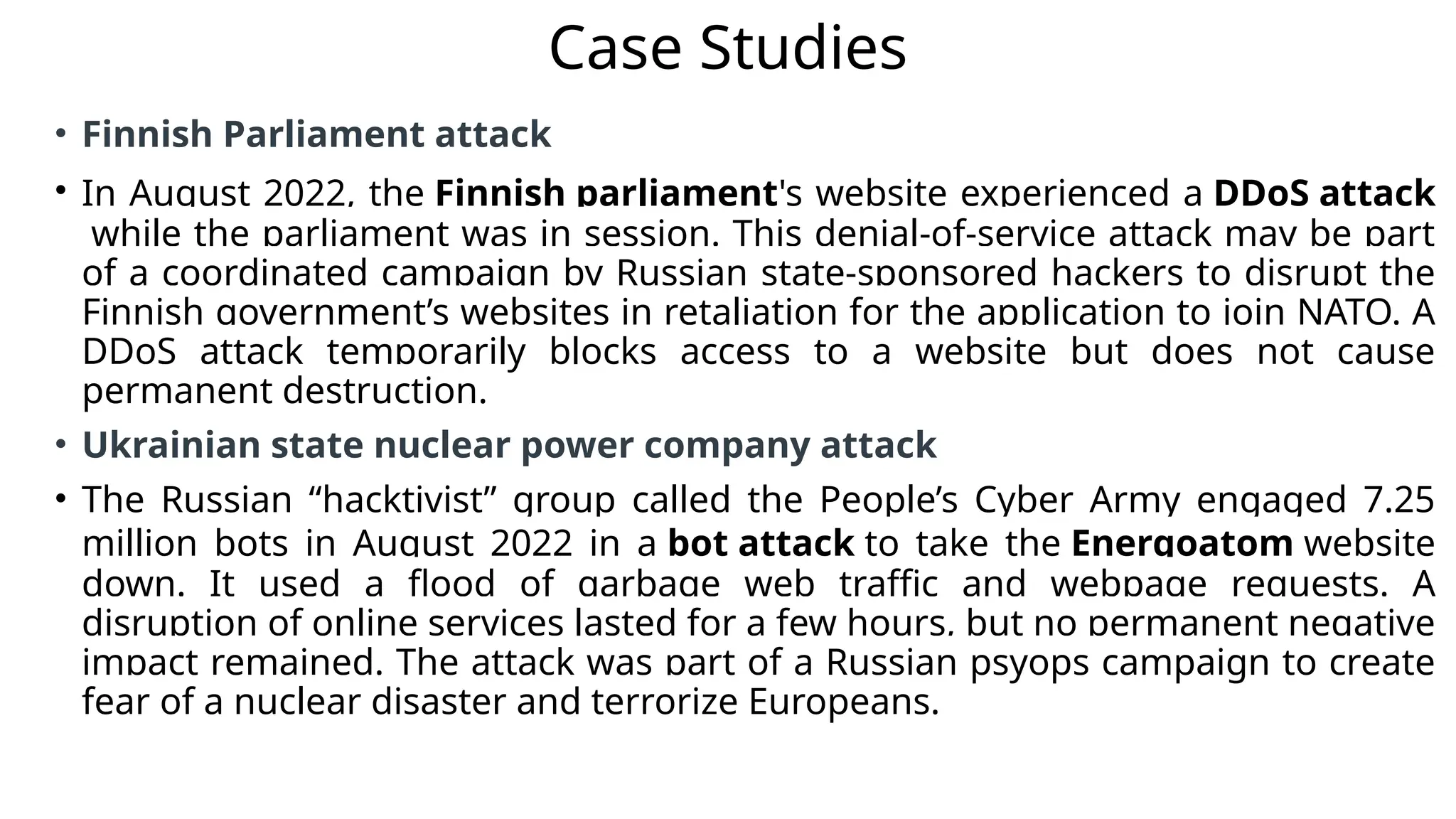
Case Studies
• Finnish Parliament attack
• In August 2022, the Finnish parliament's website experienced a DDoS attack
while the parliament was in session. This denial-of-service attack may be part
of a coordinated campaign by Russian state-sponsored hackers to disrupt the
Finnish government’s websites in retaliation for the application to join NATO. A
DDoS attack temporarily blocks access to a website but does not cause
permanent destruction.
• Ukrainian state nuclear power company attack
• The Russian “hacktivist” group called the People’s Cyber Army engaged 7.25
million bots in August 2022 in a bot attack to take the Energoatom website
down. It used a flood of garbage web traffic and webpage requests. A
disruption of online services lasted for a few hours, but no permanent negative
impact remained. The attack was part of a Russian psyops campaign to create
fear of a nuclear disaster and terrorize Europeans.
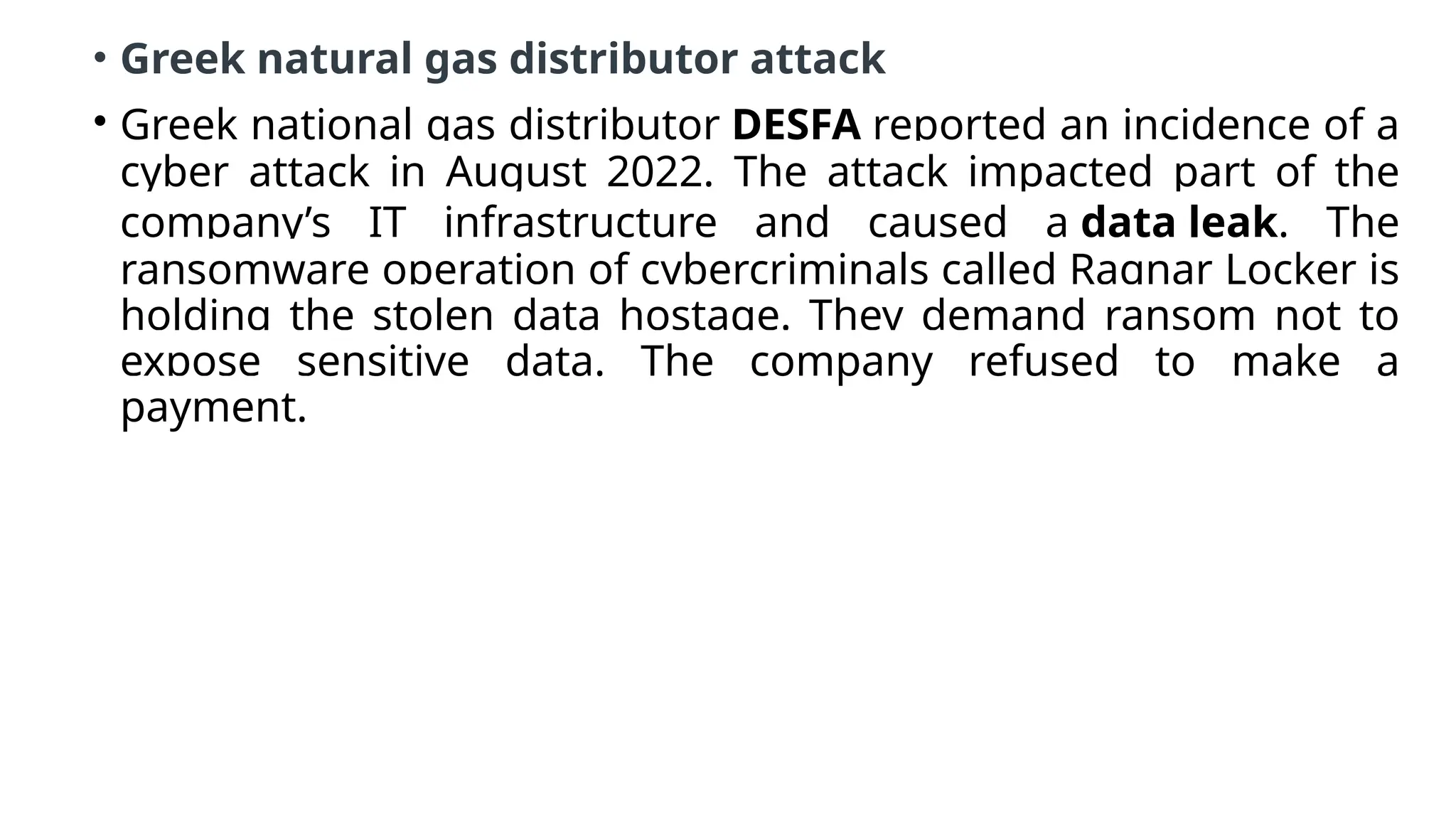
• Greek natural gas distributor attack
• Greek national gas distributor DESFA reported an incidence of a
cyber attack in August 2022. The attack impacted part of the
company’s IT infrastructure and caused a data leak. The
ransomware operation of cybercriminals called Ragnar Locker is
holding the stolen data hostage. They demand ransom not to
expose sensitive data. The company refused to make a
payment.
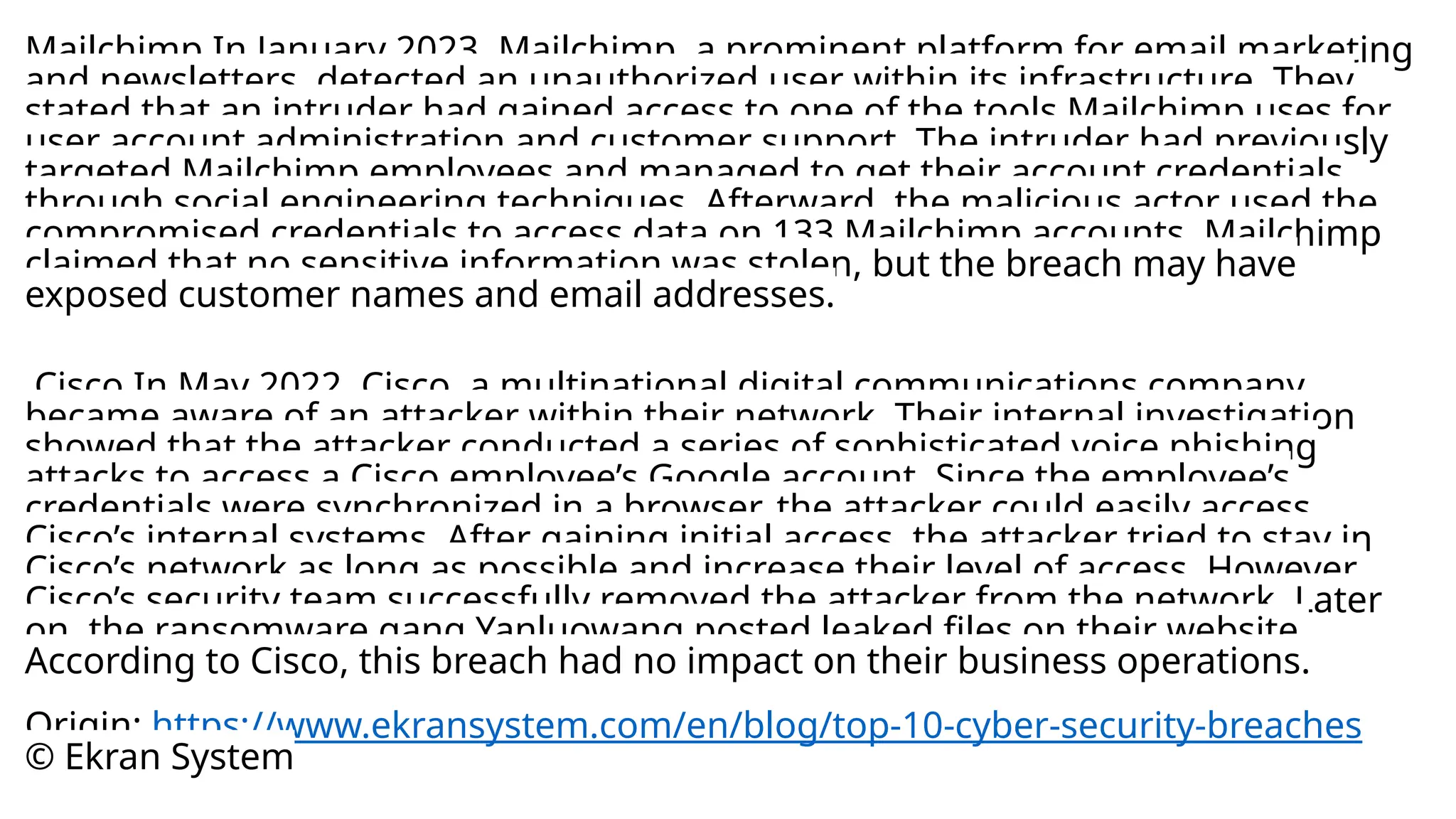
Mailchimp In January 2023, Mailchimp, a prominent platform for email marketing
and newsletters, detected an unauthorized user within its infrastructure. They
stated that an intruder had gained access to one of the tools Mailchimp uses for
user account administration and customer support. The intruder had previously
targeted Mailchimp employees and managed to get their account credentials
through social engineering techniques. Afterward, the malicious actor used the
compromised credentials to access data on 133 Mailchimp accounts. Mailchimp
claimed that no sensitive information was stolen, but the breach may have
exposed customer names and email addresses.
Cisco In May 2022, Cisco, a multinational digital communications company,
became aware of an attacker within their network. Their internal investigation
showed that the attacker conducted a series of sophisticated voice phishing
attacks to access a Cisco employee’s Google account. Since the employee’s
credentials were synchronized in a browser, the attacker could easily access
Cisco’s internal systems. After gaining initial access, the attacker tried to stay in
Cisco’s network as long as possible and increase their level of access. However,
Cisco’s security team successfully removed the attacker from the network. Later
on, the ransomware gang Yanluowang posted leaked files on their website.
According to Cisco, this breach had no impact on their business operations.
Origin: https://www.ekransystem.com/en/blog/top-10-cyber-security-breaches
© Ekran System

X.800 defines a security service iyew gt

  • 1.
    MODULE-1 INTRODUCTION: Security Goals,Cryptographic Attacks, Services and Mechanisms, Techniques.
  • 2.
    What is ComputerSecurity The protection afforded to an automated information system in order to attain the applicable objectives of preserving the integrity, availability, and confidentiality of information system resources (includes hardware, software, firmware, information/data, and telecommunications). This definition introduces three key objectives that are at the heart of computer security: ■ Confidentiality: This term covers two related concepts: • Data confidentiality: Assures that private or confidential information is not made available or disclosed to unauthorized individuals. • Privacy: Assures that individuals control or influence what information related to them may be collected and stored and by whom and to whom that information may be disclosed.
  • 3.
    Introduction • When computerdata travels in a network, there exist several threats to the data such as modification, forging, etc. • Cryptography is the method of transforming a message at the sender to unreadable format to protect it from unauthorized access in transit. • At the receiver, the unreadable message is returned back to its original form. There are three aspects of information security which needs to be considered: Security attack – Any action that compromises the security of information owned by an organization. Security mechanism – A mechanism that is designed to detect, prevent, or recover from a security attack. Security service – A service that enhances the security of the data processing systems and the information transfers of an organization. The services are intended to counter security attacks and they make use of one or more security mechanisms to provide the service
  • 4.
    X.800 X.800, also knownas the "Security Architecture for Open Systems Interconnection (OSI)," is a standard developed by the International Telecommunication Union (ITU). It provides a comprehensive framework for securing open systems and communications networks.
  • 5.
    Security Services X.800 definesa security service as a protocol layer service that ensures system and data transfer security in open systems. RFC 4949 defines it as a service providing specific protection to system resources, implementing security policies through security mechanisms. X.800 divides these services into five categories. 1. Authentication : The authentication service ensures that communications are authentic. For a single message, it confirms that the message is from the claimed source. For ongoing interactions, it verifies the authenticity of both entities at the start and ensures the connection is not compromised by third parties. X.800 defines two specific authentication services: • Peer Entity Authentication: Verifies the identity of a peer entity in an association, such as two TCP modules in different systems. It is used at connection establishment or during data transfer to ensure no masquerading or unauthorized replay. • Data Origin Authentication: Confirms the source of a data unit, but does not protect against duplication or modification. It is useful for applications like email where prior interactions are not present.
  • 6.
    2. Access control: In the context of network security, access control is the ability to limit and control the access to host systems and applications via communications links. To achieve this, each entity trying to gain access must first be identified, or authenticated, so that access rights can be tailored to the individual. 3. Data Confidentiality: Confidentiality protects transmitted data from passive attacks. It can be implemented at different levels: • Broad Protection: Safeguards all user data transmitted over a period, such as data in a TCP connection. • Narrower Protection: Focuses on single messages or specific fields, though these are less effective and more complex. Confidentiality also includes protecting traffic flow from analysis, preventing attackers from observing traffic characteristics like source, destination, frequency, and length.
  • 7.
    4 Data Integrity: Integritycan apply to a stream of messages, a single message, or specific fields. The most effective approach is total stream protection. • Connection-Oriented Integrity: Ensures that messages in a stream are received as sent, with no duplication, modification, reordering, or replay. It also covers data destruction and denial of service. • Connectionless Integrity: Focuses on individual messages, primarily protecting against modification. Integrity services can be with or without recovery. For active attacks, detection is crucial, and violations may need manual or automated recovery mechanisms. Automated recovery is generally preferred. 5 Nonrepudiation prevents either sender or receiver from denying a transmitted message. Thus, when a message is sent, the receiver can prove that the alleged sender in fact sent the message. Similarly, when a message is received, the sender can prove that the alleged receiver in fact received the message.
  • 8.
    Availability • Both X.800and RFC 4949 define availability as the ability of a system or resource to be accessible and usable by authorized entities upon demand, according to system performance specifications. • Availability is impacted by various attacks, some of which can be mitigated through automated measures like authentication and encryption, while others require physical intervention. • X.800 considers availability as part of various security services but also identifies it as a specific service
  • 9.
    Security Mechanisms The mechanismsare divided into those that are implemented in a specific protocol layer, such as TCP or an application-layer protocol, and those that are not specific to any particular protocol layer or security service. 1. SPECIFIC SECURITY MECHANISMS May be incorporated into the appropriate protocol layer in order to provide some of the OSI security services. a) Encipherment The use of mathematical algorithms to transform data into a form that is not readily intelligible. The transformation and subsequent recovery of the data depend on an algorithm and zero or more encryption keys. b) Digital Signature Data appended to, or a cryptographic transformation of, a data unit that allows a recipient of the data unit to prove the source and integrity of the data unit and protect against forgery (e.g., by the
  • 10.
    c) Access Control Avariety of mechanisms that enforce access rights to resources. d) Data Integrity A variety of mechanisms used to assure the integrity of a data unit or stream of data units. e) Authentication Exchange A mechanism intended to ensure the identity of an entity by means of information exchange. f) Traffic Padding The insertion of bits into gaps in a data stream to frustrate traffic analysis attempts. g) Routing Control Enables selection of particular physically secure routes for certain data and allows routing changes, especially when a breach of security is suspected. h) Notarization The use of a trusted third party to assure certain properties of a data exchange. Security Mechanisms conti…
  • 11.
    2. PERVASIVE SECURITYMECHANISMS Mechanisms that are not specific to any particular OSI security service or protocol layer. a. Trusted Functionality That which is perceived to be correct with respect to some criteria (e.g., as established by a security policy). b. Security Label The marking bound to a resource (which may be a data unit) that names or designates the security attributes of that resource. c. Event Detection Detection of security-relevant events. d. Security Audit Trail Data collected and potentially used to facilitate a security audit, which is an independent review and examination of system records and activities.
  • 12.
    Security attacks A usefulmeans of classifying security attacks, used both in X.800 and RFC 4949, is in terms of passive attacks and active attacks. A passive attack attempts to learn or make use of information from the system but does not affect system resources. An active attack attempts to alter system resources or affect their operation. Passive attack Passive attacks are in the nature of eavesdropping on, or monitoring of, transmissions. The goal of the opponent is to obtain information that is being transmitted. Two types of passive attacks are the release of message contents and traffic analysis. • The release of message contents is easily understood. A telephone conversation, an electronic mail message, and a transferred file may contain sensitive or confidential information. We would like to prevent an opponent from learning the contents of these transmissions.
  • 13.
    A second typeof passive attack, traffic analysis, is subtler. The common technique for masking contents is encryption. If we had encryption protection in place, an opponent might still be able to observe the pattern of these messages. The opponent could determine the location and identity of communicating hosts and could observe the frequency and length of messages being exchanged. This information might be useful in guessing the nature of the communication that was taking place.
  • 14.
    Passive attacks arevery difficult to detect, because they do not involve any alteration of the data. Typically, the message traffic is sent and received in an apparently normal fashion, and neither the sender nor receiver is aware that a third party has read the messages or observed the traffic pattern. Active attacks Active attacks involve some modification of the data stream or the creation of a false stream and can be subdivided into four categories: masquerade, replay, modification of messages, and denial of service.
  • 15.
    A masquerade takesplace when one entity pretends to be a different entity (path 2 of previous Figure). A masquerade attack usually includes one of the other forms of active attack. For example, authentication sequences can be captured and replayed after a valid authentication sequence has taken place, thus enabling an authorized entity with few privileges to obtain extra privileges by impersonating an entity that has those privileges. Replay involves the passive capture of a data unit and its subsequent retransmission to produce an unauthorized effect (paths 1, 2, and 3 active). Modification of messages simply means that some portion of a legitimate message is altered, or that messages are delayed or reordered, to produce an unauthorized effect (paths 1 and 2 active). For example, a message meaning “Allow John Smith to read confidential file accounts” is modified to mean “Allow Fred Brown to read confidential file accounts.”
  • 16.
    The denial ofservice prevents or inhibits the normal use or management of communications facilities (path 3 active). This attack may have a specific target; for example, an entity may suppress all messages directed to a particular destination (e.g., the security audit service). Another form of service denial is the disruption of an entire network, either by disabling the network or by overloading it with messages so as to degrade performance.
  • 17.
    Case Studies • FinnishParliament attack • In August 2022, the Finnish parliament's website experienced a DDoS attack while the parliament was in session. This denial-of-service attack may be part of a coordinated campaign by Russian state-sponsored hackers to disrupt the Finnish government’s websites in retaliation for the application to join NATO. A DDoS attack temporarily blocks access to a website but does not cause permanent destruction. • Ukrainian state nuclear power company attack • The Russian “hacktivist” group called the People’s Cyber Army engaged 7.25 million bots in August 2022 in a bot attack to take the Energoatom website down. It used a flood of garbage web traffic and webpage requests. A disruption of online services lasted for a few hours, but no permanent negative impact remained. The attack was part of a Russian psyops campaign to create fear of a nuclear disaster and terrorize Europeans.
  • 18.
    • Greek naturalgas distributor attack • Greek national gas distributor DESFA reported an incidence of a cyber attack in August 2022. The attack impacted part of the company’s IT infrastructure and caused a data leak. The ransomware operation of cybercriminals called Ragnar Locker is holding the stolen data hostage. They demand ransom not to expose sensitive data. The company refused to make a payment.
  • 19.
    Mailchimp In January2023, Mailchimp, a prominent platform for email marketing and newsletters, detected an unauthorized user within its infrastructure. They stated that an intruder had gained access to one of the tools Mailchimp uses for user account administration and customer support. The intruder had previously targeted Mailchimp employees and managed to get their account credentials through social engineering techniques. Afterward, the malicious actor used the compromised credentials to access data on 133 Mailchimp accounts. Mailchimp claimed that no sensitive information was stolen, but the breach may have exposed customer names and email addresses. Cisco In May 2022, Cisco, a multinational digital communications company, became aware of an attacker within their network. Their internal investigation showed that the attacker conducted a series of sophisticated voice phishing attacks to access a Cisco employee’s Google account. Since the employee’s credentials were synchronized in a browser, the attacker could easily access Cisco’s internal systems. After gaining initial access, the attacker tried to stay in Cisco’s network as long as possible and increase their level of access. However, Cisco’s security team successfully removed the attacker from the network. Later on, the ransomware gang Yanluowang posted leaked files on their website. According to Cisco, this breach had no impact on their business operations. Origin: https://www.ekransystem.com/en/blog/top-10-cyber-security-breaches © Ekran System