CS8601 MOBILE COMPUTING
UNIT – III
Dr.A.Kathirvel, Professor and Head, Dept of CSE
Misrimal Navajee Munoth Jain Engineering College, Chennai
Unit - III
MOBILE NETWORK LAYER
Mobile IP – DHCP – AdHoc– Proactive protocol-
DSDV, Reactive Routing Protocols – DSR, AODV ,
Hybrid routing –ZRP, Multicast Routing- ODMRP,
Vehicular Ad Hoc networks ( VANET) –MANET Vs
VANET – Security.
TEXT BOOKS:Jochen Schiller, Mobile Communications, PHI, Second Edn, 2003.
2
Why Mobile IP?
❑ What do cellular networks and wireless LANs provide?
❑ Wireless connectivity
❑ Mobility at the data link layer
❑ What is Dynamic Host Configuration Protocol (DHCP)?
❑ It provides local IP addresses for mobile hosts
❑ Is not secure
❑ Does not maintain network connectivity when moving around
❑ What they do not provide:
❑ Transparent connectivity at the network layer
❑ Mobility with local access
❑ The difference between mobility and nomadicity!
❑ Mobile IP provides network layer mobility
❑ Provides seamless roaming. ‘‘Extends’’ the home network over the
entire Internet
3
IP Overview 1/3
❑ IP Addressing :
❑ Dotted Decimal Notation: 32 bits (4x8) used to
represent IPv4 addresses - 192.19.241.18
❑ Network Prefix and Host Portions: p - prefix, h - host,
p + h = 32. If p = 24 then h = 32 - 24 = 8. Using above
address the network prefix will be 192.19.241 and host
will be 18. For those of you familiar with subnet masks,
“p” represents the number of 1’s in the subnet mask. If
p = 24, subnet mask is 255.255.255.0, if p = 26, subnet
mask is 255.255.255.192.
4
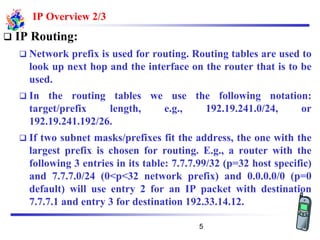
IP Overview 2/3
❑ IP Routing:
❑ Network prefix is used for routing. Routing tables are used to
look up next hop and the interface on the router that is to be
used.
❑ In the routing tables we use the following notation:
target/prefix length, e.g., 192.19.241.0/24, or
192.19.241.192/26.
❑ If two subnet masks/prefixes fit the address, the one with the
largest prefix is chosen for routing. E.g., a router with the
following 3 entries in its table: 7.7.7.99/32 (p=32 host specific)
and 7.7.7.0/24 (0<p<32 network prefix) and 0.0.0.0/0 (p=0
default) will use entry 2 for an IP packet with destination
7.7.7.1 and entry 3 for destination 192.33.14.12.
5
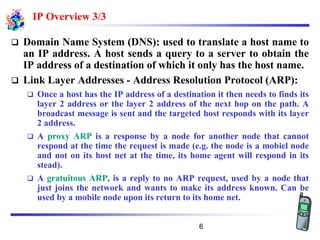
IP Overview 3/3
❑ Domain Name System (DNS): used to translate a host name to
an IP address. A host sends a query to a server to obtain the
IP address of a destination of which it only has the host name.
❑ Link Layer Addresses - Address Resolution Protocol (ARP):
❑ Once a host has the IP address of a destination it then needs to finds its
layer 2 address or the layer 2 address of the next hop on the path. A
broadcast message is sent and the targeted host responds with its layer
2 address.
❑ A proxy ARP is a response by a node for another node that cannot
respond at the time the request is made (e.g. the node is a mobiel node
and not on its host net at the time, its home agent will respond in its
stead).
❑ A gratuitous ARP, is a reply to no ARP request, used by a node that
just joins the network and wants to make its address known. Can be
used by a mobile node upon its return to its home net.
6
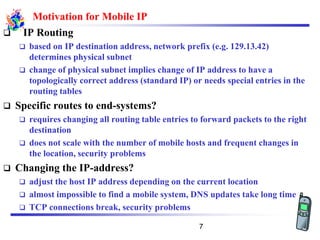
Motivation for Mobile IP
❑ IP Routing
❑ based on IP destination address, network prefix (e.g. 129.13.42)
determines physical subnet
❑ change of physical subnet implies change of IP address to have a
topologically correct address (standard IP) or needs special entries in the
routing tables
❑ Specific routes to end-systems?
❑ requires changing all routing table entries to forward packets to the right
destination
❑ does not scale with the number of mobile hosts and frequent changes in
the location, security problems
❑ Changing the IP-address?
❑ adjust the host IP address depending on the current location
❑ almost impossible to find a mobile system, DNS updates take long time
❑ TCP connections break, security problems
7
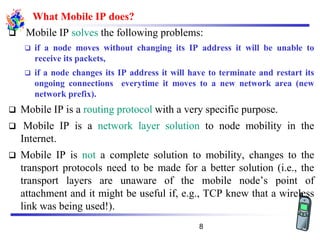
What Mobile IP does?
❑ Mobile IP solves the following problems:
❑ if a node moves without changing its IP address it will be unable to
receive its packets,
❑ if a node changes its IP address it will have to terminate and restart its
ongoing connections everytime it moves to a new network area (new
network prefix).
❑ Mobile IP is a routing protocol with a very specific purpose.
❑ Mobile IP is a network layer solution to node mobility in the
Internet.
❑ Mobile IP is not a complete solution to mobility, changes to the
transport protocols need to be made for a better solution (i.e., the
transport layers are unaware of the mobile node’s point of
attachment and it might be useful if, e.g., TCP knew that a wireless
link was being used!).
8
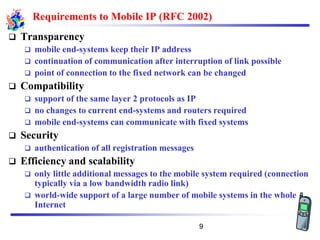
Requirements to Mobile IP (RFC 2002)
❑ Transparency
❑ mobile end-systems keep their IP address
❑ continuation of communication after interruption of link possible
❑ point of connection to the fixed network can be changed
❑ Compatibility
❑ support of the same layer 2 protocols as IP
❑ no changes to current end-systems and routers required
❑ mobile end-systems can communicate with fixed systems
❑ Security
❑ authentication of all registration messages
❑ Efficiency and scalability
❑ only little additional messages to the mobile system required (connection
typically via a low bandwidth radio link)
❑ world-wide support of a large number of mobile systems in the whole
Internet
9
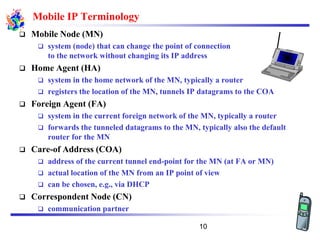
Mobile IP Terminology
❑ Mobile Node (MN)
❑ system (node) that can change the point of connection
to the network without changing its IP address
❑ Home Agent (HA)
❑ system in the home network of the MN, typically a router
❑ registers the location of the MN, tunnels IP datagrams to the COA
❑ Foreign Agent (FA)
❑ system in the current foreign network of the MN, typically a router
❑ forwards the tunneled datagrams to the MN, typically also the default
router for the MN
❑ Care-of Address (COA)
❑ address of the current tunnel end-point for the MN (at FA or MN)
❑ actual location of the MN from an IP point of view
❑ can be chosen, e.g., via DHCP
❑ Correspondent Node (CN)
❑ communication partner
10
Mobile IP Operation: Summary
❑Consists of 3 steps:
❑Agent discovery,
❑Registration, and
❑Routing/Tunneling
11
Operation Summary 1/3
❑ Agent Advertisement/Discovery: consists of
broadcast messages used by mobiles to detect that
they have moved and are required to register with a
new FA.
❑ FAs send agent advertisements
❑ MNs can solicit for agents if they have not heard an agent
advertisement in awhile or use some other mechanism to
obtain a COA or temp. IP address (e.g. DHCP).
❑ MNs know they are home when they recognize their HA.
12
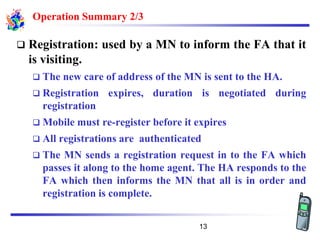
Operation Summary 2/3
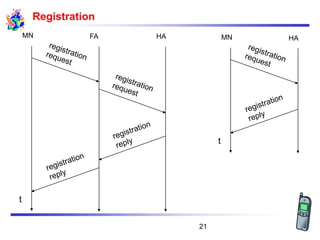
❑ Registration: used by a MN to inform the FA that it
is visiting.
❑ The new care of address of the MN is sent to the HA.
❑ Registration expires, duration is negotiated during
registration
❑ Mobile must re-register before it expires
❑ All registrations are authenticated
❑ The MN sends a registration request in to the FA which
passes it along to the home agent. The HA responds to the
FA which then informs the MN that all is in order and
registration is complete.
13
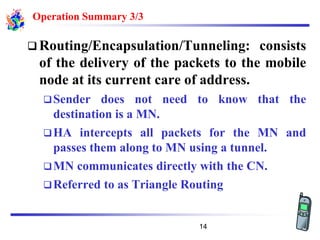
Operation Summary 3/3
❑ Routing/Encapsulation/Tunneling: consists
of the delivery of the packets to the mobile
node at its current care of address.
❑Sender does not need to know that the
destination is a MN.
❑HA intercepts all packets for the MN and
passes them along to MN using a tunnel.
❑MN communicates directly with the CN.
❑Referred to as Triangle Routing
14
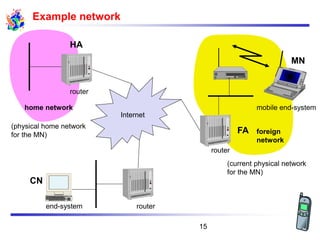
Example network
mobile end-system
Internet
router
router
router
end-system
FA
HA
MN
home network
foreign
network
(physical home network
for the MN)
(current physical network
for the MN)
CN
15
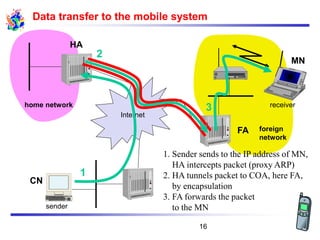
Data transfer to the mobile system
Internet
sender
FA
HA
MN
home network
foreign
network
receiver
1
2
3
1. Sender sends to the IP address of MN,
HA intercepts packet (proxy ARP)
2. HA tunnels packet to COA, here FA,
by encapsulation
3. FA forwards the packet
to the MN
CN
16
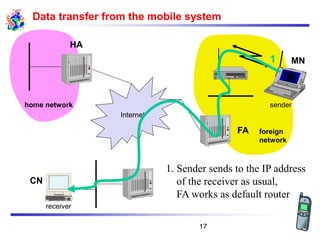
Data transfer from the mobile system
Internet
receiver
FA
HA
MN
home network
foreign
network
sender
1
1. Sender sends to the IP address
of the receiver as usual,
FA works as default router
CN
17
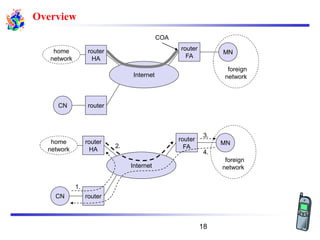
Overview
CN
router
HA
router
FA
Internet
router
1.
2.
3.
home
network
MN
foreign
network
4.
CN
router
HA
router
FA
Internet
router
home
network
MN
foreign
network
COA
18
Network integration
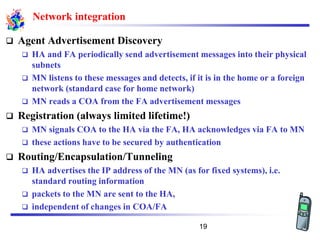
❑ Agent Advertisement Discovery
❑ HA and FA periodically send advertisement messages into their physical
subnets
❑ MN listens to these messages and detects, if it is in the home or a foreign
network (standard case for home network)
❑ MN reads a COA from the FA advertisement messages
❑ Registration (always limited lifetime!)
❑ MN signals COA to the HA via the FA, HA acknowledges via FA to MN
❑ these actions have to be secured by authentication
❑ Routing/Encapsulation/Tunneling
❑ HA advertises the IP address of the MN (as for fixed systems), i.e.
standard routing information
❑ packets to the MN are sent to the HA,
❑ independent of changes in COA/FA
19
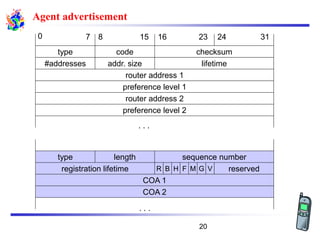
Agent advertisement
preference level 1
router address 1
#addresses
type
addr. size lifetime
checksum
COA 1
COA 2
type sequence numberlength
0 7 8 15 16 312423
code
preference level 2
router address 2
. . .
registration lifetime
. . .
R B H F M G V reserved
20
Registration
t
MN HA
t
MN FA HA
21
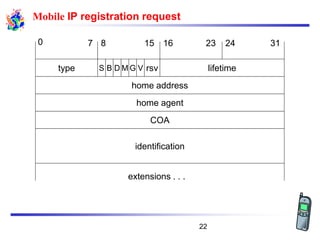
Mobile IP registration request
home agent
home address
type lifetime
0 7 8 15 16 312423
rsv
identification
COA
extensions . . .
S B D M G V
22
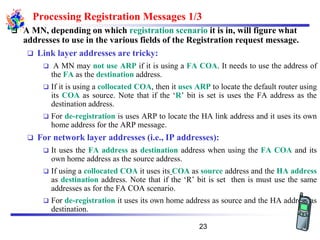
Processing Registration Messages 1/3
❑ A MN, depending on which registration scenario it is in, will figure what
addresses to use in the various fields of the Registration request message.
❑ Link layer addresses are tricky:
❑ A MN may not use ARP if it is using a FA COA. It needs to use the address of
the FA as the destination address.
❑ If it is using a collocated COA, then it uses ARP to locate the default router using
its COA as source. Note that if the ‘R’ bit is set is uses the FA address as the
destination address.
❑ For de-registration is uses ARP to locate the HA link address and it uses its own
home address for the ARP message.
❑ For network layer addresses (i.e., IP addresses):
❑ It uses the FA address as destination address when using the FA COA and its
own home address as the source address.
❑ If using a collocated COA it uses its COA as source address and the HA address
as destination address. Note that if the ‘R’ bit is set then is must use the same
addresses as for the FA COA scenario.
❑ For de-registration it uses its own home address as source and the HA address as
destination.
23
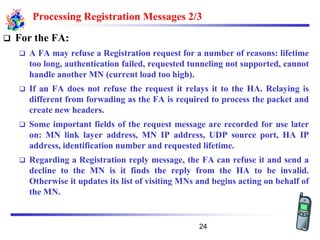
Processing Registration Messages 2/3
❑ For the FA:
❑ A FA may refuse a Registration request for a number of reasons: lifetime
too long, authentication failed, requested tunneling not supported, cannot
handle another MN (current load too high).
❑ If an FA does not refuse the request it relays it to the HA. Relaying is
different from forwading as the FA is required to process the packet and
create new headers.
❑ Some important fields of the request message are recorded for use later
on: MN link layer address, MN IP address, UDP source port, HA IP
address, identification number and requested lifetime.
❑ Regarding a Registration reply message, the FA can refuse it and send a
decline to the MN is it finds the reply from the HA to be invalid.
Otherwise it updates its list of visiting MNs and begins acting on behalf of
the MN.
24
Processing Registration Messages 3/3
❑ For a HA
❑The HA will determine, as the FA did, whether
it will accept the request. If it does not it
returns a code in the reply message indicating
the cause of the failed request.
❑If the request is accepted, the reply is sent back
by reversing all the IP addresses and UDP port
numbers.
❑The HA updates the binding table
corresponding to that MN dependent upon the
nature of the request.
25
Routing/Tunneling 1/5
❑ Routing a packet to a MN involves the
following:
❑ A router on the home link, possibly the HA,
advertises reachability to the network prefix of the
MN’s home address.
❑ All packets are therefore routed to the MN’s home
link.
❑ A HA intercepts the packets for the MN and tunnels
a copy to each COA in the binding table.
❑ At the foreign link either the MN extracts the packet
(collocated COA) or the FA extracts the packet and
forwards it to the MN.
26
Routing/Tunneling 2/5
❑ A HA can use one of two methods to intercept a
MN’s packets:
❑ The HA is a router with multiple network interfaces. In
that case it advertises reachability to the MN’s home
network prefix.
❑ The HA is not a router with multiple intefaces. It must
use ARP to receive the MN’s packets. It either
responds to ARP requests on behalf of the MN (proxy
ARP) or uses gratuitous ARPs to inform the home
network that it is receiving the MN’s IP packets. This is
to update any ARP caches that hosts and other devices
might have.
27
Routing/Tunneling 3/5
❑ How to ‘fool’ the routing table into handling
tunneled packets at the HA?
❑ A virtual interface is used to do the encapsulation.
❑ A packet destined for the MN is handled by the routing
routine as all received IP packets are.
❑ The routing table has a host specific entry for the MN.
This host specific entry is used to route the packet to a
virtual interface that basically consists of a process that
does encapsulation.
❑ Once encapsulation has been performed the packet is sent
to be processed by the routing routine again. This time the
destination address is the COA and it is routed normally.
28
Routing/Tunneling 4/5
❑ How to ‘fool’ the routing table into handling tunneled
packets at the FA?
❑ The same procedure is used as above.
❑ A packet coming in with a COA that is one of the FA
addresses’ is handled by the routing routine.
❑ A host specific address (its own address) in the routing table
points to the higher layers and the packet is passed on to a
virtual interface.
❑ The virtual interface consists of a process that decapsulates
the packet and re-routes it to the routing routine.
❑ The routing routine routes the packet normally based upon a
host specific entry that is the MN’s home address (for which
it has the link layer address!).
29
Routing/Tunneling 5/5
❑ How does a MN route its packets?
❑ It needs to find a router to send all its packets to.
❑ It can select a router in one of a number of ways dependent upon
whether it has a FA COA or a collocated COA.
❑ Having a FA COA does not imply that the MN needs to use it as its
default router for sending packets. It can use any router that sends
advertisements or that is advertised in the Agent Advertisement
message.
❑ If the MN is using a collocated COA it needs to listen for router
advertisements or is it hears none, use DHCP to find the default
router.
❑ Determining the link layer address is another issue. Collocated COA
MNs can use ARP. FA COA must note the link layer address when
they receive router advertisements or agent advertisements.
30
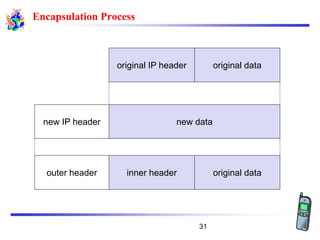
Encapsulation Process
original IP header original data
new datanew IP header
outer header inner header original data
31
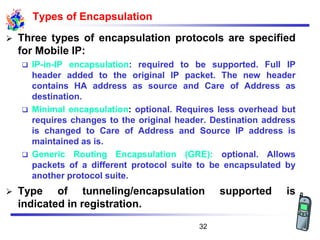
Types of Encapsulation
➢ Three types of encapsulation protocols are specified
for Mobile IP:
❑ IP-in-IP encapsulation: required to be supported. Full IP
header added to the original IP packet. The new header
contains HA address as source and Care of Address as
destination.
❑ Minimal encapsulation: optional. Requires less overhead but
requires changes to the original header. Destination address
is changed to Care of Address and Source IP address is
maintained as is.
❑ Generic Routing Encapsulation (GRE): optional. Allows
packets of a different protocol suite to be encapsulated by
another protocol suite.
➢ Type of tunneling/encapsulation supported is
indicated in registration.
32
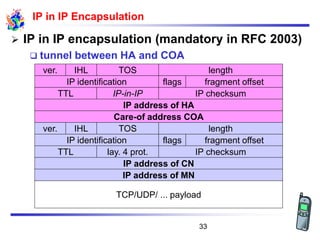
IP in IP Encapsulation
➢ IP in IP encapsulation (mandatory in RFC 2003)
❑ tunnel between HA and COA
Care-of address COA
IP address of HA
TTL
IP identification
IP-in-IP IP checksum
flags fragment offset
lengthTOSver. IHL
IP address of MN
IP address of CN
TTL
IP identification
lay. 4 prot. IP checksum
flags fragment offset
lengthTOSver. IHL
TCP/UDP/ ... payload
33
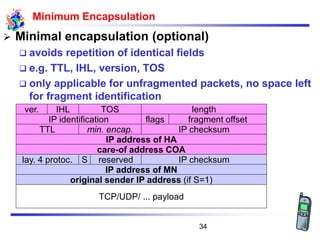
Minimum Encapsulation
➢ Minimal encapsulation (optional)
❑ avoids repetition of identical fields
❑ e.g. TTL, IHL, version, TOS
❑ only applicable for unfragmented packets, no space left
for fragment identification
care-of address COA
IP address of HA
TTL
IP identification
min. encap. IP checksum
flags fragment offset
lengthTOSver. IHL
IP address of MN
original sender IP address (if S=1)
Slay. 4 protoc. IP checksum
TCP/UDP/ ... payload
reserved
34
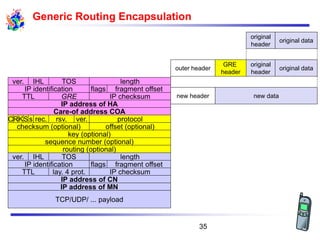
Generic Routing Encapsulation
original
header
original data
new datanew header
outer header
GRE
header
original data
original
header
Care-of address COA
IP address of HA
TTL
IP identification
GRE IP checksum
flags fragment offset
lengthTOSver. IHL
IP address of MN
IP address of CN
TTL
IP identification
lay. 4 prot. IP checksum
flags fragment offset
lengthTOSver. IHL
TCP/UDP/ ... payload
routing (optional)
sequence number (optional)
key (optional)
offset (optional)checksum (optional)
protocolrec. rsv. ver.CRKSs
35
Routing techniques
➢ Triangle Routing: tunneling in its simplest form has all
packets go to home network (HA) and then sent to MN via
a tunnel.
❑ This involves two IP routes that need to be set-up, one original
and the second the tunnel route.
❑ Causes unnecessary network overhead and adds to the latency.
➢ Route optimization: allows the correstpondent node to
learn the current location of the MN and tunnel its own
packets directly. Problems arise with
❑ mobility: correspondent node has to update/maintain its cache.
❑ authentication: HA has to communicate with the correspondent
node to do authentication, i.e., security association is with HA not
with MN.
36
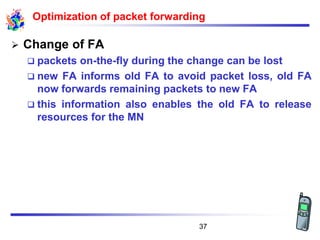
Optimization of packet forwarding
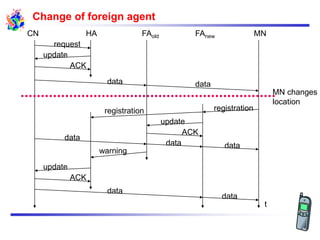
➢ Change of FA
❑ packets on-the-fly during the change can be lost
❑ new FA informs old FA to avoid packet loss, old FA
now forwards remaining packets to new FA
❑ this information also enables the old FA to release
resources for the MN
37
Change of foreign agent
CN HA FAold FAnew MN
t
request
update
ACK
data data
MN changes
location
registration
update
ACK
data
data data
warning
update
ACK
data
data
registration
Problems with Triangle Routing
➢ Triangle routing has the MN correspond directly
with the CN using its home address as the SA
❑ Firewalls at the foreign network may not allow that
❑ Multicasting: if a MN is to participate in a multicast
group, it needs to use a reverse tunnel to maintain its
association with the home network.
❑ TTL: a MN might have a TTL that is suitable for
communication when it is in its HM. This TTL may not
be sufficient when moving around (longer routes
possibly). When using a reverse tunnel, it only counts
as a single hop. A MN does not want to change the TTL
everytime it moves.
➢ Solution: reverse tunneling
39
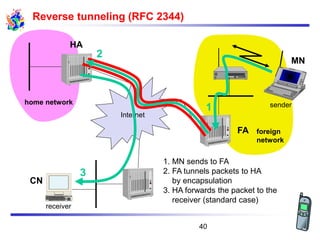
Reverse tunneling (RFC 2344)
Internet
receiver
FA
HA
MN
home network
foreign
network
sender
3
2
1
1. MN sends to FA
2. FA tunnels packets to HA
by encapsulation
3. HA forwards the packet to the
receiver (standard case)
CN
40
Mobile IP with reverse tunneling
➢ Routers accept often only “topologically correct“
addresses (firewall!)
❑ a packet from the MN encapsulated by the FA is now topologically
correct
➢ Multicast and TTL problems solved
➢ Reverse tunneling does not solve
❑ all problems with firewalls, the reverse tunnel can be abused to
circumvent security mechanisms (tunnel hijacking)
❑ optimization of data paths, i.e. packets will be forwarded through
the tunnel via the HA to a sender (longer routes)
➢ The new standard is backwards compatible
❑ the extensions can be implemented easily
41
Mobile IP and IPv6
➢ Mobile IP was developed for IPv4, but IPv6 simplifies the
protocols
❑ security is integrated and not an add-on, authentication of
registration is included
❑ COA can be assigned via auto-configuration (DHCPv6 is one
candidate), every node has address autoconfiguration
❑ no need for a separate FA, all routers perform router
advertisement which can be used instead of the special agent
advertisement
❑ MN can signal a sender directly the COA, sending via HA not
needed in this case (automatic path optimization)
❑ „soft“ hand-over, i.e. without packet loss, between two subnets is
supported
MN sends the new COA to its old router
the old router encapsulates all incoming packets for the MN and forwards
them to the new COA
authentication is always granted
42
Problems with Mobile IP
➢ Security
❑ authentication with FA problematic, for the FA typically belongs to
another organization
❑ no protocol for key management and key distribution has been
standardized in the Internet
❑ patent and export restrictions
➢ Firewalls
❑ typically mobile IP cannot be used together with firewalls, special
set-ups are needed (such as reverse tunneling)
➢ QoS
❑ many new reservations in case of RSVP
❑ tunneling makes it hard to give a flow of packets a special treatment
needed for the QoS
➢ Security, firewalls, QoS etc. are topics of current research
and discussions!
43
Security in Mobile IP
➢ Security requirements (Security Architecture for the
Internet Protocol, RFC 1825)
❑ Integrity
any changes to data between sender and receiver can be detected
by the receiver
❑ Authentication
sender address is really the address of the sender and all data
received is really data sent by this sender
❑ Confidentiality
only sender and receiver can read the data
❑ Non-Repudiation
sender cannot deny sending of data
❑ Traffic Analysis
creation of traffic and user profiles should not be possible
❑ Replay Protection - receivers can detect replay of messages
44
not encrypted encrypted
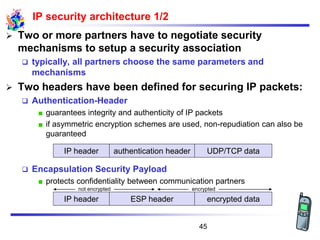
IP security architecture 1/2
➢ Two or more partners have to negotiate security
mechanisms to setup a security association
❑ typically, all partners choose the same parameters and
mechanisms
➢ Two headers have been defined for securing IP packets:
❑ Authentication-Header
guarantees integrity and authenticity of IP packets
if asymmetric encryption schemes are used, non-repudiation can also be
guaranteed
❑ Encapsulation Security Payload
protects confidentiality between communication partners
Authentification-HeaderIP-Header UDP/TCP-Paketauthentication headerIP header UDP/TCP data
ESP headerIP header encrypted data
45
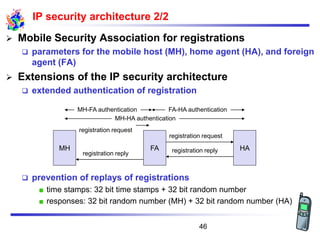
➢ Mobile Security Association for registrations
❑ parameters for the mobile host (MH), home agent (HA), and foreign
agent (FA)
➢ Extensions of the IP security architecture
❑ extended authentication of registration
❑ prevention of replays of registrations
time stamps: 32 bit time stamps + 32 bit random number
responses: 32 bit random number (MH) + 32 bit random number (HA)
IP security architecture 2/2
registration reply
registration request
MH FA HA
registration reply
MH-HA authentication
MH-FA authentication FA-HA authentication
46
Key distribution
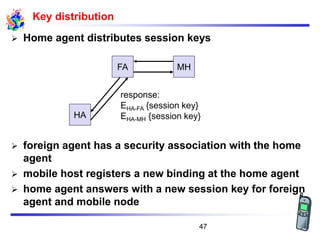
➢ Home agent distributes session keys
➢ foreign agent has a security association with the home
agent
➢ mobile host registers a new binding at the home agent
➢ home agent answers with a new session key for foreign
agent and mobile node
FA MH
HA
response:
EHA-FA {session key}
EHA-MH {session key}
47
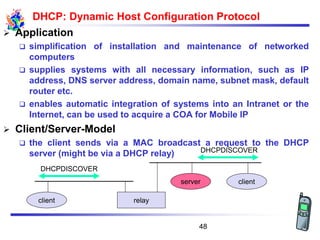
DHCP: Dynamic Host Configuration Protocol
➢ Application
❑ simplification of installation and maintenance of networked
computers
❑ supplies systems with all necessary information, such as IP
address, DNS server address, domain name, subnet mask, default
router etc.
❑ enables automatic integration of systems into an Intranet or the
Internet, can be used to acquire a COA for Mobile IP
➢ Client/Server-Model
❑ the client sends via a MAC broadcast a request to the DHCP
server (might be via a DHCP relay)
client relay
clientserver
DHCPDISCOVER
DHCPDISCOVER
48
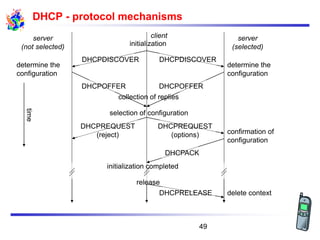
DHCP - protocol mechanisms
server
(not selected)
client server
(selected)initialization
collection of replies
selection of configuration
initialization completed
release
confirmation of
configuration
delete context
determine the
configuration
DHCPDISCOVER
DHCPOFFER
DHCPREQUEST
(reject)
DHCPACK
DHCPRELEASE
DHCPDISCOVER
DHCPOFFER
DHCPREQUEST
(options)
determine the
configuration
49
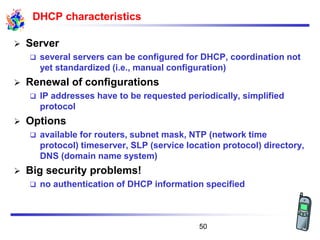
DHCP characteristics
➢ Server
❑ several servers can be configured for DHCP, coordination not
yet standardized (i.e., manual configuration)
➢ Renewal of configurations
❑ IP addresses have to be requested periodically, simplified
protocol
➢ Options
❑ available for routers, subnet mask, NTP (network time
protocol) timeserver, SLP (service location protocol) directory,
DNS (domain name system)
➢ Big security problems!
❑ no authentication of DHCP information specified
50
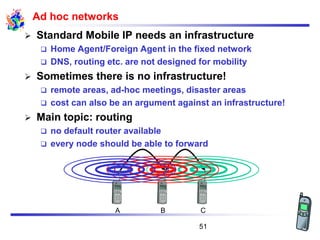
Ad hoc networks
➢ Standard Mobile IP needs an infrastructure
❑ Home Agent/Foreign Agent in the fixed network
❑ DNS, routing etc. are not designed for mobility
➢ Sometimes there is no infrastructure!
❑ remote areas, ad-hoc meetings, disaster areas
❑ cost can also be an argument against an infrastructure!
➢ Main topic: routing
❑ no default router available
❑ every node should be able to forward
A B C
51
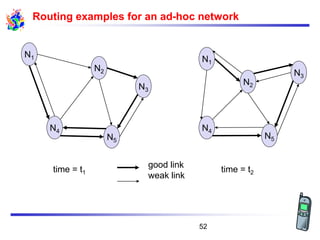
Routing examples for an ad-hoc network
N1
N4
N2
N5
N3
N1
N4
N2
N5
N3
good link
weak link
time = t1 time = t2
52
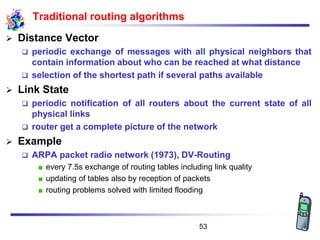
Traditional routing algorithms
➢ Distance Vector
❑ periodic exchange of messages with all physical neighbors that
contain information about who can be reached at what distance
❑ selection of the shortest path if several paths available
➢ Link State
❑ periodic notification of all routers about the current state of all
physical links
❑ router get a complete picture of the network
➢ Example
❑ ARPA packet radio network (1973), DV-Routing
every 7.5s exchange of routing tables including link quality
updating of tables also by reception of packets
routing problems solved with limited flooding
53
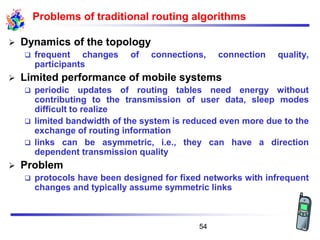
Problems of traditional routing algorithms
➢ Dynamics of the topology
❑ frequent changes of connections, connection quality,
participants
➢ Limited performance of mobile systems
❑ periodic updates of routing tables need energy without
contributing to the transmission of user data, sleep modes
difficult to realize
❑ limited bandwidth of the system is reduced even more due to the
exchange of routing information
❑ links can be asymmetric, i.e., they can have a direction
dependent transmission quality
➢ Problem
❑ protocols have been designed for fixed networks with infrequent
changes and typically assume symmetric links
54
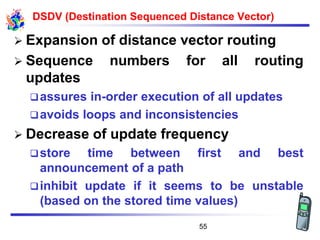
DSDV (Destination Sequenced Distance Vector)
➢ Expansion of distance vector routing
➢ Sequence numbers for all routing
updates
❑assures in-order execution of all updates
❑avoids loops and inconsistencies
➢ Decrease of update frequency
❑store time between first and best
announcement of a path
❑inhibit update if it seems to be unstable
(based on the stored time values)
55
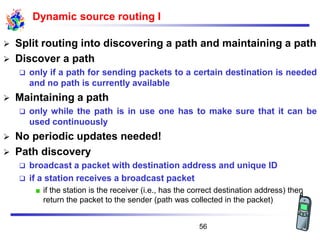
Dynamic source routing I
➢ Split routing into discovering a path and maintaining a path
➢ Discover a path
❑ only if a path for sending packets to a certain destination is needed
and no path is currently available
➢ Maintaining a path
❑ only while the path is in use one has to make sure that it can be
used continuously
➢ No periodic updates needed!
➢ Path discovery
❑ broadcast a packet with destination address and unique ID
❑ if a station receives a broadcast packet
if the station is the receiver (i.e., has the correct destination address) then
return the packet to the sender (path was collected in the packet)
56
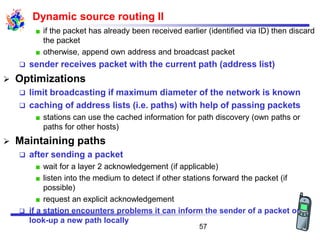
Dynamic source routing II
if the packet has already been received earlier (identified via ID) then discard
the packet
otherwise, append own address and broadcast packet
❑ sender receives packet with the current path (address list)
➢ Optimizations
❑ limit broadcasting if maximum diameter of the network is known
❑ caching of address lists (i.e. paths) with help of passing packets
stations can use the cached information for path discovery (own paths or
paths for other hosts)
➢ Maintaining paths
❑ after sending a packet
wait for a layer 2 acknowledgement (if applicable)
listen into the medium to detect if other stations forward the packet (if
possible)
request an explicit acknowledgement
❑ if a station encounters problems it can inform the sender of a packet or
look-up a new path locally
57
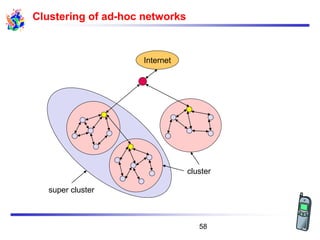
Clustering of ad-hoc networks
Internet
super cluster
cluster
58
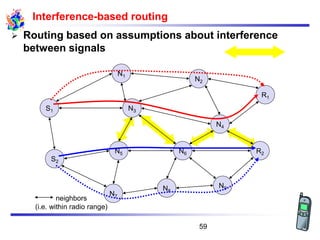
Interference-based routing
➢ Routing based on assumptions about interference
between signals
S1
N5
N3
N4
N1
N2
R1
R2N6
N8
S2
N9
N7
neighbors
(i.e. within radio range)
59
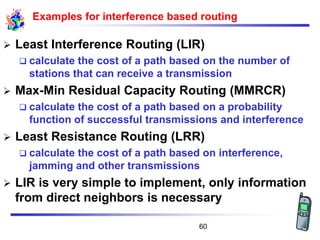
Examples for interference based routing
➢ Least Interference Routing (LIR)
❑ calculate the cost of a path based on the number of
stations that can receive a transmission
➢ Max-Min Residual Capacity Routing (MMRCR)
❑ calculate the cost of a path based on a probability
function of successful transmissions and interference
➢ Least Resistance Routing (LRR)
❑ calculate the cost of a path based on interference,
jamming and other transmissions
➢ LIR is very simple to implement, only information
from direct neighbors is necessary
60
Questions ?

Cs8601 3

  • 1.
    CS8601 MOBILE COMPUTING UNIT– III Dr.A.Kathirvel, Professor and Head, Dept of CSE Misrimal Navajee Munoth Jain Engineering College, Chennai
  • 2.
    Unit - III MOBILENETWORK LAYER Mobile IP – DHCP – AdHoc– Proactive protocol- DSDV, Reactive Routing Protocols – DSR, AODV , Hybrid routing –ZRP, Multicast Routing- ODMRP, Vehicular Ad Hoc networks ( VANET) –MANET Vs VANET – Security. TEXT BOOKS:Jochen Schiller, Mobile Communications, PHI, Second Edn, 2003. 2
  • 3.
    Why Mobile IP? ❑What do cellular networks and wireless LANs provide? ❑ Wireless connectivity ❑ Mobility at the data link layer ❑ What is Dynamic Host Configuration Protocol (DHCP)? ❑ It provides local IP addresses for mobile hosts ❑ Is not secure ❑ Does not maintain network connectivity when moving around ❑ What they do not provide: ❑ Transparent connectivity at the network layer ❑ Mobility with local access ❑ The difference between mobility and nomadicity! ❑ Mobile IP provides network layer mobility ❑ Provides seamless roaming. ‘‘Extends’’ the home network over the entire Internet 3
  • 4.
    IP Overview 1/3 ❑IP Addressing : ❑ Dotted Decimal Notation: 32 bits (4x8) used to represent IPv4 addresses - 192.19.241.18 ❑ Network Prefix and Host Portions: p - prefix, h - host, p + h = 32. If p = 24 then h = 32 - 24 = 8. Using above address the network prefix will be 192.19.241 and host will be 18. For those of you familiar with subnet masks, “p” represents the number of 1’s in the subnet mask. If p = 24, subnet mask is 255.255.255.0, if p = 26, subnet mask is 255.255.255.192. 4
  • 5.
    IP Overview 2/3 ❑IP Routing: ❑ Network prefix is used for routing. Routing tables are used to look up next hop and the interface on the router that is to be used. ❑ In the routing tables we use the following notation: target/prefix length, e.g., 192.19.241.0/24, or 192.19.241.192/26. ❑ If two subnet masks/prefixes fit the address, the one with the largest prefix is chosen for routing. E.g., a router with the following 3 entries in its table: 7.7.7.99/32 (p=32 host specific) and 7.7.7.0/24 (0<p<32 network prefix) and 0.0.0.0/0 (p=0 default) will use entry 2 for an IP packet with destination 7.7.7.1 and entry 3 for destination 192.33.14.12. 5
  • 6.
    IP Overview 3/3 ❑Domain Name System (DNS): used to translate a host name to an IP address. A host sends a query to a server to obtain the IP address of a destination of which it only has the host name. ❑ Link Layer Addresses - Address Resolution Protocol (ARP): ❑ Once a host has the IP address of a destination it then needs to finds its layer 2 address or the layer 2 address of the next hop on the path. A broadcast message is sent and the targeted host responds with its layer 2 address. ❑ A proxy ARP is a response by a node for another node that cannot respond at the time the request is made (e.g. the node is a mobiel node and not on its host net at the time, its home agent will respond in its stead). ❑ A gratuitous ARP, is a reply to no ARP request, used by a node that just joins the network and wants to make its address known. Can be used by a mobile node upon its return to its home net. 6
  • 7.
    Motivation for MobileIP ❑ IP Routing ❑ based on IP destination address, network prefix (e.g. 129.13.42) determines physical subnet ❑ change of physical subnet implies change of IP address to have a topologically correct address (standard IP) or needs special entries in the routing tables ❑ Specific routes to end-systems? ❑ requires changing all routing table entries to forward packets to the right destination ❑ does not scale with the number of mobile hosts and frequent changes in the location, security problems ❑ Changing the IP-address? ❑ adjust the host IP address depending on the current location ❑ almost impossible to find a mobile system, DNS updates take long time ❑ TCP connections break, security problems 7
  • 8.
    What Mobile IPdoes? ❑ Mobile IP solves the following problems: ❑ if a node moves without changing its IP address it will be unable to receive its packets, ❑ if a node changes its IP address it will have to terminate and restart its ongoing connections everytime it moves to a new network area (new network prefix). ❑ Mobile IP is a routing protocol with a very specific purpose. ❑ Mobile IP is a network layer solution to node mobility in the Internet. ❑ Mobile IP is not a complete solution to mobility, changes to the transport protocols need to be made for a better solution (i.e., the transport layers are unaware of the mobile node’s point of attachment and it might be useful if, e.g., TCP knew that a wireless link was being used!). 8
  • 9.
    Requirements to MobileIP (RFC 2002) ❑ Transparency ❑ mobile end-systems keep their IP address ❑ continuation of communication after interruption of link possible ❑ point of connection to the fixed network can be changed ❑ Compatibility ❑ support of the same layer 2 protocols as IP ❑ no changes to current end-systems and routers required ❑ mobile end-systems can communicate with fixed systems ❑ Security ❑ authentication of all registration messages ❑ Efficiency and scalability ❑ only little additional messages to the mobile system required (connection typically via a low bandwidth radio link) ❑ world-wide support of a large number of mobile systems in the whole Internet 9
  • 10.
    Mobile IP Terminology ❑Mobile Node (MN) ❑ system (node) that can change the point of connection to the network without changing its IP address ❑ Home Agent (HA) ❑ system in the home network of the MN, typically a router ❑ registers the location of the MN, tunnels IP datagrams to the COA ❑ Foreign Agent (FA) ❑ system in the current foreign network of the MN, typically a router ❑ forwards the tunneled datagrams to the MN, typically also the default router for the MN ❑ Care-of Address (COA) ❑ address of the current tunnel end-point for the MN (at FA or MN) ❑ actual location of the MN from an IP point of view ❑ can be chosen, e.g., via DHCP ❑ Correspondent Node (CN) ❑ communication partner 10
  • 11.
    Mobile IP Operation:Summary ❑Consists of 3 steps: ❑Agent discovery, ❑Registration, and ❑Routing/Tunneling 11
  • 12.
    Operation Summary 1/3 ❑Agent Advertisement/Discovery: consists of broadcast messages used by mobiles to detect that they have moved and are required to register with a new FA. ❑ FAs send agent advertisements ❑ MNs can solicit for agents if they have not heard an agent advertisement in awhile or use some other mechanism to obtain a COA or temp. IP address (e.g. DHCP). ❑ MNs know they are home when they recognize their HA. 12
  • 13.
    Operation Summary 2/3 ❑Registration: used by a MN to inform the FA that it is visiting. ❑ The new care of address of the MN is sent to the HA. ❑ Registration expires, duration is negotiated during registration ❑ Mobile must re-register before it expires ❑ All registrations are authenticated ❑ The MN sends a registration request in to the FA which passes it along to the home agent. The HA responds to the FA which then informs the MN that all is in order and registration is complete. 13
  • 14.
    Operation Summary 3/3 ❑Routing/Encapsulation/Tunneling: consists of the delivery of the packets to the mobile node at its current care of address. ❑Sender does not need to know that the destination is a MN. ❑HA intercepts all packets for the MN and passes them along to MN using a tunnel. ❑MN communicates directly with the CN. ❑Referred to as Triangle Routing 14
  • 15.
    Example network mobile end-system Internet router router router end-system FA HA MN homenetwork foreign network (physical home network for the MN) (current physical network for the MN) CN 15
  • 16.
    Data transfer tothe mobile system Internet sender FA HA MN home network foreign network receiver 1 2 3 1. Sender sends to the IP address of MN, HA intercepts packet (proxy ARP) 2. HA tunnels packet to COA, here FA, by encapsulation 3. FA forwards the packet to the MN CN 16
  • 17.
    Data transfer fromthe mobile system Internet receiver FA HA MN home network foreign network sender 1 1. Sender sends to the IP address of the receiver as usual, FA works as default router CN 17
  • 18.
  • 19.
    Network integration ❑ AgentAdvertisement Discovery ❑ HA and FA periodically send advertisement messages into their physical subnets ❑ MN listens to these messages and detects, if it is in the home or a foreign network (standard case for home network) ❑ MN reads a COA from the FA advertisement messages ❑ Registration (always limited lifetime!) ❑ MN signals COA to the HA via the FA, HA acknowledges via FA to MN ❑ these actions have to be secured by authentication ❑ Routing/Encapsulation/Tunneling ❑ HA advertises the IP address of the MN (as for fixed systems), i.e. standard routing information ❑ packets to the MN are sent to the HA, ❑ independent of changes in COA/FA 19
  • 20.
    Agent advertisement preference level1 router address 1 #addresses type addr. size lifetime checksum COA 1 COA 2 type sequence numberlength 0 7 8 15 16 312423 code preference level 2 router address 2 . . . registration lifetime . . . R B H F M G V reserved 20
  • 21.
  • 22.
    Mobile IP registrationrequest home agent home address type lifetime 0 7 8 15 16 312423 rsv identification COA extensions . . . S B D M G V 22
  • 23.
    Processing Registration Messages1/3 ❑ A MN, depending on which registration scenario it is in, will figure what addresses to use in the various fields of the Registration request message. ❑ Link layer addresses are tricky: ❑ A MN may not use ARP if it is using a FA COA. It needs to use the address of the FA as the destination address. ❑ If it is using a collocated COA, then it uses ARP to locate the default router using its COA as source. Note that if the ‘R’ bit is set is uses the FA address as the destination address. ❑ For de-registration is uses ARP to locate the HA link address and it uses its own home address for the ARP message. ❑ For network layer addresses (i.e., IP addresses): ❑ It uses the FA address as destination address when using the FA COA and its own home address as the source address. ❑ If using a collocated COA it uses its COA as source address and the HA address as destination address. Note that if the ‘R’ bit is set then is must use the same addresses as for the FA COA scenario. ❑ For de-registration it uses its own home address as source and the HA address as destination. 23
  • 24.
    Processing Registration Messages2/3 ❑ For the FA: ❑ A FA may refuse a Registration request for a number of reasons: lifetime too long, authentication failed, requested tunneling not supported, cannot handle another MN (current load too high). ❑ If an FA does not refuse the request it relays it to the HA. Relaying is different from forwading as the FA is required to process the packet and create new headers. ❑ Some important fields of the request message are recorded for use later on: MN link layer address, MN IP address, UDP source port, HA IP address, identification number and requested lifetime. ❑ Regarding a Registration reply message, the FA can refuse it and send a decline to the MN is it finds the reply from the HA to be invalid. Otherwise it updates its list of visiting MNs and begins acting on behalf of the MN. 24
  • 25.
    Processing Registration Messages3/3 ❑ For a HA ❑The HA will determine, as the FA did, whether it will accept the request. If it does not it returns a code in the reply message indicating the cause of the failed request. ❑If the request is accepted, the reply is sent back by reversing all the IP addresses and UDP port numbers. ❑The HA updates the binding table corresponding to that MN dependent upon the nature of the request. 25
  • 26.
    Routing/Tunneling 1/5 ❑ Routinga packet to a MN involves the following: ❑ A router on the home link, possibly the HA, advertises reachability to the network prefix of the MN’s home address. ❑ All packets are therefore routed to the MN’s home link. ❑ A HA intercepts the packets for the MN and tunnels a copy to each COA in the binding table. ❑ At the foreign link either the MN extracts the packet (collocated COA) or the FA extracts the packet and forwards it to the MN. 26
  • 27.
    Routing/Tunneling 2/5 ❑ AHA can use one of two methods to intercept a MN’s packets: ❑ The HA is a router with multiple network interfaces. In that case it advertises reachability to the MN’s home network prefix. ❑ The HA is not a router with multiple intefaces. It must use ARP to receive the MN’s packets. It either responds to ARP requests on behalf of the MN (proxy ARP) or uses gratuitous ARPs to inform the home network that it is receiving the MN’s IP packets. This is to update any ARP caches that hosts and other devices might have. 27
  • 28.
    Routing/Tunneling 3/5 ❑ Howto ‘fool’ the routing table into handling tunneled packets at the HA? ❑ A virtual interface is used to do the encapsulation. ❑ A packet destined for the MN is handled by the routing routine as all received IP packets are. ❑ The routing table has a host specific entry for the MN. This host specific entry is used to route the packet to a virtual interface that basically consists of a process that does encapsulation. ❑ Once encapsulation has been performed the packet is sent to be processed by the routing routine again. This time the destination address is the COA and it is routed normally. 28
  • 29.
    Routing/Tunneling 4/5 ❑ Howto ‘fool’ the routing table into handling tunneled packets at the FA? ❑ The same procedure is used as above. ❑ A packet coming in with a COA that is one of the FA addresses’ is handled by the routing routine. ❑ A host specific address (its own address) in the routing table points to the higher layers and the packet is passed on to a virtual interface. ❑ The virtual interface consists of a process that decapsulates the packet and re-routes it to the routing routine. ❑ The routing routine routes the packet normally based upon a host specific entry that is the MN’s home address (for which it has the link layer address!). 29
  • 30.
    Routing/Tunneling 5/5 ❑ Howdoes a MN route its packets? ❑ It needs to find a router to send all its packets to. ❑ It can select a router in one of a number of ways dependent upon whether it has a FA COA or a collocated COA. ❑ Having a FA COA does not imply that the MN needs to use it as its default router for sending packets. It can use any router that sends advertisements or that is advertised in the Agent Advertisement message. ❑ If the MN is using a collocated COA it needs to listen for router advertisements or is it hears none, use DHCP to find the default router. ❑ Determining the link layer address is another issue. Collocated COA MNs can use ARP. FA COA must note the link layer address when they receive router advertisements or agent advertisements. 30
  • 31.
    Encapsulation Process original IPheader original data new datanew IP header outer header inner header original data 31
  • 32.
    Types of Encapsulation ➢Three types of encapsulation protocols are specified for Mobile IP: ❑ IP-in-IP encapsulation: required to be supported. Full IP header added to the original IP packet. The new header contains HA address as source and Care of Address as destination. ❑ Minimal encapsulation: optional. Requires less overhead but requires changes to the original header. Destination address is changed to Care of Address and Source IP address is maintained as is. ❑ Generic Routing Encapsulation (GRE): optional. Allows packets of a different protocol suite to be encapsulated by another protocol suite. ➢ Type of tunneling/encapsulation supported is indicated in registration. 32
  • 33.
    IP in IPEncapsulation ➢ IP in IP encapsulation (mandatory in RFC 2003) ❑ tunnel between HA and COA Care-of address COA IP address of HA TTL IP identification IP-in-IP IP checksum flags fragment offset lengthTOSver. IHL IP address of MN IP address of CN TTL IP identification lay. 4 prot. IP checksum flags fragment offset lengthTOSver. IHL TCP/UDP/ ... payload 33
  • 34.
    Minimum Encapsulation ➢ Minimalencapsulation (optional) ❑ avoids repetition of identical fields ❑ e.g. TTL, IHL, version, TOS ❑ only applicable for unfragmented packets, no space left for fragment identification care-of address COA IP address of HA TTL IP identification min. encap. IP checksum flags fragment offset lengthTOSver. IHL IP address of MN original sender IP address (if S=1) Slay. 4 protoc. IP checksum TCP/UDP/ ... payload reserved 34
  • 35.
    Generic Routing Encapsulation original header originaldata new datanew header outer header GRE header original data original header Care-of address COA IP address of HA TTL IP identification GRE IP checksum flags fragment offset lengthTOSver. IHL IP address of MN IP address of CN TTL IP identification lay. 4 prot. IP checksum flags fragment offset lengthTOSver. IHL TCP/UDP/ ... payload routing (optional) sequence number (optional) key (optional) offset (optional)checksum (optional) protocolrec. rsv. ver.CRKSs 35
  • 36.
    Routing techniques ➢ TriangleRouting: tunneling in its simplest form has all packets go to home network (HA) and then sent to MN via a tunnel. ❑ This involves two IP routes that need to be set-up, one original and the second the tunnel route. ❑ Causes unnecessary network overhead and adds to the latency. ➢ Route optimization: allows the correstpondent node to learn the current location of the MN and tunnel its own packets directly. Problems arise with ❑ mobility: correspondent node has to update/maintain its cache. ❑ authentication: HA has to communicate with the correspondent node to do authentication, i.e., security association is with HA not with MN. 36
  • 37.
    Optimization of packetforwarding ➢ Change of FA ❑ packets on-the-fly during the change can be lost ❑ new FA informs old FA to avoid packet loss, old FA now forwards remaining packets to new FA ❑ this information also enables the old FA to release resources for the MN 37
  • 38.
    Change of foreignagent CN HA FAold FAnew MN t request update ACK data data MN changes location registration update ACK data data data warning update ACK data data registration
  • 39.
    Problems with TriangleRouting ➢ Triangle routing has the MN correspond directly with the CN using its home address as the SA ❑ Firewalls at the foreign network may not allow that ❑ Multicasting: if a MN is to participate in a multicast group, it needs to use a reverse tunnel to maintain its association with the home network. ❑ TTL: a MN might have a TTL that is suitable for communication when it is in its HM. This TTL may not be sufficient when moving around (longer routes possibly). When using a reverse tunnel, it only counts as a single hop. A MN does not want to change the TTL everytime it moves. ➢ Solution: reverse tunneling 39
  • 40.
    Reverse tunneling (RFC2344) Internet receiver FA HA MN home network foreign network sender 3 2 1 1. MN sends to FA 2. FA tunnels packets to HA by encapsulation 3. HA forwards the packet to the receiver (standard case) CN 40
  • 41.
    Mobile IP withreverse tunneling ➢ Routers accept often only “topologically correct“ addresses (firewall!) ❑ a packet from the MN encapsulated by the FA is now topologically correct ➢ Multicast and TTL problems solved ➢ Reverse tunneling does not solve ❑ all problems with firewalls, the reverse tunnel can be abused to circumvent security mechanisms (tunnel hijacking) ❑ optimization of data paths, i.e. packets will be forwarded through the tunnel via the HA to a sender (longer routes) ➢ The new standard is backwards compatible ❑ the extensions can be implemented easily 41
  • 42.
    Mobile IP andIPv6 ➢ Mobile IP was developed for IPv4, but IPv6 simplifies the protocols ❑ security is integrated and not an add-on, authentication of registration is included ❑ COA can be assigned via auto-configuration (DHCPv6 is one candidate), every node has address autoconfiguration ❑ no need for a separate FA, all routers perform router advertisement which can be used instead of the special agent advertisement ❑ MN can signal a sender directly the COA, sending via HA not needed in this case (automatic path optimization) ❑ „soft“ hand-over, i.e. without packet loss, between two subnets is supported MN sends the new COA to its old router the old router encapsulates all incoming packets for the MN and forwards them to the new COA authentication is always granted 42
  • 43.
    Problems with MobileIP ➢ Security ❑ authentication with FA problematic, for the FA typically belongs to another organization ❑ no protocol for key management and key distribution has been standardized in the Internet ❑ patent and export restrictions ➢ Firewalls ❑ typically mobile IP cannot be used together with firewalls, special set-ups are needed (such as reverse tunneling) ➢ QoS ❑ many new reservations in case of RSVP ❑ tunneling makes it hard to give a flow of packets a special treatment needed for the QoS ➢ Security, firewalls, QoS etc. are topics of current research and discussions! 43
  • 44.
    Security in MobileIP ➢ Security requirements (Security Architecture for the Internet Protocol, RFC 1825) ❑ Integrity any changes to data between sender and receiver can be detected by the receiver ❑ Authentication sender address is really the address of the sender and all data received is really data sent by this sender ❑ Confidentiality only sender and receiver can read the data ❑ Non-Repudiation sender cannot deny sending of data ❑ Traffic Analysis creation of traffic and user profiles should not be possible ❑ Replay Protection - receivers can detect replay of messages 44
  • 45.
    not encrypted encrypted IPsecurity architecture 1/2 ➢ Two or more partners have to negotiate security mechanisms to setup a security association ❑ typically, all partners choose the same parameters and mechanisms ➢ Two headers have been defined for securing IP packets: ❑ Authentication-Header guarantees integrity and authenticity of IP packets if asymmetric encryption schemes are used, non-repudiation can also be guaranteed ❑ Encapsulation Security Payload protects confidentiality between communication partners Authentification-HeaderIP-Header UDP/TCP-Paketauthentication headerIP header UDP/TCP data ESP headerIP header encrypted data 45
  • 46.
    ➢ Mobile SecurityAssociation for registrations ❑ parameters for the mobile host (MH), home agent (HA), and foreign agent (FA) ➢ Extensions of the IP security architecture ❑ extended authentication of registration ❑ prevention of replays of registrations time stamps: 32 bit time stamps + 32 bit random number responses: 32 bit random number (MH) + 32 bit random number (HA) IP security architecture 2/2 registration reply registration request registration request MH FA HA registration reply MH-HA authentication MH-FA authentication FA-HA authentication 46
  • 47.
    Key distribution ➢ Homeagent distributes session keys ➢ foreign agent has a security association with the home agent ➢ mobile host registers a new binding at the home agent ➢ home agent answers with a new session key for foreign agent and mobile node FA MH HA response: EHA-FA {session key} EHA-MH {session key} 47
  • 48.
    DHCP: Dynamic HostConfiguration Protocol ➢ Application ❑ simplification of installation and maintenance of networked computers ❑ supplies systems with all necessary information, such as IP address, DNS server address, domain name, subnet mask, default router etc. ❑ enables automatic integration of systems into an Intranet or the Internet, can be used to acquire a COA for Mobile IP ➢ Client/Server-Model ❑ the client sends via a MAC broadcast a request to the DHCP server (might be via a DHCP relay) client relay clientserver DHCPDISCOVER DHCPDISCOVER 48
  • 49.
    DHCP - protocolmechanisms server (not selected) client server (selected)initialization collection of replies selection of configuration initialization completed release confirmation of configuration delete context determine the configuration DHCPDISCOVER DHCPOFFER DHCPREQUEST (reject) DHCPACK DHCPRELEASE DHCPDISCOVER DHCPOFFER DHCPREQUEST (options) determine the configuration 49
  • 50.
    DHCP characteristics ➢ Server ❑several servers can be configured for DHCP, coordination not yet standardized (i.e., manual configuration) ➢ Renewal of configurations ❑ IP addresses have to be requested periodically, simplified protocol ➢ Options ❑ available for routers, subnet mask, NTP (network time protocol) timeserver, SLP (service location protocol) directory, DNS (domain name system) ➢ Big security problems! ❑ no authentication of DHCP information specified 50
  • 51.
    Ad hoc networks ➢Standard Mobile IP needs an infrastructure ❑ Home Agent/Foreign Agent in the fixed network ❑ DNS, routing etc. are not designed for mobility ➢ Sometimes there is no infrastructure! ❑ remote areas, ad-hoc meetings, disaster areas ❑ cost can also be an argument against an infrastructure! ➢ Main topic: routing ❑ no default router available ❑ every node should be able to forward A B C 51
  • 52.
    Routing examples foran ad-hoc network N1 N4 N2 N5 N3 N1 N4 N2 N5 N3 good link weak link time = t1 time = t2 52
  • 53.
    Traditional routing algorithms ➢Distance Vector ❑ periodic exchange of messages with all physical neighbors that contain information about who can be reached at what distance ❑ selection of the shortest path if several paths available ➢ Link State ❑ periodic notification of all routers about the current state of all physical links ❑ router get a complete picture of the network ➢ Example ❑ ARPA packet radio network (1973), DV-Routing every 7.5s exchange of routing tables including link quality updating of tables also by reception of packets routing problems solved with limited flooding 53
  • 54.
    Problems of traditionalrouting algorithms ➢ Dynamics of the topology ❑ frequent changes of connections, connection quality, participants ➢ Limited performance of mobile systems ❑ periodic updates of routing tables need energy without contributing to the transmission of user data, sleep modes difficult to realize ❑ limited bandwidth of the system is reduced even more due to the exchange of routing information ❑ links can be asymmetric, i.e., they can have a direction dependent transmission quality ➢ Problem ❑ protocols have been designed for fixed networks with infrequent changes and typically assume symmetric links 54
  • 55.
    DSDV (Destination SequencedDistance Vector) ➢ Expansion of distance vector routing ➢ Sequence numbers for all routing updates ❑assures in-order execution of all updates ❑avoids loops and inconsistencies ➢ Decrease of update frequency ❑store time between first and best announcement of a path ❑inhibit update if it seems to be unstable (based on the stored time values) 55
  • 56.
    Dynamic source routingI ➢ Split routing into discovering a path and maintaining a path ➢ Discover a path ❑ only if a path for sending packets to a certain destination is needed and no path is currently available ➢ Maintaining a path ❑ only while the path is in use one has to make sure that it can be used continuously ➢ No periodic updates needed! ➢ Path discovery ❑ broadcast a packet with destination address and unique ID ❑ if a station receives a broadcast packet if the station is the receiver (i.e., has the correct destination address) then return the packet to the sender (path was collected in the packet) 56
  • 57.
    Dynamic source routingII if the packet has already been received earlier (identified via ID) then discard the packet otherwise, append own address and broadcast packet ❑ sender receives packet with the current path (address list) ➢ Optimizations ❑ limit broadcasting if maximum diameter of the network is known ❑ caching of address lists (i.e. paths) with help of passing packets stations can use the cached information for path discovery (own paths or paths for other hosts) ➢ Maintaining paths ❑ after sending a packet wait for a layer 2 acknowledgement (if applicable) listen into the medium to detect if other stations forward the packet (if possible) request an explicit acknowledgement ❑ if a station encounters problems it can inform the sender of a packet or look-up a new path locally 57
  • 58.
    Clustering of ad-hocnetworks Internet super cluster cluster 58
  • 59.
    Interference-based routing ➢ Routingbased on assumptions about interference between signals S1 N5 N3 N4 N1 N2 R1 R2N6 N8 S2 N9 N7 neighbors (i.e. within radio range) 59
  • 60.
    Examples for interferencebased routing ➢ Least Interference Routing (LIR) ❑ calculate the cost of a path based on the number of stations that can receive a transmission ➢ Max-Min Residual Capacity Routing (MMRCR) ❑ calculate the cost of a path based on a probability function of successful transmissions and interference ➢ Least Resistance Routing (LRR) ❑ calculate the cost of a path based on interference, jamming and other transmissions ➢ LIR is very simple to implement, only information from direct neighbors is necessary 60
  • 61.