Technical Track Session
Service-Oriented
Architecture
Terry Woods
2
Agenda
• A little history
• What is Service-Oriented
Architecture?
• How do you build a Service-Oriented
Architecture Solution?
• What is an Enterprise Service Bus?
• Summary
Technical Track Session
A Little History
4
In the Beginning …
• Computers were the domain of
scientists for scientists
• Business and Government
discovered the value of computing
• Business requirements needed to
be captured and programmed
5
Some Past Attempts …
• COBOL – It was designed to be business-problem
oriented, machine-independent, and capable of continuous
change and development.
• SQL – The SQL "language" allows anyone with a
computer terminal to access and use relational databases.
Originally thought to be an end-user tool.
• SAD – Structured Analysis and Design
(Yourdon/DeMarco)
• IE – Information engineering (design by pictures) James
Martin
• OOAD – Object-Oriented Analysis and Design
6
Revolution …
• Revolution
– COBOL
– Basic programming
language
– C programming
language
– SQL
– Structured analyses
and design
– Electronic data
exchange
• Evolution
– Web Services
– Information Engineering
– CASE
– C++
– Java
– Object-Oriented Analysis and
Design
– HTML
– Common Record (XML)
• Ecosystem
– Standards
– SOA
Technical Track Session
What is Service-Oriented
Architecture?
8
What is Service-Oriented
Architecture?
• Service-Oriented Architecture (SOA)
is an architectural style. Applications
built using an SOA style deliver
functionality as services that can be
used or reused when building
applications or integrating within the
enterprise or trading partners.
9
SOA
• Uses open standards to integrate
software assets as services
• Standardizes interactions of services
• Services become building blocks that
form business flows
• Services can be reused by other
applications
10
What is a Service?
• A service is a reusable component that
can be used as a building block to form
larger, more complex business-
application functionality.
• A service may be as simple as “get me
some person data,” or as complex as
“process a disbursement.”
11
What is a Service?
• A service provides a discrete
business function that operates on
data. Its job is to ensure that the
business functionality is applied
consistently, returns predictable
results, and operates within the
quality of service required.
12
What is a Service?
• How the service is implemented, and
how a user of the service accesses it,
are limited only by the SOA
infrastructure choices of the enterprise.
• From a theory point of view, it really
doesn’t matter how a service is
implemented.
13
Characteristics of a Service
• Supports open standards for
integration: Although proprietary
integration mechanisms may be offered
by the SOA infrastructure, SOA’s
should be based on open standards.
Open standards ensure the broadest
integration compatibility opportunities.
14
Characteristics of a Service
• Loose coupling: The consumer of the
service is required to provide only the
stated data on the interface definition,
and to expect only the specified results
on the interface definition. The service
is capable of handling all processing
(including exception processing).
15
Characteristics of a Service
• Stateless: The service does not
maintain state between invocations. It
takes the parameters provided,
performs the defined function, and
returns the expected result. If a
transaction is involved, the transaction
is committed and the data is saved to
the database.
16
Characteristics of a Service
• Location agnostic: Users of the
service do not need to worry about
the implementation details for
accessing the service. The SOA
infrastructure will provide
standardized access mechanisms
with service-level agreements.
17
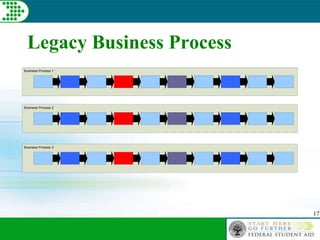
Legacy Business Process
Business Process 1
Business Process 2
Business Process 3
18
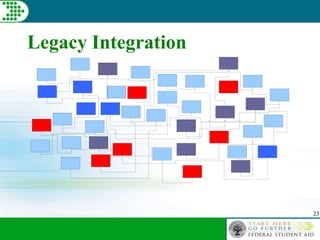
Architectural Choke Point
• Monolithic
• Extremely complex
• Very tightly coupled
• Difficult to find clean integration points
• Lack of standards makes it difficult to
integrate
• Rigid architecture makes even small
changes complex and costly
19
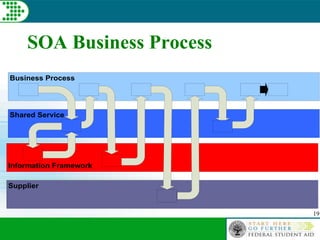
SOA Business Process
Business Process
Shared Service
Information Framework
Supplier
Technical Track Session
How Do You Build a
Service-Oriented
Architecture Solution?
21
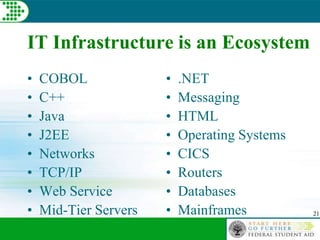
IT Infrastructure is an Ecosystem
• COBOL
• C++
• Java
• J2EE
• Networks
• TCP/IP
• Web Service
• Mid-Tier Servers
• .NET
• Messaging
• HTML
• Operating Systems
• CICS
• Routers
• Databases
• Mainframes
22
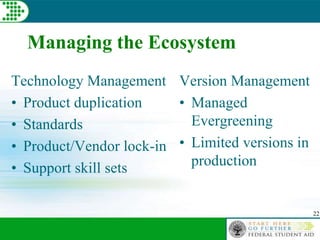
Managing the Ecosystem
Technology Management
• Product duplication
• Standards
• Product/Vendor lock-in
• Support skill sets
Version Management
• Managed
Evergreening
• Limited versions in
production
23
Legacy Integration
24
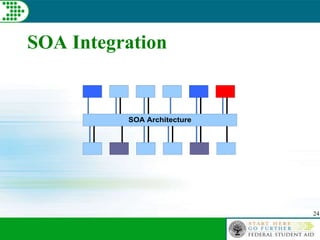
SOA Integration
SOA Architecture
25
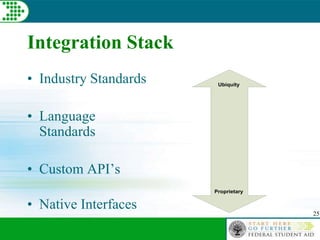
Integration Stack
• Industry Standards
• Language
Standards
• Custom API’s
• Native Interfaces
Ubiquity
Proprietary
Technical Track Session
Enterprise Service Bus
27
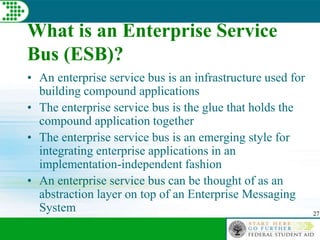
What is an Enterprise Service
Bus (ESB)?
• An enterprise service bus is an infrastructure used for
building compound applications
• The enterprise service bus is the glue that holds the
compound application together
• The enterprise service bus is an emerging style for
integrating enterprise applications in an
implementation-independent fashion
• An enterprise service bus can be thought of as an
abstraction layer on top of an Enterprise Messaging
System
28
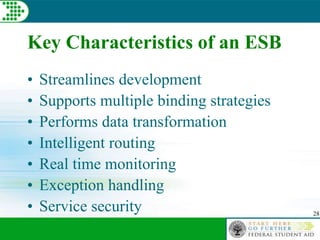
Key Characteristics of an ESB
• Streamlines development
• Supports multiple binding strategies
• Performs data transformation
• Intelligent routing
• Real time monitoring
• Exception handling
• Service security
29
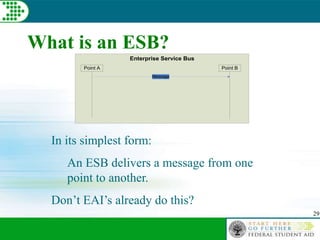
What is an ESB?
In its simplest form:
An ESB delivers a message from one
point to another.
Don’t EAI’s already do this?
Enterprise Service Bus
Point A Point B
Message
30
EAI Limitations
• An EAI can be a tightly coupled
solution
• An EAI can be location-specific
• An EAI can be based on
proprietary transport technology
31
Let’s Walk Through the ESB
• Get Person Data
• Use Standard Student Identification
Method (SSIM) identifiers to find the
person
• Return the Person Data
This is a fictional-use case, and is only intended to
illustrate how an ESB would provide a service.
32
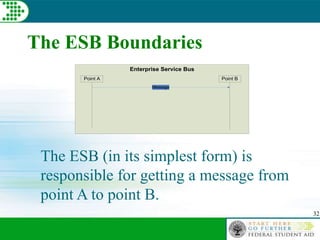
The ESB Boundaries
The ESB (in its simplest form) is
responsible for getting a message from
point A to point B.
Enterprise Service Bus
Point A Point B
Message
33
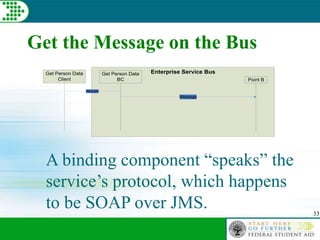
Get the Message on the Bus
A binding component “speaks” the
service’s protocol, which happens
to be SOAP over JMS.
Enterprise Service Bus
Point B
Message
Get Person Data
Client
Request
Get Person Data
BC
34
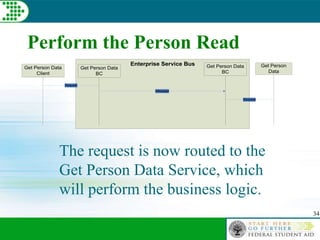
Perform the Person Read
The request is now routed to the
Get Person Data Service, which
will perform the business logic.
Enterprise Service Bus
Message
Get Person
Data
Request
Get Person Data
Client
Request
Get Person Data
BC
Get Person Data
BC
35
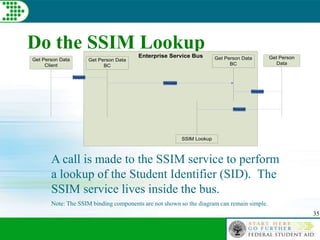
Do the SSIM Lookup
A call is made to the SSIM service to perform
a lookup of the Student Identifier (SID). The
SSIM service lives inside the bus.
Note: The SSIM binding components are not shown so the diagram can remain simple.
Enterprise Service Bus
SSIM Lookup
Message
Get Person
Data
Request
Get Person Data
Client
Request
Get Person Data
BC
Get Person Data
BC
Request
36
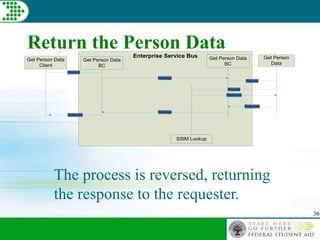
Return the Person Data
The process is reversed, returning
the response to the requester.
Enterprise Service Bus
Response
Message
Response
SSIM Lookup
Message
Get Person
Data
Request
Get Person Data
Client
Request
Get Person Data
BC
Get Person Data
BC
Request
Response
37
ESB Summary
• Loose Coupling
• Location Transparency
• Transport Neutral
38
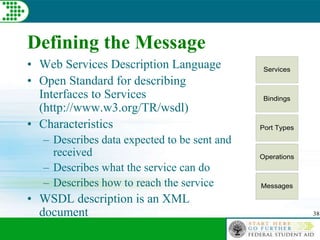
Defining the Message
• Web Services Description Language
• Open Standard for describing
Interfaces to Services
(http://www.w3.org/TR/wsdl)
• Characteristics
– Describes data expected to be sent and
received
– Describes what the service can do
– Describes how to reach the service
• WSDL description is an XML
document
Services
Bindings
Port Types
Operations
Messages
39
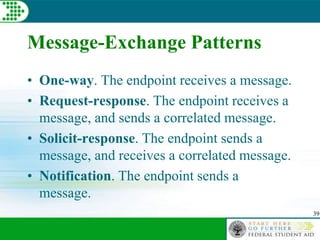
Message-Exchange Patterns
• One-way. The endpoint receives a message.
• Request-response. The endpoint receives a
message, and sends a correlated message.
• Solicit-response. The endpoint sends a
message, and receives a correlated message.
• Notification. The endpoint sends a
message.
Technical Track Session
Building a Compound
Application
41
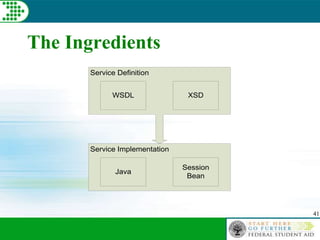
The Ingredients
Service Definition
WSDL XSD
Service Implementation
Java
Session
Bean
42
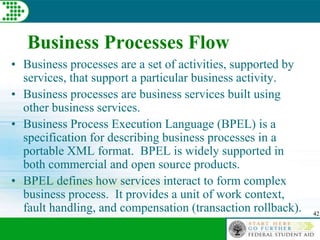
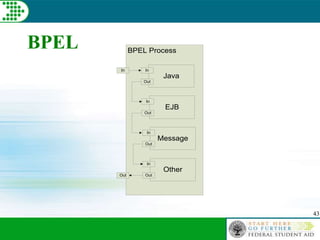
Business Processes Flow
• Business processes are a set of activities, supported by
services, that support a particular business activity.
• Business processes are business services built using
other business services.
• Business Process Execution Language (BPEL) is a
specification for describing business processes in a
portable XML format. BPEL is widely supported in
both commercial and open source products.
• BPEL defines how services interact to form complex
business process. It provides a unit of work context,
fault handling, and compensation (transaction rollback).
43
BPEL BPEL Process
In
Java
In
Out
EJB
In
Out
Message
In
Out
Other
In
OutOut
44
What BPEL does …
• BPEL binds services together to form
larger complex business services
• Control Flow (branch, loop, parallel)
• Asynchronous correlation
• Transaction support, Units of Work
• Compensation
45
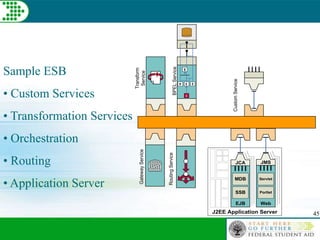
Sample ESB
• Custom Services
• Transformation Services
• Orchestration
• Routing
• Application Server
BPELService
1
5
4 23
Transform
ServiceGatewayService
RoutingService
J2EE Application Server
Web
Servlet
Portlet
JMS
EJB
MDB
SSB
JCA
CustomService
46
Summary
• What is Service-Oriented
Architecture?
• How do you build a Service-
Oriented Architecture solution?
• What is an Enterprise Service Bus?
47
We appreciate your feedback and
comments. We can be reached at:
Phone: 202 377 3023
Email: Terry.Woods@ed.gov
Contact Information

Cs 1023 lec 12 soa (week 4)

  • 1.
  • 2.
    2 Agenda • A littlehistory • What is Service-Oriented Architecture? • How do you build a Service-Oriented Architecture Solution? • What is an Enterprise Service Bus? • Summary
  • 3.
  • 4.
    4 In the Beginning… • Computers were the domain of scientists for scientists • Business and Government discovered the value of computing • Business requirements needed to be captured and programmed
  • 5.
    5 Some Past Attempts… • COBOL – It was designed to be business-problem oriented, machine-independent, and capable of continuous change and development. • SQL – The SQL "language" allows anyone with a computer terminal to access and use relational databases. Originally thought to be an end-user tool. • SAD – Structured Analysis and Design (Yourdon/DeMarco) • IE – Information engineering (design by pictures) James Martin • OOAD – Object-Oriented Analysis and Design
  • 6.
    6 Revolution … • Revolution –COBOL – Basic programming language – C programming language – SQL – Structured analyses and design – Electronic data exchange • Evolution – Web Services – Information Engineering – CASE – C++ – Java – Object-Oriented Analysis and Design – HTML – Common Record (XML) • Ecosystem – Standards – SOA
  • 7.
    Technical Track Session Whatis Service-Oriented Architecture?
  • 8.
    8 What is Service-Oriented Architecture? •Service-Oriented Architecture (SOA) is an architectural style. Applications built using an SOA style deliver functionality as services that can be used or reused when building applications or integrating within the enterprise or trading partners.
  • 9.
    9 SOA • Uses openstandards to integrate software assets as services • Standardizes interactions of services • Services become building blocks that form business flows • Services can be reused by other applications
  • 10.
    10 What is aService? • A service is a reusable component that can be used as a building block to form larger, more complex business- application functionality. • A service may be as simple as “get me some person data,” or as complex as “process a disbursement.”
  • 11.
    11 What is aService? • A service provides a discrete business function that operates on data. Its job is to ensure that the business functionality is applied consistently, returns predictable results, and operates within the quality of service required.
  • 12.
    12 What is aService? • How the service is implemented, and how a user of the service accesses it, are limited only by the SOA infrastructure choices of the enterprise. • From a theory point of view, it really doesn’t matter how a service is implemented.
  • 13.
    13 Characteristics of aService • Supports open standards for integration: Although proprietary integration mechanisms may be offered by the SOA infrastructure, SOA’s should be based on open standards. Open standards ensure the broadest integration compatibility opportunities.
  • 14.
    14 Characteristics of aService • Loose coupling: The consumer of the service is required to provide only the stated data on the interface definition, and to expect only the specified results on the interface definition. The service is capable of handling all processing (including exception processing).
  • 15.
    15 Characteristics of aService • Stateless: The service does not maintain state between invocations. It takes the parameters provided, performs the defined function, and returns the expected result. If a transaction is involved, the transaction is committed and the data is saved to the database.
  • 16.
    16 Characteristics of aService • Location agnostic: Users of the service do not need to worry about the implementation details for accessing the service. The SOA infrastructure will provide standardized access mechanisms with service-level agreements.
  • 17.
    17 Legacy Business Process BusinessProcess 1 Business Process 2 Business Process 3
  • 18.
    18 Architectural Choke Point •Monolithic • Extremely complex • Very tightly coupled • Difficult to find clean integration points • Lack of standards makes it difficult to integrate • Rigid architecture makes even small changes complex and costly
  • 19.
    19 SOA Business Process BusinessProcess Shared Service Information Framework Supplier
  • 20.
    Technical Track Session HowDo You Build a Service-Oriented Architecture Solution?
  • 21.
    21 IT Infrastructure isan Ecosystem • COBOL • C++ • Java • J2EE • Networks • TCP/IP • Web Service • Mid-Tier Servers • .NET • Messaging • HTML • Operating Systems • CICS • Routers • Databases • Mainframes
  • 22.
    22 Managing the Ecosystem TechnologyManagement • Product duplication • Standards • Product/Vendor lock-in • Support skill sets Version Management • Managed Evergreening • Limited versions in production
  • 23.
  • 24.
  • 25.
    25 Integration Stack • IndustryStandards • Language Standards • Custom API’s • Native Interfaces Ubiquity Proprietary
  • 26.
  • 27.
    27 What is anEnterprise Service Bus (ESB)? • An enterprise service bus is an infrastructure used for building compound applications • The enterprise service bus is the glue that holds the compound application together • The enterprise service bus is an emerging style for integrating enterprise applications in an implementation-independent fashion • An enterprise service bus can be thought of as an abstraction layer on top of an Enterprise Messaging System
  • 28.
    28 Key Characteristics ofan ESB • Streamlines development • Supports multiple binding strategies • Performs data transformation • Intelligent routing • Real time monitoring • Exception handling • Service security
  • 29.
    29 What is anESB? In its simplest form: An ESB delivers a message from one point to another. Don’t EAI’s already do this? Enterprise Service Bus Point A Point B Message
  • 30.
    30 EAI Limitations • AnEAI can be a tightly coupled solution • An EAI can be location-specific • An EAI can be based on proprietary transport technology
  • 31.
    31 Let’s Walk Throughthe ESB • Get Person Data • Use Standard Student Identification Method (SSIM) identifiers to find the person • Return the Person Data This is a fictional-use case, and is only intended to illustrate how an ESB would provide a service.
  • 32.
    32 The ESB Boundaries TheESB (in its simplest form) is responsible for getting a message from point A to point B. Enterprise Service Bus Point A Point B Message
  • 33.
    33 Get the Messageon the Bus A binding component “speaks” the service’s protocol, which happens to be SOAP over JMS. Enterprise Service Bus Point B Message Get Person Data Client Request Get Person Data BC
  • 34.
    34 Perform the PersonRead The request is now routed to the Get Person Data Service, which will perform the business logic. Enterprise Service Bus Message Get Person Data Request Get Person Data Client Request Get Person Data BC Get Person Data BC
  • 35.
    35 Do the SSIMLookup A call is made to the SSIM service to perform a lookup of the Student Identifier (SID). The SSIM service lives inside the bus. Note: The SSIM binding components are not shown so the diagram can remain simple. Enterprise Service Bus SSIM Lookup Message Get Person Data Request Get Person Data Client Request Get Person Data BC Get Person Data BC Request
  • 36.
    36 Return the PersonData The process is reversed, returning the response to the requester. Enterprise Service Bus Response Message Response SSIM Lookup Message Get Person Data Request Get Person Data Client Request Get Person Data BC Get Person Data BC Request Response
  • 37.
    37 ESB Summary • LooseCoupling • Location Transparency • Transport Neutral
  • 38.
    38 Defining the Message •Web Services Description Language • Open Standard for describing Interfaces to Services (http://www.w3.org/TR/wsdl) • Characteristics – Describes data expected to be sent and received – Describes what the service can do – Describes how to reach the service • WSDL description is an XML document Services Bindings Port Types Operations Messages
  • 39.
    39 Message-Exchange Patterns • One-way.The endpoint receives a message. • Request-response. The endpoint receives a message, and sends a correlated message. • Solicit-response. The endpoint sends a message, and receives a correlated message. • Notification. The endpoint sends a message.
  • 40.
    Technical Track Session Buildinga Compound Application
  • 41.
    41 The Ingredients Service Definition WSDLXSD Service Implementation Java Session Bean
  • 42.
    42 Business Processes Flow •Business processes are a set of activities, supported by services, that support a particular business activity. • Business processes are business services built using other business services. • Business Process Execution Language (BPEL) is a specification for describing business processes in a portable XML format. BPEL is widely supported in both commercial and open source products. • BPEL defines how services interact to form complex business process. It provides a unit of work context, fault handling, and compensation (transaction rollback).
  • 43.
  • 44.
    44 What BPEL does… • BPEL binds services together to form larger complex business services • Control Flow (branch, loop, parallel) • Asynchronous correlation • Transaction support, Units of Work • Compensation
  • 45.
    45 Sample ESB • CustomServices • Transformation Services • Orchestration • Routing • Application Server BPELService 1 5 4 23 Transform ServiceGatewayService RoutingService J2EE Application Server Web Servlet Portlet JMS EJB MDB SSB JCA CustomService
  • 46.
    46 Summary • What isService-Oriented Architecture? • How do you build a Service- Oriented Architecture solution? • What is an Enterprise Service Bus?
  • 47.
    47 We appreciate yourfeedback and comments. We can be reached at: Phone: 202 377 3023 Email: Terry.Woods@ed.gov Contact Information