FALCON HEAVY
BY-Randeep Singh
RNTC 1519 059
LaunchVehicle
A rocket-powered vehicle used to send artificial satellites or
spacecraft into space.
Types of Launch vehicle
• Expendable Launch Vehicle: Launch system that is used only
once to carry a payload into space.
• Re-Usable Launch Vehicle: Launch system that is used
intended to allow for recovery of all or part of the system for
later reuse.
FALCON HEVAY
Falcon Heavy is the most powerful operational rocket in the world by a factor
of two.
• It have ability to lift into orbit nearly 64 metric tons, which is greater than a
737 jetliner loaded with passengers, crew, luggage and fuel.
• Falcon Heavy can lift more than twice the payload of the next closest
operational vehicle, the Delta IV Heavy, at one-third the cost.
Features of Falcon Heavy
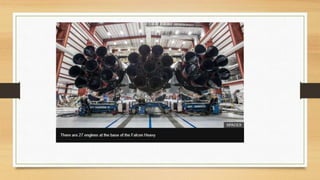
• Its first stage is composed of three Falcon 9 engine whose 27
Merlin engines together generate more than 5 million pounds
of thrust at liftoff, equal to approximately eighteen 747
aircraft.
• Falcon Heavy was designed from the outset to carry humans
into space and restores the possibility of flying missions with
crew to the Moon or Mars.
First Stage of Falcon Heavy
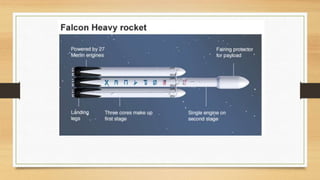
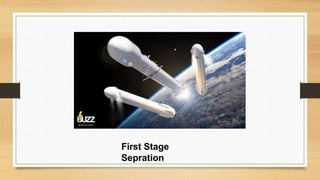
Three cores make up the first stage of Falcon Heavy. The side
cores, or boosters, are connected at the base and at the top of
the center core’s liquid oxygen tank. The three cores, with a
total of 27 Merlin engines, generate 5.13 million pounds of
thrust at liftoff. Shortly after liftoff the center core engines are
throttled down. After the side cores separate, the center core
engines throttle back up to full thrust.
First Stage
Sepration
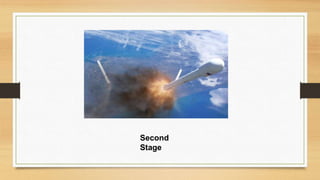
Second Stage of Falcon Heavy
The second-stage Merlin engine, identical to its
counterpart on Falcon 9, delivers the rocket’s payload to
orbit after the main engines cut off and the first-stage
cores separate. The engine can be restarted multiple
times to place payloads into a variety of orbits including
low geosynchronous transfer orbit (GTO) and
geosynchronous orbit (GSO).
Second
Stage
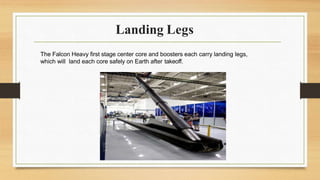
Landing Legs
The Falcon Heavy first stage center core and boosters each carry landing legs,
which will land each core safely on Earth after takeoff.
Advantage of Falcon Heavy
It is a reusable launch vehicle.
 The cost is being reduced by 40 percent.
The stage-1 can be landed any were means in a ship or sea drone which
is very efficient.
Disadvantage of FalconHeavy
Renovate a rocket engine is often expensive. And if those repairstake
too long, Space X cant launch its vehicles as frequently.
To launch Falcon Heavy the climate condition should be absolute
normal.
Conclusion
• It is a reusable launch vehicle.
• Cost efficient launch vehicle.
• 5 millions pounds of thrust generated by Falcon Heavy.
• Falcon Heavy equals approximately eighteen 747 aircraft at full power.
Below is a comparison chart of the world’s heavy lift vehicles.
THANK YOU

Falconheavy

  • 1.
  • 3.
    LaunchVehicle A rocket-powered vehicleused to send artificial satellites or spacecraft into space. Types of Launch vehicle • Expendable Launch Vehicle: Launch system that is used only once to carry a payload into space. • Re-Usable Launch Vehicle: Launch system that is used intended to allow for recovery of all or part of the system for later reuse.
  • 4.
    FALCON HEVAY Falcon Heavyis the most powerful operational rocket in the world by a factor of two. • It have ability to lift into orbit nearly 64 metric tons, which is greater than a 737 jetliner loaded with passengers, crew, luggage and fuel. • Falcon Heavy can lift more than twice the payload of the next closest operational vehicle, the Delta IV Heavy, at one-third the cost.
  • 7.
    Features of FalconHeavy • Its first stage is composed of three Falcon 9 engine whose 27 Merlin engines together generate more than 5 million pounds of thrust at liftoff, equal to approximately eighteen 747 aircraft. • Falcon Heavy was designed from the outset to carry humans into space and restores the possibility of flying missions with crew to the Moon or Mars.
  • 8.
    First Stage ofFalcon Heavy Three cores make up the first stage of Falcon Heavy. The side cores, or boosters, are connected at the base and at the top of the center core’s liquid oxygen tank. The three cores, with a total of 27 Merlin engines, generate 5.13 million pounds of thrust at liftoff. Shortly after liftoff the center core engines are throttled down. After the side cores separate, the center core engines throttle back up to full thrust.
  • 9.
  • 10.
    Second Stage ofFalcon Heavy The second-stage Merlin engine, identical to its counterpart on Falcon 9, delivers the rocket’s payload to orbit after the main engines cut off and the first-stage cores separate. The engine can be restarted multiple times to place payloads into a variety of orbits including low geosynchronous transfer orbit (GTO) and geosynchronous orbit (GSO).
  • 11.
  • 12.
    Landing Legs The FalconHeavy first stage center core and boosters each carry landing legs, which will land each core safely on Earth after takeoff.
  • 13.
    Advantage of FalconHeavy It is a reusable launch vehicle.  The cost is being reduced by 40 percent. The stage-1 can be landed any were means in a ship or sea drone which is very efficient.
  • 14.
    Disadvantage of FalconHeavy Renovatea rocket engine is often expensive. And if those repairstake too long, Space X cant launch its vehicles as frequently. To launch Falcon Heavy the climate condition should be absolute normal.
  • 15.
    Conclusion • It isa reusable launch vehicle. • Cost efficient launch vehicle. • 5 millions pounds of thrust generated by Falcon Heavy. • Falcon Heavy equals approximately eighteen 747 aircraft at full power. Below is a comparison chart of the world’s heavy lift vehicles.
  • 16.