METALLURGICAL AND MATERIAL
ENGINEERING DEPARTMENT
NITW
Seminar report on
DRY MACHINING
By
SUSHAN DESHMUKH
Roll no:175553
CONTENT
 Introduction
 Conventional Wet Machining
 Purpose of Cutting Fluid
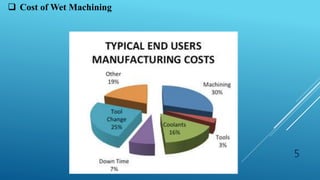
 Cost of Wet Machining
 Major Problems with Wet Machining
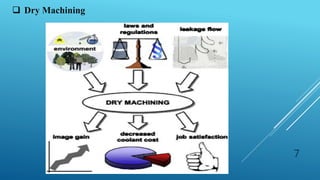
 Dry Machining
 Challenges
 Strategies and Solutions for Successful Dry Machining
 Application of Dry Machining
 Advantages
 References
2
 Introduction
Manufacturing activity is a major consumer of energy and natural resources.
In machining process, a large amount of heat is produced whose removal requires the use of
suitable cooling agents or cutting fluids.
These cutting fluids are a major source of waste generation and environmental damage.
To eliminate hazardous cutting fluids during machining operations, researchers have tried
machining components without applying cutting fluids, which is known as dry
machining.
3
4
 Conventional Wet Machining
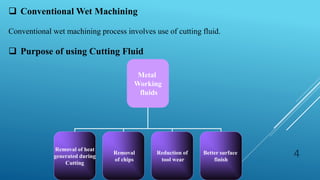
Conventional wet machining process involves use of cutting fluid.
 Purpose of using Cutting Fluid
Metal
Working
fluids
Removal of heat
generated during
Cutting
Removal
of chips
Reduction of
tool wear
Better surface
finish
5
 Cost of Wet Machining
6
 Major Problems with Conventional Process
 Wetting and dirtiness
 Corrosion and contamination of the lubricating system
 Need of storage, additional floor space, pumping system,
recycling and disposal
 Environmental pollutions and health hazards.
7
 Dry Machining
8
 Challenges
Dry machining often causes excessive temperature rise leading to poor tool life and
machined surface damage.
The main issues which restricts the practical implementation of dry machining are
1. Tool Life
2. Work-piece Geometrical Accuracies
3. Work-piece Surface Integrity
4. Machinability of Materials
9
1. Tool Life
 Average temperature near cutting tool edge is much higher
 It cause softening of tool cutting edge since the tool materials lose their hardness
at elevated temperature.
2. Work-piece Geometrical Accuracies
 Heat retention in work piece material
 Retained heat cause thermal deformations in machined parts
3. Work-piece Surface Integrity
 Excessive heat built up during dry machining raises the temperature of the
surface layer to level where phase transformation and microstructure alteration.
 It also cause the formation of hard layer on surface ( white layer when
observed under microscope)
10
4. Machinability of Materials
 Most commonly used metals in engineering applications are LCS, MCS,
Austenitic stainless steel, CI, nickel, titanium, copper and aluminium alloys etc.
 Some of these materials exhibits difficulties in machining without aid of cutting
fluids due to excessive generation of heat and high interfacial temperature.
 Strategies and Solution for Successful Dry Machining
1. Tool Materials
2. Tool Coatings
3. Hybrid Machining
4. MQL Machining
5. Cryogenic Machining
6. Under-Cooling Machining
7. Internal cooling by a vapourisation system
8. Thermoelectric Cooling System
11
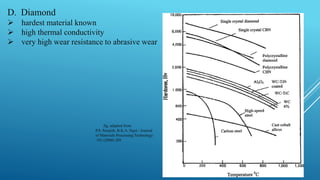
1. Tool Materials
 Dry cutting typically results in elevated tool temperature as compared to wet
machining.
 Primary requirement of a suitable tool for dry machining is the ability to retain
hardness at high temperature or hot hardness.
 the tool should be able to resist high stresses
Most widely used tool materials in dry machining are :
a. Carbide of tungsten, titanium and tantalum
b. Ceramics
c. Cubic boron nitride
d. Diamond
12
A. Carbide of tungsten, titanium and tantalum
 grain size in range 10µm- 1µm
 high hot hardness and wear resistance
B. Ceramics
 withstand at higher temperature and retain the sharpness of cutting edge for
longer duration even at elevated temperature
 high hardness and wear resistance
 suitable for high speed dry machining
C. Cubic Boron Nitride
 harder than cemented carbide and ceramics at high temperature
 chemically inert at high temperature
 high wear resistance
13
D. Diamond
 hardest material known
 high thermal conductivity
 very high wear resistance to abrasive wear
fig. adapted from
P.S. Sreejith, B.K.A. Ngoi / Journal
of Materials Processing Technology
101 (2000) 288
14
2. Tool Coatings
 coating helps to reduce friction at tool-work interface and hence compensate for
lubricating effects of cutting oils
 coatings are made from hard materials such as TiN, TiCN, CrN, CBN and
Diamond
a. Multilayered nano-coatings : avoid catastrophic fracture
b. Self lubricating coatings
c. cubic boron nitride and diamond coatings
3. Hybrid Machining
a. Vibration assisted machining
b. laser and plasma assisted machining
15
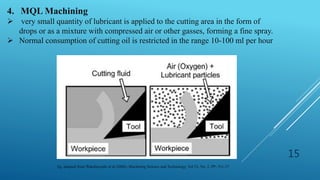
4. MQL Machining
 very small quantity of lubricant is applied to the cutting area in the form of
drops or as a mixture with compressed air or other gasses, forming a fine spray.
 Normal consumption of cutting oil is restricted in the range 10-100 ml per hour
fig. adapted from Wakabayashi et al (2006), Machining Science and Technology, Vol 53, No. 2, PP- 511-37
16
5. Cryogenic Machining
 machining with liquid nitrogen at cryogenic temperatures at about -196ºC
 Liquid nitrogen evaporates into the air as it comes in contact with the tool and
work-piece leaving no trace of any harmful agents
 it provides an excellent cooling effect in machining due to its very low temperature
6. Under-cooling System
 the coolant flows through channels located under the insert, then out to the
environment, without any direct contact with the cutting zone.
7. Internal cooling by a vapourisation system
 in which a vapourisable liquid is introduced inside the shank of the tool and
vapourised on the underside surface of the insert
17
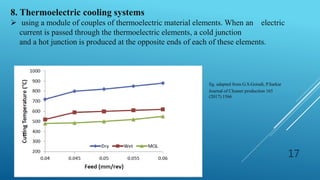
8. Thermoelectric cooling systems
 using a module of couples of thermoelectric material elements. When an electric
current is passed through the thermoelectric elements, a cold junction
and a hot junction is produced at the opposite ends of each of these elements.
fig. adapted from G.S.Goindi, P.Sarkar
Journal of Cleaner production 165
(2017) 1566
18
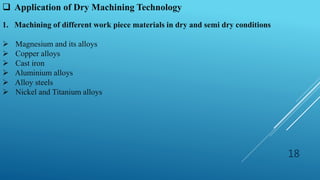
 Application of Dry Machining Technology
1. Machining of different work piece materials in dry and semi dry conditions
 Magnesium and its alloys
 Copper alloys
 Cast iron
 Aluminium alloys
 Alloy steels
 Nickel and Titanium alloys
19
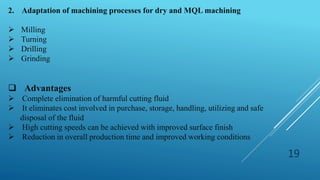
2. Adaptation of machining processes for dry and MQL machining
 Milling
 Turning
 Drilling
 Grinding
 Advantages
 Complete elimination of harmful cutting fluid
 It eliminates cost involved in purchase, storage, handling, utilizing and safe
disposal of the fluid
 High cutting speeds can be achieved with improved surface finish
 Reduction in overall production time and improved working conditions
20
 References
 P.S. Sreejith, B.K.A. Ngoi, Dry machining: Machining of the future, Journal of
Materials Processing Technology 101 (2000) 287-291
 Gyanendra Singh Goindi, Prabir Sarkar, Dry machining: A step towards sustainable
machining - Challenges and future directions, Journal of Cleaner Production 165
(2017) 1557-1571
 Bhanot, N. Rao, P.V. Deshmukh, S.G. 2015. Sustainable manufacturing: an
interaction analysis for machining parameters using graph theory. Oper. Manag.
Digit. Econ. 189, 57-63.
 Banerjee, N., Sharma, A., 2014. Identification of a friction model for minimum
quantity lubrication machining. J. Clean. Prod. 83, 437-443.
 Daniel, C. M., Olson, W. W., & Sutherland, J.W. (1997). Research advances in dry
and semi-dry machining (Technical Paper No.970415) Society of Automotive
Engineers.
 Wakabayashi et al (2006), Machining Science and Technology, Vol 53, No. 2, PP-
511-37
21
Thank you

Dry Machining

  • 1.
    METALLURGICAL AND MATERIAL ENGINEERINGDEPARTMENT NITW Seminar report on DRY MACHINING By SUSHAN DESHMUKH Roll no:175553
  • 2.
    CONTENT  Introduction  ConventionalWet Machining  Purpose of Cutting Fluid  Cost of Wet Machining  Major Problems with Wet Machining  Dry Machining  Challenges  Strategies and Solutions for Successful Dry Machining  Application of Dry Machining  Advantages  References 2
  • 3.
     Introduction Manufacturing activityis a major consumer of energy and natural resources. In machining process, a large amount of heat is produced whose removal requires the use of suitable cooling agents or cutting fluids. These cutting fluids are a major source of waste generation and environmental damage. To eliminate hazardous cutting fluids during machining operations, researchers have tried machining components without applying cutting fluids, which is known as dry machining. 3
  • 4.
    4  Conventional WetMachining Conventional wet machining process involves use of cutting fluid.  Purpose of using Cutting Fluid Metal Working fluids Removal of heat generated during Cutting Removal of chips Reduction of tool wear Better surface finish
  • 5.
    5  Cost ofWet Machining
  • 6.
    6  Major Problemswith Conventional Process  Wetting and dirtiness  Corrosion and contamination of the lubricating system  Need of storage, additional floor space, pumping system, recycling and disposal  Environmental pollutions and health hazards.
  • 7.
  • 8.
    8  Challenges Dry machiningoften causes excessive temperature rise leading to poor tool life and machined surface damage. The main issues which restricts the practical implementation of dry machining are 1. Tool Life 2. Work-piece Geometrical Accuracies 3. Work-piece Surface Integrity 4. Machinability of Materials
  • 9.
    9 1. Tool Life Average temperature near cutting tool edge is much higher  It cause softening of tool cutting edge since the tool materials lose their hardness at elevated temperature. 2. Work-piece Geometrical Accuracies  Heat retention in work piece material  Retained heat cause thermal deformations in machined parts 3. Work-piece Surface Integrity  Excessive heat built up during dry machining raises the temperature of the surface layer to level where phase transformation and microstructure alteration.  It also cause the formation of hard layer on surface ( white layer when observed under microscope)
  • 10.
    10 4. Machinability ofMaterials  Most commonly used metals in engineering applications are LCS, MCS, Austenitic stainless steel, CI, nickel, titanium, copper and aluminium alloys etc.  Some of these materials exhibits difficulties in machining without aid of cutting fluids due to excessive generation of heat and high interfacial temperature.  Strategies and Solution for Successful Dry Machining 1. Tool Materials 2. Tool Coatings 3. Hybrid Machining 4. MQL Machining 5. Cryogenic Machining 6. Under-Cooling Machining 7. Internal cooling by a vapourisation system 8. Thermoelectric Cooling System
  • 11.
    11 1. Tool Materials Dry cutting typically results in elevated tool temperature as compared to wet machining.  Primary requirement of a suitable tool for dry machining is the ability to retain hardness at high temperature or hot hardness.  the tool should be able to resist high stresses Most widely used tool materials in dry machining are : a. Carbide of tungsten, titanium and tantalum b. Ceramics c. Cubic boron nitride d. Diamond
  • 12.
    12 A. Carbide oftungsten, titanium and tantalum  grain size in range 10µm- 1µm  high hot hardness and wear resistance B. Ceramics  withstand at higher temperature and retain the sharpness of cutting edge for longer duration even at elevated temperature  high hardness and wear resistance  suitable for high speed dry machining C. Cubic Boron Nitride  harder than cemented carbide and ceramics at high temperature  chemically inert at high temperature  high wear resistance
  • 13.
    13 D. Diamond  hardestmaterial known  high thermal conductivity  very high wear resistance to abrasive wear fig. adapted from P.S. Sreejith, B.K.A. Ngoi / Journal of Materials Processing Technology 101 (2000) 288
  • 14.
    14 2. Tool Coatings coating helps to reduce friction at tool-work interface and hence compensate for lubricating effects of cutting oils  coatings are made from hard materials such as TiN, TiCN, CrN, CBN and Diamond a. Multilayered nano-coatings : avoid catastrophic fracture b. Self lubricating coatings c. cubic boron nitride and diamond coatings 3. Hybrid Machining a. Vibration assisted machining b. laser and plasma assisted machining
  • 15.
    15 4. MQL Machining very small quantity of lubricant is applied to the cutting area in the form of drops or as a mixture with compressed air or other gasses, forming a fine spray.  Normal consumption of cutting oil is restricted in the range 10-100 ml per hour fig. adapted from Wakabayashi et al (2006), Machining Science and Technology, Vol 53, No. 2, PP- 511-37
  • 16.
    16 5. Cryogenic Machining machining with liquid nitrogen at cryogenic temperatures at about -196ºC  Liquid nitrogen evaporates into the air as it comes in contact with the tool and work-piece leaving no trace of any harmful agents  it provides an excellent cooling effect in machining due to its very low temperature 6. Under-cooling System  the coolant flows through channels located under the insert, then out to the environment, without any direct contact with the cutting zone. 7. Internal cooling by a vapourisation system  in which a vapourisable liquid is introduced inside the shank of the tool and vapourised on the underside surface of the insert
  • 17.
    17 8. Thermoelectric coolingsystems  using a module of couples of thermoelectric material elements. When an electric current is passed through the thermoelectric elements, a cold junction and a hot junction is produced at the opposite ends of each of these elements. fig. adapted from G.S.Goindi, P.Sarkar Journal of Cleaner production 165 (2017) 1566
  • 18.
    18  Application ofDry Machining Technology 1. Machining of different work piece materials in dry and semi dry conditions  Magnesium and its alloys  Copper alloys  Cast iron  Aluminium alloys  Alloy steels  Nickel and Titanium alloys
  • 19.
    19 2. Adaptation ofmachining processes for dry and MQL machining  Milling  Turning  Drilling  Grinding  Advantages  Complete elimination of harmful cutting fluid  It eliminates cost involved in purchase, storage, handling, utilizing and safe disposal of the fluid  High cutting speeds can be achieved with improved surface finish  Reduction in overall production time and improved working conditions
  • 20.
    20  References  P.S.Sreejith, B.K.A. Ngoi, Dry machining: Machining of the future, Journal of Materials Processing Technology 101 (2000) 287-291  Gyanendra Singh Goindi, Prabir Sarkar, Dry machining: A step towards sustainable machining - Challenges and future directions, Journal of Cleaner Production 165 (2017) 1557-1571  Bhanot, N. Rao, P.V. Deshmukh, S.G. 2015. Sustainable manufacturing: an interaction analysis for machining parameters using graph theory. Oper. Manag. Digit. Econ. 189, 57-63.  Banerjee, N., Sharma, A., 2014. Identification of a friction model for minimum quantity lubrication machining. J. Clean. Prod. 83, 437-443.  Daniel, C. M., Olson, W. W., & Sutherland, J.W. (1997). Research advances in dry and semi-dry machining (Technical Paper No.970415) Society of Automotive Engineers.  Wakabayashi et al (2006), Machining Science and Technology, Vol 53, No. 2, PP- 511-37
  • 21.

Editor's Notes

  • #6 Cost includes storage, additional floor space, pumping system, recycling and disposal