Facilitating scaling: Initial ideas
for Livestock CRP Integrated Core
Project
Helena Posthumus
1
Livestock CRP Priority Countries Planning Meeting
26 – 27 March 2019
Nairobi, Kenya
Scaling for impact
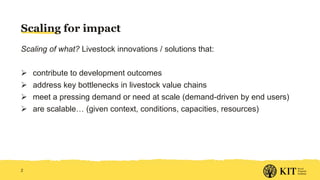
Scaling of what? Livestock innovations / solutions that:
 contribute to development outcomes
 address key bottlenecks in livestock value chains
 meet a pressing demand or need at scale (demand-driven by end users)
 are scalable… (given context, conditions, capacities, resources)
2
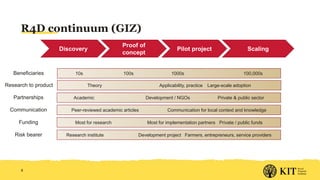
R4D continuum (GIZ)
4
Discovery
Proof of
concept
Pilot project Scaling
10s 100s 1000s 100,000sBeneficiaries
Theory Applicability, practice Large-scale adoptionResearch to product
Academic Development / NGOs Private & public sectorPartnerships
Peer-reviewed academic articles Communication for local context and knowledgeCommunication
Most for research Most for implementation partners Private / public fundsFunding
Research institute Development project Farmers, entrepreneurs, service providersRisk bearer
5
Schut et al. 2009
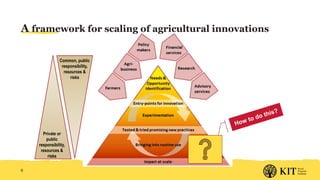
A framework for scaling of agricultural innovations
6
Common, public
responsibility,
resources &
risks
Private or
public
responsibility,
resources &
risks
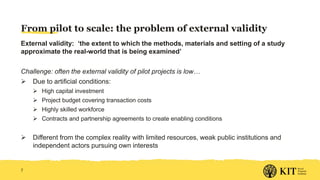
From pilot to scale: the problem of external validity
External validity: ‘the extent to which the methods, materials and setting of a study
approximate the real-world that is being examined’
Challenge: often the external validity of pilot projects is low…
 Due to artificial conditions:
 High capital investment
 Project budget covering transaction costs
 Highly skilled workforce
 Contracts and partnership agreements to create enabling conditions
 Different from the complex reality with limited resources, weak public institutions and
independent actors pursuing own interests
7
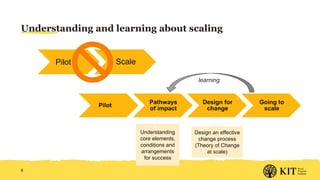
Understanding and learning about scaling
8
Pilot Scale
Pilot
Pathways
of impact
Design for
change
Going to
scale
Understanding
core elements,
conditions and
arrangements
for success
Design an effective
change process
(Theory of Change
at scale)
learning
Understanding external validity
Some questions to understand external validity of pilot projects:
• What are the enabling factors and conditions that make your intervention successful?
• What are the economies and diseconomies of scale of best-bets?
• What are the transaction costs (search & information costs; bargaining & decision costs;
policing & enforcement costs), and who will pay in real life?
• Who will become the bearer of risk and uncertainty?
• Can agreements and conditions (enabling environment) created in pilot projects be
replicated by (public or private) institutions at scale?
9
Scaling for impact
Lessons on going from pilot to scale:
• Do more than disseminate or replicate
• Make sure there is a demand or need for the innovation at scale
• Have a mix of activities which improve value chain relations, agricultural services and the institutional
environment – linking up with relevant partners
• Address the constraints and use the strengths of the target beneficiaries
• Bring the right processes, set of arrangements and enabling conditions to scale (that make the
innovation appropriate, effective and useful)…
• …or assess whether the required set of arrangements and enabling conditions are present at scale
for your best-bets
• Complement on-going interventions and build on existing experiences (“clean sites” don’t exist…)
10
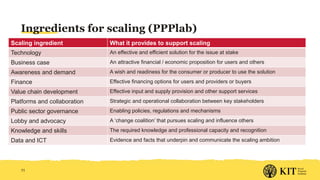
Ingredients for scaling (PPPlab)
11
Scaling ingredient What it provides to support scaling
Technology An effective and efficient solution for the issue at stake
Business case An attractive financial / economic proposition for users and others
Awareness and demand A wish and readiness for the consumer or producer to use the solution
Finance Effective financing options for users and providers or buyers
Value chain development Effective input and supply provision and other support services
Platforms and collaboration Strategic and operational collaboration between key stakeholders
Public sector governance Enabling policies, regulations and mechanisms
Lobby and advocacy A ‘change coalition’ that pursues scaling and influence others
Knowledge and skills The required knowledge and professional capacity and recognition
Data and ICT Evidence and facts that underpin and communicate the scaling ambition
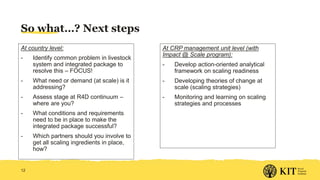
So what…? Next steps
At country level:
- Identify common problem in livestock
system and integrated package to
resolve this – FOCUS!
- What need or demand (at scale) is it
addressing?
- Assess stage at R4D continuum –
where are you?
- What conditions and requirements
need to be in place to make the
integrated package successful?
- Which partners should you involve to
get all scaling ingredients in place,
how?
12
At CRP management unit level (with
Impact @ Scale program):
- Develop action-oriented analytical
framework on scaling readiness
- Developing theories of change at
scale (scaling strategies)
- Monitoring and learning on scaling
strategies and processes

Facilitating scaling: Initial ideas for Livestock CRP Integrated Core Project

  • 1.
    Facilitating scaling: Initialideas for Livestock CRP Integrated Core Project Helena Posthumus 1 Livestock CRP Priority Countries Planning Meeting 26 – 27 March 2019 Nairobi, Kenya
  • 2.
    Scaling for impact Scalingof what? Livestock innovations / solutions that:  contribute to development outcomes  address key bottlenecks in livestock value chains  meet a pressing demand or need at scale (demand-driven by end users)  are scalable… (given context, conditions, capacities, resources) 2
  • 3.
    R4D continuum (GIZ) 4 Discovery Proofof concept Pilot project Scaling 10s 100s 1000s 100,000sBeneficiaries Theory Applicability, practice Large-scale adoptionResearch to product Academic Development / NGOs Private & public sectorPartnerships Peer-reviewed academic articles Communication for local context and knowledgeCommunication Most for research Most for implementation partners Private / public fundsFunding Research institute Development project Farmers, entrepreneurs, service providersRisk bearer
  • 4.
  • 5.
    A framework forscaling of agricultural innovations 6 Common, public responsibility, resources & risks Private or public responsibility, resources & risks
  • 6.
    From pilot toscale: the problem of external validity External validity: ‘the extent to which the methods, materials and setting of a study approximate the real-world that is being examined’ Challenge: often the external validity of pilot projects is low…  Due to artificial conditions:  High capital investment  Project budget covering transaction costs  Highly skilled workforce  Contracts and partnership agreements to create enabling conditions  Different from the complex reality with limited resources, weak public institutions and independent actors pursuing own interests 7
  • 7.
    Understanding and learningabout scaling 8 Pilot Scale Pilot Pathways of impact Design for change Going to scale Understanding core elements, conditions and arrangements for success Design an effective change process (Theory of Change at scale) learning
  • 8.
    Understanding external validity Somequestions to understand external validity of pilot projects: • What are the enabling factors and conditions that make your intervention successful? • What are the economies and diseconomies of scale of best-bets? • What are the transaction costs (search & information costs; bargaining & decision costs; policing & enforcement costs), and who will pay in real life? • Who will become the bearer of risk and uncertainty? • Can agreements and conditions (enabling environment) created in pilot projects be replicated by (public or private) institutions at scale? 9
  • 9.
    Scaling for impact Lessonson going from pilot to scale: • Do more than disseminate or replicate • Make sure there is a demand or need for the innovation at scale • Have a mix of activities which improve value chain relations, agricultural services and the institutional environment – linking up with relevant partners • Address the constraints and use the strengths of the target beneficiaries • Bring the right processes, set of arrangements and enabling conditions to scale (that make the innovation appropriate, effective and useful)… • …or assess whether the required set of arrangements and enabling conditions are present at scale for your best-bets • Complement on-going interventions and build on existing experiences (“clean sites” don’t exist…) 10
  • 10.
    Ingredients for scaling(PPPlab) 11 Scaling ingredient What it provides to support scaling Technology An effective and efficient solution for the issue at stake Business case An attractive financial / economic proposition for users and others Awareness and demand A wish and readiness for the consumer or producer to use the solution Finance Effective financing options for users and providers or buyers Value chain development Effective input and supply provision and other support services Platforms and collaboration Strategic and operational collaboration between key stakeholders Public sector governance Enabling policies, regulations and mechanisms Lobby and advocacy A ‘change coalition’ that pursues scaling and influence others Knowledge and skills The required knowledge and professional capacity and recognition Data and ICT Evidence and facts that underpin and communicate the scaling ambition
  • 11.
    So what…? Nextsteps At country level: - Identify common problem in livestock system and integrated package to resolve this – FOCUS! - What need or demand (at scale) is it addressing? - Assess stage at R4D continuum – where are you? - What conditions and requirements need to be in place to make the integrated package successful? - Which partners should you involve to get all scaling ingredients in place, how? 12 At CRP management unit level (with Impact @ Scale program): - Develop action-oriented analytical framework on scaling readiness - Developing theories of change at scale (scaling strategies) - Monitoring and learning on scaling strategies and processes

Editor's Notes

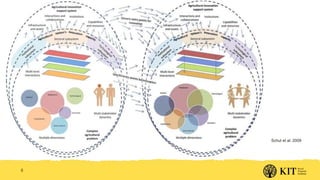
  • #6 Complex agricultural problems are defined as problems (1) that have multiple dimensions (Schut et al., 2014b), (2) that are embedded in interactions across different levels (Giller et al., 2008), and (3) where a multiplicity of actors and stakeholders are involved Schematic representation of the dynamic interactions between complex agricultural problems (multiple dimensions, multi-level interactions and multi-stakeholder dynamics), innovation capacity of the agricultural system (including its institutional, sectoral and technological subsystems), and the structural conditions within the agricultural innovation support system that can enable or constrain innovation capacity in the agricultural system (infrastructure and assets, institutions, interaction and collaboration, and capabilities and resources). RAAIS provides insight into the current state of the system (on the left). RAAIS provides specific and generic entry points for innovation that can guide a transition towards the desirable state of the system (on the right) in which the complex agricultural problem is addressed, and the innovation capacity in the agricultural system has increased. Generic entry points for innovation can have a spill-over effect in terms of addressing other complex agricultural problems than the one under review.
  • #7 There are many conceptual frameworks for innovation and scaling. This is just one of them What we want to show in this framework is the fact that in reality, the distinction between experimentation and bringing into routine use is not clear-cut. New opportunities may emerge at any time and require more experimentation. Also, adapting tested and tried promising new practices to new circumstances may require more experimentation. Most importantly, the exact timing of the process cannot be planned, as the outcomes of experimentation are by definition uncertain. A very common inclination is to divide interventions into a pilot experimental phase of learning, followed by a scaling-up phase. Here, we propose to do both types of activities at the same time. This means that interventions partly build on promising new practices that have been tested and tried by others. As we move towards scale and routine use, public responsibility, resources and risks decrease, and private responsibility, resources and risks increase