Scaling the Aquaculture Technical,
Vocational, and Entrepreneurship Training
for Improved Private Sector and Smallholder
Skills Project
Project planning and dissemination meeting 2020
29 October 2020, Zoom meeting, Zambia
Presenter: Netsayi Noris Mudege (Senior Scientist)
What is scaling?
Scaling up: deliberate efforts to increase the impact of successfully
tested [agriculture] innovations so as to benefit more people and to foster
policy and programme development on a lasting basis (Adapted from
who 2016).
Scaling up is about ensuring the quality of a development impact,
reaching out to those ‘left behind’ and ensuring the sustainability and
adaptability of results.
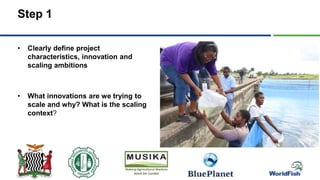
Step 1
• Clearly define project
characteristics, innovation and
scaling ambitions
• What innovations are we trying to
scale and why? What is the scaling
context?
What is the innovation package?
• Core innovation - main focus of the project that are brought to scale
• Complementary innovations are innovations necessary to scale core
innovations. They are often more context specific and related to the
broader environment that can enable or constrain the core innovation
to have impact at scale.
• Core innovations + Complementary Innovations = innovation package
Step 2: Understand the innovation system
The innovation system refers ‘to the complex interplay between an
innovation and the environment or landscape in which it is developed,
tested, or scaled
What are landscapes
Innovation landscape
Intervention Landscapes
Stakeholder landscapes
Understand the landscape to identify site specific bottle necks that may
need to be addressed
Landscapes
Innovation landscape: the complementary innovations that may impede
or support the scaling of a core innovation;
Intervention landscape: the set of projects, programs, and other
initiatives that are working on similar problems, similar objectives, are
promoting compatible or competing core or complementary innovations
The stakeholder landscape: the networks of stakeholders that have the
ability to influence, develop, or work on (the scaling of) innovations.
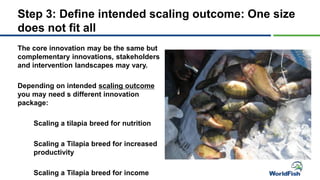
Step 3: Define intended scaling outcome: One size
does not fit all
The core innovation may be the same but
complementary innovations, stakeholders
and intervention landscapes may vary.
Depending on intended scaling outcome
you may need s different innovation
package:
Scaling a tilapia breed for nutrition
Scaling a Tilapia breed for increased
productivity
Scaling a Tilapia breed for income
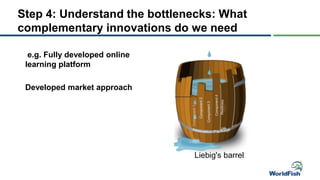
Step 4: Understand the bottlenecks: What
complementary innovations do we need
e.g. Fully developed online
learning platform
Developed market approach
Liebig's barrel
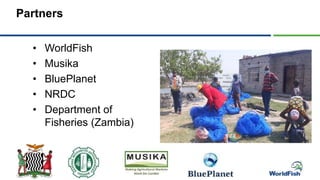
Partners
• WorldFish
• Musika
• BluePlanet
• NRDC
• Department of
Fisheries (Zambia)
Sartas, M., Schut, M., van Schagen, B., Velasco, C., Thiele, G., Proietti, C., and Leeuwis,
2020. Scaling Readiness: Concepts, Practices, and Implementation. CGIAR Research
Program on Roots, Tubers and Bananas (RTB). January 2020, pp 217.
Available at www.scalingreadiness.org and www.rtb.cgiar.org.
Acknowledgments
The project is funded by the Norwegian Agency for Development
Cooperation (Norad)-Agreement ZAM-18/0002, Aquaculture
Technical, Vocational, and Entrepreneurship Training for Improved
Private Sector and Smallholder Skills.
This work will be undertaken as part of the CGIAR Research Program
on Fish Agri-Food Systems (FISH).

Aqtevet innovations scaling - compatibility mode - read-only - compatibility mode

  • 1.
    Scaling the AquacultureTechnical, Vocational, and Entrepreneurship Training for Improved Private Sector and Smallholder Skills Project Project planning and dissemination meeting 2020 29 October 2020, Zoom meeting, Zambia Presenter: Netsayi Noris Mudege (Senior Scientist)
  • 2.
    What is scaling? Scalingup: deliberate efforts to increase the impact of successfully tested [agriculture] innovations so as to benefit more people and to foster policy and programme development on a lasting basis (Adapted from who 2016). Scaling up is about ensuring the quality of a development impact, reaching out to those ‘left behind’ and ensuring the sustainability and adaptability of results.
  • 3.
    Step 1 • Clearlydefine project characteristics, innovation and scaling ambitions • What innovations are we trying to scale and why? What is the scaling context?
  • 4.
    What is theinnovation package? • Core innovation - main focus of the project that are brought to scale • Complementary innovations are innovations necessary to scale core innovations. They are often more context specific and related to the broader environment that can enable or constrain the core innovation to have impact at scale. • Core innovations + Complementary Innovations = innovation package
  • 5.
    Step 2: Understandthe innovation system The innovation system refers ‘to the complex interplay between an innovation and the environment or landscape in which it is developed, tested, or scaled What are landscapes Innovation landscape Intervention Landscapes Stakeholder landscapes Understand the landscape to identify site specific bottle necks that may need to be addressed
  • 6.
    Landscapes Innovation landscape: thecomplementary innovations that may impede or support the scaling of a core innovation; Intervention landscape: the set of projects, programs, and other initiatives that are working on similar problems, similar objectives, are promoting compatible or competing core or complementary innovations The stakeholder landscape: the networks of stakeholders that have the ability to influence, develop, or work on (the scaling of) innovations.
  • 7.
    Step 3: Defineintended scaling outcome: One size does not fit all The core innovation may be the same but complementary innovations, stakeholders and intervention landscapes may vary. Depending on intended scaling outcome you may need s different innovation package: Scaling a tilapia breed for nutrition Scaling a Tilapia breed for increased productivity Scaling a Tilapia breed for income
  • 8.
    Step 4: Understandthe bottlenecks: What complementary innovations do we need e.g. Fully developed online learning platform Developed market approach Liebig's barrel
  • 9.
    Partners • WorldFish • Musika •BluePlanet • NRDC • Department of Fisheries (Zambia)
  • 10.
    Sartas, M., Schut,M., van Schagen, B., Velasco, C., Thiele, G., Proietti, C., and Leeuwis, 2020. Scaling Readiness: Concepts, Practices, and Implementation. CGIAR Research Program on Roots, Tubers and Bananas (RTB). January 2020, pp 217. Available at www.scalingreadiness.org and www.rtb.cgiar.org.
  • 11.
    Acknowledgments The project isfunded by the Norwegian Agency for Development Cooperation (Norad)-Agreement ZAM-18/0002, Aquaculture Technical, Vocational, and Entrepreneurship Training for Improved Private Sector and Smallholder Skills. This work will be undertaken as part of the CGIAR Research Program on Fish Agri-Food Systems (FISH).

Editor's Notes

  • #3 It is not about just replicating successes to cover larger groups or populations. Thus, a scaled up intervention or investment can deliver multiplier effects at a larger scale, including spurring policy and institutional reforms. It can also serve as an entry point for the development and scaling up of a multidimensional approach. Scaling up entails the following dimensions: social (social inclusiveness), physical (replication), political (policy and budget commitments) and conceptual (changing the mind set and power relations — a deep transformation of power and administrative structures).
  • #9 ’Just as the capacity of a barrel with staves of unequal length is limited by the shortest stave, so a plant's growth is limited by the nutrient in shortest supply’. (Wikipedia