Connecting business and scaling
The institutional design challenge
Sietze Vellema
Wageningen University & Research
DRAGON make big changes with little resources
CSA 2019, Side event, Bali, October 10
GCP4 NWO CCAFS
i-LED (inclusive Low Emission Dairy development in East Africa)
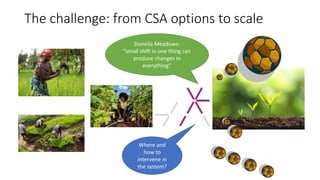
The challenge: from CSA options to scale
Donella Meadows:
“small shift in one thing can
produce changes in
everything”
Where and
how to
intervene in
the system?
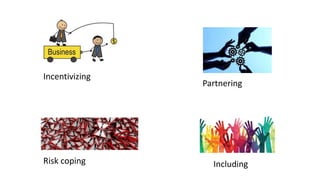
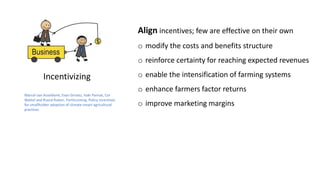
Incentivizing
Partnering
Risk coping Including
Incentivizing
Align incentives; few are effective on their own
o modify the costs and benefits structure
o reinforce certainty for reaching expected revenues
o enable the intensification of farming systems
o enhance farmers factor returns
o improve marketing margins
Marcel van Asseldonk, Evan Girvetz, Haki Pamuk, Cor
Wattel and Ruerd Ruben. Forthcoming. Policy incentives
for smallholder adoption of climate-smart agricultural
practices
Risk coping
Blend world views and management styles
o Outcomes can be managed sustainably
o Outcomes are a personal responsibility and
achievement
o Outcomes require altruism and common effort
o Outcomes are a function of chance
 O’Riordan, T., & Jordan, A. (1999). Institutions,
climate change and cultural theory: towards a
common analytical framework. Global Environmental
Change, 9(2), 81-93.
Partnering
Configure capacities to make partnerships
developmental
o Deliberation capacities
o Alignment capacities
o Transformative capacities
o Fitting capacities
 Vellema, Sietze, Schouten, Greetje, & Van Tulder, Rob
(2019) Partnering capacities for inclusive
development in food provisioning. Development
Policy Review. https://doi.org/10.1111/dpr.12466
 Meadows, D. (1999). Leverage points: Places to
intervene in a system. The Sustainability Institute:
Hartland. Accessed May 21, 2019 at:
http://donellameadows.org/archives/leverage-points-
places-to-intervene-in-a-system/
Including
Bring together multiple dimensions of the
process of inclusion
o Voice
o Ownership
o Reward
o Risk
 Vermeulen S, Cotula L (2010). Making the most of agricultural
investment: A survey of business models that provide
opportunities for smallholders. IIED.
 Chamberlain WO, Anseeuw W. (2018). Inclusiveness revisited:
Assessing inclusive businesses in South African agriculture.
Development Southern Africa:1-16.
 Thorpe J. (2018). Procedural Justice in Value Chains Through
Public–private Partnerships. World Development: 103:162-75.
 Seelos C., J. Mair (2014). Organizational closure competencies
and scaling: a realist approach to theorizing social enterprise.
In: Jeremy Short (ed.) Social Entrepreneurship and Research
Methods. Emerald Group Publishing Limited, pp.147 – 187.
 Seelos C., J. Mair (2017). Innovation and scaling for impact:
how effective social enterprises do it. Stanford, CA: Stanford
University Press.
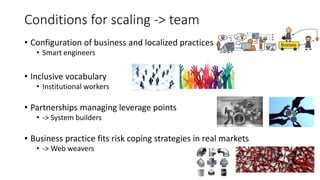
Conditions for scaling -> team
• Configuration of business and localized practices
• Smart engineers
• Inclusive vocabulary
• Institutional workers
• Partnerships managing leverage points
• -> System builders
• Business practice fits risk coping strategies in real markets
• -> Web weavers

Day3_SideEvent_Sietze Vellema

  • 1.
    Connecting business andscaling The institutional design challenge Sietze Vellema Wageningen University & Research DRAGON make big changes with little resources CSA 2019, Side event, Bali, October 10 GCP4 NWO CCAFS i-LED (inclusive Low Emission Dairy development in East Africa)
  • 2.
    The challenge: fromCSA options to scale Donella Meadows: “small shift in one thing can produce changes in everything” Where and how to intervene in the system?
  • 3.
  • 4.
    Incentivizing Align incentives; feware effective on their own o modify the costs and benefits structure o reinforce certainty for reaching expected revenues o enable the intensification of farming systems o enhance farmers factor returns o improve marketing margins Marcel van Asseldonk, Evan Girvetz, Haki Pamuk, Cor Wattel and Ruerd Ruben. Forthcoming. Policy incentives for smallholder adoption of climate-smart agricultural practices
  • 5.
    Risk coping Blend worldviews and management styles o Outcomes can be managed sustainably o Outcomes are a personal responsibility and achievement o Outcomes require altruism and common effort o Outcomes are a function of chance  O’Riordan, T., & Jordan, A. (1999). Institutions, climate change and cultural theory: towards a common analytical framework. Global Environmental Change, 9(2), 81-93.
  • 6.
    Partnering Configure capacities tomake partnerships developmental o Deliberation capacities o Alignment capacities o Transformative capacities o Fitting capacities  Vellema, Sietze, Schouten, Greetje, & Van Tulder, Rob (2019) Partnering capacities for inclusive development in food provisioning. Development Policy Review. https://doi.org/10.1111/dpr.12466  Meadows, D. (1999). Leverage points: Places to intervene in a system. The Sustainability Institute: Hartland. Accessed May 21, 2019 at: http://donellameadows.org/archives/leverage-points- places-to-intervene-in-a-system/
  • 7.
    Including Bring together multipledimensions of the process of inclusion o Voice o Ownership o Reward o Risk  Vermeulen S, Cotula L (2010). Making the most of agricultural investment: A survey of business models that provide opportunities for smallholders. IIED.  Chamberlain WO, Anseeuw W. (2018). Inclusiveness revisited: Assessing inclusive businesses in South African agriculture. Development Southern Africa:1-16.  Thorpe J. (2018). Procedural Justice in Value Chains Through Public–private Partnerships. World Development: 103:162-75.  Seelos C., J. Mair (2014). Organizational closure competencies and scaling: a realist approach to theorizing social enterprise. In: Jeremy Short (ed.) Social Entrepreneurship and Research Methods. Emerald Group Publishing Limited, pp.147 – 187.  Seelos C., J. Mair (2017). Innovation and scaling for impact: how effective social enterprises do it. Stanford, CA: Stanford University Press.
  • 8.
    Conditions for scaling-> team • Configuration of business and localized practices • Smart engineers • Inclusive vocabulary • Institutional workers • Partnerships managing leverage points • -> System builders • Business practice fits risk coping strategies in real markets • -> Web weavers