Communicating Across Culture
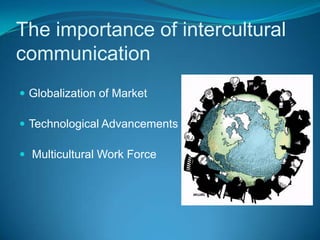
The importance of interculturalcommunicationGlobalization of MarketTechnological Advancements Multicultural Work Force
Understanding Culture Culture is complex system of values, traits,    morals, and customs shared by a society. Culture is a system for creating, sending,     storing, and processing information.
Characteristics of CultureCulture is learned      In western culture, too close      means violation. Cultures are inherently logical      In Japan, Barbie doll was a failure because of the toothy      smile.Culture combines the visible and invisible      In Japan, harmony with the environment is importantCulture is dynamic      Culture change as a result of migration, disasters, and       wars
PrototypesMental representations based on general   characteristics that are not fixed and rigid, but   rather are open to new definition. Dynamic abed may change    Based on objective observations. Example      Latin businesspeople often talk about their      families before getting down to business.      This prototype is generally accurate, but it may not      universally apply and it may change over time.
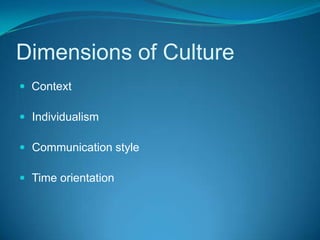
Dimensions of CultureContext Individualism Communication style Time orientation
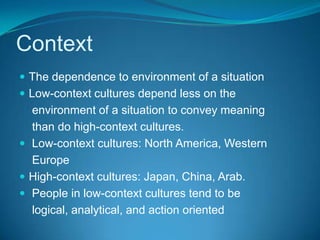
ContextThe dependence to environment of a situationLow-context cultures depend less on the    environment of a situation to convey meaning    than do high-context cultures. Low-context cultures: North America, Western    EuropeHigh-context cultures: Japan, China, Arab. People in low-context cultures tend to be    logical, analytical, and action oriented
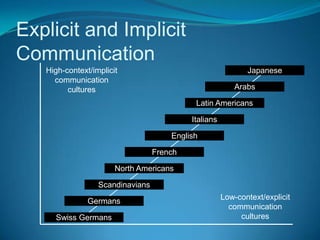
Explicit and Implicit CommunicationHigh-context/implicit communication culturesLow-context/explicit communication culturesJapaneseArabsLatin AmericansItaliansEnglishFrenchNorth AmericansScandinaviansGermansSwiss Germans
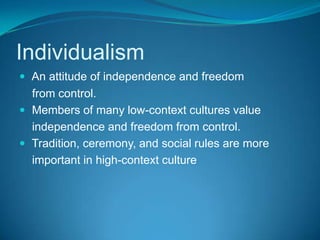
IndividualismAn attitude of independence and freedom    from control. Members of many low-context cultures value    independence and freedom from control. Tradition, ceremony, and social rules are more    important in high-context culture
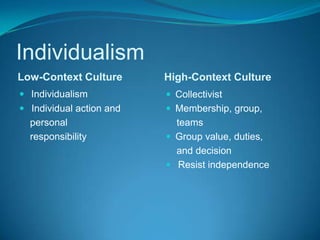
IndividualismLow-Context CultureHigh-Context CultureIndividualism Individual action and    personal    responsibilityCollectivistMembership, group,    teamsGroup value, duties,    and decision Resist independence
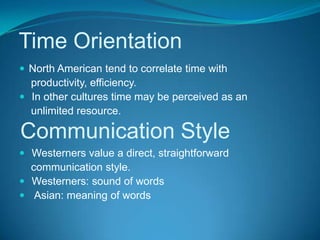
Time OrientationNorth American tend to correlate time with    productivity, efficiency. In other cultures time may be perceived as an    unlimited resource. Westerners value a direct, straightforward    communication style. Westerners: sound of words  Asian: meaning of wordsCommunication Style
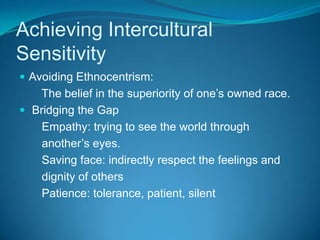
Achieving Intercultural SensitivityAvoiding Ethnocentrism:       The belief in the superiority of one’s owned race. Bridging the Gap       Empathy: trying to see the world through       another’s eyes.       Saving face: indirectly respect the feelings and       dignity of others       Patience: tolerance, patient, silent
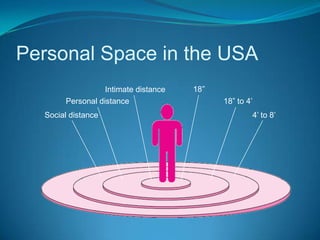
Personal Space in the USAIntimate distance18”Personal distance18” to 4’Social distance4’ to 8’
The Barriers of Cross Cultural CommunicationsBody LanguageEtiquetteEstablishing trustReligious BeliefSocial habits
Improving Cross-Culture CommunicationImproving Intercultural Proficiency &CommunicationStudy your own culture first.    Learn about other culture.   Curb ethnocentrism   Seek common ground   Observe nonverbal cues in your culture   Use simple English   Adapt to local Preferences

Cross-Cultural Communication

  • 1.
  • 2.
    The importance ofinterculturalcommunicationGlobalization of MarketTechnological Advancements Multicultural Work Force
  • 3.
    Understanding Culture Cultureis complex system of values, traits, morals, and customs shared by a society. Culture is a system for creating, sending, storing, and processing information.
  • 4.
    Characteristics of CultureCultureis learned In western culture, too close means violation. Cultures are inherently logical In Japan, Barbie doll was a failure because of the toothy smile.Culture combines the visible and invisible In Japan, harmony with the environment is importantCulture is dynamic Culture change as a result of migration, disasters, and wars
  • 5.
    PrototypesMental representations basedon general characteristics that are not fixed and rigid, but rather are open to new definition. Dynamic abed may change Based on objective observations. Example Latin businesspeople often talk about their families before getting down to business. This prototype is generally accurate, but it may not universally apply and it may change over time.
  • 6.
    Dimensions of CultureContextIndividualism Communication style Time orientation
  • 7.
    ContextThe dependence toenvironment of a situationLow-context cultures depend less on the environment of a situation to convey meaning than do high-context cultures. Low-context cultures: North America, Western EuropeHigh-context cultures: Japan, China, Arab. People in low-context cultures tend to be logical, analytical, and action oriented
  • 8.
    Explicit and ImplicitCommunicationHigh-context/implicit communication culturesLow-context/explicit communication culturesJapaneseArabsLatin AmericansItaliansEnglishFrenchNorth AmericansScandinaviansGermansSwiss Germans
  • 9.
    IndividualismAn attitude ofindependence and freedom from control. Members of many low-context cultures value independence and freedom from control. Tradition, ceremony, and social rules are more important in high-context culture
  • 10.
    IndividualismLow-Context CultureHigh-Context CultureIndividualismIndividual action and personal responsibilityCollectivistMembership, group, teamsGroup value, duties, and decision Resist independence
  • 11.
    Time OrientationNorth Americantend to correlate time with productivity, efficiency. In other cultures time may be perceived as an unlimited resource. Westerners value a direct, straightforward communication style. Westerners: sound of words Asian: meaning of wordsCommunication Style
  • 12.
    Achieving Intercultural SensitivityAvoidingEthnocentrism: The belief in the superiority of one’s owned race. Bridging the Gap Empathy: trying to see the world through another’s eyes. Saving face: indirectly respect the feelings and dignity of others Patience: tolerance, patient, silent
  • 13.
    Personal Space inthe USAIntimate distance18”Personal distance18” to 4’Social distance4’ to 8’
  • 14.
    The Barriers ofCross Cultural CommunicationsBody LanguageEtiquetteEstablishing trustReligious BeliefSocial habits
  • 15.
    Improving Cross-Culture CommunicationImprovingIntercultural Proficiency &CommunicationStudy your own culture first. Learn about other culture. Curb ethnocentrism Seek common ground Observe nonverbal cues in your culture Use simple English Adapt to local Preferences