Here is a story…….
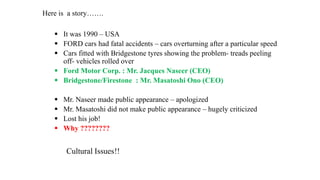
 It was 1990 – USA
 FORD cars had fatal accidents – cars overturning after a particular speed
 Cars fitted with Bridgestone tyres showing the problem- treads peeling
off- vehicles rolled over
 Ford Motor Corp. : Mr. Jacques Naseer (CEO)
 Bridgestone/Firestone : Mr. Masatoshi Ono (CEO)
 Mr. Naseer made public appearance – apologized
 Mr. Masatoshi did not make public appearance – hugely criticized
 Lost his job!
 Why ????????
Cultural Issues!!
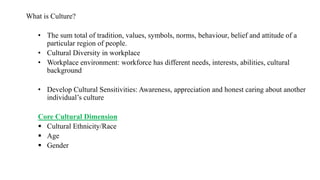
What is Culture?
• The sum total of tradition, values, symbols, norms, behaviour, belief and attitude of a
particular region of people.
• Cultural Diversity in workplace
• Workplace environment: workforce has different needs, interests, abilities, cultural
background
• Develop Cultural Sensitivities: Awareness, appreciation and honest caring about another
individual’s culture
Core Cultural Dimension
 Cultural Ethnicity/Race
 Age
 Gender
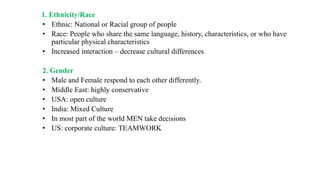
1. Ethnicity/Race
• Ethnic: National or Racial group of people
• Race: People who share the same language, history, characteristics, or who have
particular physical characteristics
• Increased interaction – decrease cultural differences
2. Gender
• Male and Female respond to each other differently.
• Middle East: highly conservative
• USA: open culture
• India: Mixed Culture
• In most part of the world MEN take decisions
• US: corporate culture: TEAMWORK
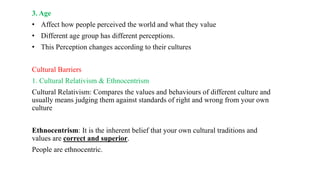
3. Age
• Affect how people perceived the world and what they value
• Different age group has different perceptions.
• This Perception changes according to their cultures
Cultural Barriers
1. Cultural Relativism & Ethnocentrism
Cultural Relativism: Compares the values and behaviours of different culture and
usually means judging them against standards of right and wrong from your own
culture
Ethnocentrism: It is the inherent belief that your own cultural traditions and
values are correct and superior.
People are ethnocentric.
• Ethnocentric people look down upon people from other cultures, making them feel
undervalued.
• It affects conversations negatively between people of two different cultures as they
would uncomfortable with each other holding a conversation.
2. Stereotypes
• People believe the idea that all people in one culture are alike; behavior,
perception, characteristics are all the same.
• Japanese are workaholic, a young man can never be an inspiring leader, Americans
go for multiple marriages etc.
• each culture has similarities and differences
• Stereotypes can also turn into prejudices and prevent positive communication
• People in America take the fork on the left hand while eating to which the Arabians
dislike, as they know the left hand is used only for toilet purposes.
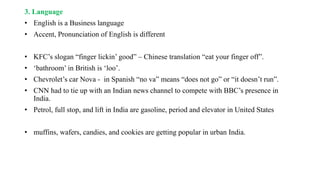
3. Language
• English is a Business language
• Accent, Pronunciation of English is different
• KFC’s slogan “finger lickin’ good” – Chinese translation “eat your finger off”.
• ‘bathroom’ in British is ‘loo’.
• Chevrolet’s car Nova - in Spanish “no va” means “does not go” or “it doesn’t run”.
• CNN had to tie up with an Indian news channel to compete with BBC’s presence in
India.
• Petrol, full stop, and lift in India are gasoline, period and elevator in United States
• muffins, wafers, candies, and cookies are getting popular in urban India.
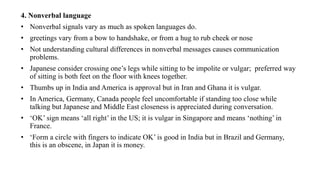
4. Nonverbal language
• Nonverbal signals vary as much as spoken languages do.
• greetings vary from a bow to handshake, or from a hug to rub cheek or nose
• Not understanding cultural differences in nonverbal messages causes communication
problems.
• Japanese consider crossing one’s legs while sitting to be impolite or vulgar; preferred way
of sitting is both feet on the floor with knees together.
• Thumbs up in India and America is approval but in Iran and Ghana it is vulgar.
• In America, Germany, Canada people feel uncomfortable if standing too close while
talking but Japanese and Middle East closeness is appreciated during conversation.
• ‘OK’ sign means ‘all right’ in the US; it is vulgar in Singapore and means ‘nothing’ in
France.
• ‘Form a circle with fingers to indicate OK’ is good in India but in Brazil and Germany,
this is an obscene, in Japan it is money.
Cultural Barriers Solution
• Learn About Different Cultures
• Accommodate Cultural Differences
• Diversity Training
• Knowledge Sharing
Contextual Model or Cultural Context
What is Context?
The social setting/ the environment. The environment mean are you from a highly
populated place or from a lowest populated place and so on.
Eg. mourning in death of a person
High Context and Low Context Cultures
High context: India, China, Japan, Mexico, Greece, Brazil etc
Low Context: Most European countries, US, Australia, Canada
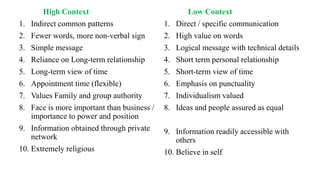
High Context
1. Indirect common patterns
2. Fewer words, more non-verbal sign
3. Simple message
4. Reliance on Long-term relationship
5. Long-term view of time
6. Appointment time (flexible)
7. Values Family and group authority
8. Face is more important than business /
importance to power and position
9. Information obtained through private
network
10. Extremely religious
Low Context
1. Direct / specific communication
2. High value on words
3. Logical message with technical details
4. Short term personal relationship
5. Short-term view of time
6. Emphasis on punctuality
7. Individualism valued
8. Ideas and people assured as equal
9. Information readily accessible with
others
10. Believe in self

Cross cultural comm.pptx

  • 1.
    Here is astory…….  It was 1990 – USA  FORD cars had fatal accidents – cars overturning after a particular speed  Cars fitted with Bridgestone tyres showing the problem- treads peeling off- vehicles rolled over  Ford Motor Corp. : Mr. Jacques Naseer (CEO)  Bridgestone/Firestone : Mr. Masatoshi Ono (CEO)  Mr. Naseer made public appearance – apologized  Mr. Masatoshi did not make public appearance – hugely criticized  Lost his job!  Why ???????? Cultural Issues!!
  • 2.
    What is Culture? •The sum total of tradition, values, symbols, norms, behaviour, belief and attitude of a particular region of people. • Cultural Diversity in workplace • Workplace environment: workforce has different needs, interests, abilities, cultural background • Develop Cultural Sensitivities: Awareness, appreciation and honest caring about another individual’s culture Core Cultural Dimension  Cultural Ethnicity/Race  Age  Gender
  • 3.
    1. Ethnicity/Race • Ethnic:National or Racial group of people • Race: People who share the same language, history, characteristics, or who have particular physical characteristics • Increased interaction – decrease cultural differences 2. Gender • Male and Female respond to each other differently. • Middle East: highly conservative • USA: open culture • India: Mixed Culture • In most part of the world MEN take decisions • US: corporate culture: TEAMWORK
  • 4.
    3. Age • Affecthow people perceived the world and what they value • Different age group has different perceptions. • This Perception changes according to their cultures Cultural Barriers 1. Cultural Relativism & Ethnocentrism Cultural Relativism: Compares the values and behaviours of different culture and usually means judging them against standards of right and wrong from your own culture Ethnocentrism: It is the inherent belief that your own cultural traditions and values are correct and superior. People are ethnocentric.
  • 5.
    • Ethnocentric peoplelook down upon people from other cultures, making them feel undervalued. • It affects conversations negatively between people of two different cultures as they would uncomfortable with each other holding a conversation. 2. Stereotypes • People believe the idea that all people in one culture are alike; behavior, perception, characteristics are all the same. • Japanese are workaholic, a young man can never be an inspiring leader, Americans go for multiple marriages etc. • each culture has similarities and differences • Stereotypes can also turn into prejudices and prevent positive communication • People in America take the fork on the left hand while eating to which the Arabians dislike, as they know the left hand is used only for toilet purposes.
  • 6.
    3. Language • Englishis a Business language • Accent, Pronunciation of English is different • KFC’s slogan “finger lickin’ good” – Chinese translation “eat your finger off”. • ‘bathroom’ in British is ‘loo’. • Chevrolet’s car Nova - in Spanish “no va” means “does not go” or “it doesn’t run”. • CNN had to tie up with an Indian news channel to compete with BBC’s presence in India. • Petrol, full stop, and lift in India are gasoline, period and elevator in United States • muffins, wafers, candies, and cookies are getting popular in urban India.
  • 7.
    4. Nonverbal language •Nonverbal signals vary as much as spoken languages do. • greetings vary from a bow to handshake, or from a hug to rub cheek or nose • Not understanding cultural differences in nonverbal messages causes communication problems. • Japanese consider crossing one’s legs while sitting to be impolite or vulgar; preferred way of sitting is both feet on the floor with knees together. • Thumbs up in India and America is approval but in Iran and Ghana it is vulgar. • In America, Germany, Canada people feel uncomfortable if standing too close while talking but Japanese and Middle East closeness is appreciated during conversation. • ‘OK’ sign means ‘all right’ in the US; it is vulgar in Singapore and means ‘nothing’ in France. • ‘Form a circle with fingers to indicate OK’ is good in India but in Brazil and Germany, this is an obscene, in Japan it is money.
  • 8.
    Cultural Barriers Solution •Learn About Different Cultures • Accommodate Cultural Differences • Diversity Training • Knowledge Sharing
  • 9.
    Contextual Model orCultural Context What is Context? The social setting/ the environment. The environment mean are you from a highly populated place or from a lowest populated place and so on. Eg. mourning in death of a person High Context and Low Context Cultures High context: India, China, Japan, Mexico, Greece, Brazil etc Low Context: Most European countries, US, Australia, Canada
  • 10.
    High Context 1. Indirectcommon patterns 2. Fewer words, more non-verbal sign 3. Simple message 4. Reliance on Long-term relationship 5. Long-term view of time 6. Appointment time (flexible) 7. Values Family and group authority 8. Face is more important than business / importance to power and position 9. Information obtained through private network 10. Extremely religious Low Context 1. Direct / specific communication 2. High value on words 3. Logical message with technical details 4. Short term personal relationship 5. Short-term view of time 6. Emphasis on punctuality 7. Individualism valued 8. Ideas and people assured as equal 9. Information readily accessible with others 10. Believe in self