Intercultural Trade Communication March 16, 2010 Arrowhead Credit union San Bernardino, California Copyright Eddy A. Sumar 2009
A Cultural Journey By Eddy A. Sumar, MBA, CCE, CICE Copyright Eddy A. Sumar 2009 ERS Consulting Services In Collaboration with  The County of San Bernardino Economic Development Agency & CITD Presents
A Global Village
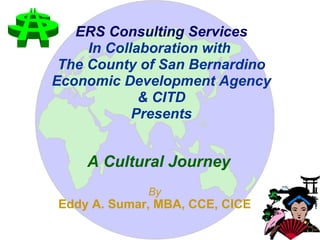
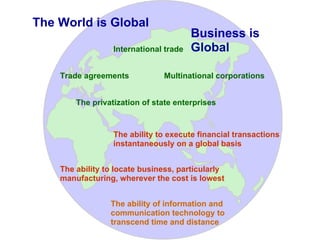
The World is Global Trade agreements International trade Multinational corporations The privatization of state enterprises The ability to locate business, particularly manufacturing, wherever the cost is lowest The ability to execute financial transactions instantaneously on a global basis The ability of information and communication technology to transcend time and distance Business is Global
Have a global mindset! Understand the world Understand Self Think Global and Act Local Think Local and Act Global Understand Culture Understand People Globalization cries out:
Cross-cultural competence is  no longer an option It is survival
Roots  [Content & Context] Risks  Rewards Understanding Culture = Survival Survival = Harnessing  R3 R3
Definition Awareness Competence Choice of Behavior Understanding Culture is the road to Cultural Intelligence & Business Success
Cultural intelligence Cultural intelligence is the capability to deal effectively with people from different cultural backgrounds Cultural intelligence is not difficult to understand  but it is difficult to put into practice on an ongoing basis
Three Components of Cultural intelligence Knowledge of culture:   [ Definition ] what culture is how culture affects human behavior how cultures vary Awareness: being aware of our own assumptions, ideas, words, and behavior being aware of other person’s assumptions, ideas, words, and behavior using all the senses in perceiving situations viewing situations from several perspectives Behavioral skills :  [ Competence   & Choice ] choosing and displaying the appropriate behavior for each particular intercultural situation
Define Culture
Culture is…… The collective programming of the mind which distinguishes the members of one group or category of people from another. Geert Hofstede The customs, beliefs, art and all other products of human thought, made by a particular group of people at a particular time. Richard D. Lewis Beliefs, norms, and attitudes that are used to guide our behaviors and to solve human problems. Guo-Ming Chen, William Starosta
Culture is: The way we dress The way we communicate (verbal and non-verbal) The way we relate to others and authority Our outlook and attitude toward life Our perception of self and role in society Our perception of time Our space perception The way we learn and study A way of life
Culture is below the surface…… Culture hides more than what it reveals, and strangely enough, what it hides, it hides most effectively from its own participants. Edward Hall
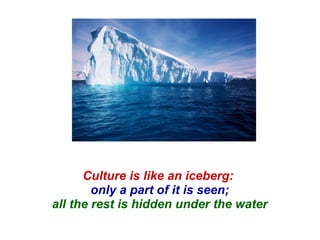
Culture is like an iceberg:  only a part of it is seen; all the rest is hidden under the water
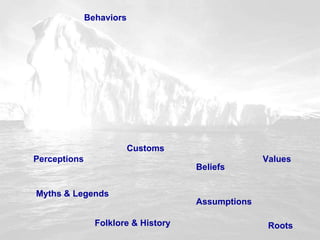
Behaviors Values Customs Beliefs Assumptions Myths & Legends Roots Perceptions Folklore & History
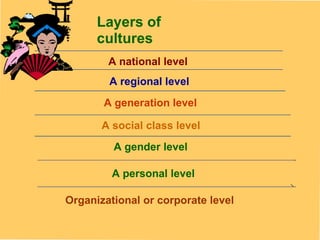
Layers of cultures A national level A regional level A generation level A gender level A social class level Organizational or corporate level A personal level
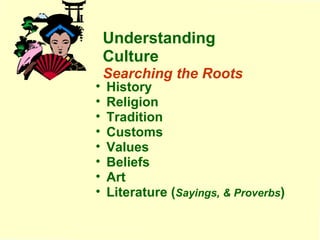
History Religion Tradition Customs Values Beliefs Art Literature ( Sayings, & Proverbs ) Understanding Culture Searching the Roots
Understanding Culture Avoiding the Risks Alienation Culture shock Conflict Confrontation Loss of face  Loss of business Loss of credibility
Understanding Culture Enjoying the Rewards Increased market share Higher sales and profitability Enhanced cash flow Diversified portfolio Truly global presence Ability to compete Improved relationships Enhanced loyalty
Understand the Values of your own Culture  Consider your assumptions Understanding Culture Start from the Home Front
Understand the Values of  American  Culture   What Japanese say [Elashmawi & Harris] Personal life Wealth Fairness One answer Family Liberty Materials Education Time Success Dreams Freedom Directness Money Reasons Religion Power Understanding Culture Start from the Home Front
Understanding Culture Start from the Home Front Understand the Values of  American  Culture   What Malaysians say [Elashmawi & Harris] Success Power Adherence Material Possessions Openness Profit Individualism Time Commitments Money Aggression Innovation Progress
Understanding Culture Start from the Home Front Understand the Values of  American  Culture   Cultural contrasts in value [Elashmawi & Harris] Freedom/Independence Self-reliance Equality Individualism/privacy Competition Efficiency Time Directness Openness Aggressiveness Informality Future-orientation Risk-taking Creativity Winning Money
How do we conduct business? How do we establish business relationships? What are our expectations of the other person? What does it take to establish trust and respect? How do we make decisions? How do we view time, power & space? How do we persuade others? How do we communicate? Understanding Culture Consider Your Assumptions
Understand the Values of the new Culture  Consider their assumptions  Understanding Culture Consider the other person & Culture
Understand the Values of  Arab  Culture   What Japanese say [Elashmawi & Harris] Religion Allah Koran Status History Family Nationality Islam Moustache Gold Understanding Culture Consider the other person & Culture
Understand the Values of  Arab  Culture   What Malaysians say [Elashmawi & Harris] Family Community Wealth Brotherhood Respect Power Friendships Social grouping Religion Status  Leisure Traditions Self-image Understanding Culture Consider the other person & Culture
Understanding Culture Consider the other person & Culture Understand the Values of  Arab  Culture   Cultural contrasts in value [Elashmawi & Harris] Family security Family harmony Parental guidance Age Authority Compromise Devotion Very patient Indirectness Hospitality/ friendship Formal  Past and present Religious beliefs Tradition Social recognition Reputation Family network
How do they conduct business? How do they establish business relationships? What are their expectations of you? How do they establish trust and respect? How do they make decisions? How do they view time, power, & space? How do they persuade others? How do they communicate? Understanding Culture Consider the other person & Culture
Dimensions of Culture
Power Distance Individualism vs. Collectivism Masculinity vs. Femininity Uncertainty Avoidance Long-term Orientation Hofstede’s Culture Dimensions
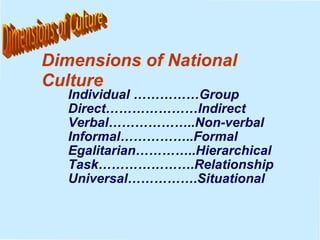
Individual ……………Group Direct…………………Indirect Verbal………………..Non-verbal Informal……………..Formal Egalitarian…………..Hierarchical Task………………….Relationship Universal…………….Situational Dimensions of National Culture
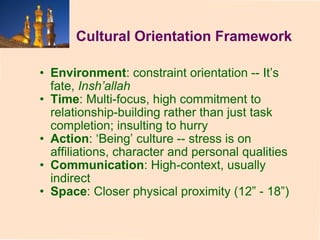
Cultural Orientation Framework Environment : constraint orientation -- It’s fate,  Insh’allah Time : Multi-focus, high commitment to relationship-building rather than just task completion; insulting to hurry Action : ‘Being’ culture -- stress is on affiliations, character and personal qualities Communication : High-context, usually indirect Space : Closer physical proximity (12” - 18”)
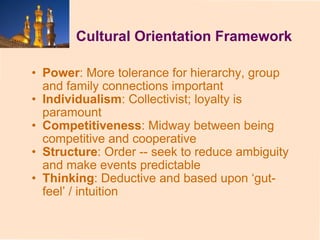
Power : More tolerance for hierarchy, group and family connections important Individualism : Collectivist; loyalty is paramount Competitiveness : Midway between being competitive and cooperative Structure : Order -- seek to reduce ambiguity and make events predictable Thinking : Deductive and based upon ‘gut-feel’ / intuition Cultural Orientation Framework
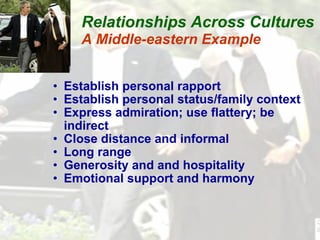
Establish personal rapport Establish personal status/family context Express admiration; use flattery; be indirect Close distance and informal Long range Generosity and and hospitality Emotional support and harmony Relationships Across Cultures A Middle-eastern Example
 
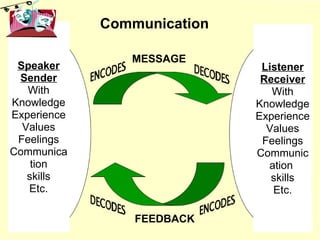
Communicating Across Cultures Communication is the interchange of messages [ verbal & non-verbal ] between people. It is the fundamental building block of social experience. We always communicate whether we are selling, buying, negotiating, leading or working with each other
MESSAGE FEEDBACK Speaker Sender With Knowledge Experience Values Feelings Communication skills Etc. Listener Receiver With Knowledge Experience Values Feelings Communication  skills Etc. Communication
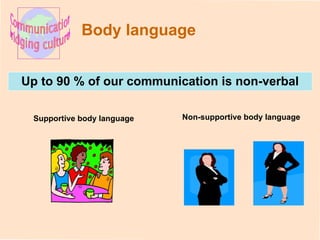
Body language Up to 90 % of our communication is non-verbal Supportive body language Non-supportive body language
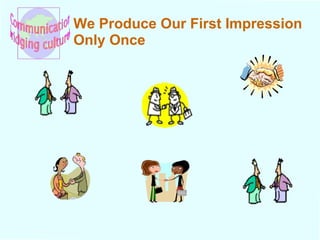
We Produce Our First Impression  Only Once
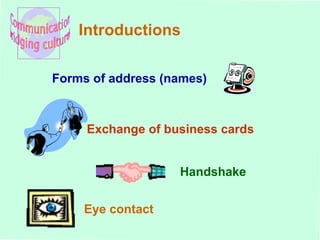
Introductions Forms of address (names) Exchange of business cards Handshake Eye contact
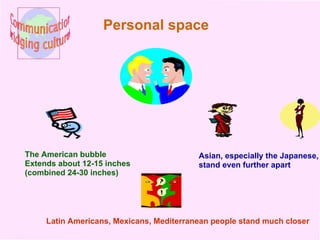
Personal space The American bubble  Extends about 12-15 inches (combined 24-30 inches) Asian, especially the Japanese, stand even further apart Latin Americans, Mexicans, Mediterranean people stand much closer
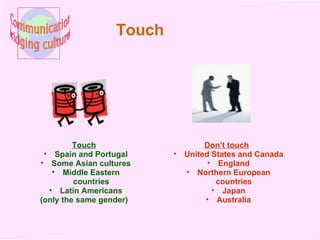
Touch Touch Spain and Portugal Some Asian cultures Middle Eastern countries Latin Americans (only the same gender) Don’t touch United States and Canada England Northern European countries Japan Australia
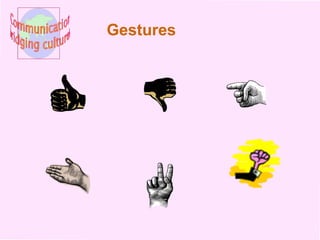
Gestures
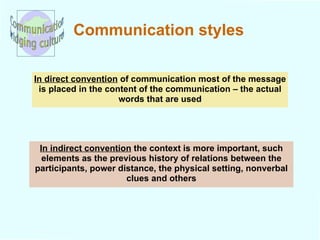
Communication styles In direct convention  of communication most of the message is placed in the content of the communication – the actual words that are used In indirect convention  the context is more important, such elements as the previous history of relations between the participants, power distance, the physical setting, nonverbal clues and others
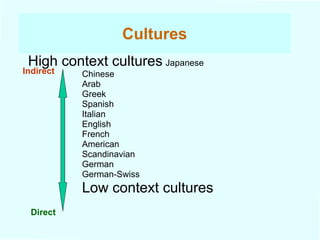
Cultures High context cultures   Japanese Chinese Arab Greek Spanish Italian English French American Scandinavian German  German-Swiss Low context cultures Indirect Direct
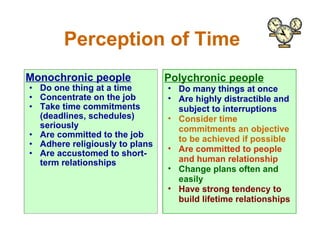
Perception of Time Monochronic people Do one thing at a time Concentrate on the job Take time commitments (deadlines, schedules) seriously Are committed to the job Adhere religiously to plans Are accustomed to short-term relationships Polychronic people Do many things at once Are highly distractible and   subject to interruptions Consider time commitments an objective to be achieved if possible Are committed to people and human relationship Change plans often and easily Have strong tendency to build lifetime relationships
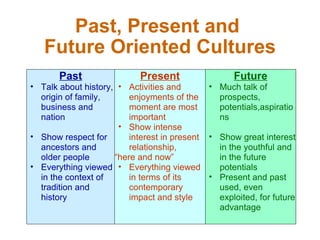
Past, Present and  Future Oriented Cultures Past Talk about history, origin of family, business and nation Show respect for ancestors and older people Everything viewed in the context of tradition and history Present Activities and enjoyments of the moment are most important Show intense interest in present relationship, “ here and now” Everything viewed in terms of its contemporary impact and style Future Much talk of prospects, potentials,aspirations Show great interest in the youthful and in the future potentials Present and past used, even exploited, for future advantage
Tips for doing business Past- and present-oriented cultures Emphasize the history, tradition and cultural heritage of those you deal with as evidence of their great potential Agree future meetings in principle but do not fix deadlines for completion Do your homework on the history, traditions and past glories of the company; consider what re-enactment you might propose Future-oriented cultures Emphasize the freedom, opportunity and limitless scope for that company and its people in the future Agree specific future meetings and deadlines Do your homework on the future, the prospects and the technological potentials of the company; consider mounting a sizable challenge
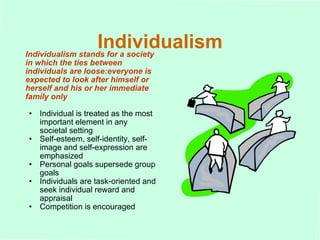
Individualism Individualism stands for a society in which the ties between individuals are loose:everyone is expected to look after himself or herself and his or her immediate   family only Individual is treated as the most important element in any societal setting Self-esteem, self-identity, self-image and self-expression are emphasized Personal goals supersede group goals Individuals are task-oriented and seek individual reward and appraisal Competition is encouraged
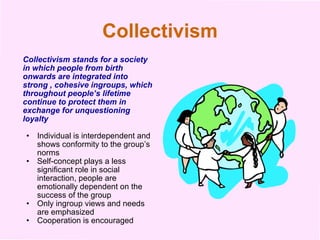
Collectivism Collectivism stands for a society in which people from birth onwards are integrated into strong , cohesive ingroups, which throughout people’s lifetime continue to protect them in exchange for unquestioning loyalty  Individual is interdependent and shows conformity to the group’s norms Self-concept plays a less significant role in social interaction, people are emotionally dependent on the success of the group Only ingroup views and needs are emphasized Cooperation is encouraged
Second language strategies Be patient Speak distinctly, annunciate the words Use short, simple sentences Use action words – verbs etc. Pause frequently, allow time for the person to formulate responses Provide feedback and encouragement Avoid idioms, slang, acronyms and sports terminology Paraphrase if not understood instead of repeating the whole statement louder and slower Be careful with numbers, write them down or repeat if necessary Never assume that people around you do not understand your language Use gestures, actions, visual aids to help understanding
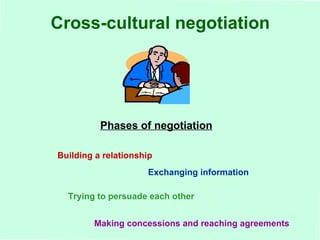
Cross-cultural negotiation Phases of negotiation Building a relationship Exchanging information Trying to persuade each other Making concessions and reaching agreements
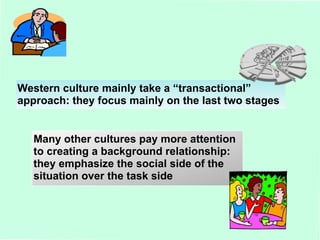
Western culture mainly take a “transactional” approach: they focus mainly on the last two stages Many other cultures pay more attention to creating a background relationship: they emphasize the social side of the situation over the task side
Principles of cross-cultural negotiation Gain cultural knowledge to anticipate differences Practice mindfulness: pay attention to the context and the conventions of communication Develop adaptive skills
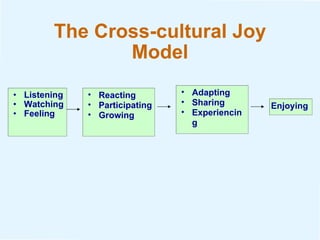
The Cross-cultural Joy Model Listening Watching Feeling Reacting Participating Growing Adapting Sharing Experiencing Enjoying
Core Intercultural Values Humility Respect Listening Observation Empathy Flexibility Informed judgment Persistence
Multicultural teams Culturally diverse groups have the potential both for higher achievement and greater failure than single culture groups. In order to avoid failures team members need cultural knowledge and the knowledge of group types, group tasks, group structure and processes
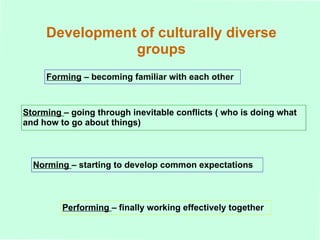
Development of culturally diverse groups Forming  – becoming familiar with each other Storming  – going through inevitable conflicts ( who is doing what and how to go about things) Norming  – starting to develop common expectations  Performing  – finally working effectively together
Strategies Understand your own culture as the point of reference  [Self] Develop an international cultural perspective and global mind-set  [Self] Gather culture-specific information about the countries you are doing business with [Others] Appreciate the complexities of cultures and individuals – avoid mindless stereotyping [Others] Be aware of on-going cultural changes [Self & others]
Final Thoughts Think beyond local perceptions Prepare for new mindset Adapt to new realities and ways Be open and flexible Welcome new experiences Show appreciation for other cultures Observe behavior; suspend judgment, seek rationale Never ignore local sayings and proverbs Negotiate differences: I adjust, you adjust, we look for a third way
American Proverbs Good fences make good neighbors.  In God we trust; all others pay cash.  Scratch my back and I'll scratch yours.
American Sayings One today is worth two tomorrows; what I am to be, I am now becoming. Time is Money. Where sense is wanting, everything is wanting. There’s danger in delay.
Sayings to be guided by Middle East in Perspective “ One step at a time” (literally, "Grapes are eaten one by one") A foolish man may be known by six things: Anger without cause, speech without profit, change without progress, inquiry without object, putting trust in a stranger, and mistaking foes for friends.   Arrogance diminishes wisdom.
An Arab Proverb Middle East in Perspective Eat whatever you like, but dress as others do.  No cure, no pay.   What is learnt in the cradle lasts to the grave.
Quotes to be guided by Middle East in Perspective Your tongue is like a horse--if you take care of it, it takes care of you; if you treat it badly, it treats you badly.   The fool has his answer on the tip of his tongue.
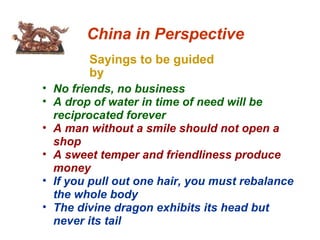
Sayings to be guided by China in Perspective No friends, no business A drop of water in time of need will be reciprocated forever A man without a smile should not open a shop A sweet temper and friendliness produce money If you pull out one hair, you must rebalance the whole body The divine dragon exhibits its head but never its tail
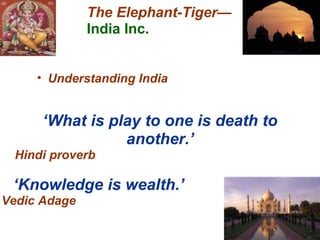
The Elephant-Tiger— India Inc. Understanding India ‘ What is play to one is death to another.’ Hindi proverb ‘ Knowledge is wealth.’ Vedic Adage
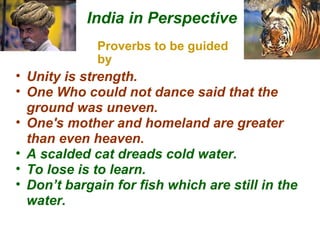
Proverbs to be guided by India in Perspective Unity is strength.  One Who could not dance said that the ground was uneven. One's mother and homeland are greater than even heaven.  A scalded cat dreads cold water. To lose is to learn. Don’t bargain for fish which are still in the water.
Become a Global Citizen. A global citizen is able to work effectively together with other people of any culture, personality, or profession. Become a cultural commuter, one who can cross from culture to culture with ease and naturalness.
Dealing with the World of Culture The Serpent  &  The Eagle   The Fox & the Hedgehog Chameleon Wisdom In Execution W
ER$ Consulting Services Eddy Sumar, MBA, CCE, CICE, CEW 7841 Leucite Avenue Rancho Cucamonga, CA. 91730 909-481-9869 [email_address] Thank You!

Eddy Sumars presentation

  • 1.
    Intercultural Trade CommunicationMarch 16, 2010 Arrowhead Credit union San Bernardino, California Copyright Eddy A. Sumar 2009
  • 2.
    A Cultural JourneyBy Eddy A. Sumar, MBA, CCE, CICE Copyright Eddy A. Sumar 2009 ERS Consulting Services In Collaboration with The County of San Bernardino Economic Development Agency & CITD Presents
  • 3.
  • 4.
    The World isGlobal Trade agreements International trade Multinational corporations The privatization of state enterprises The ability to locate business, particularly manufacturing, wherever the cost is lowest The ability to execute financial transactions instantaneously on a global basis The ability of information and communication technology to transcend time and distance Business is Global
  • 5.
    Have a globalmindset! Understand the world Understand Self Think Global and Act Local Think Local and Act Global Understand Culture Understand People Globalization cries out:
  • 6.
    Cross-cultural competence is no longer an option It is survival
  • 7.
    Roots [Content& Context] Risks Rewards Understanding Culture = Survival Survival = Harnessing R3 R3
  • 8.
    Definition Awareness CompetenceChoice of Behavior Understanding Culture is the road to Cultural Intelligence & Business Success
  • 9.
    Cultural intelligence Culturalintelligence is the capability to deal effectively with people from different cultural backgrounds Cultural intelligence is not difficult to understand but it is difficult to put into practice on an ongoing basis
  • 10.
    Three Components ofCultural intelligence Knowledge of culture: [ Definition ] what culture is how culture affects human behavior how cultures vary Awareness: being aware of our own assumptions, ideas, words, and behavior being aware of other person’s assumptions, ideas, words, and behavior using all the senses in perceiving situations viewing situations from several perspectives Behavioral skills : [ Competence & Choice ] choosing and displaying the appropriate behavior for each particular intercultural situation
  • 11.
  • 12.
    Culture is…… Thecollective programming of the mind which distinguishes the members of one group or category of people from another. Geert Hofstede The customs, beliefs, art and all other products of human thought, made by a particular group of people at a particular time. Richard D. Lewis Beliefs, norms, and attitudes that are used to guide our behaviors and to solve human problems. Guo-Ming Chen, William Starosta
  • 13.
    Culture is: Theway we dress The way we communicate (verbal and non-verbal) The way we relate to others and authority Our outlook and attitude toward life Our perception of self and role in society Our perception of time Our space perception The way we learn and study A way of life
  • 14.
    Culture is belowthe surface…… Culture hides more than what it reveals, and strangely enough, what it hides, it hides most effectively from its own participants. Edward Hall
  • 15.
    Culture is likean iceberg: only a part of it is seen; all the rest is hidden under the water
  • 16.
    Behaviors Values CustomsBeliefs Assumptions Myths & Legends Roots Perceptions Folklore & History
  • 17.
    Layers of culturesA national level A regional level A generation level A gender level A social class level Organizational or corporate level A personal level
  • 18.
    History Religion TraditionCustoms Values Beliefs Art Literature ( Sayings, & Proverbs ) Understanding Culture Searching the Roots
  • 19.
    Understanding Culture Avoidingthe Risks Alienation Culture shock Conflict Confrontation Loss of face Loss of business Loss of credibility
  • 20.
    Understanding Culture Enjoyingthe Rewards Increased market share Higher sales and profitability Enhanced cash flow Diversified portfolio Truly global presence Ability to compete Improved relationships Enhanced loyalty
  • 21.
    Understand the Valuesof your own Culture Consider your assumptions Understanding Culture Start from the Home Front
  • 22.
    Understand the Valuesof American Culture What Japanese say [Elashmawi & Harris] Personal life Wealth Fairness One answer Family Liberty Materials Education Time Success Dreams Freedom Directness Money Reasons Religion Power Understanding Culture Start from the Home Front
  • 23.
    Understanding Culture Startfrom the Home Front Understand the Values of American Culture What Malaysians say [Elashmawi & Harris] Success Power Adherence Material Possessions Openness Profit Individualism Time Commitments Money Aggression Innovation Progress
  • 24.
    Understanding Culture Startfrom the Home Front Understand the Values of American Culture Cultural contrasts in value [Elashmawi & Harris] Freedom/Independence Self-reliance Equality Individualism/privacy Competition Efficiency Time Directness Openness Aggressiveness Informality Future-orientation Risk-taking Creativity Winning Money
  • 25.
    How do weconduct business? How do we establish business relationships? What are our expectations of the other person? What does it take to establish trust and respect? How do we make decisions? How do we view time, power & space? How do we persuade others? How do we communicate? Understanding Culture Consider Your Assumptions
  • 26.
    Understand the Valuesof the new Culture Consider their assumptions Understanding Culture Consider the other person & Culture
  • 27.
    Understand the Valuesof Arab Culture What Japanese say [Elashmawi & Harris] Religion Allah Koran Status History Family Nationality Islam Moustache Gold Understanding Culture Consider the other person & Culture
  • 28.
    Understand the Valuesof Arab Culture What Malaysians say [Elashmawi & Harris] Family Community Wealth Brotherhood Respect Power Friendships Social grouping Religion Status Leisure Traditions Self-image Understanding Culture Consider the other person & Culture
  • 29.
    Understanding Culture Considerthe other person & Culture Understand the Values of Arab Culture Cultural contrasts in value [Elashmawi & Harris] Family security Family harmony Parental guidance Age Authority Compromise Devotion Very patient Indirectness Hospitality/ friendship Formal Past and present Religious beliefs Tradition Social recognition Reputation Family network
  • 30.
    How do theyconduct business? How do they establish business relationships? What are their expectations of you? How do they establish trust and respect? How do they make decisions? How do they view time, power, & space? How do they persuade others? How do they communicate? Understanding Culture Consider the other person & Culture
  • 31.
  • 32.
    Power Distance Individualismvs. Collectivism Masculinity vs. Femininity Uncertainty Avoidance Long-term Orientation Hofstede’s Culture Dimensions
  • 33.
    Individual ……………Group Direct…………………IndirectVerbal………………..Non-verbal Informal……………..Formal Egalitarian…………..Hierarchical Task………………….Relationship Universal…………….Situational Dimensions of National Culture
  • 34.
    Cultural Orientation FrameworkEnvironment : constraint orientation -- It’s fate, Insh’allah Time : Multi-focus, high commitment to relationship-building rather than just task completion; insulting to hurry Action : ‘Being’ culture -- stress is on affiliations, character and personal qualities Communication : High-context, usually indirect Space : Closer physical proximity (12” - 18”)
  • 35.
    Power : Moretolerance for hierarchy, group and family connections important Individualism : Collectivist; loyalty is paramount Competitiveness : Midway between being competitive and cooperative Structure : Order -- seek to reduce ambiguity and make events predictable Thinking : Deductive and based upon ‘gut-feel’ / intuition Cultural Orientation Framework
  • 36.
    Establish personal rapportEstablish personal status/family context Express admiration; use flattery; be indirect Close distance and informal Long range Generosity and and hospitality Emotional support and harmony Relationships Across Cultures A Middle-eastern Example
  • 37.
  • 38.
    Communicating Across CulturesCommunication is the interchange of messages [ verbal & non-verbal ] between people. It is the fundamental building block of social experience. We always communicate whether we are selling, buying, negotiating, leading or working with each other
  • 39.
    MESSAGE FEEDBACK SpeakerSender With Knowledge Experience Values Feelings Communication skills Etc. Listener Receiver With Knowledge Experience Values Feelings Communication skills Etc. Communication
  • 40.
    Body language Upto 90 % of our communication is non-verbal Supportive body language Non-supportive body language
  • 41.
    We Produce OurFirst Impression Only Once
  • 42.
    Introductions Forms ofaddress (names) Exchange of business cards Handshake Eye contact
  • 43.
    Personal space TheAmerican bubble Extends about 12-15 inches (combined 24-30 inches) Asian, especially the Japanese, stand even further apart Latin Americans, Mexicans, Mediterranean people stand much closer
  • 44.
    Touch Touch Spainand Portugal Some Asian cultures Middle Eastern countries Latin Americans (only the same gender) Don’t touch United States and Canada England Northern European countries Japan Australia
  • 45.
  • 46.
    Communication styles Indirect convention of communication most of the message is placed in the content of the communication – the actual words that are used In indirect convention the context is more important, such elements as the previous history of relations between the participants, power distance, the physical setting, nonverbal clues and others
  • 47.
    Cultures High contextcultures Japanese Chinese Arab Greek Spanish Italian English French American Scandinavian German German-Swiss Low context cultures Indirect Direct
  • 48.
    Perception of TimeMonochronic people Do one thing at a time Concentrate on the job Take time commitments (deadlines, schedules) seriously Are committed to the job Adhere religiously to plans Are accustomed to short-term relationships Polychronic people Do many things at once Are highly distractible and subject to interruptions Consider time commitments an objective to be achieved if possible Are committed to people and human relationship Change plans often and easily Have strong tendency to build lifetime relationships
  • 49.
    Past, Present and Future Oriented Cultures Past Talk about history, origin of family, business and nation Show respect for ancestors and older people Everything viewed in the context of tradition and history Present Activities and enjoyments of the moment are most important Show intense interest in present relationship, “ here and now” Everything viewed in terms of its contemporary impact and style Future Much talk of prospects, potentials,aspirations Show great interest in the youthful and in the future potentials Present and past used, even exploited, for future advantage
  • 50.
    Tips for doingbusiness Past- and present-oriented cultures Emphasize the history, tradition and cultural heritage of those you deal with as evidence of their great potential Agree future meetings in principle but do not fix deadlines for completion Do your homework on the history, traditions and past glories of the company; consider what re-enactment you might propose Future-oriented cultures Emphasize the freedom, opportunity and limitless scope for that company and its people in the future Agree specific future meetings and deadlines Do your homework on the future, the prospects and the technological potentials of the company; consider mounting a sizable challenge
  • 51.
    Individualism Individualism standsfor a society in which the ties between individuals are loose:everyone is expected to look after himself or herself and his or her immediate family only Individual is treated as the most important element in any societal setting Self-esteem, self-identity, self-image and self-expression are emphasized Personal goals supersede group goals Individuals are task-oriented and seek individual reward and appraisal Competition is encouraged
  • 52.
    Collectivism Collectivism standsfor a society in which people from birth onwards are integrated into strong , cohesive ingroups, which throughout people’s lifetime continue to protect them in exchange for unquestioning loyalty Individual is interdependent and shows conformity to the group’s norms Self-concept plays a less significant role in social interaction, people are emotionally dependent on the success of the group Only ingroup views and needs are emphasized Cooperation is encouraged
  • 53.
    Second language strategiesBe patient Speak distinctly, annunciate the words Use short, simple sentences Use action words – verbs etc. Pause frequently, allow time for the person to formulate responses Provide feedback and encouragement Avoid idioms, slang, acronyms and sports terminology Paraphrase if not understood instead of repeating the whole statement louder and slower Be careful with numbers, write them down or repeat if necessary Never assume that people around you do not understand your language Use gestures, actions, visual aids to help understanding
  • 54.
    Cross-cultural negotiation Phasesof negotiation Building a relationship Exchanging information Trying to persuade each other Making concessions and reaching agreements
  • 55.
    Western culture mainlytake a “transactional” approach: they focus mainly on the last two stages Many other cultures pay more attention to creating a background relationship: they emphasize the social side of the situation over the task side
  • 56.
    Principles of cross-culturalnegotiation Gain cultural knowledge to anticipate differences Practice mindfulness: pay attention to the context and the conventions of communication Develop adaptive skills
  • 57.
    The Cross-cultural JoyModel Listening Watching Feeling Reacting Participating Growing Adapting Sharing Experiencing Enjoying
  • 58.
    Core Intercultural ValuesHumility Respect Listening Observation Empathy Flexibility Informed judgment Persistence
  • 59.
    Multicultural teams Culturallydiverse groups have the potential both for higher achievement and greater failure than single culture groups. In order to avoid failures team members need cultural knowledge and the knowledge of group types, group tasks, group structure and processes
  • 60.
    Development of culturallydiverse groups Forming – becoming familiar with each other Storming – going through inevitable conflicts ( who is doing what and how to go about things) Norming – starting to develop common expectations Performing – finally working effectively together
  • 61.
    Strategies Understand yourown culture as the point of reference [Self] Develop an international cultural perspective and global mind-set [Self] Gather culture-specific information about the countries you are doing business with [Others] Appreciate the complexities of cultures and individuals – avoid mindless stereotyping [Others] Be aware of on-going cultural changes [Self & others]
  • 62.
    Final Thoughts Thinkbeyond local perceptions Prepare for new mindset Adapt to new realities and ways Be open and flexible Welcome new experiences Show appreciation for other cultures Observe behavior; suspend judgment, seek rationale Never ignore local sayings and proverbs Negotiate differences: I adjust, you adjust, we look for a third way
  • 63.
    American Proverbs Goodfences make good neighbors. In God we trust; all others pay cash. Scratch my back and I'll scratch yours.
  • 64.
    American Sayings Onetoday is worth two tomorrows; what I am to be, I am now becoming. Time is Money. Where sense is wanting, everything is wanting. There’s danger in delay.
  • 65.
    Sayings to beguided by Middle East in Perspective “ One step at a time” (literally, "Grapes are eaten one by one") A foolish man may be known by six things: Anger without cause, speech without profit, change without progress, inquiry without object, putting trust in a stranger, and mistaking foes for friends. Arrogance diminishes wisdom.
  • 66.
    An Arab ProverbMiddle East in Perspective Eat whatever you like, but dress as others do. No cure, no pay. What is learnt in the cradle lasts to the grave.
  • 67.
    Quotes to beguided by Middle East in Perspective Your tongue is like a horse--if you take care of it, it takes care of you; if you treat it badly, it treats you badly. The fool has his answer on the tip of his tongue.
  • 68.
    Sayings to beguided by China in Perspective No friends, no business A drop of water in time of need will be reciprocated forever A man without a smile should not open a shop A sweet temper and friendliness produce money If you pull out one hair, you must rebalance the whole body The divine dragon exhibits its head but never its tail
  • 69.
    The Elephant-Tiger— IndiaInc. Understanding India ‘ What is play to one is death to another.’ Hindi proverb ‘ Knowledge is wealth.’ Vedic Adage
  • 70.
    Proverbs to beguided by India in Perspective Unity is strength. One Who could not dance said that the ground was uneven. One's mother and homeland are greater than even heaven. A scalded cat dreads cold water. To lose is to learn. Don’t bargain for fish which are still in the water.
  • 71.
    Become a GlobalCitizen. A global citizen is able to work effectively together with other people of any culture, personality, or profession. Become a cultural commuter, one who can cross from culture to culture with ease and naturalness.
  • 72.
    Dealing with theWorld of Culture The Serpent & The Eagle The Fox & the Hedgehog Chameleon Wisdom In Execution W
  • 73.
    ER$ Consulting ServicesEddy Sumar, MBA, CCE, CICE, CEW 7841 Leucite Avenue Rancho Cucamonga, CA. 91730 909-481-9869 [email_address] Thank You!

Editor's Notes

  • #11 Mindfulness – empathize, learn to
  • #14 Dress defines behavior Pessimistic & optimistic
  • #42 Use eye contact “ blink” book 1st impression
  • #43 Europe –last name Korea – one hand card other on forearm and bow Look, treat, respectful Smile is therapydic Facial expressions can influence!
  • #44 Introduce women 1st & higher level people 1st
  • #50 American don’t know how to live in the present. (problem) not content! What is happiness? Past happen to thrive…