Cross-referencing:
Using MLA Format
Cross-Referencing Your Sources
• Cross-referencing allows readers to locate the
  publication information of source material.
• This is of great value for researchers who may
  want to locate your sources for their own
  research projects.
Avoiding Plagiarism
• Proper citation of your sources in MLA style
  can help you avoid plagiarism, which is a
  serious offense. It may result in anything from
  failure of the assignment to expulsion from
  the University.
Where to Find MLA Format
• MLA Handbook for Writers of Research
  Papers.
• Composition textbooks
• www.mla.org
• OWL website: owl.english.purdue.edu
MLA Style: Two Parts
• Works Cited Page
• Parenthetical Citations
Works Cited Page
• A complete list of every source that you make
  reference to in your essay
• Provides the information necessary for a
  reader to locate and retrieve any sources cited
  in your essay
Works Cited Page
• A complete list of every source that you make
  reference to in your Research Assignment or
  Dissertation.
• Provides the information necessary for a
  reader to locate and retrieve any sources cited
  in your Research Assignment or Dissertation.
Works Cited
•   Miller, J. Hillis. Charles Dickens: The World and His Novels. Bloomington: U of
     Indiana P, 1958.


•   Zwerdling, Alex. “Esther Summerson Rehabilitated.” PMLA 88 (May 1973): 429-439.
Works Cited
Most citations should contain the following
  basic information:
• Author’s name
• Title of work
• Publication information
Works Cited: Some Examples
• Book
Byatt, A. S. Babel Tower. New York: Random
  House, 1996.
• Article in a Magazine
Klein, Joe. “Dizzy Days.” The New Yorker 5 Oct.
  1998: 40-45.
• Web page
Poland, Dave. “The Hot Button.” Roughcut. 26
  Oct. 1998. Turner Network Television. 28 Oct.
  1998 <www.roughcut.com>.
Works Cited List
• A newspaper article
Tommasini, Anthony. “Master Teachers Whose
  Artistry Glows in Private.” New York Times 27
  Oct. 1998: B2.

• A source with no known author
“Cigarette Sales Fall 30% as California Tax Rises.”
   New York Times 14 Sept. 1999: A17.
Works Cited List
• A TV interview
McGwire, Mark. Interview with Matt Lauer.
  The Today Show. NBC. WTHR, Indianapolis.
  22 Oct. 1998.

• A personal interview
Mellencamp, John. Personal interview. 27 Oct.
  1998
When Should You Use Parenthetical
            Citations?
• When quoting any words that are not
  your own
  – Quoting means to repeat another source
    word for word, using quotation marks
When Should You Use Parenthetical
            Citations?
• When summarizing facts and ideas from a source
  – Summarizing means to take ideas from a large passage of
    another source and condense them, using your own words
• When paraphrasing a source
  – Paraphrasing means to use the ideas from another source
    but change the phrasing into your own words
Keys to Parenthetical Citations
Readability
• Keep references brief
• Give only information needed to identify the
  source on your Works Cited page
• Do not repeat unnecessary information
Handling Quotes in Your Text
• Author’s last name and page number(s)
  of quote must appear in the text
 Romantic poetry is characterized by the
 “spontaneous overflow of powerful feelings”
 (Wordsworth 263).
 Wordsworth stated that Romantic poetry
 was marked by a “spontaneous overflow of
 powerful feelings” (263).
Handling Parenthetical Citations
• Sometimes more information is necessary
• More than one author with the same last name
  (W. Wordsworth 23); (D. Wordsworth 224)
• More than one work by the same author
  (Joyce, Portrait 121); (Joyce, Ulysses 556)
• Different volumes of a multivolume work
  (1: 336)
• Citing indirect sources
  (Johnson qtd. in Boswell 2:450)
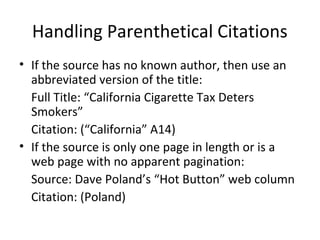
Handling Parenthetical Citations
• If the source has no known author, then use an
  abbreviated version of the title:
  Full Title: “California Cigarette Tax Deters
  Smokers”
  Citation: (“California” A14)
• If the source is only one page in length or is a
  web page with no apparent pagination:
  Source: Dave Poland’s “Hot Button” web column
  Citation: (Poland)
Handling Long Quotations
David becomes identified and defined by James Steerforth, a young man with
   whom David is acquainted from his days at Salem House. Before meeting
   Steerforth, David accepts Steerforth’s name as an authoritative power:
           There was an old door in this playground, on which the boys had a
           custom of carving their names. . . . In my dread of the end of the
           vacation and their coming back, I could not read a boy’s name,
           without inquiring in what tone and with what emphasis he would
           read, “Take care of him. He bites.” There was one boy—a certain
           J. Steerforth—who cut his name very deep and very often, who I
           conceived, would read it in a rather strong voice, and afterwards
           pull my hair. (Dickens 68)
   For Steerforth, naming becomes an act of possession, as well as
   exploitation. Steerforth names David for his fresh look and innocence, but
   also uses the name Daisy to exploit David's romantic tendencies (Dyson
   122).
Works Cited Page 1
• Aarons, Victoria. “Telling History: Inventing Identity
  in Jewish American Fiction”. Memory and Cultural
  Politics. New Approaches to American Ethnic
  Literatures. Eds. Amritjit Singh, Joseph T. Jr. and
  Robert E. Hogan. Boston: Northeastern University
  Press, 1996. 60-83.
• Abrams, M.H. A Glossary of Literary Terms. Fort
  Worth, San Diego: Harcourt Brace Jovanovich College
  Publishers, 1993.
Works Cited Page 2
• Avery, Evelyn. ed. The Magic Worlds of Bernard
  Malamud. Albany: State University of New York
  Press, 2001.
• Batker, Carol. “Literary Reformers: Crossing Class and
  Ethnic Boundaries in Jewish Women’s Fiction of the
  1920s”. Melus 25.1 (Spring 2000): 81-105.
• Bhabha, Homi K. The Location of Culture. London,
  NY: Routledge, 1994.
• Breckenridge et al. Cosmopolitanism. Durham &
  London: Duke University Press, 2002.
Works Cited Page 3
• Brogan, Kathleen. “Imagining the Past in Cynthia Ozick’s The
  Shawl”. Cultural Haunting. Charlottesville and London:
  University Press of Virginia, 1998. 160-171.
• Browder, Laura. Slippery Characters. Ethnic Impersonators
  and American Identities. Chapel Hill: the University of North
  Carolina Press, 2000.
• Budick Miller, Emily. “The Holocaust in the Jewish American
  Literary Imagination”. The Cambridge Companion to Jewish
  American Literature. Eds. Michael P. Kramer and Hana Wirth-
  Nesher. Cambridge: Cambridge University Press, 2003. 212-
  230.

Cross referencing using MLA style

  • 1.
  • 2.
    Cross-Referencing Your Sources •Cross-referencing allows readers to locate the publication information of source material. • This is of great value for researchers who may want to locate your sources for their own research projects.
  • 3.
    Avoiding Plagiarism • Propercitation of your sources in MLA style can help you avoid plagiarism, which is a serious offense. It may result in anything from failure of the assignment to expulsion from the University.
  • 4.
    Where to FindMLA Format • MLA Handbook for Writers of Research Papers. • Composition textbooks • www.mla.org • OWL website: owl.english.purdue.edu
  • 5.
    MLA Style: TwoParts • Works Cited Page • Parenthetical Citations
  • 6.
    Works Cited Page •A complete list of every source that you make reference to in your essay • Provides the information necessary for a reader to locate and retrieve any sources cited in your essay
  • 7.
    Works Cited Page •A complete list of every source that you make reference to in your Research Assignment or Dissertation. • Provides the information necessary for a reader to locate and retrieve any sources cited in your Research Assignment or Dissertation.
  • 8.
    Works Cited • Miller, J. Hillis. Charles Dickens: The World and His Novels. Bloomington: U of Indiana P, 1958. • Zwerdling, Alex. “Esther Summerson Rehabilitated.” PMLA 88 (May 1973): 429-439.
  • 9.
    Works Cited Most citationsshould contain the following basic information: • Author’s name • Title of work • Publication information
  • 10.
    Works Cited: SomeExamples • Book Byatt, A. S. Babel Tower. New York: Random House, 1996. • Article in a Magazine Klein, Joe. “Dizzy Days.” The New Yorker 5 Oct. 1998: 40-45. • Web page Poland, Dave. “The Hot Button.” Roughcut. 26 Oct. 1998. Turner Network Television. 28 Oct. 1998 <www.roughcut.com>.
  • 11.
    Works Cited List •A newspaper article Tommasini, Anthony. “Master Teachers Whose Artistry Glows in Private.” New York Times 27 Oct. 1998: B2. • A source with no known author “Cigarette Sales Fall 30% as California Tax Rises.” New York Times 14 Sept. 1999: A17.
  • 12.
    Works Cited List •A TV interview McGwire, Mark. Interview with Matt Lauer. The Today Show. NBC. WTHR, Indianapolis. 22 Oct. 1998. • A personal interview Mellencamp, John. Personal interview. 27 Oct. 1998
  • 13.
    When Should YouUse Parenthetical Citations? • When quoting any words that are not your own – Quoting means to repeat another source word for word, using quotation marks
  • 14.
    When Should YouUse Parenthetical Citations? • When summarizing facts and ideas from a source – Summarizing means to take ideas from a large passage of another source and condense them, using your own words • When paraphrasing a source – Paraphrasing means to use the ideas from another source but change the phrasing into your own words
  • 15.
    Keys to ParentheticalCitations Readability • Keep references brief • Give only information needed to identify the source on your Works Cited page • Do not repeat unnecessary information
  • 16.
    Handling Quotes inYour Text • Author’s last name and page number(s) of quote must appear in the text Romantic poetry is characterized by the “spontaneous overflow of powerful feelings” (Wordsworth 263). Wordsworth stated that Romantic poetry was marked by a “spontaneous overflow of powerful feelings” (263).
  • 17.
    Handling Parenthetical Citations •Sometimes more information is necessary • More than one author with the same last name (W. Wordsworth 23); (D. Wordsworth 224) • More than one work by the same author (Joyce, Portrait 121); (Joyce, Ulysses 556) • Different volumes of a multivolume work (1: 336) • Citing indirect sources (Johnson qtd. in Boswell 2:450)
  • 18.
    Handling Parenthetical Citations •If the source has no known author, then use an abbreviated version of the title: Full Title: “California Cigarette Tax Deters Smokers” Citation: (“California” A14) • If the source is only one page in length or is a web page with no apparent pagination: Source: Dave Poland’s “Hot Button” web column Citation: (Poland)
  • 19.
    Handling Long Quotations Davidbecomes identified and defined by James Steerforth, a young man with whom David is acquainted from his days at Salem House. Before meeting Steerforth, David accepts Steerforth’s name as an authoritative power: There was an old door in this playground, on which the boys had a custom of carving their names. . . . In my dread of the end of the vacation and their coming back, I could not read a boy’s name, without inquiring in what tone and with what emphasis he would read, “Take care of him. He bites.” There was one boy—a certain J. Steerforth—who cut his name very deep and very often, who I conceived, would read it in a rather strong voice, and afterwards pull my hair. (Dickens 68) For Steerforth, naming becomes an act of possession, as well as exploitation. Steerforth names David for his fresh look and innocence, but also uses the name Daisy to exploit David's romantic tendencies (Dyson 122).
  • 20.
    Works Cited Page1 • Aarons, Victoria. “Telling History: Inventing Identity in Jewish American Fiction”. Memory and Cultural Politics. New Approaches to American Ethnic Literatures. Eds. Amritjit Singh, Joseph T. Jr. and Robert E. Hogan. Boston: Northeastern University Press, 1996. 60-83. • Abrams, M.H. A Glossary of Literary Terms. Fort Worth, San Diego: Harcourt Brace Jovanovich College Publishers, 1993.
  • 21.
    Works Cited Page2 • Avery, Evelyn. ed. The Magic Worlds of Bernard Malamud. Albany: State University of New York Press, 2001. • Batker, Carol. “Literary Reformers: Crossing Class and Ethnic Boundaries in Jewish Women’s Fiction of the 1920s”. Melus 25.1 (Spring 2000): 81-105. • Bhabha, Homi K. The Location of Culture. London, NY: Routledge, 1994. • Breckenridge et al. Cosmopolitanism. Durham & London: Duke University Press, 2002.
  • 22.
    Works Cited Page3 • Brogan, Kathleen. “Imagining the Past in Cynthia Ozick’s The Shawl”. Cultural Haunting. Charlottesville and London: University Press of Virginia, 1998. 160-171. • Browder, Laura. Slippery Characters. Ethnic Impersonators and American Identities. Chapel Hill: the University of North Carolina Press, 2000. • Budick Miller, Emily. “The Holocaust in the Jewish American Literary Imagination”. The Cambridge Companion to Jewish American Literature. Eds. Michael P. Kramer and Hana Wirth- Nesher. Cambridge: Cambridge University Press, 2003. 212- 230.