Critical Thinking
Presented by
RR
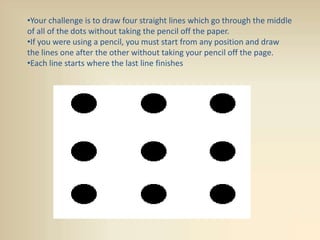
•Your challenge is to draw four straight lines which go through the middle
of all of the dots without taking the pencil off the paper.
•If you were using a pencil, you must start from any position and draw
the lines one after the other without taking your pencil off the page.
•Each line starts where the last line finishes
• Thinking is the hardest work there is, which is
probably why so few engage in it.
– Henry Ford
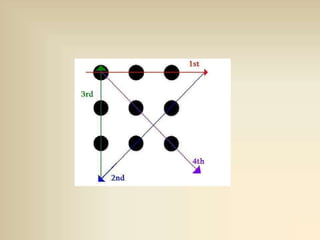
Lessons to be learnt from the puzzle
• Look beyond the current definition of the
problem
• Investigate the boundaries
• Hard work is not the solution
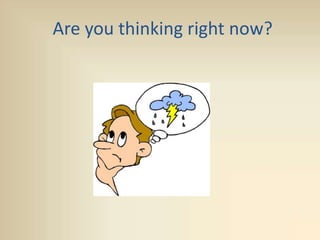
Are you thinking right now?
What is Critical Thinking?
• It is thinking that is purposeful, reasoned, and goal
directed
• It is searching, plotting, making associations,
explaining, analyzing, probing for multiple angles,
justifying, scrutinizing, making decisions, solving
problems, and investigating
• It is literally thinking about something from many
angles
– Critical thinking is about making informed, enlightened,
educated, open-minded decisions in college in
relationships in finances and decisions in life in general.
How can it help you?
• As a student, critical thinking can help you focus on
issues; gather relevant, accurate information;
remember facts; organize thoughts logically; analyze
questions and problems; and manage your priorities
• It can assist in your problem-solving skills and help you
control your emotions so that you can make rational
judgments.
• It can help you determine the accuracy of printed and
spoken words
• It can help you detect bias and determine the point of
arguments and persuasion of arguments
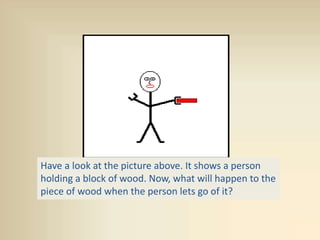
Have a look at the picture above. It shows a person
holding a block of wood. Now, what will happen to the
piece of wood when the person lets go of it?
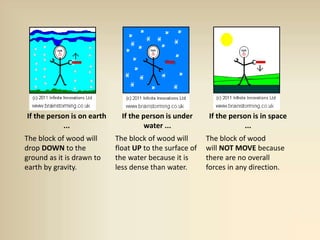
If the person is on earth
...
If the person is under
water ...
If the person is in space
...
The block of wood will
drop DOWN to the
ground as it is drawn to
earth by gravity.
The block of wood will
float UP to the surface of
the water because it is
less dense than water.
The block of wood
will NOT MOVE because
there are no overall
forces in any direction.
Lessons to be learnt from this puzzle –
A Discussion
• Think about the current situation before
answering
– If you see the world from only one angle you will
struggle to change it
– What assumptions have you made?
– How do your own perceptions influence the world you
live in?
– How do you see the world and how is your view
different to that of other people?
– What advantages & disadvantages are there for each
way of thinking?
Restraining Emotions
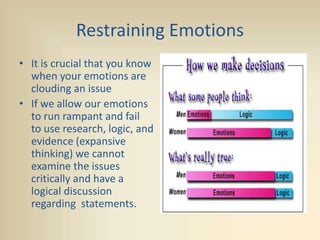
• It is crucial that you know
when your emotions are
clouding an issue
• If we allow our emotions
to run rampant and fail
to use research, logic, and
evidence (expansive
thinking) we cannot
examine the issues
critically and have a
logical discussion
regarding statements.
Restraining emotions
If you feel that your emotions caused you to be less than objective, you might consider the
following tips you are faced with an emotional decision:
• Listen to all sides of an argument or statement before you make a decision or form an
opinion.
• Make a conscious effort to identify which emotions are causing you to lose objectivity.
• Do not let your emotions withdraw you or turn you off from the situation.
• Don’t let yourself become engaged in “I’m right, you’re wrong” situations.
• Work to understand why others feel their side is valid.
• Physiological reactions to emotions, such as increased heart rate and blood pressure and
an increase in adrenaline flow, should be recognized as an emotional checklist. If you
begin to experience these reactions, relax, take a deep breath, and concentrate on
being open-minded.
• Control your negative self-talk or inner voice toward the other person(s) or situation.
• Determine whether your emotions are irrational.
Look at things differently
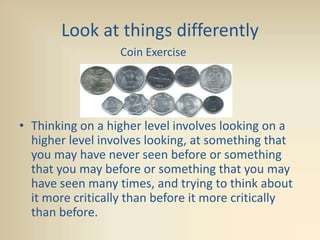
• Thinking on a higher level involves looking on a
higher level involves looking, at something that
you may have never seen before or something
that you may before or something that you may
have seen many times, and trying to think about
it more critically than before it more critically
than before.
Coin Exercise
Asking Questions
• Use questioning for exploring developing and
acquiring new knowledge.
Solving Problems
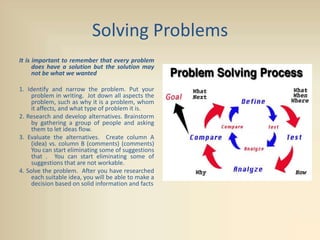
It is important to remember that every problem
does have a solution but the solution may
not be what we wanted
1. Identify and narrow the problem. Put your
problem in writing. Jot down all aspects the
problem, such as why it is a problem, whom
it affects, and what type of problem it is.
2. Research and develop alternatives. Brainstorm
by gathering a group of people and asking
them to let ideas flow.
3. Evaluate the alternatives. Create column A
(idea) vs. column B (comments) (comments)
You can start eliminating some of suggestions
that . You can start eliminating some of
suggestions that are not workable.
4. Solve the problem. After you have researched
each suitable idea, you will be able to make a
decision based on solid information and facts
Distinguishing Fact From Opinion
• One of the most important aspects of critical thinking is the ability to
distinguish fact from opinion.
• Many times an opinion can sound true, but without evidence and
proof, it is just an and proof, it is just an opinion
• A fact is something that can be proven, something that can be
objectively verified.
• Statements that cannot be proved should be always treated as
opinion.
• Statements that offer valid proof and verification from credible,
reliable sources can be treated as factual.
• If you are unsure about the credibility of the source or information,
information, treat that statement as treat that statement as opinion
Fact Vs Opinion Exercise
• Is each statement below a fact or an opinion?
1. If made into law, the Lokpal bill would be the best in
terms of anti corruption law in India.
2. Anna Hazare started a Satyagraha movement by
commencing an indefinite fast in New Delhi to
demand the passing of the bill.
3. “Gandhi” is the best movie ever made.
4. Lincoln was the best president to ever head the
United States.
5. All MBA students will get a good placement
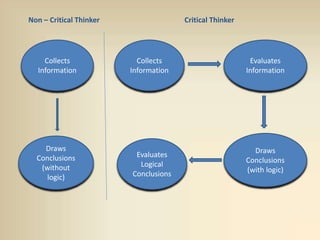
Collects
Information
Draws
Conclusions
(without
logic)
Evaluates
Logical
Conclusions
Collects
Information
Draws
Conclusions
(with logic)
Evaluates
Information
Non – Critical Thinker Critical Thinker
Critical Thinking Toolbox
To think critically, we must ask questions about the information or data we
have collected.
• “Is it important?”
• “Is it relevant?”
• “Is it applicable?”
• “Is it significant?”
But that’s not enough. We must also ask questions about the conclusion
we’ve drawn from the information we’ve collected
• “Is the conclusion fair?”
• “Is it logical?”
• “Is it reasonable?”
• “Is it consistent with all the information collected?”
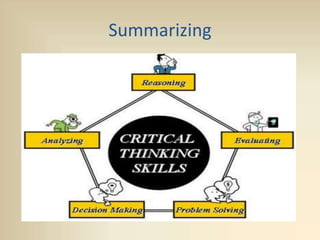
Summarizing
Case Study of a popular motor
company
Thank you

Critical Thinking for training purpose nutshell

  • 1.
  • 2.
    •Your challenge isto draw four straight lines which go through the middle of all of the dots without taking the pencil off the paper. •If you were using a pencil, you must start from any position and draw the lines one after the other without taking your pencil off the page. •Each line starts where the last line finishes
  • 3.
    • Thinking isthe hardest work there is, which is probably why so few engage in it. – Henry Ford
  • 5.
    Lessons to belearnt from the puzzle • Look beyond the current definition of the problem • Investigate the boundaries • Hard work is not the solution
  • 6.
    Are you thinkingright now?
  • 7.
    What is CriticalThinking? • It is thinking that is purposeful, reasoned, and goal directed • It is searching, plotting, making associations, explaining, analyzing, probing for multiple angles, justifying, scrutinizing, making decisions, solving problems, and investigating • It is literally thinking about something from many angles – Critical thinking is about making informed, enlightened, educated, open-minded decisions in college in relationships in finances and decisions in life in general.
  • 8.
    How can ithelp you? • As a student, critical thinking can help you focus on issues; gather relevant, accurate information; remember facts; organize thoughts logically; analyze questions and problems; and manage your priorities • It can assist in your problem-solving skills and help you control your emotions so that you can make rational judgments. • It can help you determine the accuracy of printed and spoken words • It can help you detect bias and determine the point of arguments and persuasion of arguments
  • 10.
    Have a lookat the picture above. It shows a person holding a block of wood. Now, what will happen to the piece of wood when the person lets go of it?
  • 11.
    If the personis on earth ... If the person is under water ... If the person is in space ... The block of wood will drop DOWN to the ground as it is drawn to earth by gravity. The block of wood will float UP to the surface of the water because it is less dense than water. The block of wood will NOT MOVE because there are no overall forces in any direction.
  • 12.
    Lessons to belearnt from this puzzle – A Discussion • Think about the current situation before answering – If you see the world from only one angle you will struggle to change it – What assumptions have you made? – How do your own perceptions influence the world you live in? – How do you see the world and how is your view different to that of other people? – What advantages & disadvantages are there for each way of thinking?
  • 13.
    Restraining Emotions • Itis crucial that you know when your emotions are clouding an issue • If we allow our emotions to run rampant and fail to use research, logic, and evidence (expansive thinking) we cannot examine the issues critically and have a logical discussion regarding statements.
  • 14.
    Restraining emotions If youfeel that your emotions caused you to be less than objective, you might consider the following tips you are faced with an emotional decision: • Listen to all sides of an argument or statement before you make a decision or form an opinion. • Make a conscious effort to identify which emotions are causing you to lose objectivity. • Do not let your emotions withdraw you or turn you off from the situation. • Don’t let yourself become engaged in “I’m right, you’re wrong” situations. • Work to understand why others feel their side is valid. • Physiological reactions to emotions, such as increased heart rate and blood pressure and an increase in adrenaline flow, should be recognized as an emotional checklist. If you begin to experience these reactions, relax, take a deep breath, and concentrate on being open-minded. • Control your negative self-talk or inner voice toward the other person(s) or situation. • Determine whether your emotions are irrational.
  • 15.
    Look at thingsdifferently • Thinking on a higher level involves looking on a higher level involves looking, at something that you may have never seen before or something that you may before or something that you may have seen many times, and trying to think about it more critically than before it more critically than before. Coin Exercise
  • 16.
    Asking Questions • Usequestioning for exploring developing and acquiring new knowledge.
  • 17.
    Solving Problems It isimportant to remember that every problem does have a solution but the solution may not be what we wanted 1. Identify and narrow the problem. Put your problem in writing. Jot down all aspects the problem, such as why it is a problem, whom it affects, and what type of problem it is. 2. Research and develop alternatives. Brainstorm by gathering a group of people and asking them to let ideas flow. 3. Evaluate the alternatives. Create column A (idea) vs. column B (comments) (comments) You can start eliminating some of suggestions that . You can start eliminating some of suggestions that are not workable. 4. Solve the problem. After you have researched each suitable idea, you will be able to make a decision based on solid information and facts
  • 18.
    Distinguishing Fact FromOpinion • One of the most important aspects of critical thinking is the ability to distinguish fact from opinion. • Many times an opinion can sound true, but without evidence and proof, it is just an and proof, it is just an opinion • A fact is something that can be proven, something that can be objectively verified. • Statements that cannot be proved should be always treated as opinion. • Statements that offer valid proof and verification from credible, reliable sources can be treated as factual. • If you are unsure about the credibility of the source or information, information, treat that statement as treat that statement as opinion
  • 19.
    Fact Vs OpinionExercise • Is each statement below a fact or an opinion? 1. If made into law, the Lokpal bill would be the best in terms of anti corruption law in India. 2. Anna Hazare started a Satyagraha movement by commencing an indefinite fast in New Delhi to demand the passing of the bill. 3. “Gandhi” is the best movie ever made. 4. Lincoln was the best president to ever head the United States. 5. All MBA students will get a good placement
  • 20.
  • 21.
    Critical Thinking Toolbox Tothink critically, we must ask questions about the information or data we have collected. • “Is it important?” • “Is it relevant?” • “Is it applicable?” • “Is it significant?” But that’s not enough. We must also ask questions about the conclusion we’ve drawn from the information we’ve collected • “Is the conclusion fair?” • “Is it logical?” • “Is it reasonable?” • “Is it consistent with all the information collected?”
  • 22.
  • 23.
    Case Study ofa popular motor company
  • 25.