Critical Theory
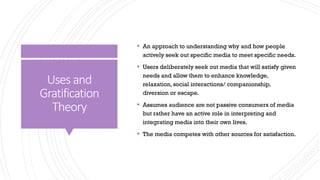
Uses and
Gratification
Theory
▪ An approach to understanding why and how people
actively seek out specific media to meet specific needs.
▪ Users deliberately seek out media that will satisfy given
needs and allow them to enhance knowledge,
relaxation,social interactions/ companionship,
diversion or escape.
▪ Assumes audience are not passive consumers of media
but rather have an active role in interpreting and
integrating media into their own lives.
▪ The media competes with other sources for satisfaction.
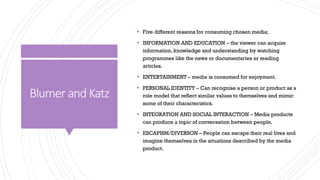
Blumer and Katz
▪ Five different reasons for consuming chosen media;
▪ INFORMATION AND EDUCATION – the viewer can acquire
information, knowledge and understanding by watching
programmes like the news or documentaries or reading
articles.
▪ ENTERTAINMENT – media is consumed for enjoyment.
▪ PERSONAL IDENTITY – Can recognise a person or product as a
role model that reflect similar values to themselves and mimic
some of their characteristics.
▪ INTEGRATION AND SOCIAL INTERACTION – Media products
can produce a topic of conversation between people.
▪ ESCAPISM/DIVERSON – People can escape their real lives and
imagine themselves in the situations described by the media
product.
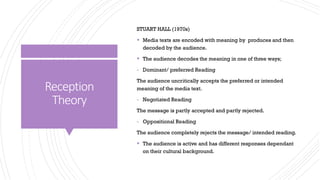
Reception
Theory
STUART HALL (1970s)
▪ Media texts are encoded with meaning by produces and then
decoded by the audience.
▪ The audience decodes the meaning in one of three ways;
- Dominant/ preferred Reading
The audience uncritically accepts the preferred or intended
meaning of the media text.
- Negotiated Reading
The message is partly accepted and partly rejected.
- Oppositional Reading
The audience completely rejects the message/ intended reading.
▪ The audience is active and has different responses dependant
on their cultural background.
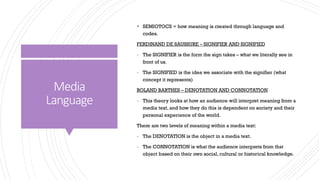
Media
Language
▪ SEMIOTOCS = how meaning is created through language and
codes.
FERDINAND DE SAUSSURE – SIGNIFIER AND SIGNIFIED
- The SIGNIFIER is the form the sign takes – what we literally see in
front of us.
- The SIGNIFIED is the idea we associate with the signifier (what
concept it represents)
ROLAND BARTHES – DENOTATION AND CONNOTATION
- This theory looks at how an audience will interpret meaning from a
media text, and how they do this is dependent on society and their
personal experience of the world.
There are two levels of meaning within a media text:
- The DENOTATION is the object in a media text.
- The CONNOTATION is what the audience interprets from that
object based on their own social, cultural or historical knowledge.
Male Gaze
Theory
LAURA MULVEY
▪ When an audience is put into the perspective of a
heterosexual man, e.g. by focusing on the curves of a
women’s body.
▪ The male gaze denies women of human identity by
regulating them to the status of objects to be admired for
their physical appearance.
▪ In the media women can therefore only view themselves
from the secondary perspective of a man.
▪ Women become an object rather than the subject of a
media text.
▪ This leads to women gazing at other women in the same
way a man would and therefore objectifying other women.
▪ A passive audience could be influenced by and imitate
this version of reality.
Genre
STEVE NEIL
▪ ‘genres are instances of repetition and difference’
‘difference is absolutely essential for the economy of
genre’ (repetition would not attract an audience)

Critical theory

  • 1.
  • 2.
    Uses and Gratification Theory ▪ Anapproach to understanding why and how people actively seek out specific media to meet specific needs. ▪ Users deliberately seek out media that will satisfy given needs and allow them to enhance knowledge, relaxation,social interactions/ companionship, diversion or escape. ▪ Assumes audience are not passive consumers of media but rather have an active role in interpreting and integrating media into their own lives. ▪ The media competes with other sources for satisfaction.
  • 3.
    Blumer and Katz ▪Five different reasons for consuming chosen media; ▪ INFORMATION AND EDUCATION – the viewer can acquire information, knowledge and understanding by watching programmes like the news or documentaries or reading articles. ▪ ENTERTAINMENT – media is consumed for enjoyment. ▪ PERSONAL IDENTITY – Can recognise a person or product as a role model that reflect similar values to themselves and mimic some of their characteristics. ▪ INTEGRATION AND SOCIAL INTERACTION – Media products can produce a topic of conversation between people. ▪ ESCAPISM/DIVERSON – People can escape their real lives and imagine themselves in the situations described by the media product.
  • 4.
    Reception Theory STUART HALL (1970s) ▪Media texts are encoded with meaning by produces and then decoded by the audience. ▪ The audience decodes the meaning in one of three ways; - Dominant/ preferred Reading The audience uncritically accepts the preferred or intended meaning of the media text. - Negotiated Reading The message is partly accepted and partly rejected. - Oppositional Reading The audience completely rejects the message/ intended reading. ▪ The audience is active and has different responses dependant on their cultural background.
  • 5.
    Media Language ▪ SEMIOTOCS =how meaning is created through language and codes. FERDINAND DE SAUSSURE – SIGNIFIER AND SIGNIFIED - The SIGNIFIER is the form the sign takes – what we literally see in front of us. - The SIGNIFIED is the idea we associate with the signifier (what concept it represents) ROLAND BARTHES – DENOTATION AND CONNOTATION - This theory looks at how an audience will interpret meaning from a media text, and how they do this is dependent on society and their personal experience of the world. There are two levels of meaning within a media text: - The DENOTATION is the object in a media text. - The CONNOTATION is what the audience interprets from that object based on their own social, cultural or historical knowledge.
  • 6.
    Male Gaze Theory LAURA MULVEY ▪When an audience is put into the perspective of a heterosexual man, e.g. by focusing on the curves of a women’s body. ▪ The male gaze denies women of human identity by regulating them to the status of objects to be admired for their physical appearance. ▪ In the media women can therefore only view themselves from the secondary perspective of a man. ▪ Women become an object rather than the subject of a media text. ▪ This leads to women gazing at other women in the same way a man would and therefore objectifying other women. ▪ A passive audience could be influenced by and imitate this version of reality.
  • 7.
    Genre STEVE NEIL ▪ ‘genresare instances of repetition and difference’ ‘difference is absolutely essential for the economy of genre’ (repetition would not attract an audience)