











PRIMARY IDENTITY:
The period of primary
socialization, in infancy and
childhood, the core social
identities are added to.
Children gradually take a
more active part in the
construction of the social
identity.
It is important not to treat identities
as completely fixed or essential
attributes of individuals. The
identities that people see as salient
vary according to the particular
situation in which they find
themselves.
For example, when there is a solid and
positive relationship between parent and
adolescent they are more likely to feel
freedom in exploring identity options for
themselves. A study found that for boys and
girls, identity formation is positively influenced
by parental involvement specifically in the
areas of: support, social monitoring and
school monitoring.
The type of relationship that
adolescents have with their
parents has a significant role
in identity formation.
Cyber-socializing and the Internet
The internet is becoming an extension of the
expressive dimension of the youth condition. There,
youth talk about their lives and concerns, design the
content that they make available to others and
assess others reactions to it in the form of optimized
and electronically mediated social approval.
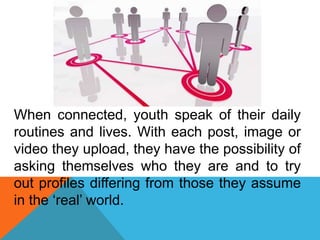
When connected, youth speak of their daily
routines and lives. With each post, image or
video they upload, they have the possibility of
asking themselves who they are and to try
out profiles differing from those they assume
in the ‘real’ world.
They thus negotiate their identity and create
senses of belonging, putting the acceptance
and censure of others to the test, an
essential mark of the process of identity
construction.
ACTIVITY:
Answer the following
Questions with your pair. Share
your answer to the class.
1. What factors influences
your identity formation?
2. What is your parents role in
in affecting your identity?

Identity formation

  • 6.
    PRIMARY IDENTITY: The periodof primary socialization, in infancy and childhood, the core social identities are added to. Children gradually take a more active part in the construction of the social identity.
  • 8.
    It is importantnot to treat identities as completely fixed or essential attributes of individuals. The identities that people see as salient vary according to the particular situation in which they find themselves.
  • 12.
    For example, whenthere is a solid and positive relationship between parent and adolescent they are more likely to feel freedom in exploring identity options for themselves. A study found that for boys and girls, identity formation is positively influenced by parental involvement specifically in the areas of: support, social monitoring and school monitoring.
  • 13.
    The type ofrelationship that adolescents have with their parents has a significant role in identity formation.
  • 15.
    Cyber-socializing and theInternet The internet is becoming an extension of the expressive dimension of the youth condition. There, youth talk about their lives and concerns, design the content that they make available to others and assess others reactions to it in the form of optimized and electronically mediated social approval.
  • 16.
    When connected, youthspeak of their daily routines and lives. With each post, image or video they upload, they have the possibility of asking themselves who they are and to try out profiles differing from those they assume in the ‘real’ world.
  • 17.
    They thus negotiatetheir identity and create senses of belonging, putting the acceptance and censure of others to the test, an essential mark of the process of identity construction.
  • 23.
    ACTIVITY: Answer the following Questionswith your pair. Share your answer to the class. 1. What factors influences your identity formation? 2. What is your parents role in in affecting your identity?