Critical Race TheoryEDUC 800-01Spring 2010Dr. Shelley WongMarch 16, 2010Group Members:Leslie LaCroixNicole SealeyAndrea Weiss
INTRODUCTION TO CRITICAL RACE THEORYUnderstanding the Nature of Race and AmericaMedia Presentation can be viewed at:http://www.youtube.com/watch?v=CB27vqknETk
CRT CONCEPTS: THE FoundationEnduring Understandings and Essential Questions
Critical Race Theory’sEnduring Understandings“A regime of white supremacy and its subordination of people of color […] have been created and maintained in America, and, in particular, […] to examine the relationship between that social structure and professed ideals such as “the rule of law” and “equal protection.”There exists a  “bond between law and racial power”  that needs to be changed.(Crenshaw, 1995)
Essential Questions for Critical Race Theory Where is ownership of dialogue?Whose narrative is of value? How can CRT effect education?How does CRT develop the discourse to reveal other ways of knowing?
CRT CONCEPTS: HISTORY & THEMESBackground and Six Key Conceptual Themes
Early History of Critical Race TheoryDevelops over time beginning in late 1970’s after the civil rights era momentum stalled.
Derrick Bell accepts a position at the University of Oregon Law School as the first African American dean in 1980.
In 1981, Harvard students organized to have Bell’s position filled and asked for the continuation of the course Race, Racism and American Law.
Scholarly works are being shared across the country at seminars and conferences in small groups and the dialogue grows and CRT emerges. Unifying Themes of CRTRacism is endemic in America. Traditional values, ie: privacy & property rights, serve to maintain the subordination of People of Color.Skeptical view of legal neutrality.Maintains that a contextual and historical account of the law is necessary to reveal original intent of common cultural practices. Presumes that racism has contributed to all contemporary manifestations of group advantages/disadvantages along racial lines.Values experiential knowledge (personal narratives) as critical for analysis of society and law.Draws from a number of disciplines including: feminism, Marxism, post-structuralism, critical legal theory, liberalism, pragmatism, and nationalism.Ultimate goal is to end oppression in all its forms.
Critical race theoristsContributors in the field
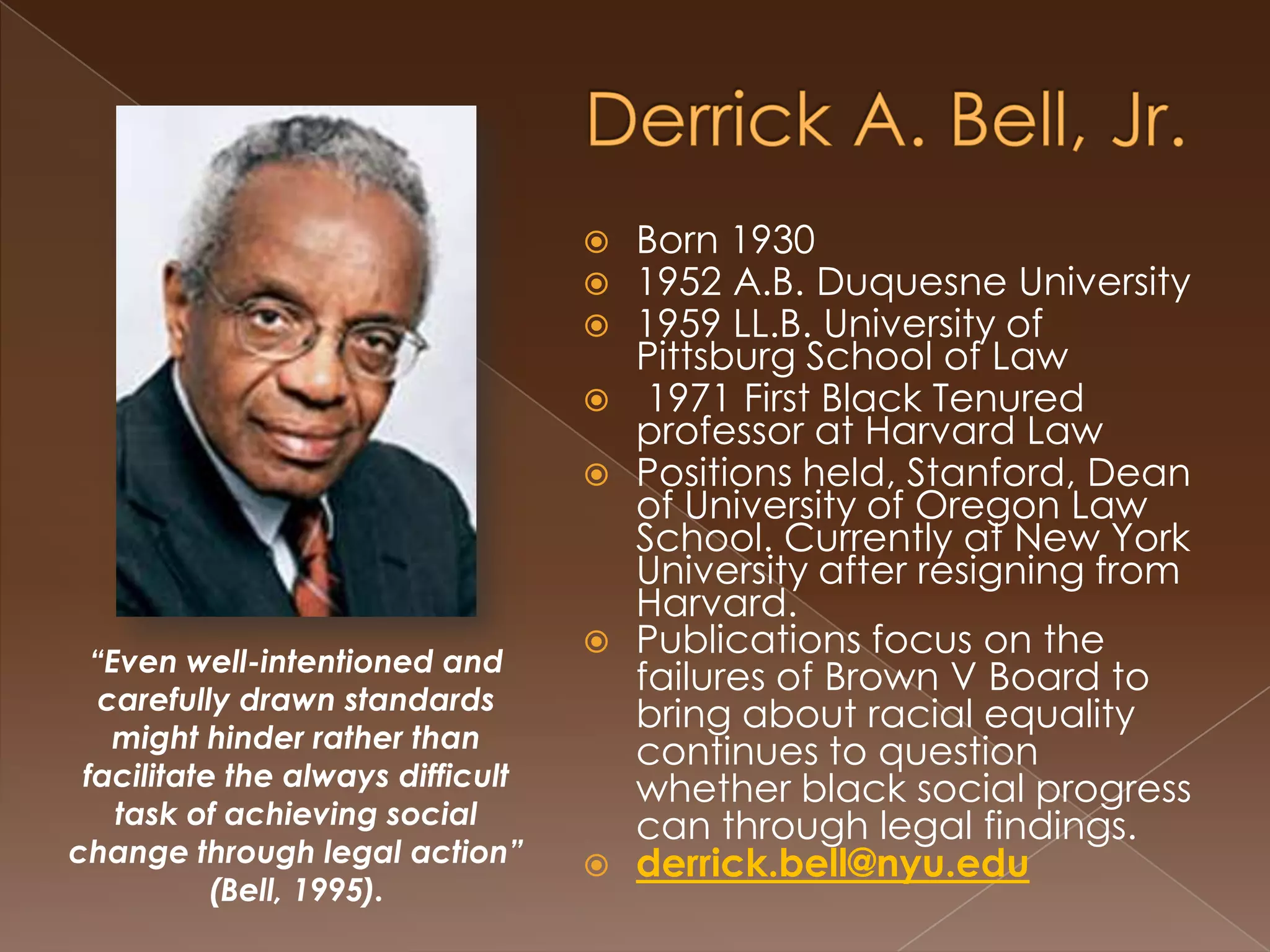
Derrick A. Bell, Jr.Born 19301952 A.B. Duquesne University1959 LL.B. University of Pittsburg School of Law 1971 First Black Tenured professor at Harvard LawPositions held, Stanford, Dean of University of Oregon Law School. Currently at New York University after resigning from Harvard. Publications focus on the failures of Brown V Board to bring about racial equality continues to question whether black social progress can through legal findings.derrick.bell@nyu.edu“Even well-intentioned andcarefully drawn standards might hinder rather thanfacilitate the always difficulttask of achieving social change through legal action” (Bell, 1995).
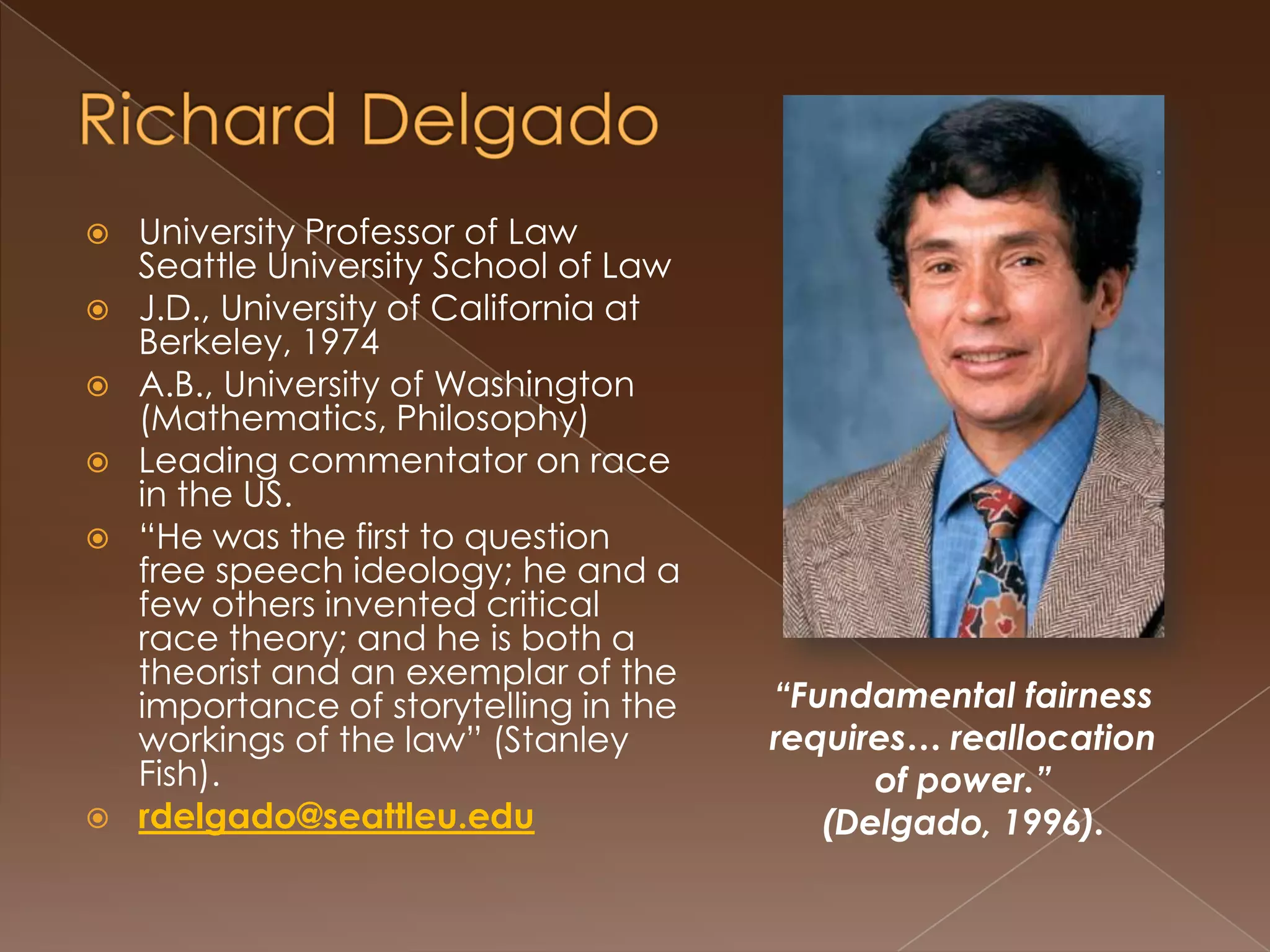
Richard DelgadoUniversity Professor of Law Seattle University School of LawJ.D., University of California at Berkeley, 1974 A.B., University of Washington (Mathematics, Philosophy)Leading commentator on race in the US.“He was the first to question free speech ideology; he and a few others invented critical race theory; and he is both a theorist and an exemplar of the importance of storytelling in the workings of the law” (Stanley Fish).rdelgado@seattleu.edu“Fundamental fairness requires… reallocation of power.” (Delgado, 1996).
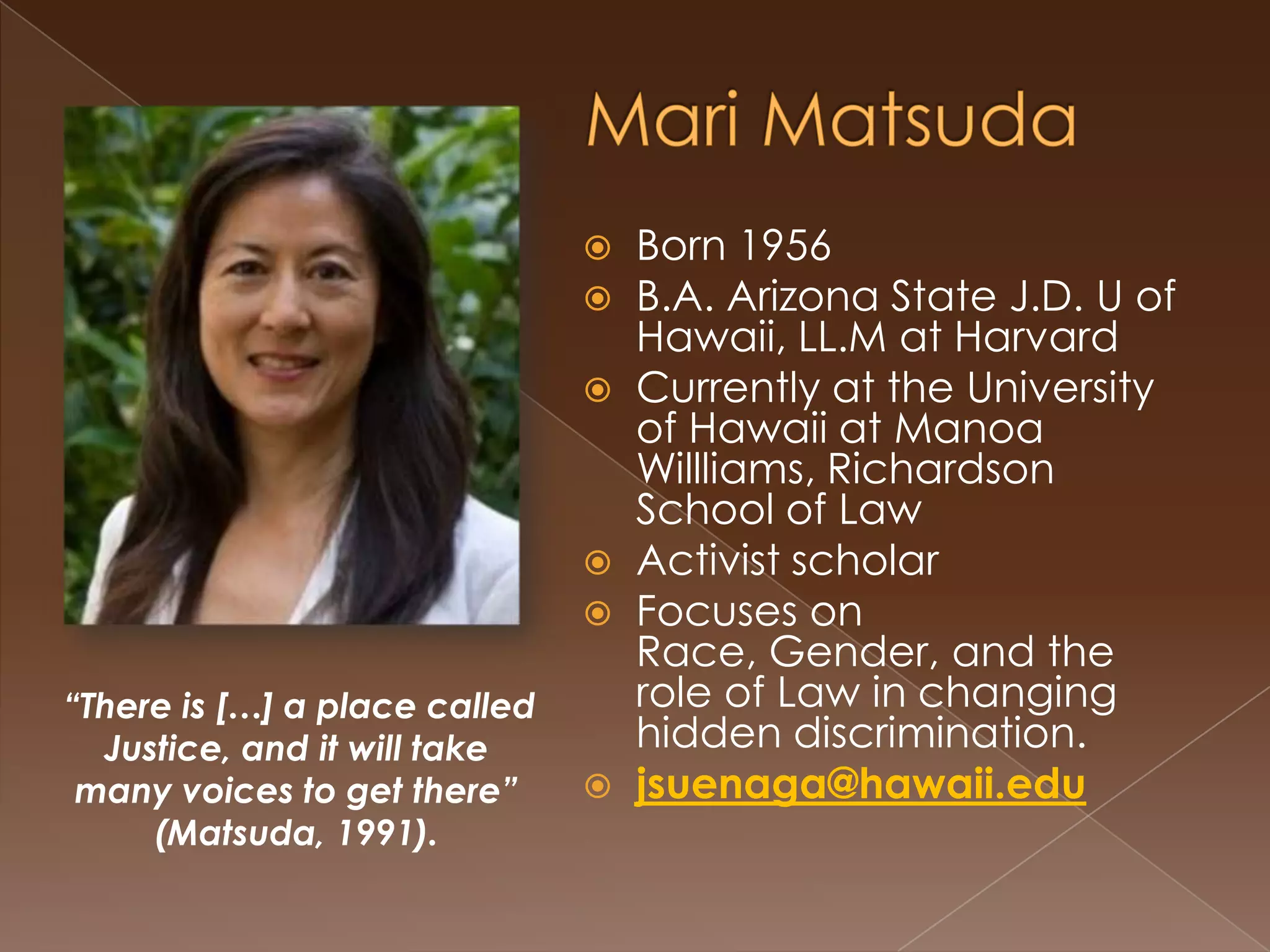
Mari MatsudaBorn 1956B.A. Arizona State J.D. U of Hawaii, LL.M at HarvardCurrently at the University of Hawaii at ManoaWillliams, Richardson School of LawActivist scholarFocuses on Race, Gender, and the role of Law in changing hidden discrimination.jsuenaga@hawaii.edu“There is […] a place called Justice, and it will take many voices to get there” (Matsuda, 1991).
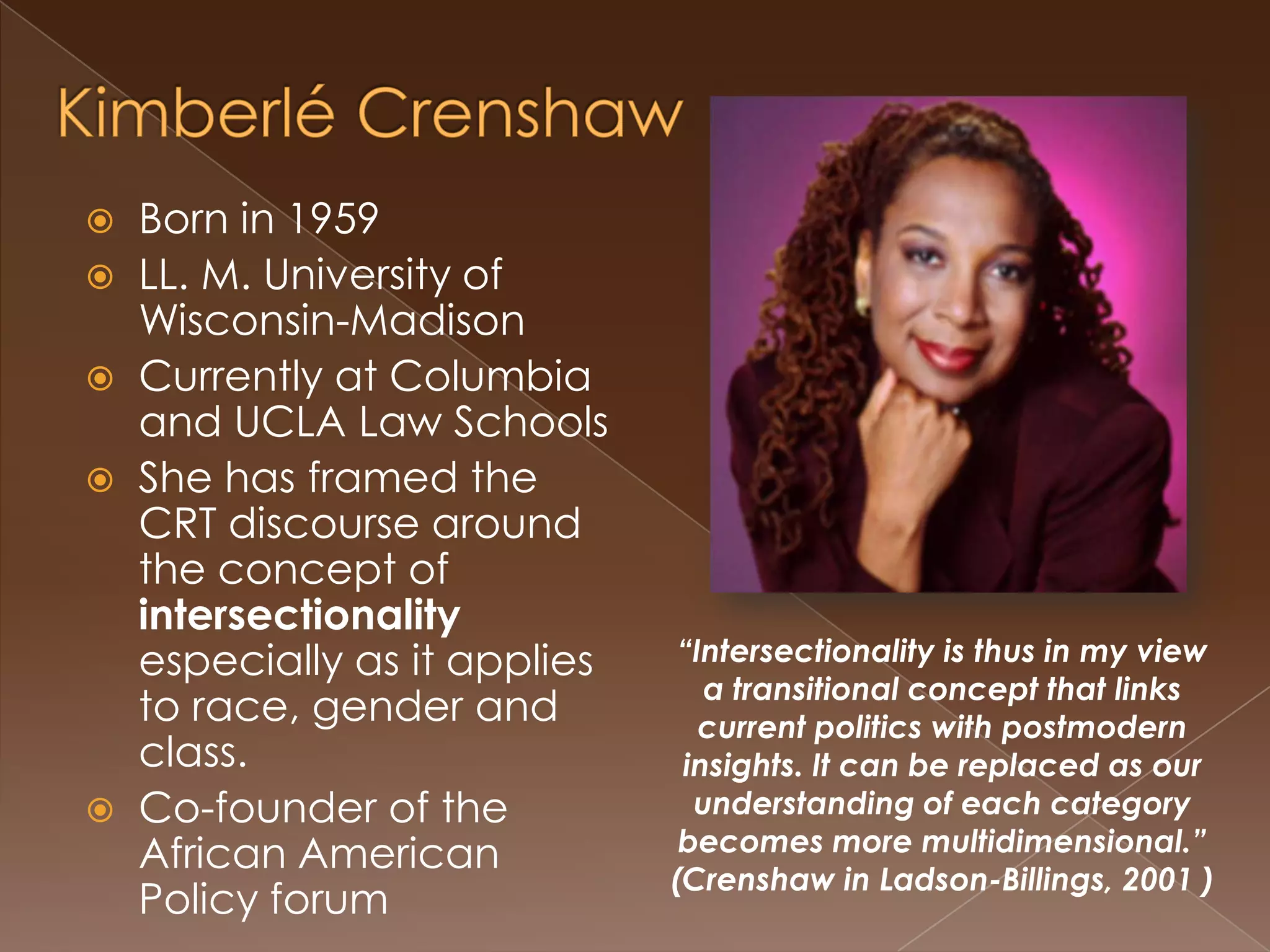
Kimberlé CrenshawBorn in 1959LL. M. University of Wisconsin-MadisonCurrently at Columbia and UCLA Law SchoolsShe has framed the CRT discourse around  the concept of intersectionality especially as it applies to race, gender and class.  Co-founder of the African American Policy forum“Intersectionality is thus in my view a transitional concept that links current politics with postmodern insights. It can be replaced as our understanding of each category becomes more multidimensional.” (Crenshaw in Ladson-Billings, 2001 )
Gloria Ladson-BillingsBorn 1947Kellner Family Chair in Urban Education and Professor of Curriculum and Instruction and Educational Policy Studies at the University of Wisconsin-MadisonStanford University, Ph.D. Curriculum & Teacher Education, 1984.Academic Areas of Interest: Educational anthropology, cultural studies, critical race theory applications to education. Culturally-relevant pedagogy --“committed to collective, not merely individual, empowerment”gjladson@wisc.edu “Adopting and adapting CRT asa framework for educational equity Means that we will have to expose  racism in education and propose radical solutions for addressing it.  We will have to take bold and sometimes unpopular positions” (Ladson-Billings, 1998).
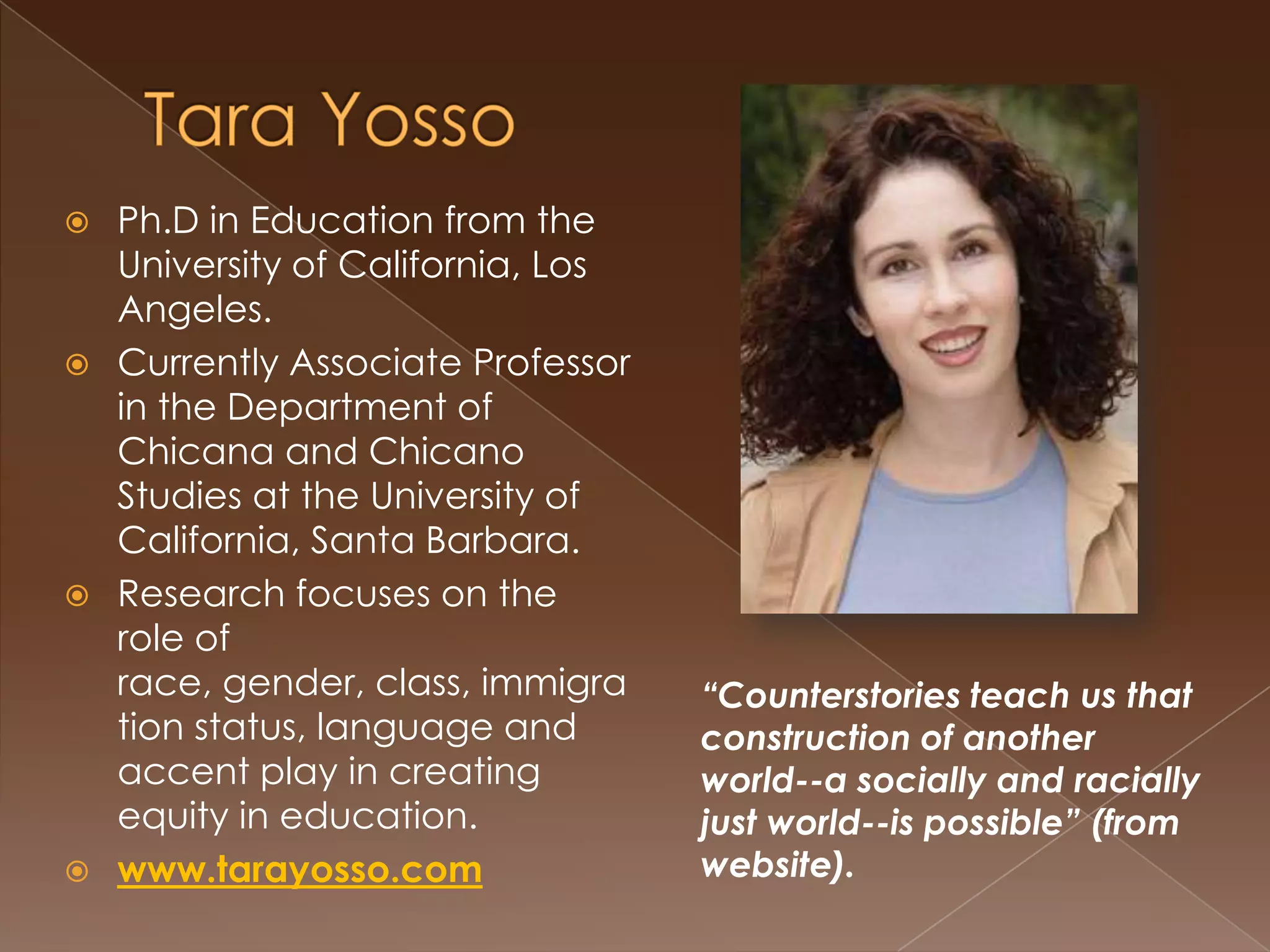
Tara YossoPh.D in Education from the University of California, Los Angeles.Currently Associate Professor in the Department of Chicana and Chicano Studies at the University of California, Santa Barbara.Research focuses on the role of race, gender, class, immigration status, language and accent play in creating equity in education.www.tarayosso.com“Counterstories teach us that construction of another world--a socially and racially just world--is possible” (from website).
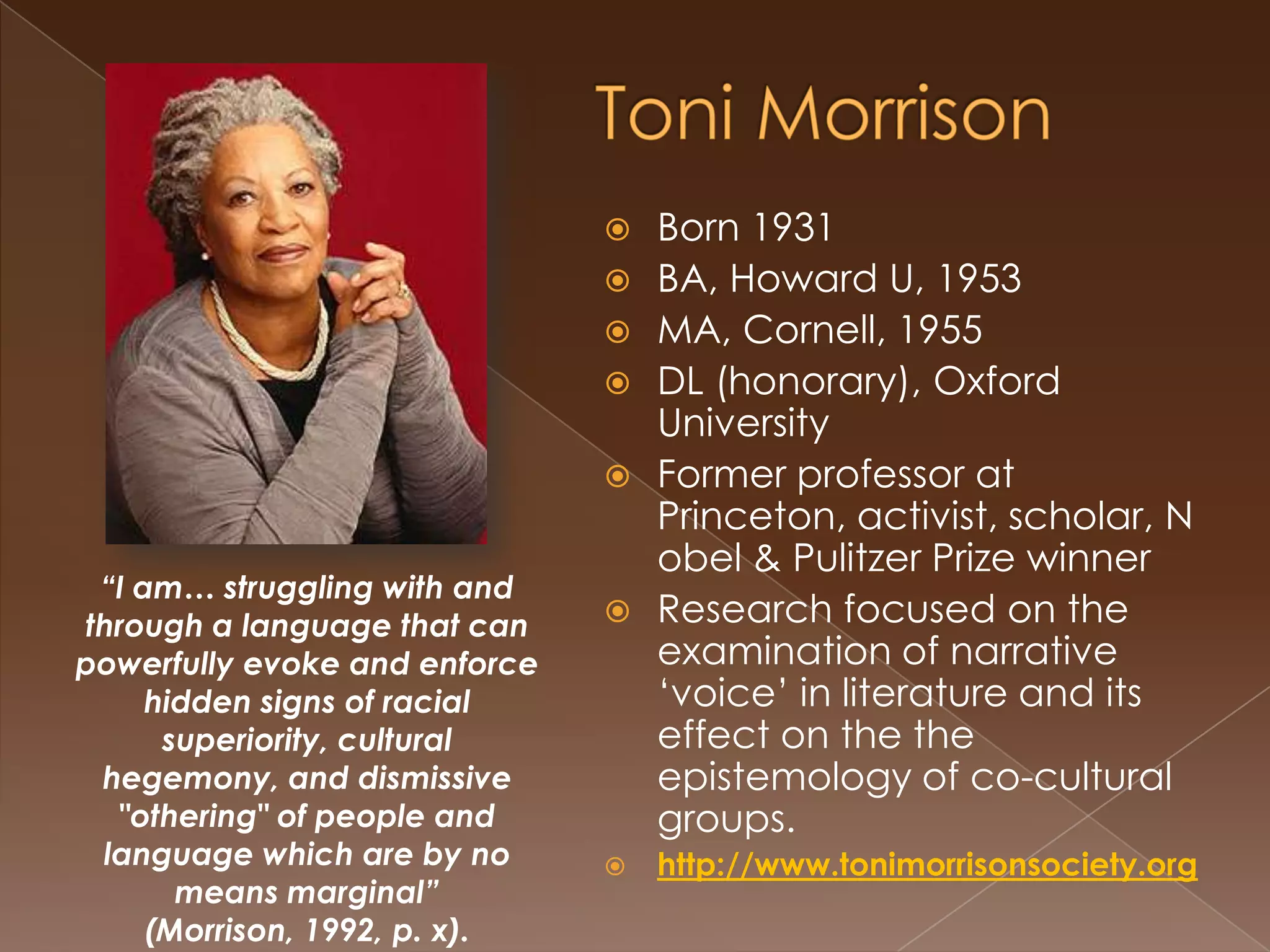
Toni MorrisonBorn 1931BA, Howard U, 1953MA, Cornell, 1955DL (honorary), Oxford UniversityFormer professor at Princeton, activist, scholar, Nobel & Pulitzer Prize winnerResearch focused on the examination of narrative ‘voice’ in literature and its effect on the the epistemology of co-cultural groups.http://www.tonimorrisonsociety.org“I am… struggling with and through a language that can powerfully evoke and enforce hidden signs of racial superiority, cultural hegemony, and dismissive "othering" of people and language which are by no means marginal”  (Morrison, 1992, p. x).
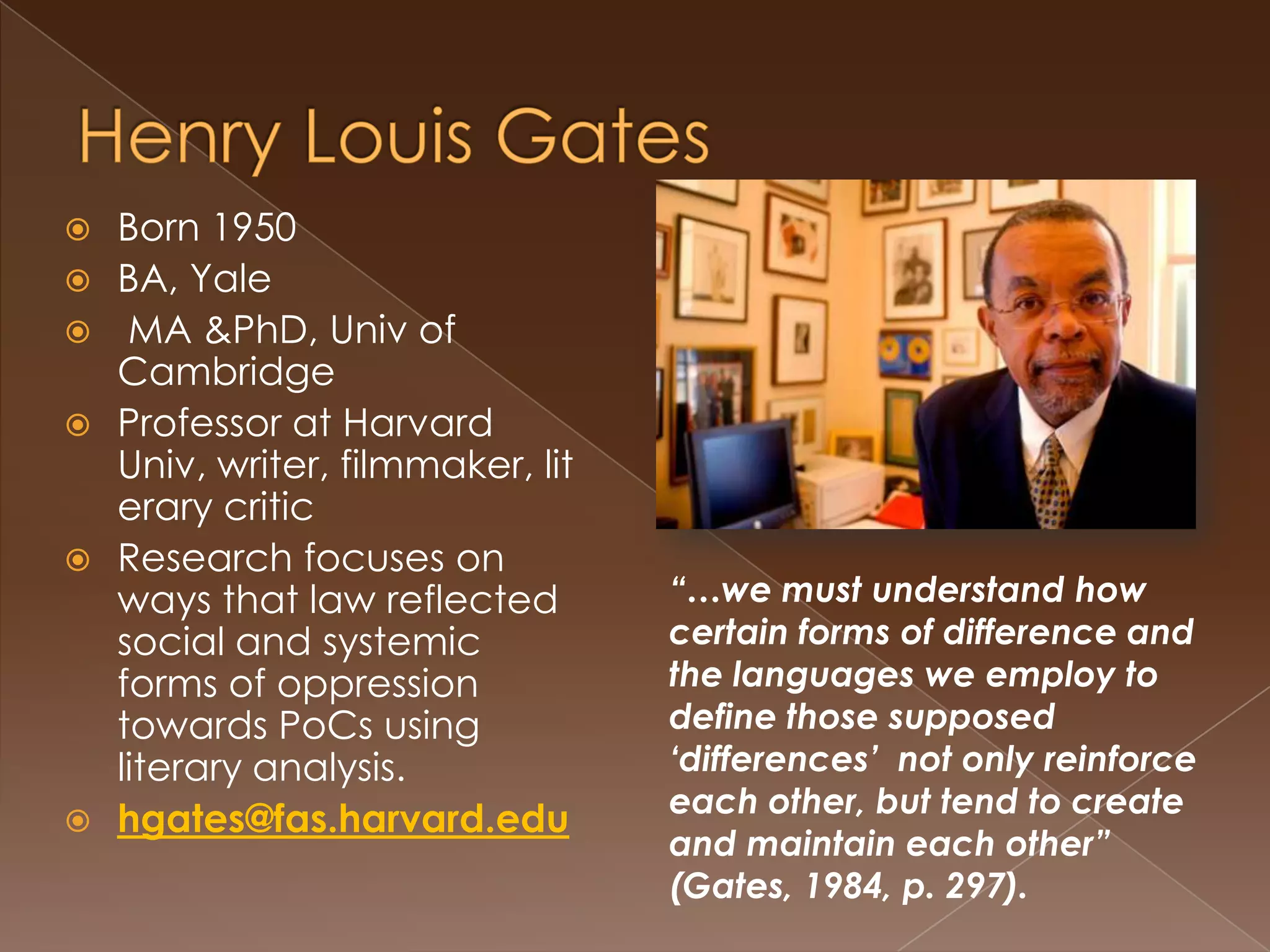
Henry Louis GatesBorn 1950BA, Yale MA &PhD, Univ of CambridgeProfessor at Harvard Univ, writer, filmmaker, literary criticResearch focuses on ways that law reflected social and systemic forms of oppression towards PoCs using literary analysis.hgates@fas.harvard.edu“…we must understand how certain forms of difference and the languages we employ to define those supposed ‘differences’  not only reinforce each other, but tend to create and maintain each other” (Gates, 1984, p. 297).
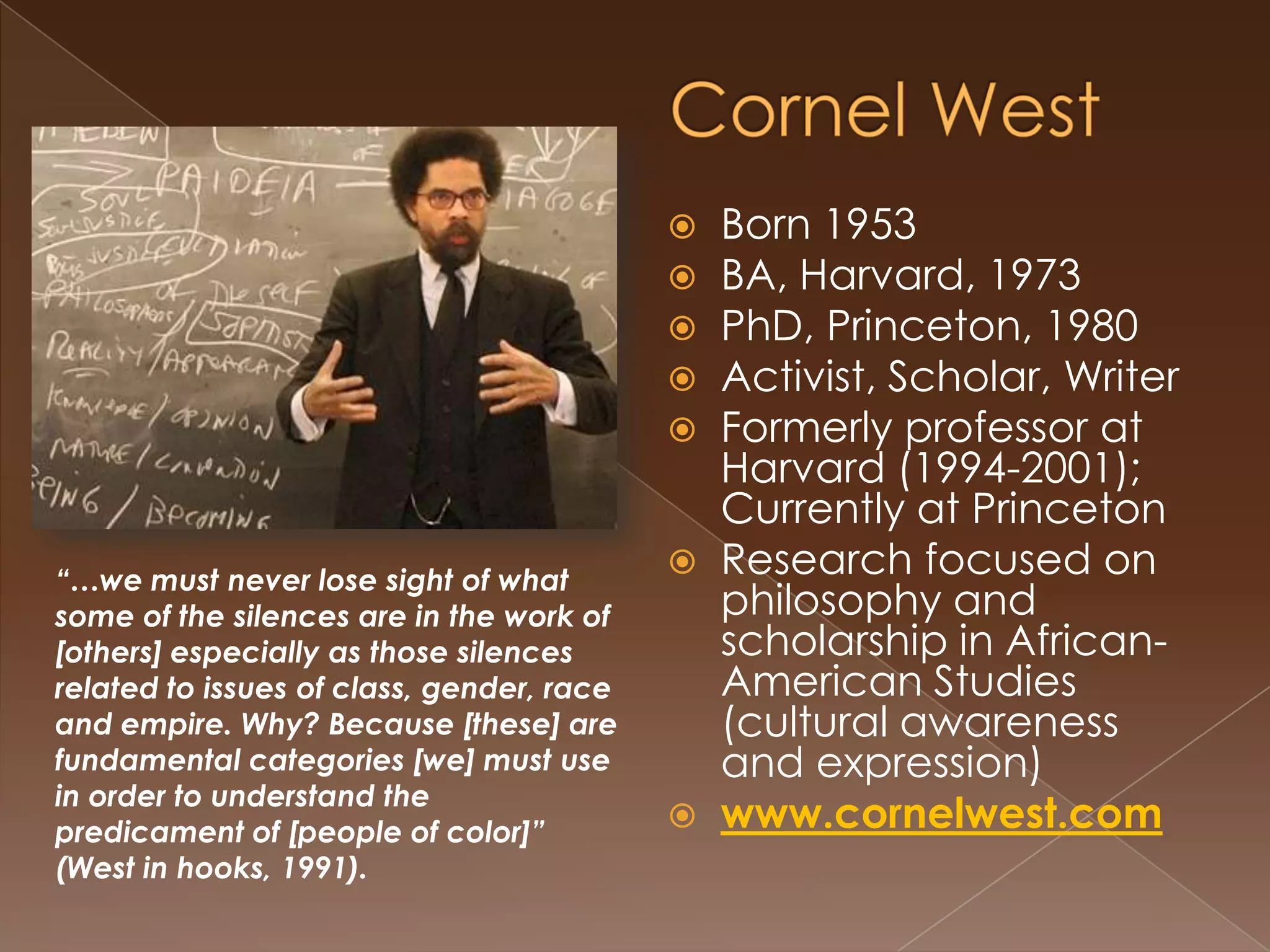
Cornel WestBorn 1953BA, Harvard, 1973PhD, Princeton, 1980Activist, Scholar, Writer Formerly professor at Harvard (1994-2001); Currently at PrincetonResearch focused on philosophy and  scholarship in African-American Studies (cultural awareness and expression)www.cornelwest.com“…we must never lose sight of what some of the silences are in the work of [others] especially as those silences related to issues of class, gender, race and empire. Why? Because [these] are fundamental categories [we] must use in order to understand the predicament of [people of color]” (West in hooks, 1991).
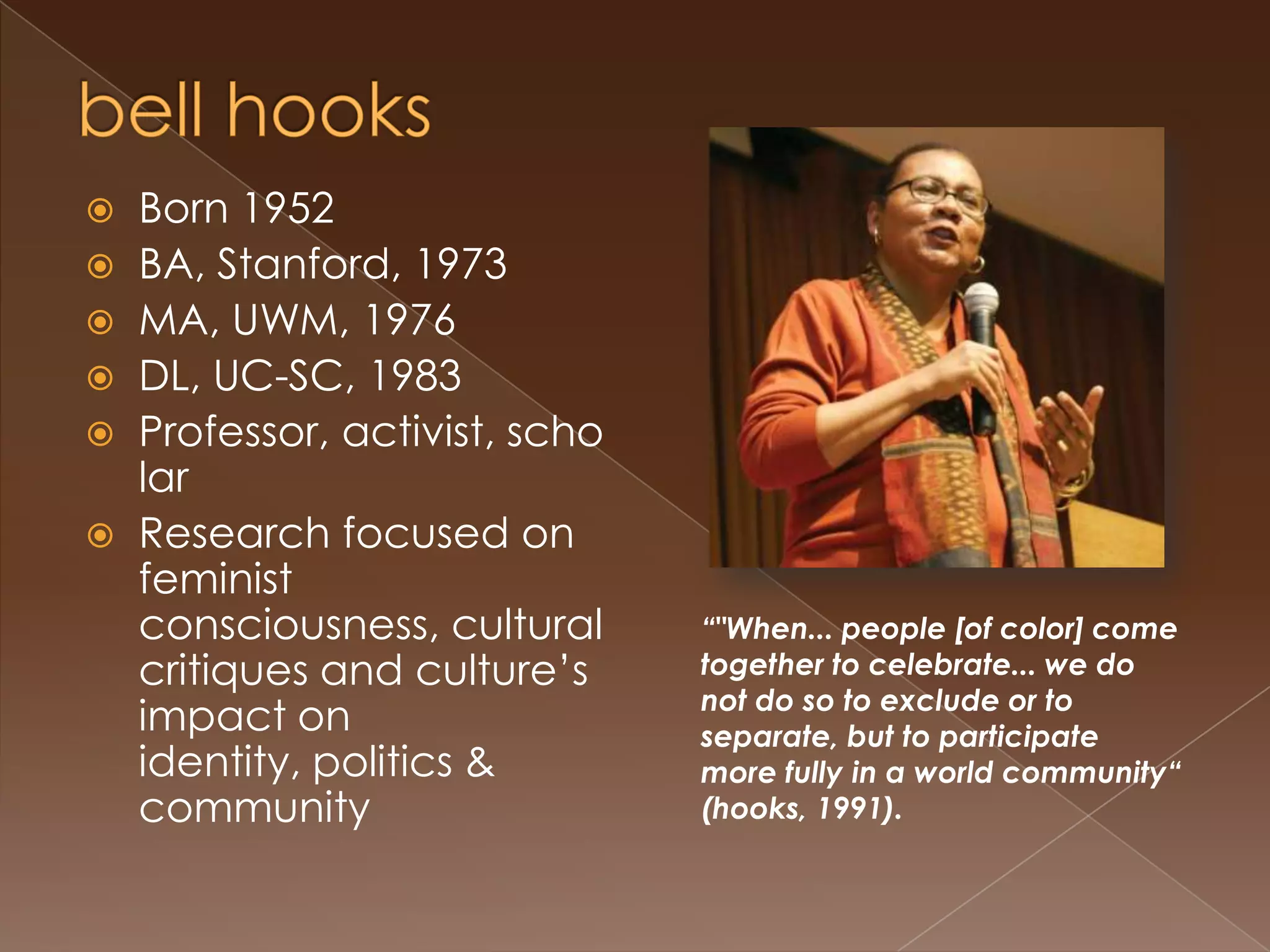
bell hooksBorn 1952BA, Stanford, 1973MA, UWM, 1976DL, UC-SC, 1983Professor, activist, scholarResearch focused on feminist consciousness, cultural critiques and culture’s impact on identity, politics & community“"When... people [of color] come together to celebrate... we do not do so to exclude or to separate, but to participate more fully in a world community“ (hooks, 1991).
NgugiwaThiong'oBorn 1938BA, MakerereUniv College, 1963Holds seven honorary doctoratesActivist, writerProfessor at NYU and UC-IrvineResearch focused on language as culture.“Language has a dual character: it is both a means of communication and a carrier of culture” (Thiong’o, 1981, p. 13).
Other Contributors to CRT DialogueDavid GillbornExpertise: Ethnographic research on race in classroomsKendall ThomasExpertise: Feminist legal theory, law and sexualityZeus LeonardoExpertise: Multicultural education, Redefining ‘whiteness’ based on ‘real’ experiences of raceCharles R. Lawrence, IIIExpertise: Constitutional and education law, race and hate speech, civil rightsLaniGuinierExpertise: The role of race and gender in the political process, equity in college admissions, and affirmative action.
CRT CONCEPTS: DIALOGUE, DOMINANCE & POWER
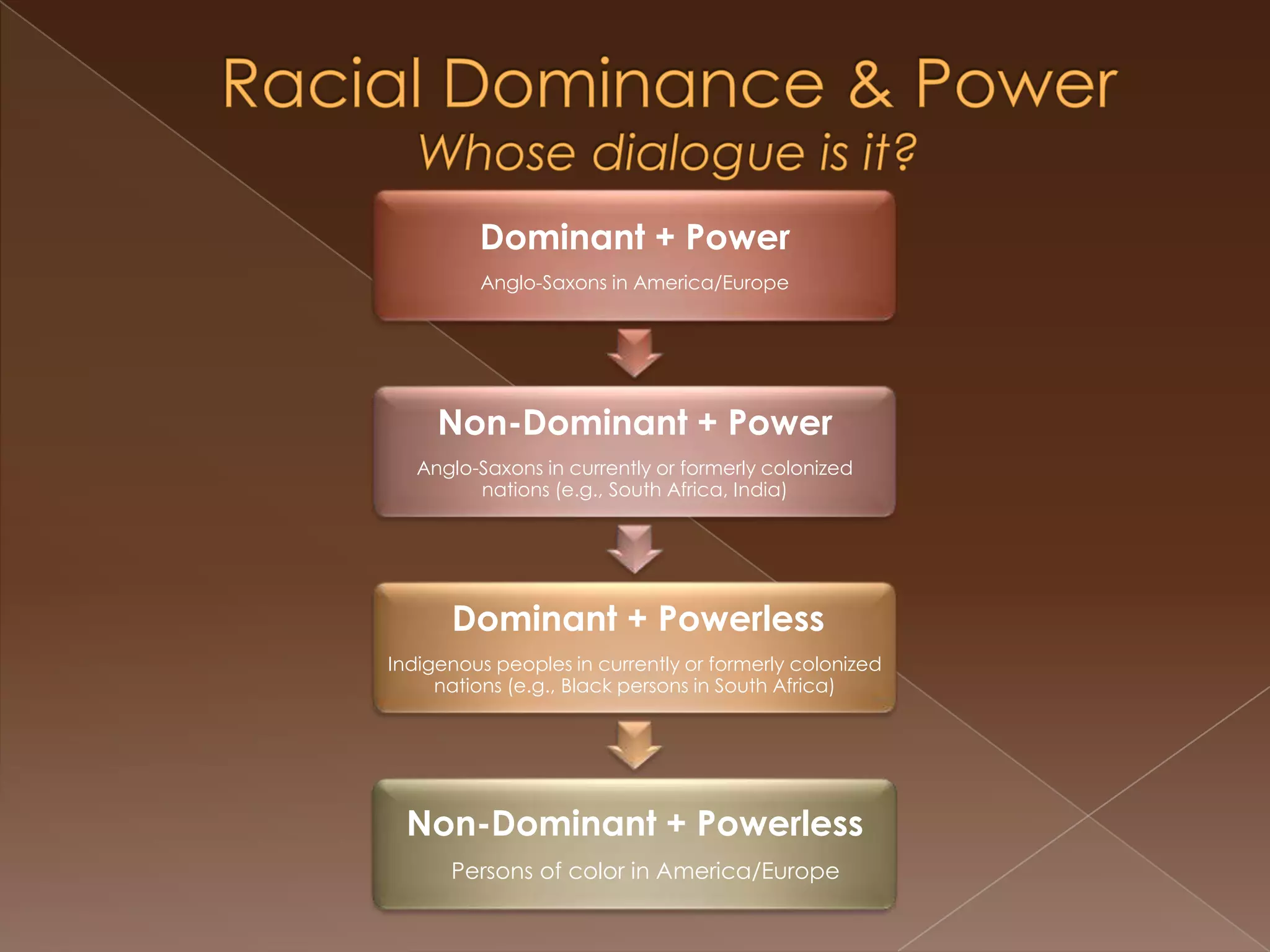
Racial Dominance & PowerWhose dialogue is it?
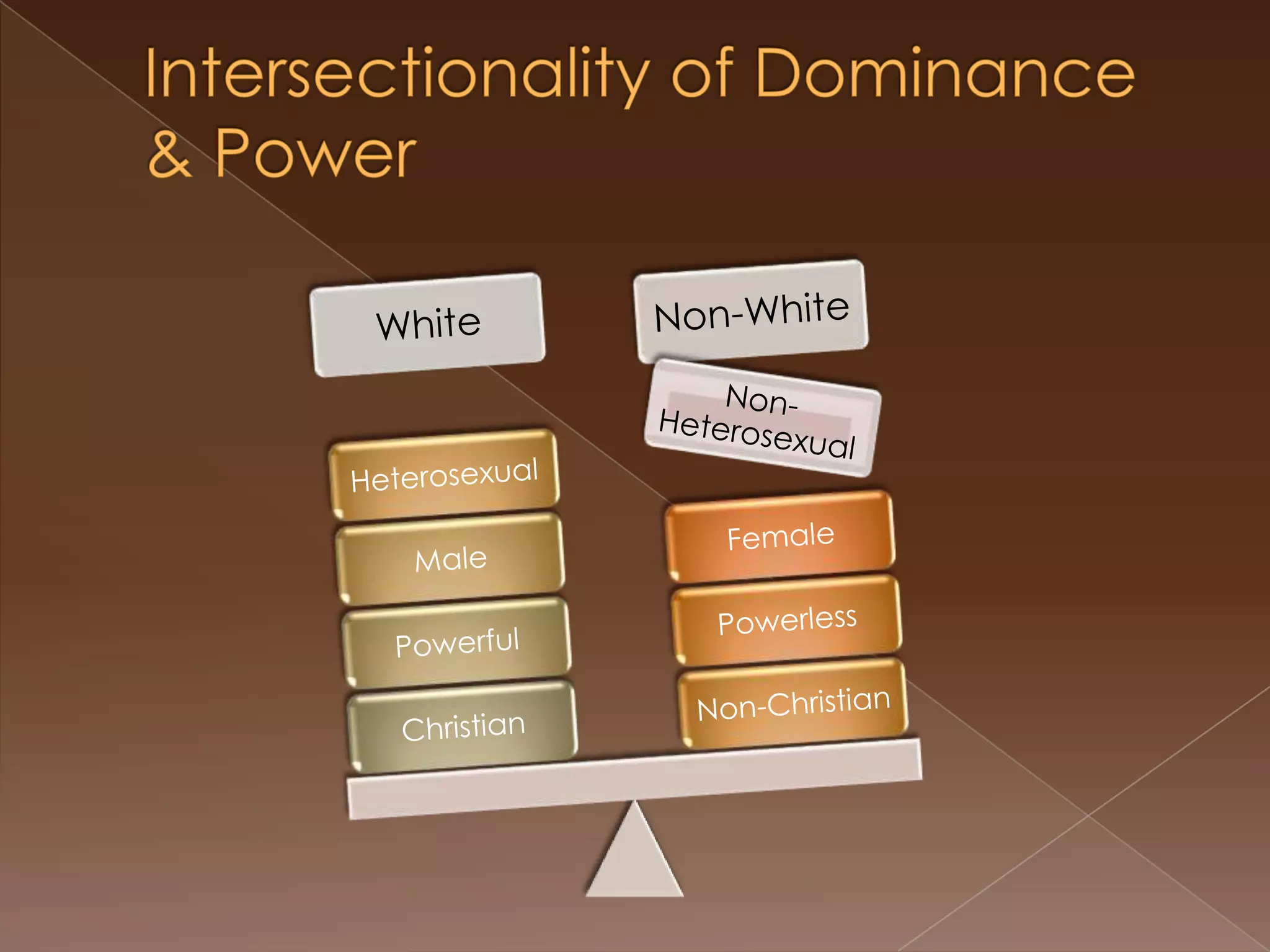
Intersectionality of Dominance & PowerNon-Heterosexual
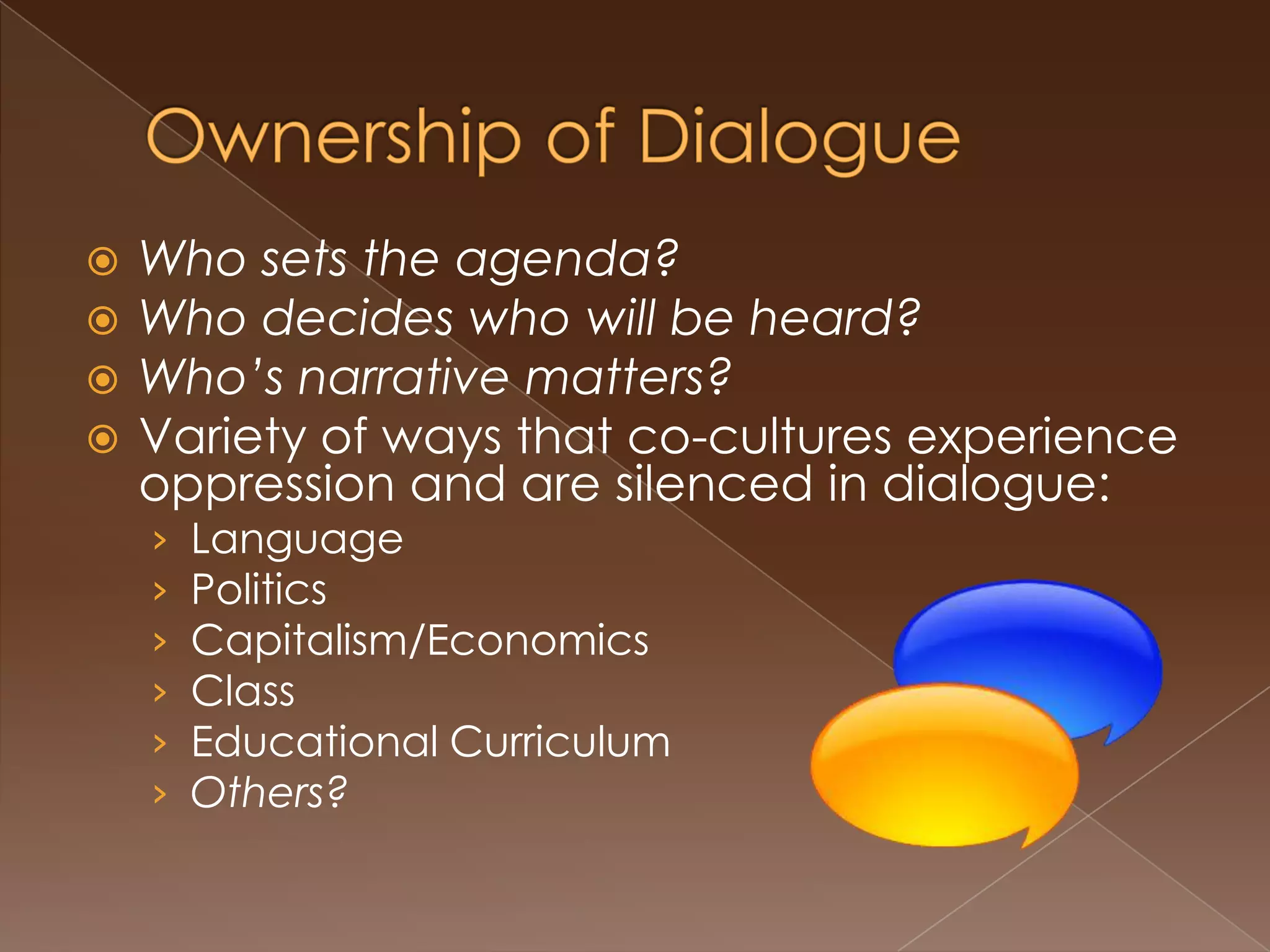
Ownership of DialogueWho sets the agenda? Who decides who will be heard?Who’s narrative matters?Variety of ways that co-cultures experience oppression and are silenced in dialogue:LanguagePoliticsCapitalism/EconomicsClassEducational CurriculumOthers?
Synthesis Activity: Concept Map ReviewDiscussion Groups for Assigned Articles
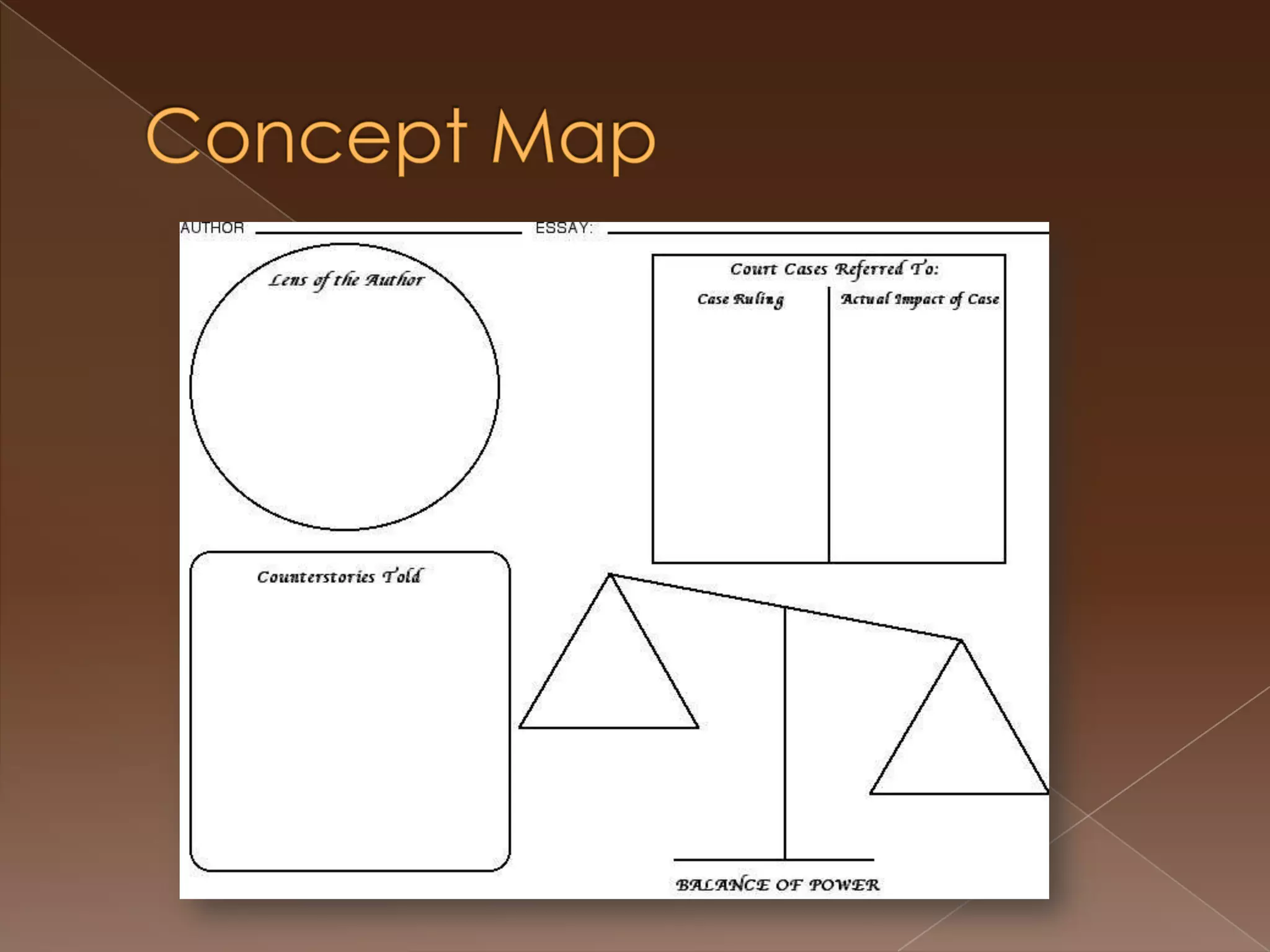
Concept Map

Critical Race Theory Week 1

  • 1.
    Critical Race TheoryEDUC800-01Spring 2010Dr. Shelley WongMarch 16, 2010Group Members:Leslie LaCroixNicole SealeyAndrea Weiss
  • 2.
    INTRODUCTION TO CRITICALRACE THEORYUnderstanding the Nature of Race and AmericaMedia Presentation can be viewed at:http://www.youtube.com/watch?v=CB27vqknETk
  • 3.
    CRT CONCEPTS: THEFoundationEnduring Understandings and Essential Questions
  • 4.
    Critical Race Theory’sEnduringUnderstandings“A regime of white supremacy and its subordination of people of color […] have been created and maintained in America, and, in particular, […] to examine the relationship between that social structure and professed ideals such as “the rule of law” and “equal protection.”There exists a “bond between law and racial power” that needs to be changed.(Crenshaw, 1995)
  • 5.
    Essential Questions forCritical Race Theory Where is ownership of dialogue?Whose narrative is of value? How can CRT effect education?How does CRT develop the discourse to reveal other ways of knowing?
  • 6.
    CRT CONCEPTS: HISTORY& THEMESBackground and Six Key Conceptual Themes
  • 7.
    Early History ofCritical Race TheoryDevelops over time beginning in late 1970’s after the civil rights era momentum stalled.
  • 8.
    Derrick Bell acceptsa position at the University of Oregon Law School as the first African American dean in 1980.
  • 9.
    In 1981, Harvardstudents organized to have Bell’s position filled and asked for the continuation of the course Race, Racism and American Law.
  • 10.
    Scholarly works arebeing shared across the country at seminars and conferences in small groups and the dialogue grows and CRT emerges. Unifying Themes of CRTRacism is endemic in America. Traditional values, ie: privacy & property rights, serve to maintain the subordination of People of Color.Skeptical view of legal neutrality.Maintains that a contextual and historical account of the law is necessary to reveal original intent of common cultural practices. Presumes that racism has contributed to all contemporary manifestations of group advantages/disadvantages along racial lines.Values experiential knowledge (personal narratives) as critical for analysis of society and law.Draws from a number of disciplines including: feminism, Marxism, post-structuralism, critical legal theory, liberalism, pragmatism, and nationalism.Ultimate goal is to end oppression in all its forms.
  • 11.
  • 12.
    Derrick A. Bell,Jr.Born 19301952 A.B. Duquesne University1959 LL.B. University of Pittsburg School of Law 1971 First Black Tenured professor at Harvard LawPositions held, Stanford, Dean of University of Oregon Law School. Currently at New York University after resigning from Harvard. Publications focus on the failures of Brown V Board to bring about racial equality continues to question whether black social progress can through legal findings.derrick.bell@nyu.edu“Even well-intentioned andcarefully drawn standards might hinder rather thanfacilitate the always difficulttask of achieving social change through legal action” (Bell, 1995).
  • 13.
    Richard DelgadoUniversity Professorof Law Seattle University School of LawJ.D., University of California at Berkeley, 1974 A.B., University of Washington (Mathematics, Philosophy)Leading commentator on race in the US.“He was the first to question free speech ideology; he and a few others invented critical race theory; and he is both a theorist and an exemplar of the importance of storytelling in the workings of the law” (Stanley Fish).rdelgado@seattleu.edu“Fundamental fairness requires… reallocation of power.” (Delgado, 1996).
  • 14.
    Mari MatsudaBorn 1956B.A.Arizona State J.D. U of Hawaii, LL.M at HarvardCurrently at the University of Hawaii at ManoaWillliams, Richardson School of LawActivist scholarFocuses on Race, Gender, and the role of Law in changing hidden discrimination.jsuenaga@hawaii.edu“There is […] a place called Justice, and it will take many voices to get there” (Matsuda, 1991).
  • 15.
    Kimberlé CrenshawBorn in1959LL. M. University of Wisconsin-MadisonCurrently at Columbia and UCLA Law SchoolsShe has framed the CRT discourse around the concept of intersectionality especially as it applies to race, gender and class. Co-founder of the African American Policy forum“Intersectionality is thus in my view a transitional concept that links current politics with postmodern insights. It can be replaced as our understanding of each category becomes more multidimensional.” (Crenshaw in Ladson-Billings, 2001 )
  • 16.
    Gloria Ladson-BillingsBorn 1947KellnerFamily Chair in Urban Education and Professor of Curriculum and Instruction and Educational Policy Studies at the University of Wisconsin-MadisonStanford University, Ph.D. Curriculum & Teacher Education, 1984.Academic Areas of Interest: Educational anthropology, cultural studies, critical race theory applications to education. Culturally-relevant pedagogy --“committed to collective, not merely individual, empowerment”gjladson@wisc.edu “Adopting and adapting CRT asa framework for educational equity Means that we will have to expose racism in education and propose radical solutions for addressing it. We will have to take bold and sometimes unpopular positions” (Ladson-Billings, 1998).
  • 17.
    Tara YossoPh.D inEducation from the University of California, Los Angeles.Currently Associate Professor in the Department of Chicana and Chicano Studies at the University of California, Santa Barbara.Research focuses on the role of race, gender, class, immigration status, language and accent play in creating equity in education.www.tarayosso.com“Counterstories teach us that construction of another world--a socially and racially just world--is possible” (from website).
  • 18.
    Toni MorrisonBorn 1931BA,Howard U, 1953MA, Cornell, 1955DL (honorary), Oxford UniversityFormer professor at Princeton, activist, scholar, Nobel & Pulitzer Prize winnerResearch focused on the examination of narrative ‘voice’ in literature and its effect on the the epistemology of co-cultural groups.http://www.tonimorrisonsociety.org“I am… struggling with and through a language that can powerfully evoke and enforce hidden signs of racial superiority, cultural hegemony, and dismissive "othering" of people and language which are by no means marginal” (Morrison, 1992, p. x).
  • 19.
    Henry Louis GatesBorn1950BA, Yale MA &PhD, Univ of CambridgeProfessor at Harvard Univ, writer, filmmaker, literary criticResearch focuses on ways that law reflected social and systemic forms of oppression towards PoCs using literary analysis.hgates@fas.harvard.edu“…we must understand how certain forms of difference and the languages we employ to define those supposed ‘differences’ not only reinforce each other, but tend to create and maintain each other” (Gates, 1984, p. 297).
  • 20.
    Cornel WestBorn 1953BA,Harvard, 1973PhD, Princeton, 1980Activist, Scholar, Writer Formerly professor at Harvard (1994-2001); Currently at PrincetonResearch focused on philosophy and scholarship in African-American Studies (cultural awareness and expression)www.cornelwest.com“…we must never lose sight of what some of the silences are in the work of [others] especially as those silences related to issues of class, gender, race and empire. Why? Because [these] are fundamental categories [we] must use in order to understand the predicament of [people of color]” (West in hooks, 1991).
  • 21.
    bell hooksBorn 1952BA,Stanford, 1973MA, UWM, 1976DL, UC-SC, 1983Professor, activist, scholarResearch focused on feminist consciousness, cultural critiques and culture’s impact on identity, politics & community“"When... people [of color] come together to celebrate... we do not do so to exclude or to separate, but to participate more fully in a world community“ (hooks, 1991).
  • 22.
    NgugiwaThiong'oBorn 1938BA, MakerereUnivCollege, 1963Holds seven honorary doctoratesActivist, writerProfessor at NYU and UC-IrvineResearch focused on language as culture.“Language has a dual character: it is both a means of communication and a carrier of culture” (Thiong’o, 1981, p. 13).
  • 23.
    Other Contributors toCRT DialogueDavid GillbornExpertise: Ethnographic research on race in classroomsKendall ThomasExpertise: Feminist legal theory, law and sexualityZeus LeonardoExpertise: Multicultural education, Redefining ‘whiteness’ based on ‘real’ experiences of raceCharles R. Lawrence, IIIExpertise: Constitutional and education law, race and hate speech, civil rightsLaniGuinierExpertise: The role of race and gender in the political process, equity in college admissions, and affirmative action.
  • 24.
    CRT CONCEPTS: DIALOGUE,DOMINANCE & POWER
  • 25.
    Racial Dominance &PowerWhose dialogue is it?
  • 26.
    Intersectionality of Dominance& PowerNon-Heterosexual
  • 27.
    Ownership of DialogueWhosets the agenda? Who decides who will be heard?Who’s narrative matters?Variety of ways that co-cultures experience oppression and are silenced in dialogue:LanguagePoliticsCapitalism/EconomicsClassEducational CurriculumOthers?
  • 28.
    Synthesis Activity: ConceptMap ReviewDiscussion Groups for Assigned Articles
  • 29.
  • 30.
    EXTENDED ACTIVTY: UNPACKINGPT IWhite Privilege: Unpacking the Invisible Knapsack

Editor's Notes

  • #8 Crenshaw recognizes this move of Bell’s as critical for the emergence of CRT. Administration did not listen and students held their own class with different guest lecturers presenting Bell’s chapters. Crenshaw and Matsuda both students in the class and Delgado and Lawrence both presenters.
  • #21 “The choice of language and the use to which language is put is central to a people’s definition of themselves in relation to their natural and social environment, indeed …the entire universe” (Thiong’o, 1981).
  • #25 CRT claims a special interest on the intersectionality of multiple identities as a critical point of complexity when evaluating marginalization of co-cultures.