Critical Race TheoryEDUC 800-01Spring 2010Dr. Shelley WongMarch 23, 2010
EXTENDED ACTIVTY: UNPACKING PT IIWhite Privilege: Unpacking the Invisible Knapsack
Which # on the list struck a cord in your experience?Write the # on the note and place it on the central list. Next, get in your groups from last week to discuss your experience.
APPLICATION OF CRT:Making change a realityEvolution and Application of CRT
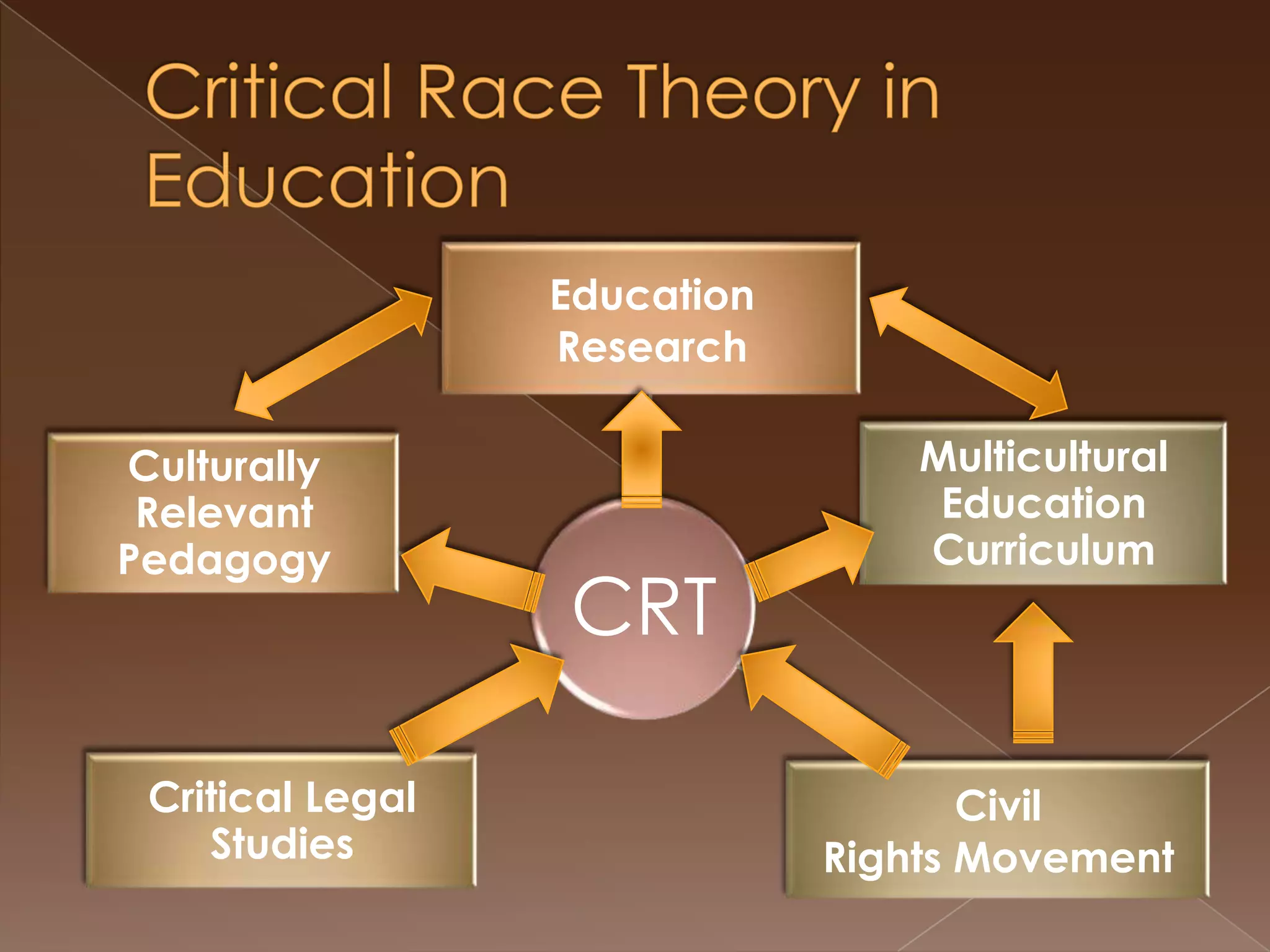
Critical Race Theory in Education
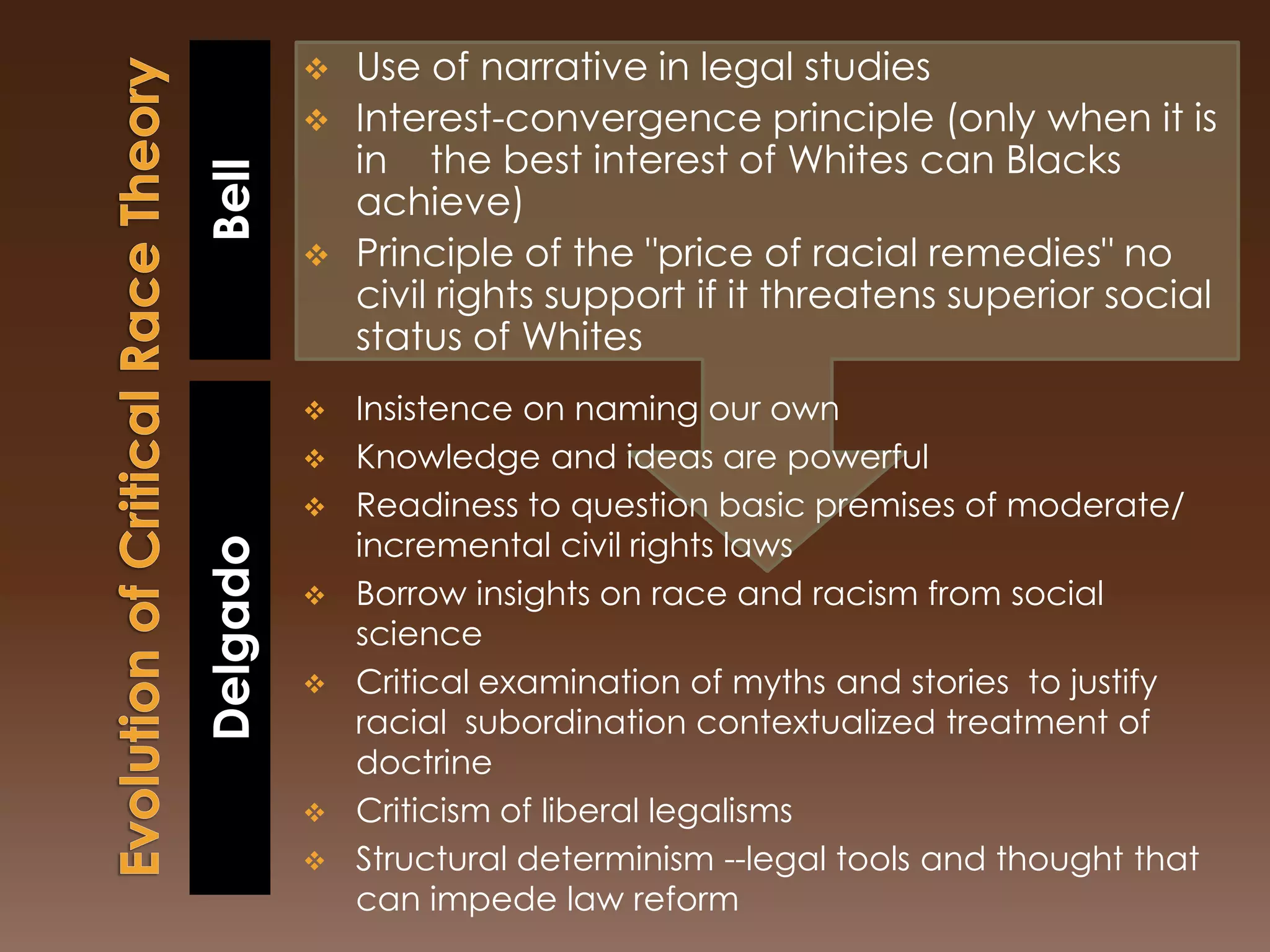
Evolution of Critical Race TheoryBellUse of narrative in legal studies
Interest-convergence principle (only when it is in    the best interest of Whites can Blacks achieve)
Principle of the "price of racial remedies" no civil rights support if it threatens superior social status of Whites  DelgadoInsistence on naming our own
Knowledge and ideas are powerful
Readiness to question basic premises of moderate/ incremental civil rights laws
Borrow insights on race and racism from social science
Critical examination of myths and stories  to justify racial  subordination contextualized treatment of doctrine
Criticism of liberal legalisms
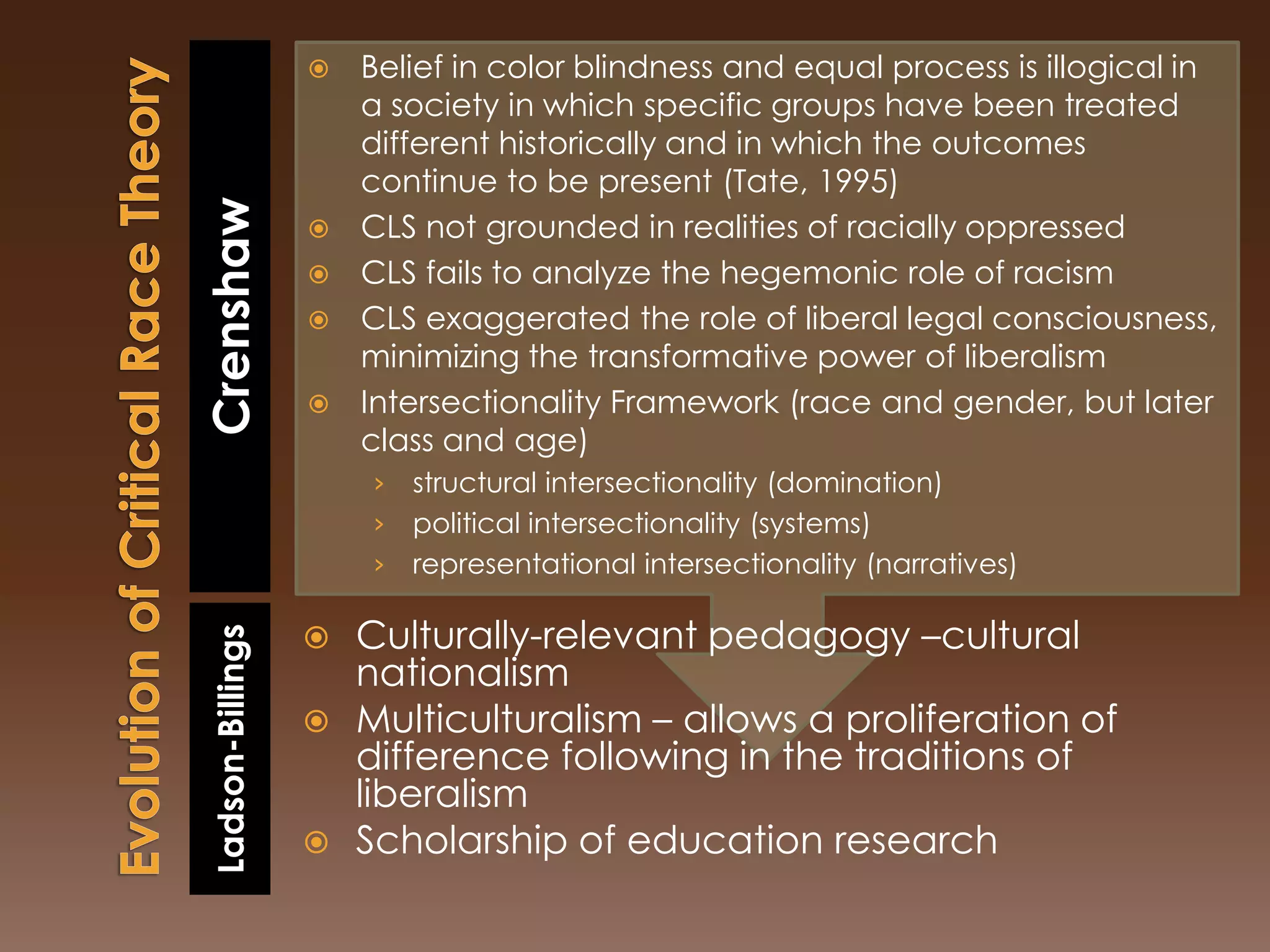
Structural determinism --legal tools and thought that can impede law reformEvolution of Critical Race TheoryCrenshawBelief in color blindness and equal process is illogical in a society in which specific groups have been treated different historically and in which the outcomes continue to be present (Tate, 1995)CLS not grounded in realities of racially oppressedCLS fails to analyze the hegemonic role of racismCLS exaggerated the role of liberal legal consciousness, minimizing the transformative power of liberalismIntersectionality Framework (race and gender, but later class and age)structural intersectionality (domination)political intersectionality (systems)representational intersectionality (narratives)Ladson-BillingsCulturally-relevant pedagogy –cultural nationalismMulticulturalism – allows a proliferation of difference following in the traditions of liberalismScholarship of education research
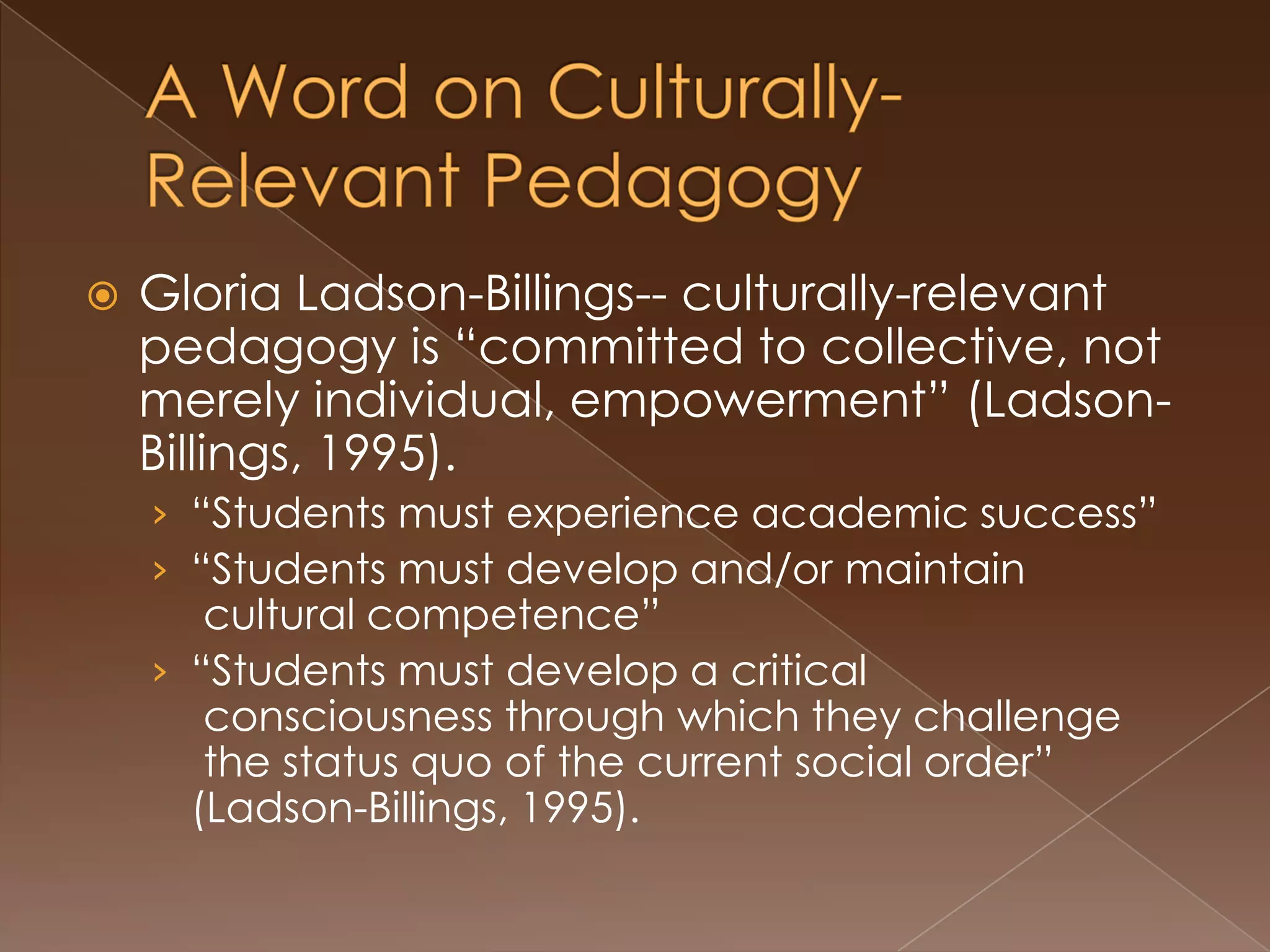
A Word on Culturally-Relevant PedagogyGloria Ladson-Billings-- culturally-relevant pedagogy is “committed to collective, not merely individual, empowerment” (Ladson-Billings, 1995).	“Students must experience academic success”“Students must develop and/or maintain 	cultural competence”“Students must develop a critical 	consciousness through which they challenge 	the status quo of the current social order” (Ladson-Billings, 1995).
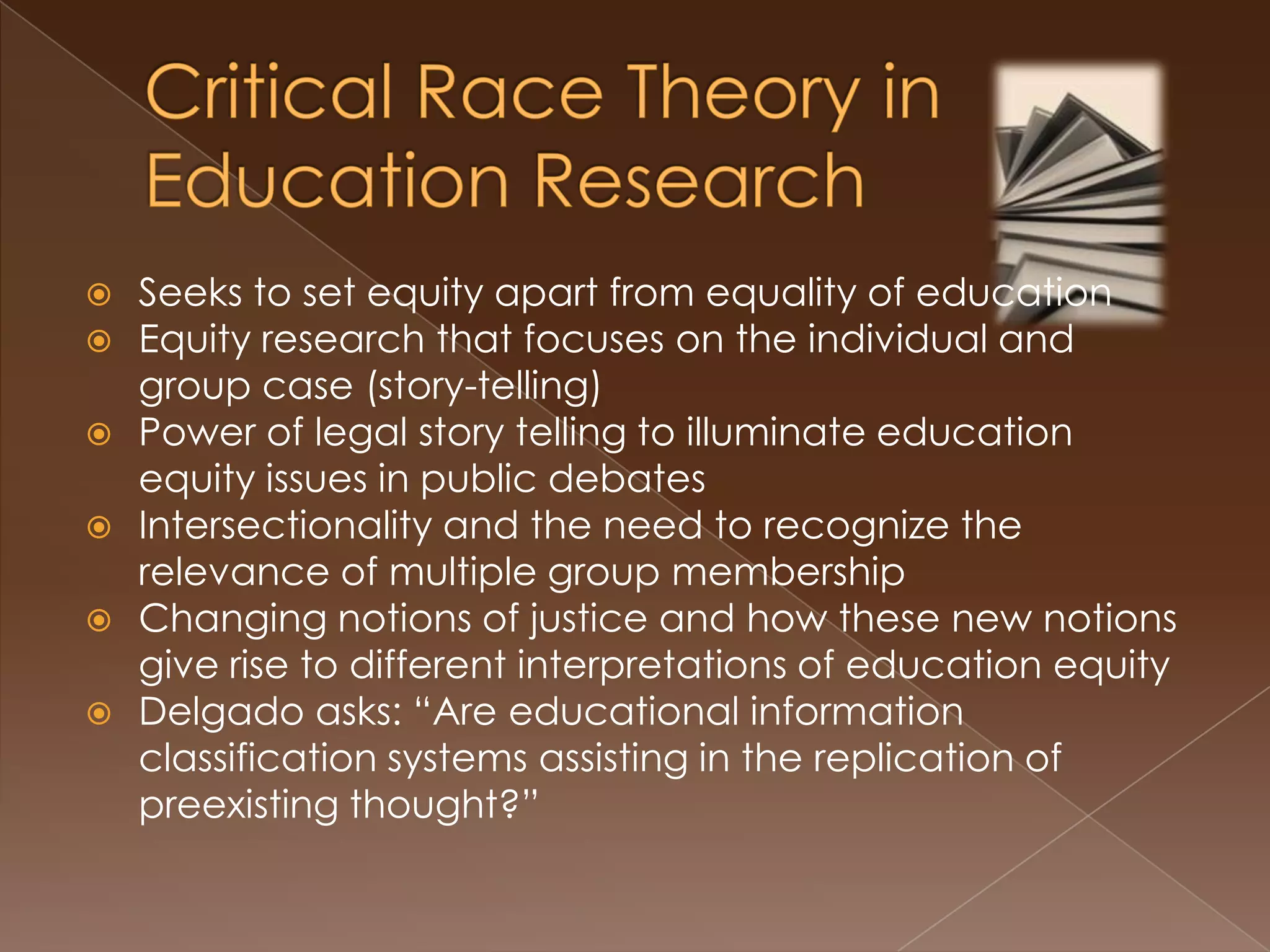
Critical Race Theory in Education ResearchSeeks to set equity apart from equality of educationEquity research that focuses on the individual and group case (story-telling)Power of legal story telling to illuminate education equity issues in public debatesIntersectionality and the need to recognize the relevance of multiple group membershipChanging notions of justice and how these new notions give rise to different interpretations of education equityDelgado asks: “Are educational information classification systems assisting in the replication of preexisting thought?”
INTERACTIVE ACTIVITY:“Changing The Lens”Viewing CRT through the lenses of:Research/Methodology
Policy
Administration
ClassroomQuote #1:“Counterstories can facilitate transformation in education. Because counterstories embed critical conceptual and theoretical content within an accessible story format they can serve as pedagogical tools.” (Yosso, 2006, p. 15).
Quote #2:“When does racial “unconsciousness” or awareness of race enrich interpretive languages, and when does it impoverish it? …how is “literary whiteness” and “literary blackness [or any people of color]” made, and what is the consequence of that construction?” (Morrison, 1992, p. xii).
Quote #3:“...whiteness is not a culture but a social concept”  (Leonardo, 2002, p. 32).
Quote #4:“We must also understand how certain forms of difference and the languages we employ to define those supposed “differences” not only reinforce each other, but tend to create and maintain each other” (Gates, 1984, p. 297).
Culturally Relevant Pedagogy:	“Students must experience academic success”	“Students must develop and/or maintain cultural competence”	“Students must develop a critical consciousness through which they challenge the status quo of the current social order” (Ladson-Billings, 2001, p.143).Quote #5:

Critical Race Theory Week 2

  • 1.
    Critical Race TheoryEDUC800-01Spring 2010Dr. Shelley WongMarch 23, 2010
  • 3.
    EXTENDED ACTIVTY: UNPACKINGPT IIWhite Privilege: Unpacking the Invisible Knapsack
  • 4.
    Which # onthe list struck a cord in your experience?Write the # on the note and place it on the central list. Next, get in your groups from last week to discuss your experience.
  • 5.
    APPLICATION OF CRT:Makingchange a realityEvolution and Application of CRT
  • 6.
  • 7.
    Evolution of CriticalRace TheoryBellUse of narrative in legal studies
  • 8.
    Interest-convergence principle (onlywhen it is in the best interest of Whites can Blacks achieve)
  • 9.
    Principle of the"price of racial remedies" no civil rights support if it threatens superior social status of Whites DelgadoInsistence on naming our own
  • 10.
  • 11.
    Readiness to questionbasic premises of moderate/ incremental civil rights laws
  • 12.
    Borrow insights onrace and racism from social science
  • 13.
    Critical examination ofmyths and stories to justify racial subordination contextualized treatment of doctrine
  • 14.
  • 15.
    Structural determinism --legaltools and thought that can impede law reformEvolution of Critical Race TheoryCrenshawBelief in color blindness and equal process is illogical in a society in which specific groups have been treated different historically and in which the outcomes continue to be present (Tate, 1995)CLS not grounded in realities of racially oppressedCLS fails to analyze the hegemonic role of racismCLS exaggerated the role of liberal legal consciousness, minimizing the transformative power of liberalismIntersectionality Framework (race and gender, but later class and age)structural intersectionality (domination)political intersectionality (systems)representational intersectionality (narratives)Ladson-BillingsCulturally-relevant pedagogy –cultural nationalismMulticulturalism – allows a proliferation of difference following in the traditions of liberalismScholarship of education research
  • 16.
    A Word onCulturally-Relevant PedagogyGloria Ladson-Billings-- culturally-relevant pedagogy is “committed to collective, not merely individual, empowerment” (Ladson-Billings, 1995). “Students must experience academic success”“Students must develop and/or maintain cultural competence”“Students must develop a critical consciousness through which they challenge the status quo of the current social order” (Ladson-Billings, 1995).
  • 17.
    Critical Race Theoryin Education ResearchSeeks to set equity apart from equality of educationEquity research that focuses on the individual and group case (story-telling)Power of legal story telling to illuminate education equity issues in public debatesIntersectionality and the need to recognize the relevance of multiple group membershipChanging notions of justice and how these new notions give rise to different interpretations of education equityDelgado asks: “Are educational information classification systems assisting in the replication of preexisting thought?”
  • 18.
    INTERACTIVE ACTIVITY:“Changing TheLens”Viewing CRT through the lenses of:Research/Methodology
  • 19.
  • 20.
  • 21.
    ClassroomQuote #1:“Counterstories canfacilitate transformation in education. Because counterstories embed critical conceptual and theoretical content within an accessible story format they can serve as pedagogical tools.” (Yosso, 2006, p. 15).
  • 22.
    Quote #2:“When doesracial “unconsciousness” or awareness of race enrich interpretive languages, and when does it impoverish it? …how is “literary whiteness” and “literary blackness [or any people of color]” made, and what is the consequence of that construction?” (Morrison, 1992, p. xii).
  • 23.
    Quote #3:“...whiteness isnot a culture but a social concept” (Leonardo, 2002, p. 32).
  • 24.
    Quote #4:“We mustalso understand how certain forms of difference and the languages we employ to define those supposed “differences” not only reinforce each other, but tend to create and maintain each other” (Gates, 1984, p. 297).
  • 25.
    Culturally Relevant Pedagogy: “Studentsmust experience academic success” “Students must develop and/or maintain cultural competence” “Students must develop a critical consciousness through which they challenge the status quo of the current social order” (Ladson-Billings, 2001, p.143).Quote #5:
  • 26.
    Quote #6:“Language hasa dual character: it is both a means of communication and a carrier of culture” (Thiong’o, 1981, p. 13).
  • 27.
    REFLECTIVE ACTIVITY:Meta-cognitive MomentViewingCRT through the lenses of:Research/Methodology
  • 28.
  • 29.
  • 30.
    ClassroomBased on thisweeks’ readings, reflect on the following:What does the bond between law and racial power look like? And what needs to be changed?
  • 31.
    Now that wehave a better understanding of CRT, what are some strategies for addressing issues in educational research and practice as pertaining to race/gender/class?
  • 32.
    Be sure todiscuss:
  • 33.
    INTERSECTIONALITY as itrelates to Accent discrimination, indigenous groups, sexuality, or other identities
  • 34.
    As viewed throughthe LENSES of: Research/Methodology, Policy, Administration, and Classroom
  • 35.
    READINGS:Matsuda (Counter Stories)Parker& Lynn (CRT Sensitive Qualitative research & Ed practice)Solarzano & Yasso (CRT methodology for research sensitive to race/gender/class)
  • 36.
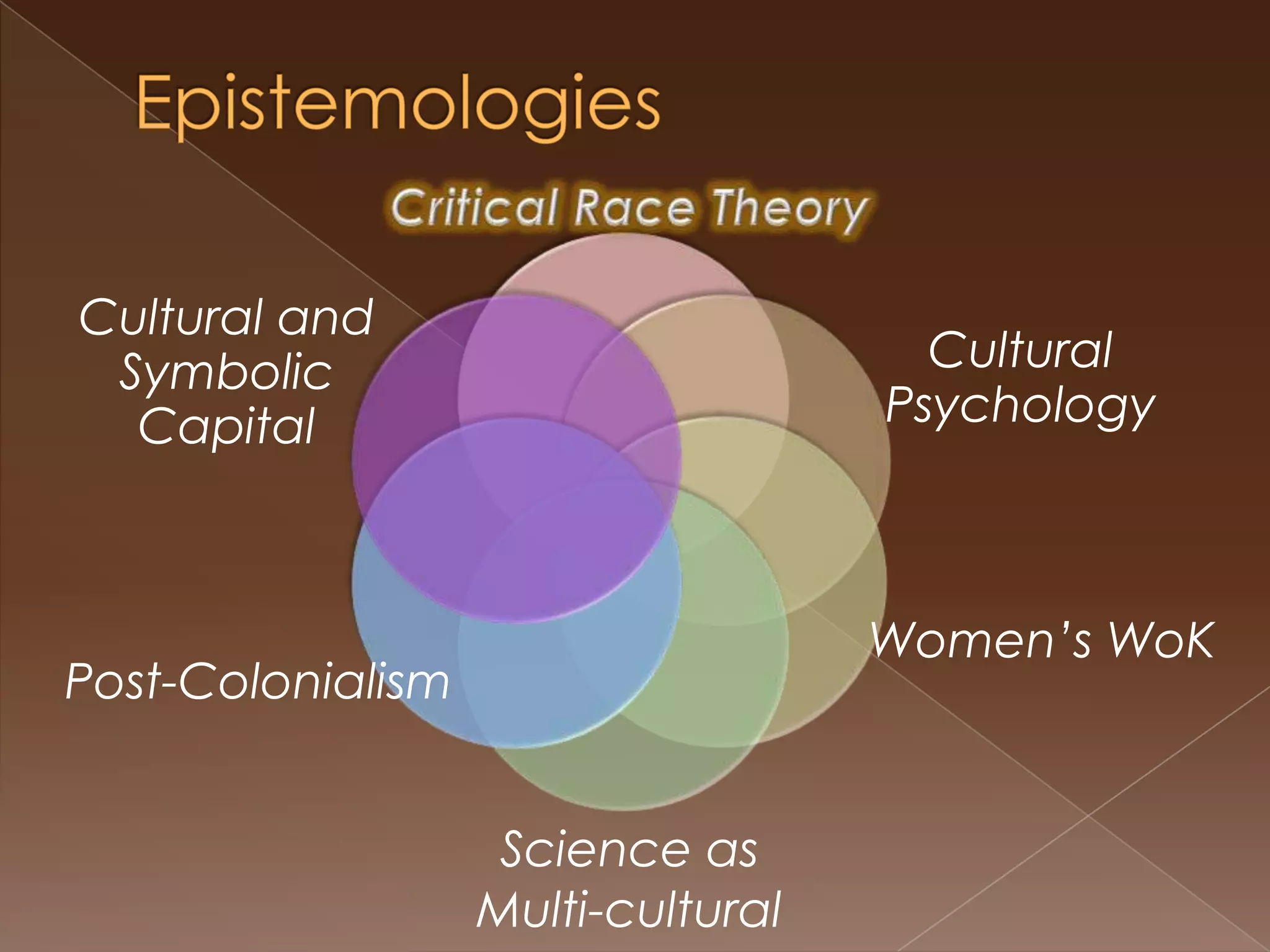
    CRT ConnectionsComparisons andContrasts to Other Ways of Knowing
  • 37.
  • 38.
    CONCLUSION:Wrapping Up CriticalRace TheoryUnit Review
  • 39.
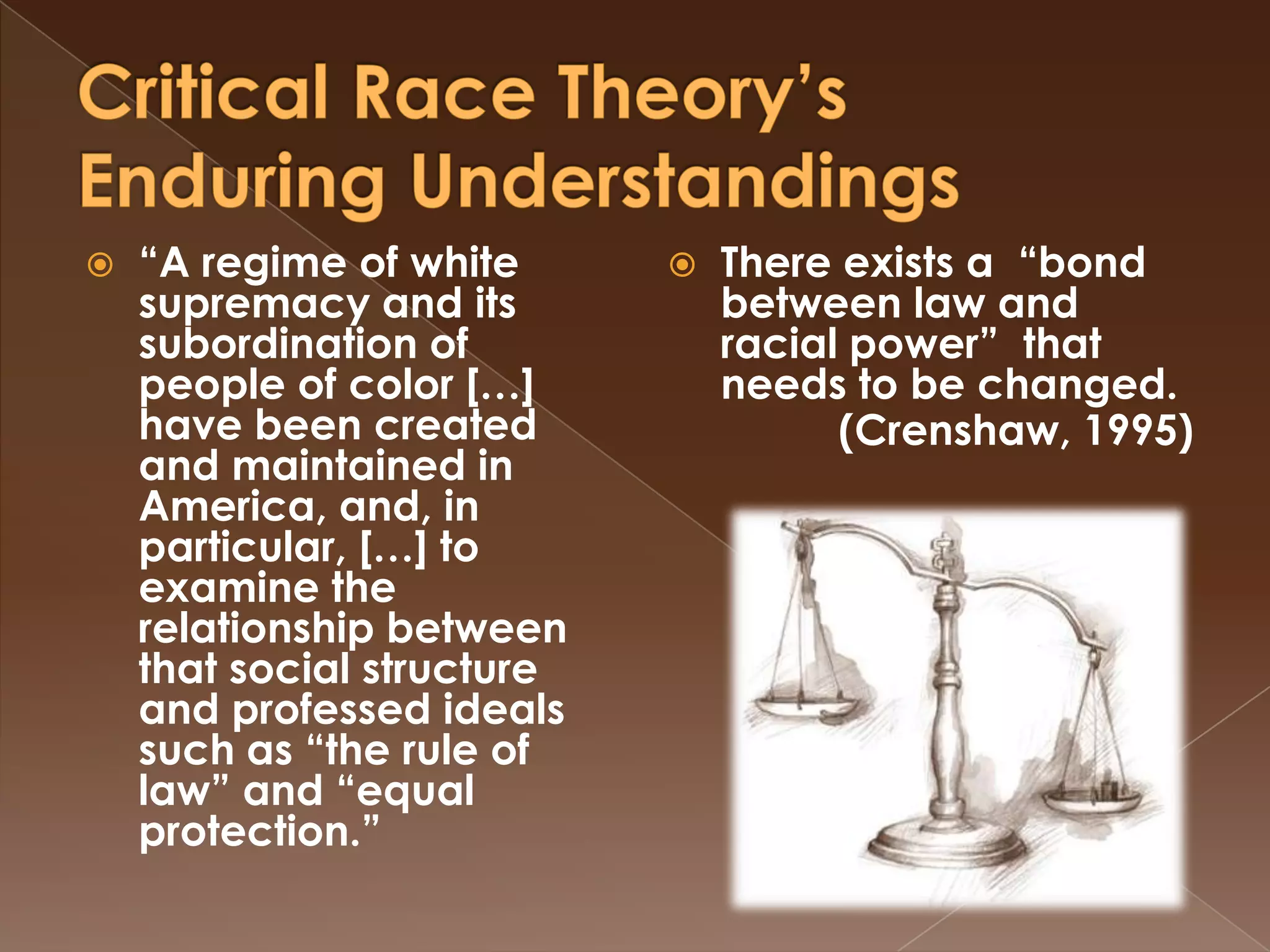
    Critical Race Theory’sEnduringUnderstandings“A regime of white supremacy and its subordination of people of color […] have been created and maintained in America, and, in particular, […] to examine the relationship between that social structure and professed ideals such as “the rule of law” and “equal protection.”There exists a “bond between law and racial power” that needs to be changed.(Crenshaw, 1995)
  • 40.
    Essential Questions forCritical Race Theory Where is ownership of dialogue?Whose narrative is of value? How can CRT effect education?How does CRT develop the discourse to reveal other ways of knowing?
  • 41.
    Thank you forparticipating!Leslie LaCroixNicole SealeyAndrea Weiss

Editor's Notes

  • #22 Cultural psychWWKSciencePost-ColonialismCultural