Critical perspectives in educational technology on
digital scholarships
CJ Bruton Image adapted from
http://guideimg.alibaba.
com
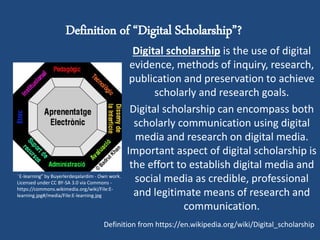
Definition of “Digital Scholarship”?
Digital scholarship is the use of digital
evidence, methods of inquiry, research,
publication and preservation to achieve
scholarly and research goals.
Digital scholarship can encompass both
scholarly communication using digital
media and research on digital media.
Important aspect of digital scholarship is
the effort to establish digital media and
social media as credible, professional
and legitimate means of research and
communication.
"E-learning" by Buyerlerdeqalardim - Own work.
Licensed under CC BY-SA 3.0 via Commons -
https://commons.wikimedia.org/wiki/File:E-
learning.jpg#/media/File:E-learning.jpg
Definition from https://en.wikipedia.org/wiki/Digital_scholarship
Ideas to encourage and support digital media and tools
• The scholar needs to question his
methods with scholarly enquiry through
the use of unique and effective research
methods.
• The scholar should read original texts
closely, while supplementing his research
with new and innovative methods.
• These methods could be data
visualisation, textual encoding and
analysis and asking new and unique
questions in order to become a critical
thinker.
Image from http://ecologyofeducation.net
There is a need to Understanding open content
licencing for educators
Czerniewicz and Wilmers (2015) have published
a 3-step guide for academics – see full reference
on last slide. Important aspects are to
1. Assess your policy frameworks (do you want people
to adopt your content or use it commercially)
2. Identify your intentions (get to know your
institution’s policies, grant agreements, stipulations &
contact agreements)
3. Select and apply the licence.(Understand Creative
Commons licensing and apply it to various content types).
Digital scholarship allow for the intersect of interdisciplinary
fields and concerns and “public scholarship”
.
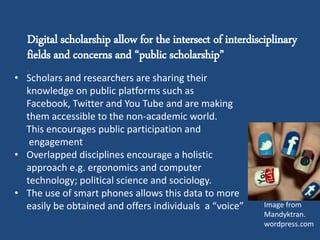
• Scholars and researchers are sharing their
knowledge on public platforms such as
Facebook, Twitter and You Tube and are making
them accessible to the non-academic world.
This encourages public participation and
engagement
• Overlapped disciplines encourage a holistic
approach e.g. ergonomics and computer
technology; political science and sociology.
• The use of smart phones allows this data to more
easily be obtained and offers individuals a “voice” Image from
Mandyktran.
wordpress.com
What are critical perspectives?
Ralph Tyler developed the “three minute
pause” when reading from a critical
perspective point of view:
1. Read for three minutes
2. Summarise the key ideas so far
3. Add your own thoughts
4. Pose clarifying questions (Tyler, date
unknown)
Image from salesstores.com
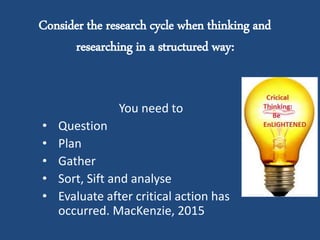
Consider the research cycle when thinking and
researching in a structured way:
You need to
• Question
• Plan
• Gather
• Sort, Sift and analyse
• Evaluate after critical action has
occurred. MacKenzie, 2015
Digital scholarship use the same skills that are vital
to non-digital scholarship. Skills like
• Writing an essay or a dissertation,
• Reading a book with critical understanding
• Working with digital tools and resources and
using the same interpretative tools
• Thinking critically about the relationship
between different forms of documents (digital,
visual, aural, visual) but using the same
interpretive skills
• Finding patterns and deciding which of those
items are important in your field of interest
and those which are not.
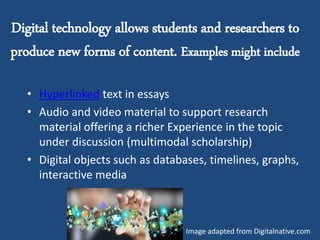
Digital technology allows students and researchers to
produce new forms of content. Examples might include
• Hyperlinked text in essays
• Audio and video material to support research
material offering a richer Experience in the topic
under discussion (multimodal scholarship)
• Digital objects such as databases, timelines, graphs,
interactive media
Image adapted from Digitalnative.com
References
• Documents.mx,. (2015). Thinking and writing from a critical perspective.
Retrieved 22 November 2015, from
http://documents.mx/education/writing-from-a-critical-perspective-
559c1b42edaa0.html
• Haverford College Libraries,. (2015). Digital Scholarship. Retrieved 23
November 2015, from http://library.haverford.edu/services/digital-
scholarship/
• McKenzie, J. (2015). The Question Mark. Questioning.org. Retrieved 23
November 2015, from http://questioning.org
• Sherman, L., & Sherman, R. (2015). What is Digital Scholarship? | Lewis &
Ruth Sherman Centre. Sherman Centre for Digital Scholarship. Retrieved 22
November 2015, from http://scds.ca/what-is-ds/
• Willmers, M., & Czerniewicz, L. (2015). Open content Licencing: a three step
guide for academics (1st ed., pp. 1 - 25). Cape Town: University of Cape
Town. Retrieved from
http://open.uct.ac.za/bitstream/handle/11427/12937/WillmersOpenLicen
sing2015.pdf?sequence=3

Critical perspectives on digital scholarships

  • 1.
    Critical perspectives ineducational technology on digital scholarships CJ Bruton Image adapted from http://guideimg.alibaba. com
  • 2.
    Definition of “DigitalScholarship”? Digital scholarship is the use of digital evidence, methods of inquiry, research, publication and preservation to achieve scholarly and research goals. Digital scholarship can encompass both scholarly communication using digital media and research on digital media. Important aspect of digital scholarship is the effort to establish digital media and social media as credible, professional and legitimate means of research and communication. "E-learning" by Buyerlerdeqalardim - Own work. Licensed under CC BY-SA 3.0 via Commons - https://commons.wikimedia.org/wiki/File:E- learning.jpg#/media/File:E-learning.jpg Definition from https://en.wikipedia.org/wiki/Digital_scholarship
  • 3.
    Ideas to encourageand support digital media and tools • The scholar needs to question his methods with scholarly enquiry through the use of unique and effective research methods. • The scholar should read original texts closely, while supplementing his research with new and innovative methods. • These methods could be data visualisation, textual encoding and analysis and asking new and unique questions in order to become a critical thinker. Image from http://ecologyofeducation.net
  • 4.
    There is aneed to Understanding open content licencing for educators Czerniewicz and Wilmers (2015) have published a 3-step guide for academics – see full reference on last slide. Important aspects are to 1. Assess your policy frameworks (do you want people to adopt your content or use it commercially) 2. Identify your intentions (get to know your institution’s policies, grant agreements, stipulations & contact agreements) 3. Select and apply the licence.(Understand Creative Commons licensing and apply it to various content types).
  • 5.
    Digital scholarship allowfor the intersect of interdisciplinary fields and concerns and “public scholarship” . • Scholars and researchers are sharing their knowledge on public platforms such as Facebook, Twitter and You Tube and are making them accessible to the non-academic world. This encourages public participation and engagement • Overlapped disciplines encourage a holistic approach e.g. ergonomics and computer technology; political science and sociology. • The use of smart phones allows this data to more easily be obtained and offers individuals a “voice” Image from Mandyktran. wordpress.com
  • 6.
    What are criticalperspectives? Ralph Tyler developed the “three minute pause” when reading from a critical perspective point of view: 1. Read for three minutes 2. Summarise the key ideas so far 3. Add your own thoughts 4. Pose clarifying questions (Tyler, date unknown) Image from salesstores.com
  • 7.
    Consider the researchcycle when thinking and researching in a structured way: You need to • Question • Plan • Gather • Sort, Sift and analyse • Evaluate after critical action has occurred. MacKenzie, 2015
  • 8.
    Digital scholarship usethe same skills that are vital to non-digital scholarship. Skills like • Writing an essay or a dissertation, • Reading a book with critical understanding • Working with digital tools and resources and using the same interpretative tools • Thinking critically about the relationship between different forms of documents (digital, visual, aural, visual) but using the same interpretive skills • Finding patterns and deciding which of those items are important in your field of interest and those which are not.
  • 9.
    Digital technology allowsstudents and researchers to produce new forms of content. Examples might include • Hyperlinked text in essays • Audio and video material to support research material offering a richer Experience in the topic under discussion (multimodal scholarship) • Digital objects such as databases, timelines, graphs, interactive media Image adapted from Digitalnative.com
  • 10.
    References • Documents.mx,. (2015).Thinking and writing from a critical perspective. Retrieved 22 November 2015, from http://documents.mx/education/writing-from-a-critical-perspective- 559c1b42edaa0.html • Haverford College Libraries,. (2015). Digital Scholarship. Retrieved 23 November 2015, from http://library.haverford.edu/services/digital- scholarship/ • McKenzie, J. (2015). The Question Mark. Questioning.org. Retrieved 23 November 2015, from http://questioning.org • Sherman, L., & Sherman, R. (2015). What is Digital Scholarship? | Lewis & Ruth Sherman Centre. Sherman Centre for Digital Scholarship. Retrieved 22 November 2015, from http://scds.ca/what-is-ds/ • Willmers, M., & Czerniewicz, L. (2015). Open content Licencing: a three step guide for academics (1st ed., pp. 1 - 25). Cape Town: University of Cape Town. Retrieved from http://open.uct.ac.za/bitstream/handle/11427/12937/WillmersOpenLicen sing2015.pdf?sequence=3