BEING A DIGITAL OPEN
NETWORKED SCHOLAR FOR
LEARNING, RESEARCH &
TEACHING
By Carina van Rooyen	
Presentation to UJ Anthro and DEV on 28 October 2015
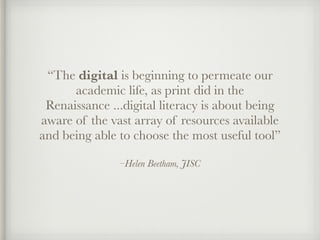
–Helen Beetham, JISC
“The digital is beginning to permeate our
academic life, as print did in the
Renaissance ...digital literacy is about being
aware of the vast array of resources available
and being able to choose the most useful tool”
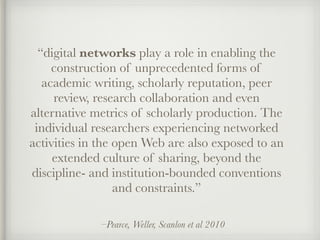
–Pearce, Weller, Scanlon et al 2010
“digital networks play a role in enabling the
construction of unprecedented forms of
academic writing, scholarly reputation, peer
review, research collaboration and even
alternative metrics of scholarly production. The
individual researchers experiencing networked
activities in the open Web are also exposed to an
extended culture of sharing, beyond the
discipline- and institution-bounded conventions
and constraints.”
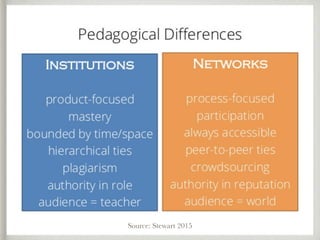
Source: Stewart 2015
OPEN EDUCATION
Open scholarship
Open access
Open licensing
Open education practices
Open education resources
Open source
Open data
Open research
Open science
Open web
Open knowledge
Source: Czerniewicz 2012a
http://www.flickr.com/photos/opensourceway/5535034664/sizes/o/in/photostream/
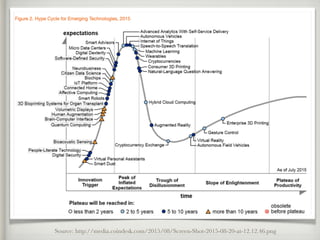
Source: http://media.coindesk.com/2015/08/Screen-Shot-2015-08-20-at-12.12.46.png
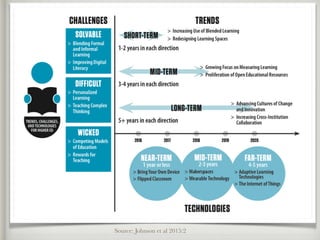
Source: Johnson et al 2015:2
Emerging roles & skills sets
Changing research dissemination strategies
Changing research itself (e.g., digital humanities, data mining, etc.)
Changing libraries
Enabling a ‘culture of contribution’
Online content can be
changed
annotated
commented on
updated
interacted with
New technical areas (aggregration, analytics, etc.)
Academic ‘reputation management’
Source: Czerniewicz 2012a
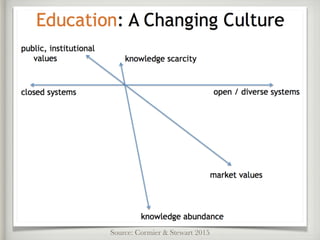
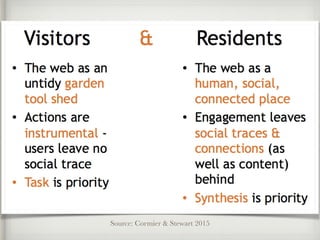
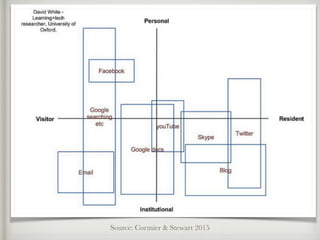
Source: Cormier & Stewart 2015
Source: Czerniewicz 2012a
OWN LEARNING &
TEACHING
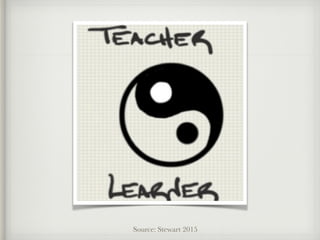
Source: Stewart 2015
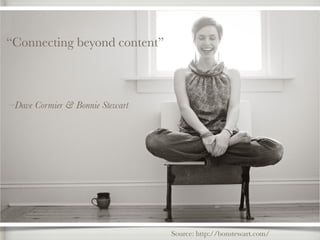
“Connecting beyond content”
–Dave Cormier & Bonnie Stewart
Source: http://bonstewart.com/
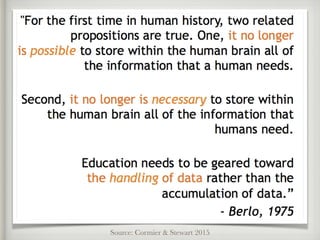
Source: Cormier & Stewart 2015
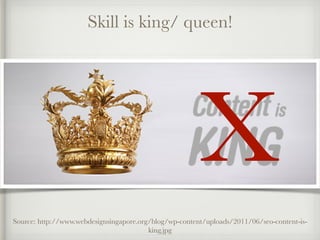
Skill is king/ queen!
X
Source: http://www.webdesignsingapore.org/blog/wp-content/uploads/2011/06/seo-content-is-
king.jpg
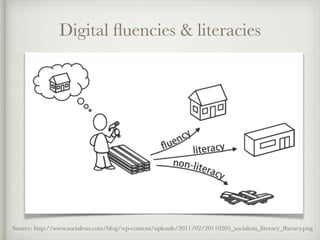
Digital fluencies & literacies
Source: http://www.socialens.com/blog/wp-content/uploads/2011/02/20110205_socialens_literacy_fluency.png
Source: Cormier & Stewart 2015
Source: http://www.sloveniatimes.com/modules/uploader/uploads/Aktualno/Podobe1/socialmedia.jpg
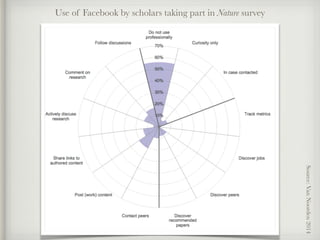
Use of Facebook by scholars taking part in Nature survey
Source:VanNoorden2014
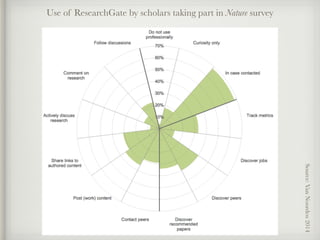
Use of ResearchGate by scholars taking part in Nature survey
Source:VanNoorden2014
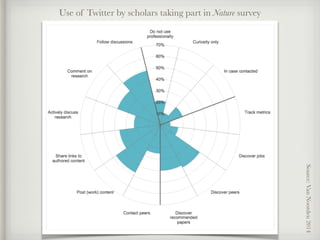
Use of Twitter by scholars taking part in Nature survey
Source:VanNoorden2014
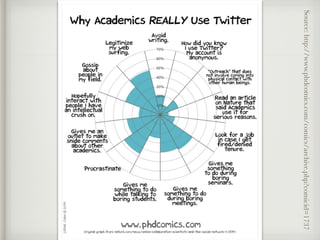
Source:http://www.phdcomics.com/comics/archive.php?comicid=1737
HEMALI ON USING
TWITTER IN TEACHING
RESEARCH
Scholarship!
The knowledge creation & dissemination cycle
Conceptualisation
Data collection
Data analysis
Findings
Engagement
Translation
Source:Czerniewicz2012a
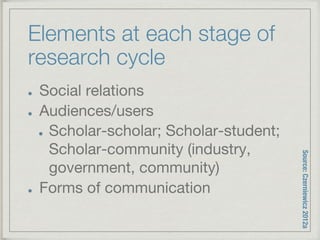
Elements at each stage of
research cycle
!   Social relations
!   Audiences/users
!   Scholar-scholar; Scholar-student;
Scholar-community (industry,
government, community) 
!   Forms of communication
Source:Czerniewicz2012a
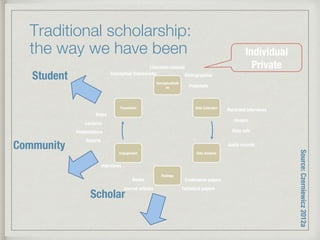
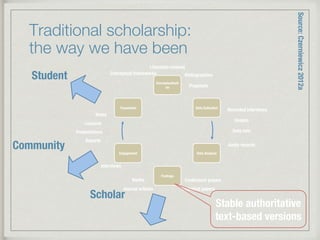
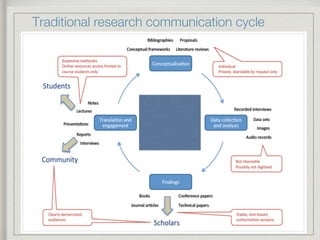
Traditional scholarship: !
the way we have been
Conceptualisati
on
Data Collection
Data Analysis
Findings
Engagement
Translation
Conceptual frameworks 
Literature reviews
Bibliographies
Proposals
Data sets
Conference papers
Audio records
Images
Recorded interviews
Books
Reports
Journal articles
 Technical papers
Notes
Presentations
Lectures
Interviews
Student
Community
Scholar
Source:Czerniewicz2012a
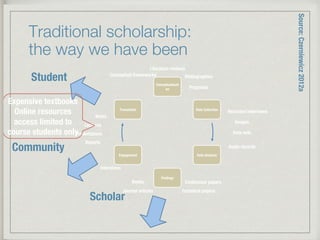
Traditional scholarship: !
the way we have been
Conceptualisati
on
Data Collection
Data Analysis
Findings
Engagement
Translation
Conceptual frameworks 
Literature reviews
Bibliographies
Proposals
Data sets
Conference papers
Audio records
Images
Recorded interviews
Books
Reports
Journal articles
 Technical papers
Notes
Presentations
Lectures
Interviews
Student
Community
Scholar
Source:Czerniewicz2012a
Individual
Private
Traditional scholarship: !
the way we have been
Conceptualisati
on
Data Collection
Data Analysis
Findings
Engagement
Translation
Conceptual frameworks 
Literature reviews
Bibliographies
Proposals
Data sets
Conference papers
Audio records
Images
Recorded interviews
Books
Reports
Journal articles
 Technical papers
Notes
Presentations
Lectures
Interviews
Student
Community
Scholar
Source:Czerniewicz2012a

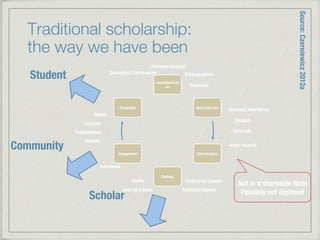
Not in a shareable form
Possibly not digitised
Traditional scholarship: !
the way we have been
Conceptualisati
on
Data Collection
Data Analysis
Findings
Engagement
Translation
Conceptual frameworks 
Literature reviews
Bibliographies
Proposals
Data sets
Conference papers
Audio records
Images
Recorded interviews
Books
Reports
Journal articles
 Technical papers
Notes
Presentations
Lectures
Interviews
Student
Community
Scholar
Source:Czerniewicz2012a
Stable authoritative
text-based versions
Traditional scholarship: !
the way we have been
Conceptualisati
on
Data Collection
Data Analysis
Findings
Engagement
Translation
Conceptual frameworks 
Literature reviews
Bibliographies
Proposals
Data sets
Conference papers
Audio records
Images
Recorded interviews
Books
Reports
Journal articles
 Technical papers
Notes
Presentations
Lectures
Interviews
Student
Community
Scholar
Source:Czerniewicz2012a
Clearly defined
audiences
Traditional scholarship: !
the way we have been
Conceptualisati
on
Data Collection
Data Analysis
Findings
Engagement
Translation
Conceptual frameworks 
Literature reviews
Bibliographies
Proposals
Data sets
Conference papers
Audio records
Images
Recorded interviews
Books
Reports
Journal articles
 Technical papers
Notes
Presentations
Lectures
Interviews
Student
Community
Scholar
Source:Czerniewicz2012a
Expensive textbooks
Online resources
access limited to
course students only
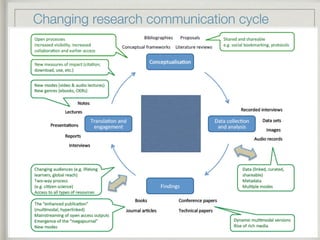
Changes in communication:
communication occurs throughout
the research cycle, not at the end
Traditional scholarship: !
the way we have been
Conceptualisati
on
Data Collection
Data Analysis
Findings
Engagement
Translation
Conceptual frameworks 
Literature reviews
Bibliographies
Proposals
Data sets
Conference papers
Audio records
Images
Recorded interviews
Books
Reports
Journal articles
 Technical papers
Notes
Presentations
Lectures
Interviews
Student
Community
Scholar
Source:Czerniewicz2012a
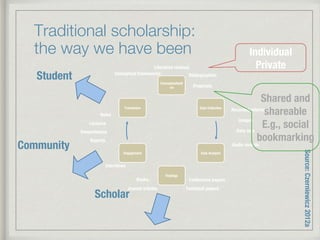
Individual
Private
Shared and
shareable
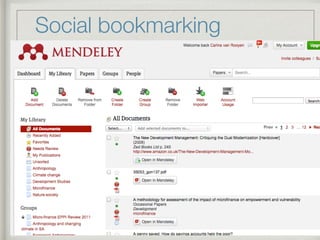
E.g., social
bookmarking
Social bookmarking
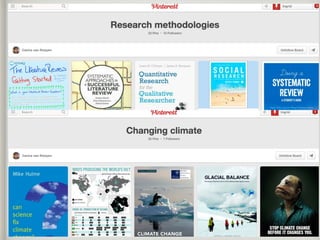
Pinterest
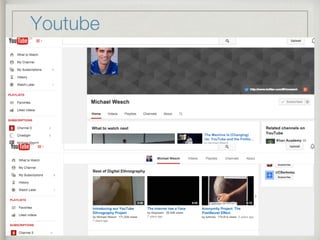
Youtube
Traditional scholarship: !
the way we have been
Conceptualisation
Data Collection
Data Analysis
Findings
Engagement
Translation
Conceptual frameworks 
Literature reviews
Bibliographies
Proposals
Data sets
Conference papers
Audio records
Images
Recorded interviews
Books
Reports
Journal articles
 Technical papers
Notes
Presentations
Lectures
Interviews
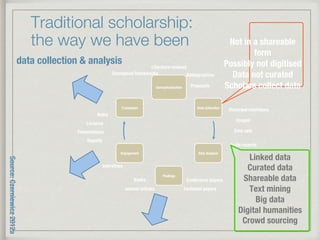
Source:Czerniewicz2012a
Not in a shareable
form
Possibly not digitised
Data not curated
Scholars collect data
Linked data
Curated data
Shareable data
Text mining
Big data
Digital humanities
Crowd sourcing
data collection & analysis
21
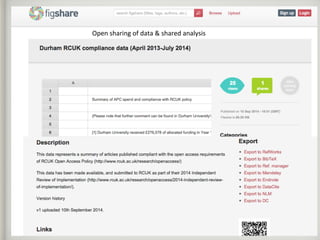
Open%sharing%of%data%&%shared%analysis%
Traditional scholarship: !
the way we have been
Conceptualisati
on
Data Collection
Data Analysis
Findings
Engagement
Translation
Conceptual frameworks 
Literature reviews
Bibliographies
Proposals
Data sets
Conference papers
Audio records
Images
Recorded interviews
Books
Reports
Journal articles
 Technical papers
Notes
Presentations
Lectures
Interviews
Source:Czerniewicz2012a
findings

Dynamic multimodal
versions, the rise of
rich media
New types of journals:“enhanced
publication”
Rise of open access
Journal publishing changing
E.g. PLOS One model
Stable authoritative
text-based versions
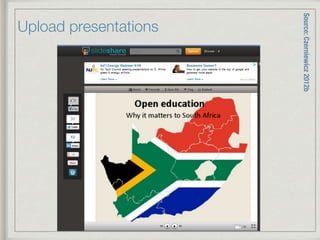
Upload presentations
Source:Czerniewicz2012b
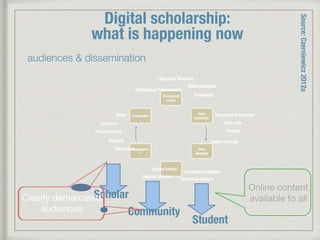
audiences & dissemination
Conceptuali
sation
Data
Collection
Data
Analysis
Findings
Engagemen
t
Translation
Conceptual Frameworks 
Literature Reviews
Bibliographies
Proposals
Data sets
Conference papers
Audio records
Images
Recorded interviews
Books
Reports
Journal articles
Technical papers
Notes
Presentations
Lectures
Interviews
Student
Community
Scholar
Clearly demarcated
audiences
Online content 
available to all
Digital scholarship: "
what is happening now
Source:Czerniewicz2012a
Conceptuali
sation
Data
Collection
Data
Analysis
Findings
Engagemen
t
Translation
Conceptual Frameworks 
Literature Reviews
Bibliographies
Proposals
Data sets
Conference papers
Audio records
Images
Recorded interviews
Books
Reports
Journal articles
Technical papers
Notes
Presentations
Lectures
Interviews
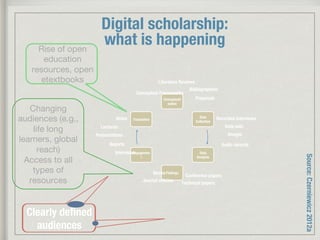
Digital scholarship: "
what is happening
Rise of open
education
resources, open
etextbooks
Clearly defined
audiences
Changing
audiences (e.g.,
life long
learners, global
reach)
Access to all
types of
resources
Source:Czerniewicz2012a
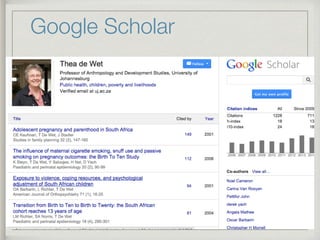
Google Scholar
Conceptuali
sation
Data
Collection
Data
Analysis
Findings
Engagemen
t
Translation
Conceptual Frameworks 
Literature Reviews
Bibliographies
Proposals
Data sets
Conference papers
Audio records
Images
Recorded interviews
Books
Reports
Journal articles
Technical papers
Notes
Presentations
Lectures
Interviews
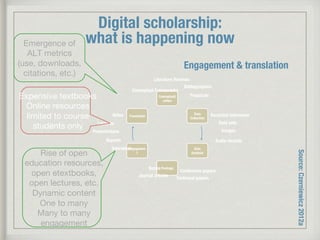
Digital scholarship: "
what is happening now
Expensive textbooks
Online resources
limited to course
students only
Rise of open
education resources,
open etextbooks,
open lectures, etc.
Dynamic content
One to many
Many to many
engagement
Engagement & translation
Emergence of
ALT metrics
(use, downloads,
citations, etc.)
Source:Czerniewicz2012a
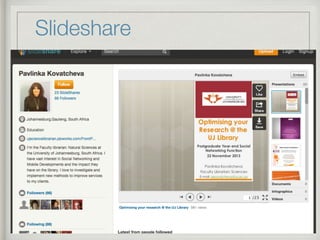
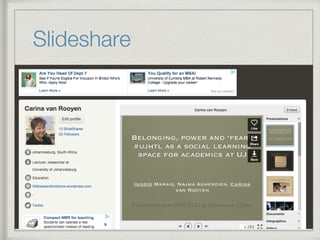
Slideshare
Traditional research communication cycle
Changing research communication cycle
CHALLENGES
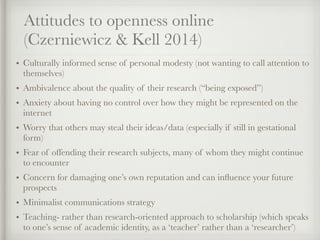
Attitudes to openness online
(Czerniewicz & Kell 2014)
• Culturally informed sense of personal modesty (not wanting to call attention to
themselves)
• Ambivalence about the quality of their research (“being exposed”)
• Anxiety about having no control over how they might be represented on the
internet
• Worry that others may steal their ideas/data (especially if still in gestational
form)
• Fear of offending their research subjects, many of whom they might continue
to encounter
• Concern for damaging one’s own reputation and can influence your future
prospects
• Minimalist communications strategy
• Teaching- rather than research-oriented approach to scholarship (which speaks
to one’s sense of academic identity, as a ‘teacher’ rather than a ‘researcher’)
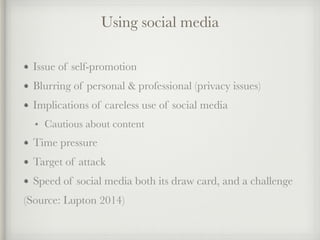
Issue of self-promotion
Blurring of personal & professional (privacy issues)
Implications of careless use of social media
• Cautious about content
Time pressure
Target of attack
Speed of social media both its draw card, and a challenge
(Source: Lupton 2014)
Using social media
Source: http://msrayspsychicepisodes.files.wordpress.com/2013/06/i-need-an-expert-
advice-600x420.jpg
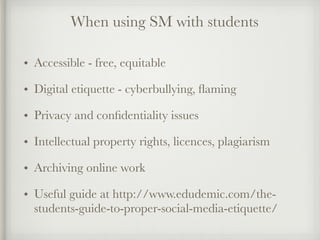
• Accessible - free, equitable
• Digital etiquette - cyberbullying, flaming
• Privacy and confidentiality issues
• Intellectual property rights, licences, plagiarism
• Archiving online work
• Useful guide at http://www.edudemic.com/the-
students-guide-to-proper-social-media-etiquette/
When using SM with students
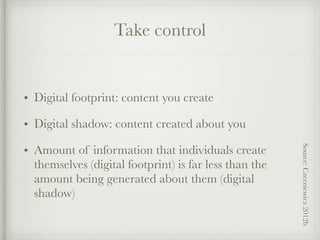
Take control
• Digital footprint: content you create
• Digital shadow: content created about you
• Amount of information that individuals create
themselves (digital footprint) is far less than the
amount being generated about them (digital
shadow)
Source:Czerniewicz2012b
What is your digital shadow?
Source:Czerniewicz2012b
LET’S DO!
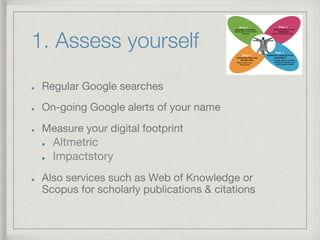
1. Assess yourself
!   Regular Google searches
!   On-going Google alerts of your name
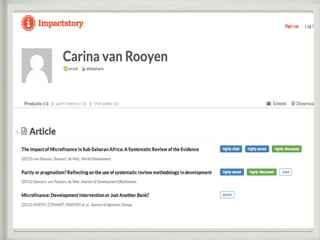
!   Measure your digital footprint
!   Altmetric
!   Impactstory
!   Also services such as Web of Knowledge or
Scopus for scholarly publications & citations
Source: Czerniewicz 2012b
Social media analytics
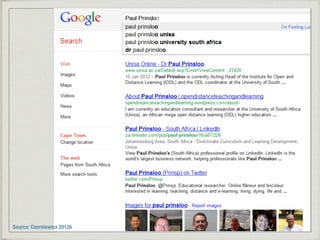
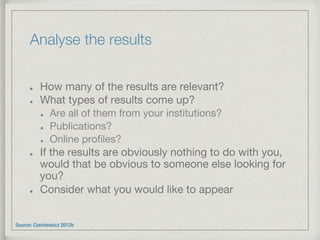
Analyse the results
!   How many of the results are relevant?
!   What types of results come up? 
!   Are all of them from your institutions? 
!   Publications? 
!   Online profiles?
!   If the results are obviously nothing to do with you,
would that be obvious to someone else looking for
you?
!   Consider what you would like to appear
Source: Czerniewicz 2012b
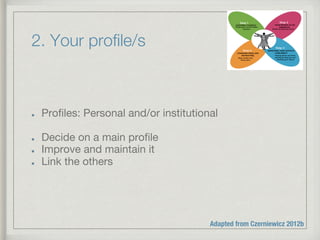
2. Your profile/s
!   Profiles: Personal and/or institutional 
!   Decide on a main profile
!   Improve and maintain it
!   Link the others
Adapted from Czerniewicz 2012b
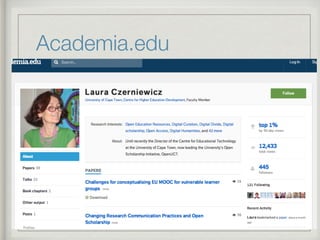
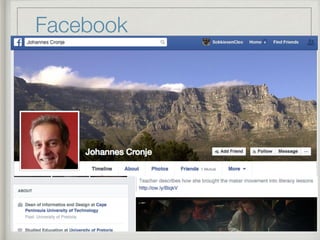
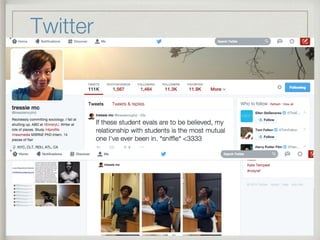
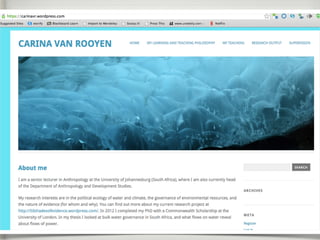
Academia.edu
Linkedin
Facebook
Google circles
Twitter
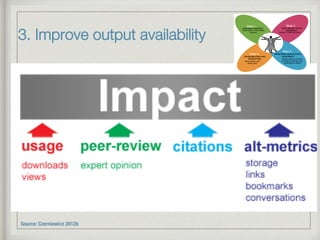
3. Improve output availability
Source: Czerniewicz 2012b
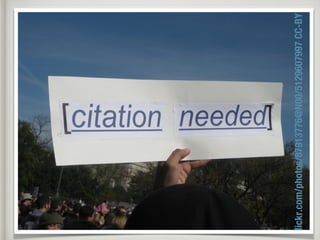
.flickr.com/photos/87913776@N00/5129607997CC-BY
Go as open as you can
!   Put journal articles you can online
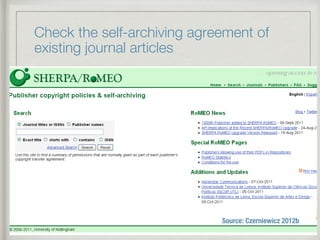
!   Check out Sherpa Romeo for publisher archiving policies
!   Archive
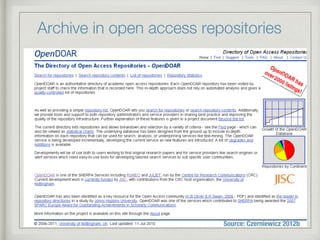
!   in repositories
!   in subject portals and aggregators
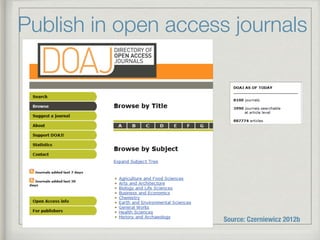
!   Publish in open access journals
!   Majority of studies have shown an increase in citations arising
from open access
!   Of the 35 studies surveyed, 27 have shown a citations advantage (the %
increase ranges from 45% increase to as high as 600%), 4 showing no
advantage (Swan A (2010) The Open Access Citation Advantage: Studies
and Results to Date. Available at http://eprints.ecs.soton.ac.uk/18516/)
!   Open everything – all scholarly output possible
(teaching, popular, etc.)
Source: Czerniewicz 2012b
Check the self-archiving agreement of
existing journal articles
Source: Czerniewicz 2012b
Archive in open access repositories
Source: Czerniewicz 2012b
Publish in open access journals
Source: Czerniewicz 2012b
Upload videos & podcasts
Source: Czerniewicz 2012b
Slideshare
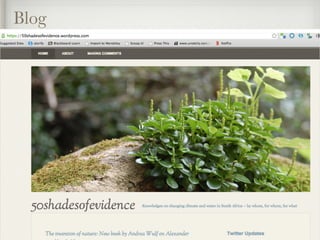
Blog
Keywords & tags
!   Take metadata seriously
!   Metadata refers to information that describes,
explains, locates and otherwise makes it easier to
retrieve, use or manage digital information
!   Add tags, keywords or descriptions to a file you
upload
Source: Czerniewicz 2012b
4. Communicate &
connect
!   Curate
!   Twitter as hub of PLN
!   Blog
!   Single-authored or multiple-author blog (e.g., LSE
blogs)?
!   What blog about: updates on research, interesting
links, commentary on current events, reports from
conferences / seminars / book launch, repost from
other blogs, thematic post with other bloggers
!   Who are you blogging for?
Source: Czerniewicz 2012b
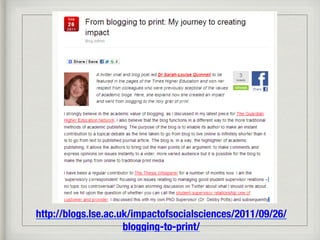
http://blogs.lse.ac.uk/impactofsocialsciences/2011/09/26/
blogging-to-print/
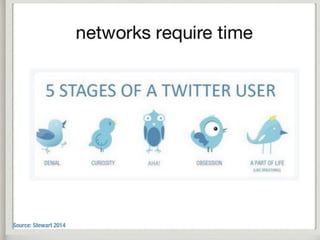
Source: Stewart 2014
Some sources
• Academics’ online presence: A four step guide to taking
control of your visibility. http://openuct.uct.ac.za/sites/
default/files/Online%20Visibility%20Guidelines.pdf
• How to curate your digital identity as an academic. http://
chronicle.com/article/How-to-Curate-Your-Digital/
151001/?cid=at&utm_source=at&utm_medium=en
• Open content licensing: A three step guide for academics.
By OpenUCT. http://open.uct.ac.za/bitstream/handle/
11427/12937/WillmersOpenLicensing2015.pdf?
sequence=3
TWITTER
• Using Twitter in university research, teaching, and
impact activities: A guide for academics and
researchers. http://blogs.lse.ac.uk/
impactofsocialsciences/2011/09/29/twitter-guide/
• List of academic tweeters by subject area. http://
blogs.lse.ac.uk/impactofsocialsciences/
2011/09/02/academic-tweeters-your-suggestions-
in-full/
Source: Davis 2014
• Cormier D & Stewart B 2014 Connecting beyond content: Education in abundance. Presentation to
#mootca15. http://www.slideshare.net/bonstewart/connecting-beyond-content-education-in-
abundance?from_action=save
• Czerniewicz L 2012a The changing scholarly communication and content landscape. Presentation to
CHEC Board on 3 May
• Czerniewicz L 2012b Academics’ online presence: Assessing & sharing your visibility. Presentation in
September
• Czerniewicz L & Kell C 2014 A framework for analysing research types and practices. Presentation to
the 9th International conference on networked learning
• Davis V 2014 Innovate like-a-turtle: The mindset, tools and teaching tips to make this the best year ever.
http://www.slideshare.net/coolcatteacher/innovate-likeaturtle-phms-mega-awesome-school-opener
• Johnson L, Adams Becker S, Estrada V & Freeman A 2015 NMC Horizon Report: 2015 Higher education
edition. Austin, Texas: The New Media Consortium
• Lupton D 2014 ‘Feeling better connected’: Academics’ use of social media. http://
www.canberra.edu.au/faculties/arts-design/attachements/pdf/n-and-mrc/Feeling-Better-Connected-
report-final.pdf
• Stewart B 2014 Networked scholars & …authentic influence? Presentation at #elearninged at the
University of Edinburgh
• Van Noorden R 2014 Online collaboration: Scientists and the social network. Nature http://
www.nature.com/news/online-collaboration-scientists-and-the-social-network-1.15711?
WT.mc_id=TWT_NatureNews
References

Being a digital open networked scholar for learning, research and teaching

  • 1.
    BEING A DIGITALOPEN NETWORKED SCHOLAR FOR LEARNING, RESEARCH & TEACHING By Carina van Rooyen Presentation to UJ Anthro and DEV on 28 October 2015
  • 2.
    –Helen Beetham, JISC “Thedigital is beginning to permeate our academic life, as print did in the Renaissance ...digital literacy is about being aware of the vast array of resources available and being able to choose the most useful tool”
  • 3.
    –Pearce, Weller, Scanlonet al 2010 “digital networks play a role in enabling the construction of unprecedented forms of academic writing, scholarly reputation, peer review, research collaboration and even alternative metrics of scholarly production. The individual researchers experiencing networked activities in the open Web are also exposed to an extended culture of sharing, beyond the discipline- and institution-bounded conventions and constraints.”
  • 4.
  • 5.
    OPEN EDUCATION Open scholarship Openaccess Open licensing Open education practices Open education resources Open source Open data Open research Open science Open web Open knowledge Source: Czerniewicz 2012a http://www.flickr.com/photos/opensourceway/5535034664/sizes/o/in/photostream/
  • 6.
  • 7.
  • 8.
    Emerging roles &skills sets Changing research dissemination strategies Changing research itself (e.g., digital humanities, data mining, etc.) Changing libraries Enabling a ‘culture of contribution’ Online content can be changed annotated commented on updated interacted with New technical areas (aggregration, analytics, etc.) Academic ‘reputation management’ Source: Czerniewicz 2012a
  • 9.
    Source: Cormier &Stewart 2015
  • 10.
  • 11.
  • 12.
  • 14.
    “Connecting beyond content” –DaveCormier & Bonnie Stewart Source: http://bonstewart.com/
  • 15.
    Source: Cormier &Stewart 2015
  • 16.
    Skill is king/queen! X Source: http://www.webdesignsingapore.org/blog/wp-content/uploads/2011/06/seo-content-is- king.jpg
  • 17.
    Digital fluencies &literacies Source: http://www.socialens.com/blog/wp-content/uploads/2011/02/20110205_socialens_literacy_fluency.png
  • 18.
    Source: Cormier &Stewart 2015
  • 19.
    Source: Cormier &Stewart 2015
  • 20.
  • 21.
    Use of Facebookby scholars taking part in Nature survey Source:VanNoorden2014
  • 22.
    Use of ResearchGateby scholars taking part in Nature survey Source:VanNoorden2014
  • 23.
    Use of Twitterby scholars taking part in Nature survey Source:VanNoorden2014
  • 24.
  • 25.
  • 26.
  • 27.
    Scholarship! The knowledge creation& dissemination cycle Conceptualisation Data collection Data analysis Findings Engagement Translation Source:Czerniewicz2012a
  • 28.
    Elements at eachstage of research cycle !   Social relations !   Audiences/users !   Scholar-scholar; Scholar-student; Scholar-community (industry, government, community) !   Forms of communication Source:Czerniewicz2012a
  • 29.
    Traditional scholarship: ! theway we have been Conceptualisati on Data Collection Data Analysis Findings Engagement Translation Conceptual frameworks Literature reviews Bibliographies Proposals Data sets Conference papers Audio records Images Recorded interviews Books Reports Journal articles Technical papers Notes Presentations Lectures Interviews Student Community Scholar Source:Czerniewicz2012a
  • 30.
    Traditional scholarship: ! theway we have been Conceptualisati on Data Collection Data Analysis Findings Engagement Translation Conceptual frameworks Literature reviews Bibliographies Proposals Data sets Conference papers Audio records Images Recorded interviews Books Reports Journal articles Technical papers Notes Presentations Lectures Interviews Student Community Scholar Source:Czerniewicz2012a Individual Private
  • 31.
    Traditional scholarship: ! theway we have been Conceptualisati on Data Collection Data Analysis Findings Engagement Translation Conceptual frameworks Literature reviews Bibliographies Proposals Data sets Conference papers Audio records Images Recorded interviews Books Reports Journal articles Technical papers Notes Presentations Lectures Interviews Student Community Scholar Source:Czerniewicz2012a Not in a shareable form Possibly not digitised
  • 32.
    Traditional scholarship: ! theway we have been Conceptualisati on Data Collection Data Analysis Findings Engagement Translation Conceptual frameworks Literature reviews Bibliographies Proposals Data sets Conference papers Audio records Images Recorded interviews Books Reports Journal articles Technical papers Notes Presentations Lectures Interviews Student Community Scholar Source:Czerniewicz2012a Stable authoritative text-based versions
  • 33.
    Traditional scholarship: ! theway we have been Conceptualisati on Data Collection Data Analysis Findings Engagement Translation Conceptual frameworks Literature reviews Bibliographies Proposals Data sets Conference papers Audio records Images Recorded interviews Books Reports Journal articles Technical papers Notes Presentations Lectures Interviews Student Community Scholar Source:Czerniewicz2012a Clearly defined audiences
  • 34.
    Traditional scholarship: ! theway we have been Conceptualisati on Data Collection Data Analysis Findings Engagement Translation Conceptual frameworks Literature reviews Bibliographies Proposals Data sets Conference papers Audio records Images Recorded interviews Books Reports Journal articles Technical papers Notes Presentations Lectures Interviews Student Community Scholar Source:Czerniewicz2012a Expensive textbooks Online resources access limited to course students only
  • 35.
    Changes in communication: communicationoccurs throughout the research cycle, not at the end
  • 36.
    Traditional scholarship: ! theway we have been Conceptualisati on Data Collection Data Analysis Findings Engagement Translation Conceptual frameworks Literature reviews Bibliographies Proposals Data sets Conference papers Audio records Images Recorded interviews Books Reports Journal articles Technical papers Notes Presentations Lectures Interviews Student Community Scholar Source:Czerniewicz2012a Individual Private Shared and shareable E.g., social bookmarking
  • 37.
  • 38.
  • 39.
  • 40.
    Traditional scholarship: ! theway we have been Conceptualisation Data Collection Data Analysis Findings Engagement Translation Conceptual frameworks Literature reviews Bibliographies Proposals Data sets Conference papers Audio records Images Recorded interviews Books Reports Journal articles Technical papers Notes Presentations Lectures Interviews Source:Czerniewicz2012a Not in a shareable form Possibly not digitised Data not curated Scholars collect data Linked data Curated data Shareable data Text mining Big data Digital humanities Crowd sourcing data collection & analysis
  • 41.
  • 42.
    Traditional scholarship: ! theway we have been Conceptualisati on Data Collection Data Analysis Findings Engagement Translation Conceptual frameworks Literature reviews Bibliographies Proposals Data sets Conference papers Audio records Images Recorded interviews Books Reports Journal articles Technical papers Notes Presentations Lectures Interviews Source:Czerniewicz2012a findings Dynamic multimodal versions, the rise of rich media New types of journals:“enhanced publication” Rise of open access Journal publishing changing E.g. PLOS One model Stable authoritative text-based versions
  • 44.
  • 45.
    audiences & dissemination Conceptuali sation Data Collection Data Analysis Findings Engagemen t Translation ConceptualFrameworks Literature Reviews Bibliographies Proposals Data sets Conference papers Audio records Images Recorded interviews Books Reports Journal articles Technical papers Notes Presentations Lectures Interviews Student Community Scholar Clearly demarcated audiences Online content available to all Digital scholarship: " what is happening now Source:Czerniewicz2012a
  • 46.
    Conceptuali sation Data Collection Data Analysis Findings Engagemen t Translation Conceptual Frameworks LiteratureReviews Bibliographies Proposals Data sets Conference papers Audio records Images Recorded interviews Books Reports Journal articles Technical papers Notes Presentations Lectures Interviews Digital scholarship: " what is happening Rise of open education resources, open etextbooks Clearly defined audiences Changing audiences (e.g., life long learners, global reach) Access to all types of resources Source:Czerniewicz2012a
  • 47.
  • 48.
    Conceptuali sation Data Collection Data Analysis Findings Engagemen t Translation Conceptual Frameworks LiteratureReviews Bibliographies Proposals Data sets Conference papers Audio records Images Recorded interviews Books Reports Journal articles Technical papers Notes Presentations Lectures Interviews Digital scholarship: " what is happening now Expensive textbooks Online resources limited to course students only Rise of open education resources, open etextbooks, open lectures, etc. Dynamic content One to many Many to many engagement Engagement & translation Emergence of ALT metrics (use, downloads, citations, etc.) Source:Czerniewicz2012a
  • 50.
  • 51.
  • 52.
  • 53.
  • 54.
    Attitudes to opennessonline (Czerniewicz & Kell 2014) • Culturally informed sense of personal modesty (not wanting to call attention to themselves) • Ambivalence about the quality of their research (“being exposed”) • Anxiety about having no control over how they might be represented on the internet • Worry that others may steal their ideas/data (especially if still in gestational form) • Fear of offending their research subjects, many of whom they might continue to encounter • Concern for damaging one’s own reputation and can influence your future prospects • Minimalist communications strategy • Teaching- rather than research-oriented approach to scholarship (which speaks to one’s sense of academic identity, as a ‘teacher’ rather than a ‘researcher’)
  • 55.
    Issue of self-promotion Blurringof personal & professional (privacy issues) Implications of careless use of social media • Cautious about content Time pressure Target of attack Speed of social media both its draw card, and a challenge (Source: Lupton 2014) Using social media
  • 56.
  • 57.
    • Accessible -free, equitable • Digital etiquette - cyberbullying, flaming • Privacy and confidentiality issues • Intellectual property rights, licences, plagiarism • Archiving online work • Useful guide at http://www.edudemic.com/the- students-guide-to-proper-social-media-etiquette/ When using SM with students
  • 58.
    Take control • Digitalfootprint: content you create • Digital shadow: content created about you • Amount of information that individuals create themselves (digital footprint) is far less than the amount being generated about them (digital shadow) Source:Czerniewicz2012b
  • 59.
    What is yourdigital shadow? Source:Czerniewicz2012b
  • 60.
  • 61.
    1. Assess yourself !  Regular Google searches !   On-going Google alerts of your name !   Measure your digital footprint !   Altmetric !   Impactstory !   Also services such as Web of Knowledge or Scopus for scholarly publications & citations
  • 62.
  • 64.
  • 65.
    Analyse the results !  How many of the results are relevant? !   What types of results come up? !   Are all of them from your institutions? !   Publications? !   Online profiles? !   If the results are obviously nothing to do with you, would that be obvious to someone else looking for you? !   Consider what you would like to appear Source: Czerniewicz 2012b
  • 66.
    2. Your profile/s !  Profiles: Personal and/or institutional !   Decide on a main profile !   Improve and maintain it !   Link the others Adapted from Czerniewicz 2012b
  • 67.
  • 69.
  • 70.
  • 71.
  • 72.
  • 74.
    3. Improve outputavailability Source: Czerniewicz 2012b
  • 75.
  • 76.
    Go as openas you can !   Put journal articles you can online !   Check out Sherpa Romeo for publisher archiving policies !   Archive !   in repositories !   in subject portals and aggregators !   Publish in open access journals !   Majority of studies have shown an increase in citations arising from open access !   Of the 35 studies surveyed, 27 have shown a citations advantage (the % increase ranges from 45% increase to as high as 600%), 4 showing no advantage (Swan A (2010) The Open Access Citation Advantage: Studies and Results to Date. Available at http://eprints.ecs.soton.ac.uk/18516/) !   Open everything – all scholarly output possible (teaching, popular, etc.) Source: Czerniewicz 2012b
  • 77.
    Check the self-archivingagreement of existing journal articles Source: Czerniewicz 2012b
  • 78.
    Archive in openaccess repositories Source: Czerniewicz 2012b
  • 79.
    Publish in openaccess journals Source: Czerniewicz 2012b
  • 80.
    Upload videos &podcasts Source: Czerniewicz 2012b
  • 81.
  • 82.
  • 83.
    Keywords & tags !  Take metadata seriously !   Metadata refers to information that describes, explains, locates and otherwise makes it easier to retrieve, use or manage digital information !   Add tags, keywords or descriptions to a file you upload Source: Czerniewicz 2012b
  • 84.
    4. Communicate & connect !  Curate !   Twitter as hub of PLN !   Blog !   Single-authored or multiple-author blog (e.g., LSE blogs)? !   What blog about: updates on research, interesting links, commentary on current events, reports from conferences / seminars / book launch, repost from other blogs, thematic post with other bloggers !   Who are you blogging for? Source: Czerniewicz 2012b
  • 85.
  • 86.
  • 88.
    Some sources • Academics’online presence: A four step guide to taking control of your visibility. http://openuct.uct.ac.za/sites/ default/files/Online%20Visibility%20Guidelines.pdf • How to curate your digital identity as an academic. http:// chronicle.com/article/How-to-Curate-Your-Digital/ 151001/?cid=at&utm_source=at&utm_medium=en • Open content licensing: A three step guide for academics. By OpenUCT. http://open.uct.ac.za/bitstream/handle/ 11427/12937/WillmersOpenLicensing2015.pdf? sequence=3
  • 89.
  • 90.
    • Using Twitterin university research, teaching, and impact activities: A guide for academics and researchers. http://blogs.lse.ac.uk/ impactofsocialsciences/2011/09/29/twitter-guide/ • List of academic tweeters by subject area. http:// blogs.lse.ac.uk/impactofsocialsciences/ 2011/09/02/academic-tweeters-your-suggestions- in-full/
  • 91.
  • 92.
    • Cormier D& Stewart B 2014 Connecting beyond content: Education in abundance. Presentation to #mootca15. http://www.slideshare.net/bonstewart/connecting-beyond-content-education-in- abundance?from_action=save • Czerniewicz L 2012a The changing scholarly communication and content landscape. Presentation to CHEC Board on 3 May • Czerniewicz L 2012b Academics’ online presence: Assessing & sharing your visibility. Presentation in September • Czerniewicz L & Kell C 2014 A framework for analysing research types and practices. Presentation to the 9th International conference on networked learning • Davis V 2014 Innovate like-a-turtle: The mindset, tools and teaching tips to make this the best year ever. http://www.slideshare.net/coolcatteacher/innovate-likeaturtle-phms-mega-awesome-school-opener • Johnson L, Adams Becker S, Estrada V & Freeman A 2015 NMC Horizon Report: 2015 Higher education edition. Austin, Texas: The New Media Consortium • Lupton D 2014 ‘Feeling better connected’: Academics’ use of social media. http:// www.canberra.edu.au/faculties/arts-design/attachements/pdf/n-and-mrc/Feeling-Better-Connected- report-final.pdf • Stewart B 2014 Networked scholars & …authentic influence? Presentation at #elearninged at the University of Edinburgh • Van Noorden R 2014 Online collaboration: Scientists and the social network. Nature http:// www.nature.com/news/online-collaboration-scientists-and-the-social-network-1.15711? WT.mc_id=TWT_NatureNews References