
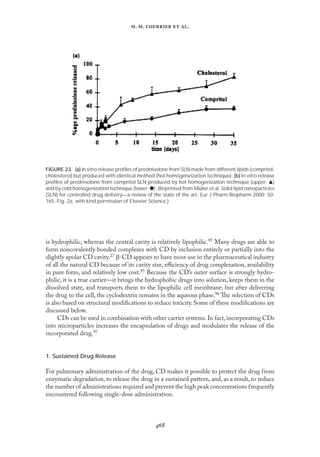
Pulmonary Drug Delivery Systems: Recent
Developments and Prospects
H. M. Courrier,1,2 N. Butz,1 & Th. F. Vandamme1,3*
1Laboratoire de Chimie Thérapeutique et Nutritionnelle, Biodisponibilité
Tissulaire et Cellulaire and 3Laboratoire de Chimie Bioorganique, Faculté de
Pharmacie, Université Louis Pasteur, France; 2Chimie des Systèmes Associatifs,
Institut Charles Sadron, Strasbourg, France;
* Address all correspondence to Dr.Th. F. Vandamme, Laboratoire de Chimie Thérapeutique et Nutritionnelle, Biodisponibilité
Tissulaire et Cellulaire, Faculté de Pharmacie, Université Louis Pasteur, 67401 Illkirch Cedex, France; vandamme@pharma.u-
strasbg.fr
ABSTRACT: Targeting drug delivery into the lungs has become one of the most important aspects
of systemic or local drug delivery systems. Consequently, in the last few years, techniques and new
drug delivery devices intended to deliver drugs into the lungs have been widely developed. Currently,
the main drug targeting regimens include direct application of a drug into the lungs, mostly by inha-
lation therapy using either pressurized metered dose inhalers (pMDI) or dry powder inhalers (DPI).
Intratracheal administration is commonly used as a first approach in lung drug delivery in vivo. To
convey a sufficient dose of drug to the lungs, suitable drug carriers are required. These can be either
solid,liquid,or gaseous excipients.Liposomes,nano- and microparticles,cyclodextrins,microemulsions,
micelles,suspensions,or solutions are all examples of this type of pharmaceutical carrier that have been
successfully used to target drugs into the lungs. The use of microreservoir-type systems offers clear
advantages, such as high loading capacity and the possibility of controlling size and permeability, and
thus of controlling the release kinetics of the drugs from the carrier systems. These systems make it
possible to use relatively small numbers of vector molecules to deliver substantial amounts of a drug to
the target.This review discusses the drug carriers administered or intended to be administered into the
lungs.The transition to CFC-free inhalers and drug delivery systems formulated with new propellants
are also discussed. Fınally, in addition to the various advances made in the field of pulmonary-route
administration, we describe new systems based on perfluorooctyl bromide, which guarantee oxygen
delivery in the event of respiratory distress and drug delivery into the lungs.
KEYWORDS: lung, specific drug delivery, pulmonary drug targeting, carrier, hydrofluoroalkane
I. INTRODUCTION
The pulmonary route presents several advantages in the treatment of respiratory diseases
(e.g., asthma, chronic obstructive bronchopneumopathy) over the administration of the
same drugs by other routes leading to the systemic delivery of such drugs. Drug inhalation
enables rapid deposition in the lungs and induces fewer side effects than does administration
Critical Reviews™in Therapeutic Drug Carrier Systems,19(4&5):425–498 (2002)
0743-4863/02 $5.00
Document#CRT1904-05-425–498(107)
© 2002 by Begell House, Inc., www.begellhouse.com

. .   .
9-NC: 9-nitrocamptothecin
ACE: angiotensin-converting enzyme
ACI: Andersen Cascade impactor
ACI: Andersen Cascade Impactor
ACTH: adrenocorticotropic hormone
ADP: adenosine diphosphate
AKP: alkaline phosphatase
AM: alveolar macrophage
A-PGI2: aerosolized prostacyclin
ASES: aerosol solvent extraction system
BAL: bronchoalveolar lavage
BDP: beclomethasone dipropionate
BGTC: bis-guanidinium-tren-cholesterol
CAT: chloramphenicol acetyl transferase
cBDP: crystalline beclomethasone dipropionate
CD: cyclodextrin
CF: carboxyfluorescein
CFC: chlorofluorocarbon
CHOL: cholesterol
CIPRO: Ciprofloxacin
CPT: camptothecin
CsA: cyclosporine A
CS-nanospheres: chitosan-modified nano-
spheres
Cys A: cyclosporine A
DEX: dexamethasone
DEXP: dexamethasone palmitate
DLPC: dilauroylphosphatidylcholine
DMPC: dimyristoylphosphatidylcholine
DMRIE/DOPE: N-(2-hydroxyethyl)-N,N-
dimethyl-2,3-bis(tetradecytoxy)-1-propan-
aminium bromide/dioleoyl phosphatidyl-
ethanolamine
DNA: desoxyribonucleic acid
DOPE: dioleoyl phosphatidylethanolamine
DOTAP-CHOL: 1,2-dioleoyl-Sn-glycero-3-
trimethylammonium propane/cholesterol
DPI: dry powder inhaler
DPPC: dipalmitoyl phosphatidylcholine
DPPE: dipalmitoyl phosphatidylethanolamine
DSPC: 1,2-distearoyl phosphatidylcholine
DSPG: 1,2-distearoyl phosphatidylglycerol
DX: detirelex decapeptide
EDMPC: 1,2-dimyristoyl-Sn-glycero-3-ethyl-
phosphatidylcholine
EE: encapsulation efficiencies
EYPC: egg yolk phosphatidylcholine
G/PFC: gentamicin/perfluorochemical
GA: glycolic acid
GSD: Geometric Standard Deviation
HAL: halothane
hCFTR: cystic fibrosis transmembrane regula-
tor conductance of human
HFA: hydrofluoroalkane
HIV: immuno-deficient virus
HPC: hydroxypropylcellulose
HSPC: hydrogenated soya phosphatidylcholine
i.t.: intratracheal
i.v.: intravenous
ICLC: polyriboinosinic-polyribocytidylic acid
(poly IC) stabilized with poly--lysine:car-
boxymethylcellulose (LC)
IEP: isoelectric point
IL-1β: interleukin 1 beta
IL-2: interleukin 2
INF-γ: interferon-γ
KF: ketotifen fumarate
L-9NC: 9-Nitrocamptothecin-liposomes
L-CPT: camptothecin-liposome
L-DEX: liposome-entrapped dexamethasone
LPS: lipopolysaccharides
L-PTX: paclitaxel-liposomes
LUV: large unilamellar vesicles
LV: liquid ventilation
MAP: mean arterial pressure
MDI: metered dose inhaler
ML: multilamellar
MLV: large multilamellar vesicles
MMAD Mass Median Aerodynamic Diameter
MMD: Mass Median Diameter
MPLA: monophosphoryl lipid A
MPO: myeloperoxydase
MTB: mycobacterium tuberculosis
MV: mechanical ventilation
NS: nedocromil sodium
PaO2: pressure arterial oxygen
PAP: pulmonary arterial pressure
PBC polybutylcyanoacrylate
PBCA: polybutylcyanoacrylate
PC: phosphatidylcholine
ABBREVIATIONS

   
by other routes.The use of drug delivery systems for the treatment of pulmonary diseases is
increasing because of its potential for localized topical therapy in the lungs.In addition,this
route makes it possible to deposit large concentrations at disease sites,to reduce the amount
of drugs administered to patients (20–10% of the amount administered by the oral route),
to increase the local activity of drugs released at such sites, and to avoid the metabolization
of drugs due to a hepatic first-pass effect.1
Recent medical advances have established that small-airway disease is a significant
component in obstructive airway disease.2 It has also been demonstrated3 that emphysema
classically involves the terminal bronchioles, but, increasingly, there is recognition that
asthma—and in particular chronic persistent asthma—also involves the small airways. For
these reasons and in order to improve the pulmonary targeting of a potentially useful therapy,
numerous scientific contributions have been focused on the construction of suitable dosage
forms to specifically target the small airways and to increase the local bioavailability of drugs
combined with carrier systems.
It was necessary to construct such carrier systems because of the limitations of chronic
oral administration with respect to systemic side effects, including hepatic dysfunction,
skeletal malformations, hyperlipidemia, and hypercalcemia.4 At present, the clinical results
obtained with particular carrier systems suggest that some of these may offer a practical al-
ternative to systemic oral administration for chemoprevention trials or the treatment of lung
diseases.This method may substantially increase the therapeutic index of targeted compounds
by reducing the systemic complications associated with long-term administration.
Although the lungs are rich in enzymes, they also contain several protease inhibitors.
Therefore,there is some evidence that exogenous proteins may be protected from proteolytic
degradation by these inhibitors.These characteristics also make the airways a useful route of
drug administration in the inhaled or aerosol form.The mechanisms of delivery to the lungs
are perhaps more complex than for other routes. The drug fraction that reaches the lungs
depends on numerous factors,such as the amount and rate of inhaled air,the respiratory pause,
and the particle size and characteristics (homogeneity, shape, electric charges, density, and
hydrophobicity).In spite of such complex mechanisms,pulmonary delivery of a variety of drugs
such as bronchodilators and steroids has enjoyed great success.Fortunately,the advantages of
this route have been recognized, and research in the field has progressed steadily.5
The pulmonary route was long used only to treat local diseases.Recently,the use of this
route to administer drugs systemically has been the subject of intensive research studies. At
the present time, the delivery of DNAse, proteins, and peptides such as insulin, calcitonin,
PCHS: phosphatidylcholine of hydrogenated soya
PCS: phosphatidylcholine of soya
PEI: polyethylenimine
PFC: perfluorocarbon
PGLA: poly(glycolic-co-lactic acid)
PLA: poly(lactic acid)
PLAL-lys: poly(acide lactique-co-lysine)
PLV: partial liquid ventilation
PMDI: pressurized metered-dose inhaler
PTH: paratyroid hormone
PTX: paclitaxel
RB: rhodamine B
RDS: respiratory distress syndrome
RF: respirable fraction
R-PGLA: rifampicin-PGLA microspheres
SC: salmon calcitonin
SLN: solid lipid nanoparticles
SUV: small unilamellar vesicles
T½: half time of elimination
TAP: triamcinolone acetonide phosphate
TCA: triamcinolone acetonide
TNF-α: tumor necrosis factor alpha
UL: unilamellar
VEE: Venezuelan equine encephalomyelitis

. .   .
α-interferon, and genetic material in general is of particular interest. In order to improve
bioavailability and to optimize the release of drugs targeted to specific sites into the lungs,
several strategies have been suggested. Among these are advances in the fields of aerosol
therapy,aerosol generators,and drug delivery systems.The latter systems include liposomes,
NanoCrystals technology, polymers, nano- and microparticles, dispersed systems, salt,
and precipitates.
In spite of the development of multidose inhalers containing dry powder and portable
spray dryers,the pressurized metered-dose inhaler (pMDI) remains by far the most popular
system for inhalation therapy.pMDIs have benefited from considerable technical advances,
following the recent progressive switch from chlorofluorocarbon (CFC) to hydrofluoroalkane
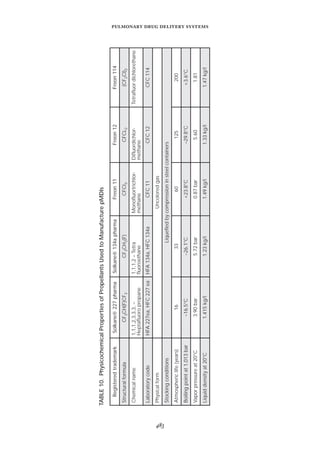
(HFA) propellants.The latter have all the qualities required for pharmaceutical use (chemi-
cally stable, no toxicological effects, etc.). (Incidentally, the FDA has recently published its
intention with regard to CFC phase-out in the Federal Register.) However, because CFCs
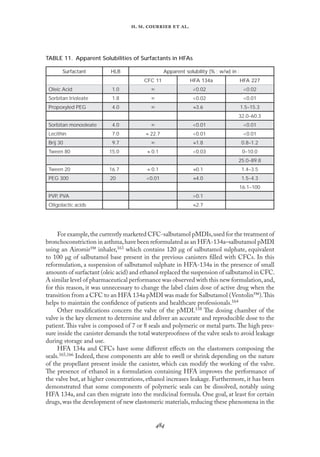
and HFAs do not have the same physicochemical characteristics (vapor pressures, densi-
ties, solubilities), the development of new pMDIs with HFAs as propellants can require
complex reformulation, the use of new packaging materials, and the introduction of new
production processes.
This article reviews these issues and the adapted dosage forms that have been tried in
order to assess the benefits of regional drug delivery and the ability to achieve this. In this
article, the term carrier must be understood as a solid, liquid, or gaseous excipient making
it possible to target a drug and, in some specific circumstances, to modulate the absorption
kinetics and pharmacokinetics of drugs.
II. DESIGN CONSIDERATIONS
II.A. Regional Histological Differences in Respiratory Tract
The human lung is an attractive route for systemic drug administration5 in view of its enor-
mous adsorptive surface area (140 m2) and thin (0.1–0.2µm) absorption mucosal membrane
in the distal lung.6 Approximately 90% of the absorptive area of the lung is attributed to
the alveolar epithelium, which primarily consists of type I pneumocytes. Because pulmo-
nary drug administration is directly related to respiratory structure and function and to the
administration routes of the drug formulation being introduced into the lung, a summary
of the basics of the lung and of drug entrance mechanisms follows.
1. The Respiratory System
In functional terms, the respiratory system consists of three major regions: the oropharynx,
the nasopharynx, and the tracheobronchial pulmonary region. The conducting airway is
composed of the nasal cavity and associated sinuses and the nasopharynx,oropharynx,larynx,
trachea,bronchi,and bronchioles,including the first 16 generations of the airways of Weibel’s
tracheobronchial tree.The conducting airway is responsible for the filtration,humidification
and warming of inspired air.The respiratory region is composed of bronchioles,alveolar ducts,
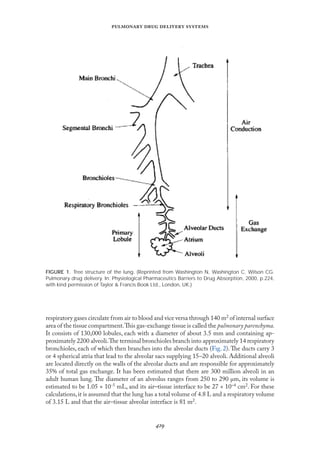
and alveolar sacs,including generation 17–23 of Weibel’s tracheobronchial tree (Fıg.1).The

   
respiratory gases circulate from air to blood and vice versa through 140 m2 of internal surface
area of the tissue compartment.This gas-exchange tissue is called the pulmonary parenchyma.
It consists of 130,000 lobules, each with a diameter of about 3.5 mm and containing ap-
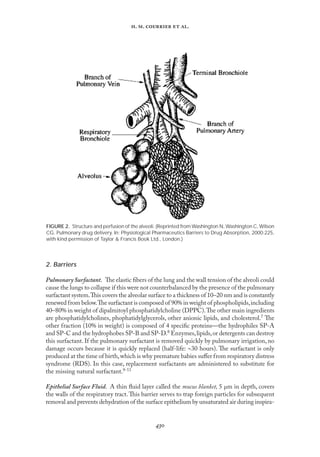
proximately 2200 alveoli.The terminal bronchioles branch into approximately 14 respiratory
bronchioles, each of which then branches into the alveolar ducts (Fıg. 2).The ducts carry 3
or 4 spherical atria that lead to the alveolar sacs supplying 15–20 alveoli. Additional alveoli
are located directly on the walls of the alveolar ducts and are responsible for approximately
35% of total gas exchange. It has been estimated that there are 300 million alveoli in an
adult human lung. The diameter of an alveolus ranges from 250 to 290 µm, its volume is
estimated to be 1.05 × 10⁻⁵ mL, and its air–tissue interface to be 27 × 10–4 cm2. For these
calculations,it is assumed that the lung has a total volume of 4.8 L and a respiratory volume
of 3.15 L and that the air–tissue alveolar interface is 81 m2.
FIGURE 1. Tree structure of the lung. (Reprinted from Washington N, Washington C, Wilson CG.
Pulmonary drug delivery. In: Physiological Pharmaceutics Barriers to Drug Absorption, 2000, p.224,
with kind permission of Taylor & Francis Book Ltd., London, UK.)

. .   .
2. Barriers
PulmonarySurfactant. The elastic fibers of the lung and the wall tension of the alveoli could
cause the lungs to collapse if this were not counterbalanced by the presence of the pulmonary
surfactant system.This covers the alveolar surface to a thickness of 10–20 nm and is constantly
renewed from below.The surfactant is composed of 90% in weight of phospholipids,including
40–80% in weight of dipalmitoyl phosphatidylcholine (DPPC).The other main ingredients
are phosphatidylcholines, phophatidylglycerols, other anionic lipids, and cholesterol.7 The
other fraction (10% in weight) is composed of 4 specific proteins—the hydrophiles SP-A
and SP-C and the hydrophobes SP-B and SP-D.8 Enzymes,lipids,or detergents can destroy
this surfactant. If the pulmonary surfactant is removed quickly by pulmonary irrigation, no
damage occurs because it is quickly replaced (half-life: ∼30 hours). The surfactant is only
produced at the time of birth,which is why premature babies suffer from respiratory distress
syndrome (RDS). In this case, replacement surfactants are administered to substitute for
the missing natural surfactant.9-11
Epithelial Surface Fluid. A thin fluid layer called the mucus blanket, 5 µm in depth, covers
the walls of the respiratory tract.This barrier serves to trap foreign particles for subsequent
removal and prevents dehydration of the surface epithelium by unsaturated air during inspira-
FIGURE 2. Structure and perfusion of the alveoli. (Reprinted from Washington N, Washington C, Wilson
CG. Pulmonary drug delivery. In: Physiological Pharmaceutics Barriers to Drug Absorption, 2000:225,
with kind permission of Taylor & Francis Book Ltd., London.)

   
tion. Hypersecretion of mucus is a result of cholinergic or α-adrenergic antagonists, which
act directly on the secreting cells of the submucosal glands. Peripheral granules, in which
mucus is stored, release a constant discharge and form a reservoir that will be secreted after
exposure to an irritating stimulus. A state of disease can modify the distribution of the cell
goblets and the composition of the fluids of the respiratory tracts.
Epithelium.12 The upper respiratory tract is made up of pseudostratified,ciliated,columnar
epithelium in cells with goblet cells.The bronchi, but not the bronchioles, have mucous and
serous glands present.However,the bronchioles possess goblet cells and smooth muscle cells
capable of narrowing the airway.The epithelium of the terminal bronchioles consists mainly
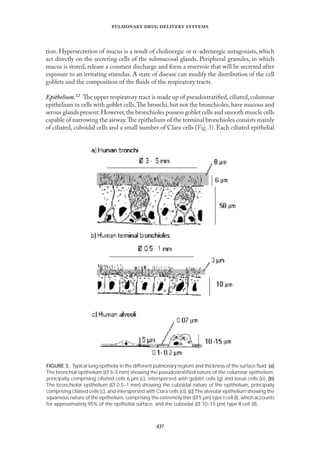
of ciliated, cuboidal cells and a small number of Clara cells (Fıg. 3). Each ciliated epithelial
FIGURE 3. Typical lung epithelia in the different pulmonary regions and thickness of the surface fluid. (a)
The bronchial epithelium (Ø 3–5 mm) showing the pseudostratified nature of the columnar epithelium,
principally comprising ciliated cells 6 µm (c), interspersed with goblet cells (g) and basal cells (b). (b)
The bronchiolar epithelium (Ø 0.5–1 mm) showing the cuboidal nature of the epithelium, principally
comprising ciliated cells (c), and interspersed with Clara cells (cl). (c) The alveolar epithelium showing the
squamous nature of the epithelium, comprising the extremely thin (Ø 5 µm) type I cell (I), which accounts
for approximately 95% of the epithelial surface, and the cuboidal (Ø 10–15 µm) type II cell (II).

. .   .
cell has around 20 cilia with an average length of 6 µm and a diameter of 0.3 µm.Clara cells,
which are secretory cells, become prevalent in respiratory bronchioles. In the alveolar ducts
and alveoli, the epithelium is flatter at 0.1–0.5 µm thick. The alveoli are packed narrowly
and do not have partitioning walls; the adjacent alveoli are separated by an alveolar septum
with communication between alveoli via alveolar pores.The alveolar surface is covered with
a lipoprotein film, which is the pulmonary surfactant. The alveolar surface is mainly com-
posed of a single layer of squamous epithelial cells—type I alveolar cells—approximately 5
µm thick.Type II cells, cuboidal in shape, 10–15 µm thick, and situated at the junction of
septa,are responsible for the production of alveolar lining fluid and the regeneration of type
I cells during repair following cell damage from viruses or chemical agents.
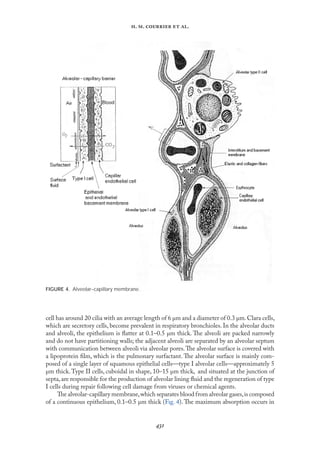
The alveolar-capillary membrane,which separates blood from alveolar gases,is composed
of a continuous epithelium, 0.1–0.5 µm thick (Fıg. 4). The maximum absorption occurs in
FIGURE 4. Alveolar–capillary membrane.

   
the area where the interstitium is the finest (80 nm) because the pulmonary surfactant is
also thin in this area (15 nm).The thickness of the air–blood barrier ranges from 0.2 to 10
µm.The most efficient gas exchange takes place when the air–blood barrier is less than 0.4
µm in thickness.
Interstitium. The lung interstitium is the extracellular and extravascular space between cells
in tissue.In order for a molecule to be absorbed from the airspaces to the blood,it must pass
through the interstitium. Within the interstitium are fibroblasts, tough connective fibers
(i.e., collagen fibers and basement membrane), and interstitial fluid, which slowly diffuses
and percolates through the tissue.
Vascular endothelium. The endothelium is the final barrier to a molecule being absorbed
from the airspace into the blood. Endothelial cells form capillaries that lie under Type I
cells in the alveoli (Fıg. 4).The basic alveolar structure is the septum, which is composed of
capillaries sandwiched between two epithelial monolayers.13
II.B. Controlling the Site of Aerosol Deposition in the Respiratory Tract
1. Factors Affecting Disposition of Particles
Deposition of aerosol particles in the bronchial tree is dependent on the granulometry of the
particles and the anatomy of the respiratory tract. Aerosols used in therapy are composed
of droplets or particles with different sizes and geometries. Generally, four parameters can
be used to characterize the granulometry of an aerosol:
1. Mass median diameter (MMD) corresponding to the diameter of the particles for which
50% w/w of particles have a lower diameter and 50% w/w have a higher diameter.
2. Percentage in weight of particles with a geometrical diameter of less than 5 µm.
3. Geometric standard deviation (GSD) corresponding to the ratio of the diameters of
particles from aerosols corresponding to 84% and 50% on the cumulative distribution
curve of the weights of particles.The use of a geometric standard deviation to describe
the particle size distribution requires that particle sizes are log-normally distributed.
If, as is frequently the case, particles are not log-normally distributed, the geometrical
standard deviation is meaningless and a misleading representation of the distribution.
Heterogeneous aerosols have, by definition, a GSD of greater than or equal to 1.22.14
4. Mass median aerodynamic diameter (MMAD), which makes it possible to define the
granulometry of aerosol particles by taking into account their geometrical diameter,
shape, and density: MMAD = MMD × Density½
2. Mechanisms of Particle Deposition in the Airways
There are three main particle deposition mechanisms in the lung: inertial impaction,
sedimentation, and Brownian diffusion. The deposit of particles administered by aerosol

. .   .
in specific areas of the respiratory tract depends on the deposition mechanism versus the
particle diameter.15
1. Inertial impaction is the most significant mechanism for the deposition of aerosol par-
ticles with an MMAD of more than 5 µm.It occurs in the upper respiratory tracts when
the velocity and mass of the particles involve an impact on the airway.It is supported by
changes in direction of inspired air and when the respiratory tracts are partially blocked.
Hyperventilation can influence impaction.
2. Sedimentation occurs in the peripheral airways and concerns small particles from an
aerosol with an MMAD ranging from 1 to 5 µm. Sedimentation is a phenomenon
resulting from the action of gravitational forces on the particles. It is proportional to
the square of the particle size (Stokes law) and is thus less significant for small particles.
This kind of deposition is independent of particle motion. Sedimentation is influenced
by breath holding, which can improve deposition.
3. Brownian diffusion is a significant mechanism for particles with an MMAD of less
than or equal to approximately 0.5 µm.The particles move by random bombardments
of gas molecules and run up against the respiratory walls. Generally, 80% of particles
with an MMAD of less than or equal to 0.5 µm are eliminated during exhalation.
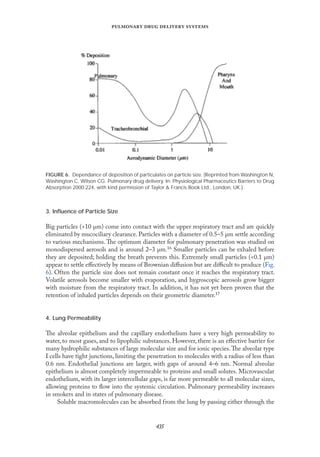
The behavior of the aerosolized particles in the body is summarized in Fıgure 5.
Inhalation of
particles
Losses of particles in
atmosphere and in device
Deposit into
mouth or nose
Deposit by impact and
sedimentation in
lower respiratory tract
Deposit into alveolar area
• Specific activity
• Systemic activity
• Crossing into gastrointestinal
tract
• Specific activity by diffusion of
drug into alveolar liquids
• Systemic activity by diffusion
into capillaries of bloodstream
• Activity on walls of capillaries
by carrying through alveolo-
capillary membrane
FIGURE 5. Behavior of aerosolized particles into the body.

   
3. Influence of Particle Size
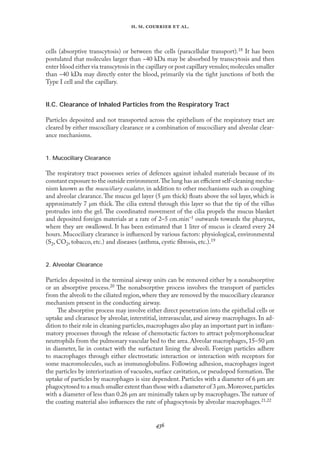
Big particles (>10 µm) come into contact with the upper respiratory tract and are quickly
eliminated by mucociliary clearance. Particles with a diameter of 0.5–5 µm settle according
to various mechanisms. The optimum diameter for pulmonary penetration was studied on
monodispersed aerosols and is around 2–3 µm.16 Smaller particles can be exhaled before
they are deposited; holding the breath prevents this. Extremely small particles (<0.1 µm)
appear to settle effectively by means of Brownian diffusion but are difficult to produce (Fıg.
6). Often the particle size does not remain constant once it reaches the respiratory tract.
Volatile aerosols become smaller with evaporation, and hygroscopic aerosols grow bigger
with moisture from the respiratory tract. In addition, it has not yet been proven that the
retention of inhaled particles depends on their geometric diameter.17
4. Lung Permeability
The alveolar epithelium and the capillary endothelium have a very high permeability to
water, to most gases, and to lipophilic substances. However, there is an effective barrier for
many hydrophilic substances of large molecular size and for ionic species.The alveolar type
I cells have tight junctions, limiting the penetration to molecules with a radius of less than
0.6 nm. Endothelial junctions are larger, with gaps of around 4–6 nm. Normal alveolar
epithelium is almost completely impermeable to proteins and small solutes. Microvascular
endothelium, with its larger intercellular gaps, is far more permeable to all molecular sizes,
allowing proteins to flow into the systemic circulation. Pulmonary permeability increases
in smokers and in states of pulmonary disease.
Soluble macromolecules can be absorbed from the lung by passing either through the
FIGURE 6. Dependance of deposition of particulates on particle size. (Reprinted from Washington N,
Washington C, Wilson CG. Pulmonary drug delivery. In: Physiological Pharmaceutics Barriers to Drug
Absorption 2000:224, with kind permission of Taylor & Francis Book Ltd., London, UK.)

. .   .
cells (absorptive transcytosis) or between the cells (paracellular transport).18 It has been
postulated that molecules larger than ~40 kDa may be absorbed by transcytosis and then
enter blood either via transcytosis in the capillary or post capillary venules; molecules smaller
than ~40 kDa may directly enter the blood, primarily via the tight junctions of both the
Type I cell and the capillary.
II.C. Clearance of Inhaled Particles from the Respiratory Tract
Particles deposited and not transported across the epithelium of the respiratory tract are
cleared by either mucociliary clearance or a combination of mucociliary and alveolar clear-
ance mechanisms.
1. Mucociliary Clearance
The respiratory tract possesses series of defences against inhaled materials because of its
constant exposure to the outside environment.The lung has an efficient self-cleaning mecha-
nism known as the mucociliary escalator, in addition to other mechanisms such as coughing
and alveolar clearance.The mucus gel layer (5 µm thick) floats above the sol layer, which is
approximately 7 µm thick. The cilia extend through this layer so that the tip of the villus
protrudes into the gel. The coordinated movement of the cilia propels the mucus blanket
and deposited foreign materials at a rate of 2–5 cm.min–1 outwards towards the pharynx,
where they are swallowed. It has been estimated that 1 liter of mucus is cleared every 24
hours. Mucociliary clearance is influenced by various factors: physiological, environmental
(S2, CO2, tobacco, etc.) and diseases (asthma, cystic fibrosis, etc.).19
2. Alveolar Clearance
Particles deposited in the terminal airway units can be removed either by a nonabsorptive
or an absorptive process.20 The nonabsorptive process involves the transport of particles
from the alveoli to the ciliated region, where they are removed by the mucociliary clearance
mechanism present in the conducting airway.
The absorptive process may involve either direct penetration into the epithelial cells or
uptake and clearance by alveolar, interstitial, intravascular, and airway macrophages. In ad-
dition to their role in cleaning particles,macrophages also play an important part in inflam-
matory processes through the release of chemotactic factors to attract polymorphonuclear
neutrophils from the pulmonary vascular bed to the area. Alveolar macrophages, 15–50 µm
in diameter, lie in contact with the surfactant lining the alveoli. Foreign particles adhere
to macrophages through either electrostatic interaction or interaction with receptors for
some macromolecules, such as immunoglobulins. Following adhesion, macrophages ingest
the particles by interiorization of vacuoles, surface cavitation, or pseudopod formation.The
uptake of particles by macrophages is size dependent. Particles with a diameter of 6 µm are
phagocytosed to a much smaller extent than those with a diameter of 3 µm.Moreover,particles
with a diameter of less than 0.26 µm are minimally taken up by macrophages.The nature of
the coating material also influences the rate of phagocytosis by alveolar macrophages.21,22

   
III. PULMONARY DRUG CARRIERS
III.A. Liposomes
Liposomes are the lung drug delivery systems that have been the subject of most studies.
Indeed,they are prepared from pulmonary surfactant endogenous phospholipids and are thus
biocompatible, biodegradable, and relatively nontoxic.23 Liposomes consist of one or more
phospholipid bilayers enclosing an aqueous phase.They can be classified as large multilamellar
vesicles (MLVs),small multilamellar vesicles (SMLVs),small unilamellar vesicles (SUVs),or
large unilamellar vesicles (LUVs), depending on their size and the number of lipid bilayers.
Liposomes are produced in a broad range of sizes and can incorporate both hydrophilic and
lipophilic drugs. A variety of drugs have been incorporated into liposomes to improve their
delivery through the airways.The advantages of drug encapsulation in liposomes are numer-
ous,with enhanced drug uptake,increased drug clearance,and reduced drug toxicity among
the most significant.The systemic toxicity of a toxic drug is markedly reduced without effect
on its efficacy once it has been incorporated into liposomes. Moreover, the composition of
liposome lipids can be carefully selected to control drug release and pulmonary retention of
the encapsulated drug.24,25 Liposomes have been studied as drug carriers for 30 years, and
some have been tested in animals and humans.26 Cytotoxic agents, anti-asthmatic drugs,
antimicrobial and antiviral drugs, and antioxidant agents with systemic actions have been
included in liposomes.27 Aerosols of liposomes containing drugs have been studied for the
treatment of bacterial,fungal,and viral infections,and as vaccines and immunomodulators.28.
We will describe the new generation of liposomes, along with the influence of formulation
on stability (phospholipids, size, functionality) and new in vitro (bioadhesion) and in vivo
(biodistribution) studies on liposomes incorporating drugs.
1. Description
The effect of liposomes composed of hydrogenated soybean phosphatidylcholine (HSPC)
and soybean phosphatidylcholine (SPC),containing carboxyfluorescein (CF),was studied in
the mouse after prolonged inhalation.29 Pulmonary histology,along with phagocyte function,
size,and composition of the alveolar macrophages (AM),were investigated.No anomaly was
detected.AM digested the liposomes and released the CF into the phagolysosomal vacuoles.
This study showed that inhaled liposomes encapsulating an active agent can be delivered to
the lungs and, in particular, to the alveolar macrophages.
Physiological solutions of Evans blue and dry powder of liposomes composed of dipal-
mitoyl phosphatidylcholine (DPPC) and dipalmitoyl phosphatidylethanolamine (DPPE)
marked with fluorescein isocyanate were administered in aerosol form to pigs.30 After nebu-
lization, the size of the particles for both solutions was around 1.20 µm, with the size of
the liposomes initially being around 3 µm.The distribution of Evans blue is uniform in the
various pulmonary zones and is proportional to the weights of the lungs and of the animal.
Fluorescence is distributed more in the intermediary and peripheral zones of the lung.This
distribution is dependent on deposition of the liposomes and alveolar liposome-macrophage
interactions, with AM being fluorescent. These results suggest that aerosol administration
of liposomes enables local deposition in the respiratory tract and interacts with the alveolar
macrophages.

. .   .
2. Immunosuppressants
The immunosuppressant agent cyclosporine A (CsA) was effectively incorporated into
liposomes composed of egg yolk phosphatidylcholine (EYPC) with a molar ratio of 1:12
CsA/EYPC.31 The association percentage was high (95%).The generation of small aerosol
particles of CsA liposomes had no effect on CsA biological activity because CsA liposomes
were as effective as CsA resuspended in its normal carrier,Cremophor EL,in the inhibition
of anti-CD3 antibody stimulation of mouse spleen cell, as measured by the incorporation
of [3H] thymidine. CsA liposome particles have a mass median aerodynamic diameter of
2 µm, which permits distribution of the drug throughout the respiratory tract. Liposomes
containing CsA were given by aerosol for 15 minutes to mice, and the CsA concentration
in the lungs was found to be equivalent to that of a single daily i.v. injection 16 times more
concentrated (Fıg. 7). CsA liposomes can be produced and aerosolized in order to achieve
pulmonary concentrations with enough immunosuppressant activity to be effective in the
treatment of lung diseases.
Waldrep et al.32 proposed an optimum liposome formulation for nebulization contain-
ing glucocorticoids or immunosuppressant, using dilauroylphosphatidylcholine (DLPC)
alone instead of dipalmitoylphosphatidylcholine (DPPC), dimyristoylphosphatidylcholine
(DMPC), or egg yolk phosphatidylcholine (EYPC).
Liposomes of DLPC containing concentrated amounts of CsA and budesonide (Bud)
FIGURE 7. Comparison of CsA concentrations in blood and lung tissue after 4 days of small-particle
aerosol or intravenous administration of CsA-containing liposomes. Liposomes were composed of 2
mg of CsA/ml and 15 mg of phosphatidylcholine/mL. Three mice (26 g) were used at each time point.
Drug was administered by aerosol for 2 h twice daily, giving a dose of 1.8 mg of CsA/kg ([25 µg of
CsA/L of aerosol × 0.026 L/min {min vol} × 240 min × 0.3 {retention factor}]/0.026 kg), or for 15 min
once daily, giving a dose of 0.11 mg of CsA/kg. Intravenous administration was a single daily injection
of 0.1 mL of CsA liposomes in the tail vein, giving a dose of 1.8 mg of CsA/kg. CsA tissue concentra-
tions were determined by HPLC. (Reprinted from Gilbert et al. Characterization and administration of
cyclosporine liposomes as a small-particle aerosol. Transplantation 1993; 56(4):976, Fig. 1, with kind
permission from Lippincott Williams & Wilkins.)

   
have been formulated and nebulized.33 Formulations 40 times more concentrated than com-
mercial ones and used by nebulization of Bud suspensions could both reduce nebulization
time and improve patient compliance.The optimum DLPC/CsA and DLPC/Bud propor-
tions are 1:7.5 and 1:15, respectively. With these, liposomes of 1–3 µm diameter could be
formulated, and after nebulization their sizes were reduced (270–560 nm).
After the inhalation of DLPC/CsA nebulized liposomes, their biodistribution was
studied in mice.34 In this study,on a per-gram-tissue basis,the lung contained approximately
18 times more CsA than the liver, and 104 times more CsA than the blood, demonstrating
the effective pulmonary targeting of the CsA/DLPC liposome aerosol.The in vitro immu-
nosuppressant effect of CsA isolated from pulmonary tissue,following delivery of nebulized
DLPC/CsA liposomes, was maintained. Inhibition (99%) of [3H]TdR by antigen-specific
stimulation reduction was revealed, along with inhibition (95%) of mitogen sensitivity.This
DLPC/CsA formulation is promising and could be used to treat chronic asthma and al-
lergies.
Liposome vectors and CsA dissociation were studied in mice following pulmonary
delivery.35 A stable radioactive complex of 99mTc-liposomes DLPC/CsA was delivered by
intratracheal (i.t.) instillation. The 99mTc-liposomes DLPC vector was retained 17 times
longer than the half-life of CsA in a normal lung and 7.5 times longer than in an inflamed
lung (Table 1).
Studies on dogs were carried out, selectively observing the immunosuppressant effect
on the lung of the aerosolized form of CsA, with the aim of seeing whether this system is
suitable for pulmonary transplants,which are compromised by chronic and acute rejection.36
The lungs absorb the nebulized CsA liposomes faster than the other organs do with weaker
concentrations of CsA. In this model, the retention of the CsA delivered by the liposomes
in the lungs was around 120 minutes.
3. Glucocorticoids
Liposomes composed of 1,2-distearoyl phosphatidylcholine (DSPC) and 1,2-distearoyl
phosphatidylglycerol (DSPG) were prepared in order to incorporate triamcinolone aceton-
TABLE 1. Half-Lives in Normal and Inflamed Lungsa
Components T1/2 α
CsA - normal lungs 17.0 ± 3.8 min
CsA - inflamed lungs 17.6 ± 7.3 min
liposomes DLPC - normal lungs 4.8 ± 0.1 h
liposomes DLPC - inflamed lungs 2.2 ± 0.9 h
HSA - normal lungs 4.2 ± 2.4 h
HSA - inflamed lungs 2.0 ± 0.3 h
a 99mTc-cyclosporine A (CsA), 99mTc-liposomes composed of DPPC, and 99mTc-
human serum albumin (HSA) (Arppe et al., 1998).

. .   .
ide phosphate (TAP).37 The glucocorticoid was in its hydrophilic form so that the liposome
membrane acts as a barrier and permits slow delivery.A liposome incorporating a lipophilic
glucocorticoid quickly slackens under unbalanced conditions (dilution,administration).These
liposomes are stable for 24 hours in contact with physiological fluid.Seventy-five percent of
TAP remains encapsulated, the initial encapsulation rate being 7–8.5%. Administration of
TAP solution and TAP-liposomes (207 ± 16 nm) i.t. and i.v. was compared in rats.The i.t.
administration ofTAP-liposomes enables prolonged occupation of glucocorticoid receptors,
compared with i.v. administration or with treatment with a TAP solution. Its cumulative
effect was 1.6 times higher in the lungs than in the liver.
Liposomes of EYPC–cholesterol (CHOL) incorporating dexamethasone palmitate
(DEXP),in a molar proportion of 4:3:0.3,were studied.38 Encapsulation of the DEXP was
effective (70%) in comparison with its nonesterified form (<2%).The biological activity of
DEXP was evaluated on blood mononuclear cells over a 24-hour period,measuring its anti-
lymphocyte proliferation properties and its inhibition of interferon-γ production (Table 2).
The DEXP incorporated in the liposomes kept its biological activity. Nebulization studies
in animals should confirm whether this vector is promising in drug delivery to the lungs.
DPPC liposomes containing dexamethasone (DEX) in a molar proportion of 9:1
were prepared and instilled by the i.t. route in rats.39 Encapsulation was effective (35%),
and the size of the liposome-entrapped dexamethasone (L-DEX) was approximately 231
± 32 nm. The pulmonary and blood retention levels of [3H]DEX radioactive compound
were, respectively, 50% and 1% for L-DEX and 26% and 5% for the free DEX 1.5 hours
after instillation. Its effects on reduction of white blood cell levels in peripheral blood and
of adrenocorticotropic hormone (ACTH) levels in the plasma were studied. L-DEX has a
prolonged action (>72 h) on reduction of white blood cells,whereas free DEX has no more
effect after 24 hours.Plasma ACTH levels are less significantly reduced with L-DEX (60%
in 1 h, 25% in 72 h) than with free DEX (80% in 1 h, 50% in 72 h). This study showed
that the retention of dexamethasone delivered directly into the lungs in liposomal form
was significantly prolonged (prolonged anti-inflammatory action) and that the side effects
were reduced.
Following these encouraging results, Suntres et al.40 examined the prophylactic effect
of L-DEX in an animal pulmonary model damaged by lipopolysaccharides (LPS).40 The
LPS stimulate the phagocytes to generate metabolites, which play a significant role in lung
pathogenesis.Rats were pre-treated by the i.t.route with L-DEX,DEX,or a saline solution,
then treated by the i.v.route with LPS.Measurements of the activity of various markers were
taken in: pulmonary cells (endothelial capillary cell markers,such as angiotensin-converting
TABLE 2. Inhibition (%) of Concavalin A Stimulating Proliferation of Lymphocytes and
Production of Interferon γ ( INF-γ )a
Inhibition %
concavaline A-stimulating Free DEXP Liposome-DEXP
Lymphocytes proliferation 94 94
INF-γ production 96 96
a Induced by 10–6 M of free dexamethasone palmitate (DEXP) or by DEXP loaded liposomes composed of EPC-
Cholesterol. (Benameur et al., 1995.)

   
enzyme [ACE] and type-II alveolar epithelial cell markers, such as alkaline phosphatase
[AKP]), inflammatory response markers (myeloperoxidase [MPO] and elastase activity,
chloramine concentration) and pro-inflammatory mediators (concentration of A2 phospholi-
pase,leukotriene eicosanoid B4,and thromboxane B2 in plasma and histamine in the lungs).
L-DEX was more effective than DEX and protected the pulmonary cells from the LPS.The
ACE and AKP activities were reduced by only 5% and 18%,respectively,while DEX reduces
them by 20 and 28%, respectively. DEX inhibited the increase in inflammatory mediator
activities. L-DEX was 15% more effective in the reduction of MPO (55%) and elastase
(68%) than DEX and 20% more effective in the reduction of chloramine (50%).The three
pro-inflammatory mediators studied are also inhibited by L-DEX and DEX: phospholipase
A2 (62 vs. 45%), leukotriene eicosanoid B4 (76 vs. 64%), and thromboxane B2 (76 vs. 64%)
in plasma.Suntres et al.40 also highlighted that pretreatment with saline solutions and blank
liposomes does not inhibit the effects induced by treatment with LPS.
4. Corticosteroids
The tolerance and safety of DLPC liposomal aerosols containing beclomethasone dipropio-
nate (BDP) were studied in 10 healthy volunteers.34 According to pulmonary function and
blood tests, exposure to aerosols containing amounts of BDP equivalent to or double those
managed by metered dose inhaler (MDI) and dry powder inhaler (DPI) for the treatment
of asthma was well tolerated.
The pulmonary distribution and clearance of DLPC-BDP liposomes and DPPC-BDP
liposomes were compared in 11 healthy volunteers.41 DLPC formed liposomes suitable for
atomization.33 Because DPPC is the major component of pulmonary surfactant and is used
for respiratory distress syndrome (RDS) therapy,9 this should also be investigated. DLPC
and DPPC liposomes had sizes of 3.5 µm and 5.0 µm,respectively,before atomizing and 0.8
µm and 0.9 µm, respectively, after atomizing.The total outputs of the nebulized liposomes
were 11.4 µg with DLPC liposomes and 3.1 µg with DPPC liposomes. This difference
could be due to phase transition temperatures (DLPC –2°C, DPPC +41°C). DPPC could
produce more rigid liposomes, which would find it difficult to pass through the openings of
the atomizer. Clearance of 99mTc-liposomes complexes was relatively slow: 24 hours after
inhalation,79% of the radioactivity originally deposited was detected using DLPC and 83%
using DPPC. Both formulations were suitable for the encapsulation of drugs because they
offered a delivery tolerated by the lower respiratory tracts. However, atomization was more
effective with the DLPC liposomes.
Liposomes containing BDP were prepared in different manners in order to improve
their stability.42 After preparation,the liposomes were freeze-dried and then rehydrated just
before atomizing. Of the series of lipids (DLPC, DMPC, DPPC, HSPC), DLPC, used
previously, was shown to be the most effective for the encapsulation of BDP, although the
encapsulation rate remains low (MLVs: 3.69 ± 0.10% m/m and SMLVs: 2.03 ± 0.08%).
Despite being increased in size after freeze-drying and rehydration, DLPC liposomes were
the smallest liposomes produced: 10.30 ± 1.35 µm and 3.87 ± 0.20 µm, before and after
atomizing,respectively.Atomization made it possible to reduce their size by breaking up any
aggregates.The best atomizing output is obtained with DLPC (78.3%),whereas the DPPC
liposomes have incorporated 25% of BDP.The RF of the DLPC liposomes was 75%,which
was 10% higher than that of the other lipids.

. .   .
5. Antibiotics
EYPC-CHOL liposomes encapsulating radio-marked gentamicin were instilled by the
i.t. route in rabbits.43 Gentamicin concentrations in the lungs, kidneys, and plasma were
compared according to their administration in solution or liposomes.With the latter dosage
form,the lungs contain up to 5 times more gentamicin than with the free form and,24 hours
postadministration, the gentamicin continued to diffuse. Concentrations in the kidney and
plasma were markedly lower with gentamicin liposomes than with gentamicin in solution.In
this study,the gentamicin was present in bronchoalveolar rinsings,but it was not determined
whether intact liposomes were introduced into the cells or if they were phagocytosed.In any
case,the administration of gentamicin liposomes into the lungs reduced the drug’s systemic
toxicity and provided a reservoir to slow release.
Different liposomal formulations loaded with tobramycin were studied in vitro to es-
tablish the release kinetics of tobramycin and were administered by the i.t. route in mice.24.
In vitro kinetics studies determining the quantity of tobramycin released at 37°C showed
that the best formulation contained mainly DPPC and provided gradual and sustained drug
release for at least 48 hours,especially with the formulation containing a negatively charged
lipid (DMPG) compared with a noncharged lipid (DMPC). However, both formulations
had similar patterns of about 50% tobramycin retention-release after 36 hours.Administra-
tion of tobramycin encapsulated in DPPC/DMPG (10:1) liposomes made it possible to
detect reduced quantities of tobramycin in the kidneys in comparison with the quantities
detected in the lungs.
6. Analgesics
A mixture of liposomes composed of phospholipon/CHOL encapsulating fentanyl and
free fentanyl was administered in aerosol form in healthy volunteers.44 The mean plasma
fentanyl concentration (Cfen) was significantly greater for i.v. administration than for the
aerosol mixture of free and liposome-encapsulated-fentanyl (4.67 ± 1.87 vs 1.15 ± 0.36
ng.ml–1). However, Cfen at 8 and 24 hours after aerosol administration were, respectively,
1.5 and 2 times greater than with the i.v. route.The peak absorption rate, time to peak ab-
sorption and bioavailability after inhalation were, respectively, 7.02 (± 2.34) µg min–1, 16
(± 8) min, and 12 (± 11)%. This fentanyl-liposomes formulation provides both a fast and
prolonged analgesic effect compared with i.v.administration,which can provide satisfactory
postoperative pain relief.
7. Antioxidant Agents
Radio-labeled liposomes containing DPPC–α-tocopherol in a ratio of 7:3 were administered
by the i.t. route to rats.45 No radioactivity was detected in their blood or organs other than
the lungs,for 72 hours after treatment.The α-tocopherol concentration was 16 times higher
in the lungs after this time. In vitro studies showed that pulmonary tissue, first treated by
the liposomal formulation and then incubated with Fe3+-adenosine diphosphate (ADP) pre-
oxidant, was protected from lipid peroxidation. The liposomes–α-tocopherol formulation
had a prophylactic effect against oxidant agents causing pulmonary damage.

   
The effectiveness of the same liposomes–α-tocopherol formulation instilled by the i.t.
route in paraquat-poisoned rats was studied.46 Paraquat,a herbicide that causes serious respi-
ratory damage,led to a reduction in enzymatic activity,in particular of angiotensin-converting
enzyme and alkaline phosphatase enzyme,indicating damage to endothelial cells and type-II
alveolar cells, respectively. Paraquat reduced concentrations of the antioxidant glutathione
and supported lipid peroxidation. Administration of liposomes–α-tocopherol resulted in a
reduction of the effects of paraquat; the enzymatic activities increased, in particular, 24 and
48 hours posttreatment,along with GSH concentrations,without,however,reaching normal
levels. A significant reduction in lipid peroxidation was observed.These results suggest that
α-tocopherol,formulated in the form of liposomes and administered directly into the lungs,
may be a potential agent for the treatment of paraquat poisoning.
8. Peptides/Proteins
a. Peptides
A formulation of liposomes was optimized to permit the encapsulation and aerosol delivery
of a cationic peptide CM3, recognized for its in vitro anti-microbial and anti-endotoxin
activities.47 Cationic peptides have already been encapsulated in liposomes to induce an
anticancer response as part of the therapeutic development of anticancer vaccines.The most
effective formulation was based on liposomes made up of DMPC/DMPG (3:1), with a
size of 262 nm, with 96% of the liposomes between 190–342 nm and 4% in the range of
13–1700 nm.The size distribution of the aerosolized preparation was 2.84 ± 0.1 µm,enabling
70% CM3 encapsulation, effective atomization (50%), and a total output of 28%. Using a
mathematical model of pulmonary deposition, it was shown that the minimum inhibitory
levels (2–4 µg.mL–1) of CM3 can be reached over most of the tracheobronchial region in
the adult model and can be exceeded throughout the same region in both pediatric model
subjects using a valved jet nebulizer with a 2.5 mL volume fill.
b. Interferon
Goldbach et al.48 incorporated and nebulized interferon-γ (INF-γ) entrapped in muramyl
tripeptide-containing liposomes.48 The encapsulation efficiency was between 30 and 40%.
A microtoxicity assay was developed to measure the tumoricidal activity of murine alveolar
macrophages.Aerosolized INF-γ and liposomal immunomodulator enhanced the antitumor
properties of AM found in mice 24 hours postinhalation.
Kanaoka et al.49 showed that the presence of empty liposomes can also stabilize nebulized
INF-γ.49 INF-γ nebulized alone is unstable, with these two cysteines producing intra- and
intermolecular bonds then involving polymerization and aggregation.This method has the
advantage of avoiding the incorporation of INF-γ in the liposomes as well as separating
free INF-γ and liposomes.The liposome size remained identical before and after atomizing.
Because they are unilamellar (UL) vesicles, these liposomes were too small and too rigid to
be deformed. The size of the nebulized droplets was identical with or without liposomes.
Therefore, liposomes do not interfere in the delivery of INF-γ. It was calculated that ap-
proximately 100 liposomes were combined with a molecule of INF-γ.The most stable for-

. .   .
mulation was achieved when the hydrophobic interactions between the acryl chain of the
lipid and INF-γ were the strongest. Hydrogenated soybean phosphatidylcholine (HSPC),
distearoyl--α-phosphatidylcholine (DSPC), and distearoyl--α-phosphatidylglycerol
(DSPG) provided stability in the following formulation: HSPC/DSPG 10:1 and DSPC/
DPPG 10:1. Fınally, INF-γ can be nebulized thanks to the liposomes, which absorb INF-γ
on their surface (Table 3).
The prophylactic effect of an INF-γ and synthetic double-stranded polyriboinosinic-
polyribocytidylic acid (poly IC) stabilized with poly--lysine:carboxymethylcellulose (LC)
(poly[ICLC]) encapsulated in a liposomal formulation was highlighted in mice infected by
a lethal amount (10 LD50) of the influenza virus.50 The immunomodulator-liposomes were
administered intranasally, but direct lung administration is feasible.
c. Interleukin
Human serum albumin and interleukin 2 (IL-2)–loaded DMPC liposomes, as well as
free IL-2, were nebulized in dogs51 in order to compare the immunological activation
of various IL-2 formulations. A toxicity assessment revealed no side effects for either
treatment. The bronchoalveolar lavage (BAL) leukocyte cell count increased significantly
after inhalation of IL-2–liposomes versus inhalation of free IL-2. A greater proportion
of lymphocytes and eosinophils was observed after IL-2–liposomes treatment. Nontoxic
activation of pulmonary immune effectors for treating cancer in the lung may be possible
using IL-2–liposomes.
DMPC liposomes containing IL-2 were administered by aerosol in several immuno-
deficient patients.52 The rate of encapsulation,or at least of association,was very high (98.8%),
and the average diameter of these liposomes was around 1.1 µm. Patient compliance, safety,
toxicity,and the immune effects of IL-2 liposomes were studied in individuals with primary
immune deficiency and,subsequently,a larger cohort of patients with hepatitis C.According
to the authors of this study,a biological activity of aerosol IL-2 liposomes has been observed
in viral disease (hepatitis C), and additional studies on aerosol Il-2 liposomes in individuals
with hepatitis C and HIV are planned.
TABLE 3. Liposome Formulations Having Adsorbed INF-γ at Their Surface, To Have
Efficient Nebulization of INF-γa
Liposome
composition
Size of liposomes
(nm, average ± SD)
Size of aerosols
(µm, average ± SD)
% of recovery
remaining
% of recovery
aerosolized
None 3.06 ± 1.99 3.1 ± 0.7 0.4 ± 0.2
HSPC/DSPG (10/1) 45.0 ± 24 4.88 ± 2.84 27.2 ± 4.7 25.7 ± 12.6
DSPC/DPPG (10/1) 28.5 ± 19 — 29.8 ± 2.6 43.1 ± 16.6
EPC/DSPG (10/1) 43.7 ± 23 3.79 ± 2.29 16.2 ± 13.0 15.8 ± 2.6
EPC 40.8 ± 24 4.99 ±3.06 3.7± 1.0 1.2 ± 0.4
a Kanaoka et al., 1999

   
d. Insulin
DPPC–CHOL (7:2) liposomes encapsulating insulin of various oligomerization degrees
were instilled by the i.t. route in rats.53 These studies revealed that only the initial response
(10 min) of encapsulated hexameric insulin is slower than that of dimeric insulin,suggesting
a slower permeability through the pulmonary epithelium.However,the hypoglycemic effect
was identical for both encapsulated oligomers, as it was for the physical mixture of insulin
and blank liposomes. Prolonged absorption of insulin is not due to encapsulation but to the
liposome surface connection and probably to an interaction between the exogenous DPPC
and pulmonary surfactant.
The absorption of insulin was studied in the presence of DPPC phospholipids or
pulmonary rinsing fluid and compared with a dispersion of insulin and blank liposomes.54
Compared to a free insulin dispersion, the presence of liposomes supported the absorption
of insulin by type-II alveolar cells.Glucose levels decreased more quickly and more intensely
in the presence of a physical mixture of insulin–DPPC than in the presence of the insulin–
liposomes dispersion. When the pulmonary rinsing fluid was added to these mixtures, the
hypoglycemic effect was reinforced, especially for the insulin-liposomes dispersion, which
remained less effective than the insulin–DPPC dispersion.In conclusion,the bonds between
the insulin and phospholipids were promoted in the case of the DPPC dispersion compared
to the liposomes, in which the DPPC molecules were sterically restricted.
9. Gene Therapy
The administration of liposomes complexed to deoxyribonucleic acid (DNA) in the form of
a plasmid—termed lipofection—has been demonstrated as a promising gene delivery strategy
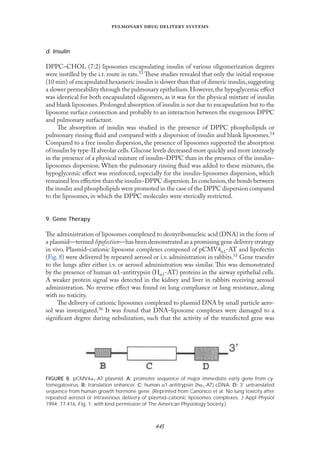
in vivo. Plasmid–cationic liposome complexes composed of pCMV4α1-AT and lipofectin
(Fıg. 8) were delivered by repeated aerosol or i.v. administration in rabbits.55 Gene transfer
to the lungs after either i.v. or aerosol administration was similar. This was demonstrated
by the presence of human α1-antitrypsin (Hα1-AT) proteins in the airway epithelial cells.
A weaker protein signal was detected in the kidney and liver in rabbits receiving aerosol
administration. No reverse effect was found on lung compliance or lung resistance, along
with no toxicity.
The delivery of cationic liposomes complexed to plasmid DNA by small particle aero-
sol was investigated.56 It was found that DNA–liposome complexes were damaged to a
significant degree during nebulization, such that the activity of the transfected gene was
FIGURE 8. pCMV4α1-AT plasmid. A: promoter sequence of major immediate early gene from cy-
tomegalovirus. B: translation enhancer. C: human α1-antitrypsin (hα1-AT) cDNA. D: 3’ untranslated
sequence from human growth hormone gene. (Reprinted from Canonico et al. No lung toxicity after
repeated aerosol or intravenous delivery of plasmid–cationic liposomes complexes. J Appl Physiol
1994; 77:416, Fig. 1, with kind permission of The American Physiology Society.)

. .   .
diminished.A more stable DNA–cationic liposome complex is desirable for aerosol delivery,
as well as a suitable flow rate and reservoir volume—all factors that influence the stability of
complexes.Complexes with liposomes composed of N-(2-hydroxyethyl)-N,N-dimethyl-2,3-
bis(tetradecytoxy)-1-propanaminium bromide/dioleoylphosphatidylethanolamine (DMRIE/
DOPE) permitted a longer period of active particle delivery.The particle size range was 1–2
µm.The aerosol output was consistent from 0 to 5 minutes. From these experiments, it was
concluded that the aerosol delivery of DNA–cationic liposome complexes to the lungs is
possible for the purposes of gene therapy to the lung.
Cationic liposomes, composed of 1,2-dimyristoyl-Sn-glycero-3-ethylphosphatidyl-
choline (EDMPC)/CHOL (1:1) were used to complex DNA encoding the human cystic
fıbrosis transmembrane regulator conductance gene (hCFTR).57 These DNA–liposome
complexes were nebulized in monkeys by aerosol. Measurements were made to determine
DNA delivery and RNAm transcription by the expression of proteins. No signs of toxicity
were detected. Proteins were widely distributed in the pulmonary tract and were located on
the apical level of the pulmonary epithelial cells, which is the drug application site.
The effects of the cationic DNA–liposome formulation on both transfection efficiency
and stability during nebulization were assessed.58 The effects of nebulization on the size of the
particles and on their morphology were also examined.The cationic lipid bis-guanidinium-
tren-cholesterol (BGTC) in combination with the neutral colipid dioleoylphosphatidyl-
ethanolamine (DOPE) was found to have a degree of stability suitable for effective gene
delivery by the aerosol route.These studies are promising with respect to clinical applications
for aerosol gene delivery.
10. Anticancer Agents
DLPC liposomes containing anticancer agent 9-nitrocamptothecin (9NC) were nebulized
in mice for the treatment of different types of human cancers: i.e., xenografts implanted by
the subcutaneous route and osteosarcomas and melanomas by the intravenous route, with
all three producing pulmonary metastases.59 Once nebulized, the particles have a diameter
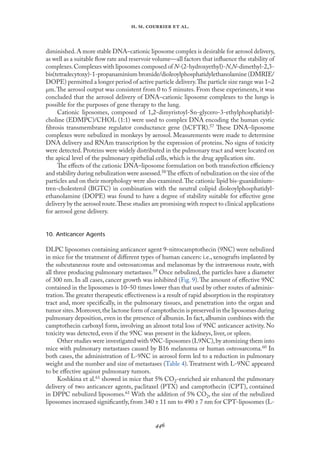
of 300 nm. In all cases, cancer growth was inhibited (Fıg. 9).The amount of effective 9NC
contained in the liposomes is 10–50 times lower than that used by other routes of adminis-
tration.The greater therapeutic effectiveness is a result of rapid absorption in the respiratory
tract and, more specifically, in the pulmonary tissues, and penetration into the organ and
tumor sites.Moreover,the lactone form of camptothecin is preserved in the liposomes during
pulmonary deposition, even in the presence of albumin. In fact, albumin combines with the
camptothecin carboxyl form, involving an almost total loss of 9NC anticancer activity. No
toxicity was detected, even if the 9NC was present in the kidneys, liver, or spleen.
Other studies were investigated with 9NC-liposomes (L9NC),by atomizing them into
mice with pulmonary metastases caused by B16 melanoma or human osteosarcoma.60 In
both cases, the administration of L-9NC in aerosol form led to a reduction in pulmonary
weight and the number and size of metastases (Table 4).Treatment with L-9NC appeared
to be effective against pulmonary tumors.
Koshkina et al.61 showed in mice that 5% CO2-enriched air enhanced the pulmonary
delivery of two anticancer agents, paclitaxel (PTX) and camptothecin (CPT), contained
in DPPC nebulized liposomes.61 With the addition of 5% CO2, the size of the nebulized
liposomes increased significantly, from 340 ± 11 nm to 490 ± 7 nm for CPT-liposomes (L-

   
FIGURE 9. Treatment of human breast cancer (CLO) xenografts in nude mice with 9-NC liposomes
aerosol. Aerosol was administered to mice in a sealed plastic cage for 15 min daily, 5 times weekly
for 31 days. The dose of 9-NC was 8.1/lg/kg per day (᭺ untreated, n = 5;. ᭹ 9-NC liposomes, n =
6). (Reprinted from Knight et al. Anticancer activity of 9-nitrocamptothecin liposome aerosol in mice.
Transactions of The American Clinical and Climatological Association 2000, 111, Fig, 5, p.139, with
kind permission of The American Clinical and Climatological Association.)
CPT) and from 130 ± 18 nm to 230 ± 17 nm for PTX-liposomes (L-PTX).CPT distribution
after 30 minutes of administration was 3.5 times higher with the 5% CO2-enriched air than
with normal air, increasing from ~134 ± 123 ng to ~ 476 ± 216 ng CTP/g of tissue. CPT
distribution in other organs also increased with the addition of 5% CO2,twofold in the liver
and eightfold in the brain. The pulmonary pharmacokinetic profile of CPT was similar in
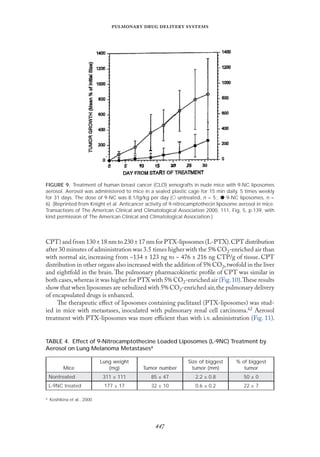
both cases,whereas it was higher for PTX with 5% CO2-enriched air (Fıg.10).These results
show that when liposomes are nebulized with 5% CO2-enriched air,the pulmonary delivery
of encapsulated drugs is enhanced.
The therapeutic effect of liposomes containing paclitaxel (PTX-liposomes) was stud-
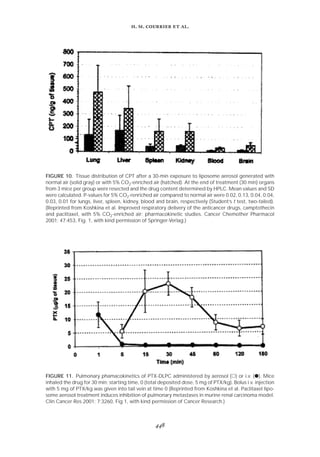
ied in mice with metastases, inoculated with pulmonary renal cell carcinoma.62 Aerosol
treatment with PTX-liposomes was more efficient than with i.v. administration (Fıg. 11).
TABLE 4. Effect of 9-Nitrocamptothecine Loaded Liposomes (L-9NC) Treatment by
Aerosol on Lung Melanoma Metastasesa
Mice
Lung weight
(mg) Tumor number
Size of biggest
tumor (mm)
% of biggest
tumor
Nontreated 311 ± 111 85 ± 47 2.2 ± 0.8 50 ± 0
L-9NC treated 177 ± 17 32 ± 10 0.6 ± 0.2 22 ± 7
a Koshikina et al., 2000

. .   .
FIGURE 11. Pulmonary phamacokinetics of PTX-DLPC administered by aerosol (᭺) or i.v. (᭹). Mice
inhaled the drug for 30 min; starting time, 0 (total deposited dose, 5 mg of PTX/kg). Bolus i.v. injection
with 5 mg of PTX/kg was given into tail vein at time 0 (Reprinted from Koshkina et al. Paclitaxel lipo-
some aerosol treatment induces inhibition of pulmonary metastases in murine renal carcinoma model.
Clin Cancer Res 2001; 7:3260, Fig 1, with kind permission of Cancer Research.)
FIGURE 10. Tissue distribution of CPT after a 30-min exposure to liposome aerosol generated with
normal air (solid gray) or with 5% CO2-enriched air (hatched). At the end of treatment (30 min) organs
from 3 mice per group were resected and the drug content determined by HPLC. Mean values and SD
were calculated. P-values for 5% CO2-renriched air compared to normal air were 0.02, 0.13, 0.04, 0.04,
0.03, 0.01 for lungs, liver, spleen, kidney, blood and brain, respectively (Student’s t test, two-tailed).
(Reprinted from Koshkina et al. Improved respiratory delivery of the anticancer drugs, camptothecin
and paclitaxel, with 5% CO2-enriched air: pharmacokinetic studies. Cancer Chemother Pharmacol
2001; 47:453, Fig. 1, with kind permission of Springer-Verlag.)

   
The weight of the lungs and the number of visible tumors decreased by ~26% and ~ 32%,
respectively, compared with the untreated mice.Their life expectancy also increased, by ~10
days. This study reveals the potential therapeutic application of aerosols for the treatment
of pulmonary cancer.
11. Bioadhesive Liposomes
Bioadhesive drug delivery systems were introduced in order to prolong and intensify the con-
tact between controlled delivery forms and the mucous apical pole,inducing active transport
processes.63 Contact with the mucus of the epithelium is called muco-adhesion, and direct
contact with the cellular membrane is called cyto-adhesion. Lectins are nonimmunological
glycoproteins that have the capacity to recognize and bind to glycoproteins exposed at the
epithelial cell surface.
Liposomes functionalized with lecithins appeared to be capable of improving their bind-
ing to human alveolar cells (A549 and primary cells).64 In this study, the unfunctionalized
liposome formulation was optimized by measuring the loss of carboxyfluorescein (CF) loaded
in the liposomes during atomization.Liposomes composed of DPPC–CHOL (50–50% mol)
were more stable during atomization (8% CF loss) than DPPC liposomes (15–20% CF loss),
even in the presence of pulmonary surfactant. Lehr et al.63 reported that the atomization
of DPPC–CHOL liposomes with lecithin functionalization did not significantly influence
their physical stability.The cell-binding capacity of functionalized liposomes is much higher
than that of unfunctionalized liposomes, even after atomization (Fıg. 12).
Immunoliposomes—liposomes carrying specific antibodies—can target cells carrying a
specific antigen. Margalit65 reported that they have been used to target pulmonary tumors
in vitro and in vivo.
12. Dry Powder Liposomes
An optimum formulation of dehydrated liposomes depends on several factors: the liposome
composition, the presence of cholesterol (CHOL), the incorporation of a cryoprotective
sugar, the preparation method, and the nature and proportion of the incorporated drug. An
optimum liposome formulation corresponds to an optimum size, lamellarity (unilamellar
[UL] or multilamellar [ML]), has a maximum drug incorporation efficiency and oxidation
index. An optimum dry powder formulation is characterized by its repose angle, its com-
pressibility index, and its dispersible and respirable fractions.
In the past, several formulations of liposome dry powder inhaler (DPI) have been de-
veloped. Among these, a formulation of liposome DPI containing anti-asthmatic ketotifen
fumarate (KF),was optimized.25 Liposomes formed by two successive hydrations before and
after sonification (1 and 2 hours, respectively) and with a molar composition KF/(EYPC-
CHOL) (1:15) demonstrate a maximum encapsulation rate.In this case,sucrose is revealed
to be the best system cryoprotector, with a mass lipid/sugar ratio of 1:12 and a maximum
concentration of 500 mM. When lactose monohydrate (Sorbolac-400) was added before
freeze-drying, 97.92 ± 0.54% KF retention was achieved. The oxidation of liposome lipids
is not inhibited by the presence of nitrogen or antioxidant agents, with the oxidation index
increasing from 0.427 ± 0.01 to 1.510 ± 0.01 (Table 5).Fınally,the respirable fraction of this

. .   .
formulation (21.59 ± 1.53%) was comparable with a commercial control (26.49 ± 1.52%).
The KF-liposome DPI was successfully prepared according to the respirable fraction to be
delivered to the central and peripheral pulmonary tract. Obviously, the choice of the cryo-
protector is dependent on the chemical structure of the drug. For example, as a reducing
sugar, the sucrose would be entirely unsuitable for protein or peptide delivery.
Table 5. Formulation of Dry Powder Inhaler (DPI) Liposomesa
Formulations KF : EYPC : CHOL Size (µm)
% of
encapsulated KF Oxidation index
KF[1] 1 : 15 : 0 1.56 ± 0.26 86 1.510 ± 0.01
KF[2] 1 : 10 : 5 1.70± 0.12 70 1.425 ± 0.01
KF[3] 1 : 7.5 : 7.5 2.05 ± 0.10 64 1.328 ± 0.01
a Liposomes are composed of egg yolk phosphatidylcholine (EYPC) and cholesterol (CHOL), which permit the
highest ketotifen fumarate (KF) incorporation rate, with an oxidation index that is still high (Joshi and Misra25).
FIGURE 12. Interaction of lectin-functionalized liposomes with alveolar epithelial cells. Cell association
of 200 µg wheat germ agglutinin (WGA)-liposomes with A549 cells. WGA liposomes = WGA-functional-
ized liposomes; blank liposomes = DPPC:cholesterol liposomes; WGA liposomes + free WGA = WGA
liposomes and 20-fold free WGA; inhibitory sugar = 20 µl of 20.0 mM diacetylchitobiose; LS = alveoafact
(lung surfactant). Results represent the average and standard deviation of at least 3 determinations
from 2 different passage numbers for A549 cells. (Reprinted from Abu-Dahab et al. Lectin-functional-
ized liposomes for pulmonary drug delivery: effect of nebulization on stability and bioadhesion. Eur J
Pharm Sci 2001; 14:43, Fig. 6b, with kind permission of Elsevier Science.)

   
III.B. Polymeric Microspheres and Nanospheres
1. Microspheres
The term microparticles includes microspheres (uniform spheres), microcapsules (with a
core and an outer layer of polymer), and irregularly-shaped particles.66 Microparticles are
composed of biodegradable polymers, which may be natural or synthetic. They have been
widely used as vectors of drugs via different administration routes.These particles have the
characteristics required to target and support drug delivery. They are prepared in a wide
range of sizes, from 1 to 999 µm, which is a decisive factor for delivery of drugs in vivo. A
number of lipophilic and hydrophilic molecules are able to be encapsulated or incorporated
in the microspheres. In comparison with liposomes, microspheres are physicochemically
more stable in vivo and in vitro and would thus allow slower release and a more prolonged
action of the encapsulated drugs.The pulmonary administration of aerosolized microspheres
may therefore provide an opportunity for the prolonged delivery of a systemically active
agent, with the drug protected from enzymatic hydrolysis. Microspheres have already been
prepared from various polymers: albumin,poly(glycolic-co-lactic acid) (PGLA),poly(lactic
acid) (PLA), poly(butylcyanoacrylate) (PBC), etc.
Microspheres can be produced to meet certain morphological requirements,such as size,
shape, and porosity, by varying the process parameters. Microspheres are less susceptible to
the effects of hygroscopic growth within the airways.67 Furthermore,Sakagami et al.66 sug-
gested enhancing pulmonary absorption by delaying mucociliary clearance through the use
of hydroxypropylcellulose microspheres, because the highly viscous hydroxypropylcellulose
demonstrates mucoadhesive properties.Because cellulose derivatives are not metabolized and
the lung is not a conduit like the GI tract, the accumulation of such drug delivery devices
can be prejudicial. For site-specific delivery, Steiner et al.66 developed microspheres formed
from a material (diketopiperazine) releasing the drug at a specific pH.
a. Albumin Microspheres
Albumin microspheres may be a suitable carrier for airway delivery because of their biocom-
patibility and biodegradability.Albumin microspheres encapsulating an anti-silicotic agent,
tetrandine,were studied as carriers for pulmonary drug delivery.69 The entrapment efficiency
was approximately 40% and the mean diameter of the microspheres was 4.41 µm, which is
suitable for inhalation.The respirable fraction (RF) was assessed in vitro with a twin-stage
liquid impinger: more than 11% of the delivered drug was collected in the lower stage, and
this fraction is believed to reach the lower airway.These types of albumin microspheres have
potential for the targeting and controlled release of an anti-silicotic drug within the lung.
Albumin microspheres loaded with ciprofloxacin (CIPRO), a quinolone used to treat
various microbial diseases, were investigated for their drug release in vitro as a potential dry
powder to inhale.70 The CIPRO-loaded albumin microspheres were smaller than 5 µm,a size
suitable for DPIs.Drug entrapment depended on the drug/material ratio and was around 50%
for CIPRO/albumin (1:1 w/w).The in vitro drug release profile from the microspheres was
dependent on the thermal treatment of the microspheres.With the best thermal treatment,
within 0.5 hours the burst effect indicates that 10 ~ 20% CIPRO has been released from
the microspheres, and within 12 hours 70 ~ 90% CIPRO is released. The CIPRO release

. .   .
rate fell as the albumin ratio increased. In conclusion, sustained-release microspheres were
suitable for dry powder inhaled pulmonary drug delivery systems.
b. Target or Avoid Alveolar Macrophages?
Targeting drugs to alveolar macrophages has the distinct advantage of delivering high concen-
trations of drug to a cell that plays a central role in the progression of disease (tuberculosis)
and in immune responses.
The microspheres can target alveolar macrophages (AMs) without eliciting a pulmonary
inflammatory response in vitro.22 In fact, a cell culture of AM, in the presence of micro-
spheres composed of PLA, produces negligible quantities of oxidants and tumor necrosis
factor alpha (TNF-α) inflammatory cytokines. Interactions between PLA microspheres,
marked by rhodamine 6G,which is a fluorescent agent,and AM are concentration-dependent
(~30% interactions with a concentration of 50,000 particles /mL). Endocytosis of the mi-
crospheres was revealed in the presence of certain endocytosis inhibitors—lysosomotropic
agents, NH4Cl, and chloroquine—reducing AM–particle interaction by around 50%. This
study demonstrated that microspheres can enter alveolar macrophages without activating
them, thus enabling possible drug delivery to target macrophages, for example, in the case
of tuberculosis.
Wang et al.71 showed that the coencapsulation of an immunomodulator (monophos-
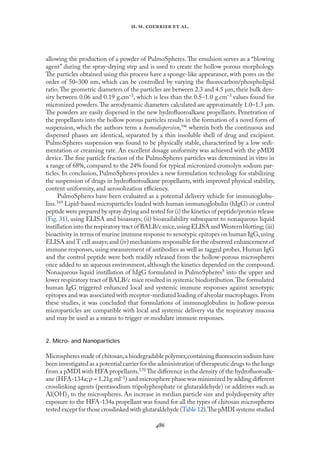
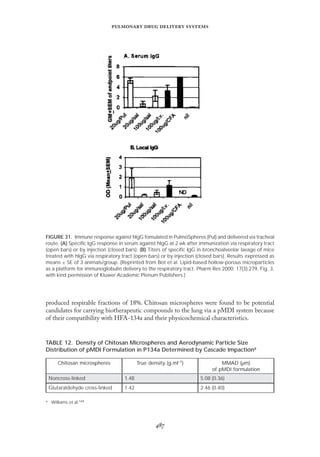
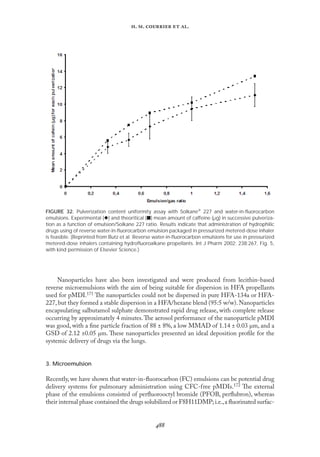
phoryl lipid A [MPLA]) in PLGA microspheres makes it possible to increase the rate of
phagocytosis (Fıg. 13). In the case of other diseases, alveolar macrophages must be avoided
FIGURE 13. Effect of coencapsulated MPLA on phagocytosis of PLGA microspheres containing plasmid
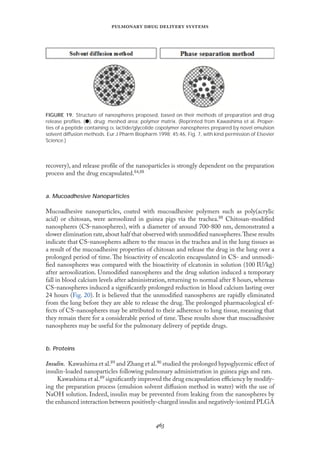
DNA. J774A-1 cells were incubated with PLGA microspheres (6000 g/mole) containing MPLA (᭜) or
no MPLA (᭿) for 0.75, 1.5, 3, 6, 12 and 24 h. Free microspheres were removed by PBS washing, cells
were fixed, and the number of microspheres per cell was counted by phase contrast microscopy. Error
bars indicate S.D. (n = 3). (Reprinted from Wang et al. Encapsulation of plasmid DNA in biodegradable
poly(D,L-lactic-co-glycolic acid) microspheres as a novel approach for immunogene delivery. J Control
Release 1999; 57:16, Fig. 9b, with kind permission of Elsevier Science.)

   
in order to prevent phagocytosis clearance and thus to enhance the alveolar half-life and
bioavailability of the drug.
DPPC plays a role in alveolar macrophage phagocytotic of microparticles.21 The in-
teractions of PLGA and DPPC/PLGA microspheres containing peroxidase, as a protein
model, have been evaluated on an AM cell culture by confocal microscopy. After incuba-
tion for 1 hour, the PLGA particles are located in the macrophage cytoplasm (95 ± 1.35%),
while the DPPC–PGLA particles are instead located at their surface (26.2 ± 13.9%). X-ray
photoelectron spectroscopy (XPS) results indicated that the inclusion of DPPC in the
microspheres altered the microsphere surface chemistry, with the DPPC covering a large
portion of the microsphere surface, but did not entirely mask the PLGA. The dominance
of DPPC on the microsphere surface was highly beneficial in moderating the interactions
occurring between the microspheres and phagocytic cells in the lung. DPPC reduced the
adsorption of opsonic proteins,thereby reducing microsphere phagocytosis occurring in the
alveoli, which enabled possible alveolar drug delivery (Table 6). These microspheres could
be designed to act as a controlled delivery system for small molecules, peptides, or proteins
for pulmonary administration.
Other studies were investigated to understand the inhibition of pulmonary phagocyto-
sis. In fact, respirable PGLA microspheres (2–3 µm) containing a fluorophore (rhodamine
B [RB]) were used as a model.20 RB’s loading efficiency was approximately 18%, and its
burst effect was very low, with less than 0.5% being released up to 19 hours. Two alveolar
macrophage types were used for this study: the NR8383 cell line and alveolar macrophages
(AM) freshly isolated from the lungs of rats. Seventy percent of the NR8383 population
phagocytosed a mean of 3.24 ± 0.69 microspheres per cell. The use of inhibitors (cytocha-
lasin D, Na azide) prevented phagocytosis. The phagocytosis of microspheres coated with
polaxomer 338 depended on the microspheres-per-cell ratio R. Compared to the control,
when R = 5, the phagocytosis reduction was 20% and 15% for AM and NR8383, respec-
tively; and when R ≥ 10,phagocytosis was 10–15% reduced for AM,while no reduction was
found for NR8383.The phagocytosis of microspheres coated with DPPC was significantly
lower than the control at all microsphere-per-cell ratios. Even at excess ratios, around 65%
of phagocytosis was inhibited for both cell types.
c. Importance of Encapsulated Drug Nature
El-Baseir et al.67 studied the in vitro release kinetics of nedocromil sodium (NS) (hydro-
soluble compound) and beclomethasone dipropionate (BDP) (hydrophobic compound) from
poly(-lactic acid) (PLA) microspheres. The release kinetics of NS exhibited a biphasic
TABLE 6. Effect of DPPC on Microparticle Internalization by Alveolar Macrophages
(AM)a
Particles PGLA PGLA/DPPC
Size (µm) 3.5 ± 1.72 3.3 ± 1.00
(%) of internalization in AM 65.1 ± 15.8 26.2 ± 13.9
a Evora et al.21

. .   .
pattern characterized by an initial and rapid release, probably of the drug located near the
surface of the microspheres, followed by a period of continuous slow release (80–100% of
drug released over an 8-day test period).The initial phase is particle-size dependent.In fact,
27% of the drug was immediately released when the particles had a diameter of 2.79 µm,
and 42–60% was released for larger particle sizes (3.52 and 4.88 µm diameter).The release
profile of NS was found to follow a square root of time-dependent mechanism as defined
by the Higuchi equation (Q = kt½), where Q is the cumulative release of the drug, k the
constant release rate, and t the time period.
BDP-loaded PLA microspheres demonstrated much higher entrapment levels and
smaller particles than the more hydrophilic NS (88% and 9% and 0.9-1.2 µm and 2.5-5 µm,
respectively).Differential scanning calorimetry (DSC) data indicated the possibility of sus-
tained release of BDP for over 6 days. BDP-loaded PLA microspheres were stable upon
immersion in phosphate-buffered saline, in contrast with NS-loaded PLA microspheres.
These results may indicate that lipophilic drug particles are not adsorbed near or on the
surface of the microsphere but that they are molecularly dispersed in the polymeric matrix,
and therefore that no initial burst effect can occur. The deposition of PLA microspheres
loaded with NS or BDP in the Andersen Cascade Impactor is presented in Table 7.
d. Corticosteroids
To prevent rapid dissolution in bronchial fluid and the fast absorption of corticoids via the
lung surface,Wichert72 encapsulated beclomethasone dipropionate (BDP) in PLA or PGLA
microparticles. Only 20% of BDP was encapsulated in the microspheres, but both particle
diameters were suitable for pulmonary delivery—namely, 2.6 ± 0.4 µm and 2.8 ± 0.7 µm
for PLA and PGLA microspheres, respectively. Microparticles with the same drug content
but different matrix polymers demonstrated marked differences in their release patterns.
PGLA (MW 15,000) released only about 20% within 8 hours, whereas PLA (MW 2000)
released nearly all the encapsulated drug (Fıg. 14). BDP release was found to be concentra-
tion dependent: a lower amount of polymer per drug molecule presented fewer barriers for
drug diffusion within the polymer matrix.The in vitro degradation of PLA microparticles in
bronchial fluid was studied in order to see whether microparticles are biodegradable within
an acceptable time span. After 1 hour of incubation with some bronchial fluid at 37°C, the
particles demonstrated an obvious deterioration of their surface characteristics, including
deep holes.This study also revealed that particles made with a lower molecular weight PLA
could be suitable for inhalatory sustained-release formulations. An evaluation of the com-
patibility and toxicity is necessary at this stage.
e. Antibiotics
Rifampicin-loaded PGLA microspheres (R-PGLA) were administered by insufflation or
nebulization to guinea pigs infected by mycobacterium tuberculosis (MTB).73 The in vitro
growth of MTB was inhibited in the presence of an appropriate dose of R-PGLA. The
R-PGLA microspheres, the sizes of which are within the respiratory range (1–5 µm), sig-
nificantly reduced the lung bacterial loads (tenfold) when compared to that of the controls
(Fıg. 15). R-PGLA–treated animals also exhibited reduced inflammation and lung damage

   
TABLE7.DepositionofPLAMicrospheres(MS)LoadedwithNedocromilorBeclomethasoneDipropionate(BDP)inanAndersen
CascadeImpactora
Sample
MMD±SD
(µm)
Flowrate
(l.min-1)
Actuatedsample
±SD(%w/w)
%Deposition±SD
ThroatStage0-filterStage2-filterStage3-filter
PLAnedocromil
sodiumMS
2.65±0.0128.372.6±26.632.8±3.6467.3±3.6529.0±1.8026.4±0.66
PLA-BDPMS1.00±0.2160.060.6±14.631.1±6.2168.9±6.2341.8±4.3220.0±3.27
aThepercentageofdepositioniscalculatedtotheactuatedsample(emitteddose)(El-Baseiretal.,1998).

. .   .
compared to untreated controls or rifampicin-solution–treated animals. Nebulization was
more efficient in reducing the number of viable microorganisms in the lungs at equivalent
doses of R-PGLA than was insufflation. This study indicated the potential of R-PGLA
microspheres, delivered by nebulization directly to the lungs, to treat the early development
of pulmonary tuberculosis.
FIGURE 15. Number of viable bacteria (cfu/mL) in lung (᭿) and spleen (ٗ) tissues (4–5 weeks postin-
fection) following nebulization of R-PLGA microspheres (1.03–1.72 mg/kg), RIF (1.03–1.72 mg/kg)
and PLGA. Animals including control group were exposed to MTB 24 h after drug administration.
Bars represent mean :t. SD for n = 3–5. * p < 0.05 (level of significance for R-PLGA microspheres).
(Reprinted from Suarez et al. Respirable PLGA microspheres containing rifampicin for the treatment
of tuberculosis: screening in an infectious disease model. Pharm Res 2001; 18(9):1317, Fig 3, with kind
permission of Kluwer Academic Plenum Publishers.)
FIGURE 14. Effect of the matrix polymer on drug release (mean of three batches ± coefficient of
variation). Drug content is 16% in all cases (Reprinted from Wichert et al. Low molecular weight PLA:
a suitable polymer for pulmonary administred microparticles. J Microencaps 1993; 10(2):202, Fig. 3,
with kind permission of Taylor & Francis Ltd, www.tandf.co.uk/journals.)

   
f. Proteins
Calcitonin. The pulmonary administration and in vitro degradation of gelatin microspheres
loaded with salmon calcitonin (SC) was studied by Morimoto et al.74 Gelatin microspheres
made it possible to prevent particle degradation by enzymes. The in vitro release study
(Fıg. 16) revealed that SC seems to be dependent on the gelatin microsphere load and
not on the particle size. Within 2 hours, approximately 85% of SC was released from
positively-charged gelatin microspheres, while 40% was released from negatively-charged
gelatin microspheres. These results suggested that the SC released from the microspheres
depended on the electrostatic repulsion between SC (isoelectric point [IEP] = 8.3) and
positively charged gelatin microspheres (IEP = 9). However, the initial release of SC from
negatively-charged microspheres was suppressed by the formation of a poly–ion complex.
Consequently, the electrostatic forces relationship between the incorporated proteins and
gelatin may be an important factor affecting the release rate of incorporated proteins from
gelatin microspheres.
The results for intratracheal administration of SC-loaded gelatin microspheres are
given in Fıgure 17. The hypocalcemic effect following the administration of SC in both
types of gelatin microspheres was significantly greater than that following administration
in aqueous solution (in pH 7.0 PBS).The hypocalcemic effect following the administration
FIGURE 16. Release profiles of salmon calcitonin from gelatin microspheres with different charge
(A) and different particle sizes (B) in pH 7.0 PBS at 37°C. Positively charged microspheres: 11.2 µm
(᭝). Negatively charged microspheres: 10.9 µm (᭡). Each point represents the mean ± s.e.m., n = 4.
(Reprinted from Morimoto et al. Gelatin microspheres as a pulmonary delivery system: evaluation
of salmon calcitonin absorption. J Pharm Pharmacol 2000; 52:614, Fig. 2, with kind permission of
Pharmaceutical Press.)

. .   .
FIGURE 17. Time course of hypocalcæmic effect in rats after pulmonary administration of salmon
calcitonin (3.0 U.kg–1) in gelatin microspheres with different charge (A) and different particle sizes (B).
Solution (᭹) ; positively charged microspheres: 3.4 µm (᭺) ; 11.2 µm (᭝) ; 22.5 µm (ٗ) ; 71.5 µm (᭛) ;
negatively charged microspheres: 10.9 µm (᭡). Each point represents the mean ± s.e.m of at least 4
animals. (Reprinted from Morimoto et al. Gelatin microspheres as a pulmonary delivery system: evalua-
tion of salmon calcitonin absorption. J Pharm Pharmacol 2000; 52:615, Fig. 3a/b, with kind permission
of Pharmaceutical Press.)

   
of SC in positively-charged gelatin microspheres was significantly greater than that after
administration in negatively-charged gelatin microspheres. Furthermore, Fıgure 17 shows
that the administration of smaller particles produced a greater hypocalcemic effect. In fact,
small particle sizes appeared to reach the lower regions of rat lungs—the alveoli—where
the respiratory tract promotes drug absorption.The pharmacological availability of SC was
greater when given via the lungs in positively-charged gelatin microspheres (particle sizes
3.4 and 11.2 µm) than in solution (50% and 15%, respectively) and was similar to that after
intramuscular administration of an SC solution.
Moreover, Morimoto et al.74 claimed that the enzyme responsible for the degradation
of SC exhibited a fourfold higher activity in the membrane fraction of lung homogenate
than in the cytosol fraction. The degradation of SC by secreted or membrane-associated
enzymes in the mucus layer of the lung would be physically prevented by the use of gelatin
microspheres.Moreover,coadministration with enzyme inhibitors could be suggested.Indeed,
inhibitors such as chymostatin, antipain, and bacitracin have the greatest inhibiting effects
on enzymes involved in SC degradation.75
In conclusion, gelatin microspheres have been shown to be a useful carrier for pulmo-
nary delivery of SC and to increase its absorption via the respiratory tract. Other proteins
or peptides (such as insulin) could also be administered via this route, but the most useful
carrier (positively- or negatively-charged microspheres) depends on the IEP of the protein
and its electrostatic interaction with the type of gelatin used.
Prospects for protein encapsulation in microspheres. Proteins, such as erythropoietin or bo-
vine serum albumin (BSA), have already been encapsulated in PGLA microspheres.76,77
However, the particle sizes were much too large (50–600 µm) to be administered by the
pulmonary tract.
DNA can be encapsulated in PLGA microspheres without compromising its structural
and functional integrity.71 Encapsulation efficiencies (EE) seemed to depend on the increased
molecular mass (MW) of the polymer (EE = 30.0% for MW = 12,500 and EE = 53.3% for
MW = 50,000).The diameter of microspheres ranged between 0.4 and 2 µm,which is within
the respirable range. Moreover, PLGA microspheres can protect plasmids from nuclease
degradation and therefore offer an effective approach for in vivo gene delivery, especially to
phagocyte cells, for inducing immunization.
g. Viruses
Venezuelan equine encephalomyelitis (VEE) was inactivated by 60Co-irradiation and microen-
capsulated in PGLA microspheres (≤10 µm) with the aim of studying the effectiveness in
inducing immune responses against aerosol challenge with VEE virus.78 Mice were primed by
s.c.or i.t.administration of microencapsulated VEE virus,followed 30 days later by a single
immunization given by the oral, i.t., or s.c. route. Mice boosted by i.t. or s.c. administration
had higher plasma IgG anti-VEE levels than orally immunized animals.The levels of IgG
and IgA antibody activity in the bronchoalveolar lavage (BAL) from mice boosted by the
i.t. route were higher than those in animals boosted by the other routes (Fıg. 18). Mucosal
immunization via the i.t. route appeared to be the most effective regimen, because 100% of
the mice resisted the virus challenge.

. .   .
FIGURE 18. Time course of plasma IgG anti-VEE antibody response in mice immunized by systemic
followed by mucosal route with methylene chloride processed microsphere vaccine. Groups of BALB/c
mice (5/group) were immunized by administration of 50 µg of formalin-fixed, 6OCo-inactivated TC-53
virus in microspheres by s.c. (50:50 DL-PLG; batch G320-140-00, methylene chlorjde solvent) or i.t.
(50:50 DL-PLG; batches H456-092-OQ and H456-109-00, methylene chloride solvent) routes on day
0 and boosted on day 30 by s.c., oral, or i.t. administration of 50 µg of the same microencapsulated
virus vaccine. Plasma was collected at 10-day intervals and assayed for antibody activity by ELISA.
(Reprinted from Greenway et al. Induction of protective immune responses against Venezuelan equine
encephalitis (VEE) virus aerosol challenge with microencapsulated VEE virus vaccine. Vaccine 1998;
15(13):1318, Fig. 2, with kind permission of Elsevier Science.)
h. Antigens
Recombinant F1 (rF1) and V (rV) subunit antigens were entrapped within PLA micro-
spheres and were administered by the i.t or i.m. route to mice challenged afterwards with a
virulent strain of Yersinia pestis.79 The introduction of antigenic material into the respiratory
tree triggers the production of locally produced specific antibodies in the lung,which should
improve protection against pneumonic plague infection.Microspheres had loadings of 1.2%
(w/w) rV and 5% (w/w) rF1. Following injection of 107 U Y. Pestis, the group immunized
with microspheres by the i.t.route had the highest percentage of survivors (55%),compared
with those immunized with microspheres by the i.m. route (50%), with antigen solution
administrated by the i.t. route (33%) and administrated by the i.m. route (20%). Only i.t.
instillation of microspheres induced significant quantities of anti-F1 and -V specific IgA
in bronchoalveolar lavage (Table 8). This study showed that the introduction of F1 and V
subunits into the respiratory tract may be an alternative to parenteral immunization schedules
for protecting individuals from plague.

   
TABLE 8. Mean (± SE) Anti-F1 and V IgG Endpoint Titers in Day 82 Lung Washesa
Treatment Anti-V IgG Anti-F1 IgG Anti-V IgA Anti-F1 IgA
MS i.t. 2048 ± 627 115 ± 14 18 ± 13 18 ± 13
Sol i.t. 780 ± 397 20 ± 13 1.6 ± 0.8 <1.0
MS i.m. 972 ± 343 42 ± 11 <1.0 <1.0
Sol i.m. 275 ± 116 13 ± 6 1.0 ± 0.5 <1.0
a Generated by day 1 and 60 immunizations with microspheres (MS) coencapsulated (5 µg F1, 1 µg V) or soluble
(sol) admixed rF1 and rV subunits (5 µg F1, 1 µg V). Mice were immunized by either i.t. or i.m. routes (n = 5).
(Eyles et al., 2000).
i. Mucoadhesive Microparticles
Mucoadhesive microspheres of hydroxypropylcellulose (HPC) encapsulating beclomethasone
dipropionate (BDP) were administered as powder aerosols to healthy or asthmatic guinea
pigs.68 The pharmacokinetics and pharmacodynamics of BDP were compared for different
BDP formulations: pure crystalline BDP (cBDP), amorphous BDP incorporated in HPC
microspheres (aBDP-HPC),and crystalline BDP-loaded HPC microspheres (cBDP-HPC).
Powder aerosols were produced within a respirable size range of 1.7–2.9 µm.The pharmaco-
kinetic profiles for these three powders were dissolution modulated.It was shown that at 180
minutes postadministration,more than 95% and 85% of BDP were absorbed from the lung
following aBDP-HPC and cBDP administration, respectively; whereas 86% of BDP were
absorbed at 180 minutes following cBDP-HPC administration.A prolonged lung retention
of BDP may be beneficial in maximizing the efficacy of BDP dose delivery to the lung and
in reducing the side effects caused by its extra lung absorption.The duration of inhibition of
eosinophil infiltration into the airways of asthma-induced guinea pigs was assessed following
cBDP and cBDP-HPC administration. While cBDP (1.37 mg.kg–1) inhibited eosinophil
infiltration for only 1–6 hours, cBDP-HPC, with a lower drug dosage (0.25 mg.kg–1), was
able to maintain these inhibitory effects for 24 hours following administration. This study
showed that this HPC microsphere system has the potential to prolong the therapeutic
duration of BDP following inhalation.
j. Porosity: A Decisive Factor
Rogerson et al. 80 highlighted that the difficulty with many sustained-release inhalation
therapies is that solid (or more dense) particles will be removed by clearance mechanisms
before acting as a drug reservoir.To avoid these problems, Rogerson et al.80 and Edwards et
al.81 developed particles of small mass density (<0.4 gram per cubic cm) with relatively large
geometric diameter (>5 µm),which permitted the highly efficient delivery of inhaled thera-
peutics into the systemic circulation and prevented the phagocytosis by macrophages.The use
of relatively low-density perforated (or porous) microparticles significantly reduced attractive
forces between the particles,thereby reducing the shear forces and increasing the flowability
of the resulting powders.82 This made it possible to prevent aggregation.The microstructures

. .   .
allowed the fluid suspension medium to freely permeate or perfuse the particulate boundary
and,hence,to reduce or minimize density differences between the dispersion components.82
Moreover, as a consequence of their large size and low mass density, porous particles can be
aerosolized from a DPI more efficiently than can smaller nonporous particles, resulting in
higher respirable fractions of inhaled drugs.81 In conclusion, in view of these advantages,
dispersions of this invention are particularly compatible with inhalation therapies.
Large porous particles are more efficient for the pulmonary administration of potent
drugs by a dry powder inhaler than are small porous or nonporous particles.81 Porous par-
ticles (ρ < ~0.4 g.cm-3, d > 5 µm) and nonporous particles (ρ ~ 1± 0.5 g.cm-3, d < 5 µm) of
PLGA,with the same aerodynamic diameter,were prepared with incorporated testosterone
and were then tested on an in vitro lung model of the Andersen cascade impactor (ACI).
The respirable fraction for the porous system is higher than that for the nonporous system:
50 ± 10% and 20.5 ± 3.5%, respectively.The highly efficient respirable fraction for the large
porous particles can be attributed to their smaller surface-to-volume ratio,their low aggrega-
tion, and their ability to exit the DPI as single particles.The particle composition has little
influence, with the respirable fraction analogous between PLGA particles and polylactic
acid-co-lysine-graft-lysine (PLAL-lys) particles: 50 ± 10% and 57 ± 1.9%, respectively. In
vivo studies on the bioavailability and inflammatory response of particles incorporating
insulin and delivered by aerosol were conducted in rats. Only 46% of porous particles are
deposited in the trachea, compared with the deposition of 79% nonporous particles. For
large porous particles, insulin bioavailability relative to subcutaneous injection was 87.5%,
whereas the small nonporous particles yielded a relative bioavailability of 12% after inhala-
tion. Given the short systemic half-life of insulin (11 min) and the 12- to 24-hour time
scale of particle clearance from the central and upper airways, the appearance of exogenous
insulin in the bloodstream several days after inhalation appeared to indicate that large
porous particles achieve long, nonphagocytosed lifetimes in the deep lungs. These studies
also demonstrated that the phagocytosis of particles fell sharply when the particle diameter
increased beyond 3 µm.Indeed,large porous particles with a mean diameter of 20.4 µm lead
to 177% bioavailability for the subcutaneous injection of testosterone, whereas only 53% of
relative bioavailability was observed for large porous particles of 10.1 µm.
2. Nanoparticles
Nanoparticles have the same characteristics as microparticles,being composed of biodegrad-
able polymers and drug binding at the surface or in the interior of the host minicarrier,83
also providing protection against enzymatic digestion and improving drug bioavailability
via controlled release.The mean size of a nanoparticles is between 1 and 999 nm.These are
new carriers for drugs84 or diagnostic products.85 The methods of preparation,drug loading,
drug release, and surface modification methods have already been reviewed.86
Furthermore, the use of bioadhesive hydrogel polymers increases the length of time
for which the nanoparticles are in contact with the respiratory mucosa, preventing the det-
rimental action of mucociliary clearance.87 In this field, Dunn87 described a new method
allowing the inhalation delivery of large macromolecules. Following Dunn’s invention, by
using cyclodextrins, sensitive molecules can be protected during the granulations of nano-
particles production phase.
The size, structure (Fıg. 19), characteristics (nanosphere recovery, drug content, drug

   
FIGURE 19. Structure of nanospheres proposed, based on their methods of preparation and drug
release profiles. (᭹), drug; meshed area: polymer matrix. (Reprinted from Kawashima et al. Proper-
ties of a peptide containing DL lactide/glycolide copolymer nanospheres prepared by novel emulsion
solvent diffusion methods. Eur J Pharm Biopharm 1998; 45:46, Fig. 7, with kind permission of Elsevier
Science.)
recovery), and release profile of the nanoparticles is strongly dependent on the preparation
process and the drug encapsulated.84,88
a. Mucoadhesive Nanoparticles
Mucoadhesive nanoparticles, coated with mucoadhesive polymers such as poly(acrylic
acid) or chitosan, were aerosolized in guinea pigs via the trachea.88 Chitosan-modified
nanospheres (CS-nanospheres), with a diameter of around 700-800 nm, demonstrated a
slower elimination rate,about half that observed with unmodified nanospheres.These results
indicate that CS-nanospheres adhere to the mucus in the trachea and in the lung tissues as
a result of the mucoadhesive properties of chitosan and release the drug in the lung over a
prolonged period of time. The bioactivity of encalcotin encapsulated in CS- and unmodi-
fied nanospheres was compared with the bioactivity of elcatonin in solution (100 IU/kg)
after aerosolization. Unmodified nanospheres and the drug solution induced a temporary
fall in blood calcium levels after administration, returning to normal after 8 hours, whereas
CS-nanospheres induced a significantly prolonged reduction in blood calcium lasting over
24 hours (Fıg. 20). It is believed that the unmodified nanospheres are rapidly eliminated
from the lung before they are able to release the drug. The prolonged pharmacological ef-
fects of CS-nanospheres may be attributed to their adherence to lung tissue, meaning that
they remain there for a considerable period of time. These results show that mucoadhesive
nanospheres may be useful for the pulmonary delivery of peptide drugs.
b. Proteins
Insulin. Kawashima et al.89 and Zhang et al.90 studied the prolonged hypoglycemic effect of
insulin-loaded nanoparticles following pulmonary administration in guinea pigs and rats.
Kawashima et al.89 significantly improved the drug encapsulation efficiency by modify-
ing the preparation process (emulsion solvent diffusion method in water) with the use of
NaOH solution. Indeed, insulin may be prevented from leaking from the nanospheres by
the enhanced interaction between positively-charged insulin and negatively-ionized PLGA

. .   .
with sodium hydroxide. The blood glucose levels measured following administration of a
nanosphere suspension and insulin solution as a reference are shown in Fıgure 21.The dose
of insulin inhaled was 3.9 IU/bodyweight of a test animal (guinea pig) in kilograms. The
nebulized aqueous dispersions of PLGA significantly reduced blood glucose levels over 48
hours, compared with the nebulized aqueous solution of insulin. In the case of the insulin
solution, the baseline glucose levels presented a minimum 6 hours after administration
and immediately recovered to the initial level.The prolonged hypoglycemia induced by the
nanosphere system could be attributed to the widespread distribution of the nanospheres
throughout the whole lung and their sustained release of insulin. The immediate hypogly-
cemia with nanospheres, which appeared in the same manner as the insulin solution, might
be due to the action of released insulin in the nebulized nanosphere mist. At a later stage,
the insulin released from the nanospheres was absorbed and a prolonged hypoglycemic
effect observed.
Zhang et al.90 determined the duration of glucose levels below 80% following the
pulmonary delivery of different doses of insulin-loaded polybutylcyanoacrylate (PBCA)
nanoparticles and insulin solution in normal rats.90 They considered the duration of glucose
levels below 80% as a criterion to evaluate two insulin formulations (insulin solution and
insulin-loaded PBCA nanoparticles).As indicated in Table 9,the duration of glucose levels
below 80% increased significantly as the dose of insulin increased, for both the insulin-
loaded nanoparticles and the insulin solution.Furthermore,the values for the insulin-loaded
nanoparticles were markedly higher than those for the insulin solution at every dose, and
FIGURE 20. Blood calcium profiles (% of initial value) after pulmonary administration (Dose: 100 IU/
kg). (ٗ): elcatonin solution, (᭿): unmodified nanospheres; (᭺): chitosan- modified nanospheres (n = 4,
mean ± S.D., *p < 0.05, ***p < 0.001) (Reprinted from Takeuchi et al. Mucoadhesive nanoparticulate
systems for peptide drug delivery. Adv Drug Deliv Rev 2001; 47:52, Fig.12, with kind permission of
Elsevier Science.)

   
FIGURE 21. Profiles of blood glucose level after pulmonary administration of insulin nanosphere
suspension. Data are presented as means ± S.D. (n = 5), ***p < 0.0001, **p < 0.01, *p < 0.05. (᭝ :
control (blank NS); (᭿): insulin solution; (᭹): insulin-loaded nanosphere suspension. (Reprinted from
Kawashima et al. Pulmonary delivery of insulin with nebulized DL lactide/glycolide copolymer (PLGA)
nanospheres to prolong hypoglycemic effect. Eur J Pharm Sci 1999; 62:286, Fig. 6, with kind permis-
sion of Elsevier Science.)
their difference increased as the insulin dose increased.The prolonged hypoglycemic effects
of insulin-loaded nanoparticles demonstrated the sustained release of insulin from the
PBCA nanoparticles.
Other results from Zhang et al.90 showed that the relative pharmacological bioavail-
ability of insulin-loaded nanoparticles by pulmonary administration was 57.2% compared
to the results obtained following subcutaneous administration of the same dose.
All of these results reveal the possibility of controlled pulmonary administration of
insulin by nanoparticles.
TABLE 9. Duration of Glucose Level Below 80% After Pulmonary Delivery of
Different Doses of Insulin-Loaded Nanoparticles and Insulin Solution to Normal Ratsa
Dose (IU.kg–1)
Insulin solution
(hours)
Insulin-loaded
polybutylcyanoacrylate
nanoparticles (hours) Difference (hours)
5 7.4 10.8 3.4
10 7.6 15.0 7.4
20 11.9 20.0 8.1
a Zhang et al.90

. .   .
c. Anticancer Agents
Paclitaxel-loaded biodegradable polymer nanospheres were prepared using an improved
solvent extraction/evaporation technique.91 Phospholipids,cholesterol,and vitamins were
used to replace traditional chemical emulsifiers in order to achieve a high encapsulation
efficiency (EE, 23–45%) and the desired drug release rate. The size of the nanospheres
ranged from 300 to 500 nm. Recording of in vitro release revealed that the release of
paclitaxel could last more than 3 months at an approximately constant release rate
following an initial burst. Nanospheres encapsulating an anticancer drug appear to be
a good carrier for long-term cancer treatment. In vivo tests are required with improved
administration, for example, by the pulmonary tract, because particles are within the
respirable range.
d. Limitations of Polymeric Micro- and Nanoparticles
In their review of the literature, Armstrong et al.92 and El-Baseir et al.67 reported that
poly(lactic acid) implants were devoid of any harmful tissue reaction. Therefore, El-Baseir
et al.67 concluded that polyesters such as poly(lactic acid), poly(glycolyc acid), and their
copolymers were biodegradable and biocompatible on the basis of studies performed on
surgical grafts and implants. Armstrong et al.92 explained that extrapolation of this conclu-
sion to PLA microspheres, particularly at a size below 10 µm, is difficult. That is why they
incorporated fluorescein and other histological dyes into PLA microspheres. In in vivo
distribution studies,fluorescence microscopy revealed that fluorescein-labeled microspheres
were distributed throughout all 4 lung lobes of a rabbit following intrapulmonary delivery.
Nevertheless,the microspheres were observed to cluster in discrete groups in the lung tissue
and were not evenly distributed.
Armstrong et al.92 also made a histological examination of serial sections of the lung
tissue adjacent to the site where the microspheres had been identified.They demonstrated
inflammatory responses to both fluorescein-labeled and unlabeled PLA microspheres.
There was also evidence of hemorrhage in the lungs of rabbits treated with PLA micro-
spheres. These results demonstrated that the microspheres are not biologically inert and
that they led to a significant inflammatory response. They produced a significant influx
of both neutrophils and eosinophils into the lung tissue adjacent to the site of impacted
microspheres.Furthermore,the time course of the infiltration (within 24 h) is commensu-
rate with an acute inflammatory response.The manufacture of these drug delivery devices
(DDS) must also be taken into account knowing that these DDSs are generally prepared
by using organic solvents. Residual organic solvents in these DDSs can also explain their
apparent toxicity.
The number of products based on polymeric nanoparticles on the market is limited.
There are quite a few well-known reasons for this, of which two should be highlighted: the
cytotoxicity of polymers and the lack of a suitable large-scale production method.
Indeed,just as for microspheres,the polymers accepted for use as implants are not nec-
essarily of good tolerability in nanoparticle form. In the nanometer size range of just a few
micrometers, the polymer can be internalized by the macrophages, and degradation inside
the cell can lead to cytotoxic effects. A 100% mortality rate was found in cell cultures when
the cells were incubated with 0.5% PLA/GA nanoparticles.93

   
III.C. Solid Lipid Nanoparticles
Solid lipid nanoparticles (SLNs),introduced in 1991,represent an alternative carrier system
to traditional colloidal carriers, such as emulsions, liposomes, and polymeric micro- and
nanoparticles.94 Indeed,SLNs combine the advantages of the safety of lipids (lipids are well
tolerated by the body) and the possibility of large-scale production. Many different drugs
have been incorporated in SLN (Prednisolone, Diazepam, Camptothecin, etc.).The factors
determining the loading capacity of a drug in the lipids are the solubility of the drug in melted
lipid, the miscibility of drug melt and lipid melt, the chemical and physical structure of the
solid lipid matrix, and the polymorphic state of the lipid material. The drug incorporation
model may vary according to the preparation method. There are three drug incorporation
models (Fıg. 22), just as for polymeric microspheres and nanospheres: the solid solution
model (drug molecularily dispersed), the core-shell models with drug-enriched shell (lipid
core), and drug-enriched core (lipid shell).
Controlled release of drugs and pulmonary administration. It is possible to modify release
profiles as a function of lipid matrix, surfactant concentration, and production parameters.
In vitro drug release could be achieved for up to 5–7 weeks.The profiles could be modulated
to demonstrate prolonged release without any burst at all, but also to generate systems with
different percentages of burst followed by prolonged release (Fıg.23).The release profiles are
not, or only slightly, affected by particle size. Because the release profile can be modulated,
controlled delivery of drug after pulmonary administration can be performed.For pulmonary
administration, SLN dispersions can be nebulized (without any significant change in mean
particle size), and SLN powders could be used in a DPI.
III.D. Cyclodextrins
Cyclodextrins (CDs) are cyclic nonreducing oligosaccharides containing 6, 7, or 8 gluco-
pyranose units (α-,β-,or γ-CD,respectively).The CD exterior,containing hydroxyl groups,
FIGURE 22. Three drug incorporation models (solid solution model (left), core-shell models with
drug-enriched shell (middle), and drug-enriched core (right). (Reprinted from Müller et al. Solid lipid
nanoparticles [SLN] for controlled drug delivery—a review of the state of the art. Eur J Pharm Biopharm
2000; 50:167, Fig. 5, with kind permission of Elsevier Science.)

. .   .
is hydrophilic, whereas the central cavity is relatively lipophilic.95 Many drugs are able to
form noncovalently bonded complexes with CD by inclusion entirely or partially into the
slightly apolar CD cavity.27 β-CD appears to have most use in the pharmaceutical industry
of all the natural CD because of its cavity size, efficiency of drug complexation, availability
in pure form, and relatively low cost.95 Because the CD’s outer surface is strongly hydro-
philic, it is a true carrier—it brings the hydrophobic drugs into solution, keeps them in the
dissolved state, and transports them to the lipophilic cell membrane; but after delivering
the drug to the cell, the cyclodextrin remains in the aqueous phase.96 The selection of CDs
is also based on structural modifications to reduce toxicity. Some of these modifications are
discussed below.
CDs can be used in combination with other carrier systems.In fact,incorporating CDs
into microparticles increases the encapsulation of drugs and modulates the release of the
incorporated drug.97
1. Sustained Drug Release
For pulmonary administration of the drug, CD makes it possible to protect the drug from
enzymatic degradation, to release the drug in a sustained pattern, and, as a result, to reduce
the number of administrations required and prevent the high peak concentrations frequently
encountered following single-dose administration.
FIGURE 23. (a) In vitro release profiles of prednisolone from SLN made from different lipids (compritol,
cholesterol) but produced with identical method (hot homogeneization technique). (b) In vitro release
profiles of prednisolone from compritol SLN produced by hot homogenization technique (upper: ᭡)
and by cold homogenization technique (lower: ᭹). (Reprinted from Müller et al. Solid lipid nanoparticles
(SLN) for controlled drug delivery—a review of the state of the art. Eur J Pharm Biopharm 2000; 50:
165, Fig. 2a, with kind permission of Elsevier Science.)

   
2. Bioavailability Enhancer
CDs have the ability to increase drug bioavailability by enhancing drug permeation through
biological membranes.The favored explanation for this phenomenon is that CDs increase the
aqueous solubility of water-insoluble drugs. But the situation is actually more complicated,
because CDs are also known to decrease drug bioavailability.This is, therefore, not solely a
question of increased aqueous drug solubility.95
3. Toxicological Considerations
β-CD permeates lipophilic membranes with considerable difficulty and, thus, is virtually
nontoxic when used in oral or topical formulations.The acute toxicity of β-CD,administered
by the oral route,was studied in rats and dogs and did not reveal any toxicity.Therefore,even
if they are swallowed during or after pulmonary administration, CD will not be toxic.
Nevertheless, CD exerted a relatively mild and reversible effect on the ciliary beat
frequency of both chicken embryo trachea and human nasal adenoid tissue in vitro in a
concentration-dependent manner.75,98 Consequently, CD appear to be nontoxic for both
the upper and lower airways.
4. Limitations
The most important parameters determining the complexability of a given molecule are its
hydrophobicity,melting point,relative size,and geometry in relation to the CD cavity.Large,
hydrophilic organic molecules (e.g., protein); small, highly water soluble, strongly hydrated
molecules (e.g., sugars); and ionized molecules cannot be complexed. Substances with high
melting points (>200°C) are generally weak complex-forming partners.Inorganic compounds
are not suitable for CD inclusion,because they form only outer sphere,or hydroxyl,complexes.
Only apolar molecules or functional groups of molecules can be included into the CD cavity,
provided that their diameter does not exceed the size of the CD cavity.
5. Pulmonary Administration of Cyclodextrins
Pulmonary administration of CD following intratracheal instillation in rabbits demonstrated
that the absolute bioavailabilities following pulmonary administration were 65.9 ± 12.8%
for β-CD, 73.9 ± 13.2% for dimethyl-β-cyclodextrin (DM-β-CD), and 79.8 ± 12.0% for
HP-β-CD.99 These values are considerably higher than cyclodextrin absorption following
other nonparenteral routes and should limit the future choice of cyclodextrins considered
for pulmonary administration to those with acceptable systemic safety profiles or negli-
gible pulmonary absorption. The time to reach the peak plasma concentration was 20–30
minutes for β-CD and DM-β-CD, while the time for HP-β-CD was approximately 113
minutes. The plasma elimination half-lives of the 3 CDs following pulmonary absorption
were comparable to those following i.v. administration, suggesting a common elimination
route independent of the administration route.

. .   .
6. Salbutamol, Rolipram, and Testosterone
The use of HP-β-CD was studied for modifying the pulmonary absorption of small,hydro-
phobic molecules and, more specifically, for slowing the rate of absorption of salbutamol,
rolipram, and testosterone in rats. But even for these compounds, which have stability con-
stants with HP-β-CD of 260 and 12,000 M–1 respectively, HP-β-CD had little affect on
rolipram absorption and no effect on testosterone absorption in vivo. Thus, the hypothesis
is false that inclusion of a molecule with a carrier molecule that is also absorbed would
create a larger entity for absorption and decrease the apparent rate of drug absorption. For
salbutamol (stability constant between 60 and 70 M–1), the same results were observed:
the pulmonary absorption of salbutamol was not significantly extended through the use of
HP-β-CD. Consequently, the hypothesis that drugs exhibiting higher stability constants
with HP-β-CD than salbutamol (such as testosterone and rolipram) may display extended
absorption profiles is also not valid.These results therefore suggest that rapid dissociation of
the drugs from HP-β-CD may occur in vivo because of the potential competition of these
drugs for CDs from endogenous molecules such as cholesterol.99
7. Insulin
The relative effectiveness of CD and derivatives as pulmonary insulin absorption enhancers
was investigated in rats.100 There was an improved hypoglycemic response when insulin
was administered intratracheally in the presence of CD.The relative effectiveness of CD in
enhancing pulmonary insulin absorption as measured by pharmacodynamic relative efficacy
followed the rank order of DM-β-CD > α-CD > β-CD>γ-CD > HP- β-CD. Pharmaco-
kinetic analysis also revealed near complete insulin uptake from the pulmonary sacs upon
coadministration with 5% DM-β-CD.However,an absolute bioavailability of only 22% was
obtained in the presence of 5% HP-β-CD.Relatively low acute mucotoxicity was observed.
The absolute bioavailabilities following pulmonary insulin administration with CD revealed
that the thinner epithelial cell layer of the respiratory mucosa in comparison with the intes-
tinal mucosa offered less resistance to CD-promoted insulin uptake.100
8. Enhancer of Pulmonary Delivery
CDs are absorption enhancers that are effective for the formulation of dry powder101 and
are also used for the transmucosal and systemic delivery of peptides and proteins, such as
salmon calcitonin.75
III.E. Aqueous and Nonaqueous Solutions and Suspensions
1. Aqueous Solutions and Suspensions
a. Aqueous Solutions
The pulmonary delivery of detirelex decapeptide (DX) was studied in dogs by i.v. and i.t.
administration and by aerosol inhalation of aqueous solutions of detirelex.102 The bioavail-
ability of DX by i.t. administration and aerosol was 29 ± 10%. The plasma absorption rate

   
profiles were identical and relatively slow: 6.5 ± 3.6 and 7.6 ± 2.2 hours, respectively. A
histopathological examination showed that the lung was normal.
Aqueous particles of cidofovir were administered by aerosol in variola-infected mice103
infected with the variola virus one day before, the same day, or one day after, by aerosol.
Cidofovir was not toxic and was more effective by aerosol administration than by subcutane-
ous (s.c.) administration; its antiviral effect was identical, or even higher, for solutions from
20 to 200 times less concentrated than those used by subcutaneous injection. The effect of
cidofovir aerosol administration was the highest when cidofovir was administered close to
the moment of infection (±1 day), while cidofovir administration by the intravenous route
was more suitable for a therapy starting just after infection. In any case, cidofovir solution
administered by aerosol had a prophylactic and therapeutic effect on the variola virus.
An aqueous aerosol delivery system (AERx Pulmonary Delivery system) was used to
examine the feasibility of the pulmonary route for noninvasive systemic administration of
morphine.104 The percentage of loaded dose emitted as an aerosol was 61%, of which 87%
contained aerosol droplets in the respirable range (<5.7 µm)—i.e.,the dose actually delivered
would be approximately 50% of the nominal value. Plasma morphine concentrations were
proportional to the dose, occurred practically instantaneously, and, over time, appeared to
be complete.The bioavailability of morphine delivered by aerosol was approximately 100%
relative to intravenous infusion.
An aqueous bolus aerosol (AERx) was used to study the pulmonary delivery of insu-
lin in healthy subjects.105 It resulted in a rapid absorption (7–20 min) with an associated
hypoglycemic effect (60–70 min) quicker than that achieved after subcutaneous dosing of
regular insulin (50–60 min and 10–120 min,respectively).While formulation variables (e.g.,
pH and concentration) had little effect on the pharmacokinetics and pharmacodynamics
of the inhaled insulin, changes in inhaled volumes during deep controlled inspiration
enhanced the rapid absorption of insulin and the hypoglycemic action, compared to s.c.
administration.
Repeated intratracheal administration of FC-100 saline solution (solid perfluorocarbon
but highly water-soluble at 37°C, with a surface tension of 15 mN.m–1) was compared with
administration of the synthetic surfactant Exosurf (a mixture of colfosceril palmitate, ce-
tyl alcohol, and tyloxapol). This study was conducted on surfactant-deficient lambs during
mechanical ventilation.106 In contrast with Exosurf,an initial dose of FC-100 administered
by the intratracheal route led to a rapid increase in arterial PO2,a decrease in arterial PCO2,
an improved arterial pH,and dynamic lung compliance.However,the arterial blood pressure
seemed to drop progressively.This anomaly might be a result of FC-100 toxicity, which has
not, to date, been investigated.
b. Aqueous Solution with Complex: Gene Therapy
Complexing DNA with cationic lipids for aerosol delivery has shown that it is possible
to significantly stabilize plasmid DNA, but it often induced the loss of biological activity
during nebulization. A new formulation for aerosolization has been developed using poly-
ethylenimine (PEI),a polycationic polymer,and DNA.107 The best formulation was obtained
with PEI:DNA with a weight ratio of 1.29:1, which corresponded to a PEI nitrogen:DNA
phosphate (N:P) ratio of 10:1.This resulted in a high level of pulmonary transfection (10- to
100-fold higher than many cationic lipids) and a good stability during nebulization.

. .   .
The same PEI–DNA complex was nebulized with 5% CO2-enriched air to optimize
pulmonary delivery.108 A higher pulmonary gene expression, threefold greater than with
normal air, was observed using chloramphenicol acetyl transferase (CAT). The highest
expression appeared 24 hours after aerosol delivery, and 40–50% of the peak level was de-
tectable after a week. The specific lung tissue distribution was assessed and no evidence of
acute inflammation was found.
The aerosol delivery of this PEI–DNA complex was studied in mice for induction of
tumor necrosis factor alpha (TNF-α) and interleukin 1 beta (IL-1β) in the lung.109 Other
DNA complexes with lipids,described previously,58 such as BGTC:DOPE:p53 by aerosol or
i.v.,1,2-dioleoyl-Sn-glycero-3-trimethylammonium-propane:cholesterol,DOTAP-CHOL:
p53 by i.v., and PEI-DNA by i.v., were administered for comparison. Lung and serum
cytokine levels 2 hours after administration were lower than with complexes administered
by aerosol, especially with PEI–DNA. CAT expression was the highest with PEI–DNA.
Aerosol delivery of PEI–DNA complexes made it possible to achieve high levels of transgene
expression in the lungs without inducing high levels of cytokine response.
It has been shown that PEI-p53 complexes can suppress the growth of lung metastases
in mice inoculated with human osteosarcoma when administered by aerosol.110 Reductions
in the number and size of tumors were observed, and no signs of toxicity or inflammation
were detected.The noninvasive nature of aerosol delivery coupled with its low toxicity made
this therapeutic approach potentially appropriate for chemotherapy.
c. Aqueous Suspension
A colloidal suspension (Nanocrystal™) of beclomethasone dipropionate was stabilized by
tyloxapol, which is a synthetic pulmonary surfactant used in the same way as Exosurf for
respiratory distress syndrome in newborn babies.111 Short-duration ultrasonic nebulization
of a concentrated Nanocrystal colloidal dispersion of beclomethasone dipropionate demon-
strated an increased respirable fraction and decreased throat deposition when evaluated in
an Andersen 8-stage cascade impactor in comparison to the commercially available propel-
lant-based product Vanceril. In this study, an aqueous-based 1.25% w/w colloidal disper-
sion of beclomethasone dipropionate, when aerosolized via an Omron NE-U03 ultrasonic
nebulizer, generated a respirable drug dose from 22.6 to 39.4 µg per 2-second actuation
period, compared to 12.8 µg for a single actuation of Vanceril. When viewed as a percent-
age of the emitted dose (through the actuator or mouthpiece),this study demonstrated that
the respirable fraction ranged from 56 to 72% for the nanocrystalline formulation versus
36% for the propellant system. In addition, the throat deposition as seen in the induction
port was 9–10% of the emitted dose for the novel suspension, compared to 53% for the
commercial product.Thus, according this study, when used with the device outlined herein,
a nanocrystalline colloidal suspension of beclomethasone dipropionate affords greater po-
tential drug delivery to the conductive airways of the lung in both quantity and as a percent
of emitted dose. In addition, lower potential throat deposition values were observed, which
may retard the development of undesirable side effects, such as candidiasis, when com-
pared to a propellant-based delivery system. Lastly, the ability to atomize aqueous-based
nanocrystalline colloidal dispersions represents an environmentally sound alternative to the
current chlorofluorocarbon (CFC)-based products and may avoid the technical difficulties
of reformulating with chlorine-free propellants.

   
2. Nonaqueous Solutions and Suspensions
a. Pulmonary Drug Administration with Liquid Perfluorocarbon (PFC)
Neat F-octyl bromide was evaluated for the treatment of acute lung injury and acute respira-
tory distress syndrome by liquid ventilation (LV) therapy.112 The dense and fluid perfluoro-
carbon (PFC) was instilled into the patient’s lungs,where it was expected to contribute to the
reopening of collapsed alveoli, facilitating the exchange of respiratory gases and protecting
the lungs from some of the harmful side effects (barotrauma or volutrauma) of conventional
mechanical ventilation.Phase I and II trials have indicated an improvement in lung compli-
ance and oxygenation status.113,114 The reduction of mortality in Phase II/III trials was not,
however,any better than with standard treatments using the latest,improved lung protection
strategies. Anti-inflammatory effects have also been reported.115
Suspensions of solid and liquid drugs in a PFC have been shown to be effective when
administered by the pulmonary route.116,117 The biochemical inertia of the PFC excludes
any interaction with drugs, their weak surface tension supports the distribution of drugs,
and their high solubility of respiratory gases ensures gas exchange during drug delivery.
Fluorocarbons, because of their entailment and physicochemical properties, prepare the
lungs and are used as vehicles for drug delivery by convective transport,118 even if these
drugs are not soluble in PFC.
b. Solutions
Liquid halothane (HAL) was administered during a PFC liquid ventilation to hamsters.117
The mean arterial pressure response (MAP), used as an index of analgesia, was significantly
lower during LV with PFC:hal than with MAP during neat PFC or gas ventilation. The
MAP percentage change from baseline was, respectively, +12 ± 5%, +28 ± 8%, and +29 ±
9%.Halothane can thus be administered during a PFC-LV technique while supporting gas
exchange and inducing analgesia.
c. Suspension
Administrationwithoutliquidventilation. A PFC gentamicin suspension was administered
by the i.t. route and an aqueous gentamicin solution by the i.v. route in lambs with normal
and acid-injured lungs.119 Physiological gas exchange and pulmonary function were main-
tained throughout both protocols.The intravenously administered gentamicin resulted in a
high initial serum concentration for 5 minutes,followed by a decline over 4 hours,while the
intratracheally administered gentamicin suspension resulted in a low initial concentration
but remained constant throughout the 4-hour protocol. Intratracheal administration was
significantly more effective in delivering the drug to the normal lungs 4 hours after admin-
istration than was i.v. (~ 31 µg.ml–1 vs ~ 4 µg.ml–1). In the injured group, i.t. administration
led to a higher gentamicin concentration in the lungs than did intravenous administration,
although the difference was small (~12 µg.ml–1 vs.~10 µg.ml–1).In both normal and injured
lungs,homogeneous gentamicin concentrations in the lung tissue could be achieved at lower
serum levels when a gentamicin–PFC suspension was delivered by the i.t.route as compared
to a gentamicin solution administered i.v.

. .   .
FIGURE 24. Mean ± SE (n = 8) values of percent change from baseline for pulmonary artery relative
to percent change from baseline for mean systemic arterial pressure (MAP) (PPA/MAP) after pulmonary
administration of drug (PAD) (᭺–᭺) and IV (᭹–᭹ ) administration of incremental doses of priscoline
during normoxic conditions. (Reprinted from Wolfson et al. Pulmonary administration of vasoactive
substances by perfluorochemical ventilation. Pediatrics 1996; 97:452, Fig. 5, with kind permission of
American Academy of Pediatrics.)
Administration by liquid ventilation. Liquid ventilation (LV) by PFC has been used for the
pulmonary administration of vasoactive agents.116 Cardiovascular responses in premature
lambs were studied by the administration of acetylcholine, epinephrine, and priscoline by
LV. The results were better with priscoline administered by LV than by i.v. (Fıg. 24). The
uniformity of drug distribution in the lungs was demonstrated by injecting 14C-DPPC
marker in suspension in PFC via the endotracheal route.
Gentamicin was also administered by LV in newborn lamb models presenting serious
respiratory symptoms,comparable with pneumonia in a newborn baby or RDS in an adult.120
Gentamicin concentrations in the serum and in the lungs following LV administration were
compared with gentamicin concentrations administered by the i.v.route during gas ventila-
tion. Serum gentamicin concentrations were equivalent with both administrations, but the
concentrations in the lungs were higher with LV administration (Fıg. 25).
Administration during partial liquid ventilation. PFC partial liquid ventilation (PLV) can
enhance intratracheal drug delivery,which can encounter certain obstacles,such as inadequate
drug distribution in the lungs and disruption of gas exchange.
The intratracheal administration of a gentamicin/perfluorochemical suspension
(G/PFC) was studied in newborn lambs ventilated by PLV with PFC (LiquiVent).121
Over time, serum gentamicin concentrations were higher by the i.v. route (11.0 ± 2.3
µg.ml–1), than by i.t. administration (0.8 ± 0.1 µg.ml–1) using a slow-fill technique (G/
PFC over 15 min at start PLV). The percentage of the administered dose remaining in
the lungs after 4 hours was higher following i.t. delivery (23.8 ± 4.3%) than after i.v.

   
FIGURE 25. Comparison of gentamicin lung tissue levels expressed as percentage of total dose given
following intravenous administration during gas ventilation and pulmonary administration of drug dur-
ing tidal liquid ventilation. CA indicates cranial apical lobe; RUL, right upper lobe; RML, right middle
lobe; RLL, right lower lobe; LUL, left upper lobe; and LLL, left lower lobe. (Reprinted from Fox et al.
Pulmonary administration of gentamicin during liquid ventilation in a newborn lamb lung injury model.
Pediatrics 1997; 100:E5, Fig. 3, with kind permission of American Academy of Pediatrics.)
administration (3.7 ± 0.5%).These findings suggest that, for a given dose of gentamicin,
i.t.administration of G/PFC was able to enhance pulmonary delivery,relative to systemic
antibiotic coverage.
Aerosolized prostacyclin (A-PGI2) and intratracheally instilled prostacyclin (I-PGI2)
were studied during PLV in rabbits with acute respiratory distress induced by oleic acid.122
After lung injury, all animals developed hypoxia, hypercarbia, and pulmonary hypertension.
The improvement in arterial oxygen partial pressure (PaO2) in the A-PGI2 + PLV and I-
PGI2 + PLV groups was consistent,especially for I-PGI2 + PLV,which induced the highest
PaO2 values after 120 minutes of treatment.Pulmonary arterial pressure (PAP) significantly
decreased following treatment in the A-PGI2, A-PGI2 + PLV, and I-PGI2 + PLV groups.
Both aerosolized and i.t.-instilled PGI2 improved oxygenation and reduced PAP during
PFC PLV in oleic acid lung injury.
Pulmonary surfactant, labeled with 14C, used for RDS, was administered by PLV and
by mechanical ventilation (MV) in rats presenting respiratory problems.123 The surfactant
distribution (25% bioavailability) was more effective with PLV than with MV; 48.8% of the
lung was radio-labeled compared to 30.9% by MV. Moreover, the regional distribution was
more uniform in the case of PLV. This study showed that pulmonary surfactant treatment
by PLV was able to improve treatment of RDS.
It has been postulated that a combination of PFC with biological agents, such as sus-
pensions,micelles,emulsions,or liposomes,may support the therapeutic effect of pulmonary
drug delivery by FC.116

. .   .
3. Solutions with Surfactants (≠ Micellar Solution)
Exogenous surfactants,used for the treatment and prevention of acute respiratory problems,124
were used as vectors for antibiotics and corticosteroids by i.t.administration of saline solution
or suspension.125 These surfactants are effective vectors as long as they do not interact with
the drug, which would cause a loss of pharmacological activity. Combined with artificial
ventilation,treatment with an exogenous surfactant could enhance pulmonary drug targeting.
It was shown that bacterial growth was inhibited in the presence of exogenous surfactant or
a mix of surfactant + specific IgG (Fıg. 26).126
4. Solid Dispersed System (Dry Powders)
The dry powder inhaler (DPI) appears to be a promising technology,avoiding the problems
related to formulations with new propellant gases for MDI and limited patient compliance
with nebulizers.127 Vaccines, such as the measles vaccine,128 could be administered by DPI,
thus avoiding destabilization of the vaccine in a solution and the possible risks of contami-
nation when using syringes.
Patton129 described the administration of calcitonin and parathyroid hormone (PTH)
by the pulmonary route for bone diseases,such as osteoporosis.Inhaled calcitonin and PTH
FIGURE 26. Bacterial proliferation in lungs of animals treated with surfactant, specific IgG, or a combina-
tion. Bacterial proliferation in left lung homogenate expressed as log10 colony forming units (CFU) per
gram lung tissue, obtained from different treatment groups at end of experiments (black bars). Similar
number of CFU given to all animals at beginning of experiment (white bars). Values are mean and S.D.
There is significant reduction in bacterial growth in surfactant group and in surfactant + specific IgG
group. (Reprinted from Herting et al. Combined treatment with surfactant and specific immunoglobulin
reduces bacterial proliferation in experimental neonatal group B streptococcal pneumonia. Am J Resp
Crit Care Med 1999; 159:1865, Fig. 1, with kind permission of the American Thoracic Society.)

   
dry powders appear to present bioactivity between 40 and 66% and bioavailability of around
29% compared to s.c. injections. The pulmonary delivery of peptides and proteins by dry
powder should be a future therapy.
An alternative micronization technique using an aerosol solvent extraction system
(ASES) has been studied to avoid the insufficient brittleness of crystals that can occur
when using normal micronization.130 Several steroids were dissolved in an organic solvent
(CH2Cl2 or MeOH) and sprayed into supercritical carbon dioxide. Crystallinity studies
were then carried out. Budenoside and triamcinolone acetonide (TCA) demonstrated no
change in crystallinity, with or without the addition of surface-active phosphatidylcholine
(PC).While the addition of PC to prednisolone led to an amorphous powder,PC tended to
decrease particle size but to increase wettability. Residual solvent containing microparticles
was found to be less than 350 ppm in all cases. A median particle-size diameter was found
to be less than 5 µm and thus within the respirable range.
5. Solutions and Dry Powder Additives
Drugs composed of dry powders or solutions can be managed in a more effective way when
combined with additives.The pulmonary absorption of peptides or proteins from dry powder
or solution can be enhanced by using an additive.101 Salmon calcitonin (SC) was insufflated
in the form of solution or powder containing an additive,such as oleic acid,lecithin,or citric
acid.The absorption effect depends,first,on the additive concentration.With a dry powder,
the bioactivity of SC was around 34 ± 7%. By adding oleic acid, it increased to 58 ± 10%.
Conversely, additives in solution had almost no effect. Indeed, on an identical volume of
epithelial fluid,additives in the liquid form were less concentrated than in the powder form.
That is why oleic acid is more effective in powder form than in solution.This additive should
increase the paracellular permeability of the small junctions and enable the absorption of
peptides and proteins.
The effects of several additives were studied by i.t. administration of insulin in solution
and dry powder.131 Bacitracin and Span 85 are effective in supporting the hypoglycemic ef-
fect induced following the administration of insulin solutions.The effect lasted 180 minutes
after administration,and the insulin bioavailability was 100% compared to i.v.administration.
The citric acid supported the hypoglycemic effect induced following the administration of a
dry powder of insulin (Fıg.27).The effect lasted a longer period of 240 minutes,but a lower
insulin bioavailability was obtained—between 42 and 53%, depending on acid concentra-
tion. The insulin bioavailability was higher with citric acid than without (12%). Moreover,
the insulin powder containing citric acid was not toxic for the pulmonary cells. Citric acid
appears to be a potential additive for insulin powder absorption.
Studies to optimize the respirable fraction of particles inhaled by aerosol have been
conducted by determining the effects of the formulation and the physical characteristics of the
dry powder.132 When formulated with an appropriate composition (albumin/lactose/DPPC
[30:10:60 in weight]) and adequate physical characteristics,the powders exhibited excellent
aerosolization properties in the Andersen cascade impactor,with emitted doses reaching 90%
and respirable fractions up to 50% using the Spinhaler device, a first-generation inhaler
(Fıg. 28). The addition of albumin slightly increased the particle size (3–5 µm) and made
them more porous and less dense, and therefore easier to breathe in. These powders can
incorporate drugs such as peptides, proteins, or DNA for local and systemic delivery.

. .   .
FIGURE 28. Influence of sugar, polyol, and albumin on dry powders respirable fraction (RF). Powders
made with 60% DPPC, 20% albumin, and 20% lactose, trehalose, or polyol (solid gray) or with 60%
DPPC, 40% lactose, trehalose, or polyol and no albumin (points). Spray-drying carried out with 70%
ethanolic solution of 0.1% total powder concentration, inlet temperature of 100°C, feed rate of 10
mL/min, and pressure of 0.5 bar. ED, dose emitted from the Spinhaler™ device; d, particle diameter;
ρ, bulk powder tap density; daer, aerodynamic diameter of individual particles. (Reprinted from Bos-
quillon et al. Influence of formulation excipients and physical characteristics of inhalation dry powders
on their aerosolization performance. J Control Release 2001; 70:333, Fig. 2, with kind permission of
Elsevier Science.)
FIGURE 27. Effect of additives on change in plasma glucose level (AGLC) after intratracheal admin-
istration of insulin dry powders with additives in rats. Insulin doses are shown in Table 3. (᭺) MI; (᭝)
MICO.1 (citric acid 0.025 mg/dose); (ٗ) MICO.2 (citric acid 0.036 mg/dose); (᭞) MISO.1 (Span 85
0.033 mg/dose); (᭛) MISI.0 (Span 85 0.16 mg/dose); (hexagon) MID (bacitracin 0.42 mg/dose). Error
bar represents S.E. for 3 or 4 rats. Error bars for MIS1.0 not shown. AGLC values for MISI.0 at 150,
180, 210, and 240 min were above 40% per unit and not shown. Statistical significance: * p < 0.05 and
** p < 0.01 compared with MI. (Reprinted from Todo et al. Effect of additives on insulin absorption
from intratracheally administered dry powders in rats. Int J Pharm 2001; 220:107, Fig. 4, with kind
permission of Elsevier Science.)

   
III.F. Micellar Solutions, Emulsions, and Microemulsions
1. Micellar Solutions
The delivery and the pharmacokinetics of cyclosporine A (CysA) by the respiratory tract
or i.v. route were evaluated in adult and young rats.133 Following i.t. instillation of a saline
suspension of CysA, the bioavailability was shown to be 78.1 ± 6.9%, with an absorption
peak at 30 minutes (Fıg.29).Following i.t.instillation of a micellar solution formed by Cre-
mophor® EL surfactant containing CysA,bioavailability differed in the adults and the young
rats, representing 77.4 ± 7.2% and 66.3 ± 4.3%, respectively. The absorption peak with the
micellar solution appeared after 5 minutes.The bioavailability of a CysA solution dissolved
in ethanol and administered by aerosol was of 80.1 ± 4.1%, with an absorption peak at 20
minutes (Fıg. 29). Micellar-CysA solution absorption, administered by the i.t. route, was
faster than with other formulations. It was therefore concluded that the micelles must have
an influence on the pulmonary permeability mechanism. The elimination half-life (T½) of
CysA in young rats was double that in adults.None of these formulations have demonstrated
histopathological variations. In conclusion, CysA can be delivered via the pulmonary tract
in order to reduce autoimmune diseases and allergens, with the aim of transplantation.
2. Microemulsions
Very few emulsions or microemulsions have been studied and used as pulmonary drug delivery
systems.134 Formulations of water-in-hydrofluoroalkane (HFA) microemulsions stabilized
by nonionic fluorinated surfactant have been described for delivery via the pulmonary tract.
However, in this study, no drug has been incorporated in those microemulsions and no
pulmonary studies have been described.135
FIGURE 29. Plasma levels (mean ± SE) of CyA i.t. instilled or administered as aerosol (dose = 1 mg/kg
BW) in young and adult rats, respectively. (Reprinted from Taljanski et al. Pulmonary delivery of intra-
tracheally instilled and aerosolized cyclosporine A to young and adult rats. Drug Metab Dispos 1997;
25(8):918, Fig. 1, with kind permission of The American Society for Pharmacology and Experimental
Therapeutics.)

. .   .
Reverse water-in-chlorofluorocarbon micelles stabilized by lecithin and containing
peptides have been aerosolized.136 The surfactant concentration of the metered dose inhaler
(MDI) formulation should range between 0.5% and 2% (w/v), with the remaining volume
component being the propellant.Although this system was stable and able to deliver peptides
and proteins to the respiratory tract, its use should be limited because of the international
agreements following the Montreal protocol (1987) and calling for the total phase-out of
CFC production. Therefore, ozone-friendly propellants such as HFA, hydrocarbons, or
fluorocarbons should be used in MDI applications.
Reverse microemulsions stabilized by lecithin and using propane and dimethyl ether
as propellant gases have been described.137 These microemulsions, stable for more than 4
weeks at ambient temperature, had an aqueous internal phase of around 3 ± 2 µm diameter
and 36% respirable fraction.This report is the first to use lecithin reverse microemulsions for
pulmonary delivery of polar drugs.The use of reverse microemulsion (versus micelles) should
allow the solubilization of a greater quantity and variety of polar compounds. Extensive
characterization of aerosols generated by MDIs containing microemulsion is underway.
Reverse water-in-fluorocarbon emulsions stabilized by a semifluorinated amphophile
derived from dimorpholinophosphate CnF2n+1(CH2)mOP(O)[N(CH2CH2)2O]2 (FnHm-
DMP) made it possible to prepare stable water-in-fluorocarbon emulsions.138 The external
phase of these emulsions consisted of perfluorooctyl bromide (PFOB, perflubron), whereas
their internal phase contained the drugs solubilized or dispersed in water.These emulsions
are being investigated as pulmonary drug delivery systems,either for systemic or local deliv-
ery of drugs.139 Physicochemical studies have made it possible to select FnHmDMP as the
candidate yielding the most stable emulsions.140 Studies on the evaluation of FnHmDMP
and FnHmDMP-stabilized emulsion cytotoxicity have been investigated in vitro on mouse
fibroblasts and human lung epithelial cells.141 F8H11DMP and F10H11DMP were found
to be the most biocompatible semifluorinated surfactants (viability average: 88 ± 4% and >
100%,respectively at 1% w/v).In addition,some water-in-fluorocarbon emulsions stabilized
with F8H11DMP and F10H11DMP surfactants appear to be biocompatible for pulmonary
drug delivery (Fıg.30).Currently,the acute toxicity of water-in-PFOB emulsions,stabilized
by F8H11DMP, is being investigated in mice, as well as the delivery of insulin contained in
these emulsions administered by the i.t. route.
IV. TRANSITION TO CFC-FREE INHALERS
A. Aerosol generators
1. Technical Transition to CFC-Free Inhalers
Aerosol generators make it possible to administer a predetermined amount of drug into the
lungs. In order to specifically target the drugs, these devices have been extensively studied
and technically improved over the last decade and are described in the literature.142 They
include aerosol generators of (i) drug powders (Spinhaler, Cyclohaler, Turbuhaler); (ii)
autoactivated aerosols (Maxair, Prolair, Autohaler); (iii) spray diffusers (Pulmicort
Nebulization, Bricanyl).143

   
FIGURE 30. Viability of HLEC treated with either solutions (white) or emulsions (grey) of F8H11DMP
or F10H11DMP, as assessed by MTT method. Viability of cells treated with PFOB or PFOB/PFDB is
represented by the dot line (. . .) and dash/dot (- . -) line, respectively.
Pressurized metered-dose inhalers. Pressurized metered-dose inhalers (pMDI) represent
approximately 80% of prescribed aerosols, despite the fact that they are complicated to use,
requiring good coordination between activation of the dose and inspiration (hand–mouth
coordination). Nevertheless, the main advantage of pharmaceutical metered-dose aerosols
is that they allow outpatient treatment, and for this reason, they remain the most popular
device used to administer drugs to the lungs.
For various reasons, only chlorofluorocarbons (CFC) have been used as propellants in
pressurized dosage forms intended for inhalation.144 Indeed, they are nontoxic for humans,
stable, nonflammable, and, from a technical point of view, ideal for the formulation of
pressurized aerosols. However, because of the presence of chlorine in their molecules and
their long lifetime in the atmosphere (half-life approximately 75–120 years),several authors
have demonstrated their role in the destruction of the ozone layer.145 The harmful effects of
CFCs on the environment have led to the signature of international agreements (Montreal
protocol) leading to the production of CFCs being completely halted.146 The alternative
propellants selected were hydrofluoroalkanes (HFAs), which do not contain chlorine and,
therefore, do not deplete the ozone layer.147,148 Toxicological trials demonstrated that these
new propellants are not toxic,149,150 are not carcinogenic, are not mutagenic,150 and do not
accumulate in the body.152 HFA-134a is rapidly absorbed and is eliminated with a half-life
of 5.1 min.153 Two HFAs—HFA-134a and HFA-227—have been investigated, and the
former was selected for development in the first non-CFC pMDI.
pMDIs comprise two main parts:(i) the contents,consisting of a medicinal liquid prepa-
ration (solution, suspension, emulsion) and one or more propellant(s); and (ii) a container,
which is pressure resistant, and a metering valve.The latter permits accurate administration

. .   .
of small volumes of propellant containing even smaller quantities of drug, which has made
MDIs possible.
In the field of aerosols, for which some liquefied gases must be used, the pressure re-
quired in the container intended for aerosolization of the particles is governed by the vapor
pressure at the temperature of use.154 This pressure remains constant throughout the use of
the pMDI: when the level of the contents falls in the container, the free space is occupied
by the gaseous phase of the propellant. Until then, the latter is present in the liquid state.
The pressure inside the container remains equal to the vapor pressure. The liquid propel-
lants used in the field of pharmaceutical aerosols are mainly chlorofluorocarbons and the
hydrofluoroalkanes (Solkane 127a and Solkane 227 Pharma).
The use of HFAs for pMDI formulations has imposed numerous modifications in
terms of composition,technology,and manufacture.The reformulation of CFC–MDIs with
hydrofluoroalkanes (HFAs) 134a and 227 is also an opportunity to improve these widely
accepted systems in terms of ease of handling, compliance, dosing, and more reliable and
efficient lung deposition.155,156 New formulation technologies combined with improved
valves and actuators should help to overcome dose uniformity and priming problems and
will increase the percentage of fine particles capable of reaching the deeper regions of the
lungs.157 However, replacing CFCs with HFAs in the manufacture of pMDIs is not easy,
although the canisters of the latter are similar. Indeed, this substitution has involved some
modifications to the technology and manufacture of pMDIs because of differences in the
physicochemical properties of the new propellants (Table 10).The construction of the new
pMDIs will not be the same, either technically or pharmacologically, and new clinical trials
will therefore be required.
2. Reformulation
pMDIs containing HFAs operate in a similar manner and the components are like those
used with CFCs.The new pMDIs differ from the previous through a combination of modi-
fications to the composition of the formulas,the valve,158 the inner polymeric coating of the
canister,and the industrial manufacturing processes.For example,as far as the conventional
surfactants used to manufacture pMDIs with CFCs are concerned, they are not soluble in
HFAs159,160 (Table 11).
When the dosage form inside the canister is a suspension, the density and the viscos-
ity of the propellants affect the physical stability of the suspension. Surfactants are used to
maintain the drug in suspension and to lubricate the valve.For pMDI formulations containing
CFCs, the most commonly used surfactants are oleic acid, lecithin, and sorbitan trioleate,
which are insoluble in both HFA 134a and HFA 227 propellants. Changing the propel-
lants modifies the physical stability of the suspension159 and, in some cases, the solubility
of the drug in the new propellants.161 For reformulation, three solutions can be considered:
(i) not using any surfactant if this is compatible with the formulation; (ii) adding an extra
excipient to dissolve a conventional surfactant (for example ethanol for oleic acid)162; or (iii)
designing new surfactants that would require their toxicological evaluation.Furthermore,the
trials conducted with some drugs that are stable in suspension with CFCs have shown that
these are not stable in the presence of HFAs. Accordingly, all the reformulations must be
considered for each drug and the solutions studied in order to realize that the substitution
of propellants may differ from one drug to another.157

   
TABLE10.PhysicochemicalPropertiesofPropellantsUsedtoManufacturepMDIs
RegisteredtrademarkSolkane227pharmaSolkane134apharmaFreon11Freon12Freon114
StructuralformulaCF3CH(F)CF3CF3CH2(F)CFCl3CFCL2(CF2Cl)2
Chemicalname1,1,1,2,3,3,3,–
Heptafluoropropane
1,1,1,2–Tetra
fluoroethane
Monofluortrichlor-
methane
Difluordichlor-
methane
Tetrafluordichlorethane
LaboratorycodeHFA227ea,HFC227eaHFA134a,HFC134aCFC11CFC12CFC114
PhysicalformUncoloredgas
StockingconditionsLiquefiedbycompressioninsteelcontainers
Atmosphericlife(years)163360125200
Boilingpointat1,013bar–16.5°C–26.1°C+23.8°C–29.8°C+3.6°C
Vaporpressureat20°C3.90bar5.72bar0.87bar5.601.81
Liquiddensityat20°C1.415kg/l1.23kg/l1.49kg/l1.33kg/l1.47kg/l

. .   .
For example,the currently marketed CFC-salbutamol pMDIs,used for the treatment of
bronchoconstriction in asthma,have been reformulated as an HFA-134a–salbutamol pMDI
using an Airomir™ inhaler,163 which contains 120 µg of salbutamol sulphate, equivalent
to 100 µg of salbutamol base present in the previous canisters filled with CFCs. In this
reformulation, a suspension of salbutamol sulphate in HFA-134a in the presence of small
amounts of surfactant (oleic acid) and ethanol replaced the suspension of salbutamol in CFC.
A similar level of pharmaceutical performance was observed with this new formulation,and,
for this reason, it was unnecessary to change the label claim dose of active drug when the
transition from a CFC to an HFA 134a pMDI was made for Salbutamol (Ventolin™).This
helps to maintain the confidence of patients and healthcare professionals.164
Other modifications concern the valve of the pMDI.158 The dosing chamber of the
valve is the key element to determine and deliver an accurate and reproducible dose to the
patient.This valve is composed of 7 or 8 seals and polymeric or metal parts.The high pres-
sure inside the canister demands the total waterproofness of the valve seals to avoid leakage
during storage and use.
HFA 134a and CFCs have some different effects on the elastomers composing the
seals.165,166 Indeed, these components are able to swell or shrink depending on the nature
of the propellant present inside the canister, which can modify the working of the valve.
The presence of ethanol in a formulation containing HFA improves the performance of
the valve but, at higher concentrations, ethanol increases leakage. Furthermore, it has been
demonstrated that some components of polymeric seals can be dissolved, notably using
HFA 134a, and can then migrate into the medicinal formula. One goal, at least for certain
drugs,was the development of new elastomeric materials,reducing these phenomena in the
TABLE 11. Apparent Solubilities of Surfactants in HFAs
Surfactant HLB Apparent solubility (% ; w/w) in :
CFC 11 HFA 134a HFA 227
Oleic Acid 1.0 ∞ <0.02 <0.02
Sorbitan trioleate 1.8 ∞ <0.02 <0.01
Propoxyled PEG 4.0 ∞ ≈3.6 1.5–15.3
32.0–60.3
Sorbitan monooleate 4.0 ∞ <0.01 <0.01
Lecithin 7.0 ≈ 22.7 <0.01 <0.01
Brij 30 9.7 ∞ ≈1.8 0.8–1.2
Tween 80 15.0 ≈ 0.1 <0.03 0–10.0
25.0–89.8
Tween 20 16.7 ≈ 0.1 ≈0.1 1.4–3.5
PEG 300 20 <0.01 ≈4.0 1.5–4.3
16.1–100
PVP, PVA >0.1
Oligolactic acids ≈2.7

   
presence of HFAs.The design of the canister is not just a matter of packaging; it also plays a
significant role in administration of a drug.Some research studies167 carried out in this field
have made it possible to highlight the characteristics of aerosols generated by two different
pressurized metered dose inhalers containing the same composition with HFAs as propel-
lants and differing from one another only by the size of the opening of the containers (0.56
mm vs. 0.25 mm) and measured by the particle size by the cascade impaction technique
(Andersen cascade impactor, ACI). The studies have shown that administration was more
efficient with the smaller opening (62% vs. 46% for the “respirable” fraction, defined as the
percentage of particles with an aerodynamic particle size diameter of <4.7 µm).
3. Advantages of New pMDIs Packaged with HFAs
Conventional pMDIs (CFC-based formulations) are reliable but,in some particular circum-
stances,the delivered dose can be significantly different from the expected dose.Modifications
to the composition of the medicinal formulas and to the valve stem, driven by the change
in propellants used, have improved the performance of the new pMDIs in these particular
circumstances. Several research studies conducted in this field have shown that the “first-
dose” effect was decreased or missing.This effect corresponds to a reduction in the emitted
dose following a prolonged period without use, with the various compounds making up the
formula escaping from the metering chamber. This phenomenon depends on the position
in which the pMDIs are stored during the period without use. For a conventional pMDI
containing fenoterol with CFC, it was shown that after a period without use of 4 hours or
16 hours,the quantity of the first delivered dose was lower than the expected dose,reaching,
on average, 62%. In particular, this phenomenon was detected when the pMDI was stored
with the valve stem and the nozzle downwards.
Similar studies on a pMDI containing salbutamol with HFA have shown that the
quantity of the first dose is very close to the expected dose, even after a period of 16 hours
without use.The “dose gain or loss”effect is also reduced.This effect is sometimes observed
with medicinal suspensions, when the drug parts with the rest of the suspension.
Fınally, with CFC-pMDIs, when the number of delivered doses of a pMDI is close
to the number of theoretical delivered doses, the precision of the drug dose delivered is
reduced (“tail-off” effect). This phenomenon is significantly reduced with the new pMDIs
formulated with HFAs.
IV.B. Preparation of Original Particles Adapted for Administering Drugs
Using HFAs
1. Homodispersion
The physical stability and aerosol characteristics of suspensions of lipid-based hollow-porous
microspheres (PulmoSpheres™) in HFA-134a have been studied.168 Those new particles
are mainly composed of phospholipids and drugs and are produced by an original process.A
fluorocarbon-in-water emulsion stabilized with phosphatidylcholine (e.g., EPC or DSPC)
is added to an aqueous solution containing the drug (cromolyn sodium, albuterol sulphate,
or formoterol fumarate) and other excipients. The combined feed solution is spray-dried,

. .   .
allowing the production of a powder of PulmoSpheres. The emulsion serves as a “blowing
agent” during the spray-drying step and is used to create the hollow porous morphology.
The particles obtained using this process have a sponge-like appearance, with pores on the
order of 50–300 nm, which can be controlled by varying the fluorocarbon/phospholipid
ratio.The geometric diameters of the particles are between 2.3 and 4.5 µm, their bulk den-
sity between 0.06 and 0.19 g.cm–3, which is less than the 0.5–1.0 g.cm–3 values found for
micronized powders.The aerodynamic diameters calculated are approximately 1.0–1.3 µm.
The powders are easily dispersed in the new hydrofluoroalkane propellants. Penetration of
the propellants into the hollow porous particles results in the formation of a novel form of
suspension, which the authors term a homodispersion,™ wherein both the continuous and
dispersed phases are identical, separated by a thin insoluble shell of drug and excipient.
PulmoSpheres suspension was found to be physically stable, characterized by a low sedi-
mentation or creaming rate. An excellent dosage uniformity was achieved with the pMDI
device.The fine particle fraction of the PulmoSpheres particles was determined in vitro in
a range of 68%, compared to the 24% found for typical micronized cromolyn sodium par-
ticles. In conclusion, PulmoSpheres provides a new formulation technology for stabilizing
the suspension of drugs in hydrofluoroalkane propellants, with improved physical stability,
content uniformity, and aerosolization efficiency.
PulmoSpheres have been evaluated as a potential delivery vehicle for immunoglobu-
lins.169 Lipid-based microparticles loaded with human immunoglobulin (hIgG) or control
peptide were prepared by spray drying and tested for (i) the kinetics of peptide/protein release
(Fıg. 31), using ELISA and bioassays; (ii) bioavailability subsequent to nonaqueous liquid
instillation into the respiratory tract of BALB/c mice,using ELISA and Western blotting;(iii)
bioactivity in terms of murine immune response to xenotypic epitopes on human IgG,using
ELISA and T cell assays; and (iv) mechanisms responsible for the observed enhancement of
immune responses, using measurement of antibodies as well as tagged probes. Human IgG
and the control peptide were both readily released from the hollow-porous microspheres
once added to an aqueous environment, although the kinetics depended on the compound.
Nonaqueous liquid instillation of hIgG formulated in PulmoSpheresS into the upper and
lower respiratory tract of BALB/c mice resulted in systemic biodistribution.The formulated
human IgG triggered enhanced local and systemic immune responses against xenotypic
epitopes and was associated with receptor-mediated loading of alveolar macrophages.From
these studies, it was concluded that formulations of immunoglobulins in hollow-porous
microparticles are compatible with local and systemic delivery via the respiratory mucosa
and may be used as a means to trigger or modulate immune responses.
2. Micro- and Nanoparticles
Microspheres made of chitosan,a biodegradable polymer,containing fluorescein sodium have
been investigated as a potential carrier for the administration of therapeutic drugs to the lungs
from a pMDI with HFA propellants.170 The difference in the density of the hydrofluoroalk-
ane (HFA-134a; ρ = 1.21g.ml–1) and microsphere phase was minimized by adding different
crosslinking agents (pentasodium tripolyphosphate or glutaraldehyde) or additives such as
Al(OH)3 to the microspheres. An increase in median particle size and polydispersity after
exposure to the HFA-134a propellant was found for all the types of chitosan microspheres
tested except for those crosslinked with glutaraldehyde (Table 12).The pMDI systems studied

   
FIGURE 31. Immune response against hIgG fomulated in PulmoSpheres (Pul) and delivered via tracheal
route. (A) Specific IgG response in serum against hIgG at 2 wk after immunization via respiratory tract
(open bars) or by injection (closed bars). (B) Titers of specific IgG in bronchoalveolar lavage of mice
treated with hIgG via respiratory tract (open bars) or by injection (closed bars). Results expressed as
means ± SE of 3 animals/group. (Reprinted from Bot et al. Lipid-based hollow-porous microparticles
as a platform for immunoglobulin delivery to the respiratory tract. Pharm Res 2000; 17(3):279, Fig. 3,
with kind permission of Kluwer Academic Plenum Publishers.)
produced respirable fractions of 18%. Chitosan microspheres were found to be potential
candidates for carrying biotherapeutic compounds to the lung via a pMDI system because
of their compatibility with HFA-134a and their physicochemical characteristics.
TABLE 12. Density of Chitosan Microspheres and Aerodynamic Particle Size
Distribution of pMDI Formulation in P134a Determined by Cascade Impactiona
Chitosan microspheres True density (g.ml–1) MMAD (µm)
of pMDI formulation
Noncross-linked 1.48 5.08 (0.36)
Glutaraldehyde cross-linked 1.42 2.46 (0.40)
a Williams et al.169

. .   .
Nanoparticles have also been investigated and were produced from lecithin-based
reverse microemulsions with the aim of being suitable for dispersion in HFA propellants
used for pMDI.171 The nanoparticles could not be dispersed in pure HFA-134a or HFA-
227, but they formed a stable dispersion in a HFA/hexane blend (95:5 w/w). Nanoparticles
encapsulating salbutamol sulphate demonstrated rapid drug release, with complete release
occurring by approximately 4 minutes.The aerosol performance of the nanoparticle pMDI
was good, with a fine particle fraction of 88 ± 8%, a low MMAD of 1.14 ± 0.03 µm, and a
GSD of 2.12 ±0.05 µm. These nanoparticles presented an ideal deposition profile for the
systemic delivery of drugs via the lungs.
3. Microemulsion
Recently, we have shown that water-in-fluorocarbon (FC) emulsions can be potential drug
delivery systems for pulmonary administration using CFC-free pMDIs.172 The external
phase of the emulsions consisted of perfluorooctyl bromide (PFOB, perflubron), whereas
their internal phase contained the drugs solubilized or F8H11DMP;i.e.,a fluorinated surfac-
FIGURE 32. Pulverization content uniformity assay with Solkane® 227 and water-in-fluorocarbon
emulsions. Experimental (᭜) and theoritical (᭿) mean amount of caffeine (µg) in successive pulveriza-
tion as a function of emulsion/Solkane 227 ratio. Results indicate that administration of hydrophilic
drugs using of reverse water-in-fluorocarbon emulsion packaged in pressurized metered-dose inhaler
is feasible. (Reprinted from Butz et al. Reverse water-in-fluorocarbon emulsions for use in pressurized
metered-dose inhalers containing hydrofluoroalkane propellants. Int J Pharm 2002; 238:267, Fig. 5,
with kind permission of Elsevier Science.)

   
tant.Two HFAs—Solkane 134a and Solkane 227—were used as propellants,and various
solution (or emulsion)/propellant ratios (1/3,1/2,2/3,3/2,3/1 v/v) were investigated.In this
study, the insolubility of water (with or without the fluorinated surfactant F8H11DMP) in
both HFA-227 and HFA-134a was demonstrated, and PFOB and the reverse emulsions
were totally soluble or dispersible in all proportions in both propellants. This study also
demonstrated that the reverse FC emulsion can be successfully used to deliver a drug in a
homogenous and reproducible manner (Fıg. 32). The stability of the emulsions was evalu-
ated by determining the mean diameter of the emulsion water droplets in the pressurized
canister, immediately after packaging and after 1 week of storage at room temperature.The
best results were obtained with emulsion/propellant ratios between 2/3 and 3/2, and with
HFA227 as a propellant.
V. CONCLUSIONS AND PROSPECTS
For several decades, the pulmonary route has been used therapeutically because of its nu-
merous advantages in the treatment of respiratory diseases.Advances in our knowledge and
understanding of the mechanisms of action of the various components of the pulmonary
membranes and of absorption of drugs through these membranes have led to optimization
of the delivery of drugs into the lungs (site-specific delivery, release kinetics, more suitable
dosage forms). As a result of these advances in the last few years, techniques and new drug
delivery devices intended to deliver drugs into the lungs have been widely developed and now
allow us to envisage the use of the pulmonary route for systemic drug delivery. It has been
possible to apply the development of new concepts and innovations in the field of new drug
targeting dosage forms (nanoparticles,microspheres,polymers,cyclodextrins,liposomes,etc.)
intended to deliver drugs to specific cells or tissues following i.v.administration to pulmonary
drug delivery. It should be possible to use these new technologies and strategies in the near
future to reach specific tissues or cells of the lungs and thus to avoid general distribution
throughout the whole lung, as was systematically the case in the past.
In addition to research and development work, some extensive improvements have
been made in the field of aerosol generators and pressurized and nonpressurized metered
dose inhalers, making it possible to deliver constant quantities of drug and, by controlling
the size and shape of the particles, to target specific tissues or parts of the lungs.The recent
development of new propellants has also made it possible to improve the use of pressurized
metered dose inhalers by reducing the damaging effects of chlorofluorocarbons (CFCs) on
the stratospheric ozone with the development of hydrofluoroalkanes (HFA 134a and HFA
227),which have no ozone-damaging potential and are safe.Their use has required changes
to many aspects of the drug formulation, inhaler design, and manufacture.This, in turn, has
given at least some pharmaceutical companies the opportunity to assess and enhance the
performance of their new inhalers. The new products are neither technically nor pharma-
ceutically identical to their CFC-based counterparts. Some of them have now completed
clinical trials, and the transition has already started: at the present time, several HFA-based
inhalers have reached the marketplace around the world.
In the future,promising developments with respect to new drug carrier systems should
make it possible (i) to release drugs which were not previously able to be delivered using
conventional methods (Table 13); (ii) to cure some specific lung diseases (genetic diseases

. .   .
such as cystic fibrosis) for which it is necessary to target certain genes and proteins and
substitutive or complementary treatments into the diseased cells in order to transform these
into phenotypically normal heterozygote cells. It should therefore be possible to provide
solutions and new pharmacological treatments to assist the progress and the discoveries
made by geneticists, molecular biologists, physiologists, and clinicians.
REFERENCES
1. Zheng Y, Marsh KC, Bertz RJ, El-Shourbagy T, Adjei AL. Pulmonary delivery of a dopamine
D-1 agonist, ABT-431, in dogs and humans. Int J Pharm 1999; 191:131–140.
2. Thompson PJ. Drug delivery to the small airways. Am J Respir Crit Care Med 1998; 157:
S199–S202.
3. Ariyananda PL,Agnew JE,Clarke SW.Aerosol delivery systems for bronchial asthma.Postgrad
Med J 1996; 72:151–156.
4. Brooks AD, Tong W, Benedetti F, Kaneda Y, Miller V, Warrell RP. Inhaled aerosolization of
all-trans-retinoic acid for targeted pulmonary delivery. Cancer Chemother Pharm 2000; 46:
313–318.
5. Gonda I.The ascent of pulmonary drug delivery. J Pharm Sci 2000; 89:940–945.
6. Newhouse MT. Tennis anyone? The lungs as a new court for systemic therapy. CMAJ 1999;
161:1287–1288.
7. Goerke J. Pulmonary surfactant: functions and molecular composition. Biochim Biophys Acta
1998; 1408:79–89.
8. Johansson J,Curstedt T,Robertson B.The proteins of the surfactant system.Eur Respir J 1994;
7:372–391.
9. Morley CJ. Surfactant treatment for premature babies—a review of clinical trials. Arch Dis
Child 1991; 66:445–450.
10. Nicholas TE. Pulmonary surfactant: no mere paint on the alveolar wall. Respirology 1996; 1:
247–257.
11. Suresh GK, Soll R.F. Current surfactant use in premature infants. Clin Perinatol 2001; 28:
671–694.
TABLE 13. Compounds Capable of Being Delivered via Pulmonary Route
Small molecules Large molecules
Respiratory disease Inhaled corticosteroids
β2-agonists
Anticholinergics
Antibiotics
Antifungals
Peptide agonists/ antagonists
Antibodies (anti-IgE)
DNA (genes) (CFTR)
Aptamers
Nonrespiratory disease Morphine
Anesthesics
5-HT1B/1D agonists (triptans)
Adenosine A1 agonists
Sildenafil
Peptide agonists/ antagonists
Antibodies
DNA (genes)
Aptamers
Vaccines
DNA includes the large peptide dornase alfa.
CFTR = cystic fibrosis transmembrane conductance regulator.

   
12. Crapo JD, Barry BE, Gehr P, Bachofen M,Weibel ER. Cell number and cell characteristics of
normal human lung. Am Rev Respir Dis 1982; 126:332–337.
13. Weibel ER. Morphometry of the human lung: the state of the art after two decades. Bull Eur
Physiopathol Respir 1979; 15:999–1013.
14. Fuchs NA,SutuginP.The mechanies of aerosols.In:Davies CN,editor.Aerosol Science.London:
University Press, 1966.
15. Washington N, Washington C, Wilson CG. Pulmonary drug delivery. In: Washington N,
Washington C,Wilson CG,editors.Physiological Pharmaceutics: Barriers to Drug Absorption
New York: Taylor and Francis, 2000.
16. Gonda I.A semi-empirical model of aerosol deposition in the human respiratory tract for mouth
inhalation. J Pharm Pharmacol 1981; 33:692–696.
17. Philipson K, Falk R, Svartengren M, Jarvis N, Bailey M, Bergmann R, Hofmann W, Camner
P. Does lung retention of inhaled particles depend on their geometric diameter? Exp Lung
Res 2000; 26:437–455.
18. Patton J.S. Mechanisms of macromolecule absorption by the lungs. Adv Drug Del Rev 1996;
19:3–36.
19. Houtmeyers E, Gosselink R, Gayan-Ramirez G, Decramer M. Regulation of mucociliary
clearance in health and disease. Eur Respir J 1999; 13:1177–1188.
20. Jones JG. Clearance of inhaled particles from the alveoli. In: Clarke SW, editor. Aerosol and
the Lung: Clinical and Experimental Aspects. London: Butterworth, 1984.
21. Evora C,Soriano I,Rogers RA,Shakesheff KM,Hanes J,Langer R.Relating the phagocytosis of
microparticles by alveolar macrophages to surface chemistry: the effect of 1,2-dipalmitoylphos-
phatidylcholine. J Control Release 1998; 51:143–152.
22. Ng K, Stringer KA, Cohen Z, Serravo R, Tian B, Meyer JD, Falk R, Randolph T, Manning
MC, Thompson DC. Alveolar macrophage cell line is not activated by exposure to polymeric
microspheres. Int J Pharm 1998; 170:41–49.
23. Mihalko PJ, Schreier H, Abra RM. Liposomes: a pulmonary perspective. In: Gregoriadis G.,
editor. Liposomes as Drug Carriers. Wiley, 1988.
24. Beaulac C, Clement-Major S, Hawari J, Lagace J. In vitro kinetics of drug release and pulmo-
nary retention of microencapsulated antibiotic in liposomal formulations in relation to the lipid
composition. J Microencapsul 1997; 14:–348.
25. Joshi M, Misra A. Dry powder inhalation of liposomal Ketotifen fumarate: formulation and
characterization. Int J Pharm 2001; 223:15–27.
26. Kellaway IW,Farr S.Liposomes as drug delivery systems to the lungs.Adv Drug Del Rev 1990;
5:149–161.
27. Zeng XM, Martin GP, Marriott C. The controlled delivery of drugs to the lung. Int J Pharm
1995; 124:149–164.
28. Gilbert BE. Liposomal aerosols in the management of pulmonary infections. J Aerosol Med
1996; 9:111–122.
29. Myers MA,Thomas DA, Straub L, Soucy DW, Niven RW, Kaltenbach M, Hood CI, Schreier
H, Gonzales-Rothi RJ. Pulmonary Effects of chronic exposure to liposome aerosol in mice.
Exp Lung Res 1993; 19:1–19.
30. Forsgren P, Modig J, Gerdin B, Axelsson B, Dahlback M. Intrapulmonary deposition of aero-
solized Evans blue dye and liposomes in an experimental porcine model of early ARDS. Ups J
Med Sci 1990; 95:117–136.
31. Gilbert BE,Wilson SZ,Garcon NM,Wyde PR,Knight V.Characterization and administration
of cyclosporine liposomes as a small-particle aerosol.Transplantation 1993; 56:974–977.
32. WaldrepJC,KeyhaniK,BlackM,KnightV.Operatingcharacteristicsof18differentcontinuous-flow
jet nebulizers with beclomethasone dipropionate liposome aerosol.Chest 1994; 105:106–110.
33. Waldrep JC, Arppe J, Jansa KA, Knight V. High dose cyclosporin A and budesonide-liposome
aerosols. Int J Pharm 1997; 152:27–36.

. .   .
34. Waldrep JC, Arppe J, Jansa KA, Vidgren M. Experimental pulmonary delivery of cyclosporin
A by liposome aerosol. Int J Pharm 1998; 160:239–249.
35. Arppe J, Vidgren M, Waldrep JC. Pulmonary pharmacokinetics of cyclosporin A liposomes.
Int J Pharm 1998; 161:205–214.
36. Letsou GV, Safi HJ, Reardon MJ, Ergenoglu M, Li Z, Klonaris CN, Baldwin JC, Gilbert BE,
Waldrep JC. Pharmacokinetics of liposomal aerosolized cyclosporine A for pulmonary im-
munosuppression. Ann Thorac Surg 1999; 68:2044–2048.
37. Gonzales-Rothi RJ, Suarez S, Hochhaus G, Schreier H, Luckyanov A, Derendorf H, Dalla
Costa T. Pulmonary targeting of liposomal triamcinolone acetonide phosphate. Pharm Res
1996; 13:1699–1703.
38. Benameur H,Latour N,Schandene L,Van Vooren JP,Flamion B,Legros FJ.Liposome-incor-
porated dexamethasone palmitate inhibits in-vitro lymphocyte response to mitogen. J Pharm
Pharmacol 1995; 47:812–817.
39. Suntres ZE, Shek PN. Liposomes promote pulmonary glucocorticoid delivery. J Drug Target
1998; 6:175–182.
40. Suntres ZE, Shek PN. Prophylaxis against lipopolysaccharide-induced lung injuries by lipo-
some-entrapped dexomethasone in rats. Biochem Pharmacol 2000; 59:1155–1161.
41. Saari M,Vidgren MT,Koskinen MO,Turjanmaa VMH,Nieminen MM.Pulmonary distribu-
tion and clearance of two beclomethasone liposome formulations in healthy volunteers. Int J
Pharm 1999; 181:1–9.
42. Darwis Y,Kellaway IW.Nebulisation of rehydrated freeze-dried beclomethasone dipropionate
liposomes. Int J Pharm 2001; 215:113–121.
43. Demaeyer P, Akodad EM, Gravet E, Schietecat P, Van Vooren JP, Drowart A, Yernault JC,
Legros FJ. Disposition of liposomal gentamicin following intrabronchial administration in
rabbits. J Microencapsul 1993; 10:77–88.
44. Hung OR, Whynot SC, Varvel JR, Shafer SL, Mezei M. Pharmacokinetics of inhaled lipo-
some-encapsulated fentanyl. Anesthesiology 1995; 83:277–284.
45. Suntres ZE,Hepworth SR,Shek PN.Pulmonary uptake of liposome-associated alpha-tocoph-
erol following intratracheal instillation in rats. J Pharm Pharmacol 1993; 45:514–520.
46. Suntres ZE,Shek PN.Liposomal α-tocopherol alleviates the progression of paraquat-induced
lung damage. J Drug Target 1995; 2:493–500.
47. Lange CF, Hancock RE, Samuel J, Fınlay WH. In vitro aerosol delivery and regional airway
surface liquid concentration of liposomal cationic peptide. J Pharm Sci 2001; 901647–1657.
48. Goldbach P, Dumont S, Kessler R , Poindron P, Stamm A. Preparation and characterization of
interferon-containing liposomes. Int J Pharm 1995; 123:33–39.
49. Kanaoka E, Nagata S, Hirano K. Stabilization of aerosolized IFN-gamma by liposomes. Int J
Pharm 1999; 188:165–172.
50. Saravolac EG, Sabuda D, Crist C, Blasetti K, Schnell G, Yang H, Kende M, Levy HB, Wong
JP. Immunoprophylactic strategies against respiratory influenza virus infection. Vaccine 2001;
19:2227–2232.
51. Khanna C, Hasz DE, Klausner JS, Anderson PM. Aerosol delivery of interleukin 2-liposomes
is nontoxic and biologically effective: canine studies. Clin Cancer Res 1996; 2:721–734.
52. Ten RM, Anderson PM, Zein NN, Temesgen Z, Clawson ML, Weiss W. Interleukin-2 lipo-
somes for primary immune deficiency using the aerosol route. Int Immunopharmacol 2002;
2:333–344.
53. Liu FY, Shao Z, Kildsig DO, Mitra AK. Pulmonary delivery of free and liposomal insulin.
Pharm Res 1993;10:228–232.
54. Mitra R, Pezron I, Li Y, Mitra AK. Enhanced pulmonary delivery of insulin by lung lavage
fluid and phospholipids. Int J Pharm 2001; 217:25–31.
55. Canonico AE, Plitman JD, Conary JT, Meyrick BO, Brigham KL. No lung toxicity after re-

   
peated aerosol or intravenous delivery of plasmid-cationic liposome complexes. J Appl Physiol
1994; 77:415–419.
56. Schwarz LA, Johnson JL, Black M, Cheng SH, Hogan ME, Waldrep JC. Delivery of DNA-
cationic liposome complexes by small-particle aerosol. Hum Gene Ther 1996; 7:731–741.
57. McDonald RJ, Liggitt HD, Roche L, Nguyen HT, Pearlman R, Raabe OG, Bussey LB, Gor-
man CM. Aerosol delivery of lipid:DNA complexes to lungs of rhesus monkeys. Pharm Res
1998; 15:671–679.
58. Desmore CL,Giddings TH,Waldrep JC,Kinsey BM,Knight V.Gene transfer by guadinium-
cholesterol: dioleoylphosphatidyl-ethanolamine liposome–DNA complexes in aerosol. J Gene
Med 1999; 1:251–264.
59. Knight V, Koshkina N, Waldrep JC, Giovanella BC, Kleinerman E, Gilbert B. Anti-cancer
activity of 9-nitrocamptothecin liposome aerosol in mice.Trans Am Clin Climatol Assoc 2000;
111:135–145.
60. Koshkina NV, Kleinerman ES, Waldrep JC., Jia SF, Worth LL, Gilbert BE, Knight V. 9-Ni-
trocamptothecin liposome aerosol treatment of melanoma and osteosarcoma lung metastases
in mice. Clin Cancer Res 2000; 6:2876–2880.
61. Koshkina NV, Knight V, Gilbert BE, Golunski E, Roberts L, Waldrep JC. Improved respira-
tory delivery of the anticancer drugs, camptothecin and paclitaxel, with 5% CO2-enriched air:
pharmacokinetic studies. Cancer Chemoth Pharm 2001; 47:451–456.
62. Koshkina NV,Waldrep JC,Roberts LE,Golunski E,Melton S,Knight VP.Paclitaxel liposome
aerosol treatment induces inhibition of pulmonary metastases in murine renal carcinoma model.
Clin Cancer Res 2001; 7:3258–3262.
63. Lehr C-M. Lectin-mediated drug delivery: the second generation of bioadhesives. J Control
Release 2000; 65:19–29.
64. Abu-Dahab R, Schäfer UF, Lehr C-M. Lectin-functionalized liposomes for pulmonary drug
delivery: effect of nebulization on stability and bioadhesion. Eur J Pharm Sci 2001; 14:37–46.
65. Margalit R.Liposome-mediated drug targeting in topical and regional therapies.Crit RevTher
Drug Carrier Syst 1995; 12:233–261.
66. Steiner SS,Feldstein R,Lian H,Rhodes C,Shen G.Method for drug delivery to the pulmonary
system. WO 96/36314, 1996.
67. El-Baseir MM, Kellaway IW. Poly(-lactic acid) microspheres for pulmonary drug delivery:
release kinetics and aerosolization studies. Int J Pharm 1998; 175:135–145.
68. Sakagami M, Sakon K, Kinoshita W, Makino Y. Enhanced pulmonary absorption following
aerosol administration of mucoadhesive powder microspheres. J Control Release 2001; 77:
117–129.
69. Zeng XM,Martin GP,Marriott C.Preparation and in vitro evaluation of tetrandrine-entrapped
albumin microspheres as an inhaled drug delivery system. Eur J Pharm Sci 1995; 3:87–93.
70. Li FQ, Hu JH, Lu B,Yao H, Zhang WG. Ciprofloxacin-loaded bovine serum albumin micro-
spheres: preparation and drug-release in vitro. J Microencapsul 2001; 18:825–829.
71. Wang D,Robinson DR,Kwon GS,Samuel J.Encapsulation of plasmid DNA in biodegradable
poly(,-lactic-co-glycolic acid) microspheres as a novel approach for immunogene delivery. J
Control Release 1999; 57:9–18.
72. Wichert B, Rohdewald P. Low molecular weight PLA: a suitable polymer for pulmonary ad-
ministered microparticles? J Microencapsul 1993; 10:195–207.
73. Suarez S, O’Hara P, Kazantseva M, Newcomer CE, Hopfer R, McMurray DN, Hickey AJ.
Respirable PLGA microspheres containing rifampicin for the treatment of tuberculosis: screen-
ing in an infectious disease model. Pharm Res 2001; 18:1315–1319.
74. Morimoto K, Katsumata H, Yabuta T, Iwanaga K, Kakemi M,Tabata Y, Ikada Y. Gelatin mi-
crospheres as a pulmonary delivery system: evaluation of salmon calcitonin absorption.J Pharm
Pharmacol 2000; 52:611–617.

. .   .
75. Sayani AP, Chien YW. Systemic delivery of peptides and proteins across absorptive mucosae.
Crit Rev Ther Drug Carrier Syst 1996; 13:1385–184.
76. Bittner B,Morlock M,Koll H,Winter G,KisselT.Recombinant human erythropoietin (rhEPO)
loaded poly(lactide-co-glycolide) microspheres: influence of the encapsulation technique and
polymer purity on microsphere characteristics. Eur J Pharm Biopharm 1998; 45:295–305.
77. Blanco D,Alonso MJ.Protein encapsulation and release from poly(lactide-co-glycolide) micro-
spheres: effect of the protein and polymer properties and of the co-encapsulation of surfactants.
Eur J Pharm Biopharm 1998; 45:285–294.
78. GreenwayTE,Eldridge JH,Ludwig G,Staas JK,Smith JF,Gilley RM,Michalek SM.Induction
of protective immune responses against Venezuelan equine encephalitis (VEE) virus aerosol
challenge with microencapsulated VEE virus vaccine. Vaccine 1998; 16:1314–1323.
79. Eyles JE,Williamson ED,Spiers ID,Alpar HO.Protection studies following bronchopulmonary
and intramuscular immunisation with yersinia pestis F1 and V subunit vaccines coencapsulated
in biodegradable microspheres: a comparison of efficacy. Vaccine 2000; 18:3266–3271.
80. Rogerson CV, Osborne NB. Microparticles and their therapeutic or diagnostic use. WO 99/
32083, 1999.
81. Edwards DA, Hanes J, Caponetti G, Hrkach J, Ben-Jebria A, Eskew ML, Mintzes J, Deaver
D, Lotan N, Langer R. Large porous particles for pulmonary drug delivery. Science 1997; 276:
1868–1871.
82. Weers JG, Dellamary LA. Stabilized preparations for use in metered dose inhalers. WO 99/
16422, 1999.
83. Speiser PP. Poorly soluble drugs, a challenge in drug delivery. In: Müller RH, Benita S, Böhm
B, editors. Emulsions and Nanosuspensions for the Formulation of Poorly Soluble Drugs.
Stuttgart: Med. Pharm. Scientific Publishers; 1998.
84. Kawashima Y, Yamamoto H,Takeuchi H, Fujioka S, Hino T. Properties of a peptide contain-
ing  lactide/glycolide copolymer nanospheres prepared by novel emulsion solvent diffusion
methods. Eur J Pharm Biopharm 1998; 45:41–48.
85. Mc Intire GL,Bacon ER,Toner JL,Cornacoff JB,Losco PE,Illig KJ,Nikula KJ,Muggenburg
BA, Ketai L. Pulmonary delivery of nanoparticles of insoluble, iodinated CT X-ray contrast
agents to draining lymph nodes in dogs. J Pharm Sci 1998; 87:1466–1470.
86. Soppimath KS, Aminabhavi TM, Kulkarni AR, Rudzinski WE. Biodegradable polymeric
nanoparticles as drug delivery devices. J Control Release 2001; 70:1–20.
87. Dunn JM. Drug delivery systems for macromolecular drugs. WO 97/04747, 1997.
88. Takeuchi H, Yamamoto H, Kawashima Y. Mucoadhesive nanoparticulate systems for peptide
drug delivery. Adv Drug Del Rev 2001; 47:39–54.
89. Kawashima Y, Yamamoto H, Takeuchi H, Fujioka S, Hino T. Pulmonary delivery of insulin
with nebulized -lactide/glycolide copolymer (PLGA) nanospheres to prolong hypoglycemic
effect. J Control Release 1999; 62:279–287.
90. Zhang Q, Shen Z, Nagai T. Prolonged hypoglycemic effect of insulin-loaded polybutylcyano-
acrylate nanoparticles after pulmonary administration to normal rats. Int J Pharm 2001; 218:
75–80.
91. Feng SS, Mu L, Chen BH, Pack D. Polymeric nanospheres fabricated with natural emulsifiers
for clinical administration of an anticancer drug paclitaxel (Taxol®). Mat Sci Eng C 2002; 20:
85–92.
92. Armstrong DJ, Elliott PNC, Ford JL, Gadson D, McCarthy GP, Rostron C, Worsley MD.
Poly-(,-lactic acid) microspheres incorporating histological dyes for intra-pulmonary histo-
pathological investigations. J Pharm Pharmacol 1996; 48:258–262.
93. Müller RH, Maassen S, Weyhers H, Specht F, Lucks JS. Cytotoxicity of magnetite loaded
polylactide, polylactide/glycolide particles and solid lipid nanoparticles (SLN). Int J Pharm
1996; 138:85–94.

   
94. Müller RH, Mäder K, Gohla S. Solid lipid nanoparticles (SLN) for controlled drug deliv-
ery—review of the state of the art. Eur J Pharm Biopharm 2000; 50:161–177.
95. Loftsson T, Brewster ME. Cyclodextrins as pharmaceutical excipients. Pharm Technol Eur
1997; 9:26–34.
96. Dûchene D, editor. Cyclodextrins and their industrial uses. Paris: Editions de Santé, 1987.
97. Dûchene D,Wouessidjewe D,Ponchel G.Cyclodextrins and carrier systems.J Control Release
1999; 62:263–268.
98. Irie T, Uekama K. Pharmaceutical applications of cyclodextrins. III. Toxicological issues and
safety evaluation. J Pharm Sci 1997; 86:147–162.
99. Cabral Marques HM, Hadgraft J. Studies of cyclodextrin inclusion complexes: the pulmonary
absorption of β-, DM-β- and HP-β-cyclodextrin in rabbits. Int J Pharm 19991; 77:297–302.
100. Chetty DJ,Chien YW.Novel methods of insulin delivery: an update.Crit Rev Ther Drug Car-
rier Syst 1998; 15:629–670.
101. Kobayashi S,Kondo S,Juni K.Pulmonary delivery of salmon calcitonin dry powders containing
absorption enhancers in rats. Pharm Res 1996; 13:80–83.
102. Bennett DB,Tyson E, Nerenberg CA, Mah S, de Groot JS,Teitelbaum Z. Pulmonary delivery
of detirelix by intratracheal instillation and aerosol inhalation in the briefly anesthetized dog.
Pharm Res 1994; 11:1048–1055.
103. Bray M, Martinez M, Kefauver D, West M, Roy C. Treatment of aerosolized cowpox virus
infection in mice with aerosolized cidofovir. Antiviral Res 2002; 54:129–142.
104. Ward ME, Woodhouse A, Mather LE, Farr S, Okikawa JK, Lloyd P, Schuster JA, Rubsamen
RM.Morphine pharmacokinetics after pulmonary administration from a novel aerosol delivery
system. Clin Pharmacol Ther 1997; 62:596–609.
105. Farr SJ, McElduff A, Mather LE, Okikawa J, Ward ME, Gonda I, Licko V, Rubsamen RM.
Pulmonary insulin administration using the AERx system: physiological and physicochemical
factors influencing insulin effectiveness in healthy fasting subjects.Diabetes Technol Therapeut
2000; 2:185–197.
106. Moya FR,Llanos AJ,Rios AM,Riquelme RA,Moraga FA,Rubio LA,Salvo HD,Jacobs HC.
Repeated doses of the perfluocarbon FC-100 improve lung function of preterms lambs.Pediatr
Res 1997; 42:893–897.
107. Desmore CL, Orson FM, Xu B, Kinsey BM,Waldrep JC, Hua P, Bhogal B, Knight V. Aerosol
delivery of robust polyethylenimine–DNA complexes for gene therapy and genetic immuniza-
tion. Mol Ther 2000; 1:180–188.
108. Gautam A, Densmore CL, Xu B, Waldrep JC. Enhanced gene expression in mouse lung after
PEI-DNA aerosol delivery. Mol Ther 2000; 2:63–70.
109. Gautam A, Densmore CL, Waldrep JC. Pulmonary cytokine responses associated with PEI-
DNA aerosol gene therapy. Gene Ther 2001; 8:254–257.
110. Desmore CL, Kleinerman ES, Gautam A, Jia SF, Xu B, Worth LL, Waldrep JC, Fung YK,
T’Ang A,Knight V.Growth suppression of established human osteosarcoma lung metastases in
mice by aerosol gene therapy with PEI-p53 complexes. Cancer Gene Ther 2001; 8619–627.
111. Ostrander KD,Bosch HW,Bondanza DM.An in-vitro assessment of a NanoCrystal™ beclo-
methasone dipropionate colloidal dispersion via ultrasonic nebulization.Eur J Pharm Biopharm
1999; 48:207–215.
112. Shaffer TH, Wolfson MR, Greenspan JS. Liquid ventilation: current status. Pediatr Rev 1999;
20:134–142.
113. Gauger PG, Overbeck MC, Chambers SD, Cailipan CI, Hirschl RB. Partial liquid ventila-
tion improves gas exchange and increases EELV in acute lung injury. J Appl Physiol 1998; 84:
1566–1572.
114. Greenspan JS, Wolfson MR, Shaffer TH. Liquid ventilation: clinical experiences. Biomed
Instrument Technol 1999; 33:253–259.

. .   .
115. Steinhorn DM, Papo MC, Rotta AT, Aljada A, Fuhrman BP, Dandona P. Liquid ventilation
attenuates pulmonary oxidative damage. J Crit Care 1999; 14:20–28.
116. Wolfson MR, Greenspan JS, Shaffer TH. Pulmonary administration of vasoactive substances
by perfluorochemical ventilation. Pediatrics 1996; 97:449–455.
117. Kimless-Garber DB,Wolfson MR,Carlsson C,Shaffer TH.Halothane administration during
liquid ventilation. Resp Med 1997; 91:255–262.
118. Scherer PW, Haselton FR. Convective exchange in oscillatory flow through bronchial-tree
models. J Appl Physiol 1982; 53:1023–1033.
119. Cox CA,Cullen AB,Wolfson MR,ShafferTH.Intratracheal administration of perfluorochemi-
cal-gentamicin suspension: a comparison to intravenous administration in normal and injured
lungs. Pediatr Pulm 2001; 32:142–151.
120. Fox WW,Weis CM,Cox C,Farina C,Drott H,Wolfson MR,Shaffer TH.Pulmonary admin-
istration of gentamicin during liquid ventilation in a newborn lamb lung injury model.Pediatrics
1997; 100:1–7.
121. Cullen AB, Cox CA, Hipp SJ, Wolfson MR, Shaffer TH. Intra-tracheal delivery strategy of
gentamicin with partial liquid ventilation. Respir Med 1999; 93:770–778.
122. Nakazawa K, Yokoyama K, Matsuzawa Y, Makita K, Amaha K. Pulmonary administration
of prostacyclin (PGI2) during partial liquid ventilation in an oleic acid-induced lung injury:
inhalation of aerosol or intratracheal instillation? Intens Care Med 2001; 27:243–250.
123. Chappell SE,Wolfson MR,ShafferTH.A comparison of surfactant delivery with conventional
mechanical ventilation and partial liquid ventilation in meconium aspiration injury. Resp Med
2001; 95:612–617.
124. Anda GFV, Lachmann B.Treatment and prevention of acute respiratory failure; physiological
basis. Arch Med Res 2001; 32:91–101.
125. Haitsma JJ, Lachmann U, Lachmann B. Exogenous surfactant as a drug delivery agent. Adv
Drug Del Rev 2001; 47:197–207.
126. Herting E,Gan X,Rauprich P,Jarstrand C,Robertson B.Combined treatment with surfactant
and specific immunoglobulin reduces bacterial proliferation in experimental neonatal group B
streptococcal pneumonia. Am J Respir Crit Care Med 1999; 159:1862–1867.
127. Malcolmson RJ, Embleton JK. Dry powder formulations for pulmonary delivery. PSTT 1998;
1:394–398.
128. LiCalsi C, Christensen T, Bennett JV, Phillips E, Witham C. Dry powder inhalation as a
potential delivery method for vaccines. Vaccine 1999; 17:1796–1803.
129. Patton JS. Pulmonary delivery of drugs for bone disorders. Adv Drug Del Rev 2000; 42:
239–248.
130. Steckel H,Thies J, Müller BW. Micronizing of steroids for pulmonary delivery by supercritical
carbon dioxide. Int J Pharm 1997; 152:99–110.
131. Todo H, Okamoto H, Iida K, Danjo K. Effect of additives on insulin absorption from intra-
tracheally administrated dry powders in rats. Int J Pharm 2001; 220:101–110.
132. Bosquillon C,Lombry C,Préat V,Vanbever R.Influence of formulation excipients and physical
characteristics of inhalation dry powders on their aerosolization performance.J Control Release
2001; 70:329–339.
133. Taljanski W, Pierzynowski SG, Lundin PD, Westrom BR, Eirefel S, Podlesny J, Dahlback M,
Siwinska-Golebiowska H, Karlsson BW. Pulmonary delivery of intratracheally instilled and
aerosolized cyclosporine A to young and adult rats. Drug Metab Dispos 1997; 25:917–920.
134. Lawrence MJ,Rees GD.Microemulsion-based media as novel drug delivery systems.Adv Drug
Del Rev 2000; 45:89–121.
135. Patel N, Marlow M, Lawrence MJ. Microemulsions: a novel pMDI formulation. In: Patel N,
Marlow M, Lawrence MJ, editors. Drug Delivery to the Lungs IX, London: The Aerosol
Society, Bristol, 1998.

   
136. Evans RM.Aerosol formulations including proteins and peptides solubilized in reverse micelles
and process for making the aerosol formulations. US Patent 5,230,884; 1993.
137. Sommerville ML, Cain JB, Johnson CS, Hickey AJ. Lecithin inverse microemulsions for the
pulmonary delivery of polar compounds utilizing dimethylether and propane as propellants.
Pharm Dev Tech 2000; 5:219–230.
138. Sadtler VM, Krafft MP, Riess JG. Achieving stable, reverse water-in-fluorocarbon emulsions.
Angew Chem Int Ed Engl 1996; 35:1976–1978.
139. Sadtler VM, Krafft MP, Riess JG. Reverse water-in-fluorocarbon emulsions as drug delivery
system: an in vitro study. Colloid Surface A, 1999; 147:309–315.
140. Courrier HM,Rawiso M,Vandamme ThF,Krafft MP.Emulsification behavior of a fluorinated
amphiphile at the interface between a fluorocarbon and water. Colloid Surf A 2003 (submitted).
141. Courrier HM, Krafft MP, Butz N, Porté C, Frossard N, Remy-Kristensen A, Mely Y, Pons F,
and Vandamme ThF. Evaluation of cytotoxicity of new semi-fluorinated amphiphiles derived
from dimorpholinophosphate. Biomaterials 2003; 24:689–696.
142. Aiache J-M. The ideal drug delivery system: a look into the future. J Aerosol Med 1991; 4:
323–334.
143. Niven RW. Delivery of biotherapeutics by inhalation aerosol. Crit Rev Ther Drug 1995; 12:
151–231.
144. Kontny MJ,Destefano G,Jager PD,McNamara DP,Turi JS,Van Campen L.Issues surrounding
MDI formulation development with non-CFC propellants. J Aerosol Med 1991; 4:181–187.
145. McDonald KJ, Martin GP.Transition to CFC-free metered dose inhalers— into the new mil-
lennium. Int J Pharm 2000; 201:89–107.
146. Chinet T. Changes in metered dose inhaler propellants. Rev Malad Respirat 2000; 17:15–20.
147. Purewal TS. Alternative propellants for metered dose inhalers. Aerosol Spray Rep 1998; 37:
20–25.
148. Dolovich M. New propellant-free technologies under investigation. J Aerosol Med 1999; 12:
S9–S17.
149. Graepel P, Alexander DJ. CFC replacements: safety testing, approval for use in metered dose
inhalers. J Aerosol Med 1991; 4:193–200.
150. Aiache JM. Problèmes posés par la reformulation des inhalations après la suppression des
propulseurs “Les chlorofluorocarbones (CFC)”. Ann Pharmaceut Franç 1997; 55:62–68.
151. Alexander DJ, Libretto SE. An overview of the toxicology of HFA-134a (1,1,1,2-tetrafluoro-
ethane). Hum Exp Toxicol 1995; 14:715–720.
152. Emmen HH,Hoogendijk EM,Klöpping-Ketelaars WA,Muijser H,Duistermaat E,Ravensberg
JC, Alexander DJ, Borkhataria D, Rusch GM, Schmit B. Human safety and pharmacokinet-
ics of the CFC alternative propellants HFC 134a (1,1,1,2-tetrafluoroethane) and HFC 227
(1,1,1,2,3,3,3-heptafluoropropane) following whole-body exposure.RegulToxicol Pharm 2000;
3222–3235.
153. Harrison LI. Pharmacokinetics of HFA-134a: a preliminary report. Am J Ther 1996; 3:
763–765.
154. Williams III RO, Repka M, Liu J. Influence of propellant composition on drug delivery from
a pressurized metered-dose inhaler. Drug Dev Ind Pharm 1998; 24:763–770.
155. Leach C.L. Improved delivery of inhaled steroids to the large and small airways. Resp Med
1998; 92:3–8.
156. Keller M. Innovations and perspectives of metered dose inhalers in pulmonary drug delivery.
Int J Pharm 1999; 186:81–90.
157. Vanden Burgt JA, Busse WW, Martin RJ, Szefler SJ, Donnell D. Efficacy and safety overview
of a new inhaled corticosteroid,QVAR (hydrofluoroalkane-beclomethasone extrafine inhalation
aerosol), in asthma. J Allergy Clin Immunol 2000; 106:1210–1226.
158. Cummings RH. Pressurized metered dose inhalers: chlorofluorocarbon to hydrofluoroalkane
transition-valve performance. J Allergy Clin Immunol 1999; 104:S230–S235.

. .   .
159. Brindley A. The chlorofluorocarbon to hydrofluoroalkane transition: the effect on pressurized
metered dose inhaler suspension stability. J Allergy Clin Immunol 1999; 104:S221–S226.
160. Vervaet C, Byron PR. Drug-surfactant-propellant interactions in HFA-formulations. Int J
Pharm 1999; 86:13–30.
161. Dickinson PA,Seville PC,McHale H,Perkins NC,Taylor G.An investigation of the solubility
of various compounds in the hydrofluoroalkane propellants and possible model liquid propel-
lants. J Aerosol Med 2000; 13:179–186.
162. Williams III RO,Liu J.Formulation of a protein with propellant HFA 134a for aerosol delivery.
Eur J Pharm Sci 1999; 7:137–144.
163. Tansey I.The technical transition to CFC-free inhalers. Brit J Clin Pract 1997; 89:22–27.
164. Cripps A, Riebe M, Schulze M, Woodhouse R. Pharmaceutical transition to non-CFC pres-
surized metered dose inhalers. Resp Med 2000; 94:S3–S9.
165. Smith IJ.The challenge of reformulation. J Aerosol Med 1995; 8:S19–S27.
166. Tiwari D,Goldman D,Dixit S,Malick WA,Madan PL.Compatibility evaluation of metered-
dose inhaler valve elastomers with tetrafluoroethane (P134a),a non-CFC propellant.Drug Dev
Ind Pharm 1998; 24:345–352.
167. Tansey I.The challenges in the development of metered dose inhalation aerosols using ozone-
friendly propellants. Spray Technol Market 1994; 4:26–29.
168. Dellamary LA,Tarara TE,Smith DJ,Woelk CH,Adractas A,Costello ML,Gill H,Weers JG.
Hollow porous particles in metered dose inhalers. Pharm Res 2000; 17:168–174.
169. Bot AI,TararaTE,Smith DJ,Bot SR,Woods CM,Weers JG.Novel lipid-based hollow-porous
microparticles as a platform for immunoglobulin delivery to the respiratory tract. Pharm Res
2000; 17:275–283.
170. Williams III RO,Barron MK,Alonso MJ,Remuñán-López C.Investigation of a pMDI system
containing chitosan microspheres and P134a. Int J Pharm 1998; 174:209–222.
171. Dickinson PA,Howells SW,Kellaway IW.Novel nanoparticles for pulmonary drug administra-
tion. J Drug Target 2001; 9:295–302.
172. Butz N, Porté C, Courrier HM, Krafft MP, Vandamme ThF. Reverse water-in-fluorocarbon
emulsions for use in pressurized metered-dose inhalers containing hydrofluoroalkane propel-
lants. Int J Pharm 2002; 238:257–269.

Crit review2002

  • 1.
     Pulmonary Drug DeliverySystems: Recent Developments and Prospects H. M. Courrier,1,2 N. Butz,1 & Th. F. Vandamme1,3* 1Laboratoire de Chimie Thérapeutique et Nutritionnelle, Biodisponibilité Tissulaire et Cellulaire and 3Laboratoire de Chimie Bioorganique, Faculté de Pharmacie, Université Louis Pasteur, France; 2Chimie des Systèmes Associatifs, Institut Charles Sadron, Strasbourg, France; * Address all correspondence to Dr.Th. F. Vandamme, Laboratoire de Chimie Thérapeutique et Nutritionnelle, Biodisponibilité Tissulaire et Cellulaire, Faculté de Pharmacie, Université Louis Pasteur, 67401 Illkirch Cedex, France; vandamme@pharma.u- strasbg.fr ABSTRACT: Targeting drug delivery into the lungs has become one of the most important aspects of systemic or local drug delivery systems. Consequently, in the last few years, techniques and new drug delivery devices intended to deliver drugs into the lungs have been widely developed. Currently, the main drug targeting regimens include direct application of a drug into the lungs, mostly by inha- lation therapy using either pressurized metered dose inhalers (pMDI) or dry powder inhalers (DPI). Intratracheal administration is commonly used as a first approach in lung drug delivery in vivo. To convey a sufficient dose of drug to the lungs, suitable drug carriers are required. These can be either solid,liquid,or gaseous excipients.Liposomes,nano- and microparticles,cyclodextrins,microemulsions, micelles,suspensions,or solutions are all examples of this type of pharmaceutical carrier that have been successfully used to target drugs into the lungs. The use of microreservoir-type systems offers clear advantages, such as high loading capacity and the possibility of controlling size and permeability, and thus of controlling the release kinetics of the drugs from the carrier systems. These systems make it possible to use relatively small numbers of vector molecules to deliver substantial amounts of a drug to the target.This review discusses the drug carriers administered or intended to be administered into the lungs.The transition to CFC-free inhalers and drug delivery systems formulated with new propellants are also discussed. Fınally, in addition to the various advances made in the field of pulmonary-route administration, we describe new systems based on perfluorooctyl bromide, which guarantee oxygen delivery in the event of respiratory distress and drug delivery into the lungs. KEYWORDS: lung, specific drug delivery, pulmonary drug targeting, carrier, hydrofluoroalkane I. INTRODUCTION The pulmonary route presents several advantages in the treatment of respiratory diseases (e.g., asthma, chronic obstructive bronchopneumopathy) over the administration of the same drugs by other routes leading to the systemic delivery of such drugs. Drug inhalation enables rapid deposition in the lungs and induces fewer side effects than does administration Critical Reviews™in Therapeutic Drug Carrier Systems,19(4&5):425–498 (2002) 0743-4863/02 $5.00 Document#CRT1904-05-425–498(107) © 2002 by Begell House, Inc., www.begellhouse.com
  • 2.
     . .  . 9-NC: 9-nitrocamptothecin ACE: angiotensin-converting enzyme ACI: Andersen Cascade impactor ACI: Andersen Cascade Impactor ACTH: adrenocorticotropic hormone ADP: adenosine diphosphate AKP: alkaline phosphatase AM: alveolar macrophage A-PGI2: aerosolized prostacyclin ASES: aerosol solvent extraction system BAL: bronchoalveolar lavage BDP: beclomethasone dipropionate BGTC: bis-guanidinium-tren-cholesterol CAT: chloramphenicol acetyl transferase cBDP: crystalline beclomethasone dipropionate CD: cyclodextrin CF: carboxyfluorescein CFC: chlorofluorocarbon CHOL: cholesterol CIPRO: Ciprofloxacin CPT: camptothecin CsA: cyclosporine A CS-nanospheres: chitosan-modified nano- spheres Cys A: cyclosporine A DEX: dexamethasone DEXP: dexamethasone palmitate DLPC: dilauroylphosphatidylcholine DMPC: dimyristoylphosphatidylcholine DMRIE/DOPE: N-(2-hydroxyethyl)-N,N- dimethyl-2,3-bis(tetradecytoxy)-1-propan- aminium bromide/dioleoyl phosphatidyl- ethanolamine DNA: desoxyribonucleic acid DOPE: dioleoyl phosphatidylethanolamine DOTAP-CHOL: 1,2-dioleoyl-Sn-glycero-3- trimethylammonium propane/cholesterol DPI: dry powder inhaler DPPC: dipalmitoyl phosphatidylcholine DPPE: dipalmitoyl phosphatidylethanolamine DSPC: 1,2-distearoyl phosphatidylcholine DSPG: 1,2-distearoyl phosphatidylglycerol DX: detirelex decapeptide EDMPC: 1,2-dimyristoyl-Sn-glycero-3-ethyl- phosphatidylcholine EE: encapsulation efficiencies EYPC: egg yolk phosphatidylcholine G/PFC: gentamicin/perfluorochemical GA: glycolic acid GSD: Geometric Standard Deviation HAL: halothane hCFTR: cystic fibrosis transmembrane regula- tor conductance of human HFA: hydrofluoroalkane HIV: immuno-deficient virus HPC: hydroxypropylcellulose HSPC: hydrogenated soya phosphatidylcholine i.t.: intratracheal i.v.: intravenous ICLC: polyriboinosinic-polyribocytidylic acid (poly IC) stabilized with poly--lysine:car- boxymethylcellulose (LC) IEP: isoelectric point IL-1β: interleukin 1 beta IL-2: interleukin 2 INF-γ: interferon-γ KF: ketotifen fumarate L-9NC: 9-Nitrocamptothecin-liposomes L-CPT: camptothecin-liposome L-DEX: liposome-entrapped dexamethasone LPS: lipopolysaccharides L-PTX: paclitaxel-liposomes LUV: large unilamellar vesicles LV: liquid ventilation MAP: mean arterial pressure MDI: metered dose inhaler ML: multilamellar MLV: large multilamellar vesicles MMAD Mass Median Aerodynamic Diameter MMD: Mass Median Diameter MPLA: monophosphoryl lipid A MPO: myeloperoxydase MTB: mycobacterium tuberculosis MV: mechanical ventilation NS: nedocromil sodium PaO2: pressure arterial oxygen PAP: pulmonary arterial pressure PBC polybutylcyanoacrylate PBCA: polybutylcyanoacrylate PC: phosphatidylcholine ABBREVIATIONS
  • 3.
        by other routes.The use of drug delivery systems for the treatment of pulmonary diseases is increasing because of its potential for localized topical therapy in the lungs.In addition,this route makes it possible to deposit large concentrations at disease sites,to reduce the amount of drugs administered to patients (20–10% of the amount administered by the oral route), to increase the local activity of drugs released at such sites, and to avoid the metabolization of drugs due to a hepatic first-pass effect.1 Recent medical advances have established that small-airway disease is a significant component in obstructive airway disease.2 It has also been demonstrated3 that emphysema classically involves the terminal bronchioles, but, increasingly, there is recognition that asthma—and in particular chronic persistent asthma—also involves the small airways. For these reasons and in order to improve the pulmonary targeting of a potentially useful therapy, numerous scientific contributions have been focused on the construction of suitable dosage forms to specifically target the small airways and to increase the local bioavailability of drugs combined with carrier systems. It was necessary to construct such carrier systems because of the limitations of chronic oral administration with respect to systemic side effects, including hepatic dysfunction, skeletal malformations, hyperlipidemia, and hypercalcemia.4 At present, the clinical results obtained with particular carrier systems suggest that some of these may offer a practical al- ternative to systemic oral administration for chemoprevention trials or the treatment of lung diseases.This method may substantially increase the therapeutic index of targeted compounds by reducing the systemic complications associated with long-term administration. Although the lungs are rich in enzymes, they also contain several protease inhibitors. Therefore,there is some evidence that exogenous proteins may be protected from proteolytic degradation by these inhibitors.These characteristics also make the airways a useful route of drug administration in the inhaled or aerosol form.The mechanisms of delivery to the lungs are perhaps more complex than for other routes. The drug fraction that reaches the lungs depends on numerous factors,such as the amount and rate of inhaled air,the respiratory pause, and the particle size and characteristics (homogeneity, shape, electric charges, density, and hydrophobicity).In spite of such complex mechanisms,pulmonary delivery of a variety of drugs such as bronchodilators and steroids has enjoyed great success.Fortunately,the advantages of this route have been recognized, and research in the field has progressed steadily.5 The pulmonary route was long used only to treat local diseases.Recently,the use of this route to administer drugs systemically has been the subject of intensive research studies. At the present time, the delivery of DNAse, proteins, and peptides such as insulin, calcitonin, PCHS: phosphatidylcholine of hydrogenated soya PCS: phosphatidylcholine of soya PEI: polyethylenimine PFC: perfluorocarbon PGLA: poly(glycolic-co-lactic acid) PLA: poly(lactic acid) PLAL-lys: poly(acide lactique-co-lysine) PLV: partial liquid ventilation PMDI: pressurized metered-dose inhaler PTH: paratyroid hormone PTX: paclitaxel RB: rhodamine B RDS: respiratory distress syndrome RF: respirable fraction R-PGLA: rifampicin-PGLA microspheres SC: salmon calcitonin SLN: solid lipid nanoparticles SUV: small unilamellar vesicles T½: half time of elimination TAP: triamcinolone acetonide phosphate TCA: triamcinolone acetonide TNF-α: tumor necrosis factor alpha UL: unilamellar VEE: Venezuelan equine encephalomyelitis
  • 4.
     . .  . α-interferon, and genetic material in general is of particular interest. In order to improve bioavailability and to optimize the release of drugs targeted to specific sites into the lungs, several strategies have been suggested. Among these are advances in the fields of aerosol therapy,aerosol generators,and drug delivery systems.The latter systems include liposomes, NanoCrystals technology, polymers, nano- and microparticles, dispersed systems, salt, and precipitates. In spite of the development of multidose inhalers containing dry powder and portable spray dryers,the pressurized metered-dose inhaler (pMDI) remains by far the most popular system for inhalation therapy.pMDIs have benefited from considerable technical advances, following the recent progressive switch from chlorofluorocarbon (CFC) to hydrofluoroalkane (HFA) propellants.The latter have all the qualities required for pharmaceutical use (chemi- cally stable, no toxicological effects, etc.). (Incidentally, the FDA has recently published its intention with regard to CFC phase-out in the Federal Register.) However, because CFCs and HFAs do not have the same physicochemical characteristics (vapor pressures, densi- ties, solubilities), the development of new pMDIs with HFAs as propellants can require complex reformulation, the use of new packaging materials, and the introduction of new production processes. This article reviews these issues and the adapted dosage forms that have been tried in order to assess the benefits of regional drug delivery and the ability to achieve this. In this article, the term carrier must be understood as a solid, liquid, or gaseous excipient making it possible to target a drug and, in some specific circumstances, to modulate the absorption kinetics and pharmacokinetics of drugs. II. DESIGN CONSIDERATIONS II.A. Regional Histological Differences in Respiratory Tract The human lung is an attractive route for systemic drug administration5 in view of its enor- mous adsorptive surface area (140 m2) and thin (0.1–0.2µm) absorption mucosal membrane in the distal lung.6 Approximately 90% of the absorptive area of the lung is attributed to the alveolar epithelium, which primarily consists of type I pneumocytes. Because pulmo- nary drug administration is directly related to respiratory structure and function and to the administration routes of the drug formulation being introduced into the lung, a summary of the basics of the lung and of drug entrance mechanisms follows. 1. The Respiratory System In functional terms, the respiratory system consists of three major regions: the oropharynx, the nasopharynx, and the tracheobronchial pulmonary region. The conducting airway is composed of the nasal cavity and associated sinuses and the nasopharynx,oropharynx,larynx, trachea,bronchi,and bronchioles,including the first 16 generations of the airways of Weibel’s tracheobronchial tree.The conducting airway is responsible for the filtration,humidification and warming of inspired air.The respiratory region is composed of bronchioles,alveolar ducts, and alveolar sacs,including generation 17–23 of Weibel’s tracheobronchial tree (Fıg.1).The
  • 5.
        respiratory gases circulate from air to blood and vice versa through 140 m2 of internal surface area of the tissue compartment.This gas-exchange tissue is called the pulmonary parenchyma. It consists of 130,000 lobules, each with a diameter of about 3.5 mm and containing ap- proximately 2200 alveoli.The terminal bronchioles branch into approximately 14 respiratory bronchioles, each of which then branches into the alveolar ducts (Fıg. 2).The ducts carry 3 or 4 spherical atria that lead to the alveolar sacs supplying 15–20 alveoli. Additional alveoli are located directly on the walls of the alveolar ducts and are responsible for approximately 35% of total gas exchange. It has been estimated that there are 300 million alveoli in an adult human lung. The diameter of an alveolus ranges from 250 to 290 µm, its volume is estimated to be 1.05 × 10⁻⁵ mL, and its air–tissue interface to be 27 × 10–4 cm2. For these calculations,it is assumed that the lung has a total volume of 4.8 L and a respiratory volume of 3.15 L and that the air–tissue alveolar interface is 81 m2. FIGURE 1. Tree structure of the lung. (Reprinted from Washington N, Washington C, Wilson CG. Pulmonary drug delivery. In: Physiological Pharmaceutics Barriers to Drug Absorption, 2000, p.224, with kind permission of Taylor & Francis Book Ltd., London, UK.)
  • 6.
     . .  . 2. Barriers PulmonarySurfactant. The elastic fibers of the lung and the wall tension of the alveoli could cause the lungs to collapse if this were not counterbalanced by the presence of the pulmonary surfactant system.This covers the alveolar surface to a thickness of 10–20 nm and is constantly renewed from below.The surfactant is composed of 90% in weight of phospholipids,including 40–80% in weight of dipalmitoyl phosphatidylcholine (DPPC).The other main ingredients are phosphatidylcholines, phophatidylglycerols, other anionic lipids, and cholesterol.7 The other fraction (10% in weight) is composed of 4 specific proteins—the hydrophiles SP-A and SP-C and the hydrophobes SP-B and SP-D.8 Enzymes,lipids,or detergents can destroy this surfactant. If the pulmonary surfactant is removed quickly by pulmonary irrigation, no damage occurs because it is quickly replaced (half-life: ∼30 hours). The surfactant is only produced at the time of birth,which is why premature babies suffer from respiratory distress syndrome (RDS). In this case, replacement surfactants are administered to substitute for the missing natural surfactant.9-11 Epithelial Surface Fluid. A thin fluid layer called the mucus blanket, 5 µm in depth, covers the walls of the respiratory tract.This barrier serves to trap foreign particles for subsequent removal and prevents dehydration of the surface epithelium by unsaturated air during inspira- FIGURE 2. Structure and perfusion of the alveoli. (Reprinted from Washington N, Washington C, Wilson CG. Pulmonary drug delivery. In: Physiological Pharmaceutics Barriers to Drug Absorption, 2000:225, with kind permission of Taylor & Francis Book Ltd., London.)
  • 7.
        tion. Hypersecretion of mucus is a result of cholinergic or α-adrenergic antagonists, which act directly on the secreting cells of the submucosal glands. Peripheral granules, in which mucus is stored, release a constant discharge and form a reservoir that will be secreted after exposure to an irritating stimulus. A state of disease can modify the distribution of the cell goblets and the composition of the fluids of the respiratory tracts. Epithelium.12 The upper respiratory tract is made up of pseudostratified,ciliated,columnar epithelium in cells with goblet cells.The bronchi, but not the bronchioles, have mucous and serous glands present.However,the bronchioles possess goblet cells and smooth muscle cells capable of narrowing the airway.The epithelium of the terminal bronchioles consists mainly of ciliated, cuboidal cells and a small number of Clara cells (Fıg. 3). Each ciliated epithelial FIGURE 3. Typical lung epithelia in the different pulmonary regions and thickness of the surface fluid. (a) The bronchial epithelium (Ø 3–5 mm) showing the pseudostratified nature of the columnar epithelium, principally comprising ciliated cells 6 µm (c), interspersed with goblet cells (g) and basal cells (b). (b) The bronchiolar epithelium (Ø 0.5–1 mm) showing the cuboidal nature of the epithelium, principally comprising ciliated cells (c), and interspersed with Clara cells (cl). (c) The alveolar epithelium showing the squamous nature of the epithelium, comprising the extremely thin (Ø 5 µm) type I cell (I), which accounts for approximately 95% of the epithelial surface, and the cuboidal (Ø 10–15 µm) type II cell (II).
  • 8.
     . .  . cell has around 20 cilia with an average length of 6 µm and a diameter of 0.3 µm.Clara cells, which are secretory cells, become prevalent in respiratory bronchioles. In the alveolar ducts and alveoli, the epithelium is flatter at 0.1–0.5 µm thick. The alveoli are packed narrowly and do not have partitioning walls; the adjacent alveoli are separated by an alveolar septum with communication between alveoli via alveolar pores.The alveolar surface is covered with a lipoprotein film, which is the pulmonary surfactant. The alveolar surface is mainly com- posed of a single layer of squamous epithelial cells—type I alveolar cells—approximately 5 µm thick.Type II cells, cuboidal in shape, 10–15 µm thick, and situated at the junction of septa,are responsible for the production of alveolar lining fluid and the regeneration of type I cells during repair following cell damage from viruses or chemical agents. The alveolar-capillary membrane,which separates blood from alveolar gases,is composed of a continuous epithelium, 0.1–0.5 µm thick (Fıg. 4). The maximum absorption occurs in FIGURE 4. Alveolar–capillary membrane.
  • 9.
        the area where the interstitium is the finest (80 nm) because the pulmonary surfactant is also thin in this area (15 nm).The thickness of the air–blood barrier ranges from 0.2 to 10 µm.The most efficient gas exchange takes place when the air–blood barrier is less than 0.4 µm in thickness. Interstitium. The lung interstitium is the extracellular and extravascular space between cells in tissue.In order for a molecule to be absorbed from the airspaces to the blood,it must pass through the interstitium. Within the interstitium are fibroblasts, tough connective fibers (i.e., collagen fibers and basement membrane), and interstitial fluid, which slowly diffuses and percolates through the tissue. Vascular endothelium. The endothelium is the final barrier to a molecule being absorbed from the airspace into the blood. Endothelial cells form capillaries that lie under Type I cells in the alveoli (Fıg. 4).The basic alveolar structure is the septum, which is composed of capillaries sandwiched between two epithelial monolayers.13 II.B. Controlling the Site of Aerosol Deposition in the Respiratory Tract 1. Factors Affecting Disposition of Particles Deposition of aerosol particles in the bronchial tree is dependent on the granulometry of the particles and the anatomy of the respiratory tract. Aerosols used in therapy are composed of droplets or particles with different sizes and geometries. Generally, four parameters can be used to characterize the granulometry of an aerosol: 1. Mass median diameter (MMD) corresponding to the diameter of the particles for which 50% w/w of particles have a lower diameter and 50% w/w have a higher diameter. 2. Percentage in weight of particles with a geometrical diameter of less than 5 µm. 3. Geometric standard deviation (GSD) corresponding to the ratio of the diameters of particles from aerosols corresponding to 84% and 50% on the cumulative distribution curve of the weights of particles.The use of a geometric standard deviation to describe the particle size distribution requires that particle sizes are log-normally distributed. If, as is frequently the case, particles are not log-normally distributed, the geometrical standard deviation is meaningless and a misleading representation of the distribution. Heterogeneous aerosols have, by definition, a GSD of greater than or equal to 1.22.14 4. Mass median aerodynamic diameter (MMAD), which makes it possible to define the granulometry of aerosol particles by taking into account their geometrical diameter, shape, and density: MMAD = MMD × Density½ 2. Mechanisms of Particle Deposition in the Airways There are three main particle deposition mechanisms in the lung: inertial impaction, sedimentation, and Brownian diffusion. The deposit of particles administered by aerosol
  • 10.
     . .  . in specific areas of the respiratory tract depends on the deposition mechanism versus the particle diameter.15 1. Inertial impaction is the most significant mechanism for the deposition of aerosol par- ticles with an MMAD of more than 5 µm.It occurs in the upper respiratory tracts when the velocity and mass of the particles involve an impact on the airway.It is supported by changes in direction of inspired air and when the respiratory tracts are partially blocked. Hyperventilation can influence impaction. 2. Sedimentation occurs in the peripheral airways and concerns small particles from an aerosol with an MMAD ranging from 1 to 5 µm. Sedimentation is a phenomenon resulting from the action of gravitational forces on the particles. It is proportional to the square of the particle size (Stokes law) and is thus less significant for small particles. This kind of deposition is independent of particle motion. Sedimentation is influenced by breath holding, which can improve deposition. 3. Brownian diffusion is a significant mechanism for particles with an MMAD of less than or equal to approximately 0.5 µm.The particles move by random bombardments of gas molecules and run up against the respiratory walls. Generally, 80% of particles with an MMAD of less than or equal to 0.5 µm are eliminated during exhalation. The behavior of the aerosolized particles in the body is summarized in Fıgure 5. Inhalation of particles Losses of particles in atmosphere and in device Deposit into mouth or nose Deposit by impact and sedimentation in lower respiratory tract Deposit into alveolar area • Specific activity • Systemic activity • Crossing into gastrointestinal tract • Specific activity by diffusion of drug into alveolar liquids • Systemic activity by diffusion into capillaries of bloodstream • Activity on walls of capillaries by carrying through alveolo- capillary membrane FIGURE 5. Behavior of aerosolized particles into the body.
  • 11.
        3. Influence of Particle Size Big particles (>10 µm) come into contact with the upper respiratory tract and are quickly eliminated by mucociliary clearance. Particles with a diameter of 0.5–5 µm settle according to various mechanisms. The optimum diameter for pulmonary penetration was studied on monodispersed aerosols and is around 2–3 µm.16 Smaller particles can be exhaled before they are deposited; holding the breath prevents this. Extremely small particles (<0.1 µm) appear to settle effectively by means of Brownian diffusion but are difficult to produce (Fıg. 6). Often the particle size does not remain constant once it reaches the respiratory tract. Volatile aerosols become smaller with evaporation, and hygroscopic aerosols grow bigger with moisture from the respiratory tract. In addition, it has not yet been proven that the retention of inhaled particles depends on their geometric diameter.17 4. Lung Permeability The alveolar epithelium and the capillary endothelium have a very high permeability to water, to most gases, and to lipophilic substances. However, there is an effective barrier for many hydrophilic substances of large molecular size and for ionic species.The alveolar type I cells have tight junctions, limiting the penetration to molecules with a radius of less than 0.6 nm. Endothelial junctions are larger, with gaps of around 4–6 nm. Normal alveolar epithelium is almost completely impermeable to proteins and small solutes. Microvascular endothelium, with its larger intercellular gaps, is far more permeable to all molecular sizes, allowing proteins to flow into the systemic circulation. Pulmonary permeability increases in smokers and in states of pulmonary disease. Soluble macromolecules can be absorbed from the lung by passing either through the FIGURE 6. Dependance of deposition of particulates on particle size. (Reprinted from Washington N, Washington C, Wilson CG. Pulmonary drug delivery. In: Physiological Pharmaceutics Barriers to Drug Absorption 2000:224, with kind permission of Taylor & Francis Book Ltd., London, UK.)
  • 12.
     . .  . cells (absorptive transcytosis) or between the cells (paracellular transport).18 It has been postulated that molecules larger than ~40 kDa may be absorbed by transcytosis and then enter blood either via transcytosis in the capillary or post capillary venules; molecules smaller than ~40 kDa may directly enter the blood, primarily via the tight junctions of both the Type I cell and the capillary. II.C. Clearance of Inhaled Particles from the Respiratory Tract Particles deposited and not transported across the epithelium of the respiratory tract are cleared by either mucociliary clearance or a combination of mucociliary and alveolar clear- ance mechanisms. 1. Mucociliary Clearance The respiratory tract possesses series of defences against inhaled materials because of its constant exposure to the outside environment.The lung has an efficient self-cleaning mecha- nism known as the mucociliary escalator, in addition to other mechanisms such as coughing and alveolar clearance.The mucus gel layer (5 µm thick) floats above the sol layer, which is approximately 7 µm thick. The cilia extend through this layer so that the tip of the villus protrudes into the gel. The coordinated movement of the cilia propels the mucus blanket and deposited foreign materials at a rate of 2–5 cm.min–1 outwards towards the pharynx, where they are swallowed. It has been estimated that 1 liter of mucus is cleared every 24 hours. Mucociliary clearance is influenced by various factors: physiological, environmental (S2, CO2, tobacco, etc.) and diseases (asthma, cystic fibrosis, etc.).19 2. Alveolar Clearance Particles deposited in the terminal airway units can be removed either by a nonabsorptive or an absorptive process.20 The nonabsorptive process involves the transport of particles from the alveoli to the ciliated region, where they are removed by the mucociliary clearance mechanism present in the conducting airway. The absorptive process may involve either direct penetration into the epithelial cells or uptake and clearance by alveolar, interstitial, intravascular, and airway macrophages. In ad- dition to their role in cleaning particles,macrophages also play an important part in inflam- matory processes through the release of chemotactic factors to attract polymorphonuclear neutrophils from the pulmonary vascular bed to the area. Alveolar macrophages, 15–50 µm in diameter, lie in contact with the surfactant lining the alveoli. Foreign particles adhere to macrophages through either electrostatic interaction or interaction with receptors for some macromolecules, such as immunoglobulins. Following adhesion, macrophages ingest the particles by interiorization of vacuoles, surface cavitation, or pseudopod formation.The uptake of particles by macrophages is size dependent. Particles with a diameter of 6 µm are phagocytosed to a much smaller extent than those with a diameter of 3 µm.Moreover,particles with a diameter of less than 0.26 µm are minimally taken up by macrophages.The nature of the coating material also influences the rate of phagocytosis by alveolar macrophages.21,22
  • 13.
        III. PULMONARY DRUG CARRIERS III.A. Liposomes Liposomes are the lung drug delivery systems that have been the subject of most studies. Indeed,they are prepared from pulmonary surfactant endogenous phospholipids and are thus biocompatible, biodegradable, and relatively nontoxic.23 Liposomes consist of one or more phospholipid bilayers enclosing an aqueous phase.They can be classified as large multilamellar vesicles (MLVs),small multilamellar vesicles (SMLVs),small unilamellar vesicles (SUVs),or large unilamellar vesicles (LUVs), depending on their size and the number of lipid bilayers. Liposomes are produced in a broad range of sizes and can incorporate both hydrophilic and lipophilic drugs. A variety of drugs have been incorporated into liposomes to improve their delivery through the airways.The advantages of drug encapsulation in liposomes are numer- ous,with enhanced drug uptake,increased drug clearance,and reduced drug toxicity among the most significant.The systemic toxicity of a toxic drug is markedly reduced without effect on its efficacy once it has been incorporated into liposomes. Moreover, the composition of liposome lipids can be carefully selected to control drug release and pulmonary retention of the encapsulated drug.24,25 Liposomes have been studied as drug carriers for 30 years, and some have been tested in animals and humans.26 Cytotoxic agents, anti-asthmatic drugs, antimicrobial and antiviral drugs, and antioxidant agents with systemic actions have been included in liposomes.27 Aerosols of liposomes containing drugs have been studied for the treatment of bacterial,fungal,and viral infections,and as vaccines and immunomodulators.28. We will describe the new generation of liposomes, along with the influence of formulation on stability (phospholipids, size, functionality) and new in vitro (bioadhesion) and in vivo (biodistribution) studies on liposomes incorporating drugs. 1. Description The effect of liposomes composed of hydrogenated soybean phosphatidylcholine (HSPC) and soybean phosphatidylcholine (SPC),containing carboxyfluorescein (CF),was studied in the mouse after prolonged inhalation.29 Pulmonary histology,along with phagocyte function, size,and composition of the alveolar macrophages (AM),were investigated.No anomaly was detected.AM digested the liposomes and released the CF into the phagolysosomal vacuoles. This study showed that inhaled liposomes encapsulating an active agent can be delivered to the lungs and, in particular, to the alveolar macrophages. Physiological solutions of Evans blue and dry powder of liposomes composed of dipal- mitoyl phosphatidylcholine (DPPC) and dipalmitoyl phosphatidylethanolamine (DPPE) marked with fluorescein isocyanate were administered in aerosol form to pigs.30 After nebu- lization, the size of the particles for both solutions was around 1.20 µm, with the size of the liposomes initially being around 3 µm.The distribution of Evans blue is uniform in the various pulmonary zones and is proportional to the weights of the lungs and of the animal. Fluorescence is distributed more in the intermediary and peripheral zones of the lung.This distribution is dependent on deposition of the liposomes and alveolar liposome-macrophage interactions, with AM being fluorescent. These results suggest that aerosol administration of liposomes enables local deposition in the respiratory tract and interacts with the alveolar macrophages.
  • 14.
     . .  . 2. Immunosuppressants The immunosuppressant agent cyclosporine A (CsA) was effectively incorporated into liposomes composed of egg yolk phosphatidylcholine (EYPC) with a molar ratio of 1:12 CsA/EYPC.31 The association percentage was high (95%).The generation of small aerosol particles of CsA liposomes had no effect on CsA biological activity because CsA liposomes were as effective as CsA resuspended in its normal carrier,Cremophor EL,in the inhibition of anti-CD3 antibody stimulation of mouse spleen cell, as measured by the incorporation of [3H] thymidine. CsA liposome particles have a mass median aerodynamic diameter of 2 µm, which permits distribution of the drug throughout the respiratory tract. Liposomes containing CsA were given by aerosol for 15 minutes to mice, and the CsA concentration in the lungs was found to be equivalent to that of a single daily i.v. injection 16 times more concentrated (Fıg. 7). CsA liposomes can be produced and aerosolized in order to achieve pulmonary concentrations with enough immunosuppressant activity to be effective in the treatment of lung diseases. Waldrep et al.32 proposed an optimum liposome formulation for nebulization contain- ing glucocorticoids or immunosuppressant, using dilauroylphosphatidylcholine (DLPC) alone instead of dipalmitoylphosphatidylcholine (DPPC), dimyristoylphosphatidylcholine (DMPC), or egg yolk phosphatidylcholine (EYPC). Liposomes of DLPC containing concentrated amounts of CsA and budesonide (Bud) FIGURE 7. Comparison of CsA concentrations in blood and lung tissue after 4 days of small-particle aerosol or intravenous administration of CsA-containing liposomes. Liposomes were composed of 2 mg of CsA/ml and 15 mg of phosphatidylcholine/mL. Three mice (26 g) were used at each time point. Drug was administered by aerosol for 2 h twice daily, giving a dose of 1.8 mg of CsA/kg ([25 µg of CsA/L of aerosol × 0.026 L/min {min vol} × 240 min × 0.3 {retention factor}]/0.026 kg), or for 15 min once daily, giving a dose of 0.11 mg of CsA/kg. Intravenous administration was a single daily injection of 0.1 mL of CsA liposomes in the tail vein, giving a dose of 1.8 mg of CsA/kg. CsA tissue concentra- tions were determined by HPLC. (Reprinted from Gilbert et al. Characterization and administration of cyclosporine liposomes as a small-particle aerosol. Transplantation 1993; 56(4):976, Fig. 1, with kind permission from Lippincott Williams & Wilkins.)
  • 15.
        have been formulated and nebulized.33 Formulations 40 times more concentrated than com- mercial ones and used by nebulization of Bud suspensions could both reduce nebulization time and improve patient compliance.The optimum DLPC/CsA and DLPC/Bud propor- tions are 1:7.5 and 1:15, respectively. With these, liposomes of 1–3 µm diameter could be formulated, and after nebulization their sizes were reduced (270–560 nm). After the inhalation of DLPC/CsA nebulized liposomes, their biodistribution was studied in mice.34 In this study,on a per-gram-tissue basis,the lung contained approximately 18 times more CsA than the liver, and 104 times more CsA than the blood, demonstrating the effective pulmonary targeting of the CsA/DLPC liposome aerosol.The in vitro immu- nosuppressant effect of CsA isolated from pulmonary tissue,following delivery of nebulized DLPC/CsA liposomes, was maintained. Inhibition (99%) of [3H]TdR by antigen-specific stimulation reduction was revealed, along with inhibition (95%) of mitogen sensitivity.This DLPC/CsA formulation is promising and could be used to treat chronic asthma and al- lergies. Liposome vectors and CsA dissociation were studied in mice following pulmonary delivery.35 A stable radioactive complex of 99mTc-liposomes DLPC/CsA was delivered by intratracheal (i.t.) instillation. The 99mTc-liposomes DLPC vector was retained 17 times longer than the half-life of CsA in a normal lung and 7.5 times longer than in an inflamed lung (Table 1). Studies on dogs were carried out, selectively observing the immunosuppressant effect on the lung of the aerosolized form of CsA, with the aim of seeing whether this system is suitable for pulmonary transplants,which are compromised by chronic and acute rejection.36 The lungs absorb the nebulized CsA liposomes faster than the other organs do with weaker concentrations of CsA. In this model, the retention of the CsA delivered by the liposomes in the lungs was around 120 minutes. 3. Glucocorticoids Liposomes composed of 1,2-distearoyl phosphatidylcholine (DSPC) and 1,2-distearoyl phosphatidylglycerol (DSPG) were prepared in order to incorporate triamcinolone aceton- TABLE 1. Half-Lives in Normal and Inflamed Lungsa Components T1/2 α CsA - normal lungs 17.0 ± 3.8 min CsA - inflamed lungs 17.6 ± 7.3 min liposomes DLPC - normal lungs 4.8 ± 0.1 h liposomes DLPC - inflamed lungs 2.2 ± 0.9 h HSA - normal lungs 4.2 ± 2.4 h HSA - inflamed lungs 2.0 ± 0.3 h a 99mTc-cyclosporine A (CsA), 99mTc-liposomes composed of DPPC, and 99mTc- human serum albumin (HSA) (Arppe et al., 1998).
  • 16.
     . .  . ide phosphate (TAP).37 The glucocorticoid was in its hydrophilic form so that the liposome membrane acts as a barrier and permits slow delivery.A liposome incorporating a lipophilic glucocorticoid quickly slackens under unbalanced conditions (dilution,administration).These liposomes are stable for 24 hours in contact with physiological fluid.Seventy-five percent of TAP remains encapsulated, the initial encapsulation rate being 7–8.5%. Administration of TAP solution and TAP-liposomes (207 ± 16 nm) i.t. and i.v. was compared in rats.The i.t. administration ofTAP-liposomes enables prolonged occupation of glucocorticoid receptors, compared with i.v. administration or with treatment with a TAP solution. Its cumulative effect was 1.6 times higher in the lungs than in the liver. Liposomes of EYPC–cholesterol (CHOL) incorporating dexamethasone palmitate (DEXP),in a molar proportion of 4:3:0.3,were studied.38 Encapsulation of the DEXP was effective (70%) in comparison with its nonesterified form (<2%).The biological activity of DEXP was evaluated on blood mononuclear cells over a 24-hour period,measuring its anti- lymphocyte proliferation properties and its inhibition of interferon-γ production (Table 2). The DEXP incorporated in the liposomes kept its biological activity. Nebulization studies in animals should confirm whether this vector is promising in drug delivery to the lungs. DPPC liposomes containing dexamethasone (DEX) in a molar proportion of 9:1 were prepared and instilled by the i.t. route in rats.39 Encapsulation was effective (35%), and the size of the liposome-entrapped dexamethasone (L-DEX) was approximately 231 ± 32 nm. The pulmonary and blood retention levels of [3H]DEX radioactive compound were, respectively, 50% and 1% for L-DEX and 26% and 5% for the free DEX 1.5 hours after instillation. Its effects on reduction of white blood cell levels in peripheral blood and of adrenocorticotropic hormone (ACTH) levels in the plasma were studied. L-DEX has a prolonged action (>72 h) on reduction of white blood cells,whereas free DEX has no more effect after 24 hours.Plasma ACTH levels are less significantly reduced with L-DEX (60% in 1 h, 25% in 72 h) than with free DEX (80% in 1 h, 50% in 72 h). This study showed that the retention of dexamethasone delivered directly into the lungs in liposomal form was significantly prolonged (prolonged anti-inflammatory action) and that the side effects were reduced. Following these encouraging results, Suntres et al.40 examined the prophylactic effect of L-DEX in an animal pulmonary model damaged by lipopolysaccharides (LPS).40 The LPS stimulate the phagocytes to generate metabolites, which play a significant role in lung pathogenesis.Rats were pre-treated by the i.t.route with L-DEX,DEX,or a saline solution, then treated by the i.v.route with LPS.Measurements of the activity of various markers were taken in: pulmonary cells (endothelial capillary cell markers,such as angiotensin-converting TABLE 2. Inhibition (%) of Concavalin A Stimulating Proliferation of Lymphocytes and Production of Interferon γ ( INF-γ )a Inhibition % concavaline A-stimulating Free DEXP Liposome-DEXP Lymphocytes proliferation 94 94 INF-γ production 96 96 a Induced by 10–6 M of free dexamethasone palmitate (DEXP) or by DEXP loaded liposomes composed of EPC- Cholesterol. (Benameur et al., 1995.)
  • 17.
        enzyme [ACE] and type-II alveolar epithelial cell markers, such as alkaline phosphatase [AKP]), inflammatory response markers (myeloperoxidase [MPO] and elastase activity, chloramine concentration) and pro-inflammatory mediators (concentration of A2 phospholi- pase,leukotriene eicosanoid B4,and thromboxane B2 in plasma and histamine in the lungs). L-DEX was more effective than DEX and protected the pulmonary cells from the LPS.The ACE and AKP activities were reduced by only 5% and 18%,respectively,while DEX reduces them by 20 and 28%, respectively. DEX inhibited the increase in inflammatory mediator activities. L-DEX was 15% more effective in the reduction of MPO (55%) and elastase (68%) than DEX and 20% more effective in the reduction of chloramine (50%).The three pro-inflammatory mediators studied are also inhibited by L-DEX and DEX: phospholipase A2 (62 vs. 45%), leukotriene eicosanoid B4 (76 vs. 64%), and thromboxane B2 (76 vs. 64%) in plasma.Suntres et al.40 also highlighted that pretreatment with saline solutions and blank liposomes does not inhibit the effects induced by treatment with LPS. 4. Corticosteroids The tolerance and safety of DLPC liposomal aerosols containing beclomethasone dipropio- nate (BDP) were studied in 10 healthy volunteers.34 According to pulmonary function and blood tests, exposure to aerosols containing amounts of BDP equivalent to or double those managed by metered dose inhaler (MDI) and dry powder inhaler (DPI) for the treatment of asthma was well tolerated. The pulmonary distribution and clearance of DLPC-BDP liposomes and DPPC-BDP liposomes were compared in 11 healthy volunteers.41 DLPC formed liposomes suitable for atomization.33 Because DPPC is the major component of pulmonary surfactant and is used for respiratory distress syndrome (RDS) therapy,9 this should also be investigated. DLPC and DPPC liposomes had sizes of 3.5 µm and 5.0 µm,respectively,before atomizing and 0.8 µm and 0.9 µm, respectively, after atomizing.The total outputs of the nebulized liposomes were 11.4 µg with DLPC liposomes and 3.1 µg with DPPC liposomes. This difference could be due to phase transition temperatures (DLPC –2°C, DPPC +41°C). DPPC could produce more rigid liposomes, which would find it difficult to pass through the openings of the atomizer. Clearance of 99mTc-liposomes complexes was relatively slow: 24 hours after inhalation,79% of the radioactivity originally deposited was detected using DLPC and 83% using DPPC. Both formulations were suitable for the encapsulation of drugs because they offered a delivery tolerated by the lower respiratory tracts. However, atomization was more effective with the DLPC liposomes. Liposomes containing BDP were prepared in different manners in order to improve their stability.42 After preparation,the liposomes were freeze-dried and then rehydrated just before atomizing. Of the series of lipids (DLPC, DMPC, DPPC, HSPC), DLPC, used previously, was shown to be the most effective for the encapsulation of BDP, although the encapsulation rate remains low (MLVs: 3.69 ± 0.10% m/m and SMLVs: 2.03 ± 0.08%). Despite being increased in size after freeze-drying and rehydration, DLPC liposomes were the smallest liposomes produced: 10.30 ± 1.35 µm and 3.87 ± 0.20 µm, before and after atomizing,respectively.Atomization made it possible to reduce their size by breaking up any aggregates.The best atomizing output is obtained with DLPC (78.3%),whereas the DPPC liposomes have incorporated 25% of BDP.The RF of the DLPC liposomes was 75%,which was 10% higher than that of the other lipids.
  • 18.
     . .  . 5. Antibiotics EYPC-CHOL liposomes encapsulating radio-marked gentamicin were instilled by the i.t. route in rabbits.43 Gentamicin concentrations in the lungs, kidneys, and plasma were compared according to their administration in solution or liposomes.With the latter dosage form,the lungs contain up to 5 times more gentamicin than with the free form and,24 hours postadministration, the gentamicin continued to diffuse. Concentrations in the kidney and plasma were markedly lower with gentamicin liposomes than with gentamicin in solution.In this study,the gentamicin was present in bronchoalveolar rinsings,but it was not determined whether intact liposomes were introduced into the cells or if they were phagocytosed.In any case,the administration of gentamicin liposomes into the lungs reduced the drug’s systemic toxicity and provided a reservoir to slow release. Different liposomal formulations loaded with tobramycin were studied in vitro to es- tablish the release kinetics of tobramycin and were administered by the i.t. route in mice.24. In vitro kinetics studies determining the quantity of tobramycin released at 37°C showed that the best formulation contained mainly DPPC and provided gradual and sustained drug release for at least 48 hours,especially with the formulation containing a negatively charged lipid (DMPG) compared with a noncharged lipid (DMPC). However, both formulations had similar patterns of about 50% tobramycin retention-release after 36 hours.Administra- tion of tobramycin encapsulated in DPPC/DMPG (10:1) liposomes made it possible to detect reduced quantities of tobramycin in the kidneys in comparison with the quantities detected in the lungs. 6. Analgesics A mixture of liposomes composed of phospholipon/CHOL encapsulating fentanyl and free fentanyl was administered in aerosol form in healthy volunteers.44 The mean plasma fentanyl concentration (Cfen) was significantly greater for i.v. administration than for the aerosol mixture of free and liposome-encapsulated-fentanyl (4.67 ± 1.87 vs 1.15 ± 0.36 ng.ml–1). However, Cfen at 8 and 24 hours after aerosol administration were, respectively, 1.5 and 2 times greater than with the i.v. route.The peak absorption rate, time to peak ab- sorption and bioavailability after inhalation were, respectively, 7.02 (± 2.34) µg min–1, 16 (± 8) min, and 12 (± 11)%. This fentanyl-liposomes formulation provides both a fast and prolonged analgesic effect compared with i.v.administration,which can provide satisfactory postoperative pain relief. 7. Antioxidant Agents Radio-labeled liposomes containing DPPC–α-tocopherol in a ratio of 7:3 were administered by the i.t. route to rats.45 No radioactivity was detected in their blood or organs other than the lungs,for 72 hours after treatment.The α-tocopherol concentration was 16 times higher in the lungs after this time. In vitro studies showed that pulmonary tissue, first treated by the liposomal formulation and then incubated with Fe3+-adenosine diphosphate (ADP) pre- oxidant, was protected from lipid peroxidation. The liposomes–α-tocopherol formulation had a prophylactic effect against oxidant agents causing pulmonary damage.
  • 19.
        The effectiveness of the same liposomes–α-tocopherol formulation instilled by the i.t. route in paraquat-poisoned rats was studied.46 Paraquat,a herbicide that causes serious respi- ratory damage,led to a reduction in enzymatic activity,in particular of angiotensin-converting enzyme and alkaline phosphatase enzyme,indicating damage to endothelial cells and type-II alveolar cells, respectively. Paraquat reduced concentrations of the antioxidant glutathione and supported lipid peroxidation. Administration of liposomes–α-tocopherol resulted in a reduction of the effects of paraquat; the enzymatic activities increased, in particular, 24 and 48 hours posttreatment,along with GSH concentrations,without,however,reaching normal levels. A significant reduction in lipid peroxidation was observed.These results suggest that α-tocopherol,formulated in the form of liposomes and administered directly into the lungs, may be a potential agent for the treatment of paraquat poisoning. 8. Peptides/Proteins a. Peptides A formulation of liposomes was optimized to permit the encapsulation and aerosol delivery of a cationic peptide CM3, recognized for its in vitro anti-microbial and anti-endotoxin activities.47 Cationic peptides have already been encapsulated in liposomes to induce an anticancer response as part of the therapeutic development of anticancer vaccines.The most effective formulation was based on liposomes made up of DMPC/DMPG (3:1), with a size of 262 nm, with 96% of the liposomes between 190–342 nm and 4% in the range of 13–1700 nm.The size distribution of the aerosolized preparation was 2.84 ± 0.1 µm,enabling 70% CM3 encapsulation, effective atomization (50%), and a total output of 28%. Using a mathematical model of pulmonary deposition, it was shown that the minimum inhibitory levels (2–4 µg.mL–1) of CM3 can be reached over most of the tracheobronchial region in the adult model and can be exceeded throughout the same region in both pediatric model subjects using a valved jet nebulizer with a 2.5 mL volume fill. b. Interferon Goldbach et al.48 incorporated and nebulized interferon-γ (INF-γ) entrapped in muramyl tripeptide-containing liposomes.48 The encapsulation efficiency was between 30 and 40%. A microtoxicity assay was developed to measure the tumoricidal activity of murine alveolar macrophages.Aerosolized INF-γ and liposomal immunomodulator enhanced the antitumor properties of AM found in mice 24 hours postinhalation. Kanaoka et al.49 showed that the presence of empty liposomes can also stabilize nebulized INF-γ.49 INF-γ nebulized alone is unstable, with these two cysteines producing intra- and intermolecular bonds then involving polymerization and aggregation.This method has the advantage of avoiding the incorporation of INF-γ in the liposomes as well as separating free INF-γ and liposomes.The liposome size remained identical before and after atomizing. Because they are unilamellar (UL) vesicles, these liposomes were too small and too rigid to be deformed. The size of the nebulized droplets was identical with or without liposomes. Therefore, liposomes do not interfere in the delivery of INF-γ. It was calculated that ap- proximately 100 liposomes were combined with a molecule of INF-γ.The most stable for-
  • 20.
     . .  . mulation was achieved when the hydrophobic interactions between the acryl chain of the lipid and INF-γ were the strongest. Hydrogenated soybean phosphatidylcholine (HSPC), distearoyl--α-phosphatidylcholine (DSPC), and distearoyl--α-phosphatidylglycerol (DSPG) provided stability in the following formulation: HSPC/DSPG 10:1 and DSPC/ DPPG 10:1. Fınally, INF-γ can be nebulized thanks to the liposomes, which absorb INF-γ on their surface (Table 3). The prophylactic effect of an INF-γ and synthetic double-stranded polyriboinosinic- polyribocytidylic acid (poly IC) stabilized with poly--lysine:carboxymethylcellulose (LC) (poly[ICLC]) encapsulated in a liposomal formulation was highlighted in mice infected by a lethal amount (10 LD50) of the influenza virus.50 The immunomodulator-liposomes were administered intranasally, but direct lung administration is feasible. c. Interleukin Human serum albumin and interleukin 2 (IL-2)–loaded DMPC liposomes, as well as free IL-2, were nebulized in dogs51 in order to compare the immunological activation of various IL-2 formulations. A toxicity assessment revealed no side effects for either treatment. The bronchoalveolar lavage (BAL) leukocyte cell count increased significantly after inhalation of IL-2–liposomes versus inhalation of free IL-2. A greater proportion of lymphocytes and eosinophils was observed after IL-2–liposomes treatment. Nontoxic activation of pulmonary immune effectors for treating cancer in the lung may be possible using IL-2–liposomes. DMPC liposomes containing IL-2 were administered by aerosol in several immuno- deficient patients.52 The rate of encapsulation,or at least of association,was very high (98.8%), and the average diameter of these liposomes was around 1.1 µm. Patient compliance, safety, toxicity,and the immune effects of IL-2 liposomes were studied in individuals with primary immune deficiency and,subsequently,a larger cohort of patients with hepatitis C.According to the authors of this study,a biological activity of aerosol IL-2 liposomes has been observed in viral disease (hepatitis C), and additional studies on aerosol Il-2 liposomes in individuals with hepatitis C and HIV are planned. TABLE 3. Liposome Formulations Having Adsorbed INF-γ at Their Surface, To Have Efficient Nebulization of INF-γa Liposome composition Size of liposomes (nm, average ± SD) Size of aerosols (µm, average ± SD) % of recovery remaining % of recovery aerosolized None 3.06 ± 1.99 3.1 ± 0.7 0.4 ± 0.2 HSPC/DSPG (10/1) 45.0 ± 24 4.88 ± 2.84 27.2 ± 4.7 25.7 ± 12.6 DSPC/DPPG (10/1) 28.5 ± 19 — 29.8 ± 2.6 43.1 ± 16.6 EPC/DSPG (10/1) 43.7 ± 23 3.79 ± 2.29 16.2 ± 13.0 15.8 ± 2.6 EPC 40.8 ± 24 4.99 ±3.06 3.7± 1.0 1.2 ± 0.4 a Kanaoka et al., 1999
  • 21.
        d. Insulin DPPC–CHOL (7:2) liposomes encapsulating insulin of various oligomerization degrees were instilled by the i.t. route in rats.53 These studies revealed that only the initial response (10 min) of encapsulated hexameric insulin is slower than that of dimeric insulin,suggesting a slower permeability through the pulmonary epithelium.However,the hypoglycemic effect was identical for both encapsulated oligomers, as it was for the physical mixture of insulin and blank liposomes. Prolonged absorption of insulin is not due to encapsulation but to the liposome surface connection and probably to an interaction between the exogenous DPPC and pulmonary surfactant. The absorption of insulin was studied in the presence of DPPC phospholipids or pulmonary rinsing fluid and compared with a dispersion of insulin and blank liposomes.54 Compared to a free insulin dispersion, the presence of liposomes supported the absorption of insulin by type-II alveolar cells.Glucose levels decreased more quickly and more intensely in the presence of a physical mixture of insulin–DPPC than in the presence of the insulin– liposomes dispersion. When the pulmonary rinsing fluid was added to these mixtures, the hypoglycemic effect was reinforced, especially for the insulin-liposomes dispersion, which remained less effective than the insulin–DPPC dispersion.In conclusion,the bonds between the insulin and phospholipids were promoted in the case of the DPPC dispersion compared to the liposomes, in which the DPPC molecules were sterically restricted. 9. Gene Therapy The administration of liposomes complexed to deoxyribonucleic acid (DNA) in the form of a plasmid—termed lipofection—has been demonstrated as a promising gene delivery strategy in vivo. Plasmid–cationic liposome complexes composed of pCMV4α1-AT and lipofectin (Fıg. 8) were delivered by repeated aerosol or i.v. administration in rabbits.55 Gene transfer to the lungs after either i.v. or aerosol administration was similar. This was demonstrated by the presence of human α1-antitrypsin (Hα1-AT) proteins in the airway epithelial cells. A weaker protein signal was detected in the kidney and liver in rabbits receiving aerosol administration. No reverse effect was found on lung compliance or lung resistance, along with no toxicity. The delivery of cationic liposomes complexed to plasmid DNA by small particle aero- sol was investigated.56 It was found that DNA–liposome complexes were damaged to a significant degree during nebulization, such that the activity of the transfected gene was FIGURE 8. pCMV4α1-AT plasmid. A: promoter sequence of major immediate early gene from cy- tomegalovirus. B: translation enhancer. C: human α1-antitrypsin (hα1-AT) cDNA. D: 3’ untranslated sequence from human growth hormone gene. (Reprinted from Canonico et al. No lung toxicity after repeated aerosol or intravenous delivery of plasmid–cationic liposomes complexes. J Appl Physiol 1994; 77:416, Fig. 1, with kind permission of The American Physiology Society.)
  • 22.
     . .  . diminished.A more stable DNA–cationic liposome complex is desirable for aerosol delivery, as well as a suitable flow rate and reservoir volume—all factors that influence the stability of complexes.Complexes with liposomes composed of N-(2-hydroxyethyl)-N,N-dimethyl-2,3- bis(tetradecytoxy)-1-propanaminium bromide/dioleoylphosphatidylethanolamine (DMRIE/ DOPE) permitted a longer period of active particle delivery.The particle size range was 1–2 µm.The aerosol output was consistent from 0 to 5 minutes. From these experiments, it was concluded that the aerosol delivery of DNA–cationic liposome complexes to the lungs is possible for the purposes of gene therapy to the lung. Cationic liposomes, composed of 1,2-dimyristoyl-Sn-glycero-3-ethylphosphatidyl- choline (EDMPC)/CHOL (1:1) were used to complex DNA encoding the human cystic fıbrosis transmembrane regulator conductance gene (hCFTR).57 These DNA–liposome complexes were nebulized in monkeys by aerosol. Measurements were made to determine DNA delivery and RNAm transcription by the expression of proteins. No signs of toxicity were detected. Proteins were widely distributed in the pulmonary tract and were located on the apical level of the pulmonary epithelial cells, which is the drug application site. The effects of the cationic DNA–liposome formulation on both transfection efficiency and stability during nebulization were assessed.58 The effects of nebulization on the size of the particles and on their morphology were also examined.The cationic lipid bis-guanidinium- tren-cholesterol (BGTC) in combination with the neutral colipid dioleoylphosphatidyl- ethanolamine (DOPE) was found to have a degree of stability suitable for effective gene delivery by the aerosol route.These studies are promising with respect to clinical applications for aerosol gene delivery. 10. Anticancer Agents DLPC liposomes containing anticancer agent 9-nitrocamptothecin (9NC) were nebulized in mice for the treatment of different types of human cancers: i.e., xenografts implanted by the subcutaneous route and osteosarcomas and melanomas by the intravenous route, with all three producing pulmonary metastases.59 Once nebulized, the particles have a diameter of 300 nm. In all cases, cancer growth was inhibited (Fıg. 9).The amount of effective 9NC contained in the liposomes is 10–50 times lower than that used by other routes of adminis- tration.The greater therapeutic effectiveness is a result of rapid absorption in the respiratory tract and, more specifically, in the pulmonary tissues, and penetration into the organ and tumor sites.Moreover,the lactone form of camptothecin is preserved in the liposomes during pulmonary deposition, even in the presence of albumin. In fact, albumin combines with the camptothecin carboxyl form, involving an almost total loss of 9NC anticancer activity. No toxicity was detected, even if the 9NC was present in the kidneys, liver, or spleen. Other studies were investigated with 9NC-liposomes (L9NC),by atomizing them into mice with pulmonary metastases caused by B16 melanoma or human osteosarcoma.60 In both cases, the administration of L-9NC in aerosol form led to a reduction in pulmonary weight and the number and size of metastases (Table 4).Treatment with L-9NC appeared to be effective against pulmonary tumors. Koshkina et al.61 showed in mice that 5% CO2-enriched air enhanced the pulmonary delivery of two anticancer agents, paclitaxel (PTX) and camptothecin (CPT), contained in DPPC nebulized liposomes.61 With the addition of 5% CO2, the size of the nebulized liposomes increased significantly, from 340 ± 11 nm to 490 ± 7 nm for CPT-liposomes (L-
  • 23.
        FIGURE 9. Treatment of human breast cancer (CLO) xenografts in nude mice with 9-NC liposomes aerosol. Aerosol was administered to mice in a sealed plastic cage for 15 min daily, 5 times weekly for 31 days. The dose of 9-NC was 8.1/lg/kg per day (᭺ untreated, n = 5;. ᭹ 9-NC liposomes, n = 6). (Reprinted from Knight et al. Anticancer activity of 9-nitrocamptothecin liposome aerosol in mice. Transactions of The American Clinical and Climatological Association 2000, 111, Fig, 5, p.139, with kind permission of The American Clinical and Climatological Association.) CPT) and from 130 ± 18 nm to 230 ± 17 nm for PTX-liposomes (L-PTX).CPT distribution after 30 minutes of administration was 3.5 times higher with the 5% CO2-enriched air than with normal air, increasing from ~134 ± 123 ng to ~ 476 ± 216 ng CTP/g of tissue. CPT distribution in other organs also increased with the addition of 5% CO2,twofold in the liver and eightfold in the brain. The pulmonary pharmacokinetic profile of CPT was similar in both cases,whereas it was higher for PTX with 5% CO2-enriched air (Fıg.10).These results show that when liposomes are nebulized with 5% CO2-enriched air,the pulmonary delivery of encapsulated drugs is enhanced. The therapeutic effect of liposomes containing paclitaxel (PTX-liposomes) was stud- ied in mice with metastases, inoculated with pulmonary renal cell carcinoma.62 Aerosol treatment with PTX-liposomes was more efficient than with i.v. administration (Fıg. 11). TABLE 4. Effect of 9-Nitrocamptothecine Loaded Liposomes (L-9NC) Treatment by Aerosol on Lung Melanoma Metastasesa Mice Lung weight (mg) Tumor number Size of biggest tumor (mm) % of biggest tumor Nontreated 311 ± 111 85 ± 47 2.2 ± 0.8 50 ± 0 L-9NC treated 177 ± 17 32 ± 10 0.6 ± 0.2 22 ± 7 a Koshikina et al., 2000
  • 24.
     . .  . FIGURE 11. Pulmonary phamacokinetics of PTX-DLPC administered by aerosol (᭺) or i.v. (᭹). Mice inhaled the drug for 30 min; starting time, 0 (total deposited dose, 5 mg of PTX/kg). Bolus i.v. injection with 5 mg of PTX/kg was given into tail vein at time 0 (Reprinted from Koshkina et al. Paclitaxel lipo- some aerosol treatment induces inhibition of pulmonary metastases in murine renal carcinoma model. Clin Cancer Res 2001; 7:3260, Fig 1, with kind permission of Cancer Research.) FIGURE 10. Tissue distribution of CPT after a 30-min exposure to liposome aerosol generated with normal air (solid gray) or with 5% CO2-enriched air (hatched). At the end of treatment (30 min) organs from 3 mice per group were resected and the drug content determined by HPLC. Mean values and SD were calculated. P-values for 5% CO2-renriched air compared to normal air were 0.02, 0.13, 0.04, 0.04, 0.03, 0.01 for lungs, liver, spleen, kidney, blood and brain, respectively (Student’s t test, two-tailed). (Reprinted from Koshkina et al. Improved respiratory delivery of the anticancer drugs, camptothecin and paclitaxel, with 5% CO2-enriched air: pharmacokinetic studies. Cancer Chemother Pharmacol 2001; 47:453, Fig. 1, with kind permission of Springer-Verlag.)
  • 25.
        The weight of the lungs and the number of visible tumors decreased by ~26% and ~ 32%, respectively, compared with the untreated mice.Their life expectancy also increased, by ~10 days. This study reveals the potential therapeutic application of aerosols for the treatment of pulmonary cancer. 11. Bioadhesive Liposomes Bioadhesive drug delivery systems were introduced in order to prolong and intensify the con- tact between controlled delivery forms and the mucous apical pole,inducing active transport processes.63 Contact with the mucus of the epithelium is called muco-adhesion, and direct contact with the cellular membrane is called cyto-adhesion. Lectins are nonimmunological glycoproteins that have the capacity to recognize and bind to glycoproteins exposed at the epithelial cell surface. Liposomes functionalized with lecithins appeared to be capable of improving their bind- ing to human alveolar cells (A549 and primary cells).64 In this study, the unfunctionalized liposome formulation was optimized by measuring the loss of carboxyfluorescein (CF) loaded in the liposomes during atomization.Liposomes composed of DPPC–CHOL (50–50% mol) were more stable during atomization (8% CF loss) than DPPC liposomes (15–20% CF loss), even in the presence of pulmonary surfactant. Lehr et al.63 reported that the atomization of DPPC–CHOL liposomes with lecithin functionalization did not significantly influence their physical stability.The cell-binding capacity of functionalized liposomes is much higher than that of unfunctionalized liposomes, even after atomization (Fıg. 12). Immunoliposomes—liposomes carrying specific antibodies—can target cells carrying a specific antigen. Margalit65 reported that they have been used to target pulmonary tumors in vitro and in vivo. 12. Dry Powder Liposomes An optimum formulation of dehydrated liposomes depends on several factors: the liposome composition, the presence of cholesterol (CHOL), the incorporation of a cryoprotective sugar, the preparation method, and the nature and proportion of the incorporated drug. An optimum liposome formulation corresponds to an optimum size, lamellarity (unilamellar [UL] or multilamellar [ML]), has a maximum drug incorporation efficiency and oxidation index. An optimum dry powder formulation is characterized by its repose angle, its com- pressibility index, and its dispersible and respirable fractions. In the past, several formulations of liposome dry powder inhaler (DPI) have been de- veloped. Among these, a formulation of liposome DPI containing anti-asthmatic ketotifen fumarate (KF),was optimized.25 Liposomes formed by two successive hydrations before and after sonification (1 and 2 hours, respectively) and with a molar composition KF/(EYPC- CHOL) (1:15) demonstrate a maximum encapsulation rate.In this case,sucrose is revealed to be the best system cryoprotector, with a mass lipid/sugar ratio of 1:12 and a maximum concentration of 500 mM. When lactose monohydrate (Sorbolac-400) was added before freeze-drying, 97.92 ± 0.54% KF retention was achieved. The oxidation of liposome lipids is not inhibited by the presence of nitrogen or antioxidant agents, with the oxidation index increasing from 0.427 ± 0.01 to 1.510 ± 0.01 (Table 5).Fınally,the respirable fraction of this
  • 26.
     . .  . formulation (21.59 ± 1.53%) was comparable with a commercial control (26.49 ± 1.52%). The KF-liposome DPI was successfully prepared according to the respirable fraction to be delivered to the central and peripheral pulmonary tract. Obviously, the choice of the cryo- protector is dependent on the chemical structure of the drug. For example, as a reducing sugar, the sucrose would be entirely unsuitable for protein or peptide delivery. Table 5. Formulation of Dry Powder Inhaler (DPI) Liposomesa Formulations KF : EYPC : CHOL Size (µm) % of encapsulated KF Oxidation index KF[1] 1 : 15 : 0 1.56 ± 0.26 86 1.510 ± 0.01 KF[2] 1 : 10 : 5 1.70± 0.12 70 1.425 ± 0.01 KF[3] 1 : 7.5 : 7.5 2.05 ± 0.10 64 1.328 ± 0.01 a Liposomes are composed of egg yolk phosphatidylcholine (EYPC) and cholesterol (CHOL), which permit the highest ketotifen fumarate (KF) incorporation rate, with an oxidation index that is still high (Joshi and Misra25). FIGURE 12. Interaction of lectin-functionalized liposomes with alveolar epithelial cells. Cell association of 200 µg wheat germ agglutinin (WGA)-liposomes with A549 cells. WGA liposomes = WGA-functional- ized liposomes; blank liposomes = DPPC:cholesterol liposomes; WGA liposomes + free WGA = WGA liposomes and 20-fold free WGA; inhibitory sugar = 20 µl of 20.0 mM diacetylchitobiose; LS = alveoafact (lung surfactant). Results represent the average and standard deviation of at least 3 determinations from 2 different passage numbers for A549 cells. (Reprinted from Abu-Dahab et al. Lectin-functional- ized liposomes for pulmonary drug delivery: effect of nebulization on stability and bioadhesion. Eur J Pharm Sci 2001; 14:43, Fig. 6b, with kind permission of Elsevier Science.)
  • 27.
        III.B. Polymeric Microspheres and Nanospheres 1. Microspheres The term microparticles includes microspheres (uniform spheres), microcapsules (with a core and an outer layer of polymer), and irregularly-shaped particles.66 Microparticles are composed of biodegradable polymers, which may be natural or synthetic. They have been widely used as vectors of drugs via different administration routes.These particles have the characteristics required to target and support drug delivery. They are prepared in a wide range of sizes, from 1 to 999 µm, which is a decisive factor for delivery of drugs in vivo. A number of lipophilic and hydrophilic molecules are able to be encapsulated or incorporated in the microspheres. In comparison with liposomes, microspheres are physicochemically more stable in vivo and in vitro and would thus allow slower release and a more prolonged action of the encapsulated drugs.The pulmonary administration of aerosolized microspheres may therefore provide an opportunity for the prolonged delivery of a systemically active agent, with the drug protected from enzymatic hydrolysis. Microspheres have already been prepared from various polymers: albumin,poly(glycolic-co-lactic acid) (PGLA),poly(lactic acid) (PLA), poly(butylcyanoacrylate) (PBC), etc. Microspheres can be produced to meet certain morphological requirements,such as size, shape, and porosity, by varying the process parameters. Microspheres are less susceptible to the effects of hygroscopic growth within the airways.67 Furthermore,Sakagami et al.66 sug- gested enhancing pulmonary absorption by delaying mucociliary clearance through the use of hydroxypropylcellulose microspheres, because the highly viscous hydroxypropylcellulose demonstrates mucoadhesive properties.Because cellulose derivatives are not metabolized and the lung is not a conduit like the GI tract, the accumulation of such drug delivery devices can be prejudicial. For site-specific delivery, Steiner et al.66 developed microspheres formed from a material (diketopiperazine) releasing the drug at a specific pH. a. Albumin Microspheres Albumin microspheres may be a suitable carrier for airway delivery because of their biocom- patibility and biodegradability.Albumin microspheres encapsulating an anti-silicotic agent, tetrandine,were studied as carriers for pulmonary drug delivery.69 The entrapment efficiency was approximately 40% and the mean diameter of the microspheres was 4.41 µm, which is suitable for inhalation.The respirable fraction (RF) was assessed in vitro with a twin-stage liquid impinger: more than 11% of the delivered drug was collected in the lower stage, and this fraction is believed to reach the lower airway.These types of albumin microspheres have potential for the targeting and controlled release of an anti-silicotic drug within the lung. Albumin microspheres loaded with ciprofloxacin (CIPRO), a quinolone used to treat various microbial diseases, were investigated for their drug release in vitro as a potential dry powder to inhale.70 The CIPRO-loaded albumin microspheres were smaller than 5 µm,a size suitable for DPIs.Drug entrapment depended on the drug/material ratio and was around 50% for CIPRO/albumin (1:1 w/w).The in vitro drug release profile from the microspheres was dependent on the thermal treatment of the microspheres.With the best thermal treatment, within 0.5 hours the burst effect indicates that 10 ~ 20% CIPRO has been released from the microspheres, and within 12 hours 70 ~ 90% CIPRO is released. The CIPRO release
  • 28.
     . .  . rate fell as the albumin ratio increased. In conclusion, sustained-release microspheres were suitable for dry powder inhaled pulmonary drug delivery systems. b. Target or Avoid Alveolar Macrophages? Targeting drugs to alveolar macrophages has the distinct advantage of delivering high concen- trations of drug to a cell that plays a central role in the progression of disease (tuberculosis) and in immune responses. The microspheres can target alveolar macrophages (AMs) without eliciting a pulmonary inflammatory response in vitro.22 In fact, a cell culture of AM, in the presence of micro- spheres composed of PLA, produces negligible quantities of oxidants and tumor necrosis factor alpha (TNF-α) inflammatory cytokines. Interactions between PLA microspheres, marked by rhodamine 6G,which is a fluorescent agent,and AM are concentration-dependent (~30% interactions with a concentration of 50,000 particles /mL). Endocytosis of the mi- crospheres was revealed in the presence of certain endocytosis inhibitors—lysosomotropic agents, NH4Cl, and chloroquine—reducing AM–particle interaction by around 50%. This study demonstrated that microspheres can enter alveolar macrophages without activating them, thus enabling possible drug delivery to target macrophages, for example, in the case of tuberculosis. Wang et al.71 showed that the coencapsulation of an immunomodulator (monophos- phoryl lipid A [MPLA]) in PLGA microspheres makes it possible to increase the rate of phagocytosis (Fıg. 13). In the case of other diseases, alveolar macrophages must be avoided FIGURE 13. Effect of coencapsulated MPLA on phagocytosis of PLGA microspheres containing plasmid DNA. J774A-1 cells were incubated with PLGA microspheres (6000 g/mole) containing MPLA (᭜) or no MPLA (᭿) for 0.75, 1.5, 3, 6, 12 and 24 h. Free microspheres were removed by PBS washing, cells were fixed, and the number of microspheres per cell was counted by phase contrast microscopy. Error bars indicate S.D. (n = 3). (Reprinted from Wang et al. Encapsulation of plasmid DNA in biodegradable poly(D,L-lactic-co-glycolic acid) microspheres as a novel approach for immunogene delivery. J Control Release 1999; 57:16, Fig. 9b, with kind permission of Elsevier Science.)
  • 29.
        in order to prevent phagocytosis clearance and thus to enhance the alveolar half-life and bioavailability of the drug. DPPC plays a role in alveolar macrophage phagocytotic of microparticles.21 The in- teractions of PLGA and DPPC/PLGA microspheres containing peroxidase, as a protein model, have been evaluated on an AM cell culture by confocal microscopy. After incuba- tion for 1 hour, the PLGA particles are located in the macrophage cytoplasm (95 ± 1.35%), while the DPPC–PGLA particles are instead located at their surface (26.2 ± 13.9%). X-ray photoelectron spectroscopy (XPS) results indicated that the inclusion of DPPC in the microspheres altered the microsphere surface chemistry, with the DPPC covering a large portion of the microsphere surface, but did not entirely mask the PLGA. The dominance of DPPC on the microsphere surface was highly beneficial in moderating the interactions occurring between the microspheres and phagocytic cells in the lung. DPPC reduced the adsorption of opsonic proteins,thereby reducing microsphere phagocytosis occurring in the alveoli, which enabled possible alveolar drug delivery (Table 6). These microspheres could be designed to act as a controlled delivery system for small molecules, peptides, or proteins for pulmonary administration. Other studies were investigated to understand the inhibition of pulmonary phagocyto- sis. In fact, respirable PGLA microspheres (2–3 µm) containing a fluorophore (rhodamine B [RB]) were used as a model.20 RB’s loading efficiency was approximately 18%, and its burst effect was very low, with less than 0.5% being released up to 19 hours. Two alveolar macrophage types were used for this study: the NR8383 cell line and alveolar macrophages (AM) freshly isolated from the lungs of rats. Seventy percent of the NR8383 population phagocytosed a mean of 3.24 ± 0.69 microspheres per cell. The use of inhibitors (cytocha- lasin D, Na azide) prevented phagocytosis. The phagocytosis of microspheres coated with polaxomer 338 depended on the microspheres-per-cell ratio R. Compared to the control, when R = 5, the phagocytosis reduction was 20% and 15% for AM and NR8383, respec- tively; and when R ≥ 10,phagocytosis was 10–15% reduced for AM,while no reduction was found for NR8383.The phagocytosis of microspheres coated with DPPC was significantly lower than the control at all microsphere-per-cell ratios. Even at excess ratios, around 65% of phagocytosis was inhibited for both cell types. c. Importance of Encapsulated Drug Nature El-Baseir et al.67 studied the in vitro release kinetics of nedocromil sodium (NS) (hydro- soluble compound) and beclomethasone dipropionate (BDP) (hydrophobic compound) from poly(-lactic acid) (PLA) microspheres. The release kinetics of NS exhibited a biphasic TABLE 6. Effect of DPPC on Microparticle Internalization by Alveolar Macrophages (AM)a Particles PGLA PGLA/DPPC Size (µm) 3.5 ± 1.72 3.3 ± 1.00 (%) of internalization in AM 65.1 ± 15.8 26.2 ± 13.9 a Evora et al.21
  • 30.
     . .  . pattern characterized by an initial and rapid release, probably of the drug located near the surface of the microspheres, followed by a period of continuous slow release (80–100% of drug released over an 8-day test period).The initial phase is particle-size dependent.In fact, 27% of the drug was immediately released when the particles had a diameter of 2.79 µm, and 42–60% was released for larger particle sizes (3.52 and 4.88 µm diameter).The release profile of NS was found to follow a square root of time-dependent mechanism as defined by the Higuchi equation (Q = kt½), where Q is the cumulative release of the drug, k the constant release rate, and t the time period. BDP-loaded PLA microspheres demonstrated much higher entrapment levels and smaller particles than the more hydrophilic NS (88% and 9% and 0.9-1.2 µm and 2.5-5 µm, respectively).Differential scanning calorimetry (DSC) data indicated the possibility of sus- tained release of BDP for over 6 days. BDP-loaded PLA microspheres were stable upon immersion in phosphate-buffered saline, in contrast with NS-loaded PLA microspheres. These results may indicate that lipophilic drug particles are not adsorbed near or on the surface of the microsphere but that they are molecularly dispersed in the polymeric matrix, and therefore that no initial burst effect can occur. The deposition of PLA microspheres loaded with NS or BDP in the Andersen Cascade Impactor is presented in Table 7. d. Corticosteroids To prevent rapid dissolution in bronchial fluid and the fast absorption of corticoids via the lung surface,Wichert72 encapsulated beclomethasone dipropionate (BDP) in PLA or PGLA microparticles. Only 20% of BDP was encapsulated in the microspheres, but both particle diameters were suitable for pulmonary delivery—namely, 2.6 ± 0.4 µm and 2.8 ± 0.7 µm for PLA and PGLA microspheres, respectively. Microparticles with the same drug content but different matrix polymers demonstrated marked differences in their release patterns. PGLA (MW 15,000) released only about 20% within 8 hours, whereas PLA (MW 2000) released nearly all the encapsulated drug (Fıg. 14). BDP release was found to be concentra- tion dependent: a lower amount of polymer per drug molecule presented fewer barriers for drug diffusion within the polymer matrix.The in vitro degradation of PLA microparticles in bronchial fluid was studied in order to see whether microparticles are biodegradable within an acceptable time span. After 1 hour of incubation with some bronchial fluid at 37°C, the particles demonstrated an obvious deterioration of their surface characteristics, including deep holes.This study also revealed that particles made with a lower molecular weight PLA could be suitable for inhalatory sustained-release formulations. An evaluation of the com- patibility and toxicity is necessary at this stage. e. Antibiotics Rifampicin-loaded PGLA microspheres (R-PGLA) were administered by insufflation or nebulization to guinea pigs infected by mycobacterium tuberculosis (MTB).73 The in vitro growth of MTB was inhibited in the presence of an appropriate dose of R-PGLA. The R-PGLA microspheres, the sizes of which are within the respiratory range (1–5 µm), sig- nificantly reduced the lung bacterial loads (tenfold) when compared to that of the controls (Fıg. 15). R-PGLA–treated animals also exhibited reduced inflammation and lung damage
  • 31.
        TABLE7.DepositionofPLAMicrospheres(MS)LoadedwithNedocromilorBeclomethasoneDipropionate(BDP)inanAndersen CascadeImpactora Sample MMD±SD (µm) Flowrate (l.min-1) Actuatedsample ±SD(%w/w) %Deposition±SD ThroatStage0-filterStage2-filterStage3-filter PLAnedocromil sodiumMS 2.65±0.0128.372.6±26.632.8±3.6467.3±3.6529.0±1.8026.4±0.66 PLA-BDPMS1.00±0.2160.060.6±14.631.1±6.2168.9±6.2341.8±4.3220.0±3.27 aThepercentageofdepositioniscalculatedtotheactuatedsample(emitteddose)(El-Baseiretal.,1998).
  • 32.
     . .  . compared to untreated controls or rifampicin-solution–treated animals. Nebulization was more efficient in reducing the number of viable microorganisms in the lungs at equivalent doses of R-PGLA than was insufflation. This study indicated the potential of R-PGLA microspheres, delivered by nebulization directly to the lungs, to treat the early development of pulmonary tuberculosis. FIGURE 15. Number of viable bacteria (cfu/mL) in lung (᭿) and spleen (ٗ) tissues (4–5 weeks postin- fection) following nebulization of R-PLGA microspheres (1.03–1.72 mg/kg), RIF (1.03–1.72 mg/kg) and PLGA. Animals including control group were exposed to MTB 24 h after drug administration. Bars represent mean :t. SD for n = 3–5. * p < 0.05 (level of significance for R-PLGA microspheres). (Reprinted from Suarez et al. Respirable PLGA microspheres containing rifampicin for the treatment of tuberculosis: screening in an infectious disease model. Pharm Res 2001; 18(9):1317, Fig 3, with kind permission of Kluwer Academic Plenum Publishers.) FIGURE 14. Effect of the matrix polymer on drug release (mean of three batches ± coefficient of variation). Drug content is 16% in all cases (Reprinted from Wichert et al. Low molecular weight PLA: a suitable polymer for pulmonary administred microparticles. J Microencaps 1993; 10(2):202, Fig. 3, with kind permission of Taylor & Francis Ltd, www.tandf.co.uk/journals.)
  • 33.
        f. Proteins Calcitonin. The pulmonary administration and in vitro degradation of gelatin microspheres loaded with salmon calcitonin (SC) was studied by Morimoto et al.74 Gelatin microspheres made it possible to prevent particle degradation by enzymes. The in vitro release study (Fıg. 16) revealed that SC seems to be dependent on the gelatin microsphere load and not on the particle size. Within 2 hours, approximately 85% of SC was released from positively-charged gelatin microspheres, while 40% was released from negatively-charged gelatin microspheres. These results suggested that the SC released from the microspheres depended on the electrostatic repulsion between SC (isoelectric point [IEP] = 8.3) and positively charged gelatin microspheres (IEP = 9). However, the initial release of SC from negatively-charged microspheres was suppressed by the formation of a poly–ion complex. Consequently, the electrostatic forces relationship between the incorporated proteins and gelatin may be an important factor affecting the release rate of incorporated proteins from gelatin microspheres. The results for intratracheal administration of SC-loaded gelatin microspheres are given in Fıgure 17. The hypocalcemic effect following the administration of SC in both types of gelatin microspheres was significantly greater than that following administration in aqueous solution (in pH 7.0 PBS).The hypocalcemic effect following the administration FIGURE 16. Release profiles of salmon calcitonin from gelatin microspheres with different charge (A) and different particle sizes (B) in pH 7.0 PBS at 37°C. Positively charged microspheres: 11.2 µm (᭝). Negatively charged microspheres: 10.9 µm (᭡). Each point represents the mean ± s.e.m., n = 4. (Reprinted from Morimoto et al. Gelatin microspheres as a pulmonary delivery system: evaluation of salmon calcitonin absorption. J Pharm Pharmacol 2000; 52:614, Fig. 2, with kind permission of Pharmaceutical Press.)
  • 34.
     . .  . FIGURE 17. Time course of hypocalcæmic effect in rats after pulmonary administration of salmon calcitonin (3.0 U.kg–1) in gelatin microspheres with different charge (A) and different particle sizes (B). Solution (᭹) ; positively charged microspheres: 3.4 µm (᭺) ; 11.2 µm (᭝) ; 22.5 µm (ٗ) ; 71.5 µm (᭛) ; negatively charged microspheres: 10.9 µm (᭡). Each point represents the mean ± s.e.m of at least 4 animals. (Reprinted from Morimoto et al. Gelatin microspheres as a pulmonary delivery system: evalua- tion of salmon calcitonin absorption. J Pharm Pharmacol 2000; 52:615, Fig. 3a/b, with kind permission of Pharmaceutical Press.)
  • 35.
        of SC in positively-charged gelatin microspheres was significantly greater than that after administration in negatively-charged gelatin microspheres. Furthermore, Fıgure 17 shows that the administration of smaller particles produced a greater hypocalcemic effect. In fact, small particle sizes appeared to reach the lower regions of rat lungs—the alveoli—where the respiratory tract promotes drug absorption.The pharmacological availability of SC was greater when given via the lungs in positively-charged gelatin microspheres (particle sizes 3.4 and 11.2 µm) than in solution (50% and 15%, respectively) and was similar to that after intramuscular administration of an SC solution. Moreover, Morimoto et al.74 claimed that the enzyme responsible for the degradation of SC exhibited a fourfold higher activity in the membrane fraction of lung homogenate than in the cytosol fraction. The degradation of SC by secreted or membrane-associated enzymes in the mucus layer of the lung would be physically prevented by the use of gelatin microspheres.Moreover,coadministration with enzyme inhibitors could be suggested.Indeed, inhibitors such as chymostatin, antipain, and bacitracin have the greatest inhibiting effects on enzymes involved in SC degradation.75 In conclusion, gelatin microspheres have been shown to be a useful carrier for pulmo- nary delivery of SC and to increase its absorption via the respiratory tract. Other proteins or peptides (such as insulin) could also be administered via this route, but the most useful carrier (positively- or negatively-charged microspheres) depends on the IEP of the protein and its electrostatic interaction with the type of gelatin used. Prospects for protein encapsulation in microspheres. Proteins, such as erythropoietin or bo- vine serum albumin (BSA), have already been encapsulated in PGLA microspheres.76,77 However, the particle sizes were much too large (50–600 µm) to be administered by the pulmonary tract. DNA can be encapsulated in PLGA microspheres without compromising its structural and functional integrity.71 Encapsulation efficiencies (EE) seemed to depend on the increased molecular mass (MW) of the polymer (EE = 30.0% for MW = 12,500 and EE = 53.3% for MW = 50,000).The diameter of microspheres ranged between 0.4 and 2 µm,which is within the respirable range. Moreover, PLGA microspheres can protect plasmids from nuclease degradation and therefore offer an effective approach for in vivo gene delivery, especially to phagocyte cells, for inducing immunization. g. Viruses Venezuelan equine encephalomyelitis (VEE) was inactivated by 60Co-irradiation and microen- capsulated in PGLA microspheres (≤10 µm) with the aim of studying the effectiveness in inducing immune responses against aerosol challenge with VEE virus.78 Mice were primed by s.c.or i.t.administration of microencapsulated VEE virus,followed 30 days later by a single immunization given by the oral, i.t., or s.c. route. Mice boosted by i.t. or s.c. administration had higher plasma IgG anti-VEE levels than orally immunized animals.The levels of IgG and IgA antibody activity in the bronchoalveolar lavage (BAL) from mice boosted by the i.t. route were higher than those in animals boosted by the other routes (Fıg. 18). Mucosal immunization via the i.t. route appeared to be the most effective regimen, because 100% of the mice resisted the virus challenge.
  • 36.
     . .  . FIGURE 18. Time course of plasma IgG anti-VEE antibody response in mice immunized by systemic followed by mucosal route with methylene chloride processed microsphere vaccine. Groups of BALB/c mice (5/group) were immunized by administration of 50 µg of formalin-fixed, 6OCo-inactivated TC-53 virus in microspheres by s.c. (50:50 DL-PLG; batch G320-140-00, methylene chlorjde solvent) or i.t. (50:50 DL-PLG; batches H456-092-OQ and H456-109-00, methylene chloride solvent) routes on day 0 and boosted on day 30 by s.c., oral, or i.t. administration of 50 µg of the same microencapsulated virus vaccine. Plasma was collected at 10-day intervals and assayed for antibody activity by ELISA. (Reprinted from Greenway et al. Induction of protective immune responses against Venezuelan equine encephalitis (VEE) virus aerosol challenge with microencapsulated VEE virus vaccine. Vaccine 1998; 15(13):1318, Fig. 2, with kind permission of Elsevier Science.) h. Antigens Recombinant F1 (rF1) and V (rV) subunit antigens were entrapped within PLA micro- spheres and were administered by the i.t or i.m. route to mice challenged afterwards with a virulent strain of Yersinia pestis.79 The introduction of antigenic material into the respiratory tree triggers the production of locally produced specific antibodies in the lung,which should improve protection against pneumonic plague infection.Microspheres had loadings of 1.2% (w/w) rV and 5% (w/w) rF1. Following injection of 107 U Y. Pestis, the group immunized with microspheres by the i.t.route had the highest percentage of survivors (55%),compared with those immunized with microspheres by the i.m. route (50%), with antigen solution administrated by the i.t. route (33%) and administrated by the i.m. route (20%). Only i.t. instillation of microspheres induced significant quantities of anti-F1 and -V specific IgA in bronchoalveolar lavage (Table 8). This study showed that the introduction of F1 and V subunits into the respiratory tract may be an alternative to parenteral immunization schedules for protecting individuals from plague.
  • 37.
        TABLE 8. Mean (± SE) Anti-F1 and V IgG Endpoint Titers in Day 82 Lung Washesa Treatment Anti-V IgG Anti-F1 IgG Anti-V IgA Anti-F1 IgA MS i.t. 2048 ± 627 115 ± 14 18 ± 13 18 ± 13 Sol i.t. 780 ± 397 20 ± 13 1.6 ± 0.8 <1.0 MS i.m. 972 ± 343 42 ± 11 <1.0 <1.0 Sol i.m. 275 ± 116 13 ± 6 1.0 ± 0.5 <1.0 a Generated by day 1 and 60 immunizations with microspheres (MS) coencapsulated (5 µg F1, 1 µg V) or soluble (sol) admixed rF1 and rV subunits (5 µg F1, 1 µg V). Mice were immunized by either i.t. or i.m. routes (n = 5). (Eyles et al., 2000). i. Mucoadhesive Microparticles Mucoadhesive microspheres of hydroxypropylcellulose (HPC) encapsulating beclomethasone dipropionate (BDP) were administered as powder aerosols to healthy or asthmatic guinea pigs.68 The pharmacokinetics and pharmacodynamics of BDP were compared for different BDP formulations: pure crystalline BDP (cBDP), amorphous BDP incorporated in HPC microspheres (aBDP-HPC),and crystalline BDP-loaded HPC microspheres (cBDP-HPC). Powder aerosols were produced within a respirable size range of 1.7–2.9 µm.The pharmaco- kinetic profiles for these three powders were dissolution modulated.It was shown that at 180 minutes postadministration,more than 95% and 85% of BDP were absorbed from the lung following aBDP-HPC and cBDP administration, respectively; whereas 86% of BDP were absorbed at 180 minutes following cBDP-HPC administration.A prolonged lung retention of BDP may be beneficial in maximizing the efficacy of BDP dose delivery to the lung and in reducing the side effects caused by its extra lung absorption.The duration of inhibition of eosinophil infiltration into the airways of asthma-induced guinea pigs was assessed following cBDP and cBDP-HPC administration. While cBDP (1.37 mg.kg–1) inhibited eosinophil infiltration for only 1–6 hours, cBDP-HPC, with a lower drug dosage (0.25 mg.kg–1), was able to maintain these inhibitory effects for 24 hours following administration. This study showed that this HPC microsphere system has the potential to prolong the therapeutic duration of BDP following inhalation. j. Porosity: A Decisive Factor Rogerson et al. 80 highlighted that the difficulty with many sustained-release inhalation therapies is that solid (or more dense) particles will be removed by clearance mechanisms before acting as a drug reservoir.To avoid these problems, Rogerson et al.80 and Edwards et al.81 developed particles of small mass density (<0.4 gram per cubic cm) with relatively large geometric diameter (>5 µm),which permitted the highly efficient delivery of inhaled thera- peutics into the systemic circulation and prevented the phagocytosis by macrophages.The use of relatively low-density perforated (or porous) microparticles significantly reduced attractive forces between the particles,thereby reducing the shear forces and increasing the flowability of the resulting powders.82 This made it possible to prevent aggregation.The microstructures
  • 38.
     . .  . allowed the fluid suspension medium to freely permeate or perfuse the particulate boundary and,hence,to reduce or minimize density differences between the dispersion components.82 Moreover, as a consequence of their large size and low mass density, porous particles can be aerosolized from a DPI more efficiently than can smaller nonporous particles, resulting in higher respirable fractions of inhaled drugs.81 In conclusion, in view of these advantages, dispersions of this invention are particularly compatible with inhalation therapies. Large porous particles are more efficient for the pulmonary administration of potent drugs by a dry powder inhaler than are small porous or nonporous particles.81 Porous par- ticles (ρ < ~0.4 g.cm-3, d > 5 µm) and nonporous particles (ρ ~ 1± 0.5 g.cm-3, d < 5 µm) of PLGA,with the same aerodynamic diameter,were prepared with incorporated testosterone and were then tested on an in vitro lung model of the Andersen cascade impactor (ACI). The respirable fraction for the porous system is higher than that for the nonporous system: 50 ± 10% and 20.5 ± 3.5%, respectively.The highly efficient respirable fraction for the large porous particles can be attributed to their smaller surface-to-volume ratio,their low aggrega- tion, and their ability to exit the DPI as single particles.The particle composition has little influence, with the respirable fraction analogous between PLGA particles and polylactic acid-co-lysine-graft-lysine (PLAL-lys) particles: 50 ± 10% and 57 ± 1.9%, respectively. In vivo studies on the bioavailability and inflammatory response of particles incorporating insulin and delivered by aerosol were conducted in rats. Only 46% of porous particles are deposited in the trachea, compared with the deposition of 79% nonporous particles. For large porous particles, insulin bioavailability relative to subcutaneous injection was 87.5%, whereas the small nonporous particles yielded a relative bioavailability of 12% after inhala- tion. Given the short systemic half-life of insulin (11 min) and the 12- to 24-hour time scale of particle clearance from the central and upper airways, the appearance of exogenous insulin in the bloodstream several days after inhalation appeared to indicate that large porous particles achieve long, nonphagocytosed lifetimes in the deep lungs. These studies also demonstrated that the phagocytosis of particles fell sharply when the particle diameter increased beyond 3 µm.Indeed,large porous particles with a mean diameter of 20.4 µm lead to 177% bioavailability for the subcutaneous injection of testosterone, whereas only 53% of relative bioavailability was observed for large porous particles of 10.1 µm. 2. Nanoparticles Nanoparticles have the same characteristics as microparticles,being composed of biodegrad- able polymers and drug binding at the surface or in the interior of the host minicarrier,83 also providing protection against enzymatic digestion and improving drug bioavailability via controlled release.The mean size of a nanoparticles is between 1 and 999 nm.These are new carriers for drugs84 or diagnostic products.85 The methods of preparation,drug loading, drug release, and surface modification methods have already been reviewed.86 Furthermore, the use of bioadhesive hydrogel polymers increases the length of time for which the nanoparticles are in contact with the respiratory mucosa, preventing the det- rimental action of mucociliary clearance.87 In this field, Dunn87 described a new method allowing the inhalation delivery of large macromolecules. Following Dunn’s invention, by using cyclodextrins, sensitive molecules can be protected during the granulations of nano- particles production phase. The size, structure (Fıg. 19), characteristics (nanosphere recovery, drug content, drug
  • 39.
        FIGURE 19. Structure of nanospheres proposed, based on their methods of preparation and drug release profiles. (᭹), drug; meshed area: polymer matrix. (Reprinted from Kawashima et al. Proper- ties of a peptide containing DL lactide/glycolide copolymer nanospheres prepared by novel emulsion solvent diffusion methods. Eur J Pharm Biopharm 1998; 45:46, Fig. 7, with kind permission of Elsevier Science.) recovery), and release profile of the nanoparticles is strongly dependent on the preparation process and the drug encapsulated.84,88 a. Mucoadhesive Nanoparticles Mucoadhesive nanoparticles, coated with mucoadhesive polymers such as poly(acrylic acid) or chitosan, were aerosolized in guinea pigs via the trachea.88 Chitosan-modified nanospheres (CS-nanospheres), with a diameter of around 700-800 nm, demonstrated a slower elimination rate,about half that observed with unmodified nanospheres.These results indicate that CS-nanospheres adhere to the mucus in the trachea and in the lung tissues as a result of the mucoadhesive properties of chitosan and release the drug in the lung over a prolonged period of time. The bioactivity of encalcotin encapsulated in CS- and unmodi- fied nanospheres was compared with the bioactivity of elcatonin in solution (100 IU/kg) after aerosolization. Unmodified nanospheres and the drug solution induced a temporary fall in blood calcium levels after administration, returning to normal after 8 hours, whereas CS-nanospheres induced a significantly prolonged reduction in blood calcium lasting over 24 hours (Fıg. 20). It is believed that the unmodified nanospheres are rapidly eliminated from the lung before they are able to release the drug. The prolonged pharmacological ef- fects of CS-nanospheres may be attributed to their adherence to lung tissue, meaning that they remain there for a considerable period of time. These results show that mucoadhesive nanospheres may be useful for the pulmonary delivery of peptide drugs. b. Proteins Insulin. Kawashima et al.89 and Zhang et al.90 studied the prolonged hypoglycemic effect of insulin-loaded nanoparticles following pulmonary administration in guinea pigs and rats. Kawashima et al.89 significantly improved the drug encapsulation efficiency by modify- ing the preparation process (emulsion solvent diffusion method in water) with the use of NaOH solution. Indeed, insulin may be prevented from leaking from the nanospheres by the enhanced interaction between positively-charged insulin and negatively-ionized PLGA
  • 40.
     . .  . with sodium hydroxide. The blood glucose levels measured following administration of a nanosphere suspension and insulin solution as a reference are shown in Fıgure 21.The dose of insulin inhaled was 3.9 IU/bodyweight of a test animal (guinea pig) in kilograms. The nebulized aqueous dispersions of PLGA significantly reduced blood glucose levels over 48 hours, compared with the nebulized aqueous solution of insulin. In the case of the insulin solution, the baseline glucose levels presented a minimum 6 hours after administration and immediately recovered to the initial level.The prolonged hypoglycemia induced by the nanosphere system could be attributed to the widespread distribution of the nanospheres throughout the whole lung and their sustained release of insulin. The immediate hypogly- cemia with nanospheres, which appeared in the same manner as the insulin solution, might be due to the action of released insulin in the nebulized nanosphere mist. At a later stage, the insulin released from the nanospheres was absorbed and a prolonged hypoglycemic effect observed. Zhang et al.90 determined the duration of glucose levels below 80% following the pulmonary delivery of different doses of insulin-loaded polybutylcyanoacrylate (PBCA) nanoparticles and insulin solution in normal rats.90 They considered the duration of glucose levels below 80% as a criterion to evaluate two insulin formulations (insulin solution and insulin-loaded PBCA nanoparticles).As indicated in Table 9,the duration of glucose levels below 80% increased significantly as the dose of insulin increased, for both the insulin- loaded nanoparticles and the insulin solution.Furthermore,the values for the insulin-loaded nanoparticles were markedly higher than those for the insulin solution at every dose, and FIGURE 20. Blood calcium profiles (% of initial value) after pulmonary administration (Dose: 100 IU/ kg). (ٗ): elcatonin solution, (᭿): unmodified nanospheres; (᭺): chitosan- modified nanospheres (n = 4, mean ± S.D., *p < 0.05, ***p < 0.001) (Reprinted from Takeuchi et al. Mucoadhesive nanoparticulate systems for peptide drug delivery. Adv Drug Deliv Rev 2001; 47:52, Fig.12, with kind permission of Elsevier Science.)
  • 41.
        FIGURE 21. Profiles of blood glucose level after pulmonary administration of insulin nanosphere suspension. Data are presented as means ± S.D. (n = 5), ***p < 0.0001, **p < 0.01, *p < 0.05. (᭝ : control (blank NS); (᭿): insulin solution; (᭹): insulin-loaded nanosphere suspension. (Reprinted from Kawashima et al. Pulmonary delivery of insulin with nebulized DL lactide/glycolide copolymer (PLGA) nanospheres to prolong hypoglycemic effect. Eur J Pharm Sci 1999; 62:286, Fig. 6, with kind permis- sion of Elsevier Science.) their difference increased as the insulin dose increased.The prolonged hypoglycemic effects of insulin-loaded nanoparticles demonstrated the sustained release of insulin from the PBCA nanoparticles. Other results from Zhang et al.90 showed that the relative pharmacological bioavail- ability of insulin-loaded nanoparticles by pulmonary administration was 57.2% compared to the results obtained following subcutaneous administration of the same dose. All of these results reveal the possibility of controlled pulmonary administration of insulin by nanoparticles. TABLE 9. Duration of Glucose Level Below 80% After Pulmonary Delivery of Different Doses of Insulin-Loaded Nanoparticles and Insulin Solution to Normal Ratsa Dose (IU.kg–1) Insulin solution (hours) Insulin-loaded polybutylcyanoacrylate nanoparticles (hours) Difference (hours) 5 7.4 10.8 3.4 10 7.6 15.0 7.4 20 11.9 20.0 8.1 a Zhang et al.90
  • 42.
     . .  . c. Anticancer Agents Paclitaxel-loaded biodegradable polymer nanospheres were prepared using an improved solvent extraction/evaporation technique.91 Phospholipids,cholesterol,and vitamins were used to replace traditional chemical emulsifiers in order to achieve a high encapsulation efficiency (EE, 23–45%) and the desired drug release rate. The size of the nanospheres ranged from 300 to 500 nm. Recording of in vitro release revealed that the release of paclitaxel could last more than 3 months at an approximately constant release rate following an initial burst. Nanospheres encapsulating an anticancer drug appear to be a good carrier for long-term cancer treatment. In vivo tests are required with improved administration, for example, by the pulmonary tract, because particles are within the respirable range. d. Limitations of Polymeric Micro- and Nanoparticles In their review of the literature, Armstrong et al.92 and El-Baseir et al.67 reported that poly(lactic acid) implants were devoid of any harmful tissue reaction. Therefore, El-Baseir et al.67 concluded that polyesters such as poly(lactic acid), poly(glycolyc acid), and their copolymers were biodegradable and biocompatible on the basis of studies performed on surgical grafts and implants. Armstrong et al.92 explained that extrapolation of this conclu- sion to PLA microspheres, particularly at a size below 10 µm, is difficult. That is why they incorporated fluorescein and other histological dyes into PLA microspheres. In in vivo distribution studies,fluorescence microscopy revealed that fluorescein-labeled microspheres were distributed throughout all 4 lung lobes of a rabbit following intrapulmonary delivery. Nevertheless,the microspheres were observed to cluster in discrete groups in the lung tissue and were not evenly distributed. Armstrong et al.92 also made a histological examination of serial sections of the lung tissue adjacent to the site where the microspheres had been identified.They demonstrated inflammatory responses to both fluorescein-labeled and unlabeled PLA microspheres. There was also evidence of hemorrhage in the lungs of rabbits treated with PLA micro- spheres. These results demonstrated that the microspheres are not biologically inert and that they led to a significant inflammatory response. They produced a significant influx of both neutrophils and eosinophils into the lung tissue adjacent to the site of impacted microspheres.Furthermore,the time course of the infiltration (within 24 h) is commensu- rate with an acute inflammatory response.The manufacture of these drug delivery devices (DDS) must also be taken into account knowing that these DDSs are generally prepared by using organic solvents. Residual organic solvents in these DDSs can also explain their apparent toxicity. The number of products based on polymeric nanoparticles on the market is limited. There are quite a few well-known reasons for this, of which two should be highlighted: the cytotoxicity of polymers and the lack of a suitable large-scale production method. Indeed,just as for microspheres,the polymers accepted for use as implants are not nec- essarily of good tolerability in nanoparticle form. In the nanometer size range of just a few micrometers, the polymer can be internalized by the macrophages, and degradation inside the cell can lead to cytotoxic effects. A 100% mortality rate was found in cell cultures when the cells were incubated with 0.5% PLA/GA nanoparticles.93
  • 43.
        III.C. Solid Lipid Nanoparticles Solid lipid nanoparticles (SLNs),introduced in 1991,represent an alternative carrier system to traditional colloidal carriers, such as emulsions, liposomes, and polymeric micro- and nanoparticles.94 Indeed,SLNs combine the advantages of the safety of lipids (lipids are well tolerated by the body) and the possibility of large-scale production. Many different drugs have been incorporated in SLN (Prednisolone, Diazepam, Camptothecin, etc.).The factors determining the loading capacity of a drug in the lipids are the solubility of the drug in melted lipid, the miscibility of drug melt and lipid melt, the chemical and physical structure of the solid lipid matrix, and the polymorphic state of the lipid material. The drug incorporation model may vary according to the preparation method. There are three drug incorporation models (Fıg. 22), just as for polymeric microspheres and nanospheres: the solid solution model (drug molecularily dispersed), the core-shell models with drug-enriched shell (lipid core), and drug-enriched core (lipid shell). Controlled release of drugs and pulmonary administration. It is possible to modify release profiles as a function of lipid matrix, surfactant concentration, and production parameters. In vitro drug release could be achieved for up to 5–7 weeks.The profiles could be modulated to demonstrate prolonged release without any burst at all, but also to generate systems with different percentages of burst followed by prolonged release (Fıg.23).The release profiles are not, or only slightly, affected by particle size. Because the release profile can be modulated, controlled delivery of drug after pulmonary administration can be performed.For pulmonary administration, SLN dispersions can be nebulized (without any significant change in mean particle size), and SLN powders could be used in a DPI. III.D. Cyclodextrins Cyclodextrins (CDs) are cyclic nonreducing oligosaccharides containing 6, 7, or 8 gluco- pyranose units (α-,β-,or γ-CD,respectively).The CD exterior,containing hydroxyl groups, FIGURE 22. Three drug incorporation models (solid solution model (left), core-shell models with drug-enriched shell (middle), and drug-enriched core (right). (Reprinted from Müller et al. Solid lipid nanoparticles [SLN] for controlled drug delivery—a review of the state of the art. Eur J Pharm Biopharm 2000; 50:167, Fig. 5, with kind permission of Elsevier Science.)
  • 44.
     . .  . is hydrophilic, whereas the central cavity is relatively lipophilic.95 Many drugs are able to form noncovalently bonded complexes with CD by inclusion entirely or partially into the slightly apolar CD cavity.27 β-CD appears to have most use in the pharmaceutical industry of all the natural CD because of its cavity size, efficiency of drug complexation, availability in pure form, and relatively low cost.95 Because the CD’s outer surface is strongly hydro- philic, it is a true carrier—it brings the hydrophobic drugs into solution, keeps them in the dissolved state, and transports them to the lipophilic cell membrane; but after delivering the drug to the cell, the cyclodextrin remains in the aqueous phase.96 The selection of CDs is also based on structural modifications to reduce toxicity. Some of these modifications are discussed below. CDs can be used in combination with other carrier systems.In fact,incorporating CDs into microparticles increases the encapsulation of drugs and modulates the release of the incorporated drug.97 1. Sustained Drug Release For pulmonary administration of the drug, CD makes it possible to protect the drug from enzymatic degradation, to release the drug in a sustained pattern, and, as a result, to reduce the number of administrations required and prevent the high peak concentrations frequently encountered following single-dose administration. FIGURE 23. (a) In vitro release profiles of prednisolone from SLN made from different lipids (compritol, cholesterol) but produced with identical method (hot homogeneization technique). (b) In vitro release profiles of prednisolone from compritol SLN produced by hot homogenization technique (upper: ᭡) and by cold homogenization technique (lower: ᭹). (Reprinted from Müller et al. Solid lipid nanoparticles (SLN) for controlled drug delivery—a review of the state of the art. Eur J Pharm Biopharm 2000; 50: 165, Fig. 2a, with kind permission of Elsevier Science.)
  • 45.
        2. Bioavailability Enhancer CDs have the ability to increase drug bioavailability by enhancing drug permeation through biological membranes.The favored explanation for this phenomenon is that CDs increase the aqueous solubility of water-insoluble drugs. But the situation is actually more complicated, because CDs are also known to decrease drug bioavailability.This is, therefore, not solely a question of increased aqueous drug solubility.95 3. Toxicological Considerations β-CD permeates lipophilic membranes with considerable difficulty and, thus, is virtually nontoxic when used in oral or topical formulations.The acute toxicity of β-CD,administered by the oral route,was studied in rats and dogs and did not reveal any toxicity.Therefore,even if they are swallowed during or after pulmonary administration, CD will not be toxic. Nevertheless, CD exerted a relatively mild and reversible effect on the ciliary beat frequency of both chicken embryo trachea and human nasal adenoid tissue in vitro in a concentration-dependent manner.75,98 Consequently, CD appear to be nontoxic for both the upper and lower airways. 4. Limitations The most important parameters determining the complexability of a given molecule are its hydrophobicity,melting point,relative size,and geometry in relation to the CD cavity.Large, hydrophilic organic molecules (e.g., protein); small, highly water soluble, strongly hydrated molecules (e.g., sugars); and ionized molecules cannot be complexed. Substances with high melting points (>200°C) are generally weak complex-forming partners.Inorganic compounds are not suitable for CD inclusion,because they form only outer sphere,or hydroxyl,complexes. Only apolar molecules or functional groups of molecules can be included into the CD cavity, provided that their diameter does not exceed the size of the CD cavity. 5. Pulmonary Administration of Cyclodextrins Pulmonary administration of CD following intratracheal instillation in rabbits demonstrated that the absolute bioavailabilities following pulmonary administration were 65.9 ± 12.8% for β-CD, 73.9 ± 13.2% for dimethyl-β-cyclodextrin (DM-β-CD), and 79.8 ± 12.0% for HP-β-CD.99 These values are considerably higher than cyclodextrin absorption following other nonparenteral routes and should limit the future choice of cyclodextrins considered for pulmonary administration to those with acceptable systemic safety profiles or negli- gible pulmonary absorption. The time to reach the peak plasma concentration was 20–30 minutes for β-CD and DM-β-CD, while the time for HP-β-CD was approximately 113 minutes. The plasma elimination half-lives of the 3 CDs following pulmonary absorption were comparable to those following i.v. administration, suggesting a common elimination route independent of the administration route.
  • 46.
     . .  . 6. Salbutamol, Rolipram, and Testosterone The use of HP-β-CD was studied for modifying the pulmonary absorption of small,hydro- phobic molecules and, more specifically, for slowing the rate of absorption of salbutamol, rolipram, and testosterone in rats. But even for these compounds, which have stability con- stants with HP-β-CD of 260 and 12,000 M–1 respectively, HP-β-CD had little affect on rolipram absorption and no effect on testosterone absorption in vivo. Thus, the hypothesis is false that inclusion of a molecule with a carrier molecule that is also absorbed would create a larger entity for absorption and decrease the apparent rate of drug absorption. For salbutamol (stability constant between 60 and 70 M–1), the same results were observed: the pulmonary absorption of salbutamol was not significantly extended through the use of HP-β-CD. Consequently, the hypothesis that drugs exhibiting higher stability constants with HP-β-CD than salbutamol (such as testosterone and rolipram) may display extended absorption profiles is also not valid.These results therefore suggest that rapid dissociation of the drugs from HP-β-CD may occur in vivo because of the potential competition of these drugs for CDs from endogenous molecules such as cholesterol.99 7. Insulin The relative effectiveness of CD and derivatives as pulmonary insulin absorption enhancers was investigated in rats.100 There was an improved hypoglycemic response when insulin was administered intratracheally in the presence of CD.The relative effectiveness of CD in enhancing pulmonary insulin absorption as measured by pharmacodynamic relative efficacy followed the rank order of DM-β-CD > α-CD > β-CD>γ-CD > HP- β-CD. Pharmaco- kinetic analysis also revealed near complete insulin uptake from the pulmonary sacs upon coadministration with 5% DM-β-CD.However,an absolute bioavailability of only 22% was obtained in the presence of 5% HP-β-CD.Relatively low acute mucotoxicity was observed. The absolute bioavailabilities following pulmonary insulin administration with CD revealed that the thinner epithelial cell layer of the respiratory mucosa in comparison with the intes- tinal mucosa offered less resistance to CD-promoted insulin uptake.100 8. Enhancer of Pulmonary Delivery CDs are absorption enhancers that are effective for the formulation of dry powder101 and are also used for the transmucosal and systemic delivery of peptides and proteins, such as salmon calcitonin.75 III.E. Aqueous and Nonaqueous Solutions and Suspensions 1. Aqueous Solutions and Suspensions a. Aqueous Solutions The pulmonary delivery of detirelex decapeptide (DX) was studied in dogs by i.v. and i.t. administration and by aerosol inhalation of aqueous solutions of detirelex.102 The bioavail- ability of DX by i.t. administration and aerosol was 29 ± 10%. The plasma absorption rate
  • 47.
        profiles were identical and relatively slow: 6.5 ± 3.6 and 7.6 ± 2.2 hours, respectively. A histopathological examination showed that the lung was normal. Aqueous particles of cidofovir were administered by aerosol in variola-infected mice103 infected with the variola virus one day before, the same day, or one day after, by aerosol. Cidofovir was not toxic and was more effective by aerosol administration than by subcutane- ous (s.c.) administration; its antiviral effect was identical, or even higher, for solutions from 20 to 200 times less concentrated than those used by subcutaneous injection. The effect of cidofovir aerosol administration was the highest when cidofovir was administered close to the moment of infection (±1 day), while cidofovir administration by the intravenous route was more suitable for a therapy starting just after infection. In any case, cidofovir solution administered by aerosol had a prophylactic and therapeutic effect on the variola virus. An aqueous aerosol delivery system (AERx Pulmonary Delivery system) was used to examine the feasibility of the pulmonary route for noninvasive systemic administration of morphine.104 The percentage of loaded dose emitted as an aerosol was 61%, of which 87% contained aerosol droplets in the respirable range (<5.7 µm)—i.e.,the dose actually delivered would be approximately 50% of the nominal value. Plasma morphine concentrations were proportional to the dose, occurred practically instantaneously, and, over time, appeared to be complete.The bioavailability of morphine delivered by aerosol was approximately 100% relative to intravenous infusion. An aqueous bolus aerosol (AERx) was used to study the pulmonary delivery of insu- lin in healthy subjects.105 It resulted in a rapid absorption (7–20 min) with an associated hypoglycemic effect (60–70 min) quicker than that achieved after subcutaneous dosing of regular insulin (50–60 min and 10–120 min,respectively).While formulation variables (e.g., pH and concentration) had little effect on the pharmacokinetics and pharmacodynamics of the inhaled insulin, changes in inhaled volumes during deep controlled inspiration enhanced the rapid absorption of insulin and the hypoglycemic action, compared to s.c. administration. Repeated intratracheal administration of FC-100 saline solution (solid perfluorocarbon but highly water-soluble at 37°C, with a surface tension of 15 mN.m–1) was compared with administration of the synthetic surfactant Exosurf (a mixture of colfosceril palmitate, ce- tyl alcohol, and tyloxapol). This study was conducted on surfactant-deficient lambs during mechanical ventilation.106 In contrast with Exosurf,an initial dose of FC-100 administered by the intratracheal route led to a rapid increase in arterial PO2,a decrease in arterial PCO2, an improved arterial pH,and dynamic lung compliance.However,the arterial blood pressure seemed to drop progressively.This anomaly might be a result of FC-100 toxicity, which has not, to date, been investigated. b. Aqueous Solution with Complex: Gene Therapy Complexing DNA with cationic lipids for aerosol delivery has shown that it is possible to significantly stabilize plasmid DNA, but it often induced the loss of biological activity during nebulization. A new formulation for aerosolization has been developed using poly- ethylenimine (PEI),a polycationic polymer,and DNA.107 The best formulation was obtained with PEI:DNA with a weight ratio of 1.29:1, which corresponded to a PEI nitrogen:DNA phosphate (N:P) ratio of 10:1.This resulted in a high level of pulmonary transfection (10- to 100-fold higher than many cationic lipids) and a good stability during nebulization.
  • 48.
     . .  . The same PEI–DNA complex was nebulized with 5% CO2-enriched air to optimize pulmonary delivery.108 A higher pulmonary gene expression, threefold greater than with normal air, was observed using chloramphenicol acetyl transferase (CAT). The highest expression appeared 24 hours after aerosol delivery, and 40–50% of the peak level was de- tectable after a week. The specific lung tissue distribution was assessed and no evidence of acute inflammation was found. The aerosol delivery of this PEI–DNA complex was studied in mice for induction of tumor necrosis factor alpha (TNF-α) and interleukin 1 beta (IL-1β) in the lung.109 Other DNA complexes with lipids,described previously,58 such as BGTC:DOPE:p53 by aerosol or i.v.,1,2-dioleoyl-Sn-glycero-3-trimethylammonium-propane:cholesterol,DOTAP-CHOL: p53 by i.v., and PEI-DNA by i.v., were administered for comparison. Lung and serum cytokine levels 2 hours after administration were lower than with complexes administered by aerosol, especially with PEI–DNA. CAT expression was the highest with PEI–DNA. Aerosol delivery of PEI–DNA complexes made it possible to achieve high levels of transgene expression in the lungs without inducing high levels of cytokine response. It has been shown that PEI-p53 complexes can suppress the growth of lung metastases in mice inoculated with human osteosarcoma when administered by aerosol.110 Reductions in the number and size of tumors were observed, and no signs of toxicity or inflammation were detected.The noninvasive nature of aerosol delivery coupled with its low toxicity made this therapeutic approach potentially appropriate for chemotherapy. c. Aqueous Suspension A colloidal suspension (Nanocrystal™) of beclomethasone dipropionate was stabilized by tyloxapol, which is a synthetic pulmonary surfactant used in the same way as Exosurf for respiratory distress syndrome in newborn babies.111 Short-duration ultrasonic nebulization of a concentrated Nanocrystal colloidal dispersion of beclomethasone dipropionate demon- strated an increased respirable fraction and decreased throat deposition when evaluated in an Andersen 8-stage cascade impactor in comparison to the commercially available propel- lant-based product Vanceril. In this study, an aqueous-based 1.25% w/w colloidal disper- sion of beclomethasone dipropionate, when aerosolized via an Omron NE-U03 ultrasonic nebulizer, generated a respirable drug dose from 22.6 to 39.4 µg per 2-second actuation period, compared to 12.8 µg for a single actuation of Vanceril. When viewed as a percent- age of the emitted dose (through the actuator or mouthpiece),this study demonstrated that the respirable fraction ranged from 56 to 72% for the nanocrystalline formulation versus 36% for the propellant system. In addition, the throat deposition as seen in the induction port was 9–10% of the emitted dose for the novel suspension, compared to 53% for the commercial product.Thus, according this study, when used with the device outlined herein, a nanocrystalline colloidal suspension of beclomethasone dipropionate affords greater po- tential drug delivery to the conductive airways of the lung in both quantity and as a percent of emitted dose. In addition, lower potential throat deposition values were observed, which may retard the development of undesirable side effects, such as candidiasis, when com- pared to a propellant-based delivery system. Lastly, the ability to atomize aqueous-based nanocrystalline colloidal dispersions represents an environmentally sound alternative to the current chlorofluorocarbon (CFC)-based products and may avoid the technical difficulties of reformulating with chlorine-free propellants.
  • 49.
        2. Nonaqueous Solutions and Suspensions a. Pulmonary Drug Administration with Liquid Perfluorocarbon (PFC) Neat F-octyl bromide was evaluated for the treatment of acute lung injury and acute respira- tory distress syndrome by liquid ventilation (LV) therapy.112 The dense and fluid perfluoro- carbon (PFC) was instilled into the patient’s lungs,where it was expected to contribute to the reopening of collapsed alveoli, facilitating the exchange of respiratory gases and protecting the lungs from some of the harmful side effects (barotrauma or volutrauma) of conventional mechanical ventilation.Phase I and II trials have indicated an improvement in lung compli- ance and oxygenation status.113,114 The reduction of mortality in Phase II/III trials was not, however,any better than with standard treatments using the latest,improved lung protection strategies. Anti-inflammatory effects have also been reported.115 Suspensions of solid and liquid drugs in a PFC have been shown to be effective when administered by the pulmonary route.116,117 The biochemical inertia of the PFC excludes any interaction with drugs, their weak surface tension supports the distribution of drugs, and their high solubility of respiratory gases ensures gas exchange during drug delivery. Fluorocarbons, because of their entailment and physicochemical properties, prepare the lungs and are used as vehicles for drug delivery by convective transport,118 even if these drugs are not soluble in PFC. b. Solutions Liquid halothane (HAL) was administered during a PFC liquid ventilation to hamsters.117 The mean arterial pressure response (MAP), used as an index of analgesia, was significantly lower during LV with PFC:hal than with MAP during neat PFC or gas ventilation. The MAP percentage change from baseline was, respectively, +12 ± 5%, +28 ± 8%, and +29 ± 9%.Halothane can thus be administered during a PFC-LV technique while supporting gas exchange and inducing analgesia. c. Suspension Administrationwithoutliquidventilation. A PFC gentamicin suspension was administered by the i.t. route and an aqueous gentamicin solution by the i.v. route in lambs with normal and acid-injured lungs.119 Physiological gas exchange and pulmonary function were main- tained throughout both protocols.The intravenously administered gentamicin resulted in a high initial serum concentration for 5 minutes,followed by a decline over 4 hours,while the intratracheally administered gentamicin suspension resulted in a low initial concentration but remained constant throughout the 4-hour protocol. Intratracheal administration was significantly more effective in delivering the drug to the normal lungs 4 hours after admin- istration than was i.v. (~ 31 µg.ml–1 vs ~ 4 µg.ml–1). In the injured group, i.t. administration led to a higher gentamicin concentration in the lungs than did intravenous administration, although the difference was small (~12 µg.ml–1 vs.~10 µg.ml–1).In both normal and injured lungs,homogeneous gentamicin concentrations in the lung tissue could be achieved at lower serum levels when a gentamicin–PFC suspension was delivered by the i.t.route as compared to a gentamicin solution administered i.v.
  • 50.
     . .  . FIGURE 24. Mean ± SE (n = 8) values of percent change from baseline for pulmonary artery relative to percent change from baseline for mean systemic arterial pressure (MAP) (PPA/MAP) after pulmonary administration of drug (PAD) (᭺–᭺) and IV (᭹–᭹ ) administration of incremental doses of priscoline during normoxic conditions. (Reprinted from Wolfson et al. Pulmonary administration of vasoactive substances by perfluorochemical ventilation. Pediatrics 1996; 97:452, Fig. 5, with kind permission of American Academy of Pediatrics.) Administration by liquid ventilation. Liquid ventilation (LV) by PFC has been used for the pulmonary administration of vasoactive agents.116 Cardiovascular responses in premature lambs were studied by the administration of acetylcholine, epinephrine, and priscoline by LV. The results were better with priscoline administered by LV than by i.v. (Fıg. 24). The uniformity of drug distribution in the lungs was demonstrated by injecting 14C-DPPC marker in suspension in PFC via the endotracheal route. Gentamicin was also administered by LV in newborn lamb models presenting serious respiratory symptoms,comparable with pneumonia in a newborn baby or RDS in an adult.120 Gentamicin concentrations in the serum and in the lungs following LV administration were compared with gentamicin concentrations administered by the i.v.route during gas ventila- tion. Serum gentamicin concentrations were equivalent with both administrations, but the concentrations in the lungs were higher with LV administration (Fıg. 25). Administration during partial liquid ventilation. PFC partial liquid ventilation (PLV) can enhance intratracheal drug delivery,which can encounter certain obstacles,such as inadequate drug distribution in the lungs and disruption of gas exchange. The intratracheal administration of a gentamicin/perfluorochemical suspension (G/PFC) was studied in newborn lambs ventilated by PLV with PFC (LiquiVent).121 Over time, serum gentamicin concentrations were higher by the i.v. route (11.0 ± 2.3 µg.ml–1), than by i.t. administration (0.8 ± 0.1 µg.ml–1) using a slow-fill technique (G/ PFC over 15 min at start PLV). The percentage of the administered dose remaining in the lungs after 4 hours was higher following i.t. delivery (23.8 ± 4.3%) than after i.v.
  • 51.
        FIGURE 25. Comparison of gentamicin lung tissue levels expressed as percentage of total dose given following intravenous administration during gas ventilation and pulmonary administration of drug dur- ing tidal liquid ventilation. CA indicates cranial apical lobe; RUL, right upper lobe; RML, right middle lobe; RLL, right lower lobe; LUL, left upper lobe; and LLL, left lower lobe. (Reprinted from Fox et al. Pulmonary administration of gentamicin during liquid ventilation in a newborn lamb lung injury model. Pediatrics 1997; 100:E5, Fig. 3, with kind permission of American Academy of Pediatrics.) administration (3.7 ± 0.5%).These findings suggest that, for a given dose of gentamicin, i.t.administration of G/PFC was able to enhance pulmonary delivery,relative to systemic antibiotic coverage. Aerosolized prostacyclin (A-PGI2) and intratracheally instilled prostacyclin (I-PGI2) were studied during PLV in rabbits with acute respiratory distress induced by oleic acid.122 After lung injury, all animals developed hypoxia, hypercarbia, and pulmonary hypertension. The improvement in arterial oxygen partial pressure (PaO2) in the A-PGI2 + PLV and I- PGI2 + PLV groups was consistent,especially for I-PGI2 + PLV,which induced the highest PaO2 values after 120 minutes of treatment.Pulmonary arterial pressure (PAP) significantly decreased following treatment in the A-PGI2, A-PGI2 + PLV, and I-PGI2 + PLV groups. Both aerosolized and i.t.-instilled PGI2 improved oxygenation and reduced PAP during PFC PLV in oleic acid lung injury. Pulmonary surfactant, labeled with 14C, used for RDS, was administered by PLV and by mechanical ventilation (MV) in rats presenting respiratory problems.123 The surfactant distribution (25% bioavailability) was more effective with PLV than with MV; 48.8% of the lung was radio-labeled compared to 30.9% by MV. Moreover, the regional distribution was more uniform in the case of PLV. This study showed that pulmonary surfactant treatment by PLV was able to improve treatment of RDS. It has been postulated that a combination of PFC with biological agents, such as sus- pensions,micelles,emulsions,or liposomes,may support the therapeutic effect of pulmonary drug delivery by FC.116
  • 52.
     . .  . 3. Solutions with Surfactants (≠ Micellar Solution) Exogenous surfactants,used for the treatment and prevention of acute respiratory problems,124 were used as vectors for antibiotics and corticosteroids by i.t.administration of saline solution or suspension.125 These surfactants are effective vectors as long as they do not interact with the drug, which would cause a loss of pharmacological activity. Combined with artificial ventilation,treatment with an exogenous surfactant could enhance pulmonary drug targeting. It was shown that bacterial growth was inhibited in the presence of exogenous surfactant or a mix of surfactant + specific IgG (Fıg. 26).126 4. Solid Dispersed System (Dry Powders) The dry powder inhaler (DPI) appears to be a promising technology,avoiding the problems related to formulations with new propellant gases for MDI and limited patient compliance with nebulizers.127 Vaccines, such as the measles vaccine,128 could be administered by DPI, thus avoiding destabilization of the vaccine in a solution and the possible risks of contami- nation when using syringes. Patton129 described the administration of calcitonin and parathyroid hormone (PTH) by the pulmonary route for bone diseases,such as osteoporosis.Inhaled calcitonin and PTH FIGURE 26. Bacterial proliferation in lungs of animals treated with surfactant, specific IgG, or a combina- tion. Bacterial proliferation in left lung homogenate expressed as log10 colony forming units (CFU) per gram lung tissue, obtained from different treatment groups at end of experiments (black bars). Similar number of CFU given to all animals at beginning of experiment (white bars). Values are mean and S.D. There is significant reduction in bacterial growth in surfactant group and in surfactant + specific IgG group. (Reprinted from Herting et al. Combined treatment with surfactant and specific immunoglobulin reduces bacterial proliferation in experimental neonatal group B streptococcal pneumonia. Am J Resp Crit Care Med 1999; 159:1865, Fig. 1, with kind permission of the American Thoracic Society.)
  • 53.
        dry powders appear to present bioactivity between 40 and 66% and bioavailability of around 29% compared to s.c. injections. The pulmonary delivery of peptides and proteins by dry powder should be a future therapy. An alternative micronization technique using an aerosol solvent extraction system (ASES) has been studied to avoid the insufficient brittleness of crystals that can occur when using normal micronization.130 Several steroids were dissolved in an organic solvent (CH2Cl2 or MeOH) and sprayed into supercritical carbon dioxide. Crystallinity studies were then carried out. Budenoside and triamcinolone acetonide (TCA) demonstrated no change in crystallinity, with or without the addition of surface-active phosphatidylcholine (PC).While the addition of PC to prednisolone led to an amorphous powder,PC tended to decrease particle size but to increase wettability. Residual solvent containing microparticles was found to be less than 350 ppm in all cases. A median particle-size diameter was found to be less than 5 µm and thus within the respirable range. 5. Solutions and Dry Powder Additives Drugs composed of dry powders or solutions can be managed in a more effective way when combined with additives.The pulmonary absorption of peptides or proteins from dry powder or solution can be enhanced by using an additive.101 Salmon calcitonin (SC) was insufflated in the form of solution or powder containing an additive,such as oleic acid,lecithin,or citric acid.The absorption effect depends,first,on the additive concentration.With a dry powder, the bioactivity of SC was around 34 ± 7%. By adding oleic acid, it increased to 58 ± 10%. Conversely, additives in solution had almost no effect. Indeed, on an identical volume of epithelial fluid,additives in the liquid form were less concentrated than in the powder form. That is why oleic acid is more effective in powder form than in solution.This additive should increase the paracellular permeability of the small junctions and enable the absorption of peptides and proteins. The effects of several additives were studied by i.t. administration of insulin in solution and dry powder.131 Bacitracin and Span 85 are effective in supporting the hypoglycemic ef- fect induced following the administration of insulin solutions.The effect lasted 180 minutes after administration,and the insulin bioavailability was 100% compared to i.v.administration. The citric acid supported the hypoglycemic effect induced following the administration of a dry powder of insulin (Fıg.27).The effect lasted a longer period of 240 minutes,but a lower insulin bioavailability was obtained—between 42 and 53%, depending on acid concentra- tion. The insulin bioavailability was higher with citric acid than without (12%). Moreover, the insulin powder containing citric acid was not toxic for the pulmonary cells. Citric acid appears to be a potential additive for insulin powder absorption. Studies to optimize the respirable fraction of particles inhaled by aerosol have been conducted by determining the effects of the formulation and the physical characteristics of the dry powder.132 When formulated with an appropriate composition (albumin/lactose/DPPC [30:10:60 in weight]) and adequate physical characteristics,the powders exhibited excellent aerosolization properties in the Andersen cascade impactor,with emitted doses reaching 90% and respirable fractions up to 50% using the Spinhaler device, a first-generation inhaler (Fıg. 28). The addition of albumin slightly increased the particle size (3–5 µm) and made them more porous and less dense, and therefore easier to breathe in. These powders can incorporate drugs such as peptides, proteins, or DNA for local and systemic delivery.
  • 54.
     . .  . FIGURE 28. Influence of sugar, polyol, and albumin on dry powders respirable fraction (RF). Powders made with 60% DPPC, 20% albumin, and 20% lactose, trehalose, or polyol (solid gray) or with 60% DPPC, 40% lactose, trehalose, or polyol and no albumin (points). Spray-drying carried out with 70% ethanolic solution of 0.1% total powder concentration, inlet temperature of 100°C, feed rate of 10 mL/min, and pressure of 0.5 bar. ED, dose emitted from the Spinhaler™ device; d, particle diameter; ρ, bulk powder tap density; daer, aerodynamic diameter of individual particles. (Reprinted from Bos- quillon et al. Influence of formulation excipients and physical characteristics of inhalation dry powders on their aerosolization performance. J Control Release 2001; 70:333, Fig. 2, with kind permission of Elsevier Science.) FIGURE 27. Effect of additives on change in plasma glucose level (AGLC) after intratracheal admin- istration of insulin dry powders with additives in rats. Insulin doses are shown in Table 3. (᭺) MI; (᭝) MICO.1 (citric acid 0.025 mg/dose); (ٗ) MICO.2 (citric acid 0.036 mg/dose); (᭞) MISO.1 (Span 85 0.033 mg/dose); (᭛) MISI.0 (Span 85 0.16 mg/dose); (hexagon) MID (bacitracin 0.42 mg/dose). Error bar represents S.E. for 3 or 4 rats. Error bars for MIS1.0 not shown. AGLC values for MISI.0 at 150, 180, 210, and 240 min were above 40% per unit and not shown. Statistical significance: * p < 0.05 and ** p < 0.01 compared with MI. (Reprinted from Todo et al. Effect of additives on insulin absorption from intratracheally administered dry powders in rats. Int J Pharm 2001; 220:107, Fig. 4, with kind permission of Elsevier Science.)
  • 55.
        III.F. Micellar Solutions, Emulsions, and Microemulsions 1. Micellar Solutions The delivery and the pharmacokinetics of cyclosporine A (CysA) by the respiratory tract or i.v. route were evaluated in adult and young rats.133 Following i.t. instillation of a saline suspension of CysA, the bioavailability was shown to be 78.1 ± 6.9%, with an absorption peak at 30 minutes (Fıg.29).Following i.t.instillation of a micellar solution formed by Cre- mophor® EL surfactant containing CysA,bioavailability differed in the adults and the young rats, representing 77.4 ± 7.2% and 66.3 ± 4.3%, respectively. The absorption peak with the micellar solution appeared after 5 minutes.The bioavailability of a CysA solution dissolved in ethanol and administered by aerosol was of 80.1 ± 4.1%, with an absorption peak at 20 minutes (Fıg. 29). Micellar-CysA solution absorption, administered by the i.t. route, was faster than with other formulations. It was therefore concluded that the micelles must have an influence on the pulmonary permeability mechanism. The elimination half-life (T½) of CysA in young rats was double that in adults.None of these formulations have demonstrated histopathological variations. In conclusion, CysA can be delivered via the pulmonary tract in order to reduce autoimmune diseases and allergens, with the aim of transplantation. 2. Microemulsions Very few emulsions or microemulsions have been studied and used as pulmonary drug delivery systems.134 Formulations of water-in-hydrofluoroalkane (HFA) microemulsions stabilized by nonionic fluorinated surfactant have been described for delivery via the pulmonary tract. However, in this study, no drug has been incorporated in those microemulsions and no pulmonary studies have been described.135 FIGURE 29. Plasma levels (mean ± SE) of CyA i.t. instilled or administered as aerosol (dose = 1 mg/kg BW) in young and adult rats, respectively. (Reprinted from Taljanski et al. Pulmonary delivery of intra- tracheally instilled and aerosolized cyclosporine A to young and adult rats. Drug Metab Dispos 1997; 25(8):918, Fig. 1, with kind permission of The American Society for Pharmacology and Experimental Therapeutics.)
  • 56.
     . .  . Reverse water-in-chlorofluorocarbon micelles stabilized by lecithin and containing peptides have been aerosolized.136 The surfactant concentration of the metered dose inhaler (MDI) formulation should range between 0.5% and 2% (w/v), with the remaining volume component being the propellant.Although this system was stable and able to deliver peptides and proteins to the respiratory tract, its use should be limited because of the international agreements following the Montreal protocol (1987) and calling for the total phase-out of CFC production. Therefore, ozone-friendly propellants such as HFA, hydrocarbons, or fluorocarbons should be used in MDI applications. Reverse microemulsions stabilized by lecithin and using propane and dimethyl ether as propellant gases have been described.137 These microemulsions, stable for more than 4 weeks at ambient temperature, had an aqueous internal phase of around 3 ± 2 µm diameter and 36% respirable fraction.This report is the first to use lecithin reverse microemulsions for pulmonary delivery of polar drugs.The use of reverse microemulsion (versus micelles) should allow the solubilization of a greater quantity and variety of polar compounds. Extensive characterization of aerosols generated by MDIs containing microemulsion is underway. Reverse water-in-fluorocarbon emulsions stabilized by a semifluorinated amphophile derived from dimorpholinophosphate CnF2n+1(CH2)mOP(O)[N(CH2CH2)2O]2 (FnHm- DMP) made it possible to prepare stable water-in-fluorocarbon emulsions.138 The external phase of these emulsions consisted of perfluorooctyl bromide (PFOB, perflubron), whereas their internal phase contained the drugs solubilized or dispersed in water.These emulsions are being investigated as pulmonary drug delivery systems,either for systemic or local deliv- ery of drugs.139 Physicochemical studies have made it possible to select FnHmDMP as the candidate yielding the most stable emulsions.140 Studies on the evaluation of FnHmDMP and FnHmDMP-stabilized emulsion cytotoxicity have been investigated in vitro on mouse fibroblasts and human lung epithelial cells.141 F8H11DMP and F10H11DMP were found to be the most biocompatible semifluorinated surfactants (viability average: 88 ± 4% and > 100%,respectively at 1% w/v).In addition,some water-in-fluorocarbon emulsions stabilized with F8H11DMP and F10H11DMP surfactants appear to be biocompatible for pulmonary drug delivery (Fıg.30).Currently,the acute toxicity of water-in-PFOB emulsions,stabilized by F8H11DMP, is being investigated in mice, as well as the delivery of insulin contained in these emulsions administered by the i.t. route. IV. TRANSITION TO CFC-FREE INHALERS A. Aerosol generators 1. Technical Transition to CFC-Free Inhalers Aerosol generators make it possible to administer a predetermined amount of drug into the lungs. In order to specifically target the drugs, these devices have been extensively studied and technically improved over the last decade and are described in the literature.142 They include aerosol generators of (i) drug powders (Spinhaler, Cyclohaler, Turbuhaler); (ii) autoactivated aerosols (Maxair, Prolair, Autohaler); (iii) spray diffusers (Pulmicort Nebulization, Bricanyl).143
  • 57.
        FIGURE 30. Viability of HLEC treated with either solutions (white) or emulsions (grey) of F8H11DMP or F10H11DMP, as assessed by MTT method. Viability of cells treated with PFOB or PFOB/PFDB is represented by the dot line (. . .) and dash/dot (- . -) line, respectively. Pressurized metered-dose inhalers. Pressurized metered-dose inhalers (pMDI) represent approximately 80% of prescribed aerosols, despite the fact that they are complicated to use, requiring good coordination between activation of the dose and inspiration (hand–mouth coordination). Nevertheless, the main advantage of pharmaceutical metered-dose aerosols is that they allow outpatient treatment, and for this reason, they remain the most popular device used to administer drugs to the lungs. For various reasons, only chlorofluorocarbons (CFC) have been used as propellants in pressurized dosage forms intended for inhalation.144 Indeed, they are nontoxic for humans, stable, nonflammable, and, from a technical point of view, ideal for the formulation of pressurized aerosols. However, because of the presence of chlorine in their molecules and their long lifetime in the atmosphere (half-life approximately 75–120 years),several authors have demonstrated their role in the destruction of the ozone layer.145 The harmful effects of CFCs on the environment have led to the signature of international agreements (Montreal protocol) leading to the production of CFCs being completely halted.146 The alternative propellants selected were hydrofluoroalkanes (HFAs), which do not contain chlorine and, therefore, do not deplete the ozone layer.147,148 Toxicological trials demonstrated that these new propellants are not toxic,149,150 are not carcinogenic, are not mutagenic,150 and do not accumulate in the body.152 HFA-134a is rapidly absorbed and is eliminated with a half-life of 5.1 min.153 Two HFAs—HFA-134a and HFA-227—have been investigated, and the former was selected for development in the first non-CFC pMDI. pMDIs comprise two main parts:(i) the contents,consisting of a medicinal liquid prepa- ration (solution, suspension, emulsion) and one or more propellant(s); and (ii) a container, which is pressure resistant, and a metering valve.The latter permits accurate administration
  • 58.
     . .  . of small volumes of propellant containing even smaller quantities of drug, which has made MDIs possible. In the field of aerosols, for which some liquefied gases must be used, the pressure re- quired in the container intended for aerosolization of the particles is governed by the vapor pressure at the temperature of use.154 This pressure remains constant throughout the use of the pMDI: when the level of the contents falls in the container, the free space is occupied by the gaseous phase of the propellant. Until then, the latter is present in the liquid state. The pressure inside the container remains equal to the vapor pressure. The liquid propel- lants used in the field of pharmaceutical aerosols are mainly chlorofluorocarbons and the hydrofluoroalkanes (Solkane 127a and Solkane 227 Pharma). The use of HFAs for pMDI formulations has imposed numerous modifications in terms of composition,technology,and manufacture.The reformulation of CFC–MDIs with hydrofluoroalkanes (HFAs) 134a and 227 is also an opportunity to improve these widely accepted systems in terms of ease of handling, compliance, dosing, and more reliable and efficient lung deposition.155,156 New formulation technologies combined with improved valves and actuators should help to overcome dose uniformity and priming problems and will increase the percentage of fine particles capable of reaching the deeper regions of the lungs.157 However, replacing CFCs with HFAs in the manufacture of pMDIs is not easy, although the canisters of the latter are similar. Indeed, this substitution has involved some modifications to the technology and manufacture of pMDIs because of differences in the physicochemical properties of the new propellants (Table 10).The construction of the new pMDIs will not be the same, either technically or pharmacologically, and new clinical trials will therefore be required. 2. Reformulation pMDIs containing HFAs operate in a similar manner and the components are like those used with CFCs.The new pMDIs differ from the previous through a combination of modi- fications to the composition of the formulas,the valve,158 the inner polymeric coating of the canister,and the industrial manufacturing processes.For example,as far as the conventional surfactants used to manufacture pMDIs with CFCs are concerned, they are not soluble in HFAs159,160 (Table 11). When the dosage form inside the canister is a suspension, the density and the viscos- ity of the propellants affect the physical stability of the suspension. Surfactants are used to maintain the drug in suspension and to lubricate the valve.For pMDI formulations containing CFCs, the most commonly used surfactants are oleic acid, lecithin, and sorbitan trioleate, which are insoluble in both HFA 134a and HFA 227 propellants. Changing the propel- lants modifies the physical stability of the suspension159 and, in some cases, the solubility of the drug in the new propellants.161 For reformulation, three solutions can be considered: (i) not using any surfactant if this is compatible with the formulation; (ii) adding an extra excipient to dissolve a conventional surfactant (for example ethanol for oleic acid)162; or (iii) designing new surfactants that would require their toxicological evaluation.Furthermore,the trials conducted with some drugs that are stable in suspension with CFCs have shown that these are not stable in the presence of HFAs. Accordingly, all the reformulations must be considered for each drug and the solutions studied in order to realize that the substitution of propellants may differ from one drug to another.157
  • 59.
        TABLE10.PhysicochemicalPropertiesofPropellantsUsedtoManufacturepMDIs RegisteredtrademarkSolkane227pharmaSolkane134apharmaFreon11Freon12Freon114 StructuralformulaCF3CH(F)CF3CF3CH2(F)CFCl3CFCL2(CF2Cl)2 Chemicalname1,1,1,2,3,3,3,– Heptafluoropropane 1,1,1,2–Tetra fluoroethane Monofluortrichlor- methane Difluordichlor- methane Tetrafluordichlorethane LaboratorycodeHFA227ea,HFC227eaHFA134a,HFC134aCFC11CFC12CFC114 PhysicalformUncoloredgas StockingconditionsLiquefiedbycompressioninsteelcontainers Atmosphericlife(years)163360125200 Boilingpointat1,013bar–16.5°C–26.1°C+23.8°C–29.8°C+3.6°C Vaporpressureat20°C3.90bar5.72bar0.87bar5.601.81 Liquiddensityat20°C1.415kg/l1.23kg/l1.49kg/l1.33kg/l1.47kg/l
  • 60.
     . .  . For example,the currently marketed CFC-salbutamol pMDIs,used for the treatment of bronchoconstriction in asthma,have been reformulated as an HFA-134a–salbutamol pMDI using an Airomir™ inhaler,163 which contains 120 µg of salbutamol sulphate, equivalent to 100 µg of salbutamol base present in the previous canisters filled with CFCs. In this reformulation, a suspension of salbutamol sulphate in HFA-134a in the presence of small amounts of surfactant (oleic acid) and ethanol replaced the suspension of salbutamol in CFC. A similar level of pharmaceutical performance was observed with this new formulation,and, for this reason, it was unnecessary to change the label claim dose of active drug when the transition from a CFC to an HFA 134a pMDI was made for Salbutamol (Ventolin™).This helps to maintain the confidence of patients and healthcare professionals.164 Other modifications concern the valve of the pMDI.158 The dosing chamber of the valve is the key element to determine and deliver an accurate and reproducible dose to the patient.This valve is composed of 7 or 8 seals and polymeric or metal parts.The high pres- sure inside the canister demands the total waterproofness of the valve seals to avoid leakage during storage and use. HFA 134a and CFCs have some different effects on the elastomers composing the seals.165,166 Indeed, these components are able to swell or shrink depending on the nature of the propellant present inside the canister, which can modify the working of the valve. The presence of ethanol in a formulation containing HFA improves the performance of the valve but, at higher concentrations, ethanol increases leakage. Furthermore, it has been demonstrated that some components of polymeric seals can be dissolved, notably using HFA 134a, and can then migrate into the medicinal formula. One goal, at least for certain drugs,was the development of new elastomeric materials,reducing these phenomena in the TABLE 11. Apparent Solubilities of Surfactants in HFAs Surfactant HLB Apparent solubility (% ; w/w) in : CFC 11 HFA 134a HFA 227 Oleic Acid 1.0 ∞ <0.02 <0.02 Sorbitan trioleate 1.8 ∞ <0.02 <0.01 Propoxyled PEG 4.0 ∞ ≈3.6 1.5–15.3 32.0–60.3 Sorbitan monooleate 4.0 ∞ <0.01 <0.01 Lecithin 7.0 ≈ 22.7 <0.01 <0.01 Brij 30 9.7 ∞ ≈1.8 0.8–1.2 Tween 80 15.0 ≈ 0.1 <0.03 0–10.0 25.0–89.8 Tween 20 16.7 ≈ 0.1 ≈0.1 1.4–3.5 PEG 300 20 <0.01 ≈4.0 1.5–4.3 16.1–100 PVP, PVA >0.1 Oligolactic acids ≈2.7
  • 61.
        presence of HFAs.The design of the canister is not just a matter of packaging; it also plays a significant role in administration of a drug.Some research studies167 carried out in this field have made it possible to highlight the characteristics of aerosols generated by two different pressurized metered dose inhalers containing the same composition with HFAs as propel- lants and differing from one another only by the size of the opening of the containers (0.56 mm vs. 0.25 mm) and measured by the particle size by the cascade impaction technique (Andersen cascade impactor, ACI). The studies have shown that administration was more efficient with the smaller opening (62% vs. 46% for the “respirable” fraction, defined as the percentage of particles with an aerodynamic particle size diameter of <4.7 µm). 3. Advantages of New pMDIs Packaged with HFAs Conventional pMDIs (CFC-based formulations) are reliable but,in some particular circum- stances,the delivered dose can be significantly different from the expected dose.Modifications to the composition of the medicinal formulas and to the valve stem, driven by the change in propellants used, have improved the performance of the new pMDIs in these particular circumstances. Several research studies conducted in this field have shown that the “first- dose” effect was decreased or missing.This effect corresponds to a reduction in the emitted dose following a prolonged period without use, with the various compounds making up the formula escaping from the metering chamber. This phenomenon depends on the position in which the pMDIs are stored during the period without use. For a conventional pMDI containing fenoterol with CFC, it was shown that after a period without use of 4 hours or 16 hours,the quantity of the first delivered dose was lower than the expected dose,reaching, on average, 62%. In particular, this phenomenon was detected when the pMDI was stored with the valve stem and the nozzle downwards. Similar studies on a pMDI containing salbutamol with HFA have shown that the quantity of the first dose is very close to the expected dose, even after a period of 16 hours without use.The “dose gain or loss”effect is also reduced.This effect is sometimes observed with medicinal suspensions, when the drug parts with the rest of the suspension. Fınally, with CFC-pMDIs, when the number of delivered doses of a pMDI is close to the number of theoretical delivered doses, the precision of the drug dose delivered is reduced (“tail-off” effect). This phenomenon is significantly reduced with the new pMDIs formulated with HFAs. IV.B. Preparation of Original Particles Adapted for Administering Drugs Using HFAs 1. Homodispersion The physical stability and aerosol characteristics of suspensions of lipid-based hollow-porous microspheres (PulmoSpheres™) in HFA-134a have been studied.168 Those new particles are mainly composed of phospholipids and drugs and are produced by an original process.A fluorocarbon-in-water emulsion stabilized with phosphatidylcholine (e.g., EPC or DSPC) is added to an aqueous solution containing the drug (cromolyn sodium, albuterol sulphate, or formoterol fumarate) and other excipients. The combined feed solution is spray-dried,
  • 62.
     . .  . allowing the production of a powder of PulmoSpheres. The emulsion serves as a “blowing agent” during the spray-drying step and is used to create the hollow porous morphology. The particles obtained using this process have a sponge-like appearance, with pores on the order of 50–300 nm, which can be controlled by varying the fluorocarbon/phospholipid ratio.The geometric diameters of the particles are between 2.3 and 4.5 µm, their bulk den- sity between 0.06 and 0.19 g.cm–3, which is less than the 0.5–1.0 g.cm–3 values found for micronized powders.The aerodynamic diameters calculated are approximately 1.0–1.3 µm. The powders are easily dispersed in the new hydrofluoroalkane propellants. Penetration of the propellants into the hollow porous particles results in the formation of a novel form of suspension, which the authors term a homodispersion,™ wherein both the continuous and dispersed phases are identical, separated by a thin insoluble shell of drug and excipient. PulmoSpheres suspension was found to be physically stable, characterized by a low sedi- mentation or creaming rate. An excellent dosage uniformity was achieved with the pMDI device.The fine particle fraction of the PulmoSpheres particles was determined in vitro in a range of 68%, compared to the 24% found for typical micronized cromolyn sodium par- ticles. In conclusion, PulmoSpheres provides a new formulation technology for stabilizing the suspension of drugs in hydrofluoroalkane propellants, with improved physical stability, content uniformity, and aerosolization efficiency. PulmoSpheres have been evaluated as a potential delivery vehicle for immunoglobu- lins.169 Lipid-based microparticles loaded with human immunoglobulin (hIgG) or control peptide were prepared by spray drying and tested for (i) the kinetics of peptide/protein release (Fıg. 31), using ELISA and bioassays; (ii) bioavailability subsequent to nonaqueous liquid instillation into the respiratory tract of BALB/c mice,using ELISA and Western blotting;(iii) bioactivity in terms of murine immune response to xenotypic epitopes on human IgG,using ELISA and T cell assays; and (iv) mechanisms responsible for the observed enhancement of immune responses, using measurement of antibodies as well as tagged probes. Human IgG and the control peptide were both readily released from the hollow-porous microspheres once added to an aqueous environment, although the kinetics depended on the compound. Nonaqueous liquid instillation of hIgG formulated in PulmoSpheresS into the upper and lower respiratory tract of BALB/c mice resulted in systemic biodistribution.The formulated human IgG triggered enhanced local and systemic immune responses against xenotypic epitopes and was associated with receptor-mediated loading of alveolar macrophages.From these studies, it was concluded that formulations of immunoglobulins in hollow-porous microparticles are compatible with local and systemic delivery via the respiratory mucosa and may be used as a means to trigger or modulate immune responses. 2. Micro- and Nanoparticles Microspheres made of chitosan,a biodegradable polymer,containing fluorescein sodium have been investigated as a potential carrier for the administration of therapeutic drugs to the lungs from a pMDI with HFA propellants.170 The difference in the density of the hydrofluoroalk- ane (HFA-134a; ρ = 1.21g.ml–1) and microsphere phase was minimized by adding different crosslinking agents (pentasodium tripolyphosphate or glutaraldehyde) or additives such as Al(OH)3 to the microspheres. An increase in median particle size and polydispersity after exposure to the HFA-134a propellant was found for all the types of chitosan microspheres tested except for those crosslinked with glutaraldehyde (Table 12).The pMDI systems studied
  • 63.
        FIGURE 31. Immune response against hIgG fomulated in PulmoSpheres (Pul) and delivered via tracheal route. (A) Specific IgG response in serum against hIgG at 2 wk after immunization via respiratory tract (open bars) or by injection (closed bars). (B) Titers of specific IgG in bronchoalveolar lavage of mice treated with hIgG via respiratory tract (open bars) or by injection (closed bars). Results expressed as means ± SE of 3 animals/group. (Reprinted from Bot et al. Lipid-based hollow-porous microparticles as a platform for immunoglobulin delivery to the respiratory tract. Pharm Res 2000; 17(3):279, Fig. 3, with kind permission of Kluwer Academic Plenum Publishers.) produced respirable fractions of 18%. Chitosan microspheres were found to be potential candidates for carrying biotherapeutic compounds to the lung via a pMDI system because of their compatibility with HFA-134a and their physicochemical characteristics. TABLE 12. Density of Chitosan Microspheres and Aerodynamic Particle Size Distribution of pMDI Formulation in P134a Determined by Cascade Impactiona Chitosan microspheres True density (g.ml–1) MMAD (µm) of pMDI formulation Noncross-linked 1.48 5.08 (0.36) Glutaraldehyde cross-linked 1.42 2.46 (0.40) a Williams et al.169
  • 64.
     . .  . Nanoparticles have also been investigated and were produced from lecithin-based reverse microemulsions with the aim of being suitable for dispersion in HFA propellants used for pMDI.171 The nanoparticles could not be dispersed in pure HFA-134a or HFA- 227, but they formed a stable dispersion in a HFA/hexane blend (95:5 w/w). Nanoparticles encapsulating salbutamol sulphate demonstrated rapid drug release, with complete release occurring by approximately 4 minutes.The aerosol performance of the nanoparticle pMDI was good, with a fine particle fraction of 88 ± 8%, a low MMAD of 1.14 ± 0.03 µm, and a GSD of 2.12 ±0.05 µm. These nanoparticles presented an ideal deposition profile for the systemic delivery of drugs via the lungs. 3. Microemulsion Recently, we have shown that water-in-fluorocarbon (FC) emulsions can be potential drug delivery systems for pulmonary administration using CFC-free pMDIs.172 The external phase of the emulsions consisted of perfluorooctyl bromide (PFOB, perflubron), whereas their internal phase contained the drugs solubilized or F8H11DMP;i.e.,a fluorinated surfac- FIGURE 32. Pulverization content uniformity assay with Solkane® 227 and water-in-fluorocarbon emulsions. Experimental (᭜) and theoritical (᭿) mean amount of caffeine (µg) in successive pulveriza- tion as a function of emulsion/Solkane 227 ratio. Results indicate that administration of hydrophilic drugs using of reverse water-in-fluorocarbon emulsion packaged in pressurized metered-dose inhaler is feasible. (Reprinted from Butz et al. Reverse water-in-fluorocarbon emulsions for use in pressurized metered-dose inhalers containing hydrofluoroalkane propellants. Int J Pharm 2002; 238:267, Fig. 5, with kind permission of Elsevier Science.)
  • 65.
        tant.Two HFAs—Solkane 134a and Solkane 227—were used as propellants,and various solution (or emulsion)/propellant ratios (1/3,1/2,2/3,3/2,3/1 v/v) were investigated.In this study, the insolubility of water (with or without the fluorinated surfactant F8H11DMP) in both HFA-227 and HFA-134a was demonstrated, and PFOB and the reverse emulsions were totally soluble or dispersible in all proportions in both propellants. This study also demonstrated that the reverse FC emulsion can be successfully used to deliver a drug in a homogenous and reproducible manner (Fıg. 32). The stability of the emulsions was evalu- ated by determining the mean diameter of the emulsion water droplets in the pressurized canister, immediately after packaging and after 1 week of storage at room temperature.The best results were obtained with emulsion/propellant ratios between 2/3 and 3/2, and with HFA227 as a propellant. V. CONCLUSIONS AND PROSPECTS For several decades, the pulmonary route has been used therapeutically because of its nu- merous advantages in the treatment of respiratory diseases.Advances in our knowledge and understanding of the mechanisms of action of the various components of the pulmonary membranes and of absorption of drugs through these membranes have led to optimization of the delivery of drugs into the lungs (site-specific delivery, release kinetics, more suitable dosage forms). As a result of these advances in the last few years, techniques and new drug delivery devices intended to deliver drugs into the lungs have been widely developed and now allow us to envisage the use of the pulmonary route for systemic drug delivery. It has been possible to apply the development of new concepts and innovations in the field of new drug targeting dosage forms (nanoparticles,microspheres,polymers,cyclodextrins,liposomes,etc.) intended to deliver drugs to specific cells or tissues following i.v.administration to pulmonary drug delivery. It should be possible to use these new technologies and strategies in the near future to reach specific tissues or cells of the lungs and thus to avoid general distribution throughout the whole lung, as was systematically the case in the past. In addition to research and development work, some extensive improvements have been made in the field of aerosol generators and pressurized and nonpressurized metered dose inhalers, making it possible to deliver constant quantities of drug and, by controlling the size and shape of the particles, to target specific tissues or parts of the lungs.The recent development of new propellants has also made it possible to improve the use of pressurized metered dose inhalers by reducing the damaging effects of chlorofluorocarbons (CFCs) on the stratospheric ozone with the development of hydrofluoroalkanes (HFA 134a and HFA 227),which have no ozone-damaging potential and are safe.Their use has required changes to many aspects of the drug formulation, inhaler design, and manufacture.This, in turn, has given at least some pharmaceutical companies the opportunity to assess and enhance the performance of their new inhalers. The new products are neither technically nor pharma- ceutically identical to their CFC-based counterparts. Some of them have now completed clinical trials, and the transition has already started: at the present time, several HFA-based inhalers have reached the marketplace around the world. In the future,promising developments with respect to new drug carrier systems should make it possible (i) to release drugs which were not previously able to be delivered using conventional methods (Table 13); (ii) to cure some specific lung diseases (genetic diseases
  • 66.
     . .  . such as cystic fibrosis) for which it is necessary to target certain genes and proteins and substitutive or complementary treatments into the diseased cells in order to transform these into phenotypically normal heterozygote cells. It should therefore be possible to provide solutions and new pharmacological treatments to assist the progress and the discoveries made by geneticists, molecular biologists, physiologists, and clinicians. REFERENCES 1. Zheng Y, Marsh KC, Bertz RJ, El-Shourbagy T, Adjei AL. Pulmonary delivery of a dopamine D-1 agonist, ABT-431, in dogs and humans. Int J Pharm 1999; 191:131–140. 2. Thompson PJ. Drug delivery to the small airways. Am J Respir Crit Care Med 1998; 157: S199–S202. 3. Ariyananda PL,Agnew JE,Clarke SW.Aerosol delivery systems for bronchial asthma.Postgrad Med J 1996; 72:151–156. 4. Brooks AD, Tong W, Benedetti F, Kaneda Y, Miller V, Warrell RP. Inhaled aerosolization of all-trans-retinoic acid for targeted pulmonary delivery. Cancer Chemother Pharm 2000; 46: 313–318. 5. Gonda I.The ascent of pulmonary drug delivery. J Pharm Sci 2000; 89:940–945. 6. Newhouse MT. Tennis anyone? The lungs as a new court for systemic therapy. CMAJ 1999; 161:1287–1288. 7. Goerke J. Pulmonary surfactant: functions and molecular composition. Biochim Biophys Acta 1998; 1408:79–89. 8. Johansson J,Curstedt T,Robertson B.The proteins of the surfactant system.Eur Respir J 1994; 7:372–391. 9. Morley CJ. Surfactant treatment for premature babies—a review of clinical trials. Arch Dis Child 1991; 66:445–450. 10. Nicholas TE. Pulmonary surfactant: no mere paint on the alveolar wall. Respirology 1996; 1: 247–257. 11. Suresh GK, Soll R.F. Current surfactant use in premature infants. Clin Perinatol 2001; 28: 671–694. TABLE 13. Compounds Capable of Being Delivered via Pulmonary Route Small molecules Large molecules Respiratory disease Inhaled corticosteroids β2-agonists Anticholinergics Antibiotics Antifungals Peptide agonists/ antagonists Antibodies (anti-IgE) DNA (genes) (CFTR) Aptamers Nonrespiratory disease Morphine Anesthesics 5-HT1B/1D agonists (triptans) Adenosine A1 agonists Sildenafil Peptide agonists/ antagonists Antibodies DNA (genes) Aptamers Vaccines DNA includes the large peptide dornase alfa. CFTR = cystic fibrosis transmembrane conductance regulator.
  • 67.
        12. Crapo JD, Barry BE, Gehr P, Bachofen M,Weibel ER. Cell number and cell characteristics of normal human lung. Am Rev Respir Dis 1982; 126:332–337. 13. Weibel ER. Morphometry of the human lung: the state of the art after two decades. Bull Eur Physiopathol Respir 1979; 15:999–1013. 14. Fuchs NA,SutuginP.The mechanies of aerosols.In:Davies CN,editor.Aerosol Science.London: University Press, 1966. 15. Washington N, Washington C, Wilson CG. Pulmonary drug delivery. In: Washington N, Washington C,Wilson CG,editors.Physiological Pharmaceutics: Barriers to Drug Absorption New York: Taylor and Francis, 2000. 16. Gonda I.A semi-empirical model of aerosol deposition in the human respiratory tract for mouth inhalation. J Pharm Pharmacol 1981; 33:692–696. 17. Philipson K, Falk R, Svartengren M, Jarvis N, Bailey M, Bergmann R, Hofmann W, Camner P. Does lung retention of inhaled particles depend on their geometric diameter? Exp Lung Res 2000; 26:437–455. 18. Patton J.S. Mechanisms of macromolecule absorption by the lungs. Adv Drug Del Rev 1996; 19:3–36. 19. Houtmeyers E, Gosselink R, Gayan-Ramirez G, Decramer M. Regulation of mucociliary clearance in health and disease. Eur Respir J 1999; 13:1177–1188. 20. Jones JG. Clearance of inhaled particles from the alveoli. In: Clarke SW, editor. Aerosol and the Lung: Clinical and Experimental Aspects. London: Butterworth, 1984. 21. Evora C,Soriano I,Rogers RA,Shakesheff KM,Hanes J,Langer R.Relating the phagocytosis of microparticles by alveolar macrophages to surface chemistry: the effect of 1,2-dipalmitoylphos- phatidylcholine. J Control Release 1998; 51:143–152. 22. Ng K, Stringer KA, Cohen Z, Serravo R, Tian B, Meyer JD, Falk R, Randolph T, Manning MC, Thompson DC. Alveolar macrophage cell line is not activated by exposure to polymeric microspheres. Int J Pharm 1998; 170:41–49. 23. Mihalko PJ, Schreier H, Abra RM. Liposomes: a pulmonary perspective. In: Gregoriadis G., editor. Liposomes as Drug Carriers. Wiley, 1988. 24. Beaulac C, Clement-Major S, Hawari J, Lagace J. In vitro kinetics of drug release and pulmo- nary retention of microencapsulated antibiotic in liposomal formulations in relation to the lipid composition. J Microencapsul 1997; 14:–348. 25. Joshi M, Misra A. Dry powder inhalation of liposomal Ketotifen fumarate: formulation and characterization. Int J Pharm 2001; 223:15–27. 26. Kellaway IW,Farr S.Liposomes as drug delivery systems to the lungs.Adv Drug Del Rev 1990; 5:149–161. 27. Zeng XM, Martin GP, Marriott C. The controlled delivery of drugs to the lung. Int J Pharm 1995; 124:149–164. 28. Gilbert BE. Liposomal aerosols in the management of pulmonary infections. J Aerosol Med 1996; 9:111–122. 29. Myers MA,Thomas DA, Straub L, Soucy DW, Niven RW, Kaltenbach M, Hood CI, Schreier H, Gonzales-Rothi RJ. Pulmonary Effects of chronic exposure to liposome aerosol in mice. Exp Lung Res 1993; 19:1–19. 30. Forsgren P, Modig J, Gerdin B, Axelsson B, Dahlback M. Intrapulmonary deposition of aero- solized Evans blue dye and liposomes in an experimental porcine model of early ARDS. Ups J Med Sci 1990; 95:117–136. 31. Gilbert BE,Wilson SZ,Garcon NM,Wyde PR,Knight V.Characterization and administration of cyclosporine liposomes as a small-particle aerosol.Transplantation 1993; 56:974–977. 32. WaldrepJC,KeyhaniK,BlackM,KnightV.Operatingcharacteristicsof18differentcontinuous-flow jet nebulizers with beclomethasone dipropionate liposome aerosol.Chest 1994; 105:106–110. 33. Waldrep JC, Arppe J, Jansa KA, Knight V. High dose cyclosporin A and budesonide-liposome aerosols. Int J Pharm 1997; 152:27–36.
  • 68.
     . .  . 34. Waldrep JC, Arppe J, Jansa KA, Vidgren M. Experimental pulmonary delivery of cyclosporin A by liposome aerosol. Int J Pharm 1998; 160:239–249. 35. Arppe J, Vidgren M, Waldrep JC. Pulmonary pharmacokinetics of cyclosporin A liposomes. Int J Pharm 1998; 161:205–214. 36. Letsou GV, Safi HJ, Reardon MJ, Ergenoglu M, Li Z, Klonaris CN, Baldwin JC, Gilbert BE, Waldrep JC. Pharmacokinetics of liposomal aerosolized cyclosporine A for pulmonary im- munosuppression. Ann Thorac Surg 1999; 68:2044–2048. 37. Gonzales-Rothi RJ, Suarez S, Hochhaus G, Schreier H, Luckyanov A, Derendorf H, Dalla Costa T. Pulmonary targeting of liposomal triamcinolone acetonide phosphate. Pharm Res 1996; 13:1699–1703. 38. Benameur H,Latour N,Schandene L,Van Vooren JP,Flamion B,Legros FJ.Liposome-incor- porated dexamethasone palmitate inhibits in-vitro lymphocyte response to mitogen. J Pharm Pharmacol 1995; 47:812–817. 39. Suntres ZE, Shek PN. Liposomes promote pulmonary glucocorticoid delivery. J Drug Target 1998; 6:175–182. 40. Suntres ZE, Shek PN. Prophylaxis against lipopolysaccharide-induced lung injuries by lipo- some-entrapped dexomethasone in rats. Biochem Pharmacol 2000; 59:1155–1161. 41. Saari M,Vidgren MT,Koskinen MO,Turjanmaa VMH,Nieminen MM.Pulmonary distribu- tion and clearance of two beclomethasone liposome formulations in healthy volunteers. Int J Pharm 1999; 181:1–9. 42. Darwis Y,Kellaway IW.Nebulisation of rehydrated freeze-dried beclomethasone dipropionate liposomes. Int J Pharm 2001; 215:113–121. 43. Demaeyer P, Akodad EM, Gravet E, Schietecat P, Van Vooren JP, Drowart A, Yernault JC, Legros FJ. Disposition of liposomal gentamicin following intrabronchial administration in rabbits. J Microencapsul 1993; 10:77–88. 44. Hung OR, Whynot SC, Varvel JR, Shafer SL, Mezei M. Pharmacokinetics of inhaled lipo- some-encapsulated fentanyl. Anesthesiology 1995; 83:277–284. 45. Suntres ZE,Hepworth SR,Shek PN.Pulmonary uptake of liposome-associated alpha-tocoph- erol following intratracheal instillation in rats. J Pharm Pharmacol 1993; 45:514–520. 46. Suntres ZE,Shek PN.Liposomal α-tocopherol alleviates the progression of paraquat-induced lung damage. J Drug Target 1995; 2:493–500. 47. Lange CF, Hancock RE, Samuel J, Fınlay WH. In vitro aerosol delivery and regional airway surface liquid concentration of liposomal cationic peptide. J Pharm Sci 2001; 901647–1657. 48. Goldbach P, Dumont S, Kessler R , Poindron P, Stamm A. Preparation and characterization of interferon-containing liposomes. Int J Pharm 1995; 123:33–39. 49. Kanaoka E, Nagata S, Hirano K. Stabilization of aerosolized IFN-gamma by liposomes. Int J Pharm 1999; 188:165–172. 50. Saravolac EG, Sabuda D, Crist C, Blasetti K, Schnell G, Yang H, Kende M, Levy HB, Wong JP. Immunoprophylactic strategies against respiratory influenza virus infection. Vaccine 2001; 19:2227–2232. 51. Khanna C, Hasz DE, Klausner JS, Anderson PM. Aerosol delivery of interleukin 2-liposomes is nontoxic and biologically effective: canine studies. Clin Cancer Res 1996; 2:721–734. 52. Ten RM, Anderson PM, Zein NN, Temesgen Z, Clawson ML, Weiss W. Interleukin-2 lipo- somes for primary immune deficiency using the aerosol route. Int Immunopharmacol 2002; 2:333–344. 53. Liu FY, Shao Z, Kildsig DO, Mitra AK. Pulmonary delivery of free and liposomal insulin. Pharm Res 1993;10:228–232. 54. Mitra R, Pezron I, Li Y, Mitra AK. Enhanced pulmonary delivery of insulin by lung lavage fluid and phospholipids. Int J Pharm 2001; 217:25–31. 55. Canonico AE, Plitman JD, Conary JT, Meyrick BO, Brigham KL. No lung toxicity after re-
  • 69.
        peated aerosol or intravenous delivery of plasmid-cationic liposome complexes. J Appl Physiol 1994; 77:415–419. 56. Schwarz LA, Johnson JL, Black M, Cheng SH, Hogan ME, Waldrep JC. Delivery of DNA- cationic liposome complexes by small-particle aerosol. Hum Gene Ther 1996; 7:731–741. 57. McDonald RJ, Liggitt HD, Roche L, Nguyen HT, Pearlman R, Raabe OG, Bussey LB, Gor- man CM. Aerosol delivery of lipid:DNA complexes to lungs of rhesus monkeys. Pharm Res 1998; 15:671–679. 58. Desmore CL,Giddings TH,Waldrep JC,Kinsey BM,Knight V.Gene transfer by guadinium- cholesterol: dioleoylphosphatidyl-ethanolamine liposome–DNA complexes in aerosol. J Gene Med 1999; 1:251–264. 59. Knight V, Koshkina N, Waldrep JC, Giovanella BC, Kleinerman E, Gilbert B. Anti-cancer activity of 9-nitrocamptothecin liposome aerosol in mice.Trans Am Clin Climatol Assoc 2000; 111:135–145. 60. Koshkina NV, Kleinerman ES, Waldrep JC., Jia SF, Worth LL, Gilbert BE, Knight V. 9-Ni- trocamptothecin liposome aerosol treatment of melanoma and osteosarcoma lung metastases in mice. Clin Cancer Res 2000; 6:2876–2880. 61. Koshkina NV, Knight V, Gilbert BE, Golunski E, Roberts L, Waldrep JC. Improved respira- tory delivery of the anticancer drugs, camptothecin and paclitaxel, with 5% CO2-enriched air: pharmacokinetic studies. Cancer Chemoth Pharm 2001; 47:451–456. 62. Koshkina NV,Waldrep JC,Roberts LE,Golunski E,Melton S,Knight VP.Paclitaxel liposome aerosol treatment induces inhibition of pulmonary metastases in murine renal carcinoma model. Clin Cancer Res 2001; 7:3258–3262. 63. Lehr C-M. Lectin-mediated drug delivery: the second generation of bioadhesives. J Control Release 2000; 65:19–29. 64. Abu-Dahab R, Schäfer UF, Lehr C-M. Lectin-functionalized liposomes for pulmonary drug delivery: effect of nebulization on stability and bioadhesion. Eur J Pharm Sci 2001; 14:37–46. 65. Margalit R.Liposome-mediated drug targeting in topical and regional therapies.Crit RevTher Drug Carrier Syst 1995; 12:233–261. 66. Steiner SS,Feldstein R,Lian H,Rhodes C,Shen G.Method for drug delivery to the pulmonary system. WO 96/36314, 1996. 67. El-Baseir MM, Kellaway IW. Poly(-lactic acid) microspheres for pulmonary drug delivery: release kinetics and aerosolization studies. Int J Pharm 1998; 175:135–145. 68. Sakagami M, Sakon K, Kinoshita W, Makino Y. Enhanced pulmonary absorption following aerosol administration of mucoadhesive powder microspheres. J Control Release 2001; 77: 117–129. 69. Zeng XM,Martin GP,Marriott C.Preparation and in vitro evaluation of tetrandrine-entrapped albumin microspheres as an inhaled drug delivery system. Eur J Pharm Sci 1995; 3:87–93. 70. Li FQ, Hu JH, Lu B,Yao H, Zhang WG. Ciprofloxacin-loaded bovine serum albumin micro- spheres: preparation and drug-release in vitro. J Microencapsul 2001; 18:825–829. 71. Wang D,Robinson DR,Kwon GS,Samuel J.Encapsulation of plasmid DNA in biodegradable poly(,-lactic-co-glycolic acid) microspheres as a novel approach for immunogene delivery. J Control Release 1999; 57:9–18. 72. Wichert B, Rohdewald P. Low molecular weight PLA: a suitable polymer for pulmonary ad- ministered microparticles? J Microencapsul 1993; 10:195–207. 73. Suarez S, O’Hara P, Kazantseva M, Newcomer CE, Hopfer R, McMurray DN, Hickey AJ. Respirable PLGA microspheres containing rifampicin for the treatment of tuberculosis: screen- ing in an infectious disease model. Pharm Res 2001; 18:1315–1319. 74. Morimoto K, Katsumata H, Yabuta T, Iwanaga K, Kakemi M,Tabata Y, Ikada Y. Gelatin mi- crospheres as a pulmonary delivery system: evaluation of salmon calcitonin absorption.J Pharm Pharmacol 2000; 52:611–617.
  • 70.
     . .  . 75. Sayani AP, Chien YW. Systemic delivery of peptides and proteins across absorptive mucosae. Crit Rev Ther Drug Carrier Syst 1996; 13:1385–184. 76. Bittner B,Morlock M,Koll H,Winter G,KisselT.Recombinant human erythropoietin (rhEPO) loaded poly(lactide-co-glycolide) microspheres: influence of the encapsulation technique and polymer purity on microsphere characteristics. Eur J Pharm Biopharm 1998; 45:295–305. 77. Blanco D,Alonso MJ.Protein encapsulation and release from poly(lactide-co-glycolide) micro- spheres: effect of the protein and polymer properties and of the co-encapsulation of surfactants. Eur J Pharm Biopharm 1998; 45:285–294. 78. GreenwayTE,Eldridge JH,Ludwig G,Staas JK,Smith JF,Gilley RM,Michalek SM.Induction of protective immune responses against Venezuelan equine encephalitis (VEE) virus aerosol challenge with microencapsulated VEE virus vaccine. Vaccine 1998; 16:1314–1323. 79. Eyles JE,Williamson ED,Spiers ID,Alpar HO.Protection studies following bronchopulmonary and intramuscular immunisation with yersinia pestis F1 and V subunit vaccines coencapsulated in biodegradable microspheres: a comparison of efficacy. Vaccine 2000; 18:3266–3271. 80. Rogerson CV, Osborne NB. Microparticles and their therapeutic or diagnostic use. WO 99/ 32083, 1999. 81. Edwards DA, Hanes J, Caponetti G, Hrkach J, Ben-Jebria A, Eskew ML, Mintzes J, Deaver D, Lotan N, Langer R. Large porous particles for pulmonary drug delivery. Science 1997; 276: 1868–1871. 82. Weers JG, Dellamary LA. Stabilized preparations for use in metered dose inhalers. WO 99/ 16422, 1999. 83. Speiser PP. Poorly soluble drugs, a challenge in drug delivery. In: Müller RH, Benita S, Böhm B, editors. Emulsions and Nanosuspensions for the Formulation of Poorly Soluble Drugs. Stuttgart: Med. Pharm. Scientific Publishers; 1998. 84. Kawashima Y, Yamamoto H,Takeuchi H, Fujioka S, Hino T. Properties of a peptide contain- ing  lactide/glycolide copolymer nanospheres prepared by novel emulsion solvent diffusion methods. Eur J Pharm Biopharm 1998; 45:41–48. 85. Mc Intire GL,Bacon ER,Toner JL,Cornacoff JB,Losco PE,Illig KJ,Nikula KJ,Muggenburg BA, Ketai L. Pulmonary delivery of nanoparticles of insoluble, iodinated CT X-ray contrast agents to draining lymph nodes in dogs. J Pharm Sci 1998; 87:1466–1470. 86. Soppimath KS, Aminabhavi TM, Kulkarni AR, Rudzinski WE. Biodegradable polymeric nanoparticles as drug delivery devices. J Control Release 2001; 70:1–20. 87. Dunn JM. Drug delivery systems for macromolecular drugs. WO 97/04747, 1997. 88. Takeuchi H, Yamamoto H, Kawashima Y. Mucoadhesive nanoparticulate systems for peptide drug delivery. Adv Drug Del Rev 2001; 47:39–54. 89. Kawashima Y, Yamamoto H, Takeuchi H, Fujioka S, Hino T. Pulmonary delivery of insulin with nebulized -lactide/glycolide copolymer (PLGA) nanospheres to prolong hypoglycemic effect. J Control Release 1999; 62:279–287. 90. Zhang Q, Shen Z, Nagai T. Prolonged hypoglycemic effect of insulin-loaded polybutylcyano- acrylate nanoparticles after pulmonary administration to normal rats. Int J Pharm 2001; 218: 75–80. 91. Feng SS, Mu L, Chen BH, Pack D. Polymeric nanospheres fabricated with natural emulsifiers for clinical administration of an anticancer drug paclitaxel (Taxol®). Mat Sci Eng C 2002; 20: 85–92. 92. Armstrong DJ, Elliott PNC, Ford JL, Gadson D, McCarthy GP, Rostron C, Worsley MD. Poly-(,-lactic acid) microspheres incorporating histological dyes for intra-pulmonary histo- pathological investigations. J Pharm Pharmacol 1996; 48:258–262. 93. Müller RH, Maassen S, Weyhers H, Specht F, Lucks JS. Cytotoxicity of magnetite loaded polylactide, polylactide/glycolide particles and solid lipid nanoparticles (SLN). Int J Pharm 1996; 138:85–94.
  • 71.
        94. Müller RH, Mäder K, Gohla S. Solid lipid nanoparticles (SLN) for controlled drug deliv- ery—review of the state of the art. Eur J Pharm Biopharm 2000; 50:161–177. 95. Loftsson T, Brewster ME. Cyclodextrins as pharmaceutical excipients. Pharm Technol Eur 1997; 9:26–34. 96. Dûchene D, editor. Cyclodextrins and their industrial uses. Paris: Editions de Santé, 1987. 97. Dûchene D,Wouessidjewe D,Ponchel G.Cyclodextrins and carrier systems.J Control Release 1999; 62:263–268. 98. Irie T, Uekama K. Pharmaceutical applications of cyclodextrins. III. Toxicological issues and safety evaluation. J Pharm Sci 1997; 86:147–162. 99. Cabral Marques HM, Hadgraft J. Studies of cyclodextrin inclusion complexes: the pulmonary absorption of β-, DM-β- and HP-β-cyclodextrin in rabbits. Int J Pharm 19991; 77:297–302. 100. Chetty DJ,Chien YW.Novel methods of insulin delivery: an update.Crit Rev Ther Drug Car- rier Syst 1998; 15:629–670. 101. Kobayashi S,Kondo S,Juni K.Pulmonary delivery of salmon calcitonin dry powders containing absorption enhancers in rats. Pharm Res 1996; 13:80–83. 102. Bennett DB,Tyson E, Nerenberg CA, Mah S, de Groot JS,Teitelbaum Z. Pulmonary delivery of detirelix by intratracheal instillation and aerosol inhalation in the briefly anesthetized dog. Pharm Res 1994; 11:1048–1055. 103. Bray M, Martinez M, Kefauver D, West M, Roy C. Treatment of aerosolized cowpox virus infection in mice with aerosolized cidofovir. Antiviral Res 2002; 54:129–142. 104. Ward ME, Woodhouse A, Mather LE, Farr S, Okikawa JK, Lloyd P, Schuster JA, Rubsamen RM.Morphine pharmacokinetics after pulmonary administration from a novel aerosol delivery system. Clin Pharmacol Ther 1997; 62:596–609. 105. Farr SJ, McElduff A, Mather LE, Okikawa J, Ward ME, Gonda I, Licko V, Rubsamen RM. Pulmonary insulin administration using the AERx system: physiological and physicochemical factors influencing insulin effectiveness in healthy fasting subjects.Diabetes Technol Therapeut 2000; 2:185–197. 106. Moya FR,Llanos AJ,Rios AM,Riquelme RA,Moraga FA,Rubio LA,Salvo HD,Jacobs HC. Repeated doses of the perfluocarbon FC-100 improve lung function of preterms lambs.Pediatr Res 1997; 42:893–897. 107. Desmore CL, Orson FM, Xu B, Kinsey BM,Waldrep JC, Hua P, Bhogal B, Knight V. Aerosol delivery of robust polyethylenimine–DNA complexes for gene therapy and genetic immuniza- tion. Mol Ther 2000; 1:180–188. 108. Gautam A, Densmore CL, Xu B, Waldrep JC. Enhanced gene expression in mouse lung after PEI-DNA aerosol delivery. Mol Ther 2000; 2:63–70. 109. Gautam A, Densmore CL, Waldrep JC. Pulmonary cytokine responses associated with PEI- DNA aerosol gene therapy. Gene Ther 2001; 8:254–257. 110. Desmore CL, Kleinerman ES, Gautam A, Jia SF, Xu B, Worth LL, Waldrep JC, Fung YK, T’Ang A,Knight V.Growth suppression of established human osteosarcoma lung metastases in mice by aerosol gene therapy with PEI-p53 complexes. Cancer Gene Ther 2001; 8619–627. 111. Ostrander KD,Bosch HW,Bondanza DM.An in-vitro assessment of a NanoCrystal™ beclo- methasone dipropionate colloidal dispersion via ultrasonic nebulization.Eur J Pharm Biopharm 1999; 48:207–215. 112. Shaffer TH, Wolfson MR, Greenspan JS. Liquid ventilation: current status. Pediatr Rev 1999; 20:134–142. 113. Gauger PG, Overbeck MC, Chambers SD, Cailipan CI, Hirschl RB. Partial liquid ventila- tion improves gas exchange and increases EELV in acute lung injury. J Appl Physiol 1998; 84: 1566–1572. 114. Greenspan JS, Wolfson MR, Shaffer TH. Liquid ventilation: clinical experiences. Biomed Instrument Technol 1999; 33:253–259.
  • 72.
     . .  . 115. Steinhorn DM, Papo MC, Rotta AT, Aljada A, Fuhrman BP, Dandona P. Liquid ventilation attenuates pulmonary oxidative damage. J Crit Care 1999; 14:20–28. 116. Wolfson MR, Greenspan JS, Shaffer TH. Pulmonary administration of vasoactive substances by perfluorochemical ventilation. Pediatrics 1996; 97:449–455. 117. Kimless-Garber DB,Wolfson MR,Carlsson C,Shaffer TH.Halothane administration during liquid ventilation. Resp Med 1997; 91:255–262. 118. Scherer PW, Haselton FR. Convective exchange in oscillatory flow through bronchial-tree models. J Appl Physiol 1982; 53:1023–1033. 119. Cox CA,Cullen AB,Wolfson MR,ShafferTH.Intratracheal administration of perfluorochemi- cal-gentamicin suspension: a comparison to intravenous administration in normal and injured lungs. Pediatr Pulm 2001; 32:142–151. 120. Fox WW,Weis CM,Cox C,Farina C,Drott H,Wolfson MR,Shaffer TH.Pulmonary admin- istration of gentamicin during liquid ventilation in a newborn lamb lung injury model.Pediatrics 1997; 100:1–7. 121. Cullen AB, Cox CA, Hipp SJ, Wolfson MR, Shaffer TH. Intra-tracheal delivery strategy of gentamicin with partial liquid ventilation. Respir Med 1999; 93:770–778. 122. Nakazawa K, Yokoyama K, Matsuzawa Y, Makita K, Amaha K. Pulmonary administration of prostacyclin (PGI2) during partial liquid ventilation in an oleic acid-induced lung injury: inhalation of aerosol or intratracheal instillation? Intens Care Med 2001; 27:243–250. 123. Chappell SE,Wolfson MR,ShafferTH.A comparison of surfactant delivery with conventional mechanical ventilation and partial liquid ventilation in meconium aspiration injury. Resp Med 2001; 95:612–617. 124. Anda GFV, Lachmann B.Treatment and prevention of acute respiratory failure; physiological basis. Arch Med Res 2001; 32:91–101. 125. Haitsma JJ, Lachmann U, Lachmann B. Exogenous surfactant as a drug delivery agent. Adv Drug Del Rev 2001; 47:197–207. 126. Herting E,Gan X,Rauprich P,Jarstrand C,Robertson B.Combined treatment with surfactant and specific immunoglobulin reduces bacterial proliferation in experimental neonatal group B streptococcal pneumonia. Am J Respir Crit Care Med 1999; 159:1862–1867. 127. Malcolmson RJ, Embleton JK. Dry powder formulations for pulmonary delivery. PSTT 1998; 1:394–398. 128. LiCalsi C, Christensen T, Bennett JV, Phillips E, Witham C. Dry powder inhalation as a potential delivery method for vaccines. Vaccine 1999; 17:1796–1803. 129. Patton JS. Pulmonary delivery of drugs for bone disorders. Adv Drug Del Rev 2000; 42: 239–248. 130. Steckel H,Thies J, Müller BW. Micronizing of steroids for pulmonary delivery by supercritical carbon dioxide. Int J Pharm 1997; 152:99–110. 131. Todo H, Okamoto H, Iida K, Danjo K. Effect of additives on insulin absorption from intra- tracheally administrated dry powders in rats. Int J Pharm 2001; 220:101–110. 132. Bosquillon C,Lombry C,Préat V,Vanbever R.Influence of formulation excipients and physical characteristics of inhalation dry powders on their aerosolization performance.J Control Release 2001; 70:329–339. 133. Taljanski W, Pierzynowski SG, Lundin PD, Westrom BR, Eirefel S, Podlesny J, Dahlback M, Siwinska-Golebiowska H, Karlsson BW. Pulmonary delivery of intratracheally instilled and aerosolized cyclosporine A to young and adult rats. Drug Metab Dispos 1997; 25:917–920. 134. Lawrence MJ,Rees GD.Microemulsion-based media as novel drug delivery systems.Adv Drug Del Rev 2000; 45:89–121. 135. Patel N, Marlow M, Lawrence MJ. Microemulsions: a novel pMDI formulation. In: Patel N, Marlow M, Lawrence MJ, editors. Drug Delivery to the Lungs IX, London: The Aerosol Society, Bristol, 1998.
  • 73.
        136. Evans RM.Aerosol formulations including proteins and peptides solubilized in reverse micelles and process for making the aerosol formulations. US Patent 5,230,884; 1993. 137. Sommerville ML, Cain JB, Johnson CS, Hickey AJ. Lecithin inverse microemulsions for the pulmonary delivery of polar compounds utilizing dimethylether and propane as propellants. Pharm Dev Tech 2000; 5:219–230. 138. Sadtler VM, Krafft MP, Riess JG. Achieving stable, reverse water-in-fluorocarbon emulsions. Angew Chem Int Ed Engl 1996; 35:1976–1978. 139. Sadtler VM, Krafft MP, Riess JG. Reverse water-in-fluorocarbon emulsions as drug delivery system: an in vitro study. Colloid Surface A, 1999; 147:309–315. 140. Courrier HM,Rawiso M,Vandamme ThF,Krafft MP.Emulsification behavior of a fluorinated amphiphile at the interface between a fluorocarbon and water. Colloid Surf A 2003 (submitted). 141. Courrier HM, Krafft MP, Butz N, Porté C, Frossard N, Remy-Kristensen A, Mely Y, Pons F, and Vandamme ThF. Evaluation of cytotoxicity of new semi-fluorinated amphiphiles derived from dimorpholinophosphate. Biomaterials 2003; 24:689–696. 142. Aiache J-M. The ideal drug delivery system: a look into the future. J Aerosol Med 1991; 4: 323–334. 143. Niven RW. Delivery of biotherapeutics by inhalation aerosol. Crit Rev Ther Drug 1995; 12: 151–231. 144. Kontny MJ,Destefano G,Jager PD,McNamara DP,Turi JS,Van Campen L.Issues surrounding MDI formulation development with non-CFC propellants. J Aerosol Med 1991; 4:181–187. 145. McDonald KJ, Martin GP.Transition to CFC-free metered dose inhalers— into the new mil- lennium. Int J Pharm 2000; 201:89–107. 146. Chinet T. Changes in metered dose inhaler propellants. Rev Malad Respirat 2000; 17:15–20. 147. Purewal TS. Alternative propellants for metered dose inhalers. Aerosol Spray Rep 1998; 37: 20–25. 148. Dolovich M. New propellant-free technologies under investigation. J Aerosol Med 1999; 12: S9–S17. 149. Graepel P, Alexander DJ. CFC replacements: safety testing, approval for use in metered dose inhalers. J Aerosol Med 1991; 4:193–200. 150. Aiache JM. Problèmes posés par la reformulation des inhalations après la suppression des propulseurs “Les chlorofluorocarbones (CFC)”. Ann Pharmaceut Franç 1997; 55:62–68. 151. Alexander DJ, Libretto SE. An overview of the toxicology of HFA-134a (1,1,1,2-tetrafluoro- ethane). Hum Exp Toxicol 1995; 14:715–720. 152. Emmen HH,Hoogendijk EM,Klöpping-Ketelaars WA,Muijser H,Duistermaat E,Ravensberg JC, Alexander DJ, Borkhataria D, Rusch GM, Schmit B. Human safety and pharmacokinet- ics of the CFC alternative propellants HFC 134a (1,1,1,2-tetrafluoroethane) and HFC 227 (1,1,1,2,3,3,3-heptafluoropropane) following whole-body exposure.RegulToxicol Pharm 2000; 3222–3235. 153. Harrison LI. Pharmacokinetics of HFA-134a: a preliminary report. Am J Ther 1996; 3: 763–765. 154. Williams III RO, Repka M, Liu J. Influence of propellant composition on drug delivery from a pressurized metered-dose inhaler. Drug Dev Ind Pharm 1998; 24:763–770. 155. Leach C.L. Improved delivery of inhaled steroids to the large and small airways. Resp Med 1998; 92:3–8. 156. Keller M. Innovations and perspectives of metered dose inhalers in pulmonary drug delivery. Int J Pharm 1999; 186:81–90. 157. Vanden Burgt JA, Busse WW, Martin RJ, Szefler SJ, Donnell D. Efficacy and safety overview of a new inhaled corticosteroid,QVAR (hydrofluoroalkane-beclomethasone extrafine inhalation aerosol), in asthma. J Allergy Clin Immunol 2000; 106:1210–1226. 158. Cummings RH. Pressurized metered dose inhalers: chlorofluorocarbon to hydrofluoroalkane transition-valve performance. J Allergy Clin Immunol 1999; 104:S230–S235.
  • 74.
     . .  . 159. Brindley A. The chlorofluorocarbon to hydrofluoroalkane transition: the effect on pressurized metered dose inhaler suspension stability. J Allergy Clin Immunol 1999; 104:S221–S226. 160. Vervaet C, Byron PR. Drug-surfactant-propellant interactions in HFA-formulations. Int J Pharm 1999; 86:13–30. 161. Dickinson PA,Seville PC,McHale H,Perkins NC,Taylor G.An investigation of the solubility of various compounds in the hydrofluoroalkane propellants and possible model liquid propel- lants. J Aerosol Med 2000; 13:179–186. 162. Williams III RO,Liu J.Formulation of a protein with propellant HFA 134a for aerosol delivery. Eur J Pharm Sci 1999; 7:137–144. 163. Tansey I.The technical transition to CFC-free inhalers. Brit J Clin Pract 1997; 89:22–27. 164. Cripps A, Riebe M, Schulze M, Woodhouse R. Pharmaceutical transition to non-CFC pres- surized metered dose inhalers. Resp Med 2000; 94:S3–S9. 165. Smith IJ.The challenge of reformulation. J Aerosol Med 1995; 8:S19–S27. 166. Tiwari D,Goldman D,Dixit S,Malick WA,Madan PL.Compatibility evaluation of metered- dose inhaler valve elastomers with tetrafluoroethane (P134a),a non-CFC propellant.Drug Dev Ind Pharm 1998; 24:345–352. 167. Tansey I.The challenges in the development of metered dose inhalation aerosols using ozone- friendly propellants. Spray Technol Market 1994; 4:26–29. 168. Dellamary LA,Tarara TE,Smith DJ,Woelk CH,Adractas A,Costello ML,Gill H,Weers JG. Hollow porous particles in metered dose inhalers. Pharm Res 2000; 17:168–174. 169. Bot AI,TararaTE,Smith DJ,Bot SR,Woods CM,Weers JG.Novel lipid-based hollow-porous microparticles as a platform for immunoglobulin delivery to the respiratory tract. Pharm Res 2000; 17:275–283. 170. Williams III RO,Barron MK,Alonso MJ,Remuñán-López C.Investigation of a pMDI system containing chitosan microspheres and P134a. Int J Pharm 1998; 174:209–222. 171. Dickinson PA,Howells SW,Kellaway IW.Novel nanoparticles for pulmonary drug administra- tion. J Drug Target 2001; 9:295–302. 172. Butz N, Porté C, Courrier HM, Krafft MP, Vandamme ThF. Reverse water-in-fluorocarbon emulsions for use in pressurized metered-dose inhalers containing hydrofluoroalkane propel- lants. Int J Pharm 2002; 238:257–269.