PRESENTING 
WITH POWER 
How to Plan and Prepare 
Awesome Presentations 
80 TOP EXPERTS SHARE THEIR SECRETS 
Sponsored by: 
1
Foreword..............................................................................5 
Meet the Experts..................................................................7 
Part 1: How To Give A Great Presentation (Seriously) 
Meet Mitch Joel......................................................................19 
Part 2: Planning and Preparing Presentations 
Love Your Topic, Change People’s Minds..............................28 
Make Your Presentation Rock................................................29 
It’s Not a Speech, It’s a Gift..................................................30 
Lights, Camera, Action—Engage!...........................................31 
Tap Your Experience for a Fantastic Speech..............................32 
Connecting with Your Audience.............................................33 
Ask a (Rhetorical) Question....................................................34 
Leave ‘Em Laughing...............................................................35 
A Life Worth Talking About.....................................................36 
To (What) So That (Why).........................................................37 
Be Giving, Be Kind, Be There.................................................38 
Talking to the President...........................................................39 
Sponsored by: 2 
TABLE OF CONTENTS 
Know Thy Audience.............................................................40 
Do It… Backwards...............................................................41 
Part 3: Delivering Presentations 
Make It Personal and Real: Use Proper Names..................43 
Dodging Tomatoes: Giving Conversational Talks..................44 
Keeping a Balanced Stool..................................................45 
There Are No Secrets: Speaking with Common Sense...............46 
Animating Your Audience with Visuals....................................47 
Building a Fire: Using Your Energy to Captivate 
Your Audience....................................................................48 
Be Brave, Get Real.............................................................49 
Keeping Your Audience’s Interest in the Face of Technology.........50 
The Deal Is in the Details....................................................51 
Making a First Impression on Your Audience.......................52 
Making Your Stories Relevant.............................................53 
X Marks the Spot: Getting the Audience to Take Action......54 
Short-circuiting Your Reticular Activator...............................55 
The Story Matters...............................................................56
Catching Them with a Story....................................................57 
Hooking Your Audience..........................................................58 
Nailing It: Staying Memorable to Your Audience.....................59 
Move Like a Rock Star............................................................60 
Team Presenting: Lightning in a Bottle....................................61 
Before and After: Making Sure Your Audience Gets It.............62 
Share Your Own Story to Make a Difference...........................63 
Winning Friends and Influencing People: Presentations That Count....64 
Speaking from the Heart.........................................................65 
Practicing the Golden Rule of Presenting................................66 
Know the Audience but Be Yourself........................................67 
Educate, Motivate, Challenge, Inspire......................................68 
3.5 Secrets to Engaging Your Audience..................................69 
Hooking Your Audience...........................................................70 
Solve a Problem. Tell a Story...................................................71 
Continuous Improvement: Learning from Feedback...............72 
Don’t Be Boring, and Don’t Be “That Guy”.............................73 
Sponsored by: 3 
TABLE OF CONTENTS 
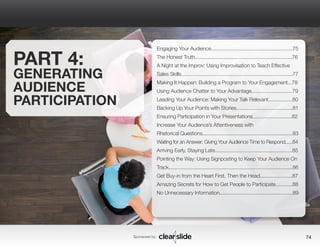
Part 4: Generating Audience Participation 
Engaging Your Audience........................................................75 
The Honest Truth...................................................................76 
A Night at the Improv: Using Improvisation to Teach Effective 
Sales Skills.............................................................................77 
Making It Happen: Building a Program to Your Engagement...78 
Using Audience Chatter to Your Advantage...........................79 
Leading Your Audience: Making Your Talk Relevant...............80 
Backing Up Your Points with Stories......................................81 
Ensuring Participation in Your Presentations..........................82 
Increase Your Audience’s Attentiveness with 
Rhetorical Questions..............................................................83 
Waiting for an Answer: Giving Your Audience Time to Respond...84 
Arriving Early, Staying Late.....................................................85 
Pointing the Way: Using Signposting to Keep Your Audience 
On Track................................................................................86 
Get Buy-in from the Heart First, Then the Head.....................87 
Amazing Secrets for How to Get People to Participate..........88 
No Unnecessary Information..................................................89
Part 5: Getting Them to Take Action 
Make It About Them...............................................................91 
Getting People to Take Action................................................92 
Trying Not to Try: Engaging Your Audience Without Fear........93 
Why Change? Making the Audience See the Problem...........94 
Fighting Fear: Channeling Your Anxiety for Better Presentations....95 
Practice Makes Perfect: Applying Concepts from Presentations...96 
Meeting Death by Poor Planning............................................97 
Trading In the Rhetoric: Using Simple Questions to Engage 
Your Audience........................................................................98 
Mesmerizing Your Audience with Storytelling.........................99 
Draining the Moat: Connecting with Your Audience.............100 
Sponsored by: 4 
TABLE OF CONTENTS 
Getting the Picture: Helping Your Audience Achieve 
Small Victories......................................................................101 
Following Up with Your Audience.........................................102 
Giving Presentations with a Purpose....................................103 
Building Trust by Selecting the Right Speaker......................104 
Committing to Act: Challenging Your Audience to Succeed...105 
Leave ‘em Laughing: Using Humor in Your Presentations....106 
Making Your Point Through Quotes.....................................107 
Demo Your Story..................................................................108 
3 Rules for Getting a Response to Your Prospecting E-mail...109 
Final Remarks...................................................................110
Part 5: Getting Them to Take Action 
Make It About Them.................................................. 
............... 
Getting People to Take Ac-tion.................................................. 
Trying Not to Try: Engaging Your Audience Without Fear.......... 
Why Change? Making the Audience See the Problem............. 
Fighting Fear: Channeling Your Anxiety for Better Presentations... 
Practice Makes Perfect: Applying Concepts from Presentations.. 
Meeting Death by Poor Planning............................................. 
Trading In the Rhetoric: Using Simple Questions to Engage 
Sponsored by: 5 
FOREWORD 
t ClearSlide, our vision is to power valuable, genuine business conversations for our customers. We want to blend 
technology with natural human interactions so that sales professionals and customers can connect more seamlessly 
and have the best possible experience. 
Most companies constantly seek ways to increase the productivity and impact of their sales team. Given the cost investment 
in people, if your company can increase its sales team’s productivity and effectiveness by any meaningful percentage, that 
increase can have dramatic impact on your business. That’s what ClearSlide does. ClearSlide is a sales engagement platform 
that accelerates revenue performance. 
To make the best use of a service like ClearSlide, sellers need to know how to pitch with impact. This e book is about the softer 
skills—the art of presenting your content with confidence, conviction, and influence. 
Regardless of whether you’re in sales, we think you’ll find the advice in this e book powerful and game changing in your every 
day life as you communicate and connect with others. 
Al Lieb, 
CEO of ClearSlide 
A
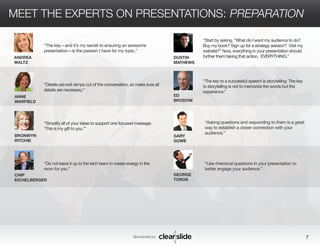
MEET THE EXPERTS ON PRESENTATIONS: PREPARATION 
DUSTIN 
MATHEWS 
“Start by asking, “What do I want my audience to do? 
Buy my book? Sign up for a strategy session? Visit my 
website?” Now, everything in your presentation should 
further them taking that action. EVERYTHING.” 
Sponsored by: 7 
ANDREA 
WALTZ 
ANNE 
WARFIELD 
BRONWYN 
RITCHIE 
CHIP 
EICHELBERGER 
ED 
BRODOW 
GARY 
GUWE 
GEORGE 
TOROK 
“The key—and it’s my secret to ensuring an awesome 
presentation—is the passion I have for my topic.” 
“Asking questions and responding to them is a great 
way to establish a closer connection with your 
audience.” 
“Use rhetorical questions in your presentation to 
better engage your audience.” 
“Details are exit ramps out of the conversation, so make sure all 
details are necessary.” 
“Simplify all of your ideas to support one focused message. 
‘This is my gift to you.’” 
“Do not leave it up to the tech team to create energy in the 
room for you.” 
“The key to a successful speech is storytelling. The key 
to storytelling is not to memorize the words but the 
experience.”
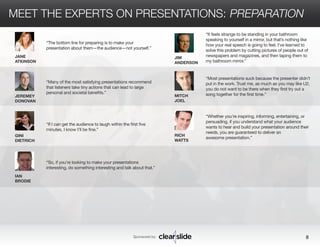
MEET THE EXPERTS ON PRESENTATIONS: PREPARATION 
Sponsored by: 8 
JANE 
ATKINSON 
JEREMEY 
DONOVAN 
JIM 
ANDERSON 
MITCH 
JOEL 
RICH 
WATTS 
“The bottom line for preparing is to make your 
presentation about them—the audience—not yourself.” 
“Many of the most satisfying presentations recommend 
that listeners take tiny actions that can lead to large 
personal and societal benefits.” 
“It feels strange to be standing in your bathroom 
speaking to yourself in a mirror, but that’s nothing like 
how your real speech is going to feel. I’ve learned to 
solve this problem by cutting pictures of people out of 
newspapers and magazines, and then taping them to 
my bathroom mirror.” 
“Most presentations suck because the presenter didn’t 
put in the work. Trust me, as much as you may like U2, 
you do not want to be there when they first try out a 
song together for the first time.” 
“Whether you’re inspiring, informing, entertaining, or 
persuading, if you understand what your audience 
wants to hear and build your presentation around their 
needs, you are guaranteed to deliver an 
GINI awesome presentation.” 
DIETRICH 
IAN 
BRODIE 
“If I can get the audience to laugh within the first five 
minutes, I know I’ll be fine.” 
“So, if you’re looking to make your presentations 
interesting, do something interesting and talk about that.”
MEET THE EXPERTS ON PRESENTATIONS: DELIVERY 
Sponsored by: 9 
ALESSANDRA 
CIMATTI 
ALEX 
CEQUEA 
ALEX 
RISTER 
ALEXEI 
KAPTEREV 
ANASTASIA 
PRYANIKOVA 
ANGELA 
DEFINIS 
ANTHONY 
IANNARINO 
ARDATH 
ALBEE 
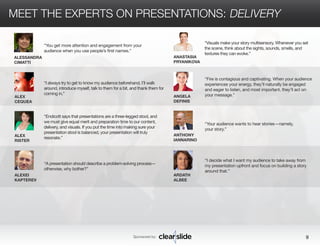
“You get more attention and engagement from your 
audience when you use people’s first names.” 
“Fire is contagious and captivating. When your audience 
experiences your energy, they’ll naturally be engaged 
and eager to listen, and most important, they’ll act on 
your message.” 
“Your audience wants to hear stories—namely, 
your story.” 
“I decide what I want my audience to take away from 
my presentation upfront and focus on building a story 
around that.” 
“I always try to get to know my audience beforehand. I’ll walk 
around, introduce myself, talk to them for a bit, and thank them for 
coming in.” 
“Endicott says that presentations are a three-legged stool, and 
we must give equal merit and preparation time to our content, 
delivery, and visuals. If you put the time into making sure your 
presentation stool is balanced, your presentation will truly 
resonate.” 
“A presentation should describe a problem-solving process— 
otherwise, why bother?” 
“Visuals make your story multisensory. Whenever you set 
the scene, think about the sights, sounds, smells, and 
textures they can evoke.”
MEET THE EXPERTS ON PRESENTATIONS: DELIVERY 
Sponsored by: 10 
COLLEEN 
FRANCIS 
CONOR 
NEILL 
DAN 
MCDADE 
DAN 
WALDSCHMIDT 
DAVE 
KURLAN 
DAVE 
PARADI 
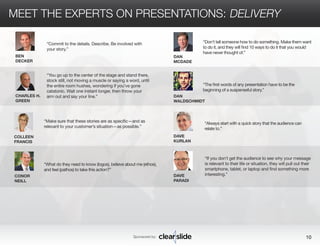
“Make sure that these stories are as specific—and as 
relevant to your customer’s situation—as possible.” 
“If you don’t get the audience to see why your message 
is relevant to their life or situation, they will pull out their 
smartphone, tablet, or laptop and find something more 
interesting.” 
“What do they need to know (logos), believe about me (ethos), 
and feel (pathos) to take this action?” 
“Don’t tell someone how to do something. Make them want 
to do it, and they will find 10 ways to do it that you would 
have never thought of.” 
“The first words of any presentation have to be the 
beginning of a suspenseful story.” 
“Always start with a quick story that the audience can 
relate to.” 
BEN 
DECKER 
CHARLES H. 
GREEN 
“Commit to the details. Describe. Be involved with 
your story.” 
“You go up to the center of the stage and stand there, 
stock still, not moving a muscle or saying a word, until 
the entire room hushes, wondering if you’ve gone 
catatonic. Wait one instant longer, then throw your 
arm out and say your line.”
MEET THE EXPERTS ON PRESENTATIONS: DELIVERY 
GARR 
REYNOLDS 
GARY 
GENARD 
JANICE 
TOMICH 
JOEY 
ASHER 
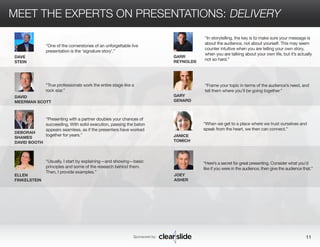
“In storytelling, the key is to make sure your message is 
about the audience, not about yourself. This may seem 
counter intuitive when you are telling your own story, 
when you are talking about your own life, but it’s actually 
not so hard.” 
“Frame your topic in terms of the audience’s need, and 
tell them where you’ll be going together.” 
“When we get to a place where we trust ourselves and 
speak from the heart, we then can connect.” 
“Here’s a secret for great presenting. Consider what you’d 
like if you were in the audience, then give the audience that.” 
Sponsored by: 11 
DAVE 
STEIN 
DAVID 
MEERMAN SCOTT 
ELLEN 
FINKELSTEIN 
“Presenting with a partner doubles your chances of 
succeeding. With solid execution, passing the baton 
appears seamless, as if the presenters have worked 
together for years.” 
“Usually, I start by explaining—and showing—basic 
principles and some of the research behind them. 
Then, I provide examples.” 
DEBORAH 
SHAMES 
DAVID BOOTH 
“One of the cornerstones of an unforgettable live 
presentation is the ‘signature story’.” 
“True professionals work the entire stage like a 
rock star.”
MEET THE EXPERTS ON PRESENTATIONS: DELIVERY 
Sponsored by: 12 
LISA B. 
MARSHALL 
MATT 
HEINZ 
PAUL J. 
RADICH 
TERRY 
GAULT 
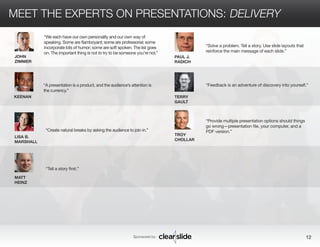
“Tell a story first.” 
“Solve a problem. Tell a story. Use slide layouts that 
reinforce the main message of each slide.” 
“Feedback is an adventure of discovery into yourself.” 
“Create natural breaks by asking the audience to join in.” 
TROY 
CHOLLAR 
“Provide multiple presentation options should things 
go wrong—presentation file, your computer, and a 
PDF version.” 
JOHN 
ZIMMER 
KEENAN 
“We each have our own personality and our own way of 
speaking. Some are flamboyant; some are professorial; some 
incorporate lots of humor; some are soft spoken. The list goes 
on. The important thing is not to try to be someone you’re not.” 
“A presentation is a product, and the audience’s attention is 
the currency.”
MEET THE EXPERTS ON PRESENTATIONS: PARTICIPATION 
Sponsored by: 13 
GAVIN 
MEIKLE 
GEETESH 
BAJAJ 
JILL 
KONRATH 
KEN 
THORESON 
LISA 
BRAITHWAITE 
LORI 
RICHARDSON 
MARK 
HUNTER 
“Lead with an interesting point, question, or 
statement that has a good chance of catching the 
audience’s attention.” 
“When it comes to engaging your audience, you 
have to share stories that vividly back up your 
points, or your audience will most certainly forget 
your points.” 
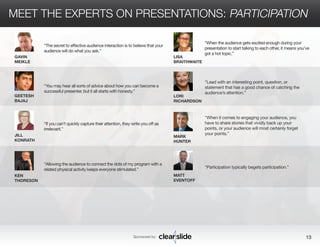
“The secret to effective audience interaction is to believe that your 
audience will do what you ask.” 
“You may hear all sorts of advice about how you can become a 
successful presenter, but it all starts with honesty.” 
“If you can’t quickly capture their attention, they write you off as 
irrelevant.” 
“Allowing the audience to connect the dots of my program with a 
related physical activity keeps everyone stimulated.” 
“When the audience gets excited enough during your 
presentation to start talking to each other, it means you’ve 
got a hot topic.” 
MATT 
EVENTOFF 
“Participation typically begets participation.”
MEET THE EXPERTS ON PRESENTATIONS: PARTICIPATION 
Sponsored by: 14 
SIMON 
RAYBOULD 
STEPHEN 
SHAPIRO 
VICKI 
HITZGES 
VIVEK 
SINGH 
MAX 
ATKINSON 
NICK 
MORGAN 
RIC 
BRETSCHNEIDER 
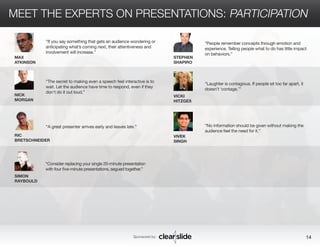
“People remember concepts through emotion and 
experience. Telling people what to do has little impact 
on behaviors.” 
“Laughter is contagious. If people sit too far apart, it 
doesn’t ‘contage.’” 
“No information should be given without making the 
audience feel the need for it.” 
“If you say something that gets an audience wondering or 
anticipating what’s coming next, their attentiveness and 
involvement will increase.” 
“The secret to making even a speech feel interactive is to 
wait. Let the audience have time to respond, even if they 
don’t do it out loud.” 
“A great presenter arrives early and leaves late.” 
“Consider replacing your single 20-minute presentation 
with four five-minute presentations, segued together.”
MEET THE EXPERTS ON PRESENTATIONS: TAKE ACTION 
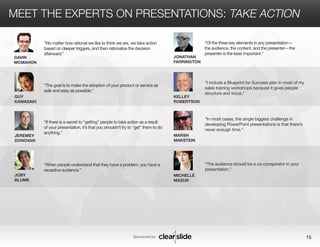
“No matter how rational we like to think we are, we take action 
based on deeper triggers, and then rationalize the decision 
afterward.” 
Sponsored by: 15 
GAVIN 
MCMAHON 
GUY 
KAWASAKI 
JEREMEY 
DONOVAN 
JOBY 
BLUME 
JONATHAN 
FARRINGTON 
KELLEY 
ROBERTSON 
MARSH 
MAKSTEIN 
MICHELLE 
MAZUR 
“I include a Blueprint for Success plan in most of my 
sales training workshops because it gives people 
structure and focus.” 
“In most cases, the single biggest challenge in 
developing PowerPoint presentations is that there’s 
never enough time.” 
“The audience should be a co-conspirator in your 
presentation.” 
“The goal is to make the adoption of your product or service as 
safe and easy as possible.” 
“If there is a secret to “getting” people to take action as a result 
of your presentation, it’s that you shouldn’t try to “get” them to do 
anything.” 
“When people understand that they have a problem, you have a 
receptive audience.” 
“Of the three key elements in any presentation— 
the audience, the content, and the presenter—the 
presenter is the least important.”
MEET THE EXPERTS ON PRESENTATIONS: TAKE ACTION 
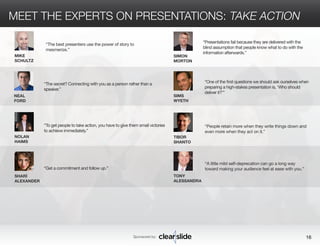
“The secret? Connecting with you as a person rather than a 
speaker.” 
Sponsored by: 16 
NEAL 
FORD 
NOLAN 
HAIMS 
SHARÍ 
ALEXANDER 
SIMON 
MORTON 
SIMS 
WYETH 
TIBOR 
SHANTO 
“People retain more when they write things down and 
even more when they act on it.” 
“To get people to take action, you have to give them small victories 
to achieve immediately.” 
“Get a commitment and follow up.” 
“Presentations fail because they are delivered with the 
blind assumption that people know what to do with the 
information afterwards.” 
“One of the first questions we should ask ourselves when 
preparing a high-stakes presentation is, ‘Who should 
deliver it?’” 
MIKE 
SCHULTZ 
“The best presenters use the power of story to 
mesmerize.” 
TONY 
ALESSANDRA 
“A little mild self-deprecation can go a long way 
toward making your audience feel at ease with you.”
MEET THE EXPERTS ON PRESENTATIONS: TAKE ACTION 
Sponsored by: 17 
TRISH 
BERTUZZI 
TUDOR 
GIRBA 
WENDY 
WEISS 
“Measurement is a part of what mangers do, but it isn’t the why. 
The why is about people.” 
“We crave concreteness. We want to sense. Our 
imagination thrives on examples. Tap that opportunity.” 
“The rule in a cold call or a cold e-mail is that you must 
be clear.”
PART 1: 
HOW TO GIVE A 
GREAT PRESENTATION 
(SERIOUSLY) 
Sponsored by: 18
HOW TO GIVE A GREAT PRESENTATION (SERIOUSLY) 
ou’re doing it wrong. 
People hate it when someone says, “you’re doing it wrong,” but trust 
me... you’re doing it wrong when it comes to how you prepare for a public 
speech. I’m sure this will upset many people, but let’s walk through the 
typical scenario of how someone is asked to speak and what happens next: 
• Step 1: someone gets asked to present on a specific topic. 
• Step 2: the presenter agrees to present. 
• Step 3: the presenter puts it in the back of their mind that they must prepare for 
this event, but because speaking in public is so nerve-wracking, they put it off for 
the last possible moment. 
• Step 4: in the week leading up to the presentation, the speaker starts writing 
down notes and building a PowerPoint deck. It could be more severe than this. 
Sometimes they write up the speech that they are going to read to the audience 
(please don’t do this). 
• Step 5: a day or two (but mostly likely, the night before), the speaker runs 
through the slides and (if they’re really keeners) will practice it formally in front of 
a mirror a few times. 
• Step 6: they deliver their presentation to an unsuspecting crowd. 
Sound familiar? 
© 2014 Studio B Productions, Inc. All rights reserved. 
Sponsored by: 19 
MITCH JOEL 
President of Twist Image 
Mitch Joel is President of Twist 
Image – one of the largest 
independent Digital Marketing 
agencies in North America 
(although he prefers the title Media 
Hacker). Back in 2006 he was 
named one of the most influential 
authorities on blog marketing in 
the world. He has been called a 
marketing and communications 
visionary, interactive expert and 
community leader. He is also a 
blogger, podcaster, passionate 
entrepreneur and speaker who 
connects with people worldwide 
by sharing his marketing and 
innovation insights on the state of 
business. 
Twitter I Website 
Y
HOW TO GIVE A GREAT PRESENTATION (SERIOUSLY) 
This is, without question, the worst way to ever give a public presentation, and yet 
this is how the vast majority do it. Why? Because the first time that the speaker is ever 
going to give this presentation will be the most important time and - possibly - the last 
time as well. Ultimately, you are taking this material for a test drive when, in fact, that 
audience is the grand prix. When you are asked to present, the material should already 
have been road tested, tweaked and perfected (as much as possible). It sounds like 
a lot of work, doesn’t it? Well, that’s the point. Most presentations suck because the 
presenter didn’t put in the work. Trust me, as much as you may like U2, you do not 
want to be there when they first try out a song together for the first time. It takes a lot 
of work to get that song to the point when it is ready for an album or live show. 
This is how to really prepare for a public speech. 
© 2014 Studio B Productions, Inc. All rights reserved. 
Sponsored by: 20 
MITCH JOEL 
President of Twist Image 
Mitch Joel is President of Twist 
Image – one of the largest 
independent Digital Marketing 
agencies in North America 
(although he prefers the title Media 
Hacker). Back in 2006 he was 
named one of the most influential 
authorities on blog marketing in 
the world. He has been called a 
marketing and communications 
visionary, interactive expert and 
community leader. He is also a 
blogger, podcaster, passionate 
entrepreneur and speaker who 
connects with people worldwide 
by sharing his marketing and 
innovation insights on the state of 
business. 
Twitter I Website
Setting the Stage for Success 
Someone gets asked to present on a specific topic. 
Don’t agree to speak unless you have enough time to prepare and test the content out live in front of 
a few real audiences (this can be a simple lunch and learn at your office, joining your local 
Toastmasters or asking some friends to endure it over some beer and pizza). 
Don’t agree to the topic that is being requested. Let the people who are asking know that you will get 
back to them in 48 hours with some thoughts on what the topic should be. 
Spend the next day thinking about what you would like to present and how it will come together. 
Jot down some simple notes and top line thoughts on the subject. 
Get confirmation and finalize the speaking topic – to your satisfaction – with the event organizers. 
MORE THOUGHTS ON SETTING THE STAGE FOR SUCCESS: 
“When people understand that they have a problem, you have a receptive 
audience.” 
JOBY BLUME 
“Of the three key elements in any presentation—the audience, the 
content, and the presenter—the presenter is the least important.” 
JONATHAN FARRINGTON 
“One of the first questions we should ask ourselves when preparing a 
high-stakes presentation is, “Who should deliver it?” 
SIMS WYETH 
“The key—and it’s my secret to ensuring an awesome presentation 
— is the passion I have for my topic.” 
ANDREA WALTZ 
Sponsored by: 21 
“Your audience wants to hear stories—namely, your story.” 
ANTHONY IANNARINO 
“The goal is to make the adoption of your product or service as safe 
and easy as possible.” 
GUY KAWASAKI
Time to prepare your content. 
Rehearsal time. 
Time to present and get feedback from colleagues. 
The event date. 
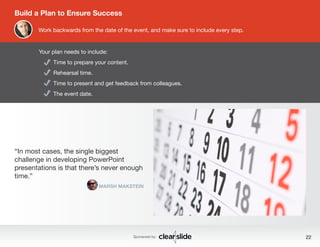
Sponsored by: 22 
Build a Plan to Ensure Success 
Work backwards from the date of the event, and make sure to include every step. 
Your plan needs to include: 
“In most cases, the single biggest 
challenge in developing PowerPoint 
presentations is that there’s never enough 
time.” 
MARSH MAKSTEIN
Build an outline for your presentation. If you have never done this before, check out the work of Nancy 
Duarte, Nick Morgan and Garr Reynolds. All three of these presentation masters have tons of free content 
on how to structure a solid presentation. 
Build your presentation. Have no more than three areas of focus. 
“Visuals make your story multisensory. Whenever you set the 
scene, think about the sights, sounds, smells, and textures they 
can evoke.” 
ANASTASIA PRYANIKOVA 
Sponsored by: 23 
“If you say something that gets an audience wondering or 
anticipating what’s coming next, their attentiveness and 
involvement will increase.” 
MAX ATKINSON 
“Details are exit ramps out of the conversation, so make sure all 
details are necessary.” 
ANNE WARFIELD 
“I decide what I want my audience to take away from my 
presentation upfront and focus on building a story around that.” 
ARDATH ALBEE 
Your First Draft 
Craft your outline and start building your presentation. 
“A presentation should describe a problem-solving process— 
otherwise, why bother?” 
ALEXEI KAPTEREV 
“If you don’t get the audience to see why your message is relevant to their 
life or situation, they will pull out their smartphone, tablet, or laptop and 
find something more interesting.” 
DAVE PARADI 
“Lead with an interesting point, question, or statement that has a good 
chance of catching the audience’s attention.” 
LORI RICHARDSON 
“No matter how rational we like to think we are, we take action based on 
deeper triggers, and then rationalize the decision afterward.” 
GAVIN MCMAHON 
MORE THOUGHTS ON YOUR FIRST DRAFT:
“Consider replacing your single 20-minute presentation with four 
five-minute presentations, segued together.” 
SIMON RAYBOULD 
Integrate your coach’s feedback. 
Practice some more on your own, and watch speakers that 
you would consider to be great (YouTube is amazing for this). 
Think about what they’re doing that wins you over. Try to 
integrate those lessons into your own presentations. 
Step away from the content for a few days. 
Step back in and keep practicing. 
Sponsored by: 24 
Getting Feedback and Practicing 
If you don’t think that your presentation skills are up to snuff, please enlist some help. Again, 
Toastmasters is great, a local presentation skills coach or even a local stand-up comedian can 
best help you massage the content and build proper presentation skills. You will be amazed at 
what you can learn in just a couple of hours. 
Rehearse on your own. 
Rehearse in front of the smaller audiences. 
Ask them for candid feedback. 
Integrate the feedback that makes sense. 
Rehearse in front of another smaller audience. 
Ask them for candid feedback. 
Integrate the feedback that makes sense. 
Ask one of your presentation coaches for their 
feedback once you have integrated everything 
from all of your test-run speeches. 
“No information should be given without making the audience feel the 
need for it.” 
VIVEK SINGH 
“Feedback is an adventure of discovery into yourself.” 
TERRY GAULT 
MORE THOUGHTS ON GETTING FEEDBACK AND PRACTICING:
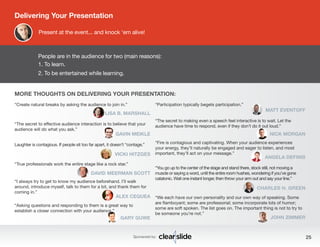
People are in the audience for two (main reasons): 
1. To learn. 
2. To be entertained while learning. 
MORE THOUGHTS ON DELIVERING YOUR PRESENTATION: 
Sponsored by: 25 
“Create natural breaks by asking the audience to join in.” 
LISA B. MARSHALL 
“The secret to effective audience interaction is to believe that your 
audience will do what you ask.” 
GAVIN MEIKLE 
Laughter is contagious. If people sit too far apart, it doesn’t “contage.” 
VICKI HITZGES 
“True professionals work the entire stage like a rock star.” 
DAVID MEERMAN SCOTT 
“I always try to get to know my audience beforehand. I’ll walk 
around, introduce myself, talk to them for a bit, and thank them for 
coming in.” 
ALEX CEQUEA 
“Asking questions and responding to them is a great way to 
establish a closer connection with your audience.” 
GARY GUWE 
Delivering Your Presentation 
Present at the event... and knock ‘em alive! 
“Participation typically begets participation.” 
MATT EVENTOFF 
“The secret to making even a speech feel interactive is to wait. Let the 
audience have time to respond, even if they don’t do it out loud.” 
NICK MORGAN 
“Fire is contagious and captivating. When your audience experiences 
your energy, they’ll naturally be engaged and eager to listen, and most 
important, they’ll act on your message.” ANGELA DEFINIS 
“You go up to the center of the stage and stand there, stock still, not moving a 
muscle or saying a word, until the entire room hushes, wondering if you’ve gone 
catatonic. Wait one instant longer, then throw your arm out and say your line.” 
CHARLES H. GREEN 
“We each have our own personality and our own way of speaking. Some 
are flamboyant; some are professorial; some incorporate lots of humor; 
some are soft spoken. The list goes on. The important thing is not to try to 
be someone you’re not.” JOHN ZIMMER
HOW TO GIVE A GREAT PRESENTATION (SERIOUSLY) 
Sounds like a lot of hard work, doesn’t it? 
It is. Great public speakers make it look easy. While it feels like they’re presenting the 
content for the very first time, most of them have practiced, nurtured, tweaked and 
road-tested their material. They look comfortable because they are 
comfortable and familiar with the content. 
Sadly, most presenters are so unprepared that their only goal is to either get to the 
end of their slides in their allotted time or read their pre-written speech from the 
podium without wetting their pants. What most presenters fail to realize is that nobody 
cares about you getting to the end of your slides or if you survived reading a 
document in public. 
No matter how serious the event is, people don’t want to be sitting all day and be 
bored listening to people reading from slides or reading from their printed out Word 
document. 
So, the next time you’re asked to present, don’t just say 
“yes”, unless you’re willing to commit the serious time, 
effort and energy to do it right. 
Why? Because if you don’t take it seriously, you’re just perpetuating a world where all 
of us have to endure another slew of painful meetings and presentations. 
Who wants that? 
Sponsored by: 26 
MITCH JOEL 
President of Twist Image 
Mitch Joel is President of Twist 
Image – one of the largest 
independent Digital Marketing 
agencies in North America 
(although he prefers the title Media 
Hacker). Back in 2006 he was 
named one of the most influential 
authorities on blog marketing in 
the world. He has been called a 
marketing and communications 
visionary, interactive expert and 
community leader. He is also a 
blogger, podcaster, passionate 
entrepreneur and speaker who 
connects with people worldwide 
by sharing his marketing and 
innovation insights on the state of 
business. 
Twitter I Website
Sponsored by: 27 
PART 2: 
PLANNING AND 
PREPARING 
PRESENTATIONS 
Love Your Topic, Change People’s Minds...............................28 
Make Your Presentation Rock.................................................29 
It’s Not a Speech, It’s a Gift...................................................30 
Lights, Camera, Action—Engage!............................................31 
Tap Your Experience for a Fantastic Speech...............................32 
Connecting with Your Audience..............................................33 
Ask a (Rhetorical) Question.....................................................34 
Leave ‘Em Laughing................................................................35 
A Life Worth Talking About......................................................36 
To (What) So That (Why)..........................................................37 
Be Giving, Be Kind, Be There..................................................38 
Talking to the President...........................................................39 
Know Thy Audience................................................................40 
Do It… Backwards..................................................................41
LOVE YOUR TOPIC, CHANGE PEOPLE’S MINDS 
started off being absolutely terrified to speak. By 7th grade, after a 
disastrous “oral report” on the dangers of smoking, I committed myself 
to doing whatever it took never to speak in front of any group ever again. 
Fast-forward to today, and I’ve now spoken in front of audiences of 
thousands. So, what changed? 
The key—and it’s my secret to ensuring an awesome presentation—is the 
passion I have for my topic. Apparently, I wasn’t too excited about the dangers 
of smoking. But today, teaching people our strategies for overcoming fear of 
failure and rejection, there is nothing I’d rather talk about. I can talk about it for 
hours. I’m wildly in love with and passionate about changing the way people 
think in these areas. 
So, when I prepare for a presentation, I think about the stories, examples, and 
passion I need to bring out to change people’s thinking. Because my husband 
and I speak together, we make sure we tell stories of our failures and fears of 
rejection so that people see we are just like them. We don’t speak from “on 
high,” and we needed our message as much as the audience does now! 
KEY LESSONS 
1 
2 
3 
BE PASSIONATE ABOUT YOUR 
TOPIC. 
THINK ABOUT THE STORIES 
AND EXAMPLES THAT CAN 
CHANGE PEOPLE’S THINKING. 
DON’T SPEAK FROM “ON HIGH.” 
“The key . . . is the passion I have for my topic.” 
Sponsored by: 28 
ANDREA 
WALTZ 
Author 
Andrea Waltz is the coauthor 
of Go for No! Yes Is the 
Destination, No Is How You 
Get There. With her husband 
and business partner Richard 
Fenton, she seeks to liberate 
people from fear of failure, 
sharing a new mindset about 
hearing the word no. Her 
philosophy has been embraced 
by people in many industries 
with amazing results. Andrea’s 
book hit #1 on Amazon’s 
“Selling” list and has remained in 
the “Sales” top 20 for the past 
three years. 
Twitter I Website 
I
MAKE YOUR PRESENTATION ROCK 
ave you ever received a gift that doesn’t fit who you are? What was 
supposed to be a gift can now be a source of irritation. 
Well, your presentation should be a “gift” to the audience, one that 
fits the people so perfectly that they can’t help but act on what you 
say. So, how do you make sure your presentation does that? 
• State the goal from the audience’s perspective. It should tell them exactly 
what they will get out of their time with you. 
• Have a clear roadmap that answers the questions your audience has for them 
to say, “Yes, I can do that.” 
• Keep it simple. Details are exit ramps out of the conversation, so make sure all 
details are necessary. If they aren’t, throw them out. 
• Logic makes you think, emotions make you act. Make sure you have a 
compelling story, interesting fact, or intriguing question up front to open their 
minds. 
• Talk with your audience, not at them. 
Challenge yourself to review your next presentation. See it from the recipient’s 
side, and make sure it is truly a present the audience will value. 
KEY LESSONS 
1 
2 
3 
PUT YOURSELF IN YOUR 
AUDIENCE’S SHOES. 
KEEP IT SIMPLE. 
HAVE A COMPELLING STORY 
TO OPEN YOUR LISTENERS’ 
MINDS. 
“Details are exit ramps out of the conversation, so 
make sure all details are necessary.” 
Sponsored by: 29 
ANNE 
WARFIELD 
CEO 
As a leading outcome strategist, 
Anne Warfield shows leaders 
how to be more influential by 
saying the right thing at the 
right time, every time. The 
revolutionary Outcome Thinking® 
is a brain-based methodology 
that shows you how to be 
transformational when you 
present, negotiate, sell, or lead. 
Anne has worked with NBC, 
ABC, CBS, and radio stations 
around the world. 
b 
Twitter I Website I Blog 
H
IT’S NOT A SPEECH, IT’S A GIFT 
he success of a presentation begins with changing your definition 
of what you are doing. This is not a speech . . . not a presentation. 
Define it instead as gift giving, and make the difficulties of preparation 
melt away. 
I realized the value of this redefinition when I was on stage presenting a gift to a 
male colleague. I was using eye contact, using humor I knew we both enjoyed; 
we were interacting, even though this was a stand-up speech. I have found that 
if I create every presentation as a gift, so many things (not just that engagement 
with audience) are so much easier and more natural. 
The first step is to make the central message a statement of gift giving: “I have this 
[product, idea, technique, message]. It is my gift to you.” In doing so you: 
• Satisfy the WIIFM factor. Explain why you chose it for them especially and 
why they will like it, why it will meet their needs. Encourage the recipients to 
visualize themselves using the gift with positive results. 
• Establish your credibility. Explaining your process for choosing this gift builds 
trust in you as a gift-giver—and as a speaker. 
• Allay your fears. If you see this as a gift giving—a pleasant, positive 
experience—you diminish the concept of a performance to be judged. 
• Create an exchange. If your message is seen as a gift, then perhaps the 
audience will be predisposed to reciprocate with openness and support. 
• Simplify all of your ideas to support one focused message. “This is my 
gift to you.” 
KEY LESSONS 
1 
2 
3 
THE SUCCESS OF A PRESEN-TATION 
BEGINS WITH 
CHANGING YOUR DEFINITION 
OF WHAT YOU ARE DOING. 
MAKE YOUR CENTRAL 
MESSAGE A STATEMENT OF 
GIFT GIVING. 
SIMPLIFY YOUR IDEAS TO 
SUPPORT ONE FOCUSED 
MESSAGE. 
“If you create every presentation as a gift, so 
many things . . . are so much easier and more 
natural.” 
Sponsored by: 30 
BRONWYN 
RITCHIE 
Founder, Curator, 
Author, Speech Coach 
Bronwyn Ritchie is a speech and 
presentation coach dedicated 
to providing resources and new 
ways of thinking for speakers 
to achieve their personal best. 
Bronwyn is a certified corporate 
trainer and speech contest judge 
with POWERtalk, a certified 
World Class Speaking coach, 
and has 30 years of experience 
encouraging, training, and 
coaching in public speaking. 
She is founder, curator, 
author, and coach at 
pivotalpublicspeaking.com. 
b 
Twitter I Website I Blog 
T
LIGHTS, CAMERA, ACTION—ENGAGE! 
developed my style of engaging an audience while working for motivational 
speaker Tony Robbins from 1988 to 1993. My job was to lead sales teams 
and work with promoters who filled his events throughout the United States, 
the United Kingdom, and Australia. I did talks to sell tickets, mostly to 
skeptical sales people. I had to get commitments to take action now and 
purchase tickets. I gave more than 1,200 talks before my first paid event. 
I quickly learned the difference between presentation and persuasion. If I did 
a presentation, people would smile, thank me for coming, and say they would 
“think about it.” But if I engaged, challenged, and persuaded them, I got ap-plause, 
ticket sales on the spot, and referrals. What actions are you persuading 
audiences to take? 
Audience engagement begins before the event. Calling and interviewing partici-pants 
from different levels of the organization are essential. When possible, obtain 
permission to use direct quotes that illustrate that you have done your homework. 
You want the audience to think, “Wow, how did the speaker know all that? He 
was really well prepared.” 
When you arrive at the event, it is helpful to attend a few sessions and converse 
with other attendees over a meal before you speak. Introduce yourself to as many 
people as possible. Referencing what you learn will boost your credibility and 
score points with even the most skeptical audience members. 
Before you go on stage, select the right music to set a fun, energetic tone for 
your presentation. Do not leave it up to the tech team to create energy in the 
room for you. 
KEY LESSONS 
1 
2 
3 
KNOW THE DIFFERENCE 
BETWEEN PRESENTATION AND 
PERSUASION. 
AUDIENCE ENGAGEMENT 
BEGINS BEFORE THE EVENT. 
REFERENCING WHAT YOU 
LEARN FROM PRE-TALK 
INTERVIEW BOOSTS YOUR 
CREDIBILITY. 
“Do not leave it up to 
the tech team to 
create energy in the 
room for you.” 
Sponsored by: 31 
CHIP 
EICHELBERGER 
Motivational 
Keynote Speaker 
Chip Eichelberger, CSP, has 
switched on more than 900 
conventions in the past 17 
years. He engages his audiences 
to look in the mirror, put on the 
hat of personal responsibility, 
and get switched on! To get 
Eichelberger’s recommended 
room setup and logistics guide 
to make your next event more 
engaging, contact him at 
chip@getswitchedon.com. 
b 
Twitter I Website I Blog 
I
TAP YOUR EXPERIENCE FOR A FANTASTIC SPEECH 
he key to a successful speech is storytelling. The key to 
storytelling is not to memorize the words but the experience. 
As a trained stage and film actor, I do this using a technique called 
personalization, or tapping into an experience from my life and 
applying the emotional impact of that experience to the story. 
For example, when Anthony Hopkins is playing the role of serial killer Hannibal 
Lecter in the film, Silence of the Lambs, he re-creates the emotional impact from 
an experience in his life where he was so mad that he wanted to kill someone. 
What we see on the screen is Hopkins as a psychopathic killer. In reality, 
Hopkins the actor is playing out the emotional reality of his substituted 
experience. 
One of my best-known signature stories is the “Meatball Sandwich.” As I 
describe each person’s action in the story, I substitute my own behavior from 
a similar experience. When I relate a character’s reaction to the situation, it is I 
reacting. As a result, no one else can tell this story the way I do. Each time I tell 
the story, it is different, but it always grabs the audience, because the emotions 
and behavior are alive and in the moment. 
KEY LESSONS 
1 
2 
3 
STORYTELLING IS THE KEY TO 
A SUCCESSFUL SPEECH. 
APPLY THE EMOTIONAL IMPACT 
OF YOU EXPERIENCES TO THE 
STORY. 
KEEP THE STORIES FRESH. 
“The key to storytelling is not to memorize the 
words but the experience.” 
Sponsored by: 32 
ED BRODOW 
CEO 
Ed Brodow is a top spokesman 
on the art of negotiation. SEC 
Chairman Harvey Pitt dubbed 
Ed “the King of Negotiators,” 
and Forbes magazine ranked 
him as one of America’s leading 
dealmakers. A nationally 
recognized television personality, 
Ed has appeared on PBS, ABC 
National News, and Inside 
Edition. He is the author of six 
books, including Negotiation 
Boot Camp: How to Resolve 
Conflict, Satisfy Customers, 
and Make Better Deals. Ed 
has enthralled audiences in 
Paris, Athens, Tokyo, Frankfurt, 
Bogota, Toronto, and New York. 
b 
Twitter I Website I Blog 
T
CONNECTING WITH YOUR AUDIENCE 
uilding rapport and connecting with your audience are key to 
helping you succeed on stage. Here are three tips to help you 
connect with your audience: 
• Determine the audience’s goals and interests. An audience gathers for a 
reason. The people are there to achieve a specific goal or purpose, so consid-er 
these questions: What are people’s life or career concerns? What are their 
pain and pleasure points? What solutions or interesting perspectives can you 
offer to help them? 
• Ask questions. Asking questions and responding to them is a great way to 
establish a closer connection with your audience because (1) spontaneity 
suggests that it is not a rehearsed performance, so you are being genuine 
and sincere; (2) it suggests that you care about them; and (3) the audience 
members get to share their concerns. 
• Tell a good story (and deliver a point). Stories allow you to paint vivid 
pictures and articulate emotions with words. They also allow you to share 
common concerns and experiences, which will help the audience know that 
you’re on the same page. Use descriptive words, weave in emotions, and 
lead them toward a lesson. 
As a final tip, end your speech on a high with recommendations or a resolution 
to your story! 
KEY LESSONS 
1 
2 
3 
BUILD A RAPPORT WITH YOUR 
AUDIENCE. 
DETERMINE YOUR LISTENERS’ 
GOALS AND INTERESTS. 
TELL A GOOD STORY. 
“Asking questions and responding to them is a 
great way to establish a closer connection with 
your audience.” 
Sponsored by: 33 
GARY GUWE 
Lead Trainer 
Gary Guwe is an award-winning 
speaker and entrepreneur from 
Singapore. An introvert by 
nature, Gary broke through his 
apprehension of public speaking 
when he realized the limitations 
his fear had on his life and 
career. Now a proud owner of 
three successful enterprises, 
he continues to inspire others 
to speak up and stand out by 
sharing his insights on public 
speaking as a communication 
skills coach. His successes have 
landed him a role lecturing at 
Singapore’s top university. 
Twitter I Website 
B
ASK A (RHETORICAL) QUESTION 
se rhetorical questions in your presentation to better engage your 
audience—a simple, yet powerful technique. It works 
especially well when delivering detailed technical information and 
when you want to persuade your listeners. 
Here’s how it works: 
• Asking a question grabs the attention of your audience. Human beings are 
programmed to respond to questions. 
• Your listeners might already be thinking that question. They will feel that you 
understand them by knowing and answering their questions. 
• Posing a rhetorical question before you give important information builds 
anticipation for the information. 
• Asking a question makes your voice more interesting, because you will 
naturally inflect your voice while asking the question. 
• This is your secret for when you forget what comes next. Pose the question 
out loud to help get your brain back on track. 
Here are a few examples of effective rhetorical questions: 
• What’s the next step? 
• What are the benefits for you? 
• What is our schedule for implementation? 
• What have customers said about this program? 
• How will this change affect you? 
Sprinkle rhetorical questions throughout your presentation to recapture your 
listeners’ attention, sound more interesting, and make your talk feel like a 
conversation. 
KEY LESSONS 
1 
2 
3 
ASKING QUESTIONS GRABS 
YOUR AUDIENCE’S ATTENTION. 
POSING A RHETORICAL 
QUESTION RAISES ANTICIPATION 
FOR THE ANSWER. 
ASKING A QUESTION INFLECTS 
YOUR VOICE, MAKING YOUR 
VOICE SOUND MORE INTERESTING. 
“Human beings are 
programmed to 
respond to questions.” 
Sponsored by: 34 
GEORGE 
TOROK 
Speech Coach for 
Executives 
George Torok was a shy student 
who was afraid to deliver a 
speech to his school. Today, 
he delivers paid speeches for 
corporations and association 
conferences. He has delivered 
more than 1,000 professional 
presentations and trains 
professionals, experts, and 
sales teams to deliver superior 
presentations. George coaches 
executives to deliver million 
dollar presentations, including 
one client whom George helped 
close a $10 million deal. 
b 
Twitter I Website I Blog 
U
LEAVE ‘EM LAUGHING 
’m an introvert. Going on stage not only scares the heck out of me, it 
drains all of my energy. But I’m also a type A personality and hugely 
competitive, so I push myself outside of my comfort zone nearly every day. 
I started speaking in 2008, right before the economy crashed. I did my first 
speaking engagement as a favor to a client, and then, when the United States 
was in the middle of the Great Recession, I needed to create additional revenue 
streams simply so I could make payroll. I pushed myself outside of my comfort 
zone out of sheer necessity. 
Today, speaking is the number one driver of revenue for the public relations firm 
side of my business. So, my team won’t let me stop! 
But here’s my secret: I overprepare for every engagement. I may have done 
the same speech a thousand times, but I add something new for a specific 
audience, I research the companies in attendance and use examples from their 
online communications during the keynote, or I rehearse for the millionth time. If I 
can get the audience to laugh within the first five minutes, I know I’ll be fine. 
KEY LESSONS 
1 
2 
3 
OVERPREPARE FOR EVERY 
ENGAGEMENT. 
ADD ELEMENTS SPECIFIC TO 
YOUR AUDIENCE. 
TO THE EXTENT POSSIBLE, 
RESEARCH YOUR AUDIENCE. 
“If I can get the audience to laugh within the first 
five minutes, I know I’ll be fine.” 
Sponsored by: 35 
GINI DIETRICH 
Chief Executive 
Officer 
Gini Dietrich is the founder 
and CEO of Arment Dietrich, 
a Chicago-based integrated 
marketing communications firm. 
She is the lead blogger at Spin 
Sucks and the founder of Spin 
Sucks Pro. She is the coauthor 
of Marketing in the Round 
and cohost of Inside PR. Her 
second book, Spin Sucks, is 
out now. 
b 
Twitter I Website I Blog 
I
A LIFE WORTH TALKING ABOUT 
he secret to delivering awesome, interesting, non-boring presentations, 
in my experience, happens way before you step on stage. 
You see, if you want to deliver an awesome, interesting presentation, 
you have to have something awesome and interesting to talk about. 
No amount of presentation skills or verbal fireworks can cover for dull material. 
How do you come up with that great material? Well, the standard advice you’ll get 
is to tell stories. Bring up funny anecdotes and dramatic experiences from your 
past that illustrate your points. The problem for most of us is that we don’t have 
many of those anecdotes, stories, or experiences. Those we do have may not fit 
the topic we’re talking about. 
So, what do you do if you don’t have interesting experiences to share? You 
make them. 
If you’re a leadership coach, for example, rather than trotting out the theory of 
great leadership or dredging up the same examples as everyone else, take up a 
voluntary and challenging leadership role yourself and use your experiences to 
illustrate your story. Years ago, I decided that the topic I was most interested in 
and most wanted to talk about was how to become known as an expert in your 
field. I had done a ton of research and interviewed many leading experts, but what 
really brought my talks alive was when I tried the methods on myself and used the 
talks to report on my own successes and failures. Those real-world experiences 
and stories hit much, much harder than anything from academic research or sec-ond- 
Sponsored by: 36 
hand data on others. 
So, if you’re looking to make your presentations interesting, do something 
interesting and talk about that. 
KEY LESSONS 
1 
2 
3 
TELL STORIES. 
USE ANECDOTES TO ILLUSTRATE 
YOUR POINTS. 
REAL-WORLD EXPERIENCES 
HAVE MORE IMPACT THAN 
SECOND-HAND RESEARCH. 
“No amount of 
presentation skills or 
verbal fireworks can 
cover for dull material.” 
IAN BRODIE 
Managing 
Director 
Ian Brodie works with 
consultants, coaches, and 
other professionals to help 
them attract and win more 
clients. In a world increasingly 
filled with hype, exaggeration, 
and “shiny new objects,” Ian’s 
simple strategies help busy 
professionals be more confident 
and competent at marketing and 
sales and—most importantly— 
get results. Recently named one 
of the Top 50 Global Thought 
Leaders in Marketing and Sales 
by Top Sales World magazine, 
his Web site is a “Resource of 
the Decade” for professional 
services marketing. 
b 
Twitter I Website I Blog 
T
BE GIVING, BE KIND, BE THERE 
y presentations are primarily to groups of professional speakers. 
Sometimes, that can feel quite daunting, especially when I know 
there are going to be a good number of seasoned pros in the 
house. But I’ve learned a thing or two about preparation and 
pre-gig mantras from my clients and colleagues over the years, 
and I lean heavily on those when the stakes are high. 
Here are my three tips for hitting it out of the park: 
• Know your stuff. When the rubber hits the road, knowing your material is the 
best way to ease the nerves. Because I have 20 years of experience, it’s rare 
that I feel nervous any more. But in the early days, I would prepare like crazy. The 
more relevant your material to the audience, the less likely they are to judge your 
speaking style. 
• Rehearse your key elements. Victoria Labalme talks about not memorizing 
every bit of your presentation or it may come off false. It’s better to get your key 
parts “in your bones” (so they sound conversational), especially your 
opening and closing stories. 
• Develop a formula. If you can pull all of your content into a neat package or 
formula, you’ll allow people to digest it more easily. Lou Heckler says that three 
points work, and I believe him. The goal is that when people walk out of the 
room, they can easily remember and repeat your formula for success. 
The bottom line for preparing is to make your presentation about them—the 
audience—not yourself. That’s why I have a mantra when stepping on stage that 
revolves around being giving, being kind, and being there for them. 
KEY LESSONS 
1 
2 
3 
KNOW YOUR STUFF. 
REHEARSE YOUR KEY 
ELEMENTS. 
DEVELOP A FORMULA. 
“The goal is that when 
people walk out of the 
room, they can easily 
remember and repeat 
your formula for 
success.” 
Sponsored by: 37 
JANE 
ATKINSON 
Author 
Jane Atkinson has been 
helping speakers catapult their 
businesses for more than 20 
years. As a former speaker’s 
agent, she has represented 
numerous speakers, celebrities, 
and best-selling authors. 
Today, Jane coaches some 
of the industry’s hottest stars, 
who have vaulted to the top 3 
percent of the field. Her book, 
The Wealthy Speaker 2.0, has 
been called “the bible” of the 
speaking industry. Her follow-up, 
The Epic Keynote, is due out in 
early 2014. 
b 
Twitter I Website I Blog 
M
TO (WHAT) SO THAT (WHY) 
he mission of most presentations is to call listeners to action in a 
way that makes their lives better. Many of the most satisfying 
presentations recommend that listeners take tiny actions that 
can lead to large personal and societal benefits. Since people are 
naturally stuck in their ways, the tiny actions suggested need to be 
fast, cheap, and easy. 
One of my favorite examples is Joe Smith, who started his talk at TEDxConcor-diaUPortland 
in 2012 with the following: “If we [Americans] could reduce the 
usage of paper towels, one paper towel per person per day, 571,230,000 
pounds of paper [would] not [be] used.” 
While there is no single best way to phrase your idea worth spreading, there is 
an excellent way to think about it during the planning stages. To impose good 
discipline, the format I recommend is: “To (what) so that (why).” The “what” is 
the action you want your audience to take; the “why” is the benefit that action 
provides to them or planet. 
While you may or may not explicitly state that objective in your talk, having it in 
your mind provides a guide to what must go into your presentation and what 
must be edited out. 
KEY LESSONS 
1 
2 
3 
MAKE CALLS TO ACTION FAST, 
CHEAP, AND EASY. 
HAVE A CLEAR OBJECTIVE IN 
MIND FOR YOUR TALK. 
THERE IS NO SINGLE BEST WAY 
TO PHRASE YOUR IDEA. 
“The mission of most presentations is to call 
listeners to action in a way that makes their 
lives better.” 
Sponsored by: 38 
JEREMEY 
DONOVAN 
Principal 
Jeremey Donovan is Chief 
Marketing Officer of American 
Management Association 
International. He is the author 
of four books, including the 
international public speaking 
best seller, How to Deliver a 
TED Talk. 
Twitter I Website 
T
TALKING TO THE PRESIDENT 
e all know that before you give a presentation, you need to 
practice, practice, practice, but it turns out that doing so can 
be difficult. It feels strange to be standing in your bathroom 
speaking to yourself in a mirror, but that’s nothing like how your 
real speech is going to feel. 
I’ve learned to solve this problem by cutting pictures of people out of 
newspapers and magazines, and then taping them to my bathroom mirror. I 
can’t tell you how many times I’ve practiced a speech with Sir Richard Branson, 
Madonna, Lady Gaga, and President Obama in my “audience.” 
Yes, this is a little silly, but you would be amazed at how much it will help you to 
relax and practice things like making good eye contact. Cut out some pictures 
and give it a try! 
KEY LESSONS 
1 
2 
PRACTICE, PRACTICE, 
PRACTICE. 
PASTE PICTURES OF PEOPLE ON 
A MIRROR TO PRACTICE YOUR 
COMMUNICATION SKILLS. 
“It feels strange to be standing in your 
bathroom speaking to yourself in a mirror, 
but that’s nothing like how your real speech 
is going to feel.” 
Sponsored by: 39 
JIM 
ANDERSON 
President 
Over the past 25 years, Dr. Jim 
Anderson has transformed failing 
public speakers worldwide. 
In his blog, “The Accidental 
Communicator”, Jim shares the 
knowledge that he has gained 
while working with individual 
speakers and audiences. His 
refreshing sense of humor, deep 
technical knowledge about how 
we communicate, and superb 
communication skills drive what 
you’ll find in his blog. 
b 
Twitter I Website I Blog 
W
ne question is all you need to ensure an awesome presentation. 
This question ensures that you deliver a presentation that 
engages, enthralls, and resonates. 
It banishes nerves. 
KNOW THY AUDIENCE 
It gives total confidence in what you are about to deliver. 
It is, “What does my audience want to hear?” 
As speakers, we often believe that it’s all about us. We’re on stage, we’re in the 
spotlight, we are the star. For example, a poor sales presenter stands in front of 
his customer and lists all 800 amazing features of his new product, the 
Dustbuster 9000. Wow. 
Alternatively, the awesome sales presenter asks, “What does my audience want 
to hear?“ and realizes that his audience wants to know how the Dustbuster 
solves their problems. He applies five of the product’s features to problems the 
customer is currently experiencing. The customer sees the value of the product 
and places a large order for the Dustbuster 9000. 
The best speakers deliver awesome presentations by always asking and 
understanding exactly what their audience wants to hear. Whether you’re 
inspiring, informing, entertaining, or persuading, if you understand what your 
audience wants o hear and build your presentation around their needs, you are 
guaranteed to deliver an awesome presentation. 
KEY LESSONS 
1 
KNOW WHAT YOUR AUDIENCE 
WANTS TO HEAR. 
2 
APPLY PRODUCT FEATURES TO 
PROBLEMS YOUR CUSTOMER IS 
FACING. 
“The best speakers 
deliver awesome 
presentations by 
always asking and 
understanding 
exactly what their 
audience wants to hear.” 
Sponsored by: 40 
RICH WATTS 
UK Business 
Speaker of the 
Year, 2012 
Rich Watts is the U.K. Business 
Speaker of the Year (awarded 
by the U.K. Speechwriters Guild) 
and a double national public 
speaking champion. He runs 
Rich Public Speaking, delivering 
original training sessions to 
help businesses overcome 
their toughest public speaking 
challenges. Rich lives with his 
girlfriend and their dog, Shadow, 
in the beautiful New Forest in the 
United Kingdom. 
b 
Twitter I Website I Blog 
O
ortune favors the bold. Most folks create virtual presentation suicide 
and don’t realize it. 
The core fundamentals remain unchanged. Superior credibility, 
believable social proof, entertaining stories, a mouth-watering offer, 
DO IT… BACKWARDS 
etc. are vital to every talk. But here’s what’s changed… Your Audience. 
Anyone speaking from stage and webinars, needs to understand the shift taking 
place in the audience’s mind. What worked in the past won’t fly in today’s mar-ketplace. 
That’s why we always start backwards, or said differently… with the end in mind 
a.k.a. “the Close.” 
Start by asking, “What do I want my audience to do? Buy my book? Sign up for 
a strategy session? Visit my website?” 
Now, everything in your presentation should further them taking that action. 
EVERYTHING. 
After an on-the-spot challenge, we coached a brand new, “unpolished” speaker 
to sell 21% of the room… despite his fear of public speaking. 
In addition, this level of thinking generated nearly $14 million dollars in sales and 
the number 35 spot on Inc. 500 Magazine’s “Fastest Growing Private Compa-nies 
Sponsored by: 41 
in America.” 
No matter your experience, as long as you start backwards, you can expect to 
see a dramatic shift in results, especially if you are selling. 
KEY LESSONS 
1 
2 
START BY FIGURING OUT WHAT 
YOU WANT YOU WANT YOUR 
AUDIENCE TO DO. 
ELIMINATE EVERYTHING IN YOUR 
PRESENTATION THAT DOESN’T 
HELP THE AUDIENCE TAKE THAT 
ACTION. 
“No matter your 
experience, as long as 
you start backwards, 
you can expect to see 
a dramatic shift in 
results, especially if 
you are selling.” 
DUSTIN 
MATHEWS 
Speaker Coach of 
the Year 
Dustin Mathews is a direct re-sponse 
marketing expert, speaker 
and author, based in the United 
States. He specializes in speaking 
and direct response marketing. 
Mathews is best known for the 
management and marketing 
expertise he applied while manag-ing 
ForeclosuresDaily and Speaking 
Empire. Mathews is currently the 
CEO of Speaking Empire. The 
company is primarily a speaker 
training company, but also offers 
services in speaker marketing. He 
is regularly featured by the media 
in news stories about webinars 
and how to increase revenue from 
them. He has also been featured by 
USA Today, Fox Business and INC 
magazine in news stories about 
marketing and sales related topics. 
b 
Twitter I Website I Blog 
F
Sponsored by: 42 
PART 3: 
DELIVERING 
PRESENTATIONS 
Make It Personal and Real: Use Proper Names...........43 
Dodging Tomatoes: Giving Conversational Talks...........44 
Keeping a Balanced Stool..........................................45 
There Are No Secrets: Speaking with Common Sense.......46 
Animating Your Audience with Visuals.............................47 
Building a Fire: Using Your Energy to Captivate 
Your Audience..............................................................48 
Be Brave, Get Real......................................................49 
Keeping Your Audience’s Interest in the Face of Technology..50 
The Deal Is in the Details..............................................51 
Making a First Impression on Your Audience.................52 
Making Your Stories Relevant.......................................53 
X Marks the Spot: Getting the Audience to Take Action...........54 
Short-circuiting Your Reticular Activator....................................55 
The Story Matters....................................................................56 
Catching Them with a Story......................................................57 
Hooking Your Audience............................................................58 
Nailing It: Staying Memorable to Your Audience.......................59 
Move Like a Rock Star..............................................................60 
Team Presenting: Lightning in a Bottle......................................61 
Before and After: Making Sure Your Audience Gets It...............62 
Share Your Own Story to Make a Difference.............................63 
Winning Friends and Influencing People: Presentations That Count...64 
Speaking from the Heart...........................................................65 
Practicing the Golden Rule of Presenting..................................66 
Know the Audience but Be Yourself..........................................67 
Educate, Motivate, Challenge, Inspire.......................................68 
3.5 Secrets to Engaging Your Audience....................................69 
Hooking Your Audience.............................................................70 
Solve a Problem. Tell a Story.....................................................71 
Continuous Improvement: Learning from Feedback.................72 
Don’t Be Boring, and Don’t Be “That Guy”...............................73
MAKE IT PERSONAL AND REAL: USE PROPER NAMES 
have found that you get more attention and engagement from you 
audience when you use people’s first names. When your presentation 
shows a case study or another example, do not be neutral and nonspecific 
when describing the situation. Don’t say, “A secretary at a company we 
worked for was experiencing technical difficulties when her manager 
decided to....” Make it real: Use proper names. How about starting with, “Mary 
is an executive secretary at Pinco Corporation in Atlanta, Georgia. Last February, 
Susan, her manager, wanted her to . . . .” 
Use proper names for people, companies, products, locations, dates, and events. 
Even if the people in the audience do not know Mary, the effect of mentioning 
her name makes the explanation more realistic and concrete, and people will pay 
more attention. 
The same tip applies when you are telling stories, even without slides. Use proper 
names, and the story will come to life. Think of children’s stories. They are specific, 
full of names, not generic, and children pay attention and remember them all their 
lives. 
KEY LESSONS 
1 
2 
USE PEOPLE’S FIRST NAMES 
TO GET THE AUDIENCE’S 
ATTENTION. 
USE PROPER NAMES WHEN YOU 
TELL STORIES. 
“You get more attention and engagement from your 
audience when you use people’s first names.” 
Sponsored by: 43 
ALESSANDRA 
CIMATTI 
Marketing and 
Presentation 
Consultant / Trainer 
Alessandra Cimatti helps 
companies with their marketing, 
presentations and social media 
by providing training, coaching, 
and consulting services. She has 
helped Autodesk Maya with the 
delivery of marketing training to 
EMEA channel partners; VMware, 
Tellabs, and BASF with effective 
presentations; and Italian 
companies with training and 
consulting services. Before going 
freelance, she spent 25 years 
in international marketing and 
business development roles with 
IBM, USRobotics, and 3Com. 
She is based in Milan, Italy. 
b 
Twitter I Website I Blog 
I
DODGING TOMATOES: GIVING CONVERSATIONAL TALKS 
always try to get to know my audience beforehand. I’ll walk around, 
introduce myself, talk to them for a bit, and thank them for coming in. 
This small gesture turns scary strangers into new friends, and it helps 
me be more natural on stage. Sometimes, this pretalk activity can also 
help me increase engagement and turnout. 
At one conference I spoke at last year, I was faced with a small turnout for the 
last presentation of the day. Out of about 75 available seats, maybe five or six 
people had sat down. To make matters worse, they were all sitting far away 
from each other. When you’re presenting, there’s nothing worse than seeing a 
sea of empty seats (except perhaps having to dodge tomatoes—but then you 
at least get a workout!). I walked around, got to know them, and kindly asked 
if they could sit close to the front, as the crowd was so small. I started to give 
a more conversational talk just for them, but when others saw that they were 
up close and engaged, new people joined. By the end, two-thirds of the seats 
were filled, and I got great testimonials! 
KEY LESSONS 
1 
2 
GET TO KNOW YOUR AUDIENCE 
BEFOREHAND. 
WHEN GIVING A TALK TO A 
SMALL GROUP, HAVE AUDIENCE 
MEMBERS SIT TOGETHER AT 
THE FRONT OF THE ROOM. 
“When you’re presenting, there’s nothing worse 
than seeing a sea of empty seats.” 
Sponsored by: 44 
ALEX CEQUEA 
Owner and Editor in 
Chief of iPhone Life 
Magazine 
Alex Cequea is the editor in 
chief of iPhone Life and owner 
of Mango Life Media. Alex has 
presented to audiences small 
and large and placed in the top 
200 speakers worldwide in the 
2011 Toastmasters International 
Inspirational Speech Contest. 
In June 2013, he attempted 
to break the Guinness World 
Record for Longest Speech 
Marathon by giving back-to-back 
presentations for 37 hours 
straight. His work and projects 
have been featured on 
TIME.com, Discovery Tech, 
NBC, ABC, Univision, and CBS. 
Twitter I Website 
I
KEEPING A BALANCED STOOL 
ne important secret from Jim Endicott ensures that a speaker will 
deliver a strong presentation. Endicott says that presentations 
are a three-legged stool, and we must give equal merit and 
preparation time to our content, delivery, and visuals. I read the 
“presentation stool” metaphor for the first time in slide:ology by 
Nancy Duarte, and it changed both my presentations and the presentations 
that my students deliver. 
My students, like most presenters, are naturally talented in one or more legs of 
the presentation stool. For example, some students have charisma that leads 
to great speech delivery. However, if those presenters rely on their delivery 
alone, they don’t tend to the other two equally important legs of the presenta-tion 
stool, and their speeches wobble. Even when presenters possess natural 
talent in one area, they should prepare and practice all three legs to have a 
strong, effective presentation. 
First, put a lot of effort into crafting your message. Research, analyze your 
audience, organize and reorganize your points, and incorporate storytelling. 
Next, design visually driven slides to support your content. Third, practice and 
rehearse until your delivery comes naturally. On speech day, if you put the time 
into making sure your presentation stool is balanced, your presentation will 
truly resonate. 
KEY LESSONS 
1 
2 
3 
GIVE EQUAL MERIT TO 
PREPARATION, DELIVERY, 
AND VISUALS. 
PUT EFFORT INTO CRAFTING 
YOUR MESSAGE. 
DESIGN VISUALLY DRIVEN 
SLIDES TO SUPPORT THE 
CONTENT. 
“If you put the time into making sure your 
presentation stool is balanced, your presentation 
will truly resonate.” 
Sponsored by: 45 
ALEX RISTER 
Instructor and Chair 
of Public Speaking 
Alex Rister is an eternal student 
dedicated to teaching and 
learning. Since 2007, Alex has 
worked with on-campus and 
online students in written, verbal, 
and visual communication. 
She is on staff in the English 
Department at Full Sail University 
and is chair of Public Speaking, 
where she leads a team of 
instructors and manages 
curriculum development. In 
her spare time, Alex enjoys 
volunteering with the Junior 
League of Greater Orlando as 
well as reading, writing, and 
running. 
b 
Website I Blog 
O
THERE ARE NO SECRETS: SPEAKING WITH COMMON SENSE 
was invited to “share an amazing secret about how to capture the 
imagination and engage your audience.” Let me share that secret— 
perhaps the most important secret in the whole presentation business: 
There are no secrets. There are tweaks, shortcuts, hacks, and 
knowledge about what button you push in PowerPoint to reformat 
a graph, but there are no secrets. 
This is probably quite strange coming from the author of the book Presentation 
Secrets, but this in fact is the most profound discovery I made while writing the 
book. There’s nothing in the book that is a secret to anybody. Everything there 
could be deduced by any sensible person who chooses to sit down and think 
about presentations for any period of time. It’s mostly common sense. The 
problem with most business and academic presentations is that they make little 
sense. This in part has to do with the overly complex subject matter, but it also 
happens because people too often rely on “presentation secrets” without trying 
to understand whether they apply to their situation. 
There are no secrets with regard to capturing the audience’s attention. The 
golden rule here is obvious: A presentation should describe a problem-solving 
process—otherwise, why bother? Describe an interesting problem—preferably 
with a solution, too. Watching somebody solve an interesting problem is itself 
interesting, and people will follow that, especially if the solution is nontrivial. 
Frankly, I don’t think you need to capture anyone’s imagination. Capture your 
own imagination. Solve interesting problems in interesting ways. Be creative in 
life, then describe it in your presentations. 
KEY LESSONS 
1 
2 
3 
GIVING PRESENTATIONS IS A 
MATTER OF COMMON SENSE. 
PRESENTATIONS SHOULD 
DESCRIBE A PROBLEM-SOLVING 
PROCESS. 
SOLVE PROBLEMS IN 
INTERESTING WAYS, THEN 
DESCRIBE THE PROCESS 
YOU USED. 
“A presentation should describe a problem-solving 
process—otherwise, why bother?” 
Sponsored by: 46 
ALEXEI 
KAPTEREV 
CEO / Founder 
Alexei Kapterev is one of the 
world’s leading experts on 
presentations. Having many 
years of experience with 
international and Russian 
consulting firms, he decided 
to focus exclusively on 
presentations in 2007. The 
same year, he published a 
presentation called Death by 
PowerPoint, which saw more 
than 1 million views, all with 
no advertising or promotion. 
In 2011, his book Presentation 
Secrets was published by Wiley. 
Twitter I Website 
I
ANIMATING YOUR AUDIENCE WITH VISUALS 
echnology offers speakers and presenters an opportunity to make 
their stories come alive and thrive in multimedia. Break down your 
story into elements, and map them to several virtual platforms to 
magnify your message. For example, I like to use Instagram for 
visual storytelling because it allows me to capture the exclusive, 
“behind-the-scenes” elements of my stories. 
I recently had the honor of meeting Brian Tracy, the legend of personal and 
professional development, when I appeared as a guest on The Brian Tracy 
Show. The photos from the event are part of my story. Visuals make your story 
multisensory. Whenever you set the scene, think about the sights, sounds, 
smells, and textures they can evoke. To add fun and variety, you can develop an 
animation or cartoon to introduce your story. 
I also like to co-create content with my virtual audience. I may ask questions and 
collect opinions in advance and use the audience’s comments in my upcoming 
presentations in the form of an infographic, for example. Express your main 
ideas in catchy phrases under 140 characters that are easy to share on social 
media. As they are shared, they will build your brand as a reflection of your 
values, core messages, and perceptions. 
KEY LESSONS 
1 
2 
3 
MAP THE ELEMENTS OF 
YOUR STORY TO VIRTUAL 
PLATFORMS. 
VISUALS MAKE YOUR STORY 
MULTISENSORY. 
EXPRESS YOUR MAIN IDEAS IN 
CATCHY PHRASES UNDER 140 
CHARACTERS. 
“Break down your story into elements, and map 
them to several virtual platforms to magnify your 
message.” 
Sponsored by: 47 
ANASTASIA 
PRYANIKOVA 
Founder / Member 
Anastasia Pryanikova, M.A., 
J.D., is the founder of E-Studio, 
LLC, a coaching, training, 
and consulting company 
that translates neuroscience 
insights into tools and solutions 
for communication, conflict 
management, public speaking, 
presenting, and transmedia 
storytelling. She is a Certified 
World Class Speaking Coach 
and a cofounder of the 
Bookphoria platform, which 
enables authors, experts, 
and speakers to convert their 
books and expert content into 
online courses and multimedia 
products to grow their business. 
b 
Twitter I Website I Blog 
T
BUILDING A FIRE: USING YOUR ENERGY TO CAPTIVATE YOUR AUDIENCE 
ou know how some speakers just radiate confidence and captivate 
an entire audience? Have you ever been drawn in by that kind of 
performance or given one yourself? That’s engagement. As an 
executive speech coach and owner of a presentation skills company, 
I tell my clients that the most engaging presentations are more than 
just intellectual aerobics. They enlist the audience at a gut level—physically, 
mentally, and emotionally. That’s how ideas and knowledge are transferred and 
used by others. 
At DeFinis Communications, we use the powerful metaphor of fire to illustrate 
how to “Create Performance Combustion” so speakers at all levels can light a 
fire in the belly of any audience. But to do this successfully you must first have 
that fire burning in your own belly. What’s the secret? Energy. You must be able 
to generate, build, and sustain energy in every aspect of your delivery— 
physically, vocally, and verbally. And you must know how to convey that 
energy to your audience. 
Fire is contagious and captivating. When your audience experiences your 
energy, they’ll naturally be engaged and eager to listen, and most important, 
they’ll act on your message. If you want your audience to be involved and alive, 
then you must use your performance energy to ignite a connection with them. 
That’s the secret to real engagement. 
KEY LESSONS 
1 
2 
ENGAGING PRESENTATIONS 
ENLIST THE AUDIENCE AT A 
GUT LEVEL. 
YOU MUST BE ABLE TO 
GENERATE, BUILD, AND 
SUSTAIN ENERGY IN EVERY 
ASPECT OF YOUR DELIVERY. 
“The most engaging presentations are more than 
just intellectual aerobics. They enlist the audience 
at a gut level.” 
Sponsored by: 48 
ANGELA 
DEFINIS 
CEO 
Angela DeFinis is the president 
of DeFinis Communications, 
a presentation skills training 
company that offers a core 
curriculum of professional public 
speaking programs and services 
to companies in all industries. 
Specializing in group training 
and executive speech coaching, 
the firm helps business 
leaders find solutions to their 
communication challenges so 
they can successfully compete 
in a demanding marketplace. 
b 
Twitter I Website I Blog 
Y
o you want to give your audience an entertaining and compelling 
presentation? Do you want them hanging on to the edge of their 
seats in anticipation of what comes next? Then, you are going to 
have to be brave, and you are going to have to get real. 
BE BRAVE, GET REAL 
Your audience wants to hear stories—namely, your story. They want to know 
how you discovered the insight that you are going to share with them. They 
want to know about the mistakes you made and how you recovered from those 
mistakes. They want to know that what you are sharing is possible for them, 
that they can do what you are going to ask them to do at the end of your 
presentation. They need to see the arc. 
Most people don’t believe that their story is compelling enough or interesting 
enough to share. But in fact, it is the most interesting story they can tell. To do 
this, you are going to have to be vulnerable. You are going to have to share more 
than you are presently comfortable sharing. And being vulnerable is the ultimate 
act of bravery. 
Be brave. Get real. Share your story. We’re waiting. 
3 
KEY LESSONS 
1 
2 
3 
YOUR AUDIENCE WANTS TO 
HEAR YOUR STORY, HOW YOU 
DISCOVERED YOUR INSIGHTS. 
SOMEONE’S STORY IS THE 
MOST INTERESTING THING 
THEY CAN TELL. 
TO BE REAL, YOU MUST BE 
VULNERABLE. 
“Your audience wants to hear stories—namely, 
your story.” 
Sponsored by: 49 
ANTHONY 
IANNARINO 
Entrepreneur, 
Speaker, Author, 
and Coach 
An author, international speaker, 
and entrepreneur, Anthony 
Iannarino is the managing 
director of B2B Sales Coach & 
Consultancy and the president 
and chief sales officer of 
Solutions Staffing. He also 
teaches Professional Selling, 
Persuasive Marketing, and 
Social Media Marketing at 
Capital University’s School of 
Management and Leadership. 
Anthony was named one the 50 
most influential people in sales 
by Top Sales World. He writes 
daily at The Sales Blog. 
b 
Twitter I Website I Blog 
D
KEEPING YOUR AUDIENCE’S INTEREST IN THE FACE OF TECHNOLOGY 
n an age of multitasking and always being connected, capturing the 
attention of your audience definitely means you can’t be boring. One of 
the things I worry about is that people will lose interest and leave during 
my presentations—whether online or off. So, there are a few things I focus 
on specifically to help counteract the urge for my audience to divide their 
attention between me and their smartphones, e-mail, or social media streams: 
• I jump right into the reason they’re there. If they want to know about me, they 
can Google me. 
• I spend a lot of time looking for just the right graphics that set context but 
maybe not in the most obvious of ways. 
• I search for words that allow me to use minimal text. 
• I decide what I want my audience to take away from my presentation upfront 
and focus on building a story around that. 
One of the biggest lessons for me was when I was presenting a Webinar last 
summer and the slide technology malfunctioned. I did the entire Webinar without 
slides, describing what the audience would see as I went. It was one of the most 
fulfilling sessions I’ve ever presented. 
3 
KEY LESSONS 
1 
2 
3 
BEGIN THE PRESENTATION 
WITH THE REASON THE 
AUDIENCE IS THERE. 
SEARCH FOR WORDS THAT 
ALLOW YOU TO USE MINIMAL 
TEXT. 
DECIDE IN ADVANCE WHAT 
YOU WANT YOUR AUDIENCE 
TO TAKE AWAY FROM THE 
PRESENTATION. 
“In an age of multitasking and always being 
connected, capturing the attention of your 
audience definitely means you can’t be boring.” 
Sponsored by: 50 
ARDATH 
ALBEE 
B2B Content 
Marketing Strategist 
Ardath Albee works with B2B 
companies that have complex 
sales to help them create 
e-marketing strategies that use 
contagious content platforms 
to turn prospects into buyers. 
She wrote the book eMarketing 
Strategies for the Complex Sale, 
published by McGraw-Hill, and has 
been one of the Top 50 Influencers 
in Sales and Lead Management for 
the past three years. 
b 
Twitter I Website I Blog 
I
THE DEAL IS IN THE DETAILS 
ust last week, I heard, “Someone in my family was dealing with a health 
issue. I helped her, and she got better.” It’s vague, cloudy. Nothing 
stands out. 
This bland summary happens all too often. I call it whitewashing, or 
glossing over the details. Instead, commit to the details. Describe. Be involved 
with your story. What was the day? The symptoms? The pain? Specifically, what 
did you do? What else was happening at the same time? What were the specific 
obstacles? How did the other person feel? 
Use the details to help your listener get it. 
The difference is subtle but important. Adding those concrete details makes the 
story real to your listener. When the story feels real, it grows in credibility. 
What should you include? 
• Human-scale details. Relate a cost to the price of a gallon of gas or a trip to 
Disneyland. 
• Brand names. “Her Tesla” packs way more punch than “her car.” 
• Actual names of meetings or initiatives. Use “Global Technology Initiative” 
rather than “the project we’re working on.” 
By no means is that an exhaustive list. Think back to a recent story you heard. 
What stuck in your head? 
3 
KEY LESSONS 
1 
2 
3 
PROVIDE HUMAN-SCALE 
DETAILS. 
USE BRAND NAMES. 
USE ACTUAL NAMES OF 
MEETINGS OR INITIATIVES. 
“Commit to the details. Describe. Be involved with 
your story.” 
Sponsored by: 51 
BEN DECKER 
CEO 
The leading business 
communications expert, Ben 
Decker bridges the gap between 
executive leaders and their 
teams. As CEO of Decker 
Communications, Ben has worked 
with hundreds of leaders in Fortune 
500 companies to strategize 
and implement communications 
solutions that are practical, direct, 
and attainable. He also coaches 
C-level executives from major 
organizations, including Charles 
Schwab, McKesson, Cisco, 
Bacardi, and Kaiser Permanente 
as well as start-ups and portfolio 
companies seeking to raise capital. 
b 
Twitter I Website I Blog 
J
MAKING A FIRST IMPRESSION ON YOUR AUDIENCE 
he great speaking coach Patricia Fripp gave me a wonderful gift. 
She helped me select an opening story from my own experience, 
and we scripted a beginning to it: “There I was, a newly promoted 
manager in a consulting firm in Boston . . . .” We then turned to 
other matters. 
Toward the end of my session, I said, “Now, help me with the very first words I 
should say.” 
“We’ve already done that: ‘There I was, a newly promoted manager . . . .” 
she said. 
“No,” I replied. “I mean, when the guy says my name and I walk on stage— 
what are the very first words I should utter?” 
She glared at me: “Read my lips,” she said. “There I was, a newly promoted 
manager . . . .” 
“You’re kidding,” I said, “really?” 
“Listen. You go up to the center of the stage and stand there, stock still, not 
moving a muscle or saying a word, until the entire room hushes, wondering if 
you’ve gone catatonic. Wait one instant longer, then throw your arm out and 
say your line.” 
I couldn’t imagine behaving so dramatically, but I tried it the next week. I stood 
stock still. The room quieted; and as I threw my arm out, I immediately knew 
she was right. 
It worked that night and has worked for me for more than a decade now. 
3 
KEY LESSONS 
1 
2 
SCRIPT YOUR OPENING 
WORDS. 
USE A DRAMATIC OPENING 
TO GET YOUR AUDIENCE’S 
ATTENTION. 
“You go up to the center of 
the stage and stand there, 
stock still, not moving a 
muscle or saying a word, 
until the entire room hushes, 
wondering if you’ve gone 
catatonic. Wait one instant 
longer, then throw your arm 
out and say your line.” 
Sponsored by: 52 
CHARLES H. 
GREEN 
CEO / Founder 
Charles H. Green is an author, 
speaker, and consultant on 
the subject of trust in business 
relationships. He co-wrote the 
classic The Trusted Advisor as 
well as Trust-based Selling and 
the Trusted Advisor Fieldbook. 
Charlie founded Trusted Advisor 
Associates and works with the 
globe’s leading professional 
services firms and financial 
services and sales organizations. 
A Harvard MBA, Charlie drove a 
taxi in New York while majoring 
in philosophy in college at 
Columbia. 
Twitter I Website 
T
MAKING YOUR STORIES RELEVANT 
ne of the mistakes I see sales professionals make is fabricating or 
exaggerating references or examples of how their products are 
being used in the field. Earlier this year, I witnessed a sales 
presentation where the rep told a story that was supposed to be 
an example of how well his product works. The only problem was, 
his story was so outlandish and so obviously fake that everyone lost interest as 
he kept going on and on. An informal poll after the session showed that not one 
of the 12 buyers who were at the table believed the story. As a result, that rep’s 
credibility was irreversibly damaged in their eyes. 
Do use real life examples, quotes, stories, and testimonials. They’re critical to 
making your story come alive and persuading people to buy your products or 
services. Just make sure that these stories are as specific—and as relevant to 
your customer’s situation—as possible. 
After all, no matter how much you love that favorite anecdote about what 
happened at last year’s BBQ at your Uncle Fred’s house, unless it involves your 
customers’ problems or challenges or your solution for them, a business 
presentation probably isn’t the best place to tell it. 
3 
KEY LESSONS 
1 
2 
DON’T EXAGGERATE REFER-ENCE 
OR EXAMPLES OF HOW 
YOUR PRODUCT IS USED IN 
THE FIELD. 
USE REAL-LIFE EXAMPLES, 
QUOTES, STORIES, AND 
TESTIMONIALS THAT ARE 
SPECIFIC TO THE SITUATION. 
“Make sure that these stories are as specific— 
and as relevant to your customer’s situation— 
as possible.” 
Sponsored by: 53 
COLLEEN 
FRANCIS 
Founder and 
President 
Colleen Francis is driven by a 
passion for sales—and results. 
A successful sales leader 
for more than 20 years, she 
understands the challenges 
of selling in today’s market. 
Clients who work with Colleen 
note her frank, no-nonsense 
approach to solving problems 
and addressing opportunities. 
Colleen is a Certified Sales 
Professional and an inductee into 
the Speaking Hall of Fame. Sales 
and Marketing Management 
Magazine has called Colleen and 
Engage Selling: One of the top 
5 most effective sales training 
organizations in the market today. 
b 
Twitter I Website I Blog 
O
X MARKS THE SPOT: GETTING THE AUDIENCE TO TAKE ACTION 
he most important question I ask myself before preparing any 
presentation is what I call point X. Point X is the statement, “When 
I have finished speaking, my audience will . . . ,” finished with a 
specific, tangible, and realistic action. 
For example, when I give a speech to entrepreneurs, my point X is often, “When 
I have finished speaking, my audience will switch on their Webcam and practice 
their pitch.” 
Point X forces me to see the presentation from their point of view: What do they 
need to know (logos), believe about me (ethos), and feel (pathos) to take this 
action? Most communication fails here. If I as a speaker am not clear on what I 
want, there is zero chance the audience will be clear. 
What’s your point X? 
3 
KEY LESSONS 
1 
2 
AS YOURSELF WHAT ACTION 
THE AUDIENCE WILL TAKE 
AFTER THE TALK IS OVER. 
SEE THE PRESENTATION FROM 
THE AUDIENCE’S POINT OF 
VIEW. 
“If I as a speaker am not clear on what I want, there 
is zero chance the audience will be clear.” 
Sponsored by: 54 
CONOR NEILL 
Professor 
Conor Neill runs Persuasive 
Communications seminars at 
IESE Business School, one of 
the world’s top MBA schools. 
Conor has trained more than 
10,000 C-level executives, 
doctors, MBAs, entrepreneurs, 
politicians, and directors. He is 
founder of four companies and a 
past area director, West Europe, 
for Entrepreneurs’ Organization. 
He runs a popular blog at 
http://www.conorneill.com. 
b 
Twitter I Website I Blog 
T
SHORT-CIRCUITING YOUR RETICULAR ACTIVATOR 
ou function by—and are limited by—your reticular activator. 
The reticular activator is a part of the brain that never sleeps. On the 
plus side, it is what causes you to wake up when you hear a strange 
noise at night. On the minus side, your reticular activator causes you 
to notice the things you always notice and ignore the things you have always 
ignored. The reticular activator is what allows you to concentrate on the conver-sation 
at your table when you are in a busy, noisy restaurant. Without the retic-ular 
activator, you would hear everything going on in the room and be unable to 
concentrate on any one thing. 
Understanding this concept, content providers need to short-circuit their audi-ences’ 
reticular activators before asking them to embrace new concepts. How? 
By establishing a mutual goal. Sell the goal, and the reticular activator will allow 
the individual to focus on it and accomplish it. A guy I worked for years ago used 
to say, “Don’t tell someone how to do something, make them want to do it, and 
they will find 10 ways to do it that you would have never thought of.” 
3 
KEY LESSONS 
1 
2 
ESTABLISH A MUTUAL GOAL. 
SELL THE GOAL, AND THE 
RETICULAR ACTIVATOR WILL 
ALLOW THE INDIVIDUAL 
TO FOCUS ON IT AND 
ACCOMPLISH IT. 
“Don’t tell someone how to do something, make 
them want to do it, and they will find 10 ways to do 
it that you would have never thought of.” 
Sponsored by: 55 
DAN MCDADE 
President & CEO 
Dan McDade founded 
PointClear in 1997 to help B2B 
companies with complex sales 
processes drive more revenue 
through effective prospect 
development. His vision and 
innovative strategies have 
assured 100 percent of leads 
delivered to PointClear clients 
are sales qualified. The Sales 
Lead Management Association 
named Dan to the inaugural 
SLMA College of Fellows in 
2013, and has been one of the 
50 Most Influential People in 
sales lead management for five 
consecutive years. 
b 
Twitter I Website I Blog 
Y
he first words of any presentation have to be the beginning of 
a suspenseful story. Like a movie trailer that draws in the 
viewer from the first few seconds, your presentation needs to 
create enough intrigue that the audience is waiting eagerly to know 
how the story will end. 
THE STORY MATTERS 
When I was offered the opportunity to speak in front of thousands of donors for 
their annual fundraising retreat, I wondered what I could say to these generous 
people that they did not already know. 
So, instead of walking through bullet points on a rather ordinary PowerPoint 
presentation, I told the story of Hazel Miner, a young student at a rural, one-room 
North Dakota school who died while protecting her 10-year-old brother, Emmet, 
and 8-year-old sister, Myrdith, during a spring blizzard in 1920. 
When I was finished, I noticed through the lights shining back at the stage that 
many in the audience were wiping away tears. The gripping lessons of a young 
lady who “gave all she had” were a better presentation than anything else I could 
have shared. 
The story matters. Tell one. 
3 
KEY LESSONS 
1 
2 
TELL A GRIPPING STORY. 
MAKE THE FIRST WORDS 
OF YOUR PRESENTATION 
SUSPENSEFUL. 
“The first words of any presentation have to be the 
beginning of a suspenseful story.” 
Sponsored by: 56 
DAN 
WALDSCHMIDT 
Managing Partner 
Dan Waldschmidt is a business 
strategist, speaker, author, and 
extreme athlete. His consulting 
firm solves marketing and 
business strategy problems for 
companies all over the world. 
Dow Jones calls his Edgy 
Conversations blog one of the 
top sales sites on the Internet. 
He’s been profiled in Business 
Week, Inc. Magazine, and the 
BBC; has been a guest on 
many radio programs; and is the 
author of the upcoming Edgy 
Conversations: How Ordinary 
People Achieve Outrageous 
Success. 
b 
Twitter I Website I Blog 
T
CATCHING THEM WITH A STORY 
always start with a quick story that the audience can relate to. In a 
recent talk, one guy walked up to me as I was being introduced and 
told me, “Don’t suck.” 
When I arrived on the stage, I immediately wove that incident into a 
story about worst introductions ever, and the audience roared in appreciation. 
For the next 45 minutes, each time that guy smiled or nodded in approval, I 
checked in with him and asked if I sucked yet. It kept the audience even more 
engaged than usual. 
3 
KEY LESSONS 
1 
2 
START YOUR PRESENTATION 
WITH A STORY THAT THE 
AUDIENCE CAN RELATE TO. 
USE HUMOR TO KEEP YOUR 
AUDIENCE ENGAGED. 
“Always start with a quick story that the audience 
can relate to.” 
Sponsored by: 57 
DAVE KURLAN 
CEO 
Dave Kurlan is a top-rated 
speaker, best-selling author, 
radio show host, successful 
entrepreneur, and sales 
development industry pioneer. 
He is the founder and CEO 
of Objective Management 
Group, Inc., the leader in sales 
candidate assessments and 
sales force evaluations, and 
CEO of Kurlan & Associates, 
Inc., an international consulting 
firm specializing in sales force 
development. He has been 
named three times to the 
Inc. 5000. His popular blog, 
Understanding the Sales Force, 
won Top Sales & Marketing Blog 
for 2011–2013. 
b 
Twitter I Website I Blog 
I
HOOKING YOUR AUDIENCE 
teach that you should never start your presentation with “credits.” The 
analogy is to a TV show. At the top of the hour, the show does not start 
with a list of all the actors, producers, and so on. Rather, it starts with a 
scene that gets you involved in the story. The show needs to get you 
engaged right away, because you can easily change the channel to 
something more interesting. 
When we present, we should not start with a list of all the staff who worked on 
the analysis, their effort, and how proud we are—the “credits” for the presenta-tion. 
Start with why the information you are presenting matters to this audience. 
If you don’t get the audience to see why your message is relevant to their life or 
situation, they will pull out their smartphone, tablet, or laptop and find something 
more interesting—the equivalent of using the remote to change the channel 
when watching TV. 
When I start a workshop, I show examples of slide makeovers from the 
presentations the group has submitted. The audience immediately sees how 
the ideas I will be sharing apply to the type of presentations they create, and 
they are eager to pay attention for the day. 
3 
KEY LESSONS 
1 
2 
DON’T START YOUR 
PRESENTATION WITH 
THE “CREDITS.” 
START WITH WHY THE 
INFORMATION YOU’RE 
PRESENTING MATTERS. 
“If you don’t get the audience to see why your 
message is relevant to their life or situation, they 
will pull out their smartphone, tablet, or laptop and 
find something more interesting.” 
Sponsored by: 58 
DAVE PARADI 
Presentation 
Expert, Author, 
Speaker 
The author of many books 
on effective PowerPoint 
presentations, Dave Paradi 
consults on high-stakes 
presentations, including one 
used to brief one of President 
Obama’s cabinet secretaries. 
Dave is one of only 12 people in 
North America to be recognized 
with the Microsoft PowerPoint 
Most Valuable Professional 
Award for his contributions to 
the PowerPoint presentation 
community. Attendees to his 
workshops say that they will 
never be able to look at another 
PowerPoint presentation the 
same way again. 
b 
Twitter I Website I Blog 
I
NAILING IT: STAYING MEMORABLE TO YOUR AUDIENCE 
ne of the cornerstones of an unforgettable live presentation is the 
“signature story.” When designing a presentation, I typically select 
one of the four I’ve developed over the years to imprint a message 
that I want my audience to remember forever. With the help of a 
coach, I wrote these accounts of real events that drive my point, 
entertain my audience, and enable them to see me as a human being and not 
just an expert. It makes me that much more believable. 
The story about seeking common ground with a senior executive from NEC at a 
restaurant in Tokyo engages my audience like nothing else can. 
When I recount losing electrical power in an airplane I was piloting during a 
moonless night over Boston, the audience gasps as I reveal what my potentially 
life-saving backup plan was. A black slide is the backdrop for this one. 
I’ve delivered these stories hundreds of times. I’ve rehearsed every word, 
expression, and movement until I was able to deliver it perfectly. 
When people come up to me in airports telling me that they retold my story to 
family and friends, I thank them and ask, “But do you remember the rest of the 
content of the presentation?” Amazing how they nail it every time. 
3 
KEY LESSONS 
1 
2 
IMPRINT A MESSAGE ON YOUR 
AUDIENCE WITH A SIGNATURE 
STORY. 
A SIGNATURE STORY MAKES 
YOU MORE HUMAN TO YOUR 
AUDIENCE. 
“One of the cornerstones of an unforgettable live 
presentation is the “signature story.” 
Sponsored by: 59 
DAVE STEIN 
Competitive Sales 
Strategist, Columnist, 
Author, Angel Investor 
Dave Stein is recognized as 
the world’s leading expert in 
sales training. After a successful 
career in sales, management, 
international operations, 
marketing, coaching, consulting, 
and training, Dave founded ES 
Research Group, Inc., in 2005. 
Dave now focuses his time 
on helping smaller companies 
build effective sales capabilities 
and helping larger companies 
win big, competitive sales 
opportunities. 
Twitter I Website 
O
MOVE LIKE A ROCK STAR 
ost public speakers either stand in front of the podium or, if they 
venture out, just hang out near the center of the stage. Some go 
back and forth to the corners like a metronome. True professionals 
work the entire stage like a rock star. 
I model my live presentations on the stage performances of the masters. 
Starting as a teenager, I’ve seen 554 live shows (nerd that I am, I keep a 
spreadsheet). In my talks, I apply lessons learned from Mick Jagger, Bob Marley, 
Joey Ramone, Frank Zappa, Madonna, David Byrne, Michael Jackson, Pink, 
Perry Farrell, and Matt Berninger. 
In summer 2013, I went to two Rolling Stones shows in Boston, a “field trip” to 
catch Sir Mick working the stage. Jagger knows exactly where he is at every 
moment. There is not a wasted gesture, move, or step. He knows where the 
other Stones are, where the spotlight is, and most of all what the audience is 
doing. He’s probably the most self-aware performer I’ve ever witnessed. I want 
that, too! 
3 
KEY LESSONS 
1 
2 
USE THE ENTIRE STAGE WHEN 
YOU PRESENT. 
BE AWARE OF SUCH ELEMENTS 
AS WHERE THE SPOTLIGHT IS 
AND WHAT THE AUDIENCE IS 
DOING. 
“True professionals work the entire stage like a 
rock star.” 
Sponsored by: 60 
DAVID 
MEERMAN 
SCOTT 
Marketing and 
Sales Strategist 
David Meerman Scott is a 
leader at showing businesses 
how to tap the tremendous 
opportunities of today’s 
communications revolution to 
stand out, get noticed, spread 
ideas, win hearts and minds, 
drive sales, and grow business. 
His groundbreaking strategies 
don’t just slap social media 
onto dusty old strategies, they 
reinvent the way business 
engages the marketplace. 
b 
Twitter I Website I Blog 
M
TEAM PRESENTING: LIGHTNING IN A BOTTLE 
hen companies make it to final pitches or beauty contests, they 
are fairly evenly matched. What sets them apart is not the size 
of the company, name recognition, or resume but successful 
hand-offs. The same is true when two individual speakers want 
to better connect with an audience. 
Presenting with a partner doubles your chances of succeeding. With solid 
execution, passing the baton appears seamless, as if the presenters have worked 
together for years. It demonstrates how well you function as a team, your unique 
process, and solid ethos. And from the speakers’ point of view, handing off allows 
one to relax, collect his or her thoughts, and gather energy for a new attack. 
Eloqui employs hand-off techniques from repertory ensembles, where this 
performance skill is essential to captivating audiences. Tips include: 
• Roles. Divide the content. Have one of you handle the big picture, the other 
detail, or the nuts and bolts. 
• Cue pick-up. When you complete a sentence, use a downward inflection 
and pause to signal your partner to speak. 
• Second chair. As the listener, face your partner so that the audience does, 
as well. 
• Inclusion. While speaking, include your partner in your eye-line, but conclude 
statements by looking at the audience. Only when you hear your partner 
speak do you then turn to them. 
• Body positions. Stand or sit on the same plane as your partner, about an 
arm’s length apart to exhibit warmth and respect. 
3 
KEY LESSONS 
1 
2 
3 
SUCCESSFUL HAND-OFFS SET 
COMPANIES APART FROM ONE 
ANOTHER. 
PRESENT WITH A PARTNER TO 
DOUBLE YOUR CHANCE OF 
SUCCEEDING. 
DIVIDE THE CONTENT INTO 
ROLES, WITH ONE SPEAKER 
HANDLING THE BIG PICTURE 
AND THE OTHER HANDLING 
THE DETAILS. 
“Presenting with a partner doubles your chances of 
succeeding.” 
Sponsored by: 61 
DEBORAH 
SHAMES AND 
DAVID BOOTH 
Co-founders 
Deborah Shames and David 
Booth are co-founders of Eloqui, 
a business communication 
and presentation training firm 
based in southern California. 
They are field trained as 
directors and have translated 
performance techniques from 
the entertainment industry for 
business professionals. Their 
book, Own the Room: Business 
Presentations that Persuade, 
Engage and Get Results, was 
published by McGraw-Hill 
in September 2009 and has 
become a business bestseller. It 
is in its third printing. 
Website 
W
BEFORE AND AFTER: MAKING SURE YOUR AUDIENCE GETS IT 
do a lot of presentation training. Usually, I start by explaining–and 
showing—basic principles and some of the research behind them. 
Then, I provide examples. But there’s one thing I do that also engages 
and delights the audience: I invite them to submit presentations to me in 
advance for a makeover. I do this when I train within an organization and 
also when I do training that is open to the public. 
In the section of my presentation where I provide examples, I display the before 
and after slides. As I do so, I explain how the after slides use the principles that 
I have explained. These makeovers work as practical examples of what I have 
taught. I usually ask the people who submitted slides to make a comment about 
what they were trying to say and note whether the makeover is an improvement 
for them. (They always say yes!) The result is that the audience sees real-world 
examples that are relevant to them. After the presentation, I send the people 
who submitted slides the makeovers that I did for them. They seem to love it. 
The comments I get often mention how helpful the makeovers were. 
3 
KEY LESSONS 
1 
2 
USE REAL-WORLD EXAMPLES 
OF WHAT YOU’RE TALKING 
ABOUT TO DRIVE YOUR POINTS 
HOME. 
EXPLAIN HOW THE EXAMPLES 
YOU OFFER SUPPORT WHAT 
YOU’RE SAYING. 
“I invite attendees to submit presentations to me 
in advance for a makeover.” 
Sponsored by: 62 
ELLEN 
FINKELSTEIN 
Owner 
Ellen Finkelstein is an expert 
trainer on using PowerPoint 
and presentation skills to 
communicate clearly and 
powerfully. One of only 11 
PowerPoint MVPs in the United 
States, her well-known Web site 
(www.ellenfinkelstein.com) offers 
hundreds of PowerPoint tips, 
and she specializes in training 
individuals and teams to convert 
Death by PowerPoint to Life by 
PowerPoint. Ellen is the author 
of PowerPoint 2013 Essentials, 
PowerPoint for Teachers: 
Dynamic Presentations and 
Interactive Classroom Projects, 
and How to Do Everything with 
PowerPoint 2007. 
b 
Twitter I Website I Blog 
I
SHARE YOUR OWN STORY TO MAKE A DIFFERENCE 
wo wonderful examples of telling your own story on stage came from 
the TEDxKyoto 2013 event, which I attended. In storytelling, the key 
is to make sure that your message is about the audience, not about 
yourself. This may seem counterintuitive when you’re telling your own 
story, talking about your own life, but it’s actually not so difficult. Of 
course, when I say, “about your audience,” I really mean for your audience. Even 
when you are sharing aspects of your own life, it’s in the spirit of contribution. 
The best presentations are always about contribution. The important thing is 
to choose a theme from your own life that is clearly relevant for the audience. 
Whether your aim is to inform, inspire, persuade, or a mix of all of these, your 
theme should be something that people can relate to, something they can take 
away with them and ponder. 
In both cases, the presenters told you what happened in their past to bring them 
to where they are today, but those details, however interesting they may be, 
were not the key theme. The particulars of the events were not the main point 
to take away. For example, Patrick Linehan’s point really had nothing to do with 
being a gay man. Similarly, Megumi Nishikura’s message was not only for those 
in biracial or bicultural families. The themes of both presenters were really for 
anyone who had struggled with feeling “different” or feeling alienated and alone 
(which would include just about everyone at some point). The theme of embrac-ing 
one’s own difference—and the resilience needed to do so—is a message 
for almost everyone. These themes clearly resonated with the largely Japanese 
audience in Kyoto: I hope they resonate with you, as well. 
3 
KEY LESSONS 
1 
2 
MAKE SURE THAT YOUR 
MESSAGE IS ABOUT THE 
AUDIENCE, NOT ABOUT 
YOURSELF. 
CHOOSE A THEME FROM YOUR 
OWN LIFE THAT YOU THINK 
WILL RESONATE WITH YOUR 
AUDIENCE. 
“Even when you are sharing aspects of your 
own life, it’s in the spirit of contribution. The best 
presentations are always about contribution.” 
Sponsored by: 63 
GARR 
REYNOLDS 
Communications 
Consultant and 
Author 
Garr Reynolds is an acclaimed 
consultant and the best-selling 
author of Presentation Zen and 
the Naked Presenter. Garr’s 
approach to communication 
uses principles from the Zen 
arts to reveal simple, concrete 
tips for communicating better. 
A sought-after speaker and 
consultant as well as an 
award-winning designer, writer, 
and musician, he is currently 
professor of Management 
and Design at Kansai Gaidai 
University. Garr is a former 
corporate trainer for Sumitomo 
Electric Industries in Osaka, 
Japan, and manager for 
Worldwide User Group Relations 
at Apple in California. 
b 
Twitter I Website I Blog 
T
WINNING FRIENDS AND INFLUENCING PEOPLE: PRESENTATIONS THAT COUNT 
elf-improvement guru Dale Carnegie once gave this famous 
advice about public speaking: “Tell the audience what you’re going 
to say, say it; then tell them what you’ve said.” Do his words hold up 
today? 
“Tell the audience what you’re going to say.” Many people think Carnegie meant, 
“Say something to your audience three times.” Yet, Carnegie was too astute an 
observer of human behavior to make that mistake. 
Instead, “Tell the audience what you’re going to say” is essential wisdom if it 
means, “Frame your topic in terms of the audience’s need, and tell them where 
you’ll be going together.” Do that, and you give listeners the big picture and let 
them feel they’re in good hands. 
“Say it.” Now, tell your story. Use examples, comparisons, case studies, and 
human interest to illustrate your points. This is your topic as you’ve framed it in 
your introduction. This portion of your talk is as easy as that. 
“Tell them what you’ve said.” When it’s time to wrap up, you need to say some-thing 
that will resonate in listeners’ minds, so your message continues to inform 
their thoughts and behavior. Remind them of your core message in a way that’s 
vivid and memorable. Do that, and you may just win friends and influence people. 
3 
KEY LESSONS 
1 
2 
3 
FRAME YOUR TOPIC SO THAT IT 
ADDRESSES THE AUDIENCE’S 
NEED. 
USE COMPARISONS, CASE 
STUDIES, AND HUMAN 
INTEREST TO ILLUSTRATE 
YOUR POINTS. 
END WITH SOMETHING THAT 
WILL RESONATE WITH YOUR 
LISTENERS. 
“Frame your topic in terms of the audience’s 
need, and tell them where you’ll be going 
together.” 
Sponsored by: 64 
GARY GENARD, 
PH.D. 
President 
Dr. Gary Genard is founder and 
president of Boston-based The 
Genard Method of performance-based 
public speaking training. 
A professional actor, Dr. Genard 
has more than 35 years of 
experience as a speech and 
communications expert. 
Through his unique training 
system, he provides worldwide 
coaching and skills development 
in executive presence, 
leadership, and presentation 
skills. He is the author of How 
to Give a Speech (2007) and 
Fearless Speaking: Beat Your 
Anxiety, Build Your Confidence, 
Change Your Life (2014). 
b 
Twitter I Website I Blog 
S
SPEAKING FROM THE HEART 
Be yourself; everyone else is taken” is especially true when it comes to 
presenters and their presentations. There is nothing more boring than a 
presenter who delivers playing a persona . . . playing a role. 
We all want to deliver a presentation that will leave a lasting impression. It’s both 
very easy and extremely difficult. To stand in front of our audience and be naked 
is a giant leap of faith, a chasm to jump over. When we get to a place where we 
trust ourselves and speak from the heart, we then can connect. From that place 
of vulnerability, we are our most memorable. 
We catch the audience’s attention. We affect them. 
The pressure we often receive is that we must be “professional.” We feel cajoled 
to speak in that buttoned-up manner of corporate speak. However, eyes roll 
back in boredom and fingers often quickly hit smartphones when staid and 
“proper” words are spoken. 
We meet others eye to eye when we deliver from the heart. We connect with 
them. 
Speak with vulnerability, humbleness, and emotion. Your next presentation will 
not be boring. 
3 
KEY LESSONS 
1 
2 
SPEAK FROM THE HEART. 
YOUR VULNERABILITY MAKES 
YOU MEMORABLE. 
“When we get to a place where we trust 
ourselves and speak from the heart, we then 
can connect.” 
Sponsored by: 65 
JANICE 
TOMICH 
Executive 
communication 
coach 
Janice Tomich is a speaker and 
executive communication coach 
who works with professionals to 
create presentations that stick. 
She coaches thought provokers 
to build powerful voices, both 
in her hometown of Vancouver, 
Canada, and online, helping 
people who are doing good 
things change how we look at 
the world. 
b 
Twitter I Website I Blog 
“
PRACTICING THE GOLDEN RULE OF PRESENTING 
he next time you have to give a speech, don’t be boring. Instead, 
follow the Golden Rule of Presenting: “Present unto others as you 
would have others present unto you.” 
In other words, put yourself in the shoes of your listeners. 
How would you feel if the presenter started with an irrelevant, marginally 
funny joke? Or would you prefer an opening where the speaker showed that 
she understood a key problem that you face every day in your practice? How 
would you like it if someone delivered a presentation to you with 15 major 
points? Or would you prefer he kept it simple, with three key takeaways? 
How would you feel if you were sentenced to endure a speaker who constantly 
cited and read from the Code of Federal Regulations? or even worse, quoted 
long passages from opinions written by dead judges? Wouldn’t you prefer that 
the speaker just tell interesting and relevant stories? 
Is there a single human being on Earth (and I’m including your mother) who 
wants to hear you speak nonstop for an hour? 
Here’s a secret for great presenting. Consider what you’d like if you were in the 
audience, then give the audience that. 
3 
KEY LESSONS 
1 
2 
3 
PUT YOURSELF IN YOUR 
AUDIENCE MEMBERS’ SHOES 
WHEN YOU PRESENT. 
DON’T OVERLOAD YOUR 
AUDIENCE WITH POINTS. 
KEEP YOUR PRESENTATIONS 
RELEVANT TO YOUR 
AUDIENCE’S NEEDS. 
“Present unto others as you would have others 
present unto you.” 
Sponsored by: 66 
JOEY ASHER 
President 
Joey Asher is president 
of Speechworks, a selling 
and communication skills 
coaching company in Atlanta, 
Georgia. He has worked with 
thousands of business people, 
helping them learn how to 
communicate in a way that 
connects with clients. His new 
book, 15 Minutes Including 
Q&A: a Plan to Save the World 
from Lousy Presentations, is 
available now. He is also the 
author three previous books, 
including How to Win a Pitch: 
The Five Fundamentals That 
Will Distinguish You from the 
Competition. 
Website 
T
KNOW THE AUDIENCE BUT BE YOURSELF 
s speakers, we should know as much as possible about our 
audiences—their needs, their interests, their hopes, their challenges— 
so that we can make our speeches and presentations relevant and 
interesting. We also have to know ourselves. And when we step on 
stage, we have to be ourselves. 
We each have our own personality and our own way of speaking. Some are 
flamboyant; some are professorial; some incorporate lots of humor; some are 
soft spoken. The list goes on. The important thing is not to try to be someone 
you’re not. 
When I was a young lawyer, one of the best pieces of advice I got was to 
develop my own style in court. “Watch other lawyers and learn from them,” a 
senior partner told me, “but never try to copy them. It won’t work.” The same 
holds true for public speaking. 
This does not mean that we should shy away from those aspects of public 
speaking in which we aren’t as strong. On the contrary: We should work on areas 
that need improvement. But we need to cultivate a style that is natural for us. 
Sometimes, when I speak with audience members after my talks, someone will 
remark that I am the same in person as I am on stage. I take that as a big 
compliment, because it means that I was truly “in the moment” for my audience. 
And when you’re in the moment, great things happen. 
Be yourself. Your audience will appreciate it. Besides, as Oscar Wilde quipped, 
everyone else is already taken. 
3 
KEY LESSONS 
1 
2 
3 
KNOW YOUR AUDIENCE AND 
KNOW YOURSELF. 
DON’T TRY TO EMULATE OTHER 
SPEAKERS: BE YOURSELF. 
WORK ON AREAS OF YOUR 
PRESENTATION SKILLS THAT 
NEED IT. 
“Know your audience, but be yourself.” 
Sponsored by: 67 
JOHN ZIMMER 
Speaker, consultant 
and trainer 
A Canadian who now lives in 
Geneva, Switzerland, John 
Zimmer holds degrees in 
International Relations and 
Law and has more than 20 
years of public speaking and 
presentation experience in a 
variety of business and legal 
forums. John has addressed 
courts and tribunals, business 
conferences, and the United 
Nations and is a guest lecturer 
on public speaking and 
presentation skills for the MBA 
and Executive MBA programs 
at universities in Switzerland, 
France, and Spain. 
b 
Twitter I Blog 
T
EDUCATE, MOTIVATE, CHALLENGE, INSPIRE 
t all starts with the audience. My goal is to deliver a presentation that 
provides information the audience wants to hear. I spend an immense 
amount of time trying to understand why my audience is coming to see 
me, what problems they are facing, and what I can send them home with 
that would have them saying, “That was awesome.” 
I’ve come to learn that a presentation is a product, and the audience’s 
attention is the currency. A presentation is a deal, a contract. Audiences make 
a conscious decision to give up their time in exchange for something, usually 
information. Knowing exactly what the audience is looking for in exchange for 
that time is the secret to a killer presentation. 
There are four elements to a great presentation: educate, motivate, challenge, 
and inspire. You must tie all of these elements together. First, provide informa-tion 
the audience didn’t have (educate). That information has to challenge their 
conventional wisdom and thought processes—get them thinking. Then, inspire 
the audience to be creative, to change, grow, try new things, think differently. 
Without inspiration, little comes from the presentation. After tapping into the 
inspiration, you have to motivate the audience to take action. Finally, all of this 
has to happen in an entertaining, fun, engaging way. You can’t accomplish much 
with an audience if you aren’t entertaining. This is where creativity comes in. 
My personal secret is a recipe of all of the above. I study stand-up comedians 
to understand delivery and humor. I submerge myself in the content and 
industry of my audience. I study psychology to understand how people respond 
to information and how to inspire and motivate. Finally, I am comfortable being 
uncomfortable; therefore, I push and am not afraid to go places others won’t to 
push my audience outside of their comfort zone. 
Educate, challenge, inspire, motivate and entertain, and you have the winning 
secret to a killer presentation. 
3 
KEY LESSONS 
1 
2 
3 
PROVIDE INFORMATION YOUR 
AUDIENCE DIDN’T HAVE. 
INSPIRE THE AUDIENCE TO BE 
CREATIVE. 
MOTIVATE THE AUDIENCE TO 
TAKE ACTION. 
“A presentation is a 
product, and the 
audience’s attention is 
the currency.” 
Sponsored by: 68 
KEENAN 
CEO 
Finder of the elephant in the 
room. 
b 
Twitter I Website I Blog 
I
3.5 SECRETS TO ENGAGING YOUR AUDIENCE 
ere are my best 3.5 secrets to effortlessly engaging an audience: 
1. Show passion. When I was in high school, I saw Bob Seger in 
concert. I still remember the band on stage, acting as if they were 
just young boys practicing music and horsing around! The playful 
fun and intense passion made the experience incredibly engaging. I always strive 
to deliver a “Bob Seger experience.” 
2. Make it conversational. Research has shown that it’s difficult to maintain 
attention. I create natural breaks by asking my audience to join in. I invariably 
include a slide in my deck that says, “Interrupt me, please.” I’ve noticed that 
people are more likely to join in, share their stories or knowledge, and feel like an 
integral part of the presentation. 
3. Tell stories. I love using personal stories to connect and engage listeners. 
Detailed, true stories are like mini-movies in the audience’s head. Well-told 
stories help listeners reflect on their own lives while internalizing and acting on 
the messages. In addition, stories make it easy for listeners to explain and share 
your messages with others. That’s true engagement! 
And secret 3.5, keep going after you’re “done.” 
3 
KEY LESSONS 
1 
2 
3 
SHOW PASSION IN YOUR 
PRESENTATIONS. 
MAKE YOUR TALK 
CONVERSATIONAL. 
TELL STORIES TO ENGAGE 
YOUR AUDIENCE. 
“Create natural breaks by asking the audience to 
join in.” 
Sponsored by: 69 
LISA B. 
MARSHALL 
Professional 
Development 
Most people know Lisa B. 
Marshall as the host of the 
Public Speaker podcast, which 
has earned more than 11 million 
downloads, and of Smart Talk: 
Inspiring Conversations with 
Exceptional People, but she 
primarily delivers professional 
development consulting, 
workshops, and speeches to 
such clients as Johns Hopkins 
Medicine, Harvard University, 
Genentech, and Roche. Her 
work has been featured on CBS 
Money Watch and Ragan.com. 
Visit www.smarttalksuccess.com 
for information on her latest book. 
b 
Twitter I Website I Blog 
H
HOOKING YOUR AUDIENCE 
here’s one thing I’ve learned that immediately gets the audience 
focused and engaged: Tell a story first. 
It’s amazing. When I get on stage and the first words I use are, “Let 
me tell you a story,” you can see the audience stop what they were 
doing, put down their phones, lean in, and listen. At this point, you have their 
attention. It’s up to you to keep it with great content (and stories), but this is a 
great way to immediately get an audience engaged. 
3 
KEY LESSON 
1 START WITH A STORY TO PULL 
YOUR AUDIENCE IN. 
“Tell a story first.” 
Sponsored by: 70 
MATT HEINZ 
President 
Matt Heinz brings more than 15 
years of marketing, business 
development, and sales 
experience from a variety of 
organizations, industries, and 
company sizes. His career 
has focused on delivering 
measurable results—greater 
sales, revenue growth, product 
success, and customer loyalty. 
Matt has held positions at 
Microsoft, Weber Shandwick, 
Boeing, The Seattle Mariners, 
Market Leader, and Verdiem. 
In 2007, Matt began Heinz 
Marketing to help clients focus 
their business on market and 
customer opportunities. 
b 
Twitter I Website I Blog 
T
SOLVE A PROBLEM. TELL A STORY. 
ow can you engage your audience? The first answer to the 
question is, it depends on what kind of presentation you’re making 
to what kind of audience. If you’re trying to entertain or inform a 
large audience, use rich, relevant visuals; project it; and use 
minimal text. If you’re trying to persuade or educate a smaller 
audience, use extensive, relevant detail; distribute it, don’t project it; and make 
sure the overall layout of each slide communicates the main message of the 
slide. Why not project? Research shows that to persuade your audience, they 
need details, and the projection medium does not allow sufficient detail. 
If you really want to make an impact, don’t use more bells and whistles but 
rather a central route: Make sure that your presentation solves a problem for 
your audience. Otherwise, why are they listening to you? Show them how your 
proposal will help them solve a problem. 
Finally, harness storytelling on three levels: 
• Employ small stories or anecdotes at key points in your presentation to drive 
home a point or illustrate a key takeaway. 
• Weave all of your information into an overarching story that solves a problem 
for your audience, anticipates their next objections, answers them by reveal-ing 
details of your solution, and transforms your presentation into a dialogue. 
• After you have your story line set, unleash the power of visual storytelling. 
Make sure that the layout of each slide is not a list of bullet points but rather a 
layout that communicates the main message of your slide. 
3 
KEY LESSON 
1 
2 
3 
USE STORIES OR ANECDOTES 
AT KEY POINTS TO DRIVE YOUR 
POINT HOME. 
WEAVE YOUR INFORMATION 
INTO AN OVERARCHING STORY 
THAT SOLVES A PROBLEM. 
USE VISUAL STORYTELLING. 
“Solve a problem. Tell a story. Use slide layouts 
that reinforce the main message of each slide.” 
Sponsored by: 71 
PAUL J. 
RADICH 
Master Trainer 
Paul Radich is an adjunct 
professor of Marketing and 
Ethics in Business and 
Economics at the Catholic 
University of America in 
Washington, D.C. Recently 
named to the Ethics Committee 
of the American Marketing 
Association, he has been 
working with Dr. Andrew Abela 
on the development and delivery 
of the Extreme Presentation 
and Extreme Insight Generation 
workshops since their inception. 
He provides consulting and 
education services to major 
corporations on insight 
generation as well as effective 
communication of complex 
information. 
b 
Website I Blog 
H
CONTINUOUS IMPROVEMENT: LEARNING FROM FEEDBACK 
eceiving frank assessments about yourself from others is often not 
easy and can be an emotional experience. Here are a few tips on 
how best to prepare yourself to receive feedback, to be receptive 
and leverage the value of the comments you receive from others: 
• Relax. Feedback is an adventure of discovery into yourself. Be willing to 
entertain new ideas about yourself. Some of the comments you receive might 
be useful, others not. Even if not all that’s said is accurate, you just might 
learn something from the small part that is. 
• Be a sponge. Resist the urge to explain. Listen respectfully, acknowledge 
the comments, and avoid explaining your actions. When you explain, you are 
likely to be perceived as defensive. 
• Ask for clarification. Ask if there were certain words, gestures, or 
expressions that created the impression the listener received from you. 
Listen carefully to these details. 
• Write down the comments. This information will be even more valuable 
after a couple of days, and you might find it easier to get past any emotionally 
charged words or issues you had at the time the comments were made. 
• Practice Kaizen. “Continuous improvement.” Embrace the philosophy that 
has made Toyota the world’s premier auto manufacturer. When you practice 
this mindset, you will begin to see that all feedback is an invaluable gift—an 
invitation to examine yourself with fresh eyes. 
Let us heed the words of poet Robert Browning: “Oh what a gift he could give 
us; to see ourselves as others see us.” 
3 
KEY LESSONS 
1 
2 
3 
BE WILLING TO ENTERTAIN 
NEW IDEAS ABOUT YOURSELF. 
RESIST THE URGE TO EXPLAIN 
YOURSELF. 
WRITE DOWN THE FEEDBACK 
YOU RECEIVE. 
“Feedback is an adventure of discovery into 
yourself.” 
Sponsored by: 72 
TERRY GAULT 
Managing Partner 
and VP of Services 
Terry Gault oversees all 
curriculum and services at 
The Henderson Group and is 
responsible for the selection, 
training, and development of all 
of its trainers and facilitators. 
Terry has a 20-year career 
in film, television, radio, and 
theatre as well as being 
director of customer service in 
manufacturing companies. He 
recently co-launched a video 
production company designed 
to help companies “illustrate 
your complex message in a 
simple, fun way so that anyone 
can understand it in 3 minutes 
or less.” 
b 
Twitter I Website I Blog 
R
DON’T BE BORING, AND DON’T BE “THAT GUY” 
s a presenter, you focus on your message, pacing, smile, and (my 
specialty) presentation graphics. But all presenters need some 
inside information so they don’t become “that guy.” Let me explain. 
The event audiovisual (AV) team is responsible for your presentation, 
microphone, announcement, videos, lighting, and how the audience 
experiences you. This behind-the-scenes team is either going to save you when 
things go awry or after the meeting talk about “that guy.” 
What should you, the presenter, do when arriving at a meeting? 
• Say hello to the AV team; become a person to them, not another item on their 
checklist. Focus on this team first, and while they are making you look great, 
you can focus on your audience. 
• Know what version of PowerPoint, Keynote, or Prezi the meeting is using, and 
use the same. 
• Provide multiple presentation options should things go wrong—the presenta-tion 
file, your computer, and a PDF version. 
• Test your presentation file. Check fonts, video, audio, animations, etc. 
• Wear microphone-friendly clothes. Have a belt, pockets, or waistline for the 
microphone pack. 
• Take off your (reflective) conference name badge, especially for the camera. 
• Don’t take off, turn off, or mute your microphone unless the AV team gives the 
okay, but do get the audio person (to whom you already said hello) to confirm 
that you are muted until you are on stage. 
Have the audience remember you and your topic. From my experience back-stage, 
that starts with the AV team. Have them like you and not talk about 
Sponsored by: 73 
“that guy!” 
3 
KEY LESSONS 
1 
2 
3 
MAKE SURE YOU GET TO 
KNOW THE AV TEAM FOR 
YOUR PRESENTATION. 
USE THE SAME VERSION OF 
POWERPOINT, KEYNOTE, OR 
PREZI AS THE AV TEAM. 
PROVIDE OPTIONS SHOULD 
THINGS GO WRONG. 
“Provide multiple 
presentation options 
should things go 
wrong—the presentation 
file, your computer, and 
a PDF version.” 
TROY 
CHOLLAR 
President and 
Co-founder 
Troy Chollar is the president 
and co-founder of TLC Creative 
Services, where he leads a team 
of talented designers in a studio 
that specializes in presentation 
design. He has been awarded 
by Microsoft as an MVP for 
PowerPoint annually since 
2004. Troy enjoys all aspects of 
visual design and has a special 
focus on speaker support 
presentations that involve 
dynamic animation, multimedia 
integration, high-impact visuals, 
and collaboration with AV teams 
to make it all come together. 
b 
Website I Blog 
A
Sponsored by: 74 
PART 4: 
GENERATING 
AUDIENCE 
PARTICIPATION 
Engaging Your Audience..........................................................75 
The Honest Truth.....................................................................76 
A Night at the Improv: Using Improvisation to Teach Effective 
Sales Skills...............................................................................77 
Making It Happen: Building a Program to Your Engagement...78 
Using Audience Chatter to Your Advantage.............................79 
Leading Your Audience: Making Your Talk Relevant.................80 
Backing Up Your Points with Stories........................................81 
Ensuring Participation in Your Presentations............................82 
Increase Your Audience’s Attentiveness with 
Rhetorical Questions................................................................83 
Waiting for an Answer: Giving Your Audience Time to Respond.....84 
Arriving Early, Staying Late.......................................................85 
Pointing the Way: Using Signposting to Keep Your Audience On 
Track........................................................................................86 
Get Buy-in from the Heart First, Then the Head.......................87 
Amazing Secrets for How to Get People to Participate............88 
No Unnecessary Information....................................................89
ENGAGING YOUR AUDIENCE 
think the secret to effective audience interaction is to believe that your 
audience will do what you ask. 
Some years ago, I was standing for election as an international officer in JCI. 
There were 24 candidates; each had to make a five-minute speech to 3,000 
delegates, and I was drawn 15th. Listening to the preceding speakers, I realized 
that I would need to do something different. With five minutes to go, I “got an idea” 
and tore up my speech. 
I walked confidently on stage and asked everyone in the audience to stand and 
stretch. When everyone did I was delighted. Then, I asked them to remain 
standing and to sit down only if they could answer “yes” to the question, “Have 
you been a member for less than one year?” I went on to ask several other 
questions that were designed get more and more people sitting until only I was 
left standing. Finally, I concluded by saying, “Now you have a good idea of my 
experience, and if you like my style, vote for me.” And you know what? They did! I 
was told afterwards that the audience interaction was the key. 
3 
KEY LESSON 
1 AUDIENCE INTERACTION IS 
THE KEY TO A SUCCESSFUL 
PRESENTATION. 
“The secret to effective audience interaction is to 
believe that your audience will do what you ask.” 
Sponsored by: 75 
GAVIN MEIKLE 
Presentation Skills 
Trainer and 
Professional 
Speaker 
Gavin Meikle is an engaging 
presenter and trainer who 
has a wealth of interpersonal 
communication and presentation 
skills training experience. 
He also blogs extensively 
about presentation skills and 
related topics. Gavin recently 
released the first in a series 
of bite-sized business books 
called The Presenters Edge on 
Amazon Kindle. He runs a small 
communication skills training 
consultancy in Southampton in 
the United Kingdom. When not 
speaking or coaching, Gavin 
loves to walk by the sea. 
b 
Twitter I Website I Blog 
I
ou may hear all sorts of advice about how you can become a 
successful presenter, but it all starts with honesty. And by honesty, I 
don’t just mean that you have to be honest with your audience. You 
must also be honest with yourself. Sometimes, that may be difficult, 
but this is one of those things that you just have to do. 
THE HONEST TRUTH 
I remember traveling to another city to do a training session. The organizers had 
assured me that the audience wanted to learn advanced skills in slide design, 
and they were all aware of the basics. I felt that there was something wrong 
around five minutes after my session began, however. The audience was looking 
blank—and this was even before I started engaging them. 
The solution was easy: Start by asking them about basic slide design skills. That 
was enough to realize that I would have to start from the beginning, but the 
problem was that the audience was promised a completely different set of skills! 
It was time to be honest—with the audience and with myself. So, that’s what 
I did. I told them that I could get started with the basics, and, depending on 
how much they learned, I would try to cover all skills promised to them, but we 
wouldn’t rush them with these skills. The audience agreed. 
Fortunately, this was a two-day session, and we were able to cover lost ground. 
The audience was with me all through those two days, because they supported 
my honesty. So, that’s how we made a hopeless situation end up as a win–win 
result for all of us. 
3 
KEY LESSON 
1 BE HONEST WITH YOURSELF 
AND YOUR AUDIENCE. 
“You may hear all sorts of advice about how you 
can become a successful presenter, but it all 
starts with honesty.” 
Sponsored by: 76 
GEETESH 
BAJAJ 
Principal / Owner 
Geetesh Bajaj has been a 
Microsoft PowerPoint MVP for 
13 years. He has been designing 
and training with PowerPoint for 
15 years and heads Indezine, 
a presentation design studio 
and content-development 
organization based out of 
Hyderabad, India. Geetesh 
believes that any PowerPoint 
presentation is a sum of its 
elements, including abstract 
elements like concept, color, 
interactivity, and navigation, and 
also slide elements, like shapes, 
graphics, charts, text, sound, 
video, and animation. 
b 
Twitter I Website I Blog 
Y
A NIGHT AT THE IMPROV: USING IMPROVISATION TO TEACH EFFECTIVE SALES SKILLS 
live in fear of being boring. I speak to a tough audience—experienced 
sales pros. If you can’t quickly capture their attention, they write you off 
as irrelevant. 
That’s why I’ve taken to using improvisation early in my presentations. I 
have a fake office set up on stage, complete with a phone and computer. The 
scenario? A morning in the life of their targeted prospect, who just happens to 
be me. I rope in five people from the session to play my colleagues, each of 
whom gets just one minute to prep for their role. 
The improv begins with me giving a quick overview of what I’m working on that 
day. Then, one by one, my colleagues come into my office with a problem. I 
deal with it the best I can, and they quickly move on. By the time they’ve all 
visited me, my schedule for the day is ruined. 
What happens? First of all, everyone has a good time with the improv. It’s edgy, 
and no one knows what’s coming next (me included). Plus, it’s their buddies on 
stage. That’s fun. But more than that, it makes a key point: Today’s crazy-busy 
prospects have no tolerance for blathering, ill-prepared salespeople. 
Now, they’re ready to listen to my ideas! 
3 
KEY LESSONS 
1 
2 
USE IMPROVISATION EARLY IN 
YOUR PRESENTATIONS. 
USE THE IMPROVISATION TO 
MAKE A KEY POINT ABOUT THE 
AUDIENCE MEMBERS’ TARGET 
FOR SALES. 
“If you can’t quickly capture their attention, they 
write you off as irrelevant.” 
Sponsored by: 77 
JILL KONRATH 
CEO 
Jill Konrath is the author of 
AGILE SELLING, SNAP Selling 
and Selling to Big Companies. 
Using fresh strategies that 
actually work with today’s crazy-busy 
buyers, she helps sellers 
create new opportunities, sell 
more to existing clients and 
speed up sales cycles. Jill’s blog 
is read by more than 125,000 
salespeople globally, and she’s 
a frequent speaker at sales kick-off 
meetings and conferences. 
Her expertise has been featured 
by ABC News, Fortune, 
Forbes, The New York Times, 
Entrepreneur and Inc. 
b 
Twitter I Website I Blog 
I
MAKING IT HAPPEN: BUILDING A PROGRAM TO YOUR ENGAGEMENT 
ngaging the audience is always the secret of a successful keynote, 
whether it’s emotional or a physical act where attendees are actively 
involved with your program. Obviously, platform work is involved, 
body language, voice inflection, but to increase the power of your 
program, I believe you need to build to your engagement. 
In my program, Gourmet Living: Creating a Menu for your Life, I discuss various 
aspects of creating a more successful life-both professionally and personally. 
The talk is based around my hobby of cooking and life experiences; I show a va-riety 
of food pictures and tell a variety of stories. During the session, I discuss the 
three ingredients that I believe lead to a gourmet life and discuss the need for life 
balance—then, I bring out a Personal and Professional Pizza for each attendee, 
each pizza having eight slices. 
(In reality, the pizzas are in paper format.) 
I then ask each person to score him- or herself personally and professionally by 
each of the eight categories (slices of life) so the attendees can see where they 
are in balance and where they need to focus to create a gourmet life. Each per-son 
leaves with this assessment and a recipe card that they can use to remem-ber 
the event and begin a life enrichment program. 
Allowing the audience to connect the dots of my program with a physical activity 
that is related keeps everyone stimulated—with memory. 
3 
KEY LESSONS 
1 
2 
BUILD YOUR PROGRAM TO 
YOUR ENGAGEMENT. 
GIVE THE AUDIENCE A 
PHYSICAL ACTIVITY THAT IS 
RELATED TO YOUR TALK. 
“Allowing the audience to connect the dots of 
my program with a related physical activity keeps 
everyone stimulated.” 
Sponsored by: 78 
KEN 
THORESON 
Founder 
During the past 15 years, 
Ken Thoreson’s consulting, 
advisory, and platform services 
have illuminated, motivated, 
and rejuvenated organizations 
throughout the world, and Ken is 
recognized as an expert in sales 
execution, revenue generation, 
compensation, forecasting, 
recruitment, and training within 
the sales function. In addition to 
three books based on his Sales 
Management Guru series, Ken’s 
blog has been rated in the top 
10 sales blogs in the United 
States. 
b 
Twitter I Website I Blog 
E
USING AUDIENCE CHATTER TO YOUR ADVANTAGE 
lot of speakers find it disruptive when the audience starts 
murmuring and talking amongst themselves while the speaker 
is trying to pontificate or make an important point. If this is 
something that flusters and annoys you, reframe it as an 
opportunity rather than a bother. 
When the audience gets excited enough during your presentation to start 
talking to each other, it means you’ve got a hot topic. This used to happen to 
me a lot when my primary audience was teenagers. So, I learned to make the 
most of this opportunity by harnessing that energy and my audience’s desire 
to share their experiences in the moment. 
First, stop talking. Then, tell the audience that you’d like to take a few 
moments for discussion. Break them up into small groups or pairs, and ask 
them to informally discuss the topic for two or three minutes. Then, come back 
and have one person from each group or pair share what was discussed. 
Ideally, you will already have audience interaction built into your presentation. 
This tip is for those times when you’re caught off guard! View this distraction 
as a way to channel your audience’s enthusiasm and put it to work for you. 
They will be more engaged if you treat them as collaborators rather than 
troublemakers. 
3 
KEY LESSONS 
1 
2 
3 
USE AUDIENCE CONVERSATION 
AS AN OPPORTUNITY RATHER 
THAN A NUISANCE. 
USE THIS CONVERSATION AS A 
CHANCE FOR DISCUSSION. 
USE SMALL GROUPS OR PAIRS, 
AND HAVE AUDIENCE MEMBERS 
SHARE WHAT THEY DISCUSSED. 
“When the audience gets excited enough during 
your presentation to start talking to each other, it 
means you’ve got a hot topic.” 
Sponsored by: 79 
LISA 
BRAITHWAITE 
Public Speaking 
Coach 
Lisa Braithwaite started 
performing at the tender age 
of three, when, confronted by 
her mother about why there 
was Comet cleanser all over the 
bathroom, she responded, “Out, 
damn’d spot! Out, I say!” She’s 
been traumatized by bathrooms 
ever since. Lisa’s philosophy of 
public speaking: That it’s fun, 
that it’s an awesome way to 
express yourself creatively, and 
that passion and enthusiasm 
are worth more than a thousand 
techniques. See her site at 
coachlisab.com/coachbio.html 
for more information. 
b 
Twitter I Website I Blog 
A
LEADING YOUR AUDIENCE: MAKING YOUR TALK RELEVANT 
hen was the last time you sat in a ridiculously boring 
presentation? If you’re like me, it happens far too often. 
Combat this business affliction by helping create better 
presentations yourself. 
Focus on what is important to the audience in front of you, and attempt to pique 
their curiosity. 
Because I present to multitasking sellers who are often participating more as 
“prisoners” than willing participants, there is no time for long, drawn-out, 
self-focused talking. Right from the start, I’ve found that a two-fold strategy is 
critical. I must admit that I’m far from perfect but seem to get better as time 
goes on, because the real key is in understanding your audience. My audience is 
much more specific now than it used to be. Hence, I’m starting to “get” them. 
First, you must lead with an interesting point, question, or statement that has 
a good chance of catching the audience’s attention. Here’s an example from a 
Webinar to new inside sales professionals: 
“Did you know that four out of five new sales positions are for inside sales and 
that you have the opportunity to grow sales quicker (and make more money) 
than your outside counterparts?” 
Start off strong, talking about them, not you. If you talk about you, have it relate 
to them. Next, work to incorporate something of interest—something 
challenging or amazing. 
If you do this, chances are the rest will fall into place. 
3 
KEY LESSONS 
1 
2 
FOCUS ON WHAT’S IMPORTANT 
TO YOUR AUDIENCE. 
LEAD WITH AN INTERESTING 
POINT, QUESTION, OR 
STATEMENT. 
“Lead with an 
interesting point, 
question, or statement 
that has a good chance 
of catching the 
audience’s attention.” 
Sponsored by: 80 
LORI 
RICHARDSON 
Revenue Generation 
Expert 
Lori Richardson helps sales 
professionals at mid-sized 
technology companies 
grow revenue by uncovering 
opportunities and finding 
creative answers to age-old 
issues. She has published 
three books on selling and is 
the author of an award-winning 
blog. Lori is also president of the 
group Sales Shebang for top 
women B2B sales experts. 
b 
Twitter I Website I Blog 
W
BACKING UP YOUR POINTS WITH STORIES 
ou must share stories that drive your points home if you want to 
engage your audience and get them to participate. 
For example, when I talk about the importance of listening, I always 
share an experience I had when I went with a client on a sales call 
so that I could better understand the client’s industry. This particular sales 
rep was calling on physicians’ offices. As she approached the front desk, she 
asked for a certain physician. 
The receptionist said, “The doctor is not here. He is in the hospital.” The sales 
rep did not listen well and instantly assumed that what the receptionist meant 
was that the physician was at the hospital making rounds, so she asked when 
he would return. 
The receptionist had said, though, that the physician was in the hospital. He 
had actually had a stroke and was not expected to regain consciousness. 
Understandably, the sales rep was embarrassed by her poor listening skills. 
Sharing this story was an incredibly effective way to illustrate my point about 
listening skills. 
When it comes to engaging your audience, you have to share stories that vividly 
back up your points, or your audience will most certainly forget your points. 
3 
KEY LESSONS 
1 
2 
SHARE STORIES THAT DRIVE 
YOUR POINTS HOME. 
OFFER STORIES THAT VIVIDLY 
BACK UP YOUR POINTS. 
“When it comes to engaging your audience, you 
have to share stories that vividly back up your 
points.” 
Sponsored by: 81 
MARK HUNTER 
Founder 
Mark Hunter helps companies 
identify better prospects, close 
more sales, and profitably 
build more long-term customer 
relationships. Since 1998, Mark 
has conducted thousands of 
training programs and keynotes 
in sales. He is best known for his 
ability to motivate and move an 
organization through his high-energy 
presentations. 
Twitter I Website 
Y
ENSURING PARTICIPATION IN YOUR PRESENTATIONS 
n any presentation, a key to audience participation is establishing a 
connection with members of the audience. I’m a firm believer that you 
can establish a connection before you even begin to formally present! 
A presentation can begin before an individual takes the stage or reaches 
the front of the room. A presentation begins the first time an audience member 
encounters the speaker. And this can be used to your benefit the next time you 
speak. 
So, how can you establish this connection and the participation that follows? 
Introduce yourself before your presentation is scheduled to begin. “Hi, I’m Matt 
Eventoff. It’s a pleasure to meet you.” 
Whether speaking to 30 or 300, I try to arrive as early as possible and position 
myself at the entrance of the room in which I’m presenting and introduce myself. 
If that isn’t possible and I am already in the room, I try to meet the few people 
surrounding me. This changes the mood in the room immediately, as now I am 
no longer speaking to a room full of strangers. There are now at least a few 
friendly faces and a few folks on whom I can count to participate—and partici-pation 
typically begets participation. 
3 
KEY LESSONS 
1 
2 
ESTABLISH A CONNECTION 
WITH THE AUDIENCE BY 
INTRODUCING YOURSELF 
BEFORE YOU BEGIN TALKING. 
ARRIVE AS EARLY AS POSSIBLE, 
AND GREET PEOPLE AT THE 
ENTRANCE OF THE ROOM IN 
WHICH YOU’LL BE SPEAKING. 
“Participation typically begets participation.” 
Sponsored by: 82 
MATT 
EVENTOFF 
Founder 
As the owner of Princeton 
Public Speaking, Matt Eventoff 
has conducted communication 
and public speaking training 
for clients in the United States 
and abroad, including Central 
America, the Middle East, and 
Asia. Matt has been cited by 
The New York Times, USA 
Today, and Forbes and has 
lectured about communication, 
messaging, and public 
speaking at universities. He is 
the professional advisor to the 
Princeton University student 
organization, Speak with Style. 
b 
Twitter I Website I Blog 
I
INCREASE YOUR AUDIENCE’S ATTENTIVENESS WITH RHETORICAL QUESTIONS 
he more you use key rhetorical techniques like contrasts, three-part 
lists, and rhetorical questions, the less likely you are to bore your 
audience. If you say something that gets an audience wondering or 
anticipating what’s coming next, their attentiveness and involvement 
will increase. 
But it’s not always quite so easy to find an example that provides a clear demon-stration 
of how a rhetorical question actually works—until television editors come 
to the rescue, as happens in this clip from the speech by U.K. Prime Minister 
David Cameron at his party conference. 
When Mr. Cameron pauses at the end of his three-part rhetorical question, the 
camera cuts away to the audience, where a woman on the left of the screen 
nods in agreement with his anticipated answer. You don’t have to be an expert 
lip-reader to see that she says, “Yes,” about two seconds before the same 
answer from Cameron triggers a more generalized display of agreement 
(applause). 
It’s also worth noting that there are people like this woman who respond more 
visibly than others in most audiences—and very useful they are, too, because 
they provide a continuing barometer of how well (or badly) you’re doing. 
3 
KEY LESSON 
1 USING RHETORICAL 
TECHNIQUES KEEPS YOUR 
AUDIENCE ENGAGED. 
“If you say something that gets an audience 
wondering or anticipating what’s coming next, 
their attentiveness and involvement will increase.” 
Sponsored by: 83 
MAX ATKINSON 
Founder & 
proprietor 
Max Atkinson is a British 
communications researcher and 
consultant who runs courses, 
coaches speakers, blogs, and 
writes books on presentation 
and public speaking, further 
details of which can be found on 
his Web site and blog. 
b 
Twitter I Website I Blog 
T
WAITING FOR AN ANSWER: GIVING YOUR AUDIENCE TIME TO RESPOND 
hat’s the difference between a conversation and a speech? 
Everyone wants to have conversations, but how many people 
want to sit through a boring one-way speech during which the 
speaker dumps information on captive listeners until they yearn 
for death? 
So, the right question to ask yourself if you don’t want to be boring is, how can 
you make your speech into a genuine conversation with your audience? The 
answer is surprisingly simple. There is a secret, and you can put it into practice 
with your next speech. 
Here’s how it works. Many speakers begin their talks with some lame variation 
of, “How are you today in (NAME OF LOCALE)?” They’re trying to make conver-sation, 
but it doesn’t feel like a real one. Why? Because they don’t wait for the 
answer. They’re caught up in their own adrenaline, pumped up or terrified to be 
standing in front of the audience. So, they ask they question and plunge on in a 
nanosecond, without waiting for the audience to respond. 
The secret to making even a speech feel interactive is to wait. Let the audience 
have time to respond—even if they don’t do it out loud. Wait to see the recog-nition 
in their eyes or in their body language. Only once they have responded 
to your questions, comments, and insights should you continue. If you let the 
audience in by waiting for them, you will make even a speech feel like a conver-sation, 
and you won’t be boring. 
3 
KEY LESSON 
1 ASK QUESTIONS, THEN GIVE 
YOUR AUDIENCE TIME TO 
ANSWER IT RATHER THAN 
RUSHING ON. 
“The secret to making even a speech feel 
interactive is to wait. Let the audience have time 
to respond, even if they don’t do it out loud.” 
Sponsored by: 84 
NICK 
MORGAN, PH.D. 
President 
Dr. Nick Morgan is one of 
America’s top communication 
theorists and coaches. A 
passionate teacher, he is 
committed to helping people 
find clarity in their thinking and 
ideas, and then delivering them 
with panache. He has been 
commissioned by Fortune 50 
companies to write for many 
CEOs and presidents and 
has coached people to give 
congressional testimony and 
to take on the investment 
community. Nick is a former 
Fellow at the Center for Public 
Leadership at Harvard’s 
Kennedy School of Government. 
b 
Twitter I Website I Blog 
W
ARRIVING EARLY, STAYING LATE 
great presenter arrives early and leaves late. Be sure not to mix that up. 
Arriving early, go out into the audience and greet them. Don’t chat 
with management, the show organizers, or other presenters. Your 
audience is more important. 
Talk to as many as you can, and get to know them. What’s their name, their 
background? Why are they here today? What do they need to get from your 
presentation? 
Be sincere: This is not a trick. Believe that you’re going to make their lives bet-ter. 
For every person you chat with, 10 to 20 others will notice and listen in. It’s 
surprising how much empathy and support you can gather this way. 
I recently spoke before a group of administrative assistants from 30 city offices 
in the Bay Area of California. For the most part, my knowledge of them was 
abstract, from some summaries I’d received. In the few minutes before the 
presentation, through a half-dozen conversations, I had relevant backgrounds 
that I used to compose targeted questions and suggestions. Our interactive 
dialogue went smoothly, with tremendous participation. 
When people know you understand them, they open up more. 
And stay late, past any formal Q&A, to take additional direct questions. Not 
everyone feels comfortable talking in front of an audience. A hallway contact 
can lead to more opportunities. 
3 
KEY LESSONS 
1 
2 
ARRIVE EARLY AND LEAVE LATE. 
MAKE A POINT TO TALK 
TO AUDIENCE MEMBERS 
BEFORE AND AFTER THE 
PRESENTATION. 
“A great presenter arrives early and leaves late.” 
Sponsored by: 85 
RIC 
BRETSCHNEIDER 
Bon Vivant 
Consultant 
Ric Bretschneider is a 
technologist and problem solver 
whose interests outstretch his 
available time by a significant 
magnitude. Currently, he 
consults, making the world 
a safer place through better 
presenters. Ric spent 17 years 
on the Microsoft PowerPoint 
team, building features you love 
and fear. After leaving, Microsoft 
awarded him PowerPoint MVP 
status, and he’s been active in 
that program for four years. Ric 
blogs at ricbret.wordpress.com. 
b 
Twitter I Website I Blog 
A
POINTING THE WAY: USING SIGNPOSTING TO KEEP YOUR AUDIENCE ON TRACK 
resentations are about engaging your audience. If you don’t do 
that, you’re better off sending a memo. One of the big problems is 
the audience’s ability to concentrate. 
Here’s a trick. 
Consider replacing your single 20-minute presentation with four five-minute 
presentations, segued together. Think of them as clearly marked chapters, 
with titles and blank pages—just like a book. And also like in a book, each 
chapter naturally leads to the next, but each is independent and can be read 
on its own. 
Before you get carried away, though, remember that (just like in a book) your 
audience needs a table of contents before you start to know what the overall 
story is. Give your audience the structure! 
Ask yourself what signposting you can use to help everyone know where they 
are in your “story”: Slides with chapter titles are useful (and black slides can be 
even better). Changing medium is good, too, as is just moving from one side 
of the stage to another. 
To help the audience keep track of the “chapters,” I’ve used almost every trick 
for signposting under the sun, including having an assistant bring real signposts 
on to the stage. (Hat tip to Clare for being both slick and funny when she did it.) 
3 
KEY LESSONS 
1 
2 
3 
THINK OF YOUR PRESENTATION 
AS A BOOK WITH CHAPTERS, 
AND DIVIDE YOUR TALK INTO 
SHORTER PRESENTATIONS (THE 
CHAPTERS). 
PROVIDE THE AUDIENCE WITH 
A “TABLE OF CONTENTS” FOR 
THE TALK. 
INCLUDE SIGNPOSTING TO 
KEEP THE AUDIENCE ON 
TRACK. 
“Consider replacing your single 20-minute 
presentation with four five-minute presentations, 
segued together.” 
Sponsored by: 86 
SIMON 
RAYBOULD, 
PH.D. 
Director 
Dr. Simon Raybould is one of 
the United Kingdom’s leading 
presentation trainers. He earned 
his Ph.D. in statistics, where he 
realized that the problem most 
people have is that although 
their content might be really 
interesting, if they can’t convince 
people of that, nothing they do 
matters! 
b 
Twitter I Website I Blog 
P
GET BUY-IN FROM THE HEART FIRST, THEN THE HEAD 
Tell them what you will tell them, tell them, and tell them what you told 
them.” For years, this is the approach that many speakers have used. 
From my perspective, it’s bad advice. Instead, I prefer to follow Aristotle, 
who suggested, “Ethos, pathos, logos”—credibility, empathy, logic. His 
belief was that the best way to engage people is first to establish your credibility 
and build an emotional connection. Only after you have that do you give people 
the solution or logic. 
I speak about innovation. Instead of telling audiences up front how to innovate (lo-gos), 
I start with examples. Only when I have a strong emotional (ethos) buy-in do 
I tell them the point. For example, when I speak about problem definition, I start 
with an example of a company that used a common innovation technique . . . and 
failed. I then use a second example that seemed like a good idea but again had 
unintended consequences. Next, I use a third example that apparently addressed 
the issues of the first two failures but in fact went terribly wrong. 
At this point, there is a lot of nervous laughter in the audience. I’ve talked about all of 
the things most companies do when they innovate. The pain has been created, and 
everyone wants to know how to do it properly, but I don’t give the solution just yet. 
Instead, I share several examples of companies that got it right. 
I’m 20 minutes into the topic, and I still haven’t given the audience the answer. Only 
after people have completely bought in (emotionally and intellectually) through six or 
seven examples do I give them the punch line. 
I say, “All of these examples—the successes and failures—make an important point: 
Don’t think outside the box, find a better box.” I dig deeper into what that means, 
how to make it a reality, and why it drives a 10x improvement on innovation return 
on investment. 
People remember concepts through emotion and experience. Telling people what to 
do has little impact on behaviors. You need to speak to them at a much deeper level. 
3 
KEY LESSONS 
1 
2 
3 
ONLY AFTER YOU HAVE 
ESTABLISHED YOUR 
CREDIBILITY SHOULD YOU 
GIVE PEOPLE THE SOLUTION. 
PEOPLE REMEMBER CONCEPTS 
THROUGH EMOTION AND 
EXPERIENCE. 
TELLING PEOPLE WHAT TO 
DO HAS LITTLE IMPACT ON 
BEHAVIORS. 
“People remember 
concepts through 
emotion and experience. 
Telling people what to 
do has little impact on 
behaviors.” 
Sponsored by: 87 
STEPHEN 
SHAPIRO 
Innovation 
Evangelist 
Stephen Shapiro is an innovation 
evangelist who has spoken to 
more than 450,000 people in 
44 countries. He is the author of 
five books, including the award-winning 
Best Practices Are 
Stupid: 40 Ways to Out Innovate 
the Competition, which has 
been featured on ABC News, 
CBS Interactive’s BNET, and 
more. Stephen’s clients include 
Nike, Microsoft, Staples, GE, 
NASA, BP, Johnson & Johnson, 
Pearson Education, and Bristol- 
Myers Squibb. 
b 
Twitter I Website I Blog 
“
AMAZING SECRETS FOR HOW TO GET PEOPLE TO PARTICIPATE 
• Laughter is contagious. If people sit too far apart, it doesn’t “contage.” 
• Get down there with them, but make sure they can see you! If you’re too low 
or you have your back to people, you’ll lose ‘em. 
• Be positive! If you aren’t sold on your activities, your group won’t be, either. 
• Divide people into groups of three instead of four to rev up the interaction. 
Always add, “Don’t leave anybody out!” 
• People don’t want to look like a goof. If you plan to put anyone on the spot, 
explain privately what you’d like them to do, and get their permission before 
you speak. 
I have a talk about zapping stress, and as I discuss each tip, audience mem-bers 
do all kinds of stress-zapping activities—many in front of the room. 
Because speaking in public alarms most people, one activity requires that I ask 
three people in advance to come onstage after they hear what I want them to 
do. To demonstrate that talking relieves stress, I have the three each yell, “You 
know what really makes me mad?” We yell back, “No! What?” Each one rants 
his or her reply. It’s fun and funny to hear what they say. 
This activity can be intimidating. By finding live wires ahead of time, there’s no 
resistance, and participants give fabulous answers. Everyone laughs and learns. 
3 
KEY LESSONS 
1 
2 
BE POSITIVE: IF YOU DON’T 
BELIEVE, YOUR AUDIENCE 
WON’T, EITHER. 
IF YOU’RE GOING TO PUT 
SOMEONE ON THE SPOT, GET 
THEIR PERMISSION AHEAD OF 
TIME. 
“Laughter is contagious. If people sit too far apart, 
it doesn’t “contage.” 
Sponsored by: 88 
VICKI HITZGES 
International Speaker 
Vicki Hitzges loves people, 
and it shows. She landed her 
first job in the front office of the 
Dallas Cowboys where she was 
discovered by KTVT, who hired 
her to anchor the morning news 
in Dallas. She ultimately left TV to 
become a publicist. In 2004, Vickie 
earned the Certified Speaking 
Professional (CSP) designation, the 
highest designation awarded by 
the National Speakers Association. 
Vicki’s clients include Chase 
Bank, New York Life, the CIA, and 
Microsoft. 
You’ll enjoy Vicki. (And, if you want 
to hear fun, behind-the-scenes 
scoop from her years of reporting 
about celebrities like singer Bette 
Midler, comedian Bill Cosby or actor-director 
Ron Howard…just ask!) 
Twitter I Website
NO UNNECESSARY INFORMATION 
use various techniques (sometimes together) to engage my audience. 
One, I ask a lot of questions. Two, I challenge the audience to predict 
what comes next in the presentation. Three, I reward the audience for 
active participation in exciting ways. 
Once, I was presenting to a groups of students about how TV advertisements 
are made. Most presenters would go step by step and cover the entire subject. I 
chose a different route in which the audience did most of the talking. I asked my 
audience to imagine that they needed to make an advertisement right now. How 
would they do that? What steps would they follow? 
I put the audience members in a real-life situation. I kept covering all the steps 
slowly and asking questions. What will you do now and why? This method 
worked wonders, and everyone actively participated. I ensured that everyone 
was involved, challenged, and given a chance to think and contribute. 
I follow the advice that no information should be given without making the audi-ence 
feel the need for it. Ask them questions, and make them realize that they 
need to know the answer. Make them commit to an answer, and then reveal the 
correct answer. 
3 
KEY LESSONS 
1 
2 
3 
ASK LOTS OF QUESTIONS. 
CHALLENGE THE AUDIENCE TO 
PREDICT WHAT COMES NEXT IN 
THE PRESENTATION. 
REWARD AUDIENCE 
PARTICIPATION. 
“No information should be given without making 
the audience feel the need for it.” 
Sponsored by: 89 
VIVEK SINGH 
Communications 
Consultant 
Vivek Singh is a communications 
consultant based in India. He 
has been working with clients 
and running a popular blog for 
more than five years, offering 
a pragmatic approach to 
presentation. 
Twitter I Website 
I
Sponsored by: 90 
PART 5: 
GETTING THEM 
TO TAKE ACTION 
Make It About Them......................................................................91 
Getting People to Take Action........................................................92 
Trying Not to Try: Engaging Your Audience Without Fear...............93 
Why Change? Making the Audience See the Problem..................94 
Fighting Fear: Channeling Your Anxiety for Better Presentations...95 
Practice Makes Perfect: Applying Concepts from Presentations...96 
Meeting Death by Poor Planning....................................................97 
Trading In the Rhetoric: Using Simple Questions to Engage Your 
Audience........................................................................................98 
Mesmerizing Your Audience with Storytelling.................................99 
Draining the Moat: Connecting with Your Audience.....................100 
Getting the Picture: Helping Your Audience Achieve 
Small Victories..............................................................................101 
Following Up with Your Audience................................................102 
Giving Presentations with a Purpose...........................................103 
Building Trust by Selecting the Right Speaker.............................104 
Committing to Act: Challenging Your Audience to Succeed.......105 
Leave ‘em Laughing: Using Humor in Your Presentations..........106 
Making Your Point Through Quotes............................................107 
Demo Your Story.........................................................................108 
3 Rules for Getting a Response to Your Prospecting E-mail.......109
ake it about them. A few years ago, a major advertising 
agency came to us and told us, “We have great creative work, 
but our clients don’t sign off on it. How do we make them like 
the creative?” The answer, it turned out, was simple: Make the 
work about them. 
MAKE IT ABOUT THEM 
No matter how rational we like to think we are, we take action based on deeper 
triggers, and then rationalize the decision afterward. Emotional triggers work 
well, but the ones that really work are when you make it personal and make it 
relatable. 
The smallest details can matter. Calling something a fiscal cliff sounds way more 
ominous than raising the debt ceiling. A cliff we can fall over; there’s nothing 
dangerous about a ceiling. Saying that we’ve increased our churn by 0.2% 
doesn’t sound like too big a problem. We lost 3,000 customers last month? 
That’s something we can act on. 
3 
KEY LESSONS 
1 
2 
MAKE YOUR PRESENTATIONS 
PERSONAL AND RELATABLE. 
THE SMALLEST DETAILS CAN 
MATTER. 
“No matter how rational we like to think we are, 
we take action based on deeper triggers, and 
then rationalize the decision afterward.” 
Sponsored by: 91 
GAVIN 
MCMAHON 
Founding Partner 
Gavin McMahon is a founding 
partner at fassforward 
Consulting Group. He 
blogs about PowerPoint, 
presenting, communication, 
and message discipline at 
makeapowerfulpoint.com. 
You can follow him on Twitter 
@powerfulpoint. 
b 
Twitter I Website I Blog 
M
GETTING PEOPLE TO TAKE ACTION 
ake Prospects Talk 
If prospects are open to buying your product or services, they 
will usually tell you what it will take to close them. All you have to 
do is (a) ask questions to get them talking about their needs, (b) 
shut up, (c) listen, and then (d) explain how your product or ser-vice 
fills their needs (if indeed it does). Most salespeople can’t do this because 
(a) they’re not prepared to ask good questions, (b) they’re too stupid to shut up, 
and (c) they don’t know their product or service well enough to know whether it 
can in fact fill the customer’s needs. When it comes to rainmaking, there’s clear-ly 
a reason why we have two ears but only one mouth. 
Provide a Safe, Easy First Step 
Unfortunately, “unsuccessful rainmakers” (an oxymoron?) make it difficult for 
prospective customers to adopt their products or services. I’ve been guilty of 
it myself—for example, asking Fortune 500 companies to throw out all their 
MS-DOS machines in favor of a new IT infrastructure based on Macintosh 
computers. (What can I say? I was young then.) The goal is to make the 
adoption of your product or service as safe and easy as possible. If you 
combine this stress-free approach with a compelling product or service, 
you’ve got it made. If your prospects have to jump through hoops to adopt 
your product or service, then you must convince them that doing so is worth 
the effort. Incidentally, this is why it’s so much easier to be a blogger than to be 
an entrepreneur. 
3 
KEY LESSONS 
1 
2 
MAKE YOUR PROSPECTS TALK 
SO THAT YOU CAN ASSESS 
THEIR NEEDS. 
MAKE THE ADOPTION OF YOUR 
PRODUCT OR SERVICE AS SAFE 
AND EASY AS POSSIBLE. 
“The goal is to make the adoption of your 
product or service as safe and easy as possible.” 
Sponsored by: 92 
GUY 
KAWASAKI 
Author, Publisher, 
Entrepreneur 
Guy Kawasaki is a special 
advisor to the Motorola business 
unit of Google. He is also the 
author of APE, What the Plus!, 
Enchantment, and nine other 
books. Previously, he was 
the chief evangelist of Apple. 
Kawasaki has a B.A. from 
Stanford University and an MBA 
from the University of California, 
Los Angeles, as well as an 
honorary doctorate from Babson 
College. 
b 
Twitter I Website I Blog 
M
TRYING NOT TO TRY: ENGAGING YOUR AUDIENCE WITHOUT FEAR 
f there is a secret to “getting” people to take action as a result of your presentation, 
it’s that you should not try to “get” them to do anything. Just tell a story—a 
personal story—with authenticity. If they feel what you felt, they will take action. 
Of course, being an authentic storyteller is easier said than done. Although I 
have no more than an armchair understanding of Buddhism, the core concepts of 
mindfulness and compassion that comprise enlightenment strike me as the keys to 
authenticity. 
Using Noel Burch’s “Conscious Competence” learning model, let’s explore this analogy: 
• Stage I: Unconscious incompetence. A public speaker in this stage stands up 
without fear, delivers a terrible presentation, and then sits back down without 
awareness of how poor his or her speech went. 
• Stage II: Conscious incompetence. An individual knows that public speaking is a 
critical part of sharing ideas worth spreading, but they have not yet learned how to 
be an effective communicator. 
• Stage III: Conscious competence. I refer to individuals in this stage as “expert 
speakers.” They know, for example, to speak loudly and slowly or to make 
deliberate eye contact for three seconds in a random pattern. 
• Stage IV: Unconscious competence. Here is where Buddhism comes back into 
the picture. Individuals in this stage are “enlightened speakers;” they are “experts 
who speak” rather than “expert speakers.” To be mindful in a public speaking 
context is to be one with your content, free of expectations of what may result from 
your speech. 
The fascinating thing about being in Stage IV is that you do not get there by learning. 
You get there by unlearning. Watch young children speak: They inspire with great 
passion and know no fear. Enlightened speaking is inside all of us; we simply have 
to share stories and ideas we are passionate about with people we care about and 
without regard for what came before or what will come after. 
3 
KEY LESSONS 
1 
2 
3 
TELL A PERSONAL STORY TO 
HELP YOUR AUDIENCE 
EMPATHIZE. 
INSPIRE YOUR AUDIENCE WITH 
PASSION AND WITHOUT FEAR. 
SHARE STORIES AND IDEAS 
YOU’RE PASSIONATE ABOUT. 
“If there is a secret to 
“getting” people to 
take action as a result 
of your presentation, 
it’s that you shouldn’t 
try to “get” them to do 
anything.” 
Sponsored by: 93 
JEREMEY 
DONOVAN 
Principal 
Jeremey Donovan is Chief 
Marketing Officer of American 
Management Association 
International. He is the author 
of four books, including the 
international public speaking 
best seller, How to Deliver a 
TED Talk. 
Twitter I Website 
I
WHY CHANGE? MAKING THE AUDIENCE SEE THE PROBLEM 
o get an audience to take action, you need to answer the 
question, “Why change?” But before the audience will listen, they 
need to feel that they actually might have a problem. Convincing 
people that they have a problem when they aren’t really listening can 
be tough. 
I helped a client build a sales presentation for software that used complex 
algorithms to solve procurement problems. The problem they had was that 
buyers didn’t realize that they often solved these complex multivendor situations 
in a suboptimal way. It can be difficult to buy from the right vendors when you 
are trying to simultaneously consider quality, transport costs, volume discounts, 
storage costs, and input costs. 
To bring home to their audience how difficult it was, we worked with the client 
to design a puzzle that seemed simple—a few products, a handful of suppliers, 
some price quotes—and they offered $20 to whoever got the correct answer first. 
It looked easy. When audience members couldn’t get the answer for this simple 
case, they immediately understood that they would be wasting huge amounts of 
money on more complex procurements and might need software to help. 
A puzzle brings interactivity, keeps energy levels up; the prize creates interest, 
and then when people understand they have a problem, you have a receptive 
audience. That’s the first step to encouraging an audience to take action. 
3 
KEY LESSONS 
1 
2 
3 
THE AUDIENCE NEEDS TO 
UNDERSTAND THAT THEY 
HAVE A PROBLEM. 
USE A PUZZLE TO ADD 
INTERACTIVITY TO YOUR TALK 
AND KEEP ENERGY LEVELS UP. 
ADD A PRIZE THAT CREATES 
INTEREST TO WHOEVER 
SOLVES THE PUZZLE FIRST. 
“When people understand that they have a 
problem, you have a receptive audience.” 
Sponsored by: 94 
JOBY BLUME 
Managing Consultant 
Joby Blume is managing 
consultant and co-founder at 
BrightCarbon, a specialist B2B 
sales presentation agency in 
Europe, the United States, and 
Asia. He has been working 
on sales messaging for 
presentations for the past seven 
years; during that time, he has 
helped clients to win billions of 
dollars in new business. Joby 
holds a first-class degree in PPE 
from the University of Oxford, 
an M.A. in Education from the 
Hebrew University, and an MBA 
from Manchester Business 
School. 
b 
Twitter I Website I Blog 
T
FIGHTING FEAR: CHANNELING YOUR ANXIETY FOR BETTER PRESENTATIONS 
he Book of Lists has accumulated and ranked a dazzling assortment 
of fascinating topics. Among them is the list of “mankind’s worst fears.” 
Many think that death is our greatest fear, but no, that’s tied for sixth place 
with sickness. Rather, our greatest fear is the prospect of having to stand 
up in front of an audience and give a presentation. 
Interestingly, the most common problem among inexperienced presenters is the 
“fear of fear,” the feeling that they will be unable to overcome this nervousness, 
but the adoption of certain basic principles can help to control nerves: 
• Learn to control your anxiety and use it to fuel your enthusiasm. Identify 
what you are afraid of (e.g., forgetting your lines, the audience’s size), then 
establish whether you can control it. Learn how to control your nerves and 
reduce your anxiety. Give yourself plenty of time to prepare; know what is 
going to happen and when. 
• Visualize. Get into the habit of visualizing how the presentation will go. That 
way, the environment will feel familiar, even if it’s your first time. Imagine the 
end of your presentation and your audience smiling with appreciation. 
• Drying up. Make bullet point notes on individual postcards to prompt you. 
You may not need them, but they will give you that “comfort zone.” Remem-ber 
to number them, just in case you accidentally shuffle them. 
• Relaxation. Before your presentation, take some time to relax, breathe deeply, 
go out into the fresh air, and clear your head. Don’t rehearse the entire presen-tation 
in your head; instead, simply concentrate on your opening lines. 
Finally, practice, practice, practice! 
Remember that of the three key elements in any presentation—the audience, 
the content, and the presenter—the presenter is the least important. 
3 
KEY LESSONS 
1 
FEAR OF PUBLIC SPEAKING IS 
NATURAL: LEARN TO CONTROL 
THE ANXIETY AND USE IT TO 
FUEL YOUR TALK. 
PRACTICE ONLY THE OPENING 
OF YOUR PRESENTATION, NOT 
THE WHOLE TALK. 
USE RELAXATION TECHNIQUES 
BEFORE YOU TAKE THE STAGE. 
“Of the three key 
elements in any 
presentation—the 
audience, the content, 
and the presenter—the 
presenter is the least 
important.” 
2 
3 
Sponsored by: 95 
JONATHAN 
FARRINGTON 
Chairman, CEO, 
Author, Mentor, Sales 
Thought Leader 
Jonathan Farrington is the CEO 
of Top Sales World and the 
managing partner of Jonathan 
Farrington & Associates, where 
their philosophy is, “Continued 
education enriches sales 
performance and personal 
growth.” Jonathan posts daily 
on his award-winning blog, The 
JF Blogit, which attracts visitors 
from all around the globe and 
affords him the opportunity to 
share knowledge gained from 40 
years of experience in sales and 
marketing. 
b 
Twitter I Website I Blog 
T
PRACTICE MAKES PERFECT: APPLYING CONCEPTS FROM PRESENTATIONS 
etting participants in my workshops or presentations to take action is 
one of the biggest challenges I face as a sales trainer. Sometimes it’s 
because they are glued to their routine or because they don’t know how 
to apply the information. 
This hit me about 15 years ago, when a sales person asked, “You’ve given us a lot of 
information; how do we actually apply it?” 
I suggested that he take one concept and focus on integrating it into his routine 
for one full week, and then repeat the process until he had applied all of the key 
concepts from the program. Several months later, he called and reported that he 
had seen a noticeable change in his results. Since then, I have included a Blueprint 
for Success plan in most of my sales training workshops because it gives people 
structure and focus. 
People often expect instant results, so it’s important to remind them that they won’t 
achieve perfection when they first apply a new concept, but like any new hobby or 
skill, the more they practice, the more proficient they will become. When people start 
to see results, they will be more motivated to continue taking action. 
3 
KEY LESSONS 
1 
2 
INCLUDE A PLAN IN YOUR 
WORKSHOPS OR PRESENTA-TIONS 
TO GIVE ATTENDEES 
STRUCTURE AND FOCUS. 
REMIND ATTENDEES NOT TO 
EXPECT INSTANT RESULTS. 
“Of the three key elements in any presentation— 
the audience, the content, and the presenter— 
the presenter is the least important.” 
Sponsored by: 96 
KELLEY 
ROBERTSON 
President 
Kelley Robertson is passionate 
about helping sales people 
improve their results and earn 
more money. He helps sales 
people master face-to-face sales 
calls and meetings, and in the 
past 18 years, he has conducted 
hundreds of workshops for 
thousands of sales people in 
a wide range of industries. He 
is the author of two books, 
numerous articles, a weekly 
newsletter, and a regular blog. 
Get a free copy of 100 Ways to 
Increase Your Sales by signing 
up for his free newsletter. 
b 
Twitter I Website I Blog 
G
MEETING DEATH BY POOR PLANNING 
or years there has been talk about “death by PowerPoint.” 
Presentation industry experts know that PowerPoint has never killed 
anyone, but “bad PowerPoint” has killed many meetings, most often 
because of poor preparation. 
After 25 years in the business of designing and producing presentation visuals, 
in most cases the single biggest challenge in developing PowerPoint presenta-tions 
is that there is never enough time. Preparing PowerPoint visuals is often 
one of the last tasks in a big project. Clients may have worked on a research 
project for 10 years before finally being given the opportunity to present their 
findings to investors. In some cases, a group of people worked on and negoti-ated 
a merger for 10 months and in the final stages need to present the plan to 
the board of the two companies to seal the multi-million-dollar deal. 
In all likelihood, the success of the merger comes down to a single presentation, 
and the PowerPoint visuals can play an important role in communicating the key 
points effectively. However, the presenter has often forgotten or doesn’t under-stand 
that preparing good PowerPoint visuals takes time. The creative efforts to 
ensure that visuals assist in the critical communication rather than becoming a 
distraction or communication killer can quickly eat up time, especially when he 
or she has a fast-approaching, critical meeting deadline. 
Whether you are presenting at an event to 500 or 1,000 people or to a small 
group of busy board members, you cannot change the scheduled presentation 
date or time. It’s do or die. You have one shot to make your message come 
alive and move people to action. Be sure you leave plenty of time to prepare the 
PowerPoint visuals and practice presenting them. Bring your ideas to life with 
preparation and practice. 
3 
KEY LESSONS 
1 
2 
GOOD VISUALS PLAY AN 
IMPORTANT ROLE IN 
COMMUNICATING KEY POINTS. 
LEAVE ENOUGH TIME TO 
PREPARE YOUR POWERPOINT 
VISUALS AND PRACTICE 
PRESENTING THEM. 
“In most cases, the 
single biggest challenge 
in developing PowerPoint 
presentations is that 
there’s never enough 
time.” 
Sponsored by: 97 
MARSH 
MAKSTEIN 
Presentation 
Design Consultant 
As a longtime true believer in 
the power of a well-designed 
presentation, Marsh Makstein 
initiated the concept that 
would become eSlide. While 
the business world was on 
the “death by PowerPoint” 
bandwagon, Marsh felt 
strongly enough about good 
presentations that he created 
a company that specializes 
in PowerPoint design and 
production. Marsh brings a 
unique combination of creative, 
technical, and managerial 
talent that provides clients with 
effective and efficiently produced 
visual media. 
b 
Twitter I Website I Blog 
F
TRADING IN THE RHETORIC: USING SIMPLE QUESTIONS TO ENGAGE YOUR AUDIENCE 
o move your audience to action, the key is to get them interacting 
early in your presentation. The audience should be a coconspirator in 
your presentation. The more they take small actions throughout your 
talk, the more willing they will be to take a larger one later. 
The easiest way to ensure audience engagement is to trade in the typical 
rhetorical question for a question that they actually answer during the 
presentation. I give a presentation on creativity; one of the first questions I 
pose to the audience is, “What did you want to be when you grew up?” This 
answer is instantly accessible to listeners. The trick is using a question that is 
easy to answer. Some audience members shout out their answer even before 
I ask them to! If you’re speaking to a large audience, ask them to share their 
answer with a new friend. Then, keep the interaction going throughout the 
presentation. The more involved they feel in your presentation and the more a 
part of the experience they are, the more likely they’ll take action after your talk. 
3 
KEY LESSONS 
1 
2 
GET YOUR AUDIENCE 
INTERACTING EARLY IN 
YOUR PRESENTATION. 
USE A SIMPLE QUESTION THAT 
THE AUDIENCE CAN ANSWER 
RATHER THAN A RHETORICAL 
QUESTION. 
“The audience should be a coconspirator in your 
presentation.” 
Sponsored by: 98 
MICHELLE 
MAZUR, PH.D. 
Communication 
Consultant & 
Speech Coach 
Dr. Michelle Mazur helps 
introverted entrepreneurs and 
business professionals step 
into the spotlight and bring 
their message center stage, 
one compelling presentation 
at a time. She has a Ph.D. 
in Communication and is the 
author of the upcoming book, 
Speak Up for Your Business. 
She resides in Seattle, 
Washington, with her loving 
fiancé, two obsessive felines, 
and a huge collection of Duran 
Duran memorabilia. 
b 
Twitter I Website I Blog 
T
MESMERIZING YOUR AUDIENCE WITH STORYTELLING 
n the latter half of the 1700s, German astrologist and physician Franz 
Anton Mesmer treated his patients by looking deeply into their eyes and 
waving magnets in front of their faces. Mesmer believed that barriers in 
our bodies disrupted the natural flow of the processes that gave us life 
and health. He further believed that his penetrating eye gazing and object 
waving restored the natural order inside his patients and relieved all sorts of 
maladies. 
In fact, he is reported to have cured headaches, swooning, blindness, paralysis, 
and a long list of additional ailments (yes, even hemorrhoids). He became quite 
the celebrity, at one point touring major cities across Europe to demonstrate the 
efficacy and power of his medical advances. It is reported that as he worked 
with his patients, he would gain complete control not just of their actions but of 
their thoughts, perceptions of reality, and feelings. 
When he did this, the patients were said to be . . . mesmerized. Thus, a new 
word was born. Why should you care? 
• You’re unlikely to forget the origin of the word mesmerized because you 
learned about it in the context of a story. (At least, you’re more likely to remem-ber 
it than if I simply said, “The word mesmerized originates from Dr. Franz 
Mesmer, whose techniques became the basis for modern-day hypnotism.”) 
• The best presenters use the power of story to mesmerize, doing what the good 
doctor did to his patients but without the magnet waving and creepy staring. 
When buyers (or anyone) hear a story, they tend to relate it to their own experi-ences 
and conjure memories that stir emotions. People who can tell a convinc-ing 
story are the best at connecting with audiences deeply and inspiring action. 
* Edited and excerpted from Insight Selling: Surprising New Research on What Sales Winners Do 
Differently by Mike Schultz and John E. Doerr (Wiley, 2014). 
3 
KEY LESSONS 
1 
LISTENERS ARE MORE LIKELY 
TO REMEMBER A KEY POINT 
IF IT’S EMBEDDED IN AN 
INTERESTING STORY. 
2 
PRESENTERS WHO CAN TELL 
A CONVINCING STORY ARE 
BETTER AT CONNECTING WITH 
AUDIENCES. 
“The best presenters 
use the power of story 
to mesmerize.” 
Sponsored by: 99 
MIKE SCHULTZ 
President 
Mike Schultz is president of 
RAIN Group, a sales training, 
consulting, and coaching firm. 
He helps companies around 
the world unleash the sales 
potential of their teams. Mike 
is also author of the Wall 
Street Journal bestselling, 
Rainmaking Conversations: 
Influence, Persuade and Sell in 
Any Situation, and publisher of 
RainToday.com. 
b 
Twitter I Website I Blog 
I
DRAINING THE MOAT: CONNECTING WITH YOUR AUDIENCE 
he secret? Connecting with you as a person rather than as a 
speaker. Don’t stand on a stage, which creates a moat, but on the 
same level as your audience. If you can get them to laugh (with 
appropriate, contextualized) humor in the first five minutes, they’ll 
loosen up and follow you anywhere. 
3 
KEY LESSONS 
1 
2 
TALK FROM THE SAME 
PHYSICAL LEVEL AS YOUR 
AUDIENCE. 
GET YOUR LISTENERS TO 
LAUGH. “The secret? Connecting with you as a person 
rather than a speaker.” 
Sponsored by: 100 
NEAL FORD 
Director / Software 
Architect / Meme 
Wrangler 
Neal Ford is director, software 
architect, and meme wrangler 
at ThoughtWorks, a global IT 
consultancy with an exclusive 
focus on end-to-end software 
development and delivery. He is 
also the designer and developer 
of applications, magazine 
articles, video/DVD presentations 
as well as the author or editor of 
eight books spanning a variety 
of subjects and technologies, 
including Presentation Patterns. 
Neal is an internationally 
acclaimed speaker, having 
delivered more than 2,000 
presentations. Check out his 
Web site at nealford.com. 
b 
Twitter I Website I Blog 
T
GETTING THE PICTURE: HELPING YOUR AUDIENCE ACHIEVE SMALL VICTORIES 
on’t ask your audiences to go out and change the world. 
I know this goes against the trend of ultra-inspiring TED Talks, but 
to get people to take action, you have to give them small victories 
that they can achieve immediately. What can you give your audi-ences 
that they can go back to their desk and instantly put into practice? 
I focus on making organizations better visual communicators, and this has the 
potential to become a heady and idealistic topic that, if presented only in this 
way, can lead to little if any actual change. But my approach is a balanced one 
in which I alternate between theory and the practical: I might first discuss the 
Picture Superiority Effect—a scientific principal that demonstrates that people 
process information far better as images than they do as text—but then I offer a 
handful of tips for actually using imagery effectively in PowerPoint presentations. 
Or, I’ll discuss the importance of finding the story within one’s data, and then 
immediately show how to use Excel to create a more effective chart. 
By all means, inspire people to change the world. Just tell them how to take the 
first step. 
3 
KEY LESSONS 
1 
2 
TO GET PEOPLE TO TAKE 
ACTION, GIVE THEM SMALL 
VICTORIES THAT THEY CAN 
ACHIEVE IMMEDIATELY. 
PEOPLE PROCESS 
INFORMATION BETTER AS 
IMAGES THAN AS TEXT. 
“To get people to take action, you have to give 
them small victories that they can achieve 
immediately.” 
Sponsored by: 101 
NOLAN HAIMS 
Owner 
With more than 20 years 
of experience in visual 
communications, Nolan Haims 
helps organizations and 
individuals show up differently 
and tell better stories with 
fewer words. Nolan speaks at 
national conferences and writes 
extensively on visual storytelling. 
Microsoft has recognized him 
as one of only 11 PowerPoint 
MVPs in the United States for his 
contributions to the presentation 
community. Read more at his 
site, PresentYourStory.com. 
Twitter I Website 
D
FOLLOWING UP WITH YOUR AUDIENCE 
f “taking action” is your goal for your audiences, then here are your es-sential 
Sponsored by: 102 
steps. 
First, identify their problem and make them feel the pain. Humans are 
more likely to move away from pain than toward pleasure. 
People become numb to pain (big and small), so your first challenge is to use 
the power of your words to make them feel the discomfort of their problem. 
The next step is probably the most intuitive one for speakers and trainers: 
Give solutions and action steps. 
The next two steps, however, are what most people miss entirely: Get a 
commitment, and follow up. Yes, this is more work for you as a speaker, but 
if you want action, then this is what you need to do. Get a verbal or written 
commitment from your audience members. Then, have a system to follow up 
with them afterward. The least work-intensive version is to have them write out 
their action steps in a letter. Then, you mail that letter back to them 30 days 
after your presentation. 
Get creative with your commitment, and follow up. You will see some amazing 
results from your audiences. 
3 
KEY LESSONS 
1 
2 
3 
IDENTIFY YOUR AUDIENCE’S 
PROBLEM, AND MAKE THEM 
FEEL IT. 
PROVIDE SOLUTIONS AND 
ACTION STEPS. 
GET A COMMITMENT FROM 
YOUR AUDIENCE MEMBERS, 
AND FOLLOW UP. 
“Get a commitment, and follow up.” 
SHARÍ 
ALEXANDER 
Influence Specialist / 
Professional Speaker 
Sharí Alexander is a self-proclaimed 
influence junkie. 
She has built her career as a 
speaker, writer, trainer, and 
coach by revealing secrets 
of enhanced communication 
techniques. She has made it her 
mission to discover the influential 
techniques that masterful 
communicators use and translate 
them to practical and strategic 
use in modern business. Certified 
in neurolinguistic programing, 
microexpressions, and body 
language, Sharí’s clients include 
Fortune 100 companies, CEOs, 
politicians, an NFL player, and 
New York Times bestselling 
authors. 
b 
Twitter I Website I Blog 
I
GIVING PRESENTATIONS WITH A PURPOSE 
resentations fail because they are delivered with the blind 
assumption that people know what to do with the information 
afterward. The reality is that unless you have a sure-fire way to 
excite or infuriate them into action, you’re simply giving them the 
opportunity to ignore you. 
The reliance here is on purely expressive communication; without stimulating its 
opposing force—receptive communication—you’re unlikely to succeed. 
Effective presentations need to be planned, from the very beginning, to 
stimulate a conversation in which every stakeholder can experience both 
sides of the communication process. Setting this as your goal from the start 
ensures that your audience is an integral part of your presentation and brings 
impressive results. 
Conversations draw people in; they naturally include questions and answers 
(thus avoiding clumsy calls to action and “no-decision” conclusions). 
Conversations deviate to satisfy curiosity and explore connections. 
Conversations are interesting and engaging because they are not “delivered”: 
They’re experienced. And with modern technology on side, conversations 
no longer have to involve people being in the same room or even the same 
continent. 
Everyone knows that a presentation has a purpose. The journey to that point is 
3 
KEY LESSONS 
1 
2 
EFFECTIVE PRESENTATIONS 
NEED TO BE PLANNED TO 
STIMULATE CONVERSATION. 
CONVERSATIONS DRAW 
PEOPLE IN. 
“Presentations fail because they are delivered 
with the blind assumption that people know what 
to do with the information afterward.” 
Sponsored by: 103 
SIMON 
MORTON 
Founder and MD 
Simon Morton’s early career as 
an executive for an international 
technology company exposed 
him to more PowerPoint 
presentations than was good 
for him. A lesser man may 
have crumbled, but Simon 
opted for the “poacher-turned-gamekeeper” 
approach and 
decided to do something about 
it. In 2004, Simon founded Eyeful 
Presentations with two aims in 
mind: ridding the world of “death 
by PowerPoint” and enjoying a 
relaxing, self-employed, family 
future. He is currently awaiting 
publication of his first book, 
The Presentation Lab: Learn 
The Formula Behind Powerful 
Presentations. 
b 
Twitter I Website I Blog 
P
BUILDING TRUST BY SELECTING THE RIGHT SPEAKER 
presentation is a tool made of words, designed to help an 
audience make a decision or prediction, but the audience must trust 
the source of those words—the speaker. One of the first questions 
we should ask ourselves when preparing a high-stakes presentation 
is, “Who should deliver it.” 
Years ago, a client asked me to help prepare a presentation to a regulatory body 
in Washington, D.C. The presentation, if successful, could earn the company 
hundreds of millions of dollars and possibly save the lives of many children. 
Several accomplished senior executives volunteered to deliver the talk, but I 
selected two young women, both Ph.D.s in chemistry. One was a free-spirited 
Californian with a radiant smile, the other was born in the heart of Brooklyn— 
with the accent to prove it—and a heart of gold: She truly cared about the 
science and the people who would be affected by the decision. Unlike the 
executives who might have been seen as business oriented, these two 
people—a tag team of presenters—came across as having no motive other 
than to do what they felt was right. 
Long story short, they won. The company was granted the right to proceed, 
saved many lives, and made a pretty penny. In the theater world, they say that 
casting is nine-tenths of directing. In the presentation world, you have a better 
chance of moving people to action if they trust you and your motives. 
3 
KEY LESSON 
1 THE AUDIENCE MUST TRUST 
THE SPEAKER. 
“One of the first questions we should ask 
ourselves when preparing a high-stakes 
presentation is, “Who should deliver it?” 
Sponsored by: 104 
SIMS WYETH 
Founder 
A graduate of Princeton 
University and the State 
University of New York, Sims 
Wyeth taught acting, voice, 
and speech at the Actor’s and 
Director’s Lab at New York 
University’s Tisch School of the 
Arts and served on the faculty 
of The New School for Social 
Research, where he taught 
Public Speaking and Training 
the Speaking Voice. Sims has 
worked with corporations to help 
executives and leaders convey 
clear, compelling messages to 
audiences. 
b 
Twitter I Website I Blog 
A
COMMITTING TO ACT: CHALLENGING YOUR AUDIENCE TO SUCCEED 
he key is to engage the audience early and throughout the presen-tation. 
The challenge is doing it in a way that is unique for everyone 
in the audience, not as part of a mass. Many are looking for and re-spond 
to a personal experience. How, then, do you deliver a unique, 
individual experience? 
I engage individuals directly and avoid the cookie cutter experience by lever-aging 
something I learned back in school. People retain more when they write 
things down and even more when they act on it. I challenge the audience to 
write down things I say that strike a chord with them; it doesn’t matter if it’s new 
or something they knew but stopped doing. At the end of my presentation, I ask 
them to pick three of the things they wrote down that they commit to put into 
action. I encourage them to share it with someone or e-mail it to me. People will 
act if they feel accountable. I’ve handed out 3x5 cards, suggesting that they pin 
it up, look at it every morning, and ask, “What progress have I made toward my 
commitment?” 
The outcome is unique to each participant. I don’t tell them what to write down, 
which three to commit to: That’s down to them. I just challenge them to listen, 
commit, and act. They choose, they own it. 
3 
KEY LESSONS 
1 
2 
3 
PEOPLE RESPOND TO A 
PERSONAL EXPERIENCE. 
PEOPLE RETAIN MORE 
INFORMATION WHEN THEY 
WRITE THINGS DOWN. 
CHALLENGE YOUR AUDIENCE 
TO LISTEN, COMMIT, AND ACT. 
“People retain more when they write things down 
and even more when they act on it.” 
Sponsored by: 105 
TIBOR 
SHANTO 
Principal 
A sales leader for more than 25 
years and a principal with Renbor 
Sales Solutions, Tibor Shanto 
has been called a brilliant sales 
tactician and the top sales trainer 
in Canada, helping sales teams 
and organizations better execute 
their sales processes. Tibor is 
co-author of the award-winning 
book on trigger events and 
recently earned a gold medal for 
Top Sales and Marketing Blog 
in Top Sales World’s 2013 Top 
Sales and Marketing Awards for 
his blog, The Pipeline. 
b 
Twitter I Website I Blog 
T
LEAVE ‘EM LAUGHING: USING HUMOR IN YOUR PRESENTATIONS 
hile being wheeled into the operating room after being shot by 
a would-be assassin, President Ronald Reagan got a chuckle 
when he wisecracked, “I hope the doctor is a Republican.” We 
may not all be so cool in a crisis, but we can all profit from a 
good sense of humor. 
My suggestions for improving your sense of humor are as follows: 
• Find out what your strong suit is, humor-wise. Ask a friend who’ll be honest 
with you. 
• Research your audience. Find out who they are, what’s made them laugh 
previously. 
• Work on your timing. Try out your best lines on your family, friends, and 
associates. 
• If humor hasn’t previously been in your repertoire, proceed slowly. It’s better 
to use humor sparingly than to be remembered as a buffoon or insensitive. 
• Sprinkle humor throughout your talk, not just at the beginning or end. 
• Make it relevant to the subject, not just a funny line you paste onto your 
speech for laughs. 
• Remember that some of the best stories are those you tell on yourself. A little 
mild self-deprecation can go a long way toward making your audience feel at 
ease with you. 
Such conversational first aid not only makes the group more persuadable but 
helps you both keep your perspective. 
3 
KEY LESSONS 
1 
2 
3 
FIND OUT WHAT YOUR HUMOR 
STRONG SUIT IS 
RESEARCH YOUR AUDIENCE. 
MAKE YOUR HUMOR RELEVANT 
TO THE SUBJECT. 
“A little mild self-deprecation can go a long way 
toward making your audience feel at ease with you.” 
Sponsored by: 106 
TONY 
ALESSANDRA, 
PH.D. 
CEO 
Dr. Tony Alessandra helps 
companies turn prospects 
into promoters. As one client 
put it, Dr. Alessandra delivers 
college lectures in a comedy 
store format. In addition to 
being president of Assessment 
Business Center, a company 
that offers online 360-degree 
assessments, he is a founding 
partner in the Platinum Rule 
Group, a company that has 
successfully combined cutting-edge 
technology and proven 
psychology to give salespeople 
the ability to build and maintain 
positive relationships with 
hundreds of clients and 
prospects. 
b 
Twitter I Website I Blog 
W
MAKING YOUR POINT THROUGH QUOTES 
’m a fan of using quotations in presentations. They can serve as powerful 
launching pads for making your case or as points of emphasis to ham-mer 
home a message. I recently discovered a way to use quotations that 
sticks in an audience’s memory and, most importantly, gets them to take 
action. I call it the coin technique. 
In short, I’ll share a quote that everyone in the audience is familiar with. This 
is the “familiar side” of the coin. Then, I’ll share a less well-known quote that 
instantly rings true but also challenges the first. This is the “flip side” of the coin. 
The ultimate point is for the audience members to challenge their own thinking 
and commit to taking action. 
As an example, if I were presenting on inside sales management, I might share 
the following: “You can’t manage what you can’t measure.” That quote is 
instantly familiar and gets heads nodding. I might then share this less-known 
quote from Rear Admiral Grace Hopper: “You manage things; you lead people.” 
It instantly clarifies the first. Measurement is a part of what mangers do, but it 
isn’t the why. The why is about people. 
3 
KEY LESSONS 
1 
2 
USE QUOTATIONS IN YOUR 
PRESENTATIONS AS LAUNCH 
PADS FOR YOUR KEY POINTS. 
USE TWO QUOTES: ONE 
FAMILIAR, ONE LESS SO. 
“Measurement is a part of what mangers do, but 
it isn’t the why. The why is about people.” 
Sponsored by: 107 
TRISH 
BERTUZZI 
President 
Author Jonathan Franzen 
said, “One-half of a passion 
is obsession, the other half 
is love.” With that in mind, 
ask anyone who’s met Trish 
Bertuzzi and they’ll tell you, 
she is passionate about inside 
sales. Since founding The 
Bridge Group in 1998, Trish 
has promoted inside sales as 
a community, profession, and 
engine for revenue growth. In the 
process, she and her team have 
worked with more than 225 B2B 
companies to build, expand, and 
optimize inside sales efforts. 
b 
Twitter I Website I Blog 
I
acts are boring. Stories make them interesting. 
It’s one thing to expose the facts about climate change and another 
to tell a story about it. One leaves the audience indifferent, and one 
gets the audience excited. Al Gore tried the first one for decades. He 
DEMO YOUR STORY 
had all the right data, but it took him to dress it in a story to get noticed. Yet, 
what truly brought it to life was him climbing on a stage crane to show what an 
off-the-charts value truly means. That’s the power of a demo. 
We crave concreteness. We want to sense. Our imagination thrives on exam-ples. 
Tap that opportunity. Get the audience to experience your story. Don’t just 
talk about it: Demo it. 
A good demo materializes your story and puts energies in motion. But demoing 
is more than just marketing. It’s a design tool, too: When you demo, you cannot 
get away with big words. You have to show your story’s worth. It’s the best 
feedback mechanism you have available. 
Demoing is a skill, and like any skill, it can be trained. Regardless of the subject, 
there is always an exciting demo lurking underneath. It just takes you to find it . . . 
and to do it. 
3 
KEY LESSONS 
1 
2 
GET THE AUDIENCE TO 
EXPERIENCE YOUR STORY 
THROUGH DEMONSTRATIONS. 
SHOW YOUR STORY’S WORTH. 
“We crave concreteness. We want to sense. 
Our imagination thrives on examples. Tap that 
opportunity.” 
Sponsored by: 108 
TUDOR 
GÎRBA, PH.D. 
Innovation Lead 
Dr. Tudor Gîrba received his 
Ph.D. from the University of 
Berne, and he now works as 
innovation lead at CompuGroup 
Medical Schweiz and as an 
independent consultant. 
Dr. Gîrba advocates that 
assessment must be recognized 
as a critical software engineering 
activity. He developed the 
humane assessment method 
and is helping companies rethink 
the way they manage complex 
software systems and data sets. 
b 
Twitter I Website I Blog 
F
3 RULES FOR GETTING A RESPONSE TO YOUR PROSPECTING E-MAIL 
rospecting E-mails vs. Marketing E-mails 
There is a difference between marketing e-mails and prospecting 
e-mails. A marketing e-mail is one communication going to many. 
A prospecting e-mail is one communication going to one individual. 
Your prospecting e-mail must sound like it was written by you, not 
your marketing department. 
Be Clear 
The rule in a cold call or a cold e-mail is that you must be clear. If your prospect 
does not understand what you are talking about, that prospect will simply delete 
your e-mail. On the phone, your prospect will say, “I’m not interested” and hang up. 
Craft Your Message 
Focus your e-mail on challenges you resolve for customers or outcomes you’re 
able to achieve for customers. Take time upfront to ensure that you’re commu-nicating 
exactly what you want to be communicating. 
Although these three rules will not guarantee a response, following them 
increases the possibility that your prospect will see you as someone who is 
credible with an interesting offering and thus will be more likely to respond. 
If you’d like help increasing the number of appointments you’re able to sched-ule, 
I invite you to download my complimentary eBook, The Cold Calling Survival 
Guide: Start Setting Appointments in the Next 24 Hours. 
3 
KEY LESSONS 
1 
2 
UNDERSTANDING THE 
DIFFERENCE BETWEEN A 
PROSPECTING E-MAIL AND A 
MARKETING E-MAIL. 
BE CLEAR, AND CRAFT YOUR 
MESSAGE. 
“The rule in a cold call or a cold e-mail is that you 
must be clear.” 
Sponsored by: 109 
WENDY WEISS 
President 
Wendy Weiss is the Queen of 
Cold Calling. She is an author, 
speaker, sales trainer, and sales 
coach recognized as a leading 
authority on lead generation, 
cold calling, and new-business 
development. Her clients include 
Avon Products, ADP, Sprint, 
and thousands of entrepreneurs 
throughout the country. Wendy 
has been featured in the New 
York Times, BusinessWeek, 
and Entrepreneur Magazine and 
is the author of Cold Calling 
for Women: Opening Doors & 
Closing Sales. 
b 
Twitter I Website I Blog 
P
Sponsored by: 110 
FINAL REMARKS 
ear Reader, 
Thank you for reading this book. Did any of the essays spark your imagination? Have you been inspired to try 
something new? If so, then we’ve succeeded. 
First, I want to thank the good folks at ClearSlide for making this book possible. Their generous support for this project is just 
one small example of their ongoing commitment to transforming the workplace. I also want to thank each of our presentation 
experts for taking the time to share their thoughts and insights. Most importantly, I want to thank you for taking the time to teach, 
share new ideas, and lead people. 
Although tools can make a world of difference in how we communicate and work together, it’s people like you who are changing 
our world for the better. I hope the ideas in this book will help you make an even bigger impact. 
All the best, 
David Rogelberg, 
Editor 
D 
© 2014 Studio B Productions, Inc. I 62 Nassau Drive I Great Neck, NY 11021 I 516 360 2622 I www.studiob.com
Presenting with Power: How to Plan and Prepare Awesome Presentations

Presenting with Power: How to Plan and Prepare Awesome Presentations

  • 1.
    PRESENTING WITH POWER How to Plan and Prepare Awesome Presentations 80 TOP EXPERTS SHARE THEIR SECRETS Sponsored by: 1
  • 2.
    Foreword..............................................................................5 Meet theExperts..................................................................7 Part 1: How To Give A Great Presentation (Seriously) Meet Mitch Joel......................................................................19 Part 2: Planning and Preparing Presentations Love Your Topic, Change People’s Minds..............................28 Make Your Presentation Rock................................................29 It’s Not a Speech, It’s a Gift..................................................30 Lights, Camera, Action—Engage!...........................................31 Tap Your Experience for a Fantastic Speech..............................32 Connecting with Your Audience.............................................33 Ask a (Rhetorical) Question....................................................34 Leave ‘Em Laughing...............................................................35 A Life Worth Talking About.....................................................36 To (What) So That (Why).........................................................37 Be Giving, Be Kind, Be There.................................................38 Talking to the President...........................................................39 Sponsored by: 2 TABLE OF CONTENTS Know Thy Audience.............................................................40 Do It… Backwards...............................................................41 Part 3: Delivering Presentations Make It Personal and Real: Use Proper Names..................43 Dodging Tomatoes: Giving Conversational Talks..................44 Keeping a Balanced Stool..................................................45 There Are No Secrets: Speaking with Common Sense...............46 Animating Your Audience with Visuals....................................47 Building a Fire: Using Your Energy to Captivate Your Audience....................................................................48 Be Brave, Get Real.............................................................49 Keeping Your Audience’s Interest in the Face of Technology.........50 The Deal Is in the Details....................................................51 Making a First Impression on Your Audience.......................52 Making Your Stories Relevant.............................................53 X Marks the Spot: Getting the Audience to Take Action......54 Short-circuiting Your Reticular Activator...............................55 The Story Matters...............................................................56
  • 3.
    Catching Them witha Story....................................................57 Hooking Your Audience..........................................................58 Nailing It: Staying Memorable to Your Audience.....................59 Move Like a Rock Star............................................................60 Team Presenting: Lightning in a Bottle....................................61 Before and After: Making Sure Your Audience Gets It.............62 Share Your Own Story to Make a Difference...........................63 Winning Friends and Influencing People: Presentations That Count....64 Speaking from the Heart.........................................................65 Practicing the Golden Rule of Presenting................................66 Know the Audience but Be Yourself........................................67 Educate, Motivate, Challenge, Inspire......................................68 3.5 Secrets to Engaging Your Audience..................................69 Hooking Your Audience...........................................................70 Solve a Problem. Tell a Story...................................................71 Continuous Improvement: Learning from Feedback...............72 Don’t Be Boring, and Don’t Be “That Guy”.............................73 Sponsored by: 3 TABLE OF CONTENTS Part 4: Generating Audience Participation Engaging Your Audience........................................................75 The Honest Truth...................................................................76 A Night at the Improv: Using Improvisation to Teach Effective Sales Skills.............................................................................77 Making It Happen: Building a Program to Your Engagement...78 Using Audience Chatter to Your Advantage...........................79 Leading Your Audience: Making Your Talk Relevant...............80 Backing Up Your Points with Stories......................................81 Ensuring Participation in Your Presentations..........................82 Increase Your Audience’s Attentiveness with Rhetorical Questions..............................................................83 Waiting for an Answer: Giving Your Audience Time to Respond...84 Arriving Early, Staying Late.....................................................85 Pointing the Way: Using Signposting to Keep Your Audience On Track................................................................................86 Get Buy-in from the Heart First, Then the Head.....................87 Amazing Secrets for How to Get People to Participate..........88 No Unnecessary Information..................................................89
  • 4.
    Part 5: GettingThem to Take Action Make It About Them...............................................................91 Getting People to Take Action................................................92 Trying Not to Try: Engaging Your Audience Without Fear........93 Why Change? Making the Audience See the Problem...........94 Fighting Fear: Channeling Your Anxiety for Better Presentations....95 Practice Makes Perfect: Applying Concepts from Presentations...96 Meeting Death by Poor Planning............................................97 Trading In the Rhetoric: Using Simple Questions to Engage Your Audience........................................................................98 Mesmerizing Your Audience with Storytelling.........................99 Draining the Moat: Connecting with Your Audience.............100 Sponsored by: 4 TABLE OF CONTENTS Getting the Picture: Helping Your Audience Achieve Small Victories......................................................................101 Following Up with Your Audience.........................................102 Giving Presentations with a Purpose....................................103 Building Trust by Selecting the Right Speaker......................104 Committing to Act: Challenging Your Audience to Succeed...105 Leave ‘em Laughing: Using Humor in Your Presentations....106 Making Your Point Through Quotes.....................................107 Demo Your Story..................................................................108 3 Rules for Getting a Response to Your Prospecting E-mail...109 Final Remarks...................................................................110
  • 5.
    Part 5: GettingThem to Take Action Make It About Them.................................................. ............... Getting People to Take Ac-tion.................................................. Trying Not to Try: Engaging Your Audience Without Fear.......... Why Change? Making the Audience See the Problem............. Fighting Fear: Channeling Your Anxiety for Better Presentations... Practice Makes Perfect: Applying Concepts from Presentations.. Meeting Death by Poor Planning............................................. Trading In the Rhetoric: Using Simple Questions to Engage Sponsored by: 5 FOREWORD t ClearSlide, our vision is to power valuable, genuine business conversations for our customers. We want to blend technology with natural human interactions so that sales professionals and customers can connect more seamlessly and have the best possible experience. Most companies constantly seek ways to increase the productivity and impact of their sales team. Given the cost investment in people, if your company can increase its sales team’s productivity and effectiveness by any meaningful percentage, that increase can have dramatic impact on your business. That’s what ClearSlide does. ClearSlide is a sales engagement platform that accelerates revenue performance. To make the best use of a service like ClearSlide, sellers need to know how to pitch with impact. This e book is about the softer skills—the art of presenting your content with confidence, conviction, and influence. Regardless of whether you’re in sales, we think you’ll find the advice in this e book powerful and game changing in your every day life as you communicate and connect with others. Al Lieb, CEO of ClearSlide A
  • 7.
    MEET THE EXPERTSON PRESENTATIONS: PREPARATION DUSTIN MATHEWS “Start by asking, “What do I want my audience to do? Buy my book? Sign up for a strategy session? Visit my website?” Now, everything in your presentation should further them taking that action. EVERYTHING.” Sponsored by: 7 ANDREA WALTZ ANNE WARFIELD BRONWYN RITCHIE CHIP EICHELBERGER ED BRODOW GARY GUWE GEORGE TOROK “The key—and it’s my secret to ensuring an awesome presentation—is the passion I have for my topic.” “Asking questions and responding to them is a great way to establish a closer connection with your audience.” “Use rhetorical questions in your presentation to better engage your audience.” “Details are exit ramps out of the conversation, so make sure all details are necessary.” “Simplify all of your ideas to support one focused message. ‘This is my gift to you.’” “Do not leave it up to the tech team to create energy in the room for you.” “The key to a successful speech is storytelling. The key to storytelling is not to memorize the words but the experience.”
  • 8.
    MEET THE EXPERTSON PRESENTATIONS: PREPARATION Sponsored by: 8 JANE ATKINSON JEREMEY DONOVAN JIM ANDERSON MITCH JOEL RICH WATTS “The bottom line for preparing is to make your presentation about them—the audience—not yourself.” “Many of the most satisfying presentations recommend that listeners take tiny actions that can lead to large personal and societal benefits.” “It feels strange to be standing in your bathroom speaking to yourself in a mirror, but that’s nothing like how your real speech is going to feel. I’ve learned to solve this problem by cutting pictures of people out of newspapers and magazines, and then taping them to my bathroom mirror.” “Most presentations suck because the presenter didn’t put in the work. Trust me, as much as you may like U2, you do not want to be there when they first try out a song together for the first time.” “Whether you’re inspiring, informing, entertaining, or persuading, if you understand what your audience wants to hear and build your presentation around their needs, you are guaranteed to deliver an GINI awesome presentation.” DIETRICH IAN BRODIE “If I can get the audience to laugh within the first five minutes, I know I’ll be fine.” “So, if you’re looking to make your presentations interesting, do something interesting and talk about that.”
  • 9.
    MEET THE EXPERTSON PRESENTATIONS: DELIVERY Sponsored by: 9 ALESSANDRA CIMATTI ALEX CEQUEA ALEX RISTER ALEXEI KAPTEREV ANASTASIA PRYANIKOVA ANGELA DEFINIS ANTHONY IANNARINO ARDATH ALBEE “You get more attention and engagement from your audience when you use people’s first names.” “Fire is contagious and captivating. When your audience experiences your energy, they’ll naturally be engaged and eager to listen, and most important, they’ll act on your message.” “Your audience wants to hear stories—namely, your story.” “I decide what I want my audience to take away from my presentation upfront and focus on building a story around that.” “I always try to get to know my audience beforehand. I’ll walk around, introduce myself, talk to them for a bit, and thank them for coming in.” “Endicott says that presentations are a three-legged stool, and we must give equal merit and preparation time to our content, delivery, and visuals. If you put the time into making sure your presentation stool is balanced, your presentation will truly resonate.” “A presentation should describe a problem-solving process— otherwise, why bother?” “Visuals make your story multisensory. Whenever you set the scene, think about the sights, sounds, smells, and textures they can evoke.”
  • 10.
    MEET THE EXPERTSON PRESENTATIONS: DELIVERY Sponsored by: 10 COLLEEN FRANCIS CONOR NEILL DAN MCDADE DAN WALDSCHMIDT DAVE KURLAN DAVE PARADI “Make sure that these stories are as specific—and as relevant to your customer’s situation—as possible.” “If you don’t get the audience to see why your message is relevant to their life or situation, they will pull out their smartphone, tablet, or laptop and find something more interesting.” “What do they need to know (logos), believe about me (ethos), and feel (pathos) to take this action?” “Don’t tell someone how to do something. Make them want to do it, and they will find 10 ways to do it that you would have never thought of.” “The first words of any presentation have to be the beginning of a suspenseful story.” “Always start with a quick story that the audience can relate to.” BEN DECKER CHARLES H. GREEN “Commit to the details. Describe. Be involved with your story.” “You go up to the center of the stage and stand there, stock still, not moving a muscle or saying a word, until the entire room hushes, wondering if you’ve gone catatonic. Wait one instant longer, then throw your arm out and say your line.”
  • 11.
    MEET THE EXPERTSON PRESENTATIONS: DELIVERY GARR REYNOLDS GARY GENARD JANICE TOMICH JOEY ASHER “In storytelling, the key is to make sure your message is about the audience, not about yourself. This may seem counter intuitive when you are telling your own story, when you are talking about your own life, but it’s actually not so hard.” “Frame your topic in terms of the audience’s need, and tell them where you’ll be going together.” “When we get to a place where we trust ourselves and speak from the heart, we then can connect.” “Here’s a secret for great presenting. Consider what you’d like if you were in the audience, then give the audience that.” Sponsored by: 11 DAVE STEIN DAVID MEERMAN SCOTT ELLEN FINKELSTEIN “Presenting with a partner doubles your chances of succeeding. With solid execution, passing the baton appears seamless, as if the presenters have worked together for years.” “Usually, I start by explaining—and showing—basic principles and some of the research behind them. Then, I provide examples.” DEBORAH SHAMES DAVID BOOTH “One of the cornerstones of an unforgettable live presentation is the ‘signature story’.” “True professionals work the entire stage like a rock star.”
  • 12.
    MEET THE EXPERTSON PRESENTATIONS: DELIVERY Sponsored by: 12 LISA B. MARSHALL MATT HEINZ PAUL J. RADICH TERRY GAULT “Tell a story first.” “Solve a problem. Tell a story. Use slide layouts that reinforce the main message of each slide.” “Feedback is an adventure of discovery into yourself.” “Create natural breaks by asking the audience to join in.” TROY CHOLLAR “Provide multiple presentation options should things go wrong—presentation file, your computer, and a PDF version.” JOHN ZIMMER KEENAN “We each have our own personality and our own way of speaking. Some are flamboyant; some are professorial; some incorporate lots of humor; some are soft spoken. The list goes on. The important thing is not to try to be someone you’re not.” “A presentation is a product, and the audience’s attention is the currency.”
  • 13.
    MEET THE EXPERTSON PRESENTATIONS: PARTICIPATION Sponsored by: 13 GAVIN MEIKLE GEETESH BAJAJ JILL KONRATH KEN THORESON LISA BRAITHWAITE LORI RICHARDSON MARK HUNTER “Lead with an interesting point, question, or statement that has a good chance of catching the audience’s attention.” “When it comes to engaging your audience, you have to share stories that vividly back up your points, or your audience will most certainly forget your points.” “The secret to effective audience interaction is to believe that your audience will do what you ask.” “You may hear all sorts of advice about how you can become a successful presenter, but it all starts with honesty.” “If you can’t quickly capture their attention, they write you off as irrelevant.” “Allowing the audience to connect the dots of my program with a related physical activity keeps everyone stimulated.” “When the audience gets excited enough during your presentation to start talking to each other, it means you’ve got a hot topic.” MATT EVENTOFF “Participation typically begets participation.”
  • 14.
    MEET THE EXPERTSON PRESENTATIONS: PARTICIPATION Sponsored by: 14 SIMON RAYBOULD STEPHEN SHAPIRO VICKI HITZGES VIVEK SINGH MAX ATKINSON NICK MORGAN RIC BRETSCHNEIDER “People remember concepts through emotion and experience. Telling people what to do has little impact on behaviors.” “Laughter is contagious. If people sit too far apart, it doesn’t ‘contage.’” “No information should be given without making the audience feel the need for it.” “If you say something that gets an audience wondering or anticipating what’s coming next, their attentiveness and involvement will increase.” “The secret to making even a speech feel interactive is to wait. Let the audience have time to respond, even if they don’t do it out loud.” “A great presenter arrives early and leaves late.” “Consider replacing your single 20-minute presentation with four five-minute presentations, segued together.”
  • 15.
    MEET THE EXPERTSON PRESENTATIONS: TAKE ACTION “No matter how rational we like to think we are, we take action based on deeper triggers, and then rationalize the decision afterward.” Sponsored by: 15 GAVIN MCMAHON GUY KAWASAKI JEREMEY DONOVAN JOBY BLUME JONATHAN FARRINGTON KELLEY ROBERTSON MARSH MAKSTEIN MICHELLE MAZUR “I include a Blueprint for Success plan in most of my sales training workshops because it gives people structure and focus.” “In most cases, the single biggest challenge in developing PowerPoint presentations is that there’s never enough time.” “The audience should be a co-conspirator in your presentation.” “The goal is to make the adoption of your product or service as safe and easy as possible.” “If there is a secret to “getting” people to take action as a result of your presentation, it’s that you shouldn’t try to “get” them to do anything.” “When people understand that they have a problem, you have a receptive audience.” “Of the three key elements in any presentation— the audience, the content, and the presenter—the presenter is the least important.”
  • 16.
    MEET THE EXPERTSON PRESENTATIONS: TAKE ACTION “The secret? Connecting with you as a person rather than a speaker.” Sponsored by: 16 NEAL FORD NOLAN HAIMS SHARÍ ALEXANDER SIMON MORTON SIMS WYETH TIBOR SHANTO “People retain more when they write things down and even more when they act on it.” “To get people to take action, you have to give them small victories to achieve immediately.” “Get a commitment and follow up.” “Presentations fail because they are delivered with the blind assumption that people know what to do with the information afterwards.” “One of the first questions we should ask ourselves when preparing a high-stakes presentation is, ‘Who should deliver it?’” MIKE SCHULTZ “The best presenters use the power of story to mesmerize.” TONY ALESSANDRA “A little mild self-deprecation can go a long way toward making your audience feel at ease with you.”
  • 17.
    MEET THE EXPERTSON PRESENTATIONS: TAKE ACTION Sponsored by: 17 TRISH BERTUZZI TUDOR GIRBA WENDY WEISS “Measurement is a part of what mangers do, but it isn’t the why. The why is about people.” “We crave concreteness. We want to sense. Our imagination thrives on examples. Tap that opportunity.” “The rule in a cold call or a cold e-mail is that you must be clear.”
  • 18.
    PART 1: HOWTO GIVE A GREAT PRESENTATION (SERIOUSLY) Sponsored by: 18
  • 19.
    HOW TO GIVEA GREAT PRESENTATION (SERIOUSLY) ou’re doing it wrong. People hate it when someone says, “you’re doing it wrong,” but trust me... you’re doing it wrong when it comes to how you prepare for a public speech. I’m sure this will upset many people, but let’s walk through the typical scenario of how someone is asked to speak and what happens next: • Step 1: someone gets asked to present on a specific topic. • Step 2: the presenter agrees to present. • Step 3: the presenter puts it in the back of their mind that they must prepare for this event, but because speaking in public is so nerve-wracking, they put it off for the last possible moment. • Step 4: in the week leading up to the presentation, the speaker starts writing down notes and building a PowerPoint deck. It could be more severe than this. Sometimes they write up the speech that they are going to read to the audience (please don’t do this). • Step 5: a day or two (but mostly likely, the night before), the speaker runs through the slides and (if they’re really keeners) will practice it formally in front of a mirror a few times. • Step 6: they deliver their presentation to an unsuspecting crowd. Sound familiar? © 2014 Studio B Productions, Inc. All rights reserved. Sponsored by: 19 MITCH JOEL President of Twist Image Mitch Joel is President of Twist Image – one of the largest independent Digital Marketing agencies in North America (although he prefers the title Media Hacker). Back in 2006 he was named one of the most influential authorities on blog marketing in the world. He has been called a marketing and communications visionary, interactive expert and community leader. He is also a blogger, podcaster, passionate entrepreneur and speaker who connects with people worldwide by sharing his marketing and innovation insights on the state of business. Twitter I Website Y
  • 20.
    HOW TO GIVEA GREAT PRESENTATION (SERIOUSLY) This is, without question, the worst way to ever give a public presentation, and yet this is how the vast majority do it. Why? Because the first time that the speaker is ever going to give this presentation will be the most important time and - possibly - the last time as well. Ultimately, you are taking this material for a test drive when, in fact, that audience is the grand prix. When you are asked to present, the material should already have been road tested, tweaked and perfected (as much as possible). It sounds like a lot of work, doesn’t it? Well, that’s the point. Most presentations suck because the presenter didn’t put in the work. Trust me, as much as you may like U2, you do not want to be there when they first try out a song together for the first time. It takes a lot of work to get that song to the point when it is ready for an album or live show. This is how to really prepare for a public speech. © 2014 Studio B Productions, Inc. All rights reserved. Sponsored by: 20 MITCH JOEL President of Twist Image Mitch Joel is President of Twist Image – one of the largest independent Digital Marketing agencies in North America (although he prefers the title Media Hacker). Back in 2006 he was named one of the most influential authorities on blog marketing in the world. He has been called a marketing and communications visionary, interactive expert and community leader. He is also a blogger, podcaster, passionate entrepreneur and speaker who connects with people worldwide by sharing his marketing and innovation insights on the state of business. Twitter I Website
  • 21.
    Setting the Stagefor Success Someone gets asked to present on a specific topic. Don’t agree to speak unless you have enough time to prepare and test the content out live in front of a few real audiences (this can be a simple lunch and learn at your office, joining your local Toastmasters or asking some friends to endure it over some beer and pizza). Don’t agree to the topic that is being requested. Let the people who are asking know that you will get back to them in 48 hours with some thoughts on what the topic should be. Spend the next day thinking about what you would like to present and how it will come together. Jot down some simple notes and top line thoughts on the subject. Get confirmation and finalize the speaking topic – to your satisfaction – with the event organizers. MORE THOUGHTS ON SETTING THE STAGE FOR SUCCESS: “When people understand that they have a problem, you have a receptive audience.” JOBY BLUME “Of the three key elements in any presentation—the audience, the content, and the presenter—the presenter is the least important.” JONATHAN FARRINGTON “One of the first questions we should ask ourselves when preparing a high-stakes presentation is, “Who should deliver it?” SIMS WYETH “The key—and it’s my secret to ensuring an awesome presentation — is the passion I have for my topic.” ANDREA WALTZ Sponsored by: 21 “Your audience wants to hear stories—namely, your story.” ANTHONY IANNARINO “The goal is to make the adoption of your product or service as safe and easy as possible.” GUY KAWASAKI
  • 22.
    Time to prepareyour content. Rehearsal time. Time to present and get feedback from colleagues. The event date. Sponsored by: 22 Build a Plan to Ensure Success Work backwards from the date of the event, and make sure to include every step. Your plan needs to include: “In most cases, the single biggest challenge in developing PowerPoint presentations is that there’s never enough time.” MARSH MAKSTEIN
  • 23.
    Build an outlinefor your presentation. If you have never done this before, check out the work of Nancy Duarte, Nick Morgan and Garr Reynolds. All three of these presentation masters have tons of free content on how to structure a solid presentation. Build your presentation. Have no more than three areas of focus. “Visuals make your story multisensory. Whenever you set the scene, think about the sights, sounds, smells, and textures they can evoke.” ANASTASIA PRYANIKOVA Sponsored by: 23 “If you say something that gets an audience wondering or anticipating what’s coming next, their attentiveness and involvement will increase.” MAX ATKINSON “Details are exit ramps out of the conversation, so make sure all details are necessary.” ANNE WARFIELD “I decide what I want my audience to take away from my presentation upfront and focus on building a story around that.” ARDATH ALBEE Your First Draft Craft your outline and start building your presentation. “A presentation should describe a problem-solving process— otherwise, why bother?” ALEXEI KAPTEREV “If you don’t get the audience to see why your message is relevant to their life or situation, they will pull out their smartphone, tablet, or laptop and find something more interesting.” DAVE PARADI “Lead with an interesting point, question, or statement that has a good chance of catching the audience’s attention.” LORI RICHARDSON “No matter how rational we like to think we are, we take action based on deeper triggers, and then rationalize the decision afterward.” GAVIN MCMAHON MORE THOUGHTS ON YOUR FIRST DRAFT:
  • 24.
    “Consider replacing yoursingle 20-minute presentation with four five-minute presentations, segued together.” SIMON RAYBOULD Integrate your coach’s feedback. Practice some more on your own, and watch speakers that you would consider to be great (YouTube is amazing for this). Think about what they’re doing that wins you over. Try to integrate those lessons into your own presentations. Step away from the content for a few days. Step back in and keep practicing. Sponsored by: 24 Getting Feedback and Practicing If you don’t think that your presentation skills are up to snuff, please enlist some help. Again, Toastmasters is great, a local presentation skills coach or even a local stand-up comedian can best help you massage the content and build proper presentation skills. You will be amazed at what you can learn in just a couple of hours. Rehearse on your own. Rehearse in front of the smaller audiences. Ask them for candid feedback. Integrate the feedback that makes sense. Rehearse in front of another smaller audience. Ask them for candid feedback. Integrate the feedback that makes sense. Ask one of your presentation coaches for their feedback once you have integrated everything from all of your test-run speeches. “No information should be given without making the audience feel the need for it.” VIVEK SINGH “Feedback is an adventure of discovery into yourself.” TERRY GAULT MORE THOUGHTS ON GETTING FEEDBACK AND PRACTICING:
  • 25.
    People are inthe audience for two (main reasons): 1. To learn. 2. To be entertained while learning. MORE THOUGHTS ON DELIVERING YOUR PRESENTATION: Sponsored by: 25 “Create natural breaks by asking the audience to join in.” LISA B. MARSHALL “The secret to effective audience interaction is to believe that your audience will do what you ask.” GAVIN MEIKLE Laughter is contagious. If people sit too far apart, it doesn’t “contage.” VICKI HITZGES “True professionals work the entire stage like a rock star.” DAVID MEERMAN SCOTT “I always try to get to know my audience beforehand. I’ll walk around, introduce myself, talk to them for a bit, and thank them for coming in.” ALEX CEQUEA “Asking questions and responding to them is a great way to establish a closer connection with your audience.” GARY GUWE Delivering Your Presentation Present at the event... and knock ‘em alive! “Participation typically begets participation.” MATT EVENTOFF “The secret to making even a speech feel interactive is to wait. Let the audience have time to respond, even if they don’t do it out loud.” NICK MORGAN “Fire is contagious and captivating. When your audience experiences your energy, they’ll naturally be engaged and eager to listen, and most important, they’ll act on your message.” ANGELA DEFINIS “You go up to the center of the stage and stand there, stock still, not moving a muscle or saying a word, until the entire room hushes, wondering if you’ve gone catatonic. Wait one instant longer, then throw your arm out and say your line.” CHARLES H. GREEN “We each have our own personality and our own way of speaking. Some are flamboyant; some are professorial; some incorporate lots of humor; some are soft spoken. The list goes on. The important thing is not to try to be someone you’re not.” JOHN ZIMMER
  • 26.
    HOW TO GIVEA GREAT PRESENTATION (SERIOUSLY) Sounds like a lot of hard work, doesn’t it? It is. Great public speakers make it look easy. While it feels like they’re presenting the content for the very first time, most of them have practiced, nurtured, tweaked and road-tested their material. They look comfortable because they are comfortable and familiar with the content. Sadly, most presenters are so unprepared that their only goal is to either get to the end of their slides in their allotted time or read their pre-written speech from the podium without wetting their pants. What most presenters fail to realize is that nobody cares about you getting to the end of your slides or if you survived reading a document in public. No matter how serious the event is, people don’t want to be sitting all day and be bored listening to people reading from slides or reading from their printed out Word document. So, the next time you’re asked to present, don’t just say “yes”, unless you’re willing to commit the serious time, effort and energy to do it right. Why? Because if you don’t take it seriously, you’re just perpetuating a world where all of us have to endure another slew of painful meetings and presentations. Who wants that? Sponsored by: 26 MITCH JOEL President of Twist Image Mitch Joel is President of Twist Image – one of the largest independent Digital Marketing agencies in North America (although he prefers the title Media Hacker). Back in 2006 he was named one of the most influential authorities on blog marketing in the world. He has been called a marketing and communications visionary, interactive expert and community leader. He is also a blogger, podcaster, passionate entrepreneur and speaker who connects with people worldwide by sharing his marketing and innovation insights on the state of business. Twitter I Website
  • 27.
    Sponsored by: 27 PART 2: PLANNING AND PREPARING PRESENTATIONS Love Your Topic, Change People’s Minds...............................28 Make Your Presentation Rock.................................................29 It’s Not a Speech, It’s a Gift...................................................30 Lights, Camera, Action—Engage!............................................31 Tap Your Experience for a Fantastic Speech...............................32 Connecting with Your Audience..............................................33 Ask a (Rhetorical) Question.....................................................34 Leave ‘Em Laughing................................................................35 A Life Worth Talking About......................................................36 To (What) So That (Why)..........................................................37 Be Giving, Be Kind, Be There..................................................38 Talking to the President...........................................................39 Know Thy Audience................................................................40 Do It… Backwards..................................................................41
  • 28.
    LOVE YOUR TOPIC,CHANGE PEOPLE’S MINDS started off being absolutely terrified to speak. By 7th grade, after a disastrous “oral report” on the dangers of smoking, I committed myself to doing whatever it took never to speak in front of any group ever again. Fast-forward to today, and I’ve now spoken in front of audiences of thousands. So, what changed? The key—and it’s my secret to ensuring an awesome presentation—is the passion I have for my topic. Apparently, I wasn’t too excited about the dangers of smoking. But today, teaching people our strategies for overcoming fear of failure and rejection, there is nothing I’d rather talk about. I can talk about it for hours. I’m wildly in love with and passionate about changing the way people think in these areas. So, when I prepare for a presentation, I think about the stories, examples, and passion I need to bring out to change people’s thinking. Because my husband and I speak together, we make sure we tell stories of our failures and fears of rejection so that people see we are just like them. We don’t speak from “on high,” and we needed our message as much as the audience does now! KEY LESSONS 1 2 3 BE PASSIONATE ABOUT YOUR TOPIC. THINK ABOUT THE STORIES AND EXAMPLES THAT CAN CHANGE PEOPLE’S THINKING. DON’T SPEAK FROM “ON HIGH.” “The key . . . is the passion I have for my topic.” Sponsored by: 28 ANDREA WALTZ Author Andrea Waltz is the coauthor of Go for No! Yes Is the Destination, No Is How You Get There. With her husband and business partner Richard Fenton, she seeks to liberate people from fear of failure, sharing a new mindset about hearing the word no. Her philosophy has been embraced by people in many industries with amazing results. Andrea’s book hit #1 on Amazon’s “Selling” list and has remained in the “Sales” top 20 for the past three years. Twitter I Website I
  • 29.
    MAKE YOUR PRESENTATIONROCK ave you ever received a gift that doesn’t fit who you are? What was supposed to be a gift can now be a source of irritation. Well, your presentation should be a “gift” to the audience, one that fits the people so perfectly that they can’t help but act on what you say. So, how do you make sure your presentation does that? • State the goal from the audience’s perspective. It should tell them exactly what they will get out of their time with you. • Have a clear roadmap that answers the questions your audience has for them to say, “Yes, I can do that.” • Keep it simple. Details are exit ramps out of the conversation, so make sure all details are necessary. If they aren’t, throw them out. • Logic makes you think, emotions make you act. Make sure you have a compelling story, interesting fact, or intriguing question up front to open their minds. • Talk with your audience, not at them. Challenge yourself to review your next presentation. See it from the recipient’s side, and make sure it is truly a present the audience will value. KEY LESSONS 1 2 3 PUT YOURSELF IN YOUR AUDIENCE’S SHOES. KEEP IT SIMPLE. HAVE A COMPELLING STORY TO OPEN YOUR LISTENERS’ MINDS. “Details are exit ramps out of the conversation, so make sure all details are necessary.” Sponsored by: 29 ANNE WARFIELD CEO As a leading outcome strategist, Anne Warfield shows leaders how to be more influential by saying the right thing at the right time, every time. The revolutionary Outcome Thinking® is a brain-based methodology that shows you how to be transformational when you present, negotiate, sell, or lead. Anne has worked with NBC, ABC, CBS, and radio stations around the world. b Twitter I Website I Blog H
  • 30.
    IT’S NOT ASPEECH, IT’S A GIFT he success of a presentation begins with changing your definition of what you are doing. This is not a speech . . . not a presentation. Define it instead as gift giving, and make the difficulties of preparation melt away. I realized the value of this redefinition when I was on stage presenting a gift to a male colleague. I was using eye contact, using humor I knew we both enjoyed; we were interacting, even though this was a stand-up speech. I have found that if I create every presentation as a gift, so many things (not just that engagement with audience) are so much easier and more natural. The first step is to make the central message a statement of gift giving: “I have this [product, idea, technique, message]. It is my gift to you.” In doing so you: • Satisfy the WIIFM factor. Explain why you chose it for them especially and why they will like it, why it will meet their needs. Encourage the recipients to visualize themselves using the gift with positive results. • Establish your credibility. Explaining your process for choosing this gift builds trust in you as a gift-giver—and as a speaker. • Allay your fears. If you see this as a gift giving—a pleasant, positive experience—you diminish the concept of a performance to be judged. • Create an exchange. If your message is seen as a gift, then perhaps the audience will be predisposed to reciprocate with openness and support. • Simplify all of your ideas to support one focused message. “This is my gift to you.” KEY LESSONS 1 2 3 THE SUCCESS OF A PRESEN-TATION BEGINS WITH CHANGING YOUR DEFINITION OF WHAT YOU ARE DOING. MAKE YOUR CENTRAL MESSAGE A STATEMENT OF GIFT GIVING. SIMPLIFY YOUR IDEAS TO SUPPORT ONE FOCUSED MESSAGE. “If you create every presentation as a gift, so many things . . . are so much easier and more natural.” Sponsored by: 30 BRONWYN RITCHIE Founder, Curator, Author, Speech Coach Bronwyn Ritchie is a speech and presentation coach dedicated to providing resources and new ways of thinking for speakers to achieve their personal best. Bronwyn is a certified corporate trainer and speech contest judge with POWERtalk, a certified World Class Speaking coach, and has 30 years of experience encouraging, training, and coaching in public speaking. She is founder, curator, author, and coach at pivotalpublicspeaking.com. b Twitter I Website I Blog T
  • 31.
    LIGHTS, CAMERA, ACTION—ENGAGE! developed my style of engaging an audience while working for motivational speaker Tony Robbins from 1988 to 1993. My job was to lead sales teams and work with promoters who filled his events throughout the United States, the United Kingdom, and Australia. I did talks to sell tickets, mostly to skeptical sales people. I had to get commitments to take action now and purchase tickets. I gave more than 1,200 talks before my first paid event. I quickly learned the difference between presentation and persuasion. If I did a presentation, people would smile, thank me for coming, and say they would “think about it.” But if I engaged, challenged, and persuaded them, I got ap-plause, ticket sales on the spot, and referrals. What actions are you persuading audiences to take? Audience engagement begins before the event. Calling and interviewing partici-pants from different levels of the organization are essential. When possible, obtain permission to use direct quotes that illustrate that you have done your homework. You want the audience to think, “Wow, how did the speaker know all that? He was really well prepared.” When you arrive at the event, it is helpful to attend a few sessions and converse with other attendees over a meal before you speak. Introduce yourself to as many people as possible. Referencing what you learn will boost your credibility and score points with even the most skeptical audience members. Before you go on stage, select the right music to set a fun, energetic tone for your presentation. Do not leave it up to the tech team to create energy in the room for you. KEY LESSONS 1 2 3 KNOW THE DIFFERENCE BETWEEN PRESENTATION AND PERSUASION. AUDIENCE ENGAGEMENT BEGINS BEFORE THE EVENT. REFERENCING WHAT YOU LEARN FROM PRE-TALK INTERVIEW BOOSTS YOUR CREDIBILITY. “Do not leave it up to the tech team to create energy in the room for you.” Sponsored by: 31 CHIP EICHELBERGER Motivational Keynote Speaker Chip Eichelberger, CSP, has switched on more than 900 conventions in the past 17 years. He engages his audiences to look in the mirror, put on the hat of personal responsibility, and get switched on! To get Eichelberger’s recommended room setup and logistics guide to make your next event more engaging, contact him at chip@getswitchedon.com. b Twitter I Website I Blog I
  • 32.
    TAP YOUR EXPERIENCEFOR A FANTASTIC SPEECH he key to a successful speech is storytelling. The key to storytelling is not to memorize the words but the experience. As a trained stage and film actor, I do this using a technique called personalization, or tapping into an experience from my life and applying the emotional impact of that experience to the story. For example, when Anthony Hopkins is playing the role of serial killer Hannibal Lecter in the film, Silence of the Lambs, he re-creates the emotional impact from an experience in his life where he was so mad that he wanted to kill someone. What we see on the screen is Hopkins as a psychopathic killer. In reality, Hopkins the actor is playing out the emotional reality of his substituted experience. One of my best-known signature stories is the “Meatball Sandwich.” As I describe each person’s action in the story, I substitute my own behavior from a similar experience. When I relate a character’s reaction to the situation, it is I reacting. As a result, no one else can tell this story the way I do. Each time I tell the story, it is different, but it always grabs the audience, because the emotions and behavior are alive and in the moment. KEY LESSONS 1 2 3 STORYTELLING IS THE KEY TO A SUCCESSFUL SPEECH. APPLY THE EMOTIONAL IMPACT OF YOU EXPERIENCES TO THE STORY. KEEP THE STORIES FRESH. “The key to storytelling is not to memorize the words but the experience.” Sponsored by: 32 ED BRODOW CEO Ed Brodow is a top spokesman on the art of negotiation. SEC Chairman Harvey Pitt dubbed Ed “the King of Negotiators,” and Forbes magazine ranked him as one of America’s leading dealmakers. A nationally recognized television personality, Ed has appeared on PBS, ABC National News, and Inside Edition. He is the author of six books, including Negotiation Boot Camp: How to Resolve Conflict, Satisfy Customers, and Make Better Deals. Ed has enthralled audiences in Paris, Athens, Tokyo, Frankfurt, Bogota, Toronto, and New York. b Twitter I Website I Blog T
  • 33.
    CONNECTING WITH YOURAUDIENCE uilding rapport and connecting with your audience are key to helping you succeed on stage. Here are three tips to help you connect with your audience: • Determine the audience’s goals and interests. An audience gathers for a reason. The people are there to achieve a specific goal or purpose, so consid-er these questions: What are people’s life or career concerns? What are their pain and pleasure points? What solutions or interesting perspectives can you offer to help them? • Ask questions. Asking questions and responding to them is a great way to establish a closer connection with your audience because (1) spontaneity suggests that it is not a rehearsed performance, so you are being genuine and sincere; (2) it suggests that you care about them; and (3) the audience members get to share their concerns. • Tell a good story (and deliver a point). Stories allow you to paint vivid pictures and articulate emotions with words. They also allow you to share common concerns and experiences, which will help the audience know that you’re on the same page. Use descriptive words, weave in emotions, and lead them toward a lesson. As a final tip, end your speech on a high with recommendations or a resolution to your story! KEY LESSONS 1 2 3 BUILD A RAPPORT WITH YOUR AUDIENCE. DETERMINE YOUR LISTENERS’ GOALS AND INTERESTS. TELL A GOOD STORY. “Asking questions and responding to them is a great way to establish a closer connection with your audience.” Sponsored by: 33 GARY GUWE Lead Trainer Gary Guwe is an award-winning speaker and entrepreneur from Singapore. An introvert by nature, Gary broke through his apprehension of public speaking when he realized the limitations his fear had on his life and career. Now a proud owner of three successful enterprises, he continues to inspire others to speak up and stand out by sharing his insights on public speaking as a communication skills coach. His successes have landed him a role lecturing at Singapore’s top university. Twitter I Website B
  • 34.
    ASK A (RHETORICAL)QUESTION se rhetorical questions in your presentation to better engage your audience—a simple, yet powerful technique. It works especially well when delivering detailed technical information and when you want to persuade your listeners. Here’s how it works: • Asking a question grabs the attention of your audience. Human beings are programmed to respond to questions. • Your listeners might already be thinking that question. They will feel that you understand them by knowing and answering their questions. • Posing a rhetorical question before you give important information builds anticipation for the information. • Asking a question makes your voice more interesting, because you will naturally inflect your voice while asking the question. • This is your secret for when you forget what comes next. Pose the question out loud to help get your brain back on track. Here are a few examples of effective rhetorical questions: • What’s the next step? • What are the benefits for you? • What is our schedule for implementation? • What have customers said about this program? • How will this change affect you? Sprinkle rhetorical questions throughout your presentation to recapture your listeners’ attention, sound more interesting, and make your talk feel like a conversation. KEY LESSONS 1 2 3 ASKING QUESTIONS GRABS YOUR AUDIENCE’S ATTENTION. POSING A RHETORICAL QUESTION RAISES ANTICIPATION FOR THE ANSWER. ASKING A QUESTION INFLECTS YOUR VOICE, MAKING YOUR VOICE SOUND MORE INTERESTING. “Human beings are programmed to respond to questions.” Sponsored by: 34 GEORGE TOROK Speech Coach for Executives George Torok was a shy student who was afraid to deliver a speech to his school. Today, he delivers paid speeches for corporations and association conferences. He has delivered more than 1,000 professional presentations and trains professionals, experts, and sales teams to deliver superior presentations. George coaches executives to deliver million dollar presentations, including one client whom George helped close a $10 million deal. b Twitter I Website I Blog U
  • 35.
    LEAVE ‘EM LAUGHING ’m an introvert. Going on stage not only scares the heck out of me, it drains all of my energy. But I’m also a type A personality and hugely competitive, so I push myself outside of my comfort zone nearly every day. I started speaking in 2008, right before the economy crashed. I did my first speaking engagement as a favor to a client, and then, when the United States was in the middle of the Great Recession, I needed to create additional revenue streams simply so I could make payroll. I pushed myself outside of my comfort zone out of sheer necessity. Today, speaking is the number one driver of revenue for the public relations firm side of my business. So, my team won’t let me stop! But here’s my secret: I overprepare for every engagement. I may have done the same speech a thousand times, but I add something new for a specific audience, I research the companies in attendance and use examples from their online communications during the keynote, or I rehearse for the millionth time. If I can get the audience to laugh within the first five minutes, I know I’ll be fine. KEY LESSONS 1 2 3 OVERPREPARE FOR EVERY ENGAGEMENT. ADD ELEMENTS SPECIFIC TO YOUR AUDIENCE. TO THE EXTENT POSSIBLE, RESEARCH YOUR AUDIENCE. “If I can get the audience to laugh within the first five minutes, I know I’ll be fine.” Sponsored by: 35 GINI DIETRICH Chief Executive Officer Gini Dietrich is the founder and CEO of Arment Dietrich, a Chicago-based integrated marketing communications firm. She is the lead blogger at Spin Sucks and the founder of Spin Sucks Pro. She is the coauthor of Marketing in the Round and cohost of Inside PR. Her second book, Spin Sucks, is out now. b Twitter I Website I Blog I
  • 36.
    A LIFE WORTHTALKING ABOUT he secret to delivering awesome, interesting, non-boring presentations, in my experience, happens way before you step on stage. You see, if you want to deliver an awesome, interesting presentation, you have to have something awesome and interesting to talk about. No amount of presentation skills or verbal fireworks can cover for dull material. How do you come up with that great material? Well, the standard advice you’ll get is to tell stories. Bring up funny anecdotes and dramatic experiences from your past that illustrate your points. The problem for most of us is that we don’t have many of those anecdotes, stories, or experiences. Those we do have may not fit the topic we’re talking about. So, what do you do if you don’t have interesting experiences to share? You make them. If you’re a leadership coach, for example, rather than trotting out the theory of great leadership or dredging up the same examples as everyone else, take up a voluntary and challenging leadership role yourself and use your experiences to illustrate your story. Years ago, I decided that the topic I was most interested in and most wanted to talk about was how to become known as an expert in your field. I had done a ton of research and interviewed many leading experts, but what really brought my talks alive was when I tried the methods on myself and used the talks to report on my own successes and failures. Those real-world experiences and stories hit much, much harder than anything from academic research or sec-ond- Sponsored by: 36 hand data on others. So, if you’re looking to make your presentations interesting, do something interesting and talk about that. KEY LESSONS 1 2 3 TELL STORIES. USE ANECDOTES TO ILLUSTRATE YOUR POINTS. REAL-WORLD EXPERIENCES HAVE MORE IMPACT THAN SECOND-HAND RESEARCH. “No amount of presentation skills or verbal fireworks can cover for dull material.” IAN BRODIE Managing Director Ian Brodie works with consultants, coaches, and other professionals to help them attract and win more clients. In a world increasingly filled with hype, exaggeration, and “shiny new objects,” Ian’s simple strategies help busy professionals be more confident and competent at marketing and sales and—most importantly— get results. Recently named one of the Top 50 Global Thought Leaders in Marketing and Sales by Top Sales World magazine, his Web site is a “Resource of the Decade” for professional services marketing. b Twitter I Website I Blog T
  • 37.
    BE GIVING, BEKIND, BE THERE y presentations are primarily to groups of professional speakers. Sometimes, that can feel quite daunting, especially when I know there are going to be a good number of seasoned pros in the house. But I’ve learned a thing or two about preparation and pre-gig mantras from my clients and colleagues over the years, and I lean heavily on those when the stakes are high. Here are my three tips for hitting it out of the park: • Know your stuff. When the rubber hits the road, knowing your material is the best way to ease the nerves. Because I have 20 years of experience, it’s rare that I feel nervous any more. But in the early days, I would prepare like crazy. The more relevant your material to the audience, the less likely they are to judge your speaking style. • Rehearse your key elements. Victoria Labalme talks about not memorizing every bit of your presentation or it may come off false. It’s better to get your key parts “in your bones” (so they sound conversational), especially your opening and closing stories. • Develop a formula. If you can pull all of your content into a neat package or formula, you’ll allow people to digest it more easily. Lou Heckler says that three points work, and I believe him. The goal is that when people walk out of the room, they can easily remember and repeat your formula for success. The bottom line for preparing is to make your presentation about them—the audience—not yourself. That’s why I have a mantra when stepping on stage that revolves around being giving, being kind, and being there for them. KEY LESSONS 1 2 3 KNOW YOUR STUFF. REHEARSE YOUR KEY ELEMENTS. DEVELOP A FORMULA. “The goal is that when people walk out of the room, they can easily remember and repeat your formula for success.” Sponsored by: 37 JANE ATKINSON Author Jane Atkinson has been helping speakers catapult their businesses for more than 20 years. As a former speaker’s agent, she has represented numerous speakers, celebrities, and best-selling authors. Today, Jane coaches some of the industry’s hottest stars, who have vaulted to the top 3 percent of the field. Her book, The Wealthy Speaker 2.0, has been called “the bible” of the speaking industry. Her follow-up, The Epic Keynote, is due out in early 2014. b Twitter I Website I Blog M
  • 38.
    TO (WHAT) SOTHAT (WHY) he mission of most presentations is to call listeners to action in a way that makes their lives better. Many of the most satisfying presentations recommend that listeners take tiny actions that can lead to large personal and societal benefits. Since people are naturally stuck in their ways, the tiny actions suggested need to be fast, cheap, and easy. One of my favorite examples is Joe Smith, who started his talk at TEDxConcor-diaUPortland in 2012 with the following: “If we [Americans] could reduce the usage of paper towels, one paper towel per person per day, 571,230,000 pounds of paper [would] not [be] used.” While there is no single best way to phrase your idea worth spreading, there is an excellent way to think about it during the planning stages. To impose good discipline, the format I recommend is: “To (what) so that (why).” The “what” is the action you want your audience to take; the “why” is the benefit that action provides to them or planet. While you may or may not explicitly state that objective in your talk, having it in your mind provides a guide to what must go into your presentation and what must be edited out. KEY LESSONS 1 2 3 MAKE CALLS TO ACTION FAST, CHEAP, AND EASY. HAVE A CLEAR OBJECTIVE IN MIND FOR YOUR TALK. THERE IS NO SINGLE BEST WAY TO PHRASE YOUR IDEA. “The mission of most presentations is to call listeners to action in a way that makes their lives better.” Sponsored by: 38 JEREMEY DONOVAN Principal Jeremey Donovan is Chief Marketing Officer of American Management Association International. He is the author of four books, including the international public speaking best seller, How to Deliver a TED Talk. Twitter I Website T
  • 39.
    TALKING TO THEPRESIDENT e all know that before you give a presentation, you need to practice, practice, practice, but it turns out that doing so can be difficult. It feels strange to be standing in your bathroom speaking to yourself in a mirror, but that’s nothing like how your real speech is going to feel. I’ve learned to solve this problem by cutting pictures of people out of newspapers and magazines, and then taping them to my bathroom mirror. I can’t tell you how many times I’ve practiced a speech with Sir Richard Branson, Madonna, Lady Gaga, and President Obama in my “audience.” Yes, this is a little silly, but you would be amazed at how much it will help you to relax and practice things like making good eye contact. Cut out some pictures and give it a try! KEY LESSONS 1 2 PRACTICE, PRACTICE, PRACTICE. PASTE PICTURES OF PEOPLE ON A MIRROR TO PRACTICE YOUR COMMUNICATION SKILLS. “It feels strange to be standing in your bathroom speaking to yourself in a mirror, but that’s nothing like how your real speech is going to feel.” Sponsored by: 39 JIM ANDERSON President Over the past 25 years, Dr. Jim Anderson has transformed failing public speakers worldwide. In his blog, “The Accidental Communicator”, Jim shares the knowledge that he has gained while working with individual speakers and audiences. His refreshing sense of humor, deep technical knowledge about how we communicate, and superb communication skills drive what you’ll find in his blog. b Twitter I Website I Blog W
  • 40.
    ne question isall you need to ensure an awesome presentation. This question ensures that you deliver a presentation that engages, enthralls, and resonates. It banishes nerves. KNOW THY AUDIENCE It gives total confidence in what you are about to deliver. It is, “What does my audience want to hear?” As speakers, we often believe that it’s all about us. We’re on stage, we’re in the spotlight, we are the star. For example, a poor sales presenter stands in front of his customer and lists all 800 amazing features of his new product, the Dustbuster 9000. Wow. Alternatively, the awesome sales presenter asks, “What does my audience want to hear?“ and realizes that his audience wants to know how the Dustbuster solves their problems. He applies five of the product’s features to problems the customer is currently experiencing. The customer sees the value of the product and places a large order for the Dustbuster 9000. The best speakers deliver awesome presentations by always asking and understanding exactly what their audience wants to hear. Whether you’re inspiring, informing, entertaining, or persuading, if you understand what your audience wants o hear and build your presentation around their needs, you are guaranteed to deliver an awesome presentation. KEY LESSONS 1 KNOW WHAT YOUR AUDIENCE WANTS TO HEAR. 2 APPLY PRODUCT FEATURES TO PROBLEMS YOUR CUSTOMER IS FACING. “The best speakers deliver awesome presentations by always asking and understanding exactly what their audience wants to hear.” Sponsored by: 40 RICH WATTS UK Business Speaker of the Year, 2012 Rich Watts is the U.K. Business Speaker of the Year (awarded by the U.K. Speechwriters Guild) and a double national public speaking champion. He runs Rich Public Speaking, delivering original training sessions to help businesses overcome their toughest public speaking challenges. Rich lives with his girlfriend and their dog, Shadow, in the beautiful New Forest in the United Kingdom. b Twitter I Website I Blog O
  • 41.
    ortune favors thebold. Most folks create virtual presentation suicide and don’t realize it. The core fundamentals remain unchanged. Superior credibility, believable social proof, entertaining stories, a mouth-watering offer, DO IT… BACKWARDS etc. are vital to every talk. But here’s what’s changed… Your Audience. Anyone speaking from stage and webinars, needs to understand the shift taking place in the audience’s mind. What worked in the past won’t fly in today’s mar-ketplace. That’s why we always start backwards, or said differently… with the end in mind a.k.a. “the Close.” Start by asking, “What do I want my audience to do? Buy my book? Sign up for a strategy session? Visit my website?” Now, everything in your presentation should further them taking that action. EVERYTHING. After an on-the-spot challenge, we coached a brand new, “unpolished” speaker to sell 21% of the room… despite his fear of public speaking. In addition, this level of thinking generated nearly $14 million dollars in sales and the number 35 spot on Inc. 500 Magazine’s “Fastest Growing Private Compa-nies Sponsored by: 41 in America.” No matter your experience, as long as you start backwards, you can expect to see a dramatic shift in results, especially if you are selling. KEY LESSONS 1 2 START BY FIGURING OUT WHAT YOU WANT YOU WANT YOUR AUDIENCE TO DO. ELIMINATE EVERYTHING IN YOUR PRESENTATION THAT DOESN’T HELP THE AUDIENCE TAKE THAT ACTION. “No matter your experience, as long as you start backwards, you can expect to see a dramatic shift in results, especially if you are selling.” DUSTIN MATHEWS Speaker Coach of the Year Dustin Mathews is a direct re-sponse marketing expert, speaker and author, based in the United States. He specializes in speaking and direct response marketing. Mathews is best known for the management and marketing expertise he applied while manag-ing ForeclosuresDaily and Speaking Empire. Mathews is currently the CEO of Speaking Empire. The company is primarily a speaker training company, but also offers services in speaker marketing. He is regularly featured by the media in news stories about webinars and how to increase revenue from them. He has also been featured by USA Today, Fox Business and INC magazine in news stories about marketing and sales related topics. b Twitter I Website I Blog F
  • 42.
    Sponsored by: 42 PART 3: DELIVERING PRESENTATIONS Make It Personal and Real: Use Proper Names...........43 Dodging Tomatoes: Giving Conversational Talks...........44 Keeping a Balanced Stool..........................................45 There Are No Secrets: Speaking with Common Sense.......46 Animating Your Audience with Visuals.............................47 Building a Fire: Using Your Energy to Captivate Your Audience..............................................................48 Be Brave, Get Real......................................................49 Keeping Your Audience’s Interest in the Face of Technology..50 The Deal Is in the Details..............................................51 Making a First Impression on Your Audience.................52 Making Your Stories Relevant.......................................53 X Marks the Spot: Getting the Audience to Take Action...........54 Short-circuiting Your Reticular Activator....................................55 The Story Matters....................................................................56 Catching Them with a Story......................................................57 Hooking Your Audience............................................................58 Nailing It: Staying Memorable to Your Audience.......................59 Move Like a Rock Star..............................................................60 Team Presenting: Lightning in a Bottle......................................61 Before and After: Making Sure Your Audience Gets It...............62 Share Your Own Story to Make a Difference.............................63 Winning Friends and Influencing People: Presentations That Count...64 Speaking from the Heart...........................................................65 Practicing the Golden Rule of Presenting..................................66 Know the Audience but Be Yourself..........................................67 Educate, Motivate, Challenge, Inspire.......................................68 3.5 Secrets to Engaging Your Audience....................................69 Hooking Your Audience.............................................................70 Solve a Problem. Tell a Story.....................................................71 Continuous Improvement: Learning from Feedback.................72 Don’t Be Boring, and Don’t Be “That Guy”...............................73
  • 43.
    MAKE IT PERSONALAND REAL: USE PROPER NAMES have found that you get more attention and engagement from you audience when you use people’s first names. When your presentation shows a case study or another example, do not be neutral and nonspecific when describing the situation. Don’t say, “A secretary at a company we worked for was experiencing technical difficulties when her manager decided to....” Make it real: Use proper names. How about starting with, “Mary is an executive secretary at Pinco Corporation in Atlanta, Georgia. Last February, Susan, her manager, wanted her to . . . .” Use proper names for people, companies, products, locations, dates, and events. Even if the people in the audience do not know Mary, the effect of mentioning her name makes the explanation more realistic and concrete, and people will pay more attention. The same tip applies when you are telling stories, even without slides. Use proper names, and the story will come to life. Think of children’s stories. They are specific, full of names, not generic, and children pay attention and remember them all their lives. KEY LESSONS 1 2 USE PEOPLE’S FIRST NAMES TO GET THE AUDIENCE’S ATTENTION. USE PROPER NAMES WHEN YOU TELL STORIES. “You get more attention and engagement from your audience when you use people’s first names.” Sponsored by: 43 ALESSANDRA CIMATTI Marketing and Presentation Consultant / Trainer Alessandra Cimatti helps companies with their marketing, presentations and social media by providing training, coaching, and consulting services. She has helped Autodesk Maya with the delivery of marketing training to EMEA channel partners; VMware, Tellabs, and BASF with effective presentations; and Italian companies with training and consulting services. Before going freelance, she spent 25 years in international marketing and business development roles with IBM, USRobotics, and 3Com. She is based in Milan, Italy. b Twitter I Website I Blog I
  • 44.
    DODGING TOMATOES: GIVINGCONVERSATIONAL TALKS always try to get to know my audience beforehand. I’ll walk around, introduce myself, talk to them for a bit, and thank them for coming in. This small gesture turns scary strangers into new friends, and it helps me be more natural on stage. Sometimes, this pretalk activity can also help me increase engagement and turnout. At one conference I spoke at last year, I was faced with a small turnout for the last presentation of the day. Out of about 75 available seats, maybe five or six people had sat down. To make matters worse, they were all sitting far away from each other. When you’re presenting, there’s nothing worse than seeing a sea of empty seats (except perhaps having to dodge tomatoes—but then you at least get a workout!). I walked around, got to know them, and kindly asked if they could sit close to the front, as the crowd was so small. I started to give a more conversational talk just for them, but when others saw that they were up close and engaged, new people joined. By the end, two-thirds of the seats were filled, and I got great testimonials! KEY LESSONS 1 2 GET TO KNOW YOUR AUDIENCE BEFOREHAND. WHEN GIVING A TALK TO A SMALL GROUP, HAVE AUDIENCE MEMBERS SIT TOGETHER AT THE FRONT OF THE ROOM. “When you’re presenting, there’s nothing worse than seeing a sea of empty seats.” Sponsored by: 44 ALEX CEQUEA Owner and Editor in Chief of iPhone Life Magazine Alex Cequea is the editor in chief of iPhone Life and owner of Mango Life Media. Alex has presented to audiences small and large and placed in the top 200 speakers worldwide in the 2011 Toastmasters International Inspirational Speech Contest. In June 2013, he attempted to break the Guinness World Record for Longest Speech Marathon by giving back-to-back presentations for 37 hours straight. His work and projects have been featured on TIME.com, Discovery Tech, NBC, ABC, Univision, and CBS. Twitter I Website I
  • 45.
    KEEPING A BALANCEDSTOOL ne important secret from Jim Endicott ensures that a speaker will deliver a strong presentation. Endicott says that presentations are a three-legged stool, and we must give equal merit and preparation time to our content, delivery, and visuals. I read the “presentation stool” metaphor for the first time in slide:ology by Nancy Duarte, and it changed both my presentations and the presentations that my students deliver. My students, like most presenters, are naturally talented in one or more legs of the presentation stool. For example, some students have charisma that leads to great speech delivery. However, if those presenters rely on their delivery alone, they don’t tend to the other two equally important legs of the presenta-tion stool, and their speeches wobble. Even when presenters possess natural talent in one area, they should prepare and practice all three legs to have a strong, effective presentation. First, put a lot of effort into crafting your message. Research, analyze your audience, organize and reorganize your points, and incorporate storytelling. Next, design visually driven slides to support your content. Third, practice and rehearse until your delivery comes naturally. On speech day, if you put the time into making sure your presentation stool is balanced, your presentation will truly resonate. KEY LESSONS 1 2 3 GIVE EQUAL MERIT TO PREPARATION, DELIVERY, AND VISUALS. PUT EFFORT INTO CRAFTING YOUR MESSAGE. DESIGN VISUALLY DRIVEN SLIDES TO SUPPORT THE CONTENT. “If you put the time into making sure your presentation stool is balanced, your presentation will truly resonate.” Sponsored by: 45 ALEX RISTER Instructor and Chair of Public Speaking Alex Rister is an eternal student dedicated to teaching and learning. Since 2007, Alex has worked with on-campus and online students in written, verbal, and visual communication. She is on staff in the English Department at Full Sail University and is chair of Public Speaking, where she leads a team of instructors and manages curriculum development. In her spare time, Alex enjoys volunteering with the Junior League of Greater Orlando as well as reading, writing, and running. b Website I Blog O
  • 46.
    THERE ARE NOSECRETS: SPEAKING WITH COMMON SENSE was invited to “share an amazing secret about how to capture the imagination and engage your audience.” Let me share that secret— perhaps the most important secret in the whole presentation business: There are no secrets. There are tweaks, shortcuts, hacks, and knowledge about what button you push in PowerPoint to reformat a graph, but there are no secrets. This is probably quite strange coming from the author of the book Presentation Secrets, but this in fact is the most profound discovery I made while writing the book. There’s nothing in the book that is a secret to anybody. Everything there could be deduced by any sensible person who chooses to sit down and think about presentations for any period of time. It’s mostly common sense. The problem with most business and academic presentations is that they make little sense. This in part has to do with the overly complex subject matter, but it also happens because people too often rely on “presentation secrets” without trying to understand whether they apply to their situation. There are no secrets with regard to capturing the audience’s attention. The golden rule here is obvious: A presentation should describe a problem-solving process—otherwise, why bother? Describe an interesting problem—preferably with a solution, too. Watching somebody solve an interesting problem is itself interesting, and people will follow that, especially if the solution is nontrivial. Frankly, I don’t think you need to capture anyone’s imagination. Capture your own imagination. Solve interesting problems in interesting ways. Be creative in life, then describe it in your presentations. KEY LESSONS 1 2 3 GIVING PRESENTATIONS IS A MATTER OF COMMON SENSE. PRESENTATIONS SHOULD DESCRIBE A PROBLEM-SOLVING PROCESS. SOLVE PROBLEMS IN INTERESTING WAYS, THEN DESCRIBE THE PROCESS YOU USED. “A presentation should describe a problem-solving process—otherwise, why bother?” Sponsored by: 46 ALEXEI KAPTEREV CEO / Founder Alexei Kapterev is one of the world’s leading experts on presentations. Having many years of experience with international and Russian consulting firms, he decided to focus exclusively on presentations in 2007. The same year, he published a presentation called Death by PowerPoint, which saw more than 1 million views, all with no advertising or promotion. In 2011, his book Presentation Secrets was published by Wiley. Twitter I Website I
  • 47.
    ANIMATING YOUR AUDIENCEWITH VISUALS echnology offers speakers and presenters an opportunity to make their stories come alive and thrive in multimedia. Break down your story into elements, and map them to several virtual platforms to magnify your message. For example, I like to use Instagram for visual storytelling because it allows me to capture the exclusive, “behind-the-scenes” elements of my stories. I recently had the honor of meeting Brian Tracy, the legend of personal and professional development, when I appeared as a guest on The Brian Tracy Show. The photos from the event are part of my story. Visuals make your story multisensory. Whenever you set the scene, think about the sights, sounds, smells, and textures they can evoke. To add fun and variety, you can develop an animation or cartoon to introduce your story. I also like to co-create content with my virtual audience. I may ask questions and collect opinions in advance and use the audience’s comments in my upcoming presentations in the form of an infographic, for example. Express your main ideas in catchy phrases under 140 characters that are easy to share on social media. As they are shared, they will build your brand as a reflection of your values, core messages, and perceptions. KEY LESSONS 1 2 3 MAP THE ELEMENTS OF YOUR STORY TO VIRTUAL PLATFORMS. VISUALS MAKE YOUR STORY MULTISENSORY. EXPRESS YOUR MAIN IDEAS IN CATCHY PHRASES UNDER 140 CHARACTERS. “Break down your story into elements, and map them to several virtual platforms to magnify your message.” Sponsored by: 47 ANASTASIA PRYANIKOVA Founder / Member Anastasia Pryanikova, M.A., J.D., is the founder of E-Studio, LLC, a coaching, training, and consulting company that translates neuroscience insights into tools and solutions for communication, conflict management, public speaking, presenting, and transmedia storytelling. She is a Certified World Class Speaking Coach and a cofounder of the Bookphoria platform, which enables authors, experts, and speakers to convert their books and expert content into online courses and multimedia products to grow their business. b Twitter I Website I Blog T
  • 48.
    BUILDING A FIRE:USING YOUR ENERGY TO CAPTIVATE YOUR AUDIENCE ou know how some speakers just radiate confidence and captivate an entire audience? Have you ever been drawn in by that kind of performance or given one yourself? That’s engagement. As an executive speech coach and owner of a presentation skills company, I tell my clients that the most engaging presentations are more than just intellectual aerobics. They enlist the audience at a gut level—physically, mentally, and emotionally. That’s how ideas and knowledge are transferred and used by others. At DeFinis Communications, we use the powerful metaphor of fire to illustrate how to “Create Performance Combustion” so speakers at all levels can light a fire in the belly of any audience. But to do this successfully you must first have that fire burning in your own belly. What’s the secret? Energy. You must be able to generate, build, and sustain energy in every aspect of your delivery— physically, vocally, and verbally. And you must know how to convey that energy to your audience. Fire is contagious and captivating. When your audience experiences your energy, they’ll naturally be engaged and eager to listen, and most important, they’ll act on your message. If you want your audience to be involved and alive, then you must use your performance energy to ignite a connection with them. That’s the secret to real engagement. KEY LESSONS 1 2 ENGAGING PRESENTATIONS ENLIST THE AUDIENCE AT A GUT LEVEL. YOU MUST BE ABLE TO GENERATE, BUILD, AND SUSTAIN ENERGY IN EVERY ASPECT OF YOUR DELIVERY. “The most engaging presentations are more than just intellectual aerobics. They enlist the audience at a gut level.” Sponsored by: 48 ANGELA DEFINIS CEO Angela DeFinis is the president of DeFinis Communications, a presentation skills training company that offers a core curriculum of professional public speaking programs and services to companies in all industries. Specializing in group training and executive speech coaching, the firm helps business leaders find solutions to their communication challenges so they can successfully compete in a demanding marketplace. b Twitter I Website I Blog Y
  • 49.
    o you wantto give your audience an entertaining and compelling presentation? Do you want them hanging on to the edge of their seats in anticipation of what comes next? Then, you are going to have to be brave, and you are going to have to get real. BE BRAVE, GET REAL Your audience wants to hear stories—namely, your story. They want to know how you discovered the insight that you are going to share with them. They want to know about the mistakes you made and how you recovered from those mistakes. They want to know that what you are sharing is possible for them, that they can do what you are going to ask them to do at the end of your presentation. They need to see the arc. Most people don’t believe that their story is compelling enough or interesting enough to share. But in fact, it is the most interesting story they can tell. To do this, you are going to have to be vulnerable. You are going to have to share more than you are presently comfortable sharing. And being vulnerable is the ultimate act of bravery. Be brave. Get real. Share your story. We’re waiting. 3 KEY LESSONS 1 2 3 YOUR AUDIENCE WANTS TO HEAR YOUR STORY, HOW YOU DISCOVERED YOUR INSIGHTS. SOMEONE’S STORY IS THE MOST INTERESTING THING THEY CAN TELL. TO BE REAL, YOU MUST BE VULNERABLE. “Your audience wants to hear stories—namely, your story.” Sponsored by: 49 ANTHONY IANNARINO Entrepreneur, Speaker, Author, and Coach An author, international speaker, and entrepreneur, Anthony Iannarino is the managing director of B2B Sales Coach & Consultancy and the president and chief sales officer of Solutions Staffing. He also teaches Professional Selling, Persuasive Marketing, and Social Media Marketing at Capital University’s School of Management and Leadership. Anthony was named one the 50 most influential people in sales by Top Sales World. He writes daily at The Sales Blog. b Twitter I Website I Blog D
  • 50.
    KEEPING YOUR AUDIENCE’SINTEREST IN THE FACE OF TECHNOLOGY n an age of multitasking and always being connected, capturing the attention of your audience definitely means you can’t be boring. One of the things I worry about is that people will lose interest and leave during my presentations—whether online or off. So, there are a few things I focus on specifically to help counteract the urge for my audience to divide their attention between me and their smartphones, e-mail, or social media streams: • I jump right into the reason they’re there. If they want to know about me, they can Google me. • I spend a lot of time looking for just the right graphics that set context but maybe not in the most obvious of ways. • I search for words that allow me to use minimal text. • I decide what I want my audience to take away from my presentation upfront and focus on building a story around that. One of the biggest lessons for me was when I was presenting a Webinar last summer and the slide technology malfunctioned. I did the entire Webinar without slides, describing what the audience would see as I went. It was one of the most fulfilling sessions I’ve ever presented. 3 KEY LESSONS 1 2 3 BEGIN THE PRESENTATION WITH THE REASON THE AUDIENCE IS THERE. SEARCH FOR WORDS THAT ALLOW YOU TO USE MINIMAL TEXT. DECIDE IN ADVANCE WHAT YOU WANT YOUR AUDIENCE TO TAKE AWAY FROM THE PRESENTATION. “In an age of multitasking and always being connected, capturing the attention of your audience definitely means you can’t be boring.” Sponsored by: 50 ARDATH ALBEE B2B Content Marketing Strategist Ardath Albee works with B2B companies that have complex sales to help them create e-marketing strategies that use contagious content platforms to turn prospects into buyers. She wrote the book eMarketing Strategies for the Complex Sale, published by McGraw-Hill, and has been one of the Top 50 Influencers in Sales and Lead Management for the past three years. b Twitter I Website I Blog I
  • 51.
    THE DEAL ISIN THE DETAILS ust last week, I heard, “Someone in my family was dealing with a health issue. I helped her, and she got better.” It’s vague, cloudy. Nothing stands out. This bland summary happens all too often. I call it whitewashing, or glossing over the details. Instead, commit to the details. Describe. Be involved with your story. What was the day? The symptoms? The pain? Specifically, what did you do? What else was happening at the same time? What were the specific obstacles? How did the other person feel? Use the details to help your listener get it. The difference is subtle but important. Adding those concrete details makes the story real to your listener. When the story feels real, it grows in credibility. What should you include? • Human-scale details. Relate a cost to the price of a gallon of gas or a trip to Disneyland. • Brand names. “Her Tesla” packs way more punch than “her car.” • Actual names of meetings or initiatives. Use “Global Technology Initiative” rather than “the project we’re working on.” By no means is that an exhaustive list. Think back to a recent story you heard. What stuck in your head? 3 KEY LESSONS 1 2 3 PROVIDE HUMAN-SCALE DETAILS. USE BRAND NAMES. USE ACTUAL NAMES OF MEETINGS OR INITIATIVES. “Commit to the details. Describe. Be involved with your story.” Sponsored by: 51 BEN DECKER CEO The leading business communications expert, Ben Decker bridges the gap between executive leaders and their teams. As CEO of Decker Communications, Ben has worked with hundreds of leaders in Fortune 500 companies to strategize and implement communications solutions that are practical, direct, and attainable. He also coaches C-level executives from major organizations, including Charles Schwab, McKesson, Cisco, Bacardi, and Kaiser Permanente as well as start-ups and portfolio companies seeking to raise capital. b Twitter I Website I Blog J
  • 52.
    MAKING A FIRSTIMPRESSION ON YOUR AUDIENCE he great speaking coach Patricia Fripp gave me a wonderful gift. She helped me select an opening story from my own experience, and we scripted a beginning to it: “There I was, a newly promoted manager in a consulting firm in Boston . . . .” We then turned to other matters. Toward the end of my session, I said, “Now, help me with the very first words I should say.” “We’ve already done that: ‘There I was, a newly promoted manager . . . .” she said. “No,” I replied. “I mean, when the guy says my name and I walk on stage— what are the very first words I should utter?” She glared at me: “Read my lips,” she said. “There I was, a newly promoted manager . . . .” “You’re kidding,” I said, “really?” “Listen. You go up to the center of the stage and stand there, stock still, not moving a muscle or saying a word, until the entire room hushes, wondering if you’ve gone catatonic. Wait one instant longer, then throw your arm out and say your line.” I couldn’t imagine behaving so dramatically, but I tried it the next week. I stood stock still. The room quieted; and as I threw my arm out, I immediately knew she was right. It worked that night and has worked for me for more than a decade now. 3 KEY LESSONS 1 2 SCRIPT YOUR OPENING WORDS. USE A DRAMATIC OPENING TO GET YOUR AUDIENCE’S ATTENTION. “You go up to the center of the stage and stand there, stock still, not moving a muscle or saying a word, until the entire room hushes, wondering if you’ve gone catatonic. Wait one instant longer, then throw your arm out and say your line.” Sponsored by: 52 CHARLES H. GREEN CEO / Founder Charles H. Green is an author, speaker, and consultant on the subject of trust in business relationships. He co-wrote the classic The Trusted Advisor as well as Trust-based Selling and the Trusted Advisor Fieldbook. Charlie founded Trusted Advisor Associates and works with the globe’s leading professional services firms and financial services and sales organizations. A Harvard MBA, Charlie drove a taxi in New York while majoring in philosophy in college at Columbia. Twitter I Website T
  • 53.
    MAKING YOUR STORIESRELEVANT ne of the mistakes I see sales professionals make is fabricating or exaggerating references or examples of how their products are being used in the field. Earlier this year, I witnessed a sales presentation where the rep told a story that was supposed to be an example of how well his product works. The only problem was, his story was so outlandish and so obviously fake that everyone lost interest as he kept going on and on. An informal poll after the session showed that not one of the 12 buyers who were at the table believed the story. As a result, that rep’s credibility was irreversibly damaged in their eyes. Do use real life examples, quotes, stories, and testimonials. They’re critical to making your story come alive and persuading people to buy your products or services. Just make sure that these stories are as specific—and as relevant to your customer’s situation—as possible. After all, no matter how much you love that favorite anecdote about what happened at last year’s BBQ at your Uncle Fred’s house, unless it involves your customers’ problems or challenges or your solution for them, a business presentation probably isn’t the best place to tell it. 3 KEY LESSONS 1 2 DON’T EXAGGERATE REFER-ENCE OR EXAMPLES OF HOW YOUR PRODUCT IS USED IN THE FIELD. USE REAL-LIFE EXAMPLES, QUOTES, STORIES, AND TESTIMONIALS THAT ARE SPECIFIC TO THE SITUATION. “Make sure that these stories are as specific— and as relevant to your customer’s situation— as possible.” Sponsored by: 53 COLLEEN FRANCIS Founder and President Colleen Francis is driven by a passion for sales—and results. A successful sales leader for more than 20 years, she understands the challenges of selling in today’s market. Clients who work with Colleen note her frank, no-nonsense approach to solving problems and addressing opportunities. Colleen is a Certified Sales Professional and an inductee into the Speaking Hall of Fame. Sales and Marketing Management Magazine has called Colleen and Engage Selling: One of the top 5 most effective sales training organizations in the market today. b Twitter I Website I Blog O
  • 54.
    X MARKS THESPOT: GETTING THE AUDIENCE TO TAKE ACTION he most important question I ask myself before preparing any presentation is what I call point X. Point X is the statement, “When I have finished speaking, my audience will . . . ,” finished with a specific, tangible, and realistic action. For example, when I give a speech to entrepreneurs, my point X is often, “When I have finished speaking, my audience will switch on their Webcam and practice their pitch.” Point X forces me to see the presentation from their point of view: What do they need to know (logos), believe about me (ethos), and feel (pathos) to take this action? Most communication fails here. If I as a speaker am not clear on what I want, there is zero chance the audience will be clear. What’s your point X? 3 KEY LESSONS 1 2 AS YOURSELF WHAT ACTION THE AUDIENCE WILL TAKE AFTER THE TALK IS OVER. SEE THE PRESENTATION FROM THE AUDIENCE’S POINT OF VIEW. “If I as a speaker am not clear on what I want, there is zero chance the audience will be clear.” Sponsored by: 54 CONOR NEILL Professor Conor Neill runs Persuasive Communications seminars at IESE Business School, one of the world’s top MBA schools. Conor has trained more than 10,000 C-level executives, doctors, MBAs, entrepreneurs, politicians, and directors. He is founder of four companies and a past area director, West Europe, for Entrepreneurs’ Organization. He runs a popular blog at http://www.conorneill.com. b Twitter I Website I Blog T
  • 55.
    SHORT-CIRCUITING YOUR RETICULARACTIVATOR ou function by—and are limited by—your reticular activator. The reticular activator is a part of the brain that never sleeps. On the plus side, it is what causes you to wake up when you hear a strange noise at night. On the minus side, your reticular activator causes you to notice the things you always notice and ignore the things you have always ignored. The reticular activator is what allows you to concentrate on the conver-sation at your table when you are in a busy, noisy restaurant. Without the retic-ular activator, you would hear everything going on in the room and be unable to concentrate on any one thing. Understanding this concept, content providers need to short-circuit their audi-ences’ reticular activators before asking them to embrace new concepts. How? By establishing a mutual goal. Sell the goal, and the reticular activator will allow the individual to focus on it and accomplish it. A guy I worked for years ago used to say, “Don’t tell someone how to do something, make them want to do it, and they will find 10 ways to do it that you would have never thought of.” 3 KEY LESSONS 1 2 ESTABLISH A MUTUAL GOAL. SELL THE GOAL, AND THE RETICULAR ACTIVATOR WILL ALLOW THE INDIVIDUAL TO FOCUS ON IT AND ACCOMPLISH IT. “Don’t tell someone how to do something, make them want to do it, and they will find 10 ways to do it that you would have never thought of.” Sponsored by: 55 DAN MCDADE President & CEO Dan McDade founded PointClear in 1997 to help B2B companies with complex sales processes drive more revenue through effective prospect development. His vision and innovative strategies have assured 100 percent of leads delivered to PointClear clients are sales qualified. The Sales Lead Management Association named Dan to the inaugural SLMA College of Fellows in 2013, and has been one of the 50 Most Influential People in sales lead management for five consecutive years. b Twitter I Website I Blog Y
  • 56.
    he first wordsof any presentation have to be the beginning of a suspenseful story. Like a movie trailer that draws in the viewer from the first few seconds, your presentation needs to create enough intrigue that the audience is waiting eagerly to know how the story will end. THE STORY MATTERS When I was offered the opportunity to speak in front of thousands of donors for their annual fundraising retreat, I wondered what I could say to these generous people that they did not already know. So, instead of walking through bullet points on a rather ordinary PowerPoint presentation, I told the story of Hazel Miner, a young student at a rural, one-room North Dakota school who died while protecting her 10-year-old brother, Emmet, and 8-year-old sister, Myrdith, during a spring blizzard in 1920. When I was finished, I noticed through the lights shining back at the stage that many in the audience were wiping away tears. The gripping lessons of a young lady who “gave all she had” were a better presentation than anything else I could have shared. The story matters. Tell one. 3 KEY LESSONS 1 2 TELL A GRIPPING STORY. MAKE THE FIRST WORDS OF YOUR PRESENTATION SUSPENSEFUL. “The first words of any presentation have to be the beginning of a suspenseful story.” Sponsored by: 56 DAN WALDSCHMIDT Managing Partner Dan Waldschmidt is a business strategist, speaker, author, and extreme athlete. His consulting firm solves marketing and business strategy problems for companies all over the world. Dow Jones calls his Edgy Conversations blog one of the top sales sites on the Internet. He’s been profiled in Business Week, Inc. Magazine, and the BBC; has been a guest on many radio programs; and is the author of the upcoming Edgy Conversations: How Ordinary People Achieve Outrageous Success. b Twitter I Website I Blog T
  • 57.
    CATCHING THEM WITHA STORY always start with a quick story that the audience can relate to. In a recent talk, one guy walked up to me as I was being introduced and told me, “Don’t suck.” When I arrived on the stage, I immediately wove that incident into a story about worst introductions ever, and the audience roared in appreciation. For the next 45 minutes, each time that guy smiled or nodded in approval, I checked in with him and asked if I sucked yet. It kept the audience even more engaged than usual. 3 KEY LESSONS 1 2 START YOUR PRESENTATION WITH A STORY THAT THE AUDIENCE CAN RELATE TO. USE HUMOR TO KEEP YOUR AUDIENCE ENGAGED. “Always start with a quick story that the audience can relate to.” Sponsored by: 57 DAVE KURLAN CEO Dave Kurlan is a top-rated speaker, best-selling author, radio show host, successful entrepreneur, and sales development industry pioneer. He is the founder and CEO of Objective Management Group, Inc., the leader in sales candidate assessments and sales force evaluations, and CEO of Kurlan & Associates, Inc., an international consulting firm specializing in sales force development. He has been named three times to the Inc. 5000. His popular blog, Understanding the Sales Force, won Top Sales & Marketing Blog for 2011–2013. b Twitter I Website I Blog I
  • 58.
    HOOKING YOUR AUDIENCE teach that you should never start your presentation with “credits.” The analogy is to a TV show. At the top of the hour, the show does not start with a list of all the actors, producers, and so on. Rather, it starts with a scene that gets you involved in the story. The show needs to get you engaged right away, because you can easily change the channel to something more interesting. When we present, we should not start with a list of all the staff who worked on the analysis, their effort, and how proud we are—the “credits” for the presenta-tion. Start with why the information you are presenting matters to this audience. If you don’t get the audience to see why your message is relevant to their life or situation, they will pull out their smartphone, tablet, or laptop and find something more interesting—the equivalent of using the remote to change the channel when watching TV. When I start a workshop, I show examples of slide makeovers from the presentations the group has submitted. The audience immediately sees how the ideas I will be sharing apply to the type of presentations they create, and they are eager to pay attention for the day. 3 KEY LESSONS 1 2 DON’T START YOUR PRESENTATION WITH THE “CREDITS.” START WITH WHY THE INFORMATION YOU’RE PRESENTING MATTERS. “If you don’t get the audience to see why your message is relevant to their life or situation, they will pull out their smartphone, tablet, or laptop and find something more interesting.” Sponsored by: 58 DAVE PARADI Presentation Expert, Author, Speaker The author of many books on effective PowerPoint presentations, Dave Paradi consults on high-stakes presentations, including one used to brief one of President Obama’s cabinet secretaries. Dave is one of only 12 people in North America to be recognized with the Microsoft PowerPoint Most Valuable Professional Award for his contributions to the PowerPoint presentation community. Attendees to his workshops say that they will never be able to look at another PowerPoint presentation the same way again. b Twitter I Website I Blog I
  • 59.
    NAILING IT: STAYINGMEMORABLE TO YOUR AUDIENCE ne of the cornerstones of an unforgettable live presentation is the “signature story.” When designing a presentation, I typically select one of the four I’ve developed over the years to imprint a message that I want my audience to remember forever. With the help of a coach, I wrote these accounts of real events that drive my point, entertain my audience, and enable them to see me as a human being and not just an expert. It makes me that much more believable. The story about seeking common ground with a senior executive from NEC at a restaurant in Tokyo engages my audience like nothing else can. When I recount losing electrical power in an airplane I was piloting during a moonless night over Boston, the audience gasps as I reveal what my potentially life-saving backup plan was. A black slide is the backdrop for this one. I’ve delivered these stories hundreds of times. I’ve rehearsed every word, expression, and movement until I was able to deliver it perfectly. When people come up to me in airports telling me that they retold my story to family and friends, I thank them and ask, “But do you remember the rest of the content of the presentation?” Amazing how they nail it every time. 3 KEY LESSONS 1 2 IMPRINT A MESSAGE ON YOUR AUDIENCE WITH A SIGNATURE STORY. A SIGNATURE STORY MAKES YOU MORE HUMAN TO YOUR AUDIENCE. “One of the cornerstones of an unforgettable live presentation is the “signature story.” Sponsored by: 59 DAVE STEIN Competitive Sales Strategist, Columnist, Author, Angel Investor Dave Stein is recognized as the world’s leading expert in sales training. After a successful career in sales, management, international operations, marketing, coaching, consulting, and training, Dave founded ES Research Group, Inc., in 2005. Dave now focuses his time on helping smaller companies build effective sales capabilities and helping larger companies win big, competitive sales opportunities. Twitter I Website O
  • 60.
    MOVE LIKE AROCK STAR ost public speakers either stand in front of the podium or, if they venture out, just hang out near the center of the stage. Some go back and forth to the corners like a metronome. True professionals work the entire stage like a rock star. I model my live presentations on the stage performances of the masters. Starting as a teenager, I’ve seen 554 live shows (nerd that I am, I keep a spreadsheet). In my talks, I apply lessons learned from Mick Jagger, Bob Marley, Joey Ramone, Frank Zappa, Madonna, David Byrne, Michael Jackson, Pink, Perry Farrell, and Matt Berninger. In summer 2013, I went to two Rolling Stones shows in Boston, a “field trip” to catch Sir Mick working the stage. Jagger knows exactly where he is at every moment. There is not a wasted gesture, move, or step. He knows where the other Stones are, where the spotlight is, and most of all what the audience is doing. He’s probably the most self-aware performer I’ve ever witnessed. I want that, too! 3 KEY LESSONS 1 2 USE THE ENTIRE STAGE WHEN YOU PRESENT. BE AWARE OF SUCH ELEMENTS AS WHERE THE SPOTLIGHT IS AND WHAT THE AUDIENCE IS DOING. “True professionals work the entire stage like a rock star.” Sponsored by: 60 DAVID MEERMAN SCOTT Marketing and Sales Strategist David Meerman Scott is a leader at showing businesses how to tap the tremendous opportunities of today’s communications revolution to stand out, get noticed, spread ideas, win hearts and minds, drive sales, and grow business. His groundbreaking strategies don’t just slap social media onto dusty old strategies, they reinvent the way business engages the marketplace. b Twitter I Website I Blog M
  • 61.
    TEAM PRESENTING: LIGHTNINGIN A BOTTLE hen companies make it to final pitches or beauty contests, they are fairly evenly matched. What sets them apart is not the size of the company, name recognition, or resume but successful hand-offs. The same is true when two individual speakers want to better connect with an audience. Presenting with a partner doubles your chances of succeeding. With solid execution, passing the baton appears seamless, as if the presenters have worked together for years. It demonstrates how well you function as a team, your unique process, and solid ethos. And from the speakers’ point of view, handing off allows one to relax, collect his or her thoughts, and gather energy for a new attack. Eloqui employs hand-off techniques from repertory ensembles, where this performance skill is essential to captivating audiences. Tips include: • Roles. Divide the content. Have one of you handle the big picture, the other detail, or the nuts and bolts. • Cue pick-up. When you complete a sentence, use a downward inflection and pause to signal your partner to speak. • Second chair. As the listener, face your partner so that the audience does, as well. • Inclusion. While speaking, include your partner in your eye-line, but conclude statements by looking at the audience. Only when you hear your partner speak do you then turn to them. • Body positions. Stand or sit on the same plane as your partner, about an arm’s length apart to exhibit warmth and respect. 3 KEY LESSONS 1 2 3 SUCCESSFUL HAND-OFFS SET COMPANIES APART FROM ONE ANOTHER. PRESENT WITH A PARTNER TO DOUBLE YOUR CHANCE OF SUCCEEDING. DIVIDE THE CONTENT INTO ROLES, WITH ONE SPEAKER HANDLING THE BIG PICTURE AND THE OTHER HANDLING THE DETAILS. “Presenting with a partner doubles your chances of succeeding.” Sponsored by: 61 DEBORAH SHAMES AND DAVID BOOTH Co-founders Deborah Shames and David Booth are co-founders of Eloqui, a business communication and presentation training firm based in southern California. They are field trained as directors and have translated performance techniques from the entertainment industry for business professionals. Their book, Own the Room: Business Presentations that Persuade, Engage and Get Results, was published by McGraw-Hill in September 2009 and has become a business bestseller. It is in its third printing. Website W
  • 62.
    BEFORE AND AFTER:MAKING SURE YOUR AUDIENCE GETS IT do a lot of presentation training. Usually, I start by explaining–and showing—basic principles and some of the research behind them. Then, I provide examples. But there’s one thing I do that also engages and delights the audience: I invite them to submit presentations to me in advance for a makeover. I do this when I train within an organization and also when I do training that is open to the public. In the section of my presentation where I provide examples, I display the before and after slides. As I do so, I explain how the after slides use the principles that I have explained. These makeovers work as practical examples of what I have taught. I usually ask the people who submitted slides to make a comment about what they were trying to say and note whether the makeover is an improvement for them. (They always say yes!) The result is that the audience sees real-world examples that are relevant to them. After the presentation, I send the people who submitted slides the makeovers that I did for them. They seem to love it. The comments I get often mention how helpful the makeovers were. 3 KEY LESSONS 1 2 USE REAL-WORLD EXAMPLES OF WHAT YOU’RE TALKING ABOUT TO DRIVE YOUR POINTS HOME. EXPLAIN HOW THE EXAMPLES YOU OFFER SUPPORT WHAT YOU’RE SAYING. “I invite attendees to submit presentations to me in advance for a makeover.” Sponsored by: 62 ELLEN FINKELSTEIN Owner Ellen Finkelstein is an expert trainer on using PowerPoint and presentation skills to communicate clearly and powerfully. One of only 11 PowerPoint MVPs in the United States, her well-known Web site (www.ellenfinkelstein.com) offers hundreds of PowerPoint tips, and she specializes in training individuals and teams to convert Death by PowerPoint to Life by PowerPoint. Ellen is the author of PowerPoint 2013 Essentials, PowerPoint for Teachers: Dynamic Presentations and Interactive Classroom Projects, and How to Do Everything with PowerPoint 2007. b Twitter I Website I Blog I
  • 63.
    SHARE YOUR OWNSTORY TO MAKE A DIFFERENCE wo wonderful examples of telling your own story on stage came from the TEDxKyoto 2013 event, which I attended. In storytelling, the key is to make sure that your message is about the audience, not about yourself. This may seem counterintuitive when you’re telling your own story, talking about your own life, but it’s actually not so difficult. Of course, when I say, “about your audience,” I really mean for your audience. Even when you are sharing aspects of your own life, it’s in the spirit of contribution. The best presentations are always about contribution. The important thing is to choose a theme from your own life that is clearly relevant for the audience. Whether your aim is to inform, inspire, persuade, or a mix of all of these, your theme should be something that people can relate to, something they can take away with them and ponder. In both cases, the presenters told you what happened in their past to bring them to where they are today, but those details, however interesting they may be, were not the key theme. The particulars of the events were not the main point to take away. For example, Patrick Linehan’s point really had nothing to do with being a gay man. Similarly, Megumi Nishikura’s message was not only for those in biracial or bicultural families. The themes of both presenters were really for anyone who had struggled with feeling “different” or feeling alienated and alone (which would include just about everyone at some point). The theme of embrac-ing one’s own difference—and the resilience needed to do so—is a message for almost everyone. These themes clearly resonated with the largely Japanese audience in Kyoto: I hope they resonate with you, as well. 3 KEY LESSONS 1 2 MAKE SURE THAT YOUR MESSAGE IS ABOUT THE AUDIENCE, NOT ABOUT YOURSELF. CHOOSE A THEME FROM YOUR OWN LIFE THAT YOU THINK WILL RESONATE WITH YOUR AUDIENCE. “Even when you are sharing aspects of your own life, it’s in the spirit of contribution. The best presentations are always about contribution.” Sponsored by: 63 GARR REYNOLDS Communications Consultant and Author Garr Reynolds is an acclaimed consultant and the best-selling author of Presentation Zen and the Naked Presenter. Garr’s approach to communication uses principles from the Zen arts to reveal simple, concrete tips for communicating better. A sought-after speaker and consultant as well as an award-winning designer, writer, and musician, he is currently professor of Management and Design at Kansai Gaidai University. Garr is a former corporate trainer for Sumitomo Electric Industries in Osaka, Japan, and manager for Worldwide User Group Relations at Apple in California. b Twitter I Website I Blog T
  • 64.
    WINNING FRIENDS ANDINFLUENCING PEOPLE: PRESENTATIONS THAT COUNT elf-improvement guru Dale Carnegie once gave this famous advice about public speaking: “Tell the audience what you’re going to say, say it; then tell them what you’ve said.” Do his words hold up today? “Tell the audience what you’re going to say.” Many people think Carnegie meant, “Say something to your audience three times.” Yet, Carnegie was too astute an observer of human behavior to make that mistake. Instead, “Tell the audience what you’re going to say” is essential wisdom if it means, “Frame your topic in terms of the audience’s need, and tell them where you’ll be going together.” Do that, and you give listeners the big picture and let them feel they’re in good hands. “Say it.” Now, tell your story. Use examples, comparisons, case studies, and human interest to illustrate your points. This is your topic as you’ve framed it in your introduction. This portion of your talk is as easy as that. “Tell them what you’ve said.” When it’s time to wrap up, you need to say some-thing that will resonate in listeners’ minds, so your message continues to inform their thoughts and behavior. Remind them of your core message in a way that’s vivid and memorable. Do that, and you may just win friends and influence people. 3 KEY LESSONS 1 2 3 FRAME YOUR TOPIC SO THAT IT ADDRESSES THE AUDIENCE’S NEED. USE COMPARISONS, CASE STUDIES, AND HUMAN INTEREST TO ILLUSTRATE YOUR POINTS. END WITH SOMETHING THAT WILL RESONATE WITH YOUR LISTENERS. “Frame your topic in terms of the audience’s need, and tell them where you’ll be going together.” Sponsored by: 64 GARY GENARD, PH.D. President Dr. Gary Genard is founder and president of Boston-based The Genard Method of performance-based public speaking training. A professional actor, Dr. Genard has more than 35 years of experience as a speech and communications expert. Through his unique training system, he provides worldwide coaching and skills development in executive presence, leadership, and presentation skills. He is the author of How to Give a Speech (2007) and Fearless Speaking: Beat Your Anxiety, Build Your Confidence, Change Your Life (2014). b Twitter I Website I Blog S
  • 65.
    SPEAKING FROM THEHEART Be yourself; everyone else is taken” is especially true when it comes to presenters and their presentations. There is nothing more boring than a presenter who delivers playing a persona . . . playing a role. We all want to deliver a presentation that will leave a lasting impression. It’s both very easy and extremely difficult. To stand in front of our audience and be naked is a giant leap of faith, a chasm to jump over. When we get to a place where we trust ourselves and speak from the heart, we then can connect. From that place of vulnerability, we are our most memorable. We catch the audience’s attention. We affect them. The pressure we often receive is that we must be “professional.” We feel cajoled to speak in that buttoned-up manner of corporate speak. However, eyes roll back in boredom and fingers often quickly hit smartphones when staid and “proper” words are spoken. We meet others eye to eye when we deliver from the heart. We connect with them. Speak with vulnerability, humbleness, and emotion. Your next presentation will not be boring. 3 KEY LESSONS 1 2 SPEAK FROM THE HEART. YOUR VULNERABILITY MAKES YOU MEMORABLE. “When we get to a place where we trust ourselves and speak from the heart, we then can connect.” Sponsored by: 65 JANICE TOMICH Executive communication coach Janice Tomich is a speaker and executive communication coach who works with professionals to create presentations that stick. She coaches thought provokers to build powerful voices, both in her hometown of Vancouver, Canada, and online, helping people who are doing good things change how we look at the world. b Twitter I Website I Blog “
  • 66.
    PRACTICING THE GOLDENRULE OF PRESENTING he next time you have to give a speech, don’t be boring. Instead, follow the Golden Rule of Presenting: “Present unto others as you would have others present unto you.” In other words, put yourself in the shoes of your listeners. How would you feel if the presenter started with an irrelevant, marginally funny joke? Or would you prefer an opening where the speaker showed that she understood a key problem that you face every day in your practice? How would you like it if someone delivered a presentation to you with 15 major points? Or would you prefer he kept it simple, with three key takeaways? How would you feel if you were sentenced to endure a speaker who constantly cited and read from the Code of Federal Regulations? or even worse, quoted long passages from opinions written by dead judges? Wouldn’t you prefer that the speaker just tell interesting and relevant stories? Is there a single human being on Earth (and I’m including your mother) who wants to hear you speak nonstop for an hour? Here’s a secret for great presenting. Consider what you’d like if you were in the audience, then give the audience that. 3 KEY LESSONS 1 2 3 PUT YOURSELF IN YOUR AUDIENCE MEMBERS’ SHOES WHEN YOU PRESENT. DON’T OVERLOAD YOUR AUDIENCE WITH POINTS. KEEP YOUR PRESENTATIONS RELEVANT TO YOUR AUDIENCE’S NEEDS. “Present unto others as you would have others present unto you.” Sponsored by: 66 JOEY ASHER President Joey Asher is president of Speechworks, a selling and communication skills coaching company in Atlanta, Georgia. He has worked with thousands of business people, helping them learn how to communicate in a way that connects with clients. His new book, 15 Minutes Including Q&A: a Plan to Save the World from Lousy Presentations, is available now. He is also the author three previous books, including How to Win a Pitch: The Five Fundamentals That Will Distinguish You from the Competition. Website T
  • 67.
    KNOW THE AUDIENCEBUT BE YOURSELF s speakers, we should know as much as possible about our audiences—their needs, their interests, their hopes, their challenges— so that we can make our speeches and presentations relevant and interesting. We also have to know ourselves. And when we step on stage, we have to be ourselves. We each have our own personality and our own way of speaking. Some are flamboyant; some are professorial; some incorporate lots of humor; some are soft spoken. The list goes on. The important thing is not to try to be someone you’re not. When I was a young lawyer, one of the best pieces of advice I got was to develop my own style in court. “Watch other lawyers and learn from them,” a senior partner told me, “but never try to copy them. It won’t work.” The same holds true for public speaking. This does not mean that we should shy away from those aspects of public speaking in which we aren’t as strong. On the contrary: We should work on areas that need improvement. But we need to cultivate a style that is natural for us. Sometimes, when I speak with audience members after my talks, someone will remark that I am the same in person as I am on stage. I take that as a big compliment, because it means that I was truly “in the moment” for my audience. And when you’re in the moment, great things happen. Be yourself. Your audience will appreciate it. Besides, as Oscar Wilde quipped, everyone else is already taken. 3 KEY LESSONS 1 2 3 KNOW YOUR AUDIENCE AND KNOW YOURSELF. DON’T TRY TO EMULATE OTHER SPEAKERS: BE YOURSELF. WORK ON AREAS OF YOUR PRESENTATION SKILLS THAT NEED IT. “Know your audience, but be yourself.” Sponsored by: 67 JOHN ZIMMER Speaker, consultant and trainer A Canadian who now lives in Geneva, Switzerland, John Zimmer holds degrees in International Relations and Law and has more than 20 years of public speaking and presentation experience in a variety of business and legal forums. John has addressed courts and tribunals, business conferences, and the United Nations and is a guest lecturer on public speaking and presentation skills for the MBA and Executive MBA programs at universities in Switzerland, France, and Spain. b Twitter I Blog T
  • 68.
    EDUCATE, MOTIVATE, CHALLENGE,INSPIRE t all starts with the audience. My goal is to deliver a presentation that provides information the audience wants to hear. I spend an immense amount of time trying to understand why my audience is coming to see me, what problems they are facing, and what I can send them home with that would have them saying, “That was awesome.” I’ve come to learn that a presentation is a product, and the audience’s attention is the currency. A presentation is a deal, a contract. Audiences make a conscious decision to give up their time in exchange for something, usually information. Knowing exactly what the audience is looking for in exchange for that time is the secret to a killer presentation. There are four elements to a great presentation: educate, motivate, challenge, and inspire. You must tie all of these elements together. First, provide informa-tion the audience didn’t have (educate). That information has to challenge their conventional wisdom and thought processes—get them thinking. Then, inspire the audience to be creative, to change, grow, try new things, think differently. Without inspiration, little comes from the presentation. After tapping into the inspiration, you have to motivate the audience to take action. Finally, all of this has to happen in an entertaining, fun, engaging way. You can’t accomplish much with an audience if you aren’t entertaining. This is where creativity comes in. My personal secret is a recipe of all of the above. I study stand-up comedians to understand delivery and humor. I submerge myself in the content and industry of my audience. I study psychology to understand how people respond to information and how to inspire and motivate. Finally, I am comfortable being uncomfortable; therefore, I push and am not afraid to go places others won’t to push my audience outside of their comfort zone. Educate, challenge, inspire, motivate and entertain, and you have the winning secret to a killer presentation. 3 KEY LESSONS 1 2 3 PROVIDE INFORMATION YOUR AUDIENCE DIDN’T HAVE. INSPIRE THE AUDIENCE TO BE CREATIVE. MOTIVATE THE AUDIENCE TO TAKE ACTION. “A presentation is a product, and the audience’s attention is the currency.” Sponsored by: 68 KEENAN CEO Finder of the elephant in the room. b Twitter I Website I Blog I
  • 69.
    3.5 SECRETS TOENGAGING YOUR AUDIENCE ere are my best 3.5 secrets to effortlessly engaging an audience: 1. Show passion. When I was in high school, I saw Bob Seger in concert. I still remember the band on stage, acting as if they were just young boys practicing music and horsing around! The playful fun and intense passion made the experience incredibly engaging. I always strive to deliver a “Bob Seger experience.” 2. Make it conversational. Research has shown that it’s difficult to maintain attention. I create natural breaks by asking my audience to join in. I invariably include a slide in my deck that says, “Interrupt me, please.” I’ve noticed that people are more likely to join in, share their stories or knowledge, and feel like an integral part of the presentation. 3. Tell stories. I love using personal stories to connect and engage listeners. Detailed, true stories are like mini-movies in the audience’s head. Well-told stories help listeners reflect on their own lives while internalizing and acting on the messages. In addition, stories make it easy for listeners to explain and share your messages with others. That’s true engagement! And secret 3.5, keep going after you’re “done.” 3 KEY LESSONS 1 2 3 SHOW PASSION IN YOUR PRESENTATIONS. MAKE YOUR TALK CONVERSATIONAL. TELL STORIES TO ENGAGE YOUR AUDIENCE. “Create natural breaks by asking the audience to join in.” Sponsored by: 69 LISA B. MARSHALL Professional Development Most people know Lisa B. Marshall as the host of the Public Speaker podcast, which has earned more than 11 million downloads, and of Smart Talk: Inspiring Conversations with Exceptional People, but she primarily delivers professional development consulting, workshops, and speeches to such clients as Johns Hopkins Medicine, Harvard University, Genentech, and Roche. Her work has been featured on CBS Money Watch and Ragan.com. Visit www.smarttalksuccess.com for information on her latest book. b Twitter I Website I Blog H
  • 70.
    HOOKING YOUR AUDIENCE here’s one thing I’ve learned that immediately gets the audience focused and engaged: Tell a story first. It’s amazing. When I get on stage and the first words I use are, “Let me tell you a story,” you can see the audience stop what they were doing, put down their phones, lean in, and listen. At this point, you have their attention. It’s up to you to keep it with great content (and stories), but this is a great way to immediately get an audience engaged. 3 KEY LESSON 1 START WITH A STORY TO PULL YOUR AUDIENCE IN. “Tell a story first.” Sponsored by: 70 MATT HEINZ President Matt Heinz brings more than 15 years of marketing, business development, and sales experience from a variety of organizations, industries, and company sizes. His career has focused on delivering measurable results—greater sales, revenue growth, product success, and customer loyalty. Matt has held positions at Microsoft, Weber Shandwick, Boeing, The Seattle Mariners, Market Leader, and Verdiem. In 2007, Matt began Heinz Marketing to help clients focus their business on market and customer opportunities. b Twitter I Website I Blog T
  • 71.
    SOLVE A PROBLEM.TELL A STORY. ow can you engage your audience? The first answer to the question is, it depends on what kind of presentation you’re making to what kind of audience. If you’re trying to entertain or inform a large audience, use rich, relevant visuals; project it; and use minimal text. If you’re trying to persuade or educate a smaller audience, use extensive, relevant detail; distribute it, don’t project it; and make sure the overall layout of each slide communicates the main message of the slide. Why not project? Research shows that to persuade your audience, they need details, and the projection medium does not allow sufficient detail. If you really want to make an impact, don’t use more bells and whistles but rather a central route: Make sure that your presentation solves a problem for your audience. Otherwise, why are they listening to you? Show them how your proposal will help them solve a problem. Finally, harness storytelling on three levels: • Employ small stories or anecdotes at key points in your presentation to drive home a point or illustrate a key takeaway. • Weave all of your information into an overarching story that solves a problem for your audience, anticipates their next objections, answers them by reveal-ing details of your solution, and transforms your presentation into a dialogue. • After you have your story line set, unleash the power of visual storytelling. Make sure that the layout of each slide is not a list of bullet points but rather a layout that communicates the main message of your slide. 3 KEY LESSON 1 2 3 USE STORIES OR ANECDOTES AT KEY POINTS TO DRIVE YOUR POINT HOME. WEAVE YOUR INFORMATION INTO AN OVERARCHING STORY THAT SOLVES A PROBLEM. USE VISUAL STORYTELLING. “Solve a problem. Tell a story. Use slide layouts that reinforce the main message of each slide.” Sponsored by: 71 PAUL J. RADICH Master Trainer Paul Radich is an adjunct professor of Marketing and Ethics in Business and Economics at the Catholic University of America in Washington, D.C. Recently named to the Ethics Committee of the American Marketing Association, he has been working with Dr. Andrew Abela on the development and delivery of the Extreme Presentation and Extreme Insight Generation workshops since their inception. He provides consulting and education services to major corporations on insight generation as well as effective communication of complex information. b Website I Blog H
  • 72.
    CONTINUOUS IMPROVEMENT: LEARNINGFROM FEEDBACK eceiving frank assessments about yourself from others is often not easy and can be an emotional experience. Here are a few tips on how best to prepare yourself to receive feedback, to be receptive and leverage the value of the comments you receive from others: • Relax. Feedback is an adventure of discovery into yourself. Be willing to entertain new ideas about yourself. Some of the comments you receive might be useful, others not. Even if not all that’s said is accurate, you just might learn something from the small part that is. • Be a sponge. Resist the urge to explain. Listen respectfully, acknowledge the comments, and avoid explaining your actions. When you explain, you are likely to be perceived as defensive. • Ask for clarification. Ask if there were certain words, gestures, or expressions that created the impression the listener received from you. Listen carefully to these details. • Write down the comments. This information will be even more valuable after a couple of days, and you might find it easier to get past any emotionally charged words or issues you had at the time the comments were made. • Practice Kaizen. “Continuous improvement.” Embrace the philosophy that has made Toyota the world’s premier auto manufacturer. When you practice this mindset, you will begin to see that all feedback is an invaluable gift—an invitation to examine yourself with fresh eyes. Let us heed the words of poet Robert Browning: “Oh what a gift he could give us; to see ourselves as others see us.” 3 KEY LESSONS 1 2 3 BE WILLING TO ENTERTAIN NEW IDEAS ABOUT YOURSELF. RESIST THE URGE TO EXPLAIN YOURSELF. WRITE DOWN THE FEEDBACK YOU RECEIVE. “Feedback is an adventure of discovery into yourself.” Sponsored by: 72 TERRY GAULT Managing Partner and VP of Services Terry Gault oversees all curriculum and services at The Henderson Group and is responsible for the selection, training, and development of all of its trainers and facilitators. Terry has a 20-year career in film, television, radio, and theatre as well as being director of customer service in manufacturing companies. He recently co-launched a video production company designed to help companies “illustrate your complex message in a simple, fun way so that anyone can understand it in 3 minutes or less.” b Twitter I Website I Blog R
  • 73.
    DON’T BE BORING,AND DON’T BE “THAT GUY” s a presenter, you focus on your message, pacing, smile, and (my specialty) presentation graphics. But all presenters need some inside information so they don’t become “that guy.” Let me explain. The event audiovisual (AV) team is responsible for your presentation, microphone, announcement, videos, lighting, and how the audience experiences you. This behind-the-scenes team is either going to save you when things go awry or after the meeting talk about “that guy.” What should you, the presenter, do when arriving at a meeting? • Say hello to the AV team; become a person to them, not another item on their checklist. Focus on this team first, and while they are making you look great, you can focus on your audience. • Know what version of PowerPoint, Keynote, or Prezi the meeting is using, and use the same. • Provide multiple presentation options should things go wrong—the presenta-tion file, your computer, and a PDF version. • Test your presentation file. Check fonts, video, audio, animations, etc. • Wear microphone-friendly clothes. Have a belt, pockets, or waistline for the microphone pack. • Take off your (reflective) conference name badge, especially for the camera. • Don’t take off, turn off, or mute your microphone unless the AV team gives the okay, but do get the audio person (to whom you already said hello) to confirm that you are muted until you are on stage. Have the audience remember you and your topic. From my experience back-stage, that starts with the AV team. Have them like you and not talk about Sponsored by: 73 “that guy!” 3 KEY LESSONS 1 2 3 MAKE SURE YOU GET TO KNOW THE AV TEAM FOR YOUR PRESENTATION. USE THE SAME VERSION OF POWERPOINT, KEYNOTE, OR PREZI AS THE AV TEAM. PROVIDE OPTIONS SHOULD THINGS GO WRONG. “Provide multiple presentation options should things go wrong—the presentation file, your computer, and a PDF version.” TROY CHOLLAR President and Co-founder Troy Chollar is the president and co-founder of TLC Creative Services, where he leads a team of talented designers in a studio that specializes in presentation design. He has been awarded by Microsoft as an MVP for PowerPoint annually since 2004. Troy enjoys all aspects of visual design and has a special focus on speaker support presentations that involve dynamic animation, multimedia integration, high-impact visuals, and collaboration with AV teams to make it all come together. b Website I Blog A
  • 74.
    Sponsored by: 74 PART 4: GENERATING AUDIENCE PARTICIPATION Engaging Your Audience..........................................................75 The Honest Truth.....................................................................76 A Night at the Improv: Using Improvisation to Teach Effective Sales Skills...............................................................................77 Making It Happen: Building a Program to Your Engagement...78 Using Audience Chatter to Your Advantage.............................79 Leading Your Audience: Making Your Talk Relevant.................80 Backing Up Your Points with Stories........................................81 Ensuring Participation in Your Presentations............................82 Increase Your Audience’s Attentiveness with Rhetorical Questions................................................................83 Waiting for an Answer: Giving Your Audience Time to Respond.....84 Arriving Early, Staying Late.......................................................85 Pointing the Way: Using Signposting to Keep Your Audience On Track........................................................................................86 Get Buy-in from the Heart First, Then the Head.......................87 Amazing Secrets for How to Get People to Participate............88 No Unnecessary Information....................................................89
  • 75.
    ENGAGING YOUR AUDIENCE think the secret to effective audience interaction is to believe that your audience will do what you ask. Some years ago, I was standing for election as an international officer in JCI. There were 24 candidates; each had to make a five-minute speech to 3,000 delegates, and I was drawn 15th. Listening to the preceding speakers, I realized that I would need to do something different. With five minutes to go, I “got an idea” and tore up my speech. I walked confidently on stage and asked everyone in the audience to stand and stretch. When everyone did I was delighted. Then, I asked them to remain standing and to sit down only if they could answer “yes” to the question, “Have you been a member for less than one year?” I went on to ask several other questions that were designed get more and more people sitting until only I was left standing. Finally, I concluded by saying, “Now you have a good idea of my experience, and if you like my style, vote for me.” And you know what? They did! I was told afterwards that the audience interaction was the key. 3 KEY LESSON 1 AUDIENCE INTERACTION IS THE KEY TO A SUCCESSFUL PRESENTATION. “The secret to effective audience interaction is to believe that your audience will do what you ask.” Sponsored by: 75 GAVIN MEIKLE Presentation Skills Trainer and Professional Speaker Gavin Meikle is an engaging presenter and trainer who has a wealth of interpersonal communication and presentation skills training experience. He also blogs extensively about presentation skills and related topics. Gavin recently released the first in a series of bite-sized business books called The Presenters Edge on Amazon Kindle. He runs a small communication skills training consultancy in Southampton in the United Kingdom. When not speaking or coaching, Gavin loves to walk by the sea. b Twitter I Website I Blog I
  • 76.
    ou may hearall sorts of advice about how you can become a successful presenter, but it all starts with honesty. And by honesty, I don’t just mean that you have to be honest with your audience. You must also be honest with yourself. Sometimes, that may be difficult, but this is one of those things that you just have to do. THE HONEST TRUTH I remember traveling to another city to do a training session. The organizers had assured me that the audience wanted to learn advanced skills in slide design, and they were all aware of the basics. I felt that there was something wrong around five minutes after my session began, however. The audience was looking blank—and this was even before I started engaging them. The solution was easy: Start by asking them about basic slide design skills. That was enough to realize that I would have to start from the beginning, but the problem was that the audience was promised a completely different set of skills! It was time to be honest—with the audience and with myself. So, that’s what I did. I told them that I could get started with the basics, and, depending on how much they learned, I would try to cover all skills promised to them, but we wouldn’t rush them with these skills. The audience agreed. Fortunately, this was a two-day session, and we were able to cover lost ground. The audience was with me all through those two days, because they supported my honesty. So, that’s how we made a hopeless situation end up as a win–win result for all of us. 3 KEY LESSON 1 BE HONEST WITH YOURSELF AND YOUR AUDIENCE. “You may hear all sorts of advice about how you can become a successful presenter, but it all starts with honesty.” Sponsored by: 76 GEETESH BAJAJ Principal / Owner Geetesh Bajaj has been a Microsoft PowerPoint MVP for 13 years. He has been designing and training with PowerPoint for 15 years and heads Indezine, a presentation design studio and content-development organization based out of Hyderabad, India. Geetesh believes that any PowerPoint presentation is a sum of its elements, including abstract elements like concept, color, interactivity, and navigation, and also slide elements, like shapes, graphics, charts, text, sound, video, and animation. b Twitter I Website I Blog Y
  • 77.
    A NIGHT ATTHE IMPROV: USING IMPROVISATION TO TEACH EFFECTIVE SALES SKILLS live in fear of being boring. I speak to a tough audience—experienced sales pros. If you can’t quickly capture their attention, they write you off as irrelevant. That’s why I’ve taken to using improvisation early in my presentations. I have a fake office set up on stage, complete with a phone and computer. The scenario? A morning in the life of their targeted prospect, who just happens to be me. I rope in five people from the session to play my colleagues, each of whom gets just one minute to prep for their role. The improv begins with me giving a quick overview of what I’m working on that day. Then, one by one, my colleagues come into my office with a problem. I deal with it the best I can, and they quickly move on. By the time they’ve all visited me, my schedule for the day is ruined. What happens? First of all, everyone has a good time with the improv. It’s edgy, and no one knows what’s coming next (me included). Plus, it’s their buddies on stage. That’s fun. But more than that, it makes a key point: Today’s crazy-busy prospects have no tolerance for blathering, ill-prepared salespeople. Now, they’re ready to listen to my ideas! 3 KEY LESSONS 1 2 USE IMPROVISATION EARLY IN YOUR PRESENTATIONS. USE THE IMPROVISATION TO MAKE A KEY POINT ABOUT THE AUDIENCE MEMBERS’ TARGET FOR SALES. “If you can’t quickly capture their attention, they write you off as irrelevant.” Sponsored by: 77 JILL KONRATH CEO Jill Konrath is the author of AGILE SELLING, SNAP Selling and Selling to Big Companies. Using fresh strategies that actually work with today’s crazy-busy buyers, she helps sellers create new opportunities, sell more to existing clients and speed up sales cycles. Jill’s blog is read by more than 125,000 salespeople globally, and she’s a frequent speaker at sales kick-off meetings and conferences. Her expertise has been featured by ABC News, Fortune, Forbes, The New York Times, Entrepreneur and Inc. b Twitter I Website I Blog I
  • 78.
    MAKING IT HAPPEN:BUILDING A PROGRAM TO YOUR ENGAGEMENT ngaging the audience is always the secret of a successful keynote, whether it’s emotional or a physical act where attendees are actively involved with your program. Obviously, platform work is involved, body language, voice inflection, but to increase the power of your program, I believe you need to build to your engagement. In my program, Gourmet Living: Creating a Menu for your Life, I discuss various aspects of creating a more successful life-both professionally and personally. The talk is based around my hobby of cooking and life experiences; I show a va-riety of food pictures and tell a variety of stories. During the session, I discuss the three ingredients that I believe lead to a gourmet life and discuss the need for life balance—then, I bring out a Personal and Professional Pizza for each attendee, each pizza having eight slices. (In reality, the pizzas are in paper format.) I then ask each person to score him- or herself personally and professionally by each of the eight categories (slices of life) so the attendees can see where they are in balance and where they need to focus to create a gourmet life. Each per-son leaves with this assessment and a recipe card that they can use to remem-ber the event and begin a life enrichment program. Allowing the audience to connect the dots of my program with a physical activity that is related keeps everyone stimulated—with memory. 3 KEY LESSONS 1 2 BUILD YOUR PROGRAM TO YOUR ENGAGEMENT. GIVE THE AUDIENCE A PHYSICAL ACTIVITY THAT IS RELATED TO YOUR TALK. “Allowing the audience to connect the dots of my program with a related physical activity keeps everyone stimulated.” Sponsored by: 78 KEN THORESON Founder During the past 15 years, Ken Thoreson’s consulting, advisory, and platform services have illuminated, motivated, and rejuvenated organizations throughout the world, and Ken is recognized as an expert in sales execution, revenue generation, compensation, forecasting, recruitment, and training within the sales function. In addition to three books based on his Sales Management Guru series, Ken’s blog has been rated in the top 10 sales blogs in the United States. b Twitter I Website I Blog E
  • 79.
    USING AUDIENCE CHATTERTO YOUR ADVANTAGE lot of speakers find it disruptive when the audience starts murmuring and talking amongst themselves while the speaker is trying to pontificate or make an important point. If this is something that flusters and annoys you, reframe it as an opportunity rather than a bother. When the audience gets excited enough during your presentation to start talking to each other, it means you’ve got a hot topic. This used to happen to me a lot when my primary audience was teenagers. So, I learned to make the most of this opportunity by harnessing that energy and my audience’s desire to share their experiences in the moment. First, stop talking. Then, tell the audience that you’d like to take a few moments for discussion. Break them up into small groups or pairs, and ask them to informally discuss the topic for two or three minutes. Then, come back and have one person from each group or pair share what was discussed. Ideally, you will already have audience interaction built into your presentation. This tip is for those times when you’re caught off guard! View this distraction as a way to channel your audience’s enthusiasm and put it to work for you. They will be more engaged if you treat them as collaborators rather than troublemakers. 3 KEY LESSONS 1 2 3 USE AUDIENCE CONVERSATION AS AN OPPORTUNITY RATHER THAN A NUISANCE. USE THIS CONVERSATION AS A CHANCE FOR DISCUSSION. USE SMALL GROUPS OR PAIRS, AND HAVE AUDIENCE MEMBERS SHARE WHAT THEY DISCUSSED. “When the audience gets excited enough during your presentation to start talking to each other, it means you’ve got a hot topic.” Sponsored by: 79 LISA BRAITHWAITE Public Speaking Coach Lisa Braithwaite started performing at the tender age of three, when, confronted by her mother about why there was Comet cleanser all over the bathroom, she responded, “Out, damn’d spot! Out, I say!” She’s been traumatized by bathrooms ever since. Lisa’s philosophy of public speaking: That it’s fun, that it’s an awesome way to express yourself creatively, and that passion and enthusiasm are worth more than a thousand techniques. See her site at coachlisab.com/coachbio.html for more information. b Twitter I Website I Blog A
  • 80.
    LEADING YOUR AUDIENCE:MAKING YOUR TALK RELEVANT hen was the last time you sat in a ridiculously boring presentation? If you’re like me, it happens far too often. Combat this business affliction by helping create better presentations yourself. Focus on what is important to the audience in front of you, and attempt to pique their curiosity. Because I present to multitasking sellers who are often participating more as “prisoners” than willing participants, there is no time for long, drawn-out, self-focused talking. Right from the start, I’ve found that a two-fold strategy is critical. I must admit that I’m far from perfect but seem to get better as time goes on, because the real key is in understanding your audience. My audience is much more specific now than it used to be. Hence, I’m starting to “get” them. First, you must lead with an interesting point, question, or statement that has a good chance of catching the audience’s attention. Here’s an example from a Webinar to new inside sales professionals: “Did you know that four out of five new sales positions are for inside sales and that you have the opportunity to grow sales quicker (and make more money) than your outside counterparts?” Start off strong, talking about them, not you. If you talk about you, have it relate to them. Next, work to incorporate something of interest—something challenging or amazing. If you do this, chances are the rest will fall into place. 3 KEY LESSONS 1 2 FOCUS ON WHAT’S IMPORTANT TO YOUR AUDIENCE. LEAD WITH AN INTERESTING POINT, QUESTION, OR STATEMENT. “Lead with an interesting point, question, or statement that has a good chance of catching the audience’s attention.” Sponsored by: 80 LORI RICHARDSON Revenue Generation Expert Lori Richardson helps sales professionals at mid-sized technology companies grow revenue by uncovering opportunities and finding creative answers to age-old issues. She has published three books on selling and is the author of an award-winning blog. Lori is also president of the group Sales Shebang for top women B2B sales experts. b Twitter I Website I Blog W
  • 81.
    BACKING UP YOURPOINTS WITH STORIES ou must share stories that drive your points home if you want to engage your audience and get them to participate. For example, when I talk about the importance of listening, I always share an experience I had when I went with a client on a sales call so that I could better understand the client’s industry. This particular sales rep was calling on physicians’ offices. As she approached the front desk, she asked for a certain physician. The receptionist said, “The doctor is not here. He is in the hospital.” The sales rep did not listen well and instantly assumed that what the receptionist meant was that the physician was at the hospital making rounds, so she asked when he would return. The receptionist had said, though, that the physician was in the hospital. He had actually had a stroke and was not expected to regain consciousness. Understandably, the sales rep was embarrassed by her poor listening skills. Sharing this story was an incredibly effective way to illustrate my point about listening skills. When it comes to engaging your audience, you have to share stories that vividly back up your points, or your audience will most certainly forget your points. 3 KEY LESSONS 1 2 SHARE STORIES THAT DRIVE YOUR POINTS HOME. OFFER STORIES THAT VIVIDLY BACK UP YOUR POINTS. “When it comes to engaging your audience, you have to share stories that vividly back up your points.” Sponsored by: 81 MARK HUNTER Founder Mark Hunter helps companies identify better prospects, close more sales, and profitably build more long-term customer relationships. Since 1998, Mark has conducted thousands of training programs and keynotes in sales. He is best known for his ability to motivate and move an organization through his high-energy presentations. Twitter I Website Y
  • 82.
    ENSURING PARTICIPATION INYOUR PRESENTATIONS n any presentation, a key to audience participation is establishing a connection with members of the audience. I’m a firm believer that you can establish a connection before you even begin to formally present! A presentation can begin before an individual takes the stage or reaches the front of the room. A presentation begins the first time an audience member encounters the speaker. And this can be used to your benefit the next time you speak. So, how can you establish this connection and the participation that follows? Introduce yourself before your presentation is scheduled to begin. “Hi, I’m Matt Eventoff. It’s a pleasure to meet you.” Whether speaking to 30 or 300, I try to arrive as early as possible and position myself at the entrance of the room in which I’m presenting and introduce myself. If that isn’t possible and I am already in the room, I try to meet the few people surrounding me. This changes the mood in the room immediately, as now I am no longer speaking to a room full of strangers. There are now at least a few friendly faces and a few folks on whom I can count to participate—and partici-pation typically begets participation. 3 KEY LESSONS 1 2 ESTABLISH A CONNECTION WITH THE AUDIENCE BY INTRODUCING YOURSELF BEFORE YOU BEGIN TALKING. ARRIVE AS EARLY AS POSSIBLE, AND GREET PEOPLE AT THE ENTRANCE OF THE ROOM IN WHICH YOU’LL BE SPEAKING. “Participation typically begets participation.” Sponsored by: 82 MATT EVENTOFF Founder As the owner of Princeton Public Speaking, Matt Eventoff has conducted communication and public speaking training for clients in the United States and abroad, including Central America, the Middle East, and Asia. Matt has been cited by The New York Times, USA Today, and Forbes and has lectured about communication, messaging, and public speaking at universities. He is the professional advisor to the Princeton University student organization, Speak with Style. b Twitter I Website I Blog I
  • 83.
    INCREASE YOUR AUDIENCE’SATTENTIVENESS WITH RHETORICAL QUESTIONS he more you use key rhetorical techniques like contrasts, three-part lists, and rhetorical questions, the less likely you are to bore your audience. If you say something that gets an audience wondering or anticipating what’s coming next, their attentiveness and involvement will increase. But it’s not always quite so easy to find an example that provides a clear demon-stration of how a rhetorical question actually works—until television editors come to the rescue, as happens in this clip from the speech by U.K. Prime Minister David Cameron at his party conference. When Mr. Cameron pauses at the end of his three-part rhetorical question, the camera cuts away to the audience, where a woman on the left of the screen nods in agreement with his anticipated answer. You don’t have to be an expert lip-reader to see that she says, “Yes,” about two seconds before the same answer from Cameron triggers a more generalized display of agreement (applause). It’s also worth noting that there are people like this woman who respond more visibly than others in most audiences—and very useful they are, too, because they provide a continuing barometer of how well (or badly) you’re doing. 3 KEY LESSON 1 USING RHETORICAL TECHNIQUES KEEPS YOUR AUDIENCE ENGAGED. “If you say something that gets an audience wondering or anticipating what’s coming next, their attentiveness and involvement will increase.” Sponsored by: 83 MAX ATKINSON Founder & proprietor Max Atkinson is a British communications researcher and consultant who runs courses, coaches speakers, blogs, and writes books on presentation and public speaking, further details of which can be found on his Web site and blog. b Twitter I Website I Blog T
  • 84.
    WAITING FOR ANANSWER: GIVING YOUR AUDIENCE TIME TO RESPOND hat’s the difference between a conversation and a speech? Everyone wants to have conversations, but how many people want to sit through a boring one-way speech during which the speaker dumps information on captive listeners until they yearn for death? So, the right question to ask yourself if you don’t want to be boring is, how can you make your speech into a genuine conversation with your audience? The answer is surprisingly simple. There is a secret, and you can put it into practice with your next speech. Here’s how it works. Many speakers begin their talks with some lame variation of, “How are you today in (NAME OF LOCALE)?” They’re trying to make conver-sation, but it doesn’t feel like a real one. Why? Because they don’t wait for the answer. They’re caught up in their own adrenaline, pumped up or terrified to be standing in front of the audience. So, they ask they question and plunge on in a nanosecond, without waiting for the audience to respond. The secret to making even a speech feel interactive is to wait. Let the audience have time to respond—even if they don’t do it out loud. Wait to see the recog-nition in their eyes or in their body language. Only once they have responded to your questions, comments, and insights should you continue. If you let the audience in by waiting for them, you will make even a speech feel like a conver-sation, and you won’t be boring. 3 KEY LESSON 1 ASK QUESTIONS, THEN GIVE YOUR AUDIENCE TIME TO ANSWER IT RATHER THAN RUSHING ON. “The secret to making even a speech feel interactive is to wait. Let the audience have time to respond, even if they don’t do it out loud.” Sponsored by: 84 NICK MORGAN, PH.D. President Dr. Nick Morgan is one of America’s top communication theorists and coaches. A passionate teacher, he is committed to helping people find clarity in their thinking and ideas, and then delivering them with panache. He has been commissioned by Fortune 50 companies to write for many CEOs and presidents and has coached people to give congressional testimony and to take on the investment community. Nick is a former Fellow at the Center for Public Leadership at Harvard’s Kennedy School of Government. b Twitter I Website I Blog W
  • 85.
    ARRIVING EARLY, STAYINGLATE great presenter arrives early and leaves late. Be sure not to mix that up. Arriving early, go out into the audience and greet them. Don’t chat with management, the show organizers, or other presenters. Your audience is more important. Talk to as many as you can, and get to know them. What’s their name, their background? Why are they here today? What do they need to get from your presentation? Be sincere: This is not a trick. Believe that you’re going to make their lives bet-ter. For every person you chat with, 10 to 20 others will notice and listen in. It’s surprising how much empathy and support you can gather this way. I recently spoke before a group of administrative assistants from 30 city offices in the Bay Area of California. For the most part, my knowledge of them was abstract, from some summaries I’d received. In the few minutes before the presentation, through a half-dozen conversations, I had relevant backgrounds that I used to compose targeted questions and suggestions. Our interactive dialogue went smoothly, with tremendous participation. When people know you understand them, they open up more. And stay late, past any formal Q&A, to take additional direct questions. Not everyone feels comfortable talking in front of an audience. A hallway contact can lead to more opportunities. 3 KEY LESSONS 1 2 ARRIVE EARLY AND LEAVE LATE. MAKE A POINT TO TALK TO AUDIENCE MEMBERS BEFORE AND AFTER THE PRESENTATION. “A great presenter arrives early and leaves late.” Sponsored by: 85 RIC BRETSCHNEIDER Bon Vivant Consultant Ric Bretschneider is a technologist and problem solver whose interests outstretch his available time by a significant magnitude. Currently, he consults, making the world a safer place through better presenters. Ric spent 17 years on the Microsoft PowerPoint team, building features you love and fear. After leaving, Microsoft awarded him PowerPoint MVP status, and he’s been active in that program for four years. Ric blogs at ricbret.wordpress.com. b Twitter I Website I Blog A
  • 86.
    POINTING THE WAY:USING SIGNPOSTING TO KEEP YOUR AUDIENCE ON TRACK resentations are about engaging your audience. If you don’t do that, you’re better off sending a memo. One of the big problems is the audience’s ability to concentrate. Here’s a trick. Consider replacing your single 20-minute presentation with four five-minute presentations, segued together. Think of them as clearly marked chapters, with titles and blank pages—just like a book. And also like in a book, each chapter naturally leads to the next, but each is independent and can be read on its own. Before you get carried away, though, remember that (just like in a book) your audience needs a table of contents before you start to know what the overall story is. Give your audience the structure! Ask yourself what signposting you can use to help everyone know where they are in your “story”: Slides with chapter titles are useful (and black slides can be even better). Changing medium is good, too, as is just moving from one side of the stage to another. To help the audience keep track of the “chapters,” I’ve used almost every trick for signposting under the sun, including having an assistant bring real signposts on to the stage. (Hat tip to Clare for being both slick and funny when she did it.) 3 KEY LESSONS 1 2 3 THINK OF YOUR PRESENTATION AS A BOOK WITH CHAPTERS, AND DIVIDE YOUR TALK INTO SHORTER PRESENTATIONS (THE CHAPTERS). PROVIDE THE AUDIENCE WITH A “TABLE OF CONTENTS” FOR THE TALK. INCLUDE SIGNPOSTING TO KEEP THE AUDIENCE ON TRACK. “Consider replacing your single 20-minute presentation with four five-minute presentations, segued together.” Sponsored by: 86 SIMON RAYBOULD, PH.D. Director Dr. Simon Raybould is one of the United Kingdom’s leading presentation trainers. He earned his Ph.D. in statistics, where he realized that the problem most people have is that although their content might be really interesting, if they can’t convince people of that, nothing they do matters! b Twitter I Website I Blog P
  • 87.
    GET BUY-IN FROMTHE HEART FIRST, THEN THE HEAD Tell them what you will tell them, tell them, and tell them what you told them.” For years, this is the approach that many speakers have used. From my perspective, it’s bad advice. Instead, I prefer to follow Aristotle, who suggested, “Ethos, pathos, logos”—credibility, empathy, logic. His belief was that the best way to engage people is first to establish your credibility and build an emotional connection. Only after you have that do you give people the solution or logic. I speak about innovation. Instead of telling audiences up front how to innovate (lo-gos), I start with examples. Only when I have a strong emotional (ethos) buy-in do I tell them the point. For example, when I speak about problem definition, I start with an example of a company that used a common innovation technique . . . and failed. I then use a second example that seemed like a good idea but again had unintended consequences. Next, I use a third example that apparently addressed the issues of the first two failures but in fact went terribly wrong. At this point, there is a lot of nervous laughter in the audience. I’ve talked about all of the things most companies do when they innovate. The pain has been created, and everyone wants to know how to do it properly, but I don’t give the solution just yet. Instead, I share several examples of companies that got it right. I’m 20 minutes into the topic, and I still haven’t given the audience the answer. Only after people have completely bought in (emotionally and intellectually) through six or seven examples do I give them the punch line. I say, “All of these examples—the successes and failures—make an important point: Don’t think outside the box, find a better box.” I dig deeper into what that means, how to make it a reality, and why it drives a 10x improvement on innovation return on investment. People remember concepts through emotion and experience. Telling people what to do has little impact on behaviors. You need to speak to them at a much deeper level. 3 KEY LESSONS 1 2 3 ONLY AFTER YOU HAVE ESTABLISHED YOUR CREDIBILITY SHOULD YOU GIVE PEOPLE THE SOLUTION. PEOPLE REMEMBER CONCEPTS THROUGH EMOTION AND EXPERIENCE. TELLING PEOPLE WHAT TO DO HAS LITTLE IMPACT ON BEHAVIORS. “People remember concepts through emotion and experience. Telling people what to do has little impact on behaviors.” Sponsored by: 87 STEPHEN SHAPIRO Innovation Evangelist Stephen Shapiro is an innovation evangelist who has spoken to more than 450,000 people in 44 countries. He is the author of five books, including the award-winning Best Practices Are Stupid: 40 Ways to Out Innovate the Competition, which has been featured on ABC News, CBS Interactive’s BNET, and more. Stephen’s clients include Nike, Microsoft, Staples, GE, NASA, BP, Johnson & Johnson, Pearson Education, and Bristol- Myers Squibb. b Twitter I Website I Blog “
  • 88.
    AMAZING SECRETS FORHOW TO GET PEOPLE TO PARTICIPATE • Laughter is contagious. If people sit too far apart, it doesn’t “contage.” • Get down there with them, but make sure they can see you! If you’re too low or you have your back to people, you’ll lose ‘em. • Be positive! If you aren’t sold on your activities, your group won’t be, either. • Divide people into groups of three instead of four to rev up the interaction. Always add, “Don’t leave anybody out!” • People don’t want to look like a goof. If you plan to put anyone on the spot, explain privately what you’d like them to do, and get their permission before you speak. I have a talk about zapping stress, and as I discuss each tip, audience mem-bers do all kinds of stress-zapping activities—many in front of the room. Because speaking in public alarms most people, one activity requires that I ask three people in advance to come onstage after they hear what I want them to do. To demonstrate that talking relieves stress, I have the three each yell, “You know what really makes me mad?” We yell back, “No! What?” Each one rants his or her reply. It’s fun and funny to hear what they say. This activity can be intimidating. By finding live wires ahead of time, there’s no resistance, and participants give fabulous answers. Everyone laughs and learns. 3 KEY LESSONS 1 2 BE POSITIVE: IF YOU DON’T BELIEVE, YOUR AUDIENCE WON’T, EITHER. IF YOU’RE GOING TO PUT SOMEONE ON THE SPOT, GET THEIR PERMISSION AHEAD OF TIME. “Laughter is contagious. If people sit too far apart, it doesn’t “contage.” Sponsored by: 88 VICKI HITZGES International Speaker Vicki Hitzges loves people, and it shows. She landed her first job in the front office of the Dallas Cowboys where she was discovered by KTVT, who hired her to anchor the morning news in Dallas. She ultimately left TV to become a publicist. In 2004, Vickie earned the Certified Speaking Professional (CSP) designation, the highest designation awarded by the National Speakers Association. Vicki’s clients include Chase Bank, New York Life, the CIA, and Microsoft. You’ll enjoy Vicki. (And, if you want to hear fun, behind-the-scenes scoop from her years of reporting about celebrities like singer Bette Midler, comedian Bill Cosby or actor-director Ron Howard…just ask!) Twitter I Website
  • 89.
    NO UNNECESSARY INFORMATION use various techniques (sometimes together) to engage my audience. One, I ask a lot of questions. Two, I challenge the audience to predict what comes next in the presentation. Three, I reward the audience for active participation in exciting ways. Once, I was presenting to a groups of students about how TV advertisements are made. Most presenters would go step by step and cover the entire subject. I chose a different route in which the audience did most of the talking. I asked my audience to imagine that they needed to make an advertisement right now. How would they do that? What steps would they follow? I put the audience members in a real-life situation. I kept covering all the steps slowly and asking questions. What will you do now and why? This method worked wonders, and everyone actively participated. I ensured that everyone was involved, challenged, and given a chance to think and contribute. I follow the advice that no information should be given without making the audi-ence feel the need for it. Ask them questions, and make them realize that they need to know the answer. Make them commit to an answer, and then reveal the correct answer. 3 KEY LESSONS 1 2 3 ASK LOTS OF QUESTIONS. CHALLENGE THE AUDIENCE TO PREDICT WHAT COMES NEXT IN THE PRESENTATION. REWARD AUDIENCE PARTICIPATION. “No information should be given without making the audience feel the need for it.” Sponsored by: 89 VIVEK SINGH Communications Consultant Vivek Singh is a communications consultant based in India. He has been working with clients and running a popular blog for more than five years, offering a pragmatic approach to presentation. Twitter I Website I
  • 90.
    Sponsored by: 90 PART 5: GETTING THEM TO TAKE ACTION Make It About Them......................................................................91 Getting People to Take Action........................................................92 Trying Not to Try: Engaging Your Audience Without Fear...............93 Why Change? Making the Audience See the Problem..................94 Fighting Fear: Channeling Your Anxiety for Better Presentations...95 Practice Makes Perfect: Applying Concepts from Presentations...96 Meeting Death by Poor Planning....................................................97 Trading In the Rhetoric: Using Simple Questions to Engage Your Audience........................................................................................98 Mesmerizing Your Audience with Storytelling.................................99 Draining the Moat: Connecting with Your Audience.....................100 Getting the Picture: Helping Your Audience Achieve Small Victories..............................................................................101 Following Up with Your Audience................................................102 Giving Presentations with a Purpose...........................................103 Building Trust by Selecting the Right Speaker.............................104 Committing to Act: Challenging Your Audience to Succeed.......105 Leave ‘em Laughing: Using Humor in Your Presentations..........106 Making Your Point Through Quotes............................................107 Demo Your Story.........................................................................108 3 Rules for Getting a Response to Your Prospecting E-mail.......109
  • 91.
    ake it aboutthem. A few years ago, a major advertising agency came to us and told us, “We have great creative work, but our clients don’t sign off on it. How do we make them like the creative?” The answer, it turned out, was simple: Make the work about them. MAKE IT ABOUT THEM No matter how rational we like to think we are, we take action based on deeper triggers, and then rationalize the decision afterward. Emotional triggers work well, but the ones that really work are when you make it personal and make it relatable. The smallest details can matter. Calling something a fiscal cliff sounds way more ominous than raising the debt ceiling. A cliff we can fall over; there’s nothing dangerous about a ceiling. Saying that we’ve increased our churn by 0.2% doesn’t sound like too big a problem. We lost 3,000 customers last month? That’s something we can act on. 3 KEY LESSONS 1 2 MAKE YOUR PRESENTATIONS PERSONAL AND RELATABLE. THE SMALLEST DETAILS CAN MATTER. “No matter how rational we like to think we are, we take action based on deeper triggers, and then rationalize the decision afterward.” Sponsored by: 91 GAVIN MCMAHON Founding Partner Gavin McMahon is a founding partner at fassforward Consulting Group. He blogs about PowerPoint, presenting, communication, and message discipline at makeapowerfulpoint.com. You can follow him on Twitter @powerfulpoint. b Twitter I Website I Blog M
  • 92.
    GETTING PEOPLE TOTAKE ACTION ake Prospects Talk If prospects are open to buying your product or services, they will usually tell you what it will take to close them. All you have to do is (a) ask questions to get them talking about their needs, (b) shut up, (c) listen, and then (d) explain how your product or ser-vice fills their needs (if indeed it does). Most salespeople can’t do this because (a) they’re not prepared to ask good questions, (b) they’re too stupid to shut up, and (c) they don’t know their product or service well enough to know whether it can in fact fill the customer’s needs. When it comes to rainmaking, there’s clear-ly a reason why we have two ears but only one mouth. Provide a Safe, Easy First Step Unfortunately, “unsuccessful rainmakers” (an oxymoron?) make it difficult for prospective customers to adopt their products or services. I’ve been guilty of it myself—for example, asking Fortune 500 companies to throw out all their MS-DOS machines in favor of a new IT infrastructure based on Macintosh computers. (What can I say? I was young then.) The goal is to make the adoption of your product or service as safe and easy as possible. If you combine this stress-free approach with a compelling product or service, you’ve got it made. If your prospects have to jump through hoops to adopt your product or service, then you must convince them that doing so is worth the effort. Incidentally, this is why it’s so much easier to be a blogger than to be an entrepreneur. 3 KEY LESSONS 1 2 MAKE YOUR PROSPECTS TALK SO THAT YOU CAN ASSESS THEIR NEEDS. MAKE THE ADOPTION OF YOUR PRODUCT OR SERVICE AS SAFE AND EASY AS POSSIBLE. “The goal is to make the adoption of your product or service as safe and easy as possible.” Sponsored by: 92 GUY KAWASAKI Author, Publisher, Entrepreneur Guy Kawasaki is a special advisor to the Motorola business unit of Google. He is also the author of APE, What the Plus!, Enchantment, and nine other books. Previously, he was the chief evangelist of Apple. Kawasaki has a B.A. from Stanford University and an MBA from the University of California, Los Angeles, as well as an honorary doctorate from Babson College. b Twitter I Website I Blog M
  • 93.
    TRYING NOT TOTRY: ENGAGING YOUR AUDIENCE WITHOUT FEAR f there is a secret to “getting” people to take action as a result of your presentation, it’s that you should not try to “get” them to do anything. Just tell a story—a personal story—with authenticity. If they feel what you felt, they will take action. Of course, being an authentic storyteller is easier said than done. Although I have no more than an armchair understanding of Buddhism, the core concepts of mindfulness and compassion that comprise enlightenment strike me as the keys to authenticity. Using Noel Burch’s “Conscious Competence” learning model, let’s explore this analogy: • Stage I: Unconscious incompetence. A public speaker in this stage stands up without fear, delivers a terrible presentation, and then sits back down without awareness of how poor his or her speech went. • Stage II: Conscious incompetence. An individual knows that public speaking is a critical part of sharing ideas worth spreading, but they have not yet learned how to be an effective communicator. • Stage III: Conscious competence. I refer to individuals in this stage as “expert speakers.” They know, for example, to speak loudly and slowly or to make deliberate eye contact for three seconds in a random pattern. • Stage IV: Unconscious competence. Here is where Buddhism comes back into the picture. Individuals in this stage are “enlightened speakers;” they are “experts who speak” rather than “expert speakers.” To be mindful in a public speaking context is to be one with your content, free of expectations of what may result from your speech. The fascinating thing about being in Stage IV is that you do not get there by learning. You get there by unlearning. Watch young children speak: They inspire with great passion and know no fear. Enlightened speaking is inside all of us; we simply have to share stories and ideas we are passionate about with people we care about and without regard for what came before or what will come after. 3 KEY LESSONS 1 2 3 TELL A PERSONAL STORY TO HELP YOUR AUDIENCE EMPATHIZE. INSPIRE YOUR AUDIENCE WITH PASSION AND WITHOUT FEAR. SHARE STORIES AND IDEAS YOU’RE PASSIONATE ABOUT. “If there is a secret to “getting” people to take action as a result of your presentation, it’s that you shouldn’t try to “get” them to do anything.” Sponsored by: 93 JEREMEY DONOVAN Principal Jeremey Donovan is Chief Marketing Officer of American Management Association International. He is the author of four books, including the international public speaking best seller, How to Deliver a TED Talk. Twitter I Website I
  • 94.
    WHY CHANGE? MAKINGTHE AUDIENCE SEE THE PROBLEM o get an audience to take action, you need to answer the question, “Why change?” But before the audience will listen, they need to feel that they actually might have a problem. Convincing people that they have a problem when they aren’t really listening can be tough. I helped a client build a sales presentation for software that used complex algorithms to solve procurement problems. The problem they had was that buyers didn’t realize that they often solved these complex multivendor situations in a suboptimal way. It can be difficult to buy from the right vendors when you are trying to simultaneously consider quality, transport costs, volume discounts, storage costs, and input costs. To bring home to their audience how difficult it was, we worked with the client to design a puzzle that seemed simple—a few products, a handful of suppliers, some price quotes—and they offered $20 to whoever got the correct answer first. It looked easy. When audience members couldn’t get the answer for this simple case, they immediately understood that they would be wasting huge amounts of money on more complex procurements and might need software to help. A puzzle brings interactivity, keeps energy levels up; the prize creates interest, and then when people understand they have a problem, you have a receptive audience. That’s the first step to encouraging an audience to take action. 3 KEY LESSONS 1 2 3 THE AUDIENCE NEEDS TO UNDERSTAND THAT THEY HAVE A PROBLEM. USE A PUZZLE TO ADD INTERACTIVITY TO YOUR TALK AND KEEP ENERGY LEVELS UP. ADD A PRIZE THAT CREATES INTEREST TO WHOEVER SOLVES THE PUZZLE FIRST. “When people understand that they have a problem, you have a receptive audience.” Sponsored by: 94 JOBY BLUME Managing Consultant Joby Blume is managing consultant and co-founder at BrightCarbon, a specialist B2B sales presentation agency in Europe, the United States, and Asia. He has been working on sales messaging for presentations for the past seven years; during that time, he has helped clients to win billions of dollars in new business. Joby holds a first-class degree in PPE from the University of Oxford, an M.A. in Education from the Hebrew University, and an MBA from Manchester Business School. b Twitter I Website I Blog T
  • 95.
    FIGHTING FEAR: CHANNELINGYOUR ANXIETY FOR BETTER PRESENTATIONS he Book of Lists has accumulated and ranked a dazzling assortment of fascinating topics. Among them is the list of “mankind’s worst fears.” Many think that death is our greatest fear, but no, that’s tied for sixth place with sickness. Rather, our greatest fear is the prospect of having to stand up in front of an audience and give a presentation. Interestingly, the most common problem among inexperienced presenters is the “fear of fear,” the feeling that they will be unable to overcome this nervousness, but the adoption of certain basic principles can help to control nerves: • Learn to control your anxiety and use it to fuel your enthusiasm. Identify what you are afraid of (e.g., forgetting your lines, the audience’s size), then establish whether you can control it. Learn how to control your nerves and reduce your anxiety. Give yourself plenty of time to prepare; know what is going to happen and when. • Visualize. Get into the habit of visualizing how the presentation will go. That way, the environment will feel familiar, even if it’s your first time. Imagine the end of your presentation and your audience smiling with appreciation. • Drying up. Make bullet point notes on individual postcards to prompt you. You may not need them, but they will give you that “comfort zone.” Remem-ber to number them, just in case you accidentally shuffle them. • Relaxation. Before your presentation, take some time to relax, breathe deeply, go out into the fresh air, and clear your head. Don’t rehearse the entire presen-tation in your head; instead, simply concentrate on your opening lines. Finally, practice, practice, practice! Remember that of the three key elements in any presentation—the audience, the content, and the presenter—the presenter is the least important. 3 KEY LESSONS 1 FEAR OF PUBLIC SPEAKING IS NATURAL: LEARN TO CONTROL THE ANXIETY AND USE IT TO FUEL YOUR TALK. PRACTICE ONLY THE OPENING OF YOUR PRESENTATION, NOT THE WHOLE TALK. USE RELAXATION TECHNIQUES BEFORE YOU TAKE THE STAGE. “Of the three key elements in any presentation—the audience, the content, and the presenter—the presenter is the least important.” 2 3 Sponsored by: 95 JONATHAN FARRINGTON Chairman, CEO, Author, Mentor, Sales Thought Leader Jonathan Farrington is the CEO of Top Sales World and the managing partner of Jonathan Farrington & Associates, where their philosophy is, “Continued education enriches sales performance and personal growth.” Jonathan posts daily on his award-winning blog, The JF Blogit, which attracts visitors from all around the globe and affords him the opportunity to share knowledge gained from 40 years of experience in sales and marketing. b Twitter I Website I Blog T
  • 96.
    PRACTICE MAKES PERFECT:APPLYING CONCEPTS FROM PRESENTATIONS etting participants in my workshops or presentations to take action is one of the biggest challenges I face as a sales trainer. Sometimes it’s because they are glued to their routine or because they don’t know how to apply the information. This hit me about 15 years ago, when a sales person asked, “You’ve given us a lot of information; how do we actually apply it?” I suggested that he take one concept and focus on integrating it into his routine for one full week, and then repeat the process until he had applied all of the key concepts from the program. Several months later, he called and reported that he had seen a noticeable change in his results. Since then, I have included a Blueprint for Success plan in most of my sales training workshops because it gives people structure and focus. People often expect instant results, so it’s important to remind them that they won’t achieve perfection when they first apply a new concept, but like any new hobby or skill, the more they practice, the more proficient they will become. When people start to see results, they will be more motivated to continue taking action. 3 KEY LESSONS 1 2 INCLUDE A PLAN IN YOUR WORKSHOPS OR PRESENTA-TIONS TO GIVE ATTENDEES STRUCTURE AND FOCUS. REMIND ATTENDEES NOT TO EXPECT INSTANT RESULTS. “Of the three key elements in any presentation— the audience, the content, and the presenter— the presenter is the least important.” Sponsored by: 96 KELLEY ROBERTSON President Kelley Robertson is passionate about helping sales people improve their results and earn more money. He helps sales people master face-to-face sales calls and meetings, and in the past 18 years, he has conducted hundreds of workshops for thousands of sales people in a wide range of industries. He is the author of two books, numerous articles, a weekly newsletter, and a regular blog. Get a free copy of 100 Ways to Increase Your Sales by signing up for his free newsletter. b Twitter I Website I Blog G
  • 97.
    MEETING DEATH BYPOOR PLANNING or years there has been talk about “death by PowerPoint.” Presentation industry experts know that PowerPoint has never killed anyone, but “bad PowerPoint” has killed many meetings, most often because of poor preparation. After 25 years in the business of designing and producing presentation visuals, in most cases the single biggest challenge in developing PowerPoint presenta-tions is that there is never enough time. Preparing PowerPoint visuals is often one of the last tasks in a big project. Clients may have worked on a research project for 10 years before finally being given the opportunity to present their findings to investors. In some cases, a group of people worked on and negoti-ated a merger for 10 months and in the final stages need to present the plan to the board of the two companies to seal the multi-million-dollar deal. In all likelihood, the success of the merger comes down to a single presentation, and the PowerPoint visuals can play an important role in communicating the key points effectively. However, the presenter has often forgotten or doesn’t under-stand that preparing good PowerPoint visuals takes time. The creative efforts to ensure that visuals assist in the critical communication rather than becoming a distraction or communication killer can quickly eat up time, especially when he or she has a fast-approaching, critical meeting deadline. Whether you are presenting at an event to 500 or 1,000 people or to a small group of busy board members, you cannot change the scheduled presentation date or time. It’s do or die. You have one shot to make your message come alive and move people to action. Be sure you leave plenty of time to prepare the PowerPoint visuals and practice presenting them. Bring your ideas to life with preparation and practice. 3 KEY LESSONS 1 2 GOOD VISUALS PLAY AN IMPORTANT ROLE IN COMMUNICATING KEY POINTS. LEAVE ENOUGH TIME TO PREPARE YOUR POWERPOINT VISUALS AND PRACTICE PRESENTING THEM. “In most cases, the single biggest challenge in developing PowerPoint presentations is that there’s never enough time.” Sponsored by: 97 MARSH MAKSTEIN Presentation Design Consultant As a longtime true believer in the power of a well-designed presentation, Marsh Makstein initiated the concept that would become eSlide. While the business world was on the “death by PowerPoint” bandwagon, Marsh felt strongly enough about good presentations that he created a company that specializes in PowerPoint design and production. Marsh brings a unique combination of creative, technical, and managerial talent that provides clients with effective and efficiently produced visual media. b Twitter I Website I Blog F
  • 98.
    TRADING IN THERHETORIC: USING SIMPLE QUESTIONS TO ENGAGE YOUR AUDIENCE o move your audience to action, the key is to get them interacting early in your presentation. The audience should be a coconspirator in your presentation. The more they take small actions throughout your talk, the more willing they will be to take a larger one later. The easiest way to ensure audience engagement is to trade in the typical rhetorical question for a question that they actually answer during the presentation. I give a presentation on creativity; one of the first questions I pose to the audience is, “What did you want to be when you grew up?” This answer is instantly accessible to listeners. The trick is using a question that is easy to answer. Some audience members shout out their answer even before I ask them to! If you’re speaking to a large audience, ask them to share their answer with a new friend. Then, keep the interaction going throughout the presentation. The more involved they feel in your presentation and the more a part of the experience they are, the more likely they’ll take action after your talk. 3 KEY LESSONS 1 2 GET YOUR AUDIENCE INTERACTING EARLY IN YOUR PRESENTATION. USE A SIMPLE QUESTION THAT THE AUDIENCE CAN ANSWER RATHER THAN A RHETORICAL QUESTION. “The audience should be a coconspirator in your presentation.” Sponsored by: 98 MICHELLE MAZUR, PH.D. Communication Consultant & Speech Coach Dr. Michelle Mazur helps introverted entrepreneurs and business professionals step into the spotlight and bring their message center stage, one compelling presentation at a time. She has a Ph.D. in Communication and is the author of the upcoming book, Speak Up for Your Business. She resides in Seattle, Washington, with her loving fiancé, two obsessive felines, and a huge collection of Duran Duran memorabilia. b Twitter I Website I Blog T
  • 99.
    MESMERIZING YOUR AUDIENCEWITH STORYTELLING n the latter half of the 1700s, German astrologist and physician Franz Anton Mesmer treated his patients by looking deeply into their eyes and waving magnets in front of their faces. Mesmer believed that barriers in our bodies disrupted the natural flow of the processes that gave us life and health. He further believed that his penetrating eye gazing and object waving restored the natural order inside his patients and relieved all sorts of maladies. In fact, he is reported to have cured headaches, swooning, blindness, paralysis, and a long list of additional ailments (yes, even hemorrhoids). He became quite the celebrity, at one point touring major cities across Europe to demonstrate the efficacy and power of his medical advances. It is reported that as he worked with his patients, he would gain complete control not just of their actions but of their thoughts, perceptions of reality, and feelings. When he did this, the patients were said to be . . . mesmerized. Thus, a new word was born. Why should you care? • You’re unlikely to forget the origin of the word mesmerized because you learned about it in the context of a story. (At least, you’re more likely to remem-ber it than if I simply said, “The word mesmerized originates from Dr. Franz Mesmer, whose techniques became the basis for modern-day hypnotism.”) • The best presenters use the power of story to mesmerize, doing what the good doctor did to his patients but without the magnet waving and creepy staring. When buyers (or anyone) hear a story, they tend to relate it to their own experi-ences and conjure memories that stir emotions. People who can tell a convinc-ing story are the best at connecting with audiences deeply and inspiring action. * Edited and excerpted from Insight Selling: Surprising New Research on What Sales Winners Do Differently by Mike Schultz and John E. Doerr (Wiley, 2014). 3 KEY LESSONS 1 LISTENERS ARE MORE LIKELY TO REMEMBER A KEY POINT IF IT’S EMBEDDED IN AN INTERESTING STORY. 2 PRESENTERS WHO CAN TELL A CONVINCING STORY ARE BETTER AT CONNECTING WITH AUDIENCES. “The best presenters use the power of story to mesmerize.” Sponsored by: 99 MIKE SCHULTZ President Mike Schultz is president of RAIN Group, a sales training, consulting, and coaching firm. He helps companies around the world unleash the sales potential of their teams. Mike is also author of the Wall Street Journal bestselling, Rainmaking Conversations: Influence, Persuade and Sell in Any Situation, and publisher of RainToday.com. b Twitter I Website I Blog I
  • 100.
    DRAINING THE MOAT:CONNECTING WITH YOUR AUDIENCE he secret? Connecting with you as a person rather than as a speaker. Don’t stand on a stage, which creates a moat, but on the same level as your audience. If you can get them to laugh (with appropriate, contextualized) humor in the first five minutes, they’ll loosen up and follow you anywhere. 3 KEY LESSONS 1 2 TALK FROM THE SAME PHYSICAL LEVEL AS YOUR AUDIENCE. GET YOUR LISTENERS TO LAUGH. “The secret? Connecting with you as a person rather than a speaker.” Sponsored by: 100 NEAL FORD Director / Software Architect / Meme Wrangler Neal Ford is director, software architect, and meme wrangler at ThoughtWorks, a global IT consultancy with an exclusive focus on end-to-end software development and delivery. He is also the designer and developer of applications, magazine articles, video/DVD presentations as well as the author or editor of eight books spanning a variety of subjects and technologies, including Presentation Patterns. Neal is an internationally acclaimed speaker, having delivered more than 2,000 presentations. Check out his Web site at nealford.com. b Twitter I Website I Blog T
  • 101.
    GETTING THE PICTURE:HELPING YOUR AUDIENCE ACHIEVE SMALL VICTORIES on’t ask your audiences to go out and change the world. I know this goes against the trend of ultra-inspiring TED Talks, but to get people to take action, you have to give them small victories that they can achieve immediately. What can you give your audi-ences that they can go back to their desk and instantly put into practice? I focus on making organizations better visual communicators, and this has the potential to become a heady and idealistic topic that, if presented only in this way, can lead to little if any actual change. But my approach is a balanced one in which I alternate between theory and the practical: I might first discuss the Picture Superiority Effect—a scientific principal that demonstrates that people process information far better as images than they do as text—but then I offer a handful of tips for actually using imagery effectively in PowerPoint presentations. Or, I’ll discuss the importance of finding the story within one’s data, and then immediately show how to use Excel to create a more effective chart. By all means, inspire people to change the world. Just tell them how to take the first step. 3 KEY LESSONS 1 2 TO GET PEOPLE TO TAKE ACTION, GIVE THEM SMALL VICTORIES THAT THEY CAN ACHIEVE IMMEDIATELY. PEOPLE PROCESS INFORMATION BETTER AS IMAGES THAN AS TEXT. “To get people to take action, you have to give them small victories that they can achieve immediately.” Sponsored by: 101 NOLAN HAIMS Owner With more than 20 years of experience in visual communications, Nolan Haims helps organizations and individuals show up differently and tell better stories with fewer words. Nolan speaks at national conferences and writes extensively on visual storytelling. Microsoft has recognized him as one of only 11 PowerPoint MVPs in the United States for his contributions to the presentation community. Read more at his site, PresentYourStory.com. Twitter I Website D
  • 102.
    FOLLOWING UP WITHYOUR AUDIENCE f “taking action” is your goal for your audiences, then here are your es-sential Sponsored by: 102 steps. First, identify their problem and make them feel the pain. Humans are more likely to move away from pain than toward pleasure. People become numb to pain (big and small), so your first challenge is to use the power of your words to make them feel the discomfort of their problem. The next step is probably the most intuitive one for speakers and trainers: Give solutions and action steps. The next two steps, however, are what most people miss entirely: Get a commitment, and follow up. Yes, this is more work for you as a speaker, but if you want action, then this is what you need to do. Get a verbal or written commitment from your audience members. Then, have a system to follow up with them afterward. The least work-intensive version is to have them write out their action steps in a letter. Then, you mail that letter back to them 30 days after your presentation. Get creative with your commitment, and follow up. You will see some amazing results from your audiences. 3 KEY LESSONS 1 2 3 IDENTIFY YOUR AUDIENCE’S PROBLEM, AND MAKE THEM FEEL IT. PROVIDE SOLUTIONS AND ACTION STEPS. GET A COMMITMENT FROM YOUR AUDIENCE MEMBERS, AND FOLLOW UP. “Get a commitment, and follow up.” SHARÍ ALEXANDER Influence Specialist / Professional Speaker Sharí Alexander is a self-proclaimed influence junkie. She has built her career as a speaker, writer, trainer, and coach by revealing secrets of enhanced communication techniques. She has made it her mission to discover the influential techniques that masterful communicators use and translate them to practical and strategic use in modern business. Certified in neurolinguistic programing, microexpressions, and body language, Sharí’s clients include Fortune 100 companies, CEOs, politicians, an NFL player, and New York Times bestselling authors. b Twitter I Website I Blog I
  • 103.
    GIVING PRESENTATIONS WITHA PURPOSE resentations fail because they are delivered with the blind assumption that people know what to do with the information afterward. The reality is that unless you have a sure-fire way to excite or infuriate them into action, you’re simply giving them the opportunity to ignore you. The reliance here is on purely expressive communication; without stimulating its opposing force—receptive communication—you’re unlikely to succeed. Effective presentations need to be planned, from the very beginning, to stimulate a conversation in which every stakeholder can experience both sides of the communication process. Setting this as your goal from the start ensures that your audience is an integral part of your presentation and brings impressive results. Conversations draw people in; they naturally include questions and answers (thus avoiding clumsy calls to action and “no-decision” conclusions). Conversations deviate to satisfy curiosity and explore connections. Conversations are interesting and engaging because they are not “delivered”: They’re experienced. And with modern technology on side, conversations no longer have to involve people being in the same room or even the same continent. Everyone knows that a presentation has a purpose. The journey to that point is 3 KEY LESSONS 1 2 EFFECTIVE PRESENTATIONS NEED TO BE PLANNED TO STIMULATE CONVERSATION. CONVERSATIONS DRAW PEOPLE IN. “Presentations fail because they are delivered with the blind assumption that people know what to do with the information afterward.” Sponsored by: 103 SIMON MORTON Founder and MD Simon Morton’s early career as an executive for an international technology company exposed him to more PowerPoint presentations than was good for him. A lesser man may have crumbled, but Simon opted for the “poacher-turned-gamekeeper” approach and decided to do something about it. In 2004, Simon founded Eyeful Presentations with two aims in mind: ridding the world of “death by PowerPoint” and enjoying a relaxing, self-employed, family future. He is currently awaiting publication of his first book, The Presentation Lab: Learn The Formula Behind Powerful Presentations. b Twitter I Website I Blog P
  • 104.
    BUILDING TRUST BYSELECTING THE RIGHT SPEAKER presentation is a tool made of words, designed to help an audience make a decision or prediction, but the audience must trust the source of those words—the speaker. One of the first questions we should ask ourselves when preparing a high-stakes presentation is, “Who should deliver it.” Years ago, a client asked me to help prepare a presentation to a regulatory body in Washington, D.C. The presentation, if successful, could earn the company hundreds of millions of dollars and possibly save the lives of many children. Several accomplished senior executives volunteered to deliver the talk, but I selected two young women, both Ph.D.s in chemistry. One was a free-spirited Californian with a radiant smile, the other was born in the heart of Brooklyn— with the accent to prove it—and a heart of gold: She truly cared about the science and the people who would be affected by the decision. Unlike the executives who might have been seen as business oriented, these two people—a tag team of presenters—came across as having no motive other than to do what they felt was right. Long story short, they won. The company was granted the right to proceed, saved many lives, and made a pretty penny. In the theater world, they say that casting is nine-tenths of directing. In the presentation world, you have a better chance of moving people to action if they trust you and your motives. 3 KEY LESSON 1 THE AUDIENCE MUST TRUST THE SPEAKER. “One of the first questions we should ask ourselves when preparing a high-stakes presentation is, “Who should deliver it?” Sponsored by: 104 SIMS WYETH Founder A graduate of Princeton University and the State University of New York, Sims Wyeth taught acting, voice, and speech at the Actor’s and Director’s Lab at New York University’s Tisch School of the Arts and served on the faculty of The New School for Social Research, where he taught Public Speaking and Training the Speaking Voice. Sims has worked with corporations to help executives and leaders convey clear, compelling messages to audiences. b Twitter I Website I Blog A
  • 105.
    COMMITTING TO ACT:CHALLENGING YOUR AUDIENCE TO SUCCEED he key is to engage the audience early and throughout the presen-tation. The challenge is doing it in a way that is unique for everyone in the audience, not as part of a mass. Many are looking for and re-spond to a personal experience. How, then, do you deliver a unique, individual experience? I engage individuals directly and avoid the cookie cutter experience by lever-aging something I learned back in school. People retain more when they write things down and even more when they act on it. I challenge the audience to write down things I say that strike a chord with them; it doesn’t matter if it’s new or something they knew but stopped doing. At the end of my presentation, I ask them to pick three of the things they wrote down that they commit to put into action. I encourage them to share it with someone or e-mail it to me. People will act if they feel accountable. I’ve handed out 3x5 cards, suggesting that they pin it up, look at it every morning, and ask, “What progress have I made toward my commitment?” The outcome is unique to each participant. I don’t tell them what to write down, which three to commit to: That’s down to them. I just challenge them to listen, commit, and act. They choose, they own it. 3 KEY LESSONS 1 2 3 PEOPLE RESPOND TO A PERSONAL EXPERIENCE. PEOPLE RETAIN MORE INFORMATION WHEN THEY WRITE THINGS DOWN. CHALLENGE YOUR AUDIENCE TO LISTEN, COMMIT, AND ACT. “People retain more when they write things down and even more when they act on it.” Sponsored by: 105 TIBOR SHANTO Principal A sales leader for more than 25 years and a principal with Renbor Sales Solutions, Tibor Shanto has been called a brilliant sales tactician and the top sales trainer in Canada, helping sales teams and organizations better execute their sales processes. Tibor is co-author of the award-winning book on trigger events and recently earned a gold medal for Top Sales and Marketing Blog in Top Sales World’s 2013 Top Sales and Marketing Awards for his blog, The Pipeline. b Twitter I Website I Blog T
  • 106.
    LEAVE ‘EM LAUGHING:USING HUMOR IN YOUR PRESENTATIONS hile being wheeled into the operating room after being shot by a would-be assassin, President Ronald Reagan got a chuckle when he wisecracked, “I hope the doctor is a Republican.” We may not all be so cool in a crisis, but we can all profit from a good sense of humor. My suggestions for improving your sense of humor are as follows: • Find out what your strong suit is, humor-wise. Ask a friend who’ll be honest with you. • Research your audience. Find out who they are, what’s made them laugh previously. • Work on your timing. Try out your best lines on your family, friends, and associates. • If humor hasn’t previously been in your repertoire, proceed slowly. It’s better to use humor sparingly than to be remembered as a buffoon or insensitive. • Sprinkle humor throughout your talk, not just at the beginning or end. • Make it relevant to the subject, not just a funny line you paste onto your speech for laughs. • Remember that some of the best stories are those you tell on yourself. A little mild self-deprecation can go a long way toward making your audience feel at ease with you. Such conversational first aid not only makes the group more persuadable but helps you both keep your perspective. 3 KEY LESSONS 1 2 3 FIND OUT WHAT YOUR HUMOR STRONG SUIT IS RESEARCH YOUR AUDIENCE. MAKE YOUR HUMOR RELEVANT TO THE SUBJECT. “A little mild self-deprecation can go a long way toward making your audience feel at ease with you.” Sponsored by: 106 TONY ALESSANDRA, PH.D. CEO Dr. Tony Alessandra helps companies turn prospects into promoters. As one client put it, Dr. Alessandra delivers college lectures in a comedy store format. In addition to being president of Assessment Business Center, a company that offers online 360-degree assessments, he is a founding partner in the Platinum Rule Group, a company that has successfully combined cutting-edge technology and proven psychology to give salespeople the ability to build and maintain positive relationships with hundreds of clients and prospects. b Twitter I Website I Blog W
  • 107.
    MAKING YOUR POINTTHROUGH QUOTES ’m a fan of using quotations in presentations. They can serve as powerful launching pads for making your case or as points of emphasis to ham-mer home a message. I recently discovered a way to use quotations that sticks in an audience’s memory and, most importantly, gets them to take action. I call it the coin technique. In short, I’ll share a quote that everyone in the audience is familiar with. This is the “familiar side” of the coin. Then, I’ll share a less well-known quote that instantly rings true but also challenges the first. This is the “flip side” of the coin. The ultimate point is for the audience members to challenge their own thinking and commit to taking action. As an example, if I were presenting on inside sales management, I might share the following: “You can’t manage what you can’t measure.” That quote is instantly familiar and gets heads nodding. I might then share this less-known quote from Rear Admiral Grace Hopper: “You manage things; you lead people.” It instantly clarifies the first. Measurement is a part of what mangers do, but it isn’t the why. The why is about people. 3 KEY LESSONS 1 2 USE QUOTATIONS IN YOUR PRESENTATIONS AS LAUNCH PADS FOR YOUR KEY POINTS. USE TWO QUOTES: ONE FAMILIAR, ONE LESS SO. “Measurement is a part of what mangers do, but it isn’t the why. The why is about people.” Sponsored by: 107 TRISH BERTUZZI President Author Jonathan Franzen said, “One-half of a passion is obsession, the other half is love.” With that in mind, ask anyone who’s met Trish Bertuzzi and they’ll tell you, she is passionate about inside sales. Since founding The Bridge Group in 1998, Trish has promoted inside sales as a community, profession, and engine for revenue growth. In the process, she and her team have worked with more than 225 B2B companies to build, expand, and optimize inside sales efforts. b Twitter I Website I Blog I
  • 108.
    acts are boring.Stories make them interesting. It’s one thing to expose the facts about climate change and another to tell a story about it. One leaves the audience indifferent, and one gets the audience excited. Al Gore tried the first one for decades. He DEMO YOUR STORY had all the right data, but it took him to dress it in a story to get noticed. Yet, what truly brought it to life was him climbing on a stage crane to show what an off-the-charts value truly means. That’s the power of a demo. We crave concreteness. We want to sense. Our imagination thrives on exam-ples. Tap that opportunity. Get the audience to experience your story. Don’t just talk about it: Demo it. A good demo materializes your story and puts energies in motion. But demoing is more than just marketing. It’s a design tool, too: When you demo, you cannot get away with big words. You have to show your story’s worth. It’s the best feedback mechanism you have available. Demoing is a skill, and like any skill, it can be trained. Regardless of the subject, there is always an exciting demo lurking underneath. It just takes you to find it . . . and to do it. 3 KEY LESSONS 1 2 GET THE AUDIENCE TO EXPERIENCE YOUR STORY THROUGH DEMONSTRATIONS. SHOW YOUR STORY’S WORTH. “We crave concreteness. We want to sense. Our imagination thrives on examples. Tap that opportunity.” Sponsored by: 108 TUDOR GÎRBA, PH.D. Innovation Lead Dr. Tudor Gîrba received his Ph.D. from the University of Berne, and he now works as innovation lead at CompuGroup Medical Schweiz and as an independent consultant. Dr. Gîrba advocates that assessment must be recognized as a critical software engineering activity. He developed the humane assessment method and is helping companies rethink the way they manage complex software systems and data sets. b Twitter I Website I Blog F
  • 109.
    3 RULES FORGETTING A RESPONSE TO YOUR PROSPECTING E-MAIL rospecting E-mails vs. Marketing E-mails There is a difference between marketing e-mails and prospecting e-mails. A marketing e-mail is one communication going to many. A prospecting e-mail is one communication going to one individual. Your prospecting e-mail must sound like it was written by you, not your marketing department. Be Clear The rule in a cold call or a cold e-mail is that you must be clear. If your prospect does not understand what you are talking about, that prospect will simply delete your e-mail. On the phone, your prospect will say, “I’m not interested” and hang up. Craft Your Message Focus your e-mail on challenges you resolve for customers or outcomes you’re able to achieve for customers. Take time upfront to ensure that you’re commu-nicating exactly what you want to be communicating. Although these three rules will not guarantee a response, following them increases the possibility that your prospect will see you as someone who is credible with an interesting offering and thus will be more likely to respond. If you’d like help increasing the number of appointments you’re able to sched-ule, I invite you to download my complimentary eBook, The Cold Calling Survival Guide: Start Setting Appointments in the Next 24 Hours. 3 KEY LESSONS 1 2 UNDERSTANDING THE DIFFERENCE BETWEEN A PROSPECTING E-MAIL AND A MARKETING E-MAIL. BE CLEAR, AND CRAFT YOUR MESSAGE. “The rule in a cold call or a cold e-mail is that you must be clear.” Sponsored by: 109 WENDY WEISS President Wendy Weiss is the Queen of Cold Calling. She is an author, speaker, sales trainer, and sales coach recognized as a leading authority on lead generation, cold calling, and new-business development. Her clients include Avon Products, ADP, Sprint, and thousands of entrepreneurs throughout the country. Wendy has been featured in the New York Times, BusinessWeek, and Entrepreneur Magazine and is the author of Cold Calling for Women: Opening Doors & Closing Sales. b Twitter I Website I Blog P
  • 110.
    Sponsored by: 110 FINAL REMARKS ear Reader, Thank you for reading this book. Did any of the essays spark your imagination? Have you been inspired to try something new? If so, then we’ve succeeded. First, I want to thank the good folks at ClearSlide for making this book possible. Their generous support for this project is just one small example of their ongoing commitment to transforming the workplace. I also want to thank each of our presentation experts for taking the time to share their thoughts and insights. Most importantly, I want to thank you for taking the time to teach, share new ideas, and lead people. Although tools can make a world of difference in how we communicate and work together, it’s people like you who are changing our world for the better. I hope the ideas in this book will help you make an even bigger impact. All the best, David Rogelberg, Editor D © 2014 Studio B Productions, Inc. I 62 Nassau Drive I Great Neck, NY 11021 I 516 360 2622 I www.studiob.com