Protecting Your Organization
by Preparing Your Employees
                     Bob Boyd
          President & CEO, Agility Recovery


For copies of the slides presented during today’s session, 
       please visit: http://agil.me/prepemployees
Prepare to Survive.


                           Today’s Key Take‐Aways
                      I.   The importance of employee 
                           preparedness
                      II. Ways to directly assist employees
                      III. Tools to help any organization prepare
                      IV. The Agility Story
Prepare to Survive.


                        The Importance of
                      Employee Preparedness
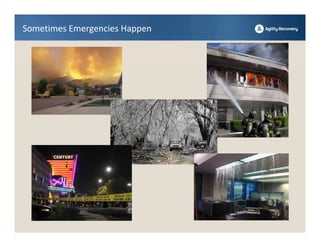
Sometimes Emergencies Happen
Sometimes they are serious


           New York City following Hurricane Sandy on Oct 29, 2012
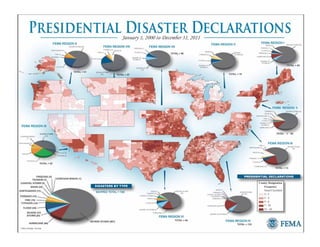
Presidential Disasters – 2000‐2010
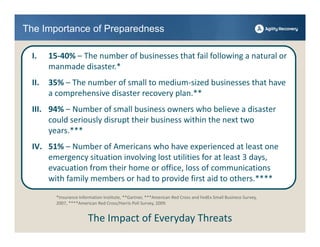
The Importance of Preparedness

 I.    15‐40% – The number of businesses that fail following a natural or 
       manmade disaster.* 
 II.   35% – The number of small to medium‐sized businesses that have 
       a comprehensive disaster recovery plan.**
 III. 94% – Number of small business owners who believe a disaster 
      could seriously disrupt their business within the next two 
      years.***
 IV. 51% – Number of Americans who have experienced at least one 
     emergency situation involving lost utilities for at least 3 days, 
     evacuation from their home or office, loss of communications 
     with family members or had to provide first aid to others.****
         *Insurance Information Institute, **Gartner, ***American Red Cross and FedEx Small Business Survey, 
         2007, ****American Red Cross/Harris Poll Survey, 2009.


                        The Impact of Everyday Threats
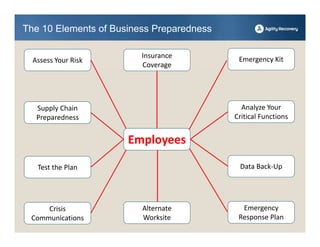
The 10 Elements of Business Preparedness

                         Insurance          Emergency Kit
  Assess Your Risk
                         Coverage


   Supply Chain                              Analyze Your 
   Preparedness                            Critical Functions


                      Employees

   Test the Plan                            Data Back‐Up


     Crisis              Alternate           Emergency 
 Communications          Worksite           Response Plan
Prepare to Survive.


                      Ways to Directly 
                      Assist Employees
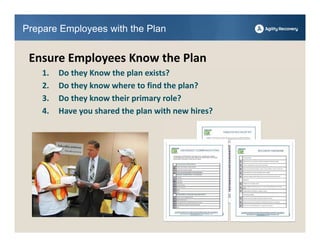
Prepare Employees with the Plan


 Ensure Employees Know the Plan
    1.   Do they Know the plan exists?
    2.   Do they know where to find the plan?
    3.   Do they know their primary role?
    4.   Have you shared the plan with new hires?
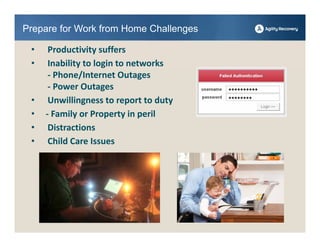
Prepare for Work from Home Challenges

 •    Productivity suffers
 •    Inability to login to networks
      ‐ Phone/Internet Outages
      ‐ Power Outages                   ●●●●●●●●●●
                                        ●●●●●●●●
 •    Unwillingness to report to duty
 •   ‐ Family or Property in peril
 •    Distractions
 •    Child Care Issues
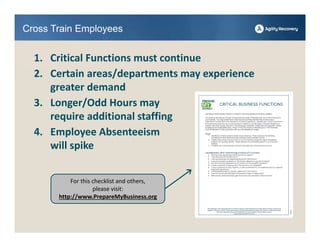
Cross Train Employees


  1. Critical Functions must continue
  2. Certain areas/departments may experience 
     greater demand
  3. Longer/Odd Hours may
     require additional staffing
  4. Employee Absenteeism 
     will spike


           For this checklist and others,
                    please visit:
       http://www.PrepareMyBusiness.org 
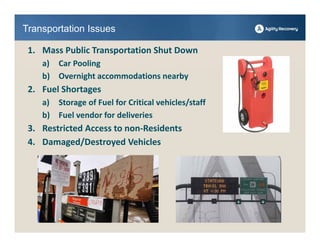
Transportation Issues

 1. Mass Public Transportation Shut Down
    a) Car Pooling
    b) Overnight accommodations nearby
 2. Fuel Shortages
    a) Storage of Fuel for Critical vehicles/staff
    b) Fuel vendor for deliveries
 3. Restricted Access to non‐Residents
 4. Damaged/Destroyed Vehicles
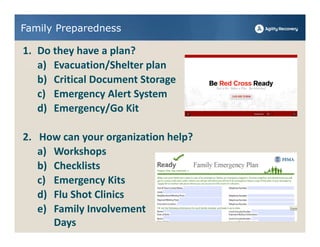
Family Preparedness

1. Do they have a plan?
   a) Evacuation/Shelter plan
   b) Critical Document Storage
   c) Emergency Alert System
   d) Emergency/Go Kit

2. How can your organization help?
   a) Workshops
   b) Checklists
   c) Emergency Kits
   d) Flu Shot Clinics
   e) Family Involvement
      Days
Prepare to Survive.


                            Tools to Help ANY
                      Organization or Family Prepare
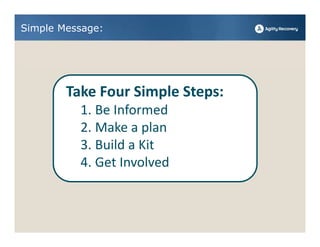
Simple Message:


        Take Four Simple Steps:
          1. Be Informed
          2. Make a plan
          3. Build a Kit
          4. Get Involved
#1 – Be Informed

• Have an Emergency Radio
• Know the Evacuation Routes
• Advise Employees ahead of forecast weather events
• Know the most likely threats and plans to mitigate the risks
   • Including both Natural & Man‐Made Threats
   • Home Fires are #1 Family Disaster

• Be familiar with local warning systems and emergency plans
   • Information sources, shelter locations & emergency contacts
#1 – Be Informed

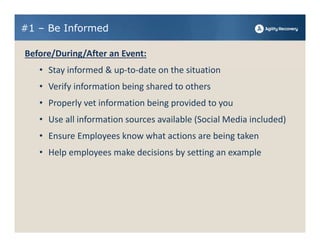
Before/During/After an Event:
   • Stay informed & up‐to‐date on the situation
   • Verify information being shared to others
   • Properly vet information being provided to you
   • Use all information sources available (Social Media included)
   • Ensure Employees know what actions are being taken
   • Help employees make decisions by setting an example
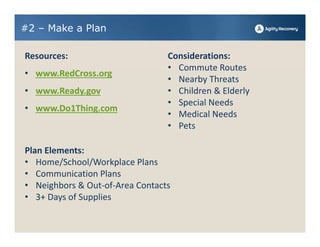
#2 – Make a Plan

Resources:                       Considerations:
                                 • Commute Routes
• www.RedCross.org
                                 • Nearby Threats
• www.Ready.gov                  • Children & Elderly
                                 • Special Needs
• www.Do1Thing.com
                                 • Medical Needs
                                 • Pets

Plan Elements:
• Home/School/Workplace Plans
• Communication Plans
• Neighbors & Out‐of‐Area Contacts
• 3+ Days of Supplies
#2 – Make a Plan

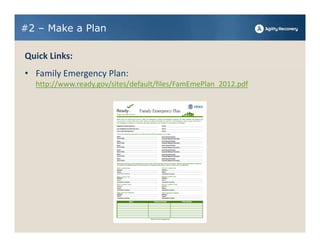
Quick Links:
• Family Emergency Plan: 
  http://www.ready.gov/sites/default/files/FamEmePlan_2012.pdf
#2 – Make a Plan

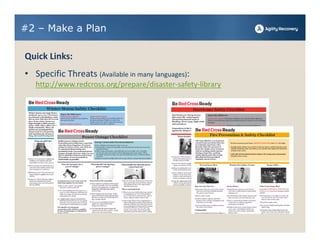
Quick Links:
• Specific Threats (Available in many languages):
   http://www.redcross.org/prepare/disaster‐safety‐library
#2 – Make a Plan

Quick Links:
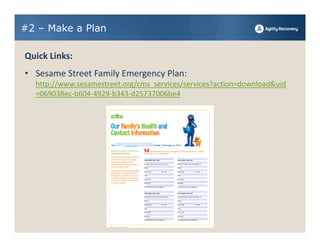
• Sesame Street Family Emergency Plan: 
  http://www.sesamestreet.org/cms_services/services?action=download&uid
  =069038ec‐b604‐4929‐b343‐d25737006be4
#2 – Make a Plan

Quick Links:
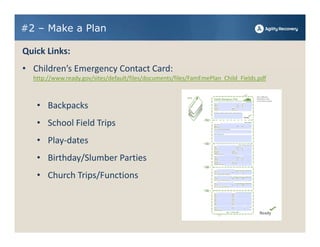
• Children’s Emergency Contact Card: 
  http://www.ready.gov/sites/default/files/documents/files/FamEmePlan_Child_Fields.pdf


   • Backpacks
   • School Field Trips
   • Play‐dates
   • Birthday/Slumber Parties
   • Church Trips/Functions
#3 – Build a Kit

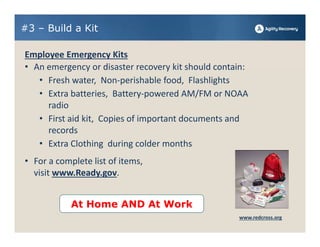
Employee Emergency Kits
• An emergency or disaster recovery kit should contain:
   • Fresh water,  Non‐perishable food,  Flashlights
   • Extra batteries,  Battery‐powered AM/FM or NOAA 
     radio
   • First aid kit,  Copies of important documents and 
     records 
   • Extra Clothing  during colder months
• For a complete list of items, 
  visit www.Ready.gov. 


            At Home AND At Work
                                                    www.redcross.org
#3 – Build a Kit

Quick Links:
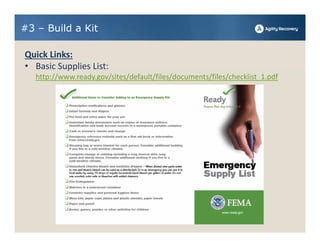
• Basic Supplies List:
   http://www.ready.gov/sites/default/files/documents/files/checklist_1.pdf
#3 – Build a Kit

Quick Links:
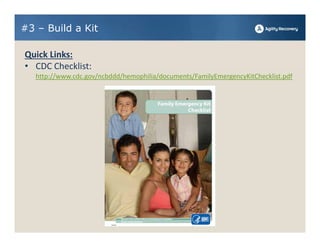
• CDC Checklist:
   http://www.cdc.gov/ncbddd/hemophilia/documents/FamilyEmergencyKitChecklist.pdf
#4 – Get Involved


• Participate in Local Drills
• Talk to your Neighbors (both at home and at work)
• Become a Citizen Corps Member (http://www.ready.gov/citizen‐corps)
• Involve other Social Groups
    • Neighborhood Watch, Faith‐based Organizations, Social Clubs, 
      Friend Networks, Professional Associations
• Volunteer Locally (Red Cross, CERT Training, Crime Prevention)
• Join the National Preparedness Coalition and “Pledge 2 Prepare” 
  (http://community.fema.gov/connect.ti/READYNPM?) 
Prepare to Survive.


                      The Agility Story
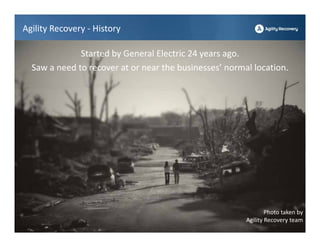
Agility Recovery ‐ History

              Started by General Electric 24 years ago.
  Saw a need to recover at or near the businesses’ normal location.


                                                                Photo taken by 
                                                        Agility Recovery team
What We Do

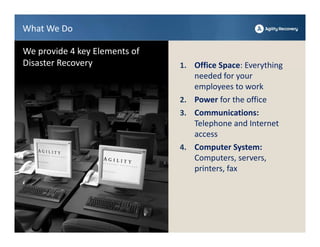
We provide 4 key Elements of 
Disaster Recovery               1. Office Space: Everything 
                                   needed for your 
                                   employees to work
                                2. Power for the office
                                3. Communications: 
                                   Telephone and Internet 
                                   access
                                4. Computer System: 
                                   Computers, servers, 
                                   printers, fax
Culture of Success

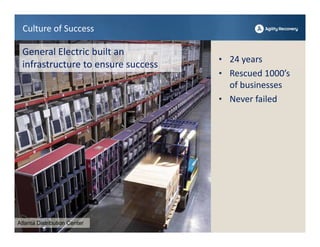
 General Electric built an 
                                     • 24 years
 infrastructure to ensure success 
                                     • Rescued 1000’s 
                                       of businesses
                                     • Never failed


Atlanta Distribution Center
New Vision


     The industry focused on the needs of the Fortune 500. 
     This model is too expensive for most businesses.


     In 2004, Agility defined a new vision.
     Agility will bring disaster recovery solutions to 
     ALL businesses.
New Business Model ‐ ReadySuite


       Agility created a solution that all business could afford.
          For a small monthly fee, normally $495/month, 
                  you can protect your business.
When You Become a Member

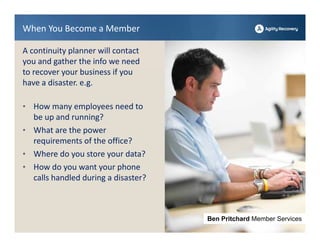
A continuity planner will contact           Erin Mitchell Agility
                                                    Rep
you and gather the info we need 
to recover your business if you 
have a disaster. e.g.

• How many employees need to 
  be up and running?
• What are the power 
  requirements of the office?
• Where do you store your data?
• How do you want your phone 
  calls handled during a disaster?


                                     Ben Pritchard Member Services
When You Become a Member

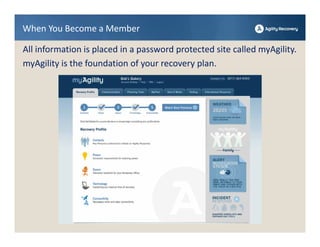
All information is placed in a password protected site called myAgility.
myAgility is the foundation of your recovery plan.
When You Have A Disaster

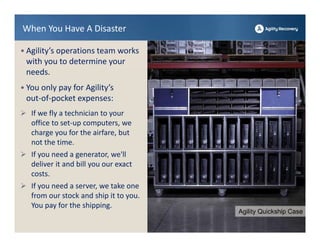
• Agility’s operations team works 
 with you to determine your 
 needs.
• You only pay for Agility’s 
 out‐of‐pocket expenses: 
 If we fly a technician to your 
   office to set‐up computers, we 
   charge you for the airfare, but 
   not the time.
 If you need a generator, we'll 
   deliver it and bill you our exact 
   costs.
 If you need a server, we take one 
   from our stock and ship it to you. 
   You pay for the shipping. 
                                         Agility Quickship Case
When You Have A Disaster


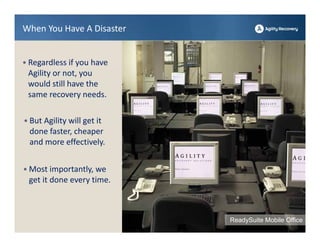
• Regardless if you have 
 Agility or not, you 
 would still have the 
 same recovery needs. 

• But Agility will get it 
  done faster, cheaper 
  and more effectively.


• Most importantly, we 
 get it done every time.


                             ReadySuite Mobile Office
Disasters Happen


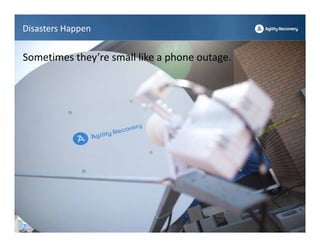
Sometimes they’re small like a phone outage. 
Disasters Happen

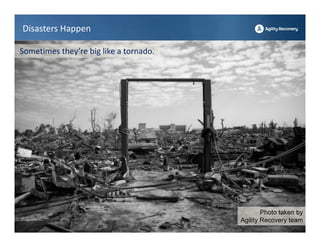
Sometimes they’re big like a tornado.


                                                Photo taken by
                                        Agility Recovery team
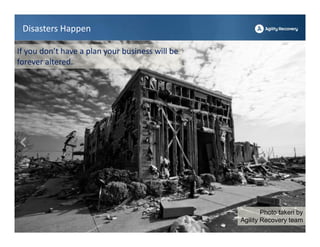
Disasters Happen

If you don’t have a plan your business will be 
forever altered.


                                                          Photo taken by
                                                  Agility Recovery team
Disasters Happen

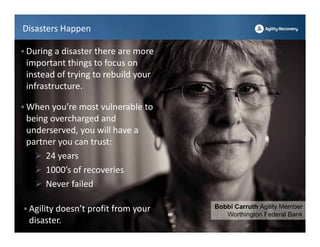
• During a disaster there are more 
 important things to focus on 
 instead of trying to rebuild your 
 infrastructure. 

• When you’re most vulnerable to 
 being overcharged and 
 underserved, you will have a 
 partner you can trust: 
    24 years
    1000’s of recoveries
    Never failed

• Agility doesn’t profit from your    Bobbi Carruth Agility Member
                                         Worthington Federal Bank
  disaster.
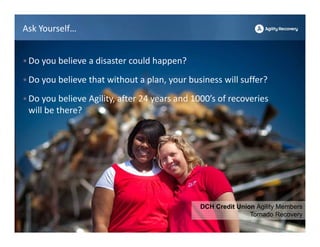
Ask Yourself…


• Do you believe a disaster could happen?

• Do you believe that without a plan, your business will suffer?

• Do you believe Agility, after 24 years and 1000’s of recoveries 
 will be there? 


                                               DCH Credit Union Agility Members
                                                              Tornado Recovery
Ask Yourself – Do You Believe?


If you answered, “Yes,” then Agility is a fairly easy decision. 
We welcome you as a member.
Prepare to Survive.

                                  Questions
                                      Bob Boyd
                            President & CEO, Agility Recovery
                             bob.boyd@agilityrecovery.com
                                     704‐927‐7922

                            Today’s session has been recorded.
                      Links to the archived recording will be emailed
                               to all registrants automatically

                        For copies of the slides presented during
                               today’s session, please visit:
                             http://agil.me/prepemployees

Agility employee preparedness - 2-13-13

  • 1.
    Protecting Your Organization by Preparing Your Employees Bob Boyd President & CEO, Agility Recovery For copies of the slides presented during today’s session,  please visit: http://agil.me/prepemployees
  • 2.
    Prepare to Survive. Today’s Key Take‐Aways I. The importance of employee  preparedness II. Ways to directly assist employees III. Tools to help any organization prepare IV. The Agility Story
  • 3.
    Prepare to Survive. The Importance of Employee Preparedness
  • 4.
  • 5.
    Sometimes they areserious New York City following Hurricane Sandy on Oct 29, 2012
  • 6.
  • 7.
    The Importance ofPreparedness I. 15‐40% – The number of businesses that fail following a natural or  manmade disaster.*  II. 35% – The number of small to medium‐sized businesses that have  a comprehensive disaster recovery plan.** III. 94% – Number of small business owners who believe a disaster  could seriously disrupt their business within the next two  years.*** IV. 51% – Number of Americans who have experienced at least one  emergency situation involving lost utilities for at least 3 days,  evacuation from their home or office, loss of communications  with family members or had to provide first aid to others.**** *Insurance Information Institute, **Gartner, ***American Red Cross and FedEx Small Business Survey,  2007, ****American Red Cross/Harris Poll Survey, 2009. The Impact of Everyday Threats
  • 8.
    The 10 Elementsof Business Preparedness Insurance  Emergency Kit Assess Your Risk Coverage Supply Chain  Analyze Your  Preparedness Critical Functions Employees Test the Plan Data Back‐Up Crisis  Alternate  Emergency  Communications Worksite Response Plan
  • 9.
    Prepare to Survive. Ways to Directly  Assist Employees
  • 10.
    Prepare Employees withthe Plan Ensure Employees Know the Plan 1. Do they Know the plan exists? 2. Do they know where to find the plan? 3. Do they know their primary role? 4. Have you shared the plan with new hires?
  • 11.
    Prepare for Workfrom Home Challenges • Productivity suffers • Inability to login to networks ‐ Phone/Internet Outages ‐ Power Outages ●●●●●●●●●● ●●●●●●●● • Unwillingness to report to duty • ‐ Family or Property in peril • Distractions • Child Care Issues
  • 12.
    Cross Train Employees 1. Critical Functions must continue 2. Certain areas/departments may experience  greater demand 3. Longer/Odd Hours may require additional staffing 4. Employee Absenteeism  will spike For this checklist and others, please visit: http://www.PrepareMyBusiness.org 
  • 13.
    Transportation Issues 1.Mass Public Transportation Shut Down a) Car Pooling b) Overnight accommodations nearby 2. Fuel Shortages a) Storage of Fuel for Critical vehicles/staff b) Fuel vendor for deliveries 3. Restricted Access to non‐Residents 4. Damaged/Destroyed Vehicles
  • 14.
    Family Preparedness 1. Do they have a plan? a) Evacuation/Shelter plan b) Critical Document Storage c) Emergency Alert System d) Emergency/Go Kit 2. How can your organization help? a) Workshops b) Checklists c) Emergency Kits d) Flu Shot Clinics e) Family Involvement Days
  • 15.
    Prepare to Survive. Tools to Help ANY Organization or Family Prepare
  • 16.
    Simple Message: Take Four Simple Steps: 1. Be Informed 2. Make a plan 3. Build a Kit 4. Get Involved
  • 17.
    #1 – BeInformed • Have an Emergency Radio • Know the Evacuation Routes • Advise Employees ahead of forecast weather events • Know the most likely threats and plans to mitigate the risks • Including both Natural & Man‐Made Threats • Home Fires are #1 Family Disaster • Be familiar with local warning systems and emergency plans • Information sources, shelter locations & emergency contacts
  • 18.
    #1 – BeInformed Before/During/After an Event: • Stay informed & up‐to‐date on the situation • Verify information being shared to others • Properly vet information being provided to you • Use all information sources available (Social Media included) • Ensure Employees know what actions are being taken • Help employees make decisions by setting an example
  • 19.
    #2 – Makea Plan Resources: Considerations: • Commute Routes • www.RedCross.org • Nearby Threats • www.Ready.gov • Children & Elderly • Special Needs • www.Do1Thing.com • Medical Needs • Pets Plan Elements: • Home/School/Workplace Plans • Communication Plans • Neighbors & Out‐of‐Area Contacts • 3+ Days of Supplies
  • 20.
    #2 – Makea Plan Quick Links: • Family Emergency Plan:  http://www.ready.gov/sites/default/files/FamEmePlan_2012.pdf
  • 21.
    #2 – Makea Plan Quick Links: • Specific Threats (Available in many languages): http://www.redcross.org/prepare/disaster‐safety‐library
  • 22.
    #2 – Makea Plan Quick Links: • Sesame Street Family Emergency Plan:  http://www.sesamestreet.org/cms_services/services?action=download&uid =069038ec‐b604‐4929‐b343‐d25737006be4
  • 23.
    #2 – Makea Plan Quick Links: • Children’s Emergency Contact Card:  http://www.ready.gov/sites/default/files/documents/files/FamEmePlan_Child_Fields.pdf • Backpacks • School Field Trips • Play‐dates • Birthday/Slumber Parties • Church Trips/Functions
  • 24.
    #3 – Builda Kit Employee Emergency Kits • An emergency or disaster recovery kit should contain: • Fresh water,  Non‐perishable food,  Flashlights • Extra batteries,  Battery‐powered AM/FM or NOAA  radio • First aid kit,  Copies of important documents and  records  • Extra Clothing  during colder months • For a complete list of items,  visit www.Ready.gov.  At Home AND At Work www.redcross.org
  • 25.
    #3 – Builda Kit Quick Links: • Basic Supplies List: http://www.ready.gov/sites/default/files/documents/files/checklist_1.pdf
  • 26.
    #3 – Builda Kit Quick Links: • CDC Checklist: http://www.cdc.gov/ncbddd/hemophilia/documents/FamilyEmergencyKitChecklist.pdf
  • 27.
    #4 – GetInvolved • Participate in Local Drills • Talk to your Neighbors (both at home and at work) • Become a Citizen Corps Member (http://www.ready.gov/citizen‐corps) • Involve other Social Groups • Neighborhood Watch, Faith‐based Organizations, Social Clubs,  Friend Networks, Professional Associations • Volunteer Locally (Red Cross, CERT Training, Crime Prevention) • Join the National Preparedness Coalition and “Pledge 2 Prepare”  (http://community.fema.gov/connect.ti/READYNPM?) 
  • 28.
    Prepare to Survive. The Agility Story
  • 29.
    Agility Recovery ‐ History Started by General Electric 24 years ago. Saw a need to recover at or near the businesses’ normal location. Photo taken by  Agility Recovery team
  • 30.
    What We Do We provide 4 key Elements of  Disaster Recovery 1. Office Space: Everything  needed for your  employees to work 2. Power for the office 3. Communications:  Telephone and Internet  access 4. Computer System:  Computers, servers,  printers, fax
  • 31.
    Culture of Success General Electric built an  • 24 years infrastructure to ensure success  • Rescued 1000’s  of businesses • Never failed Atlanta Distribution Center
  • 32.
    New Vision The industry focused on the needs of the Fortune 500.  This model is too expensive for most businesses. In 2004, Agility defined a new vision. Agility will bring disaster recovery solutions to  ALL businesses.
  • 33.
    New Business Model ‐ ReadySuite Agility created a solution that all business could afford. For a small monthly fee, normally $495/month,  you can protect your business.
  • 34.
    When You Become a Member A continuity planner will contact  Erin Mitchell Agility Rep you and gather the info we need  to recover your business if you  have a disaster. e.g. • How many employees need to  be up and running? • What are the power  requirements of the office? • Where do you store your data? • How do you want your phone  calls handled during a disaster? Ben Pritchard Member Services
  • 35.
  • 36.
    When You Have A Disaster • Agility’s operations team works  with you to determine your  needs. • You only pay for Agility’s  out‐of‐pocket expenses:   If we fly a technician to your  office to set‐up computers, we  charge you for the airfare, but  not the time.  If you need a generator, we'll  deliver it and bill you our exact  costs.  If you need a server, we take one  from our stock and ship it to you.  You pay for the shipping.  Agility Quickship Case
  • 37.
    When You Have A Disaster • Regardless if you have  Agility or not, you  would still have the  same recovery needs.  • But Agility will get it  done faster, cheaper  and more effectively. • Most importantly, we  get it done every time. ReadySuite Mobile Office
  • 38.
  • 39.
  • 40.
  • 41.
    Disasters Happen • During a disaster there are more  important things to focus on  instead of trying to rebuild your  infrastructure.  • When you’re most vulnerable to  being overcharged and  underserved, you will have a  partner you can trust:   24 years  1000’s of recoveries  Never failed • Agility doesn’t profit from your  Bobbi Carruth Agility Member Worthington Federal Bank disaster.
  • 42.
    Ask Yourself… • Do you believe a disaster could happen? • Do you believe that without a plan, your business will suffer? •Do you believe Agility, after 24 years and 1000’s of recoveries  will be there?  DCH Credit Union Agility Members Tornado Recovery
  • 43.
  • 44.
    Prepare to Survive. Questions Bob Boyd President & CEO, Agility Recovery bob.boyd@agilityrecovery.com 704‐927‐7922 Today’s session has been recorded. Links to the archived recording will be emailed to all registrants automatically For copies of the slides presented during today’s session, please visit: http://agil.me/prepemployees