Crisis Management
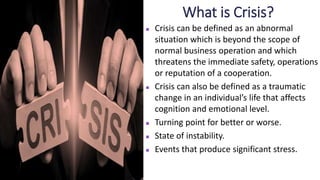
 Crisis can be defined as an abnormal
situation which is beyond the scope of
normal business operation and which
threatens the immediate safety, operations
or reputation of a cooperation.
 Crisis can also be defined as a traumatic
change in an individual’s life that affects
cognition and emotional level.
 Turning point for better or worse.
 State of instability.
 Events that produce significant stress.
What is Crisis?
Types of Crisis
• Financial Crisis.
• Personnel Crisis.
• Organizational Crisis.
• Technological Crisis.
• Natural Crisis.
• Confrontation Crisis.
• Workplace Violence Crisis.
• Crisis of Malevolence.
What is Crisis
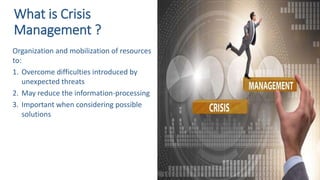
Management ?
Organization and mobilization of resources
to:
1. Overcome difficulties introduced by
unexpected threats
2. May reduce the information-processing
3. Important when considering possible
solutions
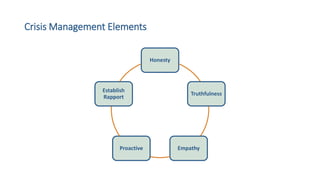
Crisis Management Elements
Honesty
Truthfulness
Empathy
Proactive
Establish
Rapport
Crisis Management Components
• Crisis Center – facility/setting established for
emergencies.
• Crisis Intervention – seek improvement or to
mitigate the situation. Prevents more serious
consequences.
• Crisis Intervention Service – services typically
provided by government or social service
agencies during emergencies/disasters and
personal crises (hot-lines, drop-in services, on-
site intervention).
• Crisis Team – group of professionals trained to
help individuals cope during and after an
emergency.
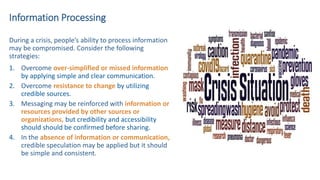
Information Processing
During a crisis, people’s ability to process information
may be compromised. Consider the following
strategies:
1. Overcome over-simplified or missed information
by applying simple and clear communication.
2. Overcome resistance to change by utilizing
credible sources.
3. Messaging may be reinforced with information or
resources provided by other sources or
organizations, but credibility and accessibility
should should be confirmed before sharing.
4. In the absence of information or communication,
credible speculation may be applied but it should
be simple and consistent.
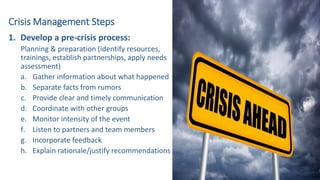
Crisis Management Steps
1. Develop a pre-crisis process:
Planning & preparation (identify resources,
trainings, establish partnerships, apply needs
assessment)
a. Gather information about what happened
b. Separate facts from rumors
c. Provide clear and timely communication
d. Coordinate with other groups
e. Monitor intensity of the event
f. Listen to partners and team members
g. Incorporate feedback
h. Explain rationale/justify recommendations
2. Results and Evaluation
a. Debrief the situation from start to finish
b. Promote actition within your organization
c. Assess performance
d. Document lessons learned
e. Plan activities to improve the crisis plan
Crisis Management Steps
Post-Crisis Resilience
Experiencing crisis can result in positive outcomes.
Survivors often gain:
• A new understanding of risks and ways to manage crisis
in the future.
• A sense of strength and empowerment
• New skills to manage challenging times
• Opportunities for personal, group and community
growth
THANK YOU!

Crisis management.pptx

  • 1.
  • 2.
     Crisis canbe defined as an abnormal situation which is beyond the scope of normal business operation and which threatens the immediate safety, operations or reputation of a cooperation.  Crisis can also be defined as a traumatic change in an individual’s life that affects cognition and emotional level.  Turning point for better or worse.  State of instability.  Events that produce significant stress. What is Crisis?
  • 3.
    Types of Crisis •Financial Crisis. • Personnel Crisis. • Organizational Crisis. • Technological Crisis. • Natural Crisis. • Confrontation Crisis. • Workplace Violence Crisis. • Crisis of Malevolence.
  • 4.
    What is Crisis Management? Organization and mobilization of resources to: 1. Overcome difficulties introduced by unexpected threats 2. May reduce the information-processing 3. Important when considering possible solutions
  • 5.
  • 6.
    Crisis Management Components •Crisis Center – facility/setting established for emergencies. • Crisis Intervention – seek improvement or to mitigate the situation. Prevents more serious consequences. • Crisis Intervention Service – services typically provided by government or social service agencies during emergencies/disasters and personal crises (hot-lines, drop-in services, on- site intervention). • Crisis Team – group of professionals trained to help individuals cope during and after an emergency.
  • 7.
    Information Processing During acrisis, people’s ability to process information may be compromised. Consider the following strategies: 1. Overcome over-simplified or missed information by applying simple and clear communication. 2. Overcome resistance to change by utilizing credible sources. 3. Messaging may be reinforced with information or resources provided by other sources or organizations, but credibility and accessibility should should be confirmed before sharing. 4. In the absence of information or communication, credible speculation may be applied but it should be simple and consistent.
  • 8.
    Crisis Management Steps 1.Develop a pre-crisis process: Planning & preparation (identify resources, trainings, establish partnerships, apply needs assessment) a. Gather information about what happened b. Separate facts from rumors c. Provide clear and timely communication d. Coordinate with other groups e. Monitor intensity of the event f. Listen to partners and team members g. Incorporate feedback h. Explain rationale/justify recommendations
  • 9.
    2. Results andEvaluation a. Debrief the situation from start to finish b. Promote actition within your organization c. Assess performance d. Document lessons learned e. Plan activities to improve the crisis plan Crisis Management Steps
  • 10.
    Post-Crisis Resilience Experiencing crisiscan result in positive outcomes. Survivors often gain: • A new understanding of risks and ways to manage crisis in the future. • A sense of strength and empowerment • New skills to manage challenging times • Opportunities for personal, group and community growth
  • 11.