CRISIS INTERVENTION
PRESENTED BY HAMANI THAKUR
MSC(N) IST YEAR
MENTAL HEALTH NURSING
CRISIS INTERVENTION
INTRODUCTION
 Crisis intervention is a technique used to help an
individual or family to understand and cope with the
intense feelings that are typical of a crisis
 Crisis intervention is an intervention designed to
keep an individual or client to cope up with a sudden
problem and encourage at a level of functioning
equal to or higher than pre-crisis state.
AIMS OF CRISIS INTERVENTION TECHNIQUES:-
 To provide a correct cognitive perception of
the situation.
 To assist the individual in manageging the
intense or overwhelming feelings associated
with the crisis
MODEL OF CRISIS INTERVENTION
ELIZABETH KUBLER ROSS MODEL (FIVE STAGES
OF GRIEF IN 1969)
It describes the five discrete stages, a
process by which people deal with grief and
tragedy especially when diagnosed with a
terminal illness or catastrophic loss.
 Denial
 Anger
 Bargaining
 Depression
 Acceptance
GOALS OF CRISIS INTERVENTION
 ENSURE SAFETY
 DIFFUSE THE SITUATION
 DETERMINE THE PROBLEM
 DECREASE THE ANXIETY LEVEL
 CAUTION
 RETURN THE PATIENT TO PRECRISIS LEVEL.
STEPS IN CRISIS INTERVENTION
1. STEP TO PROVIDE A CORRECT COGNITIVE
PERCETION .
a) Assessment of the situation
b) Defining the event
c) Develop a plan of action
2. STEP TO ASSESS THE VICTIM IN MANAGING
THE INTENSE FEELING
Helping the victim to be aware of the feeling
 HELP THE INDIVIDUAL TO ATTAINN MASTERY
OVER THR INTENSE FEELINGS
The individual should be given adequate
support and guidance through the
therapeutic process in order to handle
feelings associated with crisis but special
care should be taken not to give any false
reassurance.
ROLE OF THE NURSE
 NURSING ASSESSMENT:-
 The first step of crisis intervention is
assessment .during this phase the nurse collects
data regarding following factors :-
 Precipitating event or stressors
 Patients perception of the event or stressor
 Nature and strength of the patients support
systems. Coping resources
 Level of psychological stress patient is suffering
from and degree of impairment he is
experiencing.
 Patients ous strengths and coping mechanisms
 Another system that has been used in mass casualty situations is
an example of advanced triage implemented by nurses or other
skilled personnel. This advanced triage system involves a color-
coding scheme using red, yellow, green, white, and black tags:
 Red tags - (immediate) are used to label those who cannot survive
without immediate treatment but who have a chance of survival.

 Yellow tags - (observation) for those who require observation (and
possible later re-triage). Their condition is stable for the moment
and, they are not in immediate danger of death.
 Green tags - (wait) are reserved for the "walking wounded" who
will need medical care at some point, after more critical injuries
have been treated.
 White tags - (dismiss) are given to those with
minor injuries for whom a doctor's care is not
required.
 Black tags - (expectant) are used for the
deceased and for those whose injuries are so
extensive that they will not be able to
survive given the care that is available.
 PLANNING :-
during this phase the nurse will undertake the
following activities Dynamics underlying the present
crisis are formulated
 Alternative solutions to the problem are explored .
 Steps for achieving the soluations are identified
 Environment support needed to help the patient is
decided upon ,coping mechanisms that need to be
developed and those which need to be strengthened
are identified.
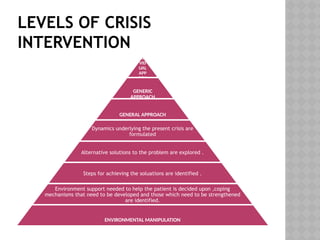
LEVELS OF CRISIS
INTERVENTION
INDI
VID
UAL
APP
ROA
CH
GENERIC
APPROACH
GENERAL APPROACH
Dynamics underlying the present crisis are
formulated
Alternative solutions to the problem are explored .
Steps for achieving the soluations are identified .
Environment support needed to help the patient is decided upon ,coping
mechanisms that need to be developed and those which need to be strengthened
are identified.
ENVIRONMENTAL MANIPULATION
TECHNIQUES OF CRISIS INTERVENTION
 1. CATHARSIS:-
 The release of feelings that takes place as the patient talks
about emotionally charged areas.
 2. CLARIFICATION:-
 Encouraging the patient to express more clearly the relationship
between certain events in their life.
 3. MANIPULATION:-
 Using the patient’s emotions ,wishes or values to beliefs the
patient in the therapeutic process.
 4. REINFORCEMENT OF BEHAVIOUR:-
 Giving the patient a positive re-inforcement to develop
adaptive behavior
5. SUPPORT OF DEFENCES:-
 Encouraging the use of healthy adaptive defenses.
 Discourage unhealthy and maladaptive defenses.
6.INCREASING SELF ESTEEM:-
 Raising self esteem and helping the patient to
regain feeling of self worth and selecting the best
available alternative way for evolving the
immediate problem.
7.EXPLORATION OF SOLUTIONS:-
 Examining alternative ways of solving the
immediate problem.
NURSING INTERVENTIONS
 BASIC NEEDS
 Provide license to social agencies.
 PHYSICAL DEFICIT
 Attend the physical emergency
 Refer to other health care provider as necessary
 PSYCHOLOGICAL EFFECTS
 Shock –listens attentively to crisis impact
 Confusion-give nurturing support ,permits regression
 Denial-permits intermittent denile,identify patient
primary concerns
 Anxiety – provide structural anti anxiety activity
 Lethargy- encourage sublimation and constructive activity
NURSING DIAGNOSIS
 NURSING DIAGNOSIS:-
 The primary nursing diagnoses in crisis
intervention are
 Ineffective individual coping
 Ineffective family coping
 Altered family process
 Post trauma response
 Ineffective individual coping refers to the inability
to ask for help ,problem solving or meet role
expectations.
 Ineffective family coping occurs when the family’s
support systems are not successful and family’s
economic or social wellbeing is threatened.
 Altered family processes result when the family
members are unable to adapt to the traumatic
experiences constructively.
 Posttraumatic response is a sustained response to an
overwhelming traumatic event
 PROTECTIVE FACTORS
 Coping –
 Encourage patient’s favoured ,adaptive coping
mechanism
 Self-efficacy-
 Support patient’s previous success and belief in own
abilities.
 Dilute irrational self deficits
 Emphasis practices of expectation to provide results
 Support –
 Add social support to patient’s world
 Provide professional support
 Refer for counseling when necessary
THANK YOU

New Microsoft Office PowerPoint Presentation.pptx

  • 1.
    CRISIS INTERVENTION PRESENTED BYHAMANI THAKUR MSC(N) IST YEAR MENTAL HEALTH NURSING
  • 2.
    CRISIS INTERVENTION INTRODUCTION  Crisisintervention is a technique used to help an individual or family to understand and cope with the intense feelings that are typical of a crisis  Crisis intervention is an intervention designed to keep an individual or client to cope up with a sudden problem and encourage at a level of functioning equal to or higher than pre-crisis state.
  • 3.
    AIMS OF CRISISINTERVENTION TECHNIQUES:-  To provide a correct cognitive perception of the situation.  To assist the individual in manageging the intense or overwhelming feelings associated with the crisis
  • 4.
    MODEL OF CRISISINTERVENTION ELIZABETH KUBLER ROSS MODEL (FIVE STAGES OF GRIEF IN 1969) It describes the five discrete stages, a process by which people deal with grief and tragedy especially when diagnosed with a terminal illness or catastrophic loss.  Denial  Anger  Bargaining  Depression  Acceptance
  • 5.
    GOALS OF CRISISINTERVENTION  ENSURE SAFETY  DIFFUSE THE SITUATION  DETERMINE THE PROBLEM  DECREASE THE ANXIETY LEVEL  CAUTION  RETURN THE PATIENT TO PRECRISIS LEVEL.
  • 6.
    STEPS IN CRISISINTERVENTION 1. STEP TO PROVIDE A CORRECT COGNITIVE PERCETION . a) Assessment of the situation b) Defining the event c) Develop a plan of action 2. STEP TO ASSESS THE VICTIM IN MANAGING THE INTENSE FEELING Helping the victim to be aware of the feeling
  • 7.
     HELP THEINDIVIDUAL TO ATTAINN MASTERY OVER THR INTENSE FEELINGS The individual should be given adequate support and guidance through the therapeutic process in order to handle feelings associated with crisis but special care should be taken not to give any false reassurance.
  • 8.
    ROLE OF THENURSE  NURSING ASSESSMENT:-  The first step of crisis intervention is assessment .during this phase the nurse collects data regarding following factors :-  Precipitating event or stressors  Patients perception of the event or stressor  Nature and strength of the patients support systems. Coping resources  Level of psychological stress patient is suffering from and degree of impairment he is experiencing.  Patients ous strengths and coping mechanisms
  • 9.
     Another systemthat has been used in mass casualty situations is an example of advanced triage implemented by nurses or other skilled personnel. This advanced triage system involves a color- coding scheme using red, yellow, green, white, and black tags:  Red tags - (immediate) are used to label those who cannot survive without immediate treatment but who have a chance of survival.   Yellow tags - (observation) for those who require observation (and possible later re-triage). Their condition is stable for the moment and, they are not in immediate danger of death.  Green tags - (wait) are reserved for the "walking wounded" who will need medical care at some point, after more critical injuries have been treated.
  • 10.
     White tags- (dismiss) are given to those with minor injuries for whom a doctor's care is not required.  Black tags - (expectant) are used for the deceased and for those whose injuries are so extensive that they will not be able to survive given the care that is available.
  • 11.
     PLANNING :- duringthis phase the nurse will undertake the following activities Dynamics underlying the present crisis are formulated  Alternative solutions to the problem are explored .  Steps for achieving the soluations are identified  Environment support needed to help the patient is decided upon ,coping mechanisms that need to be developed and those which need to be strengthened are identified.
  • 12.
    LEVELS OF CRISIS INTERVENTION INDI VID UAL APP ROA CH GENERIC APPROACH GENERALAPPROACH Dynamics underlying the present crisis are formulated Alternative solutions to the problem are explored . Steps for achieving the soluations are identified . Environment support needed to help the patient is decided upon ,coping mechanisms that need to be developed and those which need to be strengthened are identified. ENVIRONMENTAL MANIPULATION
  • 13.
    TECHNIQUES OF CRISISINTERVENTION  1. CATHARSIS:-  The release of feelings that takes place as the patient talks about emotionally charged areas.  2. CLARIFICATION:-  Encouraging the patient to express more clearly the relationship between certain events in their life.  3. MANIPULATION:-  Using the patient’s emotions ,wishes or values to beliefs the patient in the therapeutic process.  4. REINFORCEMENT OF BEHAVIOUR:-  Giving the patient a positive re-inforcement to develop adaptive behavior
  • 14.
    5. SUPPORT OFDEFENCES:-  Encouraging the use of healthy adaptive defenses.  Discourage unhealthy and maladaptive defenses. 6.INCREASING SELF ESTEEM:-  Raising self esteem and helping the patient to regain feeling of self worth and selecting the best available alternative way for evolving the immediate problem. 7.EXPLORATION OF SOLUTIONS:-  Examining alternative ways of solving the immediate problem.
  • 15.
    NURSING INTERVENTIONS  BASICNEEDS  Provide license to social agencies.  PHYSICAL DEFICIT  Attend the physical emergency  Refer to other health care provider as necessary  PSYCHOLOGICAL EFFECTS  Shock –listens attentively to crisis impact  Confusion-give nurturing support ,permits regression  Denial-permits intermittent denile,identify patient primary concerns  Anxiety – provide structural anti anxiety activity  Lethargy- encourage sublimation and constructive activity
  • 16.
    NURSING DIAGNOSIS  NURSINGDIAGNOSIS:-  The primary nursing diagnoses in crisis intervention are  Ineffective individual coping  Ineffective family coping  Altered family process  Post trauma response
  • 17.
     Ineffective individualcoping refers to the inability to ask for help ,problem solving or meet role expectations.  Ineffective family coping occurs when the family’s support systems are not successful and family’s economic or social wellbeing is threatened.  Altered family processes result when the family members are unable to adapt to the traumatic experiences constructively.  Posttraumatic response is a sustained response to an overwhelming traumatic event
  • 18.
     PROTECTIVE FACTORS Coping –  Encourage patient’s favoured ,adaptive coping mechanism  Self-efficacy-  Support patient’s previous success and belief in own abilities.  Dilute irrational self deficits  Emphasis practices of expectation to provide results  Support –  Add social support to patient’s world  Provide professional support  Refer for counseling when necessary
  • 19.