Chapter 1

Criminal Investigation: An Overview


                              Hess 1-1
Introduction
• An observant police officer can initiate an important
  criminal investigation
• Criminal investigation combines art and science
• Requires extraordinary preparation and training
• High-tech society
• Citizens expect results more quickly
• Investigators need to step up their technology and
  teamwork skills

                                               Hess 1-2
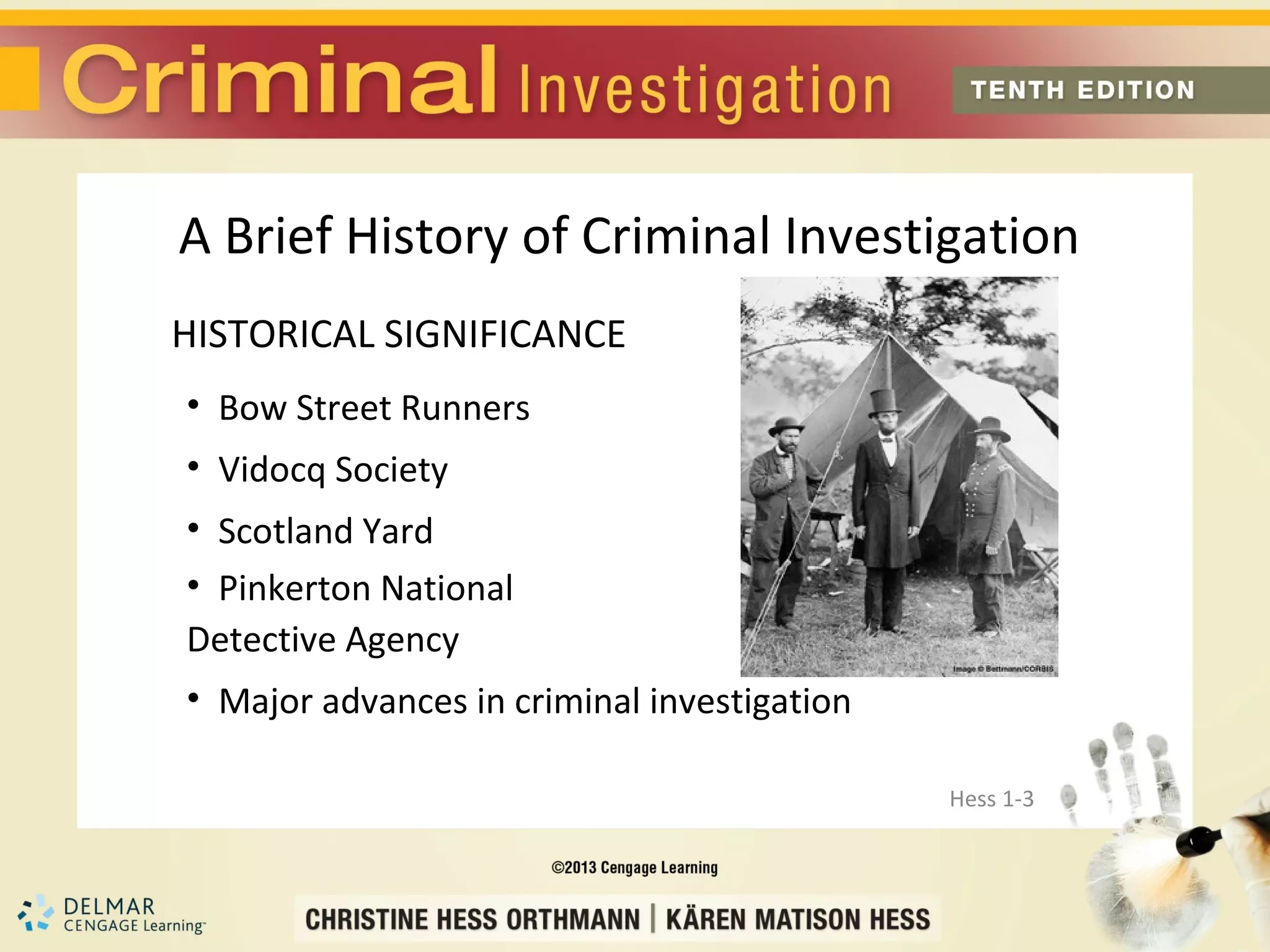
A Brief History of Criminal Investigation
HISTORICAL SIGNIFICANCE
• Bow Street Runners
• Vidocq Society
• Scotland Yard
• Pinkerton National
Detective Agency
• Major advances in criminal investigation

                                             Hess 1-3
Criminal Investigation Definitions
KEY DEFINITIONS
• Investigate
       Derived from Latin, vestigare, meaning to track or trace
• Criminal investigation
    
        Discovering, collecting, preparing, identifying and
        presenting evidence
• Deductive reasoning
    
        Logical process; conclusion follows from specific facts

                                                      Hess 1-4
Other Terms Defined
SPECIFIC TERMS
• Criminalist
• Forensic science
• Crime
• Felony
• Misdemeanor

                                Continued
                                            Hess 1-5
Other Terms Defined (Continued)
SPECIFIC TERMS
• Criminal statute
• Ordinance
• Elements of the crime
• Criminal intent
• Modus operandi, or MO


                                     Hess 1-6
Goals of Criminal Investigations
SUCCESSFUL INVESTIGATIONS
• Determine whether a crime has been committed
• Legally obtain information and evidence to identify the
  responsible person
• Arrest the suspect
• Recover stolen property
• Present the best possible case to the prosecutor

                                                Hess 1-7
Basic Functions of Investigators
INVESTIGATOR FUNCTIONS
• Provide emergency assistance
• Secure the crime scene
• Photograph, videotape and sketch
• Take notes and write reports
• Search for, obtain and process physical evidence

                                       Continued
                                                   Hess 1-8
Basic Functions of Investigators (Continued)
INVESTIGATOR FUNCTIONS
• Obtain information from witnesses and suspects
• Identify suspects
• Conduct raids, surveillances, stakeouts and undercover
  assignments
• Testify in court


                                               Hess 1-9
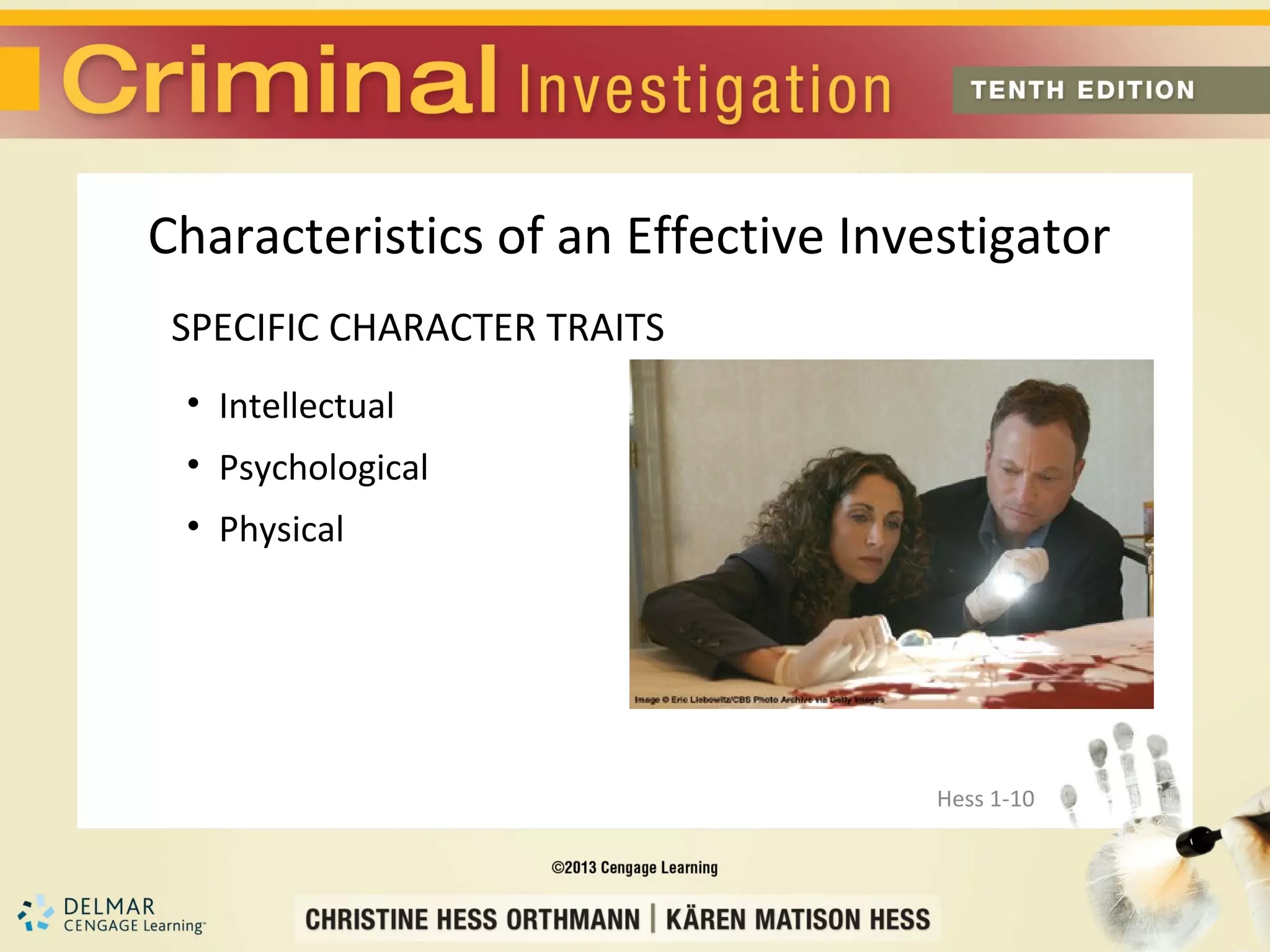
Characteristics of an Effective Investigator
 SPECIFIC CHARACTER TRAITS
 • Intellectual
 • Psychological
 • Physical


                                    Hess 1-10
An Overview of the Investigative Process
INVESTIGATIVE PROCESS
• Usually initiated by personal observation or
  information from a citizen
• Starts with a direction to proceed to a scene
• Department policy defines who responds
• Department policy defines duties of individuals


                                                  Hess 1-11
The Preliminary Investigation:
           Basic Considerations
THE INITIAL RESPONSE
• Suspect may still be at or near the scene
• Injured persons may need emergency care
• Witnesses may still be at the scene
• Dying person may have confession/information
• Weather may change/destroy evidence
• Crime scene may be altered

                                              Hess 1-12
The Preliminary Investigation:
          Basic Considerations
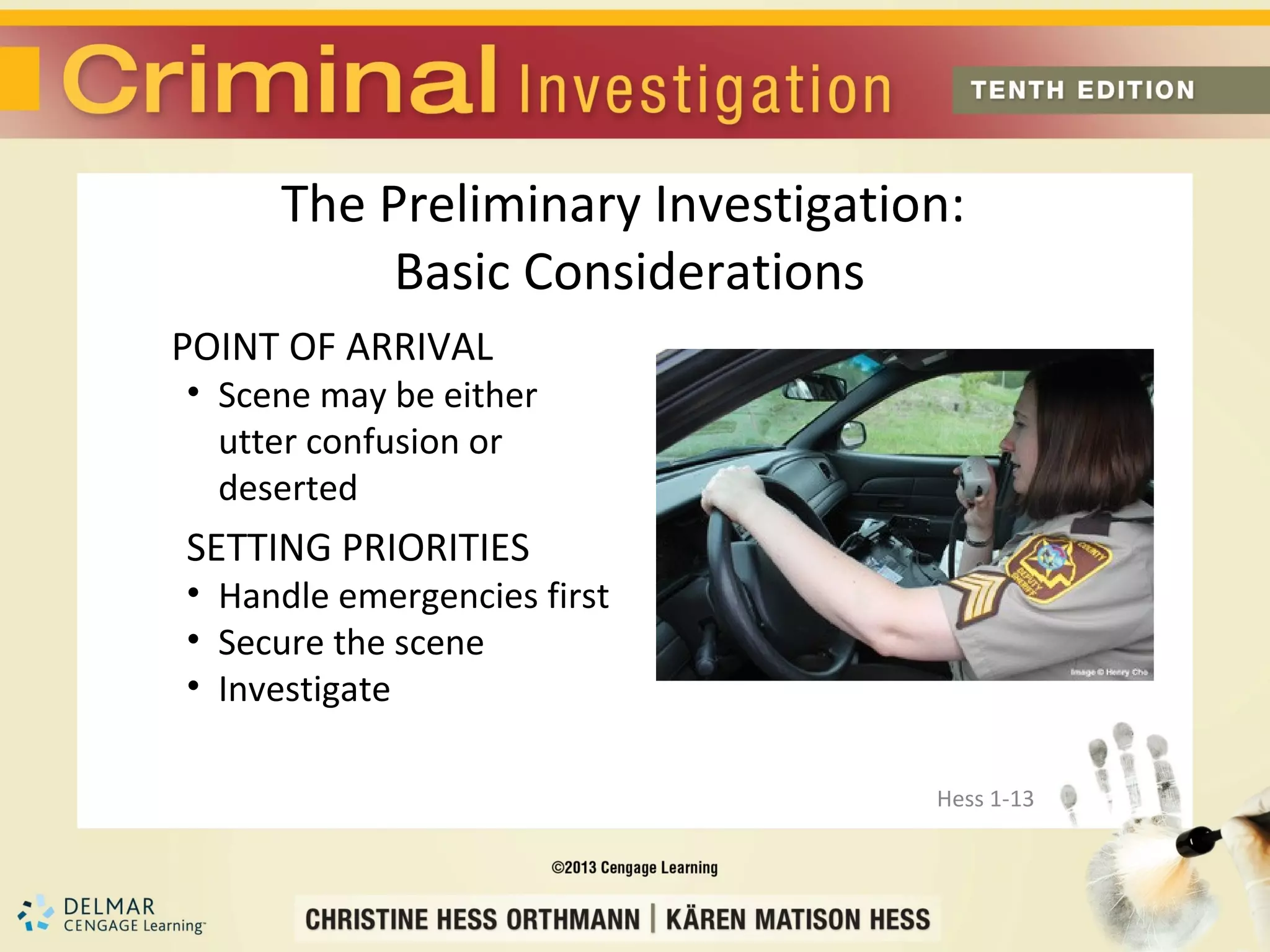
POINT OF ARRIVAL
• Scene may be either
  utter confusion or
  deserted
SETTING PRIORITIES
• Handle emergencies first
• Secure the scene
• Investigate

                                 Hess 1-13
The Preliminary Investigation:
          Basic Considerations
HANDLING EMERGENCY SITUATIONS
• Sometimes emergencies dictate procedure
• Emergency situations causes the adrenaline to flow
SUSPECT AT OR NEAR THE SCENE
• Policy determines interrogations
• Miranda warning


                                              Hess 1-14
The Preliminary Investigation:
           Basic Considerations
PERSON IS SERIOUSLY INJURED
• Emergency first aid
• Call for medical assistance
• Accompany suspects to hospital
DEAD BODY AT SCENE
• Leave the body as found
• Preserve the scene

                                   Hess 1-15
The Preliminary Investigation:
           Basic Considerations
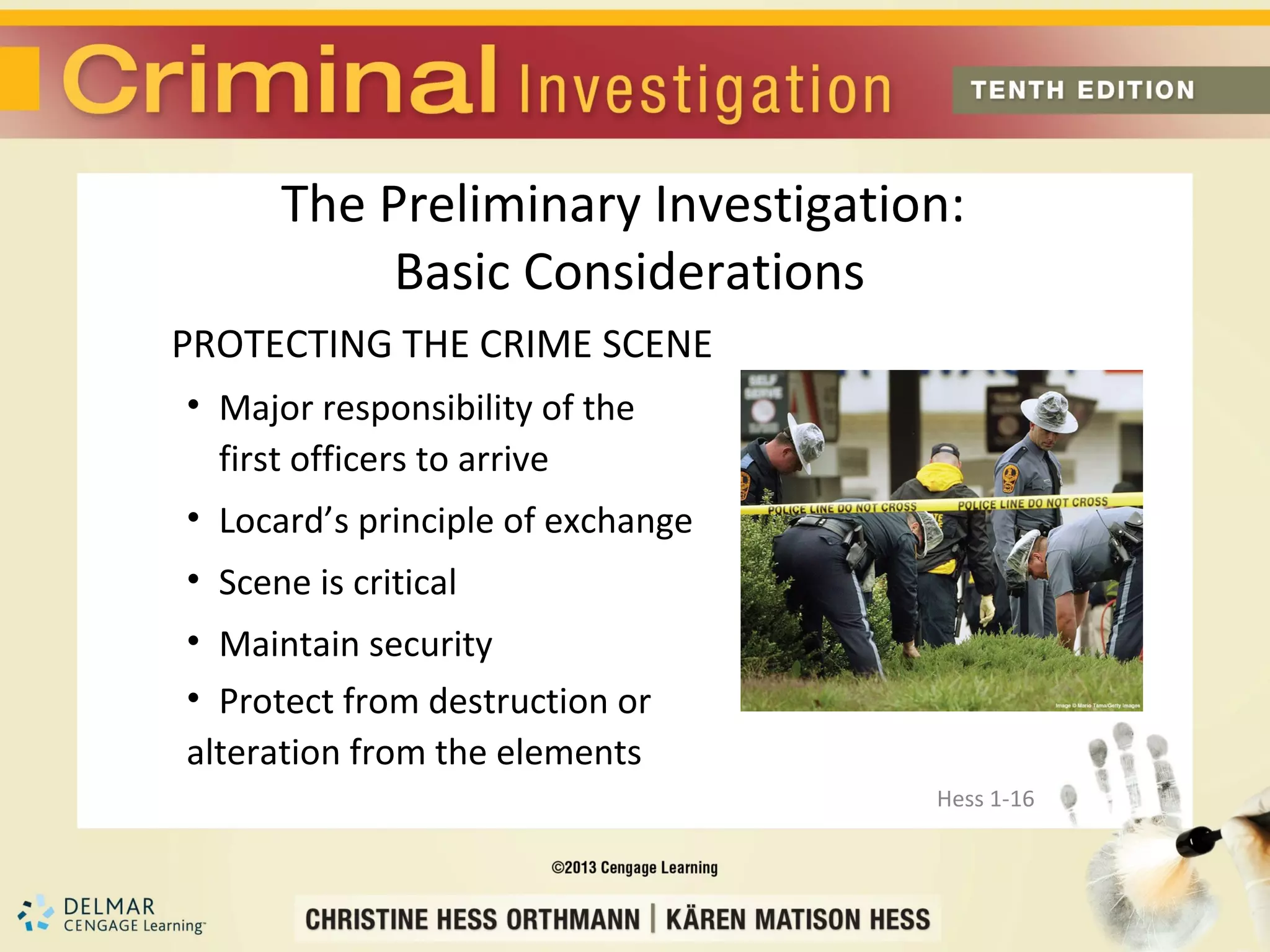
PROTECTING THE CRIME SCENE
• Major responsibility of the
  first officers to arrive
• Locard’s principle of exchange
• Scene is critical
• Maintain security
• Protect from destruction or
alteration from the elements
                                   Hess 1-16
The Preliminary Investigation:
          Basic Considerations
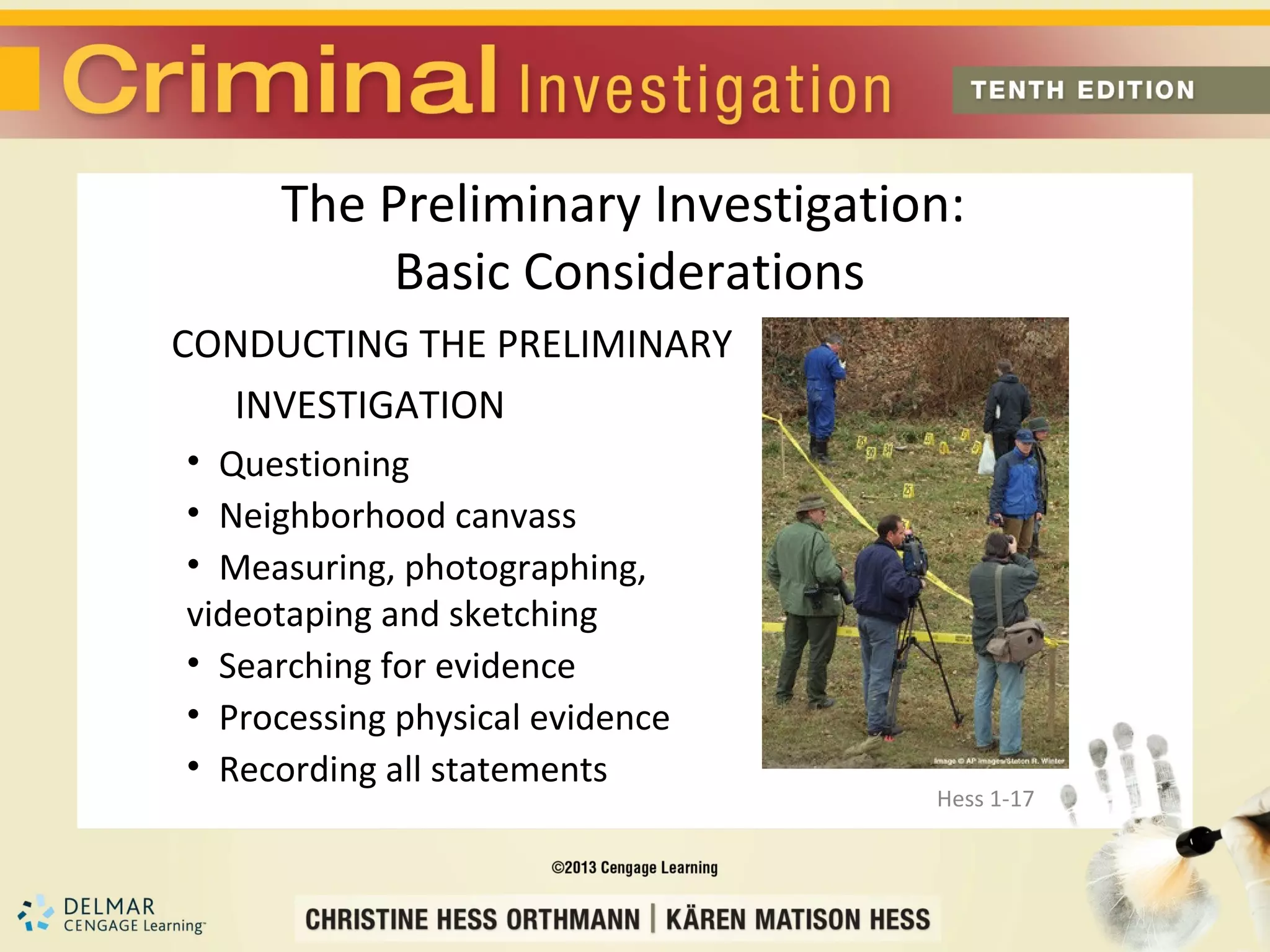
CONDUCTING THE PRELIMINARY
  INVESTIGATION
• Questioning
• Neighborhood canvass
• Measuring, photographing,
videotaping and sketching
• Searching for evidence
• Processing physical evidence
• Recording all statements
                                 Hess 1-17
Crime Scene Investigators
SCIENTIFIC SPECIALIST
• Specialist in organized scientific collection and
  processing of evidence
• Processes and packages all physical evidence
• Attends and documents autopsies
• Writes reports and testifies in court
• Crime scene technology degree

                                                  Hess 1-18
The Follow-Up Investigation
FACTORS FOR FOLLOW-UP
• Many cases require a follow-up investigation
• Factors exist that are beyond the officers’ control
• Weather can destroy evidence
• Witnesses can be uncooperative
• Follow-up phase builds on what was learned


                                                 Hess 1-19
Computer-Aided Investigation
CRIME ANALYSIS, MAPPING AND GEOGRAPHICAL
   INFORMATION SYSTEMS
• Crime mapping and hot spots
DATA MINING
• Sifting through information
• Helps narrow the field of possible suspects


                                                Hess 1-20
Problem-Oriented Policing
DEPARTMENT-WIDE STRATEGY
• Aimed at solving persistent community problems
• Identify, analyze and respond
• Used in criminal investigations in many ways
• Combining problem-oriented strategies with traditional
  investigative techniques


                                                 Hess 1-21
Investigative Productivity
PRODUCTIVITY
• Interest in the police field for some time
• All jobs have some standard of productivity
• Traditional evaluation
    
        Number of cases assigned
    
        Type of case assigned
• Continuous evaluation

                                                Hess 1-22
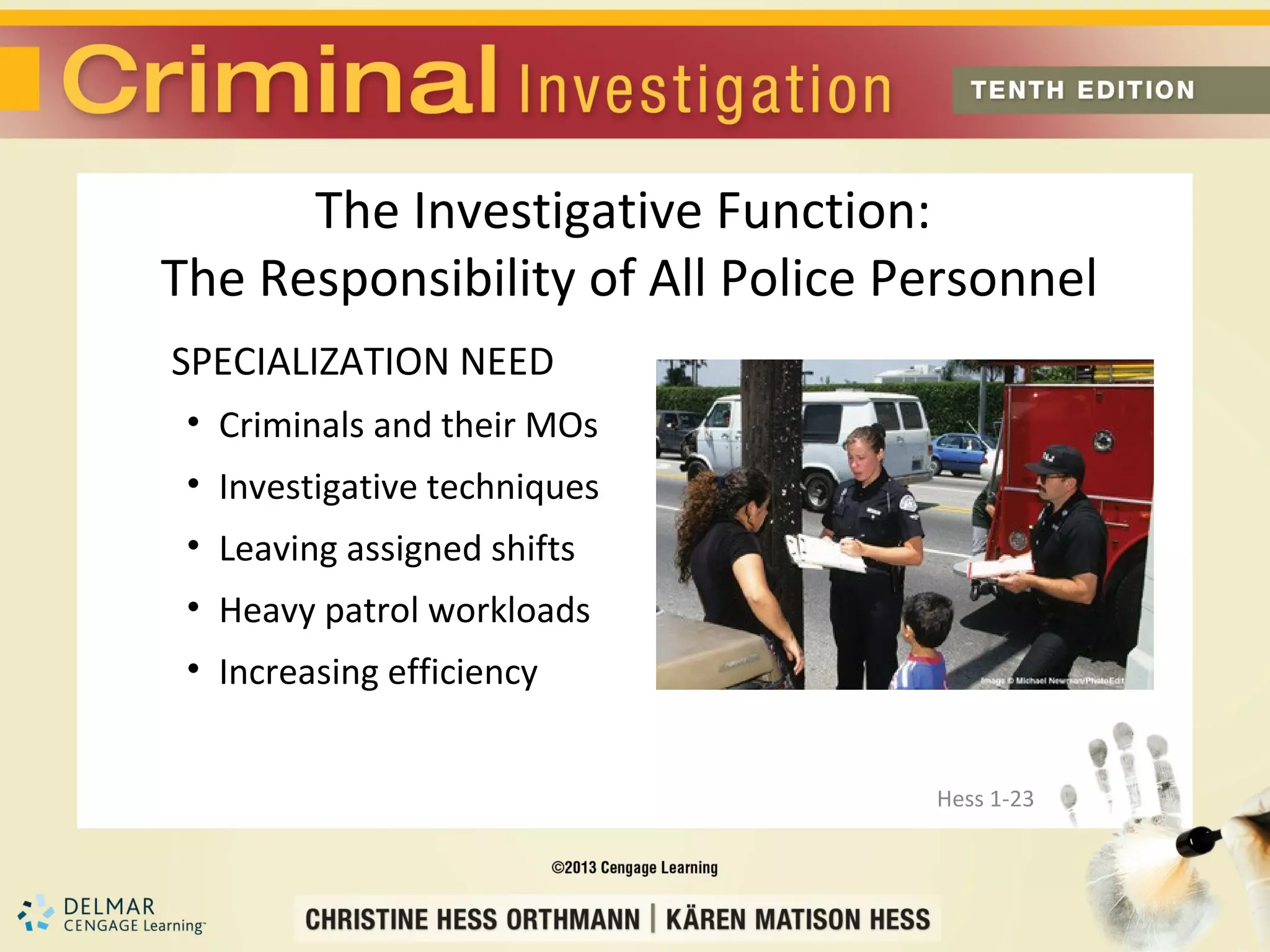
The Investigative Function:
The Responsibility of All Police Personnel
SPECIALIZATION NEED
 • Criminals and their MOs
 • Investigative techniques
 • Leaving assigned shifts
 • Heavy patrol workloads
 • Increasing efficiency


                                  Hess 1-23
Interrelationships with Others—
          Community Policing
COMMUNITY POLICING RELATIONSHIPS
• Uniformed patrol, dispatchers, prosecutors
• Physicians, coroners and medical examiners
• Forensic crime laboratories
• Citizens, victims, witnesses, media


                                               Hess 1-24
Major-Case Task Forces
COMBINED TASK FORCES
• Necessary for many crimes involving drugs, gangs and
  terrorism
• Multidisciplinary approach
• Multijurisdictional investigation
• Metro crime teams
• Special investigation units

                                              Hess 1-25
Law Enforcement Resources
FEDERAL LAW ENFORCEMENT
• Numerous resources
• Aid local and state agencies
INTERPOL
• International Criminal Police Organization
• Computerized database is available to law enforcement
  agencies worldwide

                                               Hess 1-26
Avoiding Civil Liability
CIVIL LIABILITY
• Effective policies and procedures clearly
  communicated to all
• Thorough and continuous training
• Proper supervision and discipline
• Accurate, thorough police reports


                                              Hess 1-27
Summary
• Determine whether a crime has been committed
• Legally obtain sufficient information and evidence
• Locate and arrest the suspect
• Recover stolen property
• Present the best possible case to the prosecutor
• Cooperation and coordination of efforts are also
  required outside the police department
• Criminal investigation is, indeed, a mutual effort

                                              Hess 1-28

Chapter 01

  • 1.
  • 2.
    Introduction • An observantpolice officer can initiate an important criminal investigation • Criminal investigation combines art and science • Requires extraordinary preparation and training • High-tech society • Citizens expect results more quickly • Investigators need to step up their technology and teamwork skills Hess 1-2
  • 3.
    A Brief Historyof Criminal Investigation HISTORICAL SIGNIFICANCE • Bow Street Runners • Vidocq Society • Scotland Yard • Pinkerton National Detective Agency • Major advances in criminal investigation Hess 1-3
  • 4.
    Criminal Investigation Definitions KEYDEFINITIONS • Investigate  Derived from Latin, vestigare, meaning to track or trace • Criminal investigation  Discovering, collecting, preparing, identifying and presenting evidence • Deductive reasoning  Logical process; conclusion follows from specific facts Hess 1-4
  • 5.
    Other Terms Defined SPECIFICTERMS • Criminalist • Forensic science • Crime • Felony • Misdemeanor Continued Hess 1-5
  • 6.
    Other Terms Defined(Continued) SPECIFIC TERMS • Criminal statute • Ordinance • Elements of the crime • Criminal intent • Modus operandi, or MO Hess 1-6
  • 7.
    Goals of CriminalInvestigations SUCCESSFUL INVESTIGATIONS • Determine whether a crime has been committed • Legally obtain information and evidence to identify the responsible person • Arrest the suspect • Recover stolen property • Present the best possible case to the prosecutor Hess 1-7
  • 8.
    Basic Functions ofInvestigators INVESTIGATOR FUNCTIONS • Provide emergency assistance • Secure the crime scene • Photograph, videotape and sketch • Take notes and write reports • Search for, obtain and process physical evidence Continued Hess 1-8
  • 9.
    Basic Functions ofInvestigators (Continued) INVESTIGATOR FUNCTIONS • Obtain information from witnesses and suspects • Identify suspects • Conduct raids, surveillances, stakeouts and undercover assignments • Testify in court Hess 1-9
  • 10.
    Characteristics of anEffective Investigator SPECIFIC CHARACTER TRAITS • Intellectual • Psychological • Physical Hess 1-10
  • 11.
    An Overview ofthe Investigative Process INVESTIGATIVE PROCESS • Usually initiated by personal observation or information from a citizen • Starts with a direction to proceed to a scene • Department policy defines who responds • Department policy defines duties of individuals Hess 1-11
  • 12.
    The Preliminary Investigation: Basic Considerations THE INITIAL RESPONSE • Suspect may still be at or near the scene • Injured persons may need emergency care • Witnesses may still be at the scene • Dying person may have confession/information • Weather may change/destroy evidence • Crime scene may be altered Hess 1-12
  • 13.
    The Preliminary Investigation: Basic Considerations POINT OF ARRIVAL • Scene may be either utter confusion or deserted SETTING PRIORITIES • Handle emergencies first • Secure the scene • Investigate Hess 1-13
  • 14.
    The Preliminary Investigation: Basic Considerations HANDLING EMERGENCY SITUATIONS • Sometimes emergencies dictate procedure • Emergency situations causes the adrenaline to flow SUSPECT AT OR NEAR THE SCENE • Policy determines interrogations • Miranda warning Hess 1-14
  • 15.
    The Preliminary Investigation: Basic Considerations PERSON IS SERIOUSLY INJURED • Emergency first aid • Call for medical assistance • Accompany suspects to hospital DEAD BODY AT SCENE • Leave the body as found • Preserve the scene Hess 1-15
  • 16.
    The Preliminary Investigation: Basic Considerations PROTECTING THE CRIME SCENE • Major responsibility of the first officers to arrive • Locard’s principle of exchange • Scene is critical • Maintain security • Protect from destruction or alteration from the elements Hess 1-16
  • 17.
    The Preliminary Investigation: Basic Considerations CONDUCTING THE PRELIMINARY INVESTIGATION • Questioning • Neighborhood canvass • Measuring, photographing, videotaping and sketching • Searching for evidence • Processing physical evidence • Recording all statements Hess 1-17
  • 18.
    Crime Scene Investigators SCIENTIFICSPECIALIST • Specialist in organized scientific collection and processing of evidence • Processes and packages all physical evidence • Attends and documents autopsies • Writes reports and testifies in court • Crime scene technology degree Hess 1-18
  • 19.
    The Follow-Up Investigation FACTORSFOR FOLLOW-UP • Many cases require a follow-up investigation • Factors exist that are beyond the officers’ control • Weather can destroy evidence • Witnesses can be uncooperative • Follow-up phase builds on what was learned Hess 1-19
  • 20.
    Computer-Aided Investigation CRIME ANALYSIS,MAPPING AND GEOGRAPHICAL INFORMATION SYSTEMS • Crime mapping and hot spots DATA MINING • Sifting through information • Helps narrow the field of possible suspects Hess 1-20
  • 21.
    Problem-Oriented Policing DEPARTMENT-WIDE STRATEGY •Aimed at solving persistent community problems • Identify, analyze and respond • Used in criminal investigations in many ways • Combining problem-oriented strategies with traditional investigative techniques Hess 1-21
  • 22.
    Investigative Productivity PRODUCTIVITY • Interestin the police field for some time • All jobs have some standard of productivity • Traditional evaluation  Number of cases assigned  Type of case assigned • Continuous evaluation Hess 1-22
  • 23.
    The Investigative Function: TheResponsibility of All Police Personnel SPECIALIZATION NEED • Criminals and their MOs • Investigative techniques • Leaving assigned shifts • Heavy patrol workloads • Increasing efficiency Hess 1-23
  • 24.
    Interrelationships with Others— Community Policing COMMUNITY POLICING RELATIONSHIPS • Uniformed patrol, dispatchers, prosecutors • Physicians, coroners and medical examiners • Forensic crime laboratories • Citizens, victims, witnesses, media Hess 1-24
  • 25.
    Major-Case Task Forces COMBINEDTASK FORCES • Necessary for many crimes involving drugs, gangs and terrorism • Multidisciplinary approach • Multijurisdictional investigation • Metro crime teams • Special investigation units Hess 1-25
  • 26.
    Law Enforcement Resources FEDERALLAW ENFORCEMENT • Numerous resources • Aid local and state agencies INTERPOL • International Criminal Police Organization • Computerized database is available to law enforcement agencies worldwide Hess 1-26
  • 27.
    Avoiding Civil Liability CIVILLIABILITY • Effective policies and procedures clearly communicated to all • Thorough and continuous training • Proper supervision and discipline • Accurate, thorough police reports Hess 1-27
  • 28.
    Summary • Determine whethera crime has been committed • Legally obtain sufficient information and evidence • Locate and arrest the suspect • Recover stolen property • Present the best possible case to the prosecutor • Cooperation and coordination of efforts are also required outside the police department • Criminal investigation is, indeed, a mutual effort Hess 1-28