Prestige Institute of Management
& Research
Consumer Credit
Submitted by:
Vaishnavi Pathak
MBA (FT)
Sec. –G
1121209178
Consumer Credit
 Consumer credit can be defined as "money, goods or
services provided to an individual in the absence of
immediate payment".
The cost of credit is the additional amount, over and
above the amount borrowed, that the borrower has to
pay. It includes interest, arrangement fees and any
other charges.
Example:
 Credit cards.
 Store cards.
 Personal loans.
 Motor vehicle finance.
 Retail loans.
Types :
 Installment Closed-end Credit : It is a type of
consumer credit where only a specified amount of
money is lent to the consumer, typically the total
purchase price of the good. Commonly used in
department stores & dealers. Ex.-car loans,
mortgages, and student loans
 Revolving Open-end Credit : In this kind of credit
the lender extends credit for use by the consumer,
with an outside limit that depends on the debtor's
credit history and ability to handle the debt
repayment. Ex.- Credit cards
Credit cards
 Defined as “a small plastic card issued by a bank ,
business, etc., allowing the holder to purchase
goods or services on credit.”
 It allows the cardholder to pay for goods and
services based on the holder’s promise to pay for
them.
 The issuer of the card creates a revolving account
and grants a line of credit to the consumer (or the
user)from which the user can borrow money for
payment to a merchant or as a cash advance to the
user.
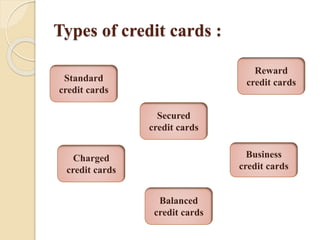
Types of credit cards :
Secured
credit cards
Standard
credit cards
Charged
credit cards
Balanced
credit cards
Business
credit cards
Reward
credit cards
Standard Credit Card :
 Also called “plain-vanilla” credit cards because they offer
no frills or rewards.
 The standard credit card allows you to have a revolving
balance up to a certain credit limit.
 Credit is used up when you make a purchase and made
available again once you've made a payment.
A finance charge is applied to outstanding balances at the
end of each month.
 Credit cards have a minimum payment that must be paid
by a certain due date to avoid late-payment penalties.
Balanced Credit Card: Many credit cards come with
the ability to transfer balances, a balance transfer credit
card is one that offers a low introductory rate on balance
transfers for a period of time.
Rewards Credit Cards: As the name indicates,
rewards cards are those that offer rewards on credit
card purchases. Three basic types of rewards cards:
 Cash back
 Points
 Travel
Charge Cards : Do not have a preset spending limit and
balances must be paid in full at the end of each month.
Charge cards typically do not have a finance charge or
minimum payment since the balance is to be paid in full .
Late payments are subject to a fee, charge restrictions, or
card cancellation depending on your card agreement.
Secured Credit Cards: An option for people who don't
have a credit history or who have damaged credit. Secured
cards require a security deposit to be placed on the card. The
credit limit on a secured credit card is typically equal to the
deposit made on the card, but it could be more in some cases.
You're still expected to make monthly payments on your
secured credit card balance.
Business Credit Cards : Designed specifically for
business use. They provide business owners with an easy
method of keeping business and personal transactions
separate.
Debit Cards
 Defined as “A card issued by a bank allowing the
holder to transfer money electronically to another bank
account when making a purchase.”
 A debit card is a plastic payment card that provides the
cardholder electronics access to their bank account at
financial institution.
 Debit cards usually also allow for instant withdrawal
of cash, acting as the ATM card for withdrawing cash.
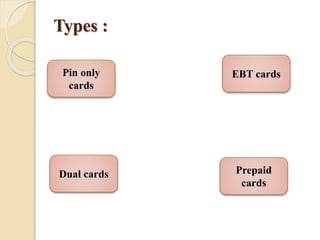
Types :
Pin only
cards
Dual cards Prepaid
cards
EBT cards
PIN-only cards
PIN-only debit cards are linked to your bank or credit
union account. You can use a PIN-only card to get cash
from an ATM, make deposits, transfer funds between
accounts, buy goods or services from retailer and pay
certain bills online or by phone.
Dual – use cards
Dual-use debit cards are both signature- and PIN-
enabled, and are tied directly to your financial institution
account.
Prepaid Cards
Prepaid cards are not associated with any specific account,
but instead provide access to funds deposited directly on
the card by you or a third party – like a store, friend or
family member. When you make a purchase with a prepaid
card, funds are taken directly from the actual balance on the
card.
EBT cards
Electronic Benefits Transfer (EBT) cards are provided by
many state or federal government agencies to people who
qualify for cash payments, food stamps or other benefits.
Categories :
 Visa debit card: These are issued with bank’s tie up
with VISA payment services providing the Verified by Visa
platform for online.
 Master card: It gives customers access to their funds
worldwide.
 Maestro card: It is easily identified by the signature
logo on all partner cards ,helps the customer gain immediate
access to money.
 RuPay card : Introduced as a domestic card scheme by
the NPCI. Facilitates online purchases & transactions.
Thank you 

Consumer credit

  • 1.
    Prestige Institute ofManagement & Research Consumer Credit Submitted by: Vaishnavi Pathak MBA (FT) Sec. –G 1121209178
  • 2.
    Consumer Credit  Consumercredit can be defined as "money, goods or services provided to an individual in the absence of immediate payment". The cost of credit is the additional amount, over and above the amount borrowed, that the borrower has to pay. It includes interest, arrangement fees and any other charges.
  • 3.
    Example:  Credit cards. Store cards.  Personal loans.  Motor vehicle finance.  Retail loans.
  • 4.
    Types :  InstallmentClosed-end Credit : It is a type of consumer credit where only a specified amount of money is lent to the consumer, typically the total purchase price of the good. Commonly used in department stores & dealers. Ex.-car loans, mortgages, and student loans  Revolving Open-end Credit : In this kind of credit the lender extends credit for use by the consumer, with an outside limit that depends on the debtor's credit history and ability to handle the debt repayment. Ex.- Credit cards
  • 5.
    Credit cards  Definedas “a small plastic card issued by a bank , business, etc., allowing the holder to purchase goods or services on credit.”  It allows the cardholder to pay for goods and services based on the holder’s promise to pay for them.  The issuer of the card creates a revolving account and grants a line of credit to the consumer (or the user)from which the user can borrow money for payment to a merchant or as a cash advance to the user.
  • 6.
    Types of creditcards : Secured credit cards Standard credit cards Charged credit cards Balanced credit cards Business credit cards Reward credit cards
  • 7.
    Standard Credit Card:  Also called “plain-vanilla” credit cards because they offer no frills or rewards.  The standard credit card allows you to have a revolving balance up to a certain credit limit.  Credit is used up when you make a purchase and made available again once you've made a payment. A finance charge is applied to outstanding balances at the end of each month.  Credit cards have a minimum payment that must be paid by a certain due date to avoid late-payment penalties.
  • 8.
    Balanced Credit Card:Many credit cards come with the ability to transfer balances, a balance transfer credit card is one that offers a low introductory rate on balance transfers for a period of time. Rewards Credit Cards: As the name indicates, rewards cards are those that offer rewards on credit card purchases. Three basic types of rewards cards:  Cash back  Points  Travel
  • 9.
    Charge Cards :Do not have a preset spending limit and balances must be paid in full at the end of each month. Charge cards typically do not have a finance charge or minimum payment since the balance is to be paid in full . Late payments are subject to a fee, charge restrictions, or card cancellation depending on your card agreement. Secured Credit Cards: An option for people who don't have a credit history or who have damaged credit. Secured cards require a security deposit to be placed on the card. The credit limit on a secured credit card is typically equal to the deposit made on the card, but it could be more in some cases. You're still expected to make monthly payments on your secured credit card balance.
  • 10.
    Business Credit Cards: Designed specifically for business use. They provide business owners with an easy method of keeping business and personal transactions separate.
  • 11.
    Debit Cards  Definedas “A card issued by a bank allowing the holder to transfer money electronically to another bank account when making a purchase.”  A debit card is a plastic payment card that provides the cardholder electronics access to their bank account at financial institution.  Debit cards usually also allow for instant withdrawal of cash, acting as the ATM card for withdrawing cash.
  • 12.
    Types : Pin only cards Dualcards Prepaid cards EBT cards
  • 13.
    PIN-only cards PIN-only debitcards are linked to your bank or credit union account. You can use a PIN-only card to get cash from an ATM, make deposits, transfer funds between accounts, buy goods or services from retailer and pay certain bills online or by phone. Dual – use cards Dual-use debit cards are both signature- and PIN- enabled, and are tied directly to your financial institution account.
  • 14.
    Prepaid Cards Prepaid cardsare not associated with any specific account, but instead provide access to funds deposited directly on the card by you or a third party – like a store, friend or family member. When you make a purchase with a prepaid card, funds are taken directly from the actual balance on the card. EBT cards Electronic Benefits Transfer (EBT) cards are provided by many state or federal government agencies to people who qualify for cash payments, food stamps or other benefits.
  • 15.
    Categories :  Visadebit card: These are issued with bank’s tie up with VISA payment services providing the Verified by Visa platform for online.  Master card: It gives customers access to their funds worldwide.  Maestro card: It is easily identified by the signature logo on all partner cards ,helps the customer gain immediate access to money.  RuPay card : Introduced as a domestic card scheme by the NPCI. Facilitates online purchases & transactions.
  • 16.