Creativity + Innovation
Kevin Popović, B.A., M.S.
© Kevin Popović, SDSU Creativity + Innovation
CourseKey
© Kevin Popović, SDSU Creativity + Innovation
Please check-in: dfwt30
Session 1.6
• Welcome
• Roll, Admin
• Game
• Quiz
© Kevin Popović, SDSU Creativity + Innovation
• Shameless Plug
• Discuss Chapter
• Assignments
• Mid-Term
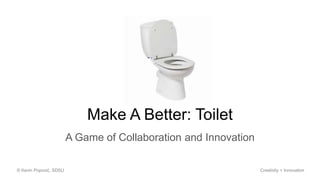
Make A Better: Toilet
A Game of Collaboration and Innovation
© Kevin Popović, SDSU Creativity + Innovation
The Problem Statement
• Design the next generation toilet that you can, BUT:
• Required: it fits in current spaces provided for toilets
• Required: it can be used by children and seniors
• Required: it is affordable to the general public
© Kevin Popović, SDSU Creativity + Innovation
Develop A Prototype
Prototypes are vehicles for communicating with and learning
from others
• Sketch, storyboard, prototype – use whatever works to
tell the story
• Give us a 'feel' for what the product would be like
(overview)
• Show us how we would use the product
• Show us how you’ve addressed the requirements
© Kevin Popović, SDSU Creativity + Innovation
Make A Better: Toilet
A Game of Evaluation
© Kevin Popović, SDSU Creativity + Innovation
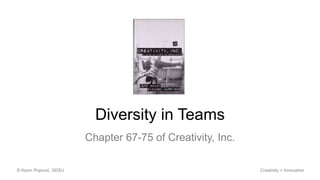
Chapter 67-75 of Creativity, Inc.
© Kevin Popović, SDSU Creativity + Innovation
Diversity in Teams
Promote Diversity
• Define “Diversity”
• Diversity brings breadth of perspective to the tasks
identifying and criticizing age-old assumptions and
recognizing new possibilities.
• Bringing together diverse elements
• Diversity just to be different is not what we’re going after
• What are we going after?
© Kevin Popović, SDSU Creativity + Innovation
Diversity in Groups
• When groups are purposefully constructed to
include diverse perspectives, the groups gain in
terms of the number and variety of angles from
which a problem can be assessed.
• The productive conflict in the group will have a
range and richness that enhance the idea the group
generates.
© Kevin Popović, SDSU Creativity + Innovation
Type of Creative Thinkers
• The good idea people who look at a problem and
return with a solution.
• The reflective people who see connections and
understand how work on one problem can apply to
another.
• The people who can conceptualize entire systems
and words in their head.
• All types are required for success.
© Kevin Popović, SDSU Creativity + Innovation
Fostering Diverse Intelligence
• People with diverse expertise can be
assembled for a single project (stack the deck)
• To staff diverse groups, a company must have a
diversity of employees and types of thinking.
© Kevin Popović, SDSU Creativity + Innovation
Fostering Diverse Intelligence
• One company employees full-time staff artists in
all phases of a business – why?
• The traditional education system rewards
compliance, not innovation. Why?
© Kevin Popović, SDSU Creativity + Innovation
Fostering Diverse Intelligence
• Breaking the rules is how you get smarter, and
this is (usually) not encouraged by educators –
why?
• Training can enable business people to
challenge what they have been taught,
welcomes new ideas, and challenges them to
think about their own thinking.
© Kevin Popović, SDSU Creativity + Innovation
Diversity at the Leadership Level
Without diversity of thinking and perspective in its
leaders (i.e., you) a company (yours) is less likely to:
• identify creative employees
• embrace the conflict inherent in breaking and
making connections
• lack the vision needed to make the best use of the
creativity they have
© Kevin Popović, SDSU Creativity + Innovation
Diversity at the Leadership Level
• Leadership is predominantly:
• Sensing, judging types
• No adventurers, a few inventors
• Making judgments based on culture
• Not diverse
© Kevin Popović, SDSU Creativity + Innovation
Diversity at the Leadership Level
• “We promote people who act like us.”
• “We build companies of people who are most
like us.”
• Diversity committed to serving the company will
result in creative, functional harmony
© Kevin Popović, SDSU Creativity + Innovation
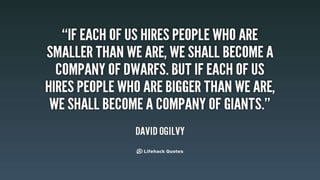
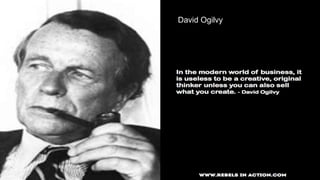
David OgilvyDavid Ogilvy
Organize for Intrinsic Motivation
• Groups, like individuals, perform more
creatively when intrinsically motivated.
• Coalitions
• Teams
© Kevin Popović, SDSU Creativity + Innovation
Coalitions
• When people voluntarily organize themselves to
solve a problem or realize a new idea they are
making a coalition.
• Each member brings their unique energy,
enthusiasm and creativity to the task.
© Kevin Popović, SDSU Creativity + Innovation
Coalitions
• Participating in this formation, pursuing its goal
not because of assignment but from their own
volition.
• Members posses a degree of motivation that is
rarely matched.
© Kevin Popović, SDSU Creativity + Innovation
Teams
• Companies for teams when they want to tackle
a problem or search for opportunities.
• Resources are assigned, reporting procedures
established, team members chosen for their
strengths and availability.
© Kevin Popović, SDSU Creativity + Innovation
Teams
• Each person has a role and works towards the
project goal.
• Formalized relationships can hamper flexibility:
poor fits in talent or style may be hard to
correct; members may join without intrinsic
motivation.
© Kevin Popović, SDSU Creativity + Innovation
Harvard Business Review
© Kevin Popović, SDSU Creativity + Innovation
Quiz: Medici String Quartet
Harvard Business Review
© Kevin Popović, SDSU Creativity + Innovation
Medici String Quartet
Assignment
© Kevin Popović, SDSU Creativity + Innovation
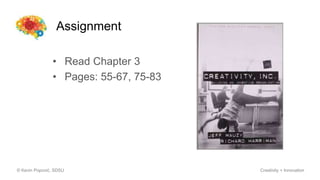
• Read Chapter 3
• Pages: 55-67, 75-83
Assignment
© Kevin Popović, SDSU Creativity + Innovation
• Read “Managing
Creativity at Shanghai
Tang”
• Available in the reader
• Prepare for Quiz

Creativity & Innovation - Week 6

  • 1.
    Creativity + Innovation KevinPopović, B.A., M.S. © Kevin Popović, SDSU Creativity + Innovation
  • 2.
    CourseKey © Kevin Popović,SDSU Creativity + Innovation Please check-in: dfwt30
  • 3.
    Session 1.6 • Welcome •Roll, Admin • Game • Quiz © Kevin Popović, SDSU Creativity + Innovation • Shameless Plug • Discuss Chapter • Assignments • Mid-Term
  • 4.
    Make A Better:Toilet A Game of Collaboration and Innovation © Kevin Popović, SDSU Creativity + Innovation
  • 5.
    The Problem Statement •Design the next generation toilet that you can, BUT: • Required: it fits in current spaces provided for toilets • Required: it can be used by children and seniors • Required: it is affordable to the general public © Kevin Popović, SDSU Creativity + Innovation
  • 6.
    Develop A Prototype Prototypesare vehicles for communicating with and learning from others • Sketch, storyboard, prototype – use whatever works to tell the story • Give us a 'feel' for what the product would be like (overview) • Show us how we would use the product • Show us how you’ve addressed the requirements © Kevin Popović, SDSU Creativity + Innovation
  • 7.
    Make A Better:Toilet A Game of Evaluation © Kevin Popović, SDSU Creativity + Innovation
  • 8.
    Chapter 67-75 ofCreativity, Inc. © Kevin Popović, SDSU Creativity + Innovation Diversity in Teams
  • 9.
    Promote Diversity • Define“Diversity” • Diversity brings breadth of perspective to the tasks identifying and criticizing age-old assumptions and recognizing new possibilities. • Bringing together diverse elements • Diversity just to be different is not what we’re going after • What are we going after? © Kevin Popović, SDSU Creativity + Innovation
  • 10.
    Diversity in Groups •When groups are purposefully constructed to include diverse perspectives, the groups gain in terms of the number and variety of angles from which a problem can be assessed. • The productive conflict in the group will have a range and richness that enhance the idea the group generates. © Kevin Popović, SDSU Creativity + Innovation
  • 11.
    Type of CreativeThinkers • The good idea people who look at a problem and return with a solution. • The reflective people who see connections and understand how work on one problem can apply to another. • The people who can conceptualize entire systems and words in their head. • All types are required for success. © Kevin Popović, SDSU Creativity + Innovation
  • 12.
    Fostering Diverse Intelligence •People with diverse expertise can be assembled for a single project (stack the deck) • To staff diverse groups, a company must have a diversity of employees and types of thinking. © Kevin Popović, SDSU Creativity + Innovation
  • 13.
    Fostering Diverse Intelligence •One company employees full-time staff artists in all phases of a business – why? • The traditional education system rewards compliance, not innovation. Why? © Kevin Popović, SDSU Creativity + Innovation
  • 14.
    Fostering Diverse Intelligence •Breaking the rules is how you get smarter, and this is (usually) not encouraged by educators – why? • Training can enable business people to challenge what they have been taught, welcomes new ideas, and challenges them to think about their own thinking. © Kevin Popović, SDSU Creativity + Innovation
  • 15.
    Diversity at theLeadership Level Without diversity of thinking and perspective in its leaders (i.e., you) a company (yours) is less likely to: • identify creative employees • embrace the conflict inherent in breaking and making connections • lack the vision needed to make the best use of the creativity they have © Kevin Popović, SDSU Creativity + Innovation
  • 16.
    Diversity at theLeadership Level • Leadership is predominantly: • Sensing, judging types • No adventurers, a few inventors • Making judgments based on culture • Not diverse © Kevin Popović, SDSU Creativity + Innovation
  • 17.
    Diversity at theLeadership Level • “We promote people who act like us.” • “We build companies of people who are most like us.” • Diversity committed to serving the company will result in creative, functional harmony © Kevin Popović, SDSU Creativity + Innovation
  • 19.
  • 20.
    Organize for IntrinsicMotivation • Groups, like individuals, perform more creatively when intrinsically motivated. • Coalitions • Teams © Kevin Popović, SDSU Creativity + Innovation
  • 21.
    Coalitions • When peoplevoluntarily organize themselves to solve a problem or realize a new idea they are making a coalition. • Each member brings their unique energy, enthusiasm and creativity to the task. © Kevin Popović, SDSU Creativity + Innovation
  • 22.
    Coalitions • Participating inthis formation, pursuing its goal not because of assignment but from their own volition. • Members posses a degree of motivation that is rarely matched. © Kevin Popović, SDSU Creativity + Innovation
  • 23.
    Teams • Companies forteams when they want to tackle a problem or search for opportunities. • Resources are assigned, reporting procedures established, team members chosen for their strengths and availability. © Kevin Popović, SDSU Creativity + Innovation
  • 24.
    Teams • Each personhas a role and works towards the project goal. • Formalized relationships can hamper flexibility: poor fits in talent or style may be hard to correct; members may join without intrinsic motivation. © Kevin Popović, SDSU Creativity + Innovation
  • 25.
    Harvard Business Review ©Kevin Popović, SDSU Creativity + Innovation Quiz: Medici String Quartet
  • 26.
    Harvard Business Review ©Kevin Popović, SDSU Creativity + Innovation Medici String Quartet
  • 27.
    Assignment © Kevin Popović,SDSU Creativity + Innovation • Read Chapter 3 • Pages: 55-67, 75-83
  • 28.
    Assignment © Kevin Popović,SDSU Creativity + Innovation • Read “Managing Creativity at Shanghai Tang” • Available in the reader • Prepare for Quiz

Editor's Notes

  • #2 Creativity and innovation are integral to an organization’s ability to survive and thrive in today’s competitive marketplace. This course provides students with an understanding of how creativity and innovation can be facilitated and managed in a work setting. Students will learn about theoretical conceptualizations of creativity and innovation as well as practical applications involved in fostering creativity and innovation in the workplace. Students will be expected to play an active role in learning through class exercises, class discussions, and dialogue with guest speakers, and presentations about real (or planned) innovations in organizations.
  • #5 Make A Better: Pen Break into a coalition of 5 Look for lead users – people who knows something of value Design a better Toilet based on Design Thinking Use what you have learned about working in a creative environment Draw a picture Present your concepts to the class Prepare to be evaluated and scored
  • #6 Design the next generation toilet that you can, BUT: Required: it fits in current spaces provided for toilets Required: it can be used by children and seniors Required: it is affordable to the general public
  • #7 Prototypes are vehicles for communicating with and learning from others Sketch, storyboard, prototype – use whatever works to tell the story Give us a 'feel' for what the product would be like (overview) Show us how we would use the product Show us how you’ve addressed the requirements
  • #8 Did they meet the design requirements: Required: it fits in current spaces provided for toilets Required: it can be used by children and seniors Required: it is affordable to the general public
  • #9 Required Text: Creativity, Inc.: Building an Inventive Organization by Jeff Mauzy and Richard Harriman, ISBN: 1-57851-207-7, Harvard Business School Press.
  • #10 Class Discussion: What type of diversity are we talking about? In your Make a Better Toilet project, what kind of diversity contributed to your concept?
  • #11 For example: technology, creative, strategy departments take part in every decision. Why? What does this look like? Class Discussion: Why? What does this look like? Explore how each department may have input, focus, requirements AND how they can be modified to accommodate for all / most.
  • #13 Class Discussion: When have you assembled a team for a specific reason? How did you stack the deck and how did it work out? Reference: Money Ball Movie Pssst: Many companies do not have this. Why not?
  • #14 Artists look at things in multiple ways. It gives you the ability to see beyond. Different is more work, hard. Same is measurable, consistency makes sure all get the same.
  • #15 Artists look at things in multiple ways. It gives you the ability to see beyond. Different is more work, hard. Same is measurable, consistency makes sure all get the same.
  • #16 FYI, leadership is (usually) the least diverse group in a company. Class Discussion: Why?
  • #26 https://hbr.org/product/paul-robertson-and-the-medici-string-quartet/an/607083-PDF-ENG
  • #27  https://hbr.org/product/paul-robertson-and-the-medici-string-quartet/an/607083-PDF-ENG Class Quiz: Team – Creative Collaborative in Teams
  • #28  https://hbr.org/product/paul-robertson-and-the-medici-string-quartet/an/607083-PDF-ENG Class Quiz: Team – Creative Collaborative in Teams
  • #29  https://hbr.org/product/paul-robertson-and-the-medici-string-quartet/an/607083-PDF-ENG Class Quiz: Team – Creative Collaborative in Teams